ILLUSTRATIONS. (continued 2)
Reading edition
Now about you: Keep the money you have earned by so many tears and sacrifices, and clothe yourself; for it makes me mad to know that my good little lass is going round in shabby things, and being looked down upon by people who are not worthy to touch her patched shoes or the hem of her ragged old gowns. Make yourself tidy, and if any is left over send it to Mother; for there are always many things needed at home, though they won't tell us. I only wish I too by any amount of weeping and homesickness could earn as much. But my mite won't come amiss; and if tears can add to its value, I've shed my quart,–first, over the book not coming out; for that was a sad blow, and I waited so long it was dreadful when my castle in the air came tumbling about my ears. Pride made me laugh in public; but I wailed in private, and no one knew it. The folks at home think I rather enjoyed it, for I wrote a jolly letter. But my visit was spoiled; and now I'm digging away for dear life, that I may not have come entirely in vain. I didn't mean to groan about it; but my lass and I must tell some one our trials, and so it becomes easy to confide in one another. I never let Mother know how unhappy you were in S. till Uncle wrote.
My doings are not much this week. I sent a little tale to the "Gazette," and Clapp asked H. W. if five dollars would be enough. Cousin H. said yes, and gave it to me, with kind words and a nice parcel of paper, saying in his funny way, "Now, Lu, the door is open, go in and win." So I shall try to do it. Then cousin L. W. said Mr. B. had got my play, and told her that if Mrs. B. liked it as well, it must be clever, and if it didn't cost too much, he would bring it out by and by. Say nothing about it yet. Dr. W. tells me Mr. F. is very sick; so the farce cannot be acted yet. But the Doctor is set on its coming out, and we have fun about it. H. W. takes me often to the theatre when L. is done with me. I read to her all the p.m. often, as she is poorly, and in that way I pay my debt to them.
I'm writing another story for Clapp. I want more fives, and mean to have them too.
Uncle wrote that you were Dr. W.'s pet teacher, and every one loved you dearly. But if you are not well, don't stay. Come home, and be cuddled by your old
Lu.
CHAPTER V.
AUTHORSHIP.
OUR ANGEL IN THE HOUSE.
Sitting patient in the shadow Till the blessed light shall come, A serene and saintly presence Sanctifies our troubled home. Earthly joys and hopes and sorrows Break like ripples on the strand Of the deep and solemn river, Where her willing feet now stand. O my sister, passing from me Out of human care and strife, Leave me as a gift those virtues Which have beautified your life. Dear, bequeath me that great patience Which has power to sustain A cheerful, uncomplaining spirit In its prison-house of pain. Give me–for I need it sorely– Of that courage, wise and sweet, Which has made the path of duty Green beneath your willing feet. Give me that unselfish nature That with charity divine Can pardon wrong for love's dear sake,– Meek heart, forgive me mine! Thus our parting daily loseth Something of its bitter pain, And while learning this hard lesson My great loss becomes my gain; For the touch of grief will render My wild nature more serene, Give to life new aspirations, A new trust in the unseen.
Henceforth safe across the river I shall see forevermore A beloved household spirit Waiting for me on the shore; Hope and faith, born of my sorrow, Guardian angels shall become; And the sister gone before me By their hands shall lead me home.
WHEN only twenty-two years old Miss Alcott began her career of authorship by launching a little flower bark, which floated gaily on the stream. She had always written poems, plays, and stories for her own and her friends' pleasure, and now she gathered up some tales she had written for Mr. Emerson's daughter, and published them under the name of "Flower Fables." She received the small amount of thirty-two dollars for the book; but it gave her the great satisfaction of having earned it by work that she loved, and which she could do well. She began to have applications for stories from the papers; but as yet sewing and teaching paid better than writing. While she sewed her brain was busy with plans of poems, plays, and tales, which she made use of at a later period.
The following letter to her mother shows how closely she associated her with this early success:–
20 Pinckney Street, Boston, Dec. 25, 1854. (With "Flower Fables,")
Dear Mother,–Into your Christmas stocking I have put my "first-born," knowing that you will accept it with all its faults (for grandmothers are always kind), and look upon it merely as an earnest of what I may yet do; for, with so much to cheer me on, I hope to pass in time from fairies and fables to men and realities.
Whatever beauty or poetry is to be found in my little book is owing to your interest in and encouragement of all my efforts from the first to the last; and if ever I do anything to be proud of, my greatest happiness will be that I can thank you for that, as I may do for all the good there is in me; and I shall be content to write if it gives you pleasure.
Jo is fussing about; My lamp is going out.
To dear mother, with many kind wishes for a happy New Year and merry Christmas.
I am ever your loving daughter
Louy.
This letter shows that she had already begun to see that she must study not only fairies and fancies, but men and realities; and she now began to observe life, not in books, but as it went on around her. In the intense excitement of the anti-slavery struggles of that period she might well learn how full of dramatic situations and the elements of both tragedy and comedy real human life is. She says: "I began to see the strong contrasts and fun and frolic in every day life about this time." She also considered her reading, and tried to make it more thorough and profitable; and she did not "waste even ink on poems and fancies," but planned stories, that everything might help toward her great object of earning support for her family.
In June, 1855, Miss Alcott went to Walpole, N. H., where she had a free life among the hills for a few months. It must have been a great refreshment to her after the winter's work in the city. In July the family followed her thither, and occupied a small house. The country life and joy soon began to find expression, and she wrote a little story called "King Goldenrod," which she says "ought to be fresh and true," as written at that beautiful time and place. But this pleasant country life was for a short season only; and in chill November she set out for the city, with brave heart and scanty outfit, to seek her fortune once more. While still continuing to sew as a means of livelihood, she began to try a great variety of literary ventures. She wrote notices of books for the papers, and at one time got five dollars for a story, besides twelve dollars for sewing. The following year the publishers began to find out the value of her work, and to call for more stories. Even her poems were accepted. Little Nell was then the favorite heroine of Dickens, and Louisa's poem on that subject was published in the "Courier." Although she at first enjoyed the beautiful scenery of Walpole, she found the dull little town did not offer her the opportunities for work that she needed; and leaving her family there, she came down to Boston to seek her fortune, and went to the well-known boarding-house of Mrs. David Reed on Chauncey Street. The happy home which she had here during the winter is represented as Mrs. Kirke's house in "Little Women," and Jo's garret is the sky-parlor in which she lived and wrote. She had a rich winter, hearing many of the finest lectures, and enjoying her free pass to the theatre. One of her greatest helps, however, was the friendship of Theodore Parker, who took great interest in her struggles, and wisely strengthened and encouraged her. She loved to go to his Sunday evening receptions, and sit quietly watching the varied company who collected there; and a word or pressure of the hand from her host was enough to cheer her for the whole week. She has gratefully recorded this influence in her sketch of Mr. Power in "Work;" but she has not given to that delineation the striking personality of her subject which we should have expected of her. She then perhaps looked up to him too much to take note of the rich elements of wit and humor in his nature, and has painted him wholly seriously, and with a colorless brush.
Journal.
Twenty-two Years Old.
Pinckney Street, Boston, Jan. 1, 1855.–The principal event of the winter is the appearance of my book "Flower Fables." An edition of sixteen hundred. It has sold very well, and people seem to like it. I feel quite proud that the little tales that I wrote for Ellen E. when I was sixteen should now bring money and fame.
I will put in some of the notices as "varieties." Mothers are always foolish over their first-born.
Miss Wealthy Stevens paid for the book, and I received $32.
[A pleasing contrast to the receipts of six months only in 1886, being $8000 for the sale of books, and no new one; but I was prouder over the $32 than the $8000.–L. M. A., 1886.]
April, 1855.–I am in the garret with my papers round me, and a pile of apples to eat while I write my journal, plan stories, and enjoy the patter of rain on the roof, in peace and quiet.
[Jo in the garret.–L. M. A.]
Being behindhand, as usual, I'll make note of the main events up to date, for I don't waste ink in poetry and pages of rubbish now. I've begun to live, and have no time for sentimental musing.
In October I began my school; Father talked, Mother looked after her boarders, and tried to help everybody. Anna was in Syracuse teaching Mrs. S––'s children.
My book came out; and people began to think that topsey-turvey Louisa would amount to something after all, since she could do so well as housemaid, teacher, seamstress, and story-teller. Perhaps she may.
In February I wrote a story for which C. paid $5, and asked for more.
In March I wrote a farce for W. Warren, and Dr. W. offered it to him; but W. W. was too busy.
Also began another tale, but found little time to work on it, with school, sewing, and house-work. My winter's earnings are,–
School, one quarter $50
Sewing $50
Stories $20
if I am ever paid.
A busy and a pleasant winter, because, though hard at times, I do seem to be getting on a little; and that encourages me.
Have heard Lowell and Hedge lecture, acted in plays, and thanks to our rag-money and good cousin H., have been to the theatre several times,–always my great joy.
Summer plans are yet unsettled. Father wants to go to England: not a wise idea, I think. We shall probably stay here, and A. and I go into the country as governesses. It's a queer way to live, but dramatic, and I rather like it; for we never know what is to come next. We are real "Micawbers," and always "ready for a spring."
I have planned another Christmas book, and hope to be able to write it.
1855.–Cousin L. W. asks me to pass the summer at Walpole with her. If I can get no teaching, I shall go; for I long for the hills, and can write my fairy tales there.
I delivered my burlesque lecture on "Woman, and Her Position; by Oronthy Bluggage," last evening at Deacon G.'s. Had a merry time, and was asked by Mr. W. to do it at H. for money. Read "Hamlet" at our club,–my favorite play. Saw Mrs. W. H. Smith about the farce; says she will do it at her benefit.
May.–Father went to C. to talk with Mr. Emerson about the England trip. I am to go to Walpole. I have made my own gowns, and had money enough to fit up the girls. So glad to be independent.
[I wonder if $40 fitted up the whole family. Perhaps so, as my wardrobe was made up of old clothes from cousins and friends.–L. M. A.]
Walpole, N. H., June, 1855.–Pleasant journey and a kind welcome. Lovely place, high among the hills. So glad to run and skip in the woods and up the splendid ravine. Shall write here, I know.
Helped cousin L. in her garden; and the smell of the fresh earth and the touch of green leaves did me good.
Mr. T. came and praised my first book, so I felt much inspired to go and do another. I remember him at Scituate years ago, when he was a young ship-builder and I a curly-haired hoyden of five or six.
Up at five, and had a lovely run in the ravine, seeing the woods wake. Planned a little tale which ought to be fresh and true, as it came at that hour and place,–"King Goldenrod." Have lively days,–writing in a.m., driving in p.m., and fun in eve. My visit is doing me much good.
July, 1855.–Read "Hyperion." On the 16th the family came to live in Mr. W.'s house rent free. No better plan offered, and we were all tired of the city. Here Father can have a garden; Mother can rest and be near her good niece; the children have freedom and fine air; and A. and I can go from here to our teaching, wherever it may be.
Busy and happy times as we settle in the little house in the lane near by my dear ravine,–plays, picnics, pleasant people, and good neighbors. Fanny Kemble came up, Mrs. Kirkland and others, and Dr. Bellows is the gayest of the gay. We acted the "Jacobite," "Rivals," and "Bonnycastles," to an audience of a hundred, and were noticed in the Boston papers. H. T. was our manager, and Dr. B., D. D., our dramatic director. Anna was the star, her acting being really very fine. I did "Mrs. Malaprop," "Widow Pottle," and the old ladies.
Finished fairy book in September. Anna had an offer from Dr. Wilbur of Syracuse to teach at the great idiot asylum. She disliked it, but decided to go. Poor dear! so beauty-loving, timid, and tender. It is a hard trial; but she is so self-sacrificing she tries to like it because it is duty.
October.–A. to Syracuse. May illustrated my book, and tales called "Christmas Elves." Better than "Flower Fables." Now I must try to sell it.
[Innocent Louisa, to think that a Christmas book could be sold in October.–L. M. A.]
November.–Decided to seek my fortune; so, with my little trunk of home-made clothes, $20 earned by stories sent to the "Gazette," and my MSS., I set forth with Mother's blessing one rainy day in the dullest month in the year.
[My birth-month; always to be a memorable one.–L. M. A.]
Found it too late to do anything with the book, so put it away and tried for teaching, sewing, or any honest work. Won't go home to sit idle while I have a head and pair of hands.
December.–H. and L. W. very kind, and my dear cousins the Sewalls take me in. I sew for Mollie and others, and write stories. C. gave me books to notice. Heard Thackeray. Anxious times; Anna very home-sick. Walpole very cold and dull now the summer butterflies have gone. Got $5 for a tale and $12 for sewing; sent home a Christmas-box to cheer the dear souls in the snow-banks.
January, 1856.–C. paid $6 for "A Sister's Trial," gave me more books to notice, and wants more tales.
[Should think he would at that price.–L. M. A.]
Sewed for L. W. Sewall and others. Mr. J. M. Field took my farce to Mobile to bring out; Mr. Barry of the Boston Theatre has the play.
Heard Curtis lecture. Began a book for summer,–"Beach Bubbles." Mr. F. of the "Courier" printed a poem of mine on "Little Nell." Got $10 for "Bertha," and saw great yellow placards stuck up announcing it. Acted at the W.'s.
March.–Got $10 for "Genevieve." Prices go up, as people like the tales and ask who wrote them. Finished "Twelve Bubbles." Sewed a great deal, and got very tired; one job for Mr. G. of a dozen pillow-cases, one dozen sheets, six fine cambric neckties, and two dozen handkerchiefs, at which I had to work all one night to get them done, as they were a gift to him. I got only $4.
Sewing won't make my fortune; but I can plan my stories while I work, and then scribble 'em down on Sundays.
Poem on "Little Paul;" Curtis's lecture on "Dickens" made it go well. Hear Emerson on "England."
May.–Anna came on her way home, sick and worn out; the work was too much for her. We had some happy days visiting about. Could not dispose of B. B. in book form, but C. took them for his paper. Mr. Field died, so the farce fell through there. Altered the play for Mrs. Barrow to bring out next winter.
June, 1856.–Home, to find dear Betty very ill with scarlet-fever caught from some poor children Mother nursed when they fell sick, living over a cellar where pigs had been kept. The landlord (a deacon) would not clean the place till Mother threatened to sue him for allowing a nuisance. Too late to save two of the poor babies or Lizzie and May from the fever.
[L. never recovered, but died of it two years later.–L. M. A.]
An anxious time. I nursed, did house-work, and wrote a story a month through the summer.
Dr. Bellows and Father had Sunday eve conversations.
October.–Pleasant letters from Father, who went on a tour to N. Y., Philadelphia, and Boston.
Made plans to go to Boston for the winter, as there is nothing to do here, and there I can support myself and help the family. C. offers 10 dollars a month, and perhaps more. L. W., M. S., and others, have plenty of sewing; the play may come out, and Mrs. R. will give me a sky-parlor for $3 a week, with fire and board. I sew for her also.
If I can get A. L. to governess I shall be all right.
I was born with a boy's spirit under my bib and tucker. I can't wait when I can work; so I took my little talent in my hand and forced the world again, braver than before and wiser for my failures.
[Jo in N. Y.–L. M. A.]
I don't often pray in words; but when I set out that day with all my worldly goods in the little old trunk, my own earnings ($25) in my pocket, and much hope and resolution in my soul, my heart was very full, and I said to the Lord, "Help us all, and keep us for one another," as I never said it before, while I looked back at the dear faces watching me, so full of love and hope and faith.
Journal.
Boston, November, 1856. Mrs. David Reed's.–I find my little room up in the attic very cosey, and a house full of boarders very amusing to study. Mrs. Reed very kind. Fly round and take C. his stories. Go to see Mrs. L. about A. Don't want me. A blow, but I cheer up and hunt for sewing. Go to hear Parker, and he does me good. Asks me to come Sunday evenings to his house. I did go there, and met Phillips, Garrison, Hedge, and other great men, and sit in my corner weekly, staring and enjoying myself.
When I went Mr. Parker said, "God bless you, Louisa; come again;" and the grasp of his hand gave me courage to face another anxious week.
November 3d.–Wrote all the morning. In the p.m. went to see the Sumner reception as he comes home after the Brooks affair. I saw him pass up Beacon Street, pale and feeble, but smiling and bowing. I rushed to Hancock Street, and was in time to see him bring his proud old mother to the window when the crowd gave three cheers for her. I cheered too, and was very much excited. Mr. Parker met him somewhere before the ceremony began, and the above P. cheered like a boy; and Sumner laughed and nodded as his friend pranced and shouted, bareheaded and beaming.
My kind cousin, L. W., got tickets for a course of lectures on "Italian Literature," and seeing my old cloak sent me a new one, with other needful and pretty things such as girls love to have. I shall never forget how kind she has always been to me.
November 5th.–Went with H. W. to see Manager Barry about the everlasting play which is always coming out but never comes. We went all over the great new theatre, and I danced a jig on the immense stage. Mr. B. was very kind, and gave me a pass to come whenever I liked. This was such richness I didn't care if the play was burnt on the spot, and went home full of joy. In the eve I saw La Grange as Norma, and felt as if I knew all about that place. Quite stage-struck, and imagined myself in her place, with white robes and oak-leaf crown.
November 6th.–Sewed happily on my job of twelve sheets for H. W., and put lots of good will into the work after his kindness to me.
Walked to Roxbury to see cousin Dr. W. about the play and tell the fine news. Rode home in the new cars, and found them very nice.
In the eve went to teach at Warren Street Chapel Charity School. I'll help as I am helped, if I can. Mother says no one so poor he can't do a little for some one poorer yet.
Sunday.–Heard Parker on "Individuality of Character," and liked it much. In the eve I went to his house. Mrs. Howe was there, and Sumner and others. I sat in my usual corner, but Mr. P. came up and said, in that cordial way of his, "Well, child, how goes it?" "Pretty well, sir." "That's brave;" and with his warm hand-shake he went on, leaving me both proud and happy, though I have my trials. He is like a great fire where all can come and be warmed and comforted. Bless him!
Had a talk at tea about him, and fought for him when W. R. said he was not a Christian. He is my sort; for though he may lack reverence for other people's God, he works bravely for his own, and turns his back on no one who needs help, as some of the pious do.
Monday, 14th.–May came full of expectation and joy to visit good aunt B. and study drawing. We walked about and had a good home talk, then my girl went off to Auntie's to begin what I hope will be a pleasant and profitable winter. She needs help to develop her talent, and I can't give it to her.
Went to see Forrest as Othello. It is funny to see how attentive all the once cool gentlemen are to Miss Alcott now she has a pass to the new theatre.
November 29th.–My birthday. Felt forlorn so far from home. Wrote all day. Seem to be getting on slowly, so should be contented. To a little party at the B.'s in the eve. May looked very pretty, and seemed to be a favorite. The boys teased me about being an authoress, and I said I'd be famous yet. Will if I can, but something else may be better for me.
Found a pretty pin from Father and a nice letter when I got home. Mr. H. brought them with letters from Mother and Betty, so I went to bed happy.
December.–Busy with Christmas and New Year's tales. Heard a good lecture by E. P. Whipple on "Courage." Thought I needed it, being rather tired of living like a spider;–spinning my brains out for money.
Wrote a story, "The Cross on the Church Tower," suggested by the tower before my window.
Called on Mrs. L., and she asked me to come and teach A. for three hours each day. Just what I wanted; and the children's welcome was very pretty and comforting to "Our Olly," as they call me.
Now board is all safe, and something over for home, if stories and sewing fail. I don't do much, but can send little comforts to Mother and Betty, and keep May neat.
December 18th.–Begin with A. L., in Beacon Street. I taught C. when we lived in High Street, A. in Pinckney Street, and now Al.; so I seem to be an institution and a success, since I can start the boy, teach one girl, and take care of the little invalid. It is hard work, but I can do it; and am glad to sit in a large, fine room part of each day, after my sky-parlor, which has nothing pretty in it, and only the gray tower and blue sky outside as I sit at the window writing. I love luxury, but freedom and independence better.
To her Father, written from Mrs. Reed's.
Boston, Nov. 29, 1856.
Dearest Father,–Your little parcel was very welcome to me as I sat alone in my room, with snow falling fast outside, and a few tears in (for birthdays are dismal times to me); and the fine letter, the pretty gift, and, most of all, the loving thought so kindly taken for your old absent daughter, made the cold, dark day as warm and bright as summer to me.
And now, with the birthday pin upon my bosom, many thanks on my lips, and a whole heart full of love for its giver, I will tell you a little about my doings, stupid as they will seem after your own grand proceedings. How I wish I could be with you, enjoying what I have always longed for,–fine people, fine amusements, and fine books. But as I can't, I am glad you are; for I love to see your name first among the lecturers, to hear it kindly spoken of in papers and inquired about by good people here,–to say nothing of the delight and pride I take in seeing you at last filling the place you are so fitted for, and which you have waited for so long and patiently. If the New Yorkers raise a statue to the modern Plato, it will be a wise and highly creditable action.
I am very well and very happy. Things go smoothly, and I think I shall come out right, and prove that though an Alcott I can support myself. I like the independent feeling; and though not an easy life, it is a free one, and I enjoy it. I can't do much with my hands; so I will make a battering-ram of my head and make a way through this rough-and-tumble world. I have very pleasant lectures to amuse my evenings,–Professor Gajani on "Italian Reformers," the Mercantile Library course, Whipple, Beecher, and others, and, best of all, a free pass at the Boston Theatre. I saw Mr. Barry, and he gave it to me with many kind speeches, and promises to bring out the play very soon. I hope he will.
My farce is in the hands of Mrs. W. H. Smith, who acts at Laura Keene's theatre in New York. She took it, saying she would bring it out there. If you see or hear anything about it, let me know. I want something doing. My mornings are spent in writing. C. takes one a month, and I am to see Mr. B., who may take some of my wares.
In the afternoons I walk and visit my hundred relations, who are all kind and friendly, and seem interested in our various successes.
Sunday evenings I go to Parker's parlor, and there meet Phillips, Garrison, Scherb, Sanborn, and many other pleasant people. All talk, and I sit in a corner listening, and wishing a certain placid gray-haired gentleman was there talking too. Mrs. Parker calls on me, reads my stories, and is very good to me. Theodore asks Louisa "how her worthy parents do," and is otherwise very friendly to the large, bashful girl who adorns his parlor steadily.
Abby is preparing for a busy and, I hope, a profitable winter. She has music lessons already, French and drawing in store, and, if her eyes hold out, will keep her word and become what none of us can be, "an accomplished Alcott." Now, dear Father, I shall hope to hear from you occasionally, and will gladly answer all epistles from the Plato whose parlor parish is becoming quite famous. I got the "Tribune," but not the letter, and shall look it up. I have been meaning to write, but did not know where you were.
Good-by, and a happy birthday from your ever loving child,
Louisa.
Journal.
Twenty-four Years Old.
January, 1857.–Had my first new silk dress from good little L. W.,–very fine; and I felt as if all the Hancocks and Quincys beheld me as I went to two parties in it on New Year's eve.
A busy, happy month,–taught, wrote, sewed, read aloud to the "little mother," and went often to the theatre; heard good lectures; and enjoyed my Parker evenings very much.
Father came to see me on his way home; little money; had had a good time, and was asked to come again. Why don't rich people who enjoy his talk pay for it? Philosophers are always poor, and too modest to pass round their own hats.
Sent by him a good bundle to the poor Forlornites among the ten-foot drifts in W.
February.–Ran home as a valentine on the 14th.
March.–Have several irons in the fire now, and try to keep 'em all hot.
April.–May did a crayon head of Mother with Mrs. Murdock; very good likeness. All of us as proud as peacocks of our "little Raphael."
Heard Mrs. Butler read; very fine.
May.–Left the L.'s with my thirty-three dollars, glad to rest. May went home with her picture, happy in her winter's work and success.
Father had three talks at W. F. Channing's. Good company,–Emerson, Mrs. Howe, and the rest.
Saw young Booth in Brutus, and liked him better than his father; went about and rested after my labors; glad to be with Father, who enjoyed Boston and friends.
Home on the 10th, passing Sunday at the Emerson's. I have done what I planned,–supported myself, written eight stories, taught four months, earned a hundred dollars, and sent money home.
June.–All happy together. My dear Nan was with me, and we had good times. Betty was feeble, but seemed to cheer up for a time. The long, cold, lonely winter has been too hard for the frail creature, and we are all anxious about her. I fear she may slip away; for she never seemed to care much for this world beyond home.
So gradually the day seemed to be coming to which Louisa had long looked forward. She found that she could be independent, could help her family, and even indulge some of her own tastes.
About this time Miss Alcott mentions a young friend who died in her arms, and speaks of going to console the sister in her loneliness. This shows how warmly her heart beat for others while her head was so busy with her ambitious plans. She speaks also of the hint of a new story called "The Cost of an Idea." She never lost sight of this plan, but did not carry it out. Her father's life and character were in her mind, and she longed to portray the conflict between his high ideal and the practical difficulties of his life; but it was an impossible subject. The Fruitlands episode was told in "Transcendental Wild Oats," and his early life in "Elis's Education." But although her admiration and affection for him are abundantly shown in her journals, she never perhaps understood him so thoroughly that she could adequately portray his personality; neither could she do justice to all related to him without trenching upon the privacy due to sacred feelings.
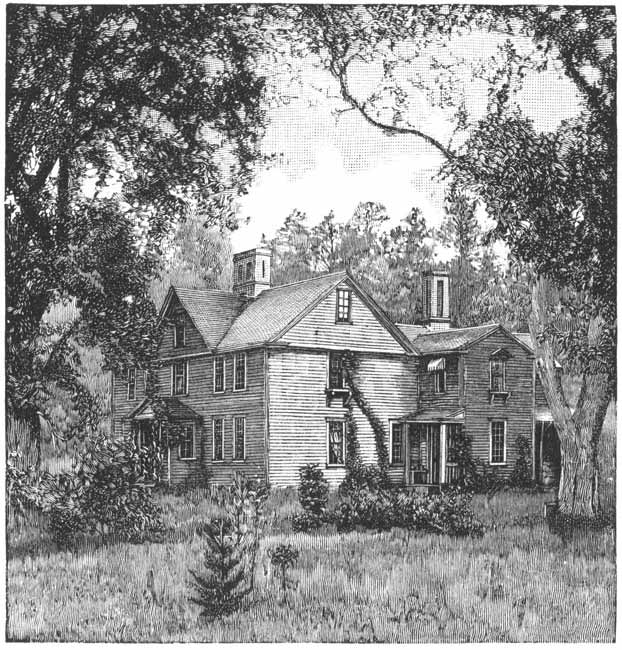
ORCHARD HOUSE, CONCORD, MASS. Home of the Alcott Family, 1858.
A great shadow fell over Louisa's heart and life from the increasing illness of her dear younger sister Elizabeth. This young girl was tenderly beloved by all the family, and was indeed as pure, refined, and holy as she is represented as Beth in "Little Women." Her decay was very gradual, and she was so patient and sweet that the sad time of anxiety was a very precious one in remembrance.
This sickness added to the pecuniary burdens of the family, and eight years afterward Louisa paid the bill of the physician who attended her sister.
In October, 1857, the family removed again to Concord, and Louisa remained at home to assist in the care of the beloved invalid. They lived a few months in a part of a house which they hired until the Orchard House, which they had bought, was ready for them. Here the dear sister's life came to a close.
This was the first break in the household, and the mother's heart never fully recovered from it. Louisa accepted death with strong, sweet wisdom. It never seemed to have any terror for her.
In July they took possession of the Orchard House, which was hereafter the permanent residence of the family. This was a picturesque old house on the side of a hill, with an orchard of apple-trees. It was not far from Mr. Emerson's, and within walking distance of the village, yet very quiet and rural. Mr. Alcott had his library, and was always very happy there; but Louisa's heart never clung to it.
The engagement of the elder sister was a very exciting event to Louisa, who did not like having the old sisterly relation broken in upon; but everything was so genuine and true in the love of the newly betrothed pair that she could not help accepting the change as a blessing to her sister and taking the new brother into her heart. The entries in her journal show that the picture she has drawn in "Little Women" of this noble man is from life, and not exaggerated.
Louisa went to Boston for a visit, and again had hopes of going on to the stage; but an accident prevented it; and she returned to Concord and her writing, working off her disappointment in a story called "Only an Actress."
Among her experiences at this time was an offer of marriage, about which she consulted her mother, telling her that she did not care for the lover very much. The wise mother saved her from the impulse to self-sacrifice, which might have led her to accept a position which would have given help to the family.
Although this was not the only instance of offers of marriage, more or less advantageous, made to her, Louisa had no inclination toward matrimony. Her heart was bound up in her family, and she could hardly contemplate her own interests as separate from theirs. She loved activity, freedom, and independence. She could not cherish illusions tenderly; and she always said that she got tired of everybody, and felt sure that she should of her husband if she married. She never wished to make her heroines marry, and the love story is the part of her books for which she cared least. She yielded to the desire of the public, who will not accept life without a recognition of this great joy in it. Still it must be acknowledged that she has sometimes painted very sweet and natural love scenes, although more often in quaint and homely guise than in the fashion of ancient romance. "King of Clubs and Queen of Hearts" is very prettily told; and "Mrs. Todger's Teapot" is true to that quiet, earnest affection which does not pass away with youth.
The writing went on, and she received five, six, or ten dollars apiece for her stories; but she did not yet venture to give up the sewing and teaching, which was still the sure reliance.
Her younger sister now began to exercise her talent, and illustrated a little book of Louisa's called "Christmas Elves," which she says is better than "Flower Fables."
Journal.
Read Charlotte Bronté's life. A very interesting, but sad one. So full of talent; and after working long, just as success, love, and happiness come, she dies.
Wonder if I shall ever be famous enough for people to care to read my story and struggles. I can't be a C. B., but I may do a little something yet.
July.–Grandma Alcott came to visit us. A sweet old lady; and I am glad to know her, and see where Father got his nature. Eighty-four; yet very smart, industrious, and wise. A house needs a grandma in it.
As we sat talking over Father's boyhood, I never realized so plainly before how much he has done for himself. His early life sounded like a pretty old romance, and Mother added the love passages.
I got a hint for a story; and some day will do it, and call it "The Cost of an Idea." Spindle Hill, Temple School, Fruitlands, Boston, and Concord, would make fine chapters. The trials and triumphs of the Pathetic Family would make a capital book; may I live to do it.
August.–A sad, anxious month. Betty worse; Mother takes her to the seashore. Father decides to go back to Concord; he is never happy far from Emerson, the one true friend who loves and understands and helps him.
September.–An old house near R. W. E.'s is bought with Mother's money, and we propose to move. Mother in Boston with poor Betty, who is failing fast. Anna and I have a hard time breaking up.
October.–Move to Concord. Take half a house in town till spring, when the old one is to be made ready.
Find dear Betty a shadow, but sweet and patient always. Fit up a nice room for her, and hope home and love and care may keep her.
People kind and friendly, and the old place looks pleasant, though I never want to live in it.
November.–Father goes West, taking Grandma home. We settle down to our winter, whatever it is to be. Lizzie seems better, and we have some plays. Sanborn's school makes things lively, and we act a good deal.
Twenty-five this month. I feel my quarter of a century rather heavy on my shoulders just now. I lead two lives. One seems gay with plays, etc., the other very sad,–in Betty's room; for though she wishes us to act, and loves to see us get ready, the shadow is there, and Mother and I see it. Betty loves to have me with her; and I am with her at night, for Mother needs rest. Betty says she feels "strong" when I am near. So glad to be of use.
December.–Some fine plays for charity.
January, 1858.–Lizzie much worse; Dr. G. says there is no hope. A hard thing to hear; but if she is only to suffer, I pray she may go soon. She was glad to know she was to "get well," as she called it, and we tried to bear it bravely for her sake. We gave up plays; Father came home; and Anna took the housekeeping, so that Mother and I could devote ourselves to her. Sad, quiet days in her room, and strange nights keeping up the fire and watching the dear little shadow try to wile away the long sleepless hours without troubling me. She sews, reads, sings softly, and lies looking at the fire,–so sweet and patient and so worn, my heart is broken to see the change. I wrote some lines one night on "Our Angel in the House."
[Jo and Beth.–L. M. A.]
February.–A mild month; Betty very comfortable, and we hope a little.
Dear Betty is slipping away, and every hour is too precious to waste, so I'll keep my lamentations over Nan's [affairs] till this duty is over.
Lizzie makes little things, and drops them out of windows to the school-children, smiling to see their surprise. In the night she tells me to be Mrs. Gamp, when I give her her lunch, and tries to be gay that I may keep up. Dear little saint! I shall be better all my life for these sad hours with you.
March 14th.–My dear Beth died at three this morning, after two years of patient pain. Last week she put her work away, saying the needle was "too heavy," and having given us her few possessions, made ready for the parting in her own simple, quiet way. For two days she suffered much, begging for ether, though its effect was gone. Tuesday she lay in Father's arms, and called us round her, smiling contentedly as she said, "All here!" I think she bid us good-by then, as she held our hands and kissed us tenderly. Saturday she slept, and at midnight became unconscious, quietly breathing her life away till three; then, with one last look of the beautiful eyes, she was gone.
A curious thing happened, and I will tell it here, for Dr. G. said it was a fact. A few moments after the last breath came, as Mother and I sat silently watching the shadow fall on the dear little face, I saw a light mist rise from the body, and float up and vanish in the air. Mother's eyes followed mine, and when I said, "What did you see?" she described the same light mist. Dr. G. said it was the life departing visibly.
For the last time we dressed her in her usual cap and gown, and laid her on her bed,–at rest at last. What she had suffered was seen in the face; for at twenty-three she looked like a woman of forty, so worn was she, and all her pretty hair gone.
On Monday Dr. Huntington read the Chapel service, and we sang her favorite hymn. Mr. Emerson, Henry Thoreau, Sanborn, and John Pratt, carried her out of the old home to the new one at Sleepy Hollow chosen by herself. So the first break comes, and I know what death means,–a liberator for her, a teacher for us.
April.–Came to occupy one wing of Hawthorne's house (once ours) while the new one was being repaired. Father, Mother, and I kept house together; May being in Boston, Anna at Pratt Farm, and, for the first time, Lizzie absent. I don't miss her as I expected to do, for she seems nearer and dearer than before; and I am glad to know she is safe from pain and age in some world where her innocent soul must be happy.
Death never seemed terrible to me, and now is beautiful; so I cannot fear it, but find it friendly and wonderful.
May.–A lonely month with all the girls gone, and Father and Mother absorbed in the old house, which I don't care about, not liking Concord.
On the 7th of April, Anna came walking in to tell us she was engaged to John Pratt; so another sister is gone. J. is a model son and brother,–a true man,–full of fine possibilities, but so modest one does not see it at once. He is handsome, healthy, and happy; just home from the West, and so full of love he is pleasant to look at.
I moaned in private over my great loss, and said I'd never forgive J. for taking Anna from me; but I shall if he makes her happy, and turn to little May for my comfort.
[Now that John is dead, I can truly say we all had cause to bless the day he came into the family; for we gained a son and brother, and Anna the best husband ever known.
For ten years he made her home a little heaven of love and peace; and when he died he left her the legacy of a beautiful life, and an honest name to his little sons.–L. M. A., 1873.]
June.–The girls came home, and I went to visit L. W. in Boston. Saw Charlotte Cushman, and had a stage-struck fit. Dr. W. asked Barry to let me act at his theatre, and he agreed. I was to do Widow Pottle, as the dress was a good disguise and I knew the part well. It was all a secret, and I had hopes of trying a new life; the old one being so changed now, I felt as if I must find interest in something absorbing. But Mr. B. broke his leg, so I had to give it up; and when it was known, the dear, respectable relations were horrified at the idea. I'll try again by-and-by, and see if I have the gift. Perhaps it is acting, not writing, I'm meant for. Nature must have a vent somehow.
July.–Went into the new house and began to settle. Father is happy; Mother glad to be at rest; Anna is in bliss with her gentle John; and May busy over her pictures. I have plans simmering, but must sweep and dust and wash my dish-pans a while longer till I see my way.
Worked off my stage fever in writing a story, and felt better; also a moral tale, and got twenty-five dollars, which pieced up our summer gowns and bonnets all round. The inside of my head can at least cover the outside.
August.–Much company to see the new house. All seem to be glad that the wandering family is anchored at last. We won't move again for twenty years if I can help it. The old people need an abiding place; and now that death and love have taken two of us away, I can, I hope, soon manage to care for the remaining four.
The weeklies will all take stories; and I can simmer novels while I do my housework, so see my way to a little money, and perhaps more by-and-by if I ever make a hit.
Probably owing to the excitement of grief for her sister's death, and sympathy in Anna's happy betrothal, Louisa became in October more discouraged than she had ever been, and went to Boston in search of work. As she walked over the mill dam the running stream brought the thought of the River of Death, which would end all troubles. It was but a momentary impulse, and the brave young heart rallied to the thought, "There is work for me, and I'll have it!" Her journal narrates how Mr. Parker helped her through this period of anxiety. She was all ready to go to Lancaster, to hard drudgery at sewing, when her old place as governess was again offered to her, and her own support was assured.
October.–Went to Boston on my usual hunt for employment, as I am not needed at home and seem to be the only bread-winner just now.
My fit of despair was soon over, for it seemed so cowardly to run away before the battle was over I couldn't do it. So I said firmly, "There is work for me, and I'll have it," and went home resolved to take Fate by the throat and shake a living out of her.
Sunday Mr. Parker preached a sermon on "Laborious Young Women." Just what I needed; for it said: "Trust your fellow-beings, and let them help you. Don't be too proud to ask, and accept the humblest work till you can find the task you want."
"I will," said I, and went to Mr. P.'s. He was out; but I told Mrs. P. my wants, and she kindly said Theodore and Hannah would be sure to have something for me. As I went home I met Mrs. L., who had not wanted me, as Alice went to school. She asked if I was engaged, and said A. did not do well, and she thought perhaps they would like me back. I was rejoiced, and went home feeling that the tide had begun to turn. Next day came Miss H. S. to offer me a place at the Girls' Reform School at Lancaster, to sew ten hours a day, make and mend. I said I'd go, as I could do anything with a needle; but added, if Mrs. L. wants me I'd rather do that.
"Of course you had. Take it if it comes, and if not, try my work." I promised and waited. That eve, when my bag was packed and all was ready for Lancaster, came a note from Mrs. L. offering the old salary and the old place. I sang for joy, and next day early posted off to Miss S. She was glad and shook hands, saying, "It was a test, my dear, and you stood it. When I told Mr. P. that you would go, he said, 'That is a true girl; Louisa will succeed.'"
I was very proud and happy; for these things are tests of character as well as courage, and I covet the respect of such true people as Mr. P. and Miss S.
So away to my little girl with a bright heart! for with tales, and sewing for Mary, which pays my board, there I am fixed for the winter and my cares over. Thank the Lord!
She now found publishers eager for her stories, and went on writing for them. She was encouraged by E. P. Whipple's praise of "Mark Field's Mistake," and by earning thirty dollars, most of which she sent home.
Journal.
Earned thirty dollars; sent twenty home. Heard Curtis, Parker, Higginson, and Mrs. Dall lecture. See Booth's Hamlet, and my ideal done at last.
My twenty-sixth birthday on the 29th. Some sweet letters from home, and a ring of A.'s and J.'s hair as a peace-offering. A quiet day, with many thoughts and memories.
The past year has brought us the first death and betrothal,–two events that change my life. I can see that these experiences have taken a deep hold, and changed or developed me. Lizzie helps me spiritually, and a little success makes me more self-reliant. Now that Mother is too tired to be wearied with my moods, I have to manage them alone, and am learning that work of head and hand is my salvation when disappointment or weariness burden and darken my soul.
In my sorrow I think I instinctively came nearer to God, and found comfort in the knowledge that he was sure to help when nothing else could.
A great grief has taught me more than any minister, and when feeling most alone I find refuge in the Almighty Friend. If this is experiencing religion I have done it; but I think it is only the lesson one must learn as it comes, and I am glad to know it.
After my fit of despair I seem to be braver and more cheerful, and grub away with a good heart. Hope it will last, for I need all the courage and comfort I can get.
I feel as if I could write better now,–more truly of things I have felt and therefore know. I hope I shall yet do my great book, for that seems to be my work, and I am growing up to it. I even think of trying the "Atlantic." There 's ambition for you! I'm sure some of the stories are very flat. If Mr. L. takes the one Father carried to him, I shall think I can do something.
December.–Father started on his tour West full of hope. Dear man! How happy he will be if people will only listen to and pay for his wisdom.
May came to B. and stayed with me while she took drawing lessons. Christmas at home. Write an Indian story.
January, 1859.–Send a parcel home to Marmee and Nan.
Mother very ill. Home to nurse her for a week. Wonder if I ought not to be a nurse, as I seem to have a gift for it. Lizzie, L. W., and Mother all say so; and I like it. If I couldn't write or act I'd try it. May yet. $21 from L.; $15 home.
Some day I'll do my best, and get well paid for it.
[$3,000 for a short serial in 1876. True prophet.–L. M. A.]
Wrote a sequel to "Mark Field." Had a queer time over it, getting up at night to write it, being too full to sleep.
March.–"Mark" was a success, and much praised. So I found the divine afflatus did descend. Busy life teaching, writing, sewing, getting all I can from lectures, books, and good people. Life is my college. May I graduate well, and earn some honors!
April.–May went home after a happy winter at the School of Design, where she did finely, and was pronounced full of promise. Mr. T. said good things of her, and we were very proud. No doubt now what she is to be, if we can only keep her along.
I went home also, being done with A., who went out of town early. Won't teach any more if I can help it; don't like it; and if I can get writing enough can do much better.
I have done more than I hoped. Supported myself, helped May, and sent something home. Not borrowed a penny, and had only five dollars given me. So my third campaign ends well.
May.–Took care of L. W., who was ill. Walked from C. to B. one day, twenty miles, in five hours, and went to a party in the evening. Not very tired. Well done for a vegetable production!
June.–Took two children to board and teach. A busy month, as Anna was in B.
September.–Great State Encampment here. Town full of soldiers, with military fuss and feathers. I like a camp, and long for a war, to see how it all seems. I can't fight, but I can nurse.
[Prophetic again.–L. M. A.]
October, 1859.–May did a fine copy of Emerson's Endymion[7] for me.
Mother sixty. God bless the dear, brave woman!
Good news of Parker in Florence,–my beloved minister and friend. To him and R. W. E. I owe much of my education. May I be a worthy pupil of such men!
November.–Hurrah! My story was accepted; and Lowell asked if it was not a translation from the German, it was so unlike most tales. I felt much set up, and my fifty dollars will be very happy money. People seem to think it a great thing to get into the "Atlantic;" but I've not been pegging away all these years in vain, and may yet have books and publishers and a fortune of my own. Success has gone to my head, and I wander a little. Twenty-seven years old, and very happy.
The Harper's Ferry tragedy makes this a memorable month. Glad I have lived to see the Antislavery movement and this last heroic act in it. Wish I could do my part in it.
December, 1859.–The execution of Saint John the Just took place on the second. A meeting at the hall, and all Concord was there. Emerson, Thoreau, Father, and Sanborn spoke, and all were full of reverence and admiration for the martyr.
I made some verses on it, and sent them to the "Liberator."
A sickness of Mrs. Alcott through which she nursed her makes Louisa question whether nursing is not her true vocation. She had an opportunity to try it later.
Much interest attaches to this period of Louisa's work, when she dashed off sensational stories as fast as they were wanted, from the account which she has given of it in "Little Women." She has concentrated into one short period there the work and the feelings of a much longer time. She certainly did let her fancy run riot in these tales, and they were as sensational as the penny papers desired. She had a passion for wild, adventurous life, and even for lurid passion and melodramatic action, which she could indulge to the utmost in these stories. Louisa was always a creature of moods; and it was a great relief to work off certain feelings by the safe vent of imaginary persons and scenes in a story. She had no one to guide or criticise her; and the fact that these gambols of fancy brought the much-needed money, and were, as she truly called them, "pot boilers," certainly did not discourage her from indulging in them. She is probably right in calling most of them "trash and rubbish," for she was yet an unformed girl, and had not studied herself or life very deeply; but her own severe condemnation of them in "Little Women" might give a false idea. The stories are never coarse or immoral. They give a lurid, unnatural picture of life, but sin is not made captivating or immorality attractive. There is often a severe moral enforced. They did not give poison to her readers, only over-seasoned unnatural food, which might destroy the relish for wholesome mental nourishment.
We are inclined to ask, What did Louisa herself get out of this wild, Walpurgis-Night ride among ghosts and goblins, letting her fancy run riot, and indulging every mood as it rose? Did it not give her the dash and freedom in writing which we find in all her books, a command of language, and a recognition of the glow and force of life? She finds life no mere commonplace drudgery, but full of great possibilities. Did it not also give her an interest in all the wild fancies and dreams of girls, all the longing for adventure of boys, and make her hopeful even of the veriest young scamps that they would work off the turbulent energies of youth safely if activities were wisely provided for them?
No writer for children ever was so fully recognized as understanding them. They never felt that she stood on a pinnacle of wisdom to censure them, but came right down into their midst to work and play with them, and at the same time to show them the path out of the tangled thickets, and to help them to see light in their gloomiest despair.
Yet she unquestionably recognized that she was not doing the best work of which she was capable; and she looked forward still to the books she was to write, as well as the fortune she was to make. She did not like any reference to these sensational stories in after life, although she sometimes re-used plots or incidents in them; and she was very unwilling to have them republished.
Boston Bulletin,–Ninth Issue.
Sunday Eve, November, 1858.
My blessed Nan,–Having finished my story, I can refresh my soul by a scribble to you, though I have nothing to tell of much interest.
Mrs. L. is to pay me my "celery" each month, as she likes to settle all bills in that way; so yesterday she put $20.85 into my willing hands, and gave me Saturday p.m. for a holiday. This unexpected $20, with the $10 for my story (if I get it) and $5 for sewing, will give me the immense sum of $35. I shall get a second-hand carpet for the little parlor, a bonnet for you, and some shoes and stockings for myself, as three times round the Common in cold weather conduces to chilblains, owing to stockings with a profusion of toe, but no heel, and shoes with plenty of heel, but a paucity of toe. The prejudices of society demand that my feet be covered in the houses of the rich and great; so I shall hose and shoe myself, and if any of my fortune is left, will invest it in the Alcott Sinking Fund, the Micawber R. R., and the Skimpole three per cents.
Tell me how much carpet you need, and T. S. will find me a good one. In December I shall have another $20; so let me know what is wanting, and don't live on "five pounds of rice and a couple of quarts of split peas" all winter, I beg.
How did you like "Mark Field's Mistake"? I don't know whether it is good or bad; but it will keep the pot boiling, and I ask no more. I wanted to go and see if "Hope's Treasures" was accepted, but was afeared. M. and H. both appeared; but one fell asleep, and the other forgot to remember; so I still wait like Patience on a hard chair, smiling at an inkstand. Miss K. asked me to go to see Booth for the last time on Saturday. Upon that ravishing thought I brooded all the week very merrily, and I danced, sang, and clashed my cymbals daily. Saturday a.m. Miss K. sent word she couldn't go, and from my pinnacle of joy I was precipitated into an abyss of woe. While in said abyss Mrs. L. put the $20 into my hands. That was a moment of awful trial. Every one of those dollars cried aloud, "What, ho! Come hither, and be happy!" But eight cold feet on a straw carpet marched to and fro so pathetically that I locked up the tempting fiend, and fell to sewing, as a Saturday treat!
But, lo! virtue was rewarded. Mrs. H. came flying in, and took me to the Museum to see "Gold" and "Lend Me Five Shillings." Warren, in an orange tie, red coat, white satin vest, and scarlet ribbons on his ankles, was the funniest creature you ever saw; and I laughed till I cried,–which was better for me than the melancholy Dane, I dare say.
I'm disgusted with this letter; for I always begin trying to be proper and neat; but my pen will not keep in order, and ink has a tendency to splash when used copiously and with rapidity. I have to be so moral and so dignified nowadays that the jocosity of my nature will gush out when it gets a chance, and the consequences are, as you see, rubbish. But you like it; so let's be merry while we may, for to-morrow is Monday, and the weekly grind begins again.
CHAPTER VI.
THE YEAR OF GOOD LUCK.
THE CHILDREN'S SONG.
Tune.–"Wait for the Wagon." The world lies fair about us, and a friendly sky above; Our lives are full of sunshine, our homes are full of love; Few cares or sorrows sadden the beauty of our day; We gather simple pleasures like daisies by the way. Chorus.–Oh! sing with cheery voices, Like robins on the tree; For little lads and lasses As blithe of heart should be. The village is our fairyland: its good men are our kings; And wandering through its by-ways our busy minds find wings. The school-room is our garden, and we the flowers there, And kind hands tend and water us that we may blossom fair. Chorus.–Oh! dance in airy circles, Like fairies on the lee; For little lads and lasses As light of foot should be. There's the Shepherd of the sheepfold; the Father of the vines; The Hermit of blue Walden; the Poet of the pines; And a Friend who comes among us, with counsels wise and mild With snow upon his forehead, yet at heart a very child. Chorus.–Oh! smile as smiles the river, Slow rippling to the sea; For little lads and lasses As full of peace should be.
There's not a cloud in heaven but drops its silent dew; No violet in the meadow but blesses with its blue; No happy child in Concord who may not do its part To make the great world better by innocence of heart. Chorus.–Oh! blossom in the sunshine Beneath the village tree; For little lads and lasses Are the fairest flowers we see.
AFTER such long and hard struggles, it is pleasant to find the diary for 1860 headed "A Year of Good Luck." The appointment of Mr. Alcott as Superintendent of Schools in Concord was a great happiness to the family. It was a recognition of his character and ability, and gave him congenial occupation and some small pecuniary compensation.
Louisa was writing for the "Atlantic," and receiving better pay for her work; Anna was happy; and May absorbed in her art.
In the summer Miss Alcott had an experience in caring for a young friend during a temporary fit of insanity, which she has partially reproduced in the touching picture of Helen in the story of "Work." It is a powerful lesson; but it is almost cruelly enforced, and is an artistic blemish in the book. While the great problem of heredity should be studied and its lessons enforced, it is yet a mystery, whose laws are not understood; and it is not wise to paint its possible effects in the lurid light of excited imagination, which may too often bring about the very evils which a wise and temperate caution might prevent. For the physician and teacher such investigations are important; but they are dangerous to the young and sensitive.
The following unusually long letter gives a pleasing picture of the family life at this time:–
To Mrs. Bond.
Apple Slump, Sept. 17, 1860.
Dear Auntie,–I consider this a practical illustration of one of Mother's naughty amended sayings, "Cast your bread upon the waters, and after many days it will return buttered;" and this "rule of three" don't "puzzle me," as the other did; for my venerable raiment went away with one if not two feet in the grave, and came back in the guise of three stout angels, having been resurrectionized by the spirit who lives on the other side of a Charles River Jordan. Thank you very much, and be sure the dreams I dream in them will be pleasant ones; for, whether you sewed them or not, I know they bring some of the Auntie influence in their strength, softness, and warmth; and, though a Vandal, I think any prayers I may say in them will be the better for the affectionate recollections that will clothe me with the putting on of these friendly gowns, while my belief in both heavenly and earthly providences will be amazingly strengthened by the knowledge of some lives here, whose beauty renders it impossible to doubt the existence of the life hereafter.
We were very glad to hear that the Papa was better; for when paternal "Richards" ain't "themselves," everybody knows the anxious state of the domestic realms.
I hope Georgie (last name disremembered) has recovered from the anguish of discontented teeth and berry-seeds, and that "the Mama" was as much benefited by the trip as the other parties were, barring the horse perhaps.
This amiable town is convulsed just now with a gymnastic fever, which shows itself with great violence in all the schools, and young societies generally. Dr. Lewis has "inoculated us for the disease," and it has "taken finely;" for every one has become a perambulating windmill, with all its four sails going as if a wind had set in; and the most virulent cases present the phenomena of black eyes and excoriation of the knobby parts of the frame, to say nothing of sprains and breakage of vessels looming in the future.
The City Fathers approve of it; and the city sons and daughters intend to show that Concord has as much muscle as brain, and be ready for another Concord fight, if Louis Napoleon sees fit to covet this famous land of Emerson, Hawthorne, Thoreau, Alcott, & Co. Abby and I are among the pioneers; and the delicate vegetable productions clash their cymbals in private, when the beef-eating young ladies faint away and become superfluous dumb belles.
Saturday we had J. G. Whittier, Charlotte Cushman, Miss Stebbins the sculptress, and Mr. Stuart, conductor of the underground railroad of this charming free country. So you see our humble place of abode is perking up; and when the "great authoress and artist" are fairly out of the shell, we shall be an honor to our country and terror to the foe,–provided good fortune don't addle or bad fortune smash us.
Father continues to stir up the schools like a mild pudding-stick, Mother to sing Hebron among her pots and pans, Anna and the Prince Consort to bill and coo in the little dove-cot, Oranthy Bluggage to launch chips on the Atlantic and make a gigantic blot of herself in working the vessel, Abby to teach the fine arts and play propriety for the family, and the old house to put its best foot foremost and hoot at the idea of ever returning to the chaos from which it came.
This is a condensed history of "the pathetic family," which is also a "happy family," owing to the prevalence of friends and lots of kindness in the original packages, "which are always arriving" when the "Widow Cruise's oil-bottle" begins to give out.
You know I never could do anything in a neat and proper manner; so you will receive this topsy-turvy note as you do its writer, and with love to all from all, believe her, dear auntie,
Ever lovingly yours, L. M. A.
This characteristic letter not only shows Louisa's affectionate feelings and gives a picture of her life, but indicates that "The Pathetic Family," which was the foundation of "Little Women," was already shaping itself in her mind.
Mr. Alcott's career as Superintendent of Schools was a gratifying success, and is still remembered by friends of education in the town. The year closed with a school festival, for which Louisa wrote a poem, and in which she took hearty delight.
In 1861 war was declared with the South. The Alcotts were all alive with patriotic enthusiasm, and Louisa took an active part in fitting off the boys for the army. But she also found time for much reading. Mr. Alcott, in his sonnet, uses the expression about Louisa–
"Hast with grave studies vexed a lively brain."
He may possibly have referred to this period, though she could never properly be called a student. She was a rapid, intelligent reader, and her taste was severe and keen. From her childhood she had browsed in her father's library, full of the works of ancient philosophers and quaint English poets, and had imbibed from them great thoughts and noble sentiments; but her reading, like all her education, was immethodical. Occasionally she would lay out courses of reading, which she pursued for a time; but in general she followed the cravings of a healthy appetite for knowledge, reading what came in her way. Later in life she often read light literature in abundance, to drown the sensations of pain, and to pass away the hours of invalidism.
She read French easily, and learned to speak it when abroad; she also studied German, but did not acquire equal facility in that tongue. Of ancient languages she had no knowledge. History could not fail to interest such a student of life, and she loved Nature too well not to enjoy the revelations of science when brought to her notice; but she had never time to give to a thorough study of either.
In her journal at this time she speaks of her religious feelings, which the experiences of grief and despair and reviving hope had deepened. Louisa Alcott's was a truly religious soul; she always lived in the consciousness of a Higher Power sustaining and blessing her, whose presence was revealed to her through Nature, through the inspired words of great thinkers and the deep experiences of her own heart. She never held her life as an isolated possession which she was free to use for her own enjoyment or glory. Her father truly called her "Duty's faithful child," and her life was consecrated to the duty she recognized as specially hers. But for outward forms and rites of religion she cared little; her home was sacred to her, and she found her best life there. She loved Theodore Parker, and found great strength and help from his preaching, and afterward liked to listen to Dr. Bartol; but she never joined any church. The Bible was not her favorite reading, though her father had read it much to her in her childhood, with his own peculiar charm of interpretation. Pilgrim's Progress was one of the few religious books which became dear to her in the same way.
Her sister Anna was married in May; this was of course a great event in the family. While fully rejoicing in her sister's happiness, Louisa felt her loss as a constant companion and confidant. The journal gives a sufficient description of the event. Her strong affection for her brother-in-law appears in "Little Women" and in "Jo's Boys." About this time her farce was brought out at the Howard Athenæum.
The story-writing continued, as it helped to pay the expenses of the family; but the continuous, hurried work had begun to affect her health, and she occasionally suffered from illness.
In the summer of 1861 Miss Alcott began to write her first novel, entitled "Moods;" this proved to be the least successful of her books, and yet like many an unfortunate child, it was the dearest to the mother's heart. It was not written for money, but for its own sake, and she was possessed by the plot and the characters. Warwick represented her ideal of a hero, while her sister preferred the type of the amiable Moor; yet there is far less of her outward self revealed in this than in her other stories. It is full of her thoughts and fancies, but not of her life. The wilful, moody, charming Sylvia does not affect us like the stormy Jo, who is a real presence to us, and whom we take to our hearts in spite of her faults. The men are such as she found in books, but had never known herself, and, carefully as she has drawn them, have not the individuality of Laurie and Professor Bhaer. The action takes place in an unreal world; and though there are many pretty scenes, they have not the real flavor of New England life. The principal incident, of a young girl going up the river on a picnic-voyage for some days with her brother and two other young men, was so contrary to common ideas of decorum, that the motive hardly seems sufficient for the staid sister's consent; but in the simple, innocent life which the Alcotts lived in Concord such scruples were little felt.
Miss Alcott did not lay stress upon the marriage question as the principal feature of the book; she cared more to describe the wilful moods of a young girl, full of good feelings, and longing for a rich and noble life, but not established in convictions and principles. She meant to represent much of her own nature in Sylvia, for she was always a creature of moods, which her family learned to recognize and respect. But how unlike was the discipline of family work and love, which saved Louisa from fatal caprices and fitful gusts of fancy called passion, to the lot of the wealthy and admired Sylvia. Miss Alcott says that the incidents of the marriage, although not drawn from life, were so close to an actual case that the wife asked her how she had known her secret; but such realism is a poor justification in art. It is that which becomes true to the imagination and heart through its vivid personation of character which is accepted, not the bare facts. The great question of the transcendental period was truth to the inward life instead of the outward law. But in "Moods" the marriage question is not stated strongly; it does not reach down to this central principle. It is only in tragedy that such a double relation could be endured, when the situation is compelled by fate,–the fate of character and overpowering circumstances,–and when there is no happy solution possible. But Sylvia's position is made only by her own weakness, and the love which stands in opposition to outward duty has no right of existence. If her love for Warwick could be overcome, there was no question of her duty; and when she accepts Faith's criticism of him, it is clear that it is a much lighter spell than love which has fascinated her. We do not accept the catastrophe which sacrifices a splendid life to make a comfortable solution of the practical difficulty, and to allow Sylvia to accept a happy home without a thorough regeneration of heart and mind. But these were the natural mistakes of youth and inexperience; Louisa had known but little of such struggles. Love and marriage were rather uninteresting themes to her, and she had not yet found her true power.
Still the book has great literary merit. It is well written, in a more finished style than any of her other work, except "Modern Mephistopheles," and the dialogue is vigorous and sprightly. In spite of her careful revision and pruning, there is something left of youthful gush in it, and this perhaps touched the heart of young girls, who found in Sylvia's troubles with herself a reflection of their own.
The "golden wedding" scenes have some of her usual freedom and vivacity. She is at home with a troop of mothers and babies and noisy boys. But the "golden wedding" was a new importation from Germany, and not at home in the New England farmhouse. Why might it not have been a true wedding or a harvest feast?
Louisa never lost her interest in this early work, though it was the most unlucky of books, and subjected to severe handling. It was sent to and fro from publisher to author, each one suggesting some change. Redpath sent it back as being too long. Ticknor found it very interesting, but could not use it then. Loring liked it, but wanted it shorter. She condensed and altered until her author's spirit rebelled, and she declared she would change it no more.
After her other books had made her famous, "Moods" was again brought forward and republished as it was originally written. It met with warmer welcome than before, and a cheap edition was published in England to supply the popular demand.
Miss Alcott learned the first painful lesson of over-work on this book. She was possessed by it, and for three weeks labored so constantly that she felt the physical effects keenly. Fortunately new household tasks (for the daughters of John Brown came to board with them), and the enthusiasm of the time, changed the current of her thoughts.
Journal.
February, 1860.–Mr. –– won't have "M. L.," as it is antislavery, and the dear South must not be offended. Got a carpet with my $50, and wild Louisa's head kept the feet of the family warm.
March.–Wrote "A Modern Cinderella," with Nan for the heroine and John for the hero.
Made my first ball dress for May, and she was the finest girl at the party. My tall, blond, graceful girl! I was proud of her.
Wrote a song for the school festival, and heard it sung by four hundred happy children. Father got up the affair, and such a pretty affair was never seen in Concord before. He said, "We spend much on our cattle and flower shows; let us each spring have a show of our children, and begrudge nothing for their culture." All liked it but the old fogies who want things as they were in the ark.
April.–Made two riding habits, and May and I had some fine rides. Both needed exercise, and this was good for us. So one of our dreams came true, and we really did "dash away on horseback."
Sanborn was nearly kidnapped for being a friend of John Brown; but his sister and A. W. rescued him when he was handcuffed, and the scamps drove off. Great ferment in town. A meeting and general flurry.
Had a funny lover who met me in the cars, and said he lost his heart at once. Handsome man of forty. A Southerner, and very demonstrative and gushing, called and wished to pay his addresses; and being told I didn't wish to see him, retired, to write letters and haunt the road with his hat off, while the girls laughed and had great fun over Jo's lover. He went at last, and peace reigned. My adorers are all queer.
Sent "Cinderella" to the "Atlantic," and it was accepted. Began "By the River," and thought that this was certainly to be a lucky year; for after ten years hard climbing I had reached a good perch on the ladder, and could look more hopefully into the future, while my paper boats sailed gaily over the Atlantic.
May.–Meg's wedding.
My farce was acted, and I went to see it. Not very well done; but I sat in a box, and the good Doctor handed up a bouquet to the author, and made as much as he could of a small affair.
Saw Anna's honeymoon home at Chelsea,–a little cottage in a blooming apple-orchard. Pretty place, simple and sweet. God bless it!
The dear girl was married on the 23d, the same day as Mother's wedding. A lovely day; the house full of sunshine, flowers, friends, and happiness. Uncle S. J. May married them, with no fuss, but much love; and we all stood round her. She in her silver-gray silk, with lilies of the valley (John's flower) in her bosom and hair. We in gray thin stuff and roses,–sackcloth, I called it, and ashes of roses; for I mourn the loss of my Nan, and am not comforted. We have had a little feast, sent by good Mrs. Judge Shaw; then the old folks danced round the bridal pair on the lawn in the German fashion, making a pretty picture to remember, under our Revolutionary elm.
Then, with tears and kisses, our dear girl, in her little white bonnet, went happily away with her good John; and we ended our first wedding. Mr. Emerson kissed her; and I thought that honor would make even matrimony endurable, for he is the god of my idolatry, and has been for years.
June.–To Boston to the memorial meeting for Mr. Parker, which was very beautiful, and proved how much he was beloved. Music Hall was full of flowers and sunshine, and hundreds of faces, both sad and proud, as the various speakers told the life of love and labor which makes Theodore Parker's memory so rich a legacy to Boston. I was very glad to have known so good a man, and been called "friend" by him.
Saw Nan in her nest, where she and her mate live like a pair of turtle doves. Very sweet and pretty, but I'd rather be a free spinster and paddle my own canoe.
August.–"Moods." Genius burned so fiercely that for four weeks I wrote all day and planned nearly all night, being quite possessed by my work. I was perfectly happy, and seemed to have no wants. Finished the book, or a rough draught of it, and put it away to settle. Mr. Emerson offered to read it when Mother told him it was "Moods" and had one of his sayings for motto.
Daresay nothing will ever come of it; but it had to be done, and I'm the richer for a new experience.
September.–Received $75 of Ticknor for "Cinderella," and feel very rich. Emerson praised it, and people wrote to me about it and patted me on the head. Paid bills, and began to simmer another.
October.–I went to B. and saw the Prince of Wales trot over the Common with his train at a review. A yellow-haired laddie very like his mother. Fanny W. and I nodded and waved as he passed, and he openly winked his boyish eye at us; for Fanny, with her yellow curls and wild waving, looked rather rowdy, and the poor little prince wanted some fun. We laughed, and thought that we had been more distinguished by the saucy wink than by a stately bow. Boys are always jolly,–even princes.
Read Richter, and enjoyed him very much.
Mother went to see Uncle S. J. May, and I was house-keeper. Gave my mind to it so energetically that I dreamed dip-toast, talked apple-sauce, thought pies, and wept drop-cakes. Read my book to Nan, who came up to cheer me in my struggles; and she laughed and cried over it and said it was "good." So I felt encouraged, and will touch it up when duty no longer orders me to make a burnt-offering of myself.
November.–Father sixty-one; L. aged twenty-eight. Our birthday. Gave Father a ream of paper, and he gave me Emerson's picture; so both were happy.
Wrote little, being busy with visitors. The John Brown Association asked me for a poem, which I wrote.
Kind Miss R. sent May $30 for lessons, so she went to B. to take some of Johnstone. She is one of the fortunate ones, and gets what she wants easily. I have to grub for my help, or go without it. Good for me, doubtless, or it wouldn't be so; so cheer up, Louisa, and grind away!
December.–More luck for May. She wanted to go to Syracuse and teach, and Dr. W. sends for her, thanks to Uncle S. J. May. I sew like a steam-engine for a week, and get her ready. On the 17th go to B. and see our youngest start on her first little flight alone into the world, full of hope and courage. May all go well with her!
Mr. Emerson invited me to his class when they meet to talk on Genius; a great honor, as all the learned ladies go.
Sent "Debby's Debit" to the "Atlantic," and they took it. Asked to the John Brown meeting, but had no "good gown," so didn't go; but my "pome" did, and came out in the paper. Not good. I'm a better patriot than poet, and couldn't say what I felt.
A quiet Christmas; no presents but apples and flowers. No merry-making; for Nan and May were gone, and Betty under the snow. But we are used to hard times, and, as Mother says, "while there is a famine in Kansas we mustn't ask for sugar-plums."
All the philosophy in our house is not in the study; a good deal is in the kitchen, where a fine old lady thinks high thoughts and does kind deeds while she cooks and scrubs.
January, 1861.–Twenty-eight; received thirteen New Year's gifts. A most uncommon fit of generosity seemed to seize people on my behalf, and I was blessed with all manner of nice things, from a gold and ivory pen to a mince-pie and a bonnet.
Wrote on a new book–"Success" ["Work"]–till Mother fell ill, when I corked up my inkstand and turned nurse. The dear woman was very ill, but rose up like a phœnix from her ashes after what she gayly called "the irrepressible conflict between sickness and the May constitution."
Father had four talks at Emerson's; good people came, and he enjoyed them much; made $30. R. W. E. probably put in $20. He has a sweet way of bestowing gifts on the table under a book or behind a candle-stick, when he thinks Father wants a little money, and no one will help him earn. A true friend is this tender and illustrious man.
Wrote a tale and put it away,–to be sent when "Debby" comes out. "F. T." appeared, and I got a dress, having mended my six-year old silk till it is more patch and tear than gown. Made the claret merino myself, and enjoyed it, as I do anything bought with my "head-money."
February.–Another turn at "Moods," which I remodelled. From the 2d to the 25th I sat writing, with a run at dusk; could not sleep, and for three days was so full of it I could not stop to get up. Mother made me a green silk cap with a red bow, to match the old green and red party wrap, which I wore as a "glory cloak." Thus arrayed I sat in groves of manuscripts, "living for immortality," as May said. Mother wandered in and out with cordial cups of tea, worried because I couldn't eat. Father thought it fine, and brought his reddest apples and hardest cider for my Pegasus to feed upon. All sorts of fun was going on; but I didn't care if the world returned to chaos if I and my inkstand only "lit" in the same place.
It was very pleasant and queer while it lasted; but after three weeks of it I found that my mind was too rampant for my body, as my head was dizzy, legs shaky, and no sleep would come. So I dropped the pen, and took long walks, cold baths, and had Nan up to frolic with me. Read all I had done to my family; and Father said: "Emerson must see this. Where did you get your metaphysics?" Mother pronounced it wonderful, and Anna laughed and cried, as she always does, over my works, saying, "My dear, I'm proud of you."
So I had a good time, even if it never comes to anything; for it was worth something to have my three dearest sit up till midnight listening with wide-open eyes to Lu's first novel.
I planned it some time ago, and have had it in my mind ever so long; but now it begins to take shape.
Father had his usual school festival, and Emerson asked me to write a song, which I did. On the 16th the schools all met in the hall (four hundred),–a pretty posy bed, with a border of proud parents and friends. Some of the fogies objected to the names Phillips and John Brown. But Emerson said: "Give it up? No, no; I will read it." Which he did, to my great contentment; for when the great man of the town says "Do it," the thing is done. So the choir warbled, and the Alcotts were uplifted in their vain minds.
Father was in glory, like a happy shepherd with a large flock of sportive lambs; for all did something. Each school had its badge,–one pink ribbons, one green shoulder-knots, and one wreaths of pop-corn on the curly pates. One school to whom Father had read Pilgrim's Progress told the story, one child after the other popping up to say his or her part; and at the end a little tot walked forward, saying with a pretty air of wonder,–"And behold it was all a dream."
When all was over, and Father about to dismiss them, F. H., a tall, handsome lad came to him, and looking up confidingly to the benign old face, asked "our dear friend Mr. Alcott to accept of Pilgrim's Progress and George Herbert's Poems from the children of Concord, as a token of their love and respect."
Father was much touched and surprised, and blushed and stammered like a boy, hugging the fine books while the children cheered till the roof rung.
His report was much admired, and a thousand copies printed to supply the demand; for it was a new thing to have a report, neither dry nor dull; and teachers were glad of the hints given, making education a part of religion, not a mere bread-making grind for teacher and an irksome cram for children.
April.–War declared with the South, and our Concord company went to Washington. A busy time getting them ready, and a sad day seeing them off; for in a little town like this we all seem like one family in times like these. At the station the scene was very dramatic, as the brave boys went away perhaps never to come back again.
I've often longed to see a war, and now I have my wish. I long to be a man; but as I can't fight, I will content myself with working for those who can.
Sewed a good deal getting May's summer things in order, as she sent for me to make and mend and buy and send her outfit.
Stories simmered in my brain, demanding to be writ; but I let them simmer, knowing that the longer the divine afflatus was bottled up the better it would be.
John Brown's daughters came to board, and upset my plans of rest and writing when the report and the sewing were done. I had my fit of woe up garret on the fat rag-bag, and then put my papers away, and fell to work at housekeeping. I think disappointment must be good for me, I get so much of it; and the constant thumping Fate gives me may be a mellowing process; so I shall be a ripe and sweet old pippin before I die.
May.–Spent our May-day working for our men,–three hundred women all sewing together at the hall for two days.
May will not return to S. after her vacation in July; and being a lucky puss, just as she wants something to do, F. B. S. needs a drawing teacher in his school and offers her the place.
Nan found that I was wearing all the old clothes she and May left; so the two dear souls clubbed together and got me some new ones; and the great parcel, with a loving letter, came to me as a beautiful surprise.
Nan and John walked up from Cambridge for a day, and we all walked back. Took a sail to the forts, and saw our men on guard there. Felt very martial and Joan-of-Arc-y as I stood on the walls with the flag flying over me and cannon all about.
June.–Read a good deal; grubbed in my garden, and made the old house pretty for May. Enjoyed Carlyle's French Revolution very much. His earthquaky style suits me.
"Charles Auchester" is charming,–a sort of fairy tale for grown people. Dear old "Evelina," as a change, was pleasant. Emerson recommended Hodson's India, and I got it, and liked it; also read Sir Thomas More's Life. I read Fielding's "Amelia," and thought it coarse and queer. The heroine having "her lovely nose smashed all to bits falling from a post shay" was a new idea. What some one says of Richardson applies to Fielding, "The virtues of his heroes are the vices of decent men."