ILLUSTRATIONS. (continued 3)
Reading edition
July.–Spent a month at the White Mountains with L. W.,–a lovely time, and it did me much good. Mountains are restful and uplifting to my mind. Lived in the woods, and revelled in brooks, birds, pines, and peace.
August.–May came home very tired, but satisfied with her first attempt, which has been very successful in every way. She is quite a belle now, and much improved,–a tall blond lass, full of grace and spirit.
September.–Ticknor sent $50. Wrote a story for C., as Plato needs new shirts, and Minerva a pair of boots, and Hebe a fall hat.
October.–All together on Marmee's birthday. Sewing and knitting for "our boys" all the time. It seems as if a few energetic women could carry on the war better than the men do it so far.
A week with Nan in the dove-cot. As happy as ever.
November and December.–Wrote, read, sewed, and wanted something to do.
In 1862, at the suggestion of Miss Peabody, Miss Alcott opened a Kindergarten school; but it was not successful, and she took a final leave of the teacher's profession, and returned to her writing, which she found to be her true calling. She wrote much; for "brain was lively, and work paid for readily." Besides the occasional stories in papers and magazines, her most important labor was the preparation of the story called "Work," or, as she originally named it, "Success." This story however was not published until ten years later. Here she took the road that was later to lead to fame and fortune, by writing from her own experience of life. Christie is Louisa herself under very thin disguise; and all her own experiences, as servant, governess, companion, seamstress, and actress are brought in to give vividness to the picture; while many other persons may be recognized as models for her skilful portraiture. The book has always been deservedly popular.
January, 1862.–E. P. Peabody wanted me to open a Kindergarten, and Mr. Barnard gave a room at the Warren Street Chapel. Don't like to teach, but take what comes; so when Mr. F. offered $40 to fit up with, twelve pupils, and his patronage, I began.
Saw many great people, and found them no bigger than the rest of the world,–often not half so good as some humble soul who made no noise. I learned a good deal in my way, and am not half so much impressed by society as before I got a peep at it. Having known Emerson, Parker, Phillips, and that set of really great and good men and women living for the world's work and service of God, the mere show people seem rather small and silly, though they shine well, and feel that they are stars.
February.–Visited about, as my school did not bring enough to pay board and the assistant I was made to have, though I didn't want her.
Went to lectures; saw Booth at the Goulds',–a handsome, shy man, glooming in a corner.
Very tired of this wandering life and distasteful work; but kept my word and tugged on.
Hate to visit people who only ask me to help amuse others, and often longed for a crust in a garret with freedom and a pen. I never knew before what insolent things a hostess can do, nor what false positions poverty can push one into.
April.–Went to and from C. every day that I might be at home. Forty miles a day is dull work; but I have my dear people at night, and am not a beggar.
Wrote "King of Clubs,"–$30. The school having no real foundation (as the people who sent didn't care for Kindergartens, and Miss P. wanted me to take pupils for nothing, to try the new system), I gave it up, as I could do much better at something else. May took my place for a month, that I might keep my part of the bargain; and I cleaned house, and wrote a story which made more than all my months of teaching. They ended in a wasted winter and a debt of $40,–to be paid if I sell my hair to do it.
May.–School finished for me, and I paid Miss N. by giving her all the furniture, and leaving her to do as she liked; while I went back to my writing, which pays much better, though Mr. F. did say, "Stick to your teaching; you can't write." Being wilful, I said, "I won't teach; and I can write, and I'll prove it."
Saw Miss Rebecca Harding, author of "Margret Howth," which has made a stir, and is very good. A handsome, fresh, quiet woman, who says she never had any troubles, though she writes about woes. I told her I had had lots of troubles; so I write jolly tales; and we wondered why we each did so.
June, July, August.–Wrote a tale for B., and he lost it, and wouldn't pay.
Wrote two tales for L. I enjoy romancing to suit myself; and though my tales are silly, they are not bad; and my sinners always have a good spot somewhere. I hope it is good drill for fancy and language, for I can do it fast; and Mr. L. says my tales are so "dramatic, vivid, and full of plot," they are just what he wants.
September, October.–Sewing Bees and Lint Picks for "our boys" kept us busy, and the prospect of the first grandchild rejoiced the hearts of the family.
Wrote much; for brain was lively, and work paid for readily. Rewrote the last story, and sent it to L., who wants more than I can send him. So, between blue flannel jackets for "our boys" and dainty slips for Louisa Caroline or John B., Jr., as the case may be, I reel off my "thrilling" tales, and mess up my work in a queer but interesting way.
War news bad. Anxious faces, beating hearts, and busy minds.
I like the stir in the air, and long for battle like a war-horse when he smells powder. The blood of the Mays is up!
After Anna's Marriage.
Sunday Morn, 1860.
Mrs. Pratt:
My Dear Madam,–The news of the town is as follows, and I present it in the usual journalesque style of correspondence. After the bridal train had departed, the mourners withdrew to their respective homes; and the bereaved family solaced their woe by washing dishes for two hours and bolting the remains of the funeral baked meats. At four, having got settled down, we were all routed up by the appearance of a long procession of children filing down our lane, headed by the Misses H. and R. Father rushed into the cellar, and appeared with a large basket of apples, which went the rounds with much effect. The light infantry formed in a semi-circle, and was watered by the matron and maids. It was really a pretty sight, these seventy children loaded with wreaths and flowers, standing under the elm in the sunshine, singing in full chorus the song I wrote for them. It was a neat little compliment to the superintendent and his daughter, who was glad to find that her "pome" was a favorite among the "lads and lasses" who sang it "with cheery voices, like robins on the tree."
Father put the finishing stroke to the spectacle by going off at full speed, hoppity-skip, and all the babes followed in a whirl of rapture at the idea. He led them up and down and round and round till they were tired; then they fell into order, and with a farewell song marched away, seventy of the happiest little ones I ever wish to see. We subsided, and fell into our beds with the new thought "Annie is married and gone" for a lullaby, which was not very effective in its results with all parties.
Thursday we set our house in order, and at two the rush began. It had gone abroad that Mr. M. and Mrs. Captain Brown were to adorn the scene, so many people coolly came who were not invited, and who had no business here. People sewed and jabbered till Mrs. Brown, with Watson Brown's widow and baby came; then a levee took place. The two pale women sat silent and serene through the clatter; and the bright-eyed, handsome baby received the homage of the multitude like a little king, bearing the kisses and praises with the utmost dignity. He is named Frederick Watson Brown, after his murdered uncle and father, and is a fair, heroic-looking baby, with a fine head, and serious eyes that look about him as if saying, "I am a Brown! Are these friends or enemies?" I wanted to cry once at the little scene the unconscious baby made. Some one caught and kissed him rudely; he didn't cry, but looked troubled, and rolled his great eyes anxiously about for some familiar face to reassure him with its smile. His mother was not there; but though many hands were stretched to him, he turned to Grandma Bridge, and putting out his little arms to her as if she was a refuge, laughed and crowed as he had not done before when she danced him on her knee. The old lady looked delighted; and Freddy patted the kind face, and cooed like a lawful descendant of that pair of ancient turtle doves.
When he was safe back in the study, playing alone at his mother's feet, C. and I went and worshipped in our own way at the shrine of John Brown's grandson, kissing him as if he were a little saint, and feeling highly honored when he sucked our fingers, or walked on us with his honest little red shoes, much the worse for wear.
Well, the baby fascinated me so that I forgot a raging headache and forty gabbling women all in full clack. Mrs. Brown, Sen., is a tall, stout woman, plain, but with a strong, good face, and a natural dignity that showed she was something better than a "lady," though she did drink out of her saucer and used the plainest speech.
The younger woman had such a patient, heart-broken face, it was a whole Harper's Ferry tragedy in a look. When we got your letter, Mother and I ran into the study to read it. Mother read aloud; for there were only C., A., I, and Mrs. Brown, Jr., in the room. As she read the words that were a poem in their simplicity and happiness, the poor young widow sat with tears rolling down her face; for I suppose it brought back her own wedding-day, not two years ago, and all the while she cried the baby laughed and crowed at her feet as if there was no trouble in the world.
The preparations had been made for twenty at the utmost; so when forty souls with the usual complement of bodies appeared, we grew desperate, and our neat little supper turned out a regular "tea fight." A., C., B., and I rushed like comets to and fro trying to fill the multitude that would eat fast and drink like sponges. I filled a big plate with all I could lay hands on, and with two cups of tea, strong enough for a dozen, charged upon Mr. E. and Uncle S., telling them to eat, drink, and be merry, for a famine was at hand. They cuddled into a corner; and then, feeling that my mission was accomplished, I let the hungry wait and the thirsty moan for tea, while I picked out and helped the regular Antislavery set.
We got through it; but it was an awful hour; and Mother wandered in her mind, utterly lost in a grove of teapots; while B. pervaded the neighborhood demanding hot water, and we girls sowed cake broadcast through the land.
When the plates were empty and the teapots dry, people wiped their mouths and confessed at last that they had done. A conversation followed, in which Grandpa B. and E. P. P. held forth, and Uncle and Father mildly upset the world, and made a new one in which every one desired to take a place. Dr. B., Mr. B., T., etc., appeared, and the rattle continued till nine, when some Solomon suggested that the Alcotts must be tired, and every one departed but C. and S. We had a polka by Mother and Uncle, the lancers by C. and B., and an étude by S., after which scrabblings of feast appeared, and we "drained the dregs of every cup," all cakes and pies we gobbled up, etc.; then peace fell upon us, and our remains were interred decently.
CHAPTER VII.
HOSPITAL SKETCHES.
THOREAU'S FLUTE.
We sighing said, "Our Pan is dead; His pipe hangs mute beside the river Around it wistful sunbeams quiver, But Music's airy voice is fled. Spring mourns as for untimely frost; The bluebird chants a requiem; The willow-blossom waits for him;– The Genius of the wood is lost." Then from the flute, untouched by hands, There came a low, harmonious breath: "For such as he there is no death;– His life the eternal life commands; Above man's aims his nature rose. The wisdom of a just content Made one small spot a continent, And tuned to poetry life's prose. "Haunting the hills, the stream, the wild, Swallow and aster, lake and pine, To him grew human or divine,– Fit mates for this large-hearted child. Such homage Nature ne'er forgets, And yearly on the coverlid 'Neath which her darling lieth hid Will write his name in violets. "To him no vain regrets belong Whose soul, that finer instrument, Gave to the world no poor lament, But wood-notes ever sweet and strong. O lonely friend! he still will be A potent presence, though unseen,– Steadfast, sagacious, and serene; Seek not for him–he is with thee."
MISS ALCOTT could not help feeling deeply the excitement of the hour when the war broke out. Her father had been one of the earliest Abolitionists, having joined the Antislavery Society with Garrison, and she well remembered the fugitive slave whom her mother had hidden in the oven. Now this feeling could be united with her patriotic zeal and her strong love of active life, and it was inevitable that she should long to share personally in the dangers and excitement of the war.
Louisa had always been the nurse in the family, and had by nature the magnetic power which encourages and helps the feeble and suffering; therefore, since no other way of serving the cause opened to her, it was most like her to take her own life in her hands and join the corps of devoted nurses. She was accepted, and went to Washington. Her journal gives an account of her situation in the Union Hospital at Georgetown. It was a small hospital, much inferior in its appointments to those which were afterward arranged. Although Louisa had never been very ill up to that time, and thought herself exceptionally strong, yet she had not the rugged constitution fit to bear the labors and exposures of such a position; and the healthful habits of outdoor life and simple food to which she had always been accustomed made the conditions of the crowded, ill-ventilated hospital peculiarly perilous to her. She says, "I was never ill before this time, and never well afterward."
But with all its hardships, Miss Alcott found in the hospital the varied and intense human life she had longed to know. Her great heart went out to all the men, black or white, the Virginia blacksmith and the rough Michigander. She even tried to befriend the one solitary rebel who had got left behind, and who was taken into the hospital to the disgust of some of the men; but he was impervious to all kindness, and she could find nothing in him for sympathy or romance to fasten upon.
Miss Alcott remained in the hospital only about six weeks. Yet this short period had a very strong influence, both for good and evil, on her future life. The severe attack of fever which drove her from her post left her with shattered nerves and weakened constitution, and she never again knew the fulness of life and health which she had before. The chamber in her quiet home at Concord was evermore haunted by the fearful visions of delirium, and she could not regain there the peace she needed for work. But the experience of life, the observation of men under the excitement of war, the way in which they met the great conqueror Death, the revelations of heroism and love, and sometimes of bitterness and hate, brought her a deeper insight into human life than she ever had before, and gave to her writings greater reality.
Louisa constantly wrote to the family of her experiences, and these letters were so interesting that she was persuaded to publish them in the "Commonwealth" newspaper. They attracted great attention, and first made her widely and favorably known to a higher public than that which had read her stories.
These letters were published by James Redpath in book form, and Miss Alcott received $200 for the book,–a welcome sum to her at that time. The sketches are almost a literal reproduction of her letters to her family; but as they have been so extensively read, and are accessible to every one, I shall give in preference to them extracts from her journal kept at the hospital. Other stories growing out of her experience in the hospital, or more remotely connected with it, have been published in the same volume in later editions. "My Contraband" is one of the most dramatic and powerful stories she ever wrote. She portrays the intensity of hatred in a noble nature,–hatred justified by the provocation, and yet restrained from fatal execution by the highest suggestions of religion. This story called forth a letter of commendation and frank criticism from Col. T. W. Higginson, which was very encouraging to the young writer.
The beautiful lines on Thoreau's flute, the most perfect of her poems, excepting the exquisite tribute to her mother, were first composed in the watches of the night in the hospital, and afterwards recalled during the tedious days of convalescence at Concord. This poem was printed in the "Atlantic," and brought her a welcome ten-dollar bill.
"Hospital Sketches" were hastily written, and with little regard to literary execution, but they are fresh and original, and, still more, they are true, and they appeared at just the time the public wanted them. Every heart was longing to hear not only from field and camp, but from the hospitals, where sons and brothers were tenderly cared for. The generous, hopeful spirit with which Miss Alcott entered into the work was recognized as that which animated the brave corps of women who answered so promptly to their country's call, and every loyal and loving heart vibrated in unison with the strings she touched so skilfully.
Journal kept at the Hospital, Georgetown, D. C., 1862.
November.–Thirty years old. Decided to go to Washington as nurse if I could find a place. Help needed, and I love nursing, and must let out my pent-up energy in some new way. Winter is always a hard and a dull time, and if I am away there is one less to feed and warm and worry over.
I want new experiences, and am sure to get 'em if I go. So I've sent in my name, and bide my time writing tales, to leave all snug behind me, and mending up my old clothes,–for nurses don't need nice things, thank Heaven!
December.–On the 11th I received a note from Miss H. M. Stevenson telling me to start for Georgetown next day to fill a place in the Union Hotel Hospital. Mrs. Ropes of Boston was matron, and Miss Kendall of Plymouth was a nurse there, and though a hard place, help was needed. I was ready, and when my commander said "March!" I marched. Packed my trunk, and reported in B. that same evening.
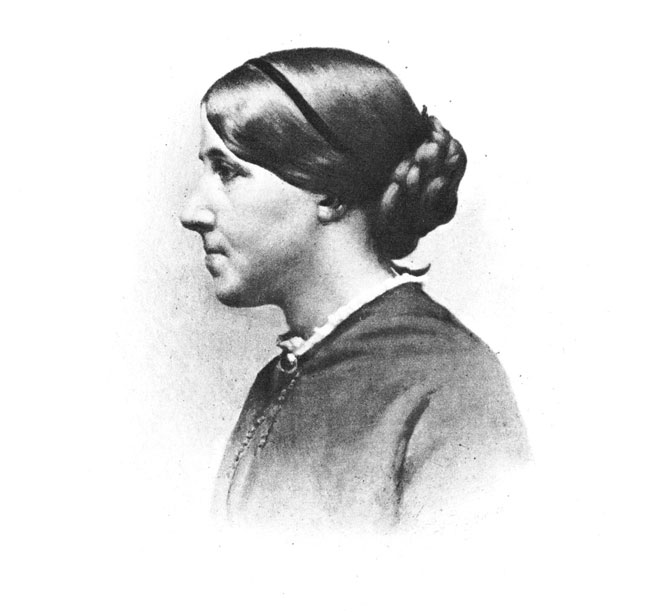
From a photograph of Miss Alcott taken about 1862.
We had all been full of courage till the last moment came; then we all broke down. I realized that I had taken my life in my hand, and might never see them all again. I said, "Shall I stay, Mother?" as I hugged her close. "No, go! and the Lord be with you!" answered the Spartan woman; and till I turned the corner she bravely smiled and waved her wet handkerchief on the door-step. Shall I ever see that dear old face again?
So I set forth in the December twilight, with May and Julian Hawthorne as escort, feeling as if I was the son of the house going to war.
Friday, the 12th, was a very memorable day, spent in running all over Boston to get my pass, etc., calling for parcels, getting a tooth filled, and buying a veil,–my only purchase. A. C. gave me some old clothes; the dear Sewalls money for myself and boys, lots of love and help; and at 5 p.m., saying "good-by" to a group of tearful faces at the station, I started on my long journey, full of hope and sorrow, courage and plans.
A most interesting journey into a new world full of stirring sights and sounds, new adventures, and an ever-growing sense of the great task I had undertaken.
I said my prayers as I went rushing through the country white with tents, all alive with patriotism, and already red with blood.
A solemn time, but I'm glad to live in it; and am sure it will do me good whether I come out alive or dead.
All went well, and I got to Georgetown one evening very tired. Was kindly welcomed, slept in my narrow bed with two other room-mates, and on the morrow began my new life by seeing a poor man die at dawn, and sitting all day between a boy with pneumonia and a man shot through the lungs. A strange day, but I did my best; and when I put mother's little black shawl round the boy while he sat up panting for breath, he smiled and said, "You are real motherly, ma'am." I felt as if I was getting on. The man only lay and stared with his big black eyes, and made me very nervous. But all were well behaved; and I sat looking at the twenty strong faces as they looked back at me,–the only new thing they had to amuse them,–hoping that I looked "motherly" to them; for my thirty years made me feel old, and the suffering round me made me long to comfort every one.
January, 1863. Union Hotel Hospital, Georgetown, D. C.–I never began the year in a stranger place than this: five hundred miles from home, alone, among strangers, doing painful duties all day long, and leading a life of constant excitement in this great house, surrounded by three or four hundred men in all stages of suffering, disease, and death. Though often homesick, heartsick, and worn out, I like it, find real pleasure in comforting, tending, and cheering these poor souls who seem to love me, to feel my sympathy though unspoken, and acknowledge my hearty good-will, in spite of the ignorance, awkwardness, and bashfulness which I cannot help showing in so new and trying a situation. The men are docile, respectful, and affectionate, with but few exceptions; truly lovable and manly many of them. John Sulie, a Virginia blacksmith, is the prince of patients; and though what we call a common man in education and condition, to me is all I could expect or ask from the first gentleman in the land. Under his plain speech and unpolished manner I seem to see a noble character, a heart as warm and tender as a woman's, a nature fresh and frank as any child's. He is about thirty, I think, tall and handsome, mortally wounded, and dying royally without reproach, repining, or remorse. Mrs. Ropes and myself love him, and feel indignant that such a man should be so early lost; for though he might never distinguish himself before the world, his influence and example cannot be without effect, for real goodness is never wasted.
Monday, 4th.–I shall record the events of a day as a sample of the days I spend:–
Up at six, dress by gaslight, run through my ward and throw up the windows, though the men grumble and shiver; but the air is bad enough to breed a pestilence; and as no notice is taken of our frequent appeals for better ventilation, I must do what I can. Poke up the fire, add blankets, joke, coax, and command; but continue to open doors and windows as if life depended upon it. Mine does, and doubtless many another, for a more perfect pestilence-box than this house I never saw,–cold, damp, dirty, full of vile odors from wounds, kitchens, wash-rooms, and stables. No competent head, male or female, to right matters, and a jumble of good, bad, and indifferent nurses, surgeons, and attendants, to complicate the chaos still more.
After this unwelcome progress through my stifling ward, I go to breakfast with what appetite I may; find the uninvitable fried beef, salt butter, husky bread, and washy coffee; listen to the clack of eight women and a dozen men,–the first silly, stupid, or possessed of one idea; the last absorbed with their breakfast and themselves to a degree that is both ludicrous and provoking, for all the dishes are ordered down the table full and returned empty; the conversation is entirely among themselves, and each announces his opinion with an air of importance that frequently causes me to choke in my cup, or bolt my meals with undignified speed lest a laugh betray to these famous beings that a "chiel's amang them takin' notes."
Till noon I trot, trot, giving out rations, cutting up food for helpless "boys," washing faces, teaching my attendants how beds are made or floors are swept, dressing wounds, taking Dr. F. P.'s orders (privately wishing all the time that he would be more gentle with my big babies), dusting tables, sewing bandages, keeping my tray tidy, rushing up and down after pillows, bed-linen, sponges, books, and directions, till it seems as if I would joyfully pay down all I possess for fifteen minutes' rest. At twelve the big bell rings, and up comes dinner for the boys, who are always ready for it and never entirely satisfied. Soup, meat, potatoes, and bread is the bill of fare. Charley Thayer, the attendant, travels up and down the room serving out the rations, saving little for himself, yet always thoughtful of his mates, and patient as a woman with their helplessness. When dinner is over, some sleep, many read, and others want letters written. This I like to do, for they put in such odd things, and express their ideas so comically, I have great fun interiorally, while as grave as possible exteriorally. A few of the men word their paragraphs well and make excellent letters. John's was the best of all I wrote. The answering of letters from friends after some one had died is the saddest and hardest duty a nurse has to do.
Supper at five sets every one to running that can run; and when that flurry is over, all settle down for the evening amusements, which consist of newspapers, gossip, the doctor's last round, and, for such as need them, the final doses for the night. At nine the bell rings, gas is turned down, and day nurses go to bed. Night nurses go on duty, and sleep and death have the house to themselves.
My work is changed to night watching, or half night and half day,–from twelve to twelve. I like it, as it leaves me time for a morning run, which is what I need to keep well; for bad air, food, and water, work and watching, are getting to be too much for me. I trot up and down the streets in all directions, sometimes to the Heights, then half way to Washington, again to the hill, over which the long trains of army wagons are constantly vanishing and ambulances appearing. That way the fighting lies, and I long to follow.
Ordered to keep my room, being threatened with pneumonia. Sharp pain in the side, cough, fever, and dizziness. A pleasant prospect for a lonely soul five hundred miles from home! Sit and sew on the boys' clothes, write letters, sleep, and read; try to talk and keep merry, but fail decidedly, as day after day goes, and I feel no better. Dream awfully, and wake unrefreshed, think of home, and wonder if I am to die here, as Mrs. R., the matron, is likely to do. Feel too miserable to care much what becomes of me. Dr. S. creaks up twice a day to feel my pulse, give me doses, and ask if I am at all consumptive, or some other cheering question. Dr. O. examines my lungs and looks sober. Dr. J. haunts the room, coming by day and night with wood, cologne, books, and messes, like a motherly little man as he is. Nurses fussy and anxious, matron dying, and everything very gloomy. They want me to go home, but I won't yet.
January 16th.–Was amazed to see Father enter the room that morning, having been telegraphed to by order of Mrs. R. without asking leave. I was very angry at first, though glad to see him, because I knew I should have to go. Mrs. D. and Miss Dix came, and pretty Miss W., to take me to Willard's to be cared for by them. I wouldn't go, preferring to keep still, being pretty ill by that time.
On the 21st I suddenly decided to go home, feeling very strangely, and dreading to be worse. Mrs. R. died, and that frightened the doctors about me; for my trouble was the same,–typhoid pneumonia. Father, Miss K., and Lizzie T. went with me. Miss Dix brought a basket full of bottles of wine, tea, medicine, and cologne, besides a little blanket and pillow, a fan, and a testament. She is a kind old soul, but very queer and arbitrary.
Was very sorry to go, and "my boys" seemed sorry to have me. Quite a flock came to see me off; but I was too sick to have but a dim idea of what was going on.
Had a strange, excited journey of a day and night,–half asleep, half wandering, just conscious that I was going home; and, when I got to Boston, of being taken out of the car, with people looking on as if I was a sight. I daresay I was all blowzed, crazy, and weak. Was too sick to reach Concord that night, though we tried to do so. Spent it at Mr. Sewall's; had a sort of fit; they sent for Dr. H., and I had a dreadful time of it.
Next morning felt better, and at four went home. Just remember seeing May's shocked face at the depot, Mother's bewildered one at home, and getting to bed in the firm belief that the house was roofless, and no one wanted to see me.
As I never shall forget the strange fancies that haunted me, I shall amuse myself with recording some of them.
The most vivid and enduring was the conviction that I had married a stout, handsome Spaniard, dressed in black velvet, with very soft hands, and a voice that was continually saying, "Lie still, my dear!" This was Mother, I suspect; but with all the comfort I often found in her presence, there was blended an awful fear of the Spanish spouse who was always coming after me, appearing out of closets, in at windows, or threatening me dreadfully all night long. I appealed to the Pope, and really got up and made a touching plea in something meant for Latin, they tell me. Once I went to heaven, and found it a twilight place, with people darting through the air in a queer way,–all very busy, and dismal, and ordinary. Miss Dix, W. H. Channing, and other people were there; but I thought it dark and "slow," and wished I hadn't come.
A mob at Baltimore breaking down the door to get me, being hung for a witch, burned, stoned, and otherwise maltreated, were some of my fancies. Also being tempted to join Dr. W. and two of the nurses in worshipping the Devil. Also tending millions of rich men who never died or got well.
February.–Recovered my senses after three weeks of delirium, and was told I had had a very bad typhoid fever, had nearly died, and was still very sick. All of which seemed rather curious, for I remembered nothing of it. Found a queer, thin, big-eyed face when I looked in the glass; didn't know myself at all; and when I tried to walk discovered that I couldn't, and cried because my legs wouldn't go.
Never having been sick before, it was all new and very interesting when I got quiet enough to understand matters. Such long, long nights; such feeble, idle days; dozing, fretting about nothing; longing to eat, and no mouth to do it with,–mine being so sore, and full of all manner of queer sensations, it was nothing but a plague. The old fancies still lingered, seeming so real I believed in them, and deluded Mother and May with the most absurd stories, so soberly told that they thought them true.
Dr. B. came every day, and was very kind. Father and Mother were with me night and day, and May sang "Birks of Aberfeldie," or read to me, to wile away the tiresome hours. People sent letters, money, kind inquiries, and goodies for the old "Nuss." I tried to sew, read, and write, and found I had to begin all over again. Received $10 for my labors in Washington. Had all my hair, a yard and a half long, cut off, and went into caps like a grandma. Felt badly about losing my one beauty. Never mind, it might have been my head, and a wig outside is better than a loss of wits inside.
March.–Began to get about a little, sitting up nearly all day, eating more regularly, and falling back into my old ways. My first job was characteristic: I cleared out my piece-bags and dusted my books, feeling as tired as if I had cleaned the whole house. Sat up till nine one night, and took no lunch at three a.m.,–two facts which I find carefully recorded in my pocket diary in my own shaky handwriting.
Father had two courses of conversations: one at Mr. Quincy's, very select and fine; the other at a hall not so good. He was tired out with taking care of me, poor old gentleman; and typhus was not inspiring.
Read a great deal, being too feeble to do much else. No end of rubbish, with a few good things as ballast. "Titan" was the one I enjoyed the most, though it tired my weak wits to read much at a time. Recalled, and wrote some lines on "Thoreau's Flute," which I composed one night on my watch by little Shaw at the hospital.
On the 28th Father came home from Boston, bringing word that Nan had a fine boy. We all screamed out when he burst in, snowy and beaming; then Mother began to cry, May to laugh, and I to say, like B. Trotwood, "There, I knew it wouldn't be a girl!" We were all so glad it was safely over, and a jolly little lad was added to the feminine family.
Mother went straight down to be sure that "mother and child were doing well," and I fell to cleaning house, as good work for an invalid and a vent for a happy aunt.
First Birth in the Alcott and Pratt Branch, 1863.
Monday Eve.
Dearest Little Mother,–Allow me to ask who was a true prophet.
Also to demand, "Where is my niece, Louisa Caroline?"
No matter, I will forgive you, and propose three cheers for my nephew. Hurrah! hurrah! Hurray!
I wish you could have seen the performance on Saturday evening.
We were all sitting deep in a novel, not expecting Father home owing to the snowstorm, when the door burst open, and in he came, all wet and white, waving his bag, and calling out, "Good news! good news! Anna has a fine boy!"
With one accord we opened our mouths and screamed for about two minutes. Then Mother began to cry; I began to laugh; and May to pour out questions; while Papa beamed upon us all,–red, damp, and shiny, the picture of a proud old Grandpa. Such a funny evening as we had! Mother kept breaking down, and each time emerged from her handkerchief saying solemnly, "I must go right down and see that baby!" Father had told every one he met, from Mr. Emerson to the coach driver, and went about the house saying, "Anna's boy! yes, yes, Anna's boy!" in a mild state of satisfaction.
May and I at once taxed our brains for a name, and decided upon "Amos Minot Bridge Bronson May Sewall Alcott Pratt," so that all the families would be suited.
I was so anxious to hear more that I went up to town this a.m. and found John's note.
Grandma and Grandpa Pratt came to hear the great news; but we could only inform them of the one tremendous fact, that Pratt, Jr., had condescended to arrive. Now tell us his weight, inches, color, etc.
I know I shall fall down and adore when I see that mite; yet my soul is rent when I think of the L. C. on the pincushion, and all the plans I had made for "my niece."
Now get up quickly, and be a happy mamma. Of course John does not consider his son as the most amazing product of the nineteenth century.
Bless the baby!
Ever your admiring Lu.
April.–Had some pleasant walks and drives, and felt as if born again, everything seemed so beautiful and new. I hope I was, and that the Washington experience may do me lasting good. To go very near to death teaches one to value life, and this winter will always be a very memorable one to me.
Sewed on little shirts and gowns for my blessed nephew, who increased rapidly in stature and godliness.
Sanborn asked me to do what Conway suggested before he left for Europe; viz., to arrange my letters in a printable shape, and put them in the "Commonwealth." They thought them witty and pathetic. I didn't; but I wanted money; so I made three hospital sketches. Much to my surprise, they made a great hit; and people bought the papers faster than they could be supplied. The second, "A Night" was much liked, and I was glad; for my beautiful "John Sulie" was the hero, and the praise belonged to him. More were wanted; and I added a postscript in the form of a letter, which finished it up, as I then thought.
Received $100 from F. L. for a tale which won the prize last January; paid debts, and was glad that my winter bore visible fruit. Sent L. another tale. Went to Boston, and saw "our baby;" thought him ugly, but promising. Got a set of furniture for my room,–a long-talked-of dream of ours.
May.–Spent the first week or two in putting the house in order. May painted and papered the parlors. I got a new carpet and rug besides the paper, and put things to rights in a thorough manner. Mother was away with Nan, so we had full sweep; and she came home to a clean, fresh house.
Nan and the Royal Infanta came as bright as a whole gross of buttons, and as good as a hairless brown angel. Went to Readville, and saw the 54th Colored Regiment, both there and next day in town as they left for the South. Enjoyed it very much; also the Antislavery meetings.
Had a fresh feather in my cap; for Mrs. Hawthorne showed Fields "Thoreau's Flute," and he desired it for the "Atlantic." Of course I didn't say no. It was printed, copied, praised, and glorified; also paid for, and being a mercenary creature, I liked the $10 nearly as well as the honor of being "a new star" and "a literary celebrity."
June.–Began to write again on "Moods," feeling encouraged by the commendation bestowed on "Hospital Sketches," which were noticed, talked of, and inquired about, much to my surprise and delight. Had a fine letter from Henry James, also one from Wasson, and a request from Redpath to be allowed to print the sketches in a book. Roberts Bros. also asked, but I preferred the Redpath, and said yes; so he fell to work with all his might.
Went to Class Day for the first time; had a pleasant day seeing new sights and old friends.
G. H. came to the H.'s. Didn't like her as well as Miss H.; too sharp and full of herself; insisted on talking about religion with Emerson, who glided away from the subject so sweetly, yet resolutely, that the energetic lady gave it up at last.
[1877.–Short-sighted Louisa! Little did you dream that this same Roberts Bros. were to help you to make your fortune a few years later. The "Sketches" never made much money, but showed me "my style," and taking the hint, I went where glory waited me.–L. M. A.]
July.–Sanborn asked for more contributions, and I gave him some of my old Mountain Letters vamped up. They were not good, and though they sold the paper, I was heartily ashamed of them, and stopped in the middle, resolving never again to try to be funny, lest I should be rowdy and nothing more. I'm glad of the lesson, and hope it will do me good.
Had some pleasant letters from Sergeant Bain,–one of my boys who has not forgotten me, though safely at home far away in Michigan. It gratified me very much, and brought back the hospital days again. He was a merry, brave little fellow, and I liked him very much. His right arm was amputated after Fredericksburg, and he took it very cheerfully, trying at once to train his left hand to do duty for both, and never complained of his loss. "Baby B."
August.–Redpath carried on the publishing of the "Sketches" vigorously, sending letters, proof, and notices daily, and making all manner of offers, suggestions, and prophecies concerning the success of the book and its author.
Wrote a story, "My Contraband," and sent it to Fields, who accepted and paid $50 for it, with much approbation for it and the "Sketches." L. sent $40 for a story, and wanted another.
Major M. invited me to Gloucester; but I refused, being too busy and too bashful to be made a lion of, even in a very small way. Letters from Dr. Hyde, Wilkie (home with a wound from Wagner), Charles Sumner, Mr. Hale, and others,–all about the little "Sketches," which keep on making friends for me, though I don't get used to the thing at all, and think it must be all a mistake.
On the 25th my first morning-glory bloomed in my room,–a hopeful blue,–and at night up came my book in its new dress. I had added several chapters to it, and it was quite a neat little affair. An edition of one thousand, and I to have five cents on each copy.
September.–Redpath anxious for another book. Send him a volume of stories and part of a book to look at. He likes both; but I decide on waiting a little, as I'm not satisfied with the stories, and the novel needs time. "Sketches" sell well, and a new edition is called for.
Dear old Grandma died at Aunt Betsey's in her eighty-ninth year,–a good woman, and much beloved by her children. I sent money to help lay her away; for Aunt B. is poor, and it was all I could do for the kind little old lady.
Nan and Freddy made us a visit, and we decided that of all splendid babies he was the king. Such a hearty, happy, funny boy, I could only play with and adore him all the while he stayed, and long for him when he went. Nan and John are very fond of "our son," and well they may be. Grandma and Grandpa think him perfect, and even artistic Aunty May condescends to say he is "a very nice thing."
"My Contraband; or, The Brothers," my story in the "Atlantic," came out, and was liked. Received $40 from Redpath for "Sketches,"–first edition; wanted me to be editor of a paper; was afraid to try, and let it go.
Poor old "Moods" came out for another touching up.
October.–Thought much about going to Port Royal to teach contrabands. Fields wanted the letters I should write, and asked if I had no book. Father spoke of "Moods," and he desired to see it. So I fell to work, and finished it off, thinking the world must be coming to an end, and all my dreams getting fulfilled in a most amazing way. If there was ever an astonished young woman, it is myself; for things have gone on so swimmingly of late I don't know who I am. A year ago I had no publisher, and went begging with my wares; now three have asked me for something, several papers are ready to print my contributions, and F. B. S. says "any publisher this side of Baltimore would be glad to get a book." There is a sudden hoist for a meek and lowly scribbler, who was told to "stick to her teaching," and never had a literary friend to lend a helping hand! Fifteen years of hard grubbing may be coming to something after all; and I may yet "pay all the debts, fix the house, send May to Italy, and keep the old folks cosey," as I've said I would so long, yet so hopelessly.
May began to take anatomical drawing lessons of Rimmer. I was very glad to be able to pay her expenses up and down and clothe her neatly. Twenty dollars more from Redpath on account.
December.–Earnings 1863, $380.
The principal event of this otherwise quiet month was the Sanitary Fair in Boston, and our part in it. At G. G. B.'s request, I dramatized six scenes from Dickens, and went to town on the 14th to play. Things did not go well for want of a good manager and more time. Our night was not at all satisfactory to us, owing to the falling through of several scenes for want of actors. People seemed to like what there was of it, and after a wearisome week I very gladly came home again. Our six entertainments made twenty-five hundred dollars for the Fair.
Rewrote the fairy tales, one of which was published; but owing to delays it was late for the holidays, and badly bound in the hurry; so the poor "Rose Family" fared badly.
Had a letter from the publisher of a new magazine, called the "Civil Service Magazine," asking for a long tale. Had no time to write one; but will by and by, if the thing is good.
While in town received $10 of F. B. S. and $20 of Redpath, with which I bought May hat, boots, gloves, ribbons, and other little matters, besides furnishing money for her fares up and down to Rimmer.
January, 1864.–New Year's Day was a very quiet one. Nan and Freddy were here, and in the evening we went to a dance at the hall. A merry time; for all the town was there, as it was for the Soldiers' Aid Society, and every one wanted to help. Nan and I sat in the gallery, and watched the young people dance the old year out, the new year in as the clock struck twelve.
On looking over my accounts, I find I have earned by my writing alone nearly six hundred dollars since last January, and spent less than a hundred for myself, which I am glad to know. May has had $70 for herself, and the rest has paid debts or bought necessary things for the family.
Received from the "Commonwealth" $18 for "A Hospital Christmas." Wrote a fairy tale, "Fairy Pinafores." "Picket Duty" and other tales came out,–first of Redpath's series of books for the "Camp Fires." Richardson sent again for a long story for the "Civil Service Magazine." Tried a war story, but couldn't make it go.
February.–Nan quite sick again. Mother passed most of the month with her; so I had to be housekeeper, and let my writing go,–as well perhaps, as my wits are tired, and the "divine afflatus" don't descend as readily as it used to do. Must wait and fill up my idea-box before I begin again. There is nothing like work to set fancy a-going.
Redpath came flying up on the 4th to get "Moods," promising to have it out by May. Gave it to him with many fears, and he departed content. The next day received a telegram to come down at once and see the printers. Went, and was told the story was too long for a single volume, and a two-volume novel was bad to begin with. Would I cut the book down about half? No, I wouldn't, having already shortened it all it would bear. So I took my "opus" and posted home again, promising to try and finish my shorter book in a month.
A dull, heavy month, grubbing in the kitchen, sewing, cleaning house, and trying to like my duty.
Mrs. S. takes a great fancy to May; sends her flowers, offers to pay for her to go to the new Art School, and arranges everything delightfully for her. She is a fortunate girl, and always finds some one to help her as she wants to be helped. Wish I could do the same, but suppose as I never do that it is best for me to work and wait and do all for myself.
Mr. Storrs, D.D., wrote for a sketch for his little paper, "The Drum Beat," to be printed during the Brooklyn Sanitary Fair. A very cordial, pleasant letter, which I answered by a little sketch called "A Hospital Lamp." He sent me another friendly letter, and all the daily papers as they came out. A very gentlemanly D.D. is Dr. Storrs.
The "Hospital Sketches" were fully entitled to their wide and rapid popularity; and for the first time perhaps Miss Alcott felt sure of her vocation, and knew that it would bring at last the success which would enable her to carry out her plans for the family. And yet the battle was not over. She gained in reputation, was received with great attention in society, and lionized more than she cared for. But she still continued writing stories for the various papers at very low prices. Some of them were refused by the publishers, as she thinks, on account of the Antislavery sentiments expressed in them. Her "blood and thunder" stories continued in demand, and she wrote them rapidly, and was glad of the money they brought. But she had not yet found her true path, and she suffered at times from keen depression of spirits; for the way seemed long and dark, and she did not see the end. In more than one sense she struggled with Moods; for that unhappy book was still tossed from publisher to publisher, who gave her much praise, but no satisfaction.
Journal.
A busy month getting settled. Freddy's birthday on the 28th, one year old. He had a dozen nice little presents laid out in a row when he came down to breakfast, and seemed quite overpowered with his riches. On being told to take what he liked best, he chose the picture of little Samuel which Father gave him, and the good pope was much delighted at that.
Was asked for a poem for the great album at the St. Louis Fair, and sent "Thoreau's Flute" as my best. Also received a letter from the Philadelphia managers asking contributions for the paper to be printed at their Fair.
Wrote nothing this month.
April.–At Father's request I sent "Moods" to T., and got a very friendly note from him, saying they had so many books on hand that they could do nothing about it now. So I put it back on the shelf, and set about my other work. Don't despair, "Moods," we'll try again by and by!
[Alas! we did try again.–L. M. A.]
Wrote the first part of a story for Professor C. called "Love and Loyalty,"–flat, patriotic, and done to order. Wrote a new fairy tale, "Nelly's Hospital."
May.–Had a letter from Mrs. Gildersleeve, asking for my photograph and a sketch of my life, for a book called "Heroic Women" which she was getting up. Respectfully refused. Also a letter and flattering notice from "Ruth Hall," and a notice from a Chicago critic with a long extract from "Rose Family." My tale "Enigmas" came out, and was much liked by readers of sensation rubbish. Having got my $50, I was resigned.
June.–To town with Father on the 3d to a Fraternity Festival to which we were invited. Had a fine time, and was amazed to find my "'umble" self made a lion of, set up among the great ones, stared at, waited upon, complimented, and made to hold a "layvee" whether I would or no; for Mr. S. kept bringing up people to be introduced till I was tired of shaking hands and hearing the words "Hospital Sketches" uttered in every tone of interest, admiration, and respect. Mr. Wasson, Whipple, Alger, Clarke, Calthrop, and Chadwick came to speak to me, and many more whose names I forget. It was a very pleasant surprise and a new experience. I liked it, but think a small dose quite as much as is good for me; for after sitting in a corner and grubbing à la Cinderella, it rather turns one's head to be taken out and be treated like a princess all of a sudden.
August.–Went to Gloucester for a fortnight with May at the M.'s. Found a family of six pretty daughters, a pleasant mother, and a father who was an image of one of the Cheeryble brothers. Had a jolly time boating, driving, charading, dancing, and picnicking. One mild moonlight night a party of us camped out on Norman's Woe, and had a splendid time, lying on the rocks singing, talking, sleeping, and rioting up and down. Had a fine time, and took coffee at all hours. The moon rose and set beautifully, and the sunrise was a picture I never shall forget.
Wrote another fairy tale, "Jamie's Wonder Book," and sent the "Christmas Stories" to W. & W., with some lovely illustrations by Miss Greene. They liked the book very much, and said they would consult about publishing it, though their hands were full.
September.–Mrs. D. made a visit, and getting hold of my old book of stories liked them, and insisted on taking "Moods" home to read. As she had had experience with publishers, was a good business woman, and an excellent critic, I let her have it, hoping she might be able to give the poor old book the lift it has been waiting for all these years. She took it, read it, and admired it heartily, saying that "no American author had showed so much promise; that the plan was admirable; the execution unequal, but often magnificent; that I had a great field before me, and my book must be got out."
Mrs. D. sent it to L., who liked it exceedingly, and asked me to shorten it if I could, else it would be too large to sell well. Was much disappointed, said I'd never touch it again, and tossed it into the spidery little cupboard where it had so often returned after fruitless trips.
At last, in the excited hours of a wakeful night, Miss Alcott thought of a way to curtail the objectionable length of the book, and she spent a fortnight in remodelling it,–as she then thought improving it greatly,–although she afterwards returned to her original version as decidedly the best. The book was brought out, and she had the pleasure of presenting the first copy to her mother on her sixty fourth birthday. She had various projects in her mind, one of which was a novel, with two characters in it like Jean Paul Richter and Goethe. It is needless to say this was never carried out. Miss Alcott had great powers of observation, and a keen insight into character as it fell within her own range of life, but she had not the creative imagination which could paint to the life the subtlest workings of thought and feeling in natures foreign to her own experience. She could not have portrayed such men: but who could?
Journal.
October.–Wrote several chapters of "Work," and was getting on finely, when, as I lay awake one night, a way to shorten and arrange "Moods" came into my head. The whole plan laid itself smoothly out before me, and I slept no more that night, but worked on it as busily as if mind and body had nothing to do with one another. Up early, and began to write it all over again. The fit was on strong, and for a fortnight I hardly ate, slept, or stirred, but wrote, wrote, like a thinking machine in full operation. When it was all rewritten without copying, I found it much improved, though I'd taken out ten chapters, and sacrificed many of my favorite things; but being resolved to make it simple, strong, and short, I let everything else go, and hoped the book would be better for it.
[It wasn't. 1867.]
Sent it to L.; and a week after, as I sat hammering away at the parlor carpet,–dusty, dismal, and tired,–a letter came from L. praising the story more enthusiastically than ever, thanking me for the improvements, and proposing to bring out the book at once. Of course we all had a rapture, and I finished my work "double quick," regardless of weariness, toothache, or blue devils.
Next day I went to Boston and saw L. A brisk, business-like man who seemed in earnest and said many complimentary things about "Hospital Sketches" and its author. It was agreed to bring out the book immediately, and Mrs. D. offered to read the proof with me.
Was glad to have the old thing under way again, but didn't quite believe it would ever come out after so many delays and disappointments.
Sewed for Nan and Mary, heard Anna Dickinson and liked her. Read "Emily Chester" and thought it an unnatural story, yet just enough like "Moods" in a few things to make me sorry that it came out now.
On Mother's sixty-fourth birthday I gave her "Moods" with this inscription,–"To Mother, my earliest patron, kindest critic, dearest reader, I gratefully and affectionately inscribe my first romance."
A letter from T. asking me to write for the new magazine "Our Young Folks," and saying that "An Hour" was in the hands of the editors.
November.–Proof began to come, and the chapters seemed small, stupid, and no more my own in print. I felt very much afraid that I'd ventured too much and should be sorry for it. But Emerson says "that what is true for your own private heart is true for others." So I wrote from my own consciousness and observation and hope it may suit some one and at least do no harm.
I sent "An Hour" to the "Commonwealth" and it was considered excellent. Also wrote a Christmas Story, "Mrs. Todger's Teapot." T. asked to see the other fairy tales and designs and poems, as he liked "Nelly's Hospital" so much.
On my thirty-second birthday received Richter's Life from Nan and enjoyed it so much that I planned a story of two men something like Jean Paul and Goethe, only more every-day people. Don't know what will come of it, but if "Moods" goes well "Success" shall follow.
Sewed for Wheeler's colored company and sent them comfort-bags, towels, books, and bed-sacks. Mr. W. sent me some relics from Point Look Out and a pleasant letter.
December.–Earnings, 1864,–$476.
On Christmas Eve received ten copies of "Moods" and a friendly note from L. The book was hastily got out, but on the whole suited me, and as the inside was considered good I let the outside go. For a week wherever I went I saw, heard, and talked "Moods;" found people laughing or crying over it, and was continually told how well it was going, how much it was liked, how fine a thing I'd done. I was glad but not proud, I think, for it has always seemed as if "Moods" grew in spite of me, and that I had little to do with it except to put into words the thoughts that would not let me rest until I had. Don't know why.
By Saturday the first edition was gone and the second ready. Several booksellers ordered a second hundred, the first went so fast, and friends could not get it but had to wait till more were ready.
Spent a fortnight in town at Mary's, shopping, helping Nan, and having plays. Heard Emerson once. Gave C. "Mrs. Todger's Teapot," which was much liked. Sent L. the rest of his story and got $50. S. paid $35 for "An Hour." R. promised $100 for "Love and Loyalty," so my year closes with a novel well-launched and about $300 to pay debts and make the family happy and comfortable till spring. Thank God for the success of the old year, the promise of the new!
The sale of "Moods" was at first very rapid; for "Hospital Sketches" had created an interest in the author, and welcome recognition came to her from many sources. She received a handsome sum from the copyright, and "the year closed with enough to make her feel free of debt and the family comfortable." She ends the year's journal triumphantly.
The following year was spent mostly in Boston. Miss Alcott went into society and enjoyed the friendly attentions of men and women of ability. She continued to write stories for money, but now received fifty, seventy-five, or a hundred dollars for them. She frequently took part in theatrical performances for charities. She was always brilliant and successful and enjoyed them with something of her early zest.
Her long story of "Success," or "Work," as she afterwards named it, was still in her mind, but she did not finish it at this time.
Journal.
January, 1865.–The month began with some plays at the town hall to raise funds for the Lyceum. We did very well and some Scenes from Dickens were excellent. Father lectured and preached a good deal, being asked like a regular minister and paid like one. He enjoyed it very much and said good things on the new religion which we ought to and shall have. May had orders from Canada and England for her pretty pen-and-ink work and did well in that line.
Notices of "Moods" came from all directions, and though people didn't understand my ideas owing to my shortening the book so much, the notices were mostly favorable and gave quite as much praise as was good for me. I had letters from Mrs. Parker, Chadwick, Sanborn, E. B. Greene, the artist, T. W. Higginson and some others. All friendly and flattering.
Saw more notices of "Moods" and received more letters, several from strangers and some very funny. People seemed to think the book finely written, very promising, wise, and interesting; but some fear it isn't moral, because it speaks freely of marriage.
Wrote a little on poor old "Work" but being tired of novels, I soon dropped it and fell back on rubbishy tales, for they pay best, and I can't afford to starve on praise, when sensation stories are written in half the time and keep the family cosey.
Earned $75 this month.
I went to Boston and heard Father lecture before the Fraternity. Met Henry James, Sr., there, and he asked me to come and dine, also called upon me with Mrs. James. I went, and was treated like the Queen of Sheba. Henry Jr. wrote a notice of "Moods" for the "North American," and was very friendly. Being a literary youth he gave me advice, as if he had been eighty and I a girl. My curly crop made me look young, though thirty-one.
Acted in some public plays for the N. E. Women's Hospital and had a pleasant time.
L. asked me to be a regular contributor to his new paper, and I agreed if he'd pay beforehand; he said he would, and bespoke two tales at once, $50 each, longer ones as often as I could, and whatever else I liked to send. So here's another source of income and Alcott brains seem in demand, whereat I sing "Hallyluyer" and fill up my inkstand.
April.–Richmond taken on the 2d. Hurrah! Went to Boston and enjoyed the grand jollification. Saw Booth again in Hamlet and thought him finer than ever. Had a pleasant walk and talk with Phillips.
On the 15th in the midst of the rejoicing came the sad news of the President's assassination, and the city went into mourning. I am glad to have seen such a strange and sudden change in a nation's feelings. Saw the great procession, and though few colored men were in it, one was walking arm in arm with a white gentleman, and I exulted thereat.
Nan went to housekeeping in a pleasant house at Jamaica Plain, and I went to help her move. It was beautiful to see how Freddy enjoyed the freedom, after being cooped up all winter, and how every morning, whether it rained or shone, he looked out and said, with a smile of perfect satisfaction, "Oh, pretty day!"–for all days were pretty to him, dear little soul!
Had a fine letter from Conway, and a notice in the "Reader,"–an English paper. He advised sending copies to several of the best London papers. English people don't understand "transcendental literature," as they call "Moods." My next book shall have no ideas in it, only facts, and the people shall be as ordinary as possible; then critics will say it's all right. I seem to have been playing with edge tools without knowing it. The relations between Warwick, Moor, and Sylvia are pronounced impossible; yet a case of the sort exists, and the woman came and asked me how I knew it. I did not know or guess, but perhaps felt it, without any other guide, and unconsciously put the thing into my book, for I changed the ending about that time. It was meant to show a life affected by moods, not a discussion of marriage, which I knew little about, except observing that very few were happy ones.
June.–Busy writing, keeping house, and sewing. Company often; and strangers begin to come, demanding to see the authoress, who does not like it, and is porcupiny. Admire the books, but let the woman alone, if you please, dear public!
On the 24th Anna's second boy was born, at half-past three in the morning,–Lizzie's birthday. A fine, stout, little lad, who took to life kindly, and seemed to find the world all right. Freddy could not understand it at first, and told his mother that "the babee" had got his place. But he soon loved the "tunning sing," and would stand watching it with a grave face, till some funny little idea found vent in still funnier words or caresses.
Nan was very happy with her two boys, so was John, though both had wished for a daughter.
July.–While at Nan's Mrs. B. asked me if I would go abroad with her sister. I said "yes;" but as I spoke neither French nor German, she didn't think I'd do. I was sorry; but being used to disappointment, went to work for Nan, and bided my time, which came very soon.
To Anna.
[Date uncertain.]
My Lass,–This must be a frivolous and dressy letter, because you always want to know about our clothes, and we have been at it lately. May's bonnet is a sight for gods and men. Black and white outside, with a great cockade boiling over the front to meet a red ditto surging from the interior, where a red rainbow darts across the brow, and a surf of white lace foams up on each side. I expect to hear that you and John fell flat in the dust with horror on beholding it.
My bonnet has nearly been the death of me; for, thinking some angel might make it possible for me to go to the mountains, I felt a wish for a tidy hat, after wearing an old one till it fell in tatters from my brow. Mrs. P. promised a bit of gray silk, and I built on that; but when I went for it I found my hat was founded on sand; for she let me down with a crash, saying she wanted the silk herself, and kindly offering me a flannel petticoat instead. I was in woe for a spell, having one dollar in the world, and scorning debt even for that prop of life, a "bonnet." Then I roused myself, flew to Dodge, demanded her cheapest bonnet, found one for a dollar, took it, and went home wondering if the sky would open and drop me a trimming. I am simple in my tastes, but a naked straw bonnet is a little too severely chaste even for me. Sky did not open; so I went to the "Widow Cruise's oil bottle"–my ribbon box–which, by the way, is the eighth wonder of the world, for nothing is ever put in, yet I always find some old dud when all other hopes fail. From this salvation bin I extracted the remains of the old white ribbon (used up, as I thought, two years ago), and the bits of black lace that have adorned a long line of departed hats. Of the lace I made a dish, on which I thriftily served up bows of ribbon, like meat on toast. Inside put the lace bow, which adorns my form anywhere when needed. A white flower A. H. gave me sat airily on the brim,–fearfully unbecoming, but pretty in itself, and in keeping. Strings are yet to be evolved from chaos. I feel that they await me somewhere in the dim future. Green ones pro tem. hold this wonder of the age upon my gifted brow, and I survey my hat with respectful awe. I trust you will also, and see in it another great example of the power of mind over matter, and the convenience of a colossal brain in the primeval wrestle with the unruly atoms which have harassed the feminine soul ever since Eve clapped on a modest fig-leaf and did up her hair with a thorn for a hairpin.
I feel very moral to-day, having done a big wash alone, baked, swept the house, picked the hops, got dinner, and written a chapter in "Moods." May gets exhausted with work, though she walks six miles without a murmur.
It is dreadfully dull, and I work so that I may not "brood." Nothing stirring but the wind; nothing to see but dust; no one comes but rose-bugs; so I grub and scold at the "A." because it takes a poor fellow's tales and keeps 'em years without paying for 'em. If I think of my woes I fall into a vortex of debts, dishpans, and despondency awful to see. So I say, "every path has its puddle," and try to play gayly with the tadpoles in my puddle, while I wait for the Lord to give me a lift, or some gallant Raleigh to spread his velvet cloak and fetch me over dry shod.
L. W. adds to my woe by writing of the splendors of Gorham, and says, "When tired, run right up here and find rest among these everlasting hills." All very aggravating to a young woman with one dollar, no bonnet, half a gown, and a discontented mind. It's a mercy the mountains are everlasting, for it will be a century before I get there. Oh, me, such is life!
Now I've done my Jeremiad, and I will go on twanging my harp in the "willow tree."
You ask what I am writing. Well, two books half done, nine stories simmering, and stacks of fairy stories moulding on the shelf. I can't do much, as I have no time to get into a real good vortex. It unfits me for work, worries Ma to see me look pale, eat nothing, and ply by night. These extinguishers keep genius from burning as I could wish, and I give up ever hoping to do anything unless luck turns for your
Lu.
CHAPTER VIII.
EUROPE AND LITTLE WOMEN.
LITTLE WOMEN.
Four little chests all in a row, Dim with dust and worn by time, All fashioned and filled long ago By children now in their prime. Four little keys hung side by side, With faded ribbons, brave and gay When fastened there with childish pride Long ago on a rainy day. Four little names, one on each lid, Carved out by a boyish hand; And underneath there lieth hid Histories of the happy band Once playing here, and pausing oft To hear the sweet refrain That came and went on the roof aloft In the falling summer rain. Four little chests all in a row, Dim with dust and worn by time: Four women, taught by weal and woe To love and labor in their prime; Four sisters parted for an hour,– None lost, one only gone before, Made by love's immortal power Nearest and dearest evermore. Oh! when these hidden stores of ours Lie open to the Father's sight, May they be rich in golden hours,– Deeds that show fairer for the light, Deeds whose brave music long shall ring Like a spirit-stirring strain, Souls that shall gladly soar and sing In the long sunshine, after rain.
THE years which followed the war and Miss Alcott's experience as a hospital nurse were rather sad and anxious from many causes. Louisa felt deeply the loss of one sister by death and the separation from another by marriage. The success of "Hospital Sketches" and a few other stories published about the same time had given her confidence in her powers and hopes of a successful future. But for nearly five years she accomplished nothing which met with equal favor. The reception of the novel "Moods," in which she thought she had expressed her best life, was not cheering to her; and she had become wholly dissatisfied with the sensational stories, which formed the most ready resource for earning money. Her health was seriously injured by the fever from which she suffered in the hospital, and she had no longer the physical energy to sustain the unceasing activity of her brain.
Under these difficulties she naturally desired a change of circumstances; and the old longing for a journey to Europe–which she had felt strongly in her youth, and which, like all Americans of culture, she felt more and more as time passed on–became her ruling desire. She was very fond of new scenes and variety of people, and she often expressed a wish to live many years in Europe.
The circumstances of the family were not yet such as to justify Louisa, in her own eyes, in taking her earnings for the desired trip. But in 1865 an opportunity was offered her to go to Europe as companion to an invalid lady. From her experience in nursing–for which she had a natural gift–she and her friends thought her suited to the position, and advised her acceptance of the offer.
Although devotedly kind, unselfish, and generous, Louisa had not the temperament suited to the needs of a nervous invalid. She was impetuous and impatient, and her own life was too strong within her and too earnest in its cravings, for her to restrain her moods and actions within the narrow limits of a companion's service. She found even what she recognized as fair services wearisome and distasteful, and sometimes chafed severely under what seemed unnecessary demands on her time, strength, and patience. Looking back on this experience in later years, she recognized these facts, and wrote in 1885: "Now, being a nervous invalid myself, I understand what seemed whims, selfishness, and folly in others."
Louisa finally decided to leave her companions and go on alone to Paris and England, where she would find many of her own and her father's friends. At Vevay she had made the acquaintance of a young Polish lad, whom she found very interesting, and who was the original of the charming Laurie in "Little Women." He met her again in Paris, and contributed greatly to the pleasure of her stay there. He afterwards came to America, and visited her; but finally returned to his own country.
The journal gives a sufficient account of her life while on this journey. I have no letters written at this time, as she wished all her family letters destroyed. Her few weeks in London passed very happily. Her wide reading in English history and in contemporary fiction, especially the works of Dickens and Thackeray, filled London with interesting associations, and she enjoyed thoroughly her free rambles through the old city, as well as the interesting people, who received her with great kindness.
That Louisa might have these few weeks of entire relaxation and enjoyment, her mother had been obliged to borrow means for the support of the family; and Louisa was very anxious to clear off this debt like all others. She was very exact in pecuniary matters. Money to her was not an end, but a most necessary means. She paid every debt that her father had incurred, even though outlawed by time. It is often asked whether she ever sold her beautiful hair, as represented in "Little Women." The deed was never really done; but she and her sisters always held this treasure as a possible resource in case of need; and Louisa once says in her journal, "I will pay my debts, if I have to sell my hair to do it." She even went so far as to inquire of a barber as to its money value.
Journal.
1865.–Mr. W., hearing that I was something of a nurse and wanted to travel, proposed my going with his invalid daughter. I agreed, though I had my doubts. But every one said "Go;" so after a week of worry I did go. On the 19th we sailed in the "China." I could not realize that my long-desired dream was coming true; and fears that I might not see all the dear home faces when I came back made my heart very full as we steamed down the harbor and Boston vanished.
Was not very sick, but uncomfortable all the way, and found the Ladies' Saloon my only refuge till we were nearly across; enjoyed intervals of quiet, and had many fine glimpses of the sea in its various moods, sunsets and sunrises, fogs, icebergs, rain-storms, and summer calms. No very pleasant people on board; so I read, took notes, and wiled away the long days as I best could.
We had a very quiet and quick passage of nine days, and on Saturday, the 29th, steamed up the Mersey at dawn, and got to Liverpool at nine. I was heartily glad to set my feet on the solid earth, and thought I'd never go to sea again; rested, and looked about a little.
August.–Went up to London, and there spent four dull, drizzly days. I amused myself in my usual way, looking well about me, and writing down all I saw in my pocket-diary or letters. Went to the parks, Westminster Abbey, and some of the famous streets. I felt as if I'd got into a novel while going about in the places I'd read so much of; saw no one I knew, and thought English weather abominable.
On the 5th to Dover through a lovely green country; took steamer there to Ostende; but was ill all the way, and saw nothing but a basin; spent two days at a queer hotel near the fine promenade, which was a very foreign and brilliant scene. To Brussels on the 7th. Here I enjoyed much, for the quaint old city was full of interesting things. The ancient square, where the statues of Egmont and Horn stand, was my delight; for the old Dutch houses were still standing, and everything was so new and strange I wanted to stay a month.
To Cologne on the 9th, and the country we passed through was like a big picture-book. The city was very hot, dirty, and evil-smelling. We saw the Cathedral, got eau de Cologne, and very gladly left after three days.
On the 12th began a lovely voyage up the Rhine. It was too beautiful to describe, so I shall not try; but I feel richer and better for that memorable day. We reached Coblenz at sunset, and I was up half the night enjoying the splendid view of the fortress opposite the town, the moonlit river with its bridges of boats, and troops crossing at midnight.
A second day, still more charming, took us through the famous parts of the Rhine, and filled my head with pictures that will last all my life.
Before we reached Bieberich we stopped at a queer little Dutch town, and had a queer time; for no one spoke English, and we only a little bad French. Passed the night there, and next day reached Schwalbach after many trials and tribulations.
The place is a narrow valley shut in by high hills, the town being divided into two parts: the lowest is the original town–queer ale-houses, churches, and narrow streets; the upper part, near the springs, is full of fine hotels, pleasure-grounds, and bath-houses.
We took lodgings with Madame Genth, wife of the Forestmeister (forest master),–two rooms,–and began the water under Dr. Genth's care.
We walked a little, talked a little, bathed and rode a little, worried a good deal, and I grubbed away at French, with no master and small success.
September.–Still at Schwalbach, A. doing her best to get well, and I doing mine to help her. Rather dull days,–bathing, walking, and quiddling about.
A letter from home on the 20th. All well and happy, thank God. It touched and pleased me very much to see how they missed me, thought of me, and longed to have me back. Every little thing I ever did for them is now so tenderly and gratefully remembered; and my absence seems to have left so large a gap that I begin to realize how much I am to them in spite of all my faults. The letters made me very happy, and everything brightened immensely. A. got stronger, and when G. came on the 28th was able to start off next day on the way to Vevay, where we are to pass some weeks before we are to go to Nice.
Went to Wiesbaden first, a pleasant, gay place, full of people. Saw the gambling hall and people playing, the fine grounds and drives, and then went on to Frankfort. Here I saw and enjoyed a good deal. The statues of Goethe, Schiller, Faust, Gutenberg, and Schaeffer are in the squares. Goethe's house is a tall, plain building, with each story projecting over the lower, and a Dutch roof; a marble slab over the front door recording the date of Goethe's birth. I took a look at it and wanted to go in, as it was empty, but there was no time. Some Americans said, "Who was Goethe, to fuss about?"
Frankfort is a pleasant old city on the river, and I'm glad to have been there.
October.–On to Heidelberg, a charming old place surrounded by mountains. We went to the Castle and had a fine time roving about the ruins, looking at the view from the great terrace, admiring the quaint stone images of knights, saints, monsters, and angels, and visiting the big tun in the cellar by torchlight.
The moon rose while we were there and completed the enchantment of the scene.
The drive home was like looking at a picture-book, for the street was narrow, the carriage high, and we looked in at the windows, seeing pretty scenes. Here, men drinking beer in a Dutch-looking room; there, little children going to bed; a pair of lovers with a pot of flowers between them; an old woman brooding over the fire like a witch; and in one room some one lay dead surrounded by candles.
From H. we went to Baden-Baden, a very fashionable place. The old château was my delight, and we passed a morning going up and down to visit it. Next to Freiburg, where the Cathedral delighted me extremely, being full of old carved images and grotesque designs; the market-place with the fountains, statues, water running beside the streets, and queer costumes.
Basle came next, and a firemen's fête made the city very gay. The hotel was on the river, and moonlight made a Venetian scene for me with the lighted bridge, covered with gondola-like boats and music from both shores. I walk while A. rests, and enjoy sights from my window when she is asleep, as I cannot leave her at night.
On our way to Berne I caught my first glimpse of the Alps, October 8th, mother's birthday. Tall, white, spectral-looking shapes they were, towering above the green hills and valleys that lay between. Clouds half hid them, and the sun glittered on the everlasting snow that lay upon their tops. Sharp, strange outlines against the sky they became as night came on, and in the morning I had a fine view of the Jungfrau, the Blümlis, the Wetterhorn, and Mönch from the terrace at Berne.
B. was a queer old city, but I saw little of it except the bears and shops. No time.
Freiburg No. 2 was the most romantic place we have been in. The town is built in a wide crevice or valley between two steep hills, so that suspension bridges are hung from height to height over a winding river and the streets of the town. Watch-towers stand all about on the hills, and give a very romantic air to the place. The hotel overhung the valley, and from our rooms we went out along a balcony to a wide, paved platform with a fountain in the middle, an aviary, and flowers all about. The view down the valley was charming,–the airy bridges, green or rocky slopes, busy squares below, cows and goats feeding on the hills, the towers, the old church, and a lovely blue sky overhead. I longed to sketch it.
At Lausanne we stopped at the Hotel Gibbon and saw the garden where the great historian wrote his history. The view of the lake was lovely, with rocky mountains opposite, little towns at their feet, vineyards along the hillsides, and pretty boats on the lake, the water of which was the loveliest blue.
To Vevay at last,–a pleasant hour's sail to a very pleasant place. We took rooms at the Pension Victoria.
Our landlady was an English woman who had married a French courier. Very kind sort of people: rooms comfortable, meals good, and surroundings agreeable. Our fellow-boarders varied from time to time,–an English doctor and wife, a fine old lady with them who looked like Marie Antoinette; two Scotch ladies named Glennie, very pleasant, well-bred ladies who told me about Beattie who was their grandfather, and Walter Scott whom they knew; Colonel –– and family, rebels, and very bitter and rude to us. Had queer times with them.
I did not enjoy the life nor the society after the first novelty wore off, for I missed my freedom and grew very tired of the daily worry which I had to go through with.
November.–(Laurie) Took some French lessons with Mademoiselle Germain and learned a little, but found it much harder than I thought, and often got discouraged, I was so stupid. A. got much better, and some new people came. The doctor and his set left, and in their place came a Russian family, an Irish lady and daughter, and a young Pole with whom we struck up a friendship. Ladislas Wisinewski (Laurie) was very gay and agreeable, and being ill and much younger we petted him. He played beautifully, and was very anxious to learn English, so we taught him that and he taught us French.
On my birthday A. gave me a pretty painting of Chillon. Ladislas promised me the notes of the Polish National Hymn, and played me his sweetest airs as a present after wishing me "All good and happiness on earth, and a high place in Heaven as my reward." It was a mild, windy day, very like me in its fitful changes of sunshine and shade. Usually I am sad on my birthday, but not this time; for though nothing very pleasant happened, I was happy and hopeful and enjoyed everything with unusual relish. I feel rather old with my thirty-three years, but have much to keep me young, and hope I shall not grow older in heart as the time goes on. I thought much of dear father on this his sixty-sixth birthday, and missed the little ceremony that always takes place on these occasions. Hope I shall be safely at home before another November comes.
December.–Laurie very interesting and good. Pleasant walks and talks with him in the château garden and about Vevay. A lovely sail on the lake, and much fun giving English and receiving French lessons. Every one very kind, and the house quite home-like. Much indecision about going to Nice owing to the cholera. At last we decided to go, and started on the 6th to meet G. at Geneva. L. went with us to Lausanne, kissed our hands at parting, and went back to V. disconsolate. Sad times for all, but we journeyed away to Nice and tried to forget our troubles. A flat uninteresting country till we approached the sea.
Nice very pleasant, climate lovely, and sea beautiful. We lived in our own rooms, and saw no one but the doctor and Consul and a few American callers. A pleasant drive every day on the Promenade,–a wide curving wall along the bay with hotels and Pensions on one side and a flowery walk on the other. Gay carriages and people always to be seen; shops full of fine and curious things; picturesque castles, towers, and walls on one hill; a lighthouse on each point of the moon-shaped bay; boats and our fleet on the water; gardens, olive and orange-trees, queer cacti, and palms all about on the land; monks, priests, soldiers, peasants, etc.
A dull Christmas within doors, though a lovely day without. Windows open, roses blooming, air mild, and city gay. With friends, health, and a little money how jolly one might be in this perpetual summer.
January, 1866.–Nice. Rained all New Year's day, and I spent it sewing, writing, and reading an American newspaper which came in the morning, my only present. I hoped for letters but got none, and was much disappointed. A. was ill, so I had to receive in American style. Mr. Perkins, Cooper, and the Consul called. At dinner we drank the healths of all at home, and did not forget Laddie (Laurie).
A quiet, dull time generally, driving sometimes, walking little, and writing letters. Now and then I got a pleasant walk by myself away among the vineyards and olive-trees or down into the queer old city. I soon tired of the fashionable Promenade, for every one was on exhibition. Sometimes before or after the fashionable hour I walked there and enjoyed the sea and sky.
A ball was given at our Pension and we went. A queer set,–Russians, Spaniards, French, English, Americans, Italians, Jews, and Sandwich Islanders. They danced wildly, dressed gayly, and sounded as if the "confusion of tongues" was come again. A few pleasant Americans called on us, but we were very lonely and uncomfortable.
Decided to take an apartment No. 10 Rue Geoffredo, paying six hundred francs for ten weeks, six rooms, all large and handsome. Dr. P. got us a good maid, and on the 17th we went to our new quarters. Madame Rolande was French governess for six years to Victoria's children, and was a funny old party.
Couldn't sleep at all for some nights, and felt very poorly, for my life didn't suit me and the air was too exciting.
February.–Got on excellently with our housekeeping, for Julie proved a treasure and we were very comfortable. Had many lovely drives, and saw something of Nice and its beauties. To Cimies, an old Franciscan monastery near the ruins of a Roman amphitheatre. The convent stands where a temple of Diana once stood, and is surrounded by ancient ilex trees. A monk in his cowl, brown robe, sandals, and rope girdle did the honors of the church, which was dark and full of bad pictures. San Andre with its château and grotto, Villa Franca in a lovely little bay, the wood of Var where the daisies grew, Valrosa, a villa in a rose garden, and the Porte were all interesting. Also Castle Hill, which overlooks the town.
I decided to go home in May, though A. wants me to stay. I'm tired of it, and as she is not going to travel, my time is too valuable to be wasted.
The carnival occurred. Funny, but not so fine a sight as I expected. Also went to the theatre to see "Lady Tartuffe." Had a pleasant time, though I couldn't understand much. The acting was so natural and good that I caught the plot, and with a little telling from Hosmer knew what was going on.
Wrote a little on three stories which would come into my head and worry me till I gave them a "vent."
Good letters from home. All well and busy, and longing for me in the spring.
March.–A tedious month, which might have been quite the reverse had I been free to enjoy it in my own way. Read French, walked to my favorite places, and wrote letters when I found time.
Went often to Valrosa, a lovely villa buried in roses. Got a wheeled chair and a man to draw it, then with books, lunch, and work, I tempted A. out into the woods, and we had some pleasant hours.
April.–Went to the Cathedral to see the Easter ceremonies. Fine music, the Gloria was sung, a Franciscan monk preached, the Bishop blessed every one, and was fussed over like a great doll. A very splendid scene.
Saw Ristori twice, once in "Medea" and once in "Elizabeth." Never saw such acting; especially in Queen Bess, it was splendid, as she changes from the young, violent, coquettish woman to the peevish old crone dying with her crown on, vain, ambitious, and remorseful.