Chapter XI
Reading edition
PREPARING FOR PEACE
We have already noticed that arrangements were made in October, 1900, under which the High Commissionership was to be separated from the Governorship of the Cape Colony in order that Lord Milner might be free to undertake the work of administrative reconstruction in the new colonies. In pursuance of this decision of the Home Government, Lord Milner became Administrator of the Transvaal and Orange River Colony upon the departure of Lord Roberts (November 29th, 1900); but circumstances did not permit him to resign the governorship of the Cape Colony and remove to the Transvaal until three months later. The new Governor of the Cape Colony was Sir Walter Hely-Hutchinson, who was himself succeeded, as Governor of Natal, by Sir Henry E. McCallum; and at the same time (March 1st, 1901), Sir H. (then Major) Goold-Adams was appointed Deputy-Administrator of the Orange River Colony, where he took over the duties hitherto discharged by General Pretyman as Military Governor.
Milner in the Transvaal.
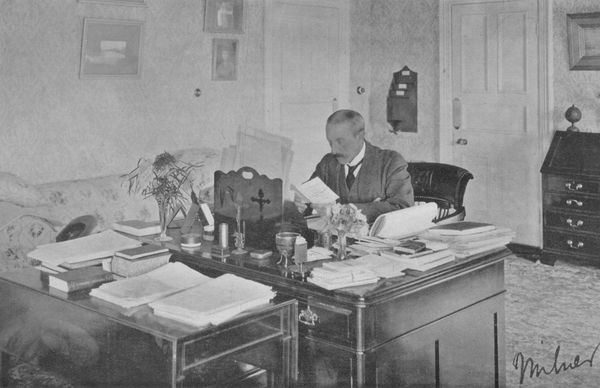
By permission of the Argus Printing and Publishing Co., Ltd., Johannesburg. LORD MILNER AT SUNNYSIDE.
Affairs in the Cape colony.
From this time forward (March 15th, 1901), Lord Milner's administrative activity is primarily concerned with the Transvaal and Orange River Colony. Owing, however, to the continued resistance of the Boers and the extension of the area of hostilities by the second invasion of the Cape Colony, the administrative development of the new colonies was confined within the narrowest limits, until six months of strenuous military operations had enabled Lord Kitchener to render the protected areas and the railways virtually secure against the raids of the Boer commandos. Four out of these six months were occupied by Lord Milner's second visit to England (May-August, 1901). But before we approach this episode, and thereby resume the main current of the narrative, it is necessary to trace the course of events in the Cape Colony. With the government of the Colony once more in the hands of the British party, Lord Milner had been relieved of the acute and constant anxieties that marked his official relationship to the Afrikander Ministry. On the vital question of the necessity of establishing British authority upon terms that would make any repetition of the war impossible, Sir Gordon Sprigg and his ministers were absolutely at one with Lord Milner and the Home Government. Whatever differences of opinion arose subsequently between the Cape ministers and the Imperial authorities were differences not of principle but of detail. For the most part they were such as would have manifested themselves in any circumstances in a country where the civil government was compelled, by the exigencies of war, to surrender some of its powers to the military authority.
The Bond and peace.
With the Bond in this mood, with certain districts practically maintaining the enemy and certain other districts constantly exposed to the incursions of the guerilla leaders, with a large proportion of the loyalist population fighting at the front, and a still larger number organised for local defence, and with the whole of the Colony, except the ports, under martial law, it was obviously impossible for the machinery of representative government to continue in its normal course.
Anti-British libels.
The extension of martial law in January (1901) had made such excesses, whether on the platform or in the Press, no longer possible. But the Afrikander nationalists in the ports, and especially in Capetown, continued to render assistance to the guerilla leaders, both by providing intelligence of the plans of the British military authorities, and by forwarding supplies of arms and ammunition, until the time (October 9th) when these towns were placed, like the rest of the Colony, under martial law.
Breakdown of government.
The collapse of the system of responsible government in the Cape Colony was complete. The truth upon which Lord Durham insisted in his famous Report on Canada, that responsible government is only possible where an effective majority of the inhabitants are British, was once more demonstrated. In the granting of supplies, the characteristic function of the lower chamber, the authority of the Governor was now substituted for that of Parliament. The endeavour to check the rebellion by the agency of the civil courts had been already abandoned. The lenient penalties of the Treason Bill had produced a large increase of disaffection. On April 6th, 1901, a notice was issued by the Attorney-General warning the public that "any act of treason or rebellion and any crime of a political character" committed after the 12th instant would be brought no longer before the Special Tribunals, with their mitigated penalties created by the Act of 1900, but dealt with by the ordinary courts, and punishable by the severe penalties of the common law of the Colony. But this warning of the Attorney-General was superseded a fortnight later (April 22nd), by a notice, issued by Lord Kitchener and published by the Cape Government, under which it was declared that—
The military courts.
Ample evidence alike of the necessity of these measures, and of the de facto suspension of the constitution, is provided by a Minister's minute of September 12th, 1901. The immediate object of the minute is to advise the Governor that it is impossible, in the opinion of the Cape Ministry, to avoid the further prorogation of Parliament; and this, although the Constitution Ordinance requires the Cape Parliament to meet "once at least every year," and cannot, therefore, be complied with, unless Parliament is summoned "for the despatch of business on or before Saturday, 12th October." In support of this decision Sir Gordon Sprigg and his colleagues referred to the Military Intelligence Report for the current month, which showed that, south of the Orange River, there were a dozen or more commandos, with a total of from 1,800 to 2,000 men; while in the portion of the Colony north of the river there were "numerous commandos also roaming about." Then follows a startling revelation of the character of the men whom the Bond organisation had sent to Parliament:
Condition of Cape parliament.
"One member of the House of Assembly," ministers write, "is undergoing a term of imprisonment for seditious libel, three members are awaiting their trial on the charge of high treason, two seats are practically vacant by reason of the absence of the members without leave during the whole of last session. Those two members are alleged to have welcomed the invaders of the Colony, and encouraged rebellion, and then fled to Holland, where they are now living. One seat is vacant by the resignation of the member, who has accepted an appointment in the Transvaal Colony. Another seat is vacant on account of the death of the member, another member is sending in his resignation owing to ill health, which compels him to reside in Europe. In all these cases the divisions concerned are either under martial law or in a state of disturbance, which makes new elections impracticable.
"Besides the cases enumerated there are members who have been deported from their homes on account of the seditious influences which the military authorities allege they were exercising, and others who are under military observation, with respect to whom their attendance in Parliament must be regarded as uncertain. Several members also are engaged in military operations, whose attendance could not, in the present condition of the country, be relied on. There are also some members who would be unable to attend owing to the state of war and rebellion prevailing in the districts where they reside, whose personal presence is necessary for the protection of their families and property."
Such a legislature, they concluded, could not be regarded as "fairly representing the people." Moreover—
The necessity for the more stringent action now taken by the Imperial authorities was, therefore, undoubted. But here again, in placing the ports, the centres of commercial life, under martial law, an endeavour was made to render the restraints of military rule as little onerous as possible. A Board, consisting of three persons nominated respectively by the Governor, the Prime Minister, and the General Commanding in the Cape Colony, was created for the consideration and, where necessary, the redress of all complaints or grievances arising out of martial law in the Colony, other than pecuniary claims against the Government. The fact that, on the whole, martial law was judiciously administered is indicated by the Report of the proceedings of this Board, presented on December 3rd by Mr. (now Sir Lewis) Mitchell, who, as Manager of the Standard Bank, had been appointed chairman by Sir W. Hely-Hutchinson. Out of 199 cases brought before the Board, Mr. Mitchell writes:
Loyalists defend the colony.
In all this Sir Gordon Sprigg loyally co-operated with the Imperial military authorities. His attitude, and that of the loyalist inhabitants of the Colony, may be gathered from the speech which he delivered at Capetown on December 1st, 1901. In this striking and inspiring utterance we have the companion picture to that presented in the minute of September 12th. Throughout there runs a note of justifiable pride in the military efforts of the Cape Government, and in the sacrifices which these efforts have entailed upon the loyalist population. First there was the number of troops provided. The Cape Government had placed, he said, 18,000 men in the field against the invaders and rebels; they had a defensive force of 18,000 town guards, of whom 3,000 were natives; and, in addition, 7,000 natives were under arms in the Transkei for the defence of those territories. In respect of this force of 18,000 men in the field, Sir Gordon Sprigg pointed out that such a number of men, coming from a population of 500,000, was equivalent to a force of 1,450,000 men from the United Kingdom, with its population of over 40,000,000. He might have added that, since half of the 500,000 Europeans in the Cape Colony were "either actually in rebellion against the Crown or in positive sympathy with rebellion," the more correct equivalent force from the United Kingdom would have been 3,000,000 men. And as for the cost of maintenance, the colony provided three-fourths of the expenditure upon the 18,000 men in the field, while it wholly supported the town guards and other purely defensive forces. He then dwelt with satisfaction upon the fact that these local forces were now entirely controlled by the Cape Government, which had made itself responsible for the defence of no less than thirty-one districts of the Colony.
Second visit to England.
Civil affairs in new colonies.
Milner in England.
"It is hard, it is ludicrous," he continued, "that some of the busiest men in the world should be obliged to occupy their time, and that so many of my friends and well wishers should be put to inconvenience—and on a day, too, when it would be so nice to be in the country—merely in order to prove to persons with an ingrained habit of self-delusion that the British Government will not give up its agents in the face of the enemy, or that the people of this country will not allow themselves to be bored into abandoning what they have spent millions of treasure and so many precious lives to obtain. All I can say is, that if it was necessary (I apologise for it: I am sorry to be the centre of a commotion from which no man could be constitutionally more averse than myself), I can only thank you heartily for the kindness and the cordiality with which the thing has been done. I feel indeed that the praises which have been bestowed, the honours which have been heaped on me, are beyond my deserts. But the simplest thing to do under these circumstances is to try to deserve them in the future. In any case I am under endless obligations. It is difficult to say these things in the face of the persons principally concerned, but I feel bound to take this opportunity, especially in view of the remarks which have been made in certain quarters, to express my deep sense of gratitude for the manner in which His Majesty's Government, and especially my immediate chief, have shown me great forbearance, and given me support most prompt at the moment when it was most needed, without which I should have been helpless indeed. And I have also to thank many friends, not a few of them here present, and some not present, for messages of encouragement, for kindly words of suggestion and advice received at critical moments, some of which have been of invaluable assistance to me, and have made an indelible impression on my heart. I am afraid, if I were to refer to all my benefactors, it would be like the bidding prayer—and you would all lose your trains.
Hint from the bidding prayer.
"But there is one hint I may take from the bidding prayer. Not only in this place, but at all times and in all places, I am specially bound to remember the devotion of the loyalists—the Dutch loyalists, if you please, and not only the British—the loyalists of South Africa. They responded to all my appeals to act, and, harder still, to wait. They never lost their cheery confidence in the darkest days of our misfortunes, they never faltered in their fidelity to a man of whose errors and failings they were necessarily more conscious than anybody else, but of whose honesty of purpose they were long ago, and once for all, convinced. If there is anything most gratifying to me on this memorable occasion it is the encouragement which I know the events of yesterday and of to-day will give to thousands of our South African fellow-countrymen, like minded with us, in the homes and in the camps of South Africa.
"Peace we could have had by self-effacement. We could have had it easily and comfortably on those terms. But we could not have held our own by any other methods than those which we have been obliged to adopt. I do not know whether I feel more inclined to laugh or to cry when I have to listen for the hundredth time to these dear delusions, this Utopian dogmatising that it only required a little more time, a little more patience, a little more tact, a little more meekness, a little more of all those gentle virtues of which I know I am so conspicuously devoid, in order to conciliate—to conciliate what? Panoplied hatred, insensate ambition, invincible ignorance. I fully believe that the time is coming—Heaven knows how we desire it to come quickly—when all the qualities of the most gentle and forbearing statesmanship which are possessed by any of our people will be called for, and ought to be applied, in South Africa. I do not say for a moment there is not great scope for them even to-day, but always provided they do not mar what is essential for success in the future—the conclusiveness of the final scenes of the present drama."
Merriman and Sauer mission.
A fortnight later a meeting of those who sympathised with the Boer cause was held in the Queen's Hall, Langham Place. The spirit of this notorious gathering, presided over by Mr. Labouchere, M.P., and attended by Mr. Merriman. Mr. Sauer, Mr. Lloyd-George, M.P., and other Radical members of Parliament, is sufficiently revealed by certain characteristic incidents which marked the proceedings. The agents of the meeting wore the Transvaal colours; a member of the audience who uncovered at the mention of King Edward was ejected; the Union Jack was hissed and hooted; and, while a printed form was handed round inviting the signatures of persons prepared to pay eight and-a-half guineas for a tour in Holland and the privilege of seeing ex-President Krüger, the name of the British sovereign was received by the audience with marks of evident disapprobation.
Agitation for Milner's recall.
"That this committee views with the utmost disapproval the statement of Sir Henry Campbell-Bannerman at Plymouth, to the effect that no satisfactory settlement would be arrived at in South Africa so long as Mr. Chamberlain and Lord Milner retained their present offices, and, on the contrary, emphatically affirms that the retention in office of those statesmen is regarded by the South African loyalists as affording the best security for a settlement which will be permanent, just, and consistent with the honour of the empire and the best interests of South Africa, and, further, affirms that the whole tone of Sir Henry Campbell-Bannerman's speech is most pernicious, and prejudicial to Imperial interests in South Africa, and shows him to be entirely out of sympathy with loyalist opinion in South Africa."
With this prompt and uncompromising rejoinder we may take leave of an attempt to remove a great and devoted servant of the empire, which is as discreditable to the intelligence as it is to the patriotism of those prominent members of the Liberal party who thus lent their co-operation to the Afrikander nationalists. In South Africa the issue was simple. While Boer and rebel combined in their efforts to rid themselves of the man who had thwarted their ambitions, the loyalists closed their ranks and stood firm in his support. It is to the far-off Homeland that we have to turn for the spectacle of a nation in which gratitude to the man who upheld the flag gave place to sympathy for the enemy and the rebel; in which patriotism itself yielded to a greed of place wrapped up by sophistry in such decent terms as "humanity," "Liberal principles," and "conciliation."
Finances of the new colonies.
This temporary financial assistance was of the utmost importance. Just as in the Cape Colony Lord Milner had seen that the Boers and Afrikander nationalists were to be beaten at their own game of renewed invasion by enabling the loyalist population to defend the Colony, so in the new colonies he proposed to beat the guerilla leaders at their game of wanton and mischievous resistance by building up a new prosperity faster than they could destroy the old. The conditions under which he worked, and the state in which he found South Africa when he began to engage actively in the work of reconstruction, he has himself described. In a despatch, written from the "High Commissioner's Office, Johannesburg," on November 15th, 1901, not only has Lord Milner placed on record the actual position of affairs in the new colonies at this time, but he has sketched with masterly precision the nature of the economic and administrative problems that awaited solution. The progress towards pacification won by the mobile columns and the blockhouse system, the dominant influence of the railways as the agency of transport, the condition of the Concentration Camps, and the degree in which our responsibility for the non-combatant and surrendered Boers limited our capacity to restore our own people to their homes, the economic exhaustion of the country, the threatened danger of the scarcity of native labour, and the processes and problems of repatriation—all these subjects are touched as by a master of statecraft.
Improved situation.
"Without being unduly optimistic," he writes, "it is impossible not to be struck by two great changes for the better in [the military situation] since the time when I first took up my residence in the Transvaal—just eight months ago. These are the now almost absolute safety and uninterrupted working of the railways and the complete pacification of certain central districts. As regards the railways, I cannot illustrate the contrast better than by my own experiences. In the end of last year and the earlier months of this I had occasion to make several journeys between Capetown and Johannesburg or Pretoria, and between Johannesburg and Bloemfontein. Though most careful preparations were made and every precaution taken, I was frequently 'hung up' on these journeys because the line had been blown up—not, I think, with any reference to my movements, but in the ordinary course of affairs. Small bodies of the enemy were always hovering about, and a state of extreme vigilance, not to say anxiety, was observable almost everywhere along the line. Since my return from England I have again traversed the country from East London to Bloemfontein and Johannesburg, and from Johannesburg to Durban and back, to say nothing of constant journeys between this place and Pretoria. On no single occasion has there been the slightest hitch or the least cause for alarm. The trains have been absolutely up to time, and very good time. They could not have been more regular in the most peaceful country. This personal experience, in itself unimportant, is typical of a general improvement. I may add, in confirmation of it, that during the last two months the mail train from Capetown to the north has only been late on one or two occasions, and then it was a matter of hours. Six months ago it was quite a common event for it to arrive a day, or a couple of days, late. I need not enlarge on the far-reaching importance of the improvement which these instances illustrate. Not only have the derailments, often accompanied by deplorable loss of life, which were at one time so common, almost entirely ceased, but, owing to more regular running, and especially the resumption of night running, the carrying capacity of the railways has greatly increased. Indeed, it is the inadequacy of the lines themselves to meet the enormous and ever-increasing extra requirements resulting from the war, and the shortness of rolling-stock, not any interference from the enemy, which causes us whatever difficulties—and they are still considerable—we now labour under in the matter of transport. When the large amount of additional rolling-stock ordered for the Imperial Military Railways last summer is received—and the first instalment will arrive very shortly—there will be a further great and progressive improvement in the conveyance of supplies and materials for the troops, the civil population of the towns, and the concentration camps.
Contraction of area of war.
"The advance made in clearing the country is equally marked. Six months ago the enemy were everywhere, outside the principal towns. It is true they held nothing, but they raided wherever they pleased, and, though mostly in small bodies, which made little or no attempt at resistance when seriously pressed, they almost invariably returned to their old haunts when the pressure was over. It looked as though the process might go on indefinitely. I had every opportunity of watching it, for during the first two months of my residence here it was in full swing in the immediate neighbourhood. There were half a dozen Boer strong-holds, or rather trysting-places, quite close to Pretoria and Johannesburg, and the country round was quite useless to us for any purpose but that of marching through it, while the enemy seemed to find no difficulty in subsisting there....
"To-day a large and important district of the Transvaal is now firmly held by us. But it must not be supposed that all the rest is held, or even roamed over, by the enemy. Wide districts of both the new colonies are virtually derelict, except, in some cases, for the native population. This is especially true of the northern part of the Transvaal, which has always been a native district, and where, excepting in Pietersburg and some other positions held by our troops, the natives are now almost the only inhabitants. Indeed, nothing is more characteristic of the latest stage of the war than the contraction of Boer resistance within certain wide but fairly well-defined districts, separated from one another by considerable spaces. Instead of ranging indifferently over the whole of the two late Republics, the enemy show an increasing tendency to confine themselves to certain neighbourhoods, which have always been their chief, though till recently by no means their exclusive, centres of strength.... From time to time the commandos try to break out of these districts and to extend the scene of operations. But the failure of the latest of these raids—Botha's bold attempt to invade Natal—shows the disadvantages under which the Boers now labour in attempting to undertake distant expeditions.
The return to the Rand.
"If the latest phase of the military situation is maintained, i.e., if we are able to prevent the Boers from breaking back into the cleared areas, or from injuring the railway lines, I can see no reason why the work of settlement should not proceed at a greatly quickened pace in the immediate future. The most urgent point is to bring back the exiled Uitlanders to the Rand, always provided that they are able to find employment when they arrive there. But the basis of any general revival of industrial and commercial activity on the Rand is the resumption of mining operations. So far it has only been found possible to proceed very slowly in this respect. The full capacity of the Rand is about 6,000 stamps. The first step was taken in April last, when the Commander-in-Chief agreed to allow the Chamber of Mines to open three mines with 50 stamps each. Up till now permission has been granted for the working of 600 stamps, but only 450 have actually been started. This is slow work, but even this beginning, modest as it is, has made an immense difference in the aspect of Johannesburg since first I came here in March last.
"The number of people allowed to return from time to time, for other than mining employments, is in proportion to the number of stamps re-started. This, no doubt, is a wise principle, for business generally can only expand pari passu with the resumption of mining. Up to the present something like 10,000 people have been allowed to come up, the vast majority of them being refugees, though there is a small new element of civil servants and civilians in the employ of the military. Assuming that from 8,000 to 9,000 are refugees, this would represent about one-sixth of the total number of well-accredited Uitlanders registered in the books of the 'Central Registration Committee.'
"The best that can be said on the thorny subject of the return of the refugees, is that latterly the rate of return has been steadily increasing. Last month the military authorities allowed us to grant 400 ordinary permits (this number is over and above permits given to officials or persons specially required for particular services to the Army or the Government). This month the number has been raised to 800. I need hardly say that the selection of 800 people out of something like fifty times that number is an onerous and ungrateful task. South Africa simply rings with complaints as to favouritism in the distribution of permits. As a matter of fact, whatever mistakes have been made, there has been no favouritism. I do not mean to say that a certain number of people—not a large number—have not slipped through or been smuggled up under false pretences. But the great bulk of the permits have been allotted by the Central Registration Committee, a large, capable, and most representative body of the citizens of this town and neighbourhood. And they have been allotted on well-defined principles, and with great impartiality.... I am satisfied that no body of officials, even if our officials were not already over-worked in other directions, could have done the business so well.
Labour and transport.
"There can, I think, be little doubt that the present rate of return can be maintained, and I am not without hope that it may in a short time be considerably increased. But this depends entirely, for the reasons already given, on the question whether the resumption of mining operations can be quickened. The obstacles to such a quickening are two-fold: first, want of native labour; secondly, want of trucks to bring up not only the increased supplies which a larger population necessitates, but also, and this is even a more serious matter, to bring up the material required for their work. The latter, I need hardly say, is a very heavy item, not only in the case of the mines, but in the case of all those other industries, building, for instance, which only need a chance in order to burst into extreme activity in this place. For the Rand requires just now an increase of everything—dwelling-houses, offices, roads, sewers, lighting, water-supply, etc., etc. Capital would be readily forthcoming for every kind of construction, and many skilled workmen are waiting at the coast. But it is no use bringing up workmen to live in the dearest place in the world unless they have the materials to work with. The most necessary materials, however, are bulky, and the carrying capacity of the railways, greatly improved as it is, gives no promise of an early importation of quantities of bulky material, if the other and more urgent demands upon our means of transport are to be satisfied.
"As regards native labour for the mines, the greater development of which is a condition of all other industrial development, the difficulty is that, while natives can be found in abundance to do surface work, the number of those who are willing to go underground is limited. There are only certain tribes among whom underground workers can be found in any great numbers, and these reside mostly in Portuguese territory. As you are aware, difficulties have arisen about the introduction of Portuguese natives, and the matter is at present the subject of negotiations between the Governor-General of Mozambique and myself. Having regard to the friendly attitude of the Governor-General, I have every hope that this difficulty may soon be overcome. But even then we shall not be able to count on any great immediate influx of labourers from Portuguese territory....
The concentration camps.
"The delay in obtaining native labour would be more serious if it were not for the existence of that other and still greater obstacle to the rapid revival of industry here which I have already dwelt on, namely, the difficulty of transport. And this latter difficulty is immensely aggravated at the present time by the constantly increasing requirements of the concentration camps. Not only has the number of people in these camps increased, with overwhelming rapidity, to an extent never contemplated when they were first started, but the extreme state of destitution in which many of the people arrived, and the deplorable amount of sickness which has all along existed among them, create a demand for a great deal more than mere primary necessities, such as food and shelter, if the condition of the camps is to be anything like what we should wish to see it. The amount of mortality in these camps, especially amongst very young children, as you are well aware, has been deplorable. I do not, indeed, agree with those who think—or assert—that the mortality among the Boers would have been less, if thousands of women and children had been allowed to live on isolated farms in a devastated country, or to roam about on the trail of the commandos. Indeed, I feel confident that it would have been far greater. The best proof of this is the deplorable state of starvation and sickness in which great numbers of people arrived at the camps, and which rendered them easy victims to the attack of epidemic diseases. At the same time it is evident that the ravages of disease would have been less if our means of transport had allowed us to provide them on their first arrival, not only with tents, rations, and necessary medicines (all of which were, as a matter of fact, supplied with great promptitude), but with the hundred and one appliances and comforts which are so essential for the recovery of the weakly and the sick, and the prevention of the spread of disease. I do not mean to say that it was only want of material, due to the insuperable difficulties of transport (especially at the time when the camps were first started, and when railways were subject to continual interruptions) from which the camps suffered. Equally serious was the want of personnel; of the necessary number of doctors, nurses, matrons, superintendents, etc., who were simply not to be found in South Africa, severely taxed as it had already been to find men and women of sufficient training and experience to look after the other victims of the war. Still, the want of material has been a serious item; and it is evidently a want which, as the carrying capacity of the railways increases, we must do our best to supply. The Ladies' Commission, of whose devoted labours in visiting and inspecting the camps it is impossible to speak too highly (they have been of inestimable service to the Government), have handed in a considerable list of requirements, which have been, and are being, supplied as fast as possible. But evidently these requirements enter into competition, and most serious competition, with the supply of food and materials necessary for the revival even of our central industry, not to say of industrial and agricultural activity elsewhere in the new colonies, of which, under the circumstances, it is, for the moment, unfortunately impossible to think.
"To decide between the competing demands upon the still very limited amount of truckage available for civil purposes, after the paramount requirements of the army have been satisfied, is indeed a most difficult and delicate task. Whether we have done all for the best, it is not for me to say. That any amount of conscientious thought and labour has been devoted, on all hands, to grappling with the problem, I can confidently assert. And I am equally confident that whatever has been done, and whatever may yet be done, the amount of hardship must have been and must still be very great. It would be amusing, if amusement were possible in the presence of so much sadness and suffering, to put side by side the absolutely contradictory criticisms, all equally vehement, to which our action is subjected. On the one hand is the outcry against the cruelty and heartlessness manifested in not making better provision for the people in the concentration camps: on the other, the equally loud outcry against our injustice in leaving the British refugees in idleness and poverty at the coast, in order to keep the people in the concentration camps supplied with every luxury and comfort. I have even frequently heard the expression that we are 'spoiling' the people in the Boer camps. We are, alas, not in a position to spoil anybody, however much we might desire to do so....
"The pressing questions connected with the return of the refugees and the maintenance of the Boers at present in the concentration camps are, it is evident, only the first of a series of problems of the most complicated character, which have to be solved before the country can resume its normal life....
Re-settlement problems.
"Even if the war were to come to an end to-morrow, it would not be possible to let the people in the concentration camps go back at once to their former homes. They would only starve there. The country is, for the most part, a desert, and, before it can be generally re-occupied, a great deal will have to be done in the way of re-stocking, provision of seed, and also probably, in the absence of draught animals, for the importation of steam ploughs.
"Then there are the arrangements to be made for the return of the prisoners of war. Evidently these will have to wait till the whole of the British refugees are brought back. The latter not only have the strongest claim, but they will be immediately wanted when order is restored, and will have, as soon as the railway can bring up the necessary material, abundance of work, whereas it may take some time before the country is fit to receive the prisoners. Nevertheless, though the return of the prisoners may still be far distant, there are certain measures which have to be taken even now, in order that we may be able to deal with the matter when the time comes.
"Altogether, the number and complexity of the tasks, embraced under the general term 're-settlement,' which are either already upon us or will come upon us as the country gradually quiets down, are sufficient to daunt the most stout-hearted. And yet the tone of hopefulness among the British population who have so far returned to the new colonies is very marked, especially in the Transvaal. It is not incompatible with many grievances, and with much grumbling at the Administration. But that was only to be expected, and is of very small importance as long as people are prepared to tackle the big work of reconstruction in front of them in a vigorous and sanguine spirit. Nor is this hopefulness, in my opinion, at all ill-founded, however gloomy may be the immediate outlook.
"Terrible as have been the ravages of war and the destruction of agricultural capital, a destruction which is now pretty well complete, the great fact remains that the Transvaal possesses an amount of mineral wealth, virtually unaffected by the war, which will ensure the prosperity of South Africa for the next fifty years; and other resources, both industrial and agricultural, which, properly developed, should make it a rich country, humanly speaking, for ever. Economically, all that is required is that a very small proportion of the superabundant but exhaustible riches of the mines should be devoted to developing the vast permanent sources of wealth which the country possesses, and which will maintain a European population twenty times as large as the present, when all the gold has been dug out. No doubt it is not economic measures alone which will ensure that result. A social change is also necessary, viz., the introduction of fresh blood, of a body of enterprising European settlers, especially on the land, to reinforce the Boer population, who have been far too few, and far too easy-going, to do even the remotest justice to the vast natural capabilities of the soil, on which, for the most part, they have done little more than squat. But then the introduction of the right type of agricultural settlers, though it will not come about of itself, would not seem to be a task beyond the powers of statesmanship to grapple with.
The land settlement report.
The irrigation report.
But, great as was the claim of agriculture, the claim of the gold industry was at once more immediate and more imperative.
"Valuable as water may be for agricultural purposes," Sir William Willcocks wrote, "it is a thousand times more valuable for gold-washing at the Rand mines."
And again:
"The prosperity and well-being of every interest, not only in the Transvaal, but in South Africa generally, will depend on the prosperity of the Rand, certainly for the next fifty years. Though my life has been spent in the execution of irrigation projects and the furtherance of agricultural prosperity, I feel that, under the special conditions prevailing in South Africa, the suggestion of any course other than the obvious one of first putting the Rand mines on a sound footing as far as their water supply is concerned, would have constituted me a bigot. Ten acres of irrigable land in the Mooi or Klip river valleys, with Johannesburg in the full tide of prosperity, will yield as good a rent as forty acres with Johannesburg in decay."
And the prosperity of the mines is not only essential in the present: it is to be the instrument for the development of the permanent resources of the Transvaal:
Economic importance of Rand.
"The mineral wealth of the Transvaal is extra-ordinarily great, but it is exhaustible, some say within a space of fifty years, others within a space of one hundred years. It would be a disaster indeed for the country if none of this wealth were devoted to the development of its agriculture. Agricultural development is slow, but it is permanent, and knows of no exhaustion. If the companies working the gold, coal, and diamond mines were by decree compelled to devote a percentage of their gains to the execution of irrigation works on lines laid down by the Government, they would assist in the permanent development of the country and would be investing in works which, though slow to give a remuneration, would, at any rate, be absolutely permanent. It would thus happen, that when the mineral wealth of the country had disappeared, its agricultural wealth would have been put on such a solid basis that the country would not have to fall from the height of prosperity to the depth of poverty."
These were conclusions of so fundamental a nature that no statesman could afford to overlook them; and, in point of fact, Lord Milner kept them steadily in sight from first to last in all that he did for the administrative and economic reconstruction of the new colonies.
Origin of the camp schools.
Over-sea teachers.
Administrative progress, 1901.
Legislative reforms.
The volume of work handled in the Legal Adviser's office formed a remarkable testimony to the energy and capacity of Sir Richard Solomon. Resident magistrates' courts had been established in twelve districts; temporary courts were being held in Pretoria and Johannesburg; the offices of the Registrar of Deeds and of the Orphan Master, and the Patent Office, were reorganised; and an ordinance creating a Supreme Court, consisting of a Chief Justice and five Puisne Judges, was drafted ready to be brought into operation so soon as circumstances permitted. The chaotic Statute Book of the late Republic had been overhauled. A large number of laws, some obsolete, some impliedly repealed, but still appearing on the Statute Book, and others unsuited to the new régime, had been repealed by proclamation; and at the same time many ordinances dealing with matters of fundamental importance had been prepared for submission to the future Legislative Council at the first opportunity.
The Departments of Mines and Native Affairs had been reorganised, and the work done by Mr. Wybergh and Sir Godfrey Lagden respectively in these departments, in co-operation with Sir Richard Solomon, had produced the administrative reforms immediately required to regulate the employment of native labourers in the mines. By proclamations amending or repealing existing laws and making fresh provisions where necessary the native had been protected against oppression and robbery at the hands of unscrupulous labour-agents, and the liquor traffic, the chief cause of his insubordination and incapacity, had been effectively repressed. Considerations of public security made the maintenance of the "pass" system necessary, but modifications were introduced into the working of the system sufficient to protect the educated native from unnecessary humiliation and the native labourer from excessive punishment. In addition to this departmental work two commissions had been appointed by Lord Milner to investigate two matters of direct and immediate concern to the gold industry. The first of these, over which Sir Richard Solomon presided, was engaged in reviewing the existing gold laws, with a view to the introduction of new legislation embodying such modifications as the best local experience and the financial interests of the colony might require. The second was employed in formulating measures necessary to provide both the mines and the community of the Rand with a water-supply that would be at once permanent and economic.
The Johannesburg police.
There remain certain special features of the administrative reconstruction accomplished in 1901 that merit attention, as showing the degree in which Lord Milner kept in view the fundamental necessities of the situation revealed by the Land Settlement and Irrigation Reports to which reference has been made above. As part of the work of the Law Department, the Johannesburg Municipal Police had been organised and placed under the control of Mr. Showers, the late head of the Calcutta Police.
South African constabulary.
Just as here, in the case of the Johannesburg police, so in the formation of the South African Constabulary and in the reorganisation of the railways, Lord Milner had determined that no opportunity of adding to the permanent British population of the two colonies should be lost. The South African Constabulary was formed in October, 1900, by General Baden-Powell, mainly on the lines of the Canadian North-West police, for the protection of the settled population in the new colonies. Since July, 1901, however, when it had been called out for military service, this force, at the time some 9,000 strong, had been employed as part of the army under the direction of the Commander-in-Chief, although its organisation, finance, and internal discipline were dealt with by the High Commissioner. The men recruited for the Constabulary were of British birth, and every endeavour was made in the selection of recruits to secure persons who were adapted by pursuits and character to become permanent and useful colonists. It is interesting to note that a body of 500 burgher police, consisting of former burghers of the Orange Free State, and placed under the colonel commanding the Orange Colony division, had been associated with the Constabulary during the time that they were thus serving with the troops. Nor is it necessary to point out that the military experience, the knowledge of the country, and acquaintance with the life of the veld which the Constabulary gained at this period, largely contributed to the efficiency which they displayed afterwards in the discharge of their regular duties.
Reorganisation of railways.
"But," Lord Milner continues, "the many difficulties incidental to the organisation of a large new staff, unaccustomed to work with one another, are being successfully overcome, and business is carried on with a smoothness which gives no indication of the internal revolution so recently effected. The new railway staff comprises some 4,000 men of British race, including 1,500 Reservists or Irregulars who had fought in the war, and who, with other newcomers, form a permanent addition to the British population of South Africa."
Thanks to the blockhouse system, supplemented where necessary by armoured trains, the mail trains from the ports to Johannesburg were running almost as rapidly and as safely as in time of peace. But the demands of the military traffic were so enormous that opportunities for ordinary traffic were still rigorously restricted.
"Military requirements in food supplies, remounts and munitions of war," Lord Milner wrote, "represented 29,000 tons weekly from the ports; while the movements of men and horses to and fro over the [then] huge theatre of war were as constant as they were sudden."
None the less the civil traffic was increasing. While in August only 684 refugees had returned, in November the number had risen to 2,623; and while in August the tonnage of civil supplies forwarded to Bloemfontein and the Transvaal was 4,612, in November it was 8,522. This result, moreover, had been obtained with the old rolling-stock, and a much more rapid progress was anticipated in the future, since the additional rolling-stock had already begun to arrive. And in anticipation of this increased rate of progress, the Commander-in-Chief had
"now seen his way to allow the mines to start 400 fresh stamps per month, as against an average of under 100 in previous months, and had also consented to the grant of 1,600 permits a month (representing about 4,000 persons) for return to the Transvaal."
In addition to the repair and reorganisation of the lines running to the coast, the Transvaal collieries had been re-opened and the coal traffic had been resumed. Not only had progress been made in stocking the mines with coal, timber, and machinery, preparatory to the full resumption of working activity, but the large unemployed native population found in Johannesburg at the time of Lord Milner's arrival had been utilised for the construction of a new and much-needed coal line, which ran for thirteen miles along the Rand.
"This short line," Lord Milner wrote, "would have no less than thirty to forty miles of sidings leading from it to every important mine, and securing direct delivery of about 1,000,000 tons of coal per annum, as well as of a large tonnage of general stores."
Development by railways.
And then follows a statement of the part to be played by railway construction in the policy of material development, which was pursued with such determination by Lord Milner after the restoration of peace.
Thus, six months before Vereeniging, and less than three months after Lord Milner's return from England, the "big unfinished job" was well in hand.[Back to Contents]