William Charles Scully
Reading edition
"Lodges in the Wilderness"
Chapter One.
The Bushmanland Desert—Its Nature and Extent—Desert Travelling—The “Toa.”
The world moves rapidly and with increasing momentum. Even regions remote from those communities which the stress of increasing population and the curse of unleisured industrialism send spinning “down the ringing grooves of change,” are often so disturbed or overwhelmed by the overflow of what threatens to be an almost worldwide current of morbid energy, that within a strangely short period their character is apt completely to alter and their individuality to become utterly destroyed.
I do not know how the Great Bushmanland Desert has fared in this respect—not having visited it for several years—but if some unlikely combination of circumstances were to take me once more to Aroegas or Koisabies,—to the tiny spring of living water that trickles from the depths and lies like a precious jewel hidden in the dark, narrow cavern at Inkruip,—or to where the flaming, red-belted cone of Bantom Berg glares over the dragon-folds of the dune-devil sprawling at its feet, I should go in fear of finding empty sardine-tins and broken bottles lying among the fragments of prehistoric pottery and flint implements which were but recently the only traces of man to be found in those abodes of solitude.
The Bushmanland Desert is but little-known. A few nomads—some of European and some of mixed descent—hang on its fringe. Here and there ephemeral mat-house villages, whose dwellers are dependent on the sparse and uncertain bounty of the sky, will, perhaps, be found for a season. But when the greedy sun has reclaimed the last drop of moisture from shallow “pan” or sand-choked rock-saucer, the mat-houses are folded up and, like the Arabs, these dwellers steal silently away from the blighting visage of the Thirst King. But the greater portion of Bushmanland may be ranked among the most complete solitudes of the earth. The lion, the rhinoceros, and, in fact, most of the larger indigenous fauna have disappeared from it—with the autochthonous pygmy human inhabitants; nevertheless it is a region full of varied and distinctive interest. The landscape consists either of vast plains, mirage-haunted and as level as the sea,—arid mountain ranges—usually mere piles of naked rock, or immense sand-dunes, massed and convoluted. The latter often change their form and occasionally their location under stress of the violent winds which sweep down from the torrid north.
The tract is an extensive one, probably upwards of 50,000 square miles lie within its limits. It is bounded on the north by the Gariep or Orange River—but as that flows and eddies at the bottom of a tremendous gorge which is cut off from the plains by a lofty, stark range of mountains,—coal-black in colour for their greater extent and glowing hot throughout the long, cloudless day, the traveller seldom sees it. The western boundary is the Atlantic Ocean; the eastern an imaginary line drawn approximately south from the Great Aughrabies Falls to the Kat Kop Range. If we bisect this line with another drawn due east from the coast to the Lange Berg, we shall get a sufficiently recognisable boundary on the south. From the tract so defined must be deducted the small area surrounding the Copper Mines, and a narrow strip of mountain land running parallel with, and about sixty miles from the coast. This strip is sparsely inhabited by European farmers.
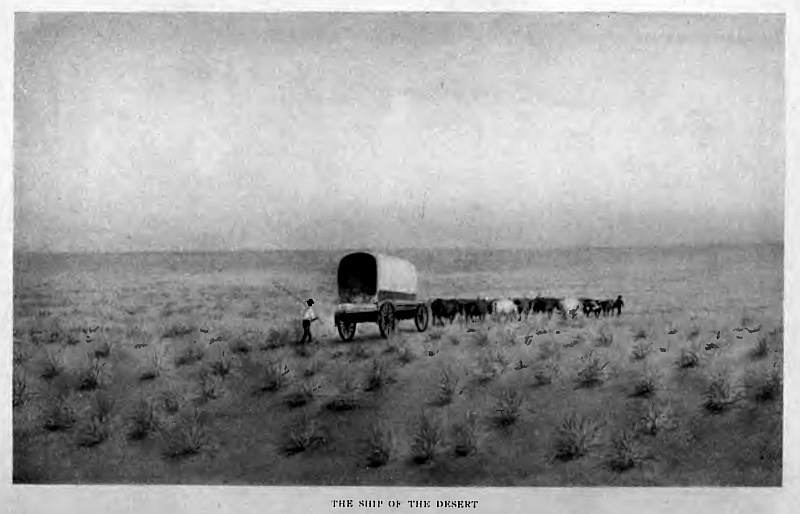
The occasional traversing of this vast tract lay within the scope of my official duties. My invariable travelling companion was Field Cornet Andries Esterhuizen (of whom more anon) and a small retinue of police, drivers, and after-riders. We never escaped hardship; the sun scorched fiercely and the sand over which we tramped was often hot enough to cook an egg in. Water, excepting the supply we carried with us, was as a rule unobtainable; consequently we had to eschew washing completely. We often had to travel by night so as to spare the oxen, and as the water-casks usually almost filled the wagon, we then had to tramp, vainly longing for sleep, through long, weary hours, from sunset to sunrise. And after the sun had arisen the heat, as a rule, made sleep impossible.
It was to the more inaccessible—and therefore comparatively inviolate—expanses of this wilderness that I was always tempted to penetrate. Therein were to be found a scanty flora and a fauna—each unusual and distinctive,—composed of hardy organisms, which an apprenticeship from days unthinkably ancient had habituated to their most difficult conditions of existence. If, somewhere near the margin of the great central plain, we happened to cross the track of a vagrant thunderstorm, we would see myriads of delicately-petalled blossoms miraculously surviving, like the Faithful Rulers of Babylon in the Fiery Furnace. On the flank of some flaming sand-dune we would find the tulip-like blooms of the Gethyllis flourishing in leafless splendour. Their corollas were of crystalline white splashed with vivid crimson; deep in each goblet lay the clustered anthers,—a convoluted mass of glowing gold. Is this flower a grail, bearing beauty too ineffable to die, through an arid aeon from one cycle of fertility to another?
Sometimes our course led over tracts of sand—sand so light and powdery that the foot sank into it ankle-deep at every step. Occasionally we crossed high, abrupt ridges of black or chocolate-hued rock, separated from each other by gorges so deep that except at noontide, no sunbeam penetrated them. But usually our course lay across plains, infinite in extent. In the Summer season such were covered with heavy-headed shocks of “toa” grass,—yellow or light green in hue, according to the more or less scanty rainfall. But in Winter all the waving plumes crumbled away, leaving the bases of the tussocks as black as pitch. Where the hills and the plains met, stood groves of immense dragon aloes—some cumbered with nests of the sociable grossbeak—each as large as a hayrick.
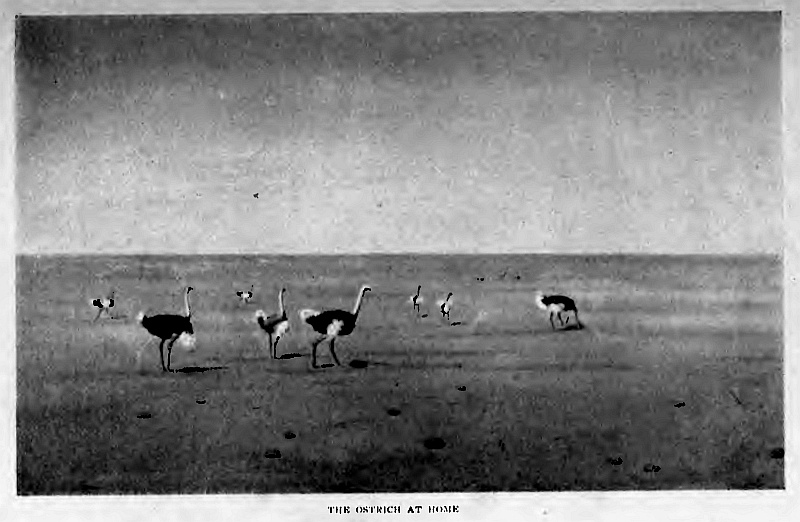
The lordly oryx crossed our path; the ungainly hartebeest lumbered away to windward at a pace which made pursuit hopeless; the gazelles of the desert fled before us like thistledown borne on an eddying wind. The roofs of many a city of desert mice sank beneath our footsteps and the horned adder hissed defiance at our caravan from his home at the tussock’s base. We crossed the zig-zag track made by the yellow cobra when prowling in the darkness. The plumed ostrich scudded away at our approach, the great bustard of the Kalihari spread his powerful wings and flew forth heavily until he almost crossed the horizon, and the “kapok vogeltje,” no bigger than a wren, twittered at us from his seat of cunning on the outside of the simulated snowball which is his nest.
We did not fear the poisoned arrows of the Bushmen, for that strange race which formerly occupied the scenes of our wanderings had long since disappeared from the face of the earth. Within the wide bounds of that tract to which the Bushman gave his name, there existed but two individuals of his race,—an old, withered, toothless man, and a bent and ancient crone. These wraiths, who subsisted on roots, reptiles and insects, still haunted the mountains near Dabienoras, and levied a kind of toll on the very occasional traveller. This took the form of a trifling contribution of tobacco and sugar.
Chapter Two.
Andries Esterhuizen—Silverfontein—The Koeker-Boom—Gamoep—Sand-Grouse—Our Horses—Kanxas—Night in the Desert—Dawn—Heat—The Mirage—Bantom Berg—The Dune-Monster—The Flight of the Oxen.
Andries Esterhuizen had lived all his life on the fringe of Bushmanland. His farm, Silverfontein, which lay a little more than twenty miles from the Ookiep Mines, had been for many years the principal jumping-off place for expeditions to the desert. Andries was a Field Cornet,—an office which empowered him to arrest offenders against the law. He was a typical Boer of the better class. Large-boned and tall, his increased bulk had for several years prevented his doing that which his soud loved above all else,—riding down a herd of oryx. His blue, laughing eyes shone from a ruddy face. His brown beard was streaked with grey. His great fist could have felled an ox; the tempest of his laughter was like the neighing of war-steeds.
Andries sent his ox-wagon to fetch my guns and baggage. Next day I followed in a cart drawn by four strong horses, for heavy stretches of sand had to be crossed before reaching Silverfontein.
On arrival there I met with a hearty welcome. The wagon stood, fully packed, before the farm-house door. The heaviest and most important item of the load was three casks of water, for we were about to enter and encamp in the deadly dune-veld where Thirst is a king who has reigned supreme since the world was young. We meant to storm his strong city and occupy it for a season,—well knowing, however, that we should soon have to retire, leaving his ancient realm unconquered and unspoiled. As we did not mean to be luxurious, our commissariat list only included coffee, sugar, salt and “Boer-biscuits” (a kind of coarse but exceedingly palatable rusk). Of these Mrs Esterhuizen had manufactured enough to fill three immense linen sacks. For meat we should have to depend upon our guns.
The country surrounding Silverfontein was wild and rugged. Long, dyked ridges, foam-tipped with snow-white quartzite rocks, stretched away to infinity, north and south; here and there a naked granite finger pointed to the cloudless sky. On the western side these ridges seemed to break like waves against the enormous bronze-hued bastions of the Kamiesbergen; on the eastward they sank by degrees into the ocean-like expanse of the desert.
Huddled in irregular patches where the dykes sprang from the red sand were the “koekerboome” (“quiver-trees,”—so called because the Bushmen used pithed sections of the boughs as receptacles for their arrows.) These were gigantic aloes of archaic form and immense age. As a rule their height was from fifteen to twenty feet. Their ungainly trunks were cone-shaped, groined and heavily buttressed. The rosette-crowned ends of their dichotomous branches collectively formed a more or less irregular oval. But at one spot, as we crossed the line where the hills ended and the plains began, we noticed some with smooth, slender, white boles rising to a height of nearly sixty feet,—each crowned with a single cup-like whorl of leaves.
Gamoep, where the last water was to be found, lay on the actual edge of the level desert some distance to the south-east of Silverfontein. To reach it involved a long day’s trek, for the route was through soft sand. At Gamoep was a permanent spring,—the water of which, although fit for animals, was not quite suitable for human consumption. Alongside the pool which the spring feeds we decided to rest for twenty-four hours, for the oxen had a heavy strain to undergo and we felt it necessary to cover as much as possible of the first part of our journey during the cool hours of night.
We slept soundly after our long tramp. Next morning, as the sun began to soar, sand-grouse in flocks of almost incredible numbers came sweeping in from the desert. The wearied birds alighted a few hundred yards from the pool, and there rested for about ten minutes. Then they arose, swooped down to the edge of the pool for a hurried sip, and sped back whence they came. We shot sufficient of these for our immediate needs.
Late in the afternoon, when the sting had gone out of the sunshine, we drove the oxen to the pool and let them drink their fill. We had brought two horses—my old hunting-horse, “Prince,” and another “Swaitland,” renamed “Bucephalus,” for Hendrick, my after-rider. But the horses had to remain for the present at Gamoep, in charge of Danster, one of our Hottentots. Piet Noona, another Hottentot, and his nephew,—a lad of about twelve years of age, were also left behind for the purpose of taking charge of the oxen when they returned, maddened with thirst, after being released from the yoke at the camping-place under Bantom Berg and the Great Dune, which was our objective.
Shortly before sundown we inspanned and made a start, shaping our course north-east. Soon we had crossed the last rocky ridge,—the boundary separating the hilly country from the plains. The latter were covered with the shock-bearing tussocks of “toa,”—waving plumes at that time bleached to a light-yellow by the ardours of the summer sun. We passed the head of the Kanxas Gorge,—a miniature canyon whose rocky, perpendicular sides contained caves which had been until a comparatively recent date occupied by Bushmen. The walls of these caves shew records of their former inhabitants in the form of black-pigmented script. This consists mainly of groups of short, parallel lines crossed at various angles by lines similar. But neither here nor in any of the haunts of the now-vanished Bushmen I have visited in the north-western areas of the Cape Province, have I seen paintings of men and animals such as are to be found in other parts of South Africa. A spring had existed at Kanxas within the memory of living Trek-Boers. Of this no vestige then remained. Herein lies an additional item of evidence pointing to the ominous conclusion that South Africa is slowly but surely drying up.
Night fell; the primrose-yellow of the “toa” faded to ghostly white; not a breath of wind stirred. Excepting the creak, creak, of the straining yokes not a sound was audible. Day faded from the sky and the cupola of stars seemed to descend around us like a curtain. We walked apart and communed with our individual selves. When by night one enters the door of the desert speech seems banal and incongruous.
At about midnight we outspanned. The oxen were, however, kept tied to the yokes; we meant to take but an hour’s rest. The patient cattle laid themselves down at once; an occasional long-drawn sigh being the only evidence of their existence. Anon the flame of our candle-bush fire ascended into the windless air,—straight as a column. Coffee was soon ready and biscuits distributed. After we had eaten and drunk, pipes were lit. Then we threw ourselves prone on the sand and gazed, wrapt, into the glittering folds of the star-curtain.
How unutterably still it was; how ineffably peaceful. The spell of silence still sealed our lips. The world of men—with its fierce and futile struggles, its crowded and ever-changing illusions, seemed but a dream. Could it be that in other regions of that earth, which there seemed so austere, so sinless and so ordered, men were struggling in warren-like cities? For that night, however, the desert was the only reality; there we seemed to have attained Nirvana.
The hour of rest soon came to an end; once more the oxen were yoked and our wagon lumbered on. There was no longer a track to guide us; our wheels drew a double-furrow through soil that had never groaned to the share of a plough forged by mortal hands,—that will never yield a crop sown by man. There were no dangers to dread but snakes; no obstacles to avoid—except an occasional tract, ten to fifteen yards in diameter, which had been undermined by desert mice. Through the crust of such a tract the wagon would have sunk to the axles; accordingly a Hottentot was detailed to walk a few yards ahead and give notice of the fact should a mouse-city lie in our course. We steered neither by the compass nor the stars, not yet by any landmark. It was the instinct of Andries and his desert-bred servants,—that “sense of direction” possessed by men whose perceptions have not been destroyed by civilisation,—which enabled them to steer us, straight as an arrow, towards an unseen objective we should only reach two days later.
A pallid gleam shot through the eastern sky; the stars grew faint; over the blue firmament stole, as it were, a sheen of pearl. Soon the rising moon touched the horizon’s rim; as we gazed she soared above it. By the first touch of her level beam-wand, fairy-land was created; the plains, sombre since daylight had departed, became ivory-white to eastward; across their immensity extended a broad strip of silver. This was due to the sheen of the new moonlight on the dew-wet plumes arising from the “toa” tussocks.
As night wore slowly on the deep sand became a weariness. Sleep grew importunate; her fingers pressed down our eyelids and the folds of her trailing robe entangled our lead-shod feet. The moon, after her first majestic soar above the horizon, seemed to climb slower and more slowly towards the zenith. It would have been a luxury to fall prone on the velvet-soft sand and sink at once into dreamless oblivion.
But this might not be; our plan of campaign had been cunningly devised and had to be strictly adhered to. We were about to contend with an enemy who gave no quarter. The fiat of Andries had gone forth; we were to travel on without pause until sunrise. Then we might sleep if the sun permitted.
At length the seemingly interminable night ended: “the phantom of false morning,” which so often had mocked us, gave place to dawn—virginal and splendid. Then day came on rapid feet. Just as the sun cleared the rim of the earth the wagon halted, and at once the yokes fell from the necks of the tired oxen. Within a few minutes we lay fast asleep beneath a hastily-constructed sun-screen.
Scarcely more than an hour had elapsed before the heat awoke us and we sprang to our feet with hardly a trace of fatigue. The strong sunshine seemed to sting us to vigour; it was aether rather than air that we breathed. Around us lay infinite expanses, glowing and quivering,—radiating fervour against fervour into the moveless atmosphere. Before us and to our right and left the horizon was unbroken. Behind us could still be faintly traced the contour of the hilly country from which we had yesterday emerged.
The oxen, after feeding a little, wandered about—attempting from time to time to escape homeward. They dreaded this plunge into the waterless waste. They instinctively anticipated the heavy sufferings to which they were doomed. So far they were not painfully thirsty; cattle bred on the borders of the desert in their search for pasturage often go voluntarily waterless for forty-eight hours at a stretch. Even in summer they do not feel this much of an inconvenience. Late in the afternoon the team was driven up and once more inspanned. Again we pressed forward on our course.
The heat was still intense; we knew it would last until sundown. The primrose-tinted carpet of the desert seemed to have turned to flame. Before us some mocking genius of the sky painted mirage-pictures. Blue seas gemmed with verdant islands, rocky beaches from which sprang groves of lofty trees,—mountain ranges clothed with boskage and suggesting cool streams in their valleys—enticed us onward. Now and then the pictures grew distorted; occasionally they became inverted in the twinkling of an eye. Then the mountains stood poised upon their summits and the trees hung downward. Perhaps the operator of the magic lantern which projected these phantasms on the sky-screen was the vizier of the Thirst King—striving to lure the unwary to a terrible doom.
Although the heat was so intense, we were not badly distressed by it. The thrill of the unaccustomed exhilarated us; each breath we drew was as a draught of new wine. Interesting and unusual incidents befel. Ever and anon a troop of ostriches sped over the plains, their white plumes outstretched and thrilling. On the right, arising from the hollow of an undulation upwards of a mile away, could be seen a small thicket of “black sticks.” Irregularly grouped and standing at various angles they shewed clear and distinct through the miraculously transparent air. “Gemsbokke,” said Andries, laconically. The bodies of the oryx were out of sight; nothing was visible but their long and almost straight horns. Soon the earth-tremor betrayed us, and the thicket of “black sticks” became agitated. It broke up, scattered and reformed in smaller thickets. Then a herd of about fifty oryx swung at a gallop out of the hollow and sped up the wind, leaving a long trail of dust to mark its course.
Night fell again; again the star-curtain descended. At about ten o’clock we once more outspanned. There was not a breath of wind. The desert was vocal with unfamiliar sounds. The weird cries of the jackal were borne from afar across the plains; the clucking lizards put out their heads and conversed from burrow to burrow; the plaintive notes of the night-flying grouse fell from the sky like a rain of echoes. Under the protecting wing of darkness the solitude became populous and vocal with strange tongues.
We inspanned after an hour’s rest. The longest and most wearying effort of our pilgrimage had now to be undertaken; our journey’s end had to be reached before the yokes again were loosened. The night seemed endless; we were spent from the long travail. The yearning for sleep became acutely painful. We swayed and staggered as we followed the creaking wagon.
Dawn broke at length, but we were too weary, too undone to enjoy its loveliness. As the light grew we became aware of an abrupt eminence of granite on our left front; it arose, in the form of a steep cone, from a monstrous, agglomerated mass of copper-tinted, shapeless hummocks. This was Bantom Berg,—the “Belted Mountain,”—its red-cinctured bulk bathed in the first sunbeams, its feet entangled in the illimitable coils of the dune-tract. The latter at once seized and held the attention.
When day had fully dissipated the faint haze of morning we endeavoured to appraise the contours of this gross, amorphous entity,—for the concept that it was one and indivisible had gradually but irresistibly formed. It grew more and more enormous; more gross and inimical. Irregular and convoluted ridges arose from it here and there; it appeared to be absolutely bare of vegetation. In the centre was piled a humped, bulging mass; out of this Bantom Berg lifted its clean-cut cone of granite,—a soaring sphynx still waiting for the carver’s chisel. Here and there columns of dust—slender beneath but widely dilating above at an enormous height, stalked slowly over the body of the prone monster, marking each the path of a miniature whirlwind. As we drew near, the face of the dune-tract once more became indefinite and complicated; for a time the eye could not follow nor appraise its details. But suddenly the thing explained itself; from the central mass, the prostrate carcase of the obscene creature, a number of league-long tentacles, consisting of sand-dunes, extended. These were thick at the base, but they tapered away to nothingness. Like a crouching spider or a half-huddled cuttle-fish the monstrosity sprawled,—its talon-tentacles seeming to gather in the plains—to infest them like a malignant cancer.
The character of the country we were traversing had changed; again the ground was hard beneath our feet; angular fragments of limestone were strewn over its surface. It was as though the dune-devil had collected and assimilated the surface sand so that its loathly limbs might develop. Inexpressibly sinister was this creature,—this mysterious, insatiable intruder from the desolate northern wastes. It seemed to be endowed with some low-graded form of rudimentary life; otherwise it was hard to account for the definite and arbitrary variations in the scheme of its southward advance. For the tentacles did not all extend in the same direction; occasionally one curved in its course and developed against the prevailing wind. The dune-monster was the slow-pacing steed of the Thirst King; it was his throne, his host and his strong city; it was the abhorrent body of which he was the resistless and implacable soul!
Our camping-place lay within the curve of one of the tentacles; it was expedient from the stand-point of the hunter to have the mounded sand between us and the plains—thus affording concealment. The sun was high when the yokes dropped once more. The unhappy oxen, now very thirsty, wandered about emitting low moans of distress. Their fundamental instincts told them that no water was near; their inherited faith in the wisdom and power of man had, however, given them the thought that relief might be provided. Suddenly, however, primordial instinct gained ascendency; their minds were made up. They paced, lowing, to the trail; then advanced along it at a trot. Soon the trot altered to a wild gallop. To-morrow, before noon, they would charge down on Gamoep—and woe to man or beast obstructing their course. Red-eyed, and with blackened tongues extended from roaring, tortured throats, they would fling themselves into the pool and drink their fill. At Gamoep they would remain for four restful days; then they would be brought back to our camp by Piet Noona and his nephew.
So at length we were within the dominions of the Thirst King—our gauntlet thrown down at the gates of his wrath; we were almost within the grasp of his awful hand. The last link with the world inhabited by men snapped when the hapless oxen disappeared over the rim of the desert. Like a water-logged ship in a tideless sea—like a derelict among the Sargossa weeds,—the wagon stood in the solitude and silence, with the cloudless sky above and the sun-scorched earth beneath—with the dune-fiend watching us from his lair. It was almost an insult to the landscape—this wood-and-canvas construction of man, hauled jolting and groaning across the pathless desert by tamed and tortured beasts. It was a disfigurement on the face of Solitude,—an incorporate insult flung like a guage against the ramparts of one of Nature’s most jealously guarded fortresses.
Under the shadow of the wagon-sail we slept throughout the day; the sun was down before we awoke. Once more night put on the garment of life. It was a desert-dweller who wrote that the heavens declared the glory of God; the first astrologer must have had his home in the wilderness. Over the desert the stars, unfolding a glory not revealed elsewhere, descend like a swarm of bees and seem to busy themselves with destiny.
Whispers of ghostly voices close at hand,—faint and far-off cries,—flutters of spectral wings—pulsed through the darkness. In the desert, the brighter the firmament at night, the more intensely darkness seems to brood over the earth,—the more insistent becomes the idea that one is surrounded by living beings, unhuman and unimaginable.
Hark! a sound of sinister import; involuntarily one sprang to grasp the rifle standing against the wagon-wheel. But an instant’s reflection brought reassurance; it was but the booming of an ostrich far out on the plains that had conjured up scenes of other days,—when questing lions prowled around camp fires, now long since quenched. The most experienced ear can hardly distinguish the distant voice of a lion from that of an ostrich. Here, however, we might rest unscathed by beasts of prey; the only possible danger was from cobras and horned adders which, being unable to sustain the heat of the earth’s surface by day, remain underground and emerge by night to practise their respective trades.
Sleep, sudden and imperative, would not be denied; we had the arrears of two wakeful nights to pay. Dune, desert and star,—past, present and future—what were they? Where were they? Whither was the awakening night-wind bearing us?
Chapter Three.
The Search for Meat—Death of the Oryx—The Flank of the Dune—Outwitting a Jackal—Hendrick, My Guardian—Thirst—The Distant Rain—Typhon—The Southern Simoom.
Daybreak found us sitting close to the candle-bush fire, for the air of morning was chill. Soon the kettle boiled and coffee was prepared. Meat was badly needed; we had eaten the last of the sand-grouse on the previous day, and a diet of unrelieved rusks is apt to pall. So we decided that I was to take my rifle and, accompanied by Hendrick, go forth in search of something to shoot.
Hendrick and I shaped our course along the western flank of the dune-tentacle close to which we were camped, meaning to cross it near its point of emergence from the main dune. On reaching a suitable spot we climbed to the top, a height of some twenty feet vertically, and carefully scanned the plain on the eastern side. The light was yet faint and, as we were facing the east, otherwise unfavourable. While we lay prone a jackal shambled up the steep slope of loose sand and met us, face to face. The creature regarded us with quaint bewilderment for a second, and then scampered back with a yelp of dismay.
So far as we could ascertain the plain before us was empty of game. Gloom, intensified by contrast with the developing pageant of morning, still lurked among the shrubs and tussocks. In front, some six hundred yards away, lay another dune-tentacle. This did not, however, extend in quite the same direction as the one we occupied, its course being a few degrees more to the southward for the greater length, while the extremity curved slightly back towards us. The intervening space was soon crossed. Once more we clambered up through loose sand that flowed at a touch; then we lay prone on the flat top, searching with expectant eyes the new expanse revealed.
The light had now improved; a limitless plain opened to south and east. Northward, the wind-scourged side of the main dune extended like a sea-worn cliff. The faint, diaphanous suspicion of haze incidental to newborn day, which lay film-wise over the yet-unawakened desert, did not interfere with our vision.
A twenty-foot elevation gives the eye an immense range. Game was now in sight; five separate groups of ostriches could be located. These were miles apart,—their units varying in number from five to twenty, or thereabouts. Away in the dim distance southward some large animals were visible; they moved slowly westward. These were almost certainly oryx. About six hundred yards off, straight before us, was a small herd of springbuck; they were busily grazing, moving to the right as they grazed. This circumstance, combined with the fact that the oryx were moving in the same direction, indicated that out on the plains there was an air-current from westward; consequently there was some likelihood of the day being fairly cool.
The springbuck were too far away to fire at; probabilities would have been too much in favour of a miss. On foot in the desert, missing one’s shot meant that one’s chances of obtaining meat were practically at an end for the day. So there was nothing for it but to wait. Perhaps a paauw (bustard) might feed up to within range. We had seen many paauws on the wing the previous day.
What most surprised us was the number of jackals. Several of these sneaking marauders were visible, loping here and there. One approached the springbuck; a ram put down his head and charged straight at the intruder. The latter fled, yelping dolorously. The buck, his head still lowered, pursued, and gained easily upon the fugitive who, hard pressed, doubled over and over again on his devious course. At length the jackal took refuge in a burrow, and the buck trotted back to join his mates, who had apparently taken no notice of the incident.
Hendrick touched me slightly on the shoulder, and uttered a slow “s-s-t.” I glanced to the left; my heart leaped almost to my throat. There, pacing towards us at a leisurely stroll, was a lordly oryx bull. He was about eight hundred yards off; evidently he had been lying down with his horns concealed behind one or other of the bushes that here and there studded the plain. Most likely he was a rogue; an old bull turned out of the herd on account of his bad temper,—or possibly a leader deposed by a rival. However that might have been, he represented meat—a commodity we were badly in need of. Ever and anon the oryx halted and gazed anxiously along the flank of the dune; then he resumed his advance, pacing steadily on a course which should have brought him to within about two hundred yards of our ambush.
Nearer and nearer the bull approached; he seemed to be suspicious, for his muzzle was held high and his large ears moved backward and forward. Probably our camp had tainted the air for miles in every direction. “Tshok-tshok” uttered a paauw which we now noticed for the first time. The bird was sauntering on a zig-zag course and occasionally pecking among the shrubs just beneath us. Its approach was from the right; thus it was advancing towards the oryx. The moment was a critical one; should the paauw have taken alarm and flown, the oryx would undoubtedly have galloped straight out towards the plains as fast as his strong legs could carry him. If, on the other hand, the paauw passed and remained unaware of our presence, the oryx would have inferred that the coast in our direction was clear, and accordingly have come unsuspiciously within easy range. So we lay as still as mummies, Hendrick and I,—almost afraid to breathe.
The crisis passed. The paauw was soon well beyond us, and the bull, accelerating his pace slightly, advanced to his doom. O! you of the swift feet, the tireless thews and the long, sharp horns that even the hungry lion dreaded,—you had run your last course, you had fought your last fight; the sands of your lordly life were running low!
The great oryx bull was now only about two hundred and fifty yards off. Something startled him; a whiff of tainted air stung his sensitive nostrils. He stood half-facing us, his right shoulder exposed. My rifle, a long Martini, had been trained on him for some seconds, awaiting a favourable opportunity. “Crack”—and the bull fell huddled on his left haunch. He sprang up, but floundered pitifully. Hendrick and I were now over the dune and running towards him. As we approached, his struggles ceased; he no longer attempted to escape. He was standing on three legs, for his right shoulder had been smashed and the limb dangled loosely.
The bull was an awe-inspiring sight. Every separate one of the wire-like hairs on his neck, shoulders and hump stood erect and quivering. His wide nostrils shewed blood-red in their depths; his eyes blazed with agony and wrath; he swayed his forty-inch-long horns menacingly from side to side, as though to test their poise.
The brave brute was evidently co-ordinating his maimed but still formidable strength for a charge at his enemy. “Schiet, Baas—anders kom hij” (“Shoot, Sir—or he will come”) yelled Hendrick. I had the bull carefully covered, and as he swayed forward in the first impulse of attack, my bullet struck him in the middle of the neck and crashed through the vertebral column. Then the strong, tense form collapsed and sank impotently to earth.
He was a noble beast,—this creature whose life I had wasted. Why had I done it? Because I wanted meat; because I followed the law of my being in obeying the hunters’ instinct,—almost the deepest and strongest in man. The answer was, of course, not quite a good one; I felt it could not be supported on ethical grounds. But conventional ethics belonged, after all, to an environment I no longer inhabited. Where I then lived and moved and had my being, the unmoral standards of primeval man prevailed.
A shout from the top of the dune. It was from Andries and the others who, on hearing the first shot, hurried over to see what my fortune had been. We returned in triumph to the wagon, carrying the liver of the slain oryx. This would be roasted on the embers for breakfast. Hendrick and his assistants would see to it that the rest of the meat, the head and the skin were removed and properly treated. Very soon the carcase had been dismembered and carried piecemeal to the camp. After the skin had been stretched out and spalked down to dry on the hot sand, we cut up and slightly salted the meat, preparatory to its being packed together and rolled in sacking. Next day it would be hung out on lines to dry into “bultong.” The head was a beauty; the horns measured 41.5 inches. That night the jackals from far and near would pick up the scent and prowl, yonking and yowling, about the camp. The less cowardly among them would steal up—almost to our very hearth. Consequently we should have to avoid leaving unprotected anything capable of being chewed. The jackal is the Autolycus of the desert.
In the afternoon I explored the south-western flank of the main dune. So light was the sand that in parts I sank almost knee-deep. Jackals were to be seen everywhere; one wondered how such a number could manage to eke out a livelihood in so barren a locality. From one hollow,—a cup-shaped depression scooped out by some recent wind-eddy, seventeen of these animals emerged. They were too far away to fire at, for I had left my rifle in camp and brought a shotgun. There was no other sign of animal life.
Fold upon fold—utterly, unspeakably arid—the flank of the main dune sinuated away towards the north-west. On turning towards the north the abomination of desolation grew more abominable at every step, so I altered my course to the left and descended the steep side of the red-hot dust-heap. Soon I found myself on the edge of a plain lying between two dune-tentacles which were about a mile apart. In more or less the centre of this plain was a small patch of low scrub, and towards the latter a single jackal was loping. He was of the “silver” variety; consequently his pelt was of value. I felt I wanted that pelt. The only good jackal is a dead jackal. I had no qualms of conscience about taking this creature’s life.
My slinking friend whose opulent coat of silver-striped fur I coveted, reached the little patch of scrub and crouched down in it. But the bushes were so low and sparse that I could distinctly see his erect, pointed ears. Now,—I meant to have some amusement out of that marauder, that prowling scoundrel who butchered young fawns and plundered the nests of birds. So I lit my pipe and strolled,—not towards the patch of scrub; that would have been far too obvious a thing to do,—but as though I meant to pass it by some distance to the right. I did pass it, but immediately afterwards inclined my course slightly to the left, proceeding in a curve. The curve became a spiral; I walked round and round the patch of scrub, gradually edging nearer.
To look towards the jackal would have been to give myself away absolutely. My game was to pretend to be unaware that such a thing as a jackal existed in Bushmanland. However, out of the tail of my left eye I could just see the pointed ears still erect; it was clear that the owner of those ears was following my movements with careful but perplexed attention. Was it possible that that villain, with all his cunning, could have really believed that I was taking just an ordinary stroll? The fact was,—he found himself face to face with a wholly unprecedented situation.
Of course I recognised that all my trouble might be for nothing; that the jackal perhaps was sitting at the side of a convenient burrow, ready to drop out of sight at my first suspicious gesture. But, on the other hand, were no burrow available, my cunning friend’s moments were drawing to a tragic close,—his last springbuck fawn had been devoured, his last smashing of ostrich-eggs perpetrated.
I was now within sixty yards of the jackal; still there was no movement on his part,—except that of the pointed ears which followed the following eyes. The distance decreased as the spiral drew in; the Lachesis-web was being spun fine; Atropos stood ready with her shears. Fifty—forty yards—now he must be very uneasy indeed. There was evidently no burrow available; otherwise he would long since have disappeared into it. He had never seen anyone manoeuvre like this; how he wished he had bolted when I first altered my course. Thirty—twenty yards;—that was more than he could stand. He hurled himself forth—only to fall, riddled by a charge of buck-shot.
Hendrick came running across the flat, his face beaming with delight. There would be joy in the camp that night, for jackal-flesh is the Hottentots’ favourite delicacy.
Try as I might, I never—in the course of my various Bushmanland trips—had been able to shake Hendrick off, for my friend Andries had issued strict injunctions that he was never to lose my spoor. So whenever I left camp, Hendrick made careful note of the direction I had taken and, after an interval, followed me. No notice was taken of the protests I made against this, as a rule, wholly unnecessary precaution, for Andries had a strong arm and a sjambok for use when his servants disobeyed him. Westward of Gamoep, Andries as a rule did what I told him to, but in the desert he was an autocrat, and a severe one. I believe that in Bushmanland he would have sjamboked me had there been no other way of enforcing his will.
Andries distrusted my desert craft, making no allowance for that “sense of direction” which strenuous wanderings of early years in waste places had developed in me. However, hunting in the desert was undoubtedly fraught with danger. Under certain atmospheric conditions, if one had suddenly to put forth exertion sufficient to induce perspiration, the pores refused to close, and moisture was drawn out of the system at such a rate that to drink presently or die was the alternative.
The Bushmanland desert has taken a heavy toll of thirst-victims. Close to Agenhuis I was shewn a little bush under which a strong young fellow—the son of a man I knew well,—laid himself down and perished miserably within a mile of his camp. The people at Agenhuis saw him coming on, walking slowly. He turned out of the track and sank under a bush; those who watched him thought he had paused to take a rest. Wondering why he delayed so long, his friends strolled over to where he lay. The man was dead. His tongue was blackened and shrunk; his lips and eyelids cracked and caked with clotted blood. This is only one of the many dismal instances of people perishing of thirst within short distances of their camps.
The day died gloriously. Far away to eastward a thunderstorm trailed down from the north, its bastions and buttresses snow-white or ebon-black—according as to whether the sunlight touched them or not. When the last level beams smote through the banked masses of vapour, a glory of rose, purple and gold transfigured the soaring turrets. That night the firmament was clearer than ever; the satellites of Jupiter could actually be seen with the naked eye. The eastern horizon was lit by Aurora-like lightning,—soft, lambent and incessant. Eastern Bushmanland must have been drenched. Even as I watched, the springbuck, scattered over the western desert, had no doubt read the signal aright and begun their hundred-mile flitting towards the regions blest with rain. Already the Trek-Boers at Namies and Naramoep would be busy pulling down their mat-houses and packing their wagons for the trek eastward. The barometer shewed a heavy fall; this indicated unsettled weather,—probably a strong wind from the north.
Mute, ominous and black loomed the dune-devil. Who and what was he, that unspeakable entity? Was he not Typhon, Lord of Evil and Autocrat of Desert Places—that monstrous deity who was cast forth from the councils of the Egyptian gods on account of his unspeakable iniquities? Yes,—it was Typhon and none other; he wandered south in search of a kingdom to usurp, and found it there. But the rain-god, whose throne is the distant Drakensberg, stretched forth his silver sword, the Gariep, and ham-strung the intruder. Otherwise the Kalihari might now be stretching forth a hand to grasp l’Agulhas, and all the African southland be a waste.
That embodied malignity, crouched and huddled beneath the sumptuous stars—what unspeakable outrage was his bestial and inchoate rudiment of a mind devising? Perhaps that day he had sent a message bidding his hag-handmaid, the north wind, come and help him to destroy us, intruders. There was menace in the air. The temperature had hardly fallen,—as it almost invariably did at night.
At daybreak the atmosphere was tense, oppressive and phenomenally lucid. Often the desert dawn is followed by a faint semi-opacity; an opaline suggestion of vapourised moisture,—the diaphanous veil of evaporated dew. But on the previous night no dew had fallen. Heaven had withheld that gracious, healing touch with which it sometimes assuaged the scorch inflicted by the ruthless sun on the patient wilderness.
The plains lay hushed as though in anticipation of sinister happenings. Soon the east grew suddenly splendid; shafts of faint gold and delicate rose spread from the horizon half-way to the zenith. These were the wheel-spokes of the still-hidden chariot of the sun-god. The flanks of Typhon, the huddled shoulders between which his head was sunk, took on the hue of glowing bronze. The Belted Mountain shone like a bale-fire.
The sun arose; his first beams smote like the lash of a whip. In the twinkling of an eye the glamour of morning had shrunk and shrivelled,—fallen to the dust and left no more trace than would a broken bubble. The world was now a tortured plain on which the redoubled wrath of the sky was poured forth. Typhon seemed to stir in his sleep,—to expand and palpitate. The reason of his baleful and unbridled power was at hand. That day he would be omnipotent and unquestioned Lord of the Desert.
A faint, hushing breath, less felt than heard, touched us and passed on over the shuddering plain. Its course was from the north; it left increasing heat on its track. Another, not so faint, but definitely audible,—tangible as flame. It was indeed the breath of Typhon,—the suspiration of his awakening fury. A fringe as of erect russet hair plumed his hunched shoulders. Here and there immense tufts, like those of a waving, quivering mane, were hurled aloft; they fell back in the form of cataracts. Then—like the sudden smoke of a volcano, his loosened locks streamed forth on the tempest. Typhon was awake and had arisen in his blighting wrath.
His breath had not yet reached us, but it was very near. His voice was a penetrating, sibillant hiss, with a moaning undertone—the utterance of fury rendered inarticulate by its own intensity. Now the sand-spouts which had been flung upwards, rained on us in fine, almost impalpable dust, that scorched where it fell. It filled the air we strove to breathe; it blinded and baffled us as we vainly sought for shelter.
Then darkness settled down and the moaning undertone swelled to a roar. We crouched within the wagon, the tilt of which rocked and strained. The air we gaspingly breathed had a horrible, acrid taste.
Now and then a compensating current of air streamed back under the wing of the tempest that overwhelmed us, and afforded relief for a space. It was only during such intervals that we could venture to lift our eyes; it was then we saw that the red-maned tentacles around us were alive and writhing, and we knew that on the morrow their location and contours would be different from what they were that morning.
It was late in the afternoon when Typhon’s rage subsided and we emerged from our ravaged wagon, which stood half-buried in sand. The tentacle near us had stretched out a feeler and grasped it to the axles. It took several hours of hard digging before we were able to liberate the wheels enough to admit of the wagon being drawn out and taken to a spot which was free from drifted sand.
Yes, the monster had moved; his shoulders were hunched at a different curve; his long flank had taken on strange bends and bulges. But he was once more prone after his terrific but impotent uprising. Typhon slept.
Chapter Four.
A Walk in the Darkness—Dreams of a Morning—The Scherm—The Slaying of the Ostrich.
Arched, sore, gritty and with overstrung nerves I sought my bed early, hoping that sleep would come soon and obliterate the effects of that day of turmoil. I meant to shoot an ostrich on the morrow. To make this practicable I should have to rise at 2 a.m., for it was essential that I should reach a locality at least six miles away before daybreak.
But the fiery breath,—the tawny, tossing mane of Typhon seemed still to envelop me; his moaning hiss yet filled my ears. I felt as if I had stood face to face with one of the Lords of Hell. The reek of Tophet was still in my nostrils. Midnight had passed before sleep came.
When Hendrick wakened me I felt as though I had hardly lost consciousness. It was the specified hour. Hendrick could no more read the face of a clock than he could decipher a logarithm, but he knew what it was we were going to attempt, and that if our adventure were to have any chance of success, we should set about it without delay.
Before waking me, Hendrick had brewed the coffee, so after hurriedly emptying a pannikin and adding a few rusks to the contents of my haversack, I seized a rifle and made a start. My course lay due south, my objective being the vicinity in which the troops of ostriches had been visible on the previous morning. It had been arranged that Hendrick was to start an hour later and make a wide détour to the right, for the purpose of stampeding any birds he could manage to get to the westward of. It was trusted that such birds might run towards the spot where I intended to lie concealed.
The sky was clear as a crystal lens, for the copious dew had caught all dust particles which were left suspended in the atmosphere after yesterday’s outburst, and carried them back to earth. The waning moon had just arisen; fantastic shadows were cast by every shrub and tussock. The air was cool—almost cold; not a breath stirred. Every few yards I stumbled over irregular heaps of soft sand, varying in height, in size and in contour. These were fragments of the ravaged locks of Typhon—locks torn out in his fury of yesterday and flung far and wide over the desert.
How still it was; how void my environment of the details of ordinary experience. It was like a ramble through dreamland. The whirring wheels of Time seemed to have become dislocated; each as it were turning reversed on its axis—no two moving at the same speed. It seemed as though the mill of which sequence is a product had fallen out of gear, for yesterday joined hands with a day of twenty years old, while the intervening myriads of days flew forth into the void like chaff from a winnower.
Space seemed to have taken on additional dimensions,—the impossible to have become actual without an effort. Faces glimmered up through the mists that hung over the dimming pathway of the past—through the steam of long-shed tears—through the ghastly coffin-lid and the horrible six feet of clay. They smiled for an instant, and vanished. Winds that had slept for years arose laden with the laughter from lips whose warm red faded with dawns long overblown. Surely I must have strayed into some pallid Hades such as the ancients fabled of,—some zone where shadows only were real and real things appeared as shadows.
Mechanically I strode on, avoiding without conscious volition the shrubs and tussocks. As the moon ascended the shadows shortened and became less grotesque. Fancied resemblances to and suggestions of things outside my own experience, but of which my mind had formed concepts that had become familiar, switched thought on to other tracks; the pendulum swung from the subjective to the objective. Imagination built up the tiny, lithe, agile forms of that race we exterminated and whose barren territory we annexed, but neither occupied nor made use of. I could almost hear the sandalled, pattering feet of the aboriginal dwellers of these plains,—those kings of the waste whose sceptre was the poisoned dart. The Bushmen were in many respects a wonderful people. They obeyed no chief; they had no political organisation whatsoever; each family governed itself independently. Yet they had their fixed customs,—their general traditional code of proprieties. They had knowledge of the properties of plants which no others possessed; they had a highly-developed dramatic art. As limners they excelled, and a keen sense of humour is evinced in many of their paintings. Not alone was this sense of humour keen, but it must have been very much akin to our own.
How many hot human hearts have searched for a clue to the nature of that Power which energises as much through evil as through good,—which could foster the development of a numerous people under painful and inexorable laws until it harmonised with its rigorous environment,—that could implant in its units the capacity for love, heroism and faithfulness—and then ordain or sanction its obliteration,—an obliteration so absolute that, with the exception of one aged and senile pair, and a few delineations on sheltered rocks, of animals that shared its doom, this people has not left a trace behind. Literally, not a trace; hardly so much evidence that it ever existed as afforded in the case of an extinct sub-species of diatoms, the imprint of whose forms may be found on the fractured face of a chalk-cliff.
Musing thus, I suddenly became aware that day was at hand, for the pallid moonlight grew paler and the thrill of approaching dawn pulsated through the firmament. If all my trouble were not to be thrown away, I should at once select a spot suitable for my ambush. But first I had to look out for a certain shallow-rooted shrub of globular form which grew in patches here and there throughout the desert. A few such shrubs had to be pulled out of the ground and piled in the form of a low, circular fence enclosing a space about six feet in diameter. This is the “scherm” or screen so often used by those who hunt in the desert. Within it the hunter lies prone, fully concealed from any approaching quarry.
I was in luck, for I had reached an almost imperceptible rise; a long oval, the highest part of which was not more than thirty inches above the general level of the plain. But those inches were of incalculable value for my purpose, for they extended by miles the scope of my vision in every direction and, should game have been afoot, enabled me to prepare for the one and only shot. A single shot each day is the utmost that the hunter on foot in the desert ever expects.
In the vicinity of the rise shrubs were fairly plentiful, so I plucked out a sufficient number of suitable size and drew them carefully to the spot I had selected for my lair. This was just to westward of an unusually high shrub, a “taaibosch” which, after the sun should have arisen, would afford temporary shade for my head. But day came on apace; no time was to be lost.
Within a few minutes my scherm was complete, and I extended prone within it. After consideration I ventured to light my pipe. There was no wind; even had there been the ostrich has no sense of smell,—and on that day I was not looking for buck. Even had an oryx approached and sniffed at me, I would have let him go scathless. An ostrich, and a super-excellent one at that, was what I wanted. No breeding bird with plumes discoloured through contact with the sand, but a young, lusty, unmarried male with peerless adornment of foam-white plumes,—the crowning result of a long period of selection,—developed by unrestricted Nature for the all-wise end of making him comely in the eyes of the female of his species.
It was now day, although the sun was not yet visible. I was in my shirt-sleeves, having left my jacket at the camp. The faint wind of morning was chill, the dew-soaked ground dank and cold. I longed for the sun to rise, albeit well knowing that after it had risen my discomfort from heat would be intense, and that I would look back to the hour of the dew and the dawn with vain regret.
Cautiously and very slowly I lifted my head until my eyes could search the plain in the direction from which Hendrick was operating. But I hardly expected to see him yet. Void, cold, passionless and austere the still-sleeping desert stretched to the sky-line. The dominant note of its colour-scheme was creamy yellow, with but a hint of sage-green,—for the plumy shocks of the “toa” far outnumbered the sparsely-scattered shrubs. A glance at Bantom Berg and Typhon shewed them to be touched by the first sunbeams. The shoulder of the dune-monster shone as though a radiant hand were laid upon it. The hand stole tenderly down the side and flank, revealing unsuspected scars. It was as though the morning were caressing the loathly creature,—trying to heal with pitying touch his self-inflicted scars of yesterday. In the limitless expanse of desert Typhon and his granite prisoner stood isolated,—the only prominence, and the ungainly bulk of Typhon made manifest the immensity of the kingdom he had usurped and the illimitable extent, of the territory towards which his carking hands outstretched.
The sun was now up and the resulting warmth was a physical delight. But I could not avoid lugubrious anticipation of what all too soon was coming,—that fierce ardour which would cause the sand to grow red-hot and make my couch, then so comfortable, a bed of torment. Why should this anticipation have almost destroyed my physical pleasure? why should mind and body thus have been set at variance with each other as the sense of grateful warmth penetrated my shivering limbs? It is this kind of thing that places man at a disadvantage as compared with other animals, who live in the immediately existing time. No matter how fair the flowers or how rich the fruits of the present may be, a menacing hand stretches back from the future and touches these with blight. When the Apostle of the Gentiles wrote that he died daily, he merely cried out under the lash of that curse of foreknowledge which is at once man’s glory and his doom. And the farther the eyes of man pierce into the future, the more terrible will be the things revealed.
A yelp; then many yelps,—faint, but clear as a tinkling bell. They came from the side opposite the one from which I expected the game to be driven. Cautiously I sank back, wormed myself round and looked over the edge of the scherm in the direction from which the sound came. A jackal, of course,—but why was he yelping? The reason was quickly apparent. About seven hundred yards away stood two ostrich hens. Running hither and thither, in hot pursuit of the jackal, was the cock bird. Autolycus was hard pressed; it was only by constant and cunning doubling and twisting that he was able to escape the sledgehammer kicks,—any one of which, had it got home, would have broken his back or ripped out his entrails. The chase trended in my direction; as the pursued and the pursuer approached I had an excellent view of it. At length the prowler reached his burrow and hurled himself incontinently in, his brush describing a frantic arc as he disappeared. The ostrich, fuming with disappointed wrath and flicking his wings alternately over his back, to work off his indignation, stalked with stately gait back to his wives.
Evidently this was a breeding trio, and the nest was not far from where the hens were standing. No doubt what happened was this: the birds arose from the nest for the purpose of allowing the eggs to cool. Then the jackal, who had made his burrow in the vicinity as soon as the nest had been established, attempted to play off his old, well known, but often effective trick. This consists in stealing up to the nest in an unguarded moment, pawing out one of the eggs to the top of the circular mound by which they are surrounded, and then butting it with his nose hard down oft the others. If the contents of an egg thus broken were fresh, the jackal would lap it up; if the chicken should already have been formed, so much the better for the thief.
These birds did not interest me that day; they and their nest formed a domestic menage which should not be interfered with,—except of course, by jackals and their confederates, the blackguardly white crows that carry small, heavy stones high into the air, and drop them on the eggs. An ostrich nursery in the desert requires much careful management and must be a source of constant anxiety.
I will not say that I had begun to regret my adventure; nevertheless the sunshine had waxed fiercely hot. My head was still within the small and decreasing patch of shadow cast by the taaibosch, but my back—and more especially my shoulders—suffered badly. I wished Hendrick would hurry. That game; was afoot was almost certain; otherwise he would long since have appeared. My trusty scout evidently had seen the advisability of making a détour wider than the one originally proposed. He was no doubt exercising every wile of his comprehensive veld-craft towards getting me a shot. His work was more arduous than mine; nevertheless I wished I could have changed places with him if only for a few minutes.
When I realised that my back was getting really overdone I turned over and exposed in turn each side, and eventually the front of my body, to the sun. Then I felt overdone all round. Moreover the vestige of shadow in which my head cowered—that cast by the sparse top of the taaibosch, through which the sunlight leaked freely—grew more and more scanty. Oh! I breathed, for a return of that blessed coolness of morning which my frame, softened by years of a semi-sedentary life, had been unable to sustain without discomfort. Oh! for the gentle, healing hand of the dew, which I so ungratefully contemned. If these desert plants can feel and think, how they must long for the night,—for the miracle of cool moisture which, perhaps, a beneficent planet distils in some grove-garden of the asteroids and seals up in the crystal vats of some celestial tavern known only to its sister spheres and the moon.
Surely there is some hostel of mercy in whose cool cellars the precious vintage lies hidden from the rapacity of the cruel sun,—held in readiness to be poured out from the etherial beakers of the firmament on the tortured tongues of the leaves and grass-blades, when the tyrant of the skies departs for a season.
My physical condition had become acutely serious on account of the increasing heat and the more nearly vertical vantage of the sun’s arrows. The actual, immediate pain was bad enough,—but how about consequences. Saint Lawrence no doubt ascended to Paradise from his gridiron, but I should have to toil on foot over miles of desert after arising from mine. Even if I thereafter soaked myself in olive oil, days of blistered misery might have been in store for me. Oh! for a cloud or for Hendrick. If he only had arrived within sight I might have vacated my couch of anguish without forfeiting his respect or my own. The loss of expected sport became unimportant. Ostrich shooting in the desert from a scherm was far more than my fancy had painted it.
Hist! What was that? It was not a sound; hardly was it a tremor. It was rather a thrill not perceptible to any one sense; something apprehended by the nameless perceptions of the noumenon-area lying deep beneath the phenomena of sensation. I risked sunstroke by discarding my hat; then I slowly lifted my head until I could look over the edge of the scherm. At what I saw misery hid her face; mind once more assumed command of body.
The plain to the south-west was dotted with moving ostriches. Singly, in twos, in threes, in tens—they were speeding north-eastward over the desert; some on my right, some to the left. Ever and anon one or other of the groups halted and its members stood at gaze. The ostrich cannot keep on the move continuously for any length of time on a hot day. If forced to attempt doing so, death from heat-apoplexy would inevitably result. One troop, far in advance of all the others, seemed to be approaching me, but it swerved and passed to the left. It contained eleven birds, most of them young and immature; a few were full-grown hens and one was a very large cock bird. However, his plumes were sand-stained, so it is evident he had been dislodged from a nest.
Far and near there must have been nearly a hundred birds in sight. No doubt some favourite food was plentiful in the vicinity from which they had been stampeded; possibly a swarm of locusts might have there hatched out. Now the birds were beginning to scud past between me and the camp, as though following a trail known to them. But they were too far off to fire at. Could it be that after all I was not to have a shot.
Another troop swerved to a course calculated to bring them fairly close to the scherm; there were eight birds in it. They paused and stood at gaze for a short interval, about a mile away. Then they resumed their flight along a course which would, if they held it, bring them to within less than three hundred yards of me, on my right.
On they pressed with even, steady stride. Two were young but full-grown cocks with snow-white, sumptuous plumes. Cautiously I laid my rifle over the edge of the scherm and adjusted the sight to two hundred yards. The steel barrel scorched my fingers. Would the birds stand,—that was the question of importance. A running shot is always uncertain.
They halted when some two hundred and fifty yards away. Of the two gallant cocks one was manifestly superior; my bead was on him. I pulled the trigger; there was a tremendous report and the recoil nearly stunned me. My shot had missed. The birds sped away, at right angles to their original course. They became confused and ran hither and thither, for the near whiz of the bullet had alarmed them nearly as much as the distant detonation. But soon the bird I had fired at was speeding straight away from me. Within ten seconds I fired again, and he fell. The explanation of my having missed the first and easier shot is simple: I had foolishly allowed the cartridge to lie for a long time in the sun-heated chamber of the rifle; consequently the powder (one of the then new, smokeless varieties) had become too energetic. There was no violent recoil from the second shot.
I sprang from the scherm and ran to my quarry. There he lay, breast downward, his long neck bent and his head concealed under the black, bulky body. The wings were expanded, with the snowy plumes outspread, fanlike, on each side. The bird was stone dead, for the bullet struck the base of the spinal column and shattered it throughout the whole length. No swifter death could have been devised.
Carefully, one by one, I plucked out the lovely plumes. They were surely the fairest and purest ornaments ever devised by that influence which men, when the world was young, personified and worshipped as the Goddess of Love,—the noblest concrete expression of that principle which strives to draw sex relations to the higher planes of beauty. And here had I, a decadent human, typical of a neuropathic age, destroyed this exquisite embodied achievement for the purpose of reversing Nature’s plan. For I should transfer to the female, to my own woman-kind, adornments developed naturally on the male for the enhancement of his own proper beauty. The female ostrich, in her robe of tender, greyish brown, is attractive enough to her prospective mate without artificial aid. Were she to hang a wisp of human hair about her graceful, undulating neck, she would rightly be regarded as a freak.
Schopenhauer was right,—among human beings as among other animals the male is essentially more beautiful than the female; it is the sex-disturbance which confuses our canons. If it were otherwise women would not find it necessary to ransack mineral, vegetable and animal nature for the purpose of enhancing their attractiveness.
My plucking came to an end. The long, foamy whites,—the short, glossy blacks whose hue was deeper than that of the raven’s wing,—were tied into bundles with twine from my compendious haversack. There lay the huddled, ruined, mangled body; there grinned the already dry and blackened blood-clot defacing the desert’s visage. Rifled of its garment of harmonious and appropriate beauty, smitten and smashed into an object of grisly horror,—this piteous sacrifice to woman’s callous vanity and the heartless cruelty of her mate seemed to make the wilderness as foul as the altar of Cain.
With an effort I passed from the stand-point of a somewhat inconsequent and inconsistent Jekyll to that of a primeval Hyde. From my flask, the contents of which had been carefully preserved intact up to the present, I poured out a libation to the manes of the departed ostrich. Might his freed spirit find refuge in some Elysian wilderness unvexed of prowlers who call chemistry and machinery to the aid of their own physical deficiencies, and slay because slaughter stimulates their debilitated pulses.
Far, far away to the south-west I saw faithful Hendrick approaching. I would not wait for him; he was too distant. My paramount need just then was shade—even if such could only be found under the tilt of a wagon where the thermometer probably stood at 112 Fahrenheit. Hendrick’s needs were elementary; he would be delighted with the meat and the inferior black feathers which I had not thought it worth while to pluck. With the latter Hendrick and his kindred would adorn their disreputable hats. But their actions would be less opposed to Nature’s plan than mine, for it was the men who would go sombrely gay, not their woman-kind.
The tramp back to camp was long and wearisome. Could it be that I strode along the same course whereon a few short hours ago I had paced hand in hand with gentle dreams? There,—on that dusty, gasping sun-scorched flat? Could it be that the stars and the soothing dew lay beyond that expanse of flaming sky, and that the laggard night, with healing on her dusky wings, would draw them down once more?
That day Danster was on his way from Gamoep with the horses. That afternoon Piet Noona and his imp-like nephew would hurry the oxen over the desert towards our camp; they should arrive the following night. On the next day we intended to break camp and trek back westward. The return journey would not be so arduous for the cattle; we should have used up the greater part of the water, and the load would be correspondingly lighter.
The horses arrived soon after sundown,—old “Prince” with his deep chest, his powerful quarters, and his broad, shoeless, almost spatulate feet. The other horse, “Bucephalus,” was a big, raw-boned black stallion which Andries had in training. Hendrick was, so far, the only one able to ride him.
Night once more—with the recurrent miracle of the dew-fall and the stars. Typhon slept. Of what was he dreaming? Of the far-off day when the overflowing measure of his infamy caused the decree of his banishment to be pronounced,—of the lands he ravaged and blighted on his southward course,—of his enemy, the rain-god, who smote him with the river-sword and thus crippled him for ever?
But man also must sleep—and on the morrow I had to journey to the Kanya-veld.
Chapter Five.
The Kanya—The Spell of the Desert—My Horse—The Terror of Noon—Execution of a Marauder.
Another glorious morning; the air was like cooled, sparkling wine. I knew, both by the taste and the direction of the wind, that the day would be as mild as it ever was in the desert at that season of the year. Through the faint dew-haze a hint of invitation—with a tender, enigmatic suggestion of a smile, shone out of the east. That was the day set apart for my journey to the Kanya-veld, the fringe of which lay about ten miles distant, beyond Typhon’s eastern flank.
This is a region which lies solitary in the very heart of solitude. “Kanya,” in the Hottentot tongue, means “round stone,” and the Kanya-veld is thickly paved with such stones. They measure, as a rule, from four to eight inches in diameter, and they lie packed so closely that they nearly touch each other. They are buried to the extent of about two-thirds of their bulk in hard, red soil. Between them a scanty, hard-bitten, salamander-like vegetation strikes root. The Kanya-veld is hardly, if at all, higher than the rest of the desert. As to what the geological explanation of this strange phenomenon may be, I have no idea whatever.
No one knew the extent of the Kanya-veld, for that part of the desert had not then been surveyed, nor even roughly charted. Before reaching the main Kanya-tract one crossed narrow strips of the closely-packed spheres; these lay outside it, after the manner of reefs surrounding a coral island.
My journey of that day was to me the most important event of the excursion,—yet it had no definite object beyond the assuagement of that hunger for a realisation of the ultimate expression of solitude which sometimes gnaws at my soul. It was of what I was then to realise that I dreamt through night hours spent alone on a certain rocky hillside, when the east wind, with the scent of the desert on its wings and the music of the waste in its lightest whisper, streamed between me and the stars. But why try to explain the inexplicable? You who have not felt a like longing would never understand; you who have, will know without a word.
Prince stood ready girthed. Swartland—renamed “Bucephalus,” the black stallion with the big head and the vicious, white-rimmed eye—was recalcitrant and resented the approach of Hendrick with the saddle. But I had decided to ride on; Hendrick was not to follow until the afternoon. I threatened that faithful follower with grievous penalties if so much as a silhouette of himself and his ugly steed shewed on my sky-line until after the sun had passed the zenith.
For we meant to be alone that day, Prince and I; to feel that we had got close enough to the heart of Solitude to hear its beats,—to try and capture in our ears, dulled by so-called civilisation, some syllables of that lore with which the desert’s murmuring undertone is so rich, but which only the great of soul can fully understand. The cast of the desert’s message is epic rather than lyrical. The cloud-mantled mountain and the green valley,—the forest, the stream and the foaming sea teach the poet his sweeter songs. But it is the Prophet of God, the law-giver and the warrior who listen for and learn their stern messages from the tongues of the arid wilderness.
The difference between the desert and the fertile tract is that between the ascetic and the full-fed man. The desert appeals to the intellect; the verdant, rain-nurtured valley to the emotions. The variance is as that between percipience and sensation. The stimulation with which a healthy organism responds to rigorous conditions expresses itself in an increased efficiency that is usually invincible. Thus it is that from the physically unfruitful desert all really great ideas have sprung. The wilderness has ever been the rich storehouse of spiritual things. Man gains corporeal, moral and intellectual power in the arid waste, and loses them in the land of corn and wine. Dearth is the parent and the tutor of thought, the desert is the harvest-field of wisdom. Solitude is the fruitful mother of noble resolve,—the kind nurse of the spirit.
I wished my horse had another, a more suitable name. “Prince” smacked of the stable—the brougham. He should have been called by some term expressive of steadfast endurance, of faithfulness,—of excellent skill as a pursuer of the oryx. That elderly bay gelding with the spatulate feet was an ideal desert mount. It was in the course of a long chase after oryx that one appreciated him to the full. I had more than once ridden him at a gallop for ten miles without a check; then, after a roll in the sand, he was apparently as fresh as ever.
One of the dangers of a desert chase lay in the mouse-city, in which on getting entangled an ordinary horse was apt to check so suddenly in his course that he rolled head-over-heels and crushed his rider. But Prince had quite an original method of meeting the difficulty: he spread his legs out in some extraordinary way, sank down until his belly almost touched the ground, and floundered through. The strange thing was that he did not seem to break his stride. There was no jerk; the rider was in no way incommoded. I would have given a great deal for a side view of the performance; it must have resembled somewhat the progress of an heraldic griffin rampaging horizontally instead of vertically.
Where the surface was suitable, neither too hard nor too soft, we cantered slowly along,—careless as the wind that gently agitated the shocks of “toa.” Game was at times in sight, but very far off. Three hartebeest sped away over the sky-line, their forms looming immense and grotesque just as the mirage seized them. I wondered what they looked like when thrown on the sky-screen and seen from a distance of fifty to a hundred miles. Oryx spoor, but not very fresh, abounded.
There were no ostriches visible. Those that on the previous day stampeded eastward had no doubt gone back during the night to the locality in which Hendrick had found them. A few springbuck were occasionally to be seen, but they were exceedingly wild. One would have had to manoeuvre to get within a thousand yards of them. Now and then a paauw flew up,—a forerunner of that immense migration which would take place a few weeks later. Then the whole paauw-population of the Kalihari would cross the Orange River and move over the plains by an oblique route towards the coast. They would return over the same course after they had nested and hatched out their young.
I had brought my rifle,—more from force of habit than anything else, for I was not anxious to shoot. I was content to gaze on the enthralling, impassive face with which the world there defied the arrogant sun; to admire that quality in it which I most lacked,—its steadfastness. I wanted to breathe the desert’s breath, to drink of its life,—to do it homage and to love it—not for any fleeting beauty, but because my unsteadfast soul found it loveable and strong.
I had been on foot for some time. Prince, with the reins fastened short about his neck to prevent them trailing, followed like a faithful dog. Should I pause for what he considered too long an interval, he pushed me gently forward with his nose. He, too, wanted to explore—to wander on listlessly whither the spirit of solitude beckoned.
At length we reached the first strip of Kanya. It was hardly six feet wide,—that even, regular pavement of ironstone spheres laid down by the hand of Nature in furtherance of some aeon-old phase of world-development. Were those spheres forged in some volcano-furnace or turned in the lathe of the rolling waves in days when the temples of Atlantis gleamed white over the ocean that is its tomb and that bears its name? Were they slowly ground in the mill-vortex of some mighty river that bore away the drainage of a boundless humid tract, where now a rain-cloud is almost as rare as a comet?
Straight ahead, a little more than a mile away, the continuous Kanya-veld shewed like a darker wrinkle on the desert’s brown face, for we were now out of the region of “toa.” The stony strips grew wider as I advanced, and the intervening spaces narrower and narrower until they disappeared altogether.
Here Prince and I parted company for a while; I dared not risk the possibility of injury to those faithful feet that had carried me so swiftly and so far. Even proceeding at a walking pace in the Kanya, unless every step were carefully picked, involved a risk of sprain to ankle or fetlock. So I removed the saddle and tied my companion to a bush—not because I feared his straying, but for the reason that it was otherwise impossible to prevent his following me.
It was far hotter there among the Kanya than outside, for the dark-hued stones absorbed heat and radiated it fiercely. The desert’s visage had taken on a sinister, forbidding expression; almost as though it resented intrusion—as though it had surrounded some shrine of secret horror with flame-hot, laming obstacles.
The only vegetation consisted of a few low, gnarled, bitter-looking shrubs. What an apprenticeship to inimical conditions these eremites of the vegetable world must have undergone to enable them to save their scanty leaves alive,—rooted, as they were, in a pinch of brick-like soil lying in narrow spaces between glowing spheres of stone, and lacking rain, as they did, for periods of years at a stretch. Their strength must have been as much greater than that of the oak as the oak’s is greater than that of a willow sapling. Did these shrubs ever flower, I wondered. Perhaps, once in a thousand years, a miracle was wrought on them as it was on Aaron’s rod. Only one could I identify—even so far as the genus went. It was a kind of Rhus; the dark-green, reticulated, trifid leaf—naked and deeply veined above and covered with down beneath,—was quite typical.
For what unspeakable cosmic sin was that titanic and seemingly eternal punishment inflicted,—that withdrawal of living water from a region built up and, no doubt, filled with abounding organic fecundity by the craft of its strong, creative hand? Did multitudes of those fearsome monsters of the prehistoric sea, which there swayed beneath the moon, gasp out their lives on that sun-blasted tract when the great cataclysm befel? Did a livid network of their colossal bones lie there for unthinkable ages until the slow attrition of wind and changing temperature transmuted them into that dust which vainly tried to scale the immutable heavens in the car of the sand-spout? Did the unanealed spirits of those long-dead creatures still people that haunted solitude which made day more terrifying than midnight? Were the landscapes of the mirage simulacra of those bounding an inland sea in which the dragon and the kraken lived and multiplied? Was the thrilling fear, which read menace in my own shadow, akin to that “terror of noon” which gripped the heartstrings of the shepherd of Mount-Ida,—when he knew, by the rustling of the brake that Pan was near?
I hastened away—back to where the desert wore a friendlier face,—to where old Prince was executing a kind of solemn dance before the “taaibosch” to which he was tethered,—lifting his feet constantly, one at a time, in a vain attempt to cool them. He welcomed me with a whinny of relief. Perhaps the spirits of the Kanya had been filling him, too, with indefinable dread. So the saddle was replaced, and I resumed my pilgrimage on foot, the old horse pacing stolidly after me.
We trended southward, for I wanted to get away from the Kanya; I began to hate it—almost as I hated Typhon. Yet I should not have hated either, for if it had not been for these two, the oryx, one of the desert’s noblest denizens,—the aristocrat of its depleted mammal population—would long since have been exterminated. The Kanya is to the oryx a strong city of refuge from pursuit, and he draws his scanty but sufficient supply of moisture from the dunes coiled about Typhon’s flanks. This seeming paradox is explained by the circumstance that a certain plant, the root of which somewhat resembles an exaggerated turnip and is heavily charged with moisture, grows in the dune-veld. This root the oryx scents out, and digs from out the sand with his strong, sharp, heavy hoofs.
The Kanya stones, which stop a galloping horse as effectively as would a barbed wire fence, are no obstacle to the oryx, for the divisions of his hoof expand widely and are connected by a strong membrane of muscle. They stretch apart when he treads on a stone, the membrane lying over the latter like a supporting spring. Yet, strangely enough, I once saw an oryx break its leg in passing over a narrow strip of Kanya. This occurred many miles from where I was that day; on the southern fringe of the Kanya-tract, in fact.
It happened in this wise. One morning Hendrick and I rode ahead of the wagon. Five oryx emerged from a depression and stood at gaze about six hundred yards away. I fired at the largest bull; he lurched half-way round, sinking partly on his haunches. But he at once sprang up and fled like the wind, completely distancing the other four. I followed, putting old Prince on his mettle from the start, for the Kanya was only about five miles away, and the wounded oryx was making straight for it.
The speed of the wounded animal slackened; not to any great extent, but enough to permit of the others slowly overtaking and then drawing ahead of him. When he reached the edge of the Kanya-tract I was about to give up the pursuit in despair, when the animal swayed in a peculiar way and then stood still, so I rode up and finished him. Then I found that the bone of his left fetlock had been freshly broken. My first bullet had, without touching the bone, passed through his right hind leg just where the great muscles of the haunch harden and thin down into sinew. The stroke of the heavy, leaden missile must have caused a severe mechanical shock. This, under stress of the gallop, evidently translated itself into stiffness, which occasioned leaning with undue heaviness on the sound leg. The oryx was crossing a strip of Kanya not more than twelve feet wide when the accident happened. Probably no similar occurrence has ever been witnessed by man.
My guardian-centaur, Hendrick-cum-Bucephalus, appeared on the north-western horizon. Yes,—it was time to turn back, for the sun had long since passed the zenith. Hendrick, as usual, looked supercilious when he found I had shot nothing. It would have been useless to have attempted to explain that Prince and I had come out that day only to talk secrets with the desert. Hendrick was too little removed from the natural man to be capable of understanding such a thing. He was an interesting creature, this Hendrick. A dash of Bushman blood in his veins had made him taciturn; the pure-bred Hottentot is almost invariably loquacious. But I found Hendrick an ideal companion. He, too,—without being aware of it, loved the desert for its own sake. But he delighted in seeing me make a good shot, and was almost pathetically puzzled on the occasions when I refrained from slaughter.
Hendrick did not on that day find it necessary to follow my sinuous spoor, but came straight towards where he knew I most probably would be. On his way he found an ostrich nest, with the inevitable jackal in its vicinity. He had chased the marauder away, but the parent birds fled too,—and in all probability Autolycus had, even before Hendrick found me, returned to the nest with nefarious intent. There was decidedly danger, for the birds, having fled after being disturbed, would not return before night. Well,—I determined to call on that jackal and, if possible, add him to the category of the righteous of his species.
We soon found the nest. Yes, as I expected, the robber had been at work. He must, in fact, have retired and concealed himself when he saw us approaching, for the evidences of his crime were quite fresh. No doubt he was peering at us from some cover close at hand while we were examining the results of his turpitude. Two eggs had been broken; their freshly-spilt contents were soaking into the sand.
We circled round, seeking for Autolycus’ spoor. How I wished I had brought a shotgun instead of a rifle. Ha! there was the thief; he sprang from the shadow of a large tussock and ran diagonally away, his brush pointed contemptuously straight at us. What was his objective? I saw it—a heap of ejected sand about two hundred yards off, which he was heading straight for, evidently masked his burrow. I sat down, adjusted the sight of my rifle and drew the bead on the heap of sand.
When he reached the threshold of his refuge the jackal did exactly what a long experience of the habits of his obnoxious tribe had led me to expect,—that is to say he sank his hindquarters into the burrow and then turned to look back, as though in derision,—his head, chest and forelegs being exposed. Crack,—and he fell back and disappeared. But I knew well enough that the bullet had fetched him; I heard its “klop” distinctly.
Hendrick hurried to the jackal’s burrow; I returned to the nest. The broken shells had to be removed and the spilt yolks sanded over; otherwise the birds would most probably have abandoned the clutch. There were three and twenty undamaged eggs remaining. Having put things as straight as possible, I rejoined Hendrick.
The jackal had disappeared into his burrow, but a big gout of blood just inside the entrance told an unambiguous tale. Hendrick wormed his way into the strait and narrow cavern as far as he thought he safely could; he emerged empty-handed, but with traces of blood on his clothing. However, Hendrick was not the Hottentot to forego a feast of jackal-flesh without a further effort, so he uncoiled a reim from the head-stall of Bucephalus, tied one end of it round his feet and gave me the other to hold; then he re-entered the dark portal and passed out of sight. Just afterwards I heard, as though from the bowels of the earth, a muffled shout. I hauled strenuously at the reim and Hendrick emerged, the dead jackal in his arms. In that cobra-haunted country I would not have attempted Hendrick’s feat for a jackal-skinful of gold.
After this useful piece of police-work we rode back to camp at an easy pace. Bucephalus always grew cantankerous at the smell of blood, so the mortal remnants of Autolycus had to be tied behind my saddle,—a circumstance which occasioned a good deal of chaff on the part of Andries.
That night I spread out my large-scale map of South Africa on boards which I had brought for the purpose. It was my wont to fill in roughly any physical data which I was able to determine. The air was so still that the flame of a lit match hardly flickered. The vicinity of the wagon was as bright as day, for we had built an enormous fire. The flame of the candle-bush shone as clear as the electric arc, and arose in a tall pyramid. Our shooting was at an end, so we did not mind our presence being advertised throughout the desert. The oxen had returned from Gamoep. All preparations for a start before dawn on the morrow had been made.
After finishing my amateur map-making, I roughly measured with a pair of compasses the distance we had travelled from the vicinity of the Copper Mines. Thus I found that if we were to travel only four times as far, altering our course a little to the northward, we would reach Johannesburg. A change, indeed. How great would have been the contrast between Bushmanland, the abode of immemorial silence and solitude, and what was probably the most intensely active (in a mechanical sense) environment on earth. And yet, but a few short years before, when I first crossed it, the Rand lay as lonely as Bantom Berg. But now I could almost hear the ten-thousand-fold thudding of the stamps,—the thunderous explosions vexing the bowels of the earth—the din of the strenuous, diversified throng in the streets.
They say that men soon wear themselves out in the city of gold and sin; that the gravestones there are mostly those of the young. What is to be the effect of this burning fever-spot on our body-politic, of this—to change the metaphor—roaring maelstrom-mill into the hopper of which so large a proportion of the youth of our country is flung?
But in the nights that are coming,—when the rock-python pursues the coney along the shattered pediments of the “Corner House,” the unchanging desert will lie, still void under the abiding scrutiny of the stars. Bushmanland can never alter.
The fire dimmed and died. One by one my companions sank into slumber. The horses were resting,—except unquiet Bucephalus, who stamped and whinnied at intervals. The oxen lay tethered to their yokes. Ever and anon one of them uttered the deep, pathetic bovine sigh,—that suspiration which seems to express perplexed resignation to the selfish dominance of man,—to that hopeless slavery which is the doom of the once-lordly bovine race.
I seized my kaross and climbed the steep side of the nearest dune-tentacle. Then I laboured along its soft, sinuous surface towards the gross, inert body of Typhon, until far beyond the reach of camp-sounds. In the yielding sand I made a lair. In this I laid me down—apparently the only waking thing in Bushmanland, for most utter silence reigned. Probably the soaring flames of our camp fire had frightened away even the jackals and the night-jars from a wide surrounding area. The stars seemed to sink earthward; so brightly did they glow in the vault of liquid purple that the face of the desert was masked in impenetrable gloom. That night the lips of the wilderness had no message audible to human sense.
Typhon slept—coiled about the feet of his granite prisoner, whose bulk loomed menacingly against the wheeling galaxies. Did he, the belted captive, sleep, or did he, haply, share vigil with the one solitary, futile human soul which, maimed from the stress of days and deeds, claimed with him brotherhood through pain and unrest. But slumber seemed to brood over the desert like a dove and a far-off voice to whisper across the shrouded plain: “Warte, nur—balde Ruhest du auch.”