William Charles Scully (continued 3)
Reading edition
Yes,—the Brabies vley must have existed under approximately similar conditions from an immensely remote antiquity. It is probable that in comparatively recent times rain was more plentiful in Bushmanland (as there is reason to believe it was generally throughout South Africa), than it now is. For there were evidences that Brabies was once a centre of population. Pottery, obviously of Bushman manufacture, abounded. If one broke a fragment, the charred fibres of the woven grass-blades on which the clay design had been formed, could be clearly seen. In the low, stone ledges surrounding the vley were to be seen grooves evidently caused by the sharpening of weapons. Some of these grooves were very deep, and as the Bushmen’s arrow-heads were made of bone, the scores must have been the result of sharpening by many generations. A few of them looked as fresh as if they had been used the previous day.
A careful search discovered stone implements of various types,—palaeolithic as well as neolithic. These suggested a receding succession of prehistoric peoples to days unthinkably remote. Some of the weapons were very peculiar,—they were either spear-heads or arrow-heads. But they seemed too small for the former and too large for the latter. If they were spear-heads they must have been used by pygmies; if arrow-heads by giants.
As there were apparently no springbucks worth the hunting on that side of the desert, we decided to return home at once. We thus had no opportunity of testing the qualities of the fearsome hunting-chariot-contraption constructed by Andries. I was not altogether sorry; my bones ached in anticipation of our probable experiences in it,—behind the half-broken team.
Each morning when the sun first grew hot, the vley was invaded by countless myriads of desert grouse. Of these we shot some hundreds, which we salted down for home consumption.
Chapter Eleven.
The Richtersveld—Kuboos—The Vicar of Wakefield Redivivus—Gold-Seeking—The Raad—Morbid Sensibility—Start for El Dorado.
Just before the Orange River, wearied from its long travail, slides into the Atlantic, it bends in a sickle-shaped curve. Its course for the previous three hundred miles has been through the tremendous and almost inaccessible gorge into whose depths it hurled itself at the Augrabies Falls.
The incidence of those aggregates of men which pass, like the individual, through the successive stages of youth, maturity and decay, and which we are accustomed to term civilisations, is as much a question of geology as of geography. Accadia and Egypt grew great and stained many pages of the record we term history by virtue of the circumstance that the Euphrates and the Nile, after leaving the mountains that gave them birth, flowed respectively through low, level countries which they enriched with precious alluvium. The Orange River was, however, sped oceanwards over a vast plateau of hard-grained rock, several thousand feet above sea-level. Into this the stream has been slowly biting, and the alluvium—that meat upon which material civilisation is nourished, was hurled through the channel and flung wastefully into the maw of the all-consuming waves. Under different physiographical circumstances another Alexandria might have arisen where to-day the flamingo nests among the misty dunes at the Orange River’s mouth, “and another Sphinx, of Hottentot or Bantu physiognomy, might have stood, gazing through forgotten centuries, across the waste of Bushmanland.” (Between Sun and Sand.)
The tract lying within the sickle-bend is called the Richtersveld. Little is known of this tract or of its inhabitants. Half a century ago prospecting for copper ore was carried on in the vicinity. Indications of the metal abounded, but no payable deposit was discovered.
I decided to organise an expedition to the Richtersveld. There were several reasons for doing this. One was a complaint which had been made to the Attorney General of the Cape Colony respecting the alleged flogging of a man under orders of the missionary at Kuboos, which is still haunted by the ghost of an institution established by the London Missionary Society in years long gone by. Another was a reported discovery of gold. This, as a matter of fact was my ostensible excuse for starting at the time I did. Third and last was my own keen desire to explore a little-known tract and make the acquaintance of its human and other inhabitants.
The Richtersveld, according to report, was extremely mountainous and was said to contain only some two hundred people of Koranna-Bushman and Hottentot descent. So remote and isolated was this region that its dwellers were tacitly permitted to govern themselves. They had a “raad” or council of elders which, under presidency of the missionary, settled all disputes and generally administered justice,—informal, but none the less just on that account. The language spoken by the Richtersvelders is an almost extinct Hottentot dialect, full of clicks, gutterals and phonetic excursions impossible to the average European tongue. Only a few of the people had even the merest smattering of Dutch.
That excursion involved more difficulties than any other I had undertaken. There was, it is true, not more than a bare hundred miles of desert to cross, but the only definite information we had been able to gain as to the route was to the effect that it led through a tract practically waterless and extremely difficult to traverse. Moreover, it was reported to be absolutely uninhabited. One thing was quite clear,—we should have to travel with oxen; horses would have been useless under the conditions as described.
Andries arrived bringing—not the comfortable, tilted, spring-wagon,—but the strong, heavy, tentless “buck” wagon, with a team of sixteen picked oxen. He seemed uneasy as to our prospects, for the coast desert had a bad reputation and we were about to plunge into a wilderness with the conditions of which he was unfamiliar. The map was produced, but Andries rather despises maps. This one shewed little beyond “gaps” and “unhabitable downs.” But it indicated, roughly, our obvious route. We would travel alongside the copper-trolley-line as far as Anenous, which lay at the foot of the mountain range and thus on the inner margin of the coast desert,—which is little, if at all, above the level of the sea. From Anenous we had to trend to the north-west, past Tarabies, Lekkersing and the northern trigonometrical beacon. Thence via Hell Gate to Kuboos, where the wagon would have to remain. Any further journeyings would apparently have to be undertaken on foot. Possibly, however, we might be able to obtain pack-oxen.
Judging by the map, the course looked obvious and easy, but we knew that the surface of the coast desert was composed of deep, soft sand, into which the wheels of the heavy wagon would sink deeply, and that through the sandy tract the northern range of mountains sent out spines or dykes of rock, many miles in length. These, we were told, often took the form of abrupt ridges extremely difficult to negotiate with any vehicle, no matter how strongly built.
The officials of the Cape Copper Company at Anenous (which was the jumping-off place for our hundred-mile sand-swim) knew nothing of the country two miles on either side of the trolley-line. All they were definite about was that no one had ever been known to arrive at Anenous from the northward or north-westward.
Such Hottentots as we were able to consult all declared that it was only under very exceptional circumstances that water was to be found between the trolley-line and the Orange River.
Andries’ feelings must have resembled those of a seaman ordered to navigate his ship through an uncharted archipelago. Owing to our absolute lack of local knowledge we should be constrained to do all our travelling by day, and this meant severe suffering for the cattle. In the old days of prospecting for copper ore, all communication with the Richtersveld was effected by a route along the actual sea-shore from Port Nolloth to the Orange River’s mouth and thence inland along the river bank to the sickle-bend.
We started from Anenous very early in the morning. On the previous day we had kept the oxen without water, so that almost to the moment of commencing the journey they might be very thirsty, and accordingly drink their fill. We at once plunged into the waste of sand; this proved to be so heavy that we were unable to travel at a higher rate than two miles an hour. The country was quite different from the Bushmanland plains; there was no “toa,” but succulent plants of great variety were plentiful. One Mesembryanthemum had the dimensions of a large cabbage. In spite of its succulence the oxen would not eat of this vegetation.
The climate, also, was different from that of the Bushmanland plains; the heat was not so great, but what there was of it proved exhausting. A haze brooded over the earth; through it the north-western mountain range loomed gigantic and mysterious. There were no roads,—unless a wide-meshed network of half-obliterated tracks—probably old game-paths—could be described as such. One strange peculiarity of the coastal desert is the extraordinary persistence of spoor and other markings on the surface of the ground. Near Walfish Bay the clear tracks of elephants may still be seen,—and there has not been an elephant in the vicinity for upwards of half a century.
After desperate efforts we reached Kuboos on the afternoon of the fourth day. I never thought it possible that a wagon could travel where ours did. We ploughed through calamitous expanses of sand, we floundered through dusty dongas. We bumped and clattered over high, steep-sided ramparts of rock. But the skill of Andries as a driver, the endurance of the oxen and the strength of the wagon brought us safely through.
The quaint little collection of ramshackle buildings forming the missing station, was perched on a ledge just below where the more or less gradual descent of the T’Oums Mountain falls steeply into the gorge, at the bottom of which the dry bed of the Anys River lies. In the centre stood, skeleton-like, the inevitable unfinished church, its narrow gables uplifted like clamorous hands to heaven in an apparently vain appeal for funds.
The groaning, bumping wagon came to a halt before a low cottage built of sun-dried bricks and thatched with reeds. From it emerged a figure startling in its incongruity. This was a tall, elderly, erect man dressed in black broad-cloth, with a bell-topper and a very voluminous white choker. He was coloured; that was quite evident, but the stately dignity of his stride as he advanced, and the courtly grace of his demeanour when he greeted us, could not have been improved upon by a Chesterfield. Self-confidence and a complete ease of manner were apparent in every word, in every graceful gesture. He spoke in High Dutch, before which my homely “taal” faltered, abashed. I should say his age was nearer seventy than sixty. This was the Reverend Mr Hein, Resident Missionary of Kuboos and Dictator of the Richtersveld.
Feeling somewhat subdued, we followed Mr Hein to his dwelling, where he ushered us through the lowly portal. The room we entered was small and poorly furnished, but scrupulously clean. The thong-bottomed sofa and chairs were evidently home-made; although rough in point of workmanship they were strong and comfortable. The walls were garnished with illuminated Bible texts and portraits of the Royal Family. The floor was of clay; the thatch of the roof could be seen through a gridiron of rafters.
Mr Hein took the head of the table and played the host to perfection. We had evidently been expected,—but how information as to our projected visit could have reached Kuboos, was more than I could fathom. However, we sat at the hospitable board and regaled ourselves with excellent coffee, rye bread and honey. The members of the family,—two fairly young men and two middle-aged damsels,—joined us. Mrs Hein was, alas, no more. She had died under a weight of years, so we were informed, a few months previously. The sons and daughters were darker in hue than their father. They were obviously ill at ease before us, strangers.
The host kept the conversational ball rolling without an effort. Andries was pathetically puzzled; the situation had got beyond him. He was as prejudiced on the Colour Question as are most colonists; in the abstract he hated the idea of sitting at table with coloured people. But on this occasion he felt himself to be completely outclassed in the items of manners and culture; consequently he became acutely embarrassed. However, he appreciated the coffee (he told me afterwards that his own wife, who had a wide reputation as a coffee-maker, could not have made it better) and the bread and honey were delicious.
Of whom was it that Mr Hein reminded me? His personality set some familiar chord vibrating. Was it—yes, it was—Parson Primrose; it was he and none other. I tried to extend the parallel. Either of the sons might, at a pitch, have passed for Moses. George? Well,—hardly. Olivia and Sophia?—Oh, well—hm—that was another matter. But at all events there was the dear old Vicar, reincarnated under a yellow skin, in that citadel of loneliness that had a hundred-mile fosse of desert sand and a rampart of all-but-impassible mountains,—that most remote corner of the habitable world. Chamisso was right:—
“Alle menschen sind einander gleich.”
Next morning I met the “Raad,” and we discussed the matter of the flogging. That Raad was a quaint assemblage; surely the most peculiar parliament on earth. It was composed of elderly men, all of a more or less monkeylike physiognomy. Mr Hein took the chair and filled it with the utmost dignity. The members were restrained in manner, temperate in discussion and logical in all they said. Their delivery was pleasing, the rules of debate were strictly observed. Several of the speeches were made in Dutch; those given in the Hottentot tongue were interpreted into Dutch for my benefit.
The individual who had received the flogging was present. He was a young married man with a weak chin, a shifty eye and a voluble tongue. His face possessed a certain measure of meretricious good-looks, evidently he was a lady-killer; one of the cheaper varieties of that species. He, an officer of the church, had committed an offence against the moral law. The partner in his guilt was present, looking sufficiently woe-begone. She did not possess the fatal gift of beauty,—at all events according to Caucasian standards. The injured spouse, attired in a goatskin robe, was present and wept softly at intervals throughout the proceedings. She was distinctly less uncomely than the erring sister.
The Raad had dealt with the case and sentenced the culprit, who had admitted his guilt, to receive three dozen with a “strop,” which were immediately and energetically inflicted. The punishment, although illegal, had been richly deserved. I considered that the Raad had acted with propriety,—but it was necessary to be guarded in what I said. If the principle involved had been given formal official sanction, it might have been logically applied to more serious cases,—those, for instance, in which capital punishment would have been due. If, at some future time, the Vicar under my implied authority had erected a gallows and engaged the services of a Lord High Executioner, it would have been awkward, to say the least of it.
Accordingly I temporised. Lothario of the shifty eye was informed that his case would be duly considered at head-quarters. So it would,—by the moths inhabiting the pigeonholes of the Record Office in Cape Town. Nevertheless I should have to deal cunningly with this episode so as to avoid raising a humanitarian howl. However, I meant, so far as I could to support the authority of the Raad. The result of discrediting that would have been to loosen the bonds of the moral law,—to hand the Richtersveld over to be exploited by the violent and lawless. This Raad interested me extremely; it was so wise and so conscientious. The Colonial Parliament might really have learnt quite a lot of useful things from it.
We are a curious people. The solicitude we are apt to evince for the posterior of a blackguard is really marvellous—considering how little we have for the victims of an industrial system under which hundreds of thousands of men, women and children are leading lives of the most degrading slavery. We see, with complacency, whole generations growing stunted and vacant-eyed under stress of their bitter lot; we know—or should know, for we have been told it often enough—that one of the pillars in the edifice of our commercial prosperity is the sweated woman in the garret,—old, haggard and hopeless at thirty. She stitches or pastes for fourteen hours a day in the blind, numbing effort to keep her blighted soul in her stunted body, and we complacently draw the dividends her long-drawn torture helps to swell. But we forget it is that woman’s grandchildren who may have to defend ours from the Huns.
Yes,—a fatal habit of acquiescing in demoralising conditions permits us to look on at, without attempting to prevent, the slow, relentless murder of a race. But the blackguard’s back—that is something sacred; the mere idea of its being defiled by the richly deserved lash fills us with horror. The divine force of indignation which is in the heart of every man,—a holy thing when used for the right purpose—is thus wasted, dissipated—fired off at a straw dummy held aloft, as it were, by Commercialism for the purpose of drawing our attention from its own foul works.
And if we came to honestly examine our own feelings on the subject we should find that it was not so much the blackguard who was in question as our own morbid sensibility. We—that is the ones who live on the labour of others,—the small minority who, feasting on the deck of the ship of western civilisation which is being steered straight for the abyss—have sunk into what Schiller called “der weichlichen Schoss der Verfeinerung” our hyperaesthesia has grown so morbid that every stripe we see administered raises a weal on ourselves. This is a condition perilously near that in which the contemplation of suffering becomes the sole channel of pleasure, for morbid sensibility and cruelty have usually hobnobbed at the same inn. It is the healthy man who does not shrink from either enduring or inflicting necessary pain.
The Raad was dissolved—dismissed with my blessing which, however, I felt constrained to express in more or less guarded terms. I regarded that body with deep and sincere admiration. It might be of incalculable benefit to the British Empire if the speakers of the respective parliaments of the self-governing Colonies, led by the speaker of the House of Commons, were to visit the Richtersveld and sit on that arid hillside listening to the Raad’s deliberations. I should be prepared personally to conduct the tour.
With the Vicar’s kind assistance I proceeded with the necessary preparations for my gold-seeking adventure. He lent me some carpenter’s tools, and I soon altered a small gin-case I had brought into a very fair imitation of a gold-digger’s cradle. The next step was to hire two pack-oxen and secure the services of a few labourers. On the following morning we would start for the supposed El Dorado. In the meantime I again called on my interesting friend the Vicar, drank some more of his excellent coffee, and, after contributing according to my means towards the building fund of the unfinished church, bade my host a cordial farewell.
It was a quaint caravan which next morning scarped the north-eastern shoulder of the T’Oums Mountain, in search of El Dorado. The guide—a little, wizened creature, certainly more than half Bushman—and I, led the procession. Next came the pack-oxen, conducted by their respective owners, but generally under Hendrick’s charge. The loads were miscellaneous in character, but not heavy. They comprised my bedding, provisions, delving tools and receptacles for such reptiles, insects and plants as we might find it worth while to collect. From the top of one load the handle of the cradle pointed towards heaven—or rather it would have had it not swayed so much from the gait of the ox. I wished for a small flag to attach to it. Next came a mixed crowd, about twenty in number. These were mere camp followers, but they insisted on accompanying me. They included men, women and children. Among the latter were two ape-like babies, slung on their mothers’ backs. Andries, for the time, had remained behind with the wagon.
The track was unexpectedly good; much better in fact than the one over which we had travelled before reaching Kuboos. To the left, in the direction of the Orange River, the scenery was comparatively tame,—that is to say it looked as though one might pass over the country without inevitably breaking one’s neck. But to the right lay chaos, confused and titanic. The strata were completely inverted—in some instances almost turned upside down. But the general suggestion was as though several miles of the earth’s surface-crust had been placed on end. The soft layers had disappeared; the hard remained standing. Alternate deep chasms and jutting, mountainous buttresses of rock were the consequence.
That sickle-bend must have been the result of a tremendous cosmic upheaval—an earth-throe which flung aside like a wisp the from thirty to forty miles of double mountains bounding the then-steep river gorge. A good deal of the former surface of the bend had disappeared. Then the river, no longer a captive in adamant bonds (as it still is farther inland) doubtless took advantage of the unstable conditions brought about by the cataclysm, laid hands on the shattered earth-ribs and hurled them, piecemeal, from its path. So that there, although the mountains were even loftier than those farther to the eastward, they did not press upon the river as though trying to strangle it.
So far as I could make out El Dorado was about twenty miles from Kuboos. As we proceeded the track improved. The guide now calmly informed me that we had passed the worst of it. Therefore all the trouble and expense of hiring the pack-oxen and their owners was unnecessary. Here evaporated another illusion; these people had developed business instincts; the serpent of guile had found its way even to the Richtersveld paradise. I scribbled a note asking Andries to follow on our spoor with the wagon. This note I sent back by one of the camp followers.
It was fairly late in the afternoon when we reached our destination. The guide pointed out to me the exact spot where the nugget was alleged to have been picked up. It was on the side of a little gully which scarred the terraced bank of the dry T’Cuidabees River. The bedrock was of soft shale; it almost protruded from the surface, so sparse was the covering soil. There was no such thing as “wash” in the ordinary sense, but merely earth to the depth of a few inches, with which a good many angular quartz pebbles were mixed. I had once found gold, in an almost exactly similar formation, at a spot in the north-eastern Transvaal.
But how to test the ground; that was the question. My principal object in sending for the wagon was the conveyance of a few loads of gravel to the nearest water,—wherever that might be. In the meantime I set a party of my followers to work loosening the soil and picking out the stones. By the time darkness set in we had as much “wash” ready as we would be able to deal with.
The Trek-Boers used to say that rain always followed me to Bushmanland. It had apparently followed me to the Richtersveld, for as we sat at the camp fire a menacing black cloud climbed into and filled the northern sky over the mountains of Great Namaqualand; every few seconds it was illuminated by fantastic lightning explosions. As the cloud drew nearer the thunder began to speak. Soon a black fog rolled down on us and a veritable thunderstorm set in. For upwards of an hour the rain fell heavily. We got wet through, but I was much consoled in the discomfort by information from the Hottentots to the effect that there was a deep hole some few hundred yards down the river-course, which held water for several days after the rare occasions upon which rain fell. Soon the storm had passed away, so we built up a huge fire and got our clothes more or less dried. Then to sleep.
In the morning the cradle was conveyed down the valley to where the water was supposed to be. Sure enough, the hole was as described; we found it full to the brim of muddy water. Although only a few feet in width it was deep. Probably it held four hundred gallons. Work was started at once,—all my followers, male as well as female, carrying down the loosened gravel in their skin garments which, to my embarrassment, they discarded (as clothing) for the occasion. The cradle stood at the side of the pool, so that the water, after it had passed through the sieve and over the trays, could run back. One of the men lifted the water in a bucket and poured it slowly into the top of the cradle, while I rocked. After running through the equivalent of a few barrow-loads I removed the top tray and examined what lay behind the lip. Yes, veritably—there were a few tiny specks of gold.
This was what gold-diggers call “a pay prospect,” for the gold was rough and not water-worn. It was quite evident that this gold had never been under the influence of water at all, but had lain in situ where the decomposing matrix had deposited it. I kept the cradle going until the water in the pool had the consistency of pea-soup; then I perforce stopped. The result was a nice little “prospect” of some seven or eight pennyweights. This was distinctly a payable proposition—or rather it would have been had permanent water existed in the vicinity.
Andries arrived with the wagon at about midday; he was much impressed by the find. Then we began an examination of the surrounding country, taking small quantities of “wash” here and there from likely-looking spots. These were sent back to the water-hole with instructions that the various lots were to be kept separate. When the liquid had cleared a little I recommenced cradling. However, except in one instance, I did not find a single “colour.” The exception was in respect of a parcel of “wash” taken from the margin of the dry bed of the river. This was found to contain a small speck,—one most likely washed down from the terrace where we had worked in the first instance. However, the existence of a practically payable gold-field in that vicinity was inconceivable, in view of the almost unmitigated aridity.
The country had the appearance of being highly mineralised; quartz reefs ran like white threads in every direction. Copper-carbonate stains were to be seen on many of the rock-ledges and I was able to trace a narrow vein of galena for a considerable distance. A systematic examination of the geological formation of that region would have been of great interest.
There was little or no animal life, and what little existed did not add to one’s comfort. While the sun was shining existence was made a burthen by a blue fly which continually fed on one; it was about the size of a horse-fly. The bite, not felt at the time, was followed by a flow of blood and afterwards caused considerable irritation. We killed several poisonous snakes. The only antelopes we saw were klipspringers, but they were too far off to shoot, and our time was too limited to admit of our pursuing them.
Mr Hein had told me that there was a small troop of zebras to be found high up on the T’Oums Mountain. The mountain zebra is the wariest animal alive; it never lies down, but sleeps in a standing posture, with the muzzle resting on a stone.
I spent another day prospecting in the vicinity but could find no more gold. When, in the evening, we were sitting at the camp fire, an idea struck me. I then determined to take some food, a kaross, the guns and the collecting plant, and pay a flying visit to the area contained within the sickle-bend. With Hendrick and a couple of bearers I should be able to cover twenty miles a day. My plan was to strike north-east across the veld until I reached the river; then to follow, so far as possible, the course of the latter down to Arris, beyond Kuboos. Andries was to take the wagon back to Kuboos and thence to Arris, where he would wait for me. My journey, if I put my best foot forward, should not consume more than three days, and it would take Andries fully two by the more direct route.
I could but ill afford the time, but really all that was involved was the loss of one day. In all probability I should never have another opportunity of exploring the Richtersveld.
Andries grumbled at first, but eventually gave in. I reminded him that he might fill in his day of waiting by taking a walk from Arris to the mouth of the Orange River. An inspection of our stores shewed that we were still fairly well off. So Hendrick was sent to the scherms of our followers to call for volunteers—men who knew the country well—who would act as guides as well as carry our baggage.
My only regret was that I should lose the opportunity of bidding farewell to my excellent friend the Vicar.
Chapter Twelve.
Expedition to the River—Flora and Fauna—The Pneumoras—Abnormal Springbuck—The Sea-Fog—Wild Horses—Fauna and Bimini.
In the grey dawn I arose and resumed preparations for the expedition. When, after breakfast, I sent word to the scherms that I wished the guides to report themselves for duty, I was both flattered and embarrassed to find that every man, woman and child of my camp following was not only willing, but apparently determined to join my colours. The previous day had seen a considerable increase to the contingent, which now included two members of the Raad. The number was alarming; nearly twenty-five per cent, of the estimated population of the Richtersveld must have been in the vicinity of the camp. The fame of my liberality had gone forth; I had distributed some tobacco among the adults and with a few dates had gladdened the hearts of the children. But I could not afford to bestow largesse upon the crowd which at my call eagerly stood forth.
It was a strange gathering. The people reminded me of gnomes, so ugly were they—and their personal uncleanliness I fear corresponded with their looks. Yet I found them lovable, because they were natural, ingenuous and unspoilt. There was not a pair of breeches nor a petticoat among the lot; men and women were dressed either in brayed skins or ancient gunny-bags. The children were hardly dressed at all.
I think it was the feeling that I was honoured and appreciated far above my deserts by those people that caused me to like them so much. They looked upon me as a powerful and beneficent being of fabulous resources,—just because I had treated them with common fairness and given away a few pounds of cheap tobacco and some handfuls of dates.
One thing was clear: my influence was increasing; every hour fresh arrivals testified to the growth of my fame. I felt almost sure I could organise a successful revolution in the Richtersveld, attack Kuboos and sack it, depose Mr Hein, and reign in his stead. However, I at once put the temptation behind me. I had eaten the Vicar’s honey and drunk his coffee; therefore, I would not rob him of his crown and kingdom. Besides,—who knew but that when my supply of tobacco and dates ran out, my popularity might not wane?
The immediate question as to who was to accompany me was a delicate one. Hendrick, of course, was chief of my staff. I only required two others, but ten—of whom four were women—clamoured insistently for enlistment, declaring that Hendrick had, the previous night, contracted with them individually and collectively for the intended trip. I explained the inadequacy of my reserve of food; I laid stress on the local scarcity of game. I was informed that at that time of year “veld-kost,” the uncultivated produce of Nature’s vegetable garden, was plentiful, and that monkeys abounded in the river forest. In despair I called up the two members of the Raad and begged of them to arbitrate. These men were diplomatists; they were accustomed to dealing with important questions.
A violent disputation followed; in the course of it the clicks of the Hottentot tongue flew about like fire-crackers. Eventually a most preposterous award was given. Five Richtersvelders—three men and two women—were to be enrolled as my corps of guides. One of the women was old; she might have passed for a revised edition of the Witch of Endor. However, she looked wiry. The other was young—not more than thirty. Was she married? Yes. Where was her husband? There he sat, with downcast visage, among the rejected. Then I would not take her. The lady was neither well-favoured nor savoury; nevertheless I had my character to consider, and the punishment locally prescribed for the abduction of a married woman—even with her husband’s consent—might have been three dozen with a strop.
But the members of the Raad had selected her. She threw the tanned skin over her head and wailed. Beauty in distress prevailed; but her husband also had to be included in the contingent. The two ladies had names, but such were difficult to remember and almost impossible to pronounce, so I decided to substitute for them, respectively, Fauna and Flora. The special work of these insistent females was to be the collection of natural history specimens.
Very early that morning I sent some of the children out to look for reptiles, insects and miscellaneous small deer. It was principally beetles and lizards they brought back. None were very rare. Julodis Gariepina, a beetle somewhat resembling a green and yellow bottle-brush, I was glad to add to my stock for distribution. Of this there were a number of specimens. But one of the boys had brought three examples of an Orthopterous insect,—a pneumora, which was new to me. The pneumora is a large, green, bladder-like creature, whose whole body has been converted into a musical instrument; there is, in fact, a complete key-board on each flank. Using its trochanter as a plectrum, this insect makes weird music, which can be heard at a considerable distance. The youngster who had brought these quaint creatures received, in addition to the ordinary currency of dates, a special reward of three pence. The nearest shop where these could be spent was at Port Nolloth, upwards of a hundred miles away. This reckless liberality on my part was fraught with seriously embarrassing consequences. The pneumora is colloquially known as the “ghoonya.”
At length we made a start. Andries was so amused at the details of my caravan that he almost became apoplectic. I felt sure that the regard my old friend had for me was often mitigated by doubts as to my sanity. The outlook of Andries was limited; however, he possessed the saving grace of a sense of humour.
Our course lay along the western side of the long, diminishing spur which almost connects the T’Oums range with the river, its compass-bearing being north-east by north. Fauna, the elder of the two ladies, was ordered to devote her attention to collecting zoological specimens. She was given a strong metal receptacle half filled with methylated spirits in which corrosive sublimate had been dissolved. In this she had to souse her trove of lizards, scorpions, centipedes and such snakes as were not too large. She also carried a cyanide bottle in which to immolate beetles and other insects. Flora was entrusted with a portfolio and directed to gather botanical specimens. She wandered far afield, gleaning the arid pastures. Fauna begged hard for permission to accompany her, but this I sternly refused. I was positive that—in spite of my solemn warnings on the subject—as soon as these women had got out of sight they would have drunk the poisoned spirit. If this had happened, the Raad might have hanged me. I realised what a dangerous precedent I had established in tacitly approving of the punishment inflicted on Lothario. Whilst Fauna carried that tank, she should not stir from my side.
We passed over some broken country and then reached a more or less level plateau, which seemed to extend almost to the river. Anon we crossed the ancient bed of what had once been a tributary river. It was as dry as the Bone-Valley of Ezekiel. Yet undoubtedly water had flowed therein, continuously, and that not so very long before. The course was full of deep, water-rounded drift. It was this kind of thing that brought home to one the circumstance that a great change in the direction of aridity must have taken place in South Africa within a comparatively short period. It was clear that not long previously this valley had carried a constantly-flowing stream,—one that took its source from the great T’Oums range. The latter, not more than ten miles away, was now arid as a heap of cinders.
As we approached the river the naked and enormous ramparts of the Great Namaqualand Mountains came more and more into evidence. They seemed to spring sheer from the narrow strip of forest at the water side. From a distance the upper strata appeared to be of black basalt. The purple mystery which so richly filled their vast chasms was a feast to the eye.
In the middle of the afternoon we reached the river. It was at half-flood. In the mass, the water looked muddy, but one could see the bottom of a pannikin filled with it, and the taste was delicious. The lovely, dark-green fringe of forest—generally continuous on both sides, but occasionally adorning one only—was soothing to gaze on. We rested for a while, and then took our course along the left-hand curve of the sickle-bend,—thus trending more to the north-westward. The way was extremely rough. When it was practicable to keep close to the river bank we made good progress, but now and then were obliged to recede for the purpose of avoiding rocky bluffs. Then our experiences were purgatorial, for we had to plunge into and climb out of a succession of deep, sand-choked clefts. On the southern bank of the river there was comparatively little forest.
Just about sundown we reached a wide terrace of stone below a cliff, and close to the water’s edge, so we decided to camp there for the night. The only game we had seen was a covey of pheasants; of these I managed to bag three. I also shot two monkeys in the forest. I felt like a murderer in consequence,—but my followers had to be fed. They had had little or no opportunity of gathering “veld-kost.”
I examined the collections of Flora and Fauna and carefully took possession of the tank of poisoned spirit. The spoil did not amount to very much. The most interesting item was a locust—very like those which occasionally over-run the Cape Colony, and do such enormous damage. It was, however, clearly a separate species, being larger and lighter in colour than the much-dreaded migratory insect.
Soon after we halted three boys approached along our trail, each carrying something with great care. They drew near, and with an air of conscious virtue, deposited their offerings at my feet.
One had brought a small, elongated, circular basket made of rushes, with the top carefully closed. I opened this and found it full of green, bladdery ghoonyas. There were dozens and dozens of them, squirming and crawling over one another. The next boy carried a rusty, battered nail-keg. This, likewise, contained ghoonyas. The third boy had denuded himself of his goatskin and tied a bunch in it, big enough to hold a moderate plum-pudding. This, too, was full of ghoonyas—green and bladdery, alive and squirming. The situation had got beyond me; words could not express my over-wrought feelings.
The pneumoras—several hundred of them—impatient after their long confinement and irritated at having been shaken about on the journey, climbed out of their respective prisons and began crawling about over the face of the rock, endeavouring to escape. The three boys, aided by Flora and Fauna, shepherded them back with twigs plucked for the occasion. I searched the remotest fastnesses of memory for a precedent to guide me, but could find none. Hendrick and the others looked on gravely. Had anyone laughed, murder would most likely have been committed. By my direction the shepherding operations were suspended and the ghoonyas fully restored to liberty.
Obviously, something had to be done. So as soon as my feelings were sufficiently under control I called up the interpreter and made a speech. I declared with emphasis that I did not want these ghoonyas; that I had been anxious to secure only a few specimens—half-a-dozen at most, but that I really and truly did not require or desire any more. However (and here is where I made a blunder) as that lot of insects had been collected on my behalf in good faith, I would reward the collectors to the extent of three pence each, plus a few dates. The gifts were joyfully accepted and the boys departed.
My enjoyment of the evening was largely spoilt by tarantulas. Hundreds of these, attracted by the light of the fire, came out from among the rocks and ran fearlessly among us. However, I managed to relish my supper of roast pheasant; while my followers indulged in a semi-cannibalistic repast of barbecued monkey. Then I lit my pipe, took my kaross and sought for a suitable couch some distance away. After lying down I felt something crawling on my neck; I sprang up, imagining it to be a tarantula, but it turned out to be only a ghoonya.
Dawn broke deliciously. The chanting falcons swooped from their cliff-eyries, and filled the morning with wild music. A swim in the swirling current would be a joy. I gave Hendrick my clothes in a bundle and sent him with them along the bank to a rocky point about a quarter of a mile down stream. I entered the water, swimming carefully while near the bank, for fear of snags. The current carried me luxuriously away. I emerged at the spot where my clothes were, and returned to camp for breakfast. All hands were foraging for “veld-kost” among the kopjes. Soon they returned, laden with strange vegetable spoil.
The previous day had been unusually cool, but that morning opened with a breath from the Kalihari,—the definite and unalterable promise of severe heat. This would last until the sea-breeze reached us, late in the afternoon. We marched along the river bank, admiring the towering bluffs that glowed in the sunshine and then allowing our eyes to sink down and drink refreshment from the delicious greenery of the forest. We were now well round the eastern section of the bend, and were travelling almost due west. More pheasants and monkeys fell to my gun. An army on the march must levy tribute on the territory it passes through.
The character of the country somewhat changed as the river curved southward. On the northern side of the river the mountains were not quite so high; on the southern, they now sprang steeply from the river bed. Here and there, under the overhanging edges of the higher terraces, we noticed caves. A murmur stole up the gorge and waxed as we advanced. It came from the steep and tortuous foaming rapids where the mighty chasm remade itself for a space. Here the river was as though flung like a ringlet among the menacing ranges.
But in view of the fact that we had not been able to make quite as much headway as I had anticipated, I regretfully felt constrained to leave the vicinity of the river for a time and take a course across some very rough country behind the south-western bluffs. We could not get from the guides an assurance of being able to make our way down through the tortuous gorge.
We soon reached a large, broken plateau, on which several small flocks of goats were grazing. Later, we found some scherms occupied by human beings. These rudimentary dwellings consisted of a few bushes piled, crescent-wise, against the wind. A rush mat, its position being altered with the changing hours, afforded shelter from the sun. Rain falls so seldom that it is not taken into account in the architecture of the Richtersveld. The dwellers in these scherms were of the same ill-favoured type as my guides. They were filled with curiosity as to the object of my expedition. But curiosity paled in the joy of receiving a little tobacco. And I found I could still spare a few dates for the children.
In one of the scherms was a newly-born baby, a girl. It weirdly resembled a hairless, light-yellow monkey. I made the mother very happy by presenting her with a shilling and my only pocket-handkerchief,—a red bandana. The shilling judiciously invested at compound interest, might provide the youngster with a dowry.
After a long, monotonous and extremely hot walk, we got beyond the convoluted gorge and once more began to descend towards the river. We now had a view of the level coast desert—or would have had if the landscape had not been to a great extent shrouded in fog. The river had widened and apparently become deeper. After its plunge into the abyss at Aughrabies, its struggle for many hundred miles through the depths of the black, torrid gorge,—it advanced with silent, stately, deliberate stride to rejoin the ocean—the mother that gave it birth.
The landscape ahead had completely altered its character. On the northern side of the river it was still mountainous, but the mountains had receded somewhat, and they rapidly decreased in height to the westward. On the southern side the mountain range came to an abrupt ending. Rounded hillocks emerged here and there from the plain which, as it approached the coast, was carpeted with patches of white, slowly-drifting fog. This made the detail difficult to appraise.
We descended the flank of the last really high mountain, intending to rest just below the lordly gate of the immense labyrinth from which we had emerged,—from the threshold of which the mist-shrouded plains extend to the Atlantic. For when the hot winds of the desert stream over the cold antarctic current that washes this coast, they draw up moisture which is blown back landward in the form of vapour. Herein lies the explanation of the circumstance that the coast desert is occasionally, for months at a time, densely shrouded in mist.
There—before the mountain gate—where the wearied water glided away in thankful silence from the last of the thunderous rapids that vexed its course,—was one of the favourite resorts of the only remaining school of sea-cows on that side of Africa, south of the tropical line. Of all the myriad hosts of wonderful wild creatures that until lately populated these desert plains and mountains, only this one school of hippopotami and a few hundred springbuck survive. I could hardly hope to find the sea-cows—at all events while daylight lasted; it would suffice if at night I might listen to their snorting and blowing—to the rustling in the reed-brakes as the huge creatures emerged from the water in search of food. These sounds would bring back memories of days long past—of adventures in other pastures of South Africa’s rich and varied wonderland.
Before the sun had set we camped in a sandy hollow, a few hundred yards from the river’s bank. There were no rocks in the immediate vicinity so we hoped to escape the usual plague of tarantulas. After a long, luxurious swim in the placid river, I returned to examine the collections of Flora and Fauna. The latter had been permitted to wander afield that day. The number of centipedes, scorpions and miscellaneous reptiles which had been soused in the poisoned spirit was so great that I no longer feared her attempting to sample it as a beverage. The harvest was more rich and interesting than usual. Flora had found a gorgeous stapelia with a more than ordinarily atrocious smell, and Fauna had captured a beetle infested with a most extraordinary parasite; also a small, speckled toad—a novelty, I thought—and a scorpion which, when stretched out, measured eight and a half inches. Well done, Fauna!
Hendrick had roasted a pheasant to a turn. I was savagely hungry; just as I was about to begin eating I noticed some people approaching along our trail. These comprised a man, two women and several children. I was filled with foreboding. The strangers approached, each carrying something with carefulness. They set offerings before me. These consisted of ghoonyas, and nothing else.
What did these people take me for; did they suppose I lived on a ghoonya diet—that I fed my caravan on ghoonya soup? Was I to have the extinction of an innocent species of orthoptera on my already burthened conscience; or would the result of all this be the adoption of the ghoonya as the totem of the Richtersveld Tribe? Those unlucky threepenny pieces,—my unfortunate enthusiasm over the first specimens—these seemed to have set the whole of the local population on the hunting trail for ghoonyas. Anger gave way to despair. I spoke a few words of appeal to Hendrick, seized my fragrant pheasant and hurriedly made for the open veld. When I returned, half an hour later, the ghoonyas and the strangers had disappeared. I never enquired as to how Hendrick had disposed of them.
After darkness had fallen I took my kaross and strolled down to the water’s edge. There I spent some peaceful, contemplative hours waiting for the sea-cows which, however, did not come. Then, with a contented heart I welcomed the touch of the wing of sleep upon my eyelids, and turned over to compose my tired thews for recuperative repose against the fatigues of the morrow.
Just before dawn I woke up cold and very damp. A thick fog had rolled in with the westerly breeze. My kaross was soaked through. So dense was the vapour that I had to wait, shivering, until it was broad daylight before attempting to find my way back to the camp. Even then I had to bend down and trace, step by step, my spoor of the previous night.
Hendrick, who brought no blanket, cowered miserably over a few inadequate embers. He was wet through. The fuel collected when we camped had been all consumed. The candle-bush—that boon to travellers in Bushmanland—does not grow in the coast desert. I roused up the guides and ordered them out for fatigue duty in the form of collecting firewood. They attempted to shift the responsibility to Flora and Fauna, but I sternly repudiated this. The men, one and all, had to turn out. Flora was young; she could accompany them, but the venerable Fauna might, if she so desired, stay behind and keep the fading embers alive. I assigned to her a duty—she had to become a fog-horn for the occasion. She was ordered to shout at intervals and continuously bang one of our two tin pannikins on our only tin plate. This would prevent any members of the scattered contingent getting lost. So dense was the fog that objects were invisible at the distance of a yard.
Soon we had a roaring fire. As we would reach Arris that afternoon, I used up all the remaining coffee in a general treat. Hendrick’s pannikin was the only one available for use in the distribution of the precious fluid, so after regaling Fauna first and then Flora, the four men drew lots to determine who was to drink next. The last man claimed the grounds as his perquisite. His claim was disputed, but after carefully weighing the circumstances, I decided in his favour.
Soon the wind dropped and the mist thinned out. We made a start and, after walking for about an hour, reached a camp. It comprised an ancient wagon of the wooden-axle type, a mat-house and a small goat-kraal full of stock. The establishment belonged to the most well-to-do man in the Richtersveld. He was pointed out to me as such sitting among the members of the Raad. I then noticed that he wore a good pair of breeches and an air of prosperity. This man was the local representative of Capital. He was the possessor of a pony—a creature hardly as big as a middling-sized donkey.
I enquired about game. Yes, there were springbuck in the vicinity—not more than two or three miles from the camp, and not far from out of our course to Arris. They were said to be comparatively tame. Probably they had acquired a contempt for the Richtersveld guns, which, I fancied, were of an antiquated type.
I hired the pony for the day. My principal reason for doing this was to save my boots, which were rapidly wearing out. Flora, Fauna and Flora’s husband were loaded up with the baggage and sent on to Arris. Hendrick, the three remaining guides, the Capitalist owner of the pony and I went to look for the springbuck.
Our course lay south-west. The fog had receded but not disappeared; it hung more or less thickly over the plains before us. But it lifted and fell in a most peculiar way; slow undulations, and graceful, deliberate eddies played along its indefinite fringe. Soon we noticed game spoor. Yes,—the Capitalist was right. But how large the spoor was; it suggested blesbuck rather than springbuck.
What was that looming through the fog-fringe? It looked almost as large as a cow. But the brown stripe and the lyre-formed horns shewed up clearly every now and then; the creature was indubitably a springbuck. It was not more than two hundred yards away. I supposed it was the changing drift of vapour that distorted and magnified the animal. However, I fired and it fell.
When we approached the struggling creature I gazed upon it with astonishment; it was so immense. Why, it must have been nearly twice as large as the springbuck of the desert. I asked the Capitalist if this were not an extraordinary specimen. No, he said, all the bucks in the vicinity were about as large. Then I recalled having read in Francis Galton’s book that he shot a springbuck weighing a hundred and sixty pounds near Walfish Bay. These Richtersveld bucks,—so the Capitalist informed me, do not trek. They must belong to a distinct sub-species,—the range of which is restricted to the Coast Desert.
As we wandered on towards Arris, the fog-curtain kept ascending and again settling down. But it did not lift to any great extent; one could never see farther than from three to four hundred yards ahead. I shot three more bucks; all were of the same type. One young animal, with horns not more than a hands-breadth long, which I shot by mistake when the fog was more than usually thick, was larger than the ordinary buck of the inland desert. I presented one of the four bucks to the Capitalist; he hid it among some bushes, intending to pick it up as he returned from Arris with the pony. The other three carcases we took on with us. I meant to cut one up and divide it among the guides. It would not have done to have left the carcase to be dismembered on the return journey; these people were so jealous of each other that a fight would surely have resulted.
We reached Arris late in the afternoon. I learnt that some people had been there with ghoonyas, but Fauna so terrified them with a description of my wrath on the occasion of the last gatherers turning up, that they fled. To prevent misunderstanding it had better be explained that Arris is not a city—not even a hamlet. It is merely a place where, in specially favourable seasons, a few of the Richtersvelders sojourn with their goats. The locality is usually known by another name; one that is more realistic than refined.
Andries had rather chafed under the delay. Not knowing that springbuck were to be found in the vicinity he undertook the suggested expedition to the mouth of the Orange River, but turned back on account of the dense fog. However, he saw what I should dearly love to have seen: a troop of those wild horses which roam over that section of the desert.
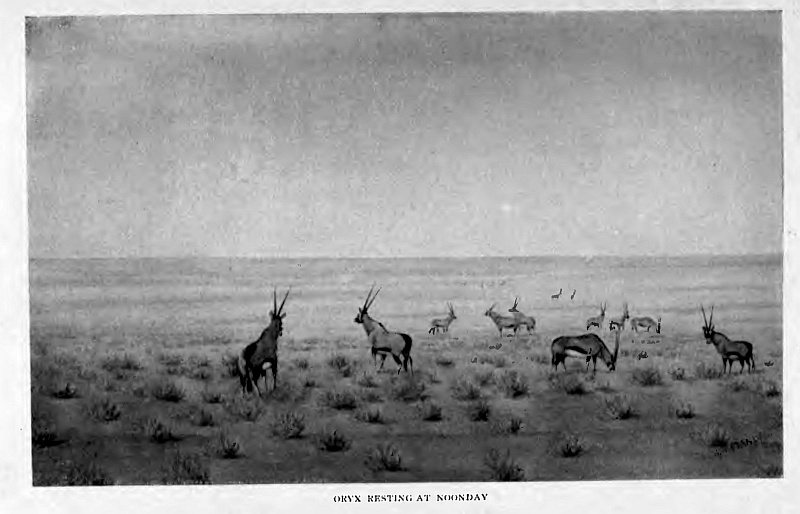
He had been walking along the river shore about ten miles from here when the fog partially lifted. Within about two hundred yards of him he saw eight shaggy horses with long, flowing manes and tails. They at once plunged into the water and swam out to the celebrated islands—that forest-covered archipelago which there enriches the river’s widened course. I much regretted having missed that sight. Descended as they are from tame animals which escaped from man’s control, these horses are as wild as the oryx. They have so far evaded capture by invariably taking to the water when pursued, and seeking refuge in the extensive island labyrinth. Long may they continue to do so.
The hour had now arrived for disbanding my corps of guides. I think I may truthfully say that we parted with genuine mutual esteem. The carcase of one of the springbuck had been dismembered and divided by lot among the faithful six. Pay had been distributed; likewise tobacco. I delivered a valedictory address.
With evident reluctance these people picked up their portions of meat and prepared to depart. Fauna apparently desired to communicate with me privately; she stood apart and gazed with appeal in her eyes. I went to her; she asked in a low, nervous voice—speaking in much-broken Dutch—if I would not send her some of the medicine made from the reptiles and insects which had been collected.
At length I caught the drift of her meaning: she thought I was about to prepare from these ingredients some philtre that would bring back vanished youth. Truly, the mind of man is one when the crust of convention is pierced. This poor old creature, like Ponce de Leon, dreamt of Bimini and longed for a return of the thrilling ecstasies of life’s morning. It cut me to the heart to have to shatter the fabric of her dream.
We decided to start for home on the following morning. I was sorry not to be able to visit the Orange River mouth and its flamingo-haunted dunes—the Vigita Magna of the old geographers. Strange, that I should again have had to miss it when only a few miles away. But I was really pressed for time; other duties insistently called me hundreds of miles thence. Nevertheless, had it not been for the fog, I would have expended another day. But the fog towards the coast was denser than ever, and there did not appear to be any reasonable likelihood of its clearing. So I would forego the barren privilege of being able to say that I had actually visited Vigita Magna.
Our homeward course lay more to the westward, for we travelled along the coast until close to Port Nolloth. We found fresh water at various spots, trickling out of sand hummocks in the immediate vicinity of the sea. We had a comparatively easy journey, for there were no steep, rocky ridges to cross.
Chapter Thirteen.
Kamiebies—The Blossoming Wilderness—The Ostrich Poachers—Hail Storms—The Springbuck behind the Dune—How Andries found me.
Reliable information reached me to the effect that the Half-Breed ostrich poachers had again been at their nefarious work. So we decided, Andries and I, to make a swoop upon the camp which these people had established in southern Bushmanland. This camp was in the vicinity of some wells, the water of which was brackish to such an extent that only men or animals who had gradually accustomed themselves to its flavour and properties, could consume it. Thus the gang of poachers had for a long time been able to defy us. After rain, however, the water grew somewhat less brackish. On the rare occasions when rain fell heavily, the proportion of brack decreased so much that the water became, for a few weeks, more or less fit for ordinary consumption.
The reason was a phenomenal one; the rains had set in a month before their usual time throughout the western desert and the mountain tract. It was then the end of March, and rain had been falling, off and on, for the previous fortnight. Rarely, indeed, did the drought break before the middle of April.
There was also news of the springbucks. The great migration was not due to take place for months, but word had reached Andries to the effect that in the desert somewhere to the east of Kamiebies a moderately large herd had been seen. If the news were true, that herd must have been the first wave of an early-coming tide. Thus we might be able to settle accounts with the poachers and provide our year’s supply of “bultong” in the course of one expedition.
The annual migration of springbucks across the desert is, I am positive, an institution of immemorial antiquity. The reason for it is obvious. The fawns are born in winter, and it is necessary that at the time the does should have green food to eat. But Bushmanland, excepting its extreme western fringe, is far drier in winter than in summer. In winter the feathery plumes of the “toa” crumble away to dust and the stumps of the tussocks turn jet-black. Then the plains become unmitigated desert.
Winter is the season during which rain falls among the mountains lying between Bushmanland and the coast desert. Then for a few short weeks the mountain range covers itself with verdure and flowers. Therefore the trek. However, of late years the mountain tract has been largely taken up by farmers, so the springbuck, as a rule, invade only its eastern margin. The western fringe of the plains usually get a slight sprinkling from the mountain rains. The exception happens when the trek, instead of being distributed over a wide extent, concentrates. Then the springbuck, in their myriads, over-run hundreds of square miles of the mountain tract, and clear the face of the country of vegetation as completely as would a swarm of locusts.
The term “springbuck” is not a satisfying one for this ethereal creature—this most lovely and graceful of the animals whose home is in the desert. The name is too obvious; why not call it what it really is, a “gazelle?” But the early Dutch inhabitants of South Africa not alone lacked imagination, but shewed positive ineptitude in the names they bestowed on the various wild animals. Take for instance the term “gemsbok,” as applied to the oryx; what could be more inappropriate? “Gemsbok” means “Chamois”—and we have in South Africa an antelope which is a chamois to all intents and purposes, but which is called a “klipspringer.” Again,—the tall, heavy, sober-tinted desert bustard is called the “paauw,” a word which means “peacock.” However, these names are so firmly fixed in the South African vocabulary that any endeavour to change them would be a hopeless task.
We trekked south-east from Silverfontein in the spring-wagon, behind a team of eight spanking horses. We slept at Kamiebies, which is an uncertain water-place a few miles over the edge of the desert and a short day’s journey south of Gamoep. During the day we rested; in the night we had to make a dash of some forty miles for our objective. We meant to take the poachers by surprise,—to drop on them just at daybreak, as though from the clouds. So in the mean time I lazed through the long, delicious day.
The rains had not alone been earlier and heavier than usual, but they had fallen throughout an unusually extensive area. The mountain tract was ablaze with flowers; even Bushmanland stirred in its aeon-old sleep, for the skirts of the last rain-cloud had trailed well over its borders, and the latent life of the waste had leaped, responsive, to the surface. Now a whole flora that had slept for years in tubers and dry stalks sent forth blossoms in million-fold rivalry to attract the replete, drowsy insects.
Here, from a dense, thorny, involuted mass of gnarled, shapeless stems that must have been many centuries old, arose the delicate, fairy-like petals of a scented pelargonium. The corolla was snow-white, except for a minute, sagittate marking of bright cerise on the lower lip. If you had examined ten thousand of these flowers you would not have found one in which that little mark varied to the extent of the ten-thousandth part of an inch. The thought of which that blossom was the manifestation—the afterthought of which the tiny cerise arrowhead was the expression—dwelt down in the unlovely labyrinth of the monstrous stems, and had been adhered to with steady persistence through successions of long arid-year periods. It was whispered to the silk-winged seed from which that hoary patriarch had birth,—perhaps when Alaric was thundering at the gates of Rome. And it would be as unerringly transmitted to blossoms making sweet the breeze in days when men will hold this generation to be as remote as we hold the dwellers of the Solutrè Cavern.
There swayed a slender heliophila—the modest sunlover who, in the course of age-long, patient vigils, had drawn down and ensnared the hue of the desert sky in her petals. Far and near the plain was starred with beauty. The small, inornate, thirst-land butterflies had ventured out from the hills; they flitted to and fro, lazy and listless. They sported with Amaryllis in the sunshine and then tried to flirt shamelessly with Iris, the shy maiden on the nodding, hair-like stem—who veiled her visage in sober brown by day, but revealed it, white and eager to the stars whilst she made the wings of the night-wind faint with perfume.
An oval shrub attracted one’s attention—not through its beauty, but because it was an object startling and bizarre. It looked as though covered with rags of various tints. This was that criminal among vegetables—the Roridula. A close inspection almost filled one with horror; the plant was like a shambles. The leaves resembled toothed traps; in most of them insects were tightly gripped. After these had been sucked dry,—drained of blood and of every vestige of bodily juices, the leaves opened, dropped the mangled and dessicated frames to the ground and cynically opened their fell jaws for more victims. Undeterred by the litter of corpses that cumbered the surrounding ground, other insects crowded in to taste of the viscid juice which the leaves exuded. This was the bait tempting to their doom moths, butterflies, beetles and other minor fauna. Here was Capitalism playing on the greed and credulity of the crowd,—gorging on the life-blood of its hapless dupes,—flourishing and waxing strong amid the ruin of its countless victims.
My eye was caught by a quivering twig; on it was a chameleon. The reptile was nearly nine inches long. His colour was brown, of a shade exactly the same as that of the twig. He moved forward with slow, hesitating steps; he paced like an amateur on the tight-rope, as though afraid of falling. His swivel eye-cases, each with a tiny, diamond-bright speck in the centre, moved about independently of each other. One was focussed on a little green insect waving its antennae on a leaf six inches in front of him; the other was carefully trained backwards over his left shoulder at me. Flick—and his tongue shot out and in so rapidly that the eye could hardly follow its motion. But the insect was no longer on the leaf, and the chameleon was munching something with solemn enjoyment. When night fell he would climb to the top of a strong, dry twig, roll and tuck himself into the shape of a pear, with his head in the centre of the bulge. Then he would change his hue to white and open his mouth, which was bright orange internally. The night-flying lepidoptera would take him for a white, yellow-centred flower, and pop in, seeking nectar. But they would not pop out again.
And the greatest wonder of all,—I bent down to examine a gazania; its inch-long golden rays expanded like a wheel of perfect symmetry. Just where the ray bent over the edge of the green, fleshy cup in which the myriad florets were nested, was a small, dark spot. I brought a simple magnifying glass to bear on this,—and what did I see? A labyrinthine crater of many-coloured fire opened. Curve melted and mingled into reluctant curve, zone into rainbow zone, until the plummet of vision was lost in the radiant abyss. I lifted the flower gently; its texture was thinner than the thinnest paper; beneath it was the desert sand. It had hardly any material thickness, yet infinity lay in its depths. I sought for a gazania of another species and found its petals eyed like the peacock’s tail. Yet another,—it shewed the rose-ardours of dawn contending with the purple of a sea on whose surface night still brooded. Every species had its own colour-scheme—its maze of splendour more intricate than the labyrinth of King Minos.
Old Mr Von Schlicht of Klipfontein—who had spent most of his life in Namaqualand, had recently been endeavouring to recall for me details of the desert journeys of Ecklon and Drege, who did so much for South African botany. I ascertained that Ecklon visited Kamiebies. How his heart must have leaped when his eyes first gathered in the winter glory of those mountains. When he afterwards stood, begging his bread at the corner of the Heerengracht, Cape Town,—did he ever recall that scene? Strange world of men that so often lets its noblest, after lives of heroic toil for the highest and most unselfish ends, die in the gutter—if it does not more mercifully slay them—and pays tribute of corn, wine and oil, of jewels and fine raiment, to the company-monger or other chartered robber adroit enough to squeeze through the meshes of the law.
We inspanned at sunset, and plunged straight into the desert, travelling slightly to the south of east. Our objective was lower Pof Adder—which must not be confounded with the northern Pof Adder beyond Namies. We were out of the region of “toa”; the plain was covered with small shrub,—half of which were soft and succulent and the others hard and thorny. There were no intermediate kinds; the desert is a region of extremes.
In spite of the jolting I managed to get a few hours’ sleep. We outspanned for an hour at midnight and made coffee. Now we had some heavy sand-tracts to cross,—with jolty stretches lying between them. But we reached the camp of the half-breeds just at dawn, as had been intended.
They were caught—if not exactly red-handed, yet with ample proof of their guilt. In the mat-houses of the suspected men we found boxes and bags packed full of feathers. These were of all kinds—from the long white plumes and the short blacks of the male bird, to the browns of the hens and chicks. The culprits pleaded guilty; retributive justice was forthwith satisfied at the wagon-wheel.
The camp was quite a large one; I should say it contained over sixty souls, men, women and children included. These people were all of the same colour, light-yellow; they even seemed to shew signs of type-inception. Lean, sinewy and tough, they were not beautiful either in form or feature. In neither sex did the sallow skin give any hint of blood beneath. However, anaemic as they were, whatever fluid circulated in their arteries must have been of good quality, for their capacity for physical endurance was considerable.
It was the eyes of those half-breeds that were most distinctive. These were dusky and deep, with an expression—not exactly furtive; rather expressive of haunting apprehension. This was hardly to be wondered at, for they had ceaselessly to watch for every change in the desert’s pitiless visage—to note each alteration in the moods of earth and sky. Their lives were spent in answering a succession of riddles propounded by the terrible sphinx between whose taloned paws they existed as playthings.
Their dwellings—ordinary mat-houses and ramshackle wagons—as well as the furniture thereof, indicated that they must have become habituated to extremes of heat and cold. They were cleanly in their persons; this I knew through having vaccinated them all,—from the patriarch to the youngest baby. Small-pox at the time was reported to be raging among the Bondleswartz Tribe, just beyond the Orange River.
But these people can never develop a type that will persist; the desert they inhabit is too small. Besides, their sons and daughters are continually being enticed away to regions with a kinder soil and a less severe climate. There they further complicate the South African race question. This question will not be confined to South Africa; it will soon be one of worldwide import, and one that is not necessarily to be answered in favour of the Caucasian, whose birth-rate statistics read like Mene Tekel. I am often inclined to think it would have been better in the long run had Charles Martel lost the Battle of Tours. In that case there would at all events have been no colour question.
But those deep, dusky eyes haunted me. They were as enigmatic as the only landscape over which they ranged. If one could only have stripped the scales from them, what wonders might they not have seen? Incalculable potencies might have been in their depths. Others, desert-bred, have caught glimpses of eternal verities which prompted them to utter words that became the hinges of history. However, up to the present, there is no sign of a prophet arising in Bushmanland with a message for a land that sorely needs it.
The half-breeds had heard of the springbuck; a few days previously the latter were credibly reported to be somewhere about thirty miles to the northward, near Kat Vley. And we were assured of the almost incredible fact that Kat Vley contained water. That was certainly an annus mirabilis in the desert.
At midday we took our departure, making for the vicinity where the springbuck were said to be. In the afternoon dense clouds rolled up from the south-westward and a deluge of hail struck us. Within the memory of men no similar thing had happened in Bushmanland. Andries and I were comfortable enough in the wagon; Hendrick and Piet Noona fixed a sail to the windward wheels and lit a big candle-bush fire to leeward. After travelling about twenty miles we had camped for the night, for the hail-clouds had been rolling up at intervals of about half an hour, and there appeared to be no likelihood of the weather clearing. The poor horses,—they were in for a time of misery!
Morning broke with drifting clouds and a high wind from the south-west. We inspanned and altered our course slightly to the westward. The hail showers had been so heavy that all spoor was obliterated; accordingly we could not tell whether game was about or not. The day was bitterly cold; over and over again the hail showers recurred. Several times we got so perished that we halted and lit fires of candle-bush just to thaw our hands at. Night fell with a slight improvement in the weather; the wind dropped and only a thin drizzle was falling. We camped again and gave the horses a liberal feed of corn. They did not appear to suffer much from the cold. Such weather was the very last thing one could have expected. But surely the sky would be clear on the morrow.
Again a cloudy morning, but the clouds were high and there was no rain. At last we saw signs of game, for we crossed the spoor of several small troops of springbuck; these had apparently been making in the direction of Kamiebies. Later we found more spoor—that of a really considerable herd making due westward.
The desert here was not quite so flat as usual; the brown expanse undulated in long, low ridges running parallel to our course. These were often several miles apart and in the spaces between, narrow sand-dunes, flat-topped and steep, extended indefinitely, east and west. At about three in the afternoon we again struck spoor. It was apparently that of the large herd whose track we had crossed a few hours previously. Now it led north-east, straight over the dune about a mile away on our right—the dune parallel to which we had been travelling for upwards of an hour. The spoor was quite fresh; it could not have been more than half an hour since the herd had passed.
We halted and outspanned. After the horses had indulged in a roll Andries and I saddled up. We rode on the spoor; soon this led us almost due north, straight to the dune, which it crossed at right angles. The herd had evidently been stampeded; it was clear they had been at a run when they passed. Their hoofs had struck deep into the wet soil and there was a distinct series of wide gaps in the dune where the crossing had been effected. We dismounted and clambered up the steep sand-slope. We looked carefully over, being heedful not to reveal ourselves. The plain before us lay empty, but about a mile to the right the herd of springbuck were visible. It was evidently one of the flying patrols of the great migratory army and apparently numbered from eight to nine thousand head.
We remounted and cantered along close to the base of the dune until we were abreast of the centre of the herd—only the dune separating us from it. Here Andries remained, while I rode on for about half a mile further. This brought me to a spot just ahead of the foremost of the game. It had been agreed that when I reached this spot Andries would cross the dune and open his attack. As soon as the herd was on the move, I would begin mine.
I dismounted, tied old Prince to a shrub, climbed the dune and laid myself flat on the top. Just to my left were the springbuck, grazing quietly and utterly unsuspicious of danger. They appeared to be all rams. This we expected, for most of the rams congregate in separate herds in the trek season. Some were grazing within less than two hundred yards of me.
When Andries’ rifle spoke a thrill ran through the multitude. Looking to the left I saw the bucks beginning to stream in my direction, but the impulse had not yet been communicated to those at my end of the herd. Rythmically the impetus of flight developed towards me. Now all were on the move. I fired and a buck rolled over. Then I descended from the dune and ran forward into the plain.
The herd was now streaming past me from the direction in which the knell of Andries’ regular bombardment sounded. The dense stream bent in its course before my advance, and for a few minutes took the form of a crescent at a distance of about four hundred yards. It was as though I were firing at a wall. Once I got my range nearly every bullet thudded. Soon the last of the stream flowed past, but its course for several hundred yards was marked by prone white and fawn forms.
Andries was busy collecting his dead at a spot about eight hundred yards away. I re-crossed the dune and led Prince over it at a flounder. Soon Andries came cantering up, his hands and arms red with the blood of the slain. He had killed eight bucks. I had had better chances and a longer innings, so my bag was larger, but I did not as yet know to what extent.
The sun was now almost down; my spoil was scattered over a large area. It was decided that I should gather up my dead, load the carcases upon Prince and convey them to where Andries had piled his. He started off to fetch the wagon. The team would now number only six, but the wagon was light, for the horses had consumed most of the grain. I loaded up three carcases and deposited them on the heap formed by those of Andries. Another load of three I also fetched. But night was rapidly falling so I could only negotiate one more load. This time I piled up four. When I reached the carcases depot there was little or no light. However, as long as it was possible to see what I was doing, I collected candle-bushes. The result, however, was lamentably meagre.
The wagon was only about four miles away—as the crow flies. But unfortunately the wagon was not a crow—and goodness only knew how far westward that wretched dune extended. However, even if it reached to Gamoep Andries would have to keep on its southern flank until he rounded the extremity. I began to feel miserably cold, for I had no jacket. To complete my misery the sky again clouded over and a thin rain commenced to fall.
I tied old Prince to a bush and removed his saddle. But means of the latter I should, at all events, be able to protect my neck and shoulders from the wet. Then I sat on the ground among the carcases and piled them around me; only my head emerged from the mass. The whole lot, numbering eighteen, were requisitioned for this unusual service. The water trickled in but the dead bucks still retained some heat and for a time I was fairly comfortable.
But as the hours passed the carcases grew cold and colder; my misery became acute. The night was pitch black. I had enough candle-bush to make a flare for about half-an-hour, but prudence prompted me to delay this operation so as to give Andries time to get round the extremity of the dune—wherever that might be. I fired my rifle occasionally, but the wind was blowing steadily and Andries’ course was down to windward.
At length, after a seemingly interminable period of wretchedness, I lit my candle-bush flares one by one. They blazed brightly and gave out a certain amount of grateful heat, but soon they came to an end, and I stole back to my sepulchre among the now stone-cold carcases.
The steady rain trickled down; I was by this time wet through. I wondered as to whether I would be able to endure the misery until morning. I had quite made up my mind that Andries would not be able to find me. The night was too black; there were no hills nor other salient landmarks to guide him to the spot. Looking to westward before we started I could see that the dune was full of forks and branches in that direction. I tried to comfort myself with anticipation of the enormous candle-bush fire I would make as soon as day broke, and the breakfast of broiled springbuck liver I would consume. My matches were safe in a waterproof pouch. How leaden-footed is time when one is miserable!
An earth-tremor; a telephone-message thrilling along the earth’s sensitive surface—telling of hoofs and wheels in rythmic motion. Had the miracle happened? Yes,—the wagon rolled up and my martyrdom was at an end. Deo gratias!
But how did Andries manage it? He heard no shot, he saw none of my flares. He could not tell me; as a matter of fact he, himself, did not know. His feat could only be explained through some theory of unconscious cerebration. Andries was elderly, stout and somewhat lethargic, he had never read any book but the Bible, and of that there was quite a lot he did not understand. But the trackless desert was to him as familiar as my study was to me, and he had been able to pilot his wagon-ship straight to that spot—through the inky darkness—with as little uncertainty as though the sun had been shining. The experience of a lifetime would not have taught me to perform that marvel which Andries did quite as a matter of course.
Chapter Fourteen.
L’Envoi.
My eyes have gazed their last upon the face of the desert. Although I love her still,—although the memory of her burning ardour, her splendid indifference and her wealth of illusive charm is my abiding and most valued possession, we shall meet no more. She is not a mistress to be lightly courted. As Brunhild slew Siegfried so would the Desert inevitably slay one who remained her lover after desire had outlasted strength. Her lioness-like caresses are not for those whose blood slows down as it nears the ocean of eternal silence—even as the force and fury of the Gariep sink to tranquillity when the mighty stream nears the Atlantic—and extinction.
Good-bye, Andries,—best of comrades. I have not told of all our adventures—of how we pursued the springbuck at full gallop across the trackless plains in your springless, home-made rattletrap, behind four wild, half-trained horses,—until we were black and blue. I have not told of how we were lured by men who desired our death to a spot sixty miles deep in the waste, and of how we had to struggle back again in the burning heat because we found the promised water to be brine, and the edges of the pools containing it thickly caked with salt. I have not told of your consistent unselfishness in giving me the best chances in the matter of shooting, nor of how generously you placed the riches of your desert lore at my disposal.
The world for us is not the same as it was—even a few years ago, for at our time of life a very few years make a considerable difference where physical endurance is concerned. Although on the verge of middle life we could still, in the days I have told of, gallop ten miles at a stretch and hold a rifle straight at the end of the race—we could endure thirst, hunger and fatigue without wilting.
In the matter of shooting I am, perhaps, like the reformed rake who coined virtue out of inability further to sin. Nevertheless, I could no longer take pleasure in slaughtering the few of Nature’s lovely wild creatures that survive our cruelly scientific machines of precision. It is true my eyesight is not quite what it was. To what extent this circumstance should be reckoned as a factor towards my abstention, I will not attempt to say.
We shall soon be old, you and I; in fact it is almost stretching a point to call ourselves still only middle-aged. We are just a couple of ineffective veterans who can only draw comfort from the bank of our experiences. Aber “wir haben geloebt und geliebet.”
Good-bye, Hendrick. No more will your keen and faithful eyes hold my vagrant spoor over sand and kanya. No more shall I see your bullet-shaped, pepper-corned head with its oblique eyes and gleaming teeth arising unexpectedly from among the tussocks. For all I know you may have saved me from a dreadful death. I can recall at least one occasion on which I was positively sure you were wrong in your idea as to the direction in which the camp lay,—yet the event proved you to be right. Had I then been alone, my bones might now be lying white in the heart of Bushmanland.
And you, Typhon,—I suppose you have awakened to wrath—that your hunched shoulders have heaved many times since that day on which my awed eyes beheld your russet mane flung streaming southward on the tempest,—I suppose your impotent tentacles still strive to gather up the plains into their blighting grip.
Sometimes, when the firmament is very clear and the fingers of the wind stray gently through the tresses of the night, I lift my eyes to the familiar stars and realise that again the sky has gathered the throbbing desert to its breast and covered Bushmanland with the folds of its purple mantle. It is then I unlock my storehouse of dreams and live once more through vanished days of strenuous effort and nights of wonderful mystery.
The End.
|
Chapter 1
| |
Chapter 2
| |
Chapter 3
| |
Chapter 4
| |
Chapter 5
| |
Chapter 6
| |
Chapter 7
| |
Chapter 8
| |
Chapter 9
| |
Chapter 10
| |
Chapter 11
| |
Chapter 12
| |
Chapter 13
| |
Chapter 14
|