William Charles Scully (continued 2)
Reading edition
The ocean-plain to the south of Typhon and the camp we had broken up, is probably the loneliest among the less frequented parts of Bushmanland. No Trek Boer ever ventures there with his stock; the hunter pauses on its undefined margin—well knowing that should he pursue the disappearing herd of oryx much farther, he and his horse would inevitably perish of thirst. For even on the rare occasions when rain falls on this tract no water is conserved on its surface. Those sand-choked, saucer-shaped depressions of the exposed bedrock found in other parts of the desert, in which rain-water sometimes lodges, do not there exist.
The only people who ever visited the area in which we sojourned were half-breed hunters. These had developed abnormal thirst-resisting powers. They usually occupied a tract some hundred miles farther south, and were incorrigible poachers of ostriches. By means of a flying squadron of boys mounted on tough ponies, these half-breeds used to round up herds, comprising birds of all ages, and mercilessly slaughter them all on the edge of the Kanya-tract.
We outspanned after a trek of about three hours. That night we intended to take things easy,—at least I meant to try and persuade Andries to consent to our so doing. The wagon was lightly laden, owing to our having consumed most of the water,—the heat had not been excessive since the oxen started from Gamoep; therefore they were not over-thirsty. In fairly cool weather cattle bred on the borders of the desert often voluntarily refrain from drinking water for several days at a time. We were homeward bound after a prosperous voyage. Supper was being got ready; Andries was busy preparing gemsbok soup, in which to soak our rusks. The candle-bush fire flared aloft. Our pipes were alight and the peace of the desert filled us with content.
Hendrick and Danster had skinned the second jackal which, in anticipation of the arrival of Piet Noona and his nephew with the cattle, I had insisted should be reserved for that night’s supper,—for on the night previous we had trekked without a halt. The flesh of Autolycus was soon roasting on the embers; all our Hottentots were smacking their lips in anticipation of a feast.
I formally presented both jackal skins to Piet Noona’s nephew,—but under an undertaking that they were not to be sold or otherwise alienated. The skin of the first jackal was too thoroughly riddled with buck-shot to be of much use to me; that of the second was badly torn by the bullet. They were to be brayed, mended, and donned by the recipient with as little delay as possible.
This gift might have been described as an offering on the altar of decency. I was not inclined to prudery, but Piet Noona’s nephew was beginning to grow up, and his sumptuary condition was shocking. In fact his only available garment was a tattered fragment of sheepskin,—a fragment so scanty that it would have barely sufficed to cover the opening of a porcupine’s burrow. Even then it could not have been guaranteed to keep out the draught. The jackal skins were not large, but compared with the sheepskin fragment they would have been as an overcoat to a child’s pinafore. I explained how they were to be worn: one in front and one in the rear. The coverings of the hind paws were to be joined, skin to skin, in such a way that the combined result would hang from the wearer’s shoulders, and the brushes were to be wound about his neck when the weather was chilly. Piet Noona’s nephew would thus be reasonably protected, fore and aft, both from Mrs Grundy and the weather. Crowned with a chaplet of Ghanna leaves and with his knob-kerrie for thyrsus, he might have easily passed for a youthful but disreputable Dionysus.
As we drew out towards the borders of the desert the fingers of silence seemed to press less heavily on our lips. Supper over, we laid ourselves on the soft sand and conversed. But at first our conversation was low-toned and very serious. The imminence of infinity abashed us; it was as though earth and air were full of ears bent to catch every word we uttered. I do not think anyone,—even the most feather-brained, could be garrulous in the desert.
The flames lit up the surrounding faces,—the ruddy, rugged countenance of Andries, with its blue, laughing eyes and cropped beard streaked with grey. The visage of Piet Noona was like that of an old baboon; his nephew’s resembled that of a young monkey. Danster’s physiognomy indicated a mixture of various strains; the result was quite insignificant.
The Mongolian features of Hendrick were distinctive and very interesting. What was it that his appearance suggested; not exactly the Chinaman, for his expression was not at all impassive; one could always read his mood by it. His eyes were slightly oblique, his cheekbones high, his head was as round as a Kanya stone. With remarkable muscular development of the chest and shoulders, heavily hipped and very slightly bandy-legged,—for long I was puzzled to discover what is was that Hendrick reminded me of. He loved a horse and rode like a Centaur—or the man-part thereof. Then I knew: it was a Hun that I was seeking for,—one of the locusts of that Asiatic horde which swept over Europe from the north-eastern steppes. I think that Attila, the Eraser of Nations, who swayed the world from his saddle-throne, must have looked somewhat like my scout. The most plausible theory as to the origin of the Hottentot race is that its progenitors migrated hither from Asia. Even van Riebeek noticed the resemblance between the aborigines of the Cape and the Chinese. Yes, I was almost certain that Hendrick was a Hun,—or rather that the tribe he was mainly descended from and the Huns were twigs from the same bough of the great human tree.
Hendrick, to be appreciated, should have been seen on the back of an unrestrained or a vicious horse; it was then that he became a personality. He rode as gracefully bare-back as with a saddle. I could picture him galloping away from some sacked and smoking town—not on raw-boned Bucephalus, but on some thickset, shaggy, steppe-bred mount. Hanging limply across his tense, gripping thighs was a milk-white, gently-nurtured Ildico maiden. Her wide blue eyes were stony with horror,—her golden hair dabbled in the sweat of the horse’s heaving flank. She was bound and pinioned with shreds torn from her robe of lawn. The other Huns were loaded with sacks of church plate, with weapons and with merchandise. But Hendrick looked on the face of this maiden, the daughter of what, but a few short hours before, had been a proud and noble house,—and desired her alone. But I think and hope she died of terror before the bivouac was reached. Hendrick was a tame, kindly, obedient hunting-scout, but I am sure that the fierce, conquering Hun lay sleeping within him.
There is not a watering place in the Bushmanland desert which has not some tragic story connected with it,—some reminiscence of a lonely thirst-death, some tale having for its motif the shedding of blood—usually by treachery. But death, accidental or designed, was always the theme. Not many miles from where we were camped that night one of the earlier Wesleyan missionaries travelling from Warmbad to the half-breed settlement on the Kamiesbergen had been shot to death with poisoned arrows. This happened early in the nineteenth century. The murderer was executed some time afterwards at Silverfontein.
The first white man who crossed this tract did a venturesome thing. For although at that time the Bushmen had already been considerably thinned out by the Hottentots and half-breeds, many of them still lurked in the less accessible parts. From time to time they emerged, singly or in small parties, and wreaked a wild and often quite inconsequent revenge.
Their mode of attacking travellers was to steal up at night among the tussocks and discharge a flight of poisoned arrows at point-blank range, among those surrounding the camp fire. They would then immediately decamp and scatter in the darkness. Hours afterwards they might repeat the attack. If the travellers were deep in the desert the repetition would perhaps be delayed until the following night, for the Bushmen took no avoidable risks. Usually the oxen or horses forming the span would also be slain. One can imagine the plight of a party of travellers under such circumstances: half of them dead or dying in agony, the survivors cowering in a wagon as hopelessly tethered to a lonely spot in a trackless waste as a wrecked ship is chained to the reef that gores her side. They would have been ringed round with drought and famine; close prisoners in a solitude only mitigated by the unseen presence of implacable foes, the stroke of whose dart was as silent and deadly as that of the snake.
Yet these Bushmen had sufficient justification for all the terrible reprisals they perpetrated. They were the original dwellers of the soil; the Hottentots came, dispossessed them of their best water-places and slaughtered them without mercy. When they migrated eastward they met the Kaffirs, who proved a more formidable and quite as pitiless a foe. In the storming of the Bushmen’s strongholds their women and children were speared or flung into the flames. They retired to the most remote wastes,—to the sheer, black-chasmed fastnesses of the Malutis, where snow lies thick for months at a time,—to torrid, waterless deserts. But in every retreat, no matter how remote, their foes sought them out. They invariably made a desperate resistance, and sold their lives dearly.
But the duel was between ferocity organised and ferocity deranged, so the former was bound to prevail. It was a struggle of the clan against a number of units which had no permanent cohesion; whose combinations were fitful and occasional. There is no god but strength visible on the checker-board of history. When the mighty is put down from his seat it is not the humble and meek who is exalted, but one whose strength, being of a more subtle order, is perhaps not at first recognised as such—one whose cloak of humility may cover armour of proved temper. The strength of the Bushmen, perfected through long ages of experience, was all-potent against his one-time only adversary, the animal. But when used against man, the intruder who had fought for his existence with other men and learnt in the process the utility of combination, it failed. The Bushman contended under one tremendous disability: he had no tribal organisation,—the family was the independent unit.
Piet Noona’s nephew, having had the duty of collecting fuel assigned to him, carried a considerable store of bushes to the vicinity of the fire and there heaped them together. With the exception of the “toa,” most of the vegetation of the desert is globular in form, and, being usually rooted in more or less soft sand, is easily pulled out. Andries reached over and seized a bush-globe; one that was rather denser and larger than usual. This he flung on the fire. Out of it glided, hissing, a snake—a horned adder. The reptile was quickly despatched. But upon seeing it Piet Noona sprang into the air to a height of about four feet; then he fled away into the darkness, bounding sideways as he ran and shrieking. He had gone quite mad for the time being. This always happened when he found himself in close proximity to a snake, and the madness invariably manifested itself in the same way. Years ago Piet had been bitten by a puff adder and narrowly escaped with his life. Ever since the sight of a snake at close quarters has incontinently thrown his brain out of gear. How far occasional bouts of brandy-drinking at the Copper Mines has been responsible for this peculiarity, I cannot say.
Some months previously I had played—to a great extent unwittingly—a cruel trick on him. I had heard of Piet’s being afraid of snakes, but had no idea that his dread of them was so intense. One day when he was saddling Prince I laid a recently-killed snake across the saddle. The creature was practically dead, but was still squirming slightly—as snakes are apt to do for a considerable time after they have been rendered harmless, no matter how badly they may have been mangled.
Piet’s head, as he tightened the girth, was under the uplifted saddle-flap. When he dropped the latter and found the snake close to his face he sprang into the air and fled, bounding sideways and every now and then striking his thigh diagonally with the palm of his right hand. It was a most peculiar and uncanny manifestation. I did not see Piet for three days afterwards. Then he emerged from the veld, red-eyed and starving, but once more in his (comparatively) right mind. That night, as his cries grew fainter in the distance, we concluded that we should see no more of him during the trip.
Once more our caravan was silently moving over the trackless waste. The desert was now in one of her moods of tenderness,—the air full of soft and subtle scent that was sweeter than myrrh—more grateful than wafts from a garden of spices. A feeling of sadness gripped my heartstrings; I was leaving the mistress I loved—the mistress beneath whose stern, arid, monotonous day-mask I could discern the fair symmetry, the soft and delicately-tinted curves of perfect and eternal youth. How often had I breathlessly watched those features quicken and grow mobile as the defacing sun departed. It was then that the breath of her mouth sought mine; then that her eyes shone softly as the evening star. But it was at full night, when the great dome above us was unvexed by the least trace of day, that the desert’s inhabiting soul came forth and transfigured the littleness of my cribbed and cabined spirit.
Sometimes for a season she smiled as though she relented, but the smile was not for me. At dawn, when Zephyr and Aurora couched at the hem of her robe, she let me lean against the softness of her bosom. At night she lulled me to sleep and crooned into my ear dream-songs that were great and strong with wisdom gleaned from the most ancient seasons. But when day returned she flung me to the lions of the sun. Should they have mangled me to death the mistress of my worship would not have cared. She was too strong to feel compassion, too lofty to be moved by grief or touched by any regret. My beloved was not mine, tho’ I was wholly hers, and the lilies at her breast were petalled with consuming flame. “Who is she that looketh forth as the morning, fair as the moon, clear as the sun, terrible as an army with banners?” It was the desert.
Spinoza’s aphorism:—“Those who love God truly must not expect that God will love them in return,” roots deep in human experience. The loftiest love is that which gets not nor expects requital. I used to believe that this desert I love hated me. But I thought so no longer. It was not hate nor any other emotion that she felt; she was filled with the divine attribute of infinite indifference.
I am subjectively certain that some ancestor of mine with prognathous jaw, flat forehead and enormous thews, paddled over the sea that once filled these plains and roamed over the far-separated hill-tracks. I often saw him,—usually where the stark mountain range,—which in those old days was covered with verdure,—arises like a rampart from the northern limit of the plains. I have watched him crouching behind a rock with a sling in his hairy hand and a stone-axe slung to his girdle of twisted thongs,—his fierce eyes bent on a herd of Aurochs (or whatever the local contemporary equivalent of those beasts may have been) straying down to the entrance of a certain valley. There he had constructed, and skilfully concealed, a staked pit. The mountains at Agenhuis and the high kopjes at Gaams and Namies were then islands, and he used to paddle from one to the other in a canoe made of Aurochs’ hide stretched over boughs. In the gorge that splits Agenhuis Mountain he waged mighty and victorious war with such dragons of the prime as attempted to lair therein,—for Agenhuis was one of his favourite sojourning places, and in the days when he flourished, dragons had not yet disappeared from earth.
In view of the undoubted scientific foundation upon which the germ-plasm theory rests, there is no limit to be set to atavistic memory. I am quite persuaded that this ancestor of mine actually existed; as a matter of fact I have over and over again seen him on the hunting trail, attending to the all-important business of filling his larder. I have watched him as he set forth in the early morning, empty and wrathful, and as he returned towards evening—still empty but laden with extraordinary spoil of antediluvian meat, and whooping an extempore triumphal chant.
He would fling the meat down at the mouth of his cave, and bellow for the attendance of his by-no-means gentle mate. She, with the fear of the stone-axe before her prehistoric eyes, would at once conceal the prehistoric baby in a corner, and with almost feverish energy busy herself with rudimentary cooking. A big fire would be already alight,—the embers containing stones in red-hot readiness for dropping into a pot-shaped depression in the cave’s floor, half-full of water. Into this the meat and the stones would be flung together, but in the meantime a tit-bit had been lightly and hurriedly broiled, cleaned of ashes, and held out to the hunter on the end of a long stick, in a propitiatory way. After this had been snatched and swallowed to the accompaniment of savage growls, the cook seemed to be more at her ease. All this time the baby kept as still as a mouse. Prehistoric babies did not cry when papa was about, and hungry. In the exceptional cases where they did, it only happened once.
I trust my claim to such ancient lineage may not be put down to snobbery. One always suspects those who dwell unduly on the deeds of their ancestors. But my justification is this:—a germ charged with an epitome of that creature’s stormy life has come down to me through the generations. It remained dormant until it met in my brain some solvent which disintegrated its shell and thus set the sleeper free. Garrulous after its long imprisonment the germ has told the story over and over again to all the grey molecules of my cortex. For some time most of these have known it off by heart.
Accordingly this ancestor—or perhaps for the sake of convenience I might term him my (many times removed) uncle—and I have been for some time shouting to each other across the ages, until we have attained to almost an intimacy. I have, in fact, by this means, acquired many prehistoric forms of thought. As may be imagined this has somewhat confused my ethical canons. Much of what I have learnt is difficult to translate into terms of modern speech.
I often long with all my soul to be prehistoric in certain matters, but the prim hand of convention—otherwise the unimaginative policeman—holds me back. However, some of my uncle’s views are still more or less widely held. He was, for instance, what in modern speech would be called a strong Conservative; that is abundantly clear from many of his peculiarities. But in his day Imperialism had not yet been born; there was so far no urgent necessity to provide for the younger sons of the aristocracy. In fact there was still room in the world for everybody, and as cultivation had not yet been invented, there was no such thing as private ownership of land. Moreover, the pressure of over-population was never really felt until cannibalism went out of fashion, and that happened only quite recently.
My uncle was, of course, an aristocrat,—his three-fold patent of nobility being founded on his muscular strength, his skill in wielding weapons and his unique talent for concentrating all the faculties of his prehistoric mind on what I, his degenerate nephew, would call the main chance.
My aunt—there were several of them, of course, but you may take your choice, they were all of the same type—was an extremely practical woman. But she was not a Suffragette—or if she was she carefully concealed the circumstance. She was quite devoid of any kind of sentiment. In the matter of personal adornment, she affected the jewellery of the period; this consisted of the scalps and ears of my husband’s deceased enemies—more or less dessicated—and the teeth of the same persons, bored through and strung on thin thongs. Her wardrobe was not extensive; in fact she never owned more than one garment at a time, and that she only used in cold weather. My uncle’s hunting provided the material, so he had neither dressmakers’ nor milliners’ bills to meet.
My aunt was fiercely fond of her children so long as they depended upon her for food and protection. Afterwards she rather disliked them than otherwise. If one of them after reaching adolescence met her accidentally when she took her walks abroad, that one would utter a howl of dismay as loud as though he had met an angry odontosaurus, and flee, leaping from side to side to avoid the slung stones. For my aunt also carried a sling; she found it far more useful than a reticule.
How Nietsche would have delighted in this family; what a joy it would be to Mr Bernard Shaw. I can imagine my uncle dining with President Roosevelt,—but it would hardly have done to invite Booker Washington to meet him.
About two hours after midnight I coerced Andries into being merciful and calling a halt, for I felt that I must sleep or die. It was only when I had thrown myself prone on the sand and told Hendrick to picket the horses close by, that Andries relented. There was really no object in pushing on at such rapid rate; by making an early start we could easily reach Gamoep shortly after noon on the morrow.
Both Danster and Piet Noona reported the presence of springbuck in this vicinity. Mrs Esterhuizen would be disappointed and contemptuous if we returned without meat other than the half-dried oryx-flesh. When, I again asked myself, would repentance for the crimes I committed in slaying those beautiful desert creatures become final and practical, instead of intermittent? Saint Augustine once put up a prayer for the grace of continence, but added a rider to the effect that he did not desire it to be granted immediately. This somewhat suggested my state of mind. But I meant some day to lay down my rifle finally—perhaps after a particularly good bag or an unusually skilful shot. Afterwards I should never kill another animal—unless in self-defence or because I badly lacked meat. However, in the meantime, like Saint Augustine, I knew I should continue certain practices which my conscience reprehended. The hunter’s instinct is the one most deeply rooted in the mind of man; it is among those tendencies which persist after the conditions which called them forth have disappeared—even from memory. It is the true basis of that original sin over which the theologians fumble, for in the absence of other available game men hunt each other.
But I had, incontinently, to sleep. And hey—for a gallop over the plains in the morning.
Chapter Seven.
The Springbuck Drive—The Bushman Caves—Return to Gamoep.
Morning,—and the cool west wind, laden with refreshment, hastened over the desert’s rim to where I lay, still on the border-land of sleep. The sweeping garments of the air-spirit were fragrant with the ichor of the sea on whose breast it had slept. Its sandals whispered through the swaying tussocks, its tresses trailed over the bending plumes of the “toa” shocks. It gently tried to draw me back to the mistress I loved and longed for, but was deserting because she would have slain me had I lingered at her unpitying feet.
At sunrise I gazed around for one ecstatic moment and again sank to sleep—to a zone too deep for dreams to haunt. The long trampings of the previous two nights had made further slumber an almost absolute necessity. Andries might go hang; I would not move.
The grateful aroma of coffee wakened me. I decided to breakfast in bed; that is without emerging from my kaross. Andries determined to go on with the wagon. Hendrick and the horses were to remain with me; also Piet Noona’s nephew who would, later, trot on and overtake the wagon with my kaross and pannikin. After another hour’s sleep the sun became insupportable, for the wind had somewhat died down, so I ordered my faithful Hun to saddle up. He had already located a herd of springbuck. It had been settled that we were to try and drive these near enough to the track to afford Andries some shooting. No one but Hendrick had seen the game; he said they were too far off—away, ahead,—on the left-hand side of the track,—for us to see. Andries was to lie in ambush at a certain knoll, while the wagon went on to Kanxas,—there to be outspanned.
Hendrick’s powers of vision were phenomenal; when objects at a distance were in question, no one dreamt of disputing his verdict. His eyes were equal, if not superior to the best prismatic binoculars ever turned out by Dollond or Zeiss, and Nature had apparently corrected them for chromatic and all other aberrations.
The western hills could now be distinctly seen; we might even recognise the contours of the ridge beyond the northern end of which Gamoep lay. Soon we should pass from the kingdom of ancient silence to where the squalid tents of nomadic men were temporarily pitched,—to where the fat-tailed sheep crowded, with anxious eyes, around the creaking derrick and the scanty trough. But to us, intruders as we were, the desert had still to pay tribute.
We started, Hendrick and I, riding quietly forth on a course a little to the east of south, for we had a wide détour to make. I knew the vicinity well; it was, literally speaking, a part of the desert, but I found it hard to acknowledge it as such, for the reason that the western hills were in sight. These seemed to link us with the conventional world.
We passed over a tract studded with small, dense patches of low scrub; it looked like a miniature archipelago in the boundless ocean of “toa.” Here brown “duiker” antelopes were numerous. So far as I knew this was the only part of Bushmanland where such were to be found. As we rode on the little creatures sprang out, right and left, from the patches of cover and bounded gracefully away.
Far to the south-west the herd of springbuck was now clearly visible. Most of them were quietly grazing in the mild sunshine. Now and then a few detached themselves from the main body and, one behind the other, bounded away for a few hundred yards on a course curved like the blade of a scimitar—“pronking” with the sheer joy of unspoilt life. After such an excursion they would rejoin the others and go on feeding. And I had come to... But if I had let Jekyll climb to my crupper Andries would have got no shooting. The herd was a small one; it did not number more than about six hundred. It was curious that these bucks had not joined in the general migration eastward towards where the lightning had flashed its message of rain a few nights previously.
The springbucks had not seen us as yet, for we were still about two miles distant from them. The eyes of these animals seem to be specialised to a definite range as the ear is tuned to a certain gamut of sound. I will endeavour to explain what is meant by this. They do not seem to notice anything at a greater distance than about fifteen hundred yards. Conversely, should you be lying in ambush and the bucks come to within fifty yards of you, they would evince far less alarm if you shewed yourself than on seeing you at a distance of from two to three hundred yards.
This can easily be accounted for. The springbuck has always spent its life in an environment of menace, but as conditions change the nature of the menace changes with them. Formerly the danger-zone for these creatures was that from which the lion, the leopard or the wild dog could spring; it was only surprise at close quarters that the springbuck had to guard against. Given a few seconds’ notice of the approach of an enemy, this creature’s unsurpassed fleetness enabled it to laugh at danger. This laughter is still expressed in the manner in which a small herd of springbuck will circle round and round a pursuing dog that is not especially swift—as porpoises sometimes circle around a moving ship.
We know from accounts left by the very old hunters that in early days, when the killing range of a bullet was little more than a hundred yards, springbuck would graze with apparent unconcern until approached to within about that distance. But with the disappearance of the larger carnivora before firearms, and the increase in the range of the rifle, a wider danger-zone has been created, while the danger of an enemy at close quarters has practically disappeared. The width of the danger-zone has gone on increasing with the longer range of the rifle.
Wild animals are quick to learn and to unlearn—which is not quite the same as to forget. Thus the springbuck has ceased to dread the springing enemy, the creature of teeth and claws that used to lie in ambush; in fact he never contemplates the contingency of any enemy at close quarters, and on the rare occasions when he meets one, the experience appears to fill him with surprise rather than alarm.
The distance between us and the herd had decreased to a little over two thousand yards, so I detached Hendrick and instructed him to alter his course to the left and endeavour to edge round the still unsuspecting animals. The object was to stampede the herd so that it would pass me on my right and head towards where Andries lay in ambush. Bucephalus and Hendrick loomed immense and black against the background of yellow shocks, but they were apparently unobserved by the game, for the latter still grazed and “pronked” about as though they had the whole desert to themselves,—as though no entangling web were being drawn about them.
Hendrick had reached the limit of his arc; then the springbuck marked him and evidently realised that there was danger. Apprehension touched them; a quiver ran through the herd; they lifted their heads and gazed; they moved to and fro. So far it was not fear that they felt; for they knew their own fleetness and had trust in it. Then, suddenly, terror seemed to strike them like a blast, for as dead leaves are caught by a wind-eddy and whirled in a spiral, these imponderable-seeming, ethereal desert creatures swerved over an area resembling in form the sweep of a fan, and then streamed forth like a handful of white rose-petals before a gale.
Why is it, I wonder, that during the forenoon springbuck in the desert appear to be white? For this is literally the case; these animals seemed to be as white as snow, as imponderable as thistledown. The fawn-tint of their necks and flanks, the broad, brown patches on their sides, the black, lyre-formed horns,—all were drowned in the milky foam of the dorsal manes. These were expanded laterally to their fullest extent; each long silvery hair stood erect and quivering.
The creatures’ heads were depressed almost to the level of their feet. With backs deeply arched they bounded over the face of the desert like so many alabaster discs—mingling, separating and re-combining in a tracery of flying arabesques. They had adopted the attitude and movement usual to their kind in moments of sudden terror or delight. Surely their flight was the highest expression of grace revealed by animated nature in motion. It was a soundless melody; a symphony for the eye.
The torrent was streaming to my right, straight for Andries. Hendrick thundered behind,—a black Centaur-monstrosity. How terrible he must have appeared to the fugitives. I wished Hendrick then would trend to his right, for if the springbuck had swerved towards Kanxas and caught sight of the wagon, they would have doubled on their tracks and made for the depths of the desert. My object was to hold them on the course they were following for as long as possible. Ha! they must have sighted the wagon, for they wheeled to their right and attempted to escape past me, about three thousand yards on my side of where Andries lay waiting for his shot. The terror of death was upon them; their manes were down—hidden in the constricted dorsal tract. The eye could hardly follow the movement of their limbs; distance died beneath the lightning of their feet.
The reins fell upon my horse’s neck, I pressed my spurless heels to his sides; he knew what was required of him. We dashed forward to cut the herd off. While we had to cover a thousand yards the springbuck had to cover nearly two—yet it was clear that they must win the race. When the springbuck runs his best the speed he attains is almost incredible. There remained but one thing to be done.
After having altered my course so as to reach some slightly higher ground, I rolled from the saddle on to the soft sand and began firing—not at the bucks, but so that my bullets would strike some twenty or thirty yards in front of the leaders of the herd. Bullet after bullet scarred the ground, sending up spouts of red sand—now here, now there. The herd faltered in bewilderment, whirled round in a half-circle to the left, and headed straight for the ambush.
A distant shot—another; several in rapid succession. It was the rifle of Andries speaking. It was Man taking toll of Nature, imposing his age-long tribute of blood and pain. It was Death eliminating Beauty become obsolete. It was like Autumn shedding the petals of a flower that had lived its allotted day.
The hunted creatures, in their dismay, completed the circle of frantic effort; they sped back to the spot where they had been disturbed. They passed it; they grew smaller and smaller until they melted into the infinite mystery of the desert.
Three bucks had fallen to Andries’ rifle. I dismounted, and we piled the carcases on Prince’s patient back. Bucephalus, as usual, grew frantic on being brought within smelling-distance of the slain game. Then we strolled to where the wagon was waiting for us, at a spot some three miles away, close to the head of the Kanxas Gorge. There we dined sumptuously on roasted springbuck liver,—one of the best of desert delicacies.
Once more I explored the gorge—that deserted city which once teemed with human life. It was narrow, it was neither long nor deep; a mere scar it was on the desert’s flank. The greatest depth was not more than fifty feet; it was possibly a mile long and the width varied. The sides contained caves, on the walls of which could still be seen traces of fires lit long, long ago. And there, thickly traced on the ledges was the mysterious, black-pigmented script—the groups of short, diagonal lines crossing each other at various angles. What did they indicate; was nothing to be read from them even by those who deciphered the graven edict, five-and-twenty centuries old, of Mesha the Sheepmaster?
Why was it that one did not find at Kanxas pictures of the eland, the oryx and the rhinoceros; why were there no perspectiveless battle-pieces depicting the successful defence of some cave-stronghold, with the baffled invaders being hurled down precipices? Such pictures are found distributed over vast areas of South Eastern Africa; it seemed remarkable that none exist, so far as I am aware, in Bushmanland.
Perhaps the plants from which the necessary pigments had to be extracted do not grow on that side of South Africa. But, deep in the Orange River gorge is a continuous strip of rich and varied woodland, in which most of the South African forest flora is represented. Moreover, on the islands which gem the river’s course near its mouth are to be found myriads of eastern plants, the progeny of seeds carried down by the annual flood from far-off Basutoland and its environs,—and it is precisely in that vicinity that Bushman paintings are most plentiful. The thing remains a puzzle.
And the strange, highly-evolved dramatic art of that vanished race,—a drama in which human beings took the parts of animals,—how often had it not found expression there in days of bygone plenty; days when the baskets of dried-locust cakes crowded every ledge and the children went pot-bellied and sleek.
There was the stage; there the auditorium; yonder the ledge along which, no doubt, the actors made their exits and their entrances. Was the audience a critical one; did it generously applaud a nervous new actor of evident talent; did it hurl stones, at one who bungled his part or tried to make up in pretentiousness what he lacked in ability? Did the author of a successful play advance to the proscenium and enjoy the tribute of plaudits paid to a successful playwright?
I fancy there must have been a chorus; possibly a semi-chorus as well. Thespis and Aeschylus probably adopted those obvious aids to rudimentary drama from the shepherd,—who is first-cousin to the savage. And the more one sees of various savages, belong they to Bushmanland or to the Bowery, the more astonishing is the kinship revealed between them. I could find no box-office—no gallery from which the gods could have jibed. The auditorium must have been all pit.
And what dramas of real life must have been enacted in that rocky valley; what rudimentary idylls had not the moon looked upon as her slanting beams searched slowly down among the rocks on summer nights. There men and women loved; there jealousy, cruel as the grave, had brooded. There vengeance had stalked abroad and taken toll for Fate. Finally, from there—after an age-long struggle—Death had evicted Life. It was, after all, only appropriate that the Kanxas fountain should have ceased to flow.
How often had not some old lion—some gaunt, lonely brute with blunted teeth and claws worn to the quick, crouched among those rocks, bent on spoil of the cave-men? During how many nights of livid fear must not the horrible purring of the man-eater, as he quested up the gorge, have sunk to the deadlier horror of silence. For then every member of the little community would have known that the prowler had at length selected a dwelling from which presently to drag a shrieking victim.
And later, the arch-enemy, the more cruel spoiler, man. Man—the spoiler to-day,—to-morrow the spoiled. The European revenged the Bushman on the Hottentot; who would revenge the Hottentot on the European? “For that which hath been is, and that which will be hath been, and there is no new thing.” The thought made “a goblin of the sun.” “O stars that sway our fate; O orbs that should be very wise, for you have circled the heavens and regarded the earth from the most ancient days,—you who, impassively, have seen an endless succession of civilisations arise, decline and die,—when, and at whose hand, will our nemesis come?”
A spirit of laziness had overcome us all. Andries lay fast asleep under the wagon; his large frame was loosened, his placid, handsome, weather-beaten face relaxed. He would have looked just as he did then, had he been dead, for his days had been days of quietness and all his pathways peaceful. Yet in that man’s deliberate arteries flowed the blood of those who withstood Alva in the Netherlands, and of others who abandoned France, with all that seemed to make life worth the living, rather than bend the knee at the shrine of a false god. I wondered whether that large-boned, contented, easy-going farmer were capable of standing on the ramparts of another Leyden and, from hunger-bitten, indomitable lips roaring heroic and vitriolic defiance at a seemingly-unconquerable foe. Would he have abandoned honour, riches, comfort, roof-tree and friends for the sake of conscience,—that discipliner whose whip-lash does not, unfortunately, bite as severely as it once was wont to do? I wondered, and in wondering breathed one of those wishes which are the essence of prayer, that he might never be put to the test.
The afternoon was young. I decided to stroll on, ahead. I found Danster and Piet Noona’s nephew just above the krantz—preventing, with some difficulty, the oxen from stampeding to Gamoep, which was now only about ten miles distant. I sent them back to the wagon with instructions to do the thing my heart had failed of,—to waken a human being from that highest condition of well-being—perfect sleep. But it was now time to inspan; for the first time since they had last drunk the oxen were really suffering from thirst. They, too, had their rights. Andries, moreover, was one of those fortunate beings who could slumber at will.
So I again strolled on. I left the track and climbed to the top of the Koeberg, the hill from which the big beacon—that farthest outpost of the trigonometrical survey on this side—springs like a startled finger. This was one of the actual portals of the desert. I was now, alas! once more within sight of the dwellings of men. Several tents had been pitched, and quite a number of mat-houses set up at Gamoep since we had left it, a little more than a week previously.
I turned eastward and cast mournful eyes back over the sun-bathed immensity from which I had emerged, and from the deepest depths of which sounded a call that I knew would for ever echo in my soul. What a strange regret it was that tugged at my aching heartstrings...
The wind had here died down. The morrow would be torrid,—perhaps with a tornado from the north. As the last skirts of the sea-cooled breeze trailed away into the infinite east, their track was marked by a line of towering sand-spouts. So gently did these move across the plains that it seemed as though they stood like a row of lofty columns sustaining the temple-dome of the sky. Yet a careful eye might detect their rhythmic and concerted movement. What was the stately measure they were treading,—to what sphere-music did their gliding feet keep time?
And then, O desert—O steadfast face that I loved—I had to bid you farewell. These eyes would gaze upon you again, but the day was swiftly coming when I should have to take leave of you for ever. But if when the body dies the spirit still lives, this soul which was nourished by your hand until it grew to a stature sufficient to enable it to realise its own littleness, will return and merge itself in your immensity.
Chapter Eight.
The Summer Clouds—News of Rain—Start for Pella—The Vedic Hymns—Digging for Water—Arrival at Pella—Terrible Heat—The Tribe—Aquinas in the Wilderness—The Mission—The River Gorge—The Tarantula Invasion.
That mountain tract stretching like a back-bone through Namaqualand, parallel with the coast upon which the Atlantic ceaselessly thunders, is the region which catches the sparse, south-western winter rains,—but which in summer is the abode of drought. On the in-lying Bushmanland plains the winters are quite arid; it is only in summer, when occasional thunderstorms stray down from the north-east, that the level desert gets rain.
In a season when the Storm Gods go forth mightily to war on the aether seas, and the capricious heavens are bountiful, it is a striking experience to climb, on a torrid afternoon, some peak jutting from the eastern margin of the mountain tract, and from there to watch the ordered procession of the thunder-ships as they sweep down from their far-off port of assembly. Like great battle-craft, black beneath and equipped with dreadful artillery,—their dazzling decks heaped and laden with ocean-gleaned merchandise of crudded white,—they charge menacingly across the illimitable plains as though to overwhelm the granite ranges. But each stately vessel barely touches some outlying buttress; then the aery hull swerves and changes its course due south, bearing its most precious freight to more fortunate regions. It is as though some immense, invisible fender were being lowered from the sky to guard the range from the shock of impact.
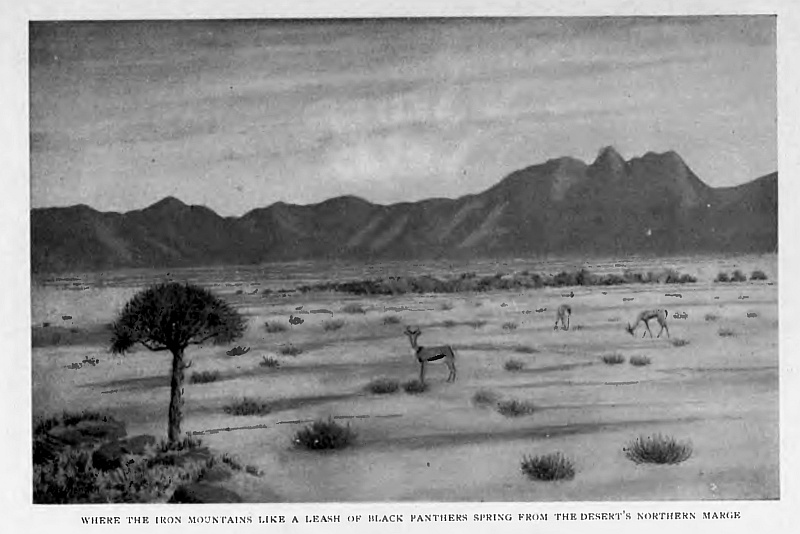
There came good news from Bushmanland; thunderstorm after thunder-storm had trailed over the plains, each marking its path with verdure and filling every rock-depression with water. The drought had broken, so my long-postponed trip to Pella, that remote outpost of French-Roman Catholicism, could be undertaken. Pella lies where the iron mountains, like a leash of black panthers, spring from the northern margin of the plains,—and then sink to their lair in that great gorge through whose depths the Orange River swirls and eddies with its drainage of a million hills.
We were to travel with horses along a route I had special reasons for wishing to take, but which, had the drought still prevailed, we would not have dared to traverse. But under the existing circumstances it would never be necessary to travel more than twenty miles without finding a spot where a water-pit might be dug.
So Andries brought his spring-wagon in to the Copper Mines and we made busy preparations for a start. Our wagon-team numbered eight, four belonging to Andries and four to me. Old Prince pulled as a wheeler; my two young chestnuts as leaders. Besides the wagon we had another vehicle,—a strange, springless, nondescript contraption knocked together by Andries out of the remains of an old horse-wagon which he had broken up. It had low, strong wheels set very wide apart, with a rough framework of yellow-wood boards superimposed. There was no seat, but a box-like rim of woodwork edged the frame. To this vehicle four half-trained horses were yoked. It was intended to be used in pursuing springbuck over the plains. Hendrick was to be the driver; his task would not be an easy one. Andries owned a mob of over sixty horses, the greater number of which had been taught but the merest rudiments of service.
We reached the outer periphery of the hills late in the afternoon, and camped on the margin of the pale-green ocean of feathery “toa.” Far-off, to eastward, we marked the rose-litten turrets of a thunder-cloud. When the sun went down these were illuminated by incessant lightnings, symbols of destruction heralding the advent of the only giver of life-rain.
I had formerly been accustomed to bring books to Bushmanland, but, with one exception, I did so no longer. The exception was Ludwig’s translation of the Vedic Hymns. The open Volume of the desert, so insistent to be read, was sufficient; nevertheless those large, primordial utterances of the Vedas seemed appropriate whenever one was brought into contact with unspoilt Nature in her vaster aspects. Although they originated under conditions very dissimilar to the local ones, the Vedic Hymns are tuned to the desert’s pitch. In India, as in Bushmanland, rain is the paramount necessity. When the rain-gods forget Bushmanland a few thousand fat-tailed sheep may perish; a hundred families may have to retire from its margins and live for a season by digging wild tubers among the granite hills, or by robbing the ants of their underground store of “toa” seed. But if a similar thing happen in India, perhaps ten millions of human beings die a horrible death.
In the desert,—away from man and everything that suggested him, the Hebrew Scriptures seemed to be too overloaded with ethics, too exigent towards enlisting the services of the deity on the side of tribe against tribe. But the Vedic Hymnist was a worshipper who imposed no conditions upon his gods. He had passionately realised the fundamental fact that his own continued existence, as well as that of all organic life, depended upon the beneficient fury of the sky, so he offered awed and unconditioned adoration to Indra, Agni and the “golden-breasted” Storm Gods through a symbolism of sincere and homely dignity. Submissive, he accepted death or life, the thunder-bolt or the Soma-flower,—the drought that slew its millions or the rain that brought a bounteous harvest.
We started at break of day. Although rain had fallen, we felt it necessary to plan our course carefully, for water was only to be found in the sand-covered rock-depressions—and these, albeit more than ordinarily frequent in that section of the desert over which our route lay, were nevertheless few and far between. The weather was hot; therefore the horses, unlike oxen, had to drink at least once a day. Even where it existed, water could only be obtained by digging to a depth of from five to eight feet; then it had to be scooped up in pannikins after having trickled in from the sides and collected at the bottom of the pit. Thus, even under favourable conditions, it took about two hours’ hard work to provide sufficient water to quench the thirst of twelve animals.
With cocked ears and anxious looks the horses would crowd to where the smell of wet sand told them that relief was near; it became necessary to keep them off with a whip. Once I narrowly escaped being badly hurt owing to a mule flinging itself into a pit in which I was digging for water.
We decided not to delay on our forward journey; therefore the various herds of game seen in the distance were not interfered with. We intended, after finishing our business at Pella, to seek out some temporary oasis favourably situated, pitch our camp there and spend a few days shooting in the vicinity.
On the forenoon of the fourth day,—a day of terrible heat, we sighted the mission buildings of Pella in the far distance. These stood on a limestone ridge in a crescent-shaped bend of that stark range of mountains on the northern side of which the Orange River has carved its tremendous earth-scar. Here the colour of the mountains changed; they were no longer jet-black as I had found those a hundred miles to westward, but a deep chocolate brown. From Pella ran a steep ravine which cleft the range almost to its base. Down this a crooked track led to the river, which was said to be about nine miles away.
It seemed as though we should never reach the mission; the trek over red-hot sand through which angular chunks of limestone were thickly distributed, seemed interminable in the fierce heat. But at length the journey ended, and the panting horses were released for their sand-bath, preliminary to a much-needed drink. The half-dozen low houses of the mission, built of unburnt brick and livid-grey in colour, lay huddled around the unfinished walls of what was intended to eventually be a church. That bare, sun-scourged, glaring ridge which had been selected as the site for the institution lacked every attribute tempting to man—save one: and that the all-essential,—water. For thither, to the midst of a howling desolation, Nature, in one of her moods of whimsical paradox, had enticed from the depths a spring of living crystal. Through torrid day and frosty night,—through short, adventitious rainy season and long, inevitable period of aridity which filled man and brute with dismay,—“ohne hast, ohne rast” the gentle fountain welled out, cold and clear. It seemed as though some spirit whose dwelling was deep in a zone untroubled by the moods of the changeful sky stretched forth a pitiful hand to touch the scarred forehead of the waste with comfort and with healing.
The heat in the wagon had been a burthen and almost a misery, yet I was able to sustain it while we were in motion. But the stillness of the atmosphere and the glare from the limestone surrounding the mission, made one desperate. Shade—coolness—where were they to be found? Even mere darkness would have been a relief. I sought refuge under a verandah, but got no assuagement. I longed for some corner into which to creep—for somewhere to hide, if only from the blistering light. Father Simon, the Director of the Mission, kindly vacated his house and placed it at my disposal. The building contained but one room.
I entered and closed the door. For a few seconds the darkness brought a sense of easement, but the closeness, the thick stagnation of the air, made me gasp. And the heat was nearly as bad as it was outside. How was that? I put my hand to one of the clod-like bricks of which the walls were built. It was quite uncomfortably hot to the touch; the force of the sun had penetrated it.
Something approaching despair seized me; it was then nearly noon—could I live through another six hours of such torture? I began to speculate as to what were the initial symptoms of heat-apoplexy. The labouring blood thundered in my ears; I felt perilously near delirium. It was as though one were being suffocated in the cellar of a burning house. I stripped off my clothes and grovelled naked on the clay floor, seeking relief in cobwebby corners. In the gloom I caught sight of a bucket of water. I tore a sheet from the bed, soaked it and wrapped it around me. In all my life I had never felt in such physical extremity. However, lying on the ground wrapped in the wet sheet brought a measure of relief. But the miseries of that day will never be forgotten.
At length the sun went down—sank in golden ruin among the fang-like peaks of the umber-tinted western mountains. Soon the quivering earth flung off its Nessus-garment and a delicious interval followed. But shortly after nightfall the chilliness of the air became so uncomfortable that I overhauled my belongings in the wagon, seeking a warmer coat. Father Simon, with a smile, produced his thermometer; the mercury stood at 86 Fahrenheit. I learned that five hours previously it had reached 119 in the shade.
Next day brought practically no diminution of temperature; but somehow I seemed to have acquired resisting power. The fear of possible collapse, even of death, which came upon me the previous day, had gone. Perhaps the fatigues of the long journey—more especially the heavy digging in the water-pits—may have lowered my vitality. Presently we had another severe ordeal to undergo, for we decided to make our way down the gorge and spend a night on the bank of the river. It seemed as though it would be like descending to the Gehenna-pit.
But first to bend an examining eye upon that strange community of men and women,—those adventurers from the Old World to a world immeasurably older and less changeful. So far as I could gather, the personnel consisted of three priests, four lay-brothers and five nuns. It was to those women that my pity went out; they were so pallid, so debilitated,—so incongruous with their surroundings. As they flitted silently about, busied with hospitable service towards the guests, their hands looked like faded leaves. How the conventual habit, albeit the material had been lightened to accord with local conditions, must have weighed them down. The low-roofed, livid-grey brick building in which they lived must have got heated through and through as Father Simon’s dwelling did. One of those nuns had, so I was told, lost her reason and was shortly to be removed. Their lot must have been one of continuous martyrdom.
Father Simon was suave in manner; I could judge him to be shrewd and clear-headed; evidently he was a man of affairs. His pallor was apparently congenital; it by no means suggested physical weakness. Salamander-like, he had habituated himself to the torrid climate. Like an Arab chief he ruled his clan of about two hundred subjects. This was as mixed a lot of human beings as one would find anywhere—even in South Africa, that land of varied human blends. Among them were pure-bred Europeans,—some bearing names held in honour from Cape Town to Pretoria. Others were frankly black,—and there were all intermediate shades.
Just then the mat-houses of the tribe were pitched at one of the outlying water-places; I did not learn how far off, for distance is an unimportant detail in the desert. But it was some place where a thunderstorm had recently burst and, therefore, where pasturage existed. The wealth of the community consisted of fat-tailed sheep, horses, goats and a few cattle. The Pella lands were held by the Mission on ownership tenure; consequently the Superintendent was an autocrat. A community of that kind was as little fitted to govern itself as a reformatory would have been. The territory over which Father Simon held sway contained all the water-places which were to be found in that corner of the desert. The water in some of these was permanent, the severest drought occasioning no diminution in its flow. It was this circumstance, more than anything else, which rendered the autocracy effective.
Acceptance of the forms of the Roman Catholic ritual was the only condition of membership; faith appeared to be taken on trust. It was told me that when Bushmanland happened to be blest with a few consecutive good seasons, scruples on points of dogma became prevalent and the tribe thinned out. But when the inevitable drought recurred, the doubters repented, returned to the forgiving bosom of Mother Church and recommenced, with more or less fervour, the practice of their religious duties. I was shewn one patriarch who, with his numerous family, had three times fallen from grace and had as often been received back as an erring but repentant sheep.
Besides Father Simon and the nuns I met only two members of the community who interested me. One was an elderly, thickset priest with a dense, brown beard. I found him sitting, in a dingy hut, at a packing-case table. He was smoking an extremely black pipe and reading at an early 17th Century folio of Thomas Aquinas. His person was generally unclean; his coarse, stumpy hands were sickening to look upon.
The reading was clearly a pretence; from the appearance of the volume I should say it had not been previously opened for a very long time. I felt instinctively that Father Simon, too, knew this, for he addressed a few sentences in French to the reader,—speaking in a low, even, firm voice. At once the folio was closed and put back on a cobwebby shelf.
The episode interested me; I sympathised with that priest. In spite of his unsavoury physical condition my heart went out to him. His life must have been appallingly empty, for he had not, like Father Simon, the saving grace of responsibility and the opportunity of expressing his individuality in administrative work. He was nothing but a more or less superfluous cog in the wheel of a cranky machine driven by a despotic hand. The Adam within him cried out for an opportunity of attracting the attention of the only visitor from the outside world he was likely to see for the next six months. I found that little trifle of deception very human—very pitiful. I wonder did he, after all, read his Aquinas at times; perhaps he did. But I fear his development would rather have been in the direction of the “dumb ox” than towards the angels. Poor, lonely, unwashed human creature.
The only way to save one’s soul alive in the desert is to wrestle with and overcome difficulties—as Jacob wrestled with the angel, and all the cobwebs ever spun by all the Schoolmen would not give so much strength to the human spirit as a gallop of ten miles over the plains, among the whispering shocks of the “toa.” That this was the case was evinced by a young lay-brother with whom I was able to converse in Dutch. He, of peasant origin and with quite a lot of fire glowing through his clay, found scope for his abounding energies in looking after the stock belonging to the Mission and generally carrying on the outside administrative work. It was he who shepherded the tribe from one water-place to another; it was he who took venturesome journeys across wide stretches of desert for the purpose of reporting as to the condition of the pasturage surrounding the far-outlying oases.
This man was brown and muscular; his eye was steady and masterful—because his life was spent in action, not in futile dreaming. If he should have looked upon one of the daughters of the desert and found her fair, I would not have given much for his vocation. I sincerely hoped he might do so. The daughters of the desert are not, as a rule, comely—but, after all, beauty is relative. I imply nothing discreditable; this man had taken no irrevocable vow of celibacy.
The Pella Mission was engaged in the hopeless task of endeavouring to make oil and water mix—or rather, to change the metaphor—to graft an archaic but vigorous and highly-specialised organism upon a rudimentary one of thin blood and low vitality. A creed rooted in and nourished by the most ancient human traditions could not possibly develop among people who possessed no traditions and had not enough positive original sin in them to make their asthenic souls worth the saving.
On this desert tract where men are blown to and fro by the fiery breath of recurrent drought, they should be left to sink in the sand or swim in the aether,—to develop body and soul of a tenacious fibre, or else to be eliminated by the adverse conditions under which they exist. Subject to tuition, kept erect by outside support, they must presently stagnate and ultimately perish. From my point of view their preservation was not nearly so important as that of the herd of oryx I was endeavouring to protect from its legioned enemies in central Bushmanland.
But the case of the Pella tribe was hopeless. Could these people have gone to war, had the desert they inhabited been ten times as wide and had its bounds contained tribes that raided one another, and thus made valour-cum-skill-in-arms the alternative to extinction, they might have developed positive virtues and vices. They might even have lifted their eyes to the stars and uttered songs of love and death.
The blistering sun of noon was almost over our heads when we started on our pilgrimage to the river. A crooked pathway choked with sand, into which one’s feet sank deep at every step, led down the wedge-formed cleft between the towering mountains. We found the course fatiguing in the descent; what would it be when we came to retrace our steps? As we proceeded the gorge bent to the right and the glowing cliffs closed in.
At length the stupendous mountain range on the other side of the river again sprang into view. Soon we caught a glimpse of the rich-green forest strip which fringed, on either side, the wide course of the stream. There at least we would find shade. The heat had become frightful; it was as though one breathed flame.
We reached the river bank. The great torrent of a few weeks back had shrunk to a network of rivulets which swirled and eddied among the rocks and islanded sand-banks with a soothing murmur. The trees just there had been much thinned out; in places the undergrowth had completely disappeared,—eaten away by the stock which was sent thither in seasons of exceptional drought. A recent freshet had carpeted the shaded ground with soft, white sand. A dip in the tepid water refreshed one; the gentle, lapping wavelets whispered of coolness to come. But the river, so gentle that day, could at times arise like a wrathful Titan. In a high cliff-crevice hung a large tree-trunk flung up and wedged there during some recent flood.
Who could paint the terrific desolation of that home of chaos,—the towering peaks, the jutting ledges, the Cyclopean, bulging protuberances? That amphitheatre was surely the haunt of some ferocious, inimical Nature-spirit—brother to Death and a hater of Life. Yet life flourished even here, for the river, like a mother holding her children with tender clasp, led westward her progeny of trees over strait and perilous pathways. But the feet of the brood dared not stray from the hem of her garment.
The sun sank; as the glare was withdrawn each salient detail of the Titanic arena grew clearer and more definite against the background of darkening blue. Then shadow gathered all into her fold, and it was upon a pit whose black sides threatened to fall in and crush us, that the stars of the zenith looked down.
It was deep in the night, but the heat still raged, for the sides of the glowing rock-pit in which we lay continued to radiate what energy they had absorbed while the sun still smote on them. We had emerged from among the trees and built a large fire of drift-wood on a sandbank,—our object being to obtain illumination. It was quite necessary to have a bright light; from many of the logs poisonous centipedes, and an occasional scorpion, were emerging. But even comparatively close to the fire we could feel no increase of heat. My gun stood against a stone some distance away. I picked the weapon up, but involuntarily dropped it, for the barrel almost scorched my hand. And this at nearly midnight!
But what were those creatures darting here and there; anon rushing towards us over the livid surface of the sand? Horror. They were tarantulas,—red, hairy creatures, larger than mice. Within a few seconds there were hundreds of them circling around the fire with almost incredible swiftness. The firelight had attracted them from the cliff-chasms which yawned around us.
This was too much for flesh and blood to endure, so I beat a retreat to the river and waded out until I reached a flat rock. This proved to be uncomfortably hot, but the soles of my boots were thick, and I could every now and then cool them in the water. However, a few yards away lay a small island of sand, and on this I took refuge. From my retreat I could see the fire and its environs. I did not think Africa contained so many tarantulas as were then visible. They had the fire to themselves, for every member of the party had fled.
The air still felt as though one were in a closed room. But the murmur of the river became audible to an increasing degree on the western side, and soon a hot breath of air struck us. After a fitful succession of puffs a continuous wind set in,—a steady current, momentarily growing cooler. This was the sea-breeze stealing up the river gorge from the far-off Atlantic, rolling the mass of heated air before it and cooling the piled rocks,—helping them to fling off the yoke of torment put upon them by the cruel, arrogant sun. Soon the temperature began to fall rapidly, so I waded back, made a wide détour so as to avoid the tarantula-infested area, and fetched my kaross from where it lay among the trees. I then returned to my sand-islet and there sank into blessed sleep with the tepid water murmuring within a few feet of my weary head.
I awoke soon after 3 a.m. The wind had turned perishingly cold,—so cold that I decided to retire from my exposed situation and seek for some spot more or less sheltered from the streaming air-current. So I once more waded back through the tepid water and sought a refuge among the trees. The fire was still alight; I had to pass it. Not a single tarantula was visible; no doubt they had retired to their lairs among the rocks on account of the fall in the temperature. Yet I do not suppose the latter was below 80 Fahrenheit; the susceptibility of one’s skin is relative; my discomfort was due to the sudden change. I wished I had not left my thermometer at the wagon; it would have been interesting to take a reading at midnight.
Once more I fell asleep, with the tree-trunks groaning around me, as the boughs swayed in the ever-freshening gale.
Chapter Nine.
Morning in the Gorge—Departure from Pella—Journey to Brabies—Protection of the Oryx—Its Peculiarities—Antelopes of the Desert and the Forest—Camping at Brabies.
Daybreak,—and the chill sea-wind was still surging up the gorge. It was delightful; nevertheless, even among the sheltering trees, a fire was very comforting. The pageant of growing day was a wonder and a delight. The upper tiers of that titanic rock-city became glorious “under the opening eyelids of the morn.” They were refulgent with hitherto unsuspected beauty. Those acre-large splashes of vermilion, blue and amber-brown must have been due to lichen. It was strange that on the previous evening we had not noticed these. Perhaps they paled under the flames of day and only revived when the cool, moist sea-wind bathed them.
After a hurried dip in the still-tepid water, followed by breakfast, we started on our journey back to Pella. The wind sank momentarily, but the air was still deliciously cool, for the bow of the sun-archer could not yet be depressed enough to send its searching arrows into the depths of the cleft through which our course lay. Soon the sea-wind folded its wings; not a breath stirred. From their eyries in the towering rock bastions the brown eagles swooped down as though to rend us, uttering wild and menacing cries.
The relentless sunbeams searched ever lower upon the western face of the chasm. From the crannies gorgeous-hued lizards crept forth to bask. Their lovely colours—vivid crimson or deep, gentian blue seemed incongruous with their ungainly form and ferocious expression. Here and there rock-rabbits darted from ledge to ledge. Crossing our sandy pathway we occasionally noticed the spoor of a leopard, a badger or a snake. For such creatures night is the season of activity; by day they could choose the climate best suited to them,—among the deep, dark cavern-clefts with which this tumbled chaos is honeycombed.
We were now beyond the area of shade; no longer did the cliff protect us. For an hour we laboured up the widening gorge, over the yielding sand,—in the glaring, unmitigated sunshine. It was with a grateful sense of relief that we reached Pella, somewhat breathless, but none the worse for our adventure.
The teams were soon inspanned, so after thanking Father Simon and the nuns for their kind entertainment, and paying a farewell visit to the student of Aquinas in his dingy hut, we made a start for Brabies,—“the place of the withered flower,” as the Bushmen named it. At Brabies it was that we had decided to pitch our hunting camp, for we heard good reports as to the water in the vley there. No one, so far as we knew, had been there lately, but a heavy thunderstorm had been observed to pass over the vicinity of Brabies about a week previously. Our objective was about thirty miles away. There was a slight improvement in the weather. The cool spell of the distant sea, owing to last night’s wind, still lay upon the grateful desert.
We pushed on steadily but could not travel fast, for the sand was heavy and the angular limestone fragments lay thick upon our course. However, we reached our destination just as the sun was going down. Brabies had no rock-saucer; its water was held in a vley, or shallow depression with a hard clay bottom. This vley was several hundred yards in circumference. It lay on an almost imperceptible rise; nevertheless this circumstance enabled anyone camping on its margin to gain a view over an immense area of desert. Usually, we had been told, at least one heavy thunderstorm broke over Brabies early in each season, and then the vley held water for about three weeks.
With the exception of a few small troops of ostriches, immensely far off, no game was in sight. However, a long, low ridge—rising so slightly above the general level that the eye had difficulty in recognising it as an elevation at all—lay to the northward, some six miles away. We knew that the tract just on the other side of that ridge was one of the favourite feeding-grounds of the oryx. And it was oryx and nothing else that we were just then interested in. Judging by the amount of spoor, some of it quite fresh, our game could not be very far off.
This more or less central area of Bushmanland,—a tract from ten to twelve hundred square miles in extent—was practically the last refuge of the oryx south of the Orange River. It is almost absolutely flat,—except on its northern and eastern margins, where the dunes intrude for an inconsiderable distance over its bounds. The tract is quite arid, but occasionally, in perhaps half-a-dozen spots, the underground rock-saucers hold water for from three to five weeks. So far as I had been able to ascertain, Brabies and one other, but nameless, vley were the only places in the whole enormous northern section of the desert where water ever lay on the surface. Brabies, as has been stated, usually contained water once, at least, during each season, but the other vley sometimes remained dry for years at a stretch. As might be imagined, the region was of no economic value.
Owing to the circumstance that a measure of informal police protection had been afforded to the vicinity of Brabies during the previous two years, practically all the oryx in the desert had there congregated. I estimated their number at about twelve hundred. There was no reason why those animals should not have increased and multiplied. Andries was a Field Cornet,—an office combining the functions of a constable with those of a justice of the peace. I had appointed him Warden of the Desert Marches and Chief Protector of the Oryx and the Ostrich. Between us, we managed to protect these animals more or less effectively. But—“thou shalt not muzzle the ox that treadeth out the corn.”
The oryx evinces several interesting peculiarities. I have mentioned in a previous chapter the remarkable formation of its foot,—the membrane connecting the wide-spreading toes, which enables it to gallop scathless over the Kanya stones which cripple all other animals. Another abnormality is shewn in the way the hair lies. If one wished to stroke the back of an oryx one would have to do so from back to front, as the hair slopes in a reverse direction as compared with all other antelopes. The oryx fawn is born with horns about four inches long, but the points are capped with a plug-like mass of horny substance. This falls off when the animal is about three weeks old.
An oryx fawn, until it has reached the age of from three to four months, is a most extraordinary object. Its neck, chest and flanks are covered with long hair, vivid red in hue. It has a shaggy red mane and a big, black, muzzle; its ears are of enormous size. The first time I saw these creatures I almost mistook them for lions. Three of them stood up suddenly at a distance of about sixty yards and gazed at me. My horse was terrified to such an extent that he became unmanageable. It was only with difficulty that Andries was able to persuade me as to the true nature of the animals.
The male and female oryx are identical in the matter of marking and are of approximately the same height, but the male is the heavier in build. The horns of the female are longer and straighter than those of the male, but are not so thick.
Occasionally, in the cool season of the year, one used dogs in hunting the oryx. But unless a dog had been specially trained to the business, it was speedily killed. Under ordinary circumstances a dog most effectively attacks an animal behind or on the flank, but the oryx, without breaking his stride, can give a lightning-quick sweep with his formidable horns and impale anything within four feet of his heels or on either side. The dog that knows its business runs in front of the oryx, for the latter cannot depress his head sufficiently forward to make the horns effective against anything before it which is low on the ground. A trained dog can thus easily bring an oryx to bay, and hold him engaged until the hunter comes to close quarters.
Here may be noted a contrast between the habits of the larger desert antelopes and of those antelopes which live in the forest. In the desert it is the males which head the flight, leaving the females and the weaklings to fend for themselves. But in the forest the male covers the retreat of his family and is always the last to flee. There is probably some connexion between the foregoing rule and the circumstance that the female of the antelope of the desert,—the oryx, the hartebeest and the blesbuck—is horned more or less as the male is, whereas the females of the forest dwellers,—the bushbuck, the koodoo and the impala—are hornless.
The horses had been watered, fed and picketed; we had eaten our supper and finished our pipes. I took my kaross and wandered away for a few hundred yards so as to be alone and undisturbed by snoring men or snorting horses. The only possible cause of anxiety was in respect of snakes. We killed a large yellow cobra just at dusk. The spoor of the cobra,—the hooded yellow death,—could be seen among the tussocks in every direction. The previous year one of my men had had a horse killed by a snake close to where the wagon then stood; the skeleton of the animal was still in evidence.
In the vicinity of the Brabies vley the sand was rather firmer than in most other parts of the desert; consequently cities of the desert mice abounded. Where mice were plentiful, so were snakes; they seemed to live together underground on the best of terms. In summer it was only at night that the snakes emerged and wandered abroad. However, cobras or no cobras, I intended to camp by myself.
And then—once more the unutterable peace, the sumptuous palace of the night,—the purple curtains of infinity excluding all that made for discord,—the music of the whispering tongues that filled the void. How the limitless, made manifest in the throbbing universe of stars, responds to the infinite which the most insignificant human soul contains. These are the transcendent wonders which the mighty Kant bracketed together.
An utterance of Shakespeare—embodying one of those cosmic imaginings only he or Goethe could have expressed, came to my mind—“the prophetic soul of the wide world dreaming on things to come.” If there be a spirit proper to our globe—a thinking and informing spirit—surely the desert should be its habitation. If such ever dwelt where men congregate, it does so no longer, for men have no longer leisure to think; they spend their strength in continuous futile labour, the fruits of which are ashes and dust. Leisure, opportunity to collate experience and appraise its results,—surely that is necessary to balanced thought,—towards being able to see things in their true proportions. But so-called progress has killed leisure.
Where, to-day, is the voice of Truth to be heard? Not in the frantic and contradictory shoutings of the forum or the market place, nor in the groans of those doomed to unrequited and unleisured toil,—but I think that an attentive ear may sometimes hear her voice whispering in the wilderness. And this I know: that when a spent and wounded soul steals out and sinks humbly at the feet of Solitude, some kind and bountiful hand holds out to it the cup of Peace,—and often the pearl of Wisdom is dissolved in that cup for the spirit’s refreshment.
Chapter Ten.
The Oryx Hunt—Terrible Thirst—Prehistoric Weapons.
Soon after daybreak we saddled up. That day our hunting was to be northward, for thither all the oryx spoor trended. Andries, Hendrick and I rode off together. We had to pass the western end of the long, low ridge noted on the previous evening. Hendrick, just before we started, declared that he saw some “black sticks” protruding near the ridge’s eastern extremity. This was difficult to credit when one took the distance into consideration, yet we could not help admitting that the Hun had never yet misled us. So we proceeded on the reasonable assumption that his eyes had not on this occasion played him false.
Assuming the oryx to be where Hendrick affirmed he had seen their horns, we had to endeavour to give the animals our wind from the proper distance. In hunting the oryx one has to follow a method opposite to that followed in the case of all other game. If one got their wind, failure was a foregone conclusion, for the oryx cannot run down the wind. To keep up the necessary supply of oxygenated blood to his mighty muscles he must run—his wide nostrils expanded like funnels—against the air-current. Should he attempt to run down the wind he would smother when hard pressed. This both he and the hunter know, so the great art in the noble sport of oryx-hunting lies in manoeuvring so as to prevent the game from taking the only course on which his powers will have full play.
The day promised to be hot; when the Kalihari wind blows in summer there is no possibility of cool weather in the desert. We advanced at a walking pace, for the strength of our horses had to be conserved against that long pursuit which, in hunting the oryx, is almost inevitable. The heat grew greater every moment. The morning was at seven; what would the sunshine be like at noon?
We reached the western limit of the ridge,—where the gentle slope merged itself almost imperceptibly into the plain. This was the juncture at which to exercise caution; one false move then, and our day would have been wasted. We dismounted and stole cautiously to our right—Hendrick and I,—Andries remaining with the horses. A low “s-s-s-t” from Hendrick, and we dropped in our tracks to the ground. The keen-eyed Hun had again discerned the tips of the “black sticks” over the rim of the earth-curve. We crept back to Andries and the horses, held a council of war and finally decided upon our strategy.
Andries was heavily built; almost corpulent. This to him was a matter of great grief. His mount was strong, but no horse that ever was foaled could, with sixteen stone on its back, run down a herd of oryx.
Hendrick and I, accordingly, were to do the riding. The game was still several miles away, on our left front as we turned and faced the camp, but it nevertheless was necessary that we should make another wide sweep so as to get further to windward. So we rode off northward, leaving Andries behind. He decided to remain where he was, it being an even chance as to whether the herd, after it had started, would break past him or to the north-eastward. In any event its course would not be more than 45 degrees on either side of the point from which the wind was blowing. Andries, moreover, had an almost uncanny knack of forecasting the movements of wild animals.
Hendrick and I had got to within about three miles of the herd, and well to windward, when it sighted us. It was a fairly large one,—numbering about eighty head. Until the oryx started running we would continue to ride diagonally away from them, edging slightly to our right and proceeding at a walking pace. But I kept my head turned far enough over my right shoulder to enable me to keep one careful eye on the herd, which stood at gaze, every head pointing northward against the wind.
Our plans had been carefully laid. When the herd started running, as it now soon would, Hendrick, on his fierce black stallion, was to ride due east at full gallop, so as to cut clean across its course. My own actions would be governed by the behaviour of the game. I was anxious, if possible, to secure Andries a shot. At length the herd started and Hendrick, tense with desire, loosened his reins and thundered away. The course of the flight was, as we expected, a little to the east of north. It is remarkable how experience teaches one to anticipate what game will do when disturbed. I edged to my right at a moderate canter. Old Prince tried to break into a gallop, but the time for that was not yet.
The herd inclined its course still more to the eastward, but Hendrick had too much of a start for that to matter; he had, so far, the hunt completely in hand. Should the oryx have adhered to the course they started on, they would soon have been in a dilemma: that of having to choose between passing Hendrick at close quarters and running down the wind. So the inevitable alteration in their course was now only a matter of seconds. Ha! they swerved; they were now heading for the opening between Andries, whom, being behind the end of the ridge, they could not see, and myself. This was precisely what we had been manoeuvring for.
I let Prince out and galloped towards the advancing herd, pressing it gently away from the wind. Were I to have pressed the oryx too hard, they would have again swerved to their right and rushed for the opening between Hendrick and me. This would have suited me, personally, well enough, but would have spoilt Andries’ chance. On they came—the full-grown bulls, about thirty of them—leading in a close phalanx. Then came the cows; behind these the fawns. I trended slightly to my right and gave Prince a looser rein. I had the herd fully in hand at about five hundred yards; I was easily holding their wind and could have closed with them whenever I liked. But, disregarding Andries’ oft-repeated advice, I yielded to temptation. After gaining another hundred yards I rolled from my horse and opened fire. It seemed impossible to miss such a mark, but my first wind had gone and the second had not yet taken its place. My bullets went all over the veld, every shot missed.
As I remounted, with shame and sorrow in my heart, I heard a shot from the other side of the herd; it was followed by a thud. Then a bull turned out of the press; it faltered, staggered and fell. Once more I let Prince out at his best gallop, keeping his nose on the flank of the phalanx. I had, through my foolish impatience, largely lost my advantage; now my only chance of a favourable shot was to ride for all I was worth, strenuously pressing the leaders of the herd away from the wind.
The herd was then about nine hundred yards away. All I could do was to continue the pressure, so as to defer the now inevitable stern chase for as long as possible. I was just barely holding my own, but that was good enough for the current stage. The oryx did not as yet venture to turn up wind; they well knew that an attempt to do so would have enabled me to close with them by putting on a spurt.
Prince knew his work and had settled down to that steady, tireless stride I knew and loved so well, and which he could easily keep up for ten miles without a rest. The wind sang as we cleft it, rushing through the swaying “toa.” The desert lay before us as level as the sea. A few springbucks, waifs from some trekking herd, stood at gaze as we swept by. They knew quite well what my objective was and accordingly were not alarmed. Paauws arose here and there on heavy wings; the flight of one startled all others in sight. Ostriches scudded away in various directions. The desert was awake; word of the presence of man,—of the arch-enemy on the war-path—had been borne to its farthest bounds.
The course of the herd was a segment of the periphery of a wide circle; my course was also a curve, but an elliptical one,—for it continually impinged on the leaders so as to continue pressing them away from the wind for every possible yard. But it was clear that very soon the oryx would be able to attain the course which was the object of their swift endeavour; this was rendered inevitable from the moment of my stupid blunder in dismounting too soon and thus throwing away my rare advantage. At length they had it; I could press them no longer. Now the flight is almost dead against the wind; now the trumpet-like nostrils are opened wide against the streaming current of air. This seems to stimulate the fugitives, for the distance between us has perceptibly increased.
Prince, unbidden, swerved to the right course and we followed hard on the heels of the flying game. It was at length a stern chase. A word to my faithful horse and his stride quickened. Soon it was clear that we were gaining. Herein was an illustration of how the instinct of animals, usually so true, may occasionally mislead them. These creatures, in the hour of danger blindly surrendering to the gregarious idea ingrained through the experience of ages, crowded so hard on each other that they got half-smothered in their own dust. Hence it is far more easy to ride down a large herd of oryx than a small one. When it is a case of a single animal, or even of two or three, a stern chase is almost hopeless, no matter how swift one’s mount.
I was gaining rapidly; I overhauled the fawns and immature animals and pressed through, passing some of them within a few yards. One I had to turn out of my way by leaning forward from the saddle and prodding it with the muzzle of my rifle. Those young things followed after me, bent only on overtaking their elders; apparently oblivious of the circumstance that I was their enemy. I overtook the crowd of cows; it opened out and scattered on either hand. I was now riding in a cloud of dust, the phalanx of bulls being only about a hundred and fifty yards ahead; the animals could be but dimly discerned through the dust-cloud. I had to gain another hundred yards without attempting to dismount; not again would I yield to impatience.
The hundred yards were soon gained; Prince shewed signs of flagging, so I had to look out for a soft place whereon I could roll from the saddle without hurting myself. My second wind had come; I was as steady as a rock, but eyes, throat and nostrils were smarting from the acrid, pungent dust. I dropped the reins on Prince’s neck; he shortened his stride and I rolled from his back on my right-hand side. I could just see the bulls, but the dust was so thick that it was impossible to pick an animal, so I fired into the brown of the moving mass. My bullet thudded hard; that was enough,—I would not fire again.
The herd of oryx sped on; I remounted and followed at a slow canter. Yes,—there was my quarry,—a bull turned out of the press and faltered in his course. I rode towards him; he still cantered but his gait was laboured. He stood, turned and faced me.
He was a noble brute,—a leader among the oryx people. Still as a statue he stood, defying his enemy. His wire-like hair was erect and quivering; his red, trumpet-formed nostrils seemed to exude defiance; his shoulders and flanks were heavily banded with streaks of foam. In spite of the long chase he did not appear to pant.
I dismounted when within about sixty yards and advanced towards the doomed and stricken creature. Now it behoved me to be wary, for had the bull charged and my shot failed to disable him, my death would inevitably have resulted. So I took careful aim at a spot just above where his neck emerged from his chest, and fired. The bull sank to the ground in a huddled heap.
I now became aware for the first time that I was suffering from raging thirst. To my dismay I found that the small flask of weak whiskey and water I had slung to the side of my saddle had got smashed in the course of the gallop. Away—in the far distance—I saw Hendrick approaching at a walk.
I disembowelled the oryx and covered the carcase with bushes so as to conceal it from the vultures. Among the bushes I burnt a few charges of gunpowder; this would serve to keep off the jackals—at all events for a few hours. Then I mounted and rode slowly towards the wagon. Hendrick altered his course and joined me, en route. Black Bucephalus looked piebald as he approached, so flaked was he with dried sweat.
The wagon was about twelve miles from where the oryx had fallen. It took us over three hours—hours of intense physical anguish—to travel those miles. My mouth was so parched that the saliva had ceased to exude, my lips were cracked and bleeding. For a considerable portion of the time spent on that dolorous journey I was on the verge of delirium. Hendrick also suffered, but in a somewhat less degree, for his fibre was tougher than mine. When about half-way to the wagon he asked my permission to ride apart, stating as his reason that he could not bear the sight of my torment. Brabies and the white tilt of the wagon seemed to recede before us. I then realised clearly how people might die on the threshold of relief. For untold gold I would not undergo another such experience.
But the journey came to an end at length, and the long drink which followed was unspeakably delicious. Soon the wagon was emptied of its contents and, with a team of eight fresh horses, despatched to fetch in the game. It was nightfall when the wagon returned with its heavy load,—the carcases of two large oryx bulls.
The morrow we spent at Brabies for the purpose of giving the horses a rest. We occupied ourselves in the prosaic process of cutting up and salting the oryx meat. On the following day we would start for home. The water of the vley was rapidly drying up under the fierce heat; in another week there would not be a drop left.
There were several features of interest connected with the vley. The water had shrunk to a series of small puddles. Swimming about in every one of these were large numbers of tiny organisms, each with a single, immense eye. These creatures belonged to a species of “Apus,”—a genus of one of the crustacean sub-families. On a trip undertaken during the previous year I had found an Apus of another species in a vley less than thirty miles from Brabies,—a vley which probably does not contain water more than once in five years. This development of separate species in localities so close to each other, suggested that local conditions had not materially changed for a very long period. No vley was found to contain more than a single variety. These quaint creatures swim through their little hour of fully developed life and, when the drying up of the water kills them, the eggs they contain are freed. Then these are blown hither and thither among the dust of the desert until another adventitious shower fills the vley in which they were generated, and some chance wind-gust carries a few of them into the water. The indefinite preservation of the life-germ on the occasionally almost red-hot surface of the desert is little short of miraculous.