VOLUME TWO (continued 6)
Reading edition
Sunday, February the 12th, 1726.
Robert Haynes
The Lives of THOMAS TIMMS, THOMAS PERRY, and EDWARD BROWN, Footpads
This poor unhappy man, Thomas Timms, was the son of mean parents in the country and as indifferently educated as he was born, so that his future ill-deeds were capable of some little extenuation. With much to-do his friends and parents raised money enough to put him out apprentice to a chair-carver, with whom he lived easily and honestly during the space of his apprenticeship, coming out of it with the character of an honest religious young lad, which he maintained after he was set up and married. He had probably continued to maintain it to the end of his life if he had not fallen into unhappy circumstances, by being out of work. This obliged him to come up to Town, where for a while he lived pretty well upon his business; but at last it so far fell off that he was obliged to list himself a soldier in the first regiment of Guards. Notwithstanding this he worked still at his trade, as much as it was possible for him to do, and to perform his duty; but misfortunes still crowding upon him, he grew at first melancholy, and at last took to drinking in the company of bad women, who soon drew him into thinking of taking dishonest methods to obtain money for the support of their debaucheries.
Amongst other of his acquaintance there was a woman who had formerly lived with a very eminent lawyer in the City. It was said she had a greater familiarity with her master than she ought to have had, from whence she took the liberty to cheat him most egregiously, especially by counterfeiting receipts from most of the tradesmen with whom her master had any dealing, by which means she retained in her own hands the money which she should have paid him. Some months after, however, the roguery was discovered, and her master being newly married, he took this opportunity to discharge her suddenly. However, he promised her, if she went into any lodgings, and gave him notice, he would take care she should not want, until she could get herself into some way of business or other.
This gentleman had three clerks, all of good families and good fortunes. The wench, after she was out of the house, first went into a neighbourhood where the eldest of these clerks and his relations were very well known. Here she took upon her to be his wife, and said that they were privately married for fear of disobliging his relations. By the help of this she got so far into credit that she took up near a hundred and twenty pounds worth of things before the least apprehension was had of her being a cheat; and then removing her lodgings, she fixed herself in a first floor within a few doors of the guardian of her master's second clerk. She gave it out there as she had done before, that she was secretly married to this young gentleman; and on the credit thereof she took up near a hundred pounds in silks and shifts. But just as she was on the point of moving off and playing the same game with the third, she was detected and committed to Bridewell. From thence she found means of escape by wheedling one of the keeper's servants, and afterwards took lodgings in the house where this Timms worked.
Whether she had any hand in persuading him to go out robbing or no, I cannot take upon me to say, but soon after, he, with his companions, Perry and Brown, on the 3rd of May, went out with a design to rob upon Hounslow Heath. All that night they lay in the fields; the next morning they met a poor old man, who telling them he had no money, they let him go without misusing him. Not long after they stopped Samuel Sells coming from Windsor, in his chair. He, it seems, kept a public-house there. Him they commanded to deliver, whereupon he gave them three half-crowns, but they toasting upon it that it was too little, he thereupon gave them ten shillings more, which both he and his companions averred was all that they took from him, though Sells at their trial, swore to a much larger sum, and that one of them held a truncheon over him, and threatened him with abundance of oaths in case he made any resistance. All of them denied this part of the charge, even to death, and said that though they had truncheons, yet they made no use of them, but kept them either in their breasts or under their coats.
Thomas Perry, the second of these malefactors, was born of parents in such wretched circumstances that when he was grown a good big lad, and death suddenly snatched them away, he found himself destitute of money, of business and even of clothes to cover him. He thereupon traveled up to London, and put himself apprentice to a glass-grinder, with whom he served his time very honestly and faithfully. Then he married and lived by working very hard in a reputable manner for about a twelve month, after which he listed in the first regiment of Foot Guards, in which he served till the Peace of Utrecht and Flanders, after the conclusion of which he returned to London in the same regiment, in which he continued to serve till this misfortune overtook him. For the last year of his life, he had, it seems, led a more loose and extravagant course than in all his days before, contracting an acquaintance with several women of the town, creatures who are the utter ruin of all such unhappy men, especially of all unlettered unexperienced persons as fall into their snares.
Some little time before he joined with Timms and his other companion in this robbery, he had the misfortune of having his leg bit by a dog at Windsor, where he was quartered. Having no friends, and but a small allowance to subsist on, he fell under great miseries there, and on his return to Town, those who had formerly employed him in glass-grinding, taking distaste at his rude and wicked behaviour, refused to have anything more to do with him. He readily gave way to the solicitations of Timms, who, as he declared, first proposed their going upon the highway, a crime which hitherto had not entered into Perry's head. However, he yielded too readily thereto, and with the persons who had shared in his crimes, came to share an ignominious and untimely death.
While under sentence, he applied himself with great seriousness and attention both to the public devotions of the chapel and to what was privately read to them in the place of their confinement, so that though he was very illiterate, he was far from being obstinate, and though he wanted the advantages of education, he was not deficient in grace, so we may therefore hope he might obtain mercy.
Edward Brown, the last of these unfortunate criminals, drew his first breath in the city of Oxford, and by the care of his parents, attained to a tolerable degree of knowledge in the Christian faith, as also in writing, reading and whatsoever was necessary in that station of life which his parents designed for him. Being arrived at an age proper to be put out an apprentice, they placed him with a glass-grinder, to whom he served an apprenticeship faithfully, and to his good liking when out of time. He worked hard as a journeyman, married a wife, and lived in reputation and credit for some small space; but falling unluckily into loose company, he gave himself up entirely to drinking, and running after bad women, which soon ruined him in the country and obliged him to come up to London for the sake of subsistance. How long he had been there, or of what standing his acquaintance was with the other two criminals, I cannot take upon me to say, only he in general was a fellow of greater openness in his behaviour than any of the criminals before mentioned. He said that they had all taken their cups pretty freely together, and had spent every farthing that they had amongst them; it was then resolved to go upon the highway for a supply, but he could not say who was the proposer of the scheme; that he himself had a sword and cane, and the rest truncheons, when they attacked Mr. Sells. He [Sells] gave them at two several times, seventeen shillings, and when they pressed for still more, said he had but eighteen pence about him, and begged they would let him have that to come to town with, which he said they agreed to, and did not offer him any ill-usage whatsoever.
At the same time these unhappy men were under sentence of death, Alexander Jones, John Platt, Mary Reynolds, Silvia Sherlock and Anne Senior were also condemned for several offences, and as is but too common with persons in their condition, all of them entertained strong notions of reprieves or pardons, so that when the death warrant came down, and these three found themselves ordered for execution, they were not a little surprised. But as they had much natural courage they made even that surprise turn to their advantage, and applied themselves with greater earnestness than ever to the duties necessary to be practised by people in their sad state.
When the day of their execution came, they were carried in one cart to Tyburn, and as they had been companions in that single action which had brought all of them to death, so there was nobody to share in that unhappy fate with them, nor were they disturbed with the sorrows of other criminals, which often distract one another's devotions at Tyburn. On the contrary, their behaviour was grave and decent, their public devotions were closed with a Psalm, and with many demonstrations of repentance they resigned their lives, on the 11th of August, 1727; Timms being about twenty-eight years of age, Perry near forty, and Brown somewhat less than twenty-four years old, at the time of their execution.
The Life of ALICE GREEN, a Cheat, Thief and Housebreaker
Amongst these melancholy relations of misery and death, I fancy it is some ease to my readers, as well as to myself, when the course of my memoirs leads me to mention a story as full of incidents, and followed by a less tragic end than the rest. This woman, whose life I am about to relate, was the daughter of an under-officer to one of the colleges at Oxford. As the doctrine of making up small salaries by taking up large perquisites prevails there as well as elsewhere, Alice's father made a shift to keep himself, his wife and five children in a handsome manner out of £60 a year, and what he made besides of his place.
An affectation of gentility had infected the whole family, the old man had a good voice and played tolerably well on the fiddle. This drew abundance of the young smart fellows of the university to his house, and that of course engaged his three daughters to take all the pains they were able to make themselves agreeable. The mother had great hopes that fine clothes and a jaunty air might marry her daughters to some gentlemen of tolerable fortunes, and that one of them, at least, might have a chance of catching a fellow commoner with a thousand or two per annum, for which reason Miss Molly, Miss Jenny, and Miss Alice were all bred to the dancing school, taught to sing prettily, and to touch the spinet with an agreeable air. In short, the house was a mansion of politeness, and except the two brothers, one of which was put out apprentice to a carpenter, and the other to a shoemaker, there was not a person to be seen in it who looked, spoke or acted as became them in their proper station of life. But it is necessary that we should come to a more particular description.
Old Peter, their father, was a man of mean birth, and of a sort of accidental education. From his youth up he had lived in Oxford, and from the time he was able to know anything, within the purlieus of a college, from whence he had gleaned up a few Latin sentences, scraps of poetry, and as the masterpiece of his improvements, had acquired a good knack of punning. All these mighty qualifications were bent to keep a good house, and drinking two or three quarts of strong ale, accompanied with a song, and two or three hours' scraping at night. The mother, again, was the last remnant of a decayed family, who charged its ruin on the Civil Wars. She was exceedingly puffed up with the notions of her birth, and the respect that was due to a person not sprung from the vulgar. Her education had extended no farther than the knowledge of preserving, pickling and making fricasees, a pretty exact knowledge in the several kinds of points and a judgment not to be despised in the choice of lace, silks and ribbons. She affected extravagance that she might not appear mean, and troublesomely ceremonious that she might not seem to want good manners. Clothes for herself and her daughters, a good quantity of china and some other exuberances of a fancy almost turned mad with the love of finery, made up the circle of what took up her thoughts, the daughters participating in their parents' tempers. But what was wonderful indeed, the sons were honest, sober, industrious young men.
In the midst of all this mirth and splendour, the father died, and left them all totally without support other than their own industry could procure for them, slender provision indeed! Miss Molly, the eldest, was about twenty-two at the time of her father's death, and her sisters were each of them younger than her, and Alice a year younger than Jenny, and about eighteen. The mother was at her wits' end to know how to procure a living for herself and them, but an old gentleman in one of the colleges, to whom Peter had been very useful, and who therefore retained a grateful sense of his service, was so kind as to give fifty pounds towards putting out the daughters, and took care to see the youngest Alice placed with a mantua-maker in London. Molly fell into a consumption, as was generally said, for the love of a young gentleman who used to spend his evenings at her father's, and who marrying a young lady of suitable birth and fortune to himself, was retired into Shropshire. Jenny ran away with a servitor, and was lost to her mother and her friends; so that Alice had it in her power to be tolerably provided for, if she had inclined to have lived virtuously, and not to have frustrated the offers of a good fortune. But she was wild and silly from her cradle, born without capacity to do good to herself, and indued only with such cunning as served her to ruin others.
The first intrigue she had after her coming up to London was with a young fellow who was clerk to a Justice of the Peace in the neighbourhood. Before be saw Alice he had been a careful, industrious young man, and through his master's kindness had picked up some money; but from the time that his master had a suit of clothes made up with Alice's mistress, and which occasioned her first coming about the house, poor Mr. Philip became the victim of her charms, and moped up and down like a hen that had lost her chickens. It was not long before the Justice's daughters found out his passion, and having communicated their discovery to the maids, exposed him to be the laughing stock of the whole house. Never was a poor young fellow so pestered! One asked him whether he liked the wife with three trades? Another was enquiring whether he had cast up the amount of remnants of silk, shreds of lace, and the savings that might be made out of linings, facings, and robings? The Justice took notice that Philip had left off reading the news, and the old lady wondered whether he had forgotten playing upon the organ in her husband's study. But all this served rather to increase than to abate his passion, so that he neglected no opportunity of meeting and paying his addresses to his mistress.
Alice was no less careful on her side, and in a short space it was agreed that she should run away from her mistress, of whom she was grown heartily weary, and that Philip should counterfeit most excessive grief at his loss, in order to prevent the least suspicion of his being privy thereto. Having adjusted this, it was not long before they put their design into execution, and Philip first having provided a lodging for her in Brewer Street, she, on a Sunday in the evening, when all the rest of the family were out, removed from her mistress's house in a court near the Strand, taking all that belonged to her in a hackney-coach, leaving the key at an alehouse. Philip had so good a character that the grief he affected on this occasion passed for reality upon all the house, and the flight of Alice had no other effect than to excite a new spring of railery on the loss of his mistress. He laid out the greatest part of what he had saved during five years' service in furnishing out two rooms for her very neatly, passing himself, where she lodged, for the son of a gentleman of fortune in the country, who had married against his friends' consent, and was therefore obliged to keep his wife in a place of privacy until things at home could be made easy.
For some time the lovers lived mighty happily together, and nothing was wanting to complete Philip's wishes than that they were married, for Alice never making such a proposal, now and then disturbed his thoughts, and put him a little out of humour. Things remained in this state with a little alteration for about five months, until an Irish captain coming to lodge pretty near where Philip had placed Alice, he found a way to see her twice or thrice, and being a fellow of a smooth tongue, a handsome person and an immoderate assurance, it was not long before he became master of her affections. The temper of Philip having been always too grave for her, in about three weeks' time she let the captain into the truth of the whole story, and at his persuasion, during the time Philip was at Surrey assizes, sold off the furniture of her lodgings, and directing a letter to be left for him at his master's house by the Penny Post, moved off with her new gallant.
It would be impossible, should I attempt to describe it, to describe the agony the poor young fellow was in at the receipt of Alice's epistle, in which she told him flatly she was weary of him and had got another gallant; and saying that if he tried to look after her or give her any other uneasiness, she would send a full account of all things to his master. The jilt was sensible this would keep him quiet, for as he depended solely upon his favour, so a story of this sort would have inevitably deprived him of it for ever. It answered her intent, and the force he put upon his passions cost him a severe fit of sickness.
Alice, in the meanwhile, indulged for about a week with her Irish captain, at the end of which he beat her and turned her out of doors. It was in vain for her to talk of her goods and her clothes; the captain had carried her amongst a set of his acquaintance, who on the first quarrel called her a thousand foolish English whores, and bid her go back to her Justice's clerk again. In the midst of her affliction, with nothing on but a linen gown, and about three shillings in her pocket, the watchman coming his rounds, found her sitting on the steps at the door where the captain lodged. He asked her what she did there, she said her husband and she had quarrelled and he had shut her out. The watchman was going away, satisfied with the answer, when the captain called out at the window, told him she was a street-walker, and bid him take her away. The landlady confirmed this, and the fellow laying fast hold of her shoulder, compelled her to go with him to the watch-house. However, a shilling procured her liberty and a favourable report to the constable that she was an honest young woman, who had the misfortune to be married to a bad husband, who turned her into the street, and she was afraid would not suffer her to come in again that night. Upon hearing this, the constable bid her sit down by the fire, gave her a glass of brandy and promised her she should be as safe and as easy as the place would allow her for that night.
But unluckily for Alice, as she went to take the glass out of the constable's hand, he knew her face, and happening to be the baker who served the mantua-maker with bread, where she lived, the next morning he conducted Mrs. Alice, much against her will, home to her mistress. One of her fellow-apprentices ran with the news to the Justice's, and one of the daughters whispered it in Philip's ears, as he was writing a recognizance in the Justice's book. Philip no sooner heard it but he fell down in a swoon, and about half an hour was spent before they could bring him again to himself. The young lady who had played him the trick, immediately quitted the room, and he opening his eyes, and perceiving her gone, pretended it was a sudden fit, and that he had been used to them when a child.
Much as he had suffered by this ungrateful woman, he took the first opportunity to go to a coffee-house within a door or two of her mistress, in order to learn what had become of her. There was but one person who had been trusted with his ever having visited her at all, and they too, were ignorant that she had ever run away with him. Philip therefore sent for his confidant, from whom he received information, that after snivelling and crying for a hour or two, she took advantage of being left alone in a parlour (although the door was locked), and getting out at the window into the backyard, made a shift to scramble over the top of the house of office into the court, and so made her escape to the waterside, where her mistress found she had taken a pair of oars. But though they followed her to Falcon Stairs, yet they were not able to retrieve her. Philip at this news was exceedingly grieved, and returned home again very disconsolate on this occasion.
Alice, in the meantime, lurked about in St. George's Fields till evening, and then crossing the bridge, walked on towards St. James's. However dirty and despicable her dress, yet as she had a very pretty face and a very engaging manner of speaking at first sight, she drew in a merchant's book-keeper, as she walked down Cornhill, to carry her to a certain tavern at the corner of Bishopsgate Street; where, after a good supper and a bottle or two of wine, she engaged him to take her to a lodging, and by degrees to give her a great deal of fine clothes, in return for which she flattered him so greatly that he grew as fond of her and as much a fool as ever Philip had been.
In the meantime her sister, who was much of her disposition, had been turned off by a young fellow she had run away with from Oxford, and in a miserable condition had trotted up to town, in order to see whether she could have better luck with another gallant. One night, as she was strolling through Leadenhall Street in her vocation, she saw her sister Alice and the book-keeper who kept her, walking home with a servant, and a candle and lanthorn before them. Jenny did not think fit to speak to them, but dogging them privately home, called upon her sister the next day and was mighty well received. The couple now took every opportunity (notwithstanding the allowance of the book-keeper) to enable Alice to stroll out with her together, and wandered about nightly in quest of adventures, till it began to grow towards ten o'clock, and the fear of a visit from her keeper drove Alice to her lodgings.
This trade, without any remarkable accident, was practised for about three months, when on a sudden the book-keeper vanished, and for three weeks' time Alice heard not a word of him. This threw both the sisters into a heavy peck of troubles, and the more because he had always kept it a secret in whose family he lived and went to the people where Alice lodged by another name than his own. However they got money enough by sparks they picked up to live pretty easily together, and that no misfortune might go too near their hearts, they fell to drinking a quart of brandy a day. It seems the woman at whose house they lodged was herself given to drinking, and so by treating her they fell into the same vice. The landlady in return was mighty civil to them, and every now and then invited them downstairs to drink with her.
One evening when they were below stairs, there happened to be some discourse about a trial at the Sessions House, whereupon Alice expressed her desire of seeing the trials, and her sister agreeing in the request, their landlady agreed to carry them the next morning. Accordingly they were at Sessions House by the time the Court was set, and the two young sluts were exceedingly merry at the wretched appearances the poor creatures made at the bar. In the midst of their mirth, a man was brought up to plead to his indictment, who had only a blanket wrapped over his shirt to keep him from the weather; they were laughing and talking to some of the people behind them, when Jenny patted her sister to take notice of what the man was charged with. Alice listened and heard the indictment read, which was for breaking open an escritoire and taking out of it ninety guineas, two diamond rings and a good tweezer. When the clerk had done reading, the criminal answered with a low voice, Not Guilty, and the keeper thereupon took him from the bar. As he turned, his face being towards them, Alice saw that it was the book-keeper who had lived with her, and in a low voice whispered her sister, As I hope to live, it is our Tom. They did not stay much longer, but began to consider as soon as they got home what was to be done. Alice was sensible that the tweezer-case mentioned in the indictment had been given her, and was under a thousand frights and fears that it should be discovered and was above all wondrous careful of her landlady, that she did not go any more to the trials that Sessions.
The day they heard that sentence was passed, Jenny went to one of the runners at Newgate, and giving him a shilling, asked what had become of such a person. The fellow answered that he was to be transported. Jenny came immediately home with the news to her sister. She shed a few tears and said, what if he should want in Newgate? Nay, says Jenny, let him want what he will, I'm sure you shall not be fool enough to pawn your things to relieve him; and as her fit of compassion was soon over, so they determined to remove their lodgings for fear that if he were under necessity, as they could not well doubt he was, considering the figure he made at his trial, he might send to her. But they needed not to have been under any apprehensions of that sort, for shame and grief had brought him so low that the gaol distemper seizing on him, he died the same week he had been tried, and the runner to whom Jenny had given the shilling, remembering her face, stopped her in the street, and told her the news. When Alice heard it, she pretended to fall into fits, and express abundance of sorrow and concern. The sorrows were not, however, so deep but that brandy and two days' time effaced them so well that she dressed in the best manner she was able, in order to go out and look for a spark.
Unfortunately for her, her amours produced the usual consequence, a loathsome distemper, which seizing about the same both her sister and herself, through want of proper care, ruined both their constitutions; and the ill consequence being increased by the use of improper food, they were soon after in such a condition that their infamous trade of prostitution fell off, and they were in danger of starving and rotting. In this distress they knew not what to do, till at last advising with an old woman whom they had scraped acquaintance with, she readily offered them the use of her house, and to engage for them a surgeon, who should complete their cure. The sisters were overjoyed at this, and in a hurry accepted her offer, removing themselves and what little valuable movables they had the next week.
They were received with great courtesy and kindness, and the old woman, from an acquaintance of three weeks, assured them that they were no less dear to her than if they had been her own daughters. This treatment continued until they were in the height of a salivation, and then they were acquainted with usage of another sort. This distemper was very expensive, their course of physic very troublesome, it required much attendance, they were strangers to her, and so by degrees the old woman got from them most of the trinkets they brought with them. So that when they were come a little to themselves, and nourishing food was proper to restore them to perfect soundness, they had no way left to procure it but by pawning or selling their clothes, which being quickly done and the money spent, nakedness and poverty became their companions.
Thus plunged in misery, they were exposed to the daily insults of the bawd, who treated them with great cruelty now she had them absolutely in her power. Alice was so very uneasy under it, that having one night got a few clean things about her, she resolved to venture out in a thin linen gown, to see what might be done to free them from these difficulties. She had not got lower than Southampton Street, in the Strand, before a gentleman well dressed, though much in liquor, invited her to go with him to his chambers. He carried her as far as Essex Street, and then turning down to the Temple, brought her into rooms up two pair of stairs, richly furnished. She saw nobody that he had to attend him, but everything seemed in very exact order, and so without further ceremony to bed they went. His weight of liquor soon forced him to sleep, but Alice, whose head was full of the miseries she had so long gone through, arose, put on her clothes and searching his pockets, found a gold watch, nineteen guineas and a large gold medal. She was so much surprised with the richness of this booty, and yet this being her first fact, so confounded within herself, that she knew not well what to do. At last, with great difficulty she forced open the chamber door, which he had locked (and laid the key where she could not find it). Next she came to the outer doors of the chambers, in which the key was, and so there was no difficulty in getting out; but then finding it impossible to shut the door after her without locking it, she even did so, and carried away the key.
She made all the haste she could home to her landlady, and without considering the consequence, paid her six pounds which she demanded, and got some clothes out of her hands, which she had retained as a security for the money. Then she removed with her sister, as secretly as she could, to an inn in Smithfield, and from thence, the next day, they removed to a little lodging in narrow lane by St. John's, where downright fear made them keep so much within doors that they had almost spent all their money in six weeks' time, without thinking of any method to get more.
At last, Jenny, as being least in danger, equipped herself as well as she could, and ventured about nine o'clock one evening into the streets. She walked about half an hour without meeting with any adventure, but at last picked up an innocent country lad. They had not gone far towards a tavern before the constable and his body-guard of watchmen surprised and hurried them away to the Wood Street Compter. There she remained until the next day, when it was intimated to her that if she could produce a couple of guineas they would be looked upon as good bail. She sent for her sister Alice, who not having so much money, foolishly offered the gold medal as a security. Some of the limbs of the Law thereabouts, were acquainted with the gentleman of the Temple who lost it, and it being shown up and down to know its value, they declared it was stolen, and Alice, instead of procuring her sister's liberty, was forced into the same prison, and confined with her. As it was about three weeks to sessions, they were permitted to remain at the Compter during that time.
This was a deeper plunge into misfortune than they had ever yet known, and the fear of hanging was so strong that Alice, in order to avoid it, resolved upon making an application to a person to whom otherwise she would never have made herself known. Who should this be but Philip, who was lately married, but still did the business of his old master the Justice, and therefore was always to be met with at his house, though he had now got a little place upon which he was capable of living pretty handsomely. Alice's letter reached him just as he was sitting down to dinner. The surprise he was in was so great that it could not be hid from the company. However, to cover the cause of it, he pretended that it brought him news of a person being gone off for whom he was bail, and which obliged him not to lose a minute in going to see what might be done. So putting on his hat, and entreating some gentlemen who were at the table with him not to disturb themselves, for he should be back in half an hour, away he went directly to the Compter. And having influence over the people in power there, he prevailed to have her let out to an adjacent tavern.
The affliction she had gone through had altered but not impaired her beauty. Philip, ill-used as he had been by her, could not forbear bursting into tears at the sight of the miserable condition in which she was. As soon as his surprise was a little over, she acquainted him with the true state of the case, and begged his assistance in prevailing on the injured gentleman to soften the prosecution. He promised her all that was in his power, but desired to know after what manner she intended to live, in case her liberty could ever be regained. She cried and promised to work hard for her living rather than fall into that miserable plight again, and then told him how unfortunately it happened that her sister also was involved in the same calamity. At parting, Philip presented her with a guinea, and told her she should have the same every week while she remained there, assuring her also that he would not fail coming to her the next day at noon, and informing her of the temper in which he found her antagonist.
It happened that the Templar was Philip's intimate acquaintance, and had a seat near his father's house in the country. Philip told him the truth of the story, and how he came to interest himself so far in the affair. The gentleman was not hard to be prevailed on, and said he did not conceive it would be of any service to the women to let them be set at liberty, considering the course of life they would be obliged immediately to fall into for bread; that for his part, he inclined rather to procure them liberty to transport themselves, and that they might not be destitute in a strange country, he was not averse, notwithstanding his loss, to give them something towards putting them in a condition of getting their livelihood when they got over. Philip readily agreed to this, though he was fearful of its proving an expedient little agreeable to the women. However, the next day, when he went, he sent for them both to the tavern, and proposed it. Alice said it was the most agreeable thing that could have befallen her. She was sensible of the manner in which she had lived in her native country, and of the difficulty there would be of her amending here, and though her sister Jenny was at first very averse, yet she quickly brought her to be as complying as herself and to wish nothing more than the possibility of living honest in any of the plantations.
Philip carried this news at night to the Temple and the gentleman there, who was a great humorist, was so much taken with the temper and spirit of Alice, that he would needs see her again, and thereupon accompanied Philip the next day to the place of her confinement. There everything was soon settled, the Templar procured their discharge, put them to board at a house which he could command, and bargained with a captain of a New England vessel for their passage thither; not as for persons who had been guilty of any misdeeds here, but as of young women of good families, who were unwilling to go to service here, and had therefore got their friends to raise as much money as would send them over there, where perhaps they might meet with better fortune.
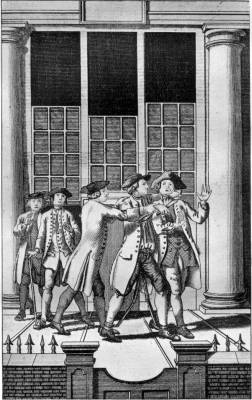
JOSEPH BLAKE ATTEMPTING THE LIFE OF JONATHAN WILD (From the Newgate Calendar)
In short, their two benefactors furnished then with things to the amount of two hundred pounds, accompanied them themselves on board the vessel, and recommended them to the captain with as much earnestness as if they had been near relations. Coming in this light into the abroad, they were received with great hospitality, and treated with much kindness and respect; and in fine, after remaining here about a year, Jenny married a gentleman of as good fortune as any in the country, and her sister, not long after, had the same luck. Jenny did not indeed survive it long, but Alice outlived her first husband, and marrying a second, returned into England where she is still living in as much respect and esteem as any gentlewoman in the county where she inhabits.
An Account of the horrid murder of MR. WIDDINGTON DARBY, committed in his chambers in the Temple, on the 11th of April, 1727, for which one HENRY FISHER was apprehended and committed to Newgate, from whence he escaped.
The deceased Mr. Darby was a young gentleman who made an extraordinary good appearance in the world. He generally wore fine rings, rich snuff boxes, and an extraordinary gold watch about him. These things possibly tempted a needy person of his acquaintance to be guilty of that barbarous murder which was committed upon him. He lived in the chambers belonging to Sir George Cook's office in the Temple. His servant lived in another place, and went home every night. It happened the night before, or rather in that wherein he was murdered, that Mr. Darby had a good deal of company with him, who supping late, they did not go away until eleven o'clock, when Mr. Darby's servant also retired to his lodgings. The next morning, being Tuesday, about nine o'clock, Mr. Darby was found dead in the said office, his skull penetrated with a pistol ball, his ear and hand cut, his rings, watch and other valuables taken away, besides his escritoire broken open, and his money and linen taken from thence.
The next day the coroner's inquest sat thereon, but being able to make no discovery of the murder, they thought fit to adjourn sine die, as soon as the coroner had made an order for the interment of his corpse which was done accordingly in a vault in the church of St. Andrew's, Holborn.
Some time passed before any light was got into this affair. At length, Mr. Moody, who had been upon the coroner's inquest who had sat on the body of Mr. Darby, received information that one Fisher, who had been in very bad circumstances, and as an acquaintance had been relieved under him by the deceased Mr. Darby, was all on a sudden, since the committing of that murder, observed to have a great deal of money. He had paid some debts which had been troublesome to him and was observed to have some valuable things about him which had never been seen before. These circumstances appearing altogether very suspicious, Mr. Moody acquainted Mr. York with it, who had been very assiduous in taking all measures possible for the discover of this horrid assassination. He falling readily into Mr. Moody's opinion, they agreed together that the likeliest method to find out the truth was to go to Mr. Willoughby, who was Fisher's landlord, and known to be a very honest man. Accordingly they went to him in a tavern in Southampton Street, where they understood he was, and falling into discourse about Mr. Darby's murder, they insinuated to him the suspicions they had of his lodger.
Returning to his house, Fisher being away, Mr. Willoughby went to his room and broke open a box, and found in it the top and bottom of a snuff-box, a vizard mask, and a pair of laced ruffles. The remains of the snuff-box Mr. York knew to have belonged to the deceased, and had reason to suspect the ruffles also to have been his, so that it was immediately agreed to go before the Honourable Sir William Thompson,[77] in order to procure a warrant. There they made an affidavit of the several circumstances attending their discovery, and Sir William upon the examination also of a lady (who produced a piece of lace before she had seen the ruffle, and declared that if it were Mr. Darby's it must tally therewith, which on a comparison it did exactly) granted a warrant. It appeared also at the same time, upon the oath of Mr. Willoughby, that the day Mr. Darby was murdered, Fisher borrowed half-a-crown of him to pay his washerwoman, and was in the utmost necessity for money.
A woman swore that a person very like Fisher was hovering about Mr. Darby's chambers the night the murder was committed, and it was proved by the oath of another person that Fisher came not to his lodgings till two o'clock on Tuesday morning, on which Mr. Darby was murdered. About eight o'clock a porter came and informed Fisher of Mr. Darby's being murdered, at which he shewed little concern and locked himself up for some hours.
Things being thus over at Sir William Thompson's, Mr. Willoughby, Mr. York, and Mr. Moody, returned to Fisher's lodgings. About two o'clock in the morning he came in, and they seized him, having a constable and proper assistance for that purpose. On Sunday noon, he was carried before Sir William Thompson in order to be examined, where he said:
That about the latter end of the week in which Mr. Darby was murdered, as he was passing through Lincoln's Inn Fields, about four in the afternoon, be took up under the wall of Lincoln's Inn Gardens, a white paper parcel in which were contained several things of great value belonging to the deceased; some of the diamonds he acknowledged he sold to a jeweller in Paternoster Row for ten guineas, the watch he pawned for nine guineas to a person at a brazier's in Bond Street, and sold the gold chain and swivels to a person in Lombard Street. He absolutely denied all knowledge of the murder, and said that at the time it happened he was at a billiard table in Duke Street, by St. James's. When taken there was found upon him two of Mr. Darby's rings with the stones taken out, wrapped up in a paper, with his seal the arms of which were taken out, and in these circumstances he was committed to Newgate.
Soon after this the coroner granted his warrant, and an order being thereupon obtained from the Commons, Mr. Darby's body was taken up and in the presence of several persons, his head opened by an eminent surgeon, who found a large lacerated wound near the left ear, the temporal bone on that side being very much fractured, several pieces of which stuck in the brain on the same side. He found, likewise, the temporal bone on the other side, exactly opposite, broken; the pieces thereof were not removed from their places, but easily removed upon his attempting to take them away. He took out the brain and the bullet dropped upon the pillow which lay upon the ground under his head. It appeared, upon comparing the said bullet taken out of the head, with some other bullets found in custody of Henry Fisher (at that time in Newgate on suspicion of the murder) that it seemed to have been cast in the same mould; and when weighing it with one of these bullets, it was very little lighter, and it fitted the bore of one of the pistols which was found in Fisher's custody, even that pistol which by some signs were looked on to have been discharged, though afterwards loaded again.
This Fisher was the son of a very eminent clothier in the West of England, who had sent him to London, and put him out clerk to an attorney, and had done everything in his power which he was able, and which was reasonable for him to do. But he being extravagant, lived far beyond the rate which was consistent with the supplies he received from his father; so that when pressed by his necessities, he had often applied to Mr. Darby for relief. When in Newgate he affected a most unreasonable gaiety and unconcernedness in his behaviour, although the circumstances were so strong against him as occasioned it to prevail as the general opinion that he would be convicted. However, he and the famous Roger Johnson took the advantage of the workmen labouring on the cells which were then building, and by breaking a hole through a place done up only with lath and plaster, they got down one of the workmen's ladders, and so made their escape. Johnson was afterwards retaken and tried for breaking prison, but alleging it was done by Fisher, he was acquitted, and this Henry Fisher, the supposed murderer of Mr. Darby, was never heard of since.
[77]
Sir William Thompson (1678-1739) was Recorder of London in 1715, Solicitor General two years later, and in 1729 became baron of the Exchequer.
The Life of JOSHUA CORNWALL, a Thief and Housebreaker
Though vices are undoubtedly the chief instruments that bring unhappy persons to that ignominious death which the Law hath appointed for enormous offences, yet it very often happens that folly rather than wickedness brings them first into the road of ruin; in which, led on by delusive hopes, they continue to run until a disastrous fate overtakes them, and puts an end at once to their vicious race, and to their lives. The criminal whose memoirs at present employ our pen is such an example as I hope, while it entertains, may also instruct my readers to avoid his errors.
This unfortunate man was the son of reputable and honest parents in the town of Brigg in the county of Lincoln. Their circumstances were such as enabled them to give him an education; and the desire they had of doing everything that was possible for their son inclined them not to be wanting in this particular. His mother, was fond of him to a fault, and being permitted by her indulgence to run up and down amongst young people of his own age, riding across the country to friends and other diversions of a like nature, he lost all liking to things of a serious nature, and without thinking how to procure the necessaries of life, was altogether taken up in enjoying those pleasures to which he had the greatest inclination. In the midst of this pleasant situation of things (at least as it appeared to him at that time) the prospect was darkened by the death of his mother. His friends retained for him a due paternal affection, but had no notion of permitting him to go on the life he led, and therefore to break him of that as well as to make him acquainted with an honest method of getting his living, his father put him out apprentice to a baker in Hull.
But as kindness seemed of all things the most fatal to this unhappy man, so the acquaintance and friendship which his master had for Cornwall's family became a new means of leading him into misfortune, for treating the young man rather with a tenderness due to a son than that severity which is usually practised towards apprentices and servants, it gave him an opportunity of renewing his old course of life. Instead of inclining him to behave in a manner which might deserve such lenity, it gave him, on the contrary, occasion frequently to abuse it by running from one dancing bout and merry-making to another, without the least care of his master's business, who out of downright affection forbore to restrain his follies with that harshness which they deserved, and which any other person would have used.
At length, having acquired so great a habit of laziness and so strong an aversion to business that he found it impossible for him to live longer in the country, he came up to London, that great receptacle of those who are either unable or unwilling to live anywhere else. Here he got into service as a footman with several persons of worth, and discharged his duty well (as indeed it was a kind of life which of all others suited him best), so that he obtained a tolerable reputation whereby he got into the service of one Mr. Fenwick, a gentleman of affluent fortune. Here it was that through desire of abounding in money he either drew in others, or was drawn in himself to commit that crime which cost him his life.
It seems that in Mr. Fenwick's family there was a great deal of plate used, which stood on a buffet. This tempted Cornwall, and it is highly likely gave him the first notion of attempting to rob the house. When he had once formed this project he resolved to take in one Rivers, a debauched companion of his, as a partner in the designed theft.
This Rivers was certainly easy enough prevailed on to join in the commission of this fact, and after several meetings to consult upon proper measures, Rivers at last proposed that their scheme should be put in execution as soon as possible; and that he might the more perfectly conceive how it was to be managed, he went home with Cornwall, and looked upon the house. Soon after this they held their last consultation, and Cornwall saying to Rivers that he must bring some other persons to assist him, Rivers made choice of one Girst, and coming with him at the appointed hour, Cornwall in his shirt opened the door and let them in. In the buffet there stood a lighted candle in a silver candle-stick, by which they were directed to the rest of the plate, which as soon as they had taken out, they placed all together upon the carpet, and fell next to rifling Mr. Fenwick's bureau, and took out a great quantity of linen, a lady's lace, the tea equipage, and two silver canisters. Then making it up in a bundle, it was carried to River's lodgings in Vinegar Yard, Drury Lane.
All this could not be performed with so little noise as not to disturb the family. Mr. Fenwick himself heard the noise, being awakened by his wife, who had heard it for some time, but it ceasing they fell asleep again until one of the servants came up in the morning, and told his master that the house had been robbed, the plate taken away, and a window in the back parlour left open, about which, as he could observe no marks of violence, he was led to suspect it was opened by somebody in the family; upon which Cornwall and a maid in the house were immediately thought to have a hand in. However, as there was no sort of proof, Mr. Fenwick forbore seizing them at that time, and contented himself with advertizing his plate; which advertisement coming into the hands of a pawnbroker, to whom a part of it had been pledged, he immediately gave notice that it was pawned to him by Rivers. A warrant being upon this obtained for the searching of River's lodging, a note was there found, directed to Thomas Rivers, Glover, in Guy's Court, Vinegar Yard, Drury Lane, in which were these words:
Dear Tom,
Let me see you at seven o'clock to-morrow morning, at the Postern Spring, Tower Hill, be sure.
Joshua Cornwall.
Upon this Cornwall was immediately taken up and Girst readily offered himself an evidence. In a few days after, sessions coming on, Joshua Cornwall and Thomas Rivers were indicted for burglariously breaking the house of Nicholas Fenwick, Esq., and taking thence divers pieces of plate, to the value of eighty-five pounds nineteen shillings, holland shirts to the value of twenty pounds, and other goods of the said Mr. Fenwick, on the 8th day of September, 1730. This indictment being fully proved, the jury found Thomas Rivers guilty thereof. But being dubious whether Joshua Cornwall, as a servant within the house of Mr. Fenwick, could be properly convicted of burglariously breaking into his said master's house, they found their verdict as to him special; which the judges having considered, they were unanimously of opinion that the crime was in its nature a burglary. Whereupon, at the following sessions at the Old Bailey, the criminal was brought to the bar, and being acquainted with their lordships' opinion, received sentence of death.
Under conviction, he behaved himself with great penitence, said he had not been guilty of many of those atrocious crimes commonly practised by such as come to that fatal end whither his folly had led him. At the place of execution he, with great fervency, justified the character of a young woman who had lived fellow-servant with him at Mr. Fenwick's. He declared, as he was a dying man, that she was not in the least privy to the injury done her master, and that he had no other than an acquaintance with her, without either having, or attempting any criminal conversation with her. Having done this justice, he seemed to die with much composure, in the twenty-second year of his age, on the 23rd of December, 1730.