VOLUME TWO (continued 3)
Reading edition
Barton was a fellow rather of too much than too little courage. He wanted no encouragements of this sort to egg him to such proceedings; the hopes of living idly and in the enjoyment of such lewd pleasures as he had addicted himself to, were sufficient to carry him into an affair of this sort. He therefore soon yielded to their suggestions, and went into such measures as they had before followed, especially housebreaking, which was the particular branch of villainy to which he had addicted himself. At this he became a very dextrous fellow, and thereby much in favour with his wicked associates, amongst whom to be impious argues a great spirit, and to be ingenious in mischief is the highest character to which persons in their miserable state can ever attain.
Amongst the rest of Barton's acquaintance there was one Yorkshire Bob, who was reckoned the most adroit housebreaker in town. This fellow one day invited Barton to his house, which at that time was not far from Red Lion Fields, and proposed to him two or three schemes by which some houses in the neighbourhood might be broke open. Barton thought all the attempts too hazardous to be made, but Bob, to convince him of the possibility with which such things might be done, undertook to rob without assistance a widow lady's house of some plate, which stood in the butler's room at noon-day.
Accordingly thither he went dressed in the habit of a footman belonging to a family which were well acquainted there; the servants conversed with him very freely, as my Lady Such-a-one's new man, while he entertained them with abundance of merry stories, until dinner was upon the table. Then taking advantage of that clutter in which they were, he slily lighted a fire-ball at the fire-side, clapped it into a closet on the side of the stairs in which the foul clothes were kept, and then perceiving the smoke, cried out with the utmost vehemence, Fire, fire. This naturally drew everybody downstairs, and created such a confusion that he found little or no difficulty in laying hold of the silver plate which he aimed at. He carried it away publicly, while the smoke confounded all the spectators, and until the next morning nobody had the least suspicion of him; but upon sending to the lady for the plate which her new servant carried away the night before, and she denying that she had any servant in the house that had not lived with her a twelvemonth, they then discovered the cheat, though at a time too late to mend it.
Barton, however, did not like his master's method entirely, choosing rather to strike out a new one of his own, which he fancied might as little mischief him as that audacious impudence of the other did in his several adventures. For which reason, he was very cautious of associating with this fellow who was very dextrous in his art, but was more ready in undertaking dangerous exploits than any of the crew at that time about town. John's way was by a certain nack of shifting the shutters, whereby he opened a speedy entrance for himself; and as he knew in how great danger his life was from each of these attempts, so he never made them but upon shops or houses where so large a booty might be expected as might prevent his being under necessity of thieving again in a week or two's time. Yet when he had in this manner got money, he was so ready to throw it away on women and at play, that in a short space his pocket was at as low an ebb as ever. When his cash was quite gone, he associated himself sometimes with a crew of footpads, and in that method got sufficient plunder to subsist until something offered in his own way, to which he would willingly have kept.
At last, hearing of a goldsmith's not far from where he lodged, who had a very considerable stock of fine snuff-boxes, gold chains, rings, etc., he fancied he had now an opportunity of getting provision for his extravagancies for at least a twelvemonth. The thoughts of this encouraged him so far that he immediately went about it, and succeeded to his wish, obtaining two gold chains, five gold necklaces, seventy-two silver spoons, and a numberless cargo of little things of value.
Yet this did not satisfy him. He ventured a few days afterwards having a proper opportunity, on the house and shop of one Mrs. Higgs, from whence he took an hundred pair of stockings, and other things to a large value. But as is common with such persons, his imprudence betrayed him in the disposing of them, and by the diligence of a constable employed for that purpose, he was caught and committed to Newgate. At the next sessions he was convicted for these facts, and as he had no friends, so it was not in any degree probable that he should escape execution; and therefore it is highly possible he might be the projector of that resistance which he and the rest under sentence with him made in the condemned hold, and which we shall give an exact account under the next life.
The peculiar humour of Barton was to appear equally gay and cheerful, though in these sad circumstances, as he had ever done in the most dissolute part of his foregoing life. In consequence of which foolish notion he smiled on a person's telling him his name was included in the death-warrant, and at chapel behaved in a manner very unbecoming one who was so soon to answer at the Bar of the Almighty for a life led in open defiance both of the laws of God and man. Yet that surprise which people naturally express at behaviour of such a kind on such an occasion seemed in the eyes of this poor wretch so high a testimony in favour of his gallantry, that he could not be prevailed on, either by the advice of the ministers, or the entreaties of his relations, to abate anything of that levity which he put on when he attended at Divine Service. Though he saw it disturbed some of his fellow sufferers at first, who were inclined to apply themselves strictly to their duties, so fatal is evil communication, even in the latest moments of our life, that his ludicrous carriage corrupted the rest, and instead of reproving him as they had formerly done, they now seemed careful only of imitating his example; and in this disposition he continued, even to the last minute of his life, which ended at Tyburn, on the 14th of March, 1725, he being then hardly twenty-three years of age.
The Life of WILLIAM SWIFT, a Thief, etc.
Amongst the multitude of other reasons which ought to incline men to an honest life, there is one very strong motive which hitherto has not, I think, been touched upon at all, and that is the danger a man runs from being known to be of ill-life and fame, of having himself accused from his character, only of crimes which he, though guiltless of, in such a case might find it difficult to get his innocence either proved or credited if any unlucky circumstance should give the least weight to the accusation.
The criminal whose life exercises our present care was a fellow of this case. He was born of but mean parents, had little or no education, and when he grew strong enough to labour, would apply himself to no way of getting his bread but by driving a wheelbarrow with fruit about the streets. This led him to the knowledge of abundance of wicked, disorderly people, whose manners agreeing best with his own, he spent most of his time in sotting with them at their haunts, when by bawling about the streets, he had got just as much as would suffice to sot with. There is no doubt, but that he now and then shared with them in what amongst such folks, at least, pass for trivial offences, but that he engaged in the great exploits of the road did not appear to any other case than that for which he died, viz., taking four table cloths, eight napkins, two shirts and other things, from Mary Cassell. The woman swore positively to him upon his trial, and his course of life being such as I have represented it, nobody appeared to his reputation so as to bring the thing in to the least suspense with the jury; whereupon he was convicted and received sentence of death.
The concern Swift was under when he found not the least hopes of life remaining, he having no friends who were capable (had they been willing) to have solicited a pardon or reprieve, shocked him so much that he scarce appeared to have his senses; however, he persisted obstinately in denying that he had the least hand in the robbery which was sworn against him. And as he made no scruple of acknowledging a multitude of other crimes, his denial of this gained some belief, more especially when Barton confessed that himself with two or three others were the persons who committed the robbery on the woman who swore against this criminal. It must be acknowledged that there was no appearance of any sinister motive, at least in Barton, to take upon himself a crime of which otherwise he would never have been accused; and the behaviour of Swift was at first of such a nature that it is not easy to conceive why, when all hopes of safety were lost, and he was full of acknowledgment as to the justice of his sentence for the many other evil deeds he had done, he should yet obdurately persist in denying this, if there had been no truth at all in his allegations.
As this fellow had neither natural courage, nor had acquired any religious principles from his education, there is no wonder to be made that he behaved himself so poorly in the last moments of his life; in which terror, confusion, and self-condemnation wrought so strongly as to make the ignominy of the halter the least dreadful part of his execution.
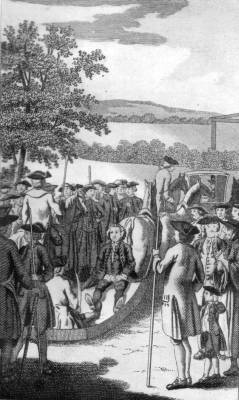
A CONDEMNED MAN DRAWN ON A SLEDGE TO TYBURN (From the Newgate Calendar)
The day on which the three last-mentioned persons, together with Yates or Gates, alias Vulcan, a deer-stealer, and Benjamin Jones (for house breaking) were to have been executed, these miserable persons framed to themselves the most absurd project of preserving their lives that could possibly have entered into the heads of men; for getting, by some means or other, an iron crow into the hold, they therewith dug out a prodigious quantity of rubbish and some stones, which it is hardly credible could have been removed with so small assistance as they had. With these they blocked up the door of the condemned hold so effectually that there was no possibility of getting it open by any force whatsoever on the outside. The keepers endeavoured to make them sensible of the folly of their undertaking, in hopes they would thereby be induced to prevent any firing upon them; which was all that those who had the custody of them were now capable of doing, to bring them to submission. The Ordinary also joined in dissuading them from thus misspending the last moments of their lives, which were through the mercy of the Law extended to them for a better purpose. But they were inexorable, and as they knew their surrender would bring them immediately to a shameful death, so they declared positively they were determined to kill or to be killed in the position in which they were.
Sir Jeremiah Murden, one of the sheriffs for the time being, was so good as to go down upon this occasion to Newgate. The keepers had opened a sort of trap-door in the room over the hold, and from thence discharged several pistols loaded with small shot, but to no purpose, the criminals retiring to the farther end of the room, continuing there safe and out of reach; though Barton and Yates received each of them a slight wound in crowding backwards. Sir Jeremy went himself to this place, and talked to them for a considerable space, and one of the fellows insisting to see his gold chain, that they might be sure they were treating with the sheriffs themselves, his condescension was so great as to put down part of it through the hole, upon which they consulted together, and at last agreed to surrender. Whereupon they began immediately to remove the stones, and as soon as the door was at liberty, one of the keepers entered. Just as he was within it, Barton snapped a steel tobacco-box in his face, the noise of which resembling a pistol, made him start back, upon which Barton said, D——n you, you was afraid.
When they were brought out, Sir Jeremy ordered the Ordinary to be sent for, and prayers to be said in the chapel, where he attended himself. But whether the hurry of this affair, or that stench which is natural to so filthy a place as the condemned hold, affected the sheriff's constitution, is hard to say, but upon his return home, he was seized with a violent fever, which in a very short space took away his life.
But to return to Swift. When they came to Tyburn, and the minister had performed his last office towards them, this criminal made a shift in a faint tone to cry out, Good People, I die as innocent of the crime for which I suffer, as the child unborn; which Barton, with a loud voice, confirmed saying, I am the man who robbed the person for which this man dies; he was not concerned with me, but one Capell and another were companions with me therein. Swift, at the time of his execution, was about twenty-seven years of age, or a little over.
The lives of EDWARD BURNWORTH, alias FRAZIER, WILLIAM BLEWIT, THOMAS BERRY, EMANUEL DICKENSON, WILLIAM MARJORAM, JOHN HIGGS, etc., Robbers, Footpads, Housebreakers and Murderers
As society intends the preservation of every man's person and property from the injuries which might be offered unto him from others, so those who in contempt of its laws go on to injure the one, and either by force or fraud to take away the other are, in the greatest proprieties of speech, enemies of mankind; and as such are reasonably rooted out, and destroyed by every government under heaven. In some parts of Europe, certain outlaws, Banditti, or whatever other appellation you'll please to bestow on them, have endeavoured to preserve themselves by force from the punishments which should have been executed upon them by justice, and finding mankind, from a spirit of self preservation, were become their enemies, they exerted themselves the utmost they were capable of in order to render their bodies so formidable as still to carry on their ravages with impunity, and in open defiance of the laws made against them. But an attempt of this sort was scarce ever heard of in Britain, even in the most early times, when, as in all other governments the hands of the Law wanted strength most; so that from the days of Robin Hood and Little John to those of the criminals of whom we are now writing, there was never any scheme formed for an open resistance of Justice, and carrying on a direct war against the lives and properties of mankind.
Edward Burnworth, alias Frazier, was the extraordinary person who framed this project for bringing rapine into method, and bounding even the practice of licentiousness with some kind of order. It may seem reasonable therefore, to begin his life preferable to the rest, and in so doing we must inform our readers that his father was by trade a painter, though so low in his circumstances as to be able to afford his son but a very mean education. However, he gave him as much as would have been sufficient for him in that trade to which he bound him apprentice, viz., to a buckle-maker in Grub Street, where for some time Edward lived honestly and much in favour with his master. But his father dying and his unhappy mother being reduced thereby into very narrow circumstances, restraint grew uneasy to him, and the weight of a parent's authority being now lost with him, he began to associate himself with those loose incorrigible vagrants, who frequent the ring at Moorfields, and from idleness and debauchery, go on in a very swift progression to robbery and picking of pockets.
Edward was a young fellow, active in his person and enterprising in his genius; he soon distinguished himself in cudgel playing, and such other Moorfields exercises as qualify a man first for the road and then for the gallows. The mob who frequented this place, where one Frazier kept the ring, were so highly pleased with Burnworth's performances that they thought nothing could express their applause so much as conferring on him the title of Young Frazier. This agreeing with the ferocity of his disposition, made him so vain thereof, that, quitting his own name, he chose to go by this, and accordingly was so called by all his companions.
Burnworth's grand associates were these, William Blewit, Emanuel Dickenson, Thomas Berry, John Levee, William Marjoram, John Higgs, John Wilson, John Mason, Thomas Mekins, William Gillingham, John Barton, William Swift, and some others that it is not material here to mention. At first he and his associates contented themselves with picking pockets, and such other exercises in the lowest class of thieving, in which however they went on very assiduously for a considerable space, and did more mischief that way than any gang which had been before them for twenty years. They rose afterwards to exploits of a more hazardous nature, viz., snatching women's pockets, swords, hats, etc.
The usual places for their carrying on such infamous practices were about the Royal Exchange, Cheapside, St. Paul's Churchyard, Fleet Street, the Strand and Charing Cross. Here they stuck a good while, nor is it probable they would ever have risen higher if Burnworth, their captain, had not been detected in an affair of this kind, and committed thereupon to Bridewell, from whence, on some apprehension of the keepers, he was removed to New Prison, where he had not continued long before he projected an escape, which he afterwards put into execution.
During this imprisonment, instead of reflecting on the sorrows which his evil course of life had brought upon him, he meditated only how to engage his companions in attempts of a higher nature than they had hitherto been concerned in; and remembering how large a circle he had of wicked associates, he began to entertain notions of putting them in such a posture as might prevent their falling easily into the hands of justice, which many of them within a month or two last past had done—though as they were sent thither on trivial offences, they quickly got discharged again.
Full of such projects, and having once more regained his freedom, he took much pains to find out Barton, Marjoram, Berry, Blewit and Dickenson, in whose company he remained continually, never venturing abroad in the day-time unless with his associates in the fields, where they walked with strange boldness, considering warrants were out against the greatest part of the gang. In the night time Burnworth strolled about in such little bawdy-houses as he had formerly frequented, and where he yet fancied he might be safe.
One evening having wandered from the rest, he was so bold as to go to a house in the Old Bailey, where he heard the servants and successors of the famous Jonathan Wild were in close pursuit of him, and that one of them was in the inner room by himself. Burnworth loaded his pistol under the table, and having primed it, goes with it ready cocked into the room where Jonathan's foreman was, with a quartern of brandy and a glass before him. Hark ye, says Edward, you fellow, who have served your time to a thief-taker; what business might you have with me or my company? Do you think to gain a hundred or two by swearing our lives away? If you do you are much mistaken; but that I may be some judge of your talent that way, I must hear you curse a little, on a very particular occasion. Upon which, filling a large glass of brandy, and putting a little gunpowder into it, he clapped it into the fellow's hands, and then presenting his pistol to his breast, obliged him to wish most horrid mischiefs upon himself, if ever he attempted to follow him or his companions any more. No sooner had he done this, but Frazier knocking him down, quitted the room, and went to acquaint his companions with his notable adventure, which, as it undoubtedly frightened the new thief-taker, so it highly exalted his reputation for undaunted bravery amongst the rest of the gang, a thing not only agreeable to Burnworth's vanity, but useful also to his design, which was to advance himself to a sort of absolute authority amongst them from whence he might be capable of making them subservient to him in such enterprises as he designed. His associates were not cunning enough to penetrate his views, but without knowing it suffered them to take effect; so that instead of robbing as they used to do (as accident directed them, or they received intelligence of any booty) they now submitted themselves to his guidance, and did nothing but as he directed or commanded them.
The morning before the murder of Thomas Ball, Burnworth, and Barton, whom we have before mentioned, pitched upon the house of an old Justice of the Peace of Clerkenwell, to whom they had a particular pique for having formerly committed Burnworth, and proposed it to their companions to break it open that night, or rather the next morning (for it was about one of the clock). They put their design in execution and executed it successfully, carrying off some things of real value, and a considerable parcel of what they took to be silver plate. With this they went into the fields above Islington, and from thence to Copenhagen House, where they spent the greatest part of the day. On parting the booty Burnworth perceived what they had taken for silver was nothing more than a gilt metal, at which he in a rage would have thrown it away; Barton opposed it, and said they should be able to sell it for something, to which Burnworth replied that it was good for nothing but to discover them, and therefore it should not be preserved at any rate. Upon this they differed, and while they were debating, came Blewit, Berry, Dickenson, Higgs, Wilson, Levee, and Marjoram, who joined the company. Burnworth and Barton agreed to toss up at whose disposal the silver ware should be, they did so, and it fell to Burnworth to dispose of it as he thought fit, upon which he carried it immediately to the New River side, and threw it in there, adding that he was sorry he had not the old Justice himself there, to share the same fate, being really as much out of humour at the thing as if the Justice had imposed upon them in a fair sale of the commodity, so easy a thing is it for men to impose upon themselves.
As it happened they were all present pretty full of money, and so under no necessity of going upon any enterprise directly, wherefore they loitered up and down the fields until towards evening, when they thought they might venture unto town, and pass the time in their usual pleasures of drinking, gaming, and whoring. While they were thus (as the French say) murdering of time, a comrade of theirs came up puffing and blowing as if ready to break his heart. As soon as he reached them, Lads, says he, beware of one thing; the constables have been all about Chick Lane in search of folk of our profession, and if ye venture to the house where we were to have met to-night, 'tis ten to one but we are all taken.
This intelligence occasioned a deep consultation amongst them, what method they had best take, in order to avoid the danger which threatened them so nearly. Burnworth took this occasion to exhort them to keep together, telling them that as they were armed with three or four pistols apiece, and short daggers under their clothes, a small force would not venture to attack them. This was approved by all the rest, and when they had passed the afternoon in this manner, and had made a solemn oath to stand by one another in case of danger, they resolved, as night grew on, to draw towards town, Barton having at the beginning of these consultations, quitted them and gone home.
As they came through Turnmill Street, they accidentally met the keeper of New Prison, from whom Burnworth had escaped about six weeks before. He desired Edward to step across the way with him, adding that he saw he had no arms, and that he did not intend to do him any prejudice. Burnworth replied that he was no way in fear of him, nor apprehensive of any injury he was able to do him, and so concealing a pistol in his hand, he stepped over to him, his companions waiting for him in the street. But the neighbours having some suspicion of them, and of the methods they followed to get money, began to gather about them; upon which they called to their companion to come away, which he, after making a low bow to the captain of New Prison, did. Finding the people increase they thought it their most advisable method to retire back in a body into the fields. This they did keeping very close together; and in order to deter the people from making any attempts, turned several times and presented their pistols in their faces, swearing they would murder the first man who came near enough for them to touch him. And the people being terrified to see such a gang of obdurate villains, dispersed as they drew near the fields, and left them at liberty to go whither they would.
As soon as they had dispersed their pursuers, they entered into a fresh consultation as to what manner they would dispose of themselves. Burnworth heard what every one proposed, and said at last, that he thought the best thing they could do was to enter with as much privacy as they could, the other quarter of the town, and so go directly to the waterside. They approved his proposal, and accordingly getting down to Blackfriars, crossed directly into Southwark; and retired at last into St. George's Fields, where their last counsel was held to settle the operation of the night. There Burnworth exerted himself in his proper colours, informing them that there was no less danger of their being apprehended there, than about Chick Lane; for that one Thomas Ball (who kept a gin-shop in the Mint, and who was very well acquainted with most of their persons) had taken it into his head to venture upon Jonathan Wild's employment, and was for all that purpose indefatigable in searching out all their haunts, that he might get a good penny to himself apprehending them. He added that but a few nights ago, he narrowly missed being caught by him, being obliged to clap a pistol to his face, and threatened to shoot him dead if he offered to lay his hands on him. Therefore, continued Burnworth, the surest way for us to procure safety, is to go to this rogue's house, and shoot him dead upon the spot. His death will not only secure us from all fears of his treachery, but it will likewise so terrify others that nobody will take up the trade of thief-catching in haste; and if it were not for such people who are acquainted with us and our houses of resort there would hardly one of our profession in a hundred see the inside of Newgate.
Burnworth had scarce made an end of his bloody proposal, before they all testified their assent to it with great alacrity, Higgs only excepted; who seeming to disapprove thereof, it put the rest into such a passion that they upbraided him in the most opprobious terms with being a coward and a scoundrel, unworthy of being any longer the companion of such brave fellows as themselves. When Frazier had sworn them all to stick fast by one another, he put himself at their head, and away they went directly to put their designed assassination into execution. Higgs retreated under favour of the night, being apprehensive of himself when their hands were in, since he, not being quite so wicked as the rest, might share the fate of Ball upon the first dislike to him that took them.
As for Burnworth and his party, when they came to Ball's house and enquired of his wife for him, they were informed that he was gone to the next door, a public house, and that she would step and call him, and went accordingly. Burnworth immediately followed her and meeting Ball at the door, took him fast by the collar, and dragged him into his own house, and began to expostulate with him as to the reason why he had attempted to take him, and how ungenerous it was for him to seek to betray his old friends and acquaintances. Ball, apprehending their mischievous intentions, addressed himself to Blewit, and begged of him to be an intercessor for him, and that they would not murder him; but Burnworth with an oath replied, he would put it out of the power of Ball ever to do him any further injury, that he should never get a penny by betraying him, and thereupon immediately shot him.
Having thus done, they all went out of doors again, and that the neighbourhood might suppose the firing of the pistol to have been done without any ill-intention, and only to discharge the same, Blewitt fired another in the street over the tops of the houses, saying aloud, they were got safe into town and there was no danger of meeting any rogues there. Ball attempted to get as far as the door, but in vain, for he dropped immediately, and died in a few minutes afterwards.
Having this executed their barbarous design, they went down from Ball's house directly towards the Falcon,[73] intending to cross the water back again. By the way they accidentally met with Higgs, who was making to the waterside likewise. Him they fell upon and rated for a pusilanimous cowardly dog (as Burnworth called him) that would desert them in an affair of such consequence, and then questioned whether Higgs himself would not betray them. Burnworth proposed it to the company to shoot their old comrade Higgs, because he had deserted them in their late expedition; which it is believed, in the humour Burnworth was then in, he would have done, had not Marjoram interposed and pleaded for sparing his life. From the Falcon stairs they crossed the water to Trig Stairs[74]; and then consulting how to spend the evening, they resolved to go to the Boar's Head Tavern, in Smithfield, as not being at a distance from the waterside, in case any pursuit should be made after them, on account of the murder by them committed. At which place they continued until near ten of the clock, when they separated themselves into parties for that night, viz., one party towards the Royal Exchange, the second to St. Paul's Churchyard, the third to Temple Bar, in pursuit of their old trade of diving.
This murder made them more cautious of appearing in public, and Blewit, Berry and Dickenson soon after set out for Harwich, and went over in a packet boat from thence for Helveot-Sluys. Higgs also being daily in fear of a discovery, shipped himself on board the Monmouth man-of-war, at Spithead, where he thought himself safe, and began to be a little at ease; but Justice quickly overtook him, when he thought himself safest from its blow; for his brother who lived in town, having wrote a letter to him, and given it to a ship's mate of his to carry to him at Spithead, this man accidentally fell into company with one Arthur, a watchman belonging to St. Sepulchre's Parish, and pulling the letters by chance out of his pocket, the watchman saw the direction, and recollected that Higgs was a companion of Frazier's. Upon this he sent word to Mr. Delasay, Under-Secretary of State, and being examined as to the circumstances of the thing, proper persons were immediately dispatched to Spithead, who seized and brought him up in custody. Wilson, another of the confederates, withdrew about the same time, and had so much cunning as to preserve himself from being heard of for a considerable time.
Burnworth, in the meanwhile, with some companions of his, continued to carry on their rapacious plunderings in almost all parts of the town; and as they kept pretty well united, and were resolute fellows, they did a vast deal of mischief, and yet were too strong to be apprehended. Amongst the rest of their pranks they were so audacious as to stop the Earl of Scarborough, in Piccadilly, but the chairmen having courage enough to draw their poles and knock one of the robbers down, the earl at the same time coming out of the chair, and putting himself upon his defence, after a smart dispute in which Burnworth shot one of the chairmen in the shoulder and thereby prevented any pursuit, they raised their wounded companion and withdrew in great confusion.
About this time their robberies and villainies having made so much noise as to deserve the notice of the Government, a proclamation was published for the apprehending Burnworth, Blewit, etc., it being justly supposed that none but those who were guilty of these outrages could be the persons concerned in the cruel murder of Ball. A gentleman who by accident had brought one of these papers, came into the alehouse at Whitecross Street, and read it publicly. The discourse of the company turning thereupon, and the impossibility of the persons concerned making their escape, and the likelihood there was that they would immediately impeach one another. Marjoram, one of the gang, was there, though known to nobody in the room; weighing the thing with himself, he retired immediately from the house into the fields, where loitering about till evening came on, he then stole with the utmost caution into Smithfield, and going to a constable there, surrendered himself in a way of obtaining a pardon, and the reward promised by the proclamation.
That night he was confined in the Wood Street Compter, his Lordship not being at leisure to examine him. The next day, as he was going to his examination, the noise of his surrender being already spread all over the town, many of his companions changed their lodgings and provided for their safety; but Barton thought of another method of securing himself from Marjoram's impeachment, and therefore planting himself in the way as Marjoram was carrying to Goldsmiths' Hall, he popped out upon him at once, though the constable had him by the arm, and presenting a pistol to him, said, D——n ye, I'll kill you. Marjoram, at the sound of his voice, ducked his head, and he immediately firing, the ball grazed only on his back, without doing him any hurt. The surprise with which all who were assisting the constable in the execution of his office were all struck upon this occasion gave an opportunity for Barton to retire, after his committing such an insult on public justice, as perhaps was never heard of. However, Marjoram proceeded to his examination, and made a very full discovery of all the transactions in which he had been concerned. Levee being taken that night by his directions in White Cross Street, and after examination committed to Newgate.
Burnworth was now perfectly deprived of his old associates, yet he went on at his old rate, even by himself; for a few nights after, he broke open the shop and house of Mr. Beezely, a great distiller near Clare Market, and took away from thence notes to a great value, with a quantity of plate, which mistaking for white metal he threw away. One Benjamin Jones picked it up and was thereupon hanged, being one of the number under sentence when the Condemned Hold was shut up, and the criminals refused to submit to the keepers. Burnworth was particularly described in the proclamation, and three hundred pounds offered to any who would apprehend him; yet so audacious was he as to come directly to a house in Holborn, where he was known, and laying a loaded pistol down on the table, called for a pint of beer, which he drank and paid for, defying anybody to touch him, though they knew him to be the person mentioned in the proclamation. It would be needless to particularise any other bravadoes of his, which were so numerous that it gave no little uneasiness to the magistrates, who perceived the evil consequences that would show if such things should become frequent; they therefore doubled their diligence in endeavouring to apprehend him, yet all their attempts were to little purpose, and it is possible he might have gone on much longer if he had not betrayed the natural consequence of one rogue's trusting another.
It happened at this time, that one Christopher Leonard was in prison for some such feats as Burnworth had been guilty of, who lodged at the same time with the wife and sister of the fellow. Kit Leonard, knowing in what state he himself was, and supposing nothing could so effectually recommend to him the mercy and favour of the Government as the procuring Frazier to be apprehended, who had so long defied all the measures they had taken for that purpose, he accordingly made the proposal by his wife to persons in authority. And the project being approved they appointed a sufficient force to assist in seizing him, who were placed at an adjoining alehouse, where Kate, the wife of Kit Leonard, was to give them the signal.
About six of the clock in the evening of Shrove Tuesday, Kate Leonard and her sister and Burnworth being all together (it not being late enough for him to go out upon his nightly enterprises) Kate Leonard proposed they should fry some pancakes for supper, which the other two approved of, accordingly her sister set about them. Burnworth took off his surtout coat, in the pocket of the lining whereof he had several pistols. There was a little back door to the house, which Burnworth usually kept upon the latch, in order to make his escape if he should be surprised or discovered to be in that house. Unperceived by Burnworth, and whilst her sister was frying the pancakes, Kate went to the alehouse for a pot of drink, when having given the men who were there waiting for him the signal, she returned, and closed the door after her, but designedly missed the staple. The door being thus upon the jar only, as she gave the drink to Burnworth, the six persons rushed into the room. Burnworth hearing the noise and fearing the surprise, jumped up, thinking to have made his escape at the back door, not knowing it to be bolted; but they were upon him before he could get it open, and holding his hands behind him, one of them tied them, whilst another, to intimidate him, fired a pistol over his head. Having thus secured him, they immediately carried him before a Justice of the Peace, who after a long examination committed him to Newgate.
Notwithstanding his confinement in that place, he was still director of such of his companions as remained at liberty, and communicating to them the suspicions he had of Kate Leonard's betraying him, and the dangers there were of her detecting some of the rest, they were easily induced to treat her as they had done Ball. One of them fired a pistol at her, just as she was entering her own house, but that missing, they made two or three other attempts of the same nature, until the Justice of the Peace placed a guard thereabouts, in order to secure her from being killed, and if possible to seize those who should attempt it, after which they heard no more of these sorts of attacks. In Newgate they confined Burnworth to the Condemned Hold, and took what other necessary precautions they thought proper in order to secure so dangerous a person, and who they were well enough aware meditated nothing but how to escape.
He was in this condition when the malefactors before-mentioned, viz., Barton, Swift, etc., were under sentence, and it was shrewdly suspected that he put them upon that attempt of breaking out, of which we have given an account before. There were two things which more immediately contributed to the defeating their design; the one was, that though five of them were to die the next day, yet four of them were so drunk that they were not able to work; the other was that they were so negligent in providing candles that two hours after they were locked up they were forced to lie-by for want of light.
As we have already related the particulars of this story, we shall not take up our reader's time in mentioning them again, but go on with the story of Burnworth. Upon suspicion of his being the projector of that enterprise the keepers removed him into the Bilbow Room, and there loaded him with irons, leaving him by himself to lament the miseries of his misspent life in the solitude of his wretched confinement; yet nothing could break the wicked stubbornness of his temper, which, as it had led him to those practices justly punished with so strait a confinement, so it now urged him continually to force his way through all opposition, and thereby regain his liberty, in order to practice more villainies of the same sort, with those in which he had hitherto spent his time.
It is impossible to say how, but by some method or other he had procured saws, files, and other instruments for this purpose; with these he first released himself from his irons, then broke through the wall of the room in which he was lodged, and thereby got into the women's apartment, the window of which was fortified with three tier of iron bars. Upon these he went immediately to work, and in a little time forced one of them; while he was filing the next, one of the women, to ingratiate herself with the keepers, gave notice, whereupon they came immediately and dragged him back to the Condemned Hold and there stapled him down to the ground.
The course of our memoirs leads us now to say something of the rest of his companions, who in a very short space came most of them to be collected to share that punishment which the Law had so justly appointed for their crimes. We will begin, then, with William Blewit, who, next to Frazier, was the chief person in the gang. He was one of St. Giles's breed, his father a porter, and his mother, at the time of his execution selling greens in the same parish. They were both of them unable to give their son education or otherwise provide for him, which occasioned his being put out by the parish to a perfumer of gloves; but his temper from his childhood inclining him to wicked practices, he soon got himself into a gang of young pickpockets, with whom he practised several years with impunity. But being at last apprehended in the very act, he was committed to Newgate, and on plain proof convicted the next sessions, and ordered for transportation. Being shipped on board the vessel with other wretches in the same condition, he was quickly let into the secret of their having provided for an escape by procuring saws, files, and other implements, put up in a little barrel, which they pretended contained gingerbread, and such other little presents which were given them by relations. Blewitt immediately foresaw abundance of difficulties in their design, and therefore resolved to make a sure use of it for his own advantage. This he did by communicating all he knew to the captain, who thereupon immediately seized their tools, and thereby prevented the loss of his ship, which otherwise in all probability would have been effected by the conspirators.
In return for this service, Blewit obtained his freedom, which did not serve him for any better purpose than his return to London as soon as be was able. Whether he went again upon his old practices before he was apprehended, we cannot determine, but before he had continued two months in town, somebody seized him, and committed him to Newgate. At the next sessions he was tried and convicted for returning from transportation, but pleading, when he received sentence of death, the service he had done in preventing the attempt of the other malefactors, execution was respited until the return of the captain, and on his report the sentence was changed into a new transportation, and leave given him also to go to what foreign port he would. But he no sooner regained his liberty than he put it to the same use as before, and took up the trade of snatching hats, wigs, etc., until he got into acquaintance with Burnworth and his gang, who taught him other methods of robbing than he had hitherto practised. Like most of the unhappy people of his sort, he had to his other crimes added the marriage of several wives, of which the first was reputed a very honest and modest woman, and it seems had so great a love for him, notwithstanding the wickedness of his behaviour, that upon her visiting him at Newgate, the day before they set out for Kingston, she was oppressed with so violent a grief as to fall down dead in the lodge. Another of his wives married Emanuel Dickenson and survived them both.
His meeting Burnworth that afternoon before Ball's murder was accidental, but the savageness of his temper led him to a quick compliance with that wicked proposition; but after the commission of that fact, he with his companions before mentioned went over in the packet boat to Holland. Guilt is a companion which never suffers rest to enter any bosom where it inhabits; they were so uneasy after their arrival there, lest an application should be made from the Government at home, that they were constantly perusing the English newspapers as they came over to the coffee houses in Rotterdam, that they might gain intelligence of what advertisements, rewards, or other methods had been taken to apprehend the persons concerned in Ball's murder; resolving on the first news of a proclamation, or other interposition of the State on that occasion, immediately to quit the Dominions of the Republic. But as Burnworth had been betrayed by the only persons from whom he could reasonably hope assistance; Higgs seized on board a ship where he fancied himself secure from all searches; so Blewit and his associates, though they daily endeavoured to acquaint themselves with the transactions at London relating to them, fell also into the hands of Justice, when they least expected it. So equal are the decrees of providence, and so inevitable the strokes of Divine vengeance.
The proclamation for apprehending them came no sooner to the hands of Mr. Finch, the British resident at the Hague, but he immediately caused an enquiry to be made, whether any such persons as were therein described had been seen at Rotterdam. Being assured that there had, and that they were lodged at the Hamburgh's Arms on the Boom Keys in that City, he sent away a special messenger to enquire the truth thereof; of which he was no sooner satisfied, than he procured an order from the States General for apprehending them anywhere within the Province. By virtue of this order the messenger, with the assistance of the proper officers for that purpose in Holland, apprehended Blewit at the house whither they had been directed; his two companions Dickenson and Berry, had left him and were gone aboard a ship, not caring to remain any longer in Holland. They conducted their prisoner to the Stadt House Prison in Rotterdam, and then went to the Brill, where the ship on board which his companions were, not being cleared out, they surprised them also, and having handcuffed them, sent them under a strong guard to Rotterdam, where they put them in the same place with their old associate Blewit. We shall now therefore take an opportunity of speaking of each of them, and acquainting the reader with those steps by which they arose to that unparalleled pitch of wickedness which rendered them alike the wonder and detestation of all the sober part of mankind.
Emanuel Dickenson was the son of a very worthy person, whose memory I shall be very careful not to stain upon this occasion. The lad was ever wild and ungovernable in his temper, and being left a child at his father's death, himself, his brother, and several sisters were thrown all upon the hands of their mother, who was utterly unable to support them in those extravagancies to which they were inclined. Whereupon they unfortunately addicted themselves to such evil courses as to them seemed likely to provide such a supply of money as might enable them to take such licentious pleasures as were suitable to their vicious inclinations. The natural consequence of which was that they all fell under misfortunes, especially Emanuel of whom we are speaking, who addicted himself to picking of pockets, and such kind of facts for a considerable space. At last, attempting to snatch a gentleman's hat off in the Strand, he was seized with it in his hand, and committed to Newgate, and at the next sessions convicted and ordered for transportation. But his mother applying at Court for a pardon, and setting forth the merit of his father, procured his discharge. The only use he made of this was to associate himself with his old companions, who by degrees led him into greater villainies than any he had till that time been concerned in; and at last falling under the direction of Burnworth, he was with the rest drawn into the murder of Ball. After this he followed Blewit's advice, and not thinking himself safe even in Holland, he and Berry (as has been said) were actually on ship board, in order to their departure.
Thomas Berry was a beggar, if not a thief, from his cradle, descended from parents in the most wretched circumstances, who being incapable of giving him an honest education suffered him on the contrary to idle about the streets, and to get into such gangs of thieves and pickpockets as taught him from his infancy the arts of diving (as they in their cant call it). And as he grew in years they still brought him on to a greater proficiency in such evil practices, in which however he did not always meet with impunity; for besides getting into the little prisons about town, and being whipped several times at the houses of correction, he had also been thrice in Newgate, and for the last fact convicted and ordered for transportation. However, by some means or other, he got away from the ship, and returned quickly to his old employment; in which he had not continued long, before falling into the acquaintance of Burnworth, it brought him first to the commission of a cruel murder, and after that with great justice to suffer an ignominious death. Having been thus particular on the circumstances of each malefactor distinctly, let us return to the thread of our story, and observe to what period their wicked designs and lawless courses brought them at the last.
After they were all three secured, and safe confined in Rotterdam, the resident dispatched an account thereof to England; whereupon he received directions for applying to the States-General for leave to send them back. This was readily granted, and six soldiers were ordered to attend them on board, besides the messengers who were sent to fetch them. Captain Samuel Taylor, in the Delight sloop, brought them safe to the Nore, where they were met by two other messengers, who assisted in taking charge of them up the river. In the midst of all the miseries they suffered, and the certainty they had of being doomed to suffer much more as soon as they came on shore, yet they behaved themselves with the greatest gaiety imaginable, were full of their jests and showed as much pleasantness as if their circumstances had been the most happy. Observing a press-gang very busy on the water, and that the people in the boat shunned them with great care, they treated them with the most opprobrious language, and impudently dared the lieutenant to come and press them for the service. On their arrival at the Tower, they were put into a boat with the messengers, with three other boats to guard them, each of which was filled with a corporal and a file of musqueteers; and in this order they were brought to Westminster. After being examined before Justice Chalk and Justice Blackerby they were all three put into a coach, and conducted by a party of Foot-guards to Newgate through a continued line of spectators, who by their loud huzzas proclaimed their joy at seeing these egregious villains in the hands of justice; for they, like Jonathan Wild, were so wicked as to lose the compassion of the mob.
On their arrival at Newgate, the keepers expressed a very great satisfaction, and having put on each a pair of the heaviest irons in the gaol, and taken such other precautions as they thought necessary for securing them, they next did them the honour of conducting them upstairs to their old friend Edward Burnworth. Having congratulated them on their safe arrival and they condoled with him on his confinement, they took their places near him, and had the convenience of the same apartment and were shackled in the like manner. They did not appear to show the least sign of contrition or remorse for what they had done; on the contrary they spent their time with all the indifference imaginable. Great numbers of people had the curiosity to come to Newgate to see them, and Blewit upon all occasions made use of every opportunity to excite their charity, alleging they had been robbed of everything when they were seized. Burnworth, with an air of indifference replied, D——n this Blewit, because he had got a long wig and ruffled shirt he takes the liberty to talk more than any of us. Being exhorted to apply the little time they had to live in preparing themselves for another world, Burnworth replied that if they had any inclination to think of a future state, it was impossible in their condition, so many persons as were admitted to come to view them in their present circumstances must needs divert any good thoughts. But their minds were totally taken up with consulting the most likely means to make their escape and extricate themselves from the bolts and shackles with which they were clogged and encumbered; and indeed all their actions showed their thoughts were bent only on enlargement, and that they were altogether unmindful of death, or at least careless of the future consequence thereof.
On Wednesday, the 30th of March, 1726, Burnworth, Blewit, Berry Dickenson, Levee, and Higgs, were all put into a waggon, handcuffed and chained, and carried to Kingston under a guard of the Duke of Bolton's horse. At their coming out of Newgate they were very merry, charging the guard to take care that no misfortune happened to them, and called upon the numerous crowd of spectators, both at their getting into the waggon, and afterwards as they passed along the road, to show their respect they bore them by halloaing, and to pay them the compliments due to gentlemen of their profession, and called for several bottles of wine that they might drink to their good journey. As they passed along the road they endeavoured to show themselves very merry and pleasant by their facetious discourse to the spectators, and frequently threw money amongst the people who followed them, diverting themselves with seeing the others strive for it. And particularly Blewit, having thrown out some halfpence amongst the mob, a little boy who was present picked up one of them, and calling out to Blewit, told him, that as sure as he (the said Blewit) would be condemned at Kingston, so sure would he have his name engraved thereon; whereupon Blewit took a shilling out of his pocket and gave it to the boy, telling him there was something towards defraying the charge of engraving and bid him be as good as his word, which he promised he would.
On the 31st of March, the assizes were opened, together with the commission of Oyer and Terminer and Gaol Delivery for the county of Surrey, before the Right Hon. the Lord Chief Justice Raymond, and Mr. Justice Denton; and the grand jury having found indictments against the prisoners, they were severally arraigned thereupon, when five of them pleaded not guilty. Burnworth absolutely refused to plead at all; upon which, after being advised by the judge not to force the Court upon that rigour which they were unwilling at any time to practice, and he still continuing obstinate, his thumbs (as is usual in such cases) were tied and strained with pack thread. This having no effect upon him, the sentence of the press, or as it is sailed in Law, of the Peine Fort et Dure, was read to him in these words: You shall go to the place from whence you came, and there being stripped naked and laid flat upon your back on the floor, with a napkin about your middle to hide your privy members, and a cloth on your face, then the press is to be laid upon you, with as much weight as, or rather more than you can bear. You are to have three morsels of barley-bread in twenty-four hours; a draught of water from the next puddle near the gaol, but not running water. The second day two morsels and the same water, with an increase of weight, and so to the third day until you expire.
This sentence thus passed upon him, and he still continuing contumacious, he was carried down to the stock-house, and the press laid upon him, which he bore for the space of one hour and three minutes, under the weight of three hundred, three quarters, and two pounds [424 lb.]. Whilst he continued under the press, he endeavoured to beat out his brains against the floor, during which time the High Sheriff himself was present, and frequently exhorted him to plead to the indictment. This at last he consented to do; and being brought up to the Court, after a trial which lasted from eight in the morning until one in the afternoon, on the first day of April, they were all six found guilty of the indictment, and being remanded back to the stock-house, were all chained and stapled down to the floor.
Whilst they were under conviction, the terrors of death did not make any impression upon them; they diverted themselves with repeating jests and stories of various natures, particularly of the manner of their escapes before out of the hands of justice, and the robberies and offences they had committed. And it being proposed, for the satisfaction of the world, for them to leave the particulars of the several robberies by them committed, Burnworth replied that were he to write all the robberies by him committed, a hundred sheets of paper, write as close as could be, would not contain them. Notwithstanding what had been alleged by Higgs of his forsaking his companions in the field, it appeared by other evidence that he followed his companions to Ball's house, and was seen hovering about the house during the time the murder was committed, with a pistol in his hand.
As for Burnworth, after conviction, his behaviour was as ludicrous as ever; and being as I said, a painter's son, he had some little notion of designing, and therewith diverted himself in sketching his own picture in several forms; particularly as he lay under the press. This being engraved in copper, was placed in the frontispiece of a sixpenny book which was published of his life, and the rest seemed to fall no way short of him in that silly contempt of death, which with the vulgar passes for resolution.
On Monday, the 4th day of April, they were brought up again from the stock-house to receive sentence of death. Before he passed it upon them Mr. Justice Denton made a very pathetic speech, in which he represented to them the necessity there was of punishing crimes like theirs with death, and exhorted them not to be more cruel to themselves than they had obliged the law to be severe towards them, by squandering away the small remainder of their time, and thereby adding to an ignominious end, an eternal punishment hereafter. When sentence was passed, they entreated leave for their friends to visit them in the prison, which was granted them by the Court, but with a strict injunction to the keeper to be careful over them. After they returned to the prison, they bent their thought wholly on making their escape, and to that purpose sent to their friends, and procured proper implements for the execution of it: Burnworth's mother being surprised with several files, etc., about her, and the whole plot discovered by Blewit's mother who was heard to say that she had forgot the opium.
It seems the scheme was to murder the two persons who attended them in the gaol, together with Mr. Eliot, the turnkey; after they had got out they intended to have fired a slack of bavins [firewood] adjoining to the prison, and thereby amused the inhabitants while they got clear off. Burnworth's mother was confined for this attempt in his favour, and some lesser implements that were sewed up in the waistband of their breeches being ripped out, all hopes whatsoever of escape were now taken away. Yet Burnworth affected to keep up the same spirit with which he had hitherto behaved, and talked in a rhodomantade to one of his guard, of coming in the night in a dark entry, and pulling him by the nose, if he did not see him decently buried.
About ten of the clock, on Wednesday morning, together with one Blackburn, who was condemned for robbing on the highway, a fellow grossly ignorant and stupid, they were carried out in a cart to their execution, being attended by a company of foot to the gallows. In their passage thither, that audacious carriage in which they had so long persisted totally forsook them, and they all appeared with all that seriousness and devotion which might be looked for from persons in their condition. Blewit perceiving one Mr. Warwick among the spectators desired that he might stop to speak to him; which being granted, he threw himself upon his knees, and earnestly intreated his pardon for having once attempted his life by presenting a pistol at him, upon suspicion that Mr. Warwick knowing what his profession was had given information against him.
When at the place of execution and tied up, Blewit and Dickenson, especially, prayed with great fervour and with a becoming earnestness, exhorted all the young persons they saw near them to take warning by them, and not follow such courses as might in time bring them to so terrible an end. Blewit acknowledged that for sixteen years last past he had lived by stealing and pilfering only. He had given all the clothes he had to his mother, but being informed that he was to be hung in chains, he desired his mother might return them to prevent his being put up in his shirt. He then desired the executioner to tie him up so that he might be as soon out of his pain as possible; then he said the Penitential Psalm, and repeated the words of it to the other criminals. Then they all kissed one another, and after some private devotions the cart drew away and they were turned off. Dickenson died very hard, kicking off one of his shoes, and loosing the other.
Their bodies were carried back under the same guard which attended them to their execution. Burnworth and Blewit were afterwards hung in chains over against the sign of the Fighting Cocks, in St. George's Fields, Dickenson and Berry were hung up on Kennington Common, but the sheriff of Surrey had orders at the same time to suffer his relations to take down the body of Dickenson in order to be interred, after its hanging up one day, which favour was granted on account of his father's service in the army, who was killed at his post in the late war. Levee and Higgs were hung up on Putney Common, beyond Wandsworth, which is all we have to add concerning these hardened malefactors who so long defied the justice of their country, and are now, to the joy of all honest people, placed as spectacles for the warning of their companions who frequent the places where they are hung in chains.
[73]
Falcon Stairs were just east of where Blackfriars Bridge now stands.
[74]
Trig Lane ran from Thames Street to the water's edge, near Lambeth Hill.
The Life of JOHN GILLINGHAM, an Highwayman and Footpad, etc.
As want of education hath brought many who might otherwise have done very well in the world to a miserable end, so the best education and instructions are often of no effect to stubborn and corrupt minds. This was the case of John Gillingham, of whom we are now to give an account. He had been brought up at Westminster School, but all he acquired there was only a smattering of learning and a great deal of self-conceit, fancying labour was below him, and that he ought to live the life of a gentleman. He associated himself with such companions as pretended to teach him this art of easily attaining money. He was a person very inclinable to follow such advices, and therefore readily came into these proposals as soon as they were made. Amongst the rest of his acquaintance, he became very intimate with Burnworth, and made one of the number in attacking the chair of the Earl of Scarborough, near St. James's Church, and was the person who shot the chairman in the shoulder.
As he was a young man of a good deal of spirit, so he committed abundance of facts in a very short space; but the indefatigable industry which the officers of Justice exerted, in apprehending Frazier's desperate gang, soon brought him to the miserable end consequent from such wicked courses. He was indicted for assaulting Robert Sherly, Esq., upon the highway, and taking from him a watch value £20. He was a second time indicted for assaulting John du Cummins, a footman, and taking from him a silver watch, a snuff-box, and five guineas in money. Both of which facts he steadily denied after his conviction, but there was a third crime of which he was convicted, viz., sending a letter to extort money from Simon Smith, Esq., and which follows in these words:
Mr. Smith.
I desire you to send me twenty guineas by the bearer, without letting him know what it is for, he is innocent of the contents if your offer to speak of this to anybody—— My blood and soul, if you are not dead man before monday morning; and if you don't send the money, the devil dash my brains out, if I don't shoot you the first time you stir out of doors, or if I should be taken there are others that will do your business for you by the first opportunity, therefore pray fail not ——. Strike me to instant D—— if I am not as good as my word.
To Mr. Smith in Great George Street over against the Church near Hanover Square.
He confessed that he knew of the writing and sending this epistle, but denied that he did it himself, and indeed the indictment set forth that it was in company with one John Mason, then deceased, that the said conspiracy was formed. Under sentence of death, he behaved himself very sillily, laughing and scoffing at his approaching end, and saying to one of his companions, as the keeper went downstairs before them, Let us knock him down and take his keys from him. If one leads to heaven, and the other to hell, we shall at least have a chance to get the right! Yet when death with all its horror stared him in the face, he began to relent in his behaviour, and to acknowledge the justness of that sentence which had doomed him to death. At the place of execution he prayed with great earnestness, confessed he had been a grievous sinner, and seemed in great confusion in his last moments. He was about twenty years of age when he died, which was on the 9th of May, 1726, at Tyburn.
The Life of JOHN COTTERELL, a Thief, etc.
The miseries of life are so many, so deep, so sudden, and so irretrievable, that when we consider them attentively, they ought to inspire us with the greatest submission towards that Providence which directs us and fills us with humble sentiments of our own capacities, which are so weak and incapable to protect us from any of those evils to which from the vicissitudes of life we are continually exposed.
John Cotterell, the subject of this part of our work, was a person descended of honest and industrious parents, who were exceedingly careful in bringing him up as far as they were able, in such a manner as might enable him to get his bread honestly and with some reputation. When he was grown big enough to be put out apprentice, they agreed with a friend of theirs, a master of a vessel, to take him with him two or three voyages for a trial. John behaved himself so well that he gained the esteem of his master and the love of all his fellow-sailors. When he had been five years at sea, his credit was so good, both as to his being an able sailor and an honest man, that his friends found it no great difficulty to get him a ship, and after that another. The last he commanded was of the burthen of 200 tons, but he sustained great losses himself, and greater still, in supporting his eldest son, who dealt in the same way, and with a vessel of his own carried on a trade between England and Holland. Through these misfortunes he fell into circumstances so narrow that he lay two years and a half in Newgate, for debt. Being discharged by the Act of Insolvency, and having not wherewith to sustain himself, he broke one night into a little chandler's shop, where he used now and then to get a halfpenny-worth of that destructive liquor gin; and there took a tub with two pounds of butter, and a pound of pepper in it. But before he got out of the shop he was apprehended, and at the next sessions was found guilty of the fact.
While under sentence of death he behaved with the greatest gravity, averred that it was the first thing of that kind he had ever done; indeed, his character appeared to be very good, for though his acquaintance in town had done little for him hitherto, yet when they saw that they should not be long troubled with him, they sent him good books, and provided everything that was necessary for him; so that with much resignation he finished his days, with the other malefactors, at Tyburn, in the fifty-second year of his age, on the 9th day of May, 1726.
The Life of CATHERINE HAYES, a bloody and inhuman Murderess, etc.
Though all crimes are in this nature foul, yet some are apparently more heinous, and of a blacker die than others. Murder has in all ages and in all climates been amongst the number of those offences held to be most enormous and the most shocking to human nature of any other; yet even this admits sometimes of aggravation, and the laws of England have made a distinction between the murder of a stranger, and of him or her to whom we owe a civil, or natural obedience. Hence it is that killing a husband, or a master is distinguished under the name of petit treason. Yet even this, in the story we are about to relate, had several heightening circumstances, the poor man having both a son and a wife imbrueing their hands in his blood.
Catherine Hall, afterwards by her marriage, Catherine Hayes, was born in the year 1690, at a village in the borders of Warwickshire, within four miles of Birmingham. Her parents were so poor as to receive the assistance of the parish and so careless of their daughter that they never gave her the least education. While a girl she discovered marks of so violent and turbulent a temper that she totally threw off all respect and obedience to her parents, giving a loose to her passions and gratifying herself in all her vicious inclinations.
About the year 1705, some officers coming into the neighbourhood to recruit, Kate was so much taken with the fellows in red that she strolled away with them, until they came to a village called Great Ombersley in Warwickshire, where they very ungenerously left her behind them. This elopement of her sparks drove her almost mad, so that she went like a distracted creature about the country, until coming to Mr. Hayes's door, his wife in compassion took her in out of charity. The eldest child of the family was John Hayes, the deceased; who being then about twenty-one years of age, found so many charms in this Catherine Hall that soon after he coming into the house he made proposals to her of marriage. There is no doubt of their being readily enough received, and as they both were sensible how disagreeable a thing it would be to his parents, they agreed to keep it secret. They quickly adjusted the measures that were to be taken in order to their being married at Worcester; for which purpose Mr. John Hayes pretended to his mother that he wanted some tools in the way of his trade, viz., that of a carpenter, for which it was necessary he should go to Worcester; and under this colour he procured also as much money as, with what he had already had, was sufficient to defray the expense of the intended wedding.
Catherine having quitted the house without the formality of bidding them adieu, and meeting at the appointed place, they accompanied each other to Worcester, where the wedding was soon celebrated. The same day Mrs. Catherine Hayes had the fortune to meet with some of her quondam acquaintance at Worcester. They understanding that she was that day married, and where the nuptials were to be solemnized, consulted among themselves how to make a penny of the bridegroom. Accordingly deferring the execution of their intentions until the evening, just as Mr. Hayes was got into bed to his wife, coming to the house where he lodged, they forcibly entered the room, and dragged the bridegroom away, pretending to impress him for her Majesty's service.
This proceeding broke the measures Mr. John Hayes had concerted with his bride, to keep their wedding secret; for finding no redemption from their hands, without the expense of a larger sum of money than he was master of, he was necessitated to let his father know of his misfortune. Mr. Hayes hearing of his son's adventures, as well of his marriage and his being pressed at the same time, his resentment for the one did not extinguish his affection for him as a father, but that he resolved to deliver him from his troubles; and accordingly, taking a gentleman in the neighbourhood along with him, he went for Worcester. At their arrival there, they found Mr. John Hayes in the hands of the officers, who insisted upon detaining him for her Majesty's service; but his father and the gentleman he brought with him by his authority, soon made them sensible of their errors, and instead of making a benefit of him, as they proposed, they were glad to discharge him, which they did immediately. Mr. Hayes having acted thus far in favour of his son, then expressed his resentment for his having married without his consent; but it being too late to prevent it, there was no other remedy but to bear with the same. For sometime afterwards Mr. Hayes and his bride lived in the neighbourhood, and as he followed his business as a carpenter, his father and mother grew more reconciled. But Mrs. Catherine Hayes, who better approved of a travelling than a settled life, persuaded her husband to enter himself a volunteer in a regiment then at Worcester, which he did, and went away with them, where he continued for some time.
Mr. John Hayes being in garrison in the Isle of Wight, Mrs. Hayes took an opportunity of going over thither and continued with him for some time; until Mr. Hayes, not content with such a lazy indolent life (wherein he could find no advantage, unless it were the gratifying his wife) solicited his father to procure his discharge, which at length he was prevailed upon to consent to. But he found much difficulty in perfecting the same, for the several journeys he was necessitated to undertake before it could be done, and the expenses of procuring such discharge, amounted to sixty pound. But having at last, at this great expense and trouble, procured his son's release, Mr. John Hayes and his wife returned to Worcestershire; and his father the better to induce him to settle himself in business in the country, put him into an estate of ten pound per annum, hoping that, with the benefit of his trade, would enable them to live handsomely and creditably, and change her roving inclinations, he being sensible that his son's ramble had been occasioned through his wife's persuasions. But Mr. John Hayes representing to his father that it was not possible for him and his wife to live on that estate only, persuaded his father to let him have another also, a leasehold of sixteen pound per annum; upon which he lived during the continuance of the lease, his father paying the annual rent thereof until it expired.
The characters of Mr. John Hayes and his wife were vastly different. He had the repute of a sober, sedate, honest, quiet, peaceable man, and a very good husband, the only objection his friends would admit of against him was that he was of too parsimonious and frugal temper, and that he was rather too indulgent of his wife, who repaid his kindness with ill usage, and frequently very opprobious language. As to his wife, she was on all hands allowed to be a very turbulent, vexatious person, always setting people together by the ears, and never free from quarrels and controversies in the neighbourhood, giving ill advice, and fomenting disputes to the disturbance of all her friends and acquaintance.
This unhappiness in her temper induced Mr. John Hayes's relations to persuade him to settle in some remote place, at a distance from and unknown to her for some time, to see if that would have any effect upon her turbulent disposition; but Mr. Hayes would not approve of that advice, nor consent to a separation. In this manner they lived for the space of about six years, until the lease of the last-mentioned farm expired; about which time Mrs. Hayes persuaded Mr. John Hayes to leave the country and come to London, which about twelve months afterwards, through her persuasions he did, in the year 1719. Upon their arrival in town they took a house, part of which they let out in lodging, and sold sea coal, chandlery-ware, etc., whereby they lived in a creditable manner. And though Mr. Hayes was of a very indulgent temper, yet she was so unhappy as to be frequently jarring, and a change of climate having made no alteration in her temper, she continued her same passionate nature, and frequent bickerings and disputes with her neighbours, as well as before in the country.
In this business they picked up money, and Mr. Hayes received the yearly rent of the first-mentioned estate, though in town; and by lending out money in small sums, amongst his country people improved the same considerably. In speaking of Mr. Hayes to his friends and acquaintance she would frequently give him the best of characters, and commend him for an indulgent husband; notwithstanding which, to some of her particular cronies who knew not Mr. Hayes's temper, she would exclaim against him, and told them particularly (above a year before the murder was committed) that it was no more sin to kill him (meaning her husband) than to kill a mad dog, and that one time or other she might give him a jolt.
Afterwards they removed into Tottenham Court Road, where they lived for some time, following the same business as formerly; from whence about two years afterwards, they removed into Tyburn Road,[75] a few doors above where the murder was committed. There they lived about twelve months, Mr. Hayes supporting himself chiefly in lending out money upon pledges, and sometimes working at his profession, and in husbandry, till it was computed he had picked up a pretty handsome sum of money. About ten months before the murder they removed a little lower to the house of Mr. Whinyard, where the murder was committed, taking lodgings up two pairs of stairs. There it was that Thomas Billings, by trade a tailor, who wrought journey-work in and about Monmouth Street; under pretence of being Mrs. Hayes's countryman came to see them. He did so, and continued in the house about six weeks before the death of Mr. Hayes.
He (Mr. Hayes) had occasion to go a little way out of town, of which his wife gave her associates immediate notice, and they thereupon flocked thither to junket with her until the time they expected his return. Some of the neighbours out of ill-will which they bore the woman, gave him intelligence of it as soon as he came back, upon which they had abundance of high words, and at last Mr. Hayes gave her a blow or two. Maybe this difference was in some degree the source of that malice which she afterwards vented upon him.
About this time Thomas Wood, who was a neighbour's son in the country, and an intimate acquaintance both of Mr. Hayes and his wife, came to town, and pressing being at that time very hot he was obliged to quit his lodgings; and thereupon Mr. Hayes very kindly invited him to accept of the convenience of theirs, promising him moreover, that as he was out of business, he would recommend him to his friends, and acquaintances. Wood accepted the offer, and lay with Billings. In three or four days' time, Mrs. Hayes having taken every opportunity to caress him, opened to him a desire of being rid of her husband, at which Wood, as he very well might, was exceedingly surprised, and demonstrated the business as well as cruelty there would be in such an action, if committed by him, who besides the general ties of humanity, stood particularly obliged to him as his neighbour and his friend. Mrs. Hayes did not desist upon this, but in order to hush his scruples would fain have persuaded him that there was no more sin in killing Hayes than in killing a brute-beast for that he was void of all religion and goodness, an enemy to God, and therefore unworthy of his protection; that he had killed a man in the country, and destroyed two of his and her children, one of which was buried under an apple tree, the other under a pear tree, in the country. To these fictitious tales she added another, which perhaps had the greatest weight, viz., that if he were dead, she should be the mistress of fifteen hundred pounds. And then, says she, you may be master thereof, if you will help to get him out of the way. Billings has agreed too, if you'll make a third, and so all may be finished without danger.
A few days after this, Wood's occasions called him out of town. On his return, which was the first day of March, he found Mr. Hayes and his wife and Billings very merry together. Amongst other things which passed in conversation, Mr. Hayes happened to say that he and another person once drank as much wine between them as came to a guinea, without either of them being fuddled. Upon this Billings proposed a wager on these terms, that half a dozen bottles of the best mountain wine should be fetched, which if Mr. Hayes could drink without being disordered, then Billings should pay for it; but if not, then it should be at the cost of Mr. Hayes. He accepting of this proposal, Mrs. Hayes and the two men went together to the Brawn's Head, in New Bond Street, to fetch the wine. As they were going thither, she put them in mind of the proposition she had made them to murder Mr. Hayes, and said they could not have a better opportunity than at present, when he should be intoxicated with liquor. Whereupon Wood made answer that it would be the most inhuman act in the world to murder a man in cool blood, and that, too, when he was in liquor. Mrs. Hayes had recourse to her old arguments, and Billings joining with her, Wood suffered himself to be overpowered.
When they came to the tavern they called for a pint of the best mountain, and after they had drank it ordered a gallon and a half to be sent home to their lodgings, and Mrs. Hayes paid ten shillings and sixpence for it, which was what it came to. Then they all came back and sat down together to see Mr. Hayes drink the wager, and while he swallowed the wine, they called for two or three full pots of beer, in order to entertain themselves. Mr. Hayes, when he had almost finished the wine, began to grow very merry, singing and dancing about the room with all the gaiety which is natural to having taken a little too much wine. But Mrs. Hayes was so fearful of his not having his dose, that she sent away privately for another bottle, of which having drunk some also, it quite finished the work, by depriving him totally of his understanding; however, reeling into the other room, he there threw himself across the bed and fell fast asleep. No sooner did his wife perceive it than she came and excited the two men to go in and do the work; whereupon Billings taking a coal-hatchet in his hand, going into the other room, struck Mr. Hayes therewith on the back of the head. This blow fractured the skull, and made him, through the agony of the pain, stamp violently upon the ground, in so much that it alarmed the people who lay in the garret; and Wood fearing the consequence, went in and repeated the blows, though that was needless since the first was mortal in itself, and he already lay still and quiet. By this time Mrs. Springate, whose husband lodged over Mr. Hayes's head, on hearing the noise came down to enquire the reason of it, complaining at the same time that it so disturbed her family that they could not rest. Mrs. Hayes thereupon told her that her husband had had some company with him, who growing merry with their liquor were a little noisy, but that they were going immediately, and desired she would be easy. Upon this she went up again for the present, and the three murderers began immediately to consult how to get rid of the body.
The men were in so much terror and confusion that they knew not what to do; but Mrs. Hayes quickly thought of an expedient in which they all agreed. She said that if the head was cut off, there would not be near so much difficulty in carrying off the body, which could not be known. In order to put this design in execution, they got a pail and she herself carrying the candle, they all entered the room where the deceased lay. Then the woman holding the pail, Billings drew the body by the head over the bedside, that the blood might bleed the more freely into it; and Wood with his pocket penknife cut it off. As soon as it was severed from the body, and the bleeding was over, they poured the blood down a wooden sink at the window, and after it several pails of water, in order to wash it quite away that it might not be perceived in the morning. However, their precautions were not altogether effectual, for the next morning Springate found several clots of blood, but not suspecting anything of the matter, threw them away. Neither had they escaped letting some tokens of their cruelty fall upon the floor, stain the wall of the room, and even spin up against the ceiling, which it may be supposed happened at the giving the first blow.
When they had finished the decollation, they again consulted what was next to be done. Mrs. Hayes was for boiling it in a pot till nothing but the skull remained, which would effectually prevent anybody's knowing to whom it belonged; but the two men thinking this too dilatory a method, they resolved to put it in a pail, and go together and throw it in the Thames. Springate, hearing a bustling in Mr. Hayes's room for some time, and then somebody going down stairs, called again to know who it was and what was the occasion of it (it being then about eleven o'clock). Mrs. Hayes answered that it was her husband, who was going a journey into the country, and pretended to take a formal leave of him, expressing her sorrow that he was obliged to go out of town at that time of night, and her fear least any accident should attend him in his journey.
Billings and Wood being thus gone to dispose of the head, went towards Whitehall, intending to have thrown the same into the river there, but the gates being shut, they were obliged to go forward as far as Mr. Macreth's wharf, near the Horseferry at Westminster, where Billings setting down the pail from under his great coat, Wood took up the same with the head therein, and threw it into the dock before the Wharf. It was expected the same would have been carried away by the tide, but the water being then ebbing, it was left behind. There were also some lighters lying over against the dock, and one of the lightermen walking then on board, saw them throw the pail into the dark; but by the obscurity of the night, the distance, and having no suspicion, they did not apprehend anything of the matter. Having thus done, they returned home again to Mrs. Hayes's where they arrived about twelve o'clock and being let in, found Mrs. Hayes had been very busily employed in washing the floor, and scraping the blood off from it, and from the walls, etc. After which, they all three went into the fore room, Billings and Wood went to bed there, and Mrs. Hayes sat by them till morning.
On the morning of the second of March, about the dawning of the day, one Robinson a watchman saw a man's head lying in the dock, and the pail near it. His surprise occasioned his calling some persons to assist in taking up the head, and finding the pail bloody, they conjectured the head had been brought thither in it. Their suspicions were fully confirmed therein by the lighterman who saw Billings and Wood throw the same into the dock, as before mentioned.
It was now time for Mrs. Hayes, Billings, and Wood to consider how they should dispose of the body. Mrs. Hayes and Wood proposed to put it in a box, where it might lie concealed till a convenient opportunity offered for removing it. This being approved of, Mrs. Hayes brought a box; but upon their endeavouring to put it in, the box was not big enough to hold it. They had before wrapped it up in a blanket, out of which they took it; Mrs. Hayes proposed to cut off the arms and legs, and they again attempted to put it in, but the box would not hold it. Then they cut off the thighs, and laying it piecemeal in the box, concealed them until night.
In the meantime Mr. Hayes's head, which had been found as before, had sufficiently alarmed the town, and information was given to the neighbouring justices of the peace. The parish officers did all that was possible towards the discovery of the persons guilty of perpetrating so horrid an action. They caused the head to be cleaned, the face to be washed from the dirt and blood, and the hair to be combed, and then the head to be set upon a post in public view in St. Margaret's churchyard, Westminster, so that everybody might have free access to see the same, with some of the parish officers to attend, hoping by that means a discovery of the same might be attained. The high constable of Westminster liberty also issued private orders to all the petty constables, watchmen, and other officers of that district, to keep a strict eye on all coaches, carts, etc., passing in the night through their liberty, imagining that the perpetrators of such a horrid fact would endeavour to free themselves of the body in the same manner as they had done the head.
These orders were executed for some time, with all the secrecy imaginable, under various pretences, but unsuccessfully; the head also continued to be exposed for some days in the manner described, which drew a prodigious number of people to see it, but without attaining any discovery of the murderers. It would be impertinent to mention the various opinions of the town upon this occasion, for they being founded upon conjecture only, were far wide of the truth. Many people either remembered or fancied they had seen that face before, but none could tell where or who it belonged to.