VOLUME TWO (continued 4)
Reading edition
On the second of March, in the evening, Catherine Hayes, Thomas Wood, and Thomas Billings took the body and disjointed members out of the box, and wrapped them up in two blankets, viz., the body in one, and the limbs in the other. Then Billings and Wood first took up the body, and about nine o'clock in the evening carried it by turns into Marylebone Fields, and threw the same into a pond (which Wood in the day time had been hunting for) and returning back again about eleven o'clock the same night, took up the limbs in the other old blanket, and carried them by turns to the same place, throwing them in also. About twelve o'clock the same night, they returned back again, and knocking at the door were let in by Mary Springate. They went up to bed in Mrs. Hayes's fore-room, and Mrs. Hayes stayed with them all night, sometimes sitting up, and sometimes lay down upon the bed by them.
The same day one Bennet, the king's organ-maker's apprentice, going to Westminster to see the head, believed it to be Mr. Hayes's, he being intimately acquainted with him; and thereupon went and informed Mrs. Hayes, that the head exposed to view in St. Margaret's churchyard, was so very like Mr. Hayes's that he believed it to be his. Upon which Mrs. Hayes assured him that Mr. Hayes was very well and reproved him very sharply for forming such an opinion, telling him he must be very cautious how he raised such false and scandalous reports, for that he might thereby bring himself into a great deal of trouble. This reprimand put a stop to the youth's saying anything about it, and having no other reason than the similitude of faces, he said no more about it. The same day also Mr. Samuel Patrick, having been at Westminster to see the head, went from thence to Mr. Grainger's at the Dog and Dial in Monmouth Street, where Mr. Hayes and his wife were intimately acquainted, they and most of their journeymen servants being Worcestershire people. Mr. Patrick told them that he had been to see the head, and that in his opinion it was the most like to their countryman Hayes of any he ever saw.
Billings being there then at work, some of the servants replied it could not be his, because there being one of Mrs. Hayes's lodgers (meaning Billings) then at work, they should have heard of it by him if Mr. Hayes had been missing, or any accident had happened to him; to which Billings made answer, that Mr. Hayes was then alive and well, and that he left him in bed, when he came to work in the morning. The third day of March, Mrs. Hayes gave Wood a white coat and a pair of leathern breeches of Mr. Hayes's, which he carried with him to Greenford, near Harrow-on-the-Hill. Mrs. Springate observed Wood carrying these things downstairs, bundled up in a white cloth, whereupon she told Mrs. Hayes that Wood was gone down with a bundle. Mrs. Hayes replied it was a suit of clothes he had borrowed of a neighbour, and was going to carry them home again.
On the fourth of March, one Mrs. Longmore coming to visit Mrs. Hayes, enquired how Mr. Hayes did, and where he was. Mrs. Hayes answered, that he was gone to take a walk, and then enquired what news there was about town. Her visitor told her that most people's discourse run upon the man's head that had been found at Westminster; Mrs. Hayes seemed to wonder very much at the wickedness of the age, and exclaimed vehemently against such barbarous murderers, adding, Here is a discourse, too, in our neighbourhood, of a woman who has been found in the fields, mangled and cut to pieces. It may be so, replied Mrs. Longmore, but I have heard nothing of it.
The next day Wood came again to town, and applied himself to his landlady, Mrs. Hayes, who gave him a pair of shoes, a pair of stockings and a waistcoat of the deceased, and five shillings in money, telling him she would continue to supply him whenever he wanted. She informed him also of her husband's head being found, and though it had been for some time exposed, yet nobody had owned it.
On the sixth of March, the parish officers considering that it might putrify if it continued longer in the air, agreed with one Mr. Westbrook, a surgeon, to have it preserved in spirits. He having accordingly provided a proper glass, put it therein, and showed it to all persons who were desirous of seeing it. Yet the murder remained still undiscovered; and notwithstanding the multitude which had seen it, yet none pretended to be directly positive of the face, though many agreed in their having seen it before.
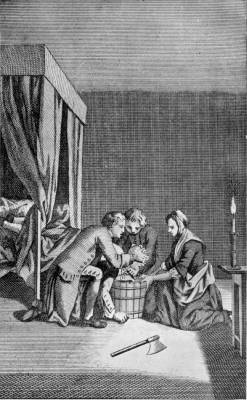
THE MURDER OF JOHN HAYES Catherine Hayes assisting Wood and Billings to cut off the head from her husband's corpse (From the Annals of Newgate)
In the meantime Mrs. Hayes quitted her lodgings, and removed from where the murder was committed to Mr. Jones's, a distiller in the neighbourhood, with Billings, Wood, and Springate, for whom she paid one quarter's rent at her old lodgings. During this time she employed herself in getting as much of her husband's effects as possibly she could, and amongst other papers and securities, finding a bond due to Mr. Hayes from John Davis, who had married Mr. Hayes's sister, she consulted how to get the money. To which purpose she sent for one Mr. Leonard Myring, a barber, and told him that she, knowing him to be her husband's particular friend and acquaintance, and he then being under some misfortunes, through which she feared he would not presently return, she knew not how to recover several sums of money that were due to her husband, unless by sending fictitious letters in his name, to the several persons from whom the same were due. Mr. Myring considering the consequences of such a proceeding declined it. But she prevailed upon some other person to write letters in Mr. Hayes's name, particularly one to his mother, on the 14th of March, to demand ten pounds of the above-mentioned Mr. Davis, threatening if he refused, to sue him for it. This letter Mr. Hayes's mother received, and acquainting her son-in-law Davis with the contents thereof, he offered to pay the money on sending down the bond, of which she by a letter acquainted Mrs. Hayes on the twenty-second of the same month.
During these transactions, several persons came daily to Mr. Westbrook's to see the head. A poor woman at Kingsland, whose husband had been missing the day before it was found, was one amongst them. At first sight she fancied it bore some resemblance to that of her husband, but was not positive enough to swear to it; yet her suspicion at first was sufficient to ground a report, which flew about the town, in the evening, and some enquiries were made after the body of the person to whom it was supposed to belong but to no purpose.
Mrs. Hayes, in the meanwhile, took all the pains imaginable to propagate a story of Mr. Hayes's withdrawing on account of an unlucky blow he had given to a person in a quarrel, and which made him apprehensive of a prosecution, though he was then in treaty with the widow in order to make it up. This story she at first told with many injunctions of secrecy, to persons who she had good reason to believe would, notwithstanding her injunctions, tell it again. It happened, in the interim, that one Mr. Joseph Ashby, who had been an intimate acquaintance of Mr. Hayes, came to see her. She, with a great deal of pretended concern, communicated the tale she had framed to him. Mr. Ashby asked whether the person he had killed was him to whom the head belonged; she said, No, the man who died by Mr. Hayes's blow was buried entire, and Mr. Hayes had given or was about to give, a security to pay the widow fifteen pounds per annum to hush it up. Mr. Ashby next enquired where Mr. Hayes was gone; she said to Portugal, with three or four foreign gentlemen.
He thereupon took his leave; but going from thence to Mr. Henry Longmore's, cousin of Mr. Hayes, he related to him the story Mrs. Hayes had told him and expressed a good deal of dissatisfaction thereat, desiring Mr. Longmore to go to her and make the same enquiry as he had done, but without saying they had seen one another. Mr. Longmore went thereupon directly to Mrs. Hayes's, and enquired in a peremptory tone for her husband. In answer she said that she had supposed Mr. Ashby had acquainted him with the misfortune which had befallen him. Mr. Longmore replied he had not seen Mr. Ashby for a considerable time and knew nothing of his cousin's misfortune, not judging of any that could attend him, for he believed he was not indebted to anybody. He then asked if he was in prison for debt. She answered him, No, 'twas worse than that. Mr. Longmore demanded what worse could befall him. As to any debts, he believed he had not contracted any. At which she blessed God and said that neither Mr. Hayes nor herself owed a farthing to any person in the world. Mr. Longmore again importuning her to know what he had done to occasion his absconding so, said I suppose he has not murdered anybody? To this she replied, he had, and beckoning him to come upstairs, related to him the story as before mentioned.
Mr. Longmore being inquisitive which way he was gone, she told him into Herefordshire, that Mr. Hayes had taken four pocket pistols with him for his security, viz., one under each arm, and two in his pockets. Mr. Longmore answered, 'twould be dangerous for him to travel in that manner; that any person seeing him so armed with pistols, would cause him to be apprehended on suspicion of being a highwayman. To which she assured him that it was his usual manner; the reason of it was that he had like to have been robbed coming out of the country, and that once he was apprehended on suspicion of being an highwayman, but that a gentleman who knew him, accidentally came in, and seeing him in custody, passed his word for his appearance, by which he was discharged. To that Mr. Longmore made answer that it was very improbable of his ever being stopped on suspicion of being an highwayman, and discharged upon a man's only passing his word for his appearance; he farther persisted which way he was supplied with money for his journey. She told him she had sewn twenty-six guineas into his clothes, and that he had about him seventeen shillings in new silver. She added that Springate, who lodged there, was privy to the whole transaction, for which reason she paid a quarter's rent for her at her old lodgings, and the better to maintain what she had averred, called Springate to justify the truth of it. In concluding the discourse, she reflected on the unkind usage of Mr. Hayes towards her, which surprised Mr. Longmore more than anything else she had said yet, and strengthened his suspicion, because he had often been a witness to her giving Mr. Hayes the best of characters, viz., of a most indulgent, tender husband.
Mr. Longmore then took leave of her and returned back to his friend Mr. Ashby; when, after comparing their several notes together, they judged by very apparent reasons that Mr. Hayes must have had very ill play shown him. Upon which they agreed to go to Mr. Eaton, a Life Guardman who was also an acquaintance of Mr. Hayes's, which accordingly they did, intending him to have gone to Mrs. Hayes also, to have heard what relation she would give him concerning her husband. They went and enquired at several places for him, but he was not then to be found; upon which Mr. Longmore and Mr. Ashby went down to Westminster to see the head at Mr. Westbrook's. When they came there, Mr. Westbrook told them that the head had been owned by a woman from Kingsland, who thought it to be her husband, but was not certain enough to swear it, though the circumstances were strong, because he had been missing from the day before the head was found. They desired to see it and Mr. Ashby first went upstairs to look on it, and coming down, told Mr. Longmore he really thought it to be Mr. Hayes's head, upon which Mr. Longmore went up to see it, and after examining it more particularly than Mr. Ashby, confirmed him in his suspicion. Then they returned to seek out Mr. Eaton, and finding him at home, informed him of their proceedings, with the sufficient reasons upon which their suspicions were founded, and compelled him to go with them to enquire into the affair.
Mr. Eaton pressed them to stay to dinner with him, which at first they agreed to, but afterwards altering their minds, went all down to Mr. Longmore's house and there renewed the reasons of their suspicions, not only of Mr. Hayes's being murdered (being satisfied with seeing the head) but also that his wife was privy to the same. But in order to be more fully satisfied they agreed that Mr. Eaton should in a day or two's time go and enquire for Mr. Hayes, but withal taking no notice of his having seen Mr. Longmore and Mr. Ashby. In the meantime Mr. Longmore's brother interfered, saying, that it seemed apparent to him that his cousin (Mr. Hayes) had been murdered, and that Mrs. Hayes appeared very suspicious to him of being guilty with some other persons, viz., Wood and Billings (who she told him, had drunk with him the night before his journey). He added, moreover, that he thought time was not to be delayed, because they might remove from their lodgings upon the least apprehensions of a discovery.
His opinion prevailed as the most reasonable, and Mr. Longmore said they would go about it immediately. Accordingly he immediately applied to Mr. Justice Lambert and acquainted him with the grounds of their suspicions and their desire of his granting a warrant for the apprehension of the parties. On hearing the story the justice not only readily agreed with them in their suspicions, and complied with their demand, but said also he would get proper officers to execute it in the evening, about nine o'clock, putting Mrs. Hayes, Thomas Wood, Thomas Billings, and Mary Springate into a special warrant for that purpose.
At the hour appointed they met, and Mr. Eaton bringing two officers of the Guards along with them, they went altogether to the house where Mrs. Hayes lodged. They went directly in and upstairs, at which Mr. Jones, who kept the house, demanded who and what they were. He was answered that they were sufficiently authorised in all they did, desiring him at the same time to bring candles and he should see on what occasion they came. Light being thereupon brought they went all upstairs together. Justice Lambert rapped at Mrs. Hayes's door with his cane; she demanded who was there, for that she was in bed, on which she was bid to get up and open it, or they would break it open.
After some time taken to put on her clothes, she came and opened it. As soon as they were in the room they seized her and Billings, who was sitting upon her bedside, without either shoes or stockings on. The justice asked whether he had been in bed with her. She said no, but that he sat there to mend his stockings. Why, then, replied Mr. Lambert, he has very good eyes to see to do it without fire or candle, whereupon they seized him too. And leaving persons below to guard them, they went up and apprehended Springate. After an examination in which they would confess nothing, they committed Billings to New Prison, Springate to the Gate House, and Mrs. Hayes to Tothill Fields Bridewell.
The consciousness of her own guilt made Mrs. Hayes very assiduous in contriving such a method of behaviour as might carry the greatest appearance of innocence. In the first place, therefore, she entreated Mr. Longmore that she might be admitted to see the head, in which request she was indulged by Mr. Lambert, who ordered her to have a sight of it as she came from Tothill Fields Bridewell to her examination. Accordingly Mr. Longmore attending the officers to bring Mrs. Hayes from thence the next day to Mr. Lambert's, ordered the coach to stop at Mr. Westbrook's door. And as soon as he entered the house, being admitted into the room, she threw herself down upon her knees, crying out in great agonies, Oh, it is my dear husband's head! It is my dear husband's head! and embracing the glass in her arms kissed the outside of it several times. In the meantime Mr. Westbrook coming in, told her that if it was his head she should have a plainer view of it, that he would take it out of the glass for her to have a full sight of it, which he did, by lifting it up by the hair and brought it to her. Taking it in her arms, she kissed it, and seemed in great confusion, withal begging to have a lock of his hair; but Mr. Westbrook replied that he was afraid she had had too much of his blood already. At which she fainted away, and after recovering, was carried to Mr. Lambert's, to be examined before him and some other Justices of the Peace. While these things were in agitation, one Mr. Huddle and his servant walking in Marylebone Fields in the evening, espied something lying in one of the ponds in the fields, which after they had examined it they found to be the legs, thighs, and arms of a man. They, being very much surprised at this, determined to search farther, and the next morning getting assistance drained the pond, where to their great astonishment they pulled out the body of a man wrapped up in a blanket; with the news of which, while Mrs. Hayes was under examination, Mr. Crosby, a constable, came down to the justices, not doubting but this was the body of Mr. Hayes which he had found thus mangled and dismembered.
Yet, though she was somewhat confounded at the new discovery made hereby of the cruelty with which her late husband had been treated, she could not, however, be prevailed on to make any discovery or acknowledgment of her knowing anything of the fact; whereupon the justices who examined her, committed her that afternoon to Newgate, the mob attending her thither with loud acclamations of joy at her commitment, and ardent wishes of her coming to a just punishment, as if they were already convinced of her guilt.
Sunday morning following, Thomas Wood came to town from Greenford, near Harrow, having heard nothing further of the affair, or of the taking up of Mrs. Hayes, Billings, or Springate. The first place he went to was Mrs. Hayes's old lodging; there he was answered that she had moved to Mr. Jones's, a distiller, a little farther in the street. Thither he went, where the people suspected of the murder said Mrs. Hayes was gone to the Green Dragon in King Street, which is Mrs. Longmore's house; and a man who was there told him, moreover, that he was going thither and would show him the way; Wood being on horseback followed him, and he led him the way to Mr. Longmore's house. At this time Mr. Longmore's brother coming to the door, and seeing Wood, immediately seized him, and unhorseing him, dragged him indoors, sent for officers and charged them with him on suspicion of the murder. From thence he was carried before Mr. Justice Lambert, who asked him many questions in relation to the murder; but he would confess nothing, whereupon he was committed to Tothill Fields Bridewell. While he was there he heard the various reports of persons concerning the murder, and from those, judging it impossible to prevent a full discovery or evade the proofs that were against him, he resolved to name an ample confession of the whole affair. Mr. Lambert being acquainted with this, he with John Madun and Thomas Salt, Esqs., two other justices of the peace, went to Tothill Fields Bridewell, to take his examination, in which he seemed very ingenuous and ample declaring all the particulars before mentioned, with this addition that Catherine Hayes was the first promoter of, and a great assistance in several parts of this horrid affair; that he had been drawn into the commission thereof partly through poverty, and partly through her crafty insinuations, who by feeding them with liquors, had spirited them up to the commission of such a piece of barbarity. He farther acknowledged that ever since the commission of the fact he had had no peace, but a continual torment of mind; that the very day before he came from Greenford he was fully persuaded within himself that he should be seized for the murder when he came to town, and should never see Greenford more; notwithstanding which he could not refrain coming, though under an unexpected certainty of being taken, and dying for the fact. Having thus made a full and ample confession, and signed the same on the 27th March, his mittimus was made by Justice Lambert, and he was committed to Newgate, whither he was carried under a guard of a serjeant and eight soldiers with muskets and bayonets to keep off the mob, who were so exasperated against the actors of such a piece of barbarity that without that caution it would have been very difficult to have carried him thither alive.
On Monday, the 28th of March, after Mrs. Hayes was committed to Newgate, being the day after Wood's apprehension, Joseph Mercer going to see Mrs. Hayes, she told him that as he was Thomas Billings's friend as well as hers; she desired he would go to him and tell him 'twas in vain to deny any longer the murder of her husband, for they were equally guilty, and both must die for it. Billings hearing this and that Wood was apprehended and had fully confessed the whole affair, thought it needless to persist any longer in a denial, and therefore the next day, being the 29th of March, he made a full and plain discovery of the whole fact, agreeing with Wood in all the particulars; which confession was made and signed in the presence of Gideon Harvey and Oliver Lambert, Esqs., two of his Majesty's justices of peace, whereupon he was removed to Newgate the same day that Wood was.
Wood and Billings, by their several confessions, acquitting Springate of having any concern in the aforesaid murder, she was soon discharged from her confinement.
This discovery making a great noise in the town, divers of Mrs. Hayes's went to visit her in Newgate and examine her as to the and motives that induced her to commit the said fact. Her acknowledgment in general was: that Mr. Hayes had proved but an indifferent husband to her; that one night he came home drunk and struck her; that upon complaining to Billings and Wood they, or one of them, said such a fellow (meaning Mr. Hayes) ought not to live, and that they would murder him for a halfpenny. She took that opportunity to propose her bloody intentions to them, and her willingness that they should do so; she was acquainted with their design, heard the blow given to Mr. Hayes by Billings, and then went with Wood into the room; she held the candle while the head was cut off, and in excuse for this bloody fact, said the devil was got into them all that made them do it. When she was made sensible that her crime in law was not only murder, but petty treason, she began to show great concern indeed, making very strict enquiries into the nature of the proof which was necessary to convict, and having possessed herself with a notion that it appeared she murdered him with her own hands, she was very angry that either Billings or Wood should, by their confession, acknowledge her guilty of the murder, and thereby subject her to that punishment which of all others she most feared, often repeating that it was hard they would not suffer her to be hanged with them! When she was told of the common report that Billings was her son, she affected, at first, to make a great mystery of it; said he was her own flesh and blood, indeed, but that he did not know how nearly he was related to her himself; at other times she said she would never disown him while she lived, and showed a greater tenderness for him than for herself, and sent every day to the condemned hold where he lay, to enquire after his health. But two or three days before her death, she became as the ordinary tells us a little more sincere in this respect, affirming that he was not only her child, but Mr. Hayes's also, though put out to another person, with whom he was bred up in the country and called him father.
There are generally a set of people about most prisons, and especially about Newgate, who get their living by imposing on unhappy criminals, and persuading them that guilt may be covered, and Justice evaded by certain artful contrivances in which they profess themselves masters. Some of these had got access to this unhappy woman, and had instilled into her a notion that the confession of Wood and Billings could no way affect her life. This made her vainly imagine that there was no positive proof against her, and that circumstantials only would not convict her. For this reason she resolved to put herself upon her trial (contrary to her first intentions; for having been asked what she would do, she had replied she would hold up her hand at the bar and plead guilty, for the whole world could not save her). Accordingly, being arraigned, she pleaded not guilty, and put herself upon her trial. Wood and Billings both pleaded guilty, and desired to make atonement for the same by the loss of their blood, only praying the Court would be graciously pleased to favour them so much (as they had made an ingenuous confession) as to dispense with their being hanged in chains. Mrs. Hayes having thus put herself upon her trial, the King's Counsel opened the indictment, setting forth the heinousness of the fact, the premeditated intentions, and inhuman method of acting it; that his Majesty for the more effectual prosecution of such vile offenders, and out of a tender regard to the peace and welfare of all his subjects, and that the actors and perpetrators of such unheard of barbarities might be brought to condign punishment, had given them directions to prosecute the prisoners. Then Richard Bromage, Robert Wilkins, Leonard Myring, Joseph Mercer, John Blakesby, Mary Springate, and Richard Bows, were called into Court; the substance of whose evidence against the prisoner was that the prisoner being interrogated about the murder, when in Newgate, said, the devil put it into her head, but, however, John Hayes was none of the best of husbands, for she had been half starved ever since she was married to him; that she did not in the least repent of anything she had done, but only in drawing those two poor men into this misfortune; that she was six weeks importuning them to do it; that they denied it two or three times, but at last agreed; her husband was so drunk that he fell out of his chair, then Billings and Wood, carried him into the next room, and laid him upon the bed; that she was not in that room but in the fore room on the same floor when he was killed, but they told her that Billings struck him twice on the head with a pole-axe, and that then Wood cut his throat; that when he was quite dead she went in and held the candle whilst Wood cut his head quite off, and afterwards they chopped off his legs and arms; that they wanted to get him into an old chest, but were forced to cut off his thighs and arms, and then the chest would not hold them all; the body and limbs were put into blankets at several times the next night, and thrown into a pond, that the devil was in them all, and they were all drunk; that it would signify nothing to make a long preamble, she could hold up her hand and say she was guilty, for nothing could save her, nobody could forgive her; that the men who did the murder were taken and confessed it; that she was not with them when they did it; that she was sitting by the fire in the shop upon a stool; that she heard the blow given and somebody stamp; that she did not cry out, for fear they should kill her; that after the head was cut off, it was put into a pail, and Wood carried it out; that Billings sat down by her and cried, and would lie all the rest of the night in the room with the dead body; that the first occasion of this design to murder him was because he came home one night and beat her, upon which Billings said this fellow deserved to be killed, and Wood said he would be his butcher for a penny; that she told them they might do as they would do it that night it was done; that she did not tell her husband of the design to murder him, for fear he should beat her; that she sent to Billings to let him know it was in vain to deny the murder of her husband any longer, for they were both guilty, and must both die for it.
Many other circumstances equally strong with those before mentioned appeared, and a cloud of witnesses, many of whom (the thing appearing so plain) were sent away unexamined. She herself confessed at the bar her previous knowledge of their intent several days before the fact was committed; yet foolishly insisted on her innocence, because the fact was not committed by her own hands. The jury, without staying long to consider of it, found her guilty, and she was taken from the bar in a very weak and faint condition. On her return to Newgate, she was visited by several persons of her acquaintance, who yet were so far from doing her any good that they rather interrupted her in those preparations which it became a woman in her sad condition to make.
When they were brought up to receive sentence, Wood and Billings renewed their former requests to the Court, that they might not be hung in chains. Mrs. Hayes also made use of her former assertion, that she was not guilty of actually committing the fact, and therefore begged of the Court that she might at least have so much mercy shown her as not to be burnt alive. The judges then proceeded in the manner prescribed by Law, that is, they sentenced the two men, with the other malefactors, to be hanged, and Mrs. Hayes, as in all cases of petty treason, to die by fire at a stake; at which she screamed, and being carried back to Newgate, fell into violent agonies. When the other criminals were brought thither after sentence passed, the men were confined in the same place with the rest in their condition, but Mrs. Hayes was put into a place by herself, which was at that time the apartment allotted to women under condemnation.
Perhaps nobody ever kept their thoughts so long and so closely united to the world, as appeared by the frequent messages she sent to Wood and Billings in the place where they were confined, and that tenderness which she expressed for both of them seemed preferable to any concern she showed for her own misfortunes, lamenting in the softest terms of having involved those two poor men in the commission of a fact for which they were now to lose their lives. In which, indeed, they deserved pity, since, as I shall show hereafter, they were persons of unblemished characters, and of virtuous inclinations, until misled by her.
As to the sense she had of her own circumstances, there has been scarce any in her state known to behave with so much indifference. She said often that death was neither grievous nor terrible to her in itself, but was in some degree shocking from the manner in which she was to die. Her fondness for Billings hurried her into indecencies of a very extraordinary nature, such as sitting with her hand in his at chapel, leaning upon his shoulder, and refusing upon being reprimanded (for giving offence to the congregation) to make any amendment in respect of these shocking passages between her and the murderers of her husband, but on the contrary, she persisted in them to the very minute of her death. One of her last expressions was to enquire of the executioner whether he had hanged her dear child, and this, as she was going from the sledge to the stake, so strong and lasting were the passions of this woman.
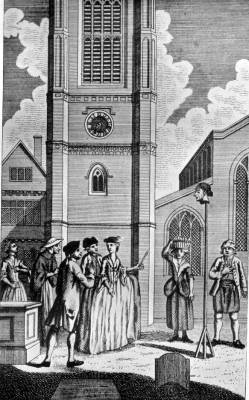
THE MURDER OF JOHN HAYES The murdered man's head is exhibited in the churchyard of St. Margaret's, Westminster
The Friday night before her execution (being assured she should die on the Monday following) she attempted to make away with herself; to which purpose she had procured a bottle of strong poison, designing to have taken the same. But a woman who was in the place with her, touching it with her lips, found that it burnt them to an extraordinary degree, and spilling a little on her handkerchief, perceived it burnt that also; upon which suspecting her intentions, she broke the phial, whereby her design was frustrated.
On the day of her execution she was at prayers, and received the Sacrament in the chapel, where she still showed her tenderness to Billings. About twelve, the prisoners were severally carried away for execution; Billings with eight others for various crimes were put into three carts, and Catherine Hayes was drawn upon a sledge to the place of execution; where being arrived, Billings with eight others, after having had some time for their private devotions, were turned off.
After which Catherine Hayes being brought to the stake, was chained thereto with an iron chain running round her waist and under her arms and a rope about her neck, which was drawn through a hole in the post; then the faggots, intermixed with light brush wood and straw, being piled all round her, the executioner put fire thereto in several places, which immediately blazing out, as soon as the same reached her, with her arms she pushed down those which were before her. When she appeared in the middle of the flames as low as her waist, the executioner got hold of the end of the cord which was round her neck, and pulled tight, in order to strangle her, but the fire soon reached his hand and burnt it, so that he was obliged to let it go again. More faggots were immediately thrown upon her, and in about three or four hours she was reduced to ashes.
In the meantime, Billings's irons were put upon him as he was hanging on the gallows; after which being cut down, he was carried to the gibbet, about one hundred yards distance, and there hung up in chains.
[75]
The old name for Oxford Street.
The Life of THOMAS BILLINGS, a Murderer.
We have said so much of this malefactor in the foregoing life, yet it was necessary, in order to preserve the connection of that barbarous story, to leave the particular consideration of these two assistants in the murder of Mr. Hayes to particular chapters, and therefore we will begin with Billings. Mrs. Hayes, some time before her execution, confidently averred that he was the son both of Mr. Hayes and of herself, that his father not liking him, he was put out to relations of hers and took the name of Billings from his godfather. But Mr. Hayes's relations confidently denying all this, and he himself saying he knew nothing more than that he called his father a shoemaker in the country, who some time since was dead. He was put apprentice to a tailor with whom he served his time, and then came up to London to work journey-work, which he did in Monmouth Street, lodging at Mr. Hayes's and believed himself nearly related to his wife, who from the influence she always maintained over him, drew him to the commission of that horrid fact.
But the most certain opinion is that he was found in a basket upon the common, near the place where Mrs. Hayes lived before she married Mr. Hayes, that he was at that time of his death about twenty-two or twenty-three years old; whereas it evidently appeared by her own confession, that she had been married to Mr. Hayes but twenty years and eight months. He was put out to nurse by the charge of the parish, to people whose names were Billings, and when he was big enough to go apprentice, was bound to one Mr. Wetherland, a tailor, to whom the parish gave forty shillings with him. It is very probable he might be a natural son of Mrs. Hayes's, born in her rambles (of which we have hinted) before her marriage, and dropped by her in the place where he was found.
As to the character of Billings in the country he was always reputed a sober, honest, industrious young man. During the time he had worked in town, he had done nothing to impeach that reputation which he brought up with him, and might possibly have lived very happily, if he had not fallen into the temptation of this unfortunate woman, who seems to have been born for her own undoing and for the destruction of others. Whatever knowledge he might have of that relation in which he stood to Mrs. Hayes, certain it is that she always preserved such an authority over him that in her presence he would never answer any questions but constantly referred himself to her, or kept an obstinate silence; he affected, also, a strange fondness for her, kissing her cheek when she fainted in the chapel at Newgate, and behaving himself when near her, in such a manner as gave great offence to the spectators. As to the remorse he had for the horrid crime he had committed, those who had occasion to know him while under confinement thought him sincere therein; but the Ordinary, whose place it is to be supreme judge in these matters, told the world in his account of the behaviour and confession of the malefactors, that he was a confused, hard-hearted fellow, and had few external signs of penitence; and a little farther, when possibly he was in a better humour, he says that in all appearance he was very penitent for his sins, and died in the Communion of the Church of England, of which he owned himself an unworthy member.
Life of THOMAS WOOD, a Murderer
This malefactor, Thomas Wood, was born at a place called Ombersley, between Ludlow and Worcester, of parents in very indifferent circumstances, who were therefore able to give him but little education. He was bred up to no settled business, but laboured in all such country employments as require only a robust body for their performance. When the summer's work was over, he used to assist as a tapster at inns and alehouses in the neighbourhood of the village where he was born, and by the industry, care, and regularity which he observed in all things, gained a very great reputation as an honest and faithful servant with all that knew him.
His mother having been left in a needy condition, with several small children, she set up a little alehouse in order to get bread for them. Thomas was very dutiful, and as his diligence enabled him to save a little money, so he was by no means backwards in giving her all the assistance that was in his power. Some few months before his death, he grew desirous of coming to London, which he did accordingly, and worked at whatsoever employment he could get both with fidelity and diligence; but a fleet being then setting out for the Mediterranean, press-warrants were granted for the manning thereof, and the diligence that was used in putting them in execution gave great uneasiness to Wood, who, having no settled business, was afraid of falling into their hands. Whereupon he bethought himself of his countryman, Mr. Hayes, to whom he applied for his advice and assistance. Mr. Hayes kindly invited him to live with them in order to avoid that danger, and he accordingly lay with Mr. Billings, as has been before related. Mr. Hayes was moreover so desirous of doing him service that he applied himself to finding out such persons as wanted labourers in order to get him into business, while Mrs. Hayes, in the meantime, made use of every blandishment to seduce the fellow into following her wicked inclinations. Perceiving that both Billings and he had religious principles then in common with ordinary persons, she artfully made even those persons' dispositions subservient to her brutal and inhuman purpose.
It seems that Mr. Hayes had fallen, within a few years of his death, into the company of some who called themselves Free-thinkers and fancy an excellency in their own understandings because they are able to ridicule those things which the rest of the world think sacred. Though it is no great conquest to obtrude the belief of anything whatsoever on persons of small parts and little education, yet they triumph greatly therein and communicate the same honour of boasting in their pupils. Mr. Hayes now and then let fall some rather rash expression, as to his disbelief of the immortality of the soul, and talked in such a manner on religious topics that Mrs. Hayes persuaded Billings and Wood that he was an Atheist, and as he believed his own soul of no greater value than that of a brute beast, there could be no difference between killing him and them. It must be indeed acknowledged that there was no less oddity in such propositions than in those of her husband; however, it prevailed, it seems, with these unfortunate men; and as she had already persuaded them it was no sin, so when they were intoxicated with liquor she found it less difficult than at any other time, to deprive them also of the humanity, and engage them in perpetrating a fact so opposite not only to religion but to the natural tenderness of the human species. Wood, as he yielded to her persuasions with reluctance, so he was the first who showed any true remorse of conscience for that cruel act of which he had been guilty; his confession of it being free and voluntary, and at the same time full and ingenious. Two days after receiving sentence, his constitution began to give way to the violence of a feverish distemper, which by a natural death prevented his execution, he dying in Newgate, in the twenty-eighth year of his age, much more pitied than either Billings or Mrs. Hayes who suffered at Tyburn. And thus with Wood we put a period to the relation of a tragedy which surprised the world exceedingly at the same time it happened, and will doubtless be read with horror in succeeding generations.
The Life of CAPTAIN JAEN, a Murderer
Though there is not perhaps any sin so opposite to our nature as cruelty towards our fellow creatures, yet we see it so thoroughly established in some tempers, that neither education nor a sense of religion are strong enough to abate it, much less to wear it out. The person of whom we are speaking, John Jaen, was the son of parents in very good circumstances at Bristol, who they bred him up to the knowledge of everything requisite to a person who was to be bred up in trade, and he grew a very tolerable proficient as well in the knowledge of the Latin tongue, as in writing and accounts, for his improvement in all which he was put under the best masters. When he had finished that course of learning which his friends thought would qualify him for what they designed him, he was immediately put apprentice to a cooper in Bristol, where he served his time with both fidelity and industry. When it was expired, he applied himself to trade with the same diligence, and sometimes went to sea, till in the year '24 he became master of a ship called the Burnett, fitted out by some merchants at Bristol, for South Carolina. In his return from this voyage he committed the murder for which he died.
On the 25th April, 1726, an Admiralty Sessions was held at the Old Bailey, before the Hon. Sir Henry Penrice, Judge of the High Court of Admiralty, assisted by the Honourable Mr. Baron Hale, at which Captain Greagh was indicated for feloniously sinking the good ship called the Friendship, of which he was commander; but as there appeared no grounds for such a charge, he was acquitted. Afterwards Captain John Jaen, of Bristol, was set to the bar, and arraigned on an indictment for wilfully and inhumanly murdering one Richard Pye, who had been cabin-boy, in the month of March, in the year 1724. It appeared by the evidence produced against him that he either whipped the boy himself or caused him to be whipped every day during the voyage; that he caused him to be tied to the mainmast with ropes for nine days together, extending his arms and legs to the utmost, whipping him with a cat (as it is called) of five small cords till he was all bloody, then causing his wounds to be several times washed with brine and pickle. Under this terrible usage the poor wretch grew soon after speechless. The Captain, notwithstanding, continued his cruel usage, stamping, beating and abusing him, and even obliging him to eat his own excrements, which forcing its way upwards again, the boy in his agony of pain made signs for a dram, whereupon the captain in derision took a glass, carried it into the cabin, and made water therein, and then brought it to the boy to drink, who rejected the same. The lamentable condition in which he was made no impression on the captain, who continued to treat him with the same severity, by whipping, pickling, kicking, beating, and bruising him while he lingered out his miserable life. On the last day of this he gave him eighteen lashes with the aforesaid cat of five tails, in a little time after which the boy died. The evidence farther deposed that when the boy's body was sewn up in a hammock to be thrown overboard it had in it as many colours as there are in a rainbow, that his flesh in many places was as soft as jelly, and his head swelled as big as two. Upon the whole it very fully appeared that a more bloody premeditated and wilful murder was never committed, and Sir Henry Penrice declared, that in all the time he had had the honour of sitting on the Bench he never heard anything like it, and hoped that no person who should sit there after him should hear of such an offence.
Under sentence of death he behaved with a great deal of piety and resignation though he did not frequent the public chapel for two reasons, the first because the number of strangers who were admitted thither to stare at such unhappy persons as are to die are always numerous and sometimes very indiscreet; the second was, that he had many enemies who took a pleasure in coming to insult him, and as he was sure either of these would totally interrupt his devotions, he thought it excusable to receive the assistance of the minister in his own chamber. As to the general offences of his life, he was very open in his confession, but as to the particular fact for which he suffered, he endeavoured to excuse it by saying he never intended to murder the boy, but only to correct him as he deserved, he being exceedingly wicked and unruly; he charged him with thieving in their voyage out, being yet worse as they came home, and that particularly one evening when he was asleep in the cabin, the lad broke open his lockers, and took out a bottle of rum, of which he drank near a pint, making himself therefor so drunk that his excrements fell involuntarily from him, which stunk so abominably that it awakened him (the Captain), whereupon he called in several of his men, who found the boy in a sad condition, and were obliged to sit down and smoke tobacco in order to overcome the stench he had raised. This produced the terrible punishment of tying him to the mast for several days and the offering him his excrements which he rejected.
Notwithstanding the captain owned all this, yet he could not forbear reflections on those who gave testimony against him at his trial, charging them with perjury and conspiracy to ruin him, though nothing like it appeared from the manner in which they delivered their testimony. As the time of his death approached nearer, the fear thereof, and remorse of conscience, brought the captain into so weak and low a state that he could scarce speak or attend to any discourses of others, but lay in a languishing condition, often fainting, and in fine appearing not unlike a person who had taken something to produce a sudden death, in order to prevent an ignominious one. Yet when such suspicions were mentioned to him, he declared that they were without ground, that he had never suffered such a thought once to enter into his head. His wife, who attended him constantly while in prison, said she loved him too well to become his executioner, and that she was positive since his commitment, he had had nothing unwholesome administered to him.
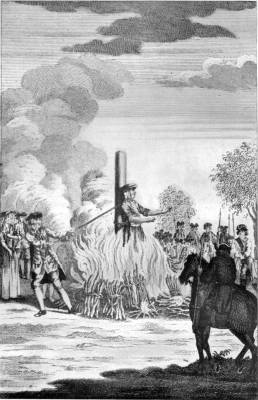
CATHERINE HAYES BURNT FOR THE MURDER OF HER HUSBAND (From the Annals of Newgate)
As he was carried to execution, he was so very much spent, that it was thought he would hardly have lived to have reached it. There he had the assistance of a minister of distinction, who prayed with him till the instant he was thrown off, which was on the 13th day of May, 1726, being then about twenty-nine years of age. As soon as he was cut down, he was put in chains, in order to be hung up.
The Life of WILLIAM BOURN, a Notorious Thief
As the want of education, from a multitude of instances, seems to be the chief cause of many of those misfortunes which befall persons in the ordinary course of life, so there are some born with such a natural inaptitude thereto, that no care, no pains, is able to conquer the stubborn stupidity of their nature, but like a knotty piece of wood, they defy the ingenuity of others to frame anything useful out of such cross-grained materials. This, as he acknowledged himself upon all occasions, was the case of the malefactor we are now speaking of, who was descended of honest and reputable parents, who were willing in his younger years to have furnished him with a tolerable share of learning; but he was utterly incorrigible, and though put to a good school, would never be brought to read or write at all, which was no small dissatisfaction to his parents, with whom in other respects he agreed tolerably well.
When of age to be put out apprentice, he was placed with a hatter in the city of Dublin, to whom he served his time honestly and faithfully; as soon as he was out of his time, he came up to London in order to become acquainted with his business. He had the good luck, though a stranger, to get into good business here, but was so unfortunate as to fall into the acquaintance of two lewd women, who fatally persuaded him that thieving was an easier way of getting money to supply their extravagant expenses than working. He being a raw young lad, unacquainted with the world, was so mad as to follow their advice, and in consequence thereof snatched a show-glass out of the shop of Mr. Lovell, a goldsmith in Bishopsgate Street, in which there was four snuff-boxes, eight silver medals, six pairs of gold buttons, five diamond rings, twenty pairs of ear-rings, sixty-four gold rings, several gold chains, and other rich goods, to the amount of near £300, with all of which he got safe off, though discovered soon afterwards by his folly in endeavouring to dispose of them.
He threw aside all hopes of life as soon as he was apprehended, as having no friends to make intercession likely to procure a pardon. He was, indeed, a poor young creature, rather stupid than wicked and his vices more owing to his folly than to the malignity of his inclinations. He seemed to have a just notion both of the heinousness of that crime which he had committed and of the shame and ignominy he had brought upon himself and his relations. He was particularly affected with the miseries which were likely to fall upon his poor wife for his folly, and when the day of his death came, he seemed very easy and contented under it, declaring, however, at last that he died in the communion of the Church of Rome. This was on the 27th of June, 1726, being then not much above eighteen years old.
The Life of JOHN MURREL, a Horse-Stealer
This malefactor was descended of very honest and reputable parents in the county of York, who took care not only that he should read and write tolerably well, but also that he should be instructed in the principles of religion. They brought him up in their own way of business, which was grazing of cattle (both black cattle and horses), and afterwards selling them at market. As he grew up a man, he settled in the same occupation, farming what is called in Yorkshire a grazing room, for which he paid near a hundred pounds a year rent, and dealt very considerably himself in the same way which had been followed by his parents. He married also a young woman with a tolerable fortune, who bore him several children, five of which were alive at the time of his execution, and lived with their mother upon some little estate she had of her own.
For some years after his marriage he lived with tolerable reputation in the country, but being lavish in his expenses, he quickly consumed both his own little fortune and what he had with his wife, and then failing in his business, a whim took him in the head to come to London, whither also he brought his son. Here he soon fell into bad company, and getting acquaintance with a woman whom he thought was capable of maintaining him, he married her, or at least lived with her as if they had been married, for a considerable space; the news of which reaching his wife in the country, affected her so much that she had very nigh fallen into a fit of sickness. Thereupon her friends demonstrated to her, in vain, how unreasonable a thing it was for her to give herself so much pain about a man who treated her at once with unkindness and injustice; in spite of their remonstrances she came up to London, in hopes that her presence might reclaim him. But herein she was utterly mistaken, for he absolutely denied her to be his wife, and even persuaded his son to deny her also for his mother, which the boy with much fear and confusion did; and the poor woman was forced to go down into the country again, overwhelmed with sorrow at the ingratitude of the one and the undutifulness of the other. However, Murrel still went on in the same way with the woman he had chosen for his companion.
There is all the reason imaginable to suppose that he did not take the most honest ways of supporting himself and his mistress. However, he fell into no trouble nor is there any direct evidence of his having been guilty of any dishonesty within the reach of the Law, until he ran away with a mare from a man in town, as to which he excused himself by saying that she had formerly been his own, and that there having nothing more than a verbal contract between them, he thought fit to carry her off and sell her again. Sometime afterwards, going down to Newcastle Fair (for he still continued to carry on some dealing in horse-flesh) he fell there into the company of some merchants in the same way, who found means to get gains and sell very cheap, by paying nothing at the first hand. Among these, there was a country man of his who went by the name of Brown, with whom Murrel had formerly had an acquaintance. This fellow knowing the company in general to be persons of the same profession, began to talk very freely of his practices in that way (viz., of horse stealing), and amongst other stories related this. He said he once rode away with an officer's horse, who had just bought it with an intent to ride him up to London; he carried the creature into the West, and having made such alterations in his mane and tail as he thought proper, sold him there to a parson for thirteen guineas, which was about seven less than the horse was worth. But knowing the doctor had another church about eight miles from the parish in which he lived, and that there was a little stable at one angle of the churchyard, where the horse was put up during service, he resolved to make bold with it again. Accordingly, when the people were all at church, having provided himself with a red coat and a horse-soldier's accoutrements, he picked the stable door, clapped them on the priest's beast, and rode him without the least suspicion as hard as conveniently he could to Worcester. There he laid aside the habit of a cavalier, and transforming himself into the natural appearance of a horse-courser, he sold the horse to a physician, telling him at the time he bought it, that it would be greatly the better for being suffered to run at grass a fortnight or so. No doubt on it, said he; but I had some design of so doing.
Yet they were much sooner executed than at first they were intended to have been, by an accident which happened the very day after the beast came into the hands of the physician; for one evening as Brown was taking a walk in the skirts of the city, who should he perceive but his old Cornish parson and his footman, jogging into town. Guilt struck him immediately with apprehensions at their errand relating to him, so that walking up and down, nor daring to go into the town for fear of being taken up and at last supposing it the only way to rid him of danger, he caught the horse once more in the doctor's close, and having stolen a saddle and bridle out of the inn where he lodged, he rode on him as far as Essex.
There he remained until Northampton Fair, where he sold the horse for the third time, for twenty-seven guineas, to an officer in the same regiment with him from whom it had been first stolen, on whose return from Flanders it was owned and the captain who bought it (though he refused to lose his money) yet gave as good description as he could of the person who sold it. Upon this the other officer put out an advertisement, describing both the man and the horse, and offering a reward of five guineas for whoever should apprehend him. This advertisement roused both the parson and the doctor, and the former took so much pains to discover him that he was at length apprehended in Cornwall, where at the assizes he was tried and convicted for the fact. But the captain who was the original possessor of the horse was so much pleased with his ingenuity that he procured a reprieve for him, and carried him abroad with him where he continued until the peace of Utrecht, when he returned home and fell to his old way of living, by which he had submitted himself unto the time in which he fell into company with Murrel, and had then bought five or six horses which had been stolen from the South, to be disposed of at the fair.
Murrel liked the precedent, and put it in practice immediately by stealing a brown mare which belonged to Jonathan Wood, for which he was shortly after apprehended and committed to Newgate. At the next sessions at the Old Bailey he was tried and convicted on very clear evidence, and during the space in which he lay under condemnation, testified a true sorrow for his sins, though not so just a sense of that for which he died as he ought to have had, and which might have been reasonably expected. For as horse-stealing did not appear any very great sin to him at the time of his committing it, so now, when he was to die for it, such an obstinate partiality towards ourselves is there naturally grafted in human nature that he could not forbear complaining of the severity of the Law, and find fault with its rigour which might have been avoided. What seemed most of all to afflict him under his misfortune was that be saw his son and nearest relations forsake him, and as much as they could shun having anything to do with his affairs. Of this he complained heavily to the minister of the place, during his confinement in Newgate, who represented to him how justly this had befallen him for first slighting his family, and leaving them without the least tenderness of respect, either to the ties of a husband, or the duty of a parent; so he began to read his sin in his punishment, and to frame himself to a due submission to what he had so much merited by his follies and his crimes.
When he was first brought up to receive sentence, he counterfeited being dead so exactly that he was brought back again to Newgate, but this cheat served only to gain a little time; for at the next sessions he was condemned and ordered for execution, which he suffered on the 27th of June, 1726, being then between forty and fifty years of age.
The Life of WILLIAM HOLLIS, a Thief and an Housebreaker
This unhappy lad was born in Portugal, while the English army served there in the late war. His father was drum-major of a regiment, but had not wherewith to give his child anything but food, for intending to bring him up a soldier, he perhaps thought learning an unnecessary thing to one of that profession. During the first years of his life the poor boy was a constant campaigner, being transported wherever the regiment removed, with the same care and conveniency as the kettle [drum] and knapsack, the only thing besides himself which make up the drum-major's equipage. When he grew big, he got, it seems, on board a man-of-war in the squadron that sailed up the Mediterranean. This was a proper university for one who had been bred in such a school; so that there is no wonder he became so great a proficient in all sorts of wickedness, gaming, drinking, and whoring, which appear not to such poor creatures as sins, but as the pleasures of life, about which they ought to spend their whole care; and, indeed, how should it be otherwise, where they know nothing that better deserves it.
When he came home to England his father dying, he was totally destitute, except what care his mother-in-law was pleased to take of him, which was, indeed, a great deal, if he would have been in any degree obedient to her instructions. But instead of that he looked upon all restraints on his liberty as the greatest evil that could befall him. Wherefore, leaving his mother's house, he abandoned himself to procuring money at any rate to support those lewd pleasures to which he had addicted himself.
It happened that he lodged near one John Mattison, a working silversmith, into whose house he got, and stole from thence no less than one hundred and forty silver buckles, the goods of one Samuel Ashmelly. For this offence he was apprehended, and committed to Newgate; at the next sessions he was tried, and on the evidence of the prosecutor, which was very full and direct, he was convicted, and having no friends, he laid aside all hopes of life, and endeavoured as far as poor capacity would give him leave to improve himself in the knowledge of the Christian Faith, and in preparing for that death to which his follies and his crimes had brought him. The Ordinary, in the account he gives of his death, says that he was extremely stupid, a thing no ways improbable considering the wretched manner in which he had spent the years of his childhood and his youth. However, at last either his insensibility or having satisfied himself with the little evil there is in death compared with living in misery and want, furnished him with so much calmness that he suffered with greater appearance of courage than could have been expected from him. Just before he died he stood up in the cart, and turning himself to the spectators, said, Good people, I am very young, but have been very wicked. It is true I have had no education, but I might have laboured hard and lived well for all that; but gaming and ill-company were my ruin. The Law hath justly brought me where I am, and I hope such young men as see my untimely fate will avoid the paths which lead unto it. Good people, pray for our departing souls, as we do, that God may give you all more grace than to follow us thither. He suffered with the malefactors before-mentioned, being at the time of his execution between seventeen and eighteen years old.
The Life of THOMAS SMITH, a Highwayman
There is a certain commendable tenderness in human nature towards all who are under misfortunes, and this tenderness is in proportion to the magnitude of those evils which we suppose the pitied person to labour under. If we extend our compassion to relieving their necessities, and feeling a regret for those miseries which they undergo, we undoubtedly discharge the duties of humanity according to the scheme both of natural religion and the laws laid down in the Gospel. Perhaps no object ever merited it from juster motives than this poor man, who is the subject of the following pages. His parents were people in tolerable circumstances in Southwark; his father was snatched from him by death, while he was yet a child, but his mother, as far as she was able, was very careful that he should not pass his younger days without instruction, and an uncle he then had, being pleased with the docile temper of the youth, was at some expense also about his education. By this means he came to read and write tolerably well, and gained some little knowledge of the Latin tongue; and having a peculiar sweetness in his behaviour, it won very much upon his relations, and encouraged them to treat him with great indulgence.
But unfortunately for him, by the time he grew big enough to go out apprentice, or to enter upon any other method of living, his friends suddenly dropped off, and, by their death becoming in great want of money, he was forced to resign all the golden hopes he had formed and for the sake of present subsistance submit to becoming footman to a gentleman, who was, however, a very good and kind master to him, till in about a year's time he died also, and poor Smith was again left at his wits' end. However, out of this trouble he was relieved by an Irish gentleman, who took him into his service, and carried him over with him to Dublin. There he met with abundance of temptations to fall into that loose and lascivious course of life which prevails more in that city, perhaps, than in any other in Europe. But he had so much grace at that time as to resist it, and after a stay there of twenty months, returned into England again, where he came into the service of a third master, no less indulgent to him than the two former had been. In this last service an odd accident befell him, in which, though I neither believe myself, nor incline to impose on my readers that there was anything supernatural in the case of it, yet I fancy the oddness of the thing may, under the story I am going to tell, prove not disagreeable.
In a journey which Thomas had made into Herefordshire, with his first master, he had contracted there an acquaintance with a young woman, daughter to a farmer, in tolerable circumstances. This girl without saying anything to the man, fell it seems desperately in love with him, and about three months after he left the country, died. One night after his coming to live with this last master, he fancied he saw her in a dream, that she stood for some time by his bedside, and at last said, Thomas, a month or two hence you will be in danger of a fever, and when that is over of a greater misfortune. Have a care, you have hitherto always behaved as an honest man; do not let either poverty or misfortunes tempt you to become otherwise; and having so said, she withdrew. In the morning the fellow was prodigiously confounded, yet made no discovery of what had happened to any but the person who lay with him, though the thing made a very strong impression on his spirits, and might perhaps contribute not a little to his falling ill about the time predicted by the phantom he had seen.
This fever soon brought him very low, and obliged him to make away with most of his things in order to support himself. Upon recovery he found himself in lamentable circumstances, being without friends, without money, and out of business. Unfortunately for him, coming along the Haymarket one evening, he happened to follow a gentleman somewhat in liquor, who knowing him, desired that he would carry him home to his house in St. Martin's Lane, to which Thomas readily agreed. But as they were going along thither, a crowd gathered about the gentleman, who became as quarrelsome as they, and took it into his head to box one of the mob, in order to do which more conveniently, he gave Smith his hat and cane, and his wig. Smith held them for some time, the mob forcing them along like a torrent, till the gentleman, whose name was Brown, made up a court near Northumberland House, and Smith thereupon marched off with the things, the necessity he was under so far blinding him that he made no scruple of attempting to sell them the next day; by which means Mr. Brown hearing of them, he caused Smith to be apprehended as a street-robber, and to be committed to Newgate, though he had the good luck, notwithstanding, to get all his things again. It seems he visited the poor man in prison, and if he did not prevaricate at his death, made him some promises of softening at least, if not of dropping the prosecution, which, as Smith asserted, prevented his making such a preparation for his defence as otherwise he might have done; which proved of very fatal consequence to him, since on the evidence of the prosecutor he was convicted of the robbery and condemned.
Never poor creature suffered more or severer hardships in the road of death than this poor man did, for by the time sentence was passed, all that he had was gone, and he had scarce a blanket to cover him from downright nakedness, during the space he lay in the hold under sentence. As he was better principled in religion than any of the other malefactors, he had retained his reading so well as to assist them in their devotions, and to supply in some measure the want of somebody constantly to attend them in their preparation for another world. So he picked up thereby such little assistances from amongst them as prevented his being starved before the time appointed for their execution came.
As this man did not want good sense, and was far from having lost what learning he had acquired in his youth, so the terrors of an ignominious death were quickly over with him, and instead of being affrighted with his approaching fate, he considered it only as a relief from miseries the most piercing that a man could feel, under which he had laboured so long that life was become a burden, and the prospect of death the only comfort that was left. He died with the greatest appearance of resolution and tranquillity on the 3rd August, 1726, being then about twenty-three years of age.
The Life of EDWARD REYNOLDS, a Thief, etc.
Notwithstanding the present age is so much celebrated for its excellency in knowledge and politeness, yet I am persuaded both these qualities, if they are really greater, are yet more restrained than they have been any time herefore whatsoever. The common people are totally ignorant, almost even of the first principles of religion. They give themselves up to debauchery without restraint, and what is yet more extraordinary, they fancy their vices are great qualifications, and look on all sorts of wickedness as merit.
This poor wretch who is the subject of our present page was put to school by his parents, who were in circumstances mean enough; but from a natural aversion to all goodness he absolutely declined making any proficiency therein. Whether he was educated to any business I cannot take upon me to say, but he worked at mop-making and carried them about to the country fairs for sale, by which he got a competency at least, and therefore had not by any means that ordinary excuse to plead that necessity had forced him upon thieving. On the contrary, he was drawn to the greatest part of those evils which he committed, and which consequently brought of those which he suffered, by frequenting the ring at Moorfields—a place which since it occurs so often in these memoirs, put me under a kind of necessity to describe it, and the customs of those who frequent it.
It lies between Upper and Middle Moorfields, and as people of rank, when they turn vicious, frequent some places where, under pretence of seeing one diversion in which perhaps there is no moral evil, they either make assignations for lewdness, or parties for gaming or drinking, and so by degrees ruin their estates, and leave the character of debauchees behind them, so those of meaner rank come thither to partake of the diversions of cudgel-playing, wrestlings, quoits, and other robust exercises which are now softened by a game of toss-up, hustle-cap, or nine-holes, which quickly brings on want; and the desire continuing, naturally inclines them to look for some means to recruit. And so, when the evening is spent in gaming, the night induces them to thieve under its cover, that they may have wherewith to supply the expenses of the ensuing day. Hence it comes to pass that this place and these practices hath ruined more young people, such as apprentices, journeymen, errand-boys, etc., than any other seminary of vice in town. But it is time that we should now return to the affairs of him who hath occasioned this digression.
In the neighbourhood of this place Reynolds found out a little alehouse to which he every night resorted. There were abundance of wicked persons who used to meet there, in order to go upon their several villainous ways of getting money; Reynolds (whose head was always full of discovering a method by which he might live more at ease than he did by working) listened very attentively to what passed amongst them. One Barnham, who had formerly been a waterman, was highly distinguished at these meetings for his consummate knowledge in every branch of the art and mystery of cheating. He had followed such practices for near twenty years, and commonly when they came there at night they formed a ring about the place where he sat and listened with the greatest delight to those relations of evil deeds, which his memory recorded.
It happened one evening, when these worthy persons were assembled together, that their orator took it in his head to harangue them on the several alterations which the science of stealing had gone through from the time of his becoming acquainted with its professors. In former days, said he, knights of the road were a kind of military order into which none but decayed gentlemen presumed to intrude themselves. If a younger brother ran out of his allowance, or if a young heir spent his estate before he had bought a tolerable understanding, if an under-courtier lived above his income, or a subaltern officer laid out twice his pay in rich suits and fine laces, this was the way they took to recruit; and if they had but money enough left to procure a good horse and a case of pistols, there was no fear of their keeping up their figure a year or two, till their faces were known. And then, upon a discovery, they generally had friends good enough to prevent their swinging, and who, ten to one, provided handsomely for them afterwards, for fear of their meeting with a second mischance, and thereby bringing a stain upon their family. But nowadays a petty alehouse-keeper, if he gives too much credit, a cheesemonger whose credit grows rotten, or a mechanic that is weary of living by his fingers-ends, makes no more ado, when he finds his circumstances uneasy, but whips into a saddle and thinks to get all things retrieved by the magic of those two formidable words, Stand and Deliver. Hence the profession is grown scandalous, since all the world knows that the same methods now makes an highwayman, that some years ago would have got a commission.
But hark ye, says one of the company, in the days of those gentlemen highwaymen, was there no way left for a poor man to get his living out of the road of honesty? Puh! Ay, replied Barnham, a hundred men were more ingenious then than they are now, and the fellows were so dexterous that it was dangerous for a man to laugh who had a good set of teeth, for fear of having them stole. They made nothing of whipping hats and wigs off at noon-day; whipping swords from folks' sides when it grew dusk; or making a midnight visit, in spite of locks, bolts, bars, and such like other little impediments to old misers, who kept their gold molding in chests till such honest fellows, at the hazard of their lives, came to set at liberty. For my part, continued he, I believe Queen Anne's war swept away the last remains of these brave spirits; for since the Peace of Utrac (as I think they call it) we have had a wondrous growth of blockheads, even in our business. And if it were not for Shephard and Frazier, a hundred years hence, they would not think that in our times there were fellows bold enough to get sixpence out of a legal road, or dare to do anything without a quirk of the law to screen them.
All his auditors were wonderfully pleased with such discourses as these, and when the liquor had a little warmed them, would each in their turn tell a multitude of stories they had heard of the boldness, cunning, and dexterity of the thieves who lived before them. In all cases whatever, evil is much sooner learnt than good, and a night debauch makes a ten times greater impression on the spirits than the most eloquent sermon. Between the liquor and the tales people begin to form new ideas to themselves of things, and instead of looking on robbery as rapine and stealing as a villainous method of defrauding another, they, on the contrary, take the first for a gallant action, and the latter for a dexterous piece of cunning; by either of which they acquire the means of indulging themselves in what best suits their inclinations, without the fatigue of business or the drudgery of hard labour.
Reynolds, though a very stupid fellow, soon became a convert to these notions, and lost no time in putting them in execution, for the next night he took from a person (who it seems knew him and his haunts well enough) a coat and a shilling, which when he came to be indicted for the fact, he pretended they were given him to prevent his charging the prosecutor with an attempt to commit sodomy—an excuse which of late years is grown as common with the men, as it has long been with the women to pretend money was given them for flogging folks, when they have been brought to the bar for picking it out of their pockets; hoping by this reverberation of ignominy to blacken each other so that the jury may believe neither. However, in this case, it must be acknowledged that Reynolds went to death with the assertion that he received the coat and the shilling on the before-mentioned account, and that he did not take it by violence, which was the crime whereof he was convicted.
He had married a poor woman, who lived in very good reputation both before and after; by her he had three children, and though he had long associated himself with other women, and left her to provide for the poor infants, yet he was extremely offended because she did not send him as much money as he wanted under his confinement, and he could not forbear treating her with very ill language when she came to see him under his misfortunes. As he was a fellow of little parts and no education, so his behaviour under condemnation was confused and unequal, as it is reasonable to suppose it should be, since he had nothing to support his hopes or to comfort him against those fears of death which are inseparable from human nature. However, he sometimes showed an inclination to learn somewhat of religion, would listen attentively while Smith was reading, and as well as his gross capacity would give him leave, would pray for mercy and forgiveness. At chapel he behaved himself decently, if not devoutly, and being by his misfortunes removed from the company of those who first seduced him into his vices, he began to have some ideas of the use of life when he was going to leave it; and his thoughts had received certain ideas (though very imperfect ones) of death and a future state, when the punishment appointed by Law sent him to experience them. He died on the 23rd of August, 1726, being then upwards of twenty-six years of age.
The Life of JOHN CLAXTON, alias JOHNSTON, a Thief, etc.
This unhappy malefactor was amongst the number of those who, through want of education, was the more easily drawn into the prosecution of such practices as became fatal to him. His father was a common sailor belonging to the town of Sunderland, who had it not in his power to breed him in a very extraordinary manner; and what little he was able to do was frustrated by the evil inclinations of his son, who instead of applying himself closely while he remained at school, loitered away his time, and made little or no proficiency there. His head, as those of most seamen's children do, ran continually on voyages and seeing foreign countries, with which roving temper the father too readily complied, and while yet a boy, unacquainted with any kind of learning and unsettled in the principles of religion, he was sent forth into the world to pick up either as he could.
The first voyage he made was up the Straits, where he touched at Gibraltar, and went soon after to Leghorn, the port to which they were bound. Being a young sprightly lad the mate carried him on shore with him, and being a man of intrigue, made use of him to go between him and an Irish woman, who was married to an Italian captain of a ship. The lady's husband was in Sicily, and they therefore apprehended themselves to be secure; she proposed to the mate the carrying off of jewels and other things, to the amount of some thousand crowns, and then flying with him from Italy. The project had certainly succeeded if it had not been for their imprudence; for the mate, who passed for her cousin, being continually in the house for three days before the ship went away, a suspicion entered into some of the neighbours (as they often do amongst Italians) that there was something more than ordinary concealed under the frequency of his visits. They therefore dispatched a messenger to Signor Stefano di Calvo, the captain's brother, with the account of their surmises. He came immediately to Leghorn, and going directly to his brother's house, found his sister had packed up all his valuable effects, and having loaded the boy with as much as he could carry, was on the point of setting out with him for the vessel. Stefano dragged her back into an inner apartment, where he locked her in, and afterwards fastened the doors of the outward apartment, through which they passed thither. But Jack, seeing how things went, laid down his burden and fled as hard as he could drive to the port, where he gave notice to the master of their disappointment, and caused the vessel immediately to weigh anchor and stand to sea, as fearing the consequences of the affair, which he knew would make a great noise, and might possibly turn to the detriment of his owners.
Claxton had hitherto done nothing that was criminal within the eye of the Law, though while at sea he was continually employed in some mischievous trick or other. When he came into England the ship happened to go to Yarmouth, and as all places were alike to him, so short a stay there engaged him to marry a young woman who had some little matter of money, with which he proposed to do for himself some little matter at sea, and taking the greatest part of it with him, came up to London in order to see after a good voyage.
But this was the most fatal journey he ever made, for falling unfortunately into the hands of bad women and their companions, they quickly drew him to be as bad as themselves; so that forgetting the poor woman he had married, and regardless of the business which brought him up to town, he gave himself up entirely to the pursuit of such villainies as they taught him, and in a short space became as expert a proficient as any in the gang.
Some of them had consulted together to rob a woodmonger's house of a considerable quantity of plate, but there was one difficulty to be encountered, without overcoming which there was no hopes of success. The woodmonger's maid carried up the keys every night to her master (the outer court having a gate to it), and unless they could call upon some stratagem either to prevent the gate being shut, or to gain the means of unlocking it, their attempt was certainly in vain. In order to bring this to pass, they put Jack, who was a neat little fellow, into a very good habit, and found means to introduce him to the acquaintance of the wench at a neighbouring chandler's shop, where he took lodgings. In a fortnight's time he prevailed upon Mrs. Anne to come out at twelve of the clock to meet him, which she could not do without leaving the great gate ajar, having first carried up the key to her master, though for her own conveniency she had thus left it upon a single lock. While she and her sweetheart were drinking punch and making merry together, the rest of the confederates got into the house and carried away silver plate to the value of £80, leaving everything behind them in so good order that the maid, who was a little tipsy into the bargain, discovered nothing that night. Going to acquaint her lover with the accident as soon as it was found out, to her great surprise she was informed that he was removed, having carried away all the things before his landlord and landlady were up. The girl carefully concealed the passage, knowing how fatal it would be to her if it should reach her master's ears; but for her spark, she heard no more of him until his commitment to Newgate for another fact, for which he was ordered for transportation.
Being on board the vessel with the rest of the convicts, he soon procured the favour of the master to be let to go out upon deck, and being a strong able sailor, he ingratiated himself so far as to meet no worse usage than any other sailor in the ship. On their arrival at the Canaries, where by stress of weather they were obliged to put in, a quarrel happened between the master of their vessel and the captain of a Jamaicaman homeward bound. It ended in a duel with sword and pistol, and the captain of the transport having carried John with him, he behaved so well upon this occasion that he promised him his liberty as soon as they arrived in America, which he honorably performed; and Jack was so indefatigable in his endeavours to get home that he arrived at London six weeks before the captain came back.
He herded again with his old crew, though before he was able to do much mischief amongst them he was apprehended for returning from transportation, and was at the next sessions tried and convicted. By this time the captain who had carried him was arrived, and hearing of John's misfortune, he made such interest as procured the sentence of death to be changed into a second transportation.
Such narrow escapes, one would have imagined, might have taught him how dangerous a thing it was to dally with the laws of the nation in any respect whatsoever; and yet, when he was on shore in New England, where the master took care to provide him with as easy a service as a man could have wished, as soon as the captain's back was turned, he found means to give the planter the slip, and in nine months' time revisited London a second time. Whether he intended to have gone on in the old trade or no is impossible for us to determine, but this we are certain, that he had not been in England many weeks ere a person who made it his business to detect such as returned from transportation clapped him up in his old lodging at Newgate, brought him to his trial, and convicted him the third time. As soon as he had received sentence, he relinquished all hopes of life, and as in all this time he had never made any enquiry after his wife at Yarmouth, so he would not now bring an odium upon her and her family by sending to them, and making his misfortune public in the place where they lived.
The man seemed to be of an easy, tractable disposition, readily yielding to whatever those who conversed with them desired to bring him to, whether it were good or evil. He attended with great seeming piety and devotion to the books which Thomas Smith read to his fellow prisoners, and gained thereby a tolerable notion of the duty of repentance, and that faith which men ought to have in Jesus Christ. Thus by degrees he brought himself to a perfect indifference as to life or death, and at the place of execution showed neither by change of colour, or any other symptom any extraordinary fear of his approaching dissolution; and having conformed very devoutly to the prayers said by the Ordinary, after a short private devotion, he submitted to his fate with the afore-mentioned malefactors Smith and Reynolds, being then about twenty-eight years old or thereabouts.
The Life of MARY STANDFORD, a Pickpocket and Thief
This unfortunate woman was born of very good parents, who sent her to school, and caused her to be bred up in every other respect so as to be capable of performing well in her station of the world, and doing her duty towards God, from a just notion of religion. But it happening, unluckily, that she set her mind on nothing so much as the company of young men and running about with them to fairs and such other country diversions, her friends were put under the necessity of sending her to London, a thing which they saw could not be avoided.
When she came to town, she got in one or two good places, which she soon lost from her forward behaviour; and having been seduced by a footman, she soon became a common street walker, and practised all the vile arts of those women who were a scandal to their sex. When she was young, she was tolerably handsome, and associated herself with one Black Mary, whose true name was Mary Rawlins, a woman of notorious ill-fame, and who, from being kept by a man of substance in the City, by her own ill-management was turned upon the town, and reduced to getting her bread after the infamous manner of the inmates of Drury. These two Marys used to walk together between Temple Bar and Ludgate Hill, where sometimes they met with foolish young fellows out of whom they got considerable sums, though at other times their adventures produced so little that they were obliged to part with almost every rag of clothes they had; nay, they were now and then reduced so low that one was obliged to stay at home while the other went out.