CABINET OF BIOGRAPHY.
Reading edition
CONDUCTED BY THE
REV. DIONYSIUS LARDNER, LL.D. F.R.S. L. & E.
M.R.I.A. F.R.A.S. F.L.S. F.Z.S. Hon. F.C.P.S. &c. &c.
ASSISTED BY
EMINENT LITERARY AND SCIENTIFIC MEN.
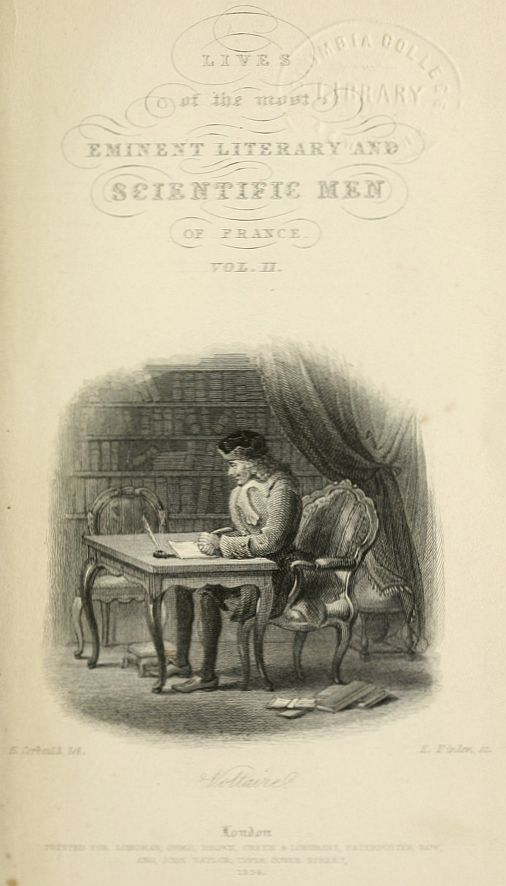
EMINENT LITERARY AND SCIENTIFIC MEN OF FRANCE.
VOL. II.
LONDON: PRINTED FOR LONGMAN, ORME, BROWN, GREEN, & LONGMANS, PATERNOSTER-ROW; AND JOHN TAYLOR, UPPER GOWER STREET.
1839.
CONTENTS
TABLE, ANALYTICAL AND CHRONOLOGICAL, TO THE FIRST VOLUME OF LIVES OF EMINENT LITERARY AND SCIENTIFIC MEN OF FRANCE. TABLE, ANALYTICAL AND CHRONOLOGICAL, TO THE SECOND VOLUME OF LIVES OF EMINENT LITERARY AND SCIENTIFIC MEN OF FRANCE. VOLTAIRE ROUSSEAU CONDORCET MIRABEAU MADAME ROLAND MADAME DE STAËL INDEX TABLE, ANALYTICAL AND CHRONOLOGICAL, TO THE FIRST VOLUME OF LIVES OF EMINENT LITERARY AND SCIENTIFIC MEN OF ITALY, SPAIN, AND PORTUGAL. TABLE, ANALYTICAL AND CHRONOLOGICAL, TO THE SECOND VOLUME OF LIVES OF EMINENT LITERARY AND SCIENTIFIC MEN OF ITALY, SPAIN, AND PORTUGAL. TABLE, ANALYTICAL AND CHRONOLOGICAL, TO THE THIRD VOLUME OF LIVES OF EMINENT LITERARY AND SCIENTIFIC MEN OF ITALY, SPAIN, AND PORTUGAL. INDEX
The Analytical and Chronological Tables and Index to the Series of Lives of Eminent Literary and Scientific Men of Italy, Spain, and Portugal, are given at the end of this volume.
TABLE, ANALYTICAL AND CHRONOLOGICAL, TO THE FIRST VOLUME OF LIVES OF EMINENT LITERARY AND SCIENTIFIC MEN OF FRANCE.
MONTAIGNE.
1533-1592
A. D.
PAGE
Birth of Michel de Montaigne
1533.
1
Pierre Eyquem, Seigneur de Montaigne
1
Education of Montaigne and his five Brothers
2
The Public School of Guienne
5
Ætat 26. Friendship with Etienne de la Boétie
1559.
7
Death of É. de la Boétie
1563.
9
Ætat 33. Marriage of Montaigne
1566.
9
Death of his father Pierre
10, 11
Troubles of France
10
Duke of Guise
10
Henry King of Navarre, afterwards Henri Quatre
11
Anecdotes of the Civil War
13, 14
Ætat. 47. Montaigne's Journey through Switzerland to Munich, Venice, and Rome
1580.
17
Ætat. 48. Citizenship of Rome granted to Montaigne by a Bull of the Pope
1581.
18
Description of Rome
18
Devotion of Montaigne, and Offering at the Shrine of Loretto
19
Montaigne elected Mayor by the Citizens of Bordeaux. His return home to fill that Office
19
Ætat 52. Friendship of Montaigne for Mlle. Marie de Gournay le Jars
1585.
20
Ætat. 60. Decease of this celebrated Author His Character
1592.
21
Montaigne's Essays edited by Mlle. de Gournay, with a Preface by that Lady
21
RABELAIS.
1483-1553.
Lord Bacon's Opinion of Rabelais
23
Style of his Romance in Writings
23
Presumed Date of Birth of Rabelais
1483.
23
His Education in a Monastery
24
Rabelais assumes the Franciscan Habit, and preaches Envy of Monks
24
His Condemnation to Bread and Water
25
On his Release he turns to the Rule of Benedict
25
Rabelais quits the Monks, and studies Medicine
26
His Edition of Hippocrates
26
His Visit to Cardinal du Bellay
27
His scarlet Gown
27
Established as Physician at Lyons
28
Rabelais' Journey to Rome
28
His Correspondence
28, 30
Interview with Pope Paul III.
29
His Journey to Lyons and Paris
29
Rabelais, Abbot of St. Maur-des-Fosses, and Curé de Meudon
30
His celebrated Work, or Romance
31
Controversy resulting therefrom
31
Rome, attack on, by Rabelais
31
Francis I. protects him from the Sorbonne
31, 32
Opinions of French Authors on Francis Rabelais
34
His Imitators enumerated
36
His various Works
37
His Acquirements in Languages and Science
38
Exemplary Conduct as a Minister of Religion
39
Ætat. 70. His Decease
39
Epitaphs for Rabelais
1553.
39
CORNEILLE.
1606-1684.
State of French Poetry and Literature
40
Birth of Corneille
1606.
40
Consequences of the Civil War in France
1590-1600.
41
Rise of the French Drama
42
Ætat. 23. Corneille writes "Mélite," a Comedy
1629.
42
Ætat. 28. His early Tragedies, &c.
1634.
42
Cardinal de Richelieu employs Corneille, Rotrou, Colletet, Bois-Robert, and L'Étoile on his own Dramatic Works
43
Theatre of the Cardinal
43
Corneille retires to Rouen
1635.
43
His Amatory Poems
43
Ætat 29. His "Medea" acted
44
Corneille's Genius excited by the Study of Guillen do Castro
45
Unity, dramatic, considered as a Fetter on modern Talent
45
He composed the "Cid"
45
Unparalleled Success of this Drama
46
Critique of the "Cid" by the French Academy
1637.
47
Ætat. 33. Writes "Horace," a Tragedy
1639.
48
Ætat. 40. Corneille's Tragedy of "Rodogune"
1616.
52
Success of his "Œdipus"
54
Is elected of the French Academy
1642.
55
His Manners and Conversation
55
Thomas Corneille's Tragedies
56
Ætat. 62. Pierre Corneille and his Family established in Paris
1662.
56
Rivality of Corneille and Racine
57, 58
Louis XIV.'s Court
58
Henrietta of England, Duchess of Orléans
58
Ætat. 79. Death of Pierre Corneille
1684.
59
Veneration for his Memory
60
Eloge by Racine
61
Account of his Sons and Daughter
61
ROCHEFOUCAULD.
1613-1680.
The Duke de la Rochefoucauld's Maxims
63
High Station of his House, and its ancient Power
63
Reign of Henry IV.
64
Reign of Louis XIII.
64
Cardinal de Richelieu represses the Ambition of the French Nobles
64
Anne of Austria, Regent of France
1643.
64
Five Years of Peace and Tranquillity
67
Ætat. 29. The Prince de Marsillac (afterwards Duc de la Rochefoucauld) returns to Paris
1642.
63
Battle of Rocroi gained by Condé over the Spaniards
1644.
67
Civil War in France
68
The Fronde
68
Barricades of Paris
68
De Retz, Cardinal, Coadjutor of the Archbishopric of Paris
68
Account of the Princes de Condé, de Conti, and their Sister the Duchess de Longueville
68
Condé and his Brother imprisoned at Vincennes
1650.
72
Liberated by the Frondeurs
73
His Actions with Turenne
80
Is defeated by Turenne near Paris
81
Raises the Standard of Rebellion in Holland
82
Peace concluded between the Court and the Fronde
83
Louis XIV. assumes the Government of his Kingdom
83
War of the Fronde terminated, and the Party dissolved
1653.
83
Ætat. 40. Duke de la Rochefoucauld retires with his Family to Danvilliers to recover from his Wounds
1653.
83
Recalled by Mazarin to Court
84
Literati in Paris in the Reign of Louis XIV.
85
Ætat. 67. Death of the Duke de la Rochefoucauld
1680.
89, 90
Critique on his "Maxims"
91
Memoirs of the Regency of Anne of Austria, Widow of Louis XIII.
96
MOLIÈRE.
1622-1673.
Distinguished Writers of the Age of Louis XIV.
97
Family of Poquelin
97
Birth of Jean Baptiste Poquelin, who assumed the Name of Molière
1622.
98
His Studies at College
98
His Fellow-Students under Gassendi
99
Ætat. 19. Attends on Louis XIII. as Royal Valet-de-Chambre
1641.
100
Execution of Cinq-Mars
100
Cardinal de Richelieu's Plays, and Encouragement of Actors
101
Ætat. 21. Molière studies the Law
1643.
101
Molière's taking the Stage for his Profession offensive to his Relatives
101
His Theatrical Company
102
The Fronde and Civil War injurious to the Theatre
102
Molière's Company perform at Bordeaux, where he produces an unsuccessful Tragedy
103
His early Comedies
103
His excellent Farcical Interludes performed at the Prince de Conti's Mansion of Pezenas
105
Molière and his Comedians established in Paris
106
They perform at Court
106
"Les Précieuses Ridicules," a Satire on the Hôtel Rambouillet
107
The Poet Voiture
108
Ætat. 37. Molière's Satire of the Affectation then in Fashion
1659.
109
Fête given by the Finance Minister Fouquet to Louis XIV.
111
Le grand Condé patronises Molière
113
Molière decried for being an Actor, is protected in his duties as Royal Valet-de-Chambre by Louis XIV.
114
Molière's Marriage
115
He writes "l'Ecole des Femmes"
117
The Court Ballets
118
"Tartuffe"
119
The Soldiers of the King's Body Guard, deprived of their free Admission to the Theatre, create a Riot
121
Ætat. 44. "Le Misanthrope"
1666.
122
Scene from the "Amphitryon"
124
Molière writes "l'Avare"
127
Scene from the Comedy of "George Dandin"
127
Unprecedented Success of "Tartuffe"
126
Friendship of Molière with Boileau, Racine, and the Wits of his Time
131
A Supper Party described
131
"Monsieur de Pourceaugnac"
132
Molière's Comedy of "Le Bourgeois Gentilhomme"
133
Scene from "Les Femmes Savantes"
135
Molière writes "Le Malade Imaginaire"
1673.
138
Ætat. 51. Is carried from the Stage in a dying State
139
Funeral Rites denied him
140
Character of Molière
141
His Charity
143
His Style
146
His Troop of Comedians dispersed
148
LA FONTAINE.
1621-1695.
Birth of Jean de la Fontaine
1621.
150
His Father a Keeper of the Royal Domains in his District
150
La Fontaine enters the Oratoire, a religious Order
151
He throws off the fetters of a monastic Life, and marries Marie d'Héricart
151
The Keepership of the Royal Domain is devolved on him
151
La Fontaine reads an Ode by Malherbe, and commences Poet
152
He studies the Classics
153
His Style simple, unaffected, and something antiquated
153
His Study of the great Italian Writers, of Rabelais, and of Clement Marot
154
Writes "Adonis" in Heroic Verse
155
Is jealous of M. Poignan, a military Man, and fights him
156
His Wife's Temper
157
His own Forgetfulness, and Anecdotes explanatory of its intensity
157
The Duchess de Bouillon notices him
158
His Appointment in the Duke of Bouillon's House
159
The Duchess takes him to Paris
159
Account of the Mancinis, Duchesses of Mazarin, and of Bouillon
159
La Fontaine's Parisian friends, Molière, Racine, and Boileau
160
His Distractions, or Absences of Mind
160
Forgets home and his Wife
161
His Journeys to Château Thierry
161
Receives a Pension from Fouquet
162
Elegance of his fugitive Poetry
162
Fouquet disgraced
162
La Fontaine endeavours to soften Louis XIV. towards this unfortunate Minister
162
"Contes et Merveilles, en Vers," of La Fontaine
163
His "Psyche and Cupid"
163
His Fables
164
"Joconde," his most popular Tale
165
He lives under the Roof of Madame de la Sablière
165
La Fontaine writes "Daphne," an Opera, for Lulli, and takes just Offence at that Musician
166
He is elected of the French Academy
167
After some hesitation, Louis XIV. confirms his Election
167
The Abbé Furetière, and Academic Disputes
168
Anecdotes illustrative of La Fontaine's Mind and Simplicity ,of Conduct
169
Account of Madame de la Sablière and her Concerns
171
La Fontaine invited to England, declines the Journey
172
He resides with Madame d'Hervart, wife of a Financier
172
Sickness of this celebrated Poet and Fabulist
173
He is taxed as to his Indifference in Religion
173
The Clergy exact a Reparation, or Testimony of his Penitence
173
His Submissiveness
174
Recovers from Illness, and publishes a few more Tales
176
His Death
1695.
176
Criticism on his Works
177
Beauty of his "Adonis"
177
Nature of his Tale of "Psyche and Cupid"
177
La Fontaine's Dramatic Pieces
178
His Fables and Tales
178
Comparison with Gay
179
His Conversation and Habits
181
PASCAL.
1623-1662.
Bayle's Praise of the Genius of Pascal's Works
183
His Family
184
Birth of Blaise Pascal
1623.
184
Ætat. 9. His Father superintends his Studies
1631.
184
Philosophy of Descartes
185
Ætat. 12. Pascal's Study of Physics
1635.
186
Being restricted to the Study of Greek and Latin, he occupies his leisure Moments with the Study of Geometry
186
His Father surprising him in his eager Pursuit of Mathematics, is overjoyed, and consults a Friend
187
Blaise Pascal comprehends Euclid without a Master's Instructions
188
Ætat. 16. His "Essay on Conic Sections"
188
His Father Etienne, being compromised in some Political Affairs, flies from Paris to Auvergne
189
Jaqueline Pascal's Performance at fourteen Years of Age in the Theatre of Cardinal de Richelieu; recites Verses declaratory of her Father's Innocence
189
Ætat. 16. Richelieu pardons M. Pascal, and Blaise is presented to him as a young Mathematician
1639.
189
Pascal studies Logic and Physics
1641.
190
Ætat. 19. He invents an Arithmetical Computing Machine
1642.
190
Galileo's Investigations of the Atmosphere
191
Torricelli pursues this Inquiry
192
Father Mersenne explains this matter to Blaise Pascal
192
Ætat. 24. Account of Pascal's Discovery of the Atmospheric Pressure, and his Experiments made on the Puy de Dôme
1647.
193
Descartes claims a Priority in this Invention
194
Ætat. 30. Pascal's Treatises "On the Weight of the Atmosphere," and "On the Equilibrium of Liquids"
1653.
194
He quits the Study of Mathematics to devote himself to Religion
195
His Sister Jaqueline imitates his Devotion
195
He falls into a State of general Debility
195
Death of Etienne Pascal
1651.
196
Jaqueline takes the Veil in the Abbey of Port Royal aux Champs
196
Ætat. 37. Pascal meets with an alarming Accident, which injures his already feeble Health
1654.
196
Is delirious, and makes a Record of some supposed Vision
197
He renounces the World, and lives solitarily, using monastic Rules of Self-denial
197
Description of the Abbey of Port Royal, and of the Arnauld Family
198
Pascal frequents the Society of Abbé Arnauld and his Friends
199
Controversy between the Jansenists and Molinists
200
The Jesuit Molina
200
Cornelius Jansen, Bishop of Ypres
200
"Five Propositions" of Jansenius condemned by the Pope at the Desire of the Jesuits
200
Antoine Arnauld's Defence of Jansenism
201
Ætat. 33. Pascal's "Lettres Provinciales"
1656.
202
Jaqueline Pascal, a Nun of Port Royal, cured by Miracle of a Fistula of the Eye
203
Pascal writes his "Pensées"
203
He subjects himself to Privations and Mortifications, for Religion
204
Ætat. 35. Entails chronical sufferings thereby on his frame
1658.
204
Pascal solved many difficult Problems in Mathematics
204
Ætat. 35. He challenged scientific Men to solve the same; and when Huygens, Wallis, and Wren were foiled, he published his Solutions
1658.
205
New Persecution of the Jansenists
207
Ætat. 38. His "Lettres Provinciales" condemned to be burnt
1661.
207
The Nuns of Port Royal expelled from their Convent
207
Jaqueline Pascal, the Sub-Prioress of Port Royal, dies in consequence of it
207
Pascal declares the "Five Propositions" to be in accordance with St. Paul
208
His dying Sentiments
209
Ætat. 39. His Death
1662.
210
His admirable Character
210
Eloquence of his Works
211
His Address to Atheists
211
MADAME DE SÉVIGNÉ.
1626-1696.
Birth of Marie de Rabutin-Chantal
1626.
214
Account of this noble Family
214
Her Father, Baron de Chantal, slain at the Isle of Rhé
1627.
215
Account of the De Coulanges Family
215
The Breton Race described
216
Ætat. 18. Mademoiselle de Rabutin-Chantal marries Henry Marquis de Sévigné
1644.
216
Cardinal de Retz and the Fronde
217
Count de Bussy-Rabutin, Cousin of Madame de Sévigné
217
Ninon de l'Enclos
217
Marquis de Sévigné falls in a Duel with the Chevalier d'Albret
218
The Prince de Conti
219
Hôtel de Rambouillet
220
Cardinal de Retz imprisoned, and escapes
220
Disgrace and Trial of Fouquet, Minister of Finance
222
Letters of Madame de Sévigné
224
Fêtes at Versailles
1664.
225
Louis XIV. takes a Part in the Tournament and Jousts
225
His Affection for Mademoiselle de la Vallière
225
Benserade, the Court Poet
226
Mademoiselle de Sévigné appears in the Ballets at Court
226
Her Marriage with the Count de Grignan
1669.
227
Correspondence of the Marchioness de Sévigné addressed to her Daughter, Madame de Grignan
227
Count and Countess de Grignan repair to Provence, of which he is Lieutenant-Governor
228
Ninon de l'Enclos again the Cause of Affliction
230
Countess de la Fayette
231
Monsieur and Madame de Coulanges, Cousins of Madame de Sévigné
232
Dialogue, Supposititious, of M. de Coulanges and M. de Bussy-Rabutin
232
Celebrity for Talent of Madame de Coulanges
234
Poetry of that Lady's Husband
235
M. Corbinelli
236
Madame de Maintenon
237
D'Argenson and Corbinelli, amusing Anecdote of
237
Death of Turenne
1675.
238
Madame de Sévigné attacked with Rheumatism
1676.
244
Ætat 51. Visited by her Daughter, who falls ill also
1677.
245
Their Residence in Paris
246
Account of the Chevalier de Grignan
246
Ætat. 54. Madame de Sévigné visits her Estate of Aux Rochers, in Britany
1680.
248, 252
Marriage of the Marquis de Sévigné, Son of Madame de Sévigné
249
Further Letters to Madame de Grignan
251
James II. established at St. Germain
251
Duke and Duchess de Chaulnes
252
Ætat. 64. Marchioness of Sévigné resides with Madame de Grignan in Provence
1690.
254
The Family of de Grignan
254
Pauline de Grignan married to the Marquis de Simiane
1695.
248, 254
Ætat. 70. Death of Madame de Sévigné
1696.
248, 254
Count de Bussy-Rabutin's Character of his celebrated Cousin
248, 254
Countess de la Fayette's Portrait of her
255
Voltaire's opinion of her Taste
256
Her Character
253
Madame de Sévigné was a Jansenist
257
The Dragonnades against the Protestants of France
257
No Posterity existent of the Family of de Sévigné
258
BOILEAU.
1636-1711.
Celebrated Era of Louis Quatorze
259
Birth of Nicholas Boileau, known also by the Name of M. Despréaux
1636.
259
He displays a turn for Poetry at the College of Beauvais
260
His first Ode
261
Ætat. 20. Boileau studies the Law
1656.
261
He addicts himself to Letters
261
Rise of Literature in France
262
The Dramatic Poets
262
Jean Chapelain’s Poem of “La Pucelle”
262
Colbert, Prime Minister
262
Satire of Boileau
263
French Poets
265
Prince de Condé’s Society of Literary Men at Chantilly
266
Boileau’s Learned Friends
267
Ætat. 30. He publishes his Satires
1666.
269
His Eighth Satire
1667.
270
"L'Art Poétique"
270
"Le Lutrin"
271-278
Parallel of Boileau and Pope by Mr. Leigh Hunt
271-278
Ætat. 41. Is pensioned by Louis XIV.
1677.
279
Friendship of Boileau for Racine
279
They are appointed Historiographers
279
They attend Louis XIV. to the Siege of Ghent
1678.
280
Campaign of these Poets
281
Boileau, leaves the military duties to Racine
281
Abbé Arnauld and the Jansenists
283
Boileau joins the Jansenists
283
He is elected of the French Academy
284
Ætat. 51. Visits the Baths of Bourbon for Health
1687.
285
Ætat. 56. His attack on Charles Perrault
1692.
287
Boileau's Satire on Women
288
Racine's explanations of his and Boileau's Pensions
289
Boileau's great Regard for Jean Racine
289
His House at Auteuil
290
Ætat. 62. Is named sole Historiographer on the Death of Racine
1698.
291
Latter Years of the Satirist passed in Tranquillity and Happiness
291
Louis Racine, Son of the Dramatic Poet
291
Boileau sells his House at Auteuil
292
His Piety and strict Observances
293
Prepares a complete Edition of his Works
293
His "Dialogue on the Romances"
293
Ætat. 75. His Death
1711.
293
His Character for Wit
294
The "Lutrin" his best Poem
295
RACINE.
1639-1699.
Birth of Jean Racine
1639.
297
His Education at Beauvais
297
Ætat. 16. Received as a Pupil at Port Royal
1655.
298
Rivalry of the Jesuits and Jansenists
298
His Enthusiasm for the Tragedies of Sophocles and Euripides
299
Marriage of Louis XIV.
1660.
300
Racine on this Occasion writes the Ode "Nymphes de la Seine"
301
Chapelain recommends him to the Minister Colbert
301
Racine resides with his Uncle le Père Sconin at Uzès, in Provence
302
His Poem, "The Bath of Venus"
304
Returned to Paris, and employed by Molière in Dramatic Composition
304
Ætat. 25. His "Alexandre"
1664.
305, 306
He teaches the celebrated Champmélé to recite
307
He replies to M. Nicole
307
His Tragedies of "Andromach" and "Britannicus"
308
He writes "Bérénice" in rivalry of Corneille on the same Subject
309
Henrietta of England, Duchess of Orléans
309
Partisans of Corneille
309
Racine's Comedy of "Les Plaideurs"
310
He is admitted of the French Academy
1673.
312
Duke of Montauzier
312
Racine's "Iphigénie," "Bajazet," and "Mithridate"
312
"Phèdre," and Madame des Houlières' Sonnet on that Tragedy
312
Racine and Boileau, supposed to have written a Reply to Madame des Houlières, are threatened by the Duke of Nevers
313
Racine resolves on renouncing the Tragic Muse
313
Ætat. 38. He meditates becoming Chartreux, but is counselled by his Confessor to marry
1677.
313
Character of Madame Racine
314
Their Sons, intended for monastic Life, are thrown into more active Pursuits
314
Their Daughters take the Veil
314
Racine reconciles himself with M. Nicole and the Abbé Arnauld of Port Royal
315
He is named Historiographer conjointly with Boileau
316
His Devotion
316
His Fondnesss for Home, and Paternal Benevolence
317
He attends Louis XIV. in his Campaigns
317
Ætat. 45. His Eloge of Corneille before the French Academy
1684.
317
His "Idyl on Peace"
318
His Attendance at Court
319
His excellent Recitation
319
"Esther"
320
"Athalie," his best Tragedy
320
Madame de Maintenon and Racine
321-325
Death of Racine
1699.
326
Criticism on the Tragedies of Jean Racine
327
FÉNÉLON.
1651-1715.
Birth of François de Salignac de la Mothe Fénélon
1651.
329
His charitable and devout heart
329
His Father the Count de Fénélon
329
His Mother of an illustrious Family
329
His early Acquaintance with Greek and Latin Literature, and Powers of Composition
330
Ætat. 18. The Abbé de Fénélon takes his Degree in the University of Cahors
1669.
331
Visits his Uncle, the Marquis de Fénélon, at Paris
331
Ætat. 19. His Success in Preaching
1670.
331
Ætat. 24. His Zeal in Ministerial Duties
1675.
332
Wishes to go as Missionary to Canada
332
His religious fervour
333
Louis XIV. commissions him to preach to the Huguenots in Poitou
332
Fame of Bossuet, then Bishop of Condom
334
Le Père Bourdaloue surpasses in eloquent Discourses his Master Bossuet
334
Bossuet, Governor of the Dauphin, writes his "Discours sur l'Histoire Universelle"
334
Fénélon "on Female Education"
335
Ætat. 38. Duke de Beauvilliers appoints Fénélon a Preceptor to the Grandsons of Louis XIV.
1689.
336
Celebrated Men employed as Preceptors to the Princes
336
Fénélon appointed Archbishop of Cambrai
339
Controversial Spirit of the Age
339
Affair of Madame Guyon's Visions and Mysticism
340
Bossuet and other Divines commissioned to inquire into her Doctrines
343
Bossuet, now Bishop of Meaux, writes the "Instruction sur les États de l'Oraison," and desires Fénélon's Approval thereof
343
The Archbishop of Cambrai refuses, and writes his "Explication des Maximes des Saints sur la Vie Intérieure"
344
The Controversy of the Two celebrated Divines has an unfortunate Result in the Division of the Gallican Church on the Doctrines in question
345
Louis XIV. prejudiced against Fénélon
345
Madame de Maintenon's Coldness to him
345
Ætat. 46. Fénélon exiled to his See
1697.
346
The Dispute between MM. de Meaux and Cambrai referred to Rome
347
Innocent XII. appoints a Commission, and calls upon those Prelates for a formal Statement of their Opinions
348
Louis XIV. erases the Name of Fénélon from the List of Preceptors to the Princes
349
Calmness and Charitable Sentiments of Fénélon under the indignities offered him
349
Ætat. 48. The Pope's Brief condemning the "Maximes des Saints" of Fénélon
1699.
352
Exemplary Obedience of Fénélon, and his Pastoral Letter on the Occasion
353
The Brief against him is registered, and Bossuet draws up a Report
355
Death of Bossuet, without any Reconciliation with Fénélon
1714.
356
"Télémaque"
337, 356
Admirable Deportment of Fénélon in the See of Cambrai
357
His Sermons
358
His Seminary for the Instruction of the younger Clergy
358, 360
His Doctrine
360
Fénélon an Opponent of Jansenism
362
He explains the Mistakes of Pascal in the "Provincial Letters"
362
The Campaigns in Flanders
362
The Duke of Burgundy obtains Louis's permission to visit the Archbishop of Cambrai
364
Famine the Result of War
365
Ætat. 58. Fénélon's active Charity to the Soldiery and the People
1709.
365
The Death of the Dauphin overwhelms Fénélon with grief as a national Misfortune
1711.
360
Death of Fénélon's chief Friends
366
Louis XIV. relents as to this admirable Prelate
1713.
366
Death of Fénélon
1715.
367
Demise of Louis XIV.
368
Person, Manners, and Talent of de la Mothe Fénélon
368
His Character given by Sir——Ramsay and other Writers
369
Eloge of Fénélon by d'Alembert
369
Criticism on "Télémaque"
372
TABLE, ANALYTICAL AND CHRONOLOGICAL, TO THE SECOND VOLUME OF LIVES OF EMINENT LITERARY AND SCIENTIFIC MEN OF FRANCE.
VOLTAIRE.
1694-1778.
A. D.
PAGE
Infidelity of Voltaire
2
Birth of François-Marie Arouet at Chatenay
1694.
4
His Father, M. Arouet, a Notary
4
Ætat. 10. Is taught by the Jesuits in the College of Louis-le-Grand
1704.
5
His Prejudice against the Jansenists
5
The Abbé de Chateauneuf
5
Precocious Genius of Arouet
5
His introduction to Parisian Society
6
Court of Louis XIV.
6
The King ruled by Molinist Confessors
6
Influence of Madame de Maintenon in religious Matters
6
Ætat. 20. Young Arouet sent to Holland with the Marquis de Chateauneuf
1714.
7
His Affection for Mademoiselle du Noyer
8
He is placed as pupil with M. Alain, Attorney in Paris
9
M. de Caumartin invites him to his Château of St. Ange
10
State of public Affairs on the Demise of Louis XIV.
1715.
10
The Regent d'Orléans, and Cardinal Dubois
10
Ætat. 22. Arouet imprisoned in the Bastille for a Satire of which he was not the Author
1716.
11
On Epic Poetry
12
Criticism on the Henriade of Voltaire
13
Duke of Orléans liberates and compensates him
14
Ætat. 24. "Œdipe," Tragedy by Voltaire
1718.
15
His Critique on the Tragedies of Sophocles
15
His mode of Life and Habits
16
His "Mariamne" successful
16
Dispute between the Poets Jean Baptiste Rousseau and Voltaire
1722.
17
Insult offered Voltaire by the Chevalier de Rohan
17
He challenges de Rohan, and is sent to the Bastille
18
Ætat. 34. He visits England and reads Locke and Newton
1728.
18
His return to Paris
19
The Clergy become suspicious of him, and aim at his Ruin
19
Increase of his Fortune
20
Reasons of his purchasing the Estate of Voltaire, and assuming that name
21
Becomes attached to the Marchioness du Châtelet
21
His "Brutus" and "Eriphyle" unsuccessful
22
Ætat. 38. Great success of "Zaire"
1732.
22
"Histoire de Charles XII."
23
"Siècle de Louis XIV." projected by Voltaire
23
Mademoiselle Lecouvreur, an Actress, denied the Rites of Sepulture
23
Voltaire's "Lettres sur les Anglais" publicly burnt
23
He retires to the Château de Cirey with the Marquis and Marchioness du Châtelet
24
Their philosophical Studies
25
He writes "Alzire," "Mérope," "Mahomet," &c.
25
"Essay on the Manners and Spirit of Nations"
25
Madame de Graffigny's Visit to Madame du Châtelet at Cirey; her Letters
26
Ætat. 44. Voltaire writes "La Pucelle," the Maid of Orléans
1738.
28
Is attacked by the Abbé des Fontaines and Jean Baptiste Rousseau
31
Alarm as to the Printing of "La Pucelle"
33
His Correspondence with Frederic II.
35
Letters of Frederic
1740.
37
Interview of the King of Prussia and M. de Voltaire at the Castle of Meuse, near Clèves
39
Maupertuis President of the Berlin Academy
39
Frederic's former Work against the Principles of Machiavel, the "Anti-Machiavel"
40
Character of Frederic
41
War against Maria Theresa, on the Death of Charles VI. her Father
1742.
42
Administration of Cardinal de Fleuri
42
Voltaire in constant Danger of the Bastille
43
Crébillon refuses to license "Mahomet"
43
It is acted at Lille in Flanders by La Noue and Mademoiselle Clairon
44
The Duke of Richelieu, a Favourite of Louis XV.
1743.
44
Ætat. 49. Voltaire endeavours to obtain a Seat in the French Academy, but is rejected
45
Great Success of his Tragedy of "Mérope"
45
He is sent on a Mission to Berlin, and a Treaty between Prussia and France is the result
46
Frederic invades Bohemia
47
Voltaire is left unrewarded
47
He resides in Paris with the Marquis and Marchioness du Châtelet
47
His Visit to the Duchess du Maine at Sceaux, when he writes "Zadig," and other Tales
48
He performs the Part of "Cicero" in his Play of "Rome Sauvée"
48
M. Longchamp's Account of Voltaire's Journeys, and his Visit to King Stanislas at Luneville
48, 51
Ætat. 54. Tragedy of "Semiramis"
1748.
49
Voltaire dangerously ill of Fever at Chalons
50
His Friendship for Madame du Châtelet
51
His Rapidity in Writing, and literary Enthusiasm
51
His "Catiline" and "Elèctre"
51
Death of the Marchioness du Châtelet
52
Voltaire become sole Tenant of their Hôtel in Paris, appoints his Niece, Madame Denis, to preside over it
53
Private Theatre in his House
53
He patronises Le Kain, the Tragedian
54
His Admiration of Corneille and Racine
55
Madame de Pompadour for a Time patronises M. de Voltaire
55
Louis XV. appoints him a Gentleman of the Bed-chamber, and Historiographer of France
56
Voltaire becomes a French Academician
56
Crébillon a successful Rival of Voltaire in dramatic Composition, and Court-favour
57
Voltaire, jealous on that Account, repairs to the Court of Frederic at Potsdam
57
Is pensioned by him, and appointed Chamberlain
58
Frederic's Admiration and Kindness
58
Voltaire's Admiration of the Prussian Monarch
59
Madame Denis left in Paris
60
Ætat. 57. His "Siècle de Louis Quatorze"
60
Umbrage and Jealousies of the King and Poet
61
Offence given by M. de Voltaire to Frederic
1751.
63
Maupertuis and the Berlin Academy; Contest respecting the mechanical Principle of the "least Power"
65
La Beaumette and Maupertuis attack M. de Voltaire
66
Voltaire's Satire of "Akakia" against Maupertuis
66
His Reconciliation with Frederic the Great
67
Their mutual Dissatisfaction renewed, and Voltaire takes leave of the Prussian Court
67
He repairs to Leipsic and Saxe Gotha
68
Is arrested at Francfort by Agents of Frederic
69
Voltaire slighted at Lyons by Cardinal du Tencin
71
Ætat. 61. He purchases the Estate of "Les Délices" at Geneva
1755.
72
Renews a literary Correspondence with Frederic
1756.
73
Despair of that Monarch on a Defeat
73
Fresh Victories of Frederic
74
M. de Voltaire's "Manners and Spirit of Nations"
74
The Publication of "La Pucelle" occasions a against the Poet
75
His Residence in the Genevese Territory becomes perilous
76
Ætat. 68. He purchases the Château de Ferney on the Frontier of France and Geneva, as a Residence affording him Security
1762.
76
The "Encyclopédie"
77
A great niece of Corneille received by Voltaire and Madame Denis at Ferney
79
Arrival of the Family of Calas at Ferney
79
Ætat. 71. Voltaire obtains the Reversal of the Condemnation of Jean Calas, and the Restoration of his Family to civil Rights
1765.
81
His Exertions in Favour of the Sirven Family
83
Execution of the Chevalier de la Barre at Abbeville, and Indignation of Voltaire at the Spirit of religious Persecution
84
The Jesuits banished from France
87
Persecution of Jansenists and Quietists
87
Bitter Quarrel and Satire between M. de Voltaire and Jean-Jacques Rousseau
88
Security and happy Life of Voltaire at Ferney
88
Ætat. 72. He is deserted at Ferney by his Niece and former Inmates
1766.
89
His Letters to the Marquise du Deffand
89
Return of Madame Denis to Voltaire at Ferney
90
Marmontel's Visit to him
91
The Countess de Genlis' Visit to Voltaire
94
Voltaire neglects the Count de Guibert and other Visitors
98
His Improvements in his Village of Ferney
98
His Humanity to Exiles, and charitable Character
99
He founds the Town of Versoi
100
Patronises the Town of Gex, and procures the Enfranchisement of Serfs of the Jura Mountains
100
Disgraceful Close of the Reign of Louis XV.
101
Ætat. 81. After the Accession of Louis XVI. Voltaire, accompanied by his Niece and M. and Madame de Villette, arrives in Paris
1788.
102
His Tragedy of "Irene"
102
Condorcet's and Baron de Grimm's Description of his honourable Reception by the Parisians, with whom he had always been a Favourite
103
Louis XVI.
104
The Clergy endeavour to obtain from M. de Voltaire, in Sickness, a Declaration of his Faith
104
On a temporary Recovery he attends the Academy and the Theatre, and is received enthusiastically
105
Is prevented from returning to Ferney by Madame Denis
105
Death of M. de Voltaire
1778.
106
Delineation of his Character
107
His Infidelity, and Grossness, alluded to
108
Critique of his Works
109
ROUSSEAU.
1712-1778.
Birth of Jean-Jacques Rousseau at Geneva
1712.
111
His Studies when a Boy
112
Placed under M. Lambercier, Minister of Bossey
113
Lives with a M. Bernard, Engineer
114
Is pupil to a Greffier
114
His love of Reading
115
He runs away from Geneva
115
Visits M. de Pontverre at Confignon in Savoy
116
The Countess de Warens, a Convert to the Romish Religion, is pensioned by the King of Sardinia, and resides at Annecy
117
Rousseau is recommended to the Hospital of Turin for the Conversion of Protestants
117
His Abjuration of the Calvinistic Creed
118
Is Footman to the Countess Vercelli
119
Also a domestic in a noble Family at Turin
120
Whom he quits on a roving Expedition to revisit Madame de Warens
120
Ætat. 17. Kind reception of Jean-Jacques by that Lady
1729.
121
His Genius in Music
121
His Visit to Neufchâtel and Paris
122
Ætat. 21. Madame de Warens recommends him to Employment in a Bureau at Chambery
1733.
122
Ætat. 23. He is established at Chambery as Music-master
1735.
124
Madame de Warens removes to Les Charmettes, where Rousseau prosecutes his Studies with Ardour
125
The Confessions of Jean-Jacques with regard to this Period of his Career
126
Ill-health of Rousseau
126
His Method of Notation for Music
127
Rousseau's Spirit of Independence
128
Ætat. 29. His Employments at Paris, where he is encouraged
1741.
128
Ætat. 31. Appointed Secretary to M. de Montague, Ambassador at Venice
1743.
128
His Return to Paris
129
His Friends interest themselves for him
129
His Mistress Thérèse le Vasseur
130
Rousseau consigns their Children to the "Enfants trouvés"
131
Reflections on the Condition of Foundlings
131
Rousseau eventually a Victim to his lax Principles from the Destitution of all social Ties
132
Ætat. 37. Visits M. Diderot, who was confined at Vincennes for a Pamphlet
1749.
133
Rousseau's celebrated Essay on the proposed Question, "Whether the Progress of the Arts and Sciences had tended to corrupt or ameliorate the condition of Men"
134
He renounces the Appointment of Cashier to a Farmer-general of the Taxes
135
Copies Music for a Subsistence
135
Ætat. 38. Great Success of his "Devin du Village," an Opera
1750.
136
His Essay on "The Origin of Inequality among Men"
137
Ætat. 42. He revisits Geneva
1754.
137
Poverty of Madame de Warens
137
Rousseau abjures the Romish Faith, and again embraces the Reformed Religion
137
Is invited to reside in Geneva, his native City
138
Madame d'Epinay
138
She establishes him at the Hermitage near Montmorenci, belonging to M. d'Epinay
138
Rousseau's "Les Institutions Politiques," and other literary employments
139
Writes "La Nouvelle Héloïse"
140
Rousseau's love for the Countess d'Houdetot
141
M. de Saint Lambert
141
Cause of the Coolness between J. J. Rousseau and MM. Diderot and Grimm
144
Treachery of M. Grimm
145
State of French Society under Louis XV.
147
Ætat. 46. Rousseau removes from the Hermitage to Montmorenci
1758.
148
His Quarrel with Diderot
148
He writes against the Establishment of a Theatre at Geneva
149
Sentiments expressed in his "Confessions"
149
Marshal the Duke of Luxembourg and the Duchess of Luxembourg friendly to Rousseau
149
Publication of "La Nouvelle Héloïse"
1760.
150
The "Emile," or Rousseau on Education
150
Some admirable Maxims of that celebrated Treatise
150
M. de Malesherbes
151
The "Confession of a Savoyard Vicar"
152
Ætat. 50. It is condemned, and Rousseau warned by the Duchess of Luxembourg to make his escape
1762.
153
He arrives at Iverdun, but is exiled by the Council of Berne
154
Is received at Neufchâtel by the Governor, Marshal Lord Keith
154
His Study of Botany, and herborising Rambles
155
His Controversy with Geneva
156
Disturbances at Geneva
157
Rousseau's "Lettres écrites de la Montagne"
157
Rousseau quits Motiers through Fear of Assassination
157
Resides in the Island of St. Pierre, Lake of Bienne, but is expelled by the Council of Berne
158
His Dislike of Dependence prevents him from repairing to the Court of Frederic; Fictitious Letter in that King's Name by Horace Walpole
159
Hospitably entertained by the Prince de Conti
159
Ætat. 54. He accompanies David Hume to England
1766.
160
Resides at Wotton in Derbyshire, writes there his "Confessions," receives a Pension from George III.; but his morbid Melancholy causes him to take some groundless Alarm and to fly to France
161
Ætat. 55. Is protected by the Prince de Conti at the Château of Trie
1767.
162
Ætat. 58. He is most kindly welcomed at Paris
1770.
163
His Readings of the "Confessions" in Society interrupted by the Minister of Police
164
Lives by copying Music
165
Prince de Ligne visits him, and offers him a Home
167
Countess de Genlis gives Testimony of his Benevolence of Heart and Modesty
167
The Abbé Bernardin de Saint Pierre gives a very favourable Description of Rousseau
167
Respect shown for Rousseau at the Theatre by the Parisians
168
His morbid Sensibility verging on Madness
169
Ætat. 66. His Death at Ermenonville, and Rumour with relation to it
1778.
169
Inscription on his Tomb
170
Character of his "Confessions"
171
His Jealousy of literary Competitors
171
His Reveries; his Charity; Suspicion his characteristic
172
The "Emile" one of his most important Works
173
Criticism of his "Nouvelle Héloïse"
174
Eloquence, Tenderness, and Nature, in his Writings
174
CONDORCET.
1744-1794.
Birth of Marie Jean Antoine de Caritat, Marquis de Condorcet
1744.
175
Ætat. 21. His Essay on the Integral Calculus
1765.
175
His scientific Works
175
Is appointed joint Secretary of the Academy of Sciences
175
His Friendship with D'Alembert
176
Visits M. de Voltaire at Ferney
176
Edits the "Pensées" of M. Pascal
177
A Friend of the Minister Turgot
178
His Reply to M. Necker on the Corn Question
178
He writes the "Reflections on Negro Slavery"
178
Refutation of De Lolme on the English Constitution
179
Mental Qualities of Condorcet
179
His Influence at the Commencement of the French Revolution
180
Ætat. 44. Writes a Declaration of the Rights of Man, on the Convocation of the States-General
1789.
180
Flight of Louis XVI. to Varennes
181
Marquis de Condorcet, a Deputy of the City of Paris in the National Assembly
182
His Speech relating to the Emigration
182
His "Declaration" adopted by that Body
183
His Character for Integrity
184
A vigorous Opponent to monarchical Government
184
His Theories, and Idea of public Virtue
185
The Girondists treat with the Court and lose Influence thereby
186
Manifesto of the Duke of Brunswick
187
Marquis de Condorcet popular
187
Did not vote for the Death of Louis XVI.
188
Ætat. 49. Denounced as Brissot's Accomplice, is obliged to conceal himself
1793.
190
His "Historical Sketch of the Progress of the Human Mind"
190
Is obliged to fly, but is seized at Chamont, and perishes of Hunger and Cold in a Prison
192
His Character pourtrayed by Madame Roland
193
Mademoiselle de Condorcet married to Arthur O'Connor
194
MIRABEAU.
1749-1791.
Family of the Marquis de Mirabeau
195
Originally Italian, and named Arrighetti
195
Valour of the Marquis Jean Antoine de Mirabeau
196
His high Character
196
Victor, Marquis de Mirabeau, a tyrannical Father
197
His literary Reputation founded on his "L'Ami des Hommes"
197
Is imprisoned for writing the "Théorie de Impôt"
197
Marries Marie Geneviève, Marchioness de Saulvebeuf, and has eleven Children
193
Instals Madame de Pailly over his Household
198
This occasions a Separation from his Marchioness
198
His Prejudice against GABRIEL HONORÉ DE MIRABEAU, his fifth Child, the Subject of this Article
199
Accuses him of an innate Depravity of Character
201
The Father makes him undergo a severe Education
202
Gabriel serves in the Regiment of the Marquis de Lambert, a strict Disciplinarian
203
The Marquis Victor de Mirabeau obtains a Lettre-de-cachet and imprisons Gabriel
204
Gabriel de Mirabeau declares his love of a military Life
205
Ætat. 23. He marries Marie Emilie de Covet, Daughter of the Marquis de Marignane
1772.
207
Incurs Debts, and is confined by his Father by means of a Lettre-de-cachet
207
Is jealous of the Chevalier de Gassaud
209
His Quarrel with the Baron de Villeneuve-Moans
209
Is imprisoned by his Father in the Castle of If, near Marseilles
209
Ætat. 26. Is transferred to the Fortress of Joux
1775.
210
His amour with Madame de Monnier (Sophie de Ruffey)
212
He escapes from Prison
213
Is indignant at his Father's Severity
214
Ætat. 27. He flies with Madame de Monnier to Holland, and earns a Subsistence by his Pen
1776.
215
M. de Monnier prosecutes him and Madame de Monnier, and they are condemned to ignominious Punishments in their Absence
216
Ætat. 28. They are arrested at Amsterdam, and Gabriel de Mirabeau is imprisoned at Vincennes
1777.
217
His Complaints of the long Persecution of him
218
His Writings during Imprisonment
219
"Essay on Lettres-de-Cachet and State Prisons"
219
Death of his Son
219
Endeavours to persuade his Wife to live with him
221
Ætat. 31. Is enlarged after Forty-one Months' Imprisonment
1780.
221, 223
Subsequent History of Madame de Monnier
222
His Father conducts himself with Kindness towards him
223
Ætat. 33. Mirabeau's Sentence for the Seduction of Madame de Monnier reversed
1782.
223
He fails in a Suit to compel Madame de Mirabeau to live with him
224
Ætat. 35. Visits London, but is not successful in the Profession of an Author
1784.
225
Renewed Cruelty of his Father, who reduces him to a State of Destitution
225
Ætat. 36. Returned to France, writes on financial Subjects; and for a Pamphlet on the system of "Agiotage" is compelled to fly to Liege
1785.
226
Ætat. 38. Financial Controversy with Necker
1787.
226
His early Exertions in favour of Revolution
226
Occasional Display of his powerful Eloquence
228
His Independence as a political Economist
228
Ætat. 39. His Reputation at its height
1788.
229
Ætat. 40. Convocation of the States-General
1789.
230
Mirabeau excluded by the Nobility of Provence from his Privileges as a Noble
231
His "Correspondence from Berlin" condemned to be burnt
232
Becomes a popular Leader of the Provençeaux, and is enthusiastically received at Aix and Marseilles
232
Disturbances in Provence, on account of Scarcity, allayed by Mirabeau
233
Is elected Deputy for Marseilles and for Aix in the "Tiers Etat;" he sits for the latter Town
234
He publishes a Journal of the Proceedings of the Chambers
234
His political Writings
235
The National Assembly
235
He draws a Line between the royal and legislative Power, or between the Throne and the People
236
His Energy and Eloquence in the Chamber
238
Address to Louis XVI.
239
Death of the Marquis Victor de Mirabeau
1789.
240
Mirabeau's genuine Sorrow on that Event, forgetful of his long Persecution by his Father
240
Louis' Ministers draw Troops around the Capital
240
Destruction of the Bastille
241
Mirabeau's Speech against the Court Party, on the Scarcity of Grain
242
He supports M. Necker's Proposal of a Subsidy of one-fourth of the Income of all Proprietors
242
He maintains that the Royal Authority is essential to the Balance of Power between the Aristocracy and People
243
The Orléans Party
237, 246
Popularity of Mirabeau with the Parisians
247
In what degree Mirabeau is to be considered the real Defender of the Monarchy
248
He negociates with the Court
249
His Enthusiasm nevertheless maintains his Influence over the National Assembly
250
His Speech on the Establishment of the Convention
250
Ætat. 42. His splendid Style of Living
1791.
251
Supposed to be supplied by the Court with Resources, as the chief Supporter of Royalty
251
His Deference to the Assembly, and Conciseness of his energetic Speeches
252
Original of his Treaty with the Court, in the Hand-writing of Monsieur [Louis XVIII.]
252
Mirabeau's ill Health
253
His last Struggle with the Jacobins, or "Mountain"
254
Sickness of Mirabeau excites the Fears of both King and People
255
His notion of the Character of the Rt. Hon. William Pitt
256
Death of Mirabeau
256
His Sepulture in the Pantheon at Paris
257
His Misfortunes
257
His wit
258
His Character of La Fayette
258
Allusion to his military Talents
259
MADAME ROLAND.
1754-1793.
Mémoires of Madame Roland, and Considerations thereon
260
Birth of Manon Phlipon
1751.
261
Care of her Education by her Father, an Engraver of some merit
261
Domestic Economy of her parental Roof
262
Madame Phlipon's Piety
262
Mademoiselle Phlipon's Residence in a Convent
263
Her Admiration of Blaise Pascal and Port Royal, or the Jansenist' Party
263
She rejects the Theories of M. Helvetius
263
Her Enthusiasm in the Cause of Liberty
264
Her Rejection of many Suitors
265
Death of Madame Phlipon
266
Impression of the "Nouvelle Héloïse" on the ardent Mind of Manon Phlipon
267
Her Habits of Economy and Seclusion from Society
267
History of M. Roland de la Platière
268
Ætat. 25. His Offer to marry Mademoiselle Phlipon, and Refusal by her Father
1779.
268
Ætat. 26. Their Union takes place
1780.
270
Madame Roland accompanies her Husband to Switzerland and England
271
Her Letters
271, 274
Ætat. 32. Her placid Temper, and domestic Happiness
1785.
274
The French Revolution. M. Roland's Mission from the Municipality of Lyon to the National Assembly on financial Affairs
1789.
272
Ætat. 37. Madame Roland's Visit to, and Residence in, Paris
1791.
273
Writings of M. Roland
273
Beauty and political Influence of Madame Roland
273
M. and Mdme. Roland form a Friendship with Brissot and the Gironde Party
273
Madame Roland's Opinions anti-monarchical
275
Position of Louis XVI.
275
M. Roland appointed Minister of the Interior
1792.
277
General Dumouriez Minister for Foreign Affairs
277
Roland's Letter to Louis XVI. written by his Wife, occasions his Dismission
278
Recalled to the Ministry
279
The Massacre of Prisoners in September alarms Madame Roland
280
Robespierre, Danton, and Marat
280
Description of Madame de Roland
281
M. Roland exhibits considerable Intrepidity during the popular Agitations
282
Madame Roland is hated by the "Mountain" Party
283
Robespierre denounced by Louvet
284
Death of the King
1793.
285
M. Roland resigns
286
Arrest of Madame Roland
287
Her calm Demeanour
288
The Reign of Terror in Paris and France
290
Condemnation of the Girondists
290
Brissot and the Girondists executed
291
Accusation and Defence of Madame Roland
291
Ætat. 39. Her Execution
292
Interesting Character of this celebrated Authoress
293
MADAME DE STAËL.
1765-1817.
M. Necker of Geneva early in life placed in a Banking-house
295
His Partnership in Thelusson's Firm
295
His "Éloge de Colbert"
1773.
295
Minister from Geneva, and appointed Director-general of Finance in France
296
He marries Mademoiselle Churchod
296
Allusion to Gibbon the Historian
296
April 22. Birth of their only Daughter, afterwards Baronne de Staël
1766.
296
Her Education under the parental Roof
296
MM. Thomas, Marmontel, de Grimm, &c. form the literary Society at M. Necker's
297
Society at M. Necker's
297
Talent of Conversation early acquired by Mlle. Necker
297
Her Writings
298
She delights M. Necker by her Talents and Wit
300
Publication of M. Necker's "Compte Rendu," or Statement of French Finance
301
His Retirement to his Estate of Saint-Ouen
302
Purchase of Coppet on the Lake of Geneva
303
Publication of his financial Work, written at Coppet
303
Administration of M. Calonne
304
Ætat. 20. His Daughter's Marriage with the Baron de Staël Holstein, Swedish Ambassador to France
1786.
305
Portrait given at that period of Madame de Staël
306
M. Necker Minister, Revival of public Credit
1788.
307
Convocation of the States-General
1789.
307
Louis XVI. commands him to retire quietly from France
307
Troops collected round Paris, by Louis, against the People
308
M. Necker generously leaves two Millions of Livres in the National Treasury
309, 313
Madame de Staël's Description of the Journeys to and from Switzerland
309, 313
Destruction of the Bastille, and Recall of M. Necker
310
His Popularity
311
Sentiments of Madame de Staël
311
Necker again retires to Coppet
1790.
313
Madame de Staël witnesses the Tumults of the Capital in August, &c.
1792.
314
Her Endeavour to save M. de Lally-Tolendal
314
Her Carriage stopt by the Republicans; she claims Privilege as Wife of a foreign Minister
315
She is carried before Robespierre, Collet d'Herbois, and the Revolutionary Tribunal
316
Is saved by the Republican Manuel, who obtains Leave for her to quit France
317
Her Emotion on the Journey across the Jura to Coppet
317
Her Appeal in favour of Marie Antoinette
1793.
318
M. Necker's Pamphlet designed to save Louis XVI.
318
Madame de Staël's "Reflections on the Peace"
1794.
318
Death of Madame Necker
318
M. de Staël resides at Paris as Swedish Minister
1795.
319
Madame de Staël's Residence there considered as an Epoch in Society
319
Reign of the Directory
320
Napoleon Buonaparte, unfavourable to Madame de Staël
321
Their Interviews
321
His Attack on the Helvetian Republic
322
Madame de Staël retires to M. Necker's at Coppet
1798.
322
She presents a Memorial at Paris in the Name of M. Necker, requiring to be erased from the List of Emigrants, and succeeds therein
323
Ætat. 33. She Witnesses the Overthrow of the Directory by Buonaparte
1799.
323
Account of Benjamin Constant
324
Jealousy of Buonaparte on Account of Madame de Staël's Influence in Parisian Society
324
His Interview with M. Necker on his Route to Italy
325
French Police, and Fouché, Minister
325
M. de Staël Holstein recalled to Sweden
1799.
327
Ætat. 36. His daughter joins M. Necker at Coppet, and the Baron de Staël dies
1802.
327
Publication of her "Delphine"
327
Critique of that Work
327
M. Necker's "Last View of Politics and Finance"
328
Madame de Staël's Affection for her Father
328
Ætat. 37. She returns to France on the Rupture of the Peace of Amiens
1803.
329
Is ordered to quit France within twenty-four Hours
329
Her Regret on being exiled
330
She is accompanied by Benjamin Constant, and receives Tidings of M. Necker's Decease
1804.
330
She resides at Coppet
330
Her "Dix Années d'Exil"
330
Her Education of her Children
331
Ætat. 39. Her Visit to Italy
1805.
331
Criticism on her "Corinne"
331
She revisits France and repairs to Rouen
332
Not having flattered Napoleon in her Writings, she is again exiled
333
She visits Vienna
333
At Coppet she writes her Work on "Germany"
333, 334
Ætat. 44. Attempts to publish her "Germany" at Blois; the Edition seized, anti she is again banished
1810.
334
Forbidden to visit Aix in Savoy for the Recovery of her Son's Health
335
William Schlegel ordered to quit Coppet by the Authorities
336
Madame de Staël makes a Tour through Switzerland in company of M. de Montmorency
336
M. de Montmorency exiled
336
Persecution of Madame de Staël
337
M. Rocca, a Spanish Officer in the French service, visits Geneva
1810.
337
He offers his Hand to Madame de Staël
338
Their Marriage
338
Madame de Staël escapes from Coppet
1812.
338
Travels through Germany and Poland to Russia
338
Her Reception by the Emperor Alexander at St. Petersburg
339
Her "Dix Années d'Exil"
339
She visits Sweden and England
339
Lord Byron
339, 340
Louis XVIII, repays to Madame de Staël the two Millions of Francs advanced by Necker to Louis XVI.
1814.
339
The Duke de Broglie marries the Daughter of Madame de Staël
340
Ill-health of M. Rocca
340
Madame de Staël's Character and Sentiments
341
Ætat. 51. Her Death in Paris
1817.
341
Death of M. Rocca
341
Criticism on the Writings of Madame de Staël
342
The Viscount de Chateaubriand's Opinion of her
343
Her "Dix Années d'Exil"
343
Her "Germany"
343
Her political Sentiments
343
LIVES OF EMINENT LITERARY AND SCIENTIFIC MEN.
VOLTAIRE
1694-1778.
It is impossible to commence the biography of this extraordinary man without feelings of apprehension as to our power of well executing the task. To write the life of Voltaire in a full and satisfactory manner, is to write not only the biography of an individual author, and the history of French literature during the course of nearly a century, but also of a revolution in the minds of men, in their opinions and rules of action, which, if not brought about entirely by him, was fostered and supported by his influence, in a manner the most singular and powerful. We are apt, as we read his letters, to laugh at the petulance which he evinced when attacked, and to reprove the vehemence with which he attacked others in return. But when we consider that an absolute monarch and a powerful hierarchy supported opinions which he and his friends struggled to subvert, we feel that it required all his dogmatic spirit, all his bitterness of sarcasm and vehemence of temper, to combat opposition, and to support both his own courage and that of his followers, in his attempt.
Voltaire has been called the Apostle of Infidelity. He denied the truths of revealed religion—he desired to subvert Christianity. He disbelieved its divine origin; he was blind to the excellence of its morality—insensible to its sublime tenets. It is easy to make his life one diatribe against the wickedness and folly of such principles and intentions—to intersperse the pages that compose his history with various epithets of condemnation of a man so lost to the knowledge of truth. But we do not intend to do this. We consider that Voltaire had many excuses, and he had also his uses. We do not mean, on the other hand, to write an elaborate defence of a system that cannot be defended; but we will mention the heads of those topics which we consider available for his justification to a certain limited extent.
In the first place, Catholicism is not Christianity. Voltaire's great war was against the church of Rome, and more particularly against the Gallican church, which was one of great persecution, bigotry, and misused power. We turn to the pages that record the history of his country, during the years that immediately preceded him, and of his own age, and we find them stained with brawls and cruelties, excited and exercised by the priesthood. The quarrels of the violinists, the Jansenists, the Quietists, and the disgraceful exhibitions of the convulsionaries, absorbed so much of the talent, and perverted so much the uprightness and charity, of men of first-rate genius, that we turn with pity and loathing from the history of the misuse of one of the best gifts of God. Voltaire had it deeply at heart to put an end to these discussions—to prevent such men as Bossuet and Fénélon from expending their vast talents on unworthy squabbles, and to prevent such men as Pascal and Racine from sacrificing their talents at the altars of superstition. He wished to redeem such of his countrymen as were slaves to the priests, from the miseries of bigotry and ignorance; and he most ardently desired to liberate those, whose piety was enlightened, from persecution at the hands of bigots. The cruelties exercised on the Huguenots raised a tumult of generous indignation in his benevolent heart; the insolence and barbarity with which the French priesthood endeavoured to quell all rebellion to their authority roused his anger and pointed his sarcasms. Liberty for the soul was the aim of his endeavours. It was a noble and a useful one.
He went too far. There are two classes of minds among men of education. Those who live for the affections—for the elegances of literature—for moral and intellectual purposes; who are virtuous and enlightened, but devoid of enthusiasm for truth or the dissemination of opinion. There is another class, to whom what they consider truth is the great all in all. It is vain to talk to them of a falsehood or mistake that has its good uses; they consider truth, that most glorious attribute of God, as the best of all things—the reformer of abuses—the sustainer of the unfortunate—the advancer of human excellence—the rock in which we ought to put our trust. To them, truth, or what they consider truth, is light; falsehood, darkness. Such a mind was Voltaire. He did not distinguish the truths of the Gospel from the multifarious, sometimes ridiculous, but always pernicious, impostures of papacy. He read of, and his heart revolted from, the series of intolerable evils brought upon the world by the Roman Catholic religion; he forgot the civilisation produced by the Gospel, and even the uses of the system of the church of Rome during days of feudal barbarism: he saw only the evil, and visited the whole with his reprobation, his ridicule, his unflinching and unwearied opposition. He fell into great and mischievous mistakes. As is often the case, he destroyed, but he could not construct. France owed to his mighty labours and powerful influence a great and swift advance in civilisation, and enfranchisement from political and priestly thraldom. But he went beyond the useful and right in his struggle; and, not contented with warring against superstition, made inroads into the blessed fields of rational piety. This must be admitted and censured. Let some among us rise to drive him back and barricade him from his invasion on revealed religion; but let us do this without, rancour or scurrility, feeling grateful at the same time for the good he did achieve, and acknowledging our esteem for his motives and abilities. Let us, above all, in writing his life, show ourselves just and impartial. From the limited nature of this work, we can only present the reader with a sketch of his labours and their effects; it is our earnest desire that this sketch should be one drawn from undoubted sources, and prove itself to the minds of all, a fair, exact, and impartial account of so great a man.
François-Marie Arouet was born at Chatenay, 20th of February, 1694. His enemies, in after life, displayed their spite by promulgating that his father was a peasant—an assertion without foundation. His father was a notary by profession, and filled the situation of treasurer of the chamber of accounts; a lucrative place, which he occupied with such integrity as to save but a small fortune, where others amassed great riches. His mother was named Marguerite d'Aumont, of a noble family of Poitou. The child was so feeble at the time of his birth that he was not expected to survive; he was hastily baptized in the house, nor considered sufficiently strong to be carried to church until he was nine months old, when he was baptized over again by the parish curate, from whom his age was concealed. Condorcet, in his life, remarks the singularity that two illustrious men of letters of that day, Voltaire and Fontenelle, were both born so feeble as not to be expected to survive, and yet lived to extreme age. He might have added the more curious instance of their contemporary, the marshal de Richelieu, a six months' child, fostered in cotton and reared artificially, who enjoyed strong and robust health, and lived till a still more advanced age.
The child was quick and sprightly; he had an elder brother, who was dull and sombre. The elder, in progress of time, became a Jansenist, a convulsionary, and a bigot; the germ of his tendency to superstition existed even in childhood; and the brothers disputed, in prose and verse, to the amusement of the family. The abbé de Chateauneuf, godfather to François-Marie, took pleasure in educating him, and taught him some of La Fontaine's fables. The boy got hold also of a deistical ode, attributed to J. B. Rousseau, called the "Mosaide," a poem, which said—
"Les hommes vains et fanatiques Reçoivent, sans difficulté, Les fables les plus chimériques; Un petit mot d'éternité Les rend bénins et pacifiques; Et l'on réduit ainsi le peuple hébété A baiser les liens dont il est garrotté."
This was a singular production to put into a child's hand: it was more singular that a child should enter into its meaning. François-Marie quoted it against his brother in argument, and his father, frightened at the premature wit and freedom of speech his son betrayed, hastened to send him to school.
Sidenote: 1704. Ætat. 10.
He entered the college of Louis-le-Grand, of which the Jesuits were the preceptors. Here the boy learned, not to take part with the Jesuits, but to despise the Jansenists, against whom, as an author, he showed himself hostile. The talents of the child rendered him a favourite with the greater number of his masters; father Porée, professor of rhetoric, saw the germ of remarkable talents, which he took great pleasure in developing; and, in after life, Voltaire always expressed gratitude for his master's encouragement and kindness. Encouragement of a far different and of a pernicious sort he received from another professor, father le Jay, who entered into arguments with his pupil; was irritated by his wit and sophistry; and on one occasion, angrily exclaimed that he would become the "Choryphæus of Deism,"—a prophecy which this very denunciation helped probably to fulfil. On all sides, the boy found admiration for his premature genius. His godfather introduced him to Ninon de L'Enclos, then advanced in years, but still full of that warmth of intellect and feeling that distinguished her whole career. She perceived and appreciated the child's genius, and no doubt her kindness and conversation tended to open his mind and refine his wit at a very early age. When she died, Ninon left him a legacy to buy books.
On leaving college the abbé de Chateauneuf introduced his godson into Parisian society. There had been a time when Louis XIV. assembled the most distinguished men of the kingdom at his court, and wit and refinement were almost confined to the circles of Versailles. In his old age, under the tutelage of madame de Maintenon and his confessors, Louis disregarded every merit but that of piety which bore the Molinist stamp. Catinat was disgraced, notwithstanding his virtues and military talents, because he was suspected of freethinking; the duke de Vendôme was reproached bitterly for not going daily to mass: bigotry, hypocrisy, and dulness reigned at Versailles. But the king was old, and could no longer make his will the fashion of the day. Unfortunately, bigotry and hypocrisy are apt to beget their opposites. The society of Paris, throwing off the yoke of royal intolerance, gave itself up to pleasure and licence. The young Arouet was introduced to the circles whose members enjoyed pre-eminence for birth and talent; he became a favourite; he wrote verses; he meditated a tragedy: his whole heart was devoted to becoming a poet and man of letters. When, on occasion of the dispute between Jean Baptiste Rousseau and Saurin, the former was banished, the young Arouet took the part of the victim, and exerted himself to make a subscription in his favour. He was now known and admired by all the first people of Paris, though he failed when he wished to bring out a tragedy on the stage, and to be crowned by the academy. The actors rejected his play; the academicians preferred another poet. The disappointed youth revenged himself by writing a satire against his rival.
M. Arouet was deeply pained by the course his son was taking; he considered the career of a literary man that of disgrace and ruin. He proposed to him to accept the office of counsellor to parliament; his son replied, that he would not buy, but earn, distinction. His attempt with the academy, and the literary quarrels that ensued, raised his father's inquietudes to the greatest height; he threatened his son with various marks of his severity, and the quarrel was becoming critical, when the marquis de Chateauneuf, ambassador to Holland, offered to take him with him to that country in the quality of page. His father readily consented to a plan which removed him from a scene where his literary ambition was excited by rivalship, and fostered by admiration.
1714. Ætat. 20.
It is, as it appears to us, a most interesting task to inquire into the early days of such a man as Voltaire; to find the exterior circumstances that influenced his mind, and the passions that were excited in his unformed character. The atmosphere of wit and gaiety which Voltaire carried with him wherever he went made him a favourite; and this favour again imparted zest to his desire for literary advancement. His father's opposition produced a thousand struggles in his mind, that tended, in the end, to give force to his inclinations: he became eager to exonerate himself, and to elevate the profession which he wished to adopt; and this gave dignity to his endeavours. Now, torn from his partial friends, and thrown on a new scene, his mind was yet further excited to gain strength. His curiosity, as to the manners and peculiarities of a strange country, was insatiable: he carried everywhere his keen observing spirit; and his early travels out of France tended to enlarge his understanding, and shake his prejudices.
Youthful passion intruded to disturb his residence in Holland. Madame du Noyer was born a Protestant; she abjured her religion when she married; and then, desirous of separating from her husband, she made religion the pretext, and fled to Holland with her two daughters. She resided at the Hague, where she subsisted on a sort of traffic of libels. Fear of the Bastille, and the laws against the freedom of the press, restrained the busy Parisians from publishing the vast quantity of libels, epigrams, and satires, which were continually being manufactured in that metropolis: these made their way to Holland; and the collecting of such, and publishing them, became a sort of trade,—infamous indeed, but lucrative. Madame du Noyer was at once notorious and enriched, by being pre-eminent in the traffic. One of her daughters was married; with the other—a gentle, amiable girl—Voltaire fell in love. He wished to save her out of the hands of such a mother. Madame du Noyer discovered the intercourse, and complained to the ambassador, who put his page under arrest, and sent an account of his son's attachment to the father. Young Arouet meanwhile carried on his intercourse with the young lady by stealth, and was again denounced to the marquis by madame du Noyer; he, seeing himself in danger of being compromised by the malice of a woman whose great desire was to create scandal, and by the perseverance of his page, sent him back to Paris. His father, knowing the vehement and resolute disposition of his son, was prepared to prevent the continuance of his love affair by the severest measures: he obtained an order that permitted him either to imprison or to transport him to the isles. The poor lawyer, whose career had been one of routine and respectability, was rendered equally miserable by both his sons; the elder having immersed himself in the Jansenist quarrels: and the old man declared that he had two fools for children, one in prose, and the other in verse.
On his return to Paris the young Arouet had two objects chiefly at his heart;—to take his mistress out of the hands of her infamous mother, and to reconcile himself to his father. For the sake of the first, he did not scruple to apply to the Jesuits, and to employ religion as the pretext. He applied also to M. du Noyer: he interested the court in the conversion. It was agreed that mademoiselle du Noyer should be carried off, and brought to the convent of New Converts in Paris; but the marquis de Chateauneuf opposed himself to so violent a proceeding, and the plan fell to the ground. In the sequel, the young lady married the baron de Winterfeld, and always preserved a great esteem and friendship for her early friend.
The young man was not less earnest to be reconciled to his father. He was carried away by innate genius to cultivate literature; but his heart was good, and he revolted from the idea of living at variance with his parent. He wrote a pathetic letter to him, declaring that he was ready to emigrate to America, and to live on bread and water, if only, before he went, he were forgiven. M. Arouet was touched by this mark of submission; and, on receiving the further one of his son's consent to attend the office of a procureur, or attorney, he was reconciled to him.
The young poet became the pupil of M. Alain, an attorney, residing in a dark, obscure quarter of Paris. Disagreeable as this change was, it had its advantages; it strengthened his habits of industry, and it taught him a knowledge of business. Voltaire became in after life a rich man, through his excellent management of his affairs: a legal education was the foundation of his prosperity. He lightened his labours, also, by forming a friendship with another pupil. Thiriot had not his friend's talents, but he shared in his youth his enthusiasm for literature: an intimacy was formed which lasted Thiriot's life. In spite of various acts of faithlessness on the part of the latter, Voltaire remained, to the end, constant to his early friend: However, the business of procureur became intolerable. He still frequented the society of Paris. He had become deeply in love with madame de Villars: he afterwards averred that this was the only passion he had ever felt that was stronger than his love of study, and caused him to lose time. Its ill success made him conquer it; but the society into which he was drawn rendered him still more averse to his legal studies. He implored his father to permit him to quit them; the old man asked him what other profession he would adopt: to this the son could not reply.
He had a friend, M. de Caumartin, who was also acquainted with the father, and asked permission that François-Marie should visit him at his chateau of St. Ange, where he could deliberate at leisure on his future course, and where he would be separated from the connections deemed so dangerous. At St. Ange the young poet found a library; and, plunging into study, became more than ever eager for the acquisition of knowledge. The father of his host was a man of great age; he had been familiar with the nobles of the days of Henri IV., and with the friends of Sully: his enthusiasm for those times and men was warm and eloquent. Voltaire listened to his anecdotes and eulogies with deep interest; and began, without yet forming a plan, to write verses in their honour.
The last years of the reign of Louis XIV. had been disastrous, through unfortunate wars and pernicious policy. Adversity in various forms visited the old age of that illustrious monarch. The generation immediately succeeding to him, brought up in his days of glory and power, died off; of the young race that remained, its hope and flower, the duke of Burgundy, died; he lost another of his grandsons also by death, and the third was removed to the throne of Spain. The successor to his crown was an infant only five years of age; the successor to his power was a prince whose dissolute character inspired the devout with hatred, and the thoughtful with sorrow and distrust. 1715. Ætat. 21. It was a moment full of eager interest, when Louis died; the cord that held the faggot snapped; and it became doubtful by whom, and in what way, it would again be gathered together. The pupil of Dubois became regent; the kingdom rang with his intrigues, his debaucheries, and the misconduct of his children. But the duke of Orléans, perverted as he was as a moral character, was a man of talent, and an enlightened ruler. He maintained peace: and though the kingdom was convulsed during his regency by the system of Law, yet its general prosperity was increased; showing, however speculative and wild a people may be in their financial schemes, yet, as long as they are preserved from war, no event can materially injure their prosperity. The regent was, to a certain degree, king Log, with this exception,—that his libertinism offered a pernicious example, which plunged Parisian society in immorality, while his toleration gave encouragement to those men of talent whose aim was to disseminate knowledge and liberal opinions.
On the death of Louis XIV., young Arouet left St. Ange, and came up to Paris to witness the effects of the change. He found the people in a delirium of joy; they celebrated the death of their sovereign by getting drunk with delight, and by manifesting their detestation of the Jesuits, who had so long tyrannised over them. Paris became inundated with satires and epigrams: the French, as in the days of the Fronde, were apt to signalise their aversions in witty and libellous verses. Voltaire was accused of writing a piece of this kind; it was entitled "Les J'ai vu," in which the author enumerates all the abuses and evils he had witnessed, and concludes by saying,—
J'ai vu ces maux, et je n'ai pas vingt ans.
1716. Ætat. 22.
Voltaire was two and twenty, but the difference was slight, and the verses were clever; he was accused of being their author, and thrown into the Bastille. The solicitations of his powerful friends were of no avail to liberate him. His father saw with grief the melancholy accomplishment of all his prognostics, and failed in his efforts to obtain his release. It was not till the true author of the verses, touched by remorse, confessed to having written them, that Voltaire was set free.
He passed a whole year in his prison without society or books, or ink and paper. We find no mention in his works or letters of the extreme sufferings which solitary and unemployed confinement must have inflicted on a man as vivacious, sensitive, and restless—delicate in health, and vehement in temper—as Voltaire, except in the deep terror with which he regarded the possibility of a second imprisonment. Thrown back on the stores of his own mind, his latest impressions were those of the conversations at St. Ange with the elder Caumartin, and the enthusiasm excited for Henri IV. and his contemporaries. The idea of an epic on this subject suggested itself. It flattered his honest pride to raise a monument of glory to the French nation in the form of a national poem, while he was the victim of the government; his literary vanity was enticed by the idea of sending his name down to posterity as the author of a French epic, a work hitherto unattempted in verse. He composed the first two cantos in his dungeon, in his mind, committing them memory; and it was his boast that, in all his subsequent improvements, he never changed a word in the second canto. He was prouder, in after life, of being the author of the "Henriade" than of any other production. His contemporaries regarded it with admiration; even our own countryman, lord Chesterfield, declares it the best epic in any language, simply because, according to the reasons he gives, it is the most devoid of imagination.
Epic poetry, in its essence, is the greatest achievement of the human intellect. It takes a subject of universal interest; it exalts it by solemn and sacred sentiments, and adorns it with sublime and beautiful imagery, thus lifting it above humanity into something divine. While the mind of man enjoys the attribute of being able to tincture its earthly ideas with the glory of something greater than itself in its every day guise, which it can only seize by snatches, and embody through the exertion of a power granted only to the favoured few, whom we name great poets,—and while it can exercise this power in giving grandeur to a narration of lofty and sublime incidents,—while this can be done by some, and appreciated by many, an epic must continue to rank as the crowning glory of literature. We find nothing of all this in the "Henriade." The very elevation of the sentiments is rendered commonplace by Voltaire's inability to mould language to his thoughts. During the whole poem he suffered language to be the shaper of his ideas—not the material which he forced to take a shape. In his letters, he quotes Fénélon's just opinion, that the French language might be adapted to lyrical poetry, but not to epic. He fancies that he disproves this assertion in the "Henriade;" while, in fact, he gives it entire support.[1] The second canto is the favourite of many French critics. They consider the account Henri IV. gives queen Elizabeth of the civil struggles of France a masterpiece. It consists of a rapid and forcible view of that disastrous period. But it contains no poetry. Voltaire's imagination was fertile, versatile, and gay; in some of his tragedies, he even rose to the passionate and energetic; but it wanted elevation—it wanted the fairy hue—the sublime transfusion of the material into the immaterial. It wanted, above all, a knowledge and love of nature. There is not a word in the "Henriade" descriptive of scenery, or storm, or calm, or night, or day, that is not commonplace, imitative, and without real imagery. Of imagery, indeed, he has no notion. Besides this, he always acted by his own verses as by those of others, and corrected them into tameness. In a word, the "Henriade" has no pretensions to success as an epic poem, and is, in whatever view we take of it, dull and tiresome. Even in his days it had not enjoyed the reputation it reached but for his admirable powers of reciting, by which he fascinated the circles of Paris, and the peculiar circumstances that rendered every other opinion in France an echo of those circles.[2] There is an amusing anecdote told, which shows, however, that the charm of his reading did not always suffice to gain unqualified approbation. One day so many petty criticisms were flung at him, that, irritated to the utmost, he exclaimed, "Then it is only fit to be burnt!" and threw the poem into the fire. The president Hainaut sprang forward, and saved it, saying, as he gave it back to the author, "You must not think that your poem is better than its hero. Yet, notwithstanding his faults, he was a great king, and the best of men." "Remember," the president afterwards wrote, "that it cost me a pair of lace ruffles to save it from the fire."
The chief interest of the poem lies in the era of its conception, and in the fact that its composition alienated the horrors of his dungeon. At last he was set free. The duke of Orléans being informed of his innocence, he was liberated. The regent compensated for the mistake by a present of money. Voltaire, on thanking the regent, said, "I thank your royal highness for continuing to support me, but I entreat you not to burden yourself again with finding me a lodging." The genius and wit, however, of Voltaire, continued to expose him to calumny and danger. He was suspected of having written the "Philippiques," a clever, but most atrocious libel against the regent and his family. His frequent visits at Sceaux, the palace of the duchess de Maine, and his intimacy with Goerts, caused his name to be mingled in the intrigues which cardinal Alberoni excited in France. The regent, however, refused to credit his enemies, and limited his displeasure to an intimation that he had better absent himself from Paris for a time. Voltaire spent several months in going from one friend's chateau to another, being sedulously occupied, meanwhile, by the "Henriade" and other literary projects. The most important in his eyes was his tragedy of "Œdipus." 1718. Ætat. 24. This piece, commenced at eighteen, altered and altered again, was at last brought out, and had the greatest success. This was not solely caused by its intrinsic merit. The reputation of the author, its being his first tragedy, and the discussions to which it gave rise with regard to the ancient and modern theatre, imparted a factitious interest; it was attacked and defended on all sides, and pamphlets were daily published and hawked about on the subject. To these legitimate sources of interest were added the unworthy one of the calumnies in vogue against the duke of Orléans, which made the odious subject of the tragedy peculiarly piquante.[3]
Voltaire wrote several letters on the treatment of his subject. His critique on the tragedies of Sophocles gives us, at once, the measure of his taste and learning: nothing can be more contemptible than either. The French soi-disant poet was utterly incapable of entering into the solemn spirit of the Athenian tragedian, and still less could he comprehend his sublime poetry, being even ignorant of the language in which it was written. The "Œdipus Tyrannus" of Sophocles is admirable as a work of art, and more admirable from a certain majesty that sustains the subject and characters to the end, and from the solemn, magnificent beauty of the choruses. All this was a dead letter to the sprightly Parisian, who admits that had Sophocles lived in his days, he had written better, but had never approached the greatness of Racine.
The life of Voltaire was an alternation of pleasure and literary labour, which would have been infinitely delightful but for that system of caballing which existed in French society, more especially among authors. Voltaire had to struggle with the envious and the presumptuous. His method of warfare was bold; it was that of attack rather than of defence. He was unsparing towards his enemies, and this perpetuated hostilities that robbed him of peace and leisure. Add to this, his labours were often interrupted by bodily suffering; for, though his constitution was strong, he was afflicted by a painful disease. Still pleasure waited on his moments of ease and leisure. Sometimes he resided in Paris, but much of his time was spent in visiting, by turns, the chateaus of the chief nobility; private theatricals, in which his own plays were got up with care and splendour, were principal amusements at these country residences. While at Maisons, a chateau belonging to the president des Maisons, he was seized with the small-pox, on the very eve of a festival, during which a comedy was to be acted, and he, himself, was to read his tragedy of "Mariamne;" he was attended by Gervasi, who treated him in the, then, novel manner, of letting blood and lowering remedies, by means of which he recovered. His friend Thiriot came up from Normandy, and waited on him with anxious solicitude. When he recovered, "Mariamne" was brought out; it went through forty representations, though it nearly fell on the first, through the levity of a Parisian audience. When, in the fifth act, Mariamne put the cup of poison to her lips, a man in the pit called out, "La Reine boit!" On the succeeding night the mode of her death was changed. Restless, and on the alert for the ridiculous, the danger of saying anything that suggested a ludicrous or familiar idea continually hampered a French tragedian; yet, with all his vanity and eagerness for success, Voltaire's lively spirits made him sometimes jest with peril. When "Œdipus" was acted, he went on the stage himself, holding up the train of the high priest, and played such antics that the maréchal de Villars asked who the young man was who was desirous of getting the piece condemned. This very liveliness was, however, a great cause of his universal success. The Parisians, and especially the nobility, desired to be amused, and no man was ever born so fitted to afford excitement to the circles of the rich and gay, as the vain, witty, restless, eager poet, who made a jest of everything, yet rendered all instinct with the interest imparted by his good heart and versatile talents.
His quarrel with Jean Baptiste Rousseau is characteristic. He visited Holland in 1722 with madame Rupelmonde. When passing through Brussels, he sought out the poet whom he had befriended in his need, and whose talents he admired. They met with delight. Voltaire called him his master and judge; he placed his "Henriade" in his hand, and read him various of his epistles. All went smilingly for a short time. Rousseau read some of his poetry in return. Voltaire did not approve. Rousseau was piqued. Various sarcasms were interchanged. Rousseau had composed an "Ode to Posterity." Voltaire told him that it would never reach its address. A violent quarrel ensued, and Rousseau became his bitter enemy.
A more serious dissension interrupted the routine of his life. One day, dining at the table of the duke de Sully, one of his warmest friends, he was treated impertinently by the chevalier de Rohan, a man of high birth, but disreputable character. The chevalier asked. Who he was? Voltaire replied that he did not inherit a great name, but would never dishonour that which he bore. The chevalier angrily left the room, and took his revenge by causing him to be seized and struck with a cane by his servants. Such were the prejudices then existent in the minds of the French noblesse, that though the duke de Sully esteemed and even loved Voltaire, and held the chevalier de Rohan in contempt, yet the bourgeois birth of the former, and noble blood of the latter, caused him to show himself perfectly indifferent to the insult. Voltaire resolved to avenge himself. He secluded himself from all society, and practised fencing carefully. As soon as he considered himself a match for his enemy, he sought him out at the opera, and demanded satisfaction. The chevalier appointed time and place for a duel, and then acquainted his family. The consequence was, the instant arrest of his antagonist, and his imprisonment for six months in the Bastille; to which was added the further injustice of an order of exile after his liberation from prison.
1728. Ætat. 34.
Voltaire took this opportunity to visit England. He had been acquainted with lord and lady Bolingbroke in France. He appreciated the talents of the illustrious Englishman, admired his various knowledge, and was fascinated by the charms of his conversation. Although he never appears to have at all understood the real foundations of English liberty, yet he appreciated its effects, especially at a moment when he was suffering so grievously from an act of despotism. Liberty of thought was in his eyes a blessing superior to every other. He read the works of Locke with enthusiasm; and while he lamented that such disquisitions were not tolerated in France, he became eager to impart to his countrymen the new range of ideas he acquired from the perusal. The discoveries of Newton also attracted his attention. He exchanged the frivolities of Paris for serious philosophy. He became aware that freedom from prejudice and the acquirement of knowledge were not mere luxuries intended for the few, but a blessing for the many; to confer and extend which was the duty of the enlightened. From that moment he resolved to turn his chief endeavours to liberate his country from priestly thraldom and antique prejudices. He felt his powers; his industry was equal to his wit, and enabled him to use a vast variety of literary weapons. What his countrymen deemed poetry, the drama, history, philosophy, and all slighter compositions, animated by wit and fancy, were to be put in use by turns for this great end. He published his "Henriade" while in England. It was better received than it deserved; and the profits he gained were the foundation of his future opulence. He wrote the tragedy of "Brutus," in which he imagined that he developed a truly republican spirit, and a love of liberty worthy of the Romans.
He spent three years in exile. He became eager to return to his country, to his friends, and to a public which naturally understood him better, and could sympathise more truly with him than the English. He ventured over to Paris. For a time his return was known only to a few friends, and he resided in an obscure quarter of the capital. By degrees he took courage; and the success of various tragedies which he brought out raised him high in public favour, and promised greater security for the future. He was regarded as the pride of France by the majority of his countrymen. The priesthood—accustomed to persecute on the most frivolous pretexts of difference of opinion—who had excited Louis XIV. to banish the Jansenists and suppress their convents—to exile the virtuous Fénélon—to massacre the Huguenots, who had long wielded religion as a weapon of offence and destruction, and had risen to a bad height of power by its misuse—held him in the sincerest hatred; while his attacks, excited by, and founded on, their crimes, unveiled to the world a scene which, had it not been rife with human suffering, had been worthy only of ridicule. A couplet in "Œdipus" first awakened their suspicion and hatred:—
"Nos prêtres ne sont point ce qu'un vain peuple pense, Notre crédulité fait tout leur science."
From that moment they lay in wait to crush him. It needed all his prudence to evade the effects of their enmity. There was a party in Paris, indeed, who went to the opposite extreme, by which he was idolised—a party which saw no medium between the superstition upheld by the clergy and direct disbelief, which it termed philosophy. This, indeed, is one of the chief mischiefs of Catholicism—by demanding too much of faith, it engenders entire infidelity; and by making men, sinful as ourselves, the directors of the conduct and thoughts, it injures the moral sense and deadens the conscience. The party in opposition had not yet risen to the height of talent it afterwards displayed; but it sufficed, through the rank, abilities, and number of the persons of whom it was composed, to encourage Voltaire in his career. Another chief support was derived from the liberal independence of means which he had attained. He inherited a competent fortune from his father and brother; the profits of "Œdipus" added to it; the duke of Orléans had made him presents; the queen of Louis XV. bestowed a pension on him; the edition of the "Henriade," brought out in London, augmented his means considerably: he was economical and careful. A fortunate speculation in a lottery instituted to pay the debts of the city of Paris, in which, from certain happy calculations, he was the chief winner, raised him to opulence. He was charitable and benevolent; and though, in his letters, we find allusions to his donations, this is never done ostentatiously, but with the plain speech of a man who, having fabricated his own fortune, knows the value of money, and keeps strict account of his expenditure. At this juncture we may also speak, of his change of name. It was the custom, as is well known, for the younger branches of noble families in France to assume the name of some estate, so to distinguish themselves from their relations. In the middling ranks the same custom was in a manner followed. Boileau took the name of Despréaux, and his younger brother that of Puy Morin, to distinguish themselves from the elder. People in this rank did not assume the de—distinctive of territorial possession. François-Marie Arouet thought it worth while, however, to purchase the estate of Voltaire (as Madame Searron, at Louis XIV.'s instigation, had that of Maintenon), as a means of elevating himself to a more respectable position in the eyes of his contemporaries. He succeeded; and though, to our ears, Arouet had sounded as well as Voltaire, did it stand in the title-page of his works; in his own day, in spite of various petty attacks from his enemies, the one he assumed was regarded by his countrymen with greater complacency.
The heyday of youth was passing away with Voltaire; his vivacity was still the same: but, from the period of his return from his exile in England, he began to look differently on life; and while he still regarded literary labour as his vocation, literary glory as the aim of his existence, he grew indifferent to the pleasures of society. At one time he meditated expatriating himself; thus to acquire liberty of writing and publishing without fear of the Bastille. His attachment for madame du Châtelet caused him to alter this plan. This lady was distinguished for her learning, her love of philosophy, and talent for the abstruse sciences. She was witty, and endowed with qualities attractive in society; but she preferred study, and the acquisition of literary renown, in seclusion. This friend induced Voltaire to remain in France, but strengthened his purpose of retiring from Paris. Various persecutions were, however, in wait for him before he gained a tranquil retreat.
Voltaire wrote his tragedies as a means of gaining public favour. He knew his countrymen. As a sovereign of the French must gather popularity by leading them to victory and military glory, so must an author, who would acquire their favour, achieve eminent success, at once to raise their enthusiasm, and to gratify their vanity, by making them participate in the greatness of his name. On his return from England, Voltaire determined to acquire the popular favour, by his triumphs in the drama. At first he was not as successful as he wished: his "Brutus" fell coldly on the gay, excitement-hunting Parisians; "Eryphile," on which he spent excessive pains,—remodelling and re-writing different portions again and again,—had faults that the author's quick eye discerned at once to be incurable, and he withdrew it after the first representation. "Zaire" repaid him for these disappointments;—"Zaire," which, whatever its faults may be, is so fresh, so eloquent, so deeply and naturally pathetic. This play was written in twenty-two days. It was a happy thought. 1732. Ætat. 38. Voltaire writes concerning it: "I never worked so fast; subject carried me on, and the piece wrote itself. I have tried to depict what has been long in my head,—Turkish manners contrasted with Christian manners; and to unite, in the same picture, all that our religion has of dignified, and even tender, with an affecting and passionate love." Two months afterwards, he writes: "I wish you had witnessed the success of 'Zaire;' allow me to enjoy freely, with you, the pleasure of succeeding. Never was piece played so well as 'Zaire' at the fourth representation. I wish you had been there; you would have seen that the public does not hate your friend. I appeared in a box, and the whole pit clapped. I blushed, and hid myself; but I should be deceitful did I not confess that I was deeply moved;—it is delightful not to be put to shame in one's own country." But, after this triumph, he laboured to correct his piece. He feared, he said, to have owed too much to the large dark eyes of mademoiselle Gaussin, and to the picturesque effect produced by the mingling of plumes and turbans on the stage. He felt, for the moment, that he had arrived at the height of literary renown, and that his task was nearly fulfilled. "What labour and pains I go through," he writes, "or this smoke of vain glory! Yet what should we do without the chimæra? it is as necessary to the soul as food to the body. I shall re-write 'Eryphile,' and the 'Death of Cæsar,'—all for this smoke. Meanwhile I am correcting the 'History of Charles XII.' for an edition in Holland; and when this is done, I shall finish the 'Letters on England,' which you know of,—that will be a month's work; after which I must return to my dramas, and finish, at lastly the 'History of the Age of Louis XIV.' This, dear friend, is the plan of my life."