Part 2 / Book 3 — CHAPTER VII. RECONSTRUCTORS AND PROJECTORS. (continued 2)
Reading edition
Part of North Gallery in upper floor to Printed Books.
The north galleries on the upper floor are divided lengthways, from east to west, into two portions; that now containing Zoological Collections (No. 22 to 26) can be advantageously appropriated to the Department of Printed Books when required. The volumes placed there can be easily lowered down and returned through a hoisting apparatus to be placed at either the south-east or south-west corner of No. 24, immediately above No. 41 on the ground floor—the nearest point of any in the main Library to the Reading-Room. By these various alterations space would be provided for about two hundred and fifty thousand printed volumes, in addition to that which still remains available in that department, from which, however, space for about fifty thousand volumes would have to be deducted, as will be presently shown.
Want of space in Department of Manuscripts.
Although there is now space remaining in the Department of Manuscripts for the accommodation of twelve thousand volumes, and although the annual average increase of manuscript volumes may be safely reckoned at less than six hundred and fifty, your Committee have, nevertheless, felt that prospective increased accommodation should now be provided, not only for the Collection of Manuscripts, but still more for artists and readers who have occasion to refer to select manuscripts, as well as for assistants, of whom two, together with one attendant and eight readers, are pent up in a space of thirty feet by twenty-three, crowded with tables, chairs, &c., which scarcely allow room for moving from one place to another or for access to the officers’ study on each side. The Head of the Department of Manuscripts has recently represented to the Trustees his want of six assistants; but he has, at the same time, been obliged to state that, if appointed, he should not know where to place them. The Trustees have complied with his request, to the extent of granting two new assistants; and he will experience great difficulty in placing the two who are to be appointed. Add to this, the interruption to which each of these persons is unavoidably liable from each of the others in the performance of his duties and occupations, owing chiefly to the narrow space in which they are confined.
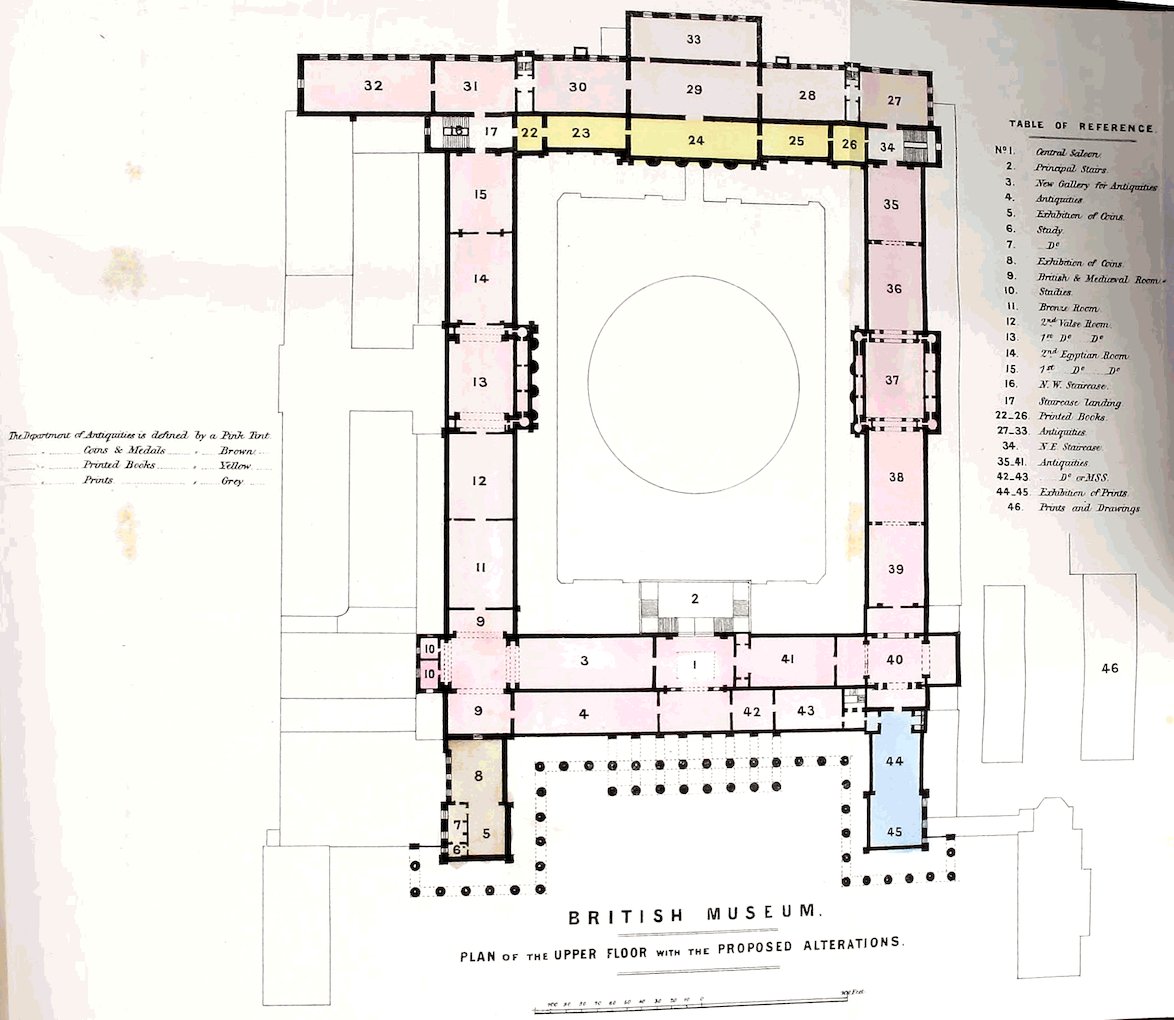
BRITISH MUSEUM. Plan of the UPPER FLOOR with the PROPOSED ALTERATIONS.
757On account of its locality, the Department of Manuscripts cannot derive any direct advantage from the removal of the Natural History Collections; no space which will thus become vacant can be rendered available for the purpose of remedying the inconveniences here stated. As, however, the Department of Printed Books obtains the additional accommodation before mentioned, a portion of the space now occupied by Printed Books, very conveniently situated to supply the wants of the Department of Manuscripts, ought to be transferred to this department.
Space to be transferred from Printed Books to Manuscripts.
It is, therefore, proposed that the study, marked No. 57 on the ground floor plan, be removed to the north end of No. 55, now occupied by Printed Books, and that the site of No. 55 be attached to the Department of Manuscripts. In that gallery, one hundred and fifteen by eighteen, excellent accommodation, with abundance of light, would be found for twenty thousand manuscript volumes—for fifteen students at least (this number is ample if admission be strictly and bonâ fide limited to the class of persons for whom it is intended) at separate seats, each having a table space of two feet and a half in depth and four in length,—and for ten assistants or more, admirably placed for superintendence. The area of the eastern recess of No. 56 would then be quite clear, and available for the exhibition of manuscripts, like the western recess in the same room. And when as large an exhibition of manuscripts as the space permits is accessible to the public (and still more accommodation for this exhibition might be found in the present Department of Manuscripts), the same restrictions as have been suggested with respect to coins and to prints ought to be imposed on the handling of select manuscripts.
It now remains to find space wherein to provide proper accommodation for the binder, as well as for the Trustees’ offices, for the Collection of Prints and for the Collection of Coins.
Buildings in the garden attached to Principal-Librarian’s house.
On the east side of the roadway parallel to the Department of Manuscripts, there is a piece of ground extending to Montague Street on the east, to the house No. 30, in that same street towards the north, and to the Principal-Librarian’s house on the south. On a portion of this ground stands an old building, now partly appropriated to the binder and partly used as a guard-house; the remainder forms the garden attached to the residence of the Principal-Librarian. It appears to your Committee that by substituting a new building for the one existing, and by building on the greater part of the garden, ample accommodation will be found for what is wanted. Your Committee cannot abstain from mentioning that this great sacrifice of personal convenience on the part of the Principal-Librarian was suggested and brought under their notice by that officer himself.
758It was some years ago suggested by the Government that the military guard might be dispensed with at the Museum; at times when the services of the army were pressingly required, it was felt that soldiers might be more usefully employed than in being kept for mere show at the Museum. It was, however, thought that on removing the military guard, better provision should be made for the safety of the Museum.
Military guard discontinued.
Then follow various details of minor consequence; to which succeed an enumeration of the additional space gained for the Collections of Printed Books, Manuscripts, Prints and Drawings, Antiquities, Coins and Medals, as well as for offices, store-rooms, bookbinders’ shops, &c., by the proposed alterations, as respects each of the several Departments of Printed Books, Manuscripts, and Antiquities; and a summary of the whole, from which it appears that the additional space gained by the Department of Printed Books amounts to an area of seventeen thousand eight hundred and three square feet; that the additional space gained by the Department of Antiquities amounts to sixty-seven thousand six hundred and ninety-two square feet; and, finally, that the additional space gained by the Department of Manuscripts amounts to three thousand four hundred and thirty square feet.
759
Recapitulation.
Present Space. Proposed Addition. Proposed Deduction. Proposed Total.
Printed Books.
Basement 33,998 14,667 48,665
Ground floor 83,748 2,070 81,678
Upper floor 5,206 5,206
117,746 19,873 2,070 135,549
Manuscripts.
Basement 210 1,360 1,570
Ground floor 12,968 2,070 15,038
13,178 3,430 16,608
Antiquities.
Basement 33,868 16,036 6,767 43,137
Ground floor 39,334 13,775 53,109
Upper floor 21,532
Less Coins and Medals 2,950
18,582 44,648 63,230
91,784 74,459 6,767 159,476
Coins and Medals.
Upper floor 2,950
New building 4,950
2,950 4,950 7,900
Prints and Drawings.
Upper floor 2,600 3,204 2,600
New building 4,950
2,600 8,154 2,600 8,154
Committee Room, Offices, Stores, &c.
Basement 1,290 1,290
Ground floor 3,565 3,565
Upper floor 1,869 1,869
New Building (Basement) 5,400
New Building (Ground) 4,950
6,724 10,350 6,724 10,350
Binders.
Basement 1,360 1,360
Detached building 3,179 3,179
New building 7,760
4,539 7,760 4,539 7,760
760Your Committee, proceeds the Report, do not think it necessary to give the particulars of the accommodation which the unappropriated portions of the basement floor would afford for the preservation of moulds, as well as for the formatore, for making and preserving casts of statues and other large objects, as well as of gems and seals, and also for providing such decent and suitable conveniences as the health and comfort of the thousands who visit the Museum absolutely require.
Future use of basement.
It is, perhaps, unnecessary to do more than simply to remind the Trustees that the want of space at the Museum has been felt and has been urged on the Government for several years past, and that during the last four or five years the additions to the Collections of Antiquities have been so rapid and so numerous, as to render it impossible to do more than provide for them temporary shelter at a considerable expense, and to the great disfigurement of the noble façade which entitles the Museum to claim rank among the most classical buildings of modern times. |Urgency of building at once.| Should the above proposals of your Committee meet with the approbation of the Trustees and the sanction of the Government, they ought to be carried into effect without delay. The Government would, doubtless, lose no time in providing a proper building for the reception of such collections as are to be removed from the Museum; until this removal has taken place, no redistribution of the vacated space can be undertaken; but the new structures proposed to be erected on ground now unoccupied ought to be proceeded with at once, that they might be rendered available as speedily as possible.
What to be first put in hand.
Your Committee are of opinion that the new building facing Montague Street, the building for the bookbinder, the building intended to be erected on the ground now vacant between the Elgin Room and the Print Room, and the construction of the new principal staircases, should be commenced immediately. The building intended to be erected on the vacant ground on the west of the Trustees’ Room (No. 11 on the plan), must, necessarily, be postponed for awhile. The alterations which might and ought to be rapidly completed, are those which will be required on the east side of the King’s Library (No. 55 and 57), to transfer the gallery to the Department of MSS. from that of Printed Books.
Committee of Trustees to be appointed.
The Lords Commissioners of Her Majesty’s Treasury state that ‘they will be prepared to enter upon the details of these questions in communication with the Trustees, and even, if it should be desired, to offer suggestions upon them.’ Your Committee are of opinion that the proffered assistance should be at once accepted; and that in order to derive all possible advantage from that assistance a small Committee of Trustees should be appointed to carry on the necessary communications with the Treasury, either verbally or otherwise, and to consider with their Lordships all suggestions that might be offered respecting the 761points touched upon in this Report, and their details. This Committee would be similar to that which the Trustees requested the Treasury to appoint, by letter of the twentieth of June, 1829, and which was afterwards appointed by the Trustees themselves, with the approbation of their Lordships, to direct and superintend, not only the works then in progress, but those to be afterwards undertaken.
On the tenth of February, 1862—after the communication of this Report to each of the Trustees individually—the recommendations of the Sub-Committee were unanimously approved, at a Special General Meeting of the Trustees, at which twenty-four members of the Board were present. |Correspondence Relating to the British Museum, No. 97 of Session 1862.| After the adoption of the plans thus accepted, another Sub-Committee of Trustees was appointed to confer with the Treasury in order to their realisation.
Before Parliament, this plan of severance and of re-arrangement—after some modifications of detail which are too unimportant for remark—was supported, in 1862, with the whole influence of the Government. But it failed to win any adequate amount either of parliamentary or of public favour. Some men doubted if the estimated saving, as between building at Bloomsbury and building at Kensington, would or could be realized. Others denied that the evils or inconveniences attendant upon severance would be compensated by any adequate gain on other points. |The Parliamentary Debate of 1862.| The popularity of the Natural History Collections; the facilities of access to Great Russell Street; the weighty—though far from unanimous—expressions of opinion from eminent men of science in favour of continuance and enlargement, rather than of severance and removal; all these and other objections were raised, and were more or less dwelt upon, both in the House of Commons and in scientific circles out of doors, scarcely less entitled to discuss a national question of this kind. The Commons 762eventually decided against the project by their vote of the 19th May, 1862.
Substantially,—and in spite of small subsequent additions from time to time to the buildings at Bloomsbury—the question of 1862 is still the question of 1870. As I have said, it has been my object to state that question rather than to discuss it.
Should it seem, after full examination, that good government may be better maintained, and adequate space for growth be efficiently provided, by enlarging the existing Museum, would it be worthy of Britain to allow the additional expenditure of a few scores of thousands of pounds—an expenditure which would be spread over the taxation of many years—to preponderate in the final vote of Parliament over larger and more enduring considerations?
In the session of 1866 Mr. Spencer Walpole spoke thus: ‘You must either determine to separate the Collections now in the Museum, or buy more land in Bloomsbury.... I have always been for keeping them together. I am, however, perfectly willing to take either course, provided you do not heap those stores one on another—as at present,’ (July, 1866)—‘in such a manner as to render them really not so available as they ought to be to those who wish to make them objects of study.’ Few men are so well entitled to speak, authoritatively, on the question—because few have given such an amount of time and labour to its consideration.
By every available and legitimate expression of opinion the Trustees have acted in the spirit of this remark, made almost four years since, by one of the most eminent of their number. The words are, unfortunately, as apposite in March, 1870, as they were in July, 1866.
THE END.
763