Part 2 / Book 3 — CHAPTER II. INTRODUCTION TO BOOK III (Continued):—GROWTH, PROGRESS, AND INTERNAL ECONOMY, OF THE BRITISH MUSEUM, DURING THE PRINCIPAL-LIBRARIANSHIP OF SIR HENRY ELLIS.
Reading edition
‘It is expedient that the Trustees should revise the salaries of the Establishment, with the view of ascertaining what increase may be required for the purpose of ... obtaining the whole time and services of the ablest men, independently of any remuneration from other sources; and that, when such scale of salary shall have been fixed, it shall not be competent to any Officer of the Museum, paid thereunder, to hold any other situation conferring emolument or entailing duties.’
Report from Select Committee on British
Museum, 14 July, 1836.
Internal Economy of the Museum at the time of the death of Joseph Planta.—The Literary Life and Public Services of Sir Henry Ellis.—The Candidature of Henry Fynes Clinton.—Progress of Improvement in certain Departments.—Introduction of Sir Antonio Panizzi into the Service of the Trustees.—The House of Commons’ Committee of 1835–36.—Panizzi and Henry Francis Cary.—Memoir of Cary.—Panizzi’s Report on the proper Character of a National Library for Britain, made in October, 1837.—His successful labours for Internal Reform.—And his Helpers in the work.—The Literary Life and Public Services of Thomas Watts.—Sir A. Panizzi’s Special Report to the Trustees of 1845, and what grew thereout.—Progress, during Sir H. Ellis’s term of office, of the several Departments of Natural History and of Antiquities.
Book III, Chap. II. History of the Museum under Sir H. Ellis.
When Sir Henry Ellis was appointed to be the successor of Mr. Planta (20th December, 1827), the British Museum was still composed of but four departments, in conformity 528with the organization of 1809. It was publicly open on three days in each week, but only during forty weeks of every year. This was a great improvement of the previous arrangements, as we have seen, under Maty and Morton. |Conditions of Museum Accessibility at commencement of Mr. Ellis’s rule.| But Mr. Planta’s most conspicuous improvements lay in the (admittedly more important) direction of access to the Medal, Print, and Reading-Rooms. To his administration, students in all these departments were much indebted. Sir Henry Ellis was to witness and to carry out, very efficiently as Principal-Librarian, some more extensive modifications of the old system of things; but he, in his turn, was to be quite eclipsed (so to speak) in the character of Museum improver, by his successor in office. And it was, in fact, to the latter that such among the conspicuous improvements of the last twenty years of Sir Henry’s official administration as related to the Department of Printed Books—and in no department were the improvements more striking—were pre-eminently due.
Sir Henry Ellis (who has but so recently departed from amongst us) entered the service of the Trustees, as a temporary assistant in the Library, in the year 1800, having had already three years’ experience in Bodley’s Library at Oxford. When coming occasionally to London during his employment at Oxford he would see Dr. Charles Morton, who had helped to organize the Museum almost fifty years before. The public life of those two acquaintances spread, conjointly, over a period of a hundred and twenty years.[23]
529Had it never fallen to the lot of Henry Ellis to render to the Public any service at all, in the way of administering and improving the National Museum, he would still have earned an honourable niche in our literary history. His contributions to literature are, indeed, very unequal in their character. |The labours in literature of Sir H. Ellis.| Some of them are fragmentary; some might be thought trivial. But very many of them have sterling value. And his archæological labours, in particular, were zealous and unremitting. He began them in 1798. He had not entirely ceased to add to them in 1868. In the closing year of the eighteenth century he was giving furtherance to the labours on British history of Richard Gough. In the sixty-eighth year of the nineteenth century he was still taking an intelligent and critical interest in the large undertakings of Lord Romilly and of Mr. Duffus Hardy, for affording to future historians the means of basing the reconstruction of our national history upon the one firm foundation of an exhaustive search of our national records.
The fourth Principal-Librarian of the British Museum was born at Shoreditch, in London, on the 29th of November, 1777. He was of a Yorkshire family long settled (and still flourishing) at Dewsbury. Henry Ellis was educated at Merchant Taylors’ School, and at St. John’s College, Oxford, where he graduated B.C.L. in 1802. His first book (but not, perhaps, his first publication) was the History of the Parish of St. Leonard, Shoreditch, printed in 1798. He became F.S.A. in 1800; one of its Secretaries in 1813; and its Director in 1854. To the Archæologia he was a contributor for more than fifty years. In 1800, he sent to the first Record Commission a Report on the Historical Manuscripts at St. John’s. For the same Commission he wrote, in the year 1813, and the three following years, an Introduction to Domesday Book. 530Of this he would speak very modestly in after-days, saying: ‘I have worked on Domesday for years; but only in making an opening into the mine. Other men will have yet to bring out the metal.’ For the second Record Commission he re-edited his Introduction and considerably improved it. This was done in 1832; and, to say the least, it brought some very good ore to the surface. When both these Commissions had given way to the better organization recently framed by Lord Romilly, he edited, for the series of Chronicles and Memorials of Great Britain, the Latin Chronicle of John of Oxenedes, from a MS. belonging to Sir Robert Cotton’s Library. When Oxenedes was published, just sixty years had passed from the publication of Sir Henry’s first Record labour, undertaken at the instance of Lord Colchester.
In the interval, he had had a great opportunity, the first glimpse of which needs must have dilated the heart of so genuine a lover of antiquity. The publication of an improved edition of the Monasticon Anglicanum of Dodsworth and Dugdale ought to have made a new epoch in British archæology. But the opportunity was lost. In those days, there was no encouragement for such labours at the Treasury; no enlightened promoter of them at the Rolls House. The control of the new Monasticon passed into the hands of mere tradesmen. Neither of Mr. Ellis’s co-editors ever buckled to the work. Ellis himself became simply the servant of the associated publishers, who had no aim whatever beyond turning a golden penny out of the traditional prestige of Sir William Dugdale’s name, and out of the standing advertisement that the Monasticon was indubitably one of those books ‘which no gentleman’s library ought to be without.’ Heaps of crude, untranslated, and unelucidated information were thrust into the book, against the 531editor’s own clear conviction of his duty, and in spite of his remonstrance. ‘We must retrench,’ was the one answer to all editorial recommendations of real improvement. And meanwhile the publishers were actually netting fair profits from a long list of confiding subscribers. What might well have been a ‘broadstone of honour’ to English literature became its glaring disgrace.[24] No one would more gladly have striven for a better result—had the power lain with him—than would Sir Henry Ellis. As to his nominal co-editors, they did almost nothing, from first to last.
To far better result did Ellis labour upon his successive editions of Hall, Hardyng, Fabyan, and Polydore Vergil, among our chroniclers, and of Brand’s Observations on Popular Antiquities, of Dugdale’s History of Saint Paul’s Cathedral, and of Norden’s Essex, among the standard illustrations of our archæology and topography. But his most enduring contribution to historical literature is, beyond doubt, his Original Letters, illustrative of English History, the publication of which began in 1824, and was completed in 1846. That work alone would suffice to keep his name in honourable memory for a long time to come.
532At the British Museum he had a considerable advantage over his predecessor in the Principal-Librarianship. He enjoyed the assistance, almost from the first, of an abler staff, in more than one of the departments, than Mr. Planta had commanded during the earlier years of his administration. |Labours of Sir H. Ellis at the British Museum.| And an improved order of service had been established before Mr. Ellis’s rule began. In this way appliances lay already under his hand which facilitated the work of progress, when—more especially—a strong demand for improvement came from without, as well as from the action of the Trustees themselves within.
State of the British Museum Staff at the time of the Death of Mr. Planta.
At that date the Department of Printed Books was under the charge of the Rev. Henry Hervey Baber (the eminent editor of the ‘Alexandrian MS.’ of the Septuagint). He was assisted by Mr. Henry Francis Cary, the translator of Dante, and also by Mr. Walter, who had been one of the Librarians of King George the Third, and who, in 1831, was succeeded by Mr. Antonio Panizzi. In the Department of MSS. Mr. Ellis’s Assistant-Keeper, the Rev. Josiah Forshall, had succeeded to the charge, and the new Keeper had the able assistance of Sir Frederick Madden, whose labours for the improvement of his department are well known to scholars. The Antiquities were confided to Mr. Edward Hawkins; the various Natural History Collections to Messrs. König and Children. The Botanical Department was, as I have shown at the close of the preceding Book, just about to be reorganized (almost to be created) by the transfer of the Collections of Sir Joseph Banks, and with them of the services of their distinguished Keeper. Taken altogether, such a staff as this was of threefold efficiency to that with which Mr. Planta had started at the beginning of the century.
Mr. Ellis enjoyed an additional advantage from the 533great familiarity with the whole service of the Museum which he had acquired during his labours as Secretary from the year 1814. The secretarial duty had been combined with the functions of keepership during thirteen years. Great punctuality, a conspicuous faculty for method and memory, and very courteous manners, were qualifications which are not always, or necessarily, found in union with conspicuous industry. In him they were combined. Nevertheless, he narrowly escaped losing the merited reward of long and assiduous labours. For he had a formidable competitor.
The Candidature of Mr. H. Fynes Clinton.
At this time, a most accomplished scholar, who deservedly possessed large influence, both social and political, had obtained the virtual promise of almost the highest personage in the realm that whenever Mr. Planta died he should receive the offer of successorship. Mr. Henry Fynes Clinton, in those quiet ante-reform days, had been able, for twenty years, to unite the functions of a Member of Parliament with the assiduous pursuits of scholarship in one of its highest forms. Learning had higher charms for him than Politics, and he had no turn for debate, but he had steadily attended the House of Commons while giving to the world his Fasti Hellenici and Fasti Romani. Six months before Mr. Planta’s decease, the Archbishop of Canterbury had, in effect, promised Mr. Fynes Clinton that he would nominate him to be Principal-Librarian, and the Archbishop well knew that, as far as learning went, such an appointment would be applauded throughout Europe. The Archbishop (Dr. Charles Manners Sutton), did not forget his promise, and his vote carried that of the then Speaker of the House of Commons, who was the Archbishop’s son. Their joint communication with the Lord Chancellor procured his assent also. ‘We have made,’ 534the Archbishop told Mr. Fynes Clinton, ‘your recommendation to the King as strong as possible.’ The practice, as the reader will perhaps remember, was that the then Principal Trustees should in all such cases recommend to the Sovereign two names, with such observations upon them as to those Trustees might seem appropriate.
Letters and Journ. of H. Fynes Clinton, in the Literary Remains (1854), pass.
As Mr. Ellis was now the senior officer; had had the care successively of two several departments (MSS. and Printed Books); had also served as Secretary, and, in all these employments, had acquitted himself with diligence and credit, there could, of course, be no difficulty as to the name which should be submitted to George the Fourth in company with that of Mr. Fynes Clinton. Other Trustees interested themselves in supporting, indirectly but efficiently, the claims of one who had served the Board so long. And the King was pleased to prefer the second name which had been placed before him by the Principal Trustees rather than the first. |Lord Lansdowne to Archbishop of Canterbury; 20 December, 1827.| Lord Lansdowne received His Majesty’s commands to signify to the Archbishop that it was upon the ground of ‘long service in the Museum’ that the King had made his choice.
Services and character of Sir H. Ellis.
Those who had (like the writer) opportunity to watch, during most of the succeeding thirty years, the continuance of that service, know that the King’s selection was justified. Sir Henry Ellis was not gifted with any of those salient abilities which dazzle the eyes of men; but he had great power of labour, the strictest integrity of purpose, and a very kind heart. He was ever, to the Trustees, a faithful servant, up to the full measure of his ability. To those who worked under him he was always courteous, considerate, and very often he was generous. He would sometimes expose himself to misconstruction, in order to appease discords. He would at times rather seem wanting in 535firmness of will than, by pressing his authority, wound the feelings of well-intentioned but irritable subordinates. No one could receive from him a merited reproof—I speak from personal experience—without perceiving that the duty of giving it was felt to be a painful duty. The Commissioners of 1850 had ample warrant for hinting, in their Report to the Crown—when alluding to certain internal disputes—that the qualities least abounding in Sir Henry Ellis’s composition were those which equip a man |Report (1850) p. 32.| ‘for such harsher duties of his office, as cannot be accomplished by the aid of conciliatory manners, the index of a benevolent disposition.’
A man of that temper will now and then, in his own despite, get forced into a somewhat bitter controversy. One sharp attack on Sir Henry’s administration of his Principal-Librarianship had a close connection with discords of an anterior date which had broken out in the Society of Antiquaries. |The story of the MSS. at Pomard.| The late Sir Harris Nicolas would scarcely have criticised, with so much vehemence, what he thought to have been a careless indifference on Ellis’s part to the acquisition for the British Museum of an important body of historical manuscripts, preserved in a chateau in a distant corner of France (and offered to the Trustees in 1829), but for the circumstance that Sir Henry’s kindly unwillingness, evinced a little while before, to desert a very weak colleague at Somerset House had stood in the way of some much-needed reforms in that quarter. Without in the least intending beforehand to represent things unfairly, Sir H. Nicolas acted under the influence of an unconscious bias or pre-judgment. The Joursanvault story is still worth telling, although it has now become an old story, and one portion of the historical treasures it relates to are now past wishing for, as an English possession.
536In the course of the revolutionary convulsions in France, a great body of historical documents had been abstracted from the famous old Castle of Blois. Eventually, as years passed on, they found their way into the country-seat, at Pomard, of the Baron de Joursanvault, and with them were amalgamated an extensive collection of old family papers, many books on genealogy, and some choice illuminated missals.
An English gentleman long resident in France had formed the acquaintance of the Baron de Joursanvault, and in the course of conversation came to hear of the existence of these historical treasures. He also perceived that their owner had little taste for them, or ability to profit by their contents. Sir Thomas Elmsley Croft probed his French friend on the subject of parting with them. The Baron lent a willing ear, and, to whet his interlocutor’s appetite, told him that a great many of the manuscripts related to the history of the English rule in France. Sir Thomas then apprised an English friend, famous for his love of old MSS., of the existence of the hoards, and of the certainty that the Baron who owned them would greatly prefer a few rouleaux of English gold to a whole castle-full of the most precious parchments that ever charmed the longing eyes of a Jonathan Oldbuck—or a Harris Nicolas.
Sir Harris, directly he received this piece of news from Paris, passed it on to his friend the late Lord Canterbury, then Speaker, who, in turn, communicated the information to Sir H. Ellis, for the use of the Trustees. Ellis was sent to France—whither indeed he had, just at that moment, arranged to go, in order to spend part of his holidays in Paris, according to his frequent custom.
He reached Pomard (two hundred and fifty miles from 537Paris) in September, 1829, and found a vast body of charters which had formed the archives of the mediæval Earls of Blois, together with many heraldic and genealogical manuscripts chiefly relating to French families. But he found hardly any manuscripts which bore, directly, upon English history or affairs—the immediate object, it must be remembered, of the mission given him by the Trustees.
Sir Henry Ellis’s report on the Historical MSS. at Pomard.
Immediately on his return to Paris, Sir Henry wrote thus to the Archbishop of Canterbury:—‘The Collection is indeed a most extraordinary one of its kind, and would be a treasure in the stores of the British Museum, or of any other public Collection, though, perhaps, for a reason which will presently appear, some of the Trustees may think a public library of France would be its most appropriate repository. |1829, September.| It is placed in two attics of the Chateau, of considerable area—and I should say sixteen feet in height—in cartons (or paste-board boxes), each two feet in length by one in depth and width. Each carton contains some hundreds of charters, at least whenever I examined them, and I made here and there my comparison with the catalogue of from twenty to thirty cartons, all answering to the catalogue and to the successive dates upon the outside of the boxes.... In one room there were above a hundred boxes piled up to the ceiling, the lower ones of which, where I could get at them, were full of instruments arranged as I have described. I counted also, in the same room, near a hundred and fifty bundles, all of single articles, partly piled up for want of room, and placed upon the floors. In the second room I counted a hundred and forty-nine cartons piled up like the former, and no ladder in the house to get at them. I did what I could upon a pair of steps made of two thin boards fastened to two other upright boards, but I had not even a safe pair of steps. Many of 538the cartons in the second room contained collections of a comparatively recent date, apparently the manuscripts of the Baron’s father. Some of these were terriers of lands, others were marked “Pays Étrangers,” “Monumens Généalogiques;” “Pièces Historiques;” “Parlement;” “Histoire de l’Église.”’
‘Of the great collection of charters (and it appeared to me to be larger than all the collection of charters at present in the British Museum put together), I am bound to say that I believe them to have formed almost the entire muniments of the Earls of Blois, containing whatever related to their concern in the wars of Europe in the middle ages, to their prædial possessions, their granting out of property and privileges, sales, feudal or public acts, quittances of money for military services, letters patents, expenses of household, and every act, material or immaterial, likely to be found in the archives of one of the greatest houses of England.
Paucity of English Documents in the Archives at Pomard.
‘I looked in vain, however, for anything illustrative of English history, except in a single bundle, tied in paper, which seemed unconnected with the cartons, and was not, as far as I could find, in any of the MS. catalogues. This bundle was entitled, in a modern hand, “Documens relatifs à l’occupation de la France par les Anglais, 1400.” It consists of about one hundred vellum instruments, one or two, or perhaps more, so far in the form of letters that they were official announcements; such as the Duke of Orleans in England in 1437, that he had obtained safe conducts for his Chancellor and Premier Écuyer d’écurie. Amongst these are various orders of payment and acquittances for money, and several relate to Charles, Duke of Orleans, whilst prisoner in England after the fight of Agincourt. There is a payment to the Earl of Suffolk; another to 539persons fighting against the English; a payment for the deliverance of the Duc d’Angouleme whilst a prisoner in England in 1412; various orders of John, Duke of Bedford, the Bastard of Salisbury, the Duke of Exeter, &c., to persons in the care of military posts under them; the Duke of Bedford concerning musters; Henry the Fifth’s acquittance to the parishioners of certain villages for payments on account of the war; various grants of the same King for services in the wars; a grant to Sir William Bourchier of the estates of the Earl of Eu, dated at Mantes in his seventh year; and an order for a confirmation to be made out of the different grants of the Kings of England and Dukes of Normandy to the House of Lepers at Dieppe.’
When Sir Henry Ellis had completed at Pomard that rough examination of the Collection which he thus described on his return to Paris, his first inquiry of the owner was, of course, about price. M. de Joursanvault was embarrassed. To Sir Thomas Croft he had already said that he hoped to get sixty thousand francs. Ellis had noticed, as the Baron drove him from Beaune into the court-yard of the old chateau, that its appearance denoted wealth in past rather than in present days, but he could hardly have been prepared for the effect of altered circumstances in turning a gentleman into a chapman. In the evening the anticipated sixty thousand francs had grown into a hundred and ten thousand. Nor was this the only demand. The Duke of Wellington must use his credit at Paris to transform the Baron into a Count (without any stipulation for an entailed estate by way of ‘majorat’); and if the task should be beyond the powers even of the conqueror of Napoleon, then M. de Joursanvault was to receive, from the English Government, authority to import 540into England five hundred pipes of Beaune wine, grown upon his own estate, free of all customs duties, and for his own profit.
Sir Henry (who with great good sense had already taken precaution that his position at the British Museum should not be known to his host at Pomard, in the hope of precluding any exaggeration of terms) remonstrated against the burden of such a demand, but all entreaty was vain. The Baron was bent on having—in addition to his £4400—either a step in nobility, or, at the least, a handsome remission of customs duty. The Trustees, in the end, declined to treat.
When it came to Sir Harris Nicolas’s knowledge that Ellis’s journey to Pomard was apparently to have no result in the way of bringing historical manuscripts into England, he felt angry as well as disappointed. It was his earnest belief—whether right or wrong—that a valuable occasion had been somewhat trifled with. He told the story,[25] and 541treasured up the memory, and both the story and the narrator’s personal reminiscences of the transaction had their share in bringing about the parliamentary enquiry into the affairs of the British Museum.
The Parliamentary Inquiry into Museum affairs of 1835 and 1836.
Originally, and immediately, that inquiry was proposed to the House of Commons by Mr. Benjamin Hawes, then M.P. for Lambeth, at the instance of a Mr. John Millard, who had been employed, for some years, on an Index of MSS., and whose employment (upon very good grounds) had been discontinued. Sir Harris Nicolas also brought his influence to bear. Mr. Hawes, personally, had a very earnest intention to benefit the Public by the inquiry. But his own pursuits in life were not such as to have given him the literary qualifications necessary for conducting it. With not less wisdom than modesty, when he had carried his motion for a Select Committee, he waived his claim to its chairmanship. The Committee chose for that office Mr. Sotheron Estcourt. The burden of examination, on 542behalf of the Trustees, was borne—it need not be said how ably—by men of no less mark than Sir Robert Harry Inglis and the late Earl of Derby, then Lord Stanley.
One of the best results of the appointment of that Committee of 1835–36 was the opportunity it gave to Mr. Baber and to Mr. Panizzi of advocating the claims of the National Library to largely increased liberality on the part of Parliament. The latter, in particular, did it with an earnestness, and with a vivacity and felicity of argument and of illustration, which I believe won for him the respect of every person who enjoyed (as I did) the pleasure of listening to his examination. I do not think that anybody in that Committee Room of 1836 thought his arguments a whit the weaker for being expressed by ‘a foreigner.’ But it chances to be within my knowledge that pressure was put upon Mr. Hawes, as a conspicuous member of the Committee, to induce him to put questions to a certain witness with the view of enabling that witness to attack the Trustees for appointing a foreigner to an important office in the Museum. The ludicrous absurdity of an objection on that score—in relation to a great establishment of Literature and Science—was not, it seems, felt in those days as it would assuredly be felt in the present day. The absurdity did not strike the mind of Mr. Hawes, but, to his great credit, he steadfastly refused to admit of any impeachment in the Committee of a choice which he believed had been most fitly made in all other respects.[26]
543It is more than probable that the ability which Mr. Panizzi had displayed in the Committee Room of the House of Commons, as well as the zeal for our national honour which he had shown himself to possess, had something to do in preparing the way for the promotion which awaited him within a few months after Mr. Hawes’ Committee made its final report to the House. But his labours in the Museum itself had certainly given substantial and ample warrant for that promotion—under all the circumstances of the case—as will be seen presently.
Mr. Panizzi’s appointment to the Keepership of Printed Books.
Amongst the duties entrusted to Mr. Panizzi after his entrance (in 1831) into the service of the Trustees as an extra Assistant-Librarian, was the cataloguing of an extraordinary Collection of Tracts illustrative of the History of the French Revolution. He had laboured on a difficult task with great diligence and with uncommon ability. In 1835, a Committee of Trustees reported, in the highest terms, on the performance of his duties, and concluded their report with a recommendation which, although the general body of Trustees did not act upon it, became the occasion of a very eulogistic minute. Two years afterwards, the office of Keeper of Printed Books became vacant by the resignation of the Reverend Henry Hervey Baber, who had filled it, with great credit, from the year 1802.
The office of Senior Assistant-Librarian in that Department was then filled by another man of eminent literary distinction, the Reverend Henry Francis Cary, who, as one of the best among the many English translators of Dante, is not likely to be soon forgotten amongst us. Not a few Englishmen of the generation that is now passing away learnt in his version to love Dante, before they were able to 544read him in his proper garb, and learnt too to love Italy, as Cary loved it, for Dante’s sake.
Mr. Cary was the grandson of Mordecai Cary, Bishop of Killaloe, and the son of a Captain in the British Army, who at the time of Henry Cary’s birth was quartered at Gibraltar, where the boy was born on the sixth of December, 1772. |Life and literary labours of Henry Francis Cary.| He was educated at Birmingham and at Christ Church, Oxford. It was in his undergraduate days at Christ Church that he began to translate the Inferno, although he did not publish his first volume until he had entered his thirty-third year, and had established himself in ‘the great wen’ as Reader at Berkeley Chapel (1805). Cary’s ‘Dante’ soon won its way to fame. Among other blessings it brought about his life-long friendship with Coleridge and with the Coleridgian circle. He now became an extensive contributor to the literary periodicals. In 1816, he was made Preacher at the Savoy. In 1825, he offered himself to the Trustees of the British Museum as a candidate for the Keepership of the Department of Antiquities in succession to Taylor Combe. That office was given, with great propriety, to Mr. Edward Hawkins, who had assisted Mr. Combe, and had, in fact, replaced him during his illness. But Mr. Cary had met with encouragement—especially from the Archbishop of Canterbury—and kept a bright look-out for new vacancies. In May or June, 1826, he wrote to his father that he had learnt that the office of Assistant-Librarian in the Department of Printed Books was vacant. It had been, he added, held by a most respectable old clergyman of the name of Bean, and Mr. Bean was just dead. Within a week or two, Mr. Cary was appointed to be his successor. By a large circle of friends the appointment was hailed as a fitting tribute to a most deserving man of letters.
545The homely rooms in the Court-yard of the Museum allotted to the Assistant-Keeper of the Printed Book Department were soon the habitual resort of a cluster of poets. The faces of Coleridge, Rogers, Charles Lamb,[27] and (during their occasional visits to London) those of Southey and of Wordsworth, became, in those days, very familiar at the gate of old Montagu House. Coleridge had always loved Cary, and when the charms of long monologues, delivered at the Grove to devout listeners, withheld him from visits, the correspondence between Highgate and Bloomsbury became so frequent and so voluminous, that he is said to have endeavoured to persuade Sir Francis Freeling that all correspondence to or from the British Museum ought to be officially regarded as ‘On His Majesty’s Service,’ and to be franked, to any weight, accordingly. But those love-enlivened rooms were, in a very few years, to be darkly clouded. Cary lost his wife on the twenty-second of November, 1832, and almost immediately afterwards—so dreadful was the blow to him—‘a look of mere childishness, approaching to a suspension of vitality, marked the countenance which had but now beamed with intellect.’ |Life of H. F. Cary, by his Son, vol. ii, p. 198.| Such are the words of his fellow-mourner.
Part of Mr. Cary’s duties at the Museum now necessarily fell, for a few months, to be discharged by Mr. 546Panizzi, who, in the preceding year, had been appointed next in office to Cary. The circumstances of that appointment have been thus stated by the eminent Prelate who made it:—
Circumstances of Mr. Panizzi’s first appointment in 1831.
‘Mr. Panizzi was entirely unknown to me, except by reputation. I understood that he was a civilian who had come from Italy, and that he was a man of great acquirements and talents, peculiarly well suited for the British Museum. That was represented to me by several persons who were not connected with the Museum, and it was strongly pressed by several of the Trustees, who were of opinion that Mr. Panizzi’s appointment would be very advantageous for the institution. |Minutes of Evidence taken before the Select Committee on the British Museum, 28 June, 1836, p. 433.|Considering the qualifications of that gentleman, his knowledge of foreign languages, his eminent ability and extensive attainments, I could not doubt the propriety of acceding to their wishes.’
When that appointment was made, Mr. Panizzi had already passed almost ten years in England. |Mr. Panizzi’s early career and his labours in England.| The greater part of them had been spent at Liverpool, as a tutor in the language and literature of Italy. Born at Brescello, in the Duchy of Modena, Mr. Panizzi had been educated at Reggio and at Parma; in the last-named University he had graduated as LL.D. in 1818; and he had practised with distinction as an advocate. Part of his leisure hours had been given to the study of bibliography, and to the acquisition of a library. But he was an ardent aspirant for the liberty of Italy, and, in 1820, narrowly escaped becoming one of its many martyrs. After the unsuccessful rising of that year in Piedmont, he was arrested at Cremona, but escaped from his prison. After his escape he was sentenced to death. He sought a refuge first at Lugano, and afterwards at Geneva. But his ability had made him a marked man. Austrian spies dogged his 547steps, and appealed, by turns, to the suspicions and to the fears of the local authorities. Presently it seemed clear that England, alone, would afford, to the dreaded ‘conspirator’ for Italy, a secure abode. At Liverpool he acquired the friendship successively of Ugo Foscolo, of Roscoe, and of Brougham. In 1828, he received and accepted the offer of the Professorship of Italian Literature in the then London University, now ‘University College.’ In 1830, he began the publication of his admirable edition of the poems of Bojardo and Ariosto, which was completed in 1834.
Minutes of Evidence on the Constitution and Management of the British Museum, 26 May, 1848, § 2764 (Report of 1850, p. 114).
When Mr. Baber announced, in March, 1837, his intention to resign his Keepership, Mr. Panizzi made no application for the office, but he wrote to the Principal Trustees an expression of his hope that if, in the event, ‘any appointment was to take place on account of Mr. Baber’s resignation,’ his services would be borne in mind.
One of Mr. Cary’s earliest steps in the matter was to apply to his friend and fellow-poet, Mr. Samuel Rogers. Rogers—to use his own words—was one who had known Cary ‘in all weathers.’ His earnest friendship induced him to write a letter of recommendation to the three Principal Trustees. After he had sent in his recommendation, a genuine conscientiousness—not the less truly characteristic of the man for all that outward semblance of cynicism which frequently veiled it—prompted him to think the matter over again. It occurred to him to doubt whether he was really serving his old friend Cary by helping to put him in a post for which failing vigour was but too obviously, though gradually, unfitting him. His misgiving increased the more he turned the affair over in his mind. He then wrote three letters (to the Archbishop, Chancellor, 548and Speaker), recalling his recommendation, and stating his reason. With the Speaker, Rogers also conversed on the subject. Mr. Abercromby asked the poet: ‘What do you know about a Mr. Panizzi, who stands next to Cary?’ ‘Panizzi,’ said Rogers, ‘would serve you very well.’ ‘To tell you the truth,’ rejoined the Speaker, ‘we think that, if Mr. Cary is not appointed, Panizzi will be the right man.’ At that time, Mr. Panizzi was not personally known either to the Speaker or to the Chancellor.
I give these details, first, because they became, in after-days, a very vital and influential part of the History of the British Museum. No appointment was ever made during the whole of the hundred and fifteen years which have elapsed betwixt the first organization of the establishment in 1755 and the year in which I write (1870) that has had such large influence upon its growth and its improvement; and, secondly, because in a published life of the excellent man whose temporary disappointment led to a great public benefit a passage appears which (doubtless very unintentionally, but not the less seriously) misrepresents the matter, and hints, mysteriously, at underhanded influence, as though something had been done in the way of treachery to Cary. ‘The Lord Chancellor and the Speaker,’ writes Cary’s biographer, ‘acting under information, the source of which was probably known only to them and their informant, |Life of Henry Francis Cary, vol. ii, p. 200.| resolved on passing him over, and appointing his subordinate, Mr. Panizzi, to the vacant place.’
These letters and conversations passed in the interval between the announcement that there would be a vacancy in the Museum staff and its actual occurrence. The Keepership became vacant on the twenty-fourth of June. On that day Mr. Cary made his personal application to the Archbishop. The Archbishop told him that objections were 549made to his appointment. Cary, immediately after his return, told his brother-officers Baber and Panizzi what the Archbishop had communicated to him. ‘Then,’ said Mr. Panizzi, ‘the thing concerns me.’ ‘Yes,’ rejoined Cary, ‘certainly it does.’ They all knew that applications for the vacant office from outsiders were talked of. Among these were the late Reverend Ernest Hawkins and the late Reverend Richard Garnett (who afterwards succeeded to the Assistant-Librarianship). And Mr. Panizzi then proceeded to say to Mr. Cary: ‘You will not, now, object to my asking for the place myself, as there are these objections to you.’ Cary replied, ‘Not at all.’ Instantly, and in Cary’s presence, Mr. Panizzi wrote thus to the Archbishop:—‘I hope your Grace will not deem it presumptuous in me to beg respectfully of your Grace and the other Principal Trustees to take my case into consideration, should they think it necessary to depart from the usual system of regular promotion, on appointing Mr. Baber’s successor. |Panizzi to the Archbishop of Canterbury, 26 June, 1837 (Minutes of Evidence of 1850).| I venture to say thus much, having been informed by Mr. Cary of the conversation he has had the honour to have with your Grace.’ The writer gave his letter into Mr. Cary’s hand, received his brother-officer’s immediate approval, and had that approval, at a later hour of the day and after a re-perusal of the letter, confirmed.
Within the walls of the Museum, the general feeling was so strongly in favour of Mr. Cary’s appointment, despite all objection (and nothing can be more natural than that it should be so—‘A fellow-feeling makes us wondrous kind’), that the public interest, in having an officer who would use the appointment rather as a working-tool than as a reclining staff, was, for the moment, lost sight of. Sir Henry Ellis himself, when asked to give a formal testimonial of Mr. Panizzi’s qualifications to be head of the 550Printed Book Department, answered: ‘If you told me that the Bodleian Librarianship was vacant—or any other outside Librarianship worth your having—you should have my heartiest recommendation. At present, you must excuse me;’ or in words to that effect. Edward Hawkins, then Keeper of the Department of Antiquities, expressed himself (in the hearing of the present writer) to like purpose, when asked what his opinion was on a point which, at the moment, attracted not a little attention in literary circles.[28]
Cary afterwards—and when it was too late to recall it—regretted his assent to Mr. Panizzi’s application. He applied again to the Archbishop, and obtained something like a promise of support. He wrote several letters to the Lord Chancellor. In one of these he (unconsciously, as it seems) adduced a conclusive argument against his own appointment to the office he sought. He wrote that, as he was informed, the objections of his Lordship and of the Speaker were twofold: the one resting on his age, and the other on the state of his health. He answered the objections in these words:—‘My age, it is plain, might rather ask for me that alleviation of labour which, in this as in other public offices, is gained by promotion to a superior place, than call for a continuance of the same laborious employment.’ |Cary to the Lord Chancellor, 18 July, 1837 (The Times).| What must have been a Lord Chancellor’s ruminations upon the ‘alleviation of labour’ which ‘a 551superior place’ brings to a public servant, is a somewhat amusing subject of conjecture.
It was with perfect honesty and integrity of purpose that Mr. Cary adduced medical testimony of his fitness for continued but diminished labours. He would have exerted himself to the best of his ability. But it was a blemish in an excellent man that (under momentary irritation) he twice permitted himself to reproach his competitor and colleague with being ‘a foreigner.’
One would fain have hoped that our famous countryman Daniel Defoe had, a hundred years before, put all reproach and contumely on the score of a man’s not being a ‘true-born Englishman’ quite out of Court, in all contentions concerning capabilities of public service. But, of all places in the world, a Museum is the queerest place in which to raise petty questions of nationality. If it be at all worthy of its name, its contents must have come from the four quarters of the globe. Men of every race under Heaven must have worked hard to furnish it. It brings together the plants of Australia; the minerals of Peru; the shells of the far Pacific; the manuscripts which had been painfully compiled or transcribed by twenty generations of labourers in every corner of Europe, as well as in the monasteries of Africa and of the Eastern Desert; and the sculptures and the printed books of every civilised country in the world. And then it is proposed—when arrangements are to be made for turning dead collections into living fountains of knowledge—that the question asked shall be: not ‘What is your capacity to administer?’ but ‘Where were you born?’ I hope, and I believe, that in later years Mr. Cary regretted that he had permitted a name so deservedly honoured to endorse so poor a sophism.
552Mr. Antonio Panizzi received his appointment on the fifteenth of July, 1837. If he had worked hard to gain promotion, he worked double tides to vindicate it. In the following month, Mr. Cary resigned his Assistant-Librarianship. |Panizzi’s appointment as Keeper of the Printed Books, July, 1837.| He left the Museum with the hearty respect and with the brotherly regrets of all his colleagues, without any exception. Of him, it may very truly be said, he was a man much beloved.
Nor was it otherwise with Mr. Baber. His public services began in old Bodley towards the end of the year 1796, and they were so efficient as to open to him, at the beginning of the present century, a subordinate post in the British Museum, his claims to which he waived the instant that he knew they would stand in the way of Ellis, his early friend of undergraduate days. He became Assistant-Librarian in 1807; Keeper of Printed Books in 1812. He, too, was a man with no enemies. In literature he won (before he was fifty) an enduring place by his edition of the Vetus Testamentum Græcum e Codice MS. Alexandrino ... descriptum.
Of the amiability of character which distinguished Mr. Baber, not less than did his scholarship, the present writer had more than common experience. It was my fortune to make my first intimate acquaintance (1835) with the affairs of the British Museum in the capacity of a critic on that part of Mr. Baber’s discharge of his manifold functions as Keeper which related to the increase of the Library, both by purchase and by the operation of the Copyright Act. I criticised some of his doings, and some of his omissions to do, with youthful presumption, and with that self-confident half-knowledge which often leads a man more astray, practically, than does sheer ignorance. So far from resenting strictures, a few of which may have had some small validity and value, while a good many were certainly plausible but 553shallow, he turned the former to profit, and, so far from resenting the latter, repeatedly evinced towards their author acts of courtesy and kindness. It was in his company that I first explored—as we strode from beam to beam of the unfinished flooring—the new Library rooms in which, long afterwards, I was to perform my humble spell of work on the Catalogue of the Printed Books; as he had performed his hard-by almost thirty years earlier.
Mr. Baber survived his retirement from his Keepership (in 1837) no less than thirty-two years. He died, on the twenty-eighth of March, 1869, at his rectory-house at Stretham, in the Isle of Ely, and in his 94th year. He had then been F.R.S. for fifty-three years, and had survived his old friend Sir Henry Ellis by a few weeks. He served his parishioners in Cambridgeshire, as he had served his country in London, with unremitting zeal and punctual assiduity.
One of Mr. Panizzi’s earliest employments in his new office of 1837 was to make arrangements for the formidable task of transferring the whole mass of the old Library from Montagu House to the new Building, but he also did something immediately towards preparing the way for that systematic enlargement of the Collection of Printed Books which he had formerly and so earnestly pressed on the attention, not merely of the Select Committee of the House of Commons in 1835–36, but of every Statesman and Parliament-man whose ear he could gain, whether (in his interlocutor’s opinion) in season or out of season. To use the expression of the man who, at a later date, mainly helped him in that task, Mr. Panizzi’s leading thought, in regard to Public Libraries, was that Paris must be surpassed. In common with others of us who, like himself, had been examined before Mr. Hawes’ Committee on that subject, he had brought into 554salient relief some points of superiority which foreign countries possessed over Britain, but the ruling motive of the unsavoury comparison was British improvement, not, most assuredly, British discredit.
In the formidable business of the transfer of the bulk of the National Library, Mr. Panizzi received his best help from a man now just lost to us, but whose memory will surely survive. Exactly six months after his own appointment to the headship of his Department, he introduced into the permanent service of the Trustees Mr. Thomas Watts. |The literary career and the public services of Thomas Watts.| The readers of such a volume as this will not, I imagine, think it to be a digression if I here make some humble attempt to record what was achieved by my old acquaintance—an acquaintance of almost one and thirty years’ standing—both in his varied literary labours and in his long and fruitful service at the Museum.
Thomas Watts was born in London in the year 1811. He was educated at a private school in London, where he was very early noted for the possession of three several qualities, one or other of which is found, in a marked degree, in thousands of men and in tens of thousands of precocious boys, but the union of all of which, whether in child or in man, is rare indeed. Young Watts evinced both an astonishing capacity for acquiring languages—the most far remote from his native speech—and an unusual readiness at English composition. He had also a knack for turning off very neat little speeches and recitations. Before he was fifteen, he could give good entertainment at a breaking up or a ‘speech-day.’ Before he was twenty, he had gained his footing as a contributor to periodical literature.[29]
555In the autumn of the year 1835, Mr. Watts’ attention was attracted to the publication of the Minutes of Evidence taken before the Select Committee on the British Museum, the first portion of which had been ordered to be printed, by the House of Commons, in the preceding August. |Watts’ early interest in the improvement of the British Museum.| He read the evidence with great interest, and ere long he wrote (in 1836 and 1837) some valuable comments upon it, which embodied several suggestions for the improvement of the Museum service, and for making it increasedly accessible to the Public. More than two or three of the suggestions so offered, he lived to carry out—long afterwards, by his own exertions, and with the cordial approval of his superior officer, Mr. Panizzi—into practice, after he had himself entered into the service of the Trustees as an Assistant in the Printed Book Department.
But he chose a very unfortunate medium for his useful communications of 1836 and 1837. He printed them in the columns of the ‘Mechanics’ Magazine,’ where, for practical purposes, they were almost buried. Of this fact I am able to give a small illustrative and personal instance. Possibly, it may be thought to have some little biographical value, as a trait of his character.
In both of the years above named Mr. Watts did the present writer the honour to make some remarks on his humble labours for the improvement of the Museum in 1835 and 1836. Mr. Watts’ remarks were very complimentary and kind in their expression. But I never saw or heard of them, until this year, 1870, after their writer had passed from the knowledge of the many acquaintances and friends who, in common with myself, much esteemed him, and who will ever honour his memory.
556One of the communications which my late friend published in that ‘Mechanics’ Magazine’ contained two suggestions—made contingently, and by way of alternative plans—for the enlargement of the Museum buildings. Nearly eleven years afterwards (August, 1847), I unconsciously repeated those very suggestions, amongst many others, in a pamphlet, entitled Public Libraries in London and Paris. I was in complete ignorance that my suggestions of 1847 were otherwise than entirely original. I thought them wholly my own. Of the print which accompanied my pamphlet I give the reader an exact fac-simile, errors included, on the opposite plate. The print embodied very nearly the same thoughts, on the enlargement of the library, which had been expressed, so long before, in the pages of the ‘Mechanics’ Magazine.’ The first presented copy of that pamphlet and print was given to my friend Watts. I was then absent, far from London, and I had presently the pleasure of receiving from him a long letter, containing some criticisms and remarks on my publication. But such was his modest reticence about his own prior performance, that the letter contained no word or hint concerning the anticipation of my alternative suggestions for the enlargement of the Library in his prior publication. And, in the long interval between 1837 and 1847, I suppose we had conversed about the improvement of the Museum, and about its buildings, actual and prospective, some thirty or forty times, but (as I have said) those valuable and thoughtful articles of his, printed in 1836–7—and making complimentary mention of my own labours, and of my evidence given before Mr. Hawes’ Committee—never came within my knowledge. No part of their contents was even mentioned to me. I saw them, for the first time, in January, 1870. Very few men—within my range of acquaintance—had so much dislike to talk of their performances, as was manifested by Thomas Watts. To this day, very much of what he did for the Public is scarcely known even by those who (at one time or other) enjoyed the pleasure, and the honour, of his friendship. He was one of the men who ‘did good by stealth,’ and would have almost blushed to find it fame.
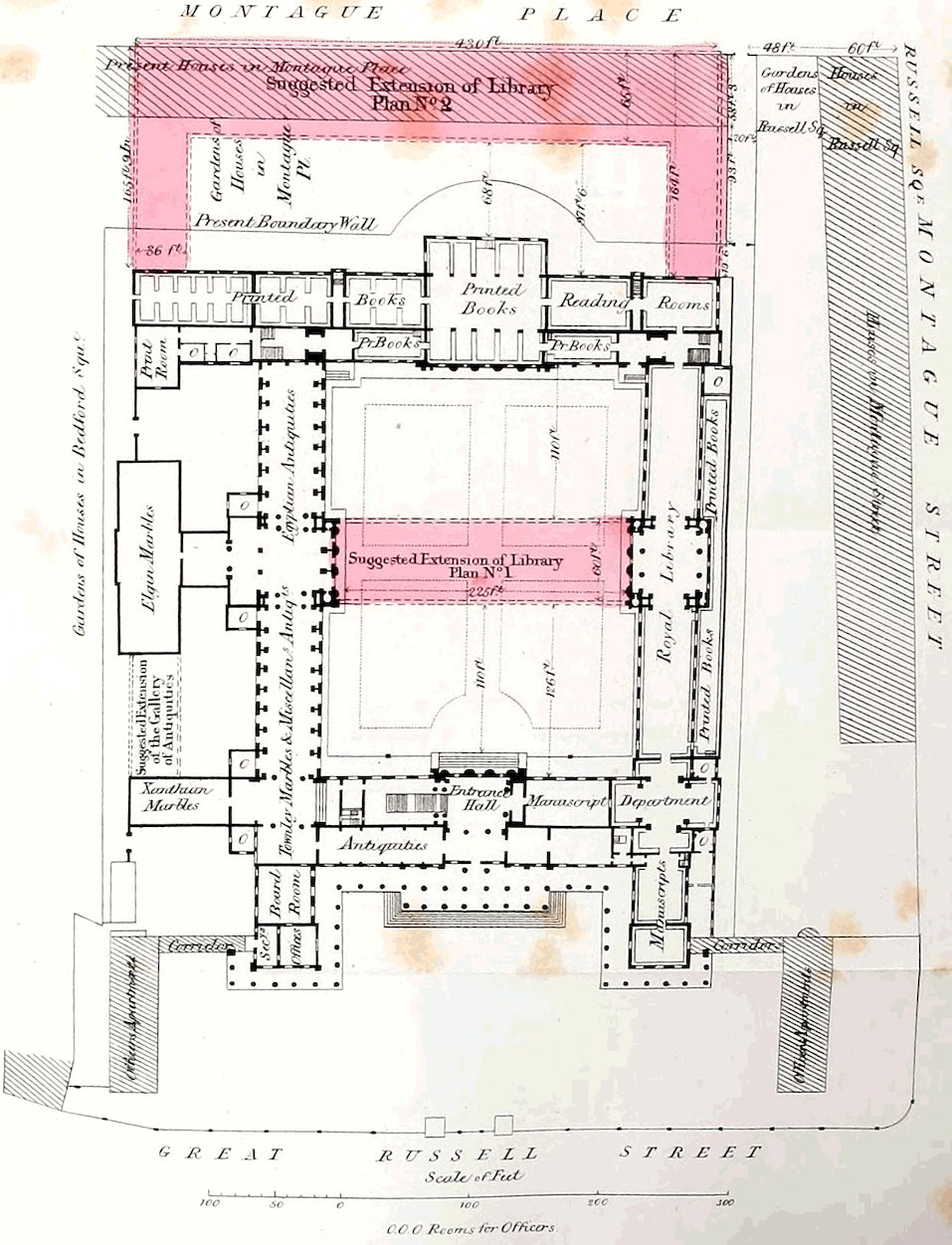
Plate Nº 2 SUGGESTIONS, MADE IN 1847. FOR THE ENLARGEMENT OF THE LIBRARY OF THE BRITISH MUSEUM. BEING THE FAC-SIMILE OF A PLAN INSERTED IN A PAMPHLET (WRITTEN IN 1846.) ENTITLED PUBLIC LIBRARIES IN LONDON AND PARIS.
Watts’ labours for the augmentation of the British Museum Library.
557When Thomas Watts entered the Museum, the immediate task entrusted to him, onerous as it was, did not (for any long time) engross his attention. In common with Mr. Panizzi, his desire to increase the Library, and to make London surpass Paris—‘Paris must be surpassed,’ are the words which close the best of those articles, printed in 1837, to which I have just now referred—amounted to a positive passion. He did not talk very much about it; but I fancy it occupied, not only his waking thoughts, but his very dreams.
Mr. Panizzi had not been at the head of his Department many weeks before he began a Special Report to the Trustees, recommending a systematic increase of the Collection of Printed Books.
In the autumn of 1837 he could hardly foresee that one of the attacks to be made, in the after-years, upon those who had appointed him, or who had promoted his appointment, for the crime of preferring ‘a foreigner’ to a high post in our National Museum, would be based upon the foreigner’s neglect of English Literature. ‘An Italian Librarian,’ said those profound logicians, ‘must, naturally and necessarily, swamp the Library with Italian books. He can’t help doing it.’ But, strange as it may have seemed to objectors of that calibre, this particular Italian happened to be, not only a scholar—a ripe and good one—but 558a man of wide sympathies, and of catholic tastes in literature. He was able himself to enjoy Shakespeare, not less thoroughly than he was able, by his critical acumen, to increase other men’s enjoyment of Ariosto and of Dante.
Sir A. Panizzi’s Report, in October, 1837, on the proper characteristics of a National Library for Great Britain.
In October, 1837, he wrote thus:—‘With respect to the purchase of books, Mr. Panizzi begs to lay before the Trustees the general principles by which he will be guided, if not otherwise directed, in endeavouring to answer the expectations and wishes of the Trustees and of the Public in this respect. First, the attention of the Keeper of this emphatically British Library ought to be directed, most particularly, to British works, and to works relating to the British Empire; its religious, political, and literary, as well as scientific history; its laws, institutions, description, commerce, arts, &c. The rarer and more expensive a work of this description is, the more indefatigable[30] efforts ought to be made to secure it for the Library. Secondly, the old and rare, as well as the critical, editions of ancient Classics, ought never to be sought for in vain in this Collection. Nor ought good comments, as also the best translations into modern languages, to be wanting. Thirdly, with respect to foreign literature, arts, and sciences, the Library ought to possess the best editions of standard works for critical purposes or for use. The Public have, moreover, a right to find, in their National Library, heavy as well as expensive foreign works, such as Literary Journals; Transactions of Societies; large Collections, historical or otherwise; complete series of Newspapers; Collections of Laws, and their best interpreters.’ We have, in this brief passage, the germ 559of the admirable Report on the National Library, written on a far more extended scale, which was afterwards laid before the Government, and, ultimately, before Parliament.
If this Report failed to lead, immediately (or, indeed, for a long time to come), to the increased means of acquisition on which its writer’s mind was so much bent, the fault did not lie in the Trustees. It lay with the House of Commons, and with the Chancellor of the Exchequer.
The impediments in the way of improvement.
It is hard to realise, in 1870, how entirely the effort for an adequate improvement of the British Museum was an uphill task. Trustees like the late Lord Derby and the late Sir R. H. Inglis were earnestly desirous to carry out such recommendations as those of Mr. Panizzi, but the employment of urging them on the Ministry was an ungrateful one. In those days of reforming-activity, although, in 1837, the average radicals in ‘the House’ were not quite such devout believers in the faith that a general overturn was the only road to a general millenium as they had been in 1832, they were willing enough to listen to attacks upon the managers of any public institution (no matter how crude were the views of the assailants, or how lopsided their information), but they were not half so ready to open the public purse-strings in order to enable impugned managers or trustees to improve the institution entrusted to them upon a worthy scale.
Three months after writing his Report of 1837, Mr. Panizzi was enabled to procure the official assistance of Mr. Watts. The appointment strengthened his hands, by giving to a man of extraordinary powers for organization and government, the services of a man not less extraordinary for his powers of accumulating and assimilating detail. What each man characteristically possessed, was just the right supplement to the special 560faculties of the other. But even such a happy union of personal qualities would have failed to carry into effect the large aspirations for the improvement of the Museum which both men, severally and independently, had cherished (during many years), but for one other circumstance. This was a merely incidental—one might say a fortuitous—circumstance; but it proved very influential upon the fortunes of the British Museum in the course of the years to come. |See hereafter, Chap. V.| When Mr. Panizzi began to be known in London society—at first, very much by the instrumentality of the late Mr. Thomas Grenville, who, at an early period, had become warmly attached to him—his acquaintance was eagerly cultivated. In this way he obtained opportunities to preach his doctrine of increased public support for our great national and educational institutions (his advocacy was not limited within the four walls of the Museum) in the ears of very valuable and powerful listeners. It was thought, now and then, that he preached on that topic out of season as well as in season. But the issue amply vindicated the zeal which prompted him to make the pleasures of social intercourse subserve the performance of a public trust. Few men, I imagine—holding the unostentatious post of a librarianship—ever possessed so many social opportunities of the kind here referred to, as were possessed by Mr. Panizzi. And even those listeners who may have thought him over-pertinacious, sometimes, in pressing his convictions, must needs have carried away with them the assurance that one public servant, at all events, did not regard his duties as ‘irksome.’ They must have seen that this man’s heart was in his official work.
So was it also in the instance of Mr. Panizzi’s righthand man within the Museum itself. Thomas Watts was not gifted with powers of persuasive argument. His 561address and manners did no sort of justice to the intrinsic qualities, or to the true heart, of the man himself. To strangers, they often gave a most inaccurate idea of his faculties and character. Under the outward guise of a blunt-spoken farmer, there dwelt, not only high scholarship, but a lofty sense—it would not be too strong to say a passionate sense—of public duty. He had none of the persuasive gifts of vivid talk. But he could preach forcibly, by example. When he had made some way with the first task which was assigned him, that of superintending the removal of the Library, and its due ordering—in some of the details of which he was ably assisted, almost from the outset, by Mr. George Bullen (who, in January, 1838, was first specially employed to retranscribe the press-marks or symbols of the books, as they stood in old Montagu House, into the new equivalents necessitated by their altered position in the new Library, in which labour he was, in the April following, assisted by Mr. N. W. Simons)—and had solved, by assiduous effort and self-denying labour, some of the many difficulties which stood in the way of effecting that removal without impeding, to any serious degree, the service of the Public Reading-Room, he turned his attention, at Mr. Panizzi’s instance, to the—to him—far more grateful task of preparing lists of foreign books for addition to the Library. For this task he evinced special qualities and attainments which, I believe, were never surpassed, by any librarian in the world; not even by an Audiffredi, a Van-Praet, or a Magliabechi.
Linguistic attainments of Thomas Watts.
Mr. Watts’ earliest schoolfellows had marvelled at his faculty for acquiring with great rapidity such a degree of familiarity with foreign tongues, as gave him an amply sufficient master-key to their several literatures. When 562yet very young, he showed a scholarly appreciation of the right methods of setting to work. He studied languages in groups—giving his whole mind to one group at a time, and then passing to another. At an age when many men (far from being blockheads) are painfully striving after a literary command of their mother-tongue, young Watts had showed himself to be master of two several clusters of the great Indo-European family, and to have a very respectable acquaintance with a third. When, as a youthful volunteer at the Museum, he was fulfilling a request made to him by Mr. Baber, that he would catalogue the Collection of Icelandic books given to the Public, half a century before, by Sir Joseph Banks, and also another parcel of Russian books, which had been bought at his own recommendation, the reading of Chinese literature was the labour of his hours of private study, and the reading of Polish literature was the recreation of his hours of leisure.
What the feelings of an ambitious student of that strain would be when officially instructed by his superior to take under his sole (or almost sole) charge the duty of examining the Museum Catalogues, and of obtaining from all parts of Europe and Asia, and from many parts of America, other catalogues of every kind, in order to ascertain the deficiencies of the Library, and to supply them, the reader can fancy. The new assistant luxuriated in his office. Many of his suggestions were periodically and earnestly supported with the Trustees by Mr. Panizzi. His labours were appreciated and often (to my personal knowledge) warmly applauded by his superior officer.
His Lists of Museum Desiderata.
He began with making lists of Russian books that were desiderata in the Museum Library; then of Hungarian; then of Dutch; then of French, Italian, Spanish, and Portuguese; then of Chinese; then of Welsh; then of the 563rapidly growing, but theretofore (at the Museum) much neglected, literature of the Americas and the Indies.
I used, now and then, to watch him at his work, and to think that no man could possibly be employed more entirely to his liking. Long after I ceased to enjoy any opportunity of talking with him about his employment, I used occasionally to hear that similar tasks occupied, not infrequently, the hours of evening leisure as well as the hours of official duty. Some who knew him more intimately than—of late years—it was my privilege to know him, believe that his early death was in part (humanly speaking) due to his passion for poring over catalogues and other records of far-off literatures when worn-out nature needed to be refreshed, and to be recreatively interested in quite other occupations.
During the last twenty years alone (1850–1869 inclusive) he cannot have marked and recommended for purchase less than a hundred and fifty thousand foreign works, and in order to their selection he must needs have examined almost a million of book-titles, in at least eighteen different languages.
When little more than half that last-named term of years had expired he was able to write—in a Report which he addressed to Mr. Panizzi in February, 1861—that the common object of Keeper and Assistant-Keeper had been, during almost a quarter of a century, to ‘bring together from all quarters the useful, the elegant, and the curious literature of every language; to unite with the best English Library in England, or the world, the best Russian Library out of Russia, the best German out of Germany, the best Spanish out of Spain, and so with every language from Italian to Icelandic, from Polish to Portuguese. In five of the languages in which it now claims this species of supremacy, in Russian, Polish, Hungarian, Danish, and Swedish, I 564believe I may say that, with the exception of perhaps fifty volumes, every book that has been purchased by the Museum within the last three and twenty years has been purchased at my suggestion. I have the pleasure of reflecting that every future student of the less-known literatures of Europe will find riches where I found poverty; though, of course, |Reports of 1861, pp. 17, 18.| the collections in all these languages together form but a small proportion of the vast accumulations that have been added to the Library during your administration and that of your successor.’[31]
When the reader comes to add to his estimate of the amount of mental labour thus briefly and modestly indicated by the man who performed it, a thought of the further toil involved in the re-arrangement and careful classification of more than four hundred thousand volumes of books, in all the literary languages of the world (without any exception), he will have attained some rough idea of the public service which was crowded into one man’s life; and that, as we all have now to regret, not a protracted life. He will have, too, some degree of conception of the amount of acquired knowledge which was taken from us when Thomas Watts was taken.
To his works of industry and of learning, the man we have lost added the still better works of a kindly, benevolent heart. Many a struggling student received at his hands both wise and loving counsel, and active help. And his good deeds were not advertised. They would not now have been spoken of, but for his loss—in the very thick of his labours for the Public.
In a precious volume, which was first added to the manuscript stores of the British Museum a little before 565Mr. Watts’ death, there occurs the rough jotting of a thought which is very apposite to our human and natural reflections upon such an early removal from the scene of labour as that just referred to. When somebody spoke to Bacon of the death, in the midst of duty and of mental vigour, of some good worker or other in the vineyard of this world, almost three centuries ago, he made the following entry in his private note-book:—‘Princes, when in jousts, triumphs, or games of victory, men deserve crowns for their performance, do not crown them below, where the deeds are performed, but call them up. |Lord Bacon’s Note-Book (MS. Addit. B. M.).| So doth God by death.’
Other literary labours of Thomas Watts.
But these several branches of public duty, onerous as they were, were far from exhausting Mr. Watts’ mental activity, either within the Museum walls or outside of them. He was a frequent contributor to periodical literature. To his pen the Quarterly Review was indebted for an excellent article on the History of Cyclopædias; the Athenæum, for a long series of papers on various topics of literary history and of current literature, extending over many years; the various Cyclopædias and Biographical Dictionaries successively edited by Mr. Charles Knight, for a long series of valuable notices, embracing the Language and Literature of Hungary; those of Wales; and more than a hundred and thirty brief biographical memoirs, distinguished alike for careful research and for clear and vigorous expression. These biographies relate, for the most part, to foreign men of letters. To the pages of the Transactions of the Philological Society he was a frequent contributor. His Memoir on Hungarian Literature, first read to that Society, procured him the distinction of a corresponding-membership of the Hungarian Academy, and the distinction was enhanced 566by his being elected on the same day with Lord Macaulay.
Within the Museum itself two distinct and important departments of official labour, both of which he filled with intelligence and zeal, have yet to be indicated. |The Museum Printed Book Catalogue of 1839–1869, and Watts’ labours in relation to it.| In 1839, he took part—with others—in framing an extensive code of ‘rules’ for the re-compilation of the entire body of the Catalogues of Printed Books. In May, 1857, he took charge of the Public Reading-Room, as Chief Superintendent of the daily service.
It need hardly be said that the first-named task—that on the Catalogues—was a labour of planning and shaping, not one of actual execution. It was very important, however, in its effects on the public economy of the Library, and it was the one only labour, as I believe, performed by Mr. Watts, whether severally or in conjunction with others, which failed to give unmixed satisfaction to the general body of readers. The Minutes of Evidence, taken by the Commissioners of 1848–1850, whilst they abound in expressions of public gratitude both to Mr. Panizzi and, next after him, to Mr. Watts, contain a not less remarkable abundance of criticisms, and of complaints, upon the plan (not the execution) of the Catalogue of Printed Books begun in 1839. The subject is a dry one, but will repay some brief attention on the reader’s part.
When Mr. Panizzi became Keeper, he had (it will have been seen) to face almost instantly, and abreast, three several tasks, each of which entailed much labour upon himself, personally, as well as upon his assistants. The third of them—this business of the Catalogue—proved to be not the least onerous, and it was, assuredly, not the best rewarded in the shape of its ultimate reception by those concerned more immediately in its performance. I can 567speak with some sympathy on this point, since it was as a temporary assistant in the preparation of this formidable and keenly-criticised Catalogue, that the present writer entered the service of the Trustees, in February, 1839.
Objections to the plan of the Museum Printed Book Catalogue (1839–1869).
That some objections to the plan adopted in 1839 are well-grounded I entirely believe. But the important point in this matter, for our present purpose, is, not that the plan preferred was unobjectionable, but that the utmost effort was used, at the time and under the circumstances of the time, to prepare such a Catalogue as should meet the fair requirements both of the Trustees and of the Readers. It is within my recollection that, to effect this, Mr. Panizzi laboured, personally as well as in the way of super-intendance and direction, as it has not often happened to me, in my time, to see men labour for the Public. Assuredly to him promotion brought no lessening of toil in any form.
In shaping the plan of the General Catalogue of 1839–1870 (for it is, at this moment of writing, still in active progress), the course taken was this:—A sort of committee of five persons was formed, each of whom severally was to prepare, in rough draft, rules for the compilation of the projected work, illustrated by copious examples. It was to be entirely new, and to embrace every book contained in the Library up to the close of the year 1838. The draft rules were then freely discussed in joint committee, and wherever differences of opinion failed to be reconciled upon conference, the majority of votes determined the question. Such was Mr. Panizzi’s anxiety to prepare the best Catalogue for the Readers that was practicable, that he never insisted, authoritatively, on his own view of any point whatever, which might be in contention amongst us, when he stood in a minority. On all such points, he voted upon 568an exact equality with his assistants. The rules that were most called into question (before the Commissioners of 1848–1850) had been severally discussed and determined in this fair and simple way. Beyond all doubt, some of the rules might now be largely amended in the light of subsequent experience. But, when adopted, they seemed to all of us the best that were practicable under all the then circumstances.
The committee thus formed consisted of Mr. Panizzi himself, of Mr. Thomas Watts, of Mr. John Winter Jones (now Principal-Librarian), of Mr. John Humffreys Parry (now Mr. Serjeant Parry), and of the writer of this volume. The labour was much more arduous than the average run of readers in a Public Library have any adequate conception of. It occupied several months. It was pushed with such energy and industry, that many a time, after we had all five worked together, till the light of the spring days of 1839 failed us, we adjourned to work on—with the help of a sandwich and a glass of Burgundy—in Mr. Panizzi’s private apartment above the old gate in the Court-yard. If the result of our joint labours had been printed in the ordinary form of books, it would have made a substantial octavo volume. The code has, no doubt, many faults and oversights, but, be they what they may, it was a vast improvement upon former doings in that direction; |See Mr. Panizzi’s evidence before the Commissioners of 1848–9.| and not a little of it has been turned to account, of late years, in the Public Libraries of France, of Germany, and of America.
In the labours of this little house-committee my late friend took a very large share. To Mr. Panizzi, and to him, all their colleagues in the task of 1839 will readily admit that the chief merit of what is good, and the smallest part of the demerit of what may have been injudicious, in the Rules for the Compilation of the Catalogue of Printed 569Books (now before me) is incontestably due. My own experience in such matters, in the spring of 1839, was small indeed. That of my friend Parry was even less. Mr. Winter Jones possessed, already, the advantage of a thorough familiarity with the Library about to be catalogued, and also an extensive and thorough general knowledge of books. Of Mr. Panizzi’s qualifications and attainments, for such a labour, it would be supererogatory and idle to say a word more, except that he had already—and single-handed—made so good a Catalogue of the fine Library of the Royal Society that the meddling of half a dozen ‘revisers’ failed to spoil it. But there is no impropriety in saying of Mr. Watts, that he so delighted in the labour in hand as to make it seem, to those who worked with him, that he looked upon it in the light of a pleasant recreation rather than in the light of a dry task.
But whatever the ultimate differences of opinion, amongst those concerned in such a matter, about the merits of the Museum Catalogue, begun in 1839, there was no difference at all, either in the House or out of it, as to the conspicuous merits of his performance of every subsequent duty. His stores of knowledge were put, with the utmost readiness, at the service of all sorts of readers; and he was not less admirable in the discharge of his office of Superintendent of the Reading-Room than afterwards in the more prominent office of Keeper of Printed Books—which he held little more than three years.
When Sir Henry Ellis retired, in 1856, from the office of Principal-Librarian, the Collection of Printed Books—which he had found, on his accession to that office, extending to less than one hundred and fifty thousand volumes—exceeded five hundred and twenty thousand volumes. 570The annual number of Readers admitted had increased from about seven hundred and fifty to nearly four thousand.
The one step which did more than aught else to promote this improvement was the systematic survey of the then existing condition of the Printed Library, in all the great departments of knowledge, which Mr. Panizzi set on foot in 1843, and embodied in a Memoir addressed to the Trustees, on the first of January, 1845.
Mr. Panizzi’s Memoir on the Collection of Printed Books, 1845.
The principle on which this Memoir was compiled lay in the careful comparison of the Museum Catalogues with the best special bibliographies, and with the Catalogues of other Libraries. In Jurisprudence, for example, the national collection was tested by the Bibliotheca Juridica of Lipenius, Senckenberg, and Madahn; by the list of law-books inserted in Dupin’s edition of Camus’ Lettres sur la profession d’Avocat, and by the Bibliothèque diplomatique choisie of Martens. In Political Economy, by Blanqui’s list given in the Histoire de l’Economie politique en Europe. The Mathematical section of the Library was compared with Rogg’s Handbuch der mathematischen Literatur. In British History, the Bibliotheca Grenvilliana, and the Catalogue of the Library of the Writers to the Signet, were examined, for those sections of the subject to which they were more particularly applicable, and so on in the other departments. The facts thus elicited were striking. It was shown that much had been done since 1836 to augment almost every section of the Library; but that the deficiencies were still of the most conspicuous sort. In a word, the statement abundantly established the truth of the proposition that ‘the Collection of Printed Books in the British Museum is not nearly so complete and perfect as the National Library of Great Britain ought to be ...’ 571and it then proceeded to discuss the further question: ‘By what means can the collection be brought with all proper despatch to a state of as much completeness and perfection as is attainable in such matters, and as the public service may require?’
It was shown that no reliance could be placed upon donations, for the filling up those gaps in the Library which were the special subject of the Memoir. Rare and precious books might thus come, but not the widely miscellaneous assemblage still needed. As to special grants for the acquisition of entire collections, not one of ten such collections, it was thought, would, under existing circumstances, be suitable for the Museum. The Copyright-tax has no bearing, however rigidly enforced, save on current British Literature. There remained, therefore, but one adequate resource, that of annual Parliamentary grants, unfettered by restrictions as to their application, and capable of being depended upon for a considerable number of years to come. Purchases might thus be organized in all parts of the world with foresight, system, and continuity. In the letter addressed by the Trustees to the Treasury, it was stated that, ‘for filling up the chasms which are so much to be regretted, and some of which are distinctly set forth in the annexed document, the Trustees think that a sum of not less than ten thousand a year will be required for the next ten years,’ in addition to the usual five thousand a year for the ordinary acquisitions of the Library.
The Lords of the Treasury were not willing to recommend to Parliament a larger annual grant than ten thousand pounds, ‘for the purchase of books of all descriptions,’ but so far they were disposed to proceed, |Treasury Minutes, 1845.| ‘for some years to come;’ and they strongly inculcated upon the Trustees ‘the necessity, during the continuance of such 572grants, of postponing additions to the other collections under their charge, which, however desirable in themselves, are of subordinate importance to that of completing the Library.’
Manuscripts added in the years 1849, 1850.
In 1843, an important series of modern Historical MSS., relating more especially to the South of Europe, was purchased from the Ranuzzi family of Bologna. The papers of the Brothers Laurence Hyde, Earl of Rochester, and Henry Hyde, Earl of Clarendon, were also secured. Additions, too, of considerable interest, were made to the theological and classical sections of the MS. Department, by the purchase of many vellum MSS., ranging from the eleventh to the fifteenth centuries. In 1849, the most important acquisitions related to our British History. About three hundred documents illustrative of the English Wars in France (1418 to 1450), nearly a hundred autograph letters of William III, and an extensive series of transcripts from the archives at the Hague, were thus gathered for the future historian. In 1850, a curious series of Stammbücker, three hundred and twenty in number, and in date extending from 1554 to 1785, was obtained by purchase. These Albums, collectively, contained more than twenty-seven thousand autographs of persons more or less eminent in the various departments of human activity. Amongst them is the signature of Milton. The acquisitions of 1851 included some Biblical MSS. of great curiosity; an extensive series of autograph letters (chiefly from the Donnadieu Collection), and a large number of papers relating to the affairs of the English Mint.
In the year last-named Sir Frederick Madden thus summed up the accessions to his Department since the year 1836:
573
Volumes of Manuscripts 9051
Rolls of Maps, Pedigrees, &c. 668
Manuscripts on Reed, Bark, or other material 136
Charters and Rolls 6750
Papyri 42
Seals 442
Tabular view of the accessions to the MSS. Department from 1836–1851.
And he adds:—‘If money had been forthcoming, the number of manuscripts acquired during the last fifteen years might have been more than doubled. The collections that have passed into other hands, namely, Sir Robert Chambers’ Sanscrit MSS.; Sir William Ouseley’s Persian; Bruce’s Ethiopic and Arabic; Michael’s Hebrew; Libri’s Italian, French, Latin, and Miscellaneous; Barrois’ French and Latin; as well as the Stowe Collection of Anglo-Saxon, Irish, and English manuscripts, might all have been so united. The liberality of the Treasury becomes very small when compared with the expenditure of individuals. Lord Ashburnham, during the last ten years, has paid nearly as large a sum for MSS. as has been expended on the National Collection since the Museum was first founded.’
Growth of the Printed Department up to 1851.
The causes which at this period again tended somewhat to slacken the growth of the Printed Collection have been glanced at already. But during the fifteen years from 1836 to 1851, it had increased at the rate of sixteen thousand volumes a year, on the average. When the estimates of 1852 were under discussion, Mr. Panizzi stated, ‘that till room is provided, the deficiency must in a great measure continue, and new [foreign] books only to a limited extent be purchased.’ The grant for such purchases was therefore, in that year, limited to four thousand pounds. In a subsequent report, Mr. Panizzi added, ‘that he could not but deeply regret the ill-consequences which must accrue by allowing old deficiencies to continue, 574and new ones to accumulate.’ From the same report may be gathered a precise view of the actual additions, from all sources, during the quinquennium of 1846–1850. The increase in the printed books, therefore, although it had not quite kept pace with Mr. Panizzi’s hopeful anticipations in 1852, had actually reached a larger yearly average, during that last quinquennium, than was attained in the like period from 1846 to 1850.
The report from which these figures are taken was made in furtherance of the good and fruitful suggestion that a great Reading-Room should be built within the inner quadrangle. Judging from the past, argued Mr. Panizzi, in June, 1852, ‘and supposing that for the next ten years from seven thousand to seven thousand five hundred pounds will be spent in the purchase of printed books, the increase ... would be at the average of about twenty-seven thousand volumes a year, without taking into consideration the chance of an extraordinary increase, owing to the purchase or donation of any large collection. |See hereafter, Chap. V.| It was owing to the splendid bequest of Mr. Grenville that the additions to the Collection in 1847 reached the enormous amount of more than fifty-five thousand volumes. After the steady and regular addition of about twenty-seven thousand volumes for ten years together, here reckoned upon, the Collection of Printed Books in the British Museum might defy comparison, and would approach, as near as seems practicable in such matters, to a state of completeness. The increase for the ten years next following might be fairly reduced to two thirds of the above sum. |Growth of the Printed Section of the Library since 1852.| At this rate, the collection of books, which has been more than doubled during the last fifteen years, would be double of what it now is in twenty years from the present time [1852].’ At the date of this report the number of volumes 575was already upwards of four hundred and seventy thousand. At the date at which I now write (January, 1870), the number of volumes, as nearly as it can be calculated, has become one million and six thousand. On the average, therefore, of the whole period, the increase has been not less than thirty-one thousand five hundred volumes in every year. The Collection was somewhat more than doubled during the first fifteen years of Mr. Panizzi’s Keepership. During the next like term of years, when the department was partly under the administration of Mr. Panizzi, and partly under that of Mr. Winter Jones, it was nearly doubled again. It follows that the anticipation expressed in the Report of 1852 has been much more than fulfilled. Less than seventeen years of labour have achieved what was then expected to be the work of twenty years.
If the other departments of the British Museum cannot show an equal ratio of growth during the term now under review, it has not been from lack of zeal, either in their heads or in the Trustees. Their progress, too, was very great, although it is not capable of being so strikingly and compendiously illustrated. It has also to be borne in mind that the arrears, so to speak, of the Library, were relatively greater than those of some other divisions of the Museum.
Progress of the Natural History Collections.
At the commencement of Sir Henry Ellis’s term of Principal-Librarianship, the Natural-History Collections were partly under the charge of Dr. Leach, partly under that of Mr. Charles König. Both were officers of considerable scientific attainments. In the instance of Dr. Leach, certain peculiar eccentricities and crotchets were mixed up in close union with undoubted learning and skill. In not a few eminent naturalists a tendency to undervalue the achievements of past days, and to exaggerate those of 576the day that is passing, has often been noted. Leach evinced this tendency in more ways than one. But a favourite way of manifesting it led him many times into difficulties with his neighbours. He despised the taxidermy of Sir Hans Sloane’s age, and made periodical bonfires of Sloanian specimens. These he was wont to call his ‘cremations.’ In his time, the Gardens of the Museum were still a favourite resort of the Bloomsburians, but the attraction of the terraces and the fragrance of the shrubberies were sadly lessened when a pungent odour of burning snakes was their accompaniment. The stronger the complaints, however, the more apparent became Dr. Leach’s attachment to his favourite cremations.
George Montagu; his labours in Natural History and his Zoological Museum.
Leach was the friend and correspondent of that eminent cultivator of the classificatory sciences, Colonel George Montagu, of Lackham. Both of them rank among the early members of the Linnæan Society, and it was under Leach’s editorship that Montagu’s latest contributions to the Society’s Transactions were published. |1802–13.| Montagu’s Synopsis of British Birds marks an epoch in the annals of our local ornithology, as does his treatise entitled Testacea Britannica in those of conchology. |1803–9.| His contributions to the National Collections were very liberal. But he did not care much for any books save those that treated of natural history. In addition to a good estate and a fine mansion, he had inherited from his brother a choice old Library at Lackham, and a large cabinet of coins. These, I believe, he turned to account as means of barter for books and specimens in his favourite department of study. His love of the beauties of nature led him to prefer an unpretending abode in Devon to his fine Wiltshire house, and it was at Knowle that he died in August, 1815. His Collections in Zoology were purchased by the Trustees, and were removed 577from Knowle soon after his death. Scarcely any other purchase of like value in the Natural-History Department was made for more than twenty years afterwards. After the purchase of the Montagu Collection, the growth of that department depended, as it had mainly depended before it, on the acquisitions made for the Public by the several naturalists who took part in the Voyages of Discovery or whose chance collections, made in the course of ordinary duty, came to be at the disposal of the British Admiralty.
Many of those naturalists were men of marked ability. Of necessity, their explorations were attended with much curious adventure. To detail their researches and vicissitudes would form—without much credit to the writer—an interesting chapter, the materials of which are superabundant. But, at present, it must needs be matter of hope, not of performance.
The distinctive progress of the Natural-History Collections, from comparative and relative poverty, to a creditable place amongst rival collections, connects itself pre-eminently with the labours of Dr. John Edward Gray, who will hereafter be remembered as the ablest keeper and organizer those collections have hitherto had. Dr. Gray is now (1870) in the forty-sixth year of his public service at the British Museum, which he entered as an Assistant, in 1824. He is widely known by his able edition of Griffiths’ Animal Kingdom, by his Illustrations of Indian Zoology, by his account of the famous Derby Menagerie at Knowsley, and by his Manual of British Shells; but his least ostensible publications rank among the most conclusive proofs both of his ability and of his zeal for the public service. Dr. Gray has always advocated the publication—to use Mr. Carlyle’s words when under interrogatory by the Museum 578Commissioners of 1848—of ‘all sorts of Catalogues.’ It is to him that the Public owe the admirable helps to the study of natural history which have been afforded by the long series of inventories, guides, and nomenclators, the publication of which began, at his instance, in the year 1844, and has been unceasingly pursued. A mere list of the various printed synopses which have grown out of Dr. Gray’s suggestion of 1844 would fill many such pages as that which the reader has now before him. The consequence is, that in no department of the Museum can the student, as yet, economise his time as he can economise it in the Natural-History Department. Printed, not Manuscript, Catalogues mean time saved; disappointment avoided; study fructified. No literary labour brings so little of credit as does the work of the Catalogue-maker. None better deserves the gratitude of scholars, as well as of the general mass of visitors.
State of the Natural History Collections of the Museum in 1836.
Dr. Gray became Keeper of Zoology in 1840. Four years earlier, he had given to Sir Benjamin Hawes’ Committee a striking account of the condition of that department, illustrating it by comparisons with the corresponding Collections in Paris, which may thus (not without unavoidable injustice) be abridged:—The species of mammalia then in the Museum were four hundred and five; the species of birds were two thousand four hundred, illustrated by four thousand six hundred and fifty-nine individual specimens. At that date, the latest accessible data assigned to the Paris Collection about five hundred species of mammals, and about two thousand three hundred species of birds, illustrated by nearly six thousand specimens. The Museum series of birds was almost equally rich in the orders, taken generally; but in gallinaceous birds it was more than proportionately rich, a 579large number of splendid examples having been received from India. In the birds of Africa, of Brazil, and of Northern Europe, also, the Museum was already exceptionally well-stored.
The special value of the Ornithological Collection undoubtedly showed that it had been more elaborately cared for than had been some other parts of natural history. But the extent and richness of the bird gallery, even at this period, is not to be ascribed merely to a desire to delight the eyes of a crowd of visitors. For scientific purposes, a collection of birds must be more largely-planned and better filled than a collection of mammals, or one of fish. In birds, the essential characters of a considerable group of individual specimens may be identical and their colours entirely different. |See Minutes of Evidence, 1836, p. 238.| Besides the numerous diversities attendant upon age and sex, the very date at which a bird is killed may produce variations which have their interest for the scientific student.
The number of species of reptiles was in 1836 about six hundred, illustrated by about one thousand three hundred specimens. This number was much inferior to that of the Museum at Paris, but it exceeded by one third the number of species in the Vienna Museum, |Ibid., p. 242 (Q. 2996–9).| and almost by one half the then number at Berlin.
The species of fish amounted to nearly a thousand, but this was hardly the fourth of the great collection at Paris, although it probably exceeded every other, or almost every other, Continental collection of the same date. Of shells, the Museum number of species was four thousand and twenty-five (exclusive of fossils), illustrated by about fifteen thousand individuals. This number of species was at par with that of Paris; much superior both to Berlin and to Leyden; but it was far from representing positive—as distinguished 580from comparative—wealth. There were already, in 1836, more than nine thousand known species of shells.
It was further shown in the evidence that, even under the arrangements of 1836, the facilities of public access equalled those given at the most liberal of the Continental Museums, and considerably exceeded those which obtained at fully four-fifths of their number.
Among the many services rendered to the Museum by Dr. Gray, one is of too important a character to be passed over, even in a notice so brief as this must needs be. |The Hardwicke Bequest of Zoology.| The large bequest in Zoology of Major-General Hardwicke grew out of a stipulation made by Dr. Gray, when he undertook, at General Hardwicke’s request, the editorship of the Illustrations of Indian Zoology. A long labour brought to the editor no pecuniary return, but it brought an important collection to the British Public in the first instance, and eventually a large augmentation of what had been originally given.
Growth of the Natural History Collections of the Museum. 1836–49.
In March, 1849, the course of inquiries pursued by Lord Ellesmere’s Commission led to a new review of the growth of the Natural-History Collections, and more especially of the Zoology. It applied in particular to the twelve or thirteen years which had then elapsed since the prior inquiries of 1835–1836. The statement possesses much interest, but it is occasionally deficient in that systematic and necessary distinction between species and specimens which characterised the evidence of 1836. In brief, however, it may be said, that in the eight years extending between June, 1840, and June, 1848, twenty-nine thousand five hundred and ninety-five specimens of vertebrated animals were added to the Museum galleries and storehouses. Of these, five thousand seven hundred and ninety-seven 581were mammals; thirteen thousand four hundred and fourteen were birds; four thousand one hundred and twelve reptiles; and six thousand two hundred and seventy-two were fish. The number of specimens of annulose animals added during the same period was seventy-three thousand five hundred and sixty-three: and that of mollusca and radiata, fifty-seven thousand six hundred and ten.