THE CHILDREN'S OWN GARDEN IN OCTOBER.
Reading edition
The Flower Garden will now be fast losing its beauty, and the cold winds and frosty nights will be everywhere heralding the coming of winter, when, more through force of circumstances than choice, our Gardening proclivities become considerably abated. Throughout the present month, however, the remaining floral vestiges of summer are often numerous, but especially so when the weather of early autumnal months happens to be of a mild and congenial nature. By this season the greater number of plants will have performed those functions, and have passed through the various stages, which each and every year exacts. In the case of plants known as annuals, an entire life is projected and perfected within the short space of a few months. Various trees and shrubs will now be assuming the rich autumnal tints, and the leaves rapidly drop at the approach of winter, and vital energy is being stored up until the following spring, when new leaves are produced.
* * *
The month of October is, notwithstanding its lack of floral ornaments, one in which the amount of work to be done is by no means inconsiderable, and the pretty little girl, with her hoe and water-can, drawn on p. 241, evidently thinks as much. We must plant now in order to secure a spring display of flowers, and for this purpose nothing can be more satisfactory than bulbous subjects, such as hyacinths, tulips, crocuses, and narcissuses. The hyacinth thrives best in a compost of light loam, leaf-mould, and sand; plenty of the latter may be included in order to secure perfect drainage, which is a very important item in the culture of bulbous plants generally. Perhaps no other spring flowering bulb looks so well when grown in neat patches as the hyacinth; the bulbs should not be less than six inches apart, and at least two and a half inches beneath the surface. They should be purchased in the autumn, selecting firm heavy roots; and "first come, first served" must be borne in mind, as by buying early in the season the best may be secured, and finer spikes of bloom will follow as a natural consequence.
* * *
Tulips have been for many years great favourites with gardeners, both amateur and professional. About two hundred years ago the mania for these plants amounted almost to a national calamity in Holland, and scores of acres are now entirely devoted to their culture. For our own part, we scarcely consider the tulip as in any way justifying the praise which is lavished upon it even in the present day, because its beauty is, to say the least, ephemeral, whilst its showiness is far from being either chaste or delicate. It will be, however desirable to have six or even a dozen bulbs, which only cost about a penny apiece. They can be planted any time during the present month, from two to three inches below the surface, in a compost of loam, leaf-mould, sand, and well-rotted manure. When purchasing, see that every bulb is perfectly solid, and select as many different sorts as possible, thereby securing a variety, which is very desirable in a garden of limited extent. In cold northern situations tulip-beds should always be covered over with a little straw or litter during very frosty weather.
* * *
Few Spring flowers are more welcome or appear so very early in the year as crocuses. No matter how cold, foggy, or dirty the weather may chance to be in this most erratic climate, the regiments of yellow, golden, blue, flaked, white, and versi-coloured crocus flowers will never fail to put in an appearance. The common sorts thrive almost anywhere, and in almost any ordinary garden soil. They should be planted during the present month, about two inches under the surface. As the roots only cost about threepence per dozen hardly any spot ought to be bare of flowers from the middle of January to early in March. A universally-grown plant, even earlier than the crocus, is the well-known snowdrop. This also, like the crocus, can be grown almost anywhere, and may remain in one spot undisturbed for years; both are most effective when grown in clumps. The French name of Perceneige, or Pierce-snow, is singularly applicable to the snowdrop. Place the tiny roots from one to two inches deep, and grow the single-flowered form only.
* * *
The narcissus or daffodil is another of the many spring-flowering plants which are invariably greeted with enthusiasm. The varieties are endless, but the greater number are almost unexcelled for growing in such situations as the tops and sides of hedges, banks, &c. They can scarcely be grown too extensively. Of the various sorts, and exclusive of the ordinary double form, few are more beautiful or more desirable than that known as the Poet's Narcissus (N. poeticus). The pure white of the segments and the delicate bright scarlet centre are best when the plant is grown sheltered from strong winds. Another favourite narcissus of ours, and which we can confidently recommend to our readers, is that known as "Orange Phœnix;" it is a singularly beautiful plant, and produces large double and well-formed flowers; it thrives best in a light sandy soil. Several colours may be secured by purchasing a dozen roots of mixed sorts, costing from two to three shillings per dozen. They may be planted any time throughout October and up to the middle of November.
* * *
The Kitchen Garden of our young folk will need but very little looking after during the present and next two months; but in stating this we must not be understood to imply that it should be wholly neglected. On the contrary, it must be kept quite free from weeds of all sorts; and everything should be in perfect order. To this end paths should be swept and weeded every week, when the state of the weather will admit of this being done. The Kitchen Garden is much too frequently seen in a disreputable state, even in pretentious places, and where flower-gardening is done very well. But well-executed work in one department by no means justifies slovenliness in another. Vacant spaces of ground will need digging, but this operation should, if possible, be left to a labourer, who, for the sake of a small remuneration, would probably be very glad to do it after his ordinary working hours. Even an enthusiast cannot but consider digging as the most laborious of all gardening work, and will take especial care to shirk it whenever possible. In fact, real garden drudgery of all kinds is better done by a labourer, no matter how simple and easy such work may superficially appear to our young folk. Good work, as we all know, can only be done by an accustomed hand.
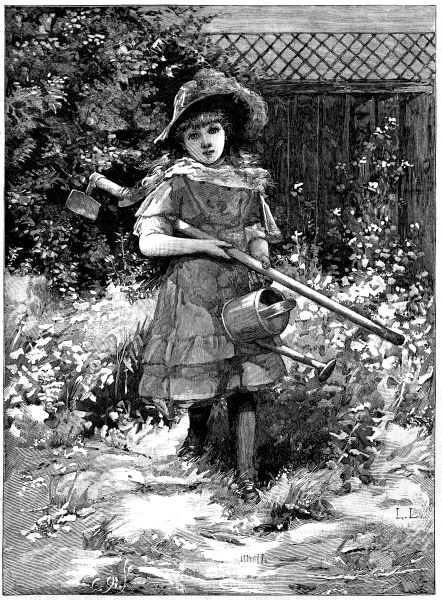
off to her garden. (See p. 239.)