A FORAGING EXPEDITION IN SOUTH AMERICA.
Reading edition
By the Author of "How the Owls of the Pampas treated their Friends," &c.
On the branch of a gigantic tree in one of the South American forests a young ant was reposing; he had been working hard all day, being a brisk, spirited fellow, and so he was rather tired, and he lazily watched an old relation of his own, who was slowly climbing the trunk towards him, his fine white polished head glancing against the bark.
"Well, Long-legs," cried the young cousin, as his elder approached, "where are you going at this late hour? I should have fancied that you would have been asleep after all the trouble you had in marching to-day."
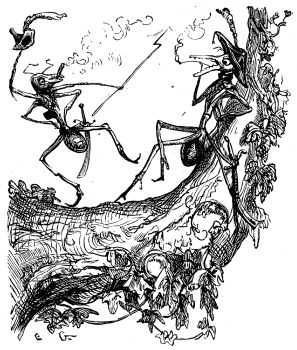
"he ... executed a little war-dance."
"My dear Shiny-pate," said the old warrior, as he settled in a little crevice and stretched out his tired limbs, while he rolled up a tiny, tiny blade of grass for a would-be cigar, "I am the bearer of news."
"Why, what is the matter?" cried Shiny-pate anxiously, jumping up so suddenly that he hit his poor little head sharply against a projecting knob.
"Silly goose! nothing is the matter," answered his friend, "only you are a little grander than you thought you were: you are promoted to be an officer—a lieutenant, in fact; so now you can assist me on our marches."
"Oh! Long-legs, is it really true?" exclaimed the young ant. "Am I to be an officer, to march the men about, to lead them to glory?" and he tried to shout "hurrah," but did not know how, so he only executed a little war-dance on the branch of the tree, while his old friend looked on, smiling grimly.
"Now I hope you will distinguish yourself, my child," said he paternally, when Shiny-pate was tired of skipping about. "You will very soon have an opportunity of showing your valour, for to-morrow we are to undertake a dangerous expedition to a distant country, and your courage will be tried."
So saying, he began creeping down the tree, disregarding the entreaties of his young companion, to stay a little longer and tell him where they were going. "No, no," he muttered; "that will be time enough to-morrow; go to sleep and be strong."
Very good advice, certainly; but when children are put to bed before the sun has set in the long summer evening, while the birds are still singing, and the bats have not begun to come out, and they feel desperately inclined to play a little longer, I am afraid they don't relish it much.
However, Shiny-pate was a good, sensible little creature, and he went off very meekly, but he awoke early in the morning, ready for the fray.
"Breakfast first," said he to himself; but no: the older officers said they had to fight first, and eat afterwards; so they soon began to arrange their marching order.
A column of ants, at least a hundred yards in length, but not very wide, was soon formed; each leader had charge of twenty workers. The officers were not expected to march in the main line, but to walk outside their company, and keep it in order; and great was our hero's pride and delight when he surveyed his own particular men, and thought what an example of bravery he would set them.
At last all were ready, and the army moved off in beautiful order. The officers ran up and down the ranks, inspecting everything, their white helmets glistening in the sun, and as Shiny-pate's position was well to the front, he had great opportunities.
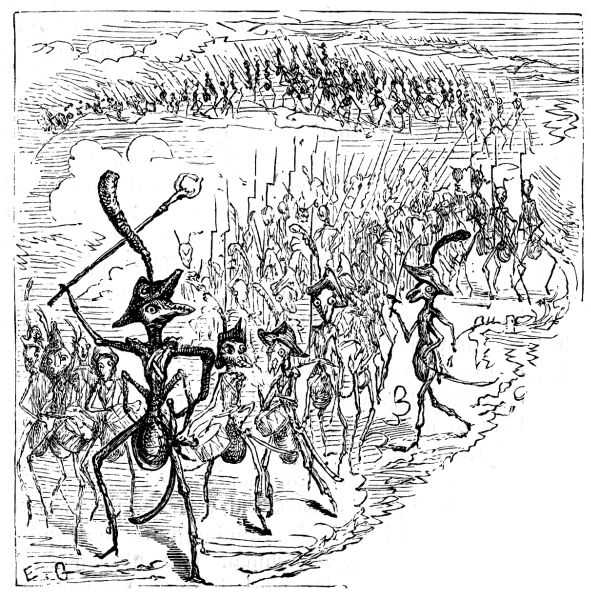
"the army moved off."
After they had proceeded for some time with great gravity and care, they came to a tree from which hung a couple of nests belonging to the large wasps of the country, and after a moment's discussion it was decided that the ants should mount and rifle them as a first move, so the obedient soldiers hastened on, and Shiny-pate, who knew nothing of the enterprise, joyfully waved his sword at the head of his troops. How astonished, how disgusted he was, when he felt the first wasp-sting he had ever experienced!
He almost fell from the nest with amazement, but he would not give in—"No, never, die first!" he thought, so he rushed on, and was among the foremost to enter the cells where the young pupæ were carefully walled in, and tearing them from their cosy cradles, the ants proceeded to devour them.
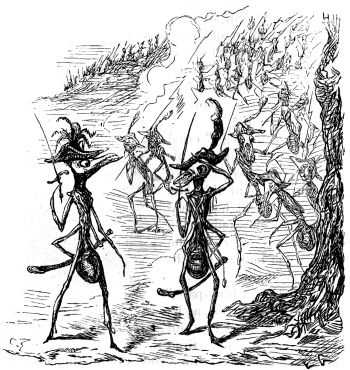
"saluting his commander." (p. 209).
However, though the nests were large, and the grubs many in number, there were not half or quarter enough for the army. More and more ants came trooping up the tree, trying to squeeze into the places where there was no room for them, and mournfully calling out that they also were very hungry. So as soon as the pasteboard domicile was empty, the little creatures descended from their elevation, and again pursued their line of march, this time without any incident occurring until they saw in the distance the figure of a man.
Now most of the ants had never seen a human being before, but what did that matter? Their ardour rose, their eyes sparkled, their long slender limbs raced over the ground, and soon the person who had been silly enough to stand and watch the advancing host was covered with the nimble insects, who quickly ran up into his coat-pockets, down his neck, and, in fact, wherever there was any aperture, inserting their sharp fangs, and injecting their poison, until he yelled with fear and pain. He had not been very long in the country, and did not understand the habits of the creatures, so at first he remained in his absurd position, capering about, and trying to brush off the ants. But as he found that their numbers so increased every moment, he began to get really alarmed, lest he should soon be "eaten up alive," and so he ran away very ignominiously, being pursued for some distance by the host of insects; but as soon as he had outrun them, the difficult task of trying to detach those already fastened to his person began. The fierce little insects preferred being pulled to pieces to letting go their hold, and their hooked mandibles remained securely fixed in poor John Lester's skin long after their bodies had been torn off.
Fortunately for himself, Shiny-pate was not included in the number who lost their lives. When the onslaught began, Long-legs commanded him to keep his detachment quiet, as their services were not required; so the steady little ant obeyed orders, and though he stood on tip-toe with impatience, and trembled with excitement, he kept out of the fray.
"Now it is all over—march!" cried Long-legs authoritatively, as John's flying coat-tails disappeared round a tree.
"Shall we not wait for the others?" inquired a young officer very politely, saluting his commander with the back of his tiny foot in true military style.
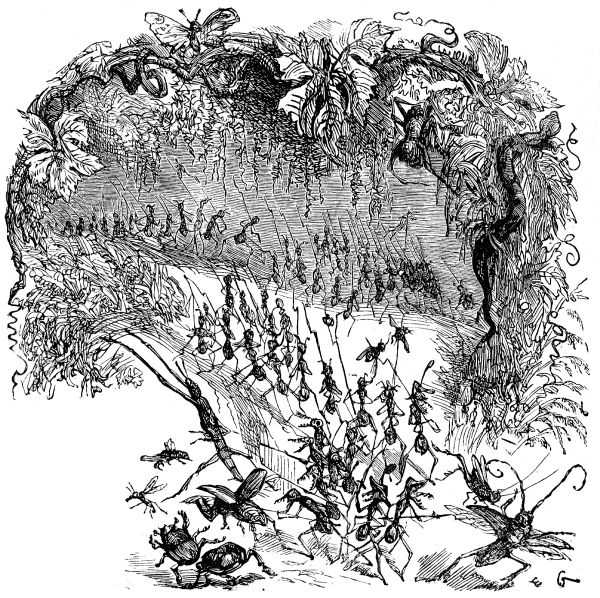
"an army of ants." (p. 210).
"None of them will ever return," replied the colonel sternly. "Do your duty, and obey orders."
So the army again started off, and after a long and dusty march the pioneers came in sight of a pretty little cottage; but I must relate who the inhabitants were before I go any farther.
The house belonged to an Irish gentleman of the name of Wolfe, who, after emigrating to South America, and building a house for his family, a few months before this story opens, brought out his wife, four children, and their old and faithful servant, called John Lester, to keep him company, and help him in the new life he had chosen for himself.
Mrs. Wolfe was rather an inexperienced young lady, and the manners and customs of the place and people, particularly those of the coloured servant, Chunga, astonished her immensely. The white lady had a great horror of creeping things of all kinds; she could hardly bear to get into her bath, for she sometimes found a centipede, as long as her hand, drowned in it.
At night, when the lamp was lighted, cockchafers and insects of all kinds buzzed and flew round it, until their wings were singed; then they danced hornpipes on the table over Mrs. Wolfe's work or writing, falling most likely into the ink-bottle first, and then spinning about with their long legs, smearing everything with which they came in contact, till she used to run away and implore her husband to "kill them all and have done with it." The children thought it was rather fun, except when a scorpion stung them. They had a play about the lizards, which were pretty and harmless, and they used to count how many different kinds of beetles were killed each night.
Sometimes the baby screamed when a particularly large spider walked across its face; but these little trials had to be borne.
On the morning of this memorable day, as Mrs. Wolfe was employed in some household duties, Chunga rushed into the verandah, joyfully crying—
"Oh, missie! oh, missie! de birds are come!"
"What birds?" inquired her mistress in amazement, wondering what new object was going to be exhibited to her, but almost expecting to see a creature with three legs, or two heads.
"De pittas, missie; de ant-thrushes, you call them," said the black woman, gleefully. "Now missie's house will be clean; massa is away, all de tings will be turned out," and as she spoke, she seized her mistress's dress, and, gently drawing her to the open door, directed her attention to several dark-coloured, short-tailed birds which were hopping from tree to tree in the neighbourhood.
"I don't see anything extraordinary about them," said Mrs. Wolfe, in a disappointed tone; "they are only small ugly birds."
"But look dere, missie," persisted Chunga, pointing towards the forest, from the dark shades of which Shiny-pate and his battalions were emerging.
"Why, it is an army of ants!" cried the Irish lady. "How curious! how pretty!"
"Dey is coming here," remarked Chunga carelessly, as she watched the procession.
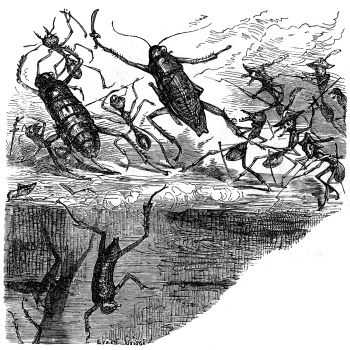
"the warriors dashed in."
"Here!" echoed Mrs. Wolf in horror; "what for? What shall we do? They will eat all the things in my store-room, they will bite my children!" and she flew to the nursery as she spoke.
But the advancing host moved steadily along, the officers gave orders to enter the house, and our young hero, though quite a novice in the work, was one of the first to creep through a slit in the walls.
"Now," cried Long-legs, "first kill the cockroaches and other small game. Come on; don't be afraid."
So the warriors dashed into the principal room, mounted the rafters, and began a fierce battle. The sleepy cockroaches, fat and heavy from good living, sprawled about, but made a very poor fight. Shiny-pate and two or three of his men would seize one of the kicking old fellows, and either push him or pull him to the edge of the rafters, whence he would fall with a dull thud on the floor, when he was generally too much stunned to make any more resistance, but even if he did he was soon overpowered, bitten, and dragged out of the house.
When the rafters were cleared, our hero was running swiftly across the floor, when a choky voice called him, and he saw his old friend's head protruding from an aperture in a large wooden chest.
"Come here! come here!" cried Long-legs. "There are loads of them inside, and I want help."
"Loads of what?" inquired Shiny-pate, rather incredulously.
"Of all kinds of food," replied the colonel; "but unfortunately it is very hard to get at them; they are hidden among the folds of some white stuff that almost suffocates me."
Shiny-pate at once proceeded to crawl into the chest, but fortunately Chunga, who knew the habits of the little insects, had been going round the house opening every press and box, and now she flung aside the cover of the great linen-chest, and in darted the little marauders, and speedily drew forth hundreds of the hideous cockroaches.
But soon all the small game was cleared off, and yet the attacking party cried for more, and cast hungry eyes at Mrs. Wolfe and the children, who had been skipping about on the floor, trying not to stand on anything, for foraging ants are not to be trifled with; and Chunga said, solemnly—
"If missie kills any ants, they kill her."
So the fear of touching any of them had greatly impeded the lady's movements; she had to step gently on the points of her toes whenever she saw a clear space. She had to rescue her baby from the cradle, and her other children from different parts of the house; and then each child, as it was carried away, began to cry for some particular toy that had been left behind, so that getting them safe and sound into the garden was a work of time. However, at last they were all seated round their mother, only dreadfully hungry, and longing for their breakfast, while the house remained in undisturbed possession of the ants.
At last, even Chunga thought it wise to beat a retreat, so she came gliding gently out, bringing the welcome news that she had seen several ants carrying off an immense scorpion, which "must have been de one dat stung massa, and made him so ill a few days before;" and that the ants were now attacking the rats and mice.
"Rats and mice!" screamed all the children in delight. "Will they kill the horrible things?"
"The rats that fought poor Kitty," pursued George, for this had been a sore trouble to the children. Mrs. Wolfe had brought a fine handsome tortoise-shell cat from Ireland with her, thinking how delightful it would be to have her house quite free from vermin, only, unfortunately, they were so very numerous that poor "Lady Catherine," as the children named their pussy, though she did her best at first, could not by any possibility keep their numbers in check, and she now lived a miserable life, being afraid of moving from her master's protection, and growing daily thinner and weaker from the combined influences of fear, and being unable to perform her usual duties; and as the children loved her dearly, and treated her like one of themselves, they all set up a howl of dismay when their darling's name was mentioned to them.
It was answered by a fearful burst of caterwauling from the interior of the house. The shrieks and yells were really terrific, and the whole party, regardless of their enemies inside, rushed back again to the door, and peeping in, beheld a sight which was almost ludicrous.
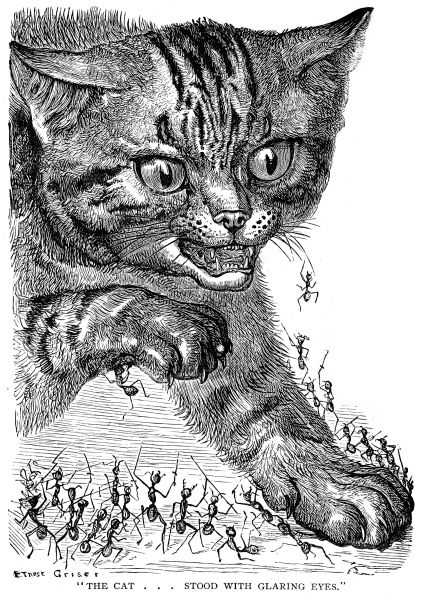
There was a shelf near one of the children's beds at a great height from the floor, and to this Lady Catherine (the cat) had mounted, but now she was surrounded, and her retreat completely cut off. There were ants to right of her, ants to left of her, and ants in front of her; and as the little creatures, led on by Shiny-pate the valorous, attacked her with determined precision, the cat, with every hair bristling up on her body, stood with glaring eyes, lifting first one foot and then another to escape her tormentors. Sometimes she stood on her hind legs and frantically tore the insects from her coat, but she wanted courage enough to make the very high jump from the shelf to the floor.
Mrs. Wolfe and the children were so distressed at the sight, that kind-hearted Chunga offered to try and save their favourite, and she crept cautiously into the house, trying to avoid standing on the ants with her bare feet. Lady Catherine's screams redoubled when she saw a friend approaching, but she did not treat the black woman very kindly, for as soon as she stood under the shelf the cat made one frantic leap to her shoulders, and inserting her sharp claws, held on tenaciously.
It was now Chunga's turn to scream, which she did in good earnest; and as she found she could not detach the cat, she fled from the house with her burden clinging tightly to her copper-coloured shoulders, and ran almost into the arms of John Lester, who was returning home. He was quick enough to see what had happened, so, snatching up an old broom with one hand he seized Lady Catherine with the other, and gave her such a sweeping as she had never experienced before, and which, indeed, she strongly objected to; but her cries were disregarded, and she was soon free from the insects, and the children joyfully clutched hold of her.
But meantime Shiny-pate had been carried off in a coil of Chunga's hair, whence he had crept from the cat's fur, and very uncomfortable he felt. He knew that his single arm could never overcome the Indian woman; he was deserted by his troops, and he had no one to direct him. He thought he had better try to alight from his precarious position, and endeavour to rejoin his men; but when he moved, Chunga—whose nerves were a little upset—cried, "Oh! Massa John, brush me too, brush me;" and began tearing her hair down to make ready for the performance. But just at that moment another insect dropped from the tree above her down on her arm, and administered such an electric shock that a thrill ran up to her shoulder, her hands fell, and Shiny-pate, seizing his opportunity, ran swiftly down her back and rushed towards the house, where the scene of confusion was but little abated.
The ants had by this time slain every living thing which had occupied the dwelling, and dragged them into the long grass outside; and the soldiers, after their hard fighting, were endeavouring to satisfy their hunger. This, however, the officers objected to, for they knew by experience what would happen; the pittas had not accompanied them on their march for nothing. The ugly black birds had their eyes wide open, and knew what they were about; they had been waiting and watching all this time, hopping about on the neighbouring trees, and now at last their turn came. The ants gorged with their prey could not escape: down pounced the pittas, and they certainly made the most of their opportunity. The hardened veterans, the most agile warriors, were gobbled up in a moment, and the officers in despair ran here and there, seeing the carnage, but being quite unable to prevent it.
At last, by the time Mrs. Wolfe and her family ventured back to their clean and well-swept house, Shiny-pate by frantic exertions had managed to collect his own troop—he had only lost two of his twenty soldiers.
So our little insects again set out. They were dreadfully tired, and they lagged behind, though their leader longed to overtake some of the advance-guard, which had already gone on. Poor little fellow! his first day's fighting had certainly been an arduous one, and it was not over yet; his exertions to keep his men in order were wonderful. But after marching some distance the ants saw before them a little stream of water, running merrily along, but presenting a serious barrier to their progress.
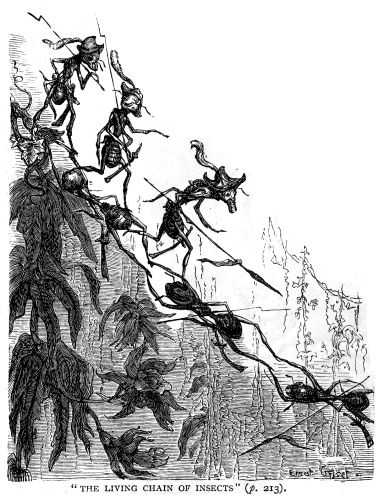
Shiny-pate at first thought the water might not extend far, and led his company along the bank; but as he found to his dismay that the stream grew wider instead of narrower, his fertile little brain began to devise a plan, and soon he had hit upon a very ingenious one. He selected a shrub with a long branch, which extended across part of the stream, and having marched his men to the very extremity of this bough he caught hold of it with his fore-legs and hung down, ordering one of the soldiers to creep down his body and hang on to the end of it; another followed and clung to the second ant, and so on. By this means the living chain of insects, when long enough, was wafted by the wind to the other bank of the stream, where the foremost ant caught a firm hold, and the brave Shiny-pate then swung off his bough, and followed by all the others crept carefully across their companions' bodies, until the foremost ant, who had been holding on all this time by his hind legs, being relieved from the weight of his comrades, was able to twirl round and obtain a safer footing.
The danger was surmounted, and the officer now inspected his little troop with triumph; indeed, he spoke a few encouraging words which actually caused his soldiers to salute in a body, as they could not cheer, and cry with one voice that they were not afraid to go anywhere with him.
This was, of course, very gratifying to such a young officer, and our hero was beginning to thank his enthusiastic followers when a slight noise attracted his attention, and he suddenly remembered that the time for vigilance was not over: for in the tree above them he beheld a little ant-eater slowly uncoiling itself before beginning its nightly excursion.
Shiny-pate saw its long slimy tongue being uncoiled like a piece of ribbon when the animal yawned; and well he knew that any ant who was unfortunate enough to touch that sticky object would never return to tell the tale; he therefore instantly determined on flight.
So our hero ordered a stampede, but he kept last of all the party, ready to sacrifice himself for the general good if need be; and after a little time his exertions were rewarded, for he happily overtook the main body of ants under the guidance of old Long-legs, and the worthy veteran was so pleased at seeing his young companion safe that he actually fell on his neck and hugged him; and there is no saying what might have happened next if two twinkling lights had not appeared in the distance. They were only fire-flies that an Indian had tied to his feet in order to illumine his path, but the sight made the friends restrain their transports until they reached home.
Then, after all their labours and adventures, they gave themselves up to enjoyment. Long-legs, Shiny-pate, and other distinguished officers who had done their duty for their home and relations, were chaired by their admiring soldiers and carried round the nest, while the fire-flies lit up the triumphal march, and the beetles sang in chorus.
We leave Mr. and Mrs. Wolfe enjoying for the first time a house cleared of both reptiles and insects, and Lady Catherine purring her delight at being relieved from her enemies. No doubt, if she could have given us the benefit of her thoughts, she would have joined the bipeds in saying—
"It's an ill wind that blows nobody good."
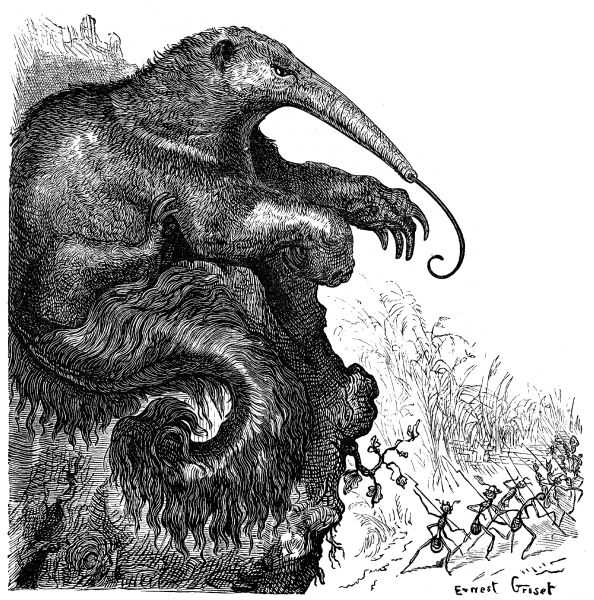
"a little ant-eater slowly uncoiling itself." (p. 210).