Chapter XV · —A MYSTERIOUS MATTER.
Reading edition
E lsie was beside herself with rage. She had not naturally a very even temper, but never in her life had she felt in such a passion. Directly her two companions loosed their hold upon her she jumped up, and struck the door of the carriage, screaming loudly, "Let me out! let me out!" She caught hold of the wooden framework, and shook it till it rattled again, while Mrs. Donaldson, well knowing it was locked, sat calmly smiling at her impotent wrath.
Then the child turned furiously upon her tormentors. Her passion knew no bounds; she felt as if she could have torn that wicked "fairy mother" to pieces. It was such a fit of passionate rage as blinds reason and takes away the power of thinking—such a mad, ungovernable fury as would have led an older stronger person to some desperate deed.
"she ... struck the door of the carriage" (p. 199)
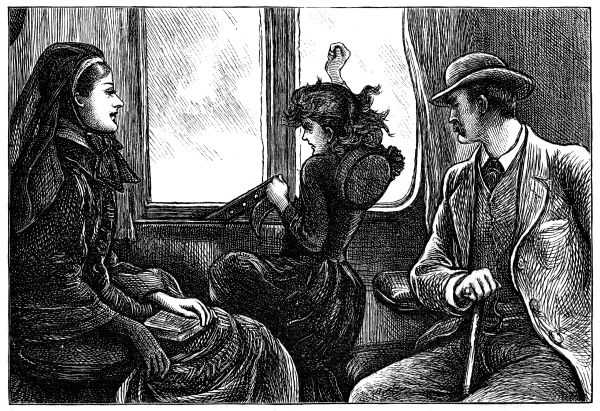
Elsie caught hold of Mrs. Donaldson's arm, and screamed at her. "You bad, wicked thing! let me out! I'll kick you! I'll bite you if you don't! Let me go to Duncan, I tell you, you wicked creature! I'll get out of the window!" and Elsie flew at it, and began tugging away at the strap.
The gentleman took her up in his arms and flung her down on the seat, where Elsie lay screaming and sobbing, and beating the cushions with her hands, grinding her teeth, and flinging herself about like a mad thing.
They let her go on as she would for a time. After a while the gentleman bent over her, and, catching hold of her wrists with the firm grasp of his powerful hands, made her sit upright. "Listen," he said, putting his head close to her face, and looking so ugly and evil that Elsie felt as if she could have struck him; "we have had enough of this. If you are wise you will behave properly, then no harm will come to you. If you make a disturbance, you will bring down upon yourself a fate that you will not like."
It was not so much the words themselves as the menacing way they were hissed in the child's ear that made them so terrible.
But Elsie was not then thinking of herself, and no threat against her took any hold upon her mind. She returned him a sulky glance of defiance, which made him scowl.
Then Mrs. Donaldson came and sat on the other side of Elsie, and began speaking.
"So long as you do what we bid you, your brother is safe," she said, in a voice of quiet decision. "He is quite at our mercy, and will be well cared for, if you are good. Any naughtiness on your part will only injure him. The moment you misbehave he will be turned into the streets, to find his way home as best he can. He will be brought to you in a week if you have not been the cause of his being lost in the meantime."
"I don't believe you," Elsie said sulkily; "you are too far from Duncan to hurt him."
Mrs. Donaldson smiled. "You can do just as you like," she said. "I only warn you. Duncan is in the hands of my people. I can send them a message all the way from London in five minutes, and before you know anything about it they will have done with Duncan whatever I tell them. You forget that I am the 'fairy mother.'"
Then flashed through Elsie's mind something she had heard her mother and granny talking about, which granny would not believe. It was about a wire which took messages all over the world as quickly as you could write them. Her mother had tried to explain it, but granny declared it sounded like some wicked thing done by evil spirits, and she wasn't going to believe it. Elsie was inclined to feel very much like poor old granny, who thought the world was turning topsy-turvy since her young days. But although she could not understand it, Elsie had a dim uneasy feeling that there was too much likelihood of Mrs. Donaldson's words being true ones for her to disregard them.
She could think of nothing else now but Duncan. If any one hurt him, whatever should she do? If only they gave her Duncan back again it seemed as if no trouble would be great.
Mrs. Donaldson's words had brought Elsie to a more reasoning frame of mind. "I will do everything, if you promise me you will fetch Duncan or take me back to him," she said eagerly. "You will take care of him, won't you?" she cried entreatingly. "Promise me nothing bad shall happen to him. You will send a message about what they are to do to him, won't you? but oh! I do wish you would let me go back to him before a week. He will be so frightened and lonely, and perhaps he will call me like he did in the night when he was frightened; and he's never been with strange folk before. He's real timid, too, when people are bad to him, and dursn't say a word, only he's scared like all the time." Elsie could not help crying at the thought of poor Duncan's terror in Sandy Ferguson's cottage, and the way he had hidden it till they were away out of hearing.
Mrs. Donaldson turned away her head uneasily. Something in Elsie's love for her brother had touched a tender chord. It reminded her of a little brother she had loved, and who had died. She had been a different creature in those days, and perhaps for a moment she wished that she were a child again, with the innocent love for her little brother to draw her away from a bad, wicked life. Perhaps the recollection of him made her think for a moment of the life beyond the grave, in which he was peacefully living, but which could only be a terror for her.
But an angry glance from her companion dispelled the passing softness. "You shall both be safe so long as you obey me," she said. "Duncan, I will tell you now, is safe in the hospital. At a word from me Meg will fetch him away. At present he is well tended, with kind doctors and nurses to give him everything he wants, and he will soon be well, for it is only a bad cold he has taken."
Elsie sank back with a sigh of relief. She pictured poor little Duncan lying on a soft white bed, with kind people bending over him, as Mrs. MacDougall had done when she was sick. It brought a great feeling of peace to her mind. She would do anything they wished her, to be sure that Duncan was safe. The only thing that troubled her now was whether Mrs. Donaldson had spoken truly; for children are quick to find out who may be trusted, and Elsie had no faith in either of these two people.
Elsie believed herself that Meg would take Duncan if it depended at all upon her, for although her behaviour had been strange, Elsie could not forget her kindness in the night, when there had been no one near. Nothing would ever make Elsie think that it was not true and genuine. It was, indeed, her faith in Meg's goodness that was her one consolation. She clung to that much more than to all Mrs. Donaldson's statements.
Presently the train stopped. "Uncle William" came, and sat very close to Elsie on one side, Mrs. Donaldson on the other, and each took one of her hands with an appearance of great affection. Elsie sat perfectly still. She had no intention of making any more disturbance. If Duncan's safety depended on her being quiet, no mouse should be more quiet than she was.
Mrs. Donaldson seemed pleased. "I see you are a sensible little girl," she said. "Now, you must mind what I tell you. Remember, I shall not tell you when I send the message, but directly you are troublesome it will go. I may not tell you till the week is gone; but you may feel quite sure that it will not be sent unless you disobey or are naughty. Do you quite understand?"
Elsie replied that she did, and Mrs. Donaldson continued—
"Do not mention Duncan again, not even to me when I am quite alone. He is always Donald."
"I will not forget," Elsie replied.
"And you will have no Uncle William when you get to London. This gentleman is your Grandpapa Donaldson. Now, I have seen that you are clever enough when you choose. Do not forget."
The train had again started on its way, and was rushing along at a tremendous rate, being an express. Mrs. Donaldson had got Elsie's hand in hers, and had kept the child's attention fixed upon herself. The gentleman was now seated in another corner. When Elsie next turned her head towards him, he had utterly changed. In the place of a dark-looking man with a small moustache was an elderly gentleman, with a face quite bare, except for some small grey whiskers and a bald head. He was lounging back most unconcernedly in the carriage, looking through his spectacles at the objects so swiftly flying past them.
Elsie uttered an exclamation of wonder. "A real fairy has been at work, you see, Effie," Mrs. Donaldson said laughingly.
"Hey, what, my dear?" the old gentleman said, bending over as if a little deaf. "Did you speak?"
"Effie wants to know where her uncle William has gone," Mrs. Donaldson shouted.
"Uncle William? what, has she got an uncle William, Mary? Who is he? Here Effie, my dear, will you have a bun?"
Elsie went over to him in a state of the most complete bewilderment, and took from him the tempting bun that he held out to her. As she did so she had a good look at him. Certainly it was not the same person who had called himself Uncle William.
His face was quite changed. In place of the black hair was a small fringe of iron grey locks. This man was years older. His very coat was a different colour.
"Won't you give grandpapa a kiss for that nice bun?" the old gentleman said in a quavering old voice. Elsie went timidly, and gave him a small hasty kiss on the cheek.
He caught hold of her, and made her do it over again. "What, you puss!" he cried, "are you frightened of grandpapa, who gives you all the nice things? Dip your hand in my bag, and take out what you like."
He opened a small black valise, and disclosed delicious fruits and cake. Elsie drew forth a large mellow pear. "If Duncan could have it," she thought as she bit a juicy mouthful.
"Do you like grandpapa better than Uncle William?" Mrs. Donaldson whispered in her ear.
"I do not know," Elsie answered; "but I couldn't dislike him any more," she added, with a little shudder.
Mrs. Donaldson laughed most good-humouredly. "Then you must like him better," she said, "and that is a good thing. Grandpapas are always kind, you know. Go and talk to yours, but you must speak loud, because he is getting a little deaf."
Elsie obeyed. The old gentleman looked round, and smiled. It was a very gracious smile, but somehow not one that Elsie liked. "That's right, come and talk to grandpapa," he said. "Can you read nicely? Here is a pretty book with pictures, out of a fairy pocket grandpapa keeps for his children." As he spoke he drew out a book in most brilliant binding of scarlet and gold. It was full of pictures, and altogether charming. Elsie grew more and more bewildered.
What had become of that dreadful man who had hissed his threats in her ear? He had quite vanished; there was no doubt about that. No one could be more different than this mild old man, who kept on saying kind things in his cracked voice. Elsie, watching him very narrowly, thought she saw something that reminded her of the Uncle William who had so mysteriously disappeared, and wondered whether this might be really his father. Yet that did not make his presence there any the less mysterious.
One effect this incident had on Elsie's mind was to make her stand more than ever in awe of her strange companions. She could not get rid of a half belief that they could do really whatever they liked with both her and Duncan. Although she had not any real faith in their goodness, she had certainly a great dread of their strange power.
The journey was a long one, with few stoppages. The train flew on at a frightful pace through the hill country, where from the windows could be seen the bare bleak peaks of Cumberland, varied with nearer slopes of soft green grass and verdant valleys. On, on through the great grimy towns of the manufacturing counties; on and on through dark tunnels, swinging round curves, over rivers, skirting woods, still rushing on, with an occasional shriek and scream, as of relentless fury; still on and on, long after the day had closed and the stars had begun to twinkle in the sky, till at last the great goal of London was reached.
There is now a gathering together of parcels and packages. The old gentleman, Grandpapa Donaldson, sets them down on the seat, and fumbles at the door. "Why doesn't that idiot unlock it?" he mutters, in a tone that brings strangely to mind the adventure on the lonely road where she first saw the "fairy mother."
"Don't be impatient, father," Mrs. Donaldson exclaims in a wavering voice; and Elsie, looking up at her, sees that her face is pale and her lips tightly set.
She draws a long black veil over her face as she stands waiting. Presently a porter comes. The door is opened. Two men spring into the carriage, and close the door after them.
"The game is up! you are my prisoners!" falls in dreadful tones on poor Elsie's frightened ears.
(To be continued.)