Front matter (continued 7)
Reading edition
"Really, it's our Christian duty to concentrate on the Busy Bee, isn't it?" said Armstrong sardonically. "Well— Can you see Atwater to-night?"
"I'm going direct to his house. But where shall I find you? You said you had an engagement."
Armstrong winced as if a wound had been roughly set to aching. "I'll be here," he said gruffly.
"We might dine together, perhaps? Atwater may be able to come, too."
"No—can't do it," was Armstrong's reply. "But I'll be here from half past eight on."
Trafford, so much encouraged that he was almost serene again, sped away to Atwater's palace in Madison Avenue. The palace was a concession to Mrs. Atwater and the daughters. They loved display and had the tastes that always accompany that passion; they, therefore, lived in the unimaginative and uncomfortable splendor of the upper class heaven that is provided by the makers of houses and furniture, whose one thought, naturally, is to pile on the cost and thus multiply the profits.
But Atwater had part of the house set aside for and dedicated to his own personal satisfaction. With the same sense of surprise that one has at the abrupt transition of a dream from one phantasy to another resembling it in no way except as there is a resemblance in flat contradictions, one passed out of the great, garish, price-encrusted entrance hall, through a door to the left into a series of really beautiful rooms—spacious, simple, solidly furnished; with quiet harmonies of color, with no suggestions of mere ornamentation anywhere. The Siersdorfs had built and furnished the whole house, and its double triumph was their first success. With the palace part they had pleased the Atwater women and the crowd of rich eager to display; with the part sacred to Atwater, they had delighted him and such people as formed their ideas of beauty upon beauty itself and not upon fashion or tradition or outlay. Trafford was shown into a music room where Atwater was playing on the piano, as he did almost every evening for an hour before dinner. It was a vast room, walls and ceilings paneled in rosewood; there were no hangings, except at the windows valances of velvet of a rosewood tint, relieved by a broad, dull gold stripe; a few simple articles of furniture; Boris Raphael's famous "Music" on the wall opposite the piano, and no other picture; a huge vase of red and gold chrysanthemums at the opposite side of the room to balance the painting; Atwater at the piano, in a dark red, velvet house suit, over it a silk robe of a somewhat lighter shade of red, as the room was not heated.
"Business?" he said, pausing in his playing, with a careless, unfriendly glance at Trafford.
"I'll only trouble you a moment," apologized the intruder. His prim, strait-laced appearance gave those surroundings, made sensuous by Boris's intoxicatingly sensuous picture, an air of impropriety, of immorality—like a woman in Quaker dress among the bare shoulders, backs, and bosoms of a ballroom.
"Business!" exclaimed Atwater, rising. "Not in this room, if you please."
He led the way to a smaller room with a billiard table in the center and great leather seats and benches round the walls. "Do you play, Trafford? Music, I mean."
"I regret to say, I do not," replied Trafford.
"Then you ought to get a mechanical piano. Music in the evening is like a bath after a day in the trenches. Try it. It'll soothe you, put you into a better condition for the next day's bout. What can I do for you?"
"I've come about the O.A.D. matter. Atwater, don't you think we might lose more than we stand to gain?"
Atwater concealed his satisfaction. Since his talk with Armstrong, he had been remeasuring with more care that young man's character, and had come to the conclusion that he was entering upon a much stiffer campaign than he had anticipated. Atwater's dealings were, and for years had been, with men of large fortune—industrial "kings," great bankers, huge investors. Such men are as timid as a hen with a brood. They will fight fiercely—if they must—for their brood of millions. But they would rather run than fight, and much rather go clucking and strutting along peacefully with their brood securely about them. To manage such men, after one has shown he knows where the worms are and how they may be got, all that is necessary is inflexible, tyrannical firmness. Their minds, their hearts, their all, is centered in the brood; personal emotions, they have none—that is, none that need be taken into account. Atwater ruled, autocratic, undisputed. Who would dare quarrel with such a liberal provider of the best worms?
But Armstrong's personality presented another proposition. Here was a man with no fortune, not even enough to have roused into a fierce passion the universal craving for wealth. He had a will, a brain, courage—and nothing to lose. And he, still comparatively poor, had succeeded in lifting himself to a position of not merely nominal but actual power. The misgivings of Atwater had been growing steadily. The price of pulling down this man might too easily be far, far beyond its profits. "We shall have to come together for a finish fight sooner or later—if I live," reasoned Atwater. "But this is not the best time I could have chosen. He isn't deeply enough involved. He isn't helpless enough. I'm breaking my rule never to fight until I'm ready and the other fellow isn't."
Instead of answering Trafford's pointed and anxious question, Atwater was humming softly. "I can't get that movement out of my head," he broke off to explain. "I'm very fond of Grieg—aren't you?"
"I know about music only in the most general way. My wife——"
"You let your women attend to the family culture, eh?" interrupted Atwater. "You originally suggested this war on Fosdick and Armstrong. By the way, you heard the news this afternoon? Armstrong has thrown out the whole executive staff of the O.A.D.—at one swoop—and has put in his own crowd."
Trafford leaped in the great leather chair in which his small body was all but swallowed up. "Impossible!" he cried. "Why, such a thing would be illegal."
"Undoubtedly. But—how many years would it be before a court can pass on it—pass on it finally? Meanwhile, Armstrong is in possession."
"That completely alters the situation," said Trafford, in dismay. "Atwater, it would be folly—madness!—for us to go on, if we could make a treaty with Armstrong."
"I don't agree with you," said Atwater, with perfect assurance now that he saw that Trafford would not call his bluff by acquiescing. "Trafford, I'm surprised; you're losing your nerve."
"Using sound business judgment is not cowardice," retorted Trafford. "I owe it to my family, to the stability of business, not to encourage a senseless, a calamitous war."
Atwater shrugged his shoulders. "As you please. I feel that, in this affair, your wishes are paramount. But, at the same time, Trafford, I tell you frankly, I don't like to be trifled with. Nor does Langdon."
"Perhaps Morris and Armstrong might be induced to turn their attention elsewhere—say, to the Busy Bee. Would you not feel compensated by getting control there?"
"Not a bad idea," mused Atwater aloud. "Not by any means a bad idea." He reflected in silence. "If you could arrange that, it would be even better than the plan you ask me to abandon at the eleventh hour."
"Then you agree?" said Trafford, quivering with eagerness.
"If we can get the Busy Bee. I've had an eye on that chap Dillworthy, for some time."
"I am much relieved," said Trafford, rising. His face was beaming; there was once more harmony between his expression and the aggressive, unbending cut of his hair and whiskers.
Atwater looked at him sharply. "You've seen Armstrong," he jerked out.
Trafford hesitated. "I thought," he said apologetically, "it would be best to have a general talk with Armstrong first—just to sound him."
"I understand." Atwater laughed sarcastically. "And may I ask, if it wasn't the news of the upset in the O.A.D., what was it that set you to running about so excitedly?"
Trafford gave a nervous cough. "My wife—you know how refined and sensitive she is— She got wind of the impending scandal, and, being very tender-hearted and also having a horror of notoriety, she urged me to try to find a peaceful way out."
"Petticoats!" said Atwater, with derision, but tolerant.
"Not that I would have—" Trafford began to protest.
"No apology necessary. I comprehend. I've got them in the house."
Trafford laughed, relieved. "The ladies are difficult at times," said he, "but, how would we do without them?"
"I don't know, I'm sure," said Atwater dryly. "I never had the good fortune of the opportunity to try it. What did Armstrong say, when you sounded him? I believe you called it 'sounding,' though I suspect— No matter. What did he say?"
"I think you may safely assume the matter is settled. In fact, Armstrong has shown a willingness to make peace."
"Rather!" said Atwater, edging his visitor toward the door. "Good night," he added in the same breath; and he was rid of Trafford. He went slowly back to the piano, and resumed the interrupted symphony softly, saying every now and then, in a half sympathetic, half cynical undertone, "Poor Dillworthy! Poor devil!"
XXVII
BREAKFAST AL FRESCO
Armstrong sent Neva a prompt telegram of sympathy and inquiry. He got a telegraphed reply—her thanks and the statement that her father was desperately ill, but apparently not in immediate danger. He wrote her about the highly satisfactory turn in his affairs; to help him to ease, he tried to dismiss herself and himself, but at every sentence he had to stem again the feeling that this letter would be read where he was remembered as the sort of person it made him hot with shame to think he had ever been. He waited two weeks; no answer. Again he wrote—a lover's appeal for news of her. Ten days, and she answered, ignoring the personal side of his letter, simply telling how ill her father was, what a long struggle at best it would be to save him. Armstrong saw that nursing and anxiety were absorbing all her time and thought and strength. He wrote a humble apology for having annoyed her, asked her to write him whenever she could, if it was only a line or so.
Two more increasingly restless weeks, and he telegraphed that he was coming. She telegraphed an absolute veto, and in the first mail came a letter that was the more crushing because it was calm and free from bitterness. "In this quiet town," wrote she, "where so little happens, you know how they remember and brood and become bitter. What is past and forgotten for us is still very vivid to him and magnified out of all proportion. Please do not write again, until you hear from me."
Thus, he learned that his worst fears were justified. If she had shown that, in the home atmosphere again, she was seeing him as formerly, he could have protested, argued, appealed. But how strive against her duty to her sick, her dying father whose generous friendship he had ruthlessly betrayed and whose life he had embittered? He debated going to Battle Field and seeing Mr. Carlin and asking forgiveness. But such an agitating interview would probably hasten death, even if he could get admittance; besides, he remembered that Frederic Carlin, slow to condemn, never forgave once he had condemned. "He feels toward me as I'd feel in the same circumstances. I have got only what I deserve." No judgments are so terrible as those that are just.
The state of Armstrong's mind so preyed upon him that it affected even his giant strength and health, and his friends urged him to take a vacation. He worked only the harder, because in work alone could he get any relief whatever from the torments of his remorse and his baffled love. He became morose, given to bursts of unreasonable anger. "Success is turning his head," was the general opinion. "He's getting to be a tyrant, like the others." In some moods, he saw the lessons of gentleness and forbearance in the fate his selfish arrogance had brought upon him; but it is not in the nature of men of strong individuality and unbroken will to practice such lessons. The keener his sufferings, the bitterer, the harder he became. And soon he began to feel that there was nearly if not quite a quittance of the balance between him and the man he had wronged. He convinced himself that, if Neva's father were dead, he could speedily win her. "Meanwhile," he reflected, "I must take my punishment"; and with the stolid, unwhimpering endurance of those whose ancestors have through countless generations been schooled in the fields, the forests, and the camps, he waited for the news that would mean the end of his expiation.
Raphael, taking his walk in Fifth Avenue late one afternoon instead of in Central Park, saw him in a closed motor in the halted mass of vehicles at the Forty-second Street crossing. Boris happened to be in his happiest mood. Always the philosopher, he was too catholic in his interests and tastes to permit disappointment in any one direction or even in many directions to close the other avenues to the joy of life. There were times when he could not quite banish the shadows which the thought of death cast over him—death, so exasperating to men of pride and imagination because, of all their adversaries, it alone cannot be challenged or compromised. But on that day, Boris had only the sense of life, life at its best, with the sun bright and not too warm, with the new garb of nature and of womankind radiantly fresh, and the whole world laughing because the winter had been vanquished once more. As his all-observing eyes noted Armstrong's profile, his face darkened. There was for him, in that profile, rugged, stern, inflexible, a challenge of the basis of his happiness.
In all his willful life Boris had never wanted anything so intensely, so exclusively as he wanted Neva. Every man who falls in love with a woman feels that he is her discoverer, that he has a property right securely based upon discovery. Raphael's sense of his right to Neva was far stronger; it was the creator's sense. Had he not said, "Let there be beauty and light and capacity to give and receive love"? And had not these wonders sprung into existence before his magic? True, the beauty and the light and the power to give and to receive were different both in kind and in degree from what he had commanded. But that did not alter his right. And this Armstrong, this coarse savage who would take away his Galatea to serve in a vulgar, sooty tent of barbaric commerce— The very sight of Armstrong set all his senses on edge, as if each were being assailed by its own particular abhorrence.
That day the stern, inflexible profile somehow struck into him the same chill that always came at the thought of death with its undebatable "must." Yet there was in his pocket, at the very moment, warming his heart like a flagon of old port, a long letter from Neva, a confidential letter, full of friendly, intimate things about herself, her anxieties, her hopes, and fears; and she asked him to stop off on his way to or from his lectures before the Chicago art students. "Narcisse is here," she wrote. "She will be leaving about that time, she says, and if you stop on your way, she and you can go back together. How I wish I could go, too! Not until I settled down here did I appreciate what you—and New York—had done for me. Yet I had thought I did. Do stop off here. It will be so good to see you, Boris."
As he looked at Armstrong's profile, he laid his hand on his coat over the letter and remembered that sentence—"It will be so good to see you." But the shadow would not depart. That profile persisted; he could not banish it.
When he descended from the train at the Battle Field station and saw Neva, with Narcisse beside her in a touring car, he saw that ominous profile, plain as if Armstrong were there, too. This, though Neva's welcome was radiantly bright. "What's the matter, Boris?" cried Narcisse, climbing to the seat beside the chauffeur before Neva could prevent. "Get in beside your hostess and cheer up. You ought to look like a clear sunrise. The lecture was a triumph. I read two whole columns of it aloud to Neva and her father this morning. No cant. No hypocrisy. They agreed with me that your art ideas are like an island in the boundless ocean of flap-doodle."
"My father used to sell bananas from a cart in Chicago," said Boris, "and we lived in the cellar where he ripened them."
Neva glanced at him with quick sympathetic interest. It was the first time he had happened to speak of his origin. "I always thought you were born abroad," said she.
"I think not," replied he. "I really don't know at exactly what point I broke into the world. Those things matter so little. Countries, governments, races—they mean nothing to me. I meet my fellow beings as individuals."
There he caught Neva studying him with an expression so curious that he paused. She forestalled his question by plunging into an animated talk about his lecture. He was well content to listen, enjoying now the surroundings and now the beauty of the woman beside him. Both were wonderfully soothing to him, filled him with innocent, virtuous thoughts, made him envy, and half delude himself into fancying he wished for himself, the joys of somnolescent, corpulent, middle-class life—the life obviously led by the people dwelling in these flower-embedded houses on either side of these shady streets. He sighed; Neva laughed. And he saw that she was laughing at him.
"Well, why not?" he demanded, knowing she understood his sigh. But before she could answer he was laughing at himself. "Still, I like it, for a change," said he. "And—" he was speaking now in an undertone—"with you I could be happy in such a place—always. Just with you; not if we let these stupid burghers in to fret me."
She laughed outright. "I understand you better than you understand yourself," said she. "Change and contrast are as necessary to you as air. If you had to live here, you would commit suicide or become commonplace.... And so should I."
"Not with a husband you loved and children you adored and a home you had created yourself. As the world expands, it contracts; as it contracts, it expands. From end to end the universe is not so vast as such a love."
Neva, coloring deeply and profoundly moved, leaned forward. "I'm sorry you're missing this," said she, lightly to Narcisse. "Boris is sentimentalizing about the vine-clad cottage with children clambering."
"It's about time you quit and came in to settle down," called Narcisse. "A few years more and you'll cease to be romantic. An old beau is ridiculous."
Boris gave Neva a triumphant look. "Narcisse votes yes," said he.
But they were arriving at the house. As the motor ran up the drive under the elms toward the gorgeous masses of forsythia about the entrance steps, Boris's eyes were so busy that he scarcely heard, while Neva explained that her father was too weak to withstand the excitement of visitors—"especially anyone distinguished. We're not telling him you're here. He would feel it his duty to exert himself."
"Distinguished!" he exclaimed. "In presence of these elms and this house built for all time, and these eternal colors, how could mere mortal be distinguished?"
It was not until the next morning that he had a chance to talk with her alone. He rose early and went out before breakfast. He strolled through the woods back of the house until he came to a pavilion with a creek rushing steeply down past it toward Otter Lake. In the pavilion he found Neva with a great heap of roses in her lap, another on the table, another on the bench. On her bright hair was a huge garden hat, its broad streamers of pink ribbon flowing upon her shoulders.
She dropped her shears and watched him with the expression in her eyes that he had surprised there, as they were coming from the station in the motor. "May I ask," said he, "what is the meaning of that look?"
"Did you sleep well?" parried she.
"Without a dream."
"I don't know," replied she—"Let us have breakfast here—you and I.... Washington!" she called.
There rose from a copse below, near the brim of the creek, a small colored boy, barefooted, bareheaded, with no garments but a blue shirt and a pair of blue cotton jean trousers. She sent him off to the house to tell them to bring breakfast. And soon a maid appeared with a tray whose chief burden was a heating apparatus for coffee and milk.
"I've heard you say you detested cold coffee," said Neva. "Your frown when I suggested breakfast out here was premature."
She scattered and heaped the roses into an odorous, dew-sprinkled mat of green and pink and white, in the center of the rustic table. Then she served the coffee. It was real coffee, and the milk was what is called cream in many parts of the world. "Brother Tom has a model farm," she explained. "These eggs were laid this morning."
"So they were," exclaimed Boris, as he broke one. His eyes were sparkling; all that was best in his looks and in his nature was irradiating from him. Her sweet, lovely face, her delicate fresh costume, the sight and odor of the roses, of the forest all round them, the melody of the descending waters, and the superb coffee, crisp rolls, and freshest of fresh eggs— "You criticise me for my appreciation of the sensuous side of life, my dear friend," said he. "But, tell me, is there anywhere anything more delicious, more inspiring than this breakfast?"
"I never criticised you for loving the joys of the senses," cried she. "Never! We are too much alike there."
"What happiness we could have!" exclaimed he. "For do we not know how to make life smooth and comfortable and beautiful, you and I?"
"Only too well," confessed she. "I often think of it. But——"
He waited for her to continue. When he saw that she would not, but was lost in a reverie, he said, "You promised you would think about our going abroad. Have you thought?"
She nodded.
"You will go?"
She slowly shook her head.
"Why not?"
"I want to, but—I can't."
"Why?"
He had paused in buttering a bit of roll. Anyone coming up just then would have thought he was looking at her, awaiting an answer to an inquiry after salt or something like that. She said: "Because I do not love you."
He waved his knife in airy dismissal. "A trifle! And so easily overcome."
"Because I cannot love you, my dear." She looked at him affectionately.
He balanced the bit of bread before his lips. "Not that brotherly look, please," said he. "It—it hurts!" He put the bread in his mouth.
She leaned forward and laid her hand on his. "We are too much alike. You are too subtle, too nervous, too appreciative, too changeable. You would soon cease to fancy you loved me. I—it so happens—have never begun to fancy I loved you. That is fortunate for us both."
"Armstrong!" he exclaimed. And suddenly, despite his ruddy coloring, he suggested a dark Sicilian hate peering from an ambush, stiletto in impatient hand.
"Don't show me that side of you, Boris," she entreated. "Whether it is Armstrong or not, did I not say the fact that I don't fancy I love you is fortunate for us both?"
"You love Armstrong," he insisted sullenly.
"How can you know that, when I don't know it myself?" replied she. "As I told you once before, the only matter that concerns you is that I do not love you." She spoke sharply. Knowing him so well, she had small patience with his childish, barbaric moods; she could not bear pettiness in a man really and almost entirely great. "Will you be yourself?" she demanded, earnest beneath her smiling manner. "How can I talk to you seriously if you act like a spoiled, bad boy? If you'll only think about the matter, as I've been compelled to think about it, you'll see that you don't really love me—that I'm not the woman for you at all. We'd aggravate each other's worst. What you need is a woman like Narcisse."
"You are most kind," he said sarcastically.
"As she told you yesterday, you've got to settle down within a few years or become absurd. And she——"
"It is because of the women I have known that you will not give me yourself," he said. "Oh, Neva, I have never loved but you." And in his agitation he clasped her hands and, dropping into French, cried with flaming eyes, "I adore you. You are my life, the light on my path—my star shining through the storm. You make me tremble with passion and with fear. Neva, my love, my soul——"
She snatched her hands away. She tried to look at him mockingly, but could not.
"Neva, my girl," he said in English again. "Do not wither my heart!"
"Boris," she answered gently, "I've tried to care for you as you wish me to care. I sent for you because I thought I had begun to succeed. But when I saw you again— I liked you, admired you, more than ever, more than anyone. But my dear, dear friend, I cannot give you what you ask. It simply will not yield."
He became calm as abruptly as he had burst into passion. Taking his heavily jeweled and engraved gold cigarette case from his pocket, he slowly extracted a cigarette, lighted it with great deliberation, blew out the match, blew out the lamp of the portable stove. "Why?" he said in a tone of pleasant bantering inquiry. "Please tell me why you do not and cannot love me."
She colored in confusion.
"Do not fear lest you will offend," urged he. "I ask impersonally. Feminine psychology is interesting."
"I'd rather not talk about it."
"Let me help you," he persisted amiably, so amiably that she had to remind herself of the sort of nature she knew he had, to quell a suspicion of treachery under his smoothness. "Because I am too—feminine?" he went on.
She nodded hesitatingly. Then, encouraged by his cynical, good-humored laugh, "Though feminine doesn't quite express it. There isn't enough of the primitive man left in you for a woman of my temperament. You have been superrefined, Boris. You are too understanding, too sympathetic for a feminine woman like me. There are two persons to you—one that feels, one that reasons—criticises—analyzes—laughs. I couldn't for a moment forget the one that laughs—at yourself, at any who respond to the you that feels. I suppose you don't understand. I'm sure I don't."
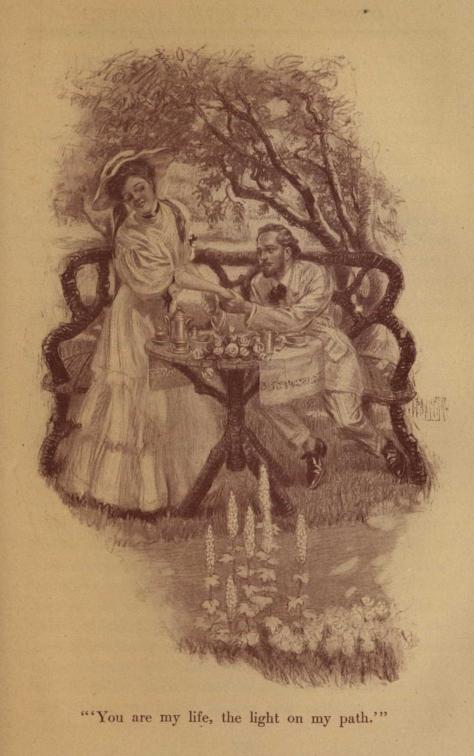
"'You are my life, the light on my path.'"
"Vaguely," said he, somewhat absently. "Who'd suspect it?"
"Suspect what?"
"That there was this—this coarse streak in you—this craving for the ultramasculine, the rude, rough, aggressive male, inconsiderate, brutal, masterful?"
"A coarse streak," she repeated, half in assent, half in mere reflection.
He surveyed impersonally her delicately feminine charms, suggesting fragility even. "And yet," he mused aloud, "I should have seen it. What else could be the meaning of those sharp, even teeth—of the long slits through which your green-gray-brown-blue eyes look. And your long, slim, sensitive lines——"
The impersonal faded into the personal, the Boris that analyzed into the Boris that felt. The appeal of her beauty to his senses swept over and submerged his pose of philosopher. His eyes shone and swam, like lights seen afar through a mist; the fingers that held the cigarette trembled. But, as he realized long afterwards, he showed then and there how right she was as to his masculinity. For, his was the passive intensity of the feminine, not the aggressive intensity of the male; instead of forgetting her in the fury of his own baffled desire and seizing her, to crush her until he had wrung some sensation, no matter what, from those unmoved nerves of hers, he restrained himself, hid his emotion as swiftly as he could, turned it off with a jest—"And I've let my coffee grow cold!" He was once more Boris of the boyish vanity that feared, more than ridicule, the triumph of a woman over him. He would rather have risked losing her than have given her the opportunity to see and perhaps enjoy her power.
Presently Narcisse came into view. The lamp was relighted; the three talked together; he was not alone with Neva again, made no attempt to be.
That afternoon, just before the time for him and Narcisse to depart, Neva took her in to say good-by to her father—a mere shadow of a wreck of a man, whose remnant of vitality was ebbing almost breath by breath. As they came from his room, it suddenly struck Narcisse how profoundly Neva was being affected by her father's life, now that his mortal illness was bringing it vividly before her. A truly noble character moves so tranquilly and unobtrusively that it is often unobserved, perhaps, rather, taken for granted, unless some startling event compels attention to it. Neva was appreciating her father at last; and Narcisse saw what there was to appreciate. No human being can live in one place for half a century without indelibly impressing himself upon his surroundings; Narcisse felt in the very atmosphere of the rooms he had frequented a personality that revealed itself altogether by example, not at all by precept; a human being that loved nature and his fellow beings, lived in justice and mercy.
"How much it means to have a father like yours!" she exclaimed.
Neva did not reply for some time. When she did, the expression of her eyes, of her mouth, made Narcisse realize that her words had some deeper, some hidden meaning: "If ever I have children," she said, "they shall have that same inheritance from their father." And presently she went on, "I often, nowadays, contrast my father with the leading men there in New York. What dreadful faces they have! What tyranny and meanness and trickery! And, how wretched! It is hard to know whether most to pity or to despise them."
Narcisse knew instinctively that she meant Armstrong, and perhaps, to a certain extent, Boris also. "We've no right to condemn them," said she. "They are the victims of circumstances too strong for them."
"You have the right," insisted Neva. "You have been tempted; yet, you are not like them. You have not let New York enslave you, but have made it your servant."
"The temptations that would have reached my weaknesses didn't happen to offer," replied she. And there she sighed, for she felt the ache of her wound—Alois.
But it was time to go. Neva took them to the station; at the parting Boris kissed her hand in foreign fashion, after his habit, with not a hint of anything but self-control and ease at heart and mind, not even such a hint as Neva alone would have understood. She bore up bravely until they were gone; then solitude and melancholy suddenly enveloped her in their black fog, and she went back home like a traveler in a desert, alone and aimless. "He didn't really care," she thought bitterly, indifferent to her own display of selfishness in having secretly and furtively wished for a love that would only have brought unhappiness to him, since, try however hard, she could not return it. "Does anyone care about anyone but himself? ... If I could only have loved him enough to deceive myself. He's so much more worth while than—than any other man I ever knew or ever shall know."
XXVIII
FORAGING FOR SON-IN-LAW
Narcisse had gone to Neva at Battle Field to get as well as to give sympathy and companionship; to get the strength to tread alone the path in which she had always had her brother to help her—and he had helped her most of all by getting help from her. She had assumed that her brother would marry some day; she herself looked forward to marrying, as she grew older and appreciated why children are something beside a source of annoyance and anxiety. But she had also assumed that he would marry a woman with whom she would be friends, a woman in real sympathy with his career. Instead, he married Amy, stunted in mind and warped in character and withered in heart by the environment of the idle rich. She knew that the end of the old life had come; and it was to get away from the melancholy spectacle of her new brother that, two months after his return from the honeymoon, she went West for that visit with Neva.
"Amy has ruined him," she said, when she had been at Battle Field long enough to feel free to open her heart wide. "It's only a question of time; he will give up his career entirely."
And, like the beginning of the fulfillment of her prophecy, there soon came a letter from him which she showed Neva. With much beating round the bush, he hinted dissolution of partnership. It gave Neva the heartache to read, and she hardly dared look at Narcisse. "I'm afraid you were right in your suspicions," she had to admit.
"Certainly I was right," replied Narcisse. "But I'm not really so cut up as you think. Nothing comes unannounced in this world, thank heaven. I've been getting ready for this ever since he told me they were engaged."
"How brave you are!" exclaimed Neva. "I know what you must feel, yet you can hide it."
"I'm hiding nothing," Narcisse assured her. "I've lived a long time—much longer than my birthdays show. I've been making my own living since I was thirteen—and it wasn't easy until the last few years. But I've learned to take life as I take weather. There are sunny seasons, and stormy seasons, and middling seasons. When the sun shines, I don't enjoy it less, but rather more, because I know foul weather is certain to come. And when it does come, I know it won't last forever." There were tears in her eyes, but through them she smiled dauntlessly. "And the sun will shine again—warm and bright and streaming happiness."
Neva's own heart was suddenly buoyant. "It will—it surely will!" she cried.
"And," proceeded Narcisse, "my troubles are trifles compared with Alois's. I know him; I know he's unhappy. If ever there was a man cheated in a marriage, that man is my poor brother. And he must realize it by this time."
She had guessed close to the truth. Alois and his bride had not been honeymooning many weeks before he confessed to himself that he had overestimated—or, perhaps, misestimated—her intellect. Not that she was stupid or ignorant; no, merely, that she lacked the originality he had attributed to her. He had pictured himself doing great work under her inspiration, his own skill supplemented by her taste and cleverness in suggesting and designing. He found that she knew only what he or some book had told her, that her enthusiasm for architecture was in large part one of those amiable pretenses wherewith the female aids the passions of the male to beguile him to her will.
But this discovery did not depress him. No man ever was depressed by finding out that his wife was his mental inferior, though many a man has been pitched headlong into permanent dejection by the discovery of the reverse. She was more beautiful than he had thought, more loving and more lovable—and those compensations more than made good the vanished dream of companionship. Soon, however, her intense affection began to wear upon him. Not that he liked it less or loved her less; but he saw with the beginnings of alarm that he was on the way to being engulfed, that he either must devote himself entirely to being Amy's husband or must expect to lose her. It was fascinating, intoxicating, to be thus encradled in love; but it was not exactly his notion of what was manly.
He talked of the work "they" would do, of the fame "they" would win; she responded with rapidly decreasing enthusiasm, finally listened without comment. Once, when he was expanding upon this subject, with some projected public buildings at Washington as the text, she suddenly threw herself into his arms, and cried, "Oh, let Narcisse take care of those things. We—you and I, dearest—have got only a little while to live. Let us be happy—happy—happy!"
"But you forget, you've married a poor man," he protested. "We've got our living to make."
"Oh—of course," said she. "I'd hate for you to be anything but independent."
"If I were, you'd soon lose respect for me, as I should for myself."
"Yes—you must work," she conceded. "But not too hard. You mustn't crowd me aside." She clasped her arms more tightly about his neck. "I'd hate you, if you made me second to anybody or anything. I'm horribly jealous, and I know I'd end by hating you."
The way to reassure her, for the moment, was obvious and easy; and he took it. They talked no more of "our" work until they got back to New York. There, it was hard for him to find time to go to the office; for she was always wanting him to do something with her, and as luck would have it, the things he really couldn't get out of doing without offending her always somehow came in office hours. Sometimes he had a business appointment he dared not break; he would explain to her, and she would try to be "sensible." But she felt irritated—was he not her husband, and is not a husband's first duty to his wife?
"Why do you make so many appointments just when you know I'll need you?" she demanded. "I believe you do it on purpose!"
He showed her how unreasonable this was, and she laughed at herself. But her feeling at bottom was unchanged. After much casting about for some one to blame for this, to her, obvious conspiracy to estrange her husband from her, she fixed upon Narcisse. "She hates me because I took him away from her," she thought; and when she had thought it often enough, she was convinced. Yes, Narcisse was trying to drift them apart. And she ought to be doubly ashamed of herself, because what would the firm of A. & N. Siersdorf amount to but for Alois? Narcisse was, no doubt, clever in a way—but almost anybody who had to work and kept at it for years, could do as well. "Why, I, with no experience at all, did wonders down at Overlook—better than Narcisse ever did anywhere." Indeed, had Narcisse really ever done anything alone? "She has been living off Alois's brains, and she's trying to get him back."
That was all quite clear; also, a loving and watchful wife's duty in the circumstances. She gave Alois no rest until he had agreed to break partnership and take offices alone. "When you've got your own offices," she cried, "what work we shall do! You must go down early and stay late, and I'll have an office there, too."
So weak is man before woman on her knees and worshipful, Alois began dimly to believe that his wife was, in a measure, right; that Narcisse had been something—not much, but something—of a handicap to his genius; that her prudence and everyday practicality had chained down his soaring imagination. He had no illusions as to the help Amy would give him; there, she had not his vanity to aid her in deluding him. But he felt he owed it to himself to free himself from the partnership. Anyhow, something was wrong; something was preventing him from doing good work—and it was just as well to see if that something was his sister. "The sooner I discover just what I am, the better," he reasoned. And he had no misgivings as to the event.
Narcisse made the break easy for him. When she came back from Neva's, she met him in her usual friendly way, and herself opened the subject. "I think we'd better each go it alone," said she, as if she had not penetrated the meaning of his letter. "You've reached the point where you don't want to be bothered with the kind of things I do best. What do you say?"
"I had thought of that, too," confessed he. "But I— Do you really want it, Cis?"
"No sentiment in business," replied she in her most offhand manner. "If each of us can do better alone, it'd be silly not to separate. Anyhow, where's the harm in trying?"
"I was going to suggest that we take offices a little further uptown," he went on. "We might do that, and keep on as we are for a while."
"No. You move; let me keep these offices. I'm like a cat; I get attached to places."
And so it was settled. "Narcisse Siersdorf, Builder," appeared where "A. & N. Siersdorf, Builders," had been. "Alois Siersdorf, Architect," appeared upon the offices, spacious and most imposing, in a small but extravagantly luxurious bank building in Fifth Avenue, within a few blocks of home—"home" being Josiah Fosdick's house.
Amy insisted on their living "at home" because her father couldn't be left quite alone; and Alois sat rent and food free; he had made a vigorous fight for complete independence in financial matters, but nothing had come of it—he felt that it was ridiculous solemnly to give Amy each month a sum which would hardly pay for her dresses. "You are too funny about money," she said. "Why attach so much importance to it? We put it all in together, and no doubt some months you pay more than our share, other months less—but what of that? You can't expect me to bother my head with horrid accounts. And I simply won't have you talking such matters with the housekeeper—and who else is there?"
Alois grumbled, but gradually yielded. He consoled himself with the reflection that presently his business would pay hugely, and then the equilibrium would be restored. And after a while—an extremely short while—he thought no more about the matter. This, in face of the fact that the business did not expand as he had dreamed. He was offered plenty to do at first, for he had reputation and the rich were eager for his services. But he simply could not find time to attend to business; he had to leave everything, even the making of plans, to assistants. There were all sorts of entertainments to which he must go with Amy—rides, coaching expeditions, luncheons, afternoon bridge parties, week-end visits. And often he was up until very late at balls; she loved to dance, and he found balls amusing, too. Indeed, he was well pleased with all the gayety. Everybody paid court to him; the husband of an heiress, and a distinguished, a successful, a famous man, one whose opinions in professional matters were quoted with respect. And as everybody talked and acted as if he were doing well, were rising steadily higher and higher, he could not but talk and act and feel so, himself—most of the time. He knew, as a matter of theory, that success of any kind, except in being rich, and that exception only for the enormously rich, is harder to keep than to win, must be won all over again each day. But in those surroundings he could not feel this; he seemed secure, permanent.
It was not long before all their world, except only her and him, knew he had practically given up the profession of architect for that of husband. The outward forms of deference to the famous young architect deceived him, enabled him to deceive himself; but his friends, in his very presence, and just out of earshot, often in undertones at his father-in-law's table, were sneering or, what is usually the same thing, moralizing. "Poor Siersdorf! How he has fagged out. Well, was there as much to him as some people said? And they tell me he is living off his wife."
When matters reach this pass, and when the man is really a man, the explosion is not far off. It came with the first bitter quarrel he and Amy had. She wished him to go away with her for two months; he wished to go, and it infuriated him against himself that he had so far lost his pride that he could even consider leaving his business when it needed him imperatively. He curtly refused to go; by degrees their discussion became a wrangle, a quarrel, a pitched battle. She was the first completely to lose control of temper. She cast about for some missile that would hit hard.
"What does this business of yours amount to, anyhow?" she jeered. "Sometimes, I can't help wondering what would have become of you if you hadn't married me."
She didn't mean it; she was hardly conscious that she was saying it until the words were out. She grew white and shrank before the damage she knew she must have done. He did not, could not, answer immediately. When he did, it was a release of all that had been poisoning him for months.
"You think that, do you?" he cried. "I might have known! You dare to think that, when you are responsible!"
"That's manly," she retorted, eager to extricate herself by putting him in the wrong.
He strode to her; he was shaking with fury. "We'll not talk about what's manly or womanly. Let's look at the facts. I loved you, and you took advantage of it to ruin my career, to make it impossible for me to work, to drive away my clients. You have taken my reputation, my brain, my energy. And you dare to taunt me! Men have killed women for less."
"Alois!" she sobbed. "Don't frighten me. Don't look—speak—like that! Oh, I'm not responsible for what I say. I know I've been selfish—it's all my fault. But what does anything matter except our happiness? Forgive me. You know why I'm so bad tempered now—so different from my usual self." And the sobs merged into a flood of hysterical tears.
The reference to her condition, to their expectations, softened him, caused his anger at once to begin to change into bitter shame, a shame to be concealed, to eat, acidlike, in and in and make a wound that would never heal, but would grow in venom until it would torture him without ceasing.
"I don't want you to work," she wept. "I want you all to myself. Ah, Alois, some time you'll appreciate my love; you'll realize that love is better than a career. And for you"—sob—"to reproach me"—sob, sob—"when I thought you were as happy as I!" A wild outburst of grief.
And he was consoling her, had her in his arms, was lulling her and himself in the bright waves of the passion which she could always evoke in him, as he in her. Never again did she speak of his dependent position; it always made her flesh creep and chill to remember what she had said. But from that time she was distinctly conscious that he was a dependent—and she no longer respected him. From that time, he clearly recognized his own position. He thought it out, decided to make a bold stand; but he felt he could not begin at once. In her condition she must not be crossed; he must go away with her, since go she must and go alone she could not. He would make a new beginning as soon as the baby was born.
Meanwhile, his office expenses were heavy, and the money he had saved before he was married was gone. He went into debt fast, terrifyingly fast. He borrowed two thousand dollars of Narcisse; he hoped it would last, as usually Amy's bills were all paid by her father. But they were away from Fosdick's house, and she, thinking and knowing nothing about money, continued to spend as usual. He got everything on credit that did not have to be paid for at once; but in spite of all his contriving, when they reached New York again he was really penniless. He went to Narcisse's office; she was out of town. In desperation he borrowed five hundred dollars from his brother-in-law.
Hugo loaned the money as if the transaction were a trifle that was making no impression on him. Like all those who think of nothing but money, he affected to think nothing of it. He noted Alois's nervousness, then his thin and harassed look. "How do Amy and Alois live?" he asked his father.
"Live? What do you mean?" said Josiah. "Why, they're perfectly happy. What put such nonsense in your head?"
"Oh, bother!" exclaimed Hugo. "Certainly they're happy. Amy'd be a fool not to be happy with as decent a chap as he is. I mean, how do they get along about money?"
"He's got a good business," said Fosdick. "You know it as well as I do."
"He used to have," replied Hugo. "But he's too busy with Amy to be doing much else. He's always standing on her dress. And he has no partner."
"I don't know anything about it," said Fosdick. "If Amy needed money, she'd come to me." Fosdick recalled that he had been paying even heavier bills for her since she was married; but he had no mind to speak of it to Hugo, as he did not wish Hugo to misunderstand. "You attend to your own affairs, boy," he continued. "Those two are all right." And he beamed benevolently. He delighted in Amy's happiness, felt that he was entirely responsible for it.
But Hugo was not to be put off. "Believe me, father, Alois is down to bed-rock. He can't speak to Amy about it, or to you. He's a gentleman. It's up to you to do something for him."
"I guess looking after Amy does keep his time pretty well filled up," chuckled the old man, much amused. "I'll fix him a place in the O.A.D.—something that'll give him a good income and not take his mind entirely off his job."
"Why not get Armstrong to make him supervising architect? A big public institution like that ought to pay more attention to cultivating the artistic side. He could think out and carry out some general plan that'd harmonize to high standards all the buildings, especially the dwelling and apartment houses they own in the provinces." Hugo spoke of the O.A.D. as "they" nowadays, though he still thought of it as "we."
"That's a good idea, Hugo, as good as any other. I'll see Armstrong to-day. I oughtn't to have neglected putting Alois on the pay rolls. I'll give him something in the railway, too. We'll fix him up handsomely. He's a fine young fellow, and he has made Amy happy. You don't appreciate that, you young scoundrel, as we of the older generation do." And Hugo had to listen patiently to a discourse on decaying virtue and honor and family life; for, like all decaying men, Fosdick mistook internal symptoms for an exterior and universal phenomenon, just as a man who is going blind cries, "The light is getting dim!"
Fosdick did not forget. Now that his attention was upon the matter, he reproached himself severely for his oversight. "I've been taking care of scores of people, and neglecting my own. But I'll make up for it." He ordered the president of the railway to put Alois on the pay rolls at once with a salary of twelve thousand a year. "You need somebody to supervise the stations. Everybody's going in for art, nowadays, and we want the best. Mail him his first check to-day, with the notice of his appointment."
In the full glow of generosity, he went up to see Armstrong. They were great friends nowadays. Since the peace, not a trace of cloud had come between them; he was careful to keep his hands entirely off the O.A.D.; Armstrong, on his side, gave the Fosdick railway and industrial enterprises the same "courtesies" they had always enjoyed, except that he charged them the current rate of interest, instead of the old special rate.
"Horace," he began, "I suppose you'll soon be organizing the construction department on broader lines. I've come to put in a good word for my son-in-law. I don't need to say anything about his merits as an architect. As you know, there's none better."
"None," said Armstrong heartily. "Anything we want in his line, he'll get."
"Thanks. Thanks. My idea, though, was a little more definite. I was thinking you might want a man to pass on all buildings, plans, improvements. He could raise the value of the company's property—particularly the dwelling and apartment houses."
"That's a valuable suggestion," said Armstrong. "And Siersdorf would be just the man for the place. But will he take it?"
"I think so."
"But he'd have to be traveling about, most of the time. He'd be in the West and South, where we're trying to get back the ground lost in those big exposés. I shouldn't think he'd care for that sort of life."
Fosdick was disconcerted. "I suppose that could be arranged. You wouldn't expect a man of Siersdorf's caliber to go chasing about the country like a retail drummer. He'd have assistants for that, and drawings and pictures and those sort of things could be forwarded to him here."
"That would hardly do," replied Armstrong, like a man advancing cautiously, but determined to advance. "Then, there's the matter of pay. The work would take all of his time, and we couldn't afford much of a salary. I should say the job was rather for some talented young fellow, trying to get a start."
"You'd simply waste whatever money you paid such a man," Fosdick objected with a restraint of tone and manner that astonished himself. "No, what you want is a high-class, a first-class, man at a good salary—a first-class man's salary."
"Say—how much?" inquired Armstrong.
"I was thinking twenty thousand a year—or, perhaps fifteen." The lower figure was an amendment suggested by the tightening of Armstrong's lips.
Armstrong saw the point. What Fosdick was after was a sinecure; a soft berth for his son-in-law to luxuriate idly in; another and a portly addition to the O.A.D's vast family of "fixed charges." "I'd like to oblige you, Mr. Fosdick," said he, with the reluctance of a man taking a new road where the passage looks doubtful and may be dangerous. "And I hate to deprive the O.A.D. of the chance to get Siersdorf's services at what is undoubtedly a bargain. But, as you may perhaps have heard, I'm directing all my efforts to lopping off expenses. I'm trying to get the O.A.D. on a basis where we can pay the policy holders a larger share of the profits we make on their money. Perhaps, later on, I can take the matter up. But I hope you won't press it at present."
The words were careful, the tone was most courteously regretful. But the refusal was none the less a slap in the face to a man like Fosdick. "As you please, as you please," he said hurriedly, and with averted eyes. "I just thought it was a good arrangement all around.... Everything going smoothly?"
"So-so."
"Well, good day."
And he went, with a friendly nod and handshake that did not deceive Armstrong. He drove to the magnificent Hearth and Home Defender building which Trafford and his pals had built for their own profit out of their stealings from millions of working men and women and children of the poorest, most ignorant class. Trafford received his fellow adept in the art of exploiting as Fosdick loved to be received; he did not let him finish his request before granting it. "An excellent idea, Fosdick," he cried. "I understand perfectly. I'll see that we get Siersdorf at once. Would fifteen thousand be too small?"
"About right, as a starter, I should say," was Fosdick's judicial answer. "You see, the thing's more or less an experiment."
"But certain to succeed," said Trafford confidently. "And, of course, we'll accept any arrangements Mr. Siersdorf may make about assistants. We can't expect him to give us all his time. We'll be quite content with his advice and judgment. You've put me under obligations to you."
Fosdick's eyes sparkled. As he went away, he said to himself, "Now, there's a big man, a gentleman, one who knows how to do business, how to treat another gentleman. I must put him in on something good."
And he did.
XXIX
"IF I MARRIED YOU"
When Armstrong saw the announcement of Frederic Carlin's death, he assumed Neva would soon be in New York, to escape the loneliness of Battle Field. He let three weeks pass, after her brief but gentle and friendly answer to his telegram of condolence. Then, he wrote her he was going to Chicago and wished to stop at Battle Field; she replied that she would be glad to see him. He took the first Westbound express—the through limited which, at his request, dropped him at the little town it had always before rushed past at disdainful speed. The respect with which he was treated, the deference of those who recognized him at the station, the smallness and simplicity of the old town, all combined to put the now triumphant and autocratic president of the mighty O.A.D. in the mood to appreciate every inch of the dizzy depth down from where he now blazed in glory to where he had begun, a barefoot boy in jeans, delivering groceries at back doors and alley gates. It was not in Armstrong to condescend; but it is in the sanest of us poor mortals, with our dim sense of proportion and our feeble sense of humor where we ourselves are the joke, to build up a grandiose mood upon less foundation of vanity of achievement than had Armstrong. The mood gave him a feeling of confidence, of conquest impending, as he strode in at the gate beside the drive into the Carlin place a full hour before he was expected. Memory was busy—not by any means altogether unpleasantly—as he went more slowly up the narrow walk to the old square stone house, with its walls all but hidden under the ivy, with its verandas draped in honeysuckle, and its peaceful, dignified foreground of primeval elms. The past was not quite forgotten; but he felt that it was completely expiated. He had paid for his ingratitude, his selfishness, his blindness, his folly—had paid in full, with interest.
He ascended to the veranda before the big oak front doors. The only life in view was a hummingbird flitting and balancing like a sprite among the honeysuckle blooms. The doors, the windows on either side, were open wide; he looked in with the future-focused eyes of the practical man of affairs. His past did not advance from those familiar rooms to abash him. On the contrary his eager gaze entered, searching for his future.
"We must have, will have, a place like this near New York," thought he. "Why not in New York? I can afford it."
He rang several times at long intervals; it was Neva herself who finally came—Neva, all in black and, so it seemed to him, more beautiful than ever. That she was glad, more than glad, at sight of him was plain to be seen in the color which submerged her pallor, in the swift lighting up of her eyes, like the first flash of stars in the night sky. But there was in her manner, as well as in her garb, a denial of the impulse of his impetuous passion; the doubts that had tormented him began to bore into his mood of self-confidence. She took him to the west veranda, with its luminous green curtains of morning-glory. She made him seat himself in the largest and laziest chair there, all the while covering the constraint with the neutral conversation which women command the more freely, the more difficult the situation. When the pause came he felt that she had permitted it, that she was ready to hear—and to speak. The doubts had made such inroads upon his assurance that his tone was less conclusive than he would have liked, as he began:
"Neva, I've come to take you back to New York."
Her expression, her manner brought vividly back to him that crucial talk of theirs at the lake shore. Only, now the advantage was wholly with her, where then it had been so distinctly on his side that he had pitied her, had felt almost cowardly. He looked at her impassive face, impossible to read, and there rose in him a feeling of fear—the fear every man at times has of the woman into whose hands his love has given his destiny.
"Everything is waiting on you," he went on. "The way lies smooth before us. You have brought me good fortune, Neva. My future—our future—is secure. With you to help me I shall go to the top. So—come, Neva!" And his heart filled his eyes.
She waited a moment before answering. "If we should fail this time, it would be the end, wouldn't it?" she said.
"But we can't fail!" he protested. He was strong in his assurance once more; did not her question imply that she loved him?
"We failed before, and we were younger and more adaptable."
"But now we understand each other."
"Do we?" she said, her eyes gravely upon him.
"How can you ask that!"
"Because so much depends on our seeing the truth exactly. The rest of our lives is at stake."
"Yes. I can't go on without you. Can you go on without me?"
"Each of us," she replied, "can go on without the other. I can paint pictures; you can make money. The question is, what will we mean to each other if we go on together? We aren't children any more, Horace. We are a man and a woman full grown, experienced, unable to blind ourselves even in our follies. And we aren't simply rushing into an episode of passion that will rage and die out. If it were merely that, I shouldn't be asking you and myself questions. When the end came, we could resume our separate lives; and, even if our experience had cost us dear instead of helping us, still we could recover, would in time be stronger and better for having had it. But you offer me your whole self, your whole life, and you ask me to give you mine. You ask me to marry you."
He did not understand this; woman meant to him only sex, and the difference between love and passion was a marriage ceremony. He felt that in what she said there lurked traces of the immorality of the woman who tries to think for herself instead of properly selecting a proper man and letting him do the thinking for both. "I love you," said he, "and there's the whole story. Love doesn't reason; it feels."
"Then it ought never to get married," she said. "We tried marriage once on the basis of husband and wife being absolute strangers to each other, and at cross purposes." She paused; he did not suspect it was to steady her constantly endangered self-control. "And," she added, "I shall never try that kind of marriage again. Passion is a better kindler than worldliness, but it is just as poor fuel."
"Neva!" he exclaimed.
"I couldn't be merely your mistress, Horace. I'd want you, and I'd want you to take me, all of me. I'd want it to be our life, and not merely an episode in our life. Can't you see what would come afterwards—when you had grown calm about me—and I about you? Can't you see that you'd turn back to your business and prostitute yourself for money, while I'd turn perhaps to luxury and show and prostitute myself to you for the means to exhibit myself? Don't you see it on every side, there in New York—the traffic in the souls of men and women viler than any on the sidewalks at night—the brazen faces of the men, flaunting their shame, the brazen faces of the women, the so-called wives, flaunting their shame?"
"But you could never be like them," he protested. "Never!"
"As strong women as I, stronger, have been dragged down. No human being can resist the slow, steady, insidious seduction of his daily surroundings."
"I don't understand this at all, Neva," he said, though his ill-concealed anger showed that he did. Indeed, so angry was he that he was almost forgetting his own warnings to himself of the injustice of holding her responsible for anything she said in her obviously unstrung condition. He asked, "What have you to do with that sort of woman?" He hesitated, forced himself to go boldly on. "Why do you compare me to those men? I do not degrade myself."
She did not answer immediately, but looked away across the beds of blooming flowers. When she began again, she seemed calmer, under better control. "All the time I was in New York," she said, "the life there—the real life of money getting and money spending—never touched me personally until toward the last. Then—I saw what it really meant, saw it so plainly that I can't ever again hide the truth from myself. And since I came away—out here—where it's calm, and one thinks of things as they are—where father and the other way of living and acting toward one's fellow beings, took strong hold of me——"
"But, Neva—you——"
"Please, let me finish," she begged, all excitement once more. "It's so hard to say—so much harder than you think. But I must—must—must let you see what kind of woman I am, who it is you've asked to be your wife. As I remember my acquaintances in New York, our friends, do you know what I always feel? I remember their palaces, their swarms of servants, their jewels, their luxuries, the food they eat, the wine they drink, all of it; and I wonder just whose dollar was stolen to help pay for this or that luxury, just who is in want, how many are in want, that that carriage might roll or the other automobile go darting about. You know the men steal it; they don't know from whom, and so they can brazen it out to themselves."
"That is harsh—too harsh, Neva!"
She did not heed his interruption. "They can brazen it out," she went on, "because no one can or will come forward and say, 'Take off that new string of pearls. Your husband stole the money from me to-day to buy it.' He did steal it, but not that day, not directly from one person, but indirectly from many who hardly, if at all, knew they were being robbed. That is what New York has come to mean to me these last few weeks—my New York and yours—the people we know best."
"But we need not know them. Have what friends you please." He took an air of gentleness, of forbearance with her. He reminded himself that she was overwrought by her father's illness and death, that she was not in condition to see things normally and practically; such hysterical ideas as these of hers naturally bred and flourished in the miasmatic soil and atmosphere of the fresh grave.
"Don't you see it?" she cried desperately. "I mean you—Horace—you, that ask me to be your wife."
"Me!" His amazement was wholly genuine.
"Yes—you!" And she lost all control of herself, was seized and swept away by the emotions that had grown stronger and stronger during her father's illness, and since his death had dominated her day and night in her loneliness. The scarlet of fever was in her cheeks, its flame in her eyes.
"Yes, you, Horace," she repeated. "Can't you see I'd be worse than uneasy about everything we bought, about every dollar we spent? When you left me to go downtown in the morning, I'd be thinking, 'Who is the man I love going to rob to-day?' And when you came back at night, when your hands touched mine, I'd be shuddering—for there might be blood on them!" She covered her face. "There would be blood on them. Happiness! Why, I should be in hell! And soon you'd hate me for what I would be thinking of you, would despise me for living a life I thought degrading."
If he had been self-analytic, he would have suspected the origin of the furious anger that surged up in him. "I see!" said he, his voice hard. "If these notions," he sneered, "were to prevail among the women, about all the strongest men in the country would lose their wives."
"That is not the question," she answered, maddened by his manner. "I'm only trying to make you acquainted with me. I don't understand, as I look at it, now that my eyes have opened, how a woman can live with a man who kills hundreds, thousands with his railway, to make dividends, or who lets thousands live in hovels and toil all the daylight hours and half starve part of the year that he may have a bigger income. Oh, I don't know the morals of it or the practical business side of it. And I don't want to know. My instinct tells me it's wrong, wrong. And I dare not have anything to do with it, Horace, or I'd become like those women, those so-called respectable women, one sees driving every afternoon in Fifth Avenue, with their hard, selfish faces. Ah, I see blood on their carriage wheels, the blood of their brothers and sisters who paid for carriage and furs and liveries and jewels. It would be dreadful enough for the intelligent and strong—for men like you, Horace—to take from the ignorant and weak to buy the necessities of life. But to snatch bread and shelter and warmth and education from their fellow beings to buy vanities— It isn't American—it isn't decent—it isn't brave!"
He saw that it would be idle to argue with her. Indeed, he began to feel, rather than to see, that beneath her hysteria there was something he would have to explore, something she was terribly in earnest about. There was a long silence, she slowly calming, he hidden behind the mask of that handsome, rugged face in which strength yielded so little for grace. "Well, what are you going to do about it?" he said unemotionally.
"All I can," she replied. "I can refuse to live that sort of life, to live on human flesh and blood. I know good people do it, people who are better than I. And if it seems right to them, why, I don't judge them. Only, it doesn't seem right to me. I wish it did. I wish I could shut my eyes again. But—I can't. My father won't let me!"
He made a movement that suggested shrinking. But he said presently, "I still don't see where I come in. In our business we don't get money that way."
"How do you get it?" she asked.
He stared, stolid and silent, at the floor.
"You told me once that——"
"In some moods I say things I don't altogether mean.... I don't moon about the miseries I can't possibly cure," he went on. "I don't quibble; I act. I don't criticise life; I live. I don't create the world or make the law of the survival of the fittest; I simply accept conditions I could not change. As for this so-called stealing, even the worst of the big men take only what's everybody's property and therefore anybody's."
"It seems to me," said she, "the question always is, 'Does this property belong to me?' and if the answer is 'No,' then to take it is—" She paused before the word.
"To steal," he said bluntly.
She made no comment. Finally he went on: "Let us understand each other. You refuse to marry me unless I abandon my career, and sink down to a position of no influence—become a nobody. For, of course, I can't play the game unless I play it under the rules. At least, I can think of no way."
"I see I didn't express myself well," she replied. "I've not tried to make conditions. I've simply shown you what kind of woman you were asking to marry you—and that you don't want her—that you want only the part of me that for the moment appeals to your senses. If I had married you without telling you what was in my mind and heart would it have been fair to you?"
He did not answer.
"Would it have been fair, Horace?"
"No," he said—a simple negative.
"You see that you do not want me—that you would find me more, far more, of a drag on your career than I was before—a force pulling back instead of merely a dead weight."
He was looking at her—was looking from behind his impenetrable mask. He looked for a long time, she now meeting his gaze and now glancing away. At last he said, with slow deliberateness: "I see that I came seeking a mistress. Whether I want her as a wife, I don't know. Whether she wants me as a husband—I don't know." He relapsed into thought which she did not interrupt.
When he rose to go, he did not see how she flushed and trembled, and fought down the longing to say the things that would have meant retreat.
"I feel," said he with a faint smile, "like a man who goes down to the pier thinking he is about to take an outing for the day, and finds that if he goes aboard he will be embarked for a life journey into new lands and will never come back. I never before really grasped what marriage means."
She had always been fascinated by his eyes, which seemed to her to contain the essence of all that attracted and thrilled and compelled her in the idea, man. As she stood touching the hand he extended, she had never felt his eyes so deeply; never before had there been in them this manly gentleness of respect and consideration. And her faltering courage took heart.
"I am going back to New York," he said. "I want to look about me."
She looked straight and calm; but, through her hand, he felt that she was vibrating like a struck, tense violin string. "Some men want a mistress when they marry," she went on, smiling-serious, "and some want a housekeeper, and some a parlor ornament, and some a mother for their children. But very few want a wife. And I"—she sighed. "I couldn't do anything at any of the other parts, unless I were also the wife."
"I understand—at last," he said. "Or rather, I begin to understand. You have thought it out. I haven't—and I must."
She hoped he would kiss her; but he did not. He reluctantly released her hand, gave her a lingering look which she had not the vanity or the buoyance rightly to interpret, then gazed slowly round the gardens, brilliant, alluring, warm. She stood motionless and tense, watching his big form, his strong shoulders and forcefully set head as he crossed the gardens, went down the walk and through the gate, to be hidden by the hedge between the lawns and the street. When the last echo of his firm step had ceased in her ears, she collapsed into the chair in which he had sat, and was all passion and tenderness and tears and longings and fears.
"He thinks me cold! He thinks me cold!" she cried. "Oh, Father, why won't You let me be weak? Why can't I take less than all? Why can't I trust him, when I love him so!"
XXX
BY A TRICK
By itself, Armstrong's insult to Fosdick in refusing to "take care of" his son-in-law would have been of small consequence, unpleasant reminder of his shorn power and rude check to his benevolent instincts though it was. Fosdick was not likely, at least soon, to forget his lesson in the wisdom of letting the big Westerner alone. Also, Armstrong was useful to him—not so useful as a tool in the same position would have been; still, far more useful than a representative of some hostile interest. But this insult was the latest and the rashest of a series of similar insults which Armstrong had been distributing right and left with an ever freer, ever bolder hand. While he was "thinking over" Neva's plain talk with him, he, by more than mere coincidence, was experimenting with a new policy which was in the general direction of the one he had adopted as soon as he got control of the O.A.D. It was a policy of "anti-graft"; and once he had inaugurated it, once he had begun to look about him in the O.A.D. for opportunities to stop the plundering, and the pilfering as well, he had pushed on far beyond where he originally intended to halt—as a strong man always does, whatever the course he chooses.
Everyone belongs to some section or class. He may quarrel with individuals in that class, he may quarrel with individuals in another class, or with the whole of it; but he may not break with the whole of his own class. Be he cracksman or financier or preacher or carpenter or lawyer or what not, he must be careful not to get his own class, as a class, against him. If he does, he will find himself alone, defenseless, doomed. Armstrong belonged to the class financier; he had been in finance all his grown-up life. He stood for the idea financier in the minds of financiers, in his own mind, in the public mind. His battles with his fellow-financiers, being within the class lines, had strengthened him, had given him clear title to recognition as a power in finance; he had been like the politician who fights his way through and over his fellow politicians to a nomination or a boss-ship, like the preacher who bears off the bishopric from his rivals, the doctor who absorbs the patronage of the rich, the lawyer who succeeds in the competition among lawyers for the position of chief pander to the plutocratic appetite for making and breaking laws.
But this new policy of Armstrong's was a policy of war on his own class. Cutting down commissions, cutting out "good things," lopping off sinecures, bisecting salaries—why, he was hacking away at the very foundations of the dominance of his class! No privileges, no parasitism, no consideration for gentlemen, no "soft snaps," no ornaments on the pay rolls—where were the profits to come from, the profits that enabled the big fellows to fatten, that filled the crib for their business and social hangers-on? Reform, economy, stoppage of waste, all these were excellent to talk about; and, within limits that recognized the rights of the dominant classes, even might be practiced without offense, especially by a fellow trying to make a reputation and judiciously doing it at the expense of financiers who had lost their grip and so could expect no quarter. But to raise the banner of "anti-graft" for a serious campaign— Anarchy, socialism, chaos!
Armstrong had inaugurated and was pressing a war on his own class. And for whose benefit? Not for his own; he wasn't enriching himself—and therein was a Phariseeism, an effort to pose as a censor of his class, that alone would have made him a suspicious character. He was fighting his own class, was making traitorous, familicidal war for the benefit of the common enemy—the vast throng of the people who hated the upper classes, as everybody knew, and were impudently restless in their God-appointed position of hewers of wood and drawers of water for the financial aristocracy. Were not the people weakening dangerously in reverence for and gratitude to their superiors, the great and good men who provided them with work, took care of their savings for them, supported the church that guarded their souls and the medical profession that healed their bodies, paid all the taxes, undertook all the large responsibilities—and did this truly godlike work, supported this Atlantean burden, in exchange for a trivial commission that brought no benefit but the sorrows of luxury? These were the ignoramuses Armstrong was inflating, these the ingrates he was encouraging. Already he had doubled the dividends of the O.A.D., had made them a seeming rebuke to the other insurance companies. Competition—yes! But not the cutthroat, wicked, ruinous competition that would destroy his own class, its profits and its power. If he were permitted to persist, the clamor for so-called "honesty" might spread from policy holders to stockholders, to wage earners, to the whole mass of the wards of high finance. And they might compel the upper class to grant them more money to waste in drink and in wicked imitation of the luxury of their betters!
Armstrong was expelling himself from his own class—into what? Except in finance, high finance, what career was there for him? He would be like a politician without a party, like a general without an army, like a preacher without a parish, like a disbarred lawyer. His reputation would be gone—for morality is a relative word, and by his conduct he was convincing the only class important to him as a man of action that he had not the morality of his class, that he could not be trusted with its interests. Every era, every race, every class has its own morality, its own practical application of the general moral code to its peculiar needs. The class financier, in the peculiar circumstances surrounding life in the new era, had its code of what was honest and what dishonest, what respectable and what disreputable, what loyal and what disloyal. Under that code his new course was disloyal, disreputable, was positively dishonest. It would avail him nothing, should other classes vaguely approve; if his own class condemned, he was damned.
"A hell of a mess I'm getting into," reflected he, "with trying to play one game by the rules of another." He saw his situation clearly, but he had no disposition to turn back. "All in a lifetime!" he concluded with a shrug. "I'll just see what comes of it. Anything but monotony." To him monotony, the monotony of simply taking in and putting away for his own use money confided to him, was the dullest of lives—and it was beginning to seem the most contemptible—"like going through the pockets of sleepers," said he to himself.
He saw the storm coming. Not that there were any clouds or gusty winds; the great storms, the cyclones, don't come that way. No, his sky was serene all round; everything looked bright, brilliant. But there was an ominous stillness in the air—that dead, dead calm which fills an experienced weather expert with misgivings. Before the great storms that explode out of those utter calms, the domestic animals always act queerly; and, in this case, that sign was not lacking. The big fellows beamed on him, were most polite, most eager for his friendship. Not so the little fellows—the underlings, both in the O.A.D. and in its allied banks and in the institutions of high finance into which Armstrong happened to go. At sight of him they became agitated, nervous, stood aloof, watched him furtively.
But he went his new way steadily, as if he did not know what was impending. It secretly amused him greatly to observe his directors. The new board he had selected was composed of men of substantial fortune, who were just outside high finance—business men, trained in business methods. But they had been agitated by what they had seen and heard and read of the financiers—of the vast fortunes quickly made, of the huge mysterious profits, of the great enterprises where the financier risked only other people's money, and stood to lose nothing if the venture failed, kept all the profits if it succeeded. They longed for these fairylike lands where money grew on bushes and the rivers ran gold. And when they were invited into the directory of the O.A.D., they thought they were at last sweeping through the gates from the real world of business to the Hesperian Gardens of finance. As they sat at the meetings, hearing Armstrong and his lieutenants give accounts of economies and safe investments and profits for the policy holders, each felt like a child who had been led to believe it was going to a Christmas festival and finds that it has been lured into a regular session of the Sunday school. Why, the honor and the director's fees were all there was in it!
Then there were the agents, the officials, the staff of the company, high and low, far and near. To the easy-going, golden days of finance had succeeded these sober days of business. Instead of generosity, free flinging about of the money that came in so easily, there was now the most rigid economy—"regular, damn, pinch-penny honesty," complained Duncan, the magnificent agent at Chicago. "I tell you frankly, Armstrong, I'm going to get out. It isn't worth the while of a man of my ability to work for what the company now allows."
"Sorry to lose you, old man," said Armstrong, "but we can't allow any secret rake-offs."
It was Duncan who precipitated the cyclone. A cyclone at its start is a little eddy of air which happens to be set whirling by a chance twist of a sunbeam glancing from a cloud. Millions of these eddies occur every hour everywhere. Only when conditions are just right does a cyclone result, does the eddy continue to whirl, draw more and more air in commotion, get a forward impulse that increases, until in an incredibly short space of time destruction is raging over the land. The conditions in the O.A.D. were just right. Armstrong was hated by the whole personnel, at home and abroad, and hated as only the man is hated who cuts his fellows off from "easy money." And he had not a friend. Throughout high finance, he was hated and feared; at any moment, as the result of his doings, some other big institution, all other big institutions might have to adopt his policy. Directors, presidents, officials great and small, all the recipients of the profits from the system of using other people's money as if it were your own, regarded him as a personal enemy. When Duncan said to one of his fellow agents, "We must get that chap out," the right eddy had been started.
Within two weeks, Duncan was at the head of an association of agents gathering proxies from the policy holders to oust the Armstrong régime. Duncan and his fellow conspirators sent out a circular, calling attention to the recent rise in the profits to policy holders. "It is evident," said the circular, "that there has been mismanagement of our interests, and that the present powers have been frightened into giving us a little larger part of our own. We ought to have it all! Send your proxies to the undersigned, that the O.A.D. may be reorganized upon an honest, democratic basis. A new broom, a clean sweep!"
Duncan in person came to Armstrong with one of the circulars. "There's nothing underhand about me," said he as he handed it to the president. "Here's our declaration of war."
Armstrong glanced at it, smiled satirically. "You've sent copies to the newspapers also, haven't you?" replied he. "As you couldn't possibly keep the matter secret, I can't get excited about your candor." And he tossed the circular on his desk.
"When you read it, you'll see we're fighting fair," said Duncan.
"I've read it," was Armstrong's answer. "One of my friends among the agents sent me a copy a week ago—the day you drew it up."
Duncan began to "hedge." "I don't want you to have any hard feelings toward me," said he. "All the boys were hot for this thing, and I had to go in with them."
"You were displaced as general Western agent this morning," said Armstrong tranquilly. "I telegraphed your assistant to take charge. I also telephoned him a memorandum of what you owe the company, with instructions to bring suit unless you paid up in three days."
"It ain't fair to single me out this way," cried Duncan. "It's persecution."
"I haven't singled you out," said Armstrong. "I bounced the whole crowd of you at the same time, and in the same way. You charge me with extravagance. Well, you see, I've admitted the charge and have begun to retrench."
Duncan's fat, round face was purple and his brown eyes were glittering. "You think you've done us up," said he, with a nasty laugh. "But you're not as 'cute' as you imagine. We provided against just that move."
"I see that your committee of policy holders to receive proxies are dummies," replied Armstrong. "I know all about your arrangements."
"Then you know we're going to win."
Armstrong looked indifferent. "That remains to be seen," said he. "Good morning."
When Duncan had got himself out of the room, Armstrong laid the circular beside the one he himself had written and sent to each of the seven hundred thousand policy holders. His circular was a straight-forward statement of the facts—of how and why his policy of economy had stirred up all the plunderers of the company, great and small. It ended with a request that proxies be sent direct to him, by those who wished the new order to persist and did not wish a return to the old order with its long-standing and grave abuses. He compared the two circulars and laughed at himself. "Mine's the unvarnished truth," thought he. "But it doesn't sound as probable, as reasonable, as Duncan's lies. If the policy holders do stand by me, it'll be because most people are fools and hit it right by accident. Most of us are never so wrong as in our way of being right. The wise thing is always to assume that the crowd that's in is crooked."
If Armstrong had been a reformer, with the passion to reorganize the world on his own private plan, and in the event of the world's failure to recognize his commission as vice-regent of the Almighty, ready to denounce it as a hopeless case—if Armstrong had been a professional regenerator, those would have been trying days for him. The measures he took that were the most honest and the most honorable were the very measures that made the other side strong. He had weeded out a multitude of grafters and had shown an inflexible purpose to weed out the rest; and so he had organized and made powerful the conspiracy to restore graft. He had attacked the men—the big agents—who were using their influence with the policy holders to enable them to rob freely; and so he had stirred up those traitors still further to cozen their victims. He had cut down the enormous subsidies to the press, had cut off the graft of the great financiers who were the powers behind the great organs of public opinion; and so he had enlisted the press as an open and most helpful ally of the conspirators. The policy holders were told by agents—whom they knew personally and regarded as their representatives—that Armstrong was the "thieving tool of the Wall Street crowd"; the policy holders read in their newspapers that "on the whole the O.A.D. would probably benefit by a new management selected by the body of the policy holders themselves." It was ridiculous, it was tragic. Armstrong laughed, with a heavy and at times a bitter heart. "I don't blame the poor devils," he said. "How are they to know? I'm the damn fool, not they—I who, dealing with men all these years, have put myself in a position where I am appealing from the men who run the people to the people, who always have been run and always will be."
Still, he began to hope against hope, as the proxies rolled in for him—by hundreds, by thousands, by tens of thousands. Most of the letters accompanying the proxies justified his cynical opinion that the average man is never so wrong as when he is right; the writers gave the most absurd reasons for supporting him, not a few of them frankly saying that it was to the best interest of the company to leave the control to the man who was in with the powers of Wall Street! But there were letters, hundreds of them, from men and women who showed that they understood the situation; and, curiously enough, most of these letters were badly written, badly spelled, letters from so-called ignorant people. It was a striking exhibit of how little education has to do with brains. "I've always said," thought Armstrong, "that our rotten system of education is responsible for most of the fools and all the damn fools, but I never before knew how true it was."
And the weeks passed, and the annual meeting and election drew nearer and nearer. Instead of Armstrong's agitation increasing, it disappeared entirely. Within, he was as calm as he had all along seemed at the surface. It was an unexpected reward for trying to do the square thing. He was eminently practical in his morals, was the last man in the world to turn the other cheek, was disposed to return a blow both in kind and in degree. But he knew, also, that the calm he now felt was due to the changed course, could never have been his in the old course.
On the morning of the great day, he stopped shaving to look into his own eyes reflected in the glass. "Old man," said he aloud, "there's much to be said for being clean—reasonably, humanly clean. It begins to have compensations sooner than the preachers seem to think."
As Armstrong entered the splendid assembly chamber of the new O.A.D. building, the first figure his eyes hit upon was that of Hugo Fosdick, entering at the opposite door. To look at him was like hearing a good joke. He was walking as if upon air, head rearing, lofty brow corrugated, eyes rolling and serious, shoulders squared as if bearing lightly a ponderous burden. Of all the trifles that flash and wink out upon the expanse of the infinite, the physically vain man seems the most trivial. The so-called upper classes, being condemned to think about themselves almost all the time, furnish to the drama of life the most of the low comedy, with their struttings and swellings and posings. Those who in addition to class vanity have physical vanity are the clowns of the great show. Hugo was of the clowns—and he dressed the part, that day. He had on a tremendously loud tweed suit, a billycock hat of a peculiar shade of brown to match, a huge plaid overcoat; he was wearing a big, rough-looking chrysanthemum that seemed of a piece with his tie; he diffused perfume like a woman who wishes to be known by the scent she uses. As he drew off his big, thick driving gloves, he gazed grandly around. His eyes met Armstrong's, and his haughty lip curled in a supercilious smile.