Front matter (continued 3)
Reading edition
Usually appreciation is little more than a liking for the person whose ideas we think we understand and share. In Amy's case, there was a good deal of real understanding. She had much natural good taste, enough to learn to share in the amusement of Narcisse and Alois at the silly imitations of old-world palaces her acquaintances were hastening to house themselves in—palaces built for a forever departed era of the human race, for a past people of a past and gone social order; she also saw, when Alois pointed it out to her, the silliness of the mania for antiques which in our day is doing so much to suffocate originality and even good taste. She learned to loathe the musty, fusty rags and worm-eaten woods the crafty European dealers manufacture, "plant," and work off on those Americans who are bent upon the same snobbishness in art education that they are determined to have in the other forms of education. Encouraged by Narcisse and Alois, she came boldly out against that which she had long in secret doubted and disliked. She was more than willing that they should build her a house suitable as a habitation for a human being in the twentieth century—a house that was ventilated and convenient and scientific. And she was giving Alois a free hand in planning surroundings of spontaneous beauty rather than of the kind that pleased the narrower and more precise fancy of a narrower age, to which the idea of freedom of any sort was unknown.
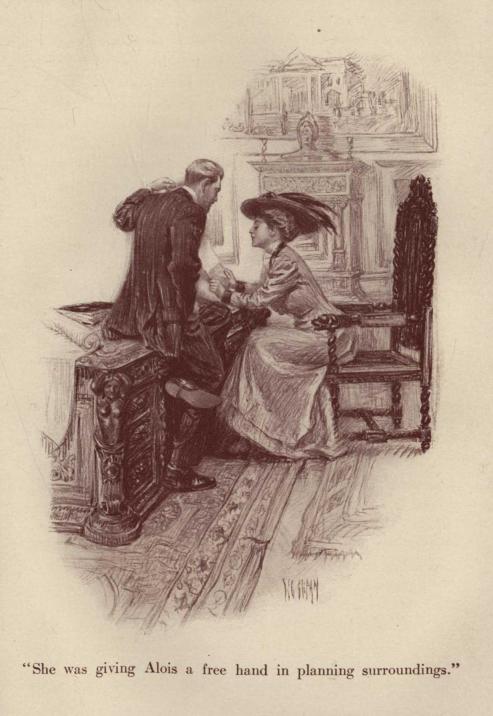
"She was giving Alois a free hand in planning surroundings."
"Gracious! It's after half past four!" she exclaimed, as if she had just become conscious of the fact, when in truth she had been impatiently watching the clock by way of a mirror for nearly an hour.
"So it is!" said Alois, immensely flattered by her unconsciousness of time.
"I want to take these plans with me—to show them to some one."
Alois felt that the "some one" was a man, and a very particular friend—else, she would have spoken the name. "Very well," he said, faintly sullen.
"Don't be disturbed," was her absent reply. "I'll take good care of them." She saw the change in him; but, not thinking of him as a man, but as an intelligence only, she did not grasp the cause. "Thank you so much," she went on, "for being so patient with me. How splendid it must be to have always with one a mind like yours—or Narcisse's. Well, until to-morrow, or next day." And, looking as charming as only a pretty woman with a fortune can look to a man who wants both her and her fortune, she left him desolate.
The "some one" was indeed a man. But he—Armstrong—did not arrive until half an hour after the appointed time. She came into the small salon into which he had been shown, her gloves, hat and wraps on and the big roll of plans under her arm; and no one would have suspected that she had been waiting for him since ten minutes before five and had spent most of the time in primping. "I'm all blown to pieces," she apologized, as she entered. "Have I kept you waiting? I really couldn't help it."
"I just got here," said Armstrong. "I, too, was late—business, as always." Which was true enough; but the whole truth would have been that he forgot the appointment until its very hour. "I'll not keep you long," he continued. "I've got to dress for an early dinner."
She was so disappointed that she did not dare speak, lest she should show her ill humor—and she knew Armstrong detested a bad disposition in a woman. She rang for tea; when the servants had brought it and were gone, she began fussing with her coat. He, preoccupied, did not see her hinted signals until she said, "Please, do help me."
As he drew off the coat there floated to him a delightful perfume, a mingling of feminine and flowers, of freshness and delicacy, a stimulating suggestion of the sensuous refinements which a woman with taste and the means can employ as powerful allies in her siege of man. She looked up at him—her eyes were, save her teeth, her best feature. She just brushed his arm in one of those seemingly unconscious, affectionate-friendly gestures which are intended to be encouraging without being "unwomanly." "How is my friend to-day?" she inquired.
"So-so," replied he, taking her advances at their face value.
"You never come here unless I send for you, and you always have some excuse for going soon."
He smiled good-natured raillery. "How sure of yourself you feel!"
"Why do you say that?"
"Your remark. You are always making that kind of remarks. They're never made except by women who feel sure."
"But I don't," protested she. "On the contrary, I'm very humble—where you're concerned." She gave him a long look. "And you know that's true."
He laughed at her with his eyes. "No. I shan't do it. You'll have only your trouble for your pains."
She colored. "What do you mean?"
"That I won't propose to you. You've been trying to inveigle me into it for nearly a year now. But you'll have to do without my scalp."
The big Westerner's jesting manner carried his remark, despite its almost insolent frankness. Besides, what with Amy's content with herself and partiality for him, it would have been difficult for him to offend her. Never before had she been able to lure him so near to the one subject she wished to discuss with him. "What conceit," cried she, all smiles. "You fancy I've been flirting with you. I might have known! Men always misunderstand a woman's friendship. I suppose you imagine I'm in love with you."
"Not in the least. No more than I with you."
She looked crestfallen at this. Whether a woman has much or little to give a man, whether she wants his love or not, she always wishes to feel that it is there waiting for her. "Why do you imagine I wish you to ask me to marry you?" she asked, swiftly recovering and not believing him.
He did not answer that. Instead he said: "You came very near to getting your way about a year ago. I had about made up my mind to marry you."
"To marry me," she echoed ironically.
"To marry you," he repeated in his attractive, downright fashion.
"Well—why didn't you?"
"I decided I didn't need you," said he, most matter-of-fact. "I saw I'd be repeating the blunder I made when I married before. When I got out of college, I was so discouraged by the prospect, I felt so weak without money or influence, that I let myself drift into a great folly—for it is a folly to imagine that money or influence are of any value in making a career. They're the results of a career, not its cause. Once more, when I faced the big battle here in New York, I was fooled for a while in spite of myself by the same old delusion. I saw that the successful men all had great wealth, and I made the same old shallow mistake of supposing their wealth gave them their success. But I got back to the sensible point of view very quickly."
"And so—I—escaped."
"Escaped is the word for it."
"You are flattering—to-day."
"That sarcasm because I did not so much as speak of your charms, I suppose?"
"You might have said I was personally a little of a temptation."
"Why go into that?" rejoined he, with an intonation that gave her a chance to be flattered, if she chose. "Of course, if I had decided I needed you in my career, I'd have flung myself over ears into love. As it was, don't you think my keeping away from you complimentary?"
This was the nearest he had ever come to an admission that she was attractive to him; she straightway exaggerated it into a declaration of love. Very few women make or even understand a man's clear distinction between physical attraction and love; Amy thought them one and the same.
"You are so hard!" said she. "I wonder at myself for liking you." As she spoke, she rapidly thought it out with the aid of her vanity; men and women, in their relations with each other, always end by taking counsel of vanity. He wanted her; he had taken this subtle means to get within her defenses and, without running the risk of a refusal, find out whether he could get her, whether a woman of her wealth and position would condescend to him. It was with her sweetest, candidest smile that she went on, "Now it is all settled. You don't want to marry me; you aren't in love with me. I need not be afraid of any designs, mercenary or otherwise. At last, we can be real friends."
He reflected, then said with a judicial, impersonal air, "No matter how well a man plays the game of man and man, he usually plays the game of man and woman badly. Why? Because he thinks the conditions are different. He is deceived by woman's air of guilelessness into imagining he has the game all his own way."
"What has that got to do with what I said to you?" asked she, her color a confession that the question was unnecessary.
He again laughed at her with his eyes. "Why did you think it had?"
She pouted. "You are in a horrible mood to-day."
He rose. "Thanks for the hint."
She began to unroll the plans.
"Now, there's the man for you," said he, with a gesture toward her bundle of blue prints.
"Who?"
"Siersdorf."
"If I had to choose, I'd prefer—even you."
"Siersdorf is adaptable and appreciative. He's good to look at, has a good all-round mind, is extraordinary in his specialty. You couldn't do better."
"I don't want him," she cried impatiently. "I prefer to suit myself in marrying." She stood before him, her hands behind her, the pretty face tilted daringly upward. "Are you trying to make me dislike you?"
He looked down at her; there was not a hint in his expression that her dare was a temptation. "I must be going," said he.
Tears gathered in her eyes, made them brilliant, took away much of their natural hardness. "Won't you be friends?" she appealed.
He continued to look straight into her eyes until her expression told him she knew he was not deceived by her maneuverings and strategies. Then he said, "No," with terse directness of manner as well as of speech. "No, because you do not want friends. You want victims."
In sudden anger she flung off her mask. "I am a good hater," she warned. "You don't want me to turn against you, do you?"
His face became sad and somewhat bitter. There had been a time when such a menace from a source so near his career would have alarmed him, would have set him to debating conciliation. But his self-confidence had developed beyond that stage, had reached the point where a man feels that, if any force from without can injure him, the sooner he finds it out, the more quickly he will be able to make a career founded upon the only unshakable ground, his own single strength.
"I've taken a great deal off you," she went on in a menacing tone, a tone intended to remind him that he was an employee. "You ought to be more careful. I'm not all sweetness. I can be hard and unforgiving when I cease to like."
He laughed unpleasantly as vanity thus easily divested itself of its mask of love. "And to cross you is all that's necessary to rouse your dislike."
"That's all," said she. And now she looked like her father in his rare exhibitions of his true self. She had never deceived Armstrong altogether. But he was too masculine not to have lingerings of the universal male delusion that feminine always and necessarily means at least something of sweetness and tenderness.
"Shall we be friends?" she demanded sharply, imperiously. At bottom, she could not believe anyone would stand against the power that gave her a scepter—the power of wealth. "Friends, or—not?"
"As you please," replied he, bowing coldly. And he went, his last look altogether calm, not without a tinge of contempt. He realized that he had come there to put an end to his flirtation with her, to assert his own independence, to free himself from the entanglement which his temporary weakness of the first days in overwhelming New York had led him into. The swimmer, used only to pond or narrow river, is unnerved for a moment when he finds himself in the sea; but if he knows his art, he is soon reassured, because he discovers that no more skill is needed for sea than for pond, only a little more self-confidence.
He was not clear of the house when she was saying to herself, "Hugo is right about him. Father must take him in hand. He shall be taught his place."
XI
AT MRS. TRAFFORD'S
Armstrong felt that he had regained his liberty.
The principal feature of every adequate defense is vigorous attack; and, so long as Amy was pretending to be and was thinking herself his friend, was in fact as much his friend as it was possible for one to be who had been bred to self-worship, Armstrong could take only lame, passive measures against Fosdick. But now— In the oncoming struggle in which he would get no quarter, he need give none. Several times, as he was dressing for dinner, a cynical smile played over his features. What a queer game life was! In other circumstances, that might easily have come about, he and Amy would have plunged into a romantic love affair; they would have been standing by each other against all the world, the stronger in their love and devotion for the opposition. A few words, and off flies her mask of sweetness, so deceptive that it almost deceived herself, and away goes her pretense of friendship; the friends become enemies, liking becomes hate. No real change in either of them; each just as likable as before; yet, what a difference! It amused him. It saddened him. "Probably at this very moment she's edging her father on to destroy me," he thought. But that disturbed him not at all. He had no fear of enemies; he knew that they fling themselves against the gates in vain, unless there are traitors within.
This break with Amy was most opportune. He was dining at the Traffords that evening; he could tell Trafford he would accept without any reservations the long-standing invitation to enter the Atwater-Trafford plot to seize the O.A.D.
Trafford was one of the rising stars in finance. He originated in a village in southern New Jersey where he was first a school teacher, then a lawyer. He spent many years in studying the problem of success—success, of course, meaning the getting of a vast fortune. He discovered that there were two ways to enormous wealth—by seizing an accumulation amassed by some one else; by devising a trap that would deceive or compel a multitude of people to contribute each his mite of a few dimes or dollars. The first way was the quicker, of course; but Trafford saw that the number of multi-millionaires incapable of defending at least the bulk of their wealth was extremely limited, and that, of them, few indeed kept their wealth together so that one swoop could scoop it all. His mind turned to the other way. After carefully examining the various forms of trap, he was delighted to discover that the one that was easiest to use was also the best. Insurance! To get several hundred thousand people to make you absolute trustee of their savings, asking no real accounting; and all you had to do was to keep a certain part of the money safely invested so that, when anybody died, you could pay his heirs about what he had paid you, with simple interest, or less, added. Trafford studied the life insurance tables, and he was amazed that nobody had ever taken the trouble to expose the business. He stood astounded before the revelation that the companies must be earning, on "risks" alone, from ten to thirty per cent, this in addition to what clever fellows on the inside must be doing in the way of speculation; that policy holders got back in so-called dividends less than five, usually less than four, often less than three per cent!
Trafford's fingers twitched. Rich? Why, he would be worth millions!
He made choice among the different kinds of insurance. The object was to get a company that would draw in the greatest number of "beneficiaries" and would have to pay the smallest proportion of "benefits." The greatest number were obviously the very poor; and, by happy coincidence, the very poor could also be exploited more easily and more thoroughly and with less outcry than any other class. So, Trafford made burial insurance his "graft." He would play upon the horror the poor have of Potter's Field.
He began in a small way in Trenton; he presently had several thousand policy holders, each paying ten cents a week to his agent-collectors. As soon as a policy of this kind has run for several months, it is to the advantage of both agent and company for it to lapse. Thus, Trafford's policies, obscurely worded, unintelligible to any but a lawyer, read that the weekly payments must be made at the office of the company; that an omission promptly to pay a single month's dues made the policy lapse; that a lapsed policy had no surrender value. He was too greedy at first, and Trenton was too small a place. When it became "too hot to hold him," he went to New York—New York with its vast, ignorant, careless tenement population, with its corrupt government, with its superb opportunities for floating and expanding a respectable grafting scheme.
If he had stayed in Trenton, he would probably have gone to the penitentiary. But in New York he became ever richer, ever more respectable; he attracted about him a group of eminently respectable sustainers of church and society, always eager to get their noses into a large, new trough of swill. The Home and Hearth Mutual Defense Company soon dwelt in a palace, built at a cost of many millions, every penny of it picked from the pockets of ragged trousers and skirts; Trafford himself dwelt in another and even more costly palace farther uptown, built with the same kind of money. He was a vestryman in the fashionable Church of the Holy Family, a subscriber to all the fashionable charities, an authority on the fashionable theories as to the tenement house question and other sociological problems relating to the slums. And he thought as well of himself as did his neighbors. Was it his business if the company's collectors forgot to be accommodating and to relieve the poor of the necessity of making their payments at the offices? Was it his business if policies lapsed by the thousands, by the tens of thousands, through the carelessness or ignorance of the policy holders? Look at the hundreds of thousands whose funeral expenses were provided by the Home and Hearth! Look at the charities he subscribed to; listen to the speeches in behalf of charity and philanthropy he made! Did he not give the policy holders all that was legally theirs?—at least, all that was rightfully theirs under the accepted business code; certainly, more than the law would have allowed them, if laws could be made so that the good could carry on "practical" business and yet the wicked not get undue license. Trafford had never been a moral theorist. He had accepted the code known as legal morals—"the world's working compromise with utopianism," he sonorously called it. As he expanded financially, he expanded morally; by the time he became a high financier, he was ready for the broader code known as financial morals—wherein allowances are made for all those moral difficulties which the legal code, being of necessity of wider application, cannot take into account.
A fine man was Trafford, with a face that the women and the clergy called "sweet" and "spiritual," with a full gray beard, young eyes, bright blue and smiling, iron-gray hair that waved a little, and the dress of the substantial citizen.
His home life was beautiful.
He had made his first and false start with a school teacher—she had had the first grade in the school where he taught the sixth grade. She was of about his own age, and indolent, and had never heard that a married woman ought to keep herself up to the mark; she was, therefore, old at thirty-two, and he still a mere boy in looks and in feeling. She said rather severe things when he so narrowly escaped disgrace during his apprenticeship at Trenton; they quarreled, they separated.
In the boarding house where he first stopped in New York there was a serious, shrewd, pretty girl, the daughter of the landlady and the niece of one of the high dignitaries of the church. Trafford induced his wife to divorce him—before she discovered how swiftly and luxuriantly he was putting forth bough and leaf in congenial New York. He married the niece of the church dignitary in the parlor of the boarding house; a "most elegant function" it was pronounced by the boarders—and, as they read all the "fashionable intelligence" and claimed kinship with various fashionable people, they ought to have known. The wedding was like the bright dawn of a bright day—a somewhat cool, even frosty day, but brilliant. Neither Trafford nor the second Mrs. Trafford had much affection in them. Who knows, perhaps the marriage was the more cloudless for that. Instead of exploiting each other, as loving couples too often do, they exploited their fellow beings, he downtown, she up. As he grew, she grew. As he became rich, she became fashionable; ten years after that wedding, hardy indeed would have been the person who would have dared remind her that she had once lived in a boarding house.
Conventionally, it is man's chief business to get rich, woman's chief business to keep young looking; the Traffords were nothing if not conventional. Mrs. Trafford appreciated that she lived in a land where beauty in a woman counts more than seventy-five points in the hundred, that she lived in a city where it counts at least ninety points in the hundred. She had no use for her charms beyond mere show—show, the sole purpose of all she did and thought and was. She took herself in hand, after the true New York fashion, at Time's first sign of malice. She had herself cared for from top to toe, and that intelligently—no credulous prey to fake beautifiers was Lily Trafford. When Trafford was fifty-two, though he did not look so much by half a dozen years, his wife was thirty-eight, and looked less than thirty.
Nor had she neglected her other duties as woman and wife. Her husband was rich; she had learned how to spend money. The theory among those who have no money "to speak of," and never had, is that everyone is born with the knowledge how to spend money. In fact, there are thousands who know how to make money where there are ten who know how to spend it. The whole mercantile class fattens on the ignorance of this neglected science—fattens by selling at high prices to those who do not know what they want or how much they should pay. Mrs. Trafford knew exactly what she wanted—she wanted to be fashionable. She had fashion as an instinct, as a passion. She wanted the "latest thing" in mental and material furnishings. She cared nothing for knowledge; she was determined to have culture, because culture was fashionable. She had no ideas of her own, and wanted none; she followed the accepted standards. It was the fashion to go to church; she went to church. It was the fashion to be a little skeptical; she was cautiously skeptical. It was the fashion to live in a palace; in a palace she lived. She went to the fashionable dressmakers and art stores and book stores. She filled her house with things recommended by the fashionable architects. She had the plainest personal tastes in food, but she ate three fashionable meals a day; and, though she loved coffee with cream, took it with hot milk in the mornings and black after lunch and dinner, because cream was unfashionable. Yes, Mrs. Trafford knew how to spend money. The science of spending money is getting what you want at as low a price as anybody can get it. Mrs. Trafford got exactly what she wanted, and got it with no more waste than is inevitable in spending large sums with people who lie awake of nights plotting to get more than they are entitled to.
As Armstrong looked round the salon into which he was shown, it seemed to him he had never seen anything so magnificent or so stiff. Trafford was housed exactly like a king—and, like a king, he had the air of being a temporary tenant of the magnificence about him. It was the typical great house—a crude, barbaric structure, an exhibition of wealth with no individuality, no originality, ludicrous to the natural eye, yet melancholy; for, from every exhibit of how little wealth buys there protrudes the suggestion of how much it has deprived how many. In such displays the absence of price marks is a doubtful concession to canons of taste which in no wise apply; the price mark would at once answer the only question that forms in the mind as the glance roams. The Traffords, however, were as content as royalty in their uncomfortable and unsightly surroundings; they had attained the upper class heaven.
"So glad you could come," said Mrs. Trafford graciously to Armstrong. Her toilet was the extreme of the fashion, and without a glimmer of individual taste. "This is my small daughter." And she smiled up at the thin, pretty young woman beside her in diaphanous white over palest yellow. "We are to be six this evening," she went on. "And Boris is coming—you know Boris Raphael?"
"Never heard of him," said Armstrong.
Miss Trafford smiled broadly. Mrs. Trafford was pained, and showed it—not at her daughter's smile, for it she did not see, but at Armstrong's ignorance of so important a fact in the current fashionable fund of information. Ignorance of literature, science, art, politics, of everything of importance in the great world, would not have disturbed Mrs. Trafford; but ignorance of any of the trivialities it was fashionable to know—what vulgarity, what humiliation! "He is the painter of portraits," she explained. "Everyone has him. He gets really fabulous prices."
"An American?" inquired Armstrong.
"I believe he was born here. But, of course, he has spent his life abroad. We are so commercial. No artist could develop here."
"Is there any place on earth where they don't take all they can get?" asked Armstrong. "Does Raphael refuse 'fabulous prices'?"
Miss Trafford laughed. Mrs. Trafford looked pained again. "Oh—but the spirit is different over there," she replied vaguely.
"Where the men won't marry unless the girl brings a dowry?"
"The customs are different from ours," said Mrs. Trafford, patiently and pleasantly. "Raphael has done me a great honor. He has asked to paint me."
"Naturally, he's on the lookout for all the jobs he can get," said Armstrong, his mind really on his impending treaty with her husband—arranging the articles, what he would give, what demand in exchange. The instant the words were out he realized their inexcusable rudeness. He reddened and looked awkwardly big and piteously apologetic.
Trafford, who had been stroking the huge deerhound on the tiger skin before the fire, now burst in. "What's that about Raphael? Did my wife tell you she has at last persuaded him to paint her picture?"
A miserable silence. Miss Trafford had to turn away to restrain her laughter. Mrs. Trafford became white, then scarlet, then white again.
"The airs he's putting on!" continued Trafford, unconscious. "Why, they tell me his father was a banana peddler and——"
"Mr. Raphael," announced the butler, holding aside one of the ten-thousand-dollar portières.
"Oh—Raphael!" exclaimed Trafford, with enthusiasm.
"So glad you could come," said Mrs. Trafford, gracious and sweet.
"Miss Carlin," announced the butler.
Armstrong, studying Raphael's face, which instantly attracted him, wheeled toward the door at the sound of this name as if he had been shot at from that direction. He might not have been noted, had he not straightway got a far greater shock. In abandon of sheer amazement he stared at the figure in the doorway—Neva, completely transformed in the two years since he saw her. The revolution in her whole mode of life and thought had produced results as striking inwardly as outwardly.
In America, transformations usually cause, at most, only momentary surprise; for almost everyone above the grade of day laborer, and not a few there, changes his environment completely, not once but several times in the lifetime, readjusting himself to his better or worse circumstances. After an interval one sees the man or the woman he has known as poor and obscure; success has come in that interval, and with it all the external and internal results of success. Or, failure has come, and with it that general sloughing away and decay which is the inevitable consequence of profound discouragement; the American, most adaptable of human beings, accepts defeat as facilely as victory.
In Neva's case, however, the phenomenon was somewhat different. It is not often that circumstance drags an obstinately retiring person into activity, breaks the shell and compels that which was hidden to become open, to develop, to dominate. The transformation of Neva seemed somewhat as if a violet had become a tall-stemmed rose; it was, in fact, no miracle of transubstantiation, but one of those perfectly natural marvels, like the metamorphosis of grub into butterfly. Armstrong had seen the chrysalis, all unsuspicious of its true nature; now, with no knowledge of the stages between, he was seeing the ethereal beauty the chrysalis had so securely concealed. It must be said, however, that Boris, though he had seen the day-to-day change, the gradual unfolding of wing and color and grace, was almost as startled as the big, matter-of-fact Westerner. In the evolution of every living thing, there comes a definite moment when the old vanishes and the new bursts forth in full splendor—when bud ceases to be bud and is in a twinkling leaf or bloom, when awkward boy or girl is all at once graceful youth, full panoplied. Neva, knowing she was to see Armstrong that night, had put forth the last crucial effort, had for the first time spread wide to the light her new plumage of body and soul. And there stood in the doorway of Trafford's salon the woman grown, radiant in that luminous envelope which crowns certain kinds of beauty with the supreme charm of mystery.
She paused an instant before Armstrong's stare, which was disconcerting the whole company. In spite of her forewarned self-control, her eyes sparkled and her cheeks flushed; that stare of his was the triumph of which she had dreamed. She came on to her hostess and extended her hand. Mrs. Trafford, who prided herself on being the "complete hostess," equal to any emergency, for once almost lost her head; something in Armstrong's face, in his eyes, raised in her the dread of a scene, and she showed it. But Neva restored her—Neva, tranquil and graceful, a "study in lengths" to delight the least observant eye now, her faintly shimmering evening dress of pale gray leaving bare her beautiful arms and shoulders and neck, and giving full opportunity to the poise of her small head with its bright brown crown of thick, vital hair; and her eyes, gleaming from the long, narrow lids, seemed at once to offer and refuse the delights such words as youth and passion conjure.
"I don't wonder you can't keep from staring," said Miss Trafford in an undertone to Armstrong, with intent to recall him to himself.
With that, he did contrive to get himself together; Mrs. Trafford introduced him to Neva, not without a nervous flutter in her voice. Neva put her hand out to him. "How d'ye do, Horace?" she said, with a faint smile, neither friendly nor cold.
Armstrong took her hand without being able to speak. Mrs. Trafford was about to say, "You have met before," when it occurred to her that this might precipitate the scene. Dinner was announced; she paired her guests—Lona with Armstrong, Neva with Trafford, she herself taking Boris.
"Did you see him stare at her?" she asked, on the way to the dining room.
Boris laughed unpleasantly. "And so should I, in the circumstance," replied he.
"What circumstance?"
"Seeing such a beautiful woman so suddenly," he said, after just an instant's hesitation.
Mrs. Trafford looked shrewdly at him. "Is it a scandal?" she asked, at the same time sending a beaming glance at Armstrong who was entering the door at the other end of the room with her daughter on his arm.
"Not at all," replied Boris.
The dinner went placidly enough. Raphael had been almost as startled as Armstrong when Neva appeared in the door of the salon, though he did not show it. Expert in women's ways, he knew it was for some specific reason that she had thus taken unprecedented pains with her toilet. Why had she striven to outshine herself? Obviously because she wished to punish the man who had so stupidly failed to appreciate her. A perfectly natural desire, a perfectly natural seizing of a not to be neglected opportunity for revenge. Still—Boris could not but wish she had shown some such desire to dazzle him; he would have preferred that she had been absolutely indifferent to the man of whom he often thought with twinges of rakish jealousy. He affected high spirits, was never more brilliant, and helped Neva to shine by giving her every encouragement and chance to talk and talk well.
In contrast to them, Armstrong was morosely silent; occasionally he ventured a glance across the table at Neva, and each time into his face came the expression that suggested he was suspecting his eyes or his mind of playing him a wildly fantastic trick. So far as he could judge, Neva was not at all disturbed by his presence. Raphael went upstairs soon after the women; he refused to be bored with the business conversation into which Trafford had drawn Armstrong.
"Well," said Trafford, the moment Boris was out of the way, "what have you decided to do?"
"I'll go in with you," said Armstrong.
Trafford rubbed his hands and his eyes sparkled—like a hungry circuit rider at sight of the heaping platter of fried chicken. "Good! Splendid!" he exclaimed. He glanced at butler and waiters busy clearing the sideboard; but they took no hints that would delay their freedom, and Trafford did not dare give an order that would put them out of humor and the domestic machinery out of gear. "No matter," said he. "This isn't the time to talk business. We'll arrange the details to-morrow. Or, shall we adjourn to my study?"
"I'll come to you in a few days when I have my plans formed," said Armstrong. "Wait till you hear from me." He tossed his cigar into a plate. "Let's go upstairs. I must leave soon."
Meanwhile, Raphael, in the salon, had bent over Neva and had said in an undertone, "You would like to leave? You can have my cab—it's waiting. I'll take yours when it comes."
"Thanks, no," answered Neva. "I'm not the least in a hurry."
Her tone ruffled him. His ears had been sentinels and his eyes scouts from the instant he knew who Armstrong was and with one expert glance took his measure mentally and physically. He appreciated that the female method in judging men is not at all like the male method, is wholly beyond the comprehension of a man; still, he could not believe that any man of the material, commercial type would attract a sincerely artistic, delicate, spiritual woman like Neva Carlin. He could not, as an expert in mankind, deny to Armstrong a certain charm of the force that in repose is like the mountain and in action is like the river. "But," reasoned he, "she knows him through and through, knows him as he is. For her, he's a commonplace tale that is told."
As Armstrong entered, his glance darted for Neva. It had first to meet Raphael smiling friendlily and suggesting anything but the man on guard, every nerve alert. Armstrong frowned frank dislike. He felt at a disadvantage before this superelegantly dressed and delicately perfumed personage. While he was not without experience with women, he had known only those who had sought him; his expertness was, thus, wholly in receiving advances and turning them to such advantage as suited his fancy, not at all in making overtures or laying siege. He saw at once that Boris was a master at the entire game of man and woman; he recalled Neva's passion for things artistic, her reverence for those great in artistic achievement; despite his prejudice against Boris, he measured him as a man of distinction and force. It seemed to him that this handsome master-painter, so masculine in feature and figure, so effeminately dandified in dress and manner, this fascinating specimen of the artistic sex that is the quintessence of both sexes, must have hypnotized his wife. Yes, his wife! For, now that Neva's revealed personality inspired in him wonder, awe, desire, he began to think of her as his property. He had quit title under a misapprehension; he had been cheated, none the less because the cheater happened to be himself.
Boris, ignoring his unfriendliness, advanced, engaged him, drew in Lona Trafford. Before he could contrive a move toward Neva, Boris had him securely trapped in a far corner of the salon with Lona as his watchful keeper, and was himself retreated in triumph to sit beside Neva. So thoroughly had Boris executed the maneuver, Armstrong was seated at such an angle that he could not even see Neva without rudely twisting away from Miss Trafford. He did not appreciate that he was the victim of a deliberate strategy. But Miss Trafford did; and when she found herself unable to fix his attention, she took a vengeful pleasure in keeping him trapped, enjoying his futile struggles, his ill-concealed wrath, his unconcealed jealousy.
That was a miserable half hour he passed; Lona talked of the painter and Neva—"his latest flame—you know, he's very inconstant—has the most dreadful reputation. Mamma wouldn't let him speak half a dozen words to me, unless she was there. They do say that Miss Carlin is making a saint of him—though, no doubt it's a disguise that'll be thrown off as soon as— I don't admire that sort of man, do you, Mr. Armstrong? I like a simple, honest man—" This with a look that said she regarded Armstrong as such—"a man that doesn't understand feminine tricks and the ways to circumvent women." There her cynical eyes smiled amusement at Armstrong's ruddy, lip-biting jealousy.
"It's rather cold, so far from the fire," said Armstrong, rising.
Lona rose also; she saw that Neva was about to go. "Just a minute," said she. "Miss Carlin is leaving. You can take the sofa as soon as she's out of the way."
Armstrong wheeled, left Miss Trafford precipitately. He was barely in time to intercept Neva, on her way to the door with Trafford. "Good night, Horace," she said. He could only stand and stare. For the first time she looked directly at him, her eyes full upon his. He remembered that in the old days, when their eyes occasionally met thus, hers had made him vaguely uncomfortable; he understood why, now. What was the meaning of this look she was giving him—this look from long, narrow lids, this look that searched him out, thrilled him with longing and with fear? He could not fathom it; he only knew that never before in his entire singly intent, ambitious life had the thought occurred to him that there might be some other worth while game than the big green tables of finance, some other use for human beings than as pawns in that game. She drew her hand away from his confused, detaining grasp, and was gone, leaving him an embarrassed, depressed, ludicrous figure, to be later the jeer of his own sense of humor.
Before Trafford had time to return from escorting her to her cab, Armstrong took leave. A brief silence in the salon; then Mrs. Trafford said to Raphael, "There is some mystery here, which I feel compelled to ask you to explain. You introduced Miss Carlin to me." She noted her daughter listening eagerly. "Lona, you would better go. Good night, my child."
Boris looked the amusement this affectation roused in him. "Don't send her away, Mrs. Trafford. The mystery is quite respectable. Miss Carlin used to be Mrs. Armstrong. As there were no children, she took her own name, when it became once more the only name she was entitled to."
"He divorced her!" exclaimed Mrs. Trafford, rearing. "And you brought her to my house!" She held it axiomatic that no woman would divorce a well-appearing breadwinner of the highest efficiency.
"She divorced him," corrected Raphael.
"I can't believe it," replied Mrs. Trafford. "If she did, he let her, to avoid scandal."
"Not at all," protested Boris. "They come from a state which has queer, sentimental divorce laws, made for honest people instead of for hypocrites. They didn't get on well; so, the law let them go their separate ways—since God had obviously not joined them."
"I must look into it," said Mrs. Trafford, with a frown at Raphael and a significant side glance toward Lona. "People in our position can't afford to——"
"I have the honor to wish you good evening," said Boris with a formal bow. And before she could recover herself, he was gone.
"You have made a mess, mamma!" exclaimed Lona.
Mrs. Trafford seemed on the verge of hysterics. "Was there ever a more unfortunate evening!" she cried. Then: "But he'd not have been so touchy, if there wasn't something wrong."
Trafford came sauntering in and she explained the situation to him. He flamed in alarm and anger, impatiently cut off her explanations with, "You've got to straighten this, Lily. If Armstrong should hear of it, and be offended, it'd cost me—I can't tell you how much!"
Mrs. Trafford looked as miserable as she felt. "I'll send off a note apologizing to Raphael this very night," she said. "And in the morning I'll ask her to the opera. Why didn't you warn me?"
"Warn!" exclaimed Trafford, bustling up and down, and plucking at his neat little beard. "How was I to know? But I supposed you'd understand that we never have anybody—any man—here unless he's of use. It's all very well to be strict, Lily; but——"
"Let's not talk about it," wailed his wife. "I'll do my best to straighten it. I shan't sleep a wink to-night."
Lona—"the child"—slipped away, a smile on her lips—a cynical smile which testified that the lesson in life as it is lived in the full stench of "respectability," had not failed to impress her.
XII
"WE NEVER WERE"
For the first time in Armstrong's career, it was imperative that he concentrate his whole mind; and, for the first time, he could not. In the midst of conferences with Trafford, with Atwater even, his attention would wander; forgetful of his surroundings, he would stare dazedly at a slim, yet not thin, figure, framed in the heavy purple and gold curtains of a doorway—the figure of his former wife, of the recreated Neva, on the threshold of Mrs. Trafford's salon. He had the habit of judging himself impartially, and this newly developed weakness of character, as strange in its way as the metamorphosis of Neva, roused angry self-contempt; but the apparition persisted, and also his inability to keep his thoughts off it.
Passion he understood, but not its compulsion, still less its tyranny. Love—except love of mother and child—he regarded as a myth that foozled only the foolish. He had sometimes thought he would like a home, a family; but a glance at the surface of the lives of his associates was enough to put such sentimentalities out of his head. He saw the imbecilities of extravagance and pretense into which the wife and daughters plunged as soon as the wealth of the head of the family permitted, the follies into which they dragged the "old man"—how, in his own home, just as downtown, he was not a man but a purse. No, Armstrong had no disposition to become the drudge and dupe of a fashionable family. So, in his life he had put woman in what he regarded as her proper place of merest incident. He spent a great deal of time with women—that is, a great deal for so busy a man. He liked women better than he liked men because with them he was able to relax and lower his guard, where with men he always had the sense of the game. For intelligence in women he cared not at all. Beauty and a good disposition—those were the requirements. It was not as at a woman that he looked at this unbanishable figure—not with the longing, thought he, or even the admiration of the masculine for the feminine—simply with wonder, a stupid stare, an endless repetition of the query, Who is it?
His vanity of self-poise was even more hard pressed to explain why he always saw, in sinister background to the apparition of Neva, the handsome, dandified face of Boris, strong, sensual, triumphant. He recalled what Lona Trafford had said of the painter. Yes, that explained it. Neva, guileless, inexperienced in the ways of the world, was being ensnared, all unsuspicious, by this rake. And, even though she might, probably would, have the virtuous fiber to stand out against him, still she would lose her reputation. Already people must be talking about her; so far as he could learn, no woman could associate with Raphael without it being assumed that she was not wasting his time. "The scented scoundrel!" muttered Armstrong. "Such men should be shot like mad dogs." This with perfect sincerity; with not a mocking suggestion that he himself had been as active in the same way as his time and inclination had permitted.
"Really, somebody ought to warn her," was naturally the next step. "What the devil do her people mean by letting her come here alone?" Yes, somebody ought to warn her. Of course, he couldn't undertake the office; his motive might be misunderstood. Still, it ought to be done. But— "Maybe, he's really in love with her—wants to marry her." This reflection so enraged him that he was in grave danger of discovering to himself the truth about his own state of mind. "Why not?" he hastily retorted upon himself. "What do I care? I must be crazy, to spend any time at all in thinking about matters that are nothing to me."
And he ordered the subject out of his mind. He was not surprised to discover that it had not obeyed him. Now, hatred of Boris became a sort of obsession with him. He found in, or imagined into, his memory picture of the painter's face, many repellant evidences of bad character. Whenever he heard Raphael's name, or saw it in a newspaper, he paused irritably upon it; he was soon in the habit of thinking of him as "that damned hound." Nor did this development unsettle his confidence in his freedom from heart interest in Neva; he was sure his antipathy toward the painter was the natural feeling of the normal man toward the abnormal. "Where's the man that wouldn't despise a creature who decks himself out with jewelry and wears rolling collars because he wants to show off his throat, and scents himself like a man-chasing woman?"
The longer he revolved it, the more clearly he saw the necessity that she be warned—and the certainty that his warning would be misunderstood. "I couldn't speak of him without showing my feelings, and women always misinterpret that sort of thing." He looked up her address; and, as he was walking to his hotel from the office in the late afternoon, or was strolling about after dinner, developing his vast and complex scheme to pile high the ruins of his enemies that he might rise the higher upon them, he would find himself almost or quite at the entrance to the apartment house where she lived. "I think I must be going crazy," he said to himself one night, when he had twice within two hours drawn himself from before her door. Then a brilliant idea came to him: "I'll go to see her, and end this. To put a woman out of mind, all that's necessary is to give her a thorough, impartial look-over. Also, in ten minutes' talk with her I can judge whether it would be worth while to warn her against that damned hound."
And at five the very next day he sent up his card. "She'll send down word she isn't at home," he decided.
He was astonished when the boy asked him into the elevator; he was confused when he faced at her door old Molly who had lived with them out in Battle Field. "Step in, sir," she said stiffly, as if he were a stranger, and an unwelcome one. He entered with his head lowered and a pink spot on either cheek. "What the devil am I doing here?" he muttered. "Yes, I'm losing my mind."
He heard indistinctly a man's voice in the room shut off by the curtains at the far end of the hall—evidently she had a caller. He went in that direction. "Is this the right way?" he called, hesitating at the curtain.
"Yes, here," came in Neva's voice. Had he not been expecting it, he would hardly have recognized it, so vibrant now with life.
He entered—found her and Boris. "I might have known he'd be here," he said to himself. "No doubt he's always here."
He ignored Boris; Boris stared coldly at him. "You two have met before?" said Neva, with a glance from one to the other, her eyes like those of a nymph smiling from the dark, dense foliage round a forest pool. "Yes, I remember. Let me give you some tea, Horace."
As she spoke that name, Boris set down his cup abruptly. He debated whether he should defy politeness and outsit the Westerner. He decided that to do so would be doubly unwise—would rouse resentment in Neva, who had had the chance to ask him to spare her being left alone with her former husband and had not; would give him an appearance of regarding the Westerner as an important, a dangerous person. With a look in his eyes that belied the smile on his lips, he shook hands with her. "Until Thursday," he said. "Don't forget you're to come half an hour earlier." And Armstrong was alone with her, was entirely free to give her the "thorough, impartial lookover."
He saw his imagination had not tricked him at Trafford's—his imagination and her dress. The change in her was real, was radical, miraculous, incredible. It was, he realized, in part, in large part, a matter of dress, of tasteful details of toilet—hair and hands and skin not merely clean and neat but thoroughly cared for. This change, however, was evidently permanent, was outward sign of a new order of thought and action, and not the accident of one evening's effort as he had been telling himself. Their eyes met and his glance hastily departed upon a slow tour of the room; in what contrast was it to his own apartment, which cost so much and sheltered him so cheerlessly. "You are very comfortable here," said he. "That, and a great deal more."
"The Siersdorfs built this house," replied she. "They have ideas—especially Narcisse." He thought her wonderfully, exasperatingly self-possessed; his own blood was throbbing fiercely and her physical charms gave him the delicious, terrifying tremors of a boy on the brink of his first love leap.
"What is it that women"—he went on, surprised by the steadiness of his voice, "some women—do to four walls, a floor, and ceiling, and a few pieces of furniture to get a result like this? It isn't a question of money. The more one spends in trying to get it, the worse off he is."
"It seems to me," said she, "that, in arranging a place to live, the one thing to consider is that it's not for show or for company, but to live in—day and night, in all kinds of weather, and in all kinds of moods. Make it to suit yourself, and then it'll fit you and be like you—and those who care for you can't but be pleased with it."
"It does resemble you—here," said he. "And it doesn't suggest a palace or an antique store or a model room in a furniture display, or an auction room.... You work hard?"
His glance had come back to her, to linger on the graceful lines of her throat and slim, pallid neck, revealed by the rounding out of her tea-gown. Never before had he been drawn to note the details of a woman's costume. He would not have believed garments could be surcharged with all that is magnetic in feminine to masculine as was this dress of cream white edged with narrow bands of sable.
"It would be impossible not to work, with Raphael to spur one on," was her reply. Her accent in pronouncing that name gave him the desire to grind something to powder between his strong, white teeth. "The better I know him, the more wonderful he seems," continued she, a gleam in her eyes that would have made a Raphael suspect she was not unaware of the emotion Armstrong was trying to conceal. "I used to think his work was great; but now it seems a feeble expression of him—of ideas he, nor no man, could ever materialize for a coarse sense like sight."
"You don't like his work, then?" said Armstrong, pleased.
Neva looked indignant. "He's the best we have—one of the best that ever lived," exclaimed she. "I didn't mean his work by itself wasn't great, but that it seemed inadequate, compared with the man. When one meets most so-called great men—your great men downtown for example—one realizes that they owe almost everything to their slyness, that they steal the labor of the hands and brains of others who are superior to them in every way but craft and unscrupulousness. A truly great man, a man like Boris Raphael, dwarfs his reputation."
Armstrong suspected a personal thrust, a contrast between him and Boris, and was accordingly uncomfortable. "I'd like to see some of your work," said he, to shift the subject.
"Not to-day. I don't feel in the mood."
"You mean, you think I wouldn't care about it—that I never was interested in that sort of thing."
"Perhaps," she admitted.
He laughed. "There's truth in that." He was about to say, "I'm still just as much of a Philistine as I used to be"; but he refrained—something in her atmosphere forbade reminiscence or hint of any connection whatever between their present and their past.
"You're like Boris in one respect," she went on. "Nothing interests you but what is immediately useful to you."
"He's over head in love with you—isn't he?" Armstrong blurted.
Her face did not change by so much as a shade. She gave not an outward hint that she knew he had rudely flung himself against the barrier between them, to enter her inmost life on his own ruthless terms of masculine intolerance of feminine equality of right. She continued to look tranquilly at him, and, as if she had not heard his question, said, "You don't go out home often?"
The rebuke—the severest, the completest, a woman can give a man—flooded his face with scarlet to the line of his hair. "Not—not often," he stammered. "That is, not at all."
"Father and I visit with each other every few weeks," she continued. "And I take the home paper." She nodded toward a copy of the Battle Field Banner, conspicuous on the table beside him. "Even the advertisements interest me—'The first strawberries now on sale at Blodgett's'—you remember Blodgett, with his pale red hair and pale red eyes and pale red skin, and always in his shirt sleeves, with a tooth-brush, bristle-end up, in his vest pocket? And I read that Sam Warfield and his sister Mattie 'Sundayed' at Rabbit's Run, as if I knew and loved the Warfields."
This connecting of her present self with her past had the effect of restoring him somewhat. It established the bond of fellow-townsmen between them. "I too take the Banner," said he. "It's like a visit at home. I walk the streets and shake hands with the people. I'm glad I come from there—but I'm glad I came."
But he could not get his ease. It seemed incredible, not, as he would have expected, that they were such utter strangers, but that they had ever been even acquaintances. Not the present, but the past, seemed a trick of the imagination upon his sober senses. His feeling toward her reminded him of how he used to regard her when he, delivering parcels from his father's little store, came upon her, so vividly representing to him her father's power and position in the community that he could not see her as a person. While she continued to talk, pleasantly, courteously, as to an acquaintance from the same town, he tried to brace himself by recalling in intimate detail all they had been to each other; but by no stretch of fancy could he convince himself of the truth. No, it was not this woman who had been his wife, who had dressed and undressed before him in the intimacy of old-fashioned married life, who had accepted his embraces, who had borne him a child.
When he rose to go, it was with obvious consciousness of his hands and feet; and he more than suspected her of deliberately preventing him from recovering himself. "She's determined I shan't fail to learn my lesson," he thought, as he stood in the outer hall, waiting for the elevator, and recovering from his awkward exit.
A week, almost to the minute, and he came again. She received him exactly as before—like an old acquaintance. She had to do the talking; he could only look and listen and marvel. "I certainly wasn't so stupid," he said to himself, "that I wouldn't have noticed her if she had had eyes like these, or such teeth, or that form, or that beautiful hair." He would have suspected that she had been at work with the beauty specialists who, he had heard, were doing a smashing business among the women, had he not seen that her manners, her speech, the use of her voice, everything about her was in keeping with her new physical appearance; she had expanded as symmetrically as a well-placed sapling. The change had clearly come from within. There was a new tenant who had made over the whole house, within and without.
What seemed to him miracle was, like all the miracles, mysterious only because the long chain of causes and effects between beginning and end was not visible. There probably never lived a human being to whom fate permitted a full development of all his possibilities—there never was a perfect season from seed-time to harvest. The world is one vast exhibit of imperfect developments, physical, mental, moral; and to get the standard, the perfection that might be, we have to take from a thousand specimens their best qualities and put them together into an impossible ideal—impossible as yet. For one fairly well-rounded human being, satisfying to eye and mind and heart, we find ten thousand stunted, blighted, blasted. Each of us knows that, in other, in more favorable, in less unfavorable circumstances, he would have been far more than he is or ever can be. But for Boris, Neva might have gone through life, not indeed as stunted a development as she had been under the blight of her unfortunate marriage, but far from the rounded personality, presenting all sides to the influences that make for growth and responding to them eagerly. Heart, and his younger brother, Mind, are two newcomers in a universe of force. They fare better than formerly; they will fare better hereafter; but they are still like infants exposed in the wilderness. Some fine natures have enough of the tough fiber successfully to make the fight; others, though they lack it, persist and prevail by chance—for the brute pressure of force is not malign; it crushes or spares at haphazard. Again, there are fine natures—who knows? perhaps the finest of all, the best minds, the best hearts—that either cannot or will not conform to the conditions. They wither and die—not of weakness, since in this world of the survival of the fittest, the fit are often the weak, the unfit the strong. All around us they are withering, dying, like the good seed cast on stony ground—the good minds, the good hearts, the men and women needing only love and appreciation and encouragement, to shine forth in mental, moral, and physical beauty. Of these had been Neva.
Boris, with eyes that penetrated all kinds of human surfaces and revealed to him the realities, had seen at first glance what she was, what she could be, what she was longing and striving to be against the wellnigh hopeless handicaps of shyness and inexperience and solitude. For his own sybarite purposes, material and selfish, from mere wanton appetite, he set his noble genius to helping her; and the creative genius finds nothing comparable in interest to the development of the human plant, to watching it sprout and put forth leaves, blossoms, flowers, perfume, spread into an individuality.
Every day there was some progress; and now and then, as in all nature, there were days when overnight a marvelous beautiful change had occurred. In scores on scores of daily conversations, between suggestions or instructions as to painting, much of the time consciously, most effectively and most often unconsciously, never with patronage or pedantry, he encouraged and trained her to learn herself, the world, the inner meaning of character and action—all that distinguishes fine senses from coarse, the living from the numb, all that most of us pass by as we pass a bank of wild flowers—with no notion of the enchanting history each petal spreads for whoever will read. Boris cleared away the weeds; he softened the soil; he gave the light and the air access. And she grew.
But Armstrong had no suspicion of this. Indeed, if he had been told that Boris Raphael, cynic and rake, had been about such an apparently innocent enterprise, he would have refused to believe it; for the Raphael temperament, the temperament that is soft and savage, sympathetic to the uttermost refinement of delicacy and appreciation, and hard and cruel as death, was quite beyond his comprehension. Armstrong, looking at Neva, saw only the results, not the processes; and he could scarcely speak for marvel, as he sat, watching and listening. "May I come again?" he asked, when he felt he must stay no longer.
"I'm usually at home after five."
Her tone was conventional—alarmingly so. With a pleading gesture of both hands outstretched and a youthful flush and frank blue eyes entreating, he burst out, "I have no friends—only people who want to get something out of me—or whom I want to get something out of. Can't you and I be friends?"
She turned abruptly away to the window. It was so long before she answered that he nerved himself for an overwhelming refusal of his complete, even abject surrender with its apology for the past, the stronger and sincerer that it was implied and did not dare narrow itself to words. When she answered with a hesitating, "We might try," he felt as happy as if she had granted all he was concealing behind that request to be tolerated. He continued in the same tone of humility, "But your life is very different from mine. I feared— And you yourself— I can't believe we were ever—anything to each other."
There was her opportunity; she did not let it slip. She looked straight into his eyes. "We never were," she said, and her eyes piercing him from their long, narrow lids and deep shadowing lashes forbade him ever to forget it again.
He returned her gaze as if mesmerized. Finally, "No, we never were," he slowly repeated after her. And again, "We never were," as if he were learning a magic password to treasures beyond those of the Forty Thieves.
He drew a long breath, bowed with formal constraint, and went; and as he walked homeward he kept repeating dazedly, "We never were—never!"
XIII
OVERLOOK LODGE
Overlook Lodge was Amy's first real success at amusing those interminable hours of hers that were like a nursery full of spoiled children on a rainy day. Every previous device, however well it had begun, had soon been withered and killed by boredom, nemesis of idlers. Overlook was a success that grew. It began tediously; to a person unaccustomed to fixing the mind for longer than a few minutes, the technical part of architecture comes hard. But before many months Overlook had crowded out all the routine distractions; instead of its being a mere stop-gap between them, they became an irritating interruption to its absorbing interest. It even took the sharp edge off her discomfiture with Armstrong; for interest is the mental cure-all. She dreaded a return of her former state, when an empty hour would make her walk the floor, racking her brains for something to do; she spun this occupation out and out. Narcisse Siersdorf lost all patience; the patience of feminine with feminine, or of masculine with masculine, is less than infinite. "We'll never get anywhere," she protested. "You linger over the smallest details for weeks, and you make all sorts of absurd changes that you know can't stand, when you order them."
Narcisse did not comprehend the situation. Who with so much to do that the months fairly flash by, can sympathize with the piteous plight of those who have nothing to do and all the time in the world to do it? Alois was not so unsympathetic. When the Overlook plans were begun, he was away; but, soon after his return, Amy fastened upon him, and presently he had abandoned all other business of the firm to his sister, that he might devote himself to making this work "really great."
"Concentration's the thing," said he to Narcisse, in excusing himself to her—and to himself. "Miss Fosdick has the true artistic spirit. She is willing to let me give full play to my imagination, and she interferes only to help and to stimulate. I feel I can afford to devote an unusual amount of time and thought. When the work is done, it'll be a monument to us."
Narcisse gave him a queer glance, and her laugh was as queer as her eyes. He colored and frowned—and continued to dawdle with Amy over the plans. It was not his fault, nor hers, that the actual work finally did begin; it was the teasing of her father and Hugo about these endless elaborations of preparation. "When Overlook is begun" became the family synonym for never. She and Alois suddenly started the work, and pushed it furiously.
The site selected had nothing to recommend it but a view that was far and away the most extensive and varied in that beautiful part of New Jersey—mountains, hills, plains, rivers, lakes, wildernesses, villages, farms, two cities—a vast sweep of country, like a miniature summary of the earth's whole surface. But Overlook Hill was in itself barren and shapeless. Many times, rich men in search of places where they could see and be seen had taken it under consideration; but always the natural difficulties and the expense had discouraged them. Fosdick had bought the site before investigating; he had been about to sell, when Amy took Narcisse out there. The builder instantly saw, and unfolded to Amy, a plan for making the hill as wonderful in itself as in its prospect; and that original inspiration of hers was the basis of all that was done.
When Amy and Alois did set to work, they at once put into motion thousands of arms and wheels. The day came when the whole hill swarmed with men and carts, with engines and hoisting machines and steam diggers and blasting apparatus; and the quiet valley resounded with the uproar of the labor. Amy took rooms at the little hotel in the village, had them costlily refurnished, moved in with a cook and staff of servants; Alois came out every morning, even Sundays. The country people watched the performance in stupefaction; it was their first acquaintance with the audacities upon nature which modern science has made possible. And presently they saw a rugged cliff rise where there had been a commonplace steep, saw great terraces, slopes, levels, gentle grades, supersede the northern ascents of Overlook. The army of workmen laid hold of that huge upheaval of earth and rock and shaped it as if it had been a handful of potter's clay.
Near the base of the cliff ran the river; barges laden with stone began to arrive—stone from Vermont and from Georgia, from Indiana, from Italy. A funicular clambered up the surface of the cliff; soon its cars were moving all day, bearing the stone to the lofty top of the hill; and there appeared the beginnings of foundations—not of a house alone, but of a dozen buildings, widely separated, and of terraces and lake bottoms and bridges—for a torrent, with several short falls and one long leap, was part of the plans. At the same time, other barges, laden with earth and with great uprooted living trees, arrived in interminable procession, and upon bare heights and slopes now began to appear patches of green, clumps of wood. And where full-grown transplanted trees were not set out, saplings were being planted by the hundreds. As the stone walls rose, sod was brought—acres of grass of various kinds; and creepers and all manner of wild growing things to produce wilderness effects in those parts of the park which were not to be constructed with all the refinements of civilization. These marvels of nature-manufacture were carried on in privacy; for the very first work had been to enclose the hill, from cliff edge round to cliff edge on the other side, with a high stone wall, pierced by only two entrances—one, the main entrance with wrought-iron gates from France, and a lodge; the other, the farm or service entrance, nearer the village and the river.
Amy and Alois had begun as soon as the frost was out of the ground. By June they had almost all the trees planted. The following spring, and the transformation was complete. Overlook Hill, as it had been for ages, was gone; in its place was a graceful height, clad in a thousand shades of green and capped by a glistening white bastionlike building half hid among trees that looked as if they had been there a century at least. Indeed, except the buildings, nothing seemed new, everything seemed to belong where it was, to have been there always. The sod, the tangle of creepers and underbrush on the cliff and in the ravines, the cliff and the ravines themselves, all looked like the product of nature's slow processes. The masonry, the roads, the drives—signs of age and of long use. One would have said that the Fosdicks were building on an old place, a house better suited to modern conditions than some structure, dating from Revolutionary days at least, which must have stood in those venerable surroundings and had been torn down to make room for the new.
"The buildings are going to look too new," said Alois. And he proceeded to have them more artfully weather-stained.
Narcisse had preached the superiority of small houses to Amy until she had convinced her. So, Overlook Lodge, while not so small as it looked, was still within the sane limits for a private house. And the interior arrangements—the distribution of large rooms and less, of sunny rooms, of windows, of stairways, of closets—were most ingenious. No space was wasted; no opportunity for good views from the windows or for agreeable lines, without or within, was neglected. Through and through it was a house to be lived in, a house whose comfort obtruded and whose luxury retired.
In the woodwork, in the finishing of walls and ceilings, in the furniture, Alois followed out the general scheme of the appearance of an old-established residence, a family homestead that had sent forth many generations. Before a stone had been blasted at Overlook, the furniture and the woven stuffs were designed and manufacturing. While the outer walls of the house were finishing, the rooms were beginning to look as if they had been lived in long. There was nothing new-looking anywhere except the plumbing; nothing old-looking, either. The air was that of things created full grown, things which have not had a shiny, awkward youth and could not have a musty, rickety, rotten old age.
There came a day when the last rubbish was cleared, when the last creeper was in leaf, the last flower in bloom, when the grass and the trees seemed green with their hundredth summer, when the settees and chairs and hammocks were on the verandas and porticos as if they had been there for many a year, when no odor of fresh paint or varnish or look of newness could be detected anywhere about the house—and the "work of art" was finished. Alois and Amy, in an automobile, went over every part of the grounds, examined them from without and from within; then they made a tour of the house, noting everything. Changes, improvements, could be made, would be made; but the work as a work was finished. They seated themselves on a veranda overlooking the valley, and listened to the rush of the torrent, descending through the ravines, in banks of moss and wild flowers, to spring from the edge of the cliff. Amy burst into tears.
"You're very tired, aren't you!" said Alois sympathetically. There were tears in his eyes.
"No, that isn't it," she answered, her face hidden—she knew she didn't look at all well when she was crying.
"I understand," said he. "There's something tragic about finishing anything. It's like bringing up a child, and having it marry and go away." He sighed. "Yes, we're done."
"I feel horribly lonely," she cried. "I've lost my occupation. It's the first great real sorrow of my life. I wish we hadn't been in such a hurry! We might have made it last a year or two longer."
"I wish we had!"
"You can't wish it as I do. You will go on and build other houses. You have a career. It seems to me that I've come to the very end."
"You don't realize," he said hesitatingly, "that it was the personal element in this that gave—that gives it its whole meaning, to me. I was working with you and—for you."
He glanced at her eagerly, but with a certain timidity, for some sign that would encourage him. A hundred times at least, in those months when he had spent the whole of almost every day with her, he had been on the point of telling her what was in his heart, why he was so tireless and so absorbed in their task. But he had never had the courage to begin. By what he regarded as a malicious fatality, she had always shifted the conversation to something with which sentiment would not have harmonized at all. Apparently she was quite unconscious that he was a man; and how she could be, when he was so acutely alive to her as a woman, he could not understand. Sometimes he thought she was fond of him—"as fond as a nice girl is likely to be, before the man declares himself." Again, it seemed to him she cared nothing about him except as an architect. Her wealth put around her, not only physically but also mentally, a halo of superiority. He could not judge her as just a woman. He always saw in her the supernal sheen of her father's millions. He knew he had great talent; he was inordinately vain about it in a way—as talented people are apt to be, where they stop short of genius, which—usually, not always—has a true sense of proportion and gets no pleasure from contrasting itself with its inferiors. He would have been as swift as the next man to deny, with honest scorn, that he was a wealth worshiper; and as he was artist enough to worship it only where it took on graceful forms, he could have made out a plausible case for himself. Amy, for example, was not homely or vulgar—or petty. She had good ideas and good taste and concealed the ugly part of her nature as dexterously as by the arrangement of her hair she concealed the fact that it was neither very long nor very thick. Besides, in her intercourse with Alois, there was no reason why any but the best side of her should ever show.
Narcisse gave over trying to make him sensible where Amy was concerned, as soon as she saw upon what he was bent. "He wouldn't think of her seriously if she weren't rich," she said to herself. "But, since he is determined to take her seriously, it's better that he should be able to delude himself into believing he loves her. And maybe he does. Isn't love always nine tenths delusion of some sort?" So, she left him free to go on with Amy, to love her, to win her love if he could. But—could he? He feared not. That so wonderful a creature, one who might marry more millions and blaze, the brightest star in the heavens of fashionable New York, should take him—it seemed unlikely. "She ought to prefer congeniality to wealth," thought he, "but"—with an unconscious inward glance—"it's not in human nature to do it."
As they sat there together in the midst of their completed work, he waiting for some hopeful sign, she at least did not change the subject. "Hasn't what we've been doing had any—personal interest for you?" he urged.
She nodded. "Yes, I owe my interest in it to you," she conceded. But she went on to discourage him with, "We have been such friends. Usually, a young man and a young woman can't be together, as have we, without trying to marry each other."
"That's true," assented he, much dejected. Then, desperately, "That's why I've put off saying what I'm going to say until the work should be done."
"Oh!" she exclaimed. "Don't say it, please—not now."
"But you must have known," he pleaded.
"I never thought of it," replied she with an air of frankness that convinced him.
"Well—won't you think of it—now?"
"Not to-day," was her answer, in the tone a woman uses when she is uncertain and wishes to convince herself that she is certain. She rose and crossed to the edge of the veranda.
In such circumstances, when the woman turns her back on the man, it is usually to signify that she has a traitor within, willing to yield to a surprise that which could not be won by a direct assault; and, had Alois's love been founded in passion instead of in interest, he would not have followed her hesitatingly, doing nothing, simply saying stumblingly: "I don't wish to annoy you. But let me say one thing—Amy—I love you, and to get you means life to me, and not to get you means the death of all that is really me. I think I could make you happy—you who are so interested in what is my life work. It must be our life work."
"I've thought of that," responded she softly. "But, not to-day—not to-day." A pause during which she was hoping, in spite of herself, that he would at least insist. When he remained silent and respectful, she went on: "Don't you think we may let father and Hugo come?"
"By all means. Everything is ready." And they went back to talking of the work—of the surprise awaiting Fosdick.
Fosdick had gratified her and delighted himself by playing the fondly indulgent father throughout the building of Overlook. He had put the widest limits on expense, he had asked no questions; he had let her keep him ignorant of all that was being done. It was a remarkable and most characteristic display of generosity. When a man earns a fortune by his own efforts, by risking his own property again and again, he is rarely "princely" in his generosity. But with the men who grow rich by risking other people's money in campaigns against rival captains of finance and industry who are also submitting to the fortunes of commercial war little or nothing that is rightfully theirs, then the princely qualities come out—the generosity with which the prince wastes the substance of his subjects in luxury, in largesse, and in wars. Fosdick felt most princely in relation to the properties he controlled. Whatever he did, if it was merely eating his breakfast or consulting a physician when he was ill, he did it for the benefit of the multitude whose money was invested in his various enterprises. Thus, when he took, he could take only his own; when he gave, he was "graciously pleased" to give up his own.
This simple, easy, and most natural theory reduced all divisions of profits, losses, expenses, to mere matters of bookkeeping. If his losses or expenses were heavy, the dividends to policy holders and stockholders must be small—clearly, he who had done his best and had acted only for the good of others ought not to cripple or hamper his future unselfish endeavors. If the profits were large—why dribble them out to several hundred thousand people who had done nothing to make them, who did not deserve, did not expect, and would not appreciate? No; the extra profits to the war-chest—which was naturally and of necessity and of right in the secure possession of the commander-in-chief. So, Fosdick, after the approved and customary manner of the princely industrial successors to the princely aristocratic parasites on mankind, was able to indulge himself in the luxury of generosity without inflicting any hardship upon his conscience or upon his purse.
The distribution of the cost of the new house had presented many nice problems in bookkeeping. Some of the expense—for raw materials, notably—was merged into the construction accounts of the O.A.D. and two railway systems; but the largest part was covered by the results of two big bond deals and a stock manipulation. This part appeared on the records as an actual payment by Fosdick out of his own private fortune; but on the other side of the ledger stood corresponding profits from the enterprises mentioned, and these profits, on careful analysis, were seen to have come from the fact that, when profits were to be distributed, Fosdick the private person was in no way distinguishable from Fosdick the trustee of the multitude.
If the old man had not had confidence in his daughter's good sense and good taste and in Siersdorf's ability, he would not have given them the absolutely free hand. It was, therefore, with the liveliest expectations that he took the train for Overlook. As he and Hugo descended at the station, they looked toward Overlook Hill, so amazingly transformed. "Well, you've certainly done something!" he exclaimed to Amy, as she came forward to meet him. "Why, I'd not have known the place. Splendid! Superb!" And he kissed her and shook hands warmly with Alois.
On the way through the village in the auto, he gushed a stream of enthusiasm and comment. "That cliff, now—what a fine idea! And the cascade—why, you've doubled the value of real estate throughout this region. I must quietly gather in some land round here— You are in on that, Siersdorf. The railway station must be improved. I'll see Thorne—he's president of the road and a good friend of mine—he'll put up a proper building—you must draw the plans, Siersdorf. This village—it's unsightly. We must either wipe it out or make it into a model."
His enthusiasm continued at the boiling point until they ascended the hill and had the first full view of the house. Then his face lengthened and he lapsed into silence. Hugo was not so considerate. "Do you mean to tell me this is the house?" demanded he of Amy. "Why, it's a cottage. How ridiculous to put such a climax to all these preparations!"
Amy's eyes flashed and she tossed her head scornfully.
Hugo continued to look and began to laugh. "Ridiculous!" he repeated. "Don't you think so, father?"
"It is hardly what I expected," confessed Fosdick. "It isn't done yet, is it, Amy?"
"Yes, it's done," she said angrily. "And it's the best thing about the place. I don't want you to say anything more until you've gone over it. The trouble with you and Hugo is that your taste has been corrupted by the vulgarity in New York. You don't appreciate the difference between beauty and ostentation. Mr. Siersdorf has built a house for a gentleman, not for a multimillionaire."
That silenced them; and in silence she led the way into and through the house, by a route that would present all its charms and comforts in effective succession. She made no comments; she simply regulated the speed of the tour, trusting to their eyes to show them what she could not believe any eyes could fail to see. At the veranda commanding the most magnificent of the many views, she brought the tour to an end. The luncheon table was there, and she ordered the servants to bring lunch. And a delicious lunch it was, ending with wonderful English strawberries, crimson, huge, pink-white within and sweet as their own fragrance—"grown on the place," explained Amy, "and this cream is from our own dairy down there."
"I take it all back," said Fosdick. "You and Siersdorf were right. Eh, Hugo?"
"It's better than I thought," conceded Hugo. "There certainly is a—a tone about the house that I've not often seen on this side of the water."
"And there's a comfort you've never seen on the other side," said Amy. "You are satisfied, father?"
"Satisfied!" exclaimed Fosdick. "I'm overwhelmed."
And when they had had coffee, which, Hugo said, reminded him of the Café Anglais at Paris, Siersdorf took them for a second tour of the house, pointing out the conveniences, the luxuries, the evidences of good taste, expanding upon them, eulogizing them, feeling as he talked that he had created them. "A gentleman's home!" he cried again and again. "It'll be a rebuke to all these vulgarians who are trying to show how much money they've got. Why, you never think, as you walk around here, 'How much this cost,' but only, 'How beautiful it is, and how comfortable.' A house for a gentleman. A gentleman's home—that's what I call it."
At each burst of enthusiasm from her father, Amy beamed on Alois. And Alois was dizzy with happiness and hope.
XIV
WOMAN'S DISTRUST—AND TRUST
Having got what she wanted of Alois, Amy now permitted her better nature to reproach her for having absorbed him so long and so completely. She assumed Narcisse was blaming, was disliking, her for it; and, indeed, Narcisse had been watching the performance with some anger and more disgust. Before Alois came upon the scene, and while Amy was still in the first flush of enthusiasm for her new friend, Narcisse had begun to draw back. She saw that Amy, like everyone who has always had his own way and so has been made capricious, was without capacity for real friendship. If she had thought Amy worth while, she would have held her—for Narcisse was many-sided and could make herself so interesting that few indeed would not have seemed tame and dull after her. But she decided that Amy was not worth while; and to cut short Amy's constant attempts to interfere between her and her work, she emphasized her positive, even aggressive, individuality, instead of softening it. Servants, fortune-hunters, flatterers, the army of parasites that gathers to swoop upon anyone with anything to give, had made Amy intolerant of the least self-assertiveness; and to be a very porcupine of prickly points; Narcisse had only to give way to her natural bent for the candid.
For example, Narcisse had common sense—like most people of good taste; for, is not sound sense the basis of sound taste, indeed the prime factor in all sound development of whatever kind? Now, there is nothing more inflammatory than steadfast good sense. It rebukes and mocks us, making us seem as stupid and as foolish as we fear we are. Narcisse would not eat things that did not agree with her; it irritated self-indulgent Amy against her, when they lunched together and she refused to eat as foolishly as did Amy. Again, Narcisse would not drive when she could walk, because driving was as bad for health and looks as walking was good for them. Amy knew that, with her tendency to fat, she ought never to drive. But she was lazy, doted on the superiority driving seemed to give, was nervous about the inferiority "the best people" attached to a woman's walking. So she persisted in driving, and ruffled at Narcisse for being equally persistent in the sensible course. It is the common conception of friendship that one's friend must do what one wishes and is no friend if he does not; Amy felt that way about it.
Alois had come back from abroad just in time to save the Fosdick architectural trade to the firm. Narcisse would soon have alienated it—and would have been glad to see it go; in fact, since she had realized where the Fosdick money came from, she with the greatest difficulty restrained herself from bursting forth to Alois in "impractical sentimentalities" which she knew would move him only against herself.
Amy expected Narcisse's enthusiasm toward Overlook to be very, very restrained indeed. "She must be jealous," thought Amy, "because she has had so little to do with it, and I so much." But she had to admit that she had misjudged the builder. It is not easy satisfactorily to praise to anyone a person or a thing he has in his heart; the most ardent praise is likely to seem cold, and any lapse in discrimination rouses a suspicion of insincerity. If Narcisse had not felt the beauty of what her brother and Amy had done, she could not have made Amy's enthusiasm for her flame afresh, as it did. Before Narcisse finished, Amy thought that she herself had not half appreciated how well she and Alois had wrought. "But it would never have been anything like so satisfactory," said she in a burst of impulsive generosity, "if you hadn't started it all."
"I wish I could feel that I had some part in it," said Narcisse, "but I can't, in honesty."
And she meant it. Those who have fertile, luxuriant minds rarely keep account of the ideas they are constantly and prodigally pouring out. Narcisse had forgotten—though Amy had not—that it was she who was inspired by that site to dream the dream that her brother and Amy had realized. It was on the tip of Amy's tongue to say this; but she decided to refrain. "I probably exaggerate the influence of what she said," she thought. "We saw it together and talked it over together, and no doubt each of us borrowed from the other"—let him who dares, criticise this, in a world that shines altogether by reflected lights.
As the two young women talked on, the builder gradually returned to her constrained attitude. She saw that Amy was taking to herself the whole credit for Overlook, was looking on Alois as simply a stimulant to her own great magnetism and artistic sense, was patronizing him as a capable and satisfactory agent for transmitting them into action. And this made her angry, not with Amy but with Alois. "Amy isn't to blame," she said to herself. "It's his fault. To please her he has been exaggerating her importance to herself, and he has succeeded in convincing her. She has ended up just where people always end up, when you encourage them to give their vanity its head." She tried to devise some way of helping her brother, of reminding Amy that he was entitled to credit for some small part of the success; but she could think of nothing to say that Amy would not misinterpret into jealousy either for herself or for her brother. When she got back to the offices, she said to him:
"If I were you, I'd not let a certain young woman imagine she has all the brains."
"What do you mean?" said he, clouding at once. He showed annoyance nowadays whenever she mentioned the Fosdicks.
"She'll soon be thinking you couldn't get along without her to give you ideas," replied Narcisse. "It's bad all round—bad for the woman, bad for the man—when he gets her too crazy about herself. She's likely to overlook his merits entirely in her excitement about her own."
"You are prejudiced against her, Narcisse," said Alois angrily. "And it isn't a bit like you to be so."
Narcisse, not being an angel, flared. "I'm not half as prejudiced against her as you'd be three months after you married her," she cried. "But you'll not get her, if you keep on as you're going now. Instead of showing her how awed you are by her, you'd better be teaching her that she ought to be in awe of you, that it's what you give her that makes her shine so bright."
And she fled to her own office, fuming against the folly of men and the silliness of women, and thoroughly miserable over the whole situation; for, at bottom she believed that such a woman as Amy must have feminine instinct enough fairly to jump at such a man as Alois, if there was a chance to attach him permanently; and, the prospect of Alois marrying a woman who could do him no good, who was all take and no give, put her into such a frame of mind that she wished she had the mean streak necessary to intriguing him and her apart.