Front matter (continued 6)
Reading edition
And Alois, in love with the woman herself now rather than with what she represented to his rather material imagination, surprised her in turn. She had thought him somewhat stilted, a distinctly professional man, with too little lightness of mind—interesting, satisfactory beyond the prosy and commonplace and patterned run of men she knew; but still with a tendency to be wearisome if taken in too large doses. She had to confess that she had misjudged him. He was no longer under the nervous strain of trying to win her, was no longer handicapped by a vague but potent notion that he would get more than he gave in a marriage with her. He revealed his real self—light-hearted, varied, most adaptable; thoroughgoing masculine, yet with a femininity, a knowledge of and interest in matters purely feminine, that made companionship as easy as it was delightful.
They were in the full rapture of these agreeable surprises each about the other when the representatives of "our set" began to insist upon associating with them. Amy shrank from the first advances; this only made the bored fashionables the more determined. Even in her morbidness about the lost reputation and the menace of prison, she could not deceive herself as to the meaning of their persistent friendliness. And soon she was delighted by a third surprise. She found that Hugo had been right, and she absurdly wrong, about public opinion. There might be, probably was, a public opinion that misunderstood her father and judged him by provincial, old-fashioned standards. But it was not her public opinion. All the people of her set were more or less involved, directly or through their relations by blood and marriage, in enterprises that necessitated what in the masses—the "lower classes" and the "criminal classes"—would be called lying, swindling, and stealing; they, therefore, had no fault to find with Fosdick. Had he not his fortune still? And was he not impregnable against the mob howling that he be treated as a common malefactor? Where, then, was the occasion for Phariseeism? Was it not the plain duty of respectable people to stand firmly by the Fosdicks and show the mob that respectability was solidly against demagogism, against attempts to judge the upper class by lower class standards? Yes; that was the wise course, and the safe course. Why, even the public prosecutor, a suspiciously demagogical shouter for "equal justice"—respectability appreciated that he had to get the suffrages of the mob, but thought he went a little too far in demagogic speech—why, even he had shown that the gentleman was stronger in him than the politician. Had he not, after a few days of silence, come out boldly rebuking "the attempt to defame and persecute one of the country's most public-spirited and useful citizens, in advance of judicial inquiry"?
Amy was amazed that she had been so preposterously unnerved by what she now saw was literally nothing at all, a mere morbid phantasy. But at the same time, she was devoutly thankful that she had been deluded. "But for that," said she to herself, "I might not have married 'Lois, might have stifled the best, the most beautiful emotion of my life, might have missed happiness entirely." This thought so moved her that she rose—it was in the dead of night—and went into his room and bent over him, asleep, and kissed him softly. And she stood, admiring in the dim light the manliness and the beauty of his head, his waving hair, his small, becoming blond beard.
"I love you," she murmured passionately. "No price would have been too dear to pay for you."
Meanwhile Fosdick was settling to the new conditions with a facility that admirably illustrated the infinite adaptability of the human animal. The inevitable, however cruel, is usually easy to accept. It is always mitigated by such reflections as that it could not have been avoided and that it might have been worse. The more intelligent the victim, the shorter his idle bewailings and the quicker his readjustment—and Fosdick was certainly intelligent. Also, among "practical" men, as youth with its ardent courage and its enthusiasms retreats and old age advances, there is a steady decay of self-respect, a rapid decline of belief that in life, so brief, so unsatisfactory at best, so fundamentally sordid, anything which interferes with comfort, personal comfort, is worth fighting for; where a young man will challenge an almost fanciful infringement of his self-respect, an old man will accept with a resigned and cynical shrug the most degrading conditions, if only they leave him material comfort and peace.
To aid old Fosdick in making the best of it, the sensational but influential part of the press each morning and each afternoon girded at him, at Morris and at the authorities, asking the most impertinent questions, making the most disgusting demands. Thus, the old man was not permitted to lose sight or sound of the foaming-jowled bloodhounds Armstrong was protecting him from. And when he gave full weight to the fact that Armstrong was also saving him from the Atwater-Langdon-Trafford crowd, he ceased to hate him, began to look on him as a friend and ally.
Now that Fosdick and Armstrong were on a basis on which he was compelled to respect the young man, each began to take a more favorable view of the other than he had ever taken before. Rarely indeed is any human being—any living being—altogether or even chiefly bad. If the evil is the predominant force in a man's life, it is usually because of some system of which he is the victim, some system whose appeal to appetite or vanity, or, often, to sheer necessities, is too strong for the natural instincts of the peaceful, patient human animal. And even the man who lives wholly by outrages upon his fellow men lives so that all but a very few of his daily acts are either not bad, or positively good. The mad beasts of creation, high and low, are few—and they are mad. All Fosdick's strongest instincts—except those for power and wealth—were decent, and some of them were fine. It was not surprising that, with so much of the genuinely good in him, he was able to delude himself into believing there was reality behind his reputation as a philanthropic business man.
The hard part of his readjustment was requesting those through whom he had controlled the O.A.D. to transfer their allegiance to Armstrong. It is a tribute to Armstrong's diplomacy—and where was there ever successful diplomat who was not at bottom a good fellow, a sympathetic appreciator of human nature?—it is a tribute to Armstrong's diplomatic skill that Fosdick came to look on this transfer—and to hasten it and to make it complete—as the best, the only means of checking that "infamous Atwater-Trafford gang." He felt he was simply retreating one step further into that shadow behind the throne of power in which he had always been careful to keep himself pretty well concealed. He felt—so considerate and delicate was Armstrong—that he would still be a power in the councils of the O.A.D. He himself suggested that Hugo should retire from the fourth vice-presidency "as soon as this thing blows over."
The public knew nothing of the transfer. Even when one gang bursts open the doors to fling another gang out, the public gets no more than a hasty and shallow glimpse behind the façade of the great institutions that exploit it and administer its affairs. It was not let into the secret that for the first time in the history of the O.A.D. its president did preside, and that he not only presided but ruled as autocratically as Fosdick had ruled, as some one man always does rule sooner or later in any human institution. But the Atwater-Langdon-Trafford "gang" soon heard what was occurring, and, as Armstrong had known that they must hear, he awaited results with not a little anxiety. Of Trafford he was not at all afraid—Trafford's tricks were the familiar common-places by which most men who get on in the world of chicane achieve their success. About Langdon, he was somewhat more unquiet; but Atwater was the one he dreaded. What was Atwater doing, now that he realized—as he must realize—that he had been duped, that Armstrong had used him to conquer Fosdick and was now facing him, armed with Fosdick's weapons and with youth and energy and astuteness; that Morris and the governor were not his tools, as he had been imagining, but Armstrong's allies; that, instead of being about to absorb the O.A.D., he might, should Armstrong force the fighting, lose the great Universal, the greater Gibraltar Mutual, and the Hearth and Home, which gathered in, and kept, the pennies of poverty?
A few days before the committee was to reassemble, Atwater telephoned Armstrong, asking him to come to lunch with him. Armstrong accepted and drew a long breath of relief. He knew that Atwater's agents had been sounding both the governor and Morris, had "persuaded" little Kenworthy to pretend to be ill, and to put off the reassembling of the committee. So, this invitation, this request for a face-to-face talk, must mean that neither the governor nor Morris had yielded.
When Armstrong and Atwater met, each looked the other over genially but thoroughly. "I congratulate you, my young friend," said Atwater heartily. "I can admire a stroke of genius, even though it cuts my own plans."
No reference from Armstrong to the fact that Atwater had planned to destroy him as soon as he had used him to get the O.A.D.; no reference from Atwater, beyond this smiling and friendly hint, to the fact that Armstrong had allied himself with Atwater ostensibly to destroy Fosdick, and had shifted just in time to outgeneral his ally. Atwater was a fine, strong-looking man of sixty and odd years, with the kindest eyes in the world, and the wickedest jaw—in repose. When he smiled, his whole face was like his eyes. He had a peculiarly agreeable voice, and so much magnetism that his enemies liked him when with him. He was a man of audacious financial dreams, which he carried out with dazzling boldness—at least, carried out to the point where he himself could "get from under" with a huge profit and could shift the responsibility of collapse to others. He was a born pirate, the best-natured of pirates, the most chivalrous and generous. He was of a type that has recurred in the world each time the diffusion of intelligence and of liberty has released the energy of man and given it a chance to play freely. Such men were the distinction of Athens in the heyday of its democracy; of Rome in the period between the austere and cruel republic of the patricians and the ferocious tyranny of Cæsardom; of Bagdad and Cordova after the Moslems became liberalized and before they became degenerate; of Italy in the period of the renaissance; of France after the Revolution and before Friedland infatuated Napoleon into megalomania.
During the lunch the two men talked racing and automobile and pictures—Atwater had a good eye for line and color. They would have gone on to talk music, had there been time—for Atwater loved music and sang well and played the violin amazingly, though he practiced only about two hours a day, and that not every day. But they did not get round to music; the coffee and cigars were brought, and the waiters withdrew.
"What is your committee going to do, when it gets together, day after to-morrow?" said Atwater, the instant the door closed on the head waiter.
"You'll have to see Morris, to find out that," replied Armstrong.
Atwater smiled and waved his hand. "Bother!" he retorted. "What's your programme?"
"Morris is the man to see," repeated Armstrong. "I wouldn't give up his secrets, if I knew them."
"Our man up at Buffalo wires," continued Atwater, "that you have got Kenworthy out of bed and completely cured. So, you are going on. And I know you are not the man to wait in the trenches. Now, it happens that Langdon and I have several matters on at this time—as much as we can conveniently look after. Besides, what's to be gained by tearing up the public again, just when it was settling down to confidence? I like a fight as well as any man; but I don't believe in fighting for mere fighting's sake, when there are so many chances for a scrimmage with something to be gained. It ain't good business. The first thing we know, the public is going to have some things impressed on it so deeply that even its rotten bad memory will hold the stamp."
"I agree with you," said Armstrong. "I love peace, myself. But I don't believe in laying down arms while the other fellow is armed to the teeth, and hiding in the bushes before my very door."
"That means me, eh?" inquired Atwater cheerfully.
"That means you," said Armstrong. "And it isn't of any use for you to call out from the bushes that you've gone away and are back at your plowing."
"But I haven't gone away," replied Atwater; "I'm still in the bushes. However, I'm willing to go.
"On what condition?"
"Give us the two first vice-presidents of the O.A.D. and the chairmanship of the Finance Committee."
That meant practical control. Armstrong knew that his worst anticipations were none too gloomy. "And if we don't?" said he.
"Our people have been collecting inside facts about the O.A.D., about its management ever since you came on to take old Shotwell's place—poor old Shotwell! If we are not put in a position where we can bring about reforms in your management and a better state of affairs, we'll have to take the only other alternative. We have the arrangements made to fire a broadside from four newspapers to-morrow morning. And we've got it so fixed that any return fire you might make would get into the columns of only two newspapers—and one of them would discredit you editorially. Also, we will at the same time expose your committee." Atwater set out this programme with the frankness of a large man of large affairs to one of his own class, one with whom evasions, concealments, and circumlocutions would be waste of time.
Armstrong smiled slightly. "Then it's war?" he said.
"If you insist."
"You know we've got the governor and the attorney-general?"
"But we've got the press, practically all respectability, and a better chance with the Grand Jury and the judges."
Armstrong gazed reflectively into space. "A good fight!" he said judicially. "If I were a very rich man I should hesitate to precipitate it. But, having nothing but my salary—and a good, clean, personal record—I think I'll enjoy myself. I'll not try to steal the credit of making the fight, Mr. Atwater. I'll see that you get all the glory that comes from kicking the cover off hell."
"Speaking of your personal record," said Atwater absently. "Let me see, you were in the A. & P. bond syndicate, in the little steel syndicate last spring, in two stock syndicates a couple of months ago. Your profits were altogether $72,356—I forget the odd cents. And they tell me you've sworn to three reports that won't stand examination."
Armstrong lifted his eyebrows, drew at his cigar awhile. "I see you've been looking me up," he said, unruffled apparently. "Of course," he went on, "I shouldn't expect to escape an occasional shot. But they'd hardly be noted in the general fusillade. The Universal has been a mere shell ever since you used it, in that traction reorganization which failed—I've got a safe full of facts about it. And Morris tells me he can have mobs trying to hang Trafford and his board of directors for their doings in the Home Defender."
Atwater smiled grimly. "I'm sorry to say, Armstrong, we'd concentrate on you. Several of the strong men look on you as a dangerous person. They don't like new faces down in this part of the town, unless they wear a more deferential expression than yours does. Personally, I'd miss you. You're the kind of man I like as friend or as foe. But I couldn't let my personal feelings influence me or oppose the advice of the leading men of finance."
"Naturally not," assented Armstrong.
"I've got to be off now," continued Atwater, rising.
"So have I," said Armstrong.
They went to the street door of the building, Atwater holding Armstrong by the arm. There, Armstrong put out his hand. "Good-by, Mr. Atwater," he said; "I'll meet you at Philippi."
"Think it over, young man, think it over," said Atwater, a friendly, sad expression in his handsome, kind eyes. "I don't want to see you come a nasty cropper—one that'll make you crawl about with a broken back the rest of your life. Put off your ambitions—or, better still, come in with us. We'll do more for you than you can do for yourself."
"Thank you," replied Armstrong ironically.
"Consult with your people. The governor has almost weakened, and I'm sure Morris will fall in line with whatever you do."
"You've got my answer," said Armstrong, unruffled in his easy good nature. "And I'll tell you, Mr. Atwater, that if you do take the cover off hell, I'll see that it isn't put on again until you've had a look-in, at least."
"You know the situation too well to imagine you can win," urged Atwater. "You must be thinking I'm bluffing."
"Frankly, I don't know," replied Armstrong. "As you will lose so much and I so little, I rather believe you are."
"Put that idea out of your mind," said Atwater; and now his face, especially his eyes, gave Armstrong a look full into the true man, the reckless and relentless tyrant, with whom tyranny was an instinct stronger than reason.
"I have," was Armstrong's quiet answer.
"Then—you agree?"
Armstrong shook his head, without taking his eyes off Atwater's.
Atwater shrugged his shoulders.
"Fallen women have been known to reform," said Armstrong. "But there's no recorded case of a fallen man's reforming. I find nothing to attract me, Atwater, in the lot of the most splendid of these male Messalinas you and your kind maintain in such luxury as officials, public and private. I belong to myself—and I shall continue to belong to myself."
Atwater's smile was cynical; but there was the cordiality of respect in the hand clasp he abruptly forced on Armstrong, as he parted from him.
XXIII
"THE WOMAN BORIS LOVED"
At last Neva had made a portrait she could look at without becoming depressed. For the free workman there is always the joy of the work itself—the mingling of the pain which is happiness and the happiness which is pain, that resembles nothing so much as what a woman experiences in becoming a mother. But, with the mother, birth is a climax; with the artist, an anti-climax. The mother always sees that her creation is good; her critical faculty is the docile echo of her love. With the artist, the critical faculty must be never so mercilessly just as when he is judging the offspring of his own soul; he looks upon the finished work, only to see its imperfections; how woefully it falls short of what he strove and hoped. The joy of life is the joy of work—the prize withers in its winner's hand.
After her first year under Raphael, Neva's portraits had been successful—more successful, perhaps, than they would have been if she had had to succeed in order to live. She suspected that her work was overpraised; Raphael said not, and thought not, and his critical faculty was so just that neither vanity nor love could trick it. But when she finished the portrait of Narcisse—Narcisse at her drawing table, her face illumined from within—her eyes full of dreams, one capable yet womanly hand against her smooth, round cheek, the background a hazed, mysterious mirage of fairylike structures—when this portrait was done, Neva looked on it and knew that it was good. "It might be better," said she. "It is far, far from best—even my best, I hope. But it is good."
She did not let her master see it until she had made the last stroke. Theretofore he had always said some word of encouragement the moment he looked at any of her work submitted to him. Now, he stood silent, his eyes searching for flaws, instead of for merits. There was no mistaking the meaning of that criticism; Neva thrilled until she trembled. It was the happiest moment of her life.
"I guess you've hit it, this time," he said at length. "Worse work than that has lived—on its merits."
"I'm afraid I'll never be able to do it again," she sighed. "It seems to me an accident."
"And so it was," replied he. "So is all inspired work. Yes, it's an accident—but that kind of accidents happen again and again to those who keep good and ready for good luck." He turned and, almost forgetting the woman in the artist, put his hand affectionately, admiringly, on her shoulder. "And you—my dear—you have worked well."
"Not so well as I shall hereafter," replied she. "I've been discouraged. This will put heart into me."
He smiled with melancholy. "Yes—you'll work better. But not because you're less discouraged. This picture gives you pleasure now. Six months hence it will be a source of pain every time you think of it. There's a picture I did about twelve years ago that has stretched me on the rack a thousand times. I never think of it without a twinge. Why? Because I feel I've never equaled it since. They say I have—say it's far inferior to my later work. But I know—and it galls."
The bell rang and presently Molly appeared with Raphael's man-of-all-work carrying a large canvas, covered. "Ah—here it is!" cried Boris, and when the two servants were gone, he said to Neva: "Now, shut your eyes, and don't open them till I tell you."
A few seconds, then he cried laughingly, "Behold!" She looked; it was a full-length portrait of herself. She was entering a room, was holding aside a dark purple curtain that was in daring, exquisite contrast with her soft, clinging, silver-white dress, and the whiteness of her slender, long, bare arms. The darkness in which her figure, long and slim and slight, was framed, the flooding light upon it as if from it, the exceeding beauty of her slender face, of her dreaming, dazzled eyes, all combining to suggest a soul, newly awakened from a long, long sleep, and entering life, full equipped for all that life has for a mind that can think and a heart that can love and laugh and weep— It was Neva at her best, Boris at his best.
He looked from the portrait to her, and back again. "Not right," he muttered discontentedly. "not yet. However, I'll touch it up here." Then to her, "I want a few sittings, if you'll take the trouble to get out that dress."
She was gazing at his work with awe; it did not seem to her to be herself. "It is finished, now," said she to him.
"It will never be finished," he replied. "I shall keep it by me and work at it from time to time." He stood off and looked at it lovingly. "You're mine, there," he went on. "All mine, young woman." And he took one of her long brushes and scrawled "Boris" across the lower left corner of the canvas. "It shall be my bid for immortality for us both. When you've ceased to belong to yourself or anyone, when you shall have passed away and are lost forever in the abyss of forgotten centuries, Boris's Neva will still be Boris's. And men and women of races we never dreamed of will stand before her and say, 'She—oh, I forget her name, but she's the woman Boris loved.'"
A note in his mock-serious tone, a gleam in his smiling gaze made the tears well into her eyes; and he saw them, and the omen put him in a glow. In his own light tone, she corrected, "A woman Boris fancied."
"The woman Boris loved," he repeated. "The woman he was never separated from, the woman he never let out of his sight. There are two of you, now. And I have the immortal one. What do you think of it?"
"There's nothing left for the mortal one but to get and to stay out of sight. No one that once saw your Neva would take much interest in mine."
"It's a portrait that's a likeness," said he. "With you, the outside happens to be an adequate reflection of the inside." And he smiled at her simplicity, which he knew was as unaffected as it always is with those who think little about themselves, much about their surroundings.
"I wish I could see it," she said wistfully.
"You can see it in the face of any man who happens to be looking at you."
But she had turned to her portrait of Narcisse and was eying it disdainfully. "I must hide that," she went on, "as long as yours is in this room. How clumsy my work looks—how painstaking and 'talented.'" She wheeled it behind a curtain.
"None of that! None of that!" he protested severely. "Never depreciate your own work to yourself. You can't be like me, nor I like you. Each flower its own perfume, each bird its own song. You are a painter born; so am I. No one can be more."
"I know, I know," she apologized. "I'm not as foolishly self-effacing as when you first took me in hand, am I?"
"You make a braver front," replied he, "but sometimes I suspect it's only a front. Will you give me a sitting this afternoon?"
"I'll change to that dress, and tell Molly not to let anyone in."
She had been gone about ten minutes when the bell rang again. Boris continued to busy himself with paints and brushes until he caught Armstrong's voice. He frowned, paused in his preparations, and listened.
"Is Miss Genevieve at home?" Armstrong was saying.
To Boris's astonishment, he heard the old woman answer, in a tone which did not conceal her dislike for the man she was addressing, "Yes, sir. Go into the studio. She will be in shortly."
Armstrong entered, to find himself facing Raphael's most irritating expression—an amused disdain, the more penetrating for a polite pretense of concealment. "Come in, Mr. Armstrong," cried he. "But you mustn't stay long, as we're at work."
"How d'ye do," said Armstrong, all but ignoring him. "Sorry to annoy you. But don't mind me. Go right on." And he began to wander about the room—Raphael had thrown a drape over his picture of Neva. The minutes dragged; the silence was oppressive. Finally Armstrong said, "Miss Carlin must be dressing."
"Beg pardon?" asked Boris, as if he had not heard.
"Nothing," replied Armstrong. "Perhaps I was thinking aloud."
Silence again, until Raphael, in the hope of inducing this untimely visitor to depart, said, "Miss Carlin is getting ready for a sitting."
"You are painting her portrait?"
"Yes."
"That will be interesting. I'd like to see how it's done. I'll sit by quite quietly. You won't mind me."
"I'm afraid you'll have to go," replied the painter. "I'd not be disturbed, but a spectator has a disastrous effect on the sitter."
"I see," said Armstrong. "Well, I'll wait until she comes. Are you just beginning?"
"No," replied Raphael curtly.
"Is that the portrait?" asked Armstrong, indicating the covered canvas.
Boris hesitated, suddenly flung off the cover.
"Ah!" exclaimed Armstrong, under his breath, drawing back a step.
He gazed with an expression that interested Boris the lover even more than Boris the student and painter of human nature. Since the talk with Atwater, Armstrong had been casting this way and that, night and day, for some means, any means, to escape from the sentence the grandee of finance had fixed upon him; for he had not even considered the alternative—to strike his flag in surrender. But escape he could not contrive, and it had pressed in upon him that he must go down, down to the bottom. He might drag many with him, perhaps Atwater himself; but, in the depths, under the whole mass of wreckage would be himself—dead beyond resurrection. At thirty a man's reputation can be shot all to pieces, and heal, with hardly a scar; but not at forty. Still young, with less than half his strength of manhood run, he would be of the living that are dead. And he had come to see Neva for the last time, after fighting in vain against the folly of the longing—of yielding to the longing, when yielding could mean only pain, more pain.
And now that he had weakly yielded, here was this creation of the genius who loved her, to put him quite down. He was like one waking to the sanity of reality from a dream in which he has figured as all that he is not but longs to be. "Even if there had been no one else seeking her," he said to himself, "what hope was there for me? And with this man loving her— Whether she loves him as yet or not, she will, she must, sooner or later." Beside the power to evoke such enchantment as that which lived and breathed before him, his own skill at cheating and lying in order to shift the position of sundry bags of tawny dirt seemed to him so mean and squalid that he felt as if he were shrinking in stature and Raphael were towering. At last, he was learning the lesson of humility—the lesson that is the beginning of character.
"I'll not wait," said he, in a voice that smote the heart of Boris, the fellow being sensitive to feeling's faintest, finest note. "Say, please, that I had to go."
Raphael astonished himself by having an impulse of compassion. But he checked it. "He'd better go," he said to himself. "Seeing her would only increase his misery." And he silently watched Armstrong move heavily toward the door into the hall. The big Westerner's hand was on the portière and his sad gray eyes were taking a last look at the picture. The faint rustle of her approach made him hesitate. Before he could go, she entered. She was not in the silver-white evening dress Raphael expected, but in the house dress she was wearing when he came.
"I'm just going," Armstrong explained. "I shan't interrupt your sitting."
"Oh, that's off for to-day," replied she. "Now that I've had the trouble of changing twice on your account, you'll have to stop awhile. Morning is better for a sitting, anyhow. We shouldn't have had more than half an hour of good light."
Boris was tranquilly acquiescent. "To-morrow morning!" he said, with not a trace of irritation.
"If you can come at noon."
"Very well."
He covered the picture, which had been quite forgotten by all three in the stress of the meeting of living personalities. He had a queer ironic smile as he pushed it back against the wall, took up his hat and coat.
"You're not going," she objected.
His face shadowed at her tone, which seemed to him to betray a feeling the opposite of objection. "Yes," said he—"since I can't do this, I must do something else. I haven't the time to idle about."
She colored at this subtle reflection upon her own devotion to work. All she said was, "At noon to-morrow, then. And I'll be dressed and ready."
When he heard the outer door close Armstrong said, "I understand now why you like him." He was looking at the draped easel with eyes that expressed all he was thinking about Neva, and about Neva and Boris.
"You liked the picture?" she asked.
"Yes," he replied. And there he stopped; his expression made her glance away and color faintly.
"What's the trouble?" she inquired with friendly satire. "Have you lost a few dollars?"
He lowered his head. "Don't," he said humbly. "Please—not to-day."
As he sat staring at the floor and looking somewhat shorn, yet a shorn Samson, she watched him, her expression like a veil not thick enough to hide the fact that there is emotion behind it, yet not thin enough to reveal what, or even what kind of, emotion. Presently she went toward the curtain behind which she had put her portrait of Narcisse. "I don't think I've ever shown you any of my work, have I?" said she.
"No, but I've seen—almost everything."
"Why, you never spoke of it."
"No," he said. Then he added, "I've always hated your work—not because it was bad, but because it was good."
She dropped her hand from the curtain she had been about to draw aside.
"Let me see it," said he. "All that doesn't matter, now."
She brought out the portrait. He looked in silence—he had hid himself behind that impenetrable stolidity which made him seem not only emotionless but incapable of emotion. When he took his gaze from the picture, it was to stare into vacancy. She watched him with eyes shining softly and sadly. As he became vaguely conscious of the light upon the dark path and stirred, she said with irresistible gentleness, "What is it, Horace?"
"Blues—only the blues," replied he, rousing himself and rising heavily from his chair. "I must go. I'll end by making you as uncomfortable as I am myself. In the mood I'm in to-day, a man should hide in his bed and let no one come near him."
"Sit down—please," said she, touching his arm in a gesture of appeal. She smiled with a trace of her old raillery. "You are more nearly human than I've ever seen you."
He yielded to the extent of seating himself tentatively on the arm of a chair. "Human? Yes—that's it. I've sunk down to where I think I'd almost be grateful even for pity." The spell of good luck, of prosperity without reverse, that had held him a mere incarnate ambition, was broken, was dissolving.
She seated herself opposite, leaned toward him. "Horace," she said, "can I help you?" And so soothing was her tone that her offer could not have smarted upon the wound even of a proud man less humbled than he.
"It's nothing in which you could be of the slightest assistance," replied he. "I've got myself in a mess—who was ever in a mess that wasn't of his own making? I jumped in, and I find there's no jumping out. I might crawl out—but I never learned that way of traveling, and at my age it can't be learned."
"Whatever it is," she said, very slow and deliberate, "you must let me help you bear it."
In the silence that followed, the possible meaning of her words penetrated to him. He looked at her in a dazed way. "What did you say—just now?" he asked.
"No matter what it is," she repeated, "we can and will bear it together."
"Does that mean you care for me?" he asked, as if stunned.
"It means I am giving you the friendship you once asked," was her answer, in the same slow, earnest way.
"Oh," he said. Then, as she colored and shrank, "I didn't mean to hurt you. Yes, I want your friendship. It's all—it's more than I've the right to ask, now. You did well to refuse me, when I wanted you and thought I had something to give in return."
"You didn't want me," she replied. "You wanted only what almost any man wants of almost any woman. And you had nothing to give me in return—for, I don't want from any man only what you think is all a man ought to give a woman, or could give her. I am like you, in one way. I want all or nothing."
"Well—you'd get nothing, now, from me," said he with stolid bitterness. "I'm done for. I wouldn't drag you down with me, even if you'd let me." And he seized his hat and strode toward the door. But she was before him, barring the way. "Drag me down!" she exclaimed. "A few months ago, when you asked me to marry you—then you did want to drag me down. The name of wife doesn't cover the shame of the plaything of passion. Now——"
His stern face relaxed. He looked down at her doubtfully, longingly. It seemed to him that, if he were to try now, if he were to ask of her pity what she had denied to his passion in his strength and pride, he might get it. The perfume of her bright brown hair intoxicated him; his whole body was inhaling her beauty, which seemed to be flowing like the fumes of ecstasy itself through her delicate, almost diaphanous draperies of lace and silk and linen. She had offered only friendship, but passion was urging that she would yield all if he would but ask. All! And what would be the price? Why, merely yielding to Atwater. He need not tell her until he had made terms with him, had secured something of a future materially, perhaps a great future, for he could make himself most useful to Atwater——
"No matter what it is," she said, "you can count on me."
—Yes, most useful to Atwater; and all would be well. Trick her into marrying him—then, compromise with Atwater—and all would be well. He thought he was about to stretch out his arms to take her, when suddenly up started within him the will that was his real self. "I can't do it," he cried roughly. "Stand away from the door!"
"Can't—do—what?" she asked.
"Can't give in to Atwater." Rapidly he gave her an outline of the situation. Partly because he abhorred cant, partly because he was determined not to say anything sounding like an appeal for her admiration and sympathy, he carefully concealed the real reasons of pride and self-respect that forbade him to make terms with Atwater. "I won't bend to any man," he ended. "I may be, shall be, struck down. But I'll never kneel down!"
She seemed bewildered by the marshy maze of trickery through which his explanation had been taking her. "It seems to me," she urged, "that if you don't make terms with Mr. Atwater, don't return to what you originally agreed to do, it'll mean disgrace you don't deserve, and injury to the men who have stood by you."
"So it will," was his answer in a monotonous, exasperating way. "Nevertheless—" He shrugged his shoulders—"I can't do it. I've always been that way. I don't know, myself, till the test comes, what I may do and what I may not do."
Her eyes lowered, but he thought he could see and feel her contempt. She left the door, seated herself, resting her head on her arms. He shifted awkwardly from one leg to the other. He felt he had accomplished his purpose, had done what was the only decent thing in the circumstances—had disgusted her. It was time to go. But he lingered.
She startled him by suddenly straightening herself and saying, or rather beginning, "If you really loved me——"
He, stung with furious anger, made a scornful gesture. "Delilah!" he cried. "It's always the same story. Love robs a man of his strength. You would use love to tempt me to be a traitor to myself. Yes, a traitor. I haven't much morality, or that sort of thing. But I've got a standard, and to it I must hold. If I yielded to Atwater, I should go straight to hell."
"Ah," she exclaimed, as if the clouds had suddenly opened, "then you are right, Horace. You must not yield! Why did you frighten me? Why didn't you say that before? Why did you pretend it was mere stubbornness?"
"Because that's what it is—mere stubbornness. Stubbornness—that's my manhood—all the manhood I've got. I grant terms—I do not accept them."
His manner chilled, where his words would have had small effect. And it conveyed no impression of being an assumed manner; on the contrary, the cold, immovable man before her seemed more like the Armstrong she had known than the man of tenderness and passion. Her words were braver than her manner, and more hopeful, as she said, "You can't deceive me, Horace. It must be that it is impossible to make honorable terms with Atwater."
"As you please."
"You are, for some reason, trying to drive away my friendship. Your pride in your own self-sufficience——"
"You force me to be perfectly frank," he interrupted. "My love for you is nothing but a passion. It has been tempting me to play the traitor to myself. I caught myself in time. I stand or fall alone. You would merely burden and weaken me."
She sat still and white and cold. Without looking at her, he, in a stolid, emotionless way, and with a deliberation that seemed to have no reluctance in it, left her alone.
"Horace!" she cried, starting up, as the portière dropped behind him.
The only answer was the click of the closing outside door. She sank back, stared in a stupor at the shrine which the god had visited after so many years—had visited only to profane and destroy.
XXIV
NEVA SOLVES A RIDDLE
Next morning she sent Boris a note asking him not to come until afternoon. When he entered the studio he found her before the blazing logs in the big fireplace, weary, depressed, bearing the unbecoming signs of a sleepless night and a day crouched down in the house. "We must go and walk this off," said he.
"No," replied she listlessly. "Nothing could induce me to dress."
He lit a cigarette, stretched himself at ease in a big chair opposite her. "You have had bad news—very bad news."
"I feel as if I had been ill—on the operating table—and the cocaine were wearing off."
"Armstrong?"
Her answer was the silence of assent.
"When you told Molly not to let anyone in, yesterday, you excepted him?"
"Yes."
"I thought it over afterwards and decided that must be so." Several reflective puffs at the cigarette. Then, not interrogating, but positively, "You care for him."
"Do I?" she said, as if the matter were doubtful and in any event not interesting.
Boris drew a long breath. "That's why I've been unable to make a beginning with you. I ought to have seen it long ago, but I didn't—not until yesterday—not until I had solved the riddle of his being able to get in."
"That's rather a strong conclusion from such a trifling incident."
"Proof is proof enough—to a discerning mind," replied he. A pause, she staring into the fire, he studying her. "Strange!" he went on, suspiciously abstract and judicial. "He's a man I'd have said you couldn't care for."
"So should I," said she, to herself rather than to him.
He was more astonished and interested than he let appear. "There's no accounting for caprices of the heart," he pursued. "But it's a fairly good rule that indifference is always and hugely inflammatory—provided it conveys the idea that if it were to take fire, there would be a flame worth the trouble of the making."
She made no comment.
"And you came on here to win him back?"
"Did I?"
"A woman always does everything with a view to some man." He smiled in cheerful self-mockery. "And I deluded myself into believing you thought only of art. Yes, I believed it. Well—now what?"
"Nothing," she said drearily. "Nothing."
"You won, and then discovered you didn't care?"
"No." She made a gesture that suggested to him utter emptiness. "I lost," she said, as her hands dropped listlessly back to her lap.
Boris winced. Usually a woman makes a confession so humiliating to vanity, only to one whom, however she may trust and like him, she yet has not the slightest desire to attract. Then he remembered that it might have a different significance, coming from her, with her pride so large and so free from petty vanity that the simple truth about a personal defeat gave her no sense of humiliation.
"I don't know what to do next," she continued, thinking aloud. "I seem to have no desire to go on, and, if I had, there doesn't seem to be any path to go on upon. You say I care for him. I don't know. I only know I seem to have needed him—his friendship—or, rather, my friendship for him."
Boris smiled cynically. But her words impressed him. True friendship was, as a rule, impossible between women and men; but every rule has exceptions, and this woman was in so many other ways an exception to all the rules that it might be just possible she had not fallen in love with Armstrong's strength of body and of feature and of will. At any rate, here was a wound, and a wound that was opportunity. The sorer the heart, the more eagerly it accepts any medicine that offers. So Boris suggested, with no apparent guile in his sympathy, "Why not go abroad for a year—two years? We can work there, and perhaps—I can help you to forget." Her expression made him hasten to add, "Oh, I understand. I'm merely the artist to you."
"Merely the artist! It's because you are 'merely the artist' that I could not look on you as just a man."
Boris's smile was sardonic. "The women the men respect too highly to love! The men the women revere too deeply for passion! Poor wretches." The smile was still upon his lips as he added, "Poor, lonely wretches!" But in his eyes she saw a pain that made her own pain throb in sympathy.
"We are, all, alone—always," said she. "But only those like you are great enough to realize it. I can deceive myself at times. I can dream of perfect companionship—or the possibility of it."
"But not with me?"
"I don't trust you—in that way," she replied. "I estimate your fancy for me at its true value. You see, I know a good deal of your history, and that has helped me to take you—not too seriously as a lover."
"How you have misread!" said he, and no one could have been sure whether he was in earnest or not under the manner he wore to aid him in avoiding what he called the colossal stupidity of taking oneself solemnly. "I'm astonished at your not appreciating that a man who lives in and upon his imagination can't be like your sober, calculating, bourgeois friends who deal in the tangible only. Besides, since I've had you as a standard, my imagination has been unable to cheat me. I've even begun to fear I'll never be able to put you far enough into the background to become interested again."
As he thus brought sharply into view the line of cleavage between their conceptions of the relations of men and women, she drew back coldly. "I don't understand your ideas there," said she, "and I don't like them. Anyone who lives on your theory fritters away his emotions."
"Not at all. He makes heavy investments in education. He accumulates a store of experience, of appreciation, of discrimination. He learns to distinguish pearl from paste. It's the habit of women of your kind to become offended if men tell them the honest truth.... Doubtless, Armstrong——"
"Don't! I don't care to hear."
"You interrupt too quickly. I question whether women interest him at all, he's so busy with his gambling. Sensible man, happy man—to have a passion for inanimate things. What I was about to say is that you women, with all your admiration for strength, are piqued and angered by the discovery that a man who is worth while is stronger than any of his passions, even the strongest, even love."
"When a woman gives, she gives all."
"Not a woman such as you are. And that's why I know you will recover, will go on, the stronger and, some day, the happier for it. The broken bone, when it has healed, is stronger than one that has never been broken—and the broken heart also. The world owes its best to strong hearts that have been broken and have healed." He let her reflect on this before he repeated, "You should go abroad."
"Not yet—not just yet."
"Soon," said he. "It will be painful for you to stay here—especially as the truth about him is coming out now."
"The truth!" she exclaimed. Her look, like a deer that has just caught the first faint scent and sound of alarm, warned him he had blundered.
"Oh, nothing new," replied he carelessly. "You know the life of shame they lead, downtown."
"But what of him?" she insisted. She was sitting up in her chair now, her face, her whole body, alert.
"I hear he went too far—or put a paw on prey that belonged to some one of the lions. So, he's going to get his deserts. Not that he's any worse than the others. In fact, he's the superior of most of them—unless you choose to think a man who has remnants of decent instinct left and goes against them is worse than the fellow who is rotten through and through and doesn't know any better." Raphael realized he was floundering in deeper and deeper with every word; but he dared not stop, and so went floundering on, more and more confused. "You'll not sympathize with him, when the facts are revealed. It's all his own fault."
A long pause, with him watching her in dread as she sat lost in thought. Presently she came back, drew a long breath, said, "Yes, all and altogether his own fault."
He felt enormously relieved. "Come abroad!" he cried. "Yours is simply a case of a woman's being irritated by indifference into some emotion which, for lack of another name, she calls love. Come abroad and forget it all. Come abroad! Art is there, and dreams! Paris—Italy—flowers—light—and love, perhaps. Come—Neva! Do you want fame? Art will give you that. Do you want love?" Her quickened breath, her widening, wistful eyes made him boldly abandon the pretense that he was lingering with her in friendship's by-path, made him strike into the main road, the great highway. "I will give you love, if you'll not shut your heart against me. You and I have been happy together, haven't we—in our work—happy many an hour, many a day?"
"Yes," she admitted. "I owe you all the real happiness I've ever had."
"Over there, with all this far away and vague—over there, you would quite forget. And happiness would come. What pictures we would paint! What thoughts! What dreams! You still have youth—all of the summer, all of the autumn, and a long, long Indian summer. But no one has youth enough to waste any of it. Come, Neva. Life is holding the brimming, sparkling glass to your lips. Drink!"
As he spoke, he seemed Life itself embodied; she could not but feel as if soft light and sweet sound and the intoxicating odor of summer were flooding, billow on billow, into the sick chamber where her heart lay aching.
"If I can," she said. And her glance made him think of morning sunbeams on leaping waters. "If I can.... What a strange, stubborn thing a sense of duty is!"
"You're really just as far from your father here as you would be there."
"I can't explain," said she. "I'll think it over."
And he saw he would have to be content with that for the present.
About eleven that night Armstrong, his nerves on edge from long, incessant pacing of the cage in which Atwater had him securely entrapped, was irritated by a knock at his door. "Come in!" he called sharply.
He heard the door, which was behind him, open and close with less noise than the hall boy ever made. Then nothing but the profound silence again.
"Well, what is it?" he demanded, turning in his chair—he was sitting before an open fire.
He started up, instantly recognized her, though her figure was swathed in an opera wrap, and the lace scarf over and about her head concealed her features without suggesting intent.
"I was at the opera," she began. "All at once—just before the last act—I felt I must see you—must see you to-night. I knew you'd not come to me. So, I had to come to you." And she advanced to the middle of the room. As he made no movement toward her, said nothing, she flung aside the scarf and opened her wrap with a single graceful gesture. She was in evening dress, and the upturned ermine of the collar of her wrap made a beautiful setting for those slender white shoulders, the firm round throat, the small, lightly poised head, crowned with masses of bright brown hair.
He took her hand. It was ice. "Come to the fire," said he.
"I'm cold—with fright," she explained. And then he noted how pale she was. "It wasn't easy to induce the hall boy to let me up unannounced. I told him you were expecting me."
She stretched one hand, one slender, round, bare arm toward the flames. She put one foot on the fender, and his glance, dropping from the allurement of the slim fingers, was caught by the narrow pale-gray slipper, its big buckle of brilliants, the web of pale-gray translucent silk over her instep——
"You've no business here," he said angrily. "You must go at once."
"Not until I am warm."
He looked as helpless as he was.
"Won't you smoke—please?" she asked, after a brief silence.
He took a cigarette from the box on the table, in mechanical obedience. As he was lighting it, he felt that to smoke would somehow be a concession. He tossed the cigarette into the fire. "You simply can't stay here," he cried.
"I simply can't go," she replied, "until I am warm."
In his nervousness he forgot, lit a cigarette, felt he would look absurd if he threw it away, continued to smoke—sullen, impatient.
"Ever since you left, yesterday," she went on, "I've been thinking of what you said, or, rather, of how you said it. And to-night, sitting there with the Morrises, I saw through your pretenses."
He turned upon her to make rude denial. But her eyes stopped him, made him turn hastily away in confusion; for they gave him a sense that she had been reading his inmost thoughts.
"Horace," she said, "you came to say good-by."
"Ridiculous," he scoffed, red and awkward.
"Horace, look at me."
His gaze slowly moved until it was almost upon hers, and there it rested.
"You have made up your mind to get out of the world, if they defeat you."
He laughed noisily. "Absurd! I'm not a romantic person, like your friend Boris. I'm a plain man of business. We don't do melodramatic things.... Come!" He took her scarf from the chair where she had dropped it. "You must go."
For answer she slipped off the cloak, deliberately lined a chair with it, and seated herself. "I shall stay," said she, "until I have your promise not to be a coward."
He looked at her with measuring eyes. She was very pale and seemed slight and frail; her skin was transparent, her expression ethereal. But the curve of her chin, though oval and soft, was as resolute as his own.
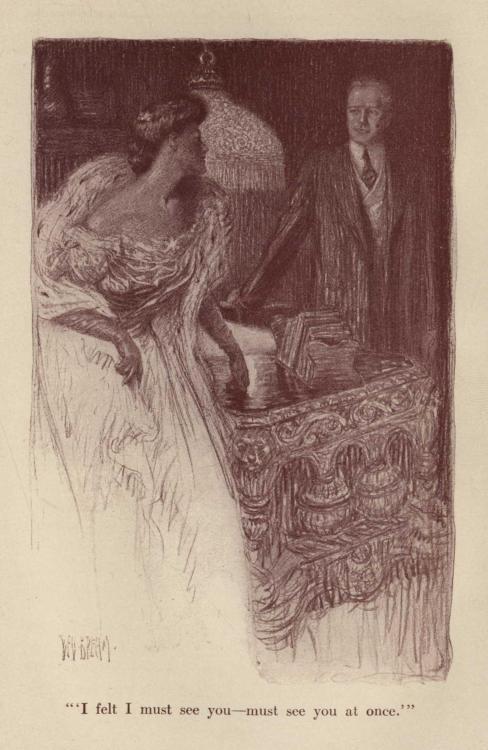
"'I felt I must see you—must see you at once.'"
"You asked for my friendship," she continued. "I gave it. Now, the time has come for me to show that my words were not an empty phrase.... Horace, you are in no condition to judge of your own affairs. You live alone. You have no one you can trust, no one you can talk things over with."
He nodded in assent.
"You must tell me the whole story. Bring it out of the darkness where you've been brooding over it. You can trust me. Just talking about it will give you a new, a clearer point of view."
"To-morrow—perhaps I'll come to you," he said, his voice hushed and strained. "But you mustn't stay here. You've come on impulse——"
"Where her reputation's concerned a woman never acts on impulse. You might not come to-morrow. It must be to-night." Her voice was as strange as his had been, was so low that its distinctness seemed weird and ghostly. "Come, Horace, drop your silly melodramatics—for it's you that are acting melodrama. Can't you see, can't you feel, that I am indeed your friend?"
He seated himself and reflected, she watching him. The stillness had the static terror of a room where a soul is about to leave or about to enter the world. It was not her words and her manner that had moved him, direct and convincing though they were; it was the far subtler revelation of her inmost self, and, through that, of a whole vast area of human nature which he had not believed to exist. Suddenly, with a look in his eyes which had never been there before, he reached out and took her hand. "You don't know what this means to me," he said in a slow, quiet voice. And he released her hand and went to lean his forehead against the tall shelf of the chimney-piece, his face hidden from her.
She did not interrupt his thoughts and his emotions until he was lighting a fresh cigarette at the table. Then she said, "Now, tell me—won't you, please?"
"It's a long story," he began.
"Don't try to make it short," urged she. And she settled herself comfortably.
It took him an hour to tell it; they discussed it for an hour and a half afterwards. Whenever he became uneasy about the time, she quieted him by questions or comments that made him feel her interest and forget the clock. At the last quarter before two, he rose determinedly. "I'm going to put you into a cab," said he. "You have accomplished all you came for—and more—a great deal more."
She made no attempt to stay on longer. He helped her into her cloak, helped her to adjust the scarf so that it would conceal her face. They were both hysterically happy, laughing much at little or nothing. He rang for the elevator, then they dashed down the stairs and escaped into the street before the car could ascend and descend again. At the corner where there was a cab stand, he drew her into the deep shadow of the entrance to the church, took both her hands between his. "It will be a very different fight from the one I was planning when you came," said he.
"And you'll win," asserted she confidently.
"Yes, I'll win. At least, I'll not lose—thanks to you, Neva." He laughed quietly. "When I'm old, I'll be able to tell how once the sun shone at midnight and summer burst out of the icy heart of January."
She nodded gayly. "Pretty good for a plain business man," said she.
Another moment and she was in the cab and away, he standing at the curb watching with an expression that made the two remaining cabmen grin and wink at each other by the light of the street lamp.
XXV
TWO WOMEN INTERVENE
"If I could find some way of detaching Trafford from Atwater," Armstrong had said to her as he was explaining. "But," he had added, "that's hopeless. He's more afraid of Atwater than of anybody or anything on earth—and well he may be." Neva seized upon the chance remark, without saying anything to him. She knew the Traffords well, knew therefore that there was one person of whom his fear was greater than of Atwater, and whose influence over him was absolute. Early the following morning she called the Traffords on the telephone. Mrs. Trafford was in the country, she learned, but would be home in the afternoon. Neva left a message that she wished particularly to see her; at five o'clock she was shown into the truly palatial room in which Mrs. Trafford always had tea.
"Narcisse has just left," said Mrs. Trafford. "She's been rummaging for me in Letty Morris's rag bag—you know, my husband bought it. She has found a few things, but not much. Still, Letty wasn't cheated any worse than most people. The trash! The trash!"
Neva was too intent upon her purpose to think of her surroundings that day; but she had often before been moved to a variety of emotions, none of them approaching admiration or approval or even tolerance, by Mrs. Trafford's procession of halls and rooms in gilt and carving and brocade, by the preposterous paintings, the glaring proclamation from every wall and every floor and every ceiling of the alternately arid and atrocious taste of the fashionable architects and connoisseurs to whom Mrs. Trafford had trusted. As in all great houses, the beauties were incidental and isolated, deformed by the general effect of coarse appeal to barbaric love of the thing that is gaudy and looks costly.
"You aren't going to move into Letty's house?" said Neva absently. She was casting about for some not too abrupt beginning.
"Heavens, no!" protested Mrs. Trafford, in horror and indignation. "John bought it—some time ago. I don't know why." She laughed. "But I do know he wishes he hadn't now. He wouldn't tell me the price he paid. I suspect he found out that he had made a bad bargain as soon as it was too late. There's some mystery about his buying that house. I don't—" Mrs. Trafford broke off. Well as she knew Neva, and intimate and confidential though she was with her, despite Neva's reserve—indeed, perhaps because of it—still, she was careful about Trafford's business. And Neva and Letty were cousins—not intimates or especially friendly, but nevertheless blood relations. "I suppose he's ashamed of not having consulted me," she ended.
"How is Mr. Trafford?" asked Neva. "I haven't seen him for months. He must be working very hard?"
"He thinks he is. But, my dear, I found the men out long, long ago, in their pretense of hard work. They talk a great deal downtown, and smoke and eat a great deal. But they work very little—even those that have the reputation of working the hardest. Business—with the upper class men—is a good deal like fishing, I guess. They spread their nets or drop their hooks and wait for fish. My husband is killing himself, eating directors' lunches. You know, they provide a lunch for the directors, for those that meet every day—and give them a ten- or twenty-dollar gold piece for eating it. It's a huge dinner—a banquet, and all that have any digestion left stuff themselves. No wonder the women hold together so much better than the men. If the men had to wear our clothes, what sights they would be!"
Neva returned to the business about which she had come. "They're having an investigating committee down there now, aren't they?"
"Not to investigate their diet," said Mrs. Trafford. "There'd be some sense in that. I suppose it's another of those schemes of the people who haven't anything, to throw discredit on the men who do the work of the world. Universal suffrage is a great mistake. Only the propertied class ought to be allowed to vote, don't you think so? Mr. Trafford says it's getting positively dreadful, the corruption good men have to resort to, with the legislatures and with buying elections, all because everybody can vote."
"I've not given the subject much thought," said Neva. "I heard— Some one was talking about the investigating committee—and said it was the beginning of another war downtown."
Mrs. Trafford looked amused. "I didn't dream you had any interest in that sort of thing. I don't see how you can be interested. I never let my husband talk business to me."
"Usually I'm not interested," said Neva, now fairly embarked and at ease. "But this particular thing was—different. It seems, there are two factions fighting for control of some insurance companies, and each is getting ready to accuse the other of the most dreadful things. Mr. Atwater's faction is going to expose Mr. Fosdick's, and Mr. Fosdick's is going to expose Mr. Atwater's."
Mrs. Trafford's expression had changed. "Neva, you've got a reason for telling me this," said she.
"Yes," frankly admitted Neva.
"Why?"
"Because I thought you—Mr. Trafford—ought to be warned of what's coming."
"What is coming?"
"I don't know all the details. But, among other things, there's to be a frightful personal attack on Mr. Trafford because he is one of Mr. Atwater's allies. Mr. Atwater thinks, or pretends, he can prevent it; but he can't. The attack is sure to come."
"They couldn't truthfully say anything against Mr. Trafford," said his wife, with a heat that was genuine, yet perfunctory, too. "He's human, of course. But I who have lived with him all these years can honestly say that he spends his whole life in trying to do good. He slaves for the poor people who have their little all invested with his company." Neva had not smiled, but Mrs. Trafford went on, as if she had: "I suppose you're thinking that sounds familiar. Oh, I know every man downtown pretends he is working only for the good of others, to keep business going, and to give labor steady employment, when of course he's really working to get rich, and— Well, somebody must be losing all this money that's piling up in the hands of a few people who spend it in silly, wicked luxury. Now, we have always frowned on that sort of thing. We—Mr. Trafford and I—set our faces against extravagance and simply live comfortably. He often says, 'I don't know what the country's coming to. The men downtown, the leaders, seem to have gone mad. They have no sense of responsibility. They aren't content with legitimate profits, but grab, grab, until I wonder people don't rise up.' And he says they will, though, of course, that wouldn't do any good, as things'd just settle back and the same old round would begin all over again. If people won't look after their own property, they can't expect to keep it, can they?"
"No," assented Neva. "Still—I sometimes wonder that the robbing should be done by the class of men that does it. One would think he wouldn't need to protect himself against those who claim to be the leaders in honesty and honor. It's as if one should have to lock up all the valuables if the bishop came to spend the night."
"There's the shame of it!" exclaimed Mrs. Trafford. "Sometimes Trafford tells me about the men that come here, the really fine, distinguished, gentlemanly ones—well, if I could repeat some of the things to you!"
"I should think," suggested Neva, "it would be dangerous to have business dealings with such men. If trouble came, people might not discriminate."
Mrs. Trafford caught the under-meaning in Neva's words and tone. She reflected a moment—thoughts that made her curiously serious—before replying, "Sometimes I'm afraid my husband will get himself into just that sort of miserable mess. He is so generous and confiding, and he believes so implicitly in some of those men whom I don't believe in at all. Tell me, Neva, are you sure—about that attack, and about Mr. Atwater's being mistaken?"
"There isn't a doubt of it," replied Neva. "Mr. Trafford ought not to let anything anyone says to the contrary influence him." And Mrs. Trafford's opinion of her directness and honesty gave her words the greatest possible weight.
"I'm ever so much obliged to you, dear," said she. "It isn't often one gets a proof of real friendship in this walk of life."
"I didn't do it altogether for your sake," replied Neva. "It seemed to me, from what I heard, that the men downtown were rushing on to do things that would result in no good and much harm and—unhappiness. I suppose, if evil has been done, it ought to be exposed; but I think, too, that no good comes of malicious and vengeful exposures."
"Especially exposures that tend to make the lower classes suspicious and unruly," said Mrs. Trafford.
Neva colored and glanced at the two strapping men-servants who were removing the tea table. But Mrs. Trafford was quite unconscious. A few years before, when the English foreign habit of thinking and talking about "lower classes" was first introduced, she had indulged in it sparingly and nervously. But, falling in with the fashion of her set, she had become as bold as the rest of these spoiled children of democracy in spitting upon the parents and grandparents. It no longer ever occurred to her to question the meaning of the glib, smug, ignorant phrase; and, like the rest, she did not even restrain herself before the "lower classes" themselves. It was a settled conviction with her that she was of different clay from the working people, the doers of manual labor, that their very minds and souls were different; the fact that they seemed to think and act in much the same way as the "upper classes" would have struck her, had she thought about it at all, as a phenomenon not unlike the almost human performances of a well-trained, unusually intelligent monkey. Indeed, she often said, without being aware of the full implication of the speech, "In how many ways our servants are like us!"
Neva went away, dissatisfied, depressed, as if she were retreating in defeat. She felt that she had gained her point; she understood Mrs. Trafford, knew that her dominant passion of spotless respectability had been touched, that the fears which would stir her most deeply had been aroused; Mrs. Trafford, worldly shrewd, would put her husband through a cross-examination which would reveal to her the truth, and would result in her bringing to bear all her authority over him. And she knew that Mrs. Trafford could compel her husband, where no force which Armstrong could have brought to bear downtown would have the least effect upon him. "I think I've won," Neva said to herself; but her spirits continued to descend. Before the victory, she had thought only about winning, not at all about what she was struggling for. Now she could think only of that—the essential.
Like almost all women and all but a few men, Neva was densely ignorant of and wholly uninterested in business—the force that has within a few decades become titanic and has revolutionized the internal as well as the external basis of life as completely as if we had been whisked away to another planet. She still talked and tried to think in the old traditional lines in which the books, grave and light, are still written and education is still restricted—although those lines have as absolutely ceased to bear upon our real life as have the gods of the classic world. It had never occurred to her that what the men did when they went to their offices involved the whole of society in all its relations, touched her life more intimately than even her painting. But, without her realizing it, the idea had gradually formed in her mind that the proceedings downtown were morally not unlike the occupation of coal-heaver or scavenger physically. How strong this impression was she did not know until she had almost reached home, revolving the whole way the thoughts that had started as Trafford's bronze doors closed behind her.
She recalled all Armstrong and others had told her about the sources of Trafford's wealth—Trafford, with his smooth, plausible personality that left upon the educated palate an after taste like machine oil. From Trafford her thoughts hastened on to hover and cluster about the real perplexity—Armstrong himself—what he had confessed to her; worse still, what he had told her as matter-of-course, had even boasted as evidence of his ability at this game which more and more clearly appeared to her as a combination of sneak-thieving and burglary. And heavier and heavier grew her heart. "I have done a shameful thing," she said to herself, as the whole repulsive panorama unrolled before her.
She was in the studio building, was going up in the elevator. Just as it was approaching her landing, Thomas, the elevator boy, gave a sigh so penetrating that she was roused to look at him, to note his expression.
"What is it, Thomas?" she asked. "Can I do anything for you?"
"Nothing—nothing—thank you," said Thomas. "It's all over now. I was just thinking back over it."
She saw a band of crape round his sleeve. "You have lost some one?" she said gently.
"My father," replied the boy. "He died day before yesterday. And we had to have the money for the funeral. We're all insured to provide for that. And my mother went down to collect father's insurance. It was for a hundred and twenty-five dollars. We'd paid in a hundred and forty on the policy, it had been running so long. And when my mother went to collect, they told her they couldn't get it through and pay it for about three weeks—and she had to have the money right away. So, they told her to go down to some offices on the floor below—it was a firm that's in cahoots with them insurance sharks. And she went, and they give her eighty-two dollars for the policy—and she had to take it because we had to bury father right away. Only, they didn't give her cash. They gave her a credit with an undertaker—he's in cahoots, too. And it took all the eighty-two dollars, and father was buried like a pauper, at that. I tell you, Miss Carlin, it's mighty hard." His voice broke. "Them rich people make a fellow pay for being poor and having no pull. That's the way we get it soaked to us, right and left, especially in sickness or hard luck or death."
Neva lingered, though she could not trust herself to speak.
"You wouldn't think," Thomas went on, "that such things'd be done by such a company as——"
"Don't!" cried Neva, pressing her hands hysterically to her ears. "I mustn't hear what company it was!"
And she rushed from the car and fled into her apartment, all unstrung. At last, at last, she not merely knew but felt, and felt with all her sensitive heart, the miseries of thousands, of hundreds of thousands, out of which those "great men" wrought their careers—those "great men" of whom her friend Armstrong was one!
Trafford reached home at half past six and, following his custom, went directly to his dressing room. Instead of his valet, he found his wife—seated before the fire, evidently waiting for him. "Is the door closed?" she said. "And you'd better draw the curtain over it."
"Well, well," he cried, all cheerfulness. "What now? Have the servants left in a body?" It had been a banner day downtown, with several big nets he had helped to set filled to overflowing, and the fish running well at all his nets, seines, lines, and trap-ponds. He felt the jolly fisherman, at peace with God and man, brimming generosity.
"I want to talk to you about that investigation," said his wife in a tone that cleared his face instantly of all its sparkling good humor.
"Whatever started you in that direction?" he exclaimed. "Don't bother your head about it, my dear. There'll be no investigation. Not that I was afraid of it. Thank God, I've always tried to live as if each moment were to be my last."
"Mr. Atwater is going to attack Mr. Fosdick, isn't he?"
Trafford showed his amazement. "Why, where did you hear that?"
"And he thinks Mr. Fosdick and his friends won't be able to retort," continued Mrs. Trafford. "Well, he's mistaken. They are going to retort. And you are the man they'll attack the most furiously."
Trafford sat down abruptly. All the men who are able to declare for themselves and their families such splendid dividends in cash upon a life of self-sacrifice to humanity, are easily perturbed by question or threat of question. Trafford, with about as much courage as a white rabbit, had only to imagine the possibility of being looked at sharply, to be thrown into inward tremors like the beginnings of sea-sickness.
"It don't matter," continued his wife, "whether you are innocent or not. They are going to hold you up to public shame."
"Who told you this?"
"Neva."
"She must have got it from the Morrises—or Armstrong."
"She came here especially to tell me, and she would not have come if she did not know it was serious."
"They sent her here to frighten me," said Trafford. "Yes, that's it!" And he rose and paced the floor, repeating now aloud and now to himself, "That's it! That's undoubtedly it."
"Tell me the whole story," commanded his wife, when the limit of her patience with his childishness had been reached. "You need an outside point of view."
She had told Neva she never permitted Trafford to talk business with her. In fact, he consulted her at every crisis, both to get courage and to get advice. He now hastened to comply. "It's very simple. Some time ago, a few of us who like to see things run on safe, conservative lines, decided that Fosdick's and Armstrong's management of the O.A.D. was a menace to stability. Armstrong and Fosdick had quarreled. It was Armstrong who came to us and suggested our interfering. I thought the man was honest, and I did everything I could to help him and Morris."
"Including buying Morris's house," interjected Mrs. Trafford, to prevent him from so covering the truth with cant that it would be invisible to her.
"That did figure in it," admitted Trafford, in some confusion. "Then, we found out they were simply using us to get control of the O.A.D. for themselves. So we—Atwater and Langdon and I—arranged quietly to drop them into their own trap. We've done it—that's all. Next week we're going to expose them and their false committee; and the policy holders of the O.A.D. will be glad to put their interests in the hands of men we can keep in order. Fosdick and Armstrong can't retaliate. We've got the press with us, and have made every arrangement. Anything they say will be branded at once as malicious lies."
"What kind of malicious lies will they tell?"
"How should I know?" And Trafford preened, with his small, precisely clad figure at its straightest.
"But you do know," said Mrs. Trafford slowly and with acidlike significance.
Trafford made no reply in words. His face, however, was eloquent.
"You've been hypnotized by Atwater," pursued Mrs. Trafford. "You think him more powerful than he is. And—he isn't in any insurance company directly, is he?"
"No."
"Mr. Langdon?"
"No—they keep in the background." Trafford's upper lip was trembling so that she could see it despite his mustache.
"Then you'll be right out in front of the guns. You—alone."
"There aren't any guns."
"I'm surprised at you!" exclaimed his wife. "Don't you know Horace Armstrong better than that!"
"The treacherous hound!"
"He has his bad side, I suppose, like everybody else," said Mrs. Trafford, who felt that it was not wise to humor him in his prejudices that evening. "His character isn't important just now. It's his ability you've got to consider."
"Atwater's got him helpless."
"Impossible!" declared Mrs. Trafford, in a voice that would have been convincing to him, had her words and his own doubts been far less strong. "You may count on it that there's to be a frightful attack on you next week. Neva Carlin knew what she was about."
"There's nothing they can say—nothing that anybody'd believe." His whiskers and his hair were combed to give him a resolute, courageous air. The contrast between this artificial bold front and the look and voice now issuing from it was ludicrous and pitiful.
Mrs. Trafford flashed scorn at him. "What nonsense!" she exclaimed. "I never heard of a big business that could stand it to have the doors thrown open and the public invited to look where it pleased. I doubt if yours is an exception, whatever you may think."
"But the doors won't be thrown open," he pleaded rather than protested. "Our private business will remain private."
"Armstrong is going to attack you, I tell you. He's not the man to fire unless he has a shot in his gun—and powder behind it."
"But he can't. He knows nothing against me." And Trafford seated himself as if he were squelching his own doubts and fears.
"He knows as much about the inside of your company as you know about the inside of his. You can assume that."
Trafford shifted miserably in his chair.
"What reason have you to suppose that as keen a man as he is would not make it his business to find out all about his rivals?"
"What if he does know?" blustered Trafford. "To hear you talk, my dear, you'd think I ran some sort of—of a"—with a nervous little laugh—"an unlawful resort."
"I know you wouldn't do anything you thought was wrong," replied his wife, in a strained, insincere voice. "But—sometimes the public doesn't judge things fairly."
"People who have risen to our position must expect calumny." He was of the color of fear and his fingers and his mouth and his eyelids were twitching.
"What difference would it make to Atwater and Langdon, if you were disgraced?" she urged. "Mightn't they even profit by it?"
At this he jumped up, and began to pace the floor. "You ought to be ashamed of yourself!" he cried. "To put suspicion in my head against these honorable men!"
"I want you to protect yourself and your family," she retorted crushingly. "The temptation to make a little more money, or a good deal more, ought not to lead you to risk your reputation. Look at the men that were disgraced by that last investigation."
"But they had done wrong."
"They don't think so, do they? How do you know what some of the things you've done will look like when they're blazoned in the newspapers?"
"I'm not afraid!" declaimed Trafford, fright in his eyes and in his noisy voice.
"No," said his wife soothingly. "Of course, you've done nothing wrong. You needn't tell me that. But it's just as bad to be misunderstood as to be guilty."
During the silence which fell he paced the floor like a man running away, and she gazed thoughtfully into the fire. When she spoke again it was with a subdued, nervous manner and as if she were telling him something which she wished him to think she did not understand. "One day I was driving in the East Side, looking after some of my poor. There was a block—in the Hester Street market. A crowd got around the carriage, and a man—a dreadful, dirty, crazy-eyed creature—called out, 'There's the wife of the blood-sucker Trafford, that swindles the poor on burial insurance!' And the crowd hissed and hooted at me, and shook their fists. And a woman spat into the carriage." Mrs. Trafford paused before going on: "I get a great many anonymous letters. I never have worried you about these things. You have your troubles, and I knew it was all false. But——"
Her voice ceased. For several minutes, oppressive and menacing silence brooded over that ostentatious room. Its costly comforts and costlier luxuries weighed upon the husband and wife, so far removed from the squalor of those whose earnings had been filched to create this pitiful, yet admired, flaunting of vanity. Finally he said, speaking almost under his breath, "What would you advise me to do?"
Although she had long had ready her answer to that inevitable question, she waited before replying. "Not to pull Atwater's chestnuts out of the fire for him," said she slowly. "Stop the attack. I've an instinct that evil will come of it—evil to us. Let Armstrong alone. If he's not managing his business right, what concern is it of yours? And if you try to get it, what if, instead of making money, you lose your reputation—maybe, more? What does Atwater risk? Nothing. What does Langdon risk? Nothing. What do you risk? Everything. That's not sensible, is it?"
"But I can't go back on Atwater," he objected in the tone that begs to be overruled. "Armstrong would attack me, anyhow, and I'd simply have both sides against me."
She turned upon him, amazed, terrified. "Do you mean to say you've got no hold on Atwater?" she exclaimed.
"I am a gentleman, dealing with gentlemen," said he, with dignity.
She made a gesture of contempt. "But suppose Atwater should prove not to be a gentleman—what then?"
"He'd hesitate to play fast and loose with me," Trafford now confessed. "He owes our allied institutions too many millions."
"Oh," she said, relieved. Then—"And what precaution has he taken against your deserting him?"
"None, so far as I know, except that he would probably join in Armstrong's attack. But, my dear, you entirely misunderstand. Atwater and I have the same interests. We——"
"I know, I know," she interrupted impatiently. "What I'm trying to get at is how you can induce him to come to an agreement with Armstrong. Can you think of no way?"
"I had never contemplated this emergency," he replied apologetically. His conduct now seemed to him to have been headlong, imbecile.
"You must do something this very night," said his wife. "There might be a change of plan on one side or the other. You must see that your position, unprotected among these howling beasts, is perilous."
At that, Trafford fell to trembling so violently that, ashamed though he was to have any human being, even his wife, see the coward in him, he yet could not steady himself. "I can offer Armstrong peace and a voice in our company. If he accepts, I can stop Atwater. I can frankly show him that I am not prepared to withstand an attack and that it is surely coming. He will not refuse. He won't dare. Besides—" He stopped suddenly.
"Besides—what?"
"It is upon me—upon my men—that Atwater relies to make the attack. He hasn't the necessary information—at least, I don't think he has."
Mrs. Trafford gave a long sigh of relief. "Why didn't you say that at first?" she cried. "All you have to do is to put Atwater off and make terms with Armstrong."
"Atwater is a very dangerous man to have as an enemy."
"But he's not a fool. He'll never blame you for saving yourself from destruction."
Neither seemed to realize how much of their secret thought—thought not clearly admitted even to their secret selves—was revealed in her using that terrible word, and in his accepting it.
He glanced at his watch. "I think I'll go now."
"Yes, indeed," said she. "This is the best time to catch them. They'll be dressing for dinner."
And he hurried away.
XXVI
TRAFFORD AS DOVE OF PEACE
As Trafford sprang from his cab at Armstrong's hotel, Armstrong was just entering the door. "Mr. Armstrong! Mr. Armstrong!" he cried, hastening after him.
The big, easy-going-looking Westerner—still the Westerner, though his surface was thoroughly Easternized—turned and glanced quizzically down at the small, prim-looking Trafford. "Hello! What do you want?"
"To see you for a few minutes, if it is quite convenient," replied Trafford, still more nervous before Armstrong's good-natured contempt.
"A very few minutes," conceded the big man. "I've a pressing engagement."
They went up to his apartment. As he opened the door, he saw a note on the threshold. "Excuse me," he said, picking it up, and so precipitate that he did not stand aside to let Trafford enter first. In the sitting room he turned on the light, tore open the note and read; and Trafford noted with dismay that, as he read, his face darkened. It was a note from Neva, saying that she had just got a telegram from home, that her father was ill; she had scrawled the note as she and Molly were rushing away to catch the train. He glanced up, saw Trafford. "Oh—beg pardon—sit down." And he read the note again; and again his mind wandered away into the gloom. Once more, after a moment or two, his eyes reminded him of Trafford. "Beg pardon—a most annoying message— Do sit down. Have a cigar?"
"Not at present, thank you," said Trafford in his precise way, reminiscent of the far days when he had taught school.
"Well—what can I do for you?" inquired Armstrong, adding to himself, "This is Atwater's first move." But he was not interested; his mind was on Neva, on the note that had chilled him—"unreasonably," he muttered, "yet, she might have put in just the one word—or something."
Trafford saw that he had no part of Armstrong's attention. He coughed.
"If you can give me—" he began.
"Yes, yes," said Armstrong impatiently. "What is it? You can't expect me to be enthusiastic, exactly, about you, you know. I didn't expect anything of the others; but I was idiot enough to think you weren't altogether shameless—you, the principal owner of the Hearth and Home!" Armstrong's sarcasm was savage.
"You are evidently laboring under some misapprehension, Mr. Armstrong," cried Trafford, pulling at his neat little beard, while one of his neat little feet tapped the carpet agitatedly.
"Bosh!" said Armstrong. "I know all about you. Don't lie to me. What do you want? Come to the point!"
There was a pink spot in each of Trafford's cheeks. "I have been much distressed," said he, "at the confusion downtown, at the strained relations between interests that ought to be working together in harmony for the general good." Armstrong's frown hastened him. "I have come to see if it isn't possible to bring about good feeling and peace."
"You come from Atwater?"
"No—that is—Frankly, no."
Armstrong rose with a gesture of dismissal. "We're wasting time. Atwater is the man. Unless you have some authority from him, I'll not detain you."
"But, my dear sir," cried Trafford, in a ferment to the very depths now, because convinced by Armstrong's manner that he was not dealing with a beaten man but with one champing for the fray. "You do not seem to hear me," he implored. "I tell you I can make terms. In this matter Atwater is dependent upon me."
"You've come about the attack he's going to make on the O.A.D.?"
"Precisely. I've come to arrange to stop it, to say I wish to make no attack."
"You mean, you don't wish to be attacked," rejoined Armstrong with a cold laugh that made Trafford's flesh creep. "By the time Morris gets through with you, I don't see how you can possibly be kept out of the penitentiary. He has all the necessary facts. I think he can compel you to disgorge at least two thirds of what you've stolen and salted away. I don't see where you got the courage to go into a fight, when you're such an easy target. The wonder is you weren't caught and sent up years ago."
"This is strange language, very strange language," said Trafford in an injured tone, and not daring to pretend or to feel insulted. "I am surprised, Mr. Armstrong, that you should use it in your own house."
"I didn't ask you here. You thrust yourself in," Armstrong reminded him, but his manner was less savage.
"True, I did come of my own accord. And I still venture to hope that you will see the advantages of a peaceful solution."
"What do you propose?—in as few words as possible," said Armstrong, still believing Trafford was trying to trifle with him, for some hidden purpose.
"To call off our attack," Trafford answered, "provided you will agree to call off yours. To give you a liberal representation in our board of directors, including a member of the executive committee."
Armstrong was astounded. He could not believe that Trafford's humble, eager manner was simulated. Yet, these terms, this humiliating surrender of assured victory—it was incredible. "You will have to explain just how you happened to come here," said he, "or I shall be unable to believe you."
The pink spots which had faded from Trafford's cheeks reappeared. "It was my wife," he replied. "She heard there was to be a scandal. She has a horror of notoriety—you know how refined and sensitive she is. She would not let me rest until I had promised to do what I could to bring about peace."
Armstrong was secretly scorning his own stupidity. He had spent days, weeks on just this problem of breaking up the combination against him, of separating Trafford or Langdon from Atwater; and the simple, easy, obvious way to do it had never occurred to him, who dealt only with the men and disregarded the women as negligible factors in affairs. To Trafford he said, "You've not seen Atwater?"
"No, but I shall go to him as soon as I have some assurance from you."
Atwater—there was the rub. Armstrong felt that the time to hope had not yet come. Still he would not discourage Trafford. He simply said, "I can't give any assurance until I consult Morris."
"But, as I understand it—at least, his original motive was simply a political ambition. We can easily gratify that."
"He wants fireworks—something that'll make the popular heart warm up to him. He has a long head. He wants some basis, at least, in popularity, so that he won't be quite at the mercy of you gentlemen, should you turn against him."
"I see—I see," said Trafford. "He was counting on the reputation he would make as an inquisitor. Yes, that would give him quite a push. But—there ought to be plenty of other matters he might safely and even, perhaps, beneficially, inquire into. For instance, there is the Bee Hive Mutual—a really infamous swindle. I've had dealings with many unattractive characters in the course of my long business career, Mr. Armstrong, but with none so repellent in every way as Dillworthy. He has made that huge institution a private graft for himself and his family. He is shocking, even in this day of loose conceptions of honesty and responsibility."
"Have you any facts?"
"Some, and they are at Mr. Morris's disposal. But all he needs to do is to send for the books of the Bee Hive. I am credibly informed—you can rely on it—that the Dillworthys have got so bold that they do not even look to the books. The grafting in that company is quite as extensive and as open as in our large industrial and railway corporations—and, you know, they haven't profited by the lesson we in the insurance companies had in the great investigation."
"Your proposal will content Morris, I think," Armstrong now said. "As the Dillworthys aren't entangled with any of the other large interests, showing them up will not cause a spreading agitation." He laughed. "There's a sermon against selfishness! If old Dillworthy hadn't been so greedy, so determined to keep it all in the family, he wouldn't be in this position."
"There will be general satisfaction over his exposure," replied Trafford. "And it will greatly benefit, tone up, the whole business world."