PART II. GROWTH AND ITS RESPONSIVE VARIATIONS.
Reading edition
X.—THE HIGH MAGNIFICATION CRESCOGRAPH FOR RESEARCHES ON GROWTH[S]
By
Sir J. C. Bose,
Assisted by
Guruprasanna Das, L.M.S.
In discussing the difficulties connected with investigations relating to longitudinal growth and its variations, special stress must be laid on the importance of maintaining external conditions absolutely constant. This constancy can only be maintained in practice for a short time. Lengthy periods of observation, moreover, introduce the uncertainty of complication arising from spontaneous variation of growth. The possibility of accurate investigation, therefore lies in reducing the period of the experiment to a few minutes during which we have to determine the normal rate of growth and its variation under a given changed condition. This would necessitate the devising of a method of very high magnification for record of the rate of growth.[S]
With auxanometers now in use, which give a magnification of about twenty times, it takes nearly four hours to determine the influence of changed condition in inducing variation of growth. It will be seen that if we succeeded in enhancing magnification from twenty to ten thousand times, the necessary period for experiment would be reduced from four hours to thirty seconds. The importance of securing a magnification of this order is sufficiently obvious.
The problem of high magnification was first solved by my Optical Lever.[T] The tip of the growing organ was attached to the short arm of a lever, the axis of which carried a small mirror; in this way it was possible to obtain a magnification of a thousand times. The magnified movement of growth was followed with a pen on a revolving drum. The record laboured under the disadvantage of not being automatic. This defect was overcome by the use of the photographic method which however entailed the inconvenience and discomfort of a dark room.
I have, for the past six years, been working with a different method, which has now been brought to a great state of perfection. The problem to be solved was the devising of a direct method of high magnification and the automatic record of the magnified rate of growth.
METHOD OF HIGH MAGNIFICATION.
The magnification in my Crescograph is obtained by a compound system of two levers. The growing plant is attached to the short arm of a lever, the long arm of which is attached to the short arm of the second lever. If the magnification by the first lever be m, and that by the second, n, the resulting magnification would be mn.
The practical difficulties met with in carrying out this idea are very numerous. It will be understood that just as the imperceptible movement is highly magnified by the compound system of levers, the various errors and difficulties are likely to be magnified in the same proportion. The principal difficulties met with were due: (1) to the weight of the compound lever which exerted a great tension on the growing plant, (2) to the yielding of flexible connections by which the plant was attached to the first lever, and the first lever to the second, and (3) to the friction at the fulcrums.
Weight of the Lever.—As the first lever is to exert a pull on the second, it has to be made rigid. The second lever serves as an index, and can therefore be made of fine glass fibre. The securing of rigidity of the first lever entails large cross section and consequent weight, which exerts considerable tension on the plant. Excessive tension greatly modifies growth; even the weight of the index used in self-recording auxanometers is found to modify the normal rate of growth. The weight of the levers introduces an additional difficulty in the increased friction at the fulcrums, on account of which there is an obstruction of the free movement of the recording arm of the lever. The conditions essential for overcoming these difficulties therefore are: (1) construction of a very light lever possessing sufficient rigidity, and (2) arranging the levers in such a way that the tension on the plant may be reduced to any extent, or even eliminated.
I found in navaldum, an alloy of aluminium, a light material possessing sufficient rigidity. The first lever is constructed out of a thin narrow sheet 25 cm. in length; it has, as explained before, to be fairly rigid in order to exert a pull on the second without undergoing any bending; this rigidity is secured by giving the thin narrow plate of the lever a T-shape. The first lever balances, to a certain extent, the second. Finer adjustments are made by means of an adjustable counterpoise B, at the end of the levers. By this means the tension on the plant can be greatly reduced; or a constant tension may be exerted by means of a weight T (Fig. 56). In my later type of the apparatus the plant connection is made to the right, instead of the left side of the first fulcrum. This gives certain practical advantages. The second lever is then made practically to balance the first, only a very slight weight being necessary for exact counterpoise. The reduction of total weight thus secured reduces materially the friction at the fulcrum with great enhancement of efficiency of the apparatus.
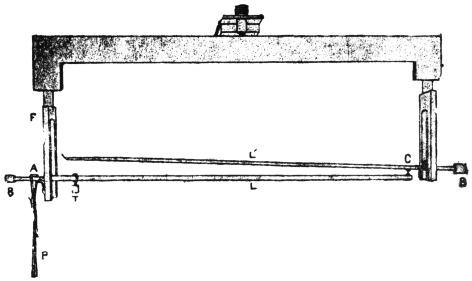
Fig. 56.—Compound lever. P, plant attached to short arm of lever L; T, weight exerting tension; C, connecting link; L′, second lever with bent tip for record; B, B, balancing counterpoise. Fork F, carries at its side two conical agate cups, on which lever rests by two pin-points. (From a photograph.)
The second or the recording lever has a normal excursion through 8 cm. on the recording surface, which is a very thin sheet of glass 8×8 cm. coated with a layer of smoke. As the recording lever is about 40 cm. in length, the curvature in the record is slight, and practically negligible in the middle portion of 4 cm. The dimensions given allow a magnification of ten thousand times. A far more compact apparatus is made with 15 cm. length of levers. This gives a magnification of a thousand times.
AUTOMATIC RECORD OF THE RATE OF GROWTH.
Another great difficulty in obtaining an accurate record of the curve of growth arises from the friction of contact of the bent tip of the writing lever against the recording surface. This I was able to overcome by an oscillating device by which the contact, instead of being continuous, was made intermittent. The smoked glass plate, G, is made to oscillate, to and fro, at regular intervals of time, say one second. The bent tip of the recording lever comes periodically in contact with the glass plate during its extreme forward oscillation. The record would thus consist of a series of dots, the distance between successive dots representing magnified growth during a second.
The drawback in connection with the obtaining of record on the oscillating plate lies in the fact that if the plate approaches the recording point with anything like suddenness, then the stroke on the flexible lever causes an after-oscillation; the multiple dots, thus produced, spoil the record. In order to overcome this, a special contrivance is necessary, by which the speed of approach of the plate should be gradually reduced to zero at contact with the recording point. The rate of recession should, on the other hand, continuously increase from zero to maximum. The recording point will in this manner be gently pressed against the glass plate, marking the dot, and then gradually set free. It was only after strict observance of these conditions that the disturbing effect of after-vibration of the lever could be obviated.
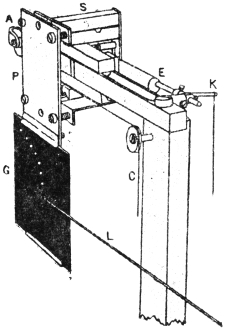
Fig. 57.—Eccentric for oscillation of plate K, crank; S, slide; P, holder for glass plate G. A, adjusting screws; L, recording lever. Clock releases string C for lateral movement of the plate. (From a photograph.)
This particular contrivance consists of an eccentric rod actuated by a rotating wheel. A cylindrical rod is supported eccentrically, so that semi-rotation of the eccentric causing a pull on the crank K (Fig. 57) pushes the plate carrier gradually forward. On the return movement of the eccentric, a light antagonistic spring makes the plate recede. The rate of the movement of the crank itself is further regulated by the device of the revolving wheel. This is released periodically by clockwork at intervals of one, two, five, ten, or fifteen seconds respectively, according to the requirements of the experiment. The complete apparatus is shown in figure 58.
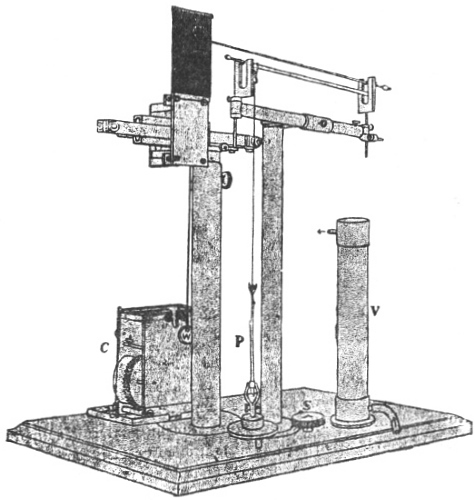
Fig. 58.—Complete apparatus. P, plant; S, micrometer screw for raising or lowering the plant; C, clockwork for periodic oscillation of plate; W, rotating wheel. V, cylindrical plant-chamber. (From a photograph.)
Connecting Links.—Another puzzling difficulty lay in the fact that the magnification actually obtained was sometimes very different from the calculated value. This unreliability I was able to trace to the defects inherent in thread connections, employed at first to attach the plant to the first lever, and the first lever to the second. These flexible connections were found to undergo a variable amount of elastic yield. Hence it became necessary to use nothing but rigid connections. The plant attachment, A, of triangular shape is made of a piece of navaldum; its knife-edge rests on a notch at the short arm of the lever, L. There are several notches at various distances from the fulcrum. It will be understood how the magnification can be modified by moving A, nearer or further from the fulcrum. The lower end of the attachment is bent in the form of a hook. The end of the leaf of the plant P, is doubled on itself and tied. The loop thus formed is then slipped over the hooked end of A.
The link, C, connecting L and L′, consists of a pin pointed at both ends, which rests on two conical agate cups fixed respectively to the upper and lower surfaces of the levers L and L′. This mode of frictionless linking is rigid and allows at the same time perfectly free movement of the levers.
The fulcrum.—The most serious difficulty was in connection with frictionless support of the axes of the two levers. The horizontal axis was at first supported on jewel bearings, with fine screw adjustment for securing lateral support. Any slight variation from absolute adjustment made the bearing either too loose or too tight, preventing free play of the lever. When perfect adjustment was secured by any chance, the movement of the levers became jerky after a few days. This I afterwards discovered was due to the deposit of invisible particles of dust on the bearings. These difficulties forced me to work out a very perfect and at the same time a much simpler device. The lever now carries two vertical pin-points which are supported on conical agate cups. The axis of the lever passes through the points of support. The friction of support is thus reduced to a minimum. The levers are kept in place under the constant pressure of their own weight. The excursion of the end of the recording lever, which represents magnified movement of growth, was now found to be without jerk and quite uniform.
EXPERIMENTAL ADJUSTMENTS.
The soil in a flower pot is liable to be disturbed by irrigation, and the record thus vitiated by physical disturbance. This is obviated by wrapping a piece of cloth round the root imbedded in a small quantity of soil. The lower end of the plant is held securely by a clamp. In order to subject the plant to the action of gases and vapours, or to variation of temperature it is enclosed in a glass cylinder (V) with an inlet and an outlet pipe (Fig. 58). The chamber is maintained in a humid condition by means of a sponge soaked in water. Different gases, warm or cold water vapours, may thus be introduced into the plant chamber.
Any quick growing organ of a plant will be found suitable for experiment. In order to avoid all possible disturbing action of circumnutation, it is preferable to employ either radial organs, such as flower peduncles and buds of certain flowers, or the limp leaves of various species of grasses, and the pistils of flowers. It is also advisable to select specimens in which the growth is uniform. I append a representative list of various specimens in which, under favourable conditions of season and temperature, the rates of growth may be as high as those given below:—
Peduncle of Zephyranthes0.70mm. per hour.
Leaf of grass1.10 " " "
Pistil of Hibiscus flower1.20 " " "
Seedling of wheat1.60 " " "
Flower bud of Crinum2.20 " " "
Seedling of Scirpus Kysoor3.00 " " "
The specimen employed for experiment may be an intact plant, rooted in a flower pot. It is, however, more convenient to employ cut specimens, the exposed end being wrapped in moist cloth. The shock-effect of section passes off after several hours, and the isolated organ renews its growth in a normal manner. Among various specimens I find S. Kysoor to be very suitable for experiments on growth. The leaves are much stronger than those of wheat and different grasses, and can bear a considerable amount of pull without harm. Its rate of growth under favourable condition of season is considerable. Some specimens were found to have grown more than 8 cm. in the course of twenty-four hours, or more than 3 mm. per hour. This was during the rainy season in the month of August. But a month later the rate of growth fell to about 1 mm. per hour.
I shall now proceed to describe certain typical experiments which will show: (1) the extreme sensibility of the Crescograph; (2) its wide applicability in different investigations; and (3) its capability in determining with great precision the time-relations of responsive changes in the rate of growth. In describing these typical cases, I shall give detailed account of the experimental methods employed, and thus avoid repetition in accounts of subsequent experiments.
Determination of the absolute rate of growth: Experiment 51.—For the determination of the absolute rate, I shall interpret the results of a record of growth obtained with a vigorous specimen S. Kysoor on a stationary plate. The oscillation frequency of the plate was once in a second, and the magnification employed was ten thousand times. The magnified growth movement was so rapid that the record consists of a series of short dashes instead of dots (Fig. 59A). For securing regularity in the rate of growth, it is advisable that the plant should be kept in uniform darkness or in uniformly diffused light. So sensitive is the recorder that it shows a change of growth-rate due to the slight increase of illumination by the opening of an additional window. One-sided light, moreover, gives rise to disturbing phototropic curvature. With the precautions described the growth-rate in vigorous specimens is found to be very uniform.
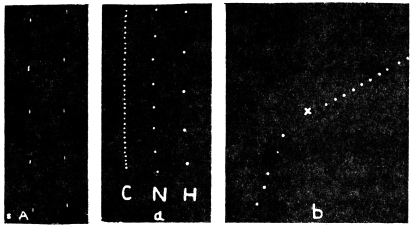
Fig. 59.—Crescographic records: (A) successive records of growth at intervals of one second (magnification 10,000 times). (a) Effect of temperature on a stationary plate; N, normal rate of growth; C, retarded rate under cold; H, enhanced rate under warmth; (b) record on moving plate, where diminished slope of curve denotes retarded rate under cold (Magnification 2,000 times.)
After the completion of the first vertical series, the recording plate was moved 1 cm. to the left; the tip of the recorder was brought once more to the top by the micrometer screw, S, (Fig. 58), and the record taken once more after an interval of 15 minutes. The magnified growth for 4 seconds is 38 mm. in the first record; it is precisely the same in the record taken fifteen minutes after. The successive growth elongations at intervals of 1 second is practically the same throughout, being 9.5 mm. This uniformity in the spacings demonstrates not only the regularity of growth under constant conditions, but also the precision of the apparatus. It also shows that by keeping the external condition constant, the normal growth-rate could be maintained uniform for at least fifteen minutes. The magnified rate of growth is nearly 1 cm. per second, and since it is quite easy to measure 0.5 mm. the Crescograph enables us to magnify and record a length of 0.0005 mm. that is to say, the sixteenth part of a wave of red light. The absolute rate of growth, moreover, can be determined in a period as short as 0.05 of a second. These facts will give some idea of the great possibilities of the Crescograph for future investigations.
As the period of experiment is very greatly shortened by the method of high magnification, I shall, in the determination of the absolute rate of growth, adopt a second as the unit of time, and µ, or micron, as the unit of length,—the micron, being a millionth part of a metre or a thousandth part of a millimeter.
If m be the magnifying power of the compound lever and l, the average distance between successive dots in mm. at intervals of t seconds then:—
the rate of growth = l/mt × 103µ per second. In the record given l = 9.5 mm. m = 10,000. t = 1 second. Hence the rate of growth = 9 .5/10,000 × 103µ per sec. = 0.95µ per sec.
Having demonstrated the extreme sensitiveness and reliability of the apparatus, in quantitative determination, I shall next proceed to show its wide applicability for various researches relating to the influence of external agencies in modification of growth. For this two different methods are employed. In the first of these methods, the records are taken on a stationary plate: of these the record is at first taken under normal condition, the subsequent series being obtained under the given changed condition; the increase or diminution of intervals between successive dots, in the two series, at once demonstrates the stimulating or depressing nature of the changed condition.
In the second method, the record is taken on a plate moving at an uniform rate by clockwork. A curve is thus obtained, the ordinate representing growth elongation and the abscissa the time. The increment of length divided by the increment of time gives the absolute rate of growth at any part of the curve. As long as the growth is uniform, so long the slope of the curve remains constant. If a stimulating agency enhances the rate of growth, there is an immediate upward flexure in the curve; a depressing agent, on the other hand, lessens the slope of the curve.
I shall now give a few typical examples of the employment of the Crescograph for investigations on growth: the first example I shall take is the demonstration of the influence of variation of temperature.
Stationary method: Experiment 52.—The records, given in Fig. 59a, were taken on a stationary plate. The specimen was S. Kysoor; the Crescographic magnification was two thousand times, and the successive dots at intervals of 5 seconds. The middle series, N, was at the temperature of the room. The next, C, was obtained with the temperature lowered by a few degrees. Finally H was taken when the plant-chamber was warmed. It will be seen how under cooling the spaces between successive dots have become shortened, showing the diminished rate of growth. Warming, on the other hand, caused a widening of intervals between successive dots, thus demonstrating an enhancement of the rate of growth.
Calculating from the data obtained from the figure we find:—
The absolute value of the normal rate0.457µ per second.
Diminished rate under cold0.101µ " "
Enhanced rate under warmth0.737µ " "
Moving plate method: Experiment 54.—This was carried out with a different specimen of S. Kysoor, the record being taken on a moving plate (Fig. 59b). The first part of the curve here represents the normal rate of growth. The plant was then subjected to moderate cooling, the subsequent curve with its diminished slope denotes the depression of growth. The question of influence of temperature will be treated in a subsequent Paper of the present series in much greater detail.
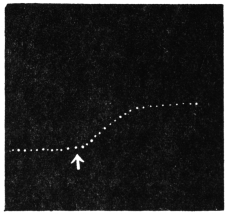
Fig. 60—Horizontal record shows absence of growth in a dead branch; physical expansion on application of warmth at arrow followed by horizontal record on attainment of steady temperature. (Magnification 2,000 times)
Precaution against physical disturbance: Experiment 54.—There may be some misgiving about the employment of such high magnification: it may be thought that the accuracy of the record might be vitiated by physical disturbance, such as vibration. In physical experimentation far greater difficulties have, however, been overcome, and the problem of securing freedom from vibration is not at all formidable. The whole apparatus need only be placed on a heavy bracket screwed on the wall to ensure against mechanical disturbance. The extent to which this has been realized will be found from the inspection of the first part of the record in figure 60, taken on a moving plate. A thin dead twig was substituted for the growing plant, and the perfectly horizontal record not only demonstrated the absence of growth movement but also of all disturbance. There is an element of physical change, against which precautions have to be taken in experiments on variation of the rate of growth at different temperatures. In order to determine its character and extent, a record was taken with the dead twig, of the effect of raising the temperature of the plant-chamber through ten degrees. The record (Fig. 60) with a magnification of two thousand times shows that there is an expansion during the rise of temperature, and that the variable period lasted for a minute, after which there was a cessation of physical movement, the record becoming once more horizontal. The obvious precautions to be taken in such a case, is to wait for several minutes for the attainment of steady temperature. The movement caused by physical change abates in a short time whereas the change of rate of growth brought about by physiological reaction is persistent.
DETERMINATION OF LATENT PERIOD AND TIME-RELATIONS OF RESPONSE.
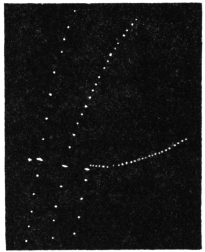
Fig. 61.—Time-relations of response of growing organ to electric stimulus of increasing intensities applied at the short horizontal lines. Successive dots at intervals of 2 seconds.
Experiment 55.—In the determination of time-relations of responsive change in growth under external stimulus, I shall take the typical case of the effect of electric shock from a secondary coil of one second’s duration. Two electrodes were applied, one above and the other below the growing region of a bud of Crinum. The record was taken on a moving plate, the magnification employed being two thousand times, and successive dots made at intervals of two seconds. It was a matter of surprise to me to find that the growth of the plant was affected by an intensity of stimulus far below the limit of our own perception. As regards the relative sensitiveness of plant and animal, some of my experiments show that the leaf of Mimosa pudica in a favourable condition responds to an electric stimulus which is one-tenth the minimum intensity that causes perception in a human being. For convenience I shall designate the intensity of electric shock that is barely perceptible to us as the unit shock. When an intensity of 0.25 unit was applied to the growing organ, it responded to it by a retardation of growth. Inspection of Fig. 61 shows that there is a flexure induced in the curve in response to stimulus, the flattening of the curve denoting retardation of growth. The latent period, in this case, is 6 seconds. The normal rate was restored after 5 minutes. The intensity of shock was next raised from 0.25 unit to one unit. The second record shows that the latent period is reduced to 4 seconds, and a relatively greater retardation of growth was induced by the action of the stronger stimulus. The recovery of the normal rate was effected after the longer period of 10 minutes. I took one more record, the intensity being three units. The latent period was now reduced to 1 second, and the induced retardation was so great as to effect a temporary arrest of growth.
TABLE X.—TIME-RELATIONS OF RESPONSIVE GROWTH-VARIATION UNDER ELECTRIC SHOCK (Crinum).
Intensity of stimulus.Latent period.Normal rate.Retarded rate.
0.25 unit.6 seconds.0.62 µ per sec.0.49 µ per sec.
1 "4 "0.62 "0.25 "
3 "1 "0.62 "Temporary arrest of growth.
It is thus found that growth in plants is affected by an intensity of stimulus which is below human perception; that with increasing stimulus the latent period is diminished and the period of recovery increased; and that the induced retardation of growth increases continuously with the stimulus till at a critical intensity there is a temporary arrest of growth. I shall speak later of the effect induced by stimulus above this critical point.
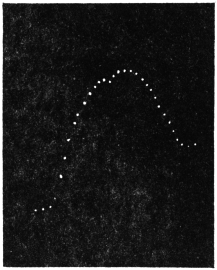
Fig. 62.—Record of a single growth-pulse of Zephyranthes (Magnification 10,000 times.)
Experiment 56.—As a further example of the capability of the Crescograph, I shall give the record of a single pulse of growth obtained with the peduncle of Zephyranthes Sulphurea (Fig. 62). The magnification employed was 10,000 times, the successive dots being at intervals of one second. It will be seen that the growth pulse commences with a sudden elongation, the maximum rate being 0.4 µ per sec. The pulse exhausts itself in 15 seconds, after which there is a partial recovery in the course of 13 seconds. The period of the complete pulse is 28 seconds. The resultant growth in each pulse is therefore the difference between elongation and recovery. Had a very highly magnifying arrangement not been used, the resulting rate would have appeared continuous. In other specimens, owing probably to greater frequency of pulsation and co-operation of numerous elements in growth, the rate appears to be practically uniform.
Advantages of the Crescograph.—There is no existing method which enables us to detect and measure such infinitesimal movements and their time-relations. The only attempt made in measuring minute growth has been by observing the movement of a mark on a growing plant through a microscope. The magnification available in practice is about 250 times. The observation of the movement would itself be sufficiently fatiguing. But a simultaneous estimate of the time-relations of rapidly fluctuating changes would prove so bewildering, that accurate results from this method would be altogether impossible. A 1/12″ objective gives a linear enlargement of about 1,200 times. But the employment of this objective is impracticable in the measurement of growth elongation of an ordinary plant. With the Crescograph, on the other hand, we obtain a magnification which far surpasses the highest powers of a microscope, and it can be used for all plants. It does not merely detect growth but automatically records the rate of growth and its slightest fluctuation. The extreme shortness of time required for an experiment renders the study of the influence of a single factor at a time possible, the other conditions being kept constant. The Crescograph thus opens out a very extensive field of inquiry into the physiology of growth; and the discovery of several important phenomena mentioned in this Paper is to be ascribed to the extreme sensitiveness of the apparatus, and the accuracy of the method employed.
MAGNETIC AMPLIFICATION.
The magnification obtained with two levers was, as stated before, 10,000 times. It may be thought that further magnification is possible by a compound system of three levers. There is, however, a limit to the number of levers that may be employed with advantage, for the slight overweight of the last lever becomes multiplied and exerts very great tension on the plant, which interferes with the normal rate of its growth. The friction at the bearings also becomes added up by an increase in the number of levers, and this interferes with the uniformity of the movement of the last recording lever. For securing further magnification, additional material contact has, therefore, to be abandoned. I have recently been successful in devising an ideal method of magnification without contact. The movement of the lever of the Crescograph upsets a very delicately balanced magnetic system. The indicator is a reflected spot of light from a mirror carried by the deflected magnet. Taking a single lever with the lengths of two arms 125 mm. and 2.5 mm. respectively we obtain a magnification of 50 times. The magnetic system gives a further magnification of 20,000 the total magnification being thus a million times. This was verified by moving by means of a micrometer screw the short arm of the lever through 0.005 mm. The resulting deflection of the spot of light at a distance of 4 metres was found to be 5,000 mm. or a million times the movement of the short arm. It is not difficult to produce a further magnification of 50 times by attaching a second lever to the first. The total magnification would in this case be 50 million times.
A concrete idea of this will be obtained when we realise that by the Magnetic Crescograph a magnification can be obtained which is about 50,000 times greater than that produced by the highest power of a microscope. This order of magnification would lengthen a wave of sodium light to about 3,000 cm. I am not aware of any existing method by which it is possible to secure an amplification of this order of magnitude. The application of this will undoubtedly be of great help in many physical investigations, some of which I hope to complete in the near future.
Such an enormous magnification cannot be employed in ordinary investigations on growth, for the moving spot of light indicating rate of growth, passes like a flash across the screen. But it is of signal service in my investigations on growth by the Method of Balance, to be described in a future Paper. The principle of this method consists in making the spot of light, which is moving in response to growth, stationary, by subjecting the plant to a compensating movement downwards. The slightest variation caused by an external agent would make the spot of light move either to the right or to the left, according to the stimulating or depressing character of the agent. It will be understood, how extremely sensitive this method is for detection of the most minute variation in the normal rate of growth.
THE DEMONSTRATION CRESCOGRAPH.
Before proceeding with accounts of further investigations, I shall describe a form of Magnetic Crescograph with which I have been able to give before a large audience demonstration of a striking character on various phenomena of growth. The magnification obtained was so great that I had to take some trouble in reducing it. This was accomplished by the employment of a single, instead of a compound system of two levers. The reflected spot of light was thrown on a screen placed at a distance of 4 metres, and this gave a magnification of a million times; it is obvious that an increase of the distance of the screen to 8 metres would have given a magnification of 2 million times. As it was, even the lower magnification was far too great for use with quick growing plants like Kysoor. I, therefore, employed the slower growing flower bud of Crinum. It will be seen from Table X that the normal rate of growth of the lily is of the order of 0.0006 mm. per second. The normal excursion of the spot of light reflected from the Crescograph exhibiting growth was found to be 3 metres in five seconds or 60 cm. per second. This is a million times the actual rate of growth of the Crinum bud. As it is easy to measure 5 mm. in the scale, it will be seen that with the Demonstration Crescograph it is possible to detect the growth of a plant for a period shorter than a hundredth part of a second.
Experiment 57.—A scale 3 metres long divided into cm. is placed against the screen. A metronome beating half seconds is started at the moment when the spot of light transits across the zero division; the number of beats is counted till the index traverses the 300 cm. At the normal temperature of the room (30°C.), the index traversed 300 cm. in five seconds. The plant chamber was next cooled to 26°C. by the blowing in of cooled water vapour; the time taken by the spot of light to traverse the scale was now 20 seconds, i.e., the growth-rate was depressed to a fourth. Under continuous lowering of temperature the growth-rate became slowed down till at 21°C. there was an arrest of growth. Warm vapour was next introduced, gradually raising the temperature of the chamber to 35°C. The spot of light now rushed across the scale in a second and a half, i.e., the growth was enhanced to more than three times the normal rate. The entire series of the above experiments, on the effect of temperature on growth, was thus completed in the course of 15 minutes.
SUMMARY.
A description is given of the High Magnification Crescograph, which enables an automatic record of growth magnified ten thousand times. The absolute rate of growth can be easily determined from the data given in the record.
A magnification of a million times is obtained by the employment of Magnetic amplification. An increment of growth so minute as a millionth part of a mm. or 0.00000004 inch may thus be detected. It is also possible to detect the growth of a plant for a period shorter than a hundredth part of a second.
The influence of external conditions on variation of rate of growth is obtained by two methods of record. In STATIONARY METHOD, the increase or diminution of the distance between successive dots representing magnified rate of growth, demonstrates the stimulating or depressing nature of the changed condition.
In the second, or MOVING PLATE METHOD, a curve is obtained, the ordinate representing growth elongation, and the abscissa, time. A stimulating agent causes an upward flexure of the normal curve; a depressing agent, on the other hand, lessens the slope of the curve.
The action of external stimulus induces a variation of the rate of growth, the time relations of which are found from the automatic record of the growth. The latent period is shortened with the intensity of the stimulus. A responsive variation of growth is induced by an intensity of stimulus which is below human perception.
It is often possible to obtain record of the pulsatory nature of growth-elongation. Thus, with the growing peduncle of Zephyranthes, the growth pulse commences with a sudden elongation, the maximum rate being 0.0004 mm. per second. The pulse exhausts itself in 15 seconds, after which there is a partial recovery in course of 13 seconds, the period of complete pulse being 28 seconds. The resultant growth in each pulse is the difference between elongation and recovery.
The Magnetic Crescograph enables demonstration of principal phenomena of growth and its variation before a large audience.
XI.—EFFECT OF TEMPERATURE ON GROWTH
By
Sir J. C. Bose,
Assisted by
Surendra Chunder Dass, M.A.
Accurate determination of the effect of temperature on growth presents many serious difficulties on account of numerous complicating factors. In nature, the upper part of the plant is exposed to the temperature of the air, while the root underground is at a very different temperature. Growth, we shall find, is modified to a certain extent by the ascent of sap. (See p. 189, Expt. 70.) The activity of this latter process is determined by the temperature to which the roots are subjected. The difficulty may be removed to a certain extent by placing the plant in a thermal chamber, with arrangement for regulating the temperature of the air. The air is a bad conductor of heat, and there is some uncertainty of the interior of the plant attaining the temperature of the surrounding air, unless the plant is long exposed to the definite and constant temperature of the plant chamber. Observation of the effects of different temperatures then becomes a prolonged process, with the possibility of vitiation of results by autonomous variation of growth. Reduction of the period of experiment by rapidly raising the temperature of the chamber introduces fresh difficulties; for a sudden variation of temperature often acts like an excitatory shock. This drawback may to some extent be obviated by ensuring a gradual change of temperature. This is by no means an easy process, for even with care the rise of temperature of the air cannot be made perfectly uniform, and any slight irregularity gives rise to sudden fluctuations in the magnified record of growth. Another difficulty arises from the radiation of heat-rays from the sides of the thermal chamber. These rays, I shall in a different Paper show, induce a retardation of growth. The effect of rise of temperature in acceleration of growth is thus antagonised by the action of thermal radiation. This trouble may be minimised by having the inner surface of the thermal chamber of bright polished metal, since the radiating power of a polished surface is relatively feeble.
The contrivance which I employ for ensuring a gradual rise of temperature, consists of a double-walled cylindrical metallic vessel; the plant is placed in the inner chamber, the walls of which are coated with electrically deposited silver and polished afterwards, and at the bottom of which there is a little water. The space between the inner and outer cylinder is filled with water, in which is immersed a coiled copper pipe. Hot water from a small boiler enters the inlet of the coiled pipe and passes through the outlet at the lower end. The water in the outer cylinder is thus gradually raised by flow of hot water in the coiled pipe. The rate of flow of hot water, on which the rate of rise of temperature depends, is regulated by a stop-cock. The air of the inner chamber in which the plant is placed, may thus be adjusted for a definite temperature. The small quantity of water in the inner chamber keeps its air in a humid condition, since dry hot air by causing dessication interferes with normal growth.
METHOD OF DISCONTINUOUS OBSERVATION.
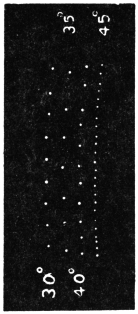
Fig. 63.—Effect of temperature on growth, and determination of optimum temperature.
Experiment 58.—High magnification records are taken for successive periods of ten seconds, for selected temperatures, maintained constant during the particular observation. In figure 63 is given records of rate of growth obtained with a specimen of Kysoor at certain selected temperatures. It will be seen that the rate of growth increases with the rise of temperature to an optimum, beyond which the growth-rate undergoes a depression. In the present case the optimum temperature is in the neighbourhood of 35°C.
METHOD OF CONTINUOUS OBSERVATION.
The method of observation that I have described above is not ideally perfect, but the best that could be devised under the circumstances. A very troublesome complication of pulsations in growth, arises at high temperatures, which render further record extremely difficult. Growth is undoubtedly a pulsatory phenomenon; but under favourable circumstances, these merge practically into a continuous average rate of elongation. At a high temperature the effect of certain disturbing factors comes into prominence. This may be due to some slight fluctuation in the temperature of the chamber, or to the effect of thermal radiation from the side of the chamber. This disturbing influence is most noticed at about 45°C, rendering the record of growth above this point a matter of great uncertainty. It will presently be shown that in plants immersed in water-bath growth is often found to persist even up to 57°C.
The only way of removing the complication arising from thermal radiation lies in varying the temperature condition of the plant, by direct contact with water at different temperatures. This procedure will also remove uncertainty regarding the body of the plant assuming the temperature of surrounding non-conducting air. The disturbing effect of sudden variation of temperature is also obviated by a more uniform regulation of rise of temperature. The inner cylinder containing the plant is filled with water; heat from gradually warmed water in the outer cylinder is conducted across the inner cylinder made of thin copper and raises the temperature of the water contained in the inner cylinder with great uniformity. A clock-hand goes round once in a minute; the experimenter, keeping his hand on the stop-cock, adjusts the rate of rise of water in the inner cylinder, so that there is a rise, say, of one-tenth of a degree every 6 seconds or of one degree every minute. The mass of water acts as a governor, and prevents any sudden fluctuations of temperature. The adoption of this particular device eliminated the erratic changes in the rate of growth that had hitherto proved so baffling.
The elongation recorded by the Crescograph will now be made up of (1) physical expansion, (2) expansion brought about by absorption of water, and (3) the pure acceleration of growth. The disentanglement of these different elements presented many difficulties. I was, however, able to find out the relative values of the first two factors in reference to the elongation of growth. This was done by carrying out a preliminary experiment with a specimen of plant in which growth had been completed. It was raised through 20°C in temperature, records being taken both at the beginning and at the end. This was for obtaining a measure of the physical change due to temperature, and also of the change brought about by absorption of water. I should state here that for the method of continuous record of growth which I contemplated, the record had to be taken for about 18 minutes. The magnification had to be lowered to 250 times to keep the record within the plate. With this magnification, the fully grown specimen did not show in the record a change even of 1 mm. in length in 18 minutes, while the growing plant under similar circumstances exhibited an elongation of 100 mm. or more. In records taken with low magnification, the effect of physical change is quite negligible.
DETERMINATION OF THE CARDINAL POINTS OF GROWTH.
The cardinal points of growth are not the same in different plants; they are modified in the same species by the climate to which the plants are habituated; the results obtained in the tropics may thus be different from those obtained in colder climates. At the time of the experiment, the prevailing temperature at Calcutta in day time was about 30°C.
Temperature minimum: Experiment 59.—For the determination of the minimum, I took a specimen of S. Kysoor, and subjected it to a continuous lowering of temperature, by regular flow of ice-cold water in the outer vessel of the plant-chamber. Record was taken on a moving plate for every degree fall of temperature; growth was found to be continuously depressed, till an arrest of growth took place at 22°C. (Fig. 64).
The arrested growth was feebly revived at 23°C., after which with further rise of temperature there was increased acceleration. The optimum point was reached at about 34°C. In some plants the optimum is reached at about 28°C., and the rate remains constant for the next 10 degrees or more.
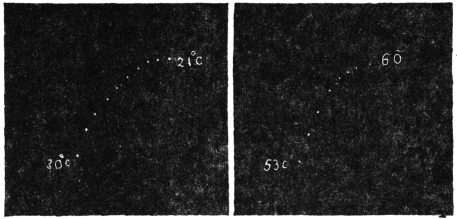
Fig. 64.—Record of effect of fall of temperature from 30°C. to arrest of growth at 22°C.
Fig. 65.—Effect of rise of temperature from 53°C. to 60°C. A sudden contraction, indicative of death-spasm, takes place at 60°C.
Temperature maximum: Experiment 60.—For the determination of the maximum, the temperature was raised much higher. At 55°C. growth was found to be greatly retarded with practical arrest at 58°C. At 60°C. there occurred a sudden spasmodic contraction (Fig. 65), which I have shown elsewhere to be the spasm of death. This mechanical spasm at 60°C. is also strikingly shown by various pulvinated organs. An electric spasm of galvanometric negativity, and a sudden diminution of electrical resistance also take place at the critical temperature of 60°C.[U]
I have described the immediate effect at the critical point. Long maintenance at a temperature few degrees below 60°C. will no doubt be attended with the death of the organ. Fatigue is also found to lower the death-point.
THE THERMO-CRESCENT CURVE.
Experiment 66.—I was next desirous of devising a method by which an automatic and continuous record of the plant should enable us to obtain a curve, which would give the rate of growth at any temperature, from the arrested growth at the minimum to a temperature as high as 40°C. In order to eliminate the elements of spontaneous variation, the entire record had to be completed within a reasonable length of time, say about 18 minutes for a rise of as many degrees in temperature. This gives a rate of rise of 1°C. for one minute. Separate experiments showed that at this rate of continuous rise of temperature there is practically no lag in the temperature assumed by thin specimens of plants. For observation during a limited range I use the slower rate of rise at 1°C. per two minutes. But the result obtained by slower rise was found not to differ from that obtained with one degree rise per minute. The curve of growth is taken on a moving plate, which travels 5 mm. per minute. Successive dots are made by the recording lever at intervals of a minute during which the rise of temperature is 1°C. A Thermo-crescent Curve is thus obtained, the ordinate of which represents increment of growth, and the abscissa, the time. As the temperature is made to rise one degree per minute, the abscissa also represents rise of temperature (Fig. 66). The vertical distance between two successive dots thus gives increment of growth in one minute for 1 degree rise of temperature from T to T′. If l represents this length, t the interval of time (here 60 sec.), and m the magnifying power of the recorder, then the rate of growth for the mean temperature (T+T′)/2 is found from the formula: rate of growth at (T+T′)/2 = l/m × t × 60 103µ per sec.
22°C 30°C 40°C
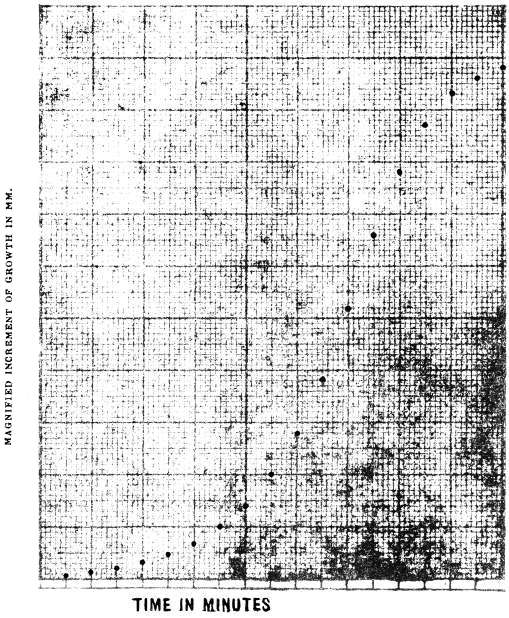
Fig. 66.—The Thermo-crescent Curve.
TABLE XI.—RATE OF GROWTH FOR DIFFERENT TEMPERATURES.
Temperature.Growth.Temperature.Growth.
22°C0.00 µ per sec.31°C0.45 µ per sec.
23°C0.02 µ " "32°C0.60 µ " "
24°C0.04 µ " "33°C0.80 µ " "
25°C0.06 µ " "34°C0.92 µ " "
26°C0.08 µ " "35°C0.84 µ " "
27°C0.12 µ " "36°C0.64 µ " "
28°C0.16 µ " "37°C0.48 µ " "
29°C0.22 µ " "38°C0.30 µ " "
30°C0.32 µ " "39°C0.16 µ " "
I give in figure 67 a curve showing the relation between temperature and growth.
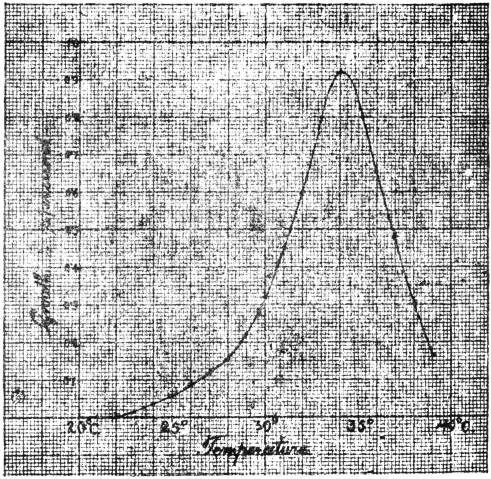
Fig. 67.—Curve showing relation between temperature and rate of growth.
It will thus be seen that, in the course of an experiment lasting about twenty minutes, data have been obtained which enable us to determine the rates of growth through a wide range of temperature. We have likewise been able by the first method to make very accurate determinations of the temperature maximum and minimum. In short, by adopting the methods described, the cardinal points of growth and the rate of growth at any temperature, may be determined with a precision unattainable by the older methods, of averages or of prolonged observation.
SUMMARY.
Temperature induces variation in the rate of growth. In accurate determination of the growth, the disturbing effect of radiation of heat has not been eliminated.
A continuous record of growth under uniform rise of temperature gives the Thermo-crescent curve, from which the rate of growth at any temperature may be deduced.
Different plant-tissues exhibit characteristic differences in their cardinal points of growth. In Kysoor, growth is arrested at the temperature minimum of 22°C. The optimum temperature is at 34°C., after which growth-rate declines and becomes completely arrested at 58°C. At 60°C. there is a sudden spasmodic contraction of death.
In other plants the cardinal points are different. In some plants the optimum growth is attained at 28°C. and remains constant up to 38°C.
XII.—THE EFFECT OF CHEMICAL AGENTS ON GROWTH
By
Sir J. C. Bose,
Assisted by
Guruprasanna Das.
Chemical agents are found to exert characteristic actions on growth. The method of investigation sketched here opens out an extended field of investigation. The effect of a chemical substance, I find, to be modified by (1) the strength of the solution, (2) the duration of application, and (3) the condition of the tissue. A poisonous substance in minute doses is often found to exert a stimulating action. Too long continued action of a stimulant, on the other hand, exerts a depressing effect. The influence of the tonic condition is shown by the fact that while a given dilution of a poisonous substance kills a weak specimen, the same poisonous solution, applied to a vigorous specimen, actually stimulates and enhances the rate of the growth. I give below descriptions of a few typical reactions.
The reagent, when in a liquid form, is locally applied on the growing organ. The records, taken before and after the application, exhibit the stimulatory or depressing character of the reagent. A different method of application of the reagent is employed for plants with extended region of growth. The specimen is then enclosed in a glass cylinder, with inlet and outlet pipes. The cylinder is first filled with water, and the normal rate of growth recorded. This rate remains constant for several hours; but prevention of access of air for too long a time affects the normal growth. After obtaining normal record, water charged with the giving chemical agent is passed into the cylinder; and the subsequent record shows the characteristic effect of the reagent. The introduction of a gas into the chamber offers no difficulty.
EFFECT OF STIMULANTS.
Hydrogen Peroxide: Experiment 62.—This reagent, as supplied by Messrs. Parke Davis & Co., was diluted to 1 per cent. and applied to the growing plant. Its stimulating action on growth is demonstrated in the right hand record of Fig. 68a, where the rate of growth is seen enhanced two and a half times the normal rate.
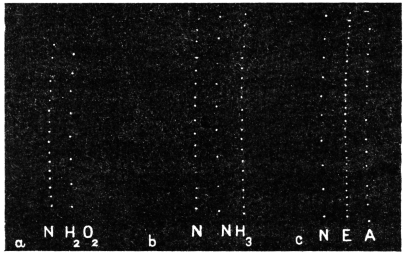
Fig. 68.—Effect of chemical agents: (a) Acceleration of growth under H2O2, (b) Effect of NH3, preliminary acceleration followed by retardation. (c) Effect of ether (E) and recovery (A).
Ammonia: Experiment 63.—The immediate effect of dilute vapour of this reagent is an enhancement of growth, seen in the middle record of Fig. 68b, where the rate is seen to be double the normal. Continued action, however, caused a depression; the third record of this series shows this, where the reduction is three-fourths of the normal rate.
EFFECT OF ANÆSTHETICS.
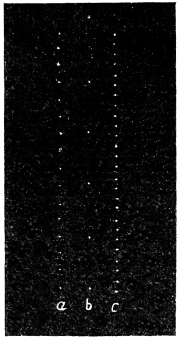
Fig. 69.—Effect of CO2. (a) Normal record; (b) immediately after application of CO2, and (c) 15 minutes after.
Ether: Experiment 64.—In Fig. 68c, the records exhibit the effect of introduction of ether vapour into the plant chamber, and its recovery after the removal of the vapour. Ether is seen to depress the rate of growth to a little more than a third of the normal rate. The recovery is seen to be nearly complete half an hour after the removal of the vapour.
Carbonic Acid: Experiment 65.—The action of this gas is very remarkable. The plant was immersed in water and normal record taken; the plant chamber was now filled with water, charged with carbonic acid gas. This induced a very marked acceleration of growth (Fig. 69). In a seedling of Onion, the increase was found to be two and a half times. In the flower bud of Crinum, the rate was found enhanced threefold from the normal 0.25 µ to 0.75 µ per second. After this preliminary enhancement, there was a depression of growth within 15 minutes of the application, the rate being now reduced to 0.15 µ per second. These effects were found to take place equally in light or in darkness.
ACTION OF DIFFERENT GASES.
Coal Gas: Experiment 66.—Coal gas induces a depression. It is curious that subjection to the action of this gas does not produce so evil an effect as one would expect. The introduction of the gas had reduced the growth-rate to more than half; but there was a recovery half an hour after the introduction of fresh air.
Sulphuretted Hydrogen: Experiment 67.—This gas not only exerts a depressing effect, but its after-effect is also very persistent. The plant experimented on was very vigorous and its rate of growth was depressed to half by subjection to the action of the gas for a short time. The record taken half an hour after the introduction of fresh air did not exhibit any recovery.
ACTION OF POISONS.
Ammonium Sulphide: Experiment 68.—This reagent in dilute solution retards growth, and in stronger solution acts as a poison. The following results were obtained with a wheat seedling under different strengths of solution:—
Normal rate0.30 µ per sec.
0.5 per cent. solution0.15 µ " "
2.0 " " "0.08 µ " "
Copper Sulphate: Experiment 69.—The effect of a solution of this reagent is far more depressing than the last. One per cent. solution acting for a short time depressed the rate from 0.45 µ to 0.13 µ per sec. Long continued action of the poisonous solution kills the plant.
SUMMARY.
The effect of a chemical agent is modified by the strength of the solution, the duration of application and the tonic condition of the tissue.
Dilute solution of hydrogen peroxide induces an acceleration of growth.
The action of dilute vapour of ammonia is a preliminary enhancement followed by depression of growth.
Ether vapour depresses the rate of growth. On the removal of the vapour there is a recovery of the normal rate.
The effect of carbonic acid is a great enhancement of the rate of growth; after this preliminary action, growth undergoes a decline. The effect described takes place equally in light or in darkness.
Coal gas induces a depression of the rate of growth from which there is a recovery after the removal of the gas. The action of sulphuretted hydrogen is far more toxic, the after-effect being very persistent.
Solution of ammonium sulphide induces increasing retardation of growth, with the strength of the solution. Copper sulphate solution acts as a toxic agent, retarding the rate of growth and ultimately killing the plant.
XIII.—EFFECT OF VARIATION OF TURGOR AND OF TENSION ON GROWTH
By
Sir J. C. Bose.
The movements of leaves of sensitive plants are caused by variation of turgor in the pulvinus induced by stimulus. The down movement or negative response of Mimosa is caused by a diminution or negative variation of turgor, while the erection or positive response is brought about by an increase, or positive variation of turgor.
We shall now investigate the change induced in a growing organ in the rate of growth by variation of turgor. Turgor may be increased by enhancing the rate of ascent of sap or by an artificial increase of internal hydrostatic pressure. A diminution of turgor may, on the other hand, be produced by withdrawal of water through plasmolysis. In order to maintain a constant terminology I shall designate an increase, as the positive, and a diminution, the negative variation of turgor.
RESPONSE TO POSITIVE VARIATION OF TURGOR.
In experimenting with Mimosa the plant was subjected to the condition of drought, water being withheld for a day. On supplying water, the leaf, after a short period, exhibited a positive or erectile movement (Expt. 12). The delay was evidently due to the time taken by the water absorbed by root to reach the responding organ.
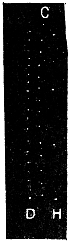
Fig. 70.—Effect of irrigation: D. record of growth under drought, C. acceleration after irrigation with cold water, H. enhanced acceleration on irrigation with warm water. (S. Kysoor)
Method of Irrigation: Experiment 70.—In order to investigate the effect of enhanced turgor on growth, I took a specimen of Kysoor which had been dug up with an attached quantity of soil; this latter was enclosed in a small bag. The plant was then securely clamped and fixed on a stand. This precaution was taken to prevent upward displacement by the swelling of the soil in flower pot of the plant under irrigation. The specimen was then subjected to a condition of drought, water being withheld for a day. The depressed rate of growth is seen in record (Fig. 70). Ordinary cold water was now applied at the root, the effect of which is seen in record C. Finally the record (H) was obtained after irrigation with tepid water. It will be seen that the spaces between successive dots, representing magnified growth at intervals of ten seconds, are very different. While a given elongation took place under drought in 19 × 10 seconds, a similar lengthening took place, after irrigation with cold water, in 13 × 10 seconds, and after irrigation with warm water in 3 × 10 seconds. Irrigation with warm water is thus seen to increase the rate of growth more than six times.
The enhancement of the rate of growth on irrigation with cold water took place after seventy seconds. The interval will obviously depend on the distance between the root by which the water is absorbed and the region of growth. It will further depend on the activity of the process of the ascent of sap. The time interval is greatly reduced when this activity is in any way increased. Thus the responsive growth elongation after application of warm water was very much quicker; in the case described it was less than 20 seconds. With regard to application of warm water, the variation of temperature should not be too sudden; it should commence with tepid, and end with warm water. Sudden application of hot water brings about certain complications due to excitatory effect. As regards the persistence of after-effect of a single application of warm water, it should be remembered that the absorbed water gradually cools down. In an experiment with a peduncle of Zephyranthes the growth under partial drought was found to be 0.04 µ per second; application of warm water increased the growth rate to 0.20 µ per second. After 15 minutes the growth rate fell to 0.13 µ per second; and after an hour to 0.08 µ per second. It will be noted that even then the rate was twice the initial rate before irrigation.
TABLE XII.—EFFECT OF IRRIGATION.
Specimen.Condition of Experiment.Rate of growth.
KysoorDry soil0.21 µ per second.
Irrigation with cold water0.30 µ " "
Irrigation with warm water1.33 µ " "
Peduncle of ZephyranthesDry soil0.04 µ " "
Irrigation with warm water0.20 µ " "
EFFECT OF ARTIFICIAL INCREASE OF INTERNAL HYDROSTATIC PRESSURE.
Increased turgor was, next, artificially induced by increase of internal hydrostatic pressure.
Experiment 71.—The plant was mounted water-tight in the short limb of an U-tube, and subjected to increased hydrostatic pressure by increasing the height of the water in the longer limb. Table XIII shows how increasing pressure enhances the rate of growth till a critical point is reached, beyond which there is a depression. This critical point varies in different plants.
TABLE XIII.—EFFECT OF INCREASED INTERNAL HYDROSTATIC PRESSURE (Kysoor).
Specimen.Hydrostatic pressure.Rate of growth.
Normal0.18 µ per second.
No. II2 cm. pressure0.20 µ " "
4 cm. "0.11 µ " "
Normal0.13 µ " "
No. II1 cm. pressure0.20 µ " "
3 cm. "0.18 µ " "
4 cm. "0.15 µ " "
RESPONSE TO NEGATIVE VARIATION OF TURGOR.
I shall now describe the influence of induced diminution of turgor on the rate of growth.
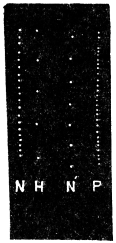
Fig. 71.—Effect of alternate increase and diminution of turgor on the same specimen: N, normal rate under drought; H, enhanced rate under irrigation with warm water; N′, normal permanent rate after irrigation; P, diminished rate after plasmolysis (Zephyranthes).
Method of plasmolysis: Experiment 72.—Being desirous of demonstrating the responsive growth variations of opposite signs in an identical specimen under alternate increase and diminution of turgor, I continued the experiment with the same peduncle of Zephyranthes in which the growth acceleration was induced by irrigation with warm water. In that experiment the growth rate of 0.04 µ per second was enhanced to 0.20 µ per second after irrigation. A strong solution of KNO3 was now applied at the root; and the growth-rate fell almost immediately to 0.03 µ per second, or nearly to one-third the previous rate, the depression induced being thus greater than under condition of drought (Fig. 71).
TABLE XIV.—EFFECT OF ALTERNATE VARIATION OF TURGOR ON GROWTH (Zephyranthes).
Condition of Experiment.Rate of growth.
Dry soil0.04 µ per second.
Application of warm water0.20 µ " "
Steady growth after 1 hour0.08 µ " "
Application of KNO3 solution0.03 µ " "
From the series of results that have been given above, it will be seen that employing very different methods of turgor variation, the rate of growth, within limits, is enhanced by an increase of turgor. A diminution or negative variation of turgor, on the other hand, brings about a retardation or negative variation in the rate of growth. We should, in this connection, bear in mind the fact that, growth is dependent on protoplasmic activity, and the variation of turgor itself is also determined by that activity.
RESPONSE OF MOTILE AND GROWING ORGANS TO VARIATION OF TURGOR.
I have already described (p. 40) the effects of variation of turgor on the motile pulvinus of Mimosa. There is a strict correspondence between the responsive movement of the leaf of Mimosa and the movement due to growth, which is summarized as follows:—
(1) An increase or positive variation of turgor induces an erection or positive response of the leaf of Mimosa, and a positive variation or enhancement of the rate of growth.
(2) A diminution or negative variation of turgor induces a fall or negative response of the leaf of Mimosa, and a negative variation or retardation of the rate of growth.
EFFECT OF EXTERNAL TENSION.
Experiment 73.—The recording levers are at first so balanced that very little tension is exerted on the plant. Record of normal growth is taken of a specimen of Crinum. The tension is gradually increased from one gram to ten grams. The table given below shows how growth-rate increases with the tension till a limit is reached, after which there is a retardation.
TABLE XV.—EFFECT OF TENSION ON GROWTH.
Tension.Rate of growth.
0 (Normal)0.41 µ per second.
4 grams0.44 µ " "
6 "0.48 µ " "
8 "0.52 µ " "
10 "0.40 µ " "
SUMMARY.
Increase of turgor induced by irrigation enhances the rate of growth. Irrigation with warm water induces a further augmentation of the rate of growth.
The latent period for enhancement of growth depends on the distance of growing region from the root. The latent period is reduced when the plant is irrigated with warm water.
Artificial increase of internal hydrostatic pressure, up to a critical degree, enhances the rate of growth.
A diminution or negative variation of turgor depresses the rate of growth.
There is a strict correspondence between the responsive movement of the leaf of Mimosa, and the movement due to growth. An increase or positive variation of turgor induces an erection of positive response of the leaf of Mimosa, and a positive variation or enhancement of the rate of growth. A diminution or negative variation of turgor induces a fall or negative response of the leaf of Mimosa, and a negative variation or retardation of the rate of growth.
External tension within limits, enhances the rate of growth.
XIV.—EFFECT OF ELECTRIC STIMULUS ON GROWTH
By
Sir J. C. Bose,
Assisted by
Guruprasanna Das.
In plant physiology, the word ‘stimulus’ is often used in a very indefinite manner. This is probably due to the different meanings which have been attached to the word. An agent is said to stimulate growth, when it induces an acceleration. But the normal effect of stimulus is to cause a retardation of growth. It is probably on account of lack of precision in the use of the term that we often find it stated, that a stimulus sometimes accelerates, and at other times, retards growth. In order to avoid any ambiguity, it is very desirable that the term stimulus should always be used in the sense as definite as in animal physiology. An induction shock, a condenser discharge, the make or break of a constant current, a sudden variation of temperature, and a mechanical shock bring about an excitatory contraction in a muscle. These various forms of stimuli cause, as we have seen, a similar excitatory contraction of the motile pulvinus of Mimosa pudica. We shall enquire whether the diverse forms of stimuli enumerated above, exert similar or different reactions on the growing organ.
EFFECT OF ELECTRIC STIMULUS OF VARYING INTENSITY AND DURATION.
The form of stimulus which is extensively used in physiological investigations, is the electric stimulus of induction shock which is easily graduated by the use of the well known sliding induction coil, in which the approach of the secondary to the primary coil, indicated by the higher reading of the scale, gives rise to increasing intensity of stimulus. The retarding effect of electrical stimulus on growth has already been demonstrated in record taken on a moving plate (Fig. 61).
I shall adopt for unit stimulus, that intensity of electric shock which induces a barely perceptible sensation in a human being. It is very interesting to find, as stated before, that growth is often affected by an electric stimulus, which is below the range of human perception.
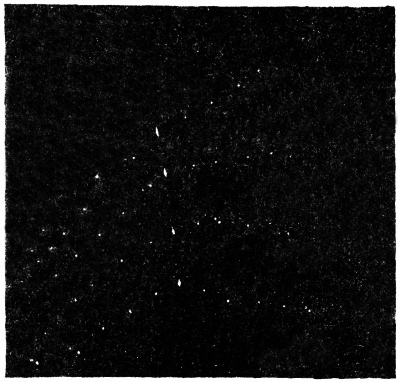
Fig. 72.—Effects of electrical stimulus of increasing intensities: of 0.25 unit, 1 unit, and 8 units. Short dashes represent the moments of application of stimulus.
Effect of Intensity: Experiment 74.—I shall now describe a typical experiment on the effect of intensity of stimulus in retarding the rate of growth. The normal rate of growth of the bud of Crinum was 0.35 µ per second. On the application of electric shock of unit intensity for 5 seconds, the rate became reduced to 0.22 µ per second. When the stimulus was increased to 2 units, the retarded rate of growth was 0.07 µ per second. When the intensity was raised to 4 units, there was a complete arrest of growth. In figure 72 is given records of a different experiment which show the effects of increasing intensity of stimulus in retardation of growth.
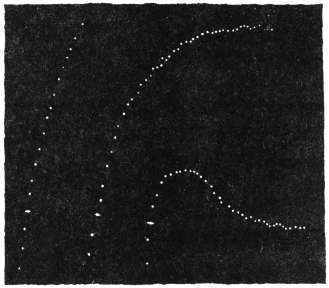
Fig. 73.—Effect of continuous electric stimulation of increasing intensity. The last record exhibits the actual shortening of the growing organ under strong stimulus.
Effect of continuous stimulation: Experiment 75.—The effect of continuous stimulation of increasing intensity will be seen in the record (Fig. 73), taken on a moving plate. On application of continuous stimulus of increasing intensity an increased flexure was produced in the curve, which denoted greater retardation in the rate of growth. When the intensity of stimulus was raised to 3 units, there was induced an actual contraction.
CONTINUITY BETWEEN INCIPIENT AND ACTUAL CONTRACTION.
It will thus be seen, that external stimulus of electric shock induces a reaction which is of opposite sign to the normal growth elongation or expansion. We may conveniently describe this effect as ‘incipient’ contraction; for under increasing intensity of stimulus, the contractile reaction, opposing growth elongation, becomes more and more pronounced; at an intermediate stage this results in an arrest of growth; at the further stage, it culminates in an actual shortening of the organ. There is no break of continuity in all these stages. I shall, therefore, use the term ‘contraction’ in a wider sense, including the ‘incipient’ which finds expression in a retardation of growth.
In Table XVI is given the results of certain typical experiments on the effect of stimulus of increasing intensity and duration.
TABLE XVI.—EFFECT OF INTENSITY AND DURATION OF ELECTRIC STIMULUS ON GROWTH.
Duration of Application.Intensity.Rate of growth.
Normal0.35 µ per second.
5 seconds1 unit0.22 µ " "
"2 units0.07 µ " "
"4 "Arrest of growth.
Continuous stimulationNormal0.30 µ per second.
" "0.5 unit0.20 µ " "
" "1 "0.09 µ " "
" "3 "Contraction.
With regard to the question of immediate and after-effect of stimulus, I find great difficulty in drawing a line of demarcation. Owing to physiological inertia there is a delay between the application of stimulus and the initiation of responsive reaction (latent period); owing to the same inertia, the physiological reaction is continued even on the cessation of stimulus. All responsive reactions are thus after-effects in reality. The latent period is shortened under strong stimulus, but the contractile reaction becomes more persistent. When the stimulus is moderate or feeble, the recovery from incipient contraction takes place within a short time. Stimulus, under certain circumstances, is found to improve the ‘tone’ of the tissue, and as we shall presently see bring about, as the after-effect, an enhancement of the rate of growth.
The effect of electric stimulus is thus an incipient or actual contraction.
SUMMARY.
In normal conditions electric stimulus induces an incipient contraction exhibited by the retardation of the rate of growth. Growth is often affected by an electric stimulus which is below human perception.
Under increasing intensity of stimulus, the contractile reaction opposing growth elongation becomes more and more pronounced. At a critical intensity of stimulus growth becomes arrested. Under stronger intensity of stimulus growing organ undergoes an actual shortening in length.
There is continuity between the incipient contraction seen in retardation, arrest of growth, and contraction of the organ under stronger stimulus.
The latent period of responsive variation of growth is shortened under stronger stimulus, but the period of recovery becomes protracted.
XV.—EFFECT OF MECHANICAL STIMULUS ON GROWTH
By
Sir J. C. Bose.
Amongst the various stimuli which induce excitation in Mimosa may be mentioned the irritation caused by rough contact, by prick, or wound. Friction causes moderate stimulation, from which the excited pulvinus recovers within a short time. But a prick or a cut induces a far more intense and persistent excitation; the recovery becomes protracted, and the wounded pulvinus remains contracted for a long period.
I shall now describe the effect of mechanical irritation on growth. For moderate stimulus, I employ rough contact or friction; more intense stimulation is caused by a prick or a cut.
EFFECT OF MECHANICAL IRRITATION.
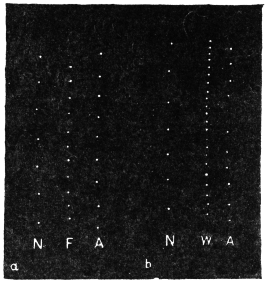
Fig. 74.—(a) N, normal rate of growth; F, retarded rate immediately after friction; A, partial recovery after 15 minutes.
(b) N, normal; W, immediately after wound; C, an hour after.
(Successive dots at intervals of 5″.)
Experiment 76.—In this experiment, I took a peduncle of Zephyranthes, which had a normal rate of growth of 0.18 µ per second. I then caused mechanical irritation by rubbing the surface with a piece of card-board. The mechanical stimulation was found to have caused a retardation of growth, the depressed rate being 0.11 µ per second, or three-fifths the normal rate. As this particular mode of stimulation was very moderate, the normal of rate growth was found to be restored after a short period of rest. After 15 minutes the rate became 0.14 µ per second; after an hour the recovery was complete, the rate being now 0.18 µ per second, the normal rate before stimulation (Fig 74a). We shall presently see that not only is the growth rate greatly depressed under intense stimulation, but the period of recovery also becomes very much protracted.
I have often been puzzled by the fact, that specimens apparently vigorous exhibited little or no growth, after attachment to the recorder. After waiting in vain for an hour, I had to discard them for others with equally unsatisfactory results. One of these specimens happened to be left attached to the recorder overnight, and I was surprised to find that the specimen, which had shown no growth the previous evening, was now exhibiting vigorous growth after being left to itself for 12 hours. I then realised that the temporary abolition of growth must have been due to the irritation of somewhat rough handling during the process of mounting and attachment of the specimen to the recorder.
In the matter of mechanical stimulation, some specimens are more irritable than others. The persistence of after-effect of irritation in retardation of growth will be demonstrated in the following experiments, where the stimulus employed was more intense.
EFFECT OF WOUND.
A prick causes an intense excitation in Mimosa. I tried the effect of this form of stimulation on responsive variation in growth.
Experiment 77.—The specimen was the same as had been employed in the last experiment. After moderate stimulation due to friction it had, in the course of an hour, completely recovered its normal rate of growth of 0.18 µ per second. I now applied the stimulus of pin prick; the actual injury to the tissue due to this was relatively slight; but the retardation of growth induced by this more intense mode of stimulation was very great. With moderate mechanical friction the rate had fallen from 0.18 µ to 0.11 µ per second, i.e., to three-fifths the normal rate: in consequence of prick the depression was from 0.18 µ to 0.05 µ per second, i.e., to less than a third of the normal rate. After 15 minutes the rate recovered from 0.05 µ to 0.07 µ per second. After moderate friction the recovery was complete after an hour; but in this case the recovery after an equal interval was only three-fourths of the original, the rate being now 0.12 µ per second (Fig. 74b). I next applied the more intense stimulus caused by a longitudinal cut This caused a depression of growth rate to 0.04 µ per second. A transverse cut, I find, gives rise to a more intense stimulation, than a longitudinal slit.
TABLE XVII.—EFFECT OF MECHANICAL IRRITATION AND OF WOUND ON GROWTH.
(Zephyranthes.)
Nature of stimulus.Condition.Rate of growth.
Mechanical frictionNormal rate0.18 µ per sec.
Immediately after stimulation0.11 µ "
15 minutes after stimulation0.14 µ "
60 minutes after stimulation0.18 µ "
Prick with needleNormal rate0.18 µ per sec.
Immediately after stimulation0.05 µ "
15 minutes after stimulation0.07 µ "
60 minutes after stimulation0.12 µ "
The effect of mechanical stimulus on growth is thus similar to that induced by electrical stimulus. Moderate stimulus of rough contact induces an incipient contraction, seen in retardation of growth, the recovery being complete in the course of an hour; but intense stimulation, induced by wound, gives rise to greater and more, persistent retardation of growth.
SUMMARY.
Mechanical stimulus induces incipient contraction or retardation of rate of growth, the effect being similar to that induced by electric stimulus.
Stimulus by contact or friction induces a retardation which is, relatively speaking, moderate. On the cessation of stimulus the normal rate of growth is restored within an hour.
Intense stimulation caused by the wound gives rise to greater and more persistent retardation of growth.
XVI.—ACTION OF LIGHT ON GROWTH
By
Sir J. C. Bose,
Assisted by
Guruprasanna Das.
The next subject of inquiry is the normal effect of light on growth. I speak of the normal effect because, under certain definite conditions, to be described in a later Paper, the response undergoes a reversal. The Crescograph is so extremely sensitive that it records the effect of even the slightest variation of light. Thus, as I have already mentioned, the opening of the blinds of a moderately-lighted room induces, within a short time, a marked change in the record of the rate of growth. The conditions of the experiment would thus become more precise if the growth-rate in the absence of light is taken as the normal. The specimens are, therefore, kept for several hours in darkness before the experiment. But this should not be carried to the extent of lowering the healthy tone of the plant.
I shall, in the present Paper, determine the characteristic response to light in variation of growth, the latent period of response, the effects of light of increasing intensity and duration, and the effects of the visible and invisible rays of the spectrum.
METHOD OF EXPERIMENT.
The plant was placed in a glass chamber kept in humid condition. The sources of light employed were: (1) an arc-lamp with self-regulating arrangement for securing steadiness of light, and (2) an incandescent electric lamp. Two inclined mirrors were placed close behind the specimen so that it should be acted on by light from all sides.
NORMAL EFFECT OF LIGHT.
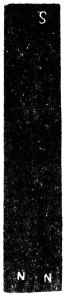
Fig. 75.—Normal effect of light. N, normal; S, retarded rate of growth in response to light; N, recovery on cessation of light.
Experiment 78.—I shall first give records obtained with Kysoor on the action of light. The first series exhibits the normal rate of growth in darkness; in the next the retarding effect of light is seen in the shortening of spacings, as compared with the normal, between successive dots. The light was next cut off and record taken once more after half an hour. Growth is now seen to have recovered its normal rate (Fig. 75). With regard to the after-effect of light I may say in anticipation that there are two different results, which depend on the physiological condition of the tissue. In a tissue whose tonic condition is below par, the after-effect is an acceleration; but with tissues in an optimum condition, the immediate after-effect is a retardation of the rate of growth. This is specially the case when the incident light is of strong intensity and of long duration.
DETERMINATION OF THE LATENT PERIOD.
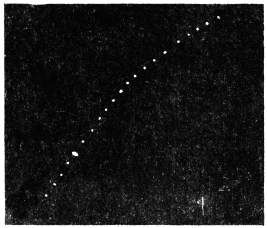
Fig. 76.—Latent period and time-relations of response to light, applied at thick line. Successive dots at intervals of 5 sec.
There is a general impression that it takes from several minutes to more than an hour for the light to react on the growing organ. This underestimate must have been due to the want of sufficient delicate means of observation. For my recorders indicate in some cases a response within less than 2 seconds of the incidence of light. This was found, for example, in the record of response given by a seedling of Cucurbita, to a flash of ultra-violet light. In the majority of cases the response is observed within 15 seconds of the incidence of light.
Experiment 79.—For the determination of the latent period, a record of the effect of arc light of 30 seconds’ duration was taken on a moving plate. It will be noticed (Fig. 76) that a retardation of growth was induced within 35 seconds of the incidence of light. The incipient contraction induced by light is thus similar to that induced by any other form of stimulus. Growth became restored to the normal value, 5 minutes after the cessation of stimulus.
EFFECT OF INTENSITY OF LIGHT.
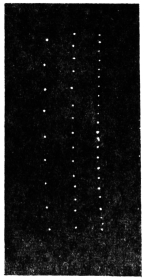
Fig. 77.—Action of light of increasing intensities: 1: 2: 3 in retardation of growth.
Experiment 80.—I next studied the action of light, the intensity of which was increased in arithmetical progression. The intensity of white light given by a half-watt incandescent electric lamp of 200 candle power, placed at a distance of a metre, is taken as the unit. Much feebler light would have been sufficient, but it would have required much longer exposure. The intensity was increased by bringing the lamp nearer the plant; marks were made on a horizontal scale so that the intensity of incident light increased at the successive marks of the scale as 1: 2: 3: and so on. The duration of exposure was same in all cases, namely, 5 minutes. After each experiment suitable periods of rest were allowed for the plant to recover its normal rate of growth. Records in Fig. 77 show increasing retardation induced by stronger intensities of light. Table XVIII gives the result of a different experiment.
TABLE XVIII.—EFFECT OF LIGHT OF INCREASING INTENSITY ON THE RATE OF GROWTH.
Intensity of light.Rate of growth.
0 (Normal)0.47 µ per sec.
1 Unit0.28 µ "
2 "0.17 µ "
3 "0.10 µ "
4 "Arrest of growth.
EFFECT OF CONTINUOUS LIGHT.
Experiment 81.—The continued effect of light of moderate intensity in bringing about increasing retardation of growth will be seen in Fig. 78(b) side by side with the record of effect of continuous electric stimulation (Fig. 78a) on growth. In both the cases the effect of continuous stimulation is seen to be the same, namely, a growing retardation, which in the given instances culminated in arrest of growth. This is true of stimulus of moderate intensity. Under a more intense stimulation the incipient contraction does not end in a mere arrest of growth, but the responding organ undergoes an actual shortening.
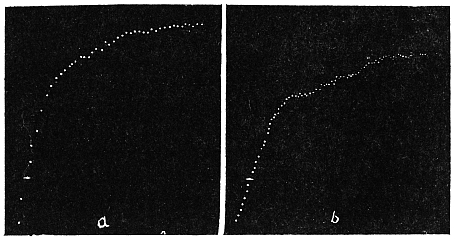
Fig. 78.—Effects of continuous (a) electric and (b) photic stimulation of moderate intensity, taken on a moving plate.
EFFECTS OF DIFFERENT RAYS OF THE SPECTRUM.
Different observers have found[V] that it is the more refrangible rays which exercise the greatest influence upon growth and tropic curvature. The relative effects of different lights will, however, become more precise from the curves of response to the action of different rays. For this purpose, I first employed monochromatic lights from different parts of the spectrum, produced by prism of high dispersion. In practice, the usual colour filters were found very convenient, as they allowed the application of more intense light. A thick stratum of bichromate of potash solution transmitted red rays, a thinner stratum allowed the transmission of yellow in addition; ammoniated copper sulphate solution allowed the blue and violet rays to pass through. It should be borne in mind that certain complicating factors are introduced by the incidence of light on the organ; there may be a slight rise of the temperature. We have seen however that moderate rise of temperature induces an acceleration of the rate of growth (p. 175). I shall later describe other experiments which will demonstrate the antagonistic effects of light and warmth on growth. Warmth again may induce a certain amount of dessication, but this is reduced to a minimum by maintaining the plant-chamber in a humid condition. The heating effect of the red is, relatively speaking, much greater than that of the blue rays. But in spite of this it is found that while red rays are practically ineffective, the blue rays are most effective in inducing responsive retardation of growth.
Effect of red and yellow light.—These rays had little or no effect in inducing variation of growth.
Effect of blue light: Experiment 82.—The blue rays exerted a marked retarding effect on growth. Light was applied for 34 seconds and retardation was initiated within 14 seconds of the incidence of light, and the retarded rate was two-fifths of the normal (Fig. 79B).
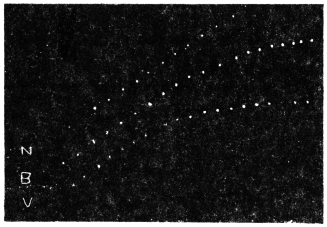
Fig. 79.—N, normal. B, effect of blue light, and V, of ultra-violet light. The records are on a moving plate.
Effect of ultra-violet light: Experiment 83.—Ultra-violet light was obtained from a quartz mercury vapour lamp. The effect of this light in retardation of growth was very marked. Response was induced within 10 seconds, the maximum retardation being one-sixth of the normal rate (Fig. 79V).
Effect of infra-red rays: Experiment 84.—In passing from the most refrangible ultra-violet to the less refrangible red rays, the responsive retardation of growth undergoes a diminution and practical abolition. Proceeding further in the infra-red region of thermal rays, it is found that these latter rays become suddenly effective in inducing retardation of growth.
A curve drawn with the wave length of light as abscissa, and effectiveness of the ray as ordinate shows a fall towards zero as we proceed from the ultra-violet wave towards the red; the curve, however, shoots up as we proceed further in the region of the infra-red. In connection with this it should be remembered that while the thermal rays induce a retardation of growth, rise of temperature, up to an optimum point, gives rise to the precisely opposite reaction of acceleration of growth.
The relative effectiveness of various rays on growth will be seen more strikingly demonstrated in records of photo-tropic curvature to be given in a succeeding Paper.
SUMMARY.
The normal effect of light is incipient contraction or retardation of the rate of growth.
The latent period may in some cases be as short as 2 seconds. In large number of cases it is about 15 seconds. The latent period is shortened under stronger intensity of light.
Increasing intensity of light induces increasing retardation and arrest of growth. Under continued action of light of strong intensity the growing organ may undergo an actual shortening.
In these reactions the action of stimulus of light resembles the effects of electric and mechanical stimuli.
The ultra-violet rays induce the most intense reaction in retardation of growth. The less refrangible yellow and red rays are practically ineffective. But the infra-red rays induce a marked retardation of growth.
The effects of light and warmth are antagonistic. The former induces a retardation and the latter an acceleration of growth.
XVII.—EFFECT OF INDIRECT STIMULUS ON GROWTH
By
Sir J. C. Bose,
Assisted by
Guruprasanna Das.
It has been shown that the direct application of stimulus gives rise in different organs to contraction, diminution of turgor, fall of motile leaf, electro-motive change of galvanometric negativity, and retardation of the rate of growth. I shall now inquire whether Indirect stimulus, that is to say, application of stimulus at some distance from the responding organ, gives rise to an effect different from that of direct application.
MECHANICAL AND ELECTRICAL RESPONSE TO INDIRECT STIMULUS.
I have already described the effect of Indirect stimulus on motile organs (p. 136). A feeble stimulus applied at a distance was found to induce an erectile movement or positive response of the leaf of Mimosa or of the leaflet of Averrhoa. This reaction is indicative of increase of turgor, an effect which is diametrically opposite to the diminution of turgor induced by the effect of Direct stimulus. It was also shown that an increase in the intensity of Indirect stimulus or a diminution of the intervening distance brought about a diphasic response, positive followed by negative. Direct stimulus gave rise only to a negative response.
Electric response to Indirect stimulus.—I have already explained how an identical reaction finds diverse expression in mechanical and electrical response, or in responsive variation of the rate of growth. It is of interest in this connection to state that my attention was first directed to the characteristic difference between the effects of Direct and Indirect stimulus from the study of electric response of vegetable tissues. I found that while Direct stimulus induced negative electric response, Indirect stimulus gave rise to a positive response. The clue thus obtained led to the discovery of positive mechanical response under Indirect stimulus.
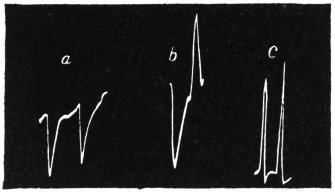
Fig. 80.—Electric response of Musa (a) Positive, (b) diphasic, (c) negative.
Experiment 85.—The records given in Fig. 80, exhibit the electric response given by vegetable tissues. On application of feeble stimulus at a distance from the responding point, the response was by galvanometric positivity. Under stronger stimulus the response became diphasic, positive followed by negative. Direct stimulus induced a negative response.
VARIATION OF GROWTH UNDER INDIRECT STIMULUS.
Since the responsive reactions of growing and non-growing organs are, as we shall find later, fundamentally similar, I expected that Indirect stimulus would give rise in a growing organ to an effect which would be of opposite sign to that induced by Direct stimulus—an acceleration, instead of retardation of growth; that would correspond to the positive mechanical and electrical responses to Indirect stimulus given by pulvinated organs and by ordinary vegetable tissues. The account of the following typical experiment will show that my anticipations have been fully verified.
Experiment 86.—I took a growing bud of Crinum and determined the region of its growth activity; lower down a region was found where the growth had attained its maximum and may, therefore, be regarded as indifferent region. I applied two electrodes in this indifferent region about 1 cm. below the region of growth. On application of moderate electric stimulus of short duration the response was by an acceleration of growth which persisted for nearly a minute, after which there was a resumption of the normal rate of growth. In this particular case the interval of time between the application of stimulus and the responsive acceleration of growth was 12 seconds. The interval varies in different cases from one second to 20 seconds or more, depending on the intervening distance between the point of application of stimulus and the responding region of growth. I give a record (Fig. 81) obtained in a different experiment which shows in an identical specimen, (1) an acceleration of growth under Indirect and (2) a retardation of growth under Direct stimulus.
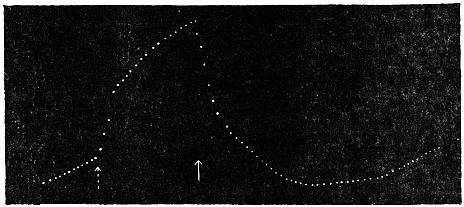
Fig. 81.—Effect of Indirect and Direct stimulus on growth of Crinum, taken on a moving plate. Dotted arrow shows application of Indirect stimulus with consequent acceleration of growth. Direct application of stimulus at the second arrow induces contraction and subsequent retardation of rate of growth. Successive dots are intervals of 5″. (Magnification 2,000 times).
TABLE XIX—ACCELERATING EFFECT OF INDIRECT STIMULUS ON GROWTH (Crinum).
Specimen.Condition of experiment.Rate of growth.
IINormal0.21 µ per second.
After Indirect stimulus0.26 µ " "
IINormal0.25 µ " "
After Indirect stimulus0.30 µ " "
It is thus seen that the effect of Indirect stimulus on growth-variation is precisely parallel to that obtained with the response of sensitive plant; that is to say, the effect induced by a feeble stimulus applied at a distance from the growing region is a positive variation or acceleration of growth. The effect becomes converted into negative or retardation of growth when the stimulus is Direct, i.e., when applied to the responding region of growth; under intermediate conditions, the growth-variation I find to be diphasic, a positive acceleration followed by a negative retardation. This is found true not merely in the case of a particular form of stimulus but of stimuli as different as mechanical, thermal, electric, and photic.
I shall in a subsequent paper formulate a generalised Law of Effects of Direct and Indirect Stimulus. From the experiments already described it is seen that:
Direct stimulus induces negative variation of turgor, contraction, fall of leaf of Mimosa, electric change of galvanometric negativity, and retardation of the rate of growth.
Indirect stimulus induces positive variation of turgor, expansion, erection of leaf of Mimosa, electrical change of galvanometric positivity, and acceleration of the rate of growth.
It is seen that Indirect stimulus gives rise to dual reactions, seen in positive and negative responses; of these the negative is the more intense. When the intervening distance is reduced, the resulting response becomes negative; this is due not to the absence of the positive, but to its being masked by the predominant negative. From the principle of continuity, this will also hold good in the limiting case, where by the reduction of the intervening distance to zero, the stimulus becomes Direct. In other words, Direct stimulus should also give rise to both positive and negative reactions. Of these the positive is masked by the predominant negative.
So much for theory; is it possible to unmask the contained positive in the resulting negative response under Direct stimulus? This important aspect of the subject will be dealt with in the following Paper.
SUMMARY.
The application of Direct stimulus gives rise to an electric response of galvanometric negativity. The application of stimulus at a distance from the responding point, i.e., Indirect stimulus, gives rise to positive electric response.
The mechanical responses of sensitive plants also exhibit similar effects, i.e., a negative response under Direct, and positive response under Indirect stimulus.
In the responsive variation of growth, Direct stimulus induces a retardation, and Indirect stimulus an acceleration of the rate of growth.
The effects of Direct and Indirect stimulus on vegetable organs in general are as follows:
Direct stimulus induces negative variation of turgor, contraction, fall of leaf of Mimosa, electric change of galvanometric negativity, and retardation of the rate of growth.
Indirect stimulus induces positive variation of turgor, expansion, erection of leaf of Mimosa, electrical change of galvanometric positivity and acceleration of the rate of growth.
XVIII.—RESPONSE OF GROWING ORGANS IN STATE OF SUB-TONICITY
By
Sir J. C. Bose.
The normal response of a growing organ to Direct stimulus is negative, that is to say, a retardation of the rate of growth. This is the case under forms of stimuli as diverse as those of mechanical and electric shocks, and of the stimulus of light.
ABNORMAL ACCELERATION OF GROWTH UNDER STIMULUS.
After my investigations on the normal retarding effect of light on growth, I was considerably surprised to find the responses occasionally becoming positive, an acceleration instead of retardation of growth. I shall first give accounts of such positive responses and then explain the cause of the abnormality.
Abnormal acceleration under stimulus of light: Experiment 87.—A rather weak specimen of Kysoor was exposed to the action of light of 5 minutes’ duration. This induced an abnormal acceleration in the rate of growth from 0.30 µ to 0.40 µ per second. But continuous exposure to light for half an hour brought about the normal effect of retardation. In trying to account for this abnormality in response I found that while specimens of Kysoor in a vigorous state of growth of about 0.8 µ per second exhibit normal retardation of growth under light, the particular specimen which exhibited the abnormal positive response had a much feebler rate of growth of 0.30 µ per second. As activity of growth in a plant is an index of its healthy tone, a feeble rate of growth must be indicative of tonicity below par. The fact that plants in sub-tonic condition exhibit abnormal acceleration of growth under stimulus will be seen further demonstrated in the next experiment.
In the parallel phenomenon of the response of pulvinated organs we found that under condition of sub-tonicity, the response becomes positive and that this abnormal positive is converted into normal negative in consequence of repeated stimulation. In growth, response likewise the abnormal acceleration of growth under light in the sub-tonic specimen of Kysoor was converted into normal retardation after continuous stimulation for half an hour. From the facts given above, we are justified in drawing the following conclusions:
(1) That while light induces a retardation of growth in a tissue whose tonic condition is normal or above par, it brings about an acceleration in a tissue whose condition is below par.
(2) That by the action of the stimulus of light itself a sub-tonic tissue is raised to a condition at par, with the concomitant restoration of normal mode of response by retardation of growth.
Another important question arises in this connection: Is the restoration of normal response due to light as a form of stimulus, or to its photo-synthetic action? An answer to this is to be found from the results of an inquiry, whether a very different form of stimulus which exerts no photo-synthetic action, such as tetanising electric shocks, also induces a similar acceleration of growth in a sub-tonic tissue.
The normal retarding effect of electric stimulus on specimens in active state of growth was demonstrated in record given in Fig. 72, where the normal rate was found greatly reduced after stimulation.
Abnormal acceleration of growth under electric stimulus: Experiment 88.—For my present purpose I took a sub-tonic specimen of seedling of wheat, its rate of growth being as low as 0.05 µ per second. After electric stimulation the rate was found enhanced to 0.12 µ per second, or about two and-a-half times. I give (Fig. 82) two records obtained with two different specimens. In the first, the record was taken on a stationary plate (Fig. 82). The closeness of successive dots in N show the feeble rate of growth of the sub-tonic specimen, the wider spacing after stimulation, S, exhibit the induced enhancement of growth.
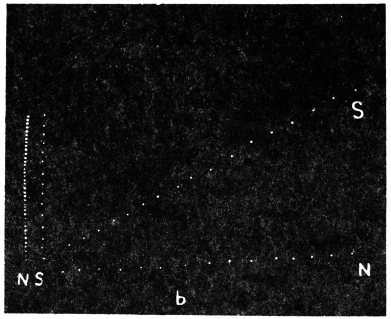
Fig. 82.—Enhancement of rate of growth in sub-tonic specimens of wheat seedling. First series of record on stationary, second series (b) on moving plate N, record before stimulation. S, after stimulation.
In the second experiment the records (Fig. 82b) were taken on a moving plate. The specimen was so extremely sub-tonic, that its normal record N appears almost horizontal. The greater erection of the curve, S, after stimulation demonstrates the induced acceleration of growth.
TABLE XX.—ACCELERATION OF GROWTH BY STIMULUS IN SUB-TONIC SPECIMENS.
Specimen.Stimulus.Rate of growth.
Wheat seedlingNormal0.05 µ per sec.
After electric stimulation0.12 µ " "
KysoorNormal0.30 µ per sec.
After 5' exposure to light0.40 µ " "
" 30' " "0.27 µ " "