PART II. GROWTH AND ITS RESPONSIVE VARIATIONS. (continued 2)
Reading edition
In my previous Paper on the ‘Modifying Influence of Tonic Condition’ I showed that while the response of the primary pulvinus of Mimosa in normal condition is negative, i.e., by contraction, diminution of turgor, and fall of the leaf, the response of a sub-tonic specimen is positive, that is to say, by expansion, enhancement of turgor, and erection of the leaf. I have shown further that in a sub-tonic specimen the action of stimulus itself raises the tissue from below par to normal or even above par, with the conversion of abnormal positive to normal negative response.
I have in the present Paper shown that a parallel series of reactions is seen in the response of growing organs. In vigorously growing specimens the action of stimulus is negative, i.e., incipient contraction, diminution of turgor, and retardation of the rate of growth. But in sub-tonic specimens, with enfeebled rate of growth, the effect of stimulus is positive, i.e., by expansion, enhancement of turgor, and acceleration of the rate of growth. Continuous stimulation also raises the sub-tonic growing tissue to a condition at par, converting the response from abnormal positive to normal negative.
It was also explained that every stimulus gave rise to dual reactions, positive and negative, and that in a highly excitable tissue the positive is masked by the predominant negative. The positive, or A-effect, is generally described as a “building up” process. By choosing a sub-tonic specimen, I have been able to unmask the positive, A. In the case of sub-tonic growing organs the positive, A, is literally a building up process, giving rise to an acceleration of growth.
From these facts and others given previously it will be seen that the abnormal response of acceleration of growth under stimulus is by no means accidental or fortuitous but is a definite expression of an universal reaction, characteristically exhibited by all tissues in a condition of sub-tonicity.
CONTINUITY BETWEEN ABNORMAL AND NORMAL RESPONSES.
A given plant-tissue may exist in widely different conditions of tonicity. Let us take two extreme conditions, the optimum and the minimum. The tonic level will be at its lowest at the minimum, where growth will be at a standstill. The range between the optimum and minimum will be very extended; hence strong and long continued stimulation will be necessary to raise the tissue from the tonic minimum to the optimum level. There are innumerable grades of tonicity between the optimum and minimum. Within this wide range the characteristic response will be the abnormal positive. As we approach the optimum, the range for positive response will become circumscribed, and the intensity and duration of stimulus necessary to convert the positive to negative will be feebler and shorter. It will be very seldom that a plant is likely to be found at the optimum. Hence plants in general may be expected to give a feeble positive response under sub-minimal stimulus.
These considerations led me to look for the positive response under sub-minimal stimulation; the tracings which I have obtained with my highly sensitive Crescograph and other recorders show that my anticipations have been justified.
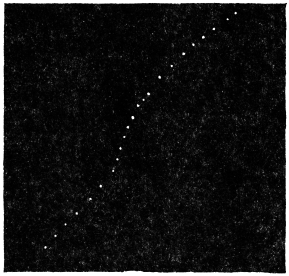
Fig. 83.—Acceleration of growth under sub-minimal light stimulus. Record on moving plate; stimulus applied at 5th dot, and subsequent erection of curve exhibits acceleration of growth. Last part of curve shows recovery of normal growth on cessation of stimulus.
Positive response under sub-minimal stimulus: Experiment 89.—In normal specimens, light of strong intensity induces a retardation of growth. When the source of light is placed at a distance, the intensity of light undergoes great diminution. Under the action of such feeble stimulus I obtained an acceleration of growth even in specimens which may be regarded as moderately vigorous (Fig. 83). Similar acceleration of growth was also obtained under feeble electric stimulation. The response is reversed to normal negative by increasing the intensity or duration of stimulus. Very feeble stimulus thus induces an acceleration and strong stimulus a retardation of growth. I have frequently obtained positive mechanical and electrical responses under sub-minimal stimulation. As chemical substances often act as stimulating agents, the opposite effects of the same drug in small and large doses may perhaps prove to be a parallel phenomenon.
It has been shown that stimulus induces simultaneously both A- and D-effects, with the attendant positive and negative responsive reactions, alike in pulvinated and in growing organs. A tissue, in an optimum condition, exhibits only the resultant negative response; the comparatively feeble positive is imperceptible, being masked by the predominant negative; but with the decline of its tone excitability diminishes, with it the D-effect, and we get the A-effect unmasked, resulting response then becomes diphasic. In extreme sub-tonic condition, it exhibits only the positive. The sequence is reversed when we begin with a tissue in a state of extreme sub-tonicity, which first exhibits only the positive. Successive stimulations continually exalt the tonic condition, the subsequent responses becoming, diphasic, and, with the attainment of optimum tone, a resultant negative response. As a further verification of the simultaneous existence of both A- and D-effects, it has been shown that in ordinary tonic condition a sub-minimal stimulus gives rise only to positive response; this becomes converted into normal negative under moderate stimulation.
I have described the action of stimulus on tissues in which, on account of sub-tonicity, growth has become enfeebled. I shall next take up the question of effect of stimulus on tissues in which growth, on account of extreme sub-tonicity, has been brought to a state of standstill.
SUMMARY.
The modifying influence of tonic condition on response is similar in pulvinated and growing organs.
The motile organ of Mimosa in a condition of sub-tonicity, exhibits a positive response, by expansion, increase of turgor, and erection of the leaf. Continuous stimulation converts the abnormal positive to normal negative.
In sub-tonic growing organs stimulus likewise induces a positive response, by expansion, increase of turgor and acceleration of the rate of growth. Continuous stimulation converts the abnormal acceleration to normal retardation.
Sub-minimal stimulus tends to induce even in normal tissues, an acceleration of rate of growth. Stimulus of moderate intensity induces in the same tissue the normal retardation of growth.
XIX.—RESUMPTION OF AUTONOMOUS PULSATION AND OF GROWTH UNDER STIMULUS
By
Sir J. C. Bose.
The autonomous activity of growth is ultimately derived from energy supplied by the environment. The internal activity may fall below par with consequent diminution or even arrest of growth; this condition of the tissue I have designated as sub-tonic. The inert plant can only be stirred up to a state of activity by stimulus from outside; and we saw that under the action of stimulus the rate of growth of a sub-tonic tissue was enhanced.
As the general question of depression of autonomous activity and its restoration by the action of stimulus is of much theoretical importance, I shall describe experiments carried out on a different form of autonomous activity, seen in spontaneous pulsation of the lateral leaflets of Desmodium gyrans. Under favourable conditions of light and warmth these leaflets execute vigorous movements, the period of a single pulse varying from one to two minutes. As the energy for this activity is ultimately derived from the environment, it is clear that isolation from the action of favourable environment will bring about a gradual depletion of energy with concomitant decline and ultimate cessation of spontaneous movement. For this we may keep the plant in semi-darkness; we may further hasten the rundown process by isolating the leaflet from the parent plant. A leaflet immersed in water was kept in a dimly lighted room; it was attached by a cocoon thread to the recording lever of an Oscillating Recorder to be fully described in the next Paper. The pulsation continued even in this isolated condition for about 48 hours, after which the spontaneous movement came to a stop. Further experiments showed that the arrest of pulsation was not indicative of mortality but of ‘latent life’ in a state of suspense, to be stirred up again by shock stimulus into throbbing activity.
REVIVAL OF AUTONOMOUS PULSATION UNDER STIMULUS.
Experiment 90.—In figure 84, is a seen record of the action of light on the sub-tonic Desmodium leaflet at standstill. A narrow pencil of light from electric arc was first thrown on the lamina in which the presence of chlorophyll rendered photo-synthetic action possible. This had no effect on the renewal of pulsation. But the autonomous activity was revived by the action of light on the pulvinule. This preferential effect on pulvinule showed that the renewal of activity was due not to photo-synthesis but to the stimulating action of light. The pulsation was also restored by chemical stimulants, such as dilute ether, and solution of ammonium carbonate.
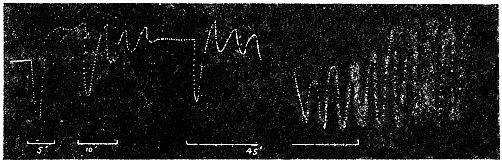
Fig. 84.—Renewal of autonomous activity in Desmodium gyrans at standstill by action of light. Up-curve represents up-movement. The horizontal lines below represent durations of exposure to light.
As regards the action of light, the pulsation continued for a time, even on the cessation of light. This persistence of autonomous activity increases with the intensity and duration of incident stimulus, that is to say with the amount of incident energy. In the present case a duration of five minutes’ exposure gave rise to a single pulsation, after which the movement of the leaflet came to a stop. The next application lasted for ten minutes and this gave rise to four pulsations, two during application, and two after cessation of light. The next application was for forty-five minutes, and the pulsation persisted for nearly an hour after the cessation of light. The experiments on sub-tonic specimens show clearly that the energy supplied by the environment becomes as it were latent in the plant, increasing its potentiality for work.
The renewal of autonomous activity in a sub-tonic tissue by the action of external stimulus, will be found in every way parallel to the renewal of growth in a sub-tonic organ.
REVIVAL OF GROWTH UNDER STIMULUS.
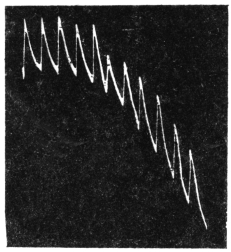
Fig. 85.—Record of responses of a mature style in which growth had come to a stop. Up-curve shows contraction under stimulus. Renewal of growth at sixth response, after which growth-elongation is shown by the trend of the base-line downwards.
Renewal of growth under stimulus: Experiment 91.—I find that application of electric stimulus renews growth in specimens where, on account of extreme sub-tonicity growth has come to a state of standstill. The resumption of growth in grass haulms under the stimulus of gravity is a phenomenon probably connected with the above. The causes which bring about cessation of growth in a mature organ are unknown; that there is a potentiality of growth even in a fully grown grass haulm is evidenced by the fact of its renewed growth under fresh stimulation. That this is not an exceptional phenomenon appears from the record which I obtained with a fully grown style of Datura alba. I subjected it to periodic stimulation, and obtained from it a series of contractile responses. After recovery from stimulus it regained its normal length which remained constant for some time as seen in the horizontal base-line. But as a result of successive stimulations, the mature style resumed its growth with increasing acceleration. This is seen in the recovery overshooting its former horizontal limit (Fig. 85).
From the investigations that have been described in this and in the previous Papers an insight is obtained into the complexity of response arising from various factors. It has been shown that the sign of response is modified by the intensity of stimulus, by its point of application, and by the tonic condition of the responding tissue. The fundamental reactions have been found to be essentially the same in pulvinated, in growing and non-growing organs. The results described enable us to enunciate general Laws of Effects of Direct and Indirect stimulus on tissues in normal and in sub-tonic condition.
LAWS OF EFFECTS OF DIRECT AND INDIRECT STIMULUS.
1. THE EFFECT OF DIRECT STIMULUS IS NEGATIVE VARIATION OF TURGOR, NEGATIVE MECHANICAL AND ELECTRICAL RESPONSE, NEGATIVE VARIATION, OR RETARDATION OF RATE OF GROWTH.
a. SUB-MINIMAL STIMULUS GIVES POSITIVE RESPONSE.
b. POSITIVE RESPONSE IS ALSO GIVEN BY A TISSUE IN A SUB-TONIC CONDITION: CONTINUOUS STIMULATION CONVERTS THE ABNORMAL POSITIVE TO NORMAL NEGATIVE RESPONSE.
c. AUTONOMOUS ACTIVITY IN A STATE OF STANDSTILL, MAY BE REVIVED BY STIMULUS.
d. THE EFFECTS OF STIMULUS AND WARMTH ARE ANTAGONISTIC.
2. THE EFFECT OF INDIRECT STIMULUS IS POSITIVE VARIATION OF TURGOR, POSITIVE MECHANICAL AND ELECTRICAL RESPONSE AND POSITIVE VARIATION OR ACCELERATION OF RATE OF GROWTH.
I have referred to the fact previously demonstrated, that while Direct stimulus induces contraction and retardation of growth, moderate rise of temperature induces the opposite effect of expansion and acceleration of growth. Further demonstration of the antagonistic effects of stimulus and warmth will be given in the next Paper.
SUMMARY.
The autonomous activity of pulsating leaflet of Desmodium gyrans comes to a stop under depletion of internal energy. A cut leaf isolated from the plant maintains the rhythmic activity of its leaflets for about 48 hours, after which there is an arrest of movement.
In this state of sub-tonicity the arrested autonomous activity is revived under the action of various stimuli. Thus the incidence of light on the pulvinule initiates pulsatory movements, which persists for a time even on the cessation of stimulus. This persistence of autonomous activity increases with the intensity and duration of stimulus to which the leaflet had been subjected.
The arrested autonomous activity of growth may often be revived by the action of stimulus. Thus the arrested growth in a mature style or Datura alba was renewed by electric stimulation.
XX.—ACTION OF LIGHT AND WARMTH ON AUTONOMOUS ACTIVITY
By
Sir J. C. Bose.
In the preceding Paper I have shown the essential similarity of effect of stimulus on autonomous activity of the Desmodium leaflet, and of the growing organ. It was shown how stimulus revived the pulsatory activity of Desmodium leaflet in a state of standstill, in the same way as it renewed the arrested growth-activity.
THE OSCILLATING RECORDER.
The investigation of this subject was rendered possible by the successful device of my Oscillating Recorder. A very light glass fibre was used for the construction of the lever, which was supported on jewel bearings. The short arm of the lever was 2 cm. in length, and the long arm 8 cm. This gave a magnification of 4 times. But it is quite easy to increase the magnification to 10 times or more.
The pull exerted by the pulsating leaflet is extremely slight, and the relatively heavy lever made of steel wire used in the Resonant Recorder is not well-suited for our purpose. The pulsation of the leaflet is relatively slow, being once in two minutes or so. The intermittent contact of ten times in a second, given by the Resonant Recorder, is therefore too quick. In the Oscillating Recorder the intermittence was, therefore, reduced to once in a second, or once in five seconds, the recording plate itself being made to move to-and-fro at this rate. The carrier of the plate-holder slides backwards and forwards on ball bearings; a wheel in the clockwork connected with an eccentric is released periodically, at intervals which may be varied between one and five seconds. By the action of the eccentric, the plate carrier approaches the writing lever with diminishing speed till the movement is zero at the contact. This contrivance is essential, since any sudden shock of the plate against the lever is apt to give rise to after-vibrations of the writer. The plate carrier is quickly withdrawn after the production of a dot on the smoked glass plate by contact with the writing lever.
The clockwork is governed by a revolving fan which can be gradually opened out by a regulating screw. The speed can thus be adjusted within wide limits, and maintained constant and at any desired speed. A second set of wheels connected with the clockwork moves the plate-holder in a lateral direction. A series of records may thus be taken for fifteen minutes, half an hour, or an hour.
The record obtained in this way is very perfect. Not only is the effect of an external agent shown by variation in the amplitude and frequency of pulsations, but the change of speed in any phase of the pulse becomes automatically recorded.
RECORD OF PULSATION OF DESMODIUM GYRANS.
The whole plant can not be conveniently manipulated for different investigations. It is, however, possible using the precautions described below to use the detached petiole carrying the pulsating leaflets. The terminal large leaf may also be removed. The necessary amputation is often followed by an arrest of pulsation. But as in the case of isolated heart in a state of standstill, the movement of the leaflet may be revived by the application of internal hydrostatic pressure. Under these conditions, the rhythmic pulsations may easily be maintained uniform for many hours.
The petiole carrying the leaflet is mounted water-tight in the short arm of an U-tube filled with water; for producing internal hydrostatic pressure in the plant the height of water in the longer arm is suitably raised. The U-tube holding the specimen may be adjusted up and down, and laterally. A hinged support also allows the specimen to be placed at any inclination. The movement of the leaflet, it is to be remembered, does not always take place in a vertical direction. The object of the mechanical adjustments is to place the specimen at such an angle that its up and down movements when in a straight line should be vertical, or have its long axis vertical when the movement is elliptical. It is important that the specimen should be illuminated equally from all sides; for one-sided illumination causes a bending over of the leaflet towards light.
The pulvinule of the leaflet acts like the pulvinus of Mimosa, that is to say, the leaflet undergoes a sudden fall to down position by the contraction of the more effective lower half of the pulvinule; the ‘up’ position denotes recovery and expansion of the more effective half. The up-and-down movements of the leaflet correspond to the diastolic and systolic movements of the animal heart. There is, indeed, as I have shown elsewhere[W] a very close resemblance between the activities of rhythmic tissue in the plant and in the animal.
EFFECT OF DIFFUSE LIGHT ON PULSATION OF DESMODIUM.
Experiment 92.—For the study of effect of light on Desmodium, I first obtained record in darkness. A horizontal beam of divergent light from an arc lamp placed at a distance of 200 cm. was made to act diffusely on the leaf from all sides. This was done by means of three inclined mirrors, the first throwing the light vertically downwards, the second vertically upwards, and the third horizontally forward from the side opposite the lantern. The effect of light is seen demonstrated in Fig. 86.
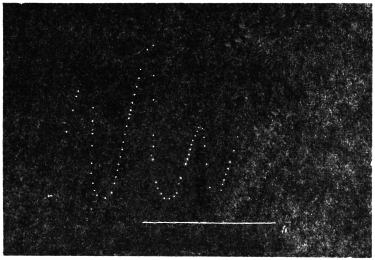
Fig. 86.—Effect of light on pulsation of Desmodium leaflet. Duration of application of light is represented by the horizontal line. Up-curve represents diastolic expansion and down-curve systolic contraction. Note contractile effect of light in diminution of amplitude and reduction of diastolic limit of pulsation.
Light was applied at the second pulsation. It will be seen that light retards or arrests the autonomous activity. On the cessation of light the normal activity was found to be gradually restored. It is of much interest to note here the similarity of action of light on autonomous activity of the leaflet of Desmodium and of a growing organ. In both, we find that while in the sub-tonic condition of the tissue the effect of light is to enhance or renew the autonomous activity of growth and pulsation, in normal condition the effect is to retard it.
Inspection of the record exhibits another very interesting characteristic. We saw that light retarded growth by inducing an incipient contraction. In the Desmodium leaflet the contractile reaction of light is exhibited by the characteristic modification of its pulsations. The duration of application of light is represented by the horizontal line. In Fig. 86 the up-curve represents up-movement of diastolic expansion, and the down-curve of systolic contraction. The contractile reaction of light is seen to counteract the normal expansion, with diminution of diastolic limit of pulsation.
EFFECT OF RISE OF TEMPERATURE ON PULSATION.
It has been shown that while rise of temperature up to an optimum enhanced the rate of growth, the effect of light was to retard it. Hence the effects of light and warmth are antagonistic.

Fig. 87.—Effect of rise of temperature on pulsation of leaflet of Desmodium gyrans. Horizontal line represents the duration of gradual rise of temperature from 30°C. to 35°C. Note the expansive effect of rise of temperature in reduction of systolic limit of pulsation.
Effect of rise of temperature on pulse-record: Experiment 93.—In studying the effect of rise of temperature on the pulsation of leaflets of Desmodium, we discover similar antagonistic reactions of light and warmth. The leaflet was placed in a plant-chamber with an electric arrangement for gradual rise of temperature. The first two records were taken in the normal temperature of the room, which was 30°C. The temperature was gradually raised to 35°C, the record being taken all the time. It will be seen (Fig. 87) that the effect of warmth is diametrically opposite to that of light. The record in Fig. 86 exhibited the contractile effect of light by reducing the diastolic limit of expansion. In the present case the expansive reaction of warmth is exhibited by the reduction of systolic limit of contraction. The temperature of the plant chamber was now allowed to return to 30°C., and we observe the gradual restoration of normal systolic limit of contraction.
SUMMARY.
Two different effects are found in the action of the stimulus of light alike on the autonomous activity of leaflet of Desmodium gyrans and of growing organs. In condition of sub-tonicity light renews pulsation of Desmodium and enhances the activity of growth. In normal tonic condition the effect induced is the very opposite, light causing an arrest of pulsation and retardation or arrest of growth.
The contractile effect of light is seen not only in the retardation of growth, but also by the characteristic modification of pulsation of Desmodium in the diminution of diastolic limit of expansion.
The antagonistic reactions of light and warmth are found not only in growth but also in the rhythmic activity of Desmodium gyrans. In the pulsation of Desmodium the contractile effect of light induces a rapid diminution of the diastolic limit of expansion, while the expansive reaction of warmth brings about a marked reduction of the systolic limit in successive pulsations.
XXI.—A COMPARISON OF RESPONSES IN GROWING AND NON-GROWING ORGANS
By
Sir J. C. Bose,
Assisted by
Guruprasanna Das.
I have in the preceding series of Papers demonstrated the effects of various forms of stimuli on growth. I have also given accounts of numerous reactions which are extraordinarily similar, in growing and non-growing organs. In fact certain characteristic reactions observed in motile pulvinus of Mimosa and other ‘sensitive’ plants led to the discovery of the corresponding phenomena in growing organs. For fully realising the essential similarity of responses given by all plant-organs, growing and non-growing, I shall give here a short review of the striking character of the parallelism.
1. The incipient contraction of a growing organ under stimulus culminates in a marked shortening of the organ.
2. The similarity of contractile responses in growing and pulvinated organs.
3. Similar modification of both under condition of sub-tonicity.
4. The opposite effects of Direct and Indirect stimulus, both in motile and in growing organs.
5. The exhibition by all plant-organs of negative electric response under Direct, and positive electric response under Indirect stimulus.
6. Similar modification of autonomous activity in Desmodium gyrans and in growing organs under parallel conditions.
7. Similar excitatory effects of various stimuli on pulvinated and growing organs.
8. Similar discriminative effects of different rays of light in excitation of motile and growing organs.
CONTRACTILE RESPONSE OF GROWING AND NON-GROWING ORGANS.
I have shown (page 198) that a growing organ under stimulus, undergoes an incipient contraction as shown in the responsive retardation of its rate of growth; that this retardation increases with the intensity of the incident stimulus till growth becomes arrested. Above this critical intensity the induced contraction causes an actual shortening of the organ. There is no breach of continuity in the increasing contractile reaction, which at various stages appears as a retardation, an arrest of growth or a marked shortening of length of the organ.
CONTRACTILE RESPONSE OF PULVINATED AND GROWING ORGANS.
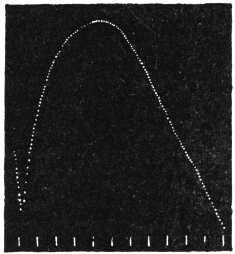
Fig. 88.—Contractile response of growing organ under electric shock. Successive dots at intervals of 4″. Vertical lines below represent intervals of one minute. (Magnification 1,000 times.)
Experiment 94.—In order to show the striking similarity between the response of ‘sensitive’ Mimosa and that of a growing organ, I give a record (Fig. 88) obtained with a growing bud of Crinum under the stimulus of electric shock above the critical intensity. The recorder gave a magnification of a thousand times. In Fig. 88, the normal growth elongation is represented as a down-curve. On the application of stimulus the normal expansion was suddenly reversed to excitatory contraction, the latent period of reaction was one second and the period of the attainment of maximum contraction (apex-time) was 4 minutes. The organ recovered its original length after a further period of seven minutes and then continued its natural growth elongation. Repetition of stimuli gave rise to successive contractile responses which are in every way similar to the mechanical responses of Mimosa pudica. The essential similarity of response of pulvinated and growing organs will be seen in the following tabular statement:
TABLE XXI.—TIME RELATIONS OF MECHANICAL RESPONSE OF PULVINATED AND GROWING ORGANS.
Specimen.Latent period.Apex-time.Period of recovery.
Motile pulvinus of Mimosa pudica.0.1 sec.003 secs.16 minutes.
Motile pulvinus of Neptunia oleracea.0.6 "180 "60 "
Growing bud of Crinum.1.0 "240 "07 "
The contraction in growing organs under stimulus is sometimes considerable. Thus in the filamentous corona of Passiflora quadrangularis the contraction may be as much as 15 per cent. of the original length. This is not very different from the excitatory reaction of the typically sensitive stamens of the Cynereæ, which exhibits a contraction from 8 to 22 per cent.
MODIFICATION OF RESPONSE BY CONDITION OF SUB-TONICITY.
In Mimosa the normal response to direct stimulus is negative, the leaf undergoing a fall. But sub-tonic specimens exhibit a positive response with erection of the leaf. The action of the stimulus itself improves the tonic condition, and the abnormal positive is thus converted into normal negative, through diphasic response (p. 147). Similarly in growing organs, while the normal effect of stimulus is incipient contraction and retardation of growth under condition of sub-tonicity the response is by acceleration of growth. Continuous stimulation converts this abnormal acceleration into normal retardation of growth (p. 225).
EFFECTS OF DIRECT AND INDIRECT STIMULUS.
Direct stimulus induces in Mimosa and other ‘sensitive’ plants a negative response. There is a diminution of turgor and contraction in the motile organ, resulting in the fall of leaf. Indirect stimulus, on the other hand, gives rise to a positive or erectile response, indicative of increase of turgor and expansion (p. 138).
In growing organs Direct stimulus induces an incipient contraction and retardation of rate of growth; the effect of Indirect stimulus is expansion and acceleration of the rate of growth (p. 216).
The opposite reactions to Direct and Indirect stimulus are also found in the electric response given by all plant organs. Thus while Direct stimulus induces an electromotive change of galvanometric negativity, Indirect stimulus induces the opposite change of galvanometric positivity (p. 214).
MODIFICATION OF AUTONOMOUS ACTIVITY.
The autonomous activity of Desmodium gyrans exhibited by the pulsation of its leaflets come to a stop under condition of sub-tonicity. The arrested movement is, however, revived by the action of stimulus (p. 228). The depressed or arrested growth of a growing organ is similarly accelerated or revived by the action of stimulus (p. 230).
In vigorous specimens stimulus induces the opposite effect by retarding or arresting the pulsatory activity or growth.
Warmth induces an effect which is antagonistic to that of stimulus. The contractile effect of stimulus is seen in the pulsations of leaflet Desmodium by the reduction of their expansive or diastolic limit, and in growing organs by the retardation of the rate of growth. The expansive effect of warmth is seen in reduction of the systolic limit of Desmodium pulsation, and in the acceleration of rate of growth in growing organs (p. 237).
EXCITATORY EFFECTS OF VARIOUS STIMULI ON PULVINATED AND GROWING ORGANS.
Certain agents induce excitation in living tissues, the excitatory change being detected by contraction, or by electromotive variation, or by change of electric resistance, and in growing organs by the retardation of the rate of growth. In general, the various stimuli which excite animal tissues also excite vegetable tissues.
It has been shown that every form of stimuli, however diverse, also induces incipient contraction and retardation of the rate of growth. Thus mechanical irritation, such as friction or wound, induces a retardation of growth (p. 202); they also induce an excitatory contraction in Mimosa, attended by the fall of the leaf. Different modes of electric stimulation act similarly on both growing and pulvinated organs. The action of light visible and invisible will presently be seen to react on both alike. And in this connection nothing could be more significant than the discriminative manner in which both the pulvinated and the growing organs respond to certain lights and not to others.
In contrast to the contractile effect of stimulus, certain agents induce the antagonistic reaction of expansion. It has been shown that while stimulus induces a retardation, rise of temperature up to an optimum point, induces an acceleration of the rate of growth. I have also referred to the fact that while the autonomous pulsations of Desmodium leaflet exhibit under stimulus a diminution of the extent of the diastolic expansion, warmth on the other hand, induces the opposite effect by diminishing the systolic contraction.
EFFECT OF LIGHT ON PULVINATED ORGANS.
I have referred to the well-known fact that it is the more refrangible portions of the spectrum that are more effective in inducing excitatory reactions and have already given records of the responsive reactions of various lights on growing organs. I shall now give records of the effect of various lights on the pulvinus of Mimosa pudica. The amplitude and time relations of the curves of response will give a more precise idea of the quantitative effects of various lights in inducing excitation.
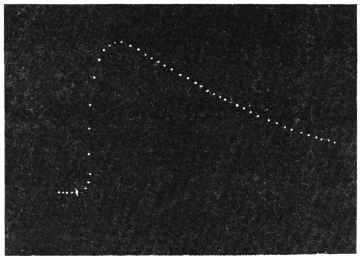
Fig. 89.—Effect of white light on the pulvinus of Mimosa. Successive dots in this and in the following records are at intervals of 10″. (Magnification 100 times)
Action of white light: Experiment 95.—The source of light was an arc lamp; a pencil of parallel light is made to pass through a trough of alum solution. This process of excluding thermal rays is adopted for the visible rays of the spectrum. Colour filters were also used for obtaining red, yellow and blue lights. The pencil of light is thrown upwards by an inclined mirror on the lower half of the pulvinus. The response is taken by an Oscillating recorder, giving successive dots at intervals of 10 seconds, the magnification employed being 100 times. The pulvinus being subjected to light for 10 seconds gave response by a fall of the leaf (Fig. 89). The response to light is thus found to be essentially similar to that induced by electric stimulus, the only difference being in the relative sluggishness of the reply. Electric shock passes instantaneously through the mass of the pulvinus, stirring up the active tissues to responsive contraction. The latent period is, therefore, as short as 0.1 second and the maximum contraction is effected in about 3 seconds. In the case of the stimulus of light the shock-effect is not so great; excitation, moreover, has to pass slowly from the surface of the pulvinus inwards. Hence the latent period is twelve seconds, and the period of maximum contraction is as long as 90 seconds. As the stimulation is moderate, the recovery is effected in 11 minutes, instead of 16 minutes, which is the usual period for Mimosa to recover from an electric shock. The important conclusion to be derived from this experiment is, that light is a mode of stimulation and that it induces a responsive contraction, similar to that caused by other forms of stimuli. This contractile response under light is exhibited not merely by the motile pulvinus of Mimosa, but by other pulvini as well, such as those of Erythrina indica, and of the ordinary bean plant.
Action of red and yellow lights.—The pulvinus gave little or practically no response to these lights.
Action of blue light: Experiment 96.—Light was applied for 10 seconds and the amplitude of response was similar to that induced by white light (Fig. 90).
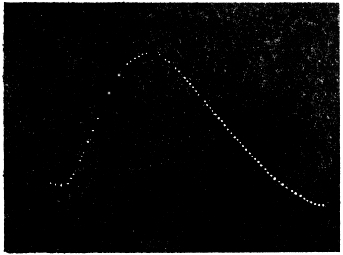
Fig. 90.—Effect of blue light on pulvinus of Mimosa.
Action of Ultra-violet rays: Experiment 97.—The source of light was a quartz mercury-vapour lamp. The effect was so intense that, to keep the record within the plate, I had to reduce the period of exposure to half, i.e., to five seconds. The responsive movement was initiated within six seconds of the application of light. The intensity and the rapidity of reaction is independently evidenced by the more erect curve of response (Fig. 91).
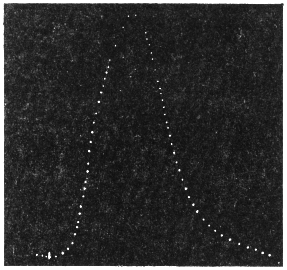
Fig. 91.—Effect of ultra-violet rays on the pulvinus of Mimosa.
Action of Infra-red rays: Experiment 98.—The obscure thermal rays also caused a strong excitatory reaction (Fig. 92). Attention is here drawn once more to the antagonistic reactions of temperature and radiation effects of heat.
It has been shown that the rays which cause the most intense excitations in Mimosa also induce the greatest retardation in the rate of growth. Thus ultra-violet is not only the most effective in causing excitation in Mimosa but also in retardation of growth. Next in order comes the blue rays: the yellow and red are practically ineffective in both the cases. Infra-red rays are, however, very effective in exciting the sensitive Mimosa and in retarding the rate of growth.
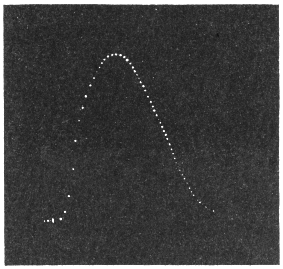
Fig. 92.—Effect of infra-red rays on the pulvinus of Mimosa.
DIVERSE MODES OF RESPONSE TO STIMULUS.
In Mimosa excitation is followed by the striking manifestation of the fall of the leaf. But in rigid trees contraction under excitation cannot find expression in movements. I have shown elsewhere that even in the absence of realised movement, the state of excitation can be detected by the induced electromotive change. I have shown that not only every plant but every organ of every plant is sensitive and reacts to stimulus by electric response of galvanometric negativity.[X]
There is an additional electric method by which the excitatory change may be recorded. I find that excitation induces a variation of the electrical resistance of a vegetable tissue.[Y] Thus the same excitatory reaction finds diverse concomitant manifestations, in diminution of turgor, in movement, in variation of growth, and in electrical change. The correspondence in the different phases of response in pulvinated, ordinary, and growing organs may be stated as follows: Excitation induces diminution of turgor, contraction and fall of the leaf of Mimosa; it induces an incipient contraction or retardation of rate of growth in a growing organ; it gives rise in all plant organs to an electric response of galvanometric negativity and of changed resistance. All these excitatory manifestations will, for convenience, be designated as the negative response. There is a responsive reaction which is opposite to the excitatory change described above. In Mimosa the fall of leaf under excitation is due to a sudden diminution of turgor; the erection of the leaf is brought about by natural or artificial restoration of turgor. Rise of temperature induces an expansive reaction which is antagonistic to that induced by stimulus. Warmth also enhances the rate of growth and induces an electric change of galvanometric positivity.[Z] The restoration of normal turgor or enhancement of turgor is associated with expansion, erection of the leaf of Mimosa, enhancement of rate of growth in a growing organ, electric response of galvanometric positivity, and contrasted change of electric resistance. All these will be distinguished as positive response.
There are thus several independent means of detecting the excitatory change or its opposite reaction in vegetable tissues. It will be seen that the employment of these different methods has greatly extended our power of investigation on the phenomenon of irritability of plants.
We have seen how essentially similar are the responsive reactions in pulvinated and in growing organs. It is therefore rational to seek for an explanation of a particular movement in a growing organ from ascertained facts relating to the corresponding movement in a pulvinated organ. The investigations on motile and growing organs that have been described fully establish the two important facts that, Direct stimulus induces contraction and Indirect stimulus induces the opposite expansive reaction. These facts will be found to offer full explanation of various tropic curvatures to be described in the subsequent series of Papers.
SUMMARY.
There is no breach of continuity in the increasing contractile reaction in a growing organ under increasing intensity of stimulus; the incipient contraction seen in retardation of rate of growth culminates in a marked shortening of the length of the organ.
Time relations of response, the latent period, the apex time, and the period of recovery are of similar order in pulvinated and in growing organs.
In condition of sub-tonicity the pulvinus of Mimosa responds to stimulus by an abnormal positive or erectile response. Under continued stimulation the abnormal positive is converted into normal negative. Growing organs in sub-tonic condition responds to stimulus by abnormal acceleration of rate of growth, which is converted into normal retardation under continuous stimulation.
Direct stimulus induces in Mimosa a negative response, with the fall of leaf. But Indirect stimulus induces the positive or erectile response. Similarly, Direct stimulus induces in a growing organ a negative variation, or retardation of rate of growth, and Indirect stimulus a positive variation or acceleration of rate of growth.
The electric response to Direct stimulus is by galvanometric negativity, that to Indirect stimulus by galvanometric positivity.
Under condition of sub-tonicity the autonomous activity of leaflet of Desmodium gyrans and of growing organs comes to a stop. The arrested activity in both is revived by the application of stimulus. Active pulsation in Desmodium, and active growth in growing organs are, however, retarded or arrested by stimulus.
The contractile effect of stimulus on pulsation of leaflets of Desmodium gyrans is seen by the reduction of the diastolic limit of its pulsations; to this corresponds the incipient contraction and retardation of rate of growth in a growing organ. The effect of warmth is antagonistic to that of stimulus. The expansive effect of rise of temperature is seen in Desmodium by the reduction of the systolic limit of its pulsation; in growth it is exhibited by an acceleration of the rate of growth.
All stimuli which induce an excitatory contraction and fall of the leaf of Mimosa also induce incipient contraction and retardation of rate of growth in a growing organ.
Excitatory effects of different rays of light on motile and growing organs are similarly discriminative. Ultra-violet light exerts the most intense reaction which reaches a minimum towards the less refrangible red end of the spectrum. Beyond this, the infra-red or thermal rays become suddenly effective in inducing excitatory movement and retardation of growth.