Volume 16 — THOMAS GRAY
Reading edition
(1716-1771)
BY GEORGE PARSONS LATHROP

he fame of Thomas Gray is unique among English poets, in that, although world-wide and luminous, it springs from a single poem, a flawless masterpiece,—the 'Elegy Written in a Country Church-Yard.' This is the one production by which he is known to the great mass of readers and will continue to be known to coming generations; yet in his own time his other poems were important factors, in establishing the high repute accorded to him then and still maintained in the esteem of critics. Nevertheless, living to be nearly fifty-five and giving himself exclusively to letters, the whole of the work that he left behind him amounted only to some fourteen hundred lines.
His value to literature and to posterity, therefore, is to be measured not by the quantity of his literary contributions or by any special variety in their scope, but by a certain wholesome and independent influence which he exerted upon the language of poetry, and by a rare quality of intense yet seemingly calm and almost repressed genius, which no one among his commentators has been able to define clearly. The most comprehensive thing ever written about him—wise, just, witty, yet sympathetic and penetrating—is the essay by James Russell Lowell in his final volume of criticism.
"It is the rarest thing," says Lowell, "to find genius and dilettantism united in the same person (as for a time they were in Goethe): for genius implies always a certain fanaticism of temperament, which, if sometimes it seem fitful, is yet capable of intense energy on occasion; while the main characteristic of the dilettante is that sort of impartiality which springs from inertia of mind, admirable for observation, incapable of turning it to practical account. Yet we have, I think, an example of this rare combination of qualities in Gray; and it accounts both for the kind of excellence to which he attained, and for the way in which he disappointed expectation.... He is especially interesting as an artist in words and phrases, a literary type far less common among writers of English than it is in France or Italy, where perhaps the traditions of Latin culture were never wholly lost.... When so many have written so much, we shall the more readily pardon the man who has written too little or just enough."
He was born in London, December 26th, 1716, the son of a money scrivener who had dissipated most of his inherited property, but was skilled in music, and perhaps transmitted to the son that musical element which gives beauty and strength to his poetry. Gray's mother was a woman of character, who with his aunt set up an India warehouse and supported herself; also sending the young man to St. Peter's College, Cambridge, after his studies at Eton. Leaving college without a degree, he traveled on the Continent of Europe with Horace Walpole in 1739; then returned to Cambridge and passed the remainder of his life in the university, as a bachelor of civil law nominally,—not practicing, but devoting himself to study and to excursions through rural England. He had a profound and passionate love for nature, a kind of religious exaltation in the contemplation of it and in mountain worship, which was at variance with the prevailing eighteenth-century literary mood and prefigured the feeling of Wordsworth. His mother having retired to Stoke Poges, Buckinghamshire, he often made visits there; and the church-yard of his deathless 'Elegy' is generally believed to be that of the parish church at Stoke Poges. It was here that he was laid to rest in the same tomb with his mother and his aunt, after his death, July 24th, 1771.
The 'Elegy' was finished in 1749. He had begun writing it seven years before. This has sometimes been alluded to as an instance in point of Horace's advice, that a poem should be matured for seven years. The length of time given to the 'Elegy,' however, may be accounted for partly by Gray's dilatory habits of writing, and partly by the parallel of Tennyson's long delay in perfecting the utterance of his meditations on the death of his friend Hallam through 'In Memoriam.' Gray's dearest friend, Richard West, died in 1742; and it was apparently under the stress of that sorrow that he began the 'Elegy,' which was completed only in 1749. Two years later it was published. It won the popular heart immediately, and passed through four editions in the first twelvemonth.
Of Gray's other poems, those which have left the deepest impression are his 'Ode on a Distant Prospect of Eton College,' 'The Progress of Poesy,' and 'The Bard.' The last two are somewhat Pindaric in style, but also suggest the influence of the Italian canzone. In the Eton College ode, his first published piece, occurs the phrase since grown proverbial, "Where ignorance is bliss, 'tis folly to be wise." It is a curious fact that while most readers know Gray only as the author of the 'Elegy,' every one is familiar with certain lines coined by him, but unaware of their source. For instance, in 'The Progress of Poesy,' he speaks of
"The unconquerable mind, and freedom's holy flame."
It is in the same place that he describes Milton as "blasted with excess of light," and in alluding to Dryden, evolves the image of
"Thoughts that breathe, and words that burn."
His, too, in 'The Bard,' is the now well-known line—
"Youth on the prow, and Pleasure at the helm."
Many of his finest expressions are in part derived from classic or other poets; but he showed undeniable genius in his adaptation, transformation, or new creation from these suggestive passages.
Gray was small and delicate in person, handsome and refined, fond of fashionable dress, and preferred to be known as a "gentleman" rather than a poet. He was very reticent, somewhat melancholy, and an invalid; a man also of vast erudition, being learned not only in literature but in botany, zoology, antiquities, architecture, art, history, and philosophy as well. He enjoyed the distinction of refusing the post of poet laureate, after the death of Cibber. On the other hand, he coveted the place of professor of modern literature and languages at Cambridge University, to which he was appointed in 1769; but he never performed any of the duties of his professorship beyond that of drawing the salary.
He brought forth nothing in the special kinds of knowledge which he had acquired in such large measure; and the actual ideas conveyed in his poetry were not original, but savored rather of the commonplace. Lowell says of the 'Elegy' that it won its popularity "not through any originality of thought, but far more through originality of sound." There must, however, be some deeper reason than this for the grasp which it has upon the minds and hearts of all classes. Two elements of power and popularity it certainly possessed in the highest degree. One is the singular simplicity of its language (a result of consummate art), which makes it understandable by everybody. The other is the depth and the sincerity of the emotion with which it imbues thoughts, sentiments, and reflections that are common to the whole of mankind. The very unproductiveness of Gray's mind in other directions probably helped this one product. The quintessence of all his learning, his perceptive faculty, and his meditations was infused into the life-blood of this immortal poem.

STOKE POGES CHURCH AND CHURCHYARD.
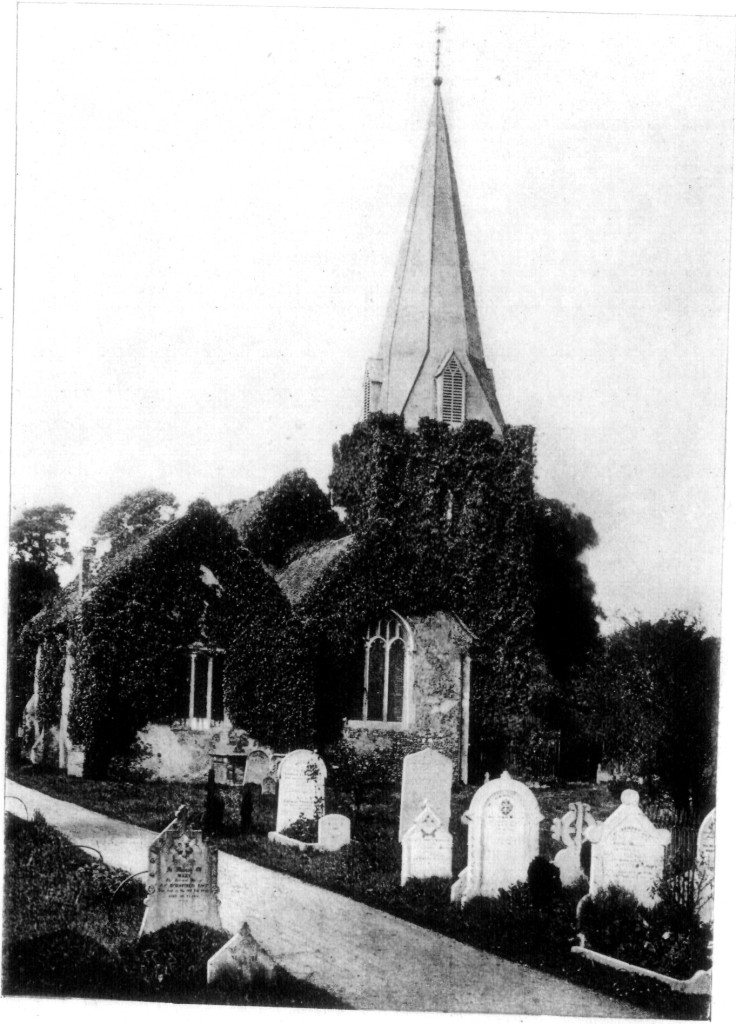
The burial-place of Thomas Gray and the scene of his famous Elegy. Photogravure from a Photograph.
ELEGY WRITTEN IN A COUNTRY CHURCH-YARD
The curfew tolls the knell of parting day; The lowing herd winds slowly o'er the lea; The plowman homeward plods his weary way, And leaves the world to darkness and to me. Now fades the glimmering landscape on the sight, And all the air a solemn stillness holds, Save where the beetle wheels his droning flight, And drowsy tinklings lull the distant folds: Save that, from yonder ivy-mantled tower, The moping owl does to the moon complain Of such as, wandering near her secret bower, Molest her ancient, solitary reign. Beneath those rugged elms, that yew-tree's shade, Where heaves the turf in many a moldering heap, Each in his narrow cell forever laid, The rude forefathers of the hamlet sleep. The breezy call of incense-breathing morn, The swallow twittering from the straw-built shed, The cock's shrill clarion, or the echoing horn, No more shall rouse them from their lowly bed. For them no more the blazing hearth shall burn, Or busy housewife ply her evening care; No children run to lisp their sire's return, Or climb his knees the envied kiss to share Oft did the harvest to their sickle yield; Their furrow oft the stubborn glebe has broke; How jocund did they drive their team afield! How bowed the woods beneath their sturdy stroke! Let not Ambition mock their useful toil, Their homely joys, and destiny obscure; Nor Grandeur hear with a disdainful smile The short and simple annals of the poor. The boast of Heraldry, the pomp of Power, And all that beauty, all that wealth e'er gave, Await alike th' inevitable hour: The paths of glory lead but to the grave. Nor you, ye proud, impute to these the fault, If Memory o'er their tomb no trophies raise, Where, through the long-drawn aisle and fretted vault, The pealing anthem swells the note of praise. Can storied urn or animated bust Back to its mansion call the fleeting breath? Can Honor's voice provoke the silent dust, Or Flattery soothe the dull, cold ear of Death? Perhaps in this neglected spot is laid Some heart once pregnant with celestial fire; Hands that the rod of empire might have swayed, Or waked to ecstasy the living lyre. But Knowledge to their eyes her ample page, Rich with the spoils of time, did ne'er unroll; Chill Penury repressed their noble rage, And froze the genial current of the soul. Full many a gem of purest ray serene The dark, unfathomed caves of ocean bear; Full many a flower is born to blush unseen, And waste its sweetness on the desert air. Some village Hampden, that with dauntless breast The little tyrant of his fields withstood; Some mute, inglorious Milton here may rest; Some Cromwell, guiltless of his country's blood. Th' applause of listening senates to command, The threats of Pain and Ruin to despise, To scatter plenty o'er a smiling land, And read their history in a nation's eyes,— Their lot forbade; nor circumscribed alone Their growing virtues, but their crimes confined; Forbade to wade through slaughter to a throne, And shut the gates of mercy on mankind; The struggling pangs of conscious Truth to hide, To quench the blushes of ingenuous Shame, Or heap the shrine of Luxury and Pride With incense kindled at the Muse's flame. [The thoughtless world to Majesty may bow, Exalt the brave, and idolize success; But more to Innocence their safety owe, Than Power and Genius e'er conspired to bless.] [Hark, how the sacred calm that broods around Bids every fierce tumultuous passion cease, In still, small accents whispering from the ground A grateful earnest of eternal peace.] Far from the madding crowd's ignoble strife, Their sober wishes never learned to stray; Along the cool, sequestered vale of life They kept the noiseless tenor of their way. Yet even these bones from insult to protect, Some frail memorial, still erected nigh, With uncouth rhymes and shapeless sculpture decked, Implores the passing tribute of a sigh. Their names, their years, spelt by th' unlettered Muse, The place of fame and elegy supply; And many a holy text around she strews, That teach the rustic moralist to die. For who, to dumb forgetfulness a prey, This pleasing, anxious being e'er resigned, Left the warm precincts of the cheerful day, Nor cast one longing, lingering look behind? On some fond breast the parting soul relies; Some pious drops the closing eye requires: E'en from the tomb the voice of Nature cries; E'en in our ashes live their wonted fires. For thee who, mindful of th' unhonored dead, Dost in these lines their artless tale relate; If, chance, by lonely Contemplation led, Some kindred spirit shall inquire thy fate, Haply some hoary-headed swain may say:— "Oft have we seen him at the peep of dawn Brushing with hasty steps the dews away, To meet the sun upon the upland lawn. "There at the foot of yonder nodding beech That wreathes its old fantastic roots so high, His listless length at noontide would he stretch, And pore upon the brook that babbles by. "Hard by yon wood, now smiling as in scorn, Muttering his wayward fancies, he would rove; Now drooping, woeful-wan, like one forlorn, Or crazed with care, or crossed in hopeless love. "One morn I missed him on the 'customed hill, Along the heath, and near his favorite tree: Another came; nor yet beside the rill, Nor up the lawn, nor at the wood, was he: "The next, with dirges due in sad array, Slow through the church-way path we saw him borne;— Approach and read (for thou canst read) the lay Graved on the stone beneath yon aged thorn." ["There scattered oft, the earliest of the year, By hands unseen, are showers of violets found; The redbreast loves to build and warble there, And little footsteps lightly print the ground."]
The Epitaph
Here rests his head upon the lap of Earth, A Youth to Fortune and to Fame unknown; Fair Science frowned not on his humble birth, And Melancholy marked him for her own. Large was his bounty, and his soul sincere; Heaven did a recompense as largely send: He gave to Misery all he had,—a tear; He gained from Heaven ('twas all he wished) a friend. No farther seek his merits to disclose, Or draw his frailties from their dread abode, (There they alike in trembling hope repose,)— The Bosom of his Father and his God.
[The stanzas included in brackets were omitted by Gray in the first edition of the 'Elegy,' and as sanctioned by him or by later editors are (except as to the third one) of infrequent appearance in the poem.]
ODE ON THE SPRING
Lo! Where the rosy-bosomed Hours, Fair Venus's train, appear, Disclose the long-expecting flowers, And wake the purple year! The Attic warbler pours her throat, Responsive to the cuckoo's note, The untaught harmony of spring; While, whispering pleasure as they fly, Cool zephyrs through the clear blue sky Their gathered fragrance fling. Where'er the oak's thick branches stretch A broader, browner shade, Where'er the rude and moss-grown beech O'er-canopies the glade, Beside some water's rushy brink With me the Muse shall sit, and think (At ease reclined in rustic state) How vain the ardor of the crowd, How low, how little are the proud, How indigent the great! Still is the toiling hand of Care; The panting herds repose: Yet hark! how through the peopled air The busy murmur glows! The insect-youth are on the wing, Eager to taste the honeyed spring, And float amid the liquid noon; Some lightly o'er the current skim, Some show their gayly gilded trim Quick-glancing to the sun. To Contemplation's sober eye Such is the race of Man; And they that creep, and they that fly, Shall end where they began. Alike the Busy and the Gay But flutter through life's little day, In Fortune's varying colors drest; Brushed by the hand of rough Mischance, Or chilled by Age, their airy dance They leave, in dust to rest. Methinks I hear, in accents low, The sportive kind reply: Poor moralist! and what art thou? A solitary fly! Thy joys no glittering female meets, No hive hast thou of hoarded sweets, No painted plumage to display: On hasty wings thy youth is flown; Thy sun is set, thy spring is gone— We frolic while 'tis May.
ON A DISTANT PROSPECT OF ETON COLLEGE
Ye distant spires, ye antique towers, That crown the watery glade, Where grateful Science still adores Her Henry's holy shade; And ye, that from the stately brow Of Windsor's heights th' expanse below Of grove, of lawn, of mead survey, Whose turf, whose shade, whose flowers among Wanders the hoary Thames along His silver-winding way! Ah, happy hills! ah, pleasing shade! Ah, fields beloved in vain! Where once my careless childhood strayed, A stranger yet to pain! I feel the gales that from ye blow A momentary bliss bestow, As waving fresh their gladsome wing, My weary soul they seem to soothe, And, redolent of joy and youth, To breathe a second spring. Say, Father Thames,—for thou hast seen Full many a sprightly race Disporting on thy margent green, The paths of pleasure trace,— Who foremost now delight to cleave With pliant arm thy glassy wave? The captive linnet which enthrall? What idle progeny succeed To chase the rolling circle's speed, Or urge the flying ball? While some, on earnest business bent, Their murmuring labors ply 'Gainst graver hours that bring constraint To sweeten liberty: Some bold adventurers disdain The limits of their little reign, And unknown regions dare descry, Still as they run they look behind, They hear a voice in every wind, And snatch a fearful joy. Gay hope is theirs, by fancy fed, Less pleasing when possest; The tear forgot as soon as shed, The sunshine of the breast: Theirs buxom health, of rosy hue, Wild wit, invention ever new, And lively cheer, of vigor born; The thoughtless day, the easy night, The spirits pure, the slumbers light, That fly th' approach of morn. Alas! regardless of their doom, The little victims play; No sense have they of ills to come, No care beyond to-day: Yet see, how all around them wait The ministers of human fate, And black Misfortune's baleful train! Ah, show them where in ambush stand, To seize their prey, the murtherous band! Ah! tell them they are men! These shall the fury Passions tear, The vultures of the mind, Disdainful Anger, pallid Fear, And Shame that skulks behind; Or pining Love shall waste their youth, Or Jealousy, with rankling tooth, That inly gnaws the secret heart; And Envy wan, and faded Care, Grim-visaged comfortless Despair, And Sorrow's piercing dart. Ambition this shall tempt to rise, Then whirl the wretch from high, To bitter Scorn a sacrifice, And grinning Infamy. The stings of Falsehood those shall try, And hard Unkindness's altered eye, That mocks the tear it forced to flow; And keen Remorse with blood defiled, And moody Madness laughing wild Amid severest woe. Lo! in the vale of years beneath A grisly troop are seen,— The painful family of Death, More hideous than their queen: This racks the joints, this fires the veins, That every laboring sinew strains, Those in the deeper vitals rage: Lo! Poverty, to fill the band, That numbs the soul with icy hand, And slow-consuming Age. To each his sufferings: all are men, Condemned alike to groan; The tender for another's pain, Th' unfeeling for his own. Yet, ah! why should they know their fate, Since sorrow never comes too late, And happiness too swiftly flies? Thought would destroy their Paradise. No more: where ignorance is bliss, 'Tis folly to be wise.
THE BARD
A Pindaric Ode
"Ruin seize thee, ruthless King! Confusion on thy banners wait! Though fanned by Conquest's crimson wing, They mock the air with idle state. Helm, nor hauberk's twisted mail, Nor e'en thy virtues, Tyrant, shall avail To save thy secret soul from nightly fears,— From Cambria's curse, from Cambria's tears!" Such were the sounds that o'er the crested pride Of the first Edward scattered wild dismay, As down the steep of Snowdon's shaggy side He wound with toilsome march his long array. Stout Glo'ster stood aghast in speechless trance; "To arms!" cried Mortimer, and couched his quivering lance. On a rock, whose haughty brow Frowns o'er cold Conway's foaming flood, Robed in the sable garb of woe, With haggard eyes the poet stood; (Loose his beard, and hoary hair Streamed, like a meteor, to the troubled air;) And with a master's hand and prophet's fire, Struck the deep sorrows of his lyre: "Hark, how each giant oak, and desert cave, Sighs to the torrent's awful voice beneath! O'er thee, O King! their hundred arms they wave, Revenge on thee in hoarser murmurs breathe; Vocal no more, since Cambria's fatal day, To high-born Hoel's harp, or soft Llewellyn's lay. "Cold is Cadwallo's tongue, That hushed the stormy main; Brave Urien sleeps upon his craggy bed; Mountains, ye mourn in vain Modred, whose magic song Made huge Plinlimmon bow his cloud-topt head. On dreary Arvon's shore they lie, Smeared with gore, and ghastly pale: Far, far aloof the affrighted ravens sail; The famished eagle screams, and passes by. Dear lost companions of my tuneful art, Dear as the light that visits these sad eyes, Dear as the ruddy drops that warm my heart, Ye died amidst your dying country's cries. No more I weep: they do not sleep; On yonder cliffs, a grisly band, I see them sit; they linger yet, Avengers of their native land; With me in dreadful harmony they join, And weave with bloody hands the tissue of thy line. "Weave the warp, and weave the woof, The winding-sheet of Edward's race; Give ample room, and verge enough, The characters of hell to trace; Mark the year, and mark the night, When Severn shall re-echo with affright The shrieks of death, through Berkley's roof that ring, Shrieks of an agonizing King! She-wolf of France, with unrelenting fangs, That tear'st the bowels of thy mangled mate, From thee be born, who o'er thy country hangs The scourge of Heaven. What terrors round him wait! Amazement in his van, with Flight combined, And Sorrow's faded form, and Solitude behind. "Mighty victor, mighty lord! Low on his funeral couch he lies! No pitying heart, no eye, afford A tear to grace his obsequies. Is the sable warrior fled? Thy son is gone. He rests among the dead. The swarm, that in thy noontide beam were born? Gone to salute the rising morn. Fair laughs the morn, and soft the zephyr blows, While proudly riding o'er the azure realm In gallant trim the gilded vessel goes: Youth on the prow, and Pleasure at the helm; Regardless of the sweeping whirlwind's sway, That, hushed in grim repose, expects his evening prey. "Fill high the sparkling bowl! The rich repast prepare! Reft of a crown, he yet may share the feast: Close by the regal chair Fell Thirst and Famine scowl A baleful smile upon their baffled guest. Heard ye the din of battle bray, Lance to lance, and horse to horse? Long years of havoc urge their destined course, And through the kindred squadrons mow their way. Ye towers of Julius, London's lasting shame, With many a foul and midnight murder fed, Revere his consort's faith, his father's fame, And spare the meek usurper's holy head. Above, below, the rose of snow, Twined with her blushing foe, we spread: The bristled boar in infant-gore Wallows beneath the thorny shade. Now, brothers, bending o'er the accursed loom, Stamp we our vengeance deep, and ratify his doom. "Edward, lo! to sudden fate (Weave we the woof. The thread is spun.) Half of thy heart we consecrate. (The web is wove. The work is done.) Stay, oh stay! nor thus forlorn Leave me unblessed, unpitied, here to mourn: In yon bright track that fires the western skies, They melt, they vanish from my eyes. But oh! what solemn scenes on Snowdon's height Descending slow their glittering skirts unroll? Visions of glory, spare my aching sight! Ye unborn ages, crowd not on my soul! No more our long-lost Arthur we bewail. All hail, ye genuine kings, Britannia's issue, hail! "Girt with many a baron bold, Sublime their starry fronts they rear; And gorgeous dames and statesmen old In bearded majesty appear. In the midst a form divine! Her eye proclaims her of the Briton line; Her lion port, her awe-commanding face, Attempered sweet to virgin grace. What strings symphonious tremble in the air; What strains of vocal transport round her play! Hear from the grave, great Taliessin, hear! They breathe a soul to animate thy clay. Bright Rapture calls, and soaring as she sings, Waves in the eye of heaven her many-colored wings. "The verse adorn again Fierce war, and faithful love, And truth severe, by fairy fiction drest. In buskined measures move Pale Grief, and pleasing Pain, With Horror, tyrant of the throbbing breast. A voice, as of the cherub choir, Gales from blooming Eden bear; And distant warblings lessen on my ear, That lost in long futurity expire. Fond impious man, thinkest thou yon sanguine cloud, Raised by thy breath, has quenched the orb of day? To-morrow he repairs the golden flood, And warms the nations with redoubled ray. Enough for me; with joy I see The different doom our fates assign; Be thine despair, and sceptred care; To triumph and to die are mine." He spoke, and headlong from the mountain's height Deep in the roaring tide he plunged to endless night.