Volume 16 — GOETHE
Reading edition
(1749-1832)
BY EDWARD DOWDEN

ohann Wolfgang Goethe was born at Frankfort-on-the-Main on August 28th, 1749, and died at Weimar on March 22d, 1832. His great life, extending over upwards of fourscore years, makes him a man of the eighteenth century and also of the nineteenth. He belongs not only to German but to European literature. And in the history of European literature his position is that of successor to Voltaire and Rousseau. Humanity, as Voltaire said, had lost its title-deeds, and the task of the eighteenth century was to recover them. Under all Voltaire's zeal for destruction in matters of religious belief lay a positive faith and a creative sentiment,—a faith in human intellect and the sentiment of social justice. What indefatigable toil! what indefatigable play! Surely it was not all to establish a negation. Voltaire poured a gay yet bitter élan into the intellectual movement of his time. Yet amid his various efforts for humanity he wanted love; he wanted reverence. And although a positive tendency underlies his achievements, we are warranted in repeating the common sentence, that upon the whole he destroyed more than he built up.
Voltaire fought to enfranchise the understanding. Rousseau dreamed, brooded, suffered, to emancipate the heart. A wave of passion, or at least of sentiment, swept over Europe with the 'Nouvelle Héloise,' the 'Émile,' the 'Confessions.' It was Rousseau, exclaims Byron, who "threw enchantment over passion," who "knew how to make madness beautiful." Such an emancipation of the heart was felt, in the eighteenth century, to be a blessed deliverance from the material interests and the eager yet too arid speculation of the age. But Byron in that same passage of 'Childe Harold' names Rousseau "the self-torturing sophist." And a sophist Rousseau was. His intellect fed upon fictions, and dangerous fictions,—fictions respecting nature, respecting the individual man, respecting human society. Therefore his intellect failed to illuminate, clarify, tranquilize his heart. His emotions were turbid, restless, and lacking in sanity.
Here then were Goethe's two great predecessors: one a most vivacious intelligence, the other a brooding sensibility; one aiming at an emancipation of the understanding, but deficient in reverence and in love; the other aiming at an emancipation of the affections, but deficient in sanity of thought. In what relation stood Goethe to these great forces of the eighteenth century?
In his old age Goethe, speaking of Voltaire, uses the words "a universal source of light." But as a young man he was repelled by "the factious dishonesty of Voltaire, and his perversion of so many worthy subjects." "He would never have done," says Goethe, "with degrading religion and the sacred books, for the sake of injuring priestcraft, as they called it." Goethe, indeed, did not deny a use to the spirit of negation. Mephistopheles lives and works. Yet he lives and works as the unwilling servant of the Lord, and the service he renders is to provoke men from indolence to activity.
Into the influence of Rousseau, on the contrary, and into the general movement of feeling to which Rousseau belonged, Goethe in his youth was caught, almost inevitably; and he abandoned himself to it for a time, it might seem without restraint.
Yet Goethe differed from Rousseau as profoundly as he differed from Voltaire. Rousseau's undisciplined sensibility, morbidly excited by the harshness or imagined harshness of his fellows, by bodily torment, by broodings in solitude, became at last one quivering mass of disease. "No tragedy had ever a fifth act so squalid." What a contrast to the closing scenes of Goethe's life in that house of his, like a modest temple of the Muses, listening to Plutarch read aloud by his daughter-in-law, or serenely active, "ohne Hast aber ohne Rast" (without haste, but without rest), in widening his sympathies with men or enlarging his knowledge of nature.
How was this? Why did the ways part so widely for Rousseau and for Goethe?
The young creator of 'Werther' may seem to have started on his career as a German Rousseau. In reality, 'Werther' expressed only a fragment of Goethe's total self. A reserve force of will and an intellect growing daily in clearness and in energy would not permit him to end as Rousseau ended. In 'Götz von Berlichingen' there goes up a cry for freedom; it presents the more masculine side of that spirit of revolt from the bonds of the eighteenth century, that "return to nature," which is presented in its more feminine aspects by 'Werther.' But by degrees it became evident to Goethe that the only true ideal of freedom is a liberation not of the passions, not of the intellect, but of the whole man; that this involves a conciliation of all the powers and faculties within us; and that such a conciliation can be effected only by degrees, and by steadfast toil.
And so we find him willing during ten years at Weimar to undertake work which might appear to be fatal to the development of his genius. To reform army administration, make good roads, work the mines with energetic intelligence, restore the finances to order,—was this fit employment for one born to be a poet? Except a few lyrics and the prose 'Iphigenie,' these years produced no literary work of importance; yet Goethe himself speaks of them as his "zweite Schriftstellerepoche."—his second epoch as a writer. They were needful to make him a master in the art of life, needful to put him into possession of all his powers. Men of genius are quick growers; but men of the highest genius, which includes the wisdom of human life, are not speedily ripe. Goethe had entered literature early; he had stormed the avenues. Now at six-and-twenty he was a chief figure in German, even in European, literature; and from twenty-six to thirty-seven he published, we may say nothing. But though he ceased to astonish the world, he was well employed in widening the basis of his existence; in organizing his faculties; in conciliating passions, intellect, and will; in applying his mind to the real world; in endeavoring to comprehend it aright; in testing and training his powers by practical activity.
A time came when he felt that his will and skill were mature; that he was no longer an apprentice in the art of living, but a master craftsman. Tasks that had grown irksome and were felt to be a distraction from higher duties, he now abandoned. Goethe fled for a time to Italy, there to receive his degree in the high school of life, and to start upon a course of more advanced studies. Thenceforward until his closing days the record is one of almost uninterrupted labor in his proper fields of literature, art, and science. "In Rome," he wrote, "I have for the first time found myself, for the first time come into harmony with myself, and grown happy and rational." He had found himself, because his passions and his intellect now co-operated; his pursuit of truth had all the ardor of a first love; his pursuit of beauty was not a fantastic chase, but was subject to rational law; and his effort after truth and his effort after beauty were alike supported by an adult will.
His task, regarded as a whole, was to do over again the work of the Renascence. But whereas the Renascence had been a large national or European movement, advancing towards its ends partly through popular passions and a new enthusiasm, the work which Goethe accomplished was more an affair of intelligence, criticism, conscious self-direction. It was less of a flood sweeping away old dikes and dams, and more of a dawn quietly and gradually drawing back the borders of darkness and widening the skirts of light. A completely developed human being, for the uses of the world,—this was the ideal in which Goethe's thoughts centred, and towards which his most important writings constantly tend. A completely developed State or commonwealth should follow, as an ideal arising out of the needs and demands of a complete individual. Goethe knew that growth comes not by self-observation and self-analysis, but by exercise. Therefore he turned himself and would turn his disciples to action, to the objective world; and in order that this action may be profitable, it must be definite and within a limited sphere. He preaches self-renunciation; but the self-renunciation he commends is not self-mortification; it is the active self-abandonment of devotion to our appropriate work. Such is the teaching of 'Wilhelm Meister': it traces the progress of a youth far from extraordinary, yet having within him the capacity for growth, progress through a thousand errors and illusions, from splendid dreams to modest reality. Life is discovered by Wilhelm to be a difficult piece of scholarship. The cry for freedom in 'Götz,' the limitless sigh of passion heard in 'Werther,' are heard no more. If freedom is to be attained, it can only be through obedience; if we are to "return to nature," it cannot be in Rousseau's way but through a wise art of living, an art not at odds with nature, but its complement:—
"This is an art which does mend nature—but The art itself is nature."
If we ask,—for this, after all, is the capital question of criticism,—What has Goethe done to make us better? the answer is: He has made each of us aspire and endeavor to be no fragment of manhood, but a man; he has taught us that to squander ourselves in vain desires is the road to spiritual poverty; that to discover our appropriate work, and to embody our passion in such work, is the way to true wealth; that such passion and such toil must be not servile, but glad and free; that the use of our intelligence is not chiefly to destroy, but to guide our activity in construction; and that in doing our best work we incorporate ourselves in the best possible way in the life of our fellows. Such lessons may seem obvious; but they had not been taught by Goethe's great predecessors, Voltaire and Rousseau. Goethe, unlike Voltaire, inculcates reverence and love; unlike Rousseau, he teaches us to see objects clearly as they are, he trains us to sanity. And Europe needed sanity in the days of Revolution and in the days which followed of Reaction.
Sanity for the imagination Goethe found in classical art. The young leader of the Romantic revival in Germany resigned his leadership; he seemed to his contemporaries to have lost the fire and impulse of his youth; his work was found cold and formal. A great change had indeed taken place within him; but his ardor had only grown steadier and stronger, extending now to every part of his complex nature. The change was a transition from what is merely inward and personal to what is outward and general. Goethe cared less than formerly to fling out his private passions, and cared more to comprehend the world and human life and to interpret these through art. He did not go into bondage under the authority of the ancients; but he found their methods right, and he endeavored to work as they had worked. For a time the reaction carried him too far: in seeking for what is general, he sometimes passed on to what is abstract, and so was forced into the error of offering symbols to represent these abstractions, instead of bodying forth his ideas in imaginative creations. But in the noble drama of 'Iphigenie,' in the epic-idyll of 'Hermann und Dorothea,' and in many of the ballads written during his period of close companionship with Schiller, we have examples of art at once modern in sentiment and classical in method.
Goethe's faith in the methods of classical art never passed away, but his narrow exclusiveness yielded. He became, with certain guiding principles which served as a control, a great eclectic, appropriating to his own uses whatever he perceived to be excellent. As in 'Hermann und Dorothea' he unites the influences of Greek art with true German feeling, so in his collection of short lyrics, the 'West-Östlicher Divan' (West-Eastern Divan), he brings together the genius of the Orient and that of the Western world, and sheds over both the spiritual illumination of the wisdom of his elder years. Gradually his creative powers waned, but he was still interested in all—except perhaps politics—that can concern the mind; he was still the greatest of critics, entering with his intelligence into everything and understanding everything, as nearly universal in his sympathies as a human mind can be. The Goethe of these elder years is seen to most advantage in the 'Conversations with Eckermann.'
The most invulnerable of Goethe's writings are his lyrical poems; against the best of these, criticism can allege nothing. They need no interpreter. But the reader who studies them in chronological order will observe that as time went on, the lyric which is a spontaneous jet of feeling is replaced by the lyric in which there is constructive art and considerate evolution. In the poems of the 'West-Östlicher Divan' Goethe returns to the lyric of spontaneity, but their inspiration is rather that of a gracious wisdom, at once serious and playful, than of passion.
His period of romance and sentiment is best represented by 'The Sorrows of Werther.' His adult wisdom of life is found most abundantly in 'Wilhelm Meister's Apprenticeship.' The world has long since agreed that if Goethe is to be represented by a single work, it shall be by 'Faust.' And even those who perceive that 'Faust' is best understood by being taken along with Goethe's other writings—his early 'Prometheus,' his autobiography, his travels in Italy, his classical dramas, his scientific studies, his work as a critic, his vast correspondence, his conversations in old age—cannot quarrel with the judgment of the world.
'Faust,' if we include under that name the First and the Second Parts, is the work of Goethe's whole life. Begun and even far advanced in early manhood, it was taken up again in his midmost years, and was completed with a faltering hand in the closing season of his old age. What it loses in unity, or at least in harmonious development as a piece of art, it gains in autobiographical interest. All his works, Goethe said, constituted a great confession. More than any other of his writings, 'Faust' is the confession of his life.
There are two ways in which a reader may deal with 'Faust.' He may choose for his own delight a fragment, detach it and disregard the rest; he may view this fragment, if he pleases, as a whole, as a rounded work of art. Such a reader will refuse to pass beyond the First Part of the vast encyclopædic poem. To do this is legitimate. The earliest form in which we possess the drama, that of the transcript made by Fräulein von Göchhausen, is a tragedy which might be named 'The Tragedy of Margaret.' Possibilities of further development lay in the subject, were indeed required by the subject, and Goethe had probably already conceived certain of them; yet the stadium in the progress of Faust's history included in 'The Tragedy of Margaret' had a unity in itself. But a reader may approach 'Faust' otherwise; he may view it as expressing the complete mind of Goethe on some of the deepest problems of human life. Viewing it thus, he must accept the whole work as Goethe has given it; he must hold in abeyance, at least for a time, his own particular likings and dislikes. While keeping his mind open to all the poetry of Faust, he will soon discover that here is something more than a poem. It may be unfortunate for the work of art that it belongs, certainly in its execution, possibly even in the growth of its conception, to far sundered periods of its author's career, when his feelings respecting art were different, when his capacity for rendering his ideas was now more and now less adequate. Such a reader, however, would part with nothing: in what is admirable he finds the master's hand; in what is feeble he discovers the same hand, but faltering, and pathetic in its infirmity. He is interested in 'Faust' not solely or chiefly as 'The Tragedy of Margaret': he finds in it the intellect, the character, the life of Goethe; it is a repository of the deepest thoughts and feelings concerning human existence of a wise seer, a repository in which he laid by those thoughts and feelings during sixty years of his mortal wayfaring.
From early manhood to extreme old age 'Faust' was with Goethe, receiving now and again, in Frankfort, in Weimar, in Rome, some new accession. We can distinguish the strata or formations of youth, of manhood, and of the closing years. We recognize by their diversities of style those parts which were written when creation was swift and almost involuntary, a passion and a joy, and those parts through which Goethe labored at an old man's pace, accomplishing to-day a hand's-breadth, to-morrow perhaps less, and binding blank pages into his manuscript, that the sight of the gaps might irritate him to produce. What unity can such a work possess, except that which comes from the fact that it all proceeded from a single mind, and that some main threads of thought—for it would be rash to speak of a ground idea—run through the several parts and bind them together? 'Faust' has not the unity of a lake whose circuit the eye can contemplate, a crystal set among the hills. Its unity is that of a river, rising far away in mountain solitudes, winding below many a mirrored cliff, passing the habitations of men, temple and mart, fields of rural toil and fields of war, reaching it may be dull levels, and forgetting the bright speed it had, until at last the dash of waves is heard, and its course is accomplished; but from first to last one stream, proceeding from a single source. Tourists may pick out a picturesque fragment of its wanderings, and this is well; but perhaps it is better to find the poetry of its entire career, from its cloudy cradle to the flats where it loses itself in the ocean.
The first part of 'Faust' is itself the work of more periods than one. The original conception may belong to Goethe's student days at Strassburg. He had grown weary of the four Faculties,—alas, even of theology; he had known a maiden as fair and sweet and simple as Gretchen, and he had left her widowed of her first love; and there in Strassburg was the presence of that old Cathedral, which inspired so terrible a scene in the 'Faust.' From Strassburg he returned to Frankfort, and no moments of his career of authorship were more fruitful than these which preceded the first Weimar years. It was in the heart of the Storm and Stress; it was the time of 'Götz' and 'Mahomet' and the 'Wandering Jew' and 'Werther' and 'Prometheus.' Here in Faust was another and a nobler Werther seeking the infinite; here was another Prometheus, a Titan shackled yet unsubduable. By Goethe's twenty-sixth year the chief portions of the 'Faust, a Fragment,' published when he was forty-one, had been written. But two scenes were added in Rome,—one of these strange in its fantasy, the Witches' Kitchen,—as if to show that the poet of the North was not quite enslaved by the beauty of classic art. It was in the last decade of the eighteenth century that Schiller succeeded in persuading Goethe to open his Faust papers, and try to recover the threads of his design. Not until 1808, Goethe's fifty-ninth year, was the First Part published as we now possess it. It is therefore incorrect to speak of this Part as the work of the author's youth; even here a series of strata belonging to different periods can be distinguished, and critics have contended that even in this Part may be discovered two schemes or plans not wholly in harmony each with the other.
The first Fragment was written, as has been said, in the spirit of the Storm and Stress. Goethe was weary of the four Faculties. The magic work of the time which was to restore vigor and joy to men was Nature. This is the theme of the opening scene of 'Faust.' Among old instruments and dusty folios and ancestral lumber and brute skeletons, away from Nature and her living founts of inspiration, the old scholar has found neither joy nor true knowledge. He opens the book of Nostradamus and gazes upon the sign of the Macrocosm; here in a symbol he beholds the life and energy of nature:—
"Where shall I grasp thee, infinite Nature, where? Ye breasts, ye fountains of all life whereon Hang heaven and earth."
He cannot grasp them; and then turning from the great Cosmos, he thinks he may at least dare to invoke the spirit of our own mother planet Earth. But to Faust, with eyes bleared with the dust of the study, to Faust, living in his own speculations or in dogmatic systems, the aspect of the Earth Spirit—a living fire—is terrible. He falls back upon himself almost despairing, when the famulus Wagner enters. What Werner was to the idealist Wilhelm Meister, Wagner is to the idealist Faust: the mere scraping together of a little hoard of barren facts contents Wagner; such grief, such despair as Faust's, are for this Philistine of learning impossible. And then the fragment of 1790 passes on to Mephistopheles. Whether or not Goethe found the features of his critical demon in Herder (as Grimm supposes), and afterwards united these to the more pronounced likeness in his friend Mephistopheles Merck, matters little. Whether Herder and Merck had been present or not, Goethe would have found Mephistopheles in his own heart. For the contrast between the idealist Faust and the realist Mephistopheles exists in some form or other in almost every great creation of Goethe. It is the contrast between Werther and Albert, between Tasso and Antonio, between Edward and the Captain. Sometimes the nobler spirit of worldliness is dwelt on, as in the case of Antonio; sometimes the cold, hard, cynical side, as in the case of Mephistopheles. The theme of Faust as originally conceived was the turning of an idealist from his own private thoughts and dreams to the real world; from all that is unnatural,—systems, speculations, barren knowledge,—to nature and the founts of life; from the solitary cell to the company of men; to action, beauty, life, and love. If he can really succeed in achieving this wisely and well, Faust is saved. He is delivered from solitude, the inane of speculation, the vagueness of idealism, and made one with the band of his toiling fellows. But to accompany him there is the spirit of base worldliness, the realist, the cynic, who sees the meaner side of all that is actual, who if possible will seduce Faust into accepting the world apart from that elevating spirit which ennobles actual life, who will try to baffle and degrade Faust by degrading all that he now seeks,—action and beauty and life and love.
It is Goethe himself who is at odds with himself,—the realist Goethe set over against the idealist Goethe; and Mephistopheles is the base realist, the cynic whose endeavor is to mar the union of high poetry and high prose in human life, which union of high poetry with high prose Goethe always looked upon as the true condition of man's activity. In the Prologue in Heaven, written when Schiller had persuaded Goethe to take up the threads of his play, the Lord speaks of Faust as his servant. Mephistopheles wagers that he will seduce Faust from his allegiance to the Highest. The Lord does not wager; he knows:—
"Though now he serve me in a maze of doubt, Yet I will lead him soon where all is clear; The gardener knows, when first the bushes sprout, That bloom and fruit will deck the riper year."
These vague passionate longings of Faust after truth and reality and life and love are not evil; they are good: they are as yet indeed but the sprouting of the immature leaf and bud, but the Lord sees in these the fruit that is to be. Therefore let Mephistopheles, the spirit of negation, try his worst, and at the last discover how an earnest striver's ways are justified by God. Faust may wander, err, fall, grievously offend,—"as long as man lives, man errs;" but for him who ever strives upward, through all his errors, there is redemption in the end.
The poem belongs to its epoch. Faust is the idealist, Mephistopheles is the realist, of the eighteenth century. Faust aspires to nature and freedom like one who had drunk deeply of Rousseau. Mephistopheles speaks like a degraded disciple of Voltaire, who has lost his master's positive faith in the human reason. Goethe can accept as his own neither the position of Voltaire nor that of Rousseau; but actually he started in life as an antagonist of Voltaire and a disciple of Rousseau, and in like manner his Faust starts on his career as one who longs for a "return to nature." While from merely negative criticism nothing virtuous can be born, the vague longings of one who loves and hopes promise measureless good.
Faust's vast aspirations, then, are not sinful; they only need to be limited and directed to suitable ends. It is as God's servant that he goes forth with the Demon from his study to the world. And Mephistopheles's first attempt to degrade Faust is a failure. In the orgy of Auerbach's cellar, while the boisterous young bloods clash their glasses, the old scholar sits silent, isolated, ashamed. It is only by infecting his blood with the witch's poison that Mephistopheles can lay hold of the spirit of Faust even for a time; and had he not seen in the mirror that vision of Helena, whom he rightly loves, and whom indeed he needs, he could not have put to his lips the filthy brewage of the witch. But now indeed he is snared; the poison rages in his veins; for one hour he is transformed into what the world basely calls a man of pleasure. Yet Faust is not wholly lost: his better self, the untrained, untamed idealist, begins to reassert its power; the fumes of the poison dissipate themselves. Guilty though he be, his love of Margaret is not what Mephistopheles requires that it should be: it is not calculating, egoistic, cynical, nor dull, easeful, and lethargic. It is not the crime of an experienced worldling nor of a dull, low liver: it is the crime of one whose unwise heart and untaught imagination delude him; and therefore though his fall be deep, it is not fatal. The wrong he has wrought may be blind and terrible as that of Othello to Desdemona; but it is not the serpentine stinging of an Iago or a Mephistopheles.
So through anguish and remorse Faust is doing off the swathe-bands of delusion, learning to master his will, learning his own heart, learning the meaning of existence: he does not part from his ideal self, his high aspirations, his ardent hopes; he is rather transforming these into realities; he is advancing from dreams to facts, so that in the end, when his life becomes a lofty prose, it may be interpenetrated by a noble poetry.
It were long to trace the history of Faust through the ever purifying and ascending scale of energies exhibited in the Second Part of the drama. Affairs of State, science, art, war—all that Goethe had known by experience—appear in this encyclopædic poem. One word, however, must be said respecting the 'Helena.' It is a mistake to view this central portion of the Second Part as solely or chiefly an allegory of the wedlock of classic and romantic art. As science is shown to form a needful part of Faust's turning from the inane of metaphysics to the positive world, so from the Greek spirit he learns sanity and strength; the deliverance of the ideal man in Faust is aided by the beauty and the healthfulness of classic art. Through beauty, as Schiller tried to show in his letters on 'Æsthetic Culture,' we attain to freedom. Faust is not an artist, but a man; Helena is but one of the spirits whose influence is needed to make him real and elevated. It is she who qualifies him for achieving practical work in a high, ideal spirit.
The Fourth Act of the Second Part is wholly concerned with practical work. What is this which engages the student of the metaphysic cell, who had gone through the four Faculties, and is now once again grown old? What is this? Only well-defined and useful activity. He has rescued some acres of arable land from the rage of the barren sea.
But Faust is not yet wholly delivered from evil; his activity is useful, indeed, but it lacks the finer grace of charity. He commissions Mephistopheles to destroy the cottage of old Philemon and Baucis, which stands in the way of his territorial improvements. It is the last crime of the unregenerate will. The four gray women—Care and Blame and Want and Crime—now assail him; but there is virtue in him to the last. However it may be with himself, grant only that ages hence the children of men, free and happy, may dwell upon the soil which he has saved for their place of labor and of love,—grant but this, and even in the anticipation of it he is made possessor of the highest bliss. Nor indeed is higher permitted to man on earth. And now that Faust has at last found satisfaction, and said to the passing moment, "Stay, thou art so fair," the time has come for Mephistopheles to claim his soul. But in this very aspiration after the perfect joy of others—not his own—Faust is forever delivered from the Evil One. The gray old man lies stretched upon the sand. Higher powers than those of his own will take him, guard him, lead him forward. The messengers of God bear away his immortal part. All Holy Hermits, all Holy Innocents, all Holy Virgins, the less and the greater Angels, and redeemed women who have sinned and sorrowed and have been purified, aid in his ultimate purification. It is the same thought which was interpreted in a lower key when Wilhelm Meister's fate was intrusted to Natalia. Usefulness is good; activity is good: but over all these should soar and brood the Divine graces of life, and love the chief of these. That which leads us farther than all the rest is what Goethe names "the imperishable womanly grace," that of love. And so the great mystery-play reaches its close.

Biographical Note.—Johann Wolfgang von Goethe was born at Frankfort-on-the-Main, August 28th, 1749; he attended the University of Leipzig 1765-1768, and went to Strassburg in 1770, where he met Herder, made the acquaintance of Shakespeare, and in 1771 took his degree. 'Götz von Berlichingen' in 1773 announced the dawn of a new era in German letters, and in 1774 'The Sorrows of Werther' made the poet world-famous. In 1775 Goethe accepted the invitation of Duke Carl August and went to Weimar, which remained thenceforth his home. The Italian journey, marking an epoch in the poet's life, took place in 1786-1787. The 'Faust Fragment' appeared in 1790. The friendship with Schiller, also of far-reaching importance in Goethe's life, began in 1794 and was terminated only by Schiller's death in 1805. 'Hermann and Dorothea' was published in 1797. In 1806 Goethe married Christiane Vulpius. The First Part of 'Faust' appeared in 1808;—in 1816 the poet is at work upon his 'Autobiography' and the 'Italian Journey'; the first part of 'Wilhelm Meister's Apprenticeship' appeared in 1821, and was completed in 1829. 'Faust' was finished on July 20th, 1831. Goethe died at Weimar on March 22d, 1832.
FROM 'FAUST'
Chorus of the Archangels; from the Prologue in Heaven
Shelley's Translation
Raphael— The sun makes music as of old Amid the rival spheres of heaven, On its predestined circle rolled With thunder speed; the angels even Draw strength from gazing on its glance, Though none its meaning fathom may The world's unwithered countenance Is bright as at creation's day. Gabriel— And swift and swift with rapid lightness The adorned earth spins silently, Alternating Elysian brightness With deep and dreadful night; the sea Foams in broad billows from the deep Up to the rocks, and rocks and ocean, Onward, with spheres which never sleep, Are hurried in eternal motion. Michael— And tempests in contention roar From land to sea, from sea to land; And raging, weave a chain of power, Which girds the earth as with a band. A flashing desolation there Flames before the thunder's way; But thy servants, Lord, revere The gentle changes of thy day.
CHORUS OF THE THREE
The angels draw strength from thy glance, Though no one comprehend thee may; Thy world's unwithered countenance Is bright as on creation's day.
SCENES FROM 'FAUST'
Translated by Bayard Taylor
All the following selections from 'Faust' are from Taylor's translation. Copyright 1870, by Bayard Taylor, and reprinted here by permission of and special agreement with Mrs. Taylor, and Houghton, Mifflin & Co., publishers, Boston.
Faust and Wagner
FAUST
Oh, happy he, who still renews The hope from Error's deeps to rise forever! That which one does not know, one needs to use, And what one knows, one uses never. But let us not, by such despondence, so The fortune of this hour embitter! Mark how, beneath the evening sunlight's glow, The green-embosomed houses glitter! The glow retreats; done is the day of toil; It yonder hastes, new fields of life exploring; Ah, that no wing can lift me from the soil, Upon its track to follow, follow soaring! Then would I see eternal Evening gild The silent world beneath me glowing, On fire each mountain-peak, with peace each valley filled, The silver brook to golden rivers flowing. The mountain chain, with all its gorges deep, Would then no more impede my godlike motion; And now before mine eyes expands the ocean With all its bays, in shining sleep! Yet finally the weary god is sinking; The new-born impulse fires my mind.— I hasten on, his beams eternal drinking. The Day before me and the Night behind. Above me heaven unfurled, the floor of waves beneath me,— A glorious dream! though now the glories fade. Alas! the wings that lift the mind no aid Of wings to lift the body can bequeath me. Yet in each soul is born the pleasure Of yearning onward, upward and away. When o'er our heads, lost in the vaulted azure, The lark sends down his flickering lay, When over crags and piny highlands The poising eagle slowly soars, And over plains and lakes and islands The crane sails by to other shores.
WAGNER
I've had, myself, at times, some odd caprices, But never yet such impulse felt, as this is. One soon fatigues on woods and fields to look, Nor would I beg the bird his wing to spare us: How otherwise the mental raptures bear us From page to page, from book to book! Then winter nights take loveliness untold, As warmer life in every limb had crowned you; And when your hands unroll some parchment rare and old, All heaven descends, and opens bright around you!
FAUST
One impulse art thou conscious of, at best; Oh, never seek to know the other! Two souls, alas! reside within my breast, And each withdraws from, and repels, its brother. One with tenacious organs holds in love And clinging lust the world in its embraces; The other strongly sweeps, this dust above, Into the high ancestral spaces. If there be airy spirits near, 'Twixt heaven and earth on potent errands fleeing, Let them drop down the golden atmosphere, And bear me forth to new and varied being! Yea, if a magic mantle once were mine, To waft me o'er the world at pleasure, I would not for the costliest stores of treasure— Not for a monarch's robe—the gift resign.
Faust and Mephistopheles
FAUST
Canst thou, poor Devil, give me whatsoever? When was a human soul, in its supreme endeavor. E'er understood by such as thou? Yet hast thou food which never satiates now: The restless, ruddy gold hast thou, That runs quicksilver-like one's fingers through; A game whose winnings no man ever knew; A maid that even from my breast Beckons my neighbor with her wanton glances, And Honor's godlike zest, The meteor that a moment dances,— Show me the fruits that, ere they're gathered, rot, And trees that daily with new leafage clothe them!
MEPHISTOPHELES
Such a demand alarms me not: Such treasures have I, and can show them. But still the time may reach us, good my friend, When peace we crave, and more luxurious diet.
FAUST
When on an idler's bed I stretch myself in quiet, There let at once my record end! Canst thou with lying flattery rule me, Until self-pleased myself I see,— Canst thou with rich enjoyment fool me, Let that day be the last for me! The bet I offer.
MEPHISTOPHELES
Done!
FAUST
And heartily! When thus I hail the Moment flying: "Ah, still delay—thou art so fair!"— Then bind me in thy bonds undying, My final ruin then declare! Then let the death-bell chime the token, Then art thou from thy service free! The clock may stop, the hand be broken, Then Time be finished unto me!
Forest and Cavern
FAUST [alone]
Spirit sublime, thou gav'st me, gav'st me all For which I prayed. Not unto me in vain Hast thou thy countenance revealed in fire. Thou gav'st me nature as a kingdom grand, With power to feel and to enjoy it. Thou Not only cold, amazed acquaintance yield'st, But grantest that in her profoundest breast I gaze, as in the bosom of a friend. The ranks of living creatures thou dost lead Before me, teaching me to know my brothers In air and water and the silent wood. And when the storm in forests roars and grinds, The giant firs, in falling, neighbor boughs And neighbor trunks with crushing weight bear down, And falling, fill the hills with hollow thunders,— Then to the cave secure thou leadest me, Then show'st me mine own self, and in my breast The deep mysterious miracles unfold. And when the perfect moon before my gaze Comes up with soothing light, around me float From every precipice and thicket damp The silvery phantoms of the ages past, And temper the austere delight of thought. That nothing can be perfect unto Man I now am conscious. With this ecstasy, Which brings me near and nearer to the gods, Thou gav'st the comrade, whom I now no more Can do without, though, cold and scornful, he Demeans me to myself, and with a breath, A word, transforms thy gifts to nothingness. Within my breast he fans a lawless fire, Unwearied, for that fair and lovely form: Thus in desire I hasten to enjoyment, And in enjoyment pine to feel desire.
Margaret
[At the spinning-wheel, alone]
My peace is gone, My heart is sore: I never shall find it, Ah, nevermore! Save I have him near, The grave is here; The world is gall And bitterness all. My poor weak head Is racked and crazed; My thought is lost, My senses mazed. My peace is gone, My heart is sore: I never shall find it, Ah, nevermore! To see him, him only, At the pane I sit; To meet him, him only, The house I quit. His lofty gait, His noble size, The smile of his mouth, The power of his eyes, And the magic flow Of his talk, the bliss In the clasp of his hand, And ah! his kiss! My peace is gone, My heart is sore: I never shall find it, Ah, nevermore! My bosom yearns For him alone; Ah, dared I clasp him, And hold, and own! And kiss his mouth To heart's desire, And on his kisses At last expire!
Martha's Garden
MARGARET
Promise me, Henry!—
FAUST
What I can!
MARGARET
How is't with thy religion, pray? Thou art a dear, good-hearted man, And yet, I think, dost not incline that way.
FAUST
Leave that, my child! Thou know'st my love is tender; For love, my blood and life would I surrender, And as for faith and church, I grant to each his own.
MARGARET
That's not enough: we must believe thereon.
FAUST
Must we?
MARGARET
Would that I had some influence! Then, too, thou honorest not the Holy Sacraments.
FAUST
I honor them.
MARGARET
Desiring no possession. 'Tis long since thou hast been to mass or to confession. Believest thou in God?
FAUST
My darling, who shall dare "I believe in God!" to say? Ask priest or sage the answer to declare, And it will seem a mocking play, A sarcasm on the asker.
MARGARET
Then thou believest not!
FAUST
Hear me not falsely, sweetest countenance! Who dare express Him? And who profess Him, Saying: I believe in Him! Who, feeling, seeing, Deny His being, Saying: I believe Him not! The All-enfolding, The All-upholding, Folds and upholds he not Thee, me, Himself? Arches not there the sky above us? Lies not beneath us, firm, the earth? And rise not, on us shining Friendly, the everlasting stars? Look I not, eye to eye, on thee, And feel'st not, thronging To head and heart, the force, Still weaving its eternal secret, Invisible, visible, round thy life? Vast as it is, fill with that force thy heart, And when thou in the feeling wholly blessed art, Call it, then, what thou wilt,— Call it Bliss! Heart! Love! God!— I have no name to give it! Feeling is all in all: The Name is sound and smoke, Obscuring Heaven's clear glow.
MARGARET
All that is fine and good, to hear it so: Much the same way the preacher spoke, Only with slightly different phrases.
FAUST
The same thing, in all places, All hearts that beat beneath the heavenly day— Each in its language—say; Then why not I in mine as well?
MARGARET
To hear it thus, it may seem passable; And yet some hitch in't there must be, For thou hast no Christianity.
FAUST
Dear love!
MARGARET
I've long been grieved to see That thou art in such company.
FAUST
How so?
MARGARET
The man who with thee goes, thy mate, Within my deepest, inmost soul I hate. In all my life there's nothing Has given my heart so keen a pang of loathing As his repulsive face has done.
FAUST
Nay, fear him not, my sweetest one!
MARGARET
I feel his presence like something ill. I've else, for all, a kindly will, But, much as my heart to see thee yearneth, The secret horror of him returneth; And I think the man a knave, as I live! If I do him wrong, may God forgive!
FAUST
There must be such queer birds, however.
MARGARET
Live with the like of him may I never! When once inside the door comes he, He looks around so sneeringly, And half in wrath: One sees that in nothing no interest he hath: 'Tis written on his very forehead That love, to him, is a thing abhorred. I am so happy on thine arm, So free, so yielding, and so warm, And in his presence stifled seems my heart.
FAUST
Foreboding angel that thou art!
In the Dungeon
In a niche of the wall a shrine, with an image of the Mater Dolorosa. Pots of flowers before it
MARGARET [Putting fresh flowers in the pots]
Incline, O Maiden, Thou sorrow-laden, Thy gracious countenance upon my pain! The sword thy heart in, With anguish smarting, Thou lookest up to where thy Son is slain! Thou seest the Father; The sad sighs gather, And bear aloft thy sorrow and his pain! Ah, past guessing, Beyond expressing, The pangs that wring my flesh and bone! Why this anxious heart so burneth, Why it trembleth, why it yearneth, Knowest thou, and thou alone! Where'er I go, what sorrow, What woe, what woe and sorrow Within my bosom aches! Alone, and ah! unsleeping, I'm weeping, weeping, weeping,— The heart within me breaks. The pots before my window, Alas! my tears did wet, As in the early morning For thee these flowers I set. Within my lonely chamber The morning sun shone red: I sat in utter sorrow, Already on my bed. Help! rescue me from death and stain! O Maiden! Thou sorrow-laden, Incline thy countenance upon my pain!
IN THE DUNGEON
FAUST
With a bunch of keys and a lamp, before an iron door
A shudder, long unfelt, comes o'er me; Mankind's collected woe o'erwhelms me here. She dwells within the dark, damp walls before me, And all her crime was a delusion dear! What! I delay to free her? I dread, once again to see her? On! my shrinking but lingers Death more near.
[He grasps the lock: the sound of singing is heard inside.]
My mother the harlot, Who put me to death; My father the varlet, Who eaten me hath! Little sister, so good, Laid my bones in the wood, In the damp moss and clay: Then was I a beautiful bird o' the wood: Fly away! Fly away!
FAUST [unlocking]
She does not dream her lover listens near; That he the rattling chain, the rustling straw, can hear.
MARGARET [hiding herself on the pallet]
Woe! woe! They come. O death of bitterness!
FAUST [whispering]
Hush! hush! The hour is come that frees thee.
MARGARET [throwing herself before him]
Art thou a man? then pity my distress!
FAUST
Thy cries will wake the guards, and they will seize thee!
He takes hold of the fetters to unlock them.
MARGARET [on her knees]
Who, headsman! unto thee such power Over me could give? Thou'rt come for me at midnight hour: Have mercy on me; let me live! Is't not soon enough when morning chime has rung? [She rises. And I am yet so young, so young! And now death comes, and ruin! I, too, was fair, and that was my undoing. My love was near, but now he's far; Torn lies the wreath, scattered the blossoms are. Seize me not thus so violently! Spare me! What have I done to thee? Let me not vainly entreat thee! I never chanced, in all my days, to meet thee!
FAUST
Shall I outlive this misery?
MARGARET
Now am I wholly in thy might. But let me suckle, first, my baby! I blissed it all this livelong night; They took 't away, to vex me, maybe, And now they say I killed the child outright. And never shall I be glad again. They sing songs about me! 'tis bad of the folk to do it! There's an old story has the same refrain; Who bade them so construe it?
FAUST [falling upon his knees]
Here lieth one who loves thee ever, The thraldom of thy woe to sever.
MARGARET [flinging herself beside him]
Oh let us kneel, and call the saints to hide us! Under the steps beside us, The threshold under, Hell heaves in thunder! The Evil One With terrible wrath Seeketh a path His prey to discover!
FAUST [aloud]
Margaret! Margaret!
MARGARET [attentively listening]
That was the voice of my lover!
[She springs to her feet: the fetters fall off.
Where is he? I heard him call me. I am free! No one shall enthrall me. To his neck will I fly, On his bosom lie! On the threshold he stood, and Margaret! calling, 'Midst of hell's howling and noises appalling, 'Midst of the wrathful, infernal derision, I knew the sweet sound of the voice of the vision!
FAUST
'Tis I!
MARGARET
'Tis thou! O, say it once again!
[Clasping him.
'Tis he! 'tis he! Where now is all my pain? The anguish of the dungeon, and the chain? 'Tis thou! Thou comest to save me, And I am saved! Again the street I see Where first I looked on thee; And the garden, brightly blooming, Where I and Martha wait thy coming.
FAUST [struggling to leave]
Come! Come with me!
FAUST AND MARGARET IN PRISON.
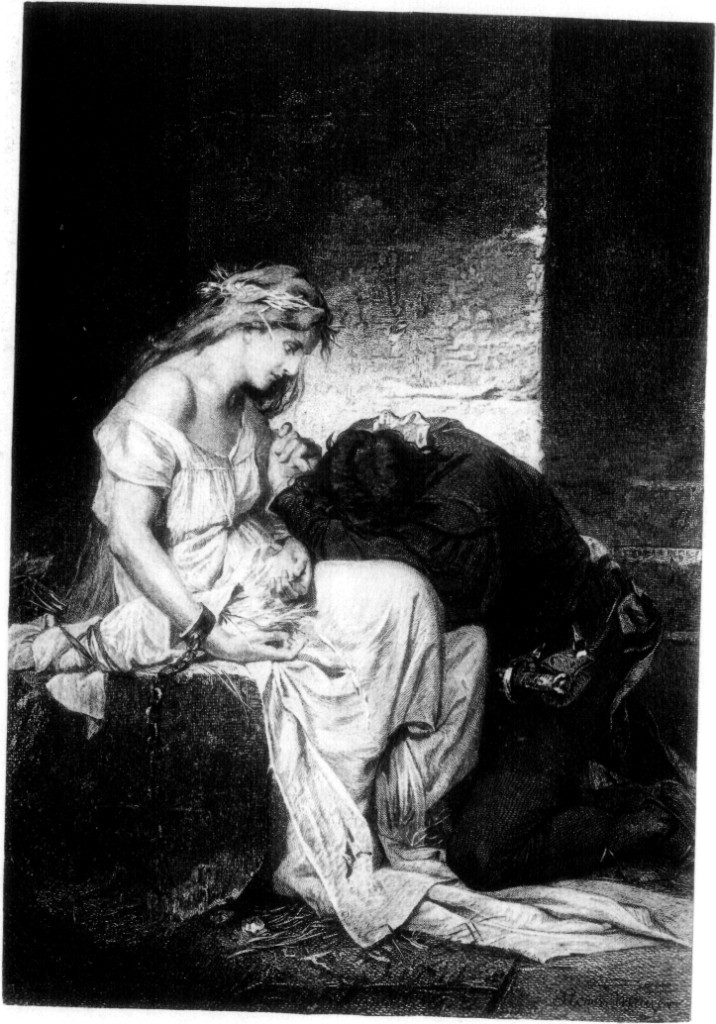
Photogravure from a Drawing by A. Leisen-Mayer.
MARGARET
Delay, now! So fain I stay, when thou delayest!
[Caressing him.
FAUST
Away, now! If longer here thou stayest, We shall be made to dearly rue it.
MARGARET
Kiss me!—canst no longer do it? My friend, so short a time thou 'rt missing, And hast unlearned thy kissing? Why is my heart so anxious, on thy breast? Where once a heaven thy glances did create me, A heaven thy loving words expressed, And thou didst kiss as thou wouldst suffocate me— Kiss me! Or I'll kiss thee!
[She embraces him.
Ah, woe! thy lips are chill, And still. How changed in fashion Thy passion! Who has done me this ill?
[She turns away from him.
FAUST
Come, follow me! My darling, be more bold: I'll clasp thee, soon, with warmth a thousandfold; But follow now! 'Tis all I beg of thee.
MARGARET [turning to him]
And is it thou? Thou, surely, certainly?
FAUST
'Tis I! Come on!
MARGARET
Thou wilt unloose my chain, And in thy lap wilt take me once again. How comes it that thou dost not shrink from me?— Say, dost thou know, my friend, whom thou mak'st free?
FAUST
Come! come! The night already vanisheth.
MARGARET
My mother have I put to death; I've drowned the baby born to thee. Was it not given to thee and me? Thee, too!—'Tis thou! It scarcely true doth seem— Give me thy hand! 'Tis not a dream! Thy dear, dear hand!—But, ah, 'tis wet! Why, wipe it off! Methinks that yet There's blood thereon. Ah, God! what hast thou done? Nay, sheathe thy sword at last! Do not affray me!
FAUST
Oh, let the past be past! Thy words will slay me!
MARGARET
No, no! Thou must outlive us. Now I'll tell thee the graves to give us: Thou must begin to-morrow The work of sorrow! The best place give to my mother, Then close at her side my brother, And me a little away, But not too very far, I pray! And here, on my right breast, my baby lay! Nobody else will lie beside me!— Ah, within thine arms to hide me, That was a sweet and a gracious bliss, But no more, no more can I attain it! I would force myself on thee and constrain it, And it seems thou repellest my kiss: And yet 'tis thou, so good, so kind to see!
FAUST
If thou feelest it is I, then come with me!
MARGARET
Out yonder?
FAUST
To freedom.
MARGARET
If the grave is there, Death lying in wait, then come! From here to eternal rest: No further step—no, no! Thou goest away! O Henry, if I could go!
FAUST
Thou canst! Just will it! Open stands the door.
MARGARET
I dare not go: there's no hope any more. Why should I fly? They'll still my steps waylay! It is so wretched, forced to beg my living, And a bad conscience sharper misery giving! It is so wretched, to be strange, forsaken, And I'd still be followed and taken!
FAUST
I'll stay with thee.
MARGARET
Be quick! Be quick! Save thy perishing child! Away! Follow the ridge Up by the brook, Over the bridge, Into the wood, To the left, where the plank is placed In the pool! Seize it in haste! 'Tis trying to rise, 'Tis struggling still! Save it! Save it!
FAUST
Recall thy wandering will! One step, and thou art free at last!
MARGARET
If the mountain we had only passed! There sits my mother upon a stone,— I feel an icy shiver! There sits my mother upon a stone, And her head is wagging ever. She beckons, she nods not, her heavy head falls o'er; She slept so long that she wakes no more. She slept, while we were caressing: Ah, those were the days of blessing!
FAUST
Here words and prayers are nothing worth; I'll venture, then, to bear thee forth.
MARGARET
No—let me go! I'll suffer no force! Grasp me not so murderously! I've done, else, all things for the love of thee.
FAUST
The day dawns: Dearest! Dearest!
MARGARET
Day? Yes, the day comes,—the last day breaks for me! My wedding day it was to be! Tell no one thou hast been with Margaret! Woe for my garland! The chances Are over—'tis all in vain! We shall meet once again, But not at the dances! The crowd is thronging, no word is spoken: The square below And the streets overflow: The death-bell tolls, the wand is broken. I am seized, and bound, and delivered— Shoved to the block—they give the sign! Now over each neck has quivered The blade that is quivering over mine. Dumb lies the world like the grave!
FAUST
Oh, had I ne'er been born!
MEPHISTOPHELES [appears outside]
Off! or you're lost ere morn. Useless talking, delaying, and praying! My horses are neighing: The morning twilight is near.
MARGARET
What rises up from the threshold here? He! he! suffer him not! What does he want in this holy spot? He seeks me!
FAUST
Thou shalt live.
MARGARET
Judgment of God! myself to thee I give.
MEPHISTOPHELES [to Faust]
Come! or I'll leave her in the lurch, and thee!
MARGARET
Thine am I, Father! rescue me! Ye angels, holy cohorts, guard me, Camp around, and from evil ward me! Henry! I shudder to think of thee.
MEPHISTOPHELES
She is judged!
VOICE [from above]
She is saved!
MEPHISTOPHELES [to Faust]
Hither to me!
[He disappears with Faust.
VOICE [from within, dying away]
Henry! Henry!
The Death of Foust
LEMURES [Digging with mocking gestures]
In youth when I did love, did love, Methought it was very sweet; When 'twas jolly and merry every way, And I blithely moved my feet. But now old Age, with his stealing steps, Hath clawed me with his crutch: I stumbled over the door of a grave; Why leave they open such?
FAUST [Comes forth from the palace, groping his way along the door-posts]
How I rejoice to hear the clattering spade! It is the crowd, for me in service moiling, Till Earth be reconciled to toiling, Till the proud waves be stayed, And the sea girded with a rigid zone.
MEPHISTOPHELES [aside]
And yet thou'rt laboring for us alone, With all thy dikes and bulwarks daring; Since thou for Neptune art preparing— The Ocean Devil—carousal great. In every way shall ye be stranded; The elements with us are banded, And ruin is the certain fate.
FAUST
Overseer!
MEPHISTOPHELES
Here!
FAUST
However possible, Collect a crowd of men with vigor, Spur by indulgence, praise, or rigor,— Reward, allure, conscript, compel! Each day report me, and correctly note How grows in length the undertaken moat.
MEPHISTOPHELES [half aloud]
When they to me the information gave, They spake not of a moat, but of—a grave.
FAUST
Below the hills a marshy plain Infects what I so long have been retrieving; This stagnant pool likewise to drain Were now my latest and my best achieving. To many millions let me furnish soil, Though not secure, yet free to active toil; Green, fertile fields, where men and herds go forth At once, with comfort, on the newest earth, And swiftly settled on the hill's firm base, Created by the bold, industrious race. A land like Paradise here, round about; Up to the brink the tide may roar without, And though it gnaw, to burst with force the limit, By common impulse all unite to hem it. Yes! to this thought I hold with firm persistence; The last result of wisdom stamps it true: He only earns his freedom and existence Who daily conquers them anew. Thus here, by dangers girt, shall glide away Of childhood, manhood, age, the vigorous day: And such a throng I fain would see,— Stand on free soil among a people free! Then dared I hail the Moment fleeing: "Ah, still delay—thou art so fair!" The traces cannot, of mine earthly being, In æons perish,—they are there! In proud fore-feeling of such lofty bliss, I now enjoy the highest Moment,—this!
[Faust sinks back: the Lemures take him and lay him upon the ground.]
MEPHISTOPHELES
No joy could sate him, and suffice no bliss! To catch but shifting shapes was his endeavor: The latest, poorest, emptiest Moment—this,— He wished to hold it fast forever. Me he resisted in such vigorous wise, But Time is lord, on earth the old man lies. The clock stands still—
CHORUS
Stands still! silent as midnight, now! The index falls.
MEPHISTOPHELES
It falls; and it is finished, here!
CHORUS
'Tis past!
MEPHISTOPHELES
Past! a stupid word. If past, then why? Past and pure Naught, complete monotony! What good for us, this endlessly creating?— What is created then annihilating? "And now it's past!" Why read a page so twisted? 'Tis just the same as if it ne'er existed, Yet goes in circles round as if it had, however: I'd rather choose, instead, the Void forever.
The Salvation of Faust
ANGELS [Soaring in the higher atmosphere, bearing the immortal part of Faust]
The noble spirit now is free, And saved from evil scheming: Whoe'er aspires unweariedly Is not beyond redeeming. And if he feels the grace of love That from on high is given, The blessed hosts, that wait above, Shall welcome him to heaven!
THE YOUNGER ANGELS
They, the roses, freely spended By the penitent, the glorious, Helped to make the fight victorious, And the lofty work is ended. We this precious soul have won us; Evil ones we forced to shun us; Devils fled us when we hit them: 'Stead of pangs of hell, that bit them, Love pangs felt they, sharper, vaster: Even he, old Satan Master, Pierced with keenest pain retreated. Now rejoice! The work's completed!
THE MORE PERFECT ANGELS
Earth's residue to bear Hath sorely pressed us; It were not pure and fair, Though 'twere asbestus. When every element The mind's high forces Have seized, subdued, and blent, No angel divorces Twin natures single grown, That inly mate them: Eternal love alone Can separate them.
THE YOUNGER ANGELS
Mist-like on heights above, We now are seeing Nearer and nearer move Spiritual Being. The clouds are growing clear; And moving throngs appear Of blessed boys, Free from the earthly gloom, In circling poise, Who taste the cheer Of the new springtime bloom Of the upper sphere. Let them inaugurate Him to the perfect state, Now, as their peer!
THE BLESSED BOYS
Gladly receive we now Him, as a chrysalis: Therefore achieve we now Pledge of our bliss. The earth-flakes dissipate That cling around him! See, he is fair and great! Divine Life hath crowned him.
DOCTOR MARIANUS [In the highest, purest cell]
Free is the view at last, The spirit lifted: There women, floating past, Are upward drifted: The Glorious One therein, With star-crown tender,— The pure, the Heavenly Queen, I know her splendor.
[Enraptured]
Highest Mistress of the World! Let me in the azure Tent of Heaven, in light unfurled, Here thy Mystery measure! Justify sweet thoughts that move Breast of man to meet thee, And with holy bliss of love Bear him up to greet thee! With unconquered courage we Do thy bidding highest; But at once shall gentle be, When thou pacifiest. Virgin, pure in brightest sheen, Mother sweet, supernal,— Unto us Elected Queen, Peer of Gods Eternal! Light clouds are circling Around her splendor,— Penitent women Of natures tender, Her knees embracing, Ether respiring, Mercy requiring! Thou, in immaculate ray, Mercy not leavest, And the lightly led astray, Who trust thee, receivest! In their weakness fallen at length, Hard it is to save them: Who can crush, by native strength, Vices that enslave them? Whose the foot that may not slip On the surface slanting? Whom befool not eye and lip, Breath and voice enchanting?
The Mater Gloriosa soars into the space
CHORUS OF WOMEN PENITENTS
To heights thou'rt speeding Of endless Eden: Receive our pleading, Transcendent Maiden, With mercy laden!
Magna Peccatrix [St. Luke, vii. 36]
By the love before him kneeling,— Him, thy Son, a Godlike vision; By the tears like balsam stealing, Spite of Pharisees' derision; By the box, whose ointment precious Shed its spice and odors cheery; By the locks, whose softest meshes Dried the holy feet and weary!—
MULIER SAMARITANA [St. John, iv.]
By that well, the ancient station Whither Abram's flocks were driven; By the jar, whose restoration To the Savior's lips was given; By the fountain pure and vernal, Thence its present bounty spending,— Overflowing, bright, eternal, Watering the worlds unending!—
MARIA ÆGYPTIACA [Acta Sanctorum]
By the place where the immortal Body of the Lord hath lain; By the arm which, from the portal, Warning, thrust me back again; By the forty years' repentance In the lonely desert land; By the blissful farewell sentence Which I wrote upon the sand!—
THE THREE
Thou thy presence not deniest Unto sinful women ever,— Liftest them to win the highest Gain of penitent endeavor,— So, from this good soul withdraw not— Who but once forgot, transgressing, Who her loving error saw not— Pardon adequate, and blessing!
UNA PŒNITENTIUM [Formerly named Margaret, stealing closer]
Incline, O Maiden, With mercy laden, In light unfading, Thy gracious countenance upon my bliss! My loved, my lover, His trials over In yonder world, returns to me in this!
BLESSED BOYS [Approaching in hovering circles]
With mighty limbs he towers Already above us; He, for this love of ours, Will richlier love us. Early were we removed, Ere Life could reach us; Yet he hath learned and proved, And he will teach us.
THE PENITENT [Formerly named Margaret]
The spirit choir around him seeing, New to himself, he scarce divines His heritage of new-born Being, When like the Holy Host he shines. Behold, how he each band hath cloven The earthly life had round him thrown, And through his garb, of ether woven, The early force of youth is shown! Vouchsafe to me that I instruct him! Still dazzles him the Day's new glare.
MATER GLORIOSA
Rise thou to higher spheres! Conduct him, Who, feeling thee, shall follow there!
DOCTOR MARIANUS [Prostrate, adoring]
Penitents, look up, elate. Where she beams salvation; Gratefully to blessed fate Grow, in re-creation! Be our souls, as they have been, Dedicate to thee! Virgin Holy, Mother, Queen, Goddess, gracious be!
CHORUS MYSTICUS
All things transitory But as symbols are sent: Earth's insufficiency Here grows to Event: The Indescribable, Here it is done: The Woman Soul leadeth us Upward and on!
MIGNON'S LOVE AND LONGING
From 'Wilhelm Meister's Apprenticeship.' Carlyle's Translation
Nothing is more touching than the first disclosure of a love which has been nursed in silence; of a faith grown strong in secret, and which at last comes forth in the hour of need and reveals itself to him who formerly has reckoned it of small account. The bud which had been closed so long and firmly was now ripe to burst its swathings, and Wilhelm's heart could never have been readier to welcome the impressions of affection.
She stood before him, and noticed his disquietude. "Master!" she cried, "if thou art unhappy, what will become of Mignon?" "Dear little creature," said he, taking her hands, "thou too art part of my anxieties. I must go hence." She looked at his eyes, glistening with restrained tears, and knelt down with vehemence before him. He kept her hands; she laid her head upon his knees, and remained quite still. He played with her hair, patted her, and spoke kindly to her. She continued motionless for a considerable time. At last he felt a sort of palpitating movement in her, which began very softly, and then by degrees, with increasing violence, diffused itself over all her frame. "What ails thee, Mignon?" cried he; "what ails thee?" She raised her little head, looked at him, and all at once laid her hand upon her heart, with the countenance of one repressing the utterance of pain. He raised her up, and she fell upon his breast; he pressed her towards him, and kissed her. She replied not by any pressure of the hand, by any motion whatever. She held firmly against her heart; and all at once gave a cry, which was accompanied by spasmodic movements of the body. She started up, and immediately fell down before him, as if broken in every joint. It was an excruciating moment! "My child!" cried he, raising her up and clasping her fast,—"my child, what ails thee?" The palpitations continued, spreading from the heart over all the lax and powerless limbs; she was merely hanging in his arms. All at once she again became quite stiff, like one enduring the sharpest corporeal agony; and soon with a new vehemence all her frame once more became alive, and she threw herself about his neck, like a bent spring that is closing; while in her soul, as it were, a strong rent took place, and at the same moment a stream of tears flowed from her shut eyes into his bosom. He held her fast. She wept, and no tongue can express the force of these tears. Her long hair had loosened, and was hanging down before her; it seemed as if her whole being was melting incessantly into a brook of tears. Her rigid limbs were again become relaxed; her inmost soul was pouring itself forth; in the wild confusion of the moment, Wilhelm was afraid she would dissolve in his arms, and leave nothing there for him to grasp. He held her faster and faster. "My child!" cried he, "my child! thou art indeed mine, if that word can comfort thee. Thou art mine! I will keep thee, I will never forsake thee!" Her tears continued flowing. At last she raised herself; a faint gladness shone upon her face. "My father!" cried she, "thou wilt not forsake me? Wilt be my father? I am thy child!"
Softly, at this moment, the harp began to sound before the door; the old man brought his most affecting songs as an evening offering to our friend, who, holding his child ever faster in his arms, enjoyed the most pure and undescribable felicity.
Know'st thou the land where citron-apples bloom, And oranges like gold in leafy gloom, A gentle wind from deep-blue heaven blows, The myrtle thick, and high the laurel grows? Know'st thou it then? 'Tis there! Tis there, O my true loved one, thou with me must go! Know'st thou the house, its porch with pillars tall? The rooms do glitter, glitters bright the hall, And marble statues stand, and look each one: What's this, poor child, to thee they've done? Know'st thou it then? 'Tis there! 'Tis there, O my protector, thou with me must go! "Know'st thou the hill, the bridge that hangs on cloud? The mules in mist grope o'er the torrent loud, In caves lie coiled the dragon's ancient brood, The crag leaps down, and over it the flood: Know'st thou it then? 'Tis there! 'Tis there Our way runs: O my father, wilt thou go?"
Next morning, on looking for Mignon about the house, Wilhelm did not find her, but was informed that she had gone out early with Melina, who had risen betimes to receive the wardrobe and other apparatus of his theatre.
After the space of some hours, Wilhelm heard the sound of music before his door. At first he thought it was the harper come again to visit him; but he soon distinguished the tones of a cithern, and the voice which began to sing was Mignon's. Wilhelm opened the door; the child came in, and sang him the song we have just given above.
The music and general expression of it pleased our friend extremely, though he could not understand all the words. He made her once more repeat the stanzas, and explain them; he wrote them down, and translated them into his native language. But the originality of its turns he could imitate only from afar: its childlike innocence of expression vanished from it in the process of reducing its broken phraseology to uniformity, and combining its disjointed parts. The charm of the tune, moreover, was entirely incomparable.
She began every verse in a stately and solemn manner, as if she wished to draw attention towards something wonderful, as if she had something weighty to communicate. In the third line, her tones became deeper and gloomier; the "Know'st thou it then?" was uttered with a show of mystery and eager circumspectness; in the "'Tis there! 'Tis there!" lay a boundless longing; and her "With me must go!" she modified at each repetition, so that now it appeared to entreat and implore, now to impel and persuade.
On finishing her song for the second time, she stood silent for a moment, looked keenly at Wilhelm, and asked him, "Know'st thou the land?" "It must mean Italy," said Wilhelm: "where didst thou get the little song?" "Italy!" said Mignon, with an earnest air. "If thou go to Italy, take me along with thee; for I am too cold here." "Hast thou been there already, little dear?" said Wilhelm. But the child was silent, and nothing more could be got out of her.
WILHELM MEISTER'S INTRODUCTION TO SHAKESPEARE
From 'Wilhelm Meister's Apprenticeship.' Carlyle's Translation
"Have you never," said Jarno, taking him aside, "read one of Shakespeare's plays?"
"No," replied Wilhelm: "since the time when they became more known in Germany, I have myself grown unacquainted with the theatre; and I know not whether I should now rejoice that an old taste and occupation of my youth, has been by chance renewed. In the mean time, all that I have heard of these plays has excited little wish to become acquainted with such extraordinary monsters, which appear to set probability and dignity alike at defiance."
"I would advise you," said the other, "to make a trial, notwithstanding: it can do one no harm to look at what is extraordinary with one's own eyes. I will lend you a volume or two; and you cannot better spend your time than by casting everything aside, and retiring to the solitude of your old habitation, to look into the magic lantern of that unknown world. It is sinful of you to waste your hours in dressing out these apes to look more human, and teaching dogs to dance. One thing only I require,—you must not cavil at the form; the rest I can leave to your own good sense and feeling."
The horses were standing at the door; and Jarno mounted with some other cavaliers, to go and hunt. Wilhelm looked after him with sadness. He would fain have spoken much with this man who though in a harsh, unfriendly way, gave him new ideas,—ideas that he had need of.
Oftentimes a man, when approaching some development of his powers, capacities, and conceptions, gets into a perplexity from which a prudent friend might easily deliver him. He resembles a traveler, who, at but a short distance from the inn he is to rest at, falls into the water: were any one to catch him then and pull him to the bank, with one good wetting it were over; whereas, though he struggles out himself, it is often at the side where he tumbled in, and he has to make a wide and weary circuit before reaching his appointed object.
Wilhelm now began to have an inkling that things went forward in the world differently from what he had supposed. He now viewed close at hand the solemn and imposing life of the great and distinguished, and wondered at the easy dignity which they contrived to give it. An army on its march, a princely hero at the head of it, such a multitude of co-operating warriors, such a multitude of crowding worshipers, exalted his imagination. In this mood he received the promised books; and ere long, as may be easily supposed, the stream of that mighty genius laid hold of him and led him down to a shoreless ocean, where he soon completely forgot and lost himself....
Wilhelm had scarcely read one or two of Shakespeare's plays, till their effect on him became so strong that he could go no further. His whole soul was in commotion. He sought an opportunity to speak with Jarno; to whom, on meeting with him, he expressed his boundless gratitude for such delicious entertainment.
"I clearly enough foresaw," said Jarno, "that you would not remain insensible to the charms of the most extraordinary and most admirable of all writers."
"Yes!" exclaimed our friend: "I cannot recollect that any book, any man, any incident of my life, has produced such important effects on me, as the precious works to which by your kindness I have been directed. They seem as if they were performances of some celestial genius descending among men, to make them by the mildest instructions acquainted with themselves. They are no fictions! You would think, while reading them, you stood before the inclosed awful Books of Fate, while the whirlwind of most impassioned life was howling through the leaves, and tossing them fiercely to and fro. The strength and tenderness, the power and peacefulness of this man, have so astonished and transported me, that I long vehemently for the time when I shall have it in my power to read further."
"Bravo!" said Jarno, holding out his hand, and squeezing our friend's. "This is as it should be! And the consequences which I hope for will likewise surely follow."
"I wish," said Wilhelm, "I could but disclose to you all that is going on within me even now. All the anticipations I have ever had regarding man and his destiny, which have accompanied me from youth upwards often unobserved by myself, I find developed and fulfilled in Shakespeare's writings. It seems as if he cleared up every one of our enigmas to us, though we cannot say, Here or there is the word of solution. His men appear like natural men, and yet they are not. These, the most mysterious and complex productions of creation, here act before us as if they were watches, whose dial-plates and cases were of crystal, which pointed out according to their use the course of the hours and minutes; while at the same time you could discern the combination of wheels and springs that turn them. The few glances I have cast over Shakespeare's world incite me, more than anything beside, to quicken my footsteps forward into the actual world, to mingle in the flood of destinies that is suspended over it; and at length, if I shall prosper, to draw a few cups from the great ocean of true nature, and to distribute them from off the stage among the thirsting people of my native land."
WILHELM MEISTER'S ANALYSIS OF HAMLET
From 'Wilhelm Meister's Apprenticeship'
Seeing the company so favorably disposed, Wilhelm now hoped he might further have it in his power to converse with them on the poetic merit of the pieces which might come before them. "It is not enough," said he next day, when they were all again assembled, "for the actor merely to glance over a dramatic work, to judge of it by his first impression, and thus without investigation to declare his satisfaction or dissatisfaction with it. Such things may be allowed in a spectator, whose purpose it is rather to be entertained and moved than formally to criticize. But the actor, on the other hand, should be prepared to give a reason for his praise or censure: and how shall he do this if he have not taught himself to penetrate the sense, the views, and feelings of his author? A common error is, to form a judgment of a drama from a single part in it; and to look upon this part itself in an isolated point of view, not in its connection with the whole. I have noticed this within a few days so clearly in my own conduct, that I will give you the account as an example, if you please to hear me patiently.
"You all know Shakespeare's incomparable 'Hamlet': our public reading of it at the Castle yielded every one of us the greatest satisfaction. On that occasion we proposed to act the piece; and I, not knowing what I undertook, engaged to play the Prince's part. This I conceived that I was studying, while I began to get by heart the strongest passages, the soliloquies, and those scenes in which force of soul, vehemence, and elevation of feeling have the freest scope; where the agitated heart is allowed to display itself with touching expressiveness.
"I further conceived that I was penetrating quite into the spirit of the character, while I endeavored as it were to take upon myself the load of deep melancholy under which my prototype was laboring, and in this humor to pursue him through the strange labyrinths of his caprices and his singularities. Thus learning, thus practicing, I doubted not but I should by-and-by become one person with my hero.
"But the farther I advanced, the more difficult did it become for me to form any image of the whole, in its general bearings; till at last it seemed as if impossible. I next went through the entire piece, without interruption; but here too I found much that I could not away with. At one time the characters, at another time the manner of displaying them, seemed inconsistent; and I almost despaired of finding any general tint, in which I might present my whole part with all its shadings and variations. In such devious paths I toiled, and wandered long in vain; till at length a hope arose that I might reach my aim in quite a new way.
"I set about investigating every trace of Hamlet's character, as it had shown itself before his father's death: I endeavored to distinguish what in it was independent of this mournful event; independent of the terrible events that followed; and what most probably the young man would have been, had no such thing occurred.
"Soft, and from a noble stem, this royal flower had sprung up under the immediate influences of majesty; the idea of moral rectitude with that of princely elevation, the feeling of the good and dignified with the consciousness of high birth, had in him been unfolded simultaneously. He was a prince, by birth a prince; and he wished to reign, only that good men might be good without obstruction. Pleasing in form, polished by nature, courteous from the heart, he was meant to be the pattern of youth and the joy of the world.
"Without any prominent passion, his love for Ophelia was a still presentiment of sweet wants. His zeal in knightly accomplishments was not entirely his own; it needed to be quickened and inflamed by praise bestowed on others for excelling in them. Pure in sentiment, he knew the honorable-minded, and could prize the rest which an upright spirit tastes on the bosom of a friend. To a certain degree, he had learned to discern and value the good and the beautiful in arts and sciences; the mean, the vulgar was offensive to him: and if hatred could take root in his tender soul, it was only so far as to make him properly despise the false and changeful insects of a court, and play with them in easy scorn. He was calm in his temper, artless in his conduct, neither pleased with idleness nor too violently eager for employment. The routine of a university he seemed to continue when at court. He possessed more mirth of humor than of heart; he was a good companion, pliant, courteous, discreet, and able to forget and forgive an injury, yet never able to unite himself with those who overstept the limits of the right, the good, and the becoming.
"When we read the piece again, you shall judge whether I am yet on the proper track. I hope at least to bring forward passages that shall support my opinion in its main points."
This delineation was received with warm approval; the company imagined they foresaw that Hamlet's manner of proceeding might now be very satisfactorily explained; they applauded this method of penetrating into the spirit of a writer. Each of them proposed to himself to take up some piece, and study it on these principles, and so unfold the author's meaning ....
Loving Shakespeare as our friend did, he failed not to lead round the conversation to the merits of that dramatist. Expressing, as he entertained, the liveliest hopes of the new epoch which these exquisite productions must form in Germany, he ere long introduced his 'Hamlet,' who had busied him so much of late.
Serlo declared that he would long ago have played the piece, had this been possible, and that he himself would willingly engage to act Polonius. He added with a smile, "An Ophelia too will certainly turn up, if we had but a Prince."
Wilhelm did not notice that Aurelia seemed a little hurt at her brother's sarcasm. Our friend was in his proper vein, becoming copious and didactic, expounding how he would have 'Hamlet' played. He circumstantially delivered to his hearers the opinions we before saw him busied with; taking all the trouble possible to make his notion of the matter acceptable, skeptical as Serlo showed himself regarding it. "Well then," said the latter finally, "suppose we grant you all this, what will you explain by it?"
"Much, everything," said Wilhelm. "Conceive a prince such as I have painted him, and that his father suddenly dies. Ambition and the love of rule are not the passions that inspire him. As a king's son, he would have been contented; but now he is first constrained to consider the difference which separates a sovereign from a subject. The crown was not hereditary; yet a longer possession of it by his father would have strengthened the pretensions of an only son, and secured his hopes of the succession. In place of this, he now beholds himself excluded by his uncle, in spite of specious promises, most probably forever. He is now poor in goods and favor, and a stranger in the scene which from youth he had looked upon as his inheritance. His temper here assumes its first mournful tinge. He feels that now he is not more, that he is less, than a private nobleman; he offers himself as the servant of every one; he is not courteous and condescending, he is needy and degraded.
"His past condition he remembers as a vanished dream. It is in vain that his uncle strives to cheer him, to present his situation in another point of view. The feeling of his nothingness will not leave him.
"The second stroke that came upon him wounded deeper, bowed still more. It was the marriage of his mother. The faithful tender son had yet a mother, when his father passed away. He hoped in the company of his surviving, noble-minded parent, to reverence the heroic form of the departed; but his mother too he loses, and it is something worse than death that robs him of her. The trustful image which a good child loves to form of its parents is gone. With the dead there is no help; on the living no hold. She also is a woman, and her name is Frailty, like that of all her sex.
"Now first does he feel himself completely bent and orphaned; and no happiness of life can repay what he has lost. Not reflective or sorrowful by nature, reflection and sorrow have become for him a heavy obligation. It is thus that we see him first enter on the scene. I do not think that I have mixed aught foreign with the piece, or overcharged a single feature of it."
Serlo looked at his sister and said, "Did I give thee a false picture of our friend? He begins well; he has still many things to tell us, many to persuade us of." Wilhelm asseverated loudly that he meant not to persuade but to convince; he begged for another moment's patience.
"Figure to yourselves this youth," cried he, "this son of princes; conceive him vividly, bring his state before your eyes, and then observe him when he learns that his father's spirit walks; stand by him in the terrors of the night, when the venerable ghost itself appears before him. A horrid shudder passes over him; he speaks to the mysterious form; he sees it beckon him; he follows it, and hears. The fearful accusation of his uncle rings in his ears; the summons to revenge, and the piercing oft-repeated prayer, Remember me!
"And when the ghost has vanished, who is it that stands before us? A young hero panting for vengeance? A prince by birth, rejoicing to be called to punish the usurper of his crown? No! trouble and astonishment take hold of the solitary young man; he grows bitter against smiling villains, swears that he will not forget the spirit, and concludes with the significant ejaculation:—
"'The time is out of joint: O cursed spite, That ever I was born to set it right!'
"In these words, I imagine, will be found the key to Hamlet's whole procedure. To me it is clear that Shakespeare meant, in the present case, to represent the effects of a great action laid upon a soul unfit for the performance of it. In this view the whole piece seems to me to be composed. There is an oak-tree planted in a costly jar, which should have borne only pleasant flowers in its bosom; the roots expand, the jar is shivered.
"A lovely, pure, noble, and most moral nature, without the strength of nerve which forms a hero, sinks beneath a burden which it cannot bear and must not cast away. All duties are holy for him; the present is too hard. Impossibilities have been required of him, not in themselves impossibilities, but such for him. He winds, and turns, and torments himself; he advances and recoils; is ever put in mind, ever puts himself in mind; at last does all but lose his purpose from his thoughts; yet still without recovering his peace of mind."
Aurelia seemed to give but little heed to what was passing; at last she conducted Wilhelm to another room, and going to the window, and looking out at the starry sky she said to him, "You have still much to tell us about Hamlet; I will not hurry you; my brother must hear it as well as I; but let me beg to know your thoughts about Ophelia."
"Of her there cannot much be said," he answered; "for a few master strokes complete her character. The whole being of Ophelia floats in sweet and ripe sensation. Kindness for the Prince, to whose hand she may aspire, flows so spontaneously, her tender heart obeys its impulses so unresistingly, that both father and brother are afraid; both give her warning harshly and directly. Decorum, like the thin lawn upon her bosom, cannot hide the soft, still movements of her heart; it on the contrary betrays them. Her fancy is smit; her silent modesty breathes amiable desire; and if the friendly goddess Opportunity should shake the tree, its fruit would fall."
"And then," said Aurelia, "when she beholds herself forsaken, cast away, despised; when all is inverted in the soul of her crazed lover, and the highest changes to the lowest, and instead of the sweet cup of love he offers her the bitter cup of woe—"
"Her heart breaks," cried Wilhelm; "the whole structure of her being is loosened from its joinings; her father's death strikes fiercely against it; and the fair edifice altogether crumbles into fragments...."
Serlo, at this moment entering, inquired about his sister; and looking in the book which our friend had hold of, cried, "So you are again at 'Hamlet'? Very good! Many doubts have arisen in me, which seem not a little to impair the canonical aspect of the piece as you would have it viewed. The English themselves have admitted that its chief interest concludes with the third act; the last two lagging sorrily on, and scarcely uniting with the rest: and certainly about the end it seems to stand stock still."
"It is very possible," said Wilhelm, "that some individuals of a nation which has so many masterpieces to feel proud of, may be led by prejudice and narrowness of mind to form false judgments; but this cannot hinder us from looking with our own eyes, and doing justice where we see it due. I am very far from censuring the plan of 'Hamlet': on the other hand, I believe there never was a grander one invented; nay, it is not invented, it is real."
"How do you demonstrate that?" inquired Serlo.
"I will not demonstrate anything," said Wilhelm; "I will merely show you what my own conceptions of it are."
Aurelia rose up from her cushion, leaned upon her hand, and looked at Wilhelm; who, with the firmest assurance that he was in the right, went on as follows:—
"It pleases us, it flatters us to see a hero acting on his own strength; loving and hating as his heart directs him; undertaking and completing; casting every obstacle aside; and at length attaining some great object which he aimed at. Poets and historians would willingly persuade us that so proud a lot may fall to man. In 'Hamlet' we are taught another lesson: the hero is without a plan, but the piece is full of plan. Here we have no villain punished on some self-conceived and rigidly accomplished scheme of vengeance: a horrid deed occurs; it rolls itself along with all its consequences, dragging guiltless persons also in its course; the perpetrator seems as if he would evade the abyss which is made ready for him, yet he plunges in, at the very point by which he thinks he shall escape and happily complete his course.
"For it is the property of crime to extend its mischief over innocence, as it is of virtue to extend its blessings over many that deserve them not; while frequently the author of the one or of the other is not punished or rewarded at all. Here in this play of ours, how strange! The Pit of Darkness sends its spirit and demands revenge; in vain! All circumstances tend one way, and hurry to revenge; in vain! Neither earthly nor infernal thing may bring about what is reserved for Fate alone. The hour of judgment comes: the wicked falls with the good; one race is mowed away, that another may spring up."
After a pause, in which they looked at one another, Serlo said: "You pay no great compliment to Providence, in thus exalting Shakespeare; and besides, it appears to me that for the honor of your poet, as others for the honor of Providence, you ascribe to him an object and a plan which he himself had never thought of."
"Let me also put a question," said Aurelia. "I have looked at Ophelia's part again; I am contented with it, and conceive that under certain circumstances I could play it. But tell me, should not the poet have furnished the insane maiden with another sort of songs? Could not one select some fragments out of melancholy ballads for this purpose? What have double meanings and lascivious insipidities to do in the mouth of such a noble-minded person?"
"Dear friend," said Wilhelm, "even here I cannot yield you one iota. In these singularities, in this apparent impropriety, a deep sense is hid. Do we not understand from the very first what the mind of the good soft-hearted girl was busied with? Silently she lived within herself, yet she scarce concealed her wishes, her longing; the tones of desire were in secret ringing through her soul; and how often may she have attempted, like an unskillful nurse, to lull her senses to repose with songs which only kept them more awake? But at last, when her self-command is altogether gone, when the secrets of her heart are hovering on her tongue, that tongue betrays her; and in the innocence of insanity she solaces herself, unmindful of king or queen, with the echo of her loose and well-beloved songs, 'Tomorrow is Saint Valentine's Day,' and 'By Gis and by Saint Charity.'
"I am much mistaken," cried he, "if I have not now discovered how the whole is to be managed; nay, I am convinced that Shakespeare himself would have arranged it so, had not his mind been too exclusively directed to the ruling interest, and perhaps misled by the novels which furnished him with his materials."
"Let us hear," said Serlo, placing himself with an air of solemnity upon the sofa; "I will listen calmly, but judge with rigor."
"I am not afraid of you," said Wilhelm; "only hear me. In the composition of this play, after the most accurate investigation and the most mature reflection, I distinguish two classes of objects. The first are the grand internal relations of the persons and events, the powerful effects which arise from the characters and proceedings of the main figures: these, I hold, are individually excellent, and the order in which they are presented cannot be improved. No kind of interference must be suffered to destroy them, or even essentially to change their form. These are the things which stamp themselves deep into the soul; which all men long to see, which no one dares to meddle with. Accordingly, I understand, they have almost wholly been retained in all our German theatres.
"But our countrymen have erred, in my opinion, with regard to the second class of objects which may be observed in this tragedy: I allude to the external relations of the persons, whereby they are brought from place to place, or combined in various ways by certain accidental incidents. These they have looked upon as very unimportant; have spoken of them only in passing, or left them out altogether. Now indeed it must be owned that these threads are slack and slender; yet they run through the entire piece, and bind together much that would otherwise fall asunder, and does actually fall asunder when you cut them off, and imagine you have done enough and more if you have left the ends hanging.
"Among these external relations I include the disturbances in Norway, the war with young Fortinbras, the embassy to his uncle, the settling of that feud, the march of young Fortinbras to Poland, and his coming back at the end; of the same sort are Horatio's return from Wittenberg, Hamlet's wish to go thither, the journey of Laertes to France, his return, the dispatch of Hamlet into England, his capture by pirates, the death of the two courtiers by the letter which they carried. All these circumstances and events would be very fit for expanding and lengthening a novel; but here they injure exceedingly the unity of the piece,—particularly as the hero had no plan,—and are in consequence entirely out of place."
"For once in the right!" cried Serlo.
"Do not interrupt me," answered Wilhelm; "perhaps you will not always think me right. These errors are like temporary props of an edifice; they must not be removed till we have built a firm wall in their stead. My project therefore is, not at all to change those first-mentioned grand situations, or at least as much as possible to spare them, both collectively and individually; but with respect to these external, single, dissipated, and dissipating motives, to cast them all at once away, and substitute a solitary one instead of them."