DOWNINGVILLE MILITIA. (continued 4)
Reading edition
I hadn't more than got the last word out of my mouth, wen the Kernel jumped up from his cheer, and ketchin hold of his boot-jack, he flourished it rite over his head in a savage style. I thought he was stark mad. I got my hickery an backed up agin the door. I seed he was tarin mad, but I didn't say a word. I knew he'd work off the bile in his own way. Finally ses he, "Majer, wat are you standin there for?" "Why," ses I, "I was waitin to see what you was goin to do with that boot-jack." Ses he, "Have I got the boot-jack?" "Wal," ses I, "you've got sumthin in your hand that looks a mity site like one." "Wal," ses he, "Majer, I want to know whether you mean to apply that story to me?" "No," ses I, "Kernel. Didn't I tell you at the outset that I didn't; but you was tellin about what you had done in the way of splittin things, an I was reminded of that story. But I told you to keep your temper, an not take it as personal, but only as a joak?" "Wal," ses he, "Majer, I'll forgive you; but ef I thought you meant that story for me, I'd arrest you for disloyal practices, an put you in the Old Capital Prison."
Rye with him an make up friends. So I did; but I noticed, after that, that the Kernel watched me very clus. The very next day I had an awful attack of rumatiz, an I also felt sick an discurraged. Thigs never looked so black afore. I had a dream that nite, an I thought I saw the old Ginneral, an he told me, ses he, "This ain't any place for you now. The abolitionists have got full sway, an they will ruin the country as sure as my name is Andrew Jackson." I also dreamed that I saw thousands of dyin men, an weepin wimmin, an cryin children. I thought the doors of the houses all over the North looked red with blood, an a black cloud hung over the hull land. People seemed to be runnin first one way an then tother, askin what they should do. Finally, I heered a grate noise, like an arthquake, that woke me up, an I laid awake the rest of the nite.
The next mornin I was eenamost down sick with trubbel an rumatiz, an I telled the Kernel I must go hum, where I could get good keer taken of me. The Kernel didn't say much agin it, for, after all, he didn't kinder like that story. So ses I, "Mr. President, I've been with you now for about a year, an I've got a clean conscience, for I've tried to tell you the rale truth jest as it is. Ef all who have cum around you had done the same, you would not be where you are; but," ses I, "I ain't got any feelin on the subject, an whenever I can be of any sarvice to my country, jest let me know, an I will come to Washinton agin."
The Kernel ses he, "Majer, I know you are a patriot, and I feel bad to have you go. I wish now I had taken your advice. But," ses he, "Majer," an here he giv my hand a tight squeeze, "you know I've only been a boat in a current, an yet like the boat I'll be jest the one that will get the worst smashed to pieces when the precipice is reached." I couldn't help feelin' kinder sorry for the Kernel as I bid him good-bye, but I felt still more sorry for my country that it had ever made him President.
I got hum all safe, an sense then I've been laid up four weeks with the rumatiz. I never had such a long pull afore. As for writin with it on me, why I can't any more do it than a shad can climb a bean-pole. I expect you've been wonderin why you didn't hear from me, but I think this letter will explain the resin. If the rumatiz don't come on agin, an I think I kin say anything that would of sarvice in this awful and solemn crysis of our country's fate, I will drop you a line. I feel as if the nashin was dyin, however, an that we all orter put on mournin an sack-cloth, but come what will, I'm for my country
Till deth,
Majer Jack Downing.
LETTER XXV.
The Major Feels Sorrowful over the Fate of His Country—The Story of the Black Heifer—The Man who Made a "Siss"—The Union—"Insine" Stebbins Again—His Reception at Downingville—"The Insensibles"—A Provoking Accident.
Downingville, March 28, 1863.
To the Eddyters of the Cawcashun:
Surs:—You may wonder why you ain't heered from me afore; but the rale truth is, that I didn't feel like ritin in these times. I went to Washinton about a year ago, out of pure patriotism. I didn't want a contrack, nor a commission, nor enything. I went to give the Kernel good advice, jest as I did Ginneral Jackson; but it warn't no go. Somnure an Greeley, an Wendil Fillips, an sech stay-at-hum fiten ginnerals got the advantage of me, an Linkin does jest wat they want him to. To an old man like me, these are tryin times. I had almost said cryin times; I can't bear to think of 'em. I dream o'nights of my country, wen it was all peace an happiness—wen ther warn't any sojers nor standin army to pay, nor no debt, nor no hospitals full of sick sojers, nor no sorrow or misery in the land; an wen I wake up an think how different it is now, I wish I could sleep all the time. The other day old Deacon Jenkens came over to see me. The Deacon, you know, was with me in Washinton a short time, wen I first went there, and his darter Jerusha Matilda went down to Port Royal to teach the contrybands their primmers. Wal, the Deacon ain't much wiser now than he was a year ago. He still thinks that by prayin an fightin the rebels will yet be whipped. He used to like the Tribune, but lately he ses he prefers the Herald, as it is more truthful. The old man, however, has been very blue for some time past, and now ses that prayin an fightin hain't accomplished much. "Wal," ses I, "Deacon, there hadn't orter been eny war at all; but," ses I, "while the South have had a single end an purpose, we've been all at odds and ends. The war has been carried on by us jest like old Sol Pendergrast's boy ploughed. Old Sol took his oldest boy, Adam, a thick-heded feller, out one Spring, an set him to ploughin. He told him to go to work an strike a furrow across a field to a black heifer, an then keep on. After givin this direcshin, old Sol went off to the house an left Adam alone. The boy started his oxen in a bee line for the black heifer, but wen he got pretty clus to her, she threw up her tail an ran off in another direcshin. Adam thought he must foller the heifer, no matter where she went; so he struck another bee line for her, and with jest the same result. Wen he got clus to her, the heifer give another frisk to her tail, an off she went. Adam geed his oxen around, and struck for her agin; an so he kept on all day. At nite the old man cum out to see how Adam had got along. He found the field all cut up with furrows, zig-zag, criss-cross, an in every direcshin, an asked Adam wat on arth it ment. 'Wal,' ses the thick-headed numskull, 'you told me to steer for the black heifer, an I've done it all day, but the denied critter wouldn't stand still, an so the furrows are a kinder criss-cross, you see.' Now," ses I, "that is jest wat Linkin has been doin. Greeley told him to steer for the nigger, an the result is jest like Adam Pendergrast's ploughing. There's a considerable fightin ben done, but it is all criss-cross, zig-zag, an don't amount to nothin, an so it will be to the end of the chapter." Wen I sed this, the Deacon knocked the ashes out of his pipe, an ses he, "Wal, Majer, wat do you think the war will amount to, enyhow?" "Wall," ses I, "I guess it will end a good deal like the feller who thought he could make a horse-shoe jest as well as a blacksmith." Ses the Deacon, ses he, "How was that, Majer?" "Wal," ses I, "one day a feller in a blacksmith's shop made a bet that he could make a horse-shoe jest as well as the blacksmith himself, though he hadn't never heated an iron nor struck a blow on an anvil. The feller sed it didn't require any great gumption to make a horse-shoe. So he took a piece of iron an at it he went. He put it in the fire, heated it an commenced poundin it, but the more he pounded, the more it didn't look like a horse-shoe. He finally gave up the job, an said if he couldn't make a horse-shoe he could make a wagon-bolt. So at it he went, but the more he pounded an the more he heated his iron, the less it grew, an finally he found that he couldn't make even a wagon-bolt. Then he declared that he had iron enough left for a horse-shoe nail, and that he would make, but upon trying, he found that the most difficult job of all. Finally, giving up in despair, ses he, 'Wal, one thing I can do enyhow, I can make a siss!' an plunging the tongs an what was left of the iron in the water, he did get up a very respectable 'siss.' Now," ses I, "when he started out, Linkin sed he was goin to restore the old Union. That has been given up long ago, and now they say they are goin to conquer the Southern States, that is, make a despotism, but the war will turn out jest like the horse-shoe business. Linkin will, after all, neether make a Union, or a despotism, or an Empire by it, but it will end with a great big 'siss.' That's all he will accomplish by it, an a dear 'siss' it will be for many a poor fellow. A dear 'siss' it will be for the fatherless and the widows, and a wonderful dear 'siss' it will be for the people who will have to pay the taxes and foot the bill of war." Wen I said this, the Deacon drew a long breth, an lookin down on the floor, didn't say enything for some minutes. Finally, ses he, "Wal, Majer, will we have to give up the Union after all?" Ses I, "I don't see eny necessity for that, providin that we kin only stop the war an talk over matters a little. But," ses I, "ef the Union is goin to be a Union wherein a white man hasn't the right to express his opinions, then I must say I don't love such a Union as that, an I'm as strong a Union man as old Ginneral Jackson, an that was strong enough. I am for the old Union, but ef the Union is to mean despotism, then I'm for breakin it all to smash, as soon as possible. Wen a man begins to humbug me by callin things by their wrong names to try an deceive me, it allus riles me onaccountably. I ain't a very larned man, but I kin generally see through one of these college chaps. Wen he talks Union to me, an all the time means despotism, I allus feel jest like haulin up my old hickory, an givin him a sockdologer. Why," ses I, "Deacon, the feller who wants to turn this government into a despotism, an keeps all the time hollerin 'Union,' while he is doin it, is not only a traitor, but a hypocrite an coward. He is afeerd to speak his rale sentiments, an so goes around tryin to deceive the people, jest as the false prophets in the Saviour's time. I'm teetotally down on such fellers, an I mean to be to the end of the chapter."
I almost forgot to tell you that Insine Stebbins, who went off to the war, has jest got hum. He had a recepshun by the military of Downingville wen he arriv. Col. Doolittle called out the Downingville Insensibles an the Maroon artillery, an all Downingville was in a blaze of glory. The Insine has been promoted to be Captin sense he went off, for ritin a pome for the contrybands at Port Royal, where the Insine was stashioned. The Insine is not a bad poet. But you orter seen the turnout in Downingville to receive him. Colonel Doolittle rode down the street on old Elder Dusenberry's sorrel mare, an jest as the cannon was blazin forth the joyous news of the Captin's arrival on the ground, old sorrel's colt, that the elder thought he had locked up safe in the stable, come tarein through the street, an fairly mowed a swath rite through the women. Such a yellin an screachin ver never heered afore. A good many people thought the rebils were comin. Elder Dusenberry's wife tore her best silk dress, an the Insine who had primed himself for a big speech on the occashin, had it all scart out of him. If it hadn't been for that rascally young colt, I think that the celebrashin would have been the greatest day Downingville had seen sence the time General Jackson visited it. The Insine brings the news from Washington that the Kernel thinks some of payin a visit to the North, an maybe to the East, afore long. Ef he does, he says he wants me to go along with him to help him make speeches and keep off the offis-seekers. Ef he sends for me, I spose I shall have to go, though I hate to do it.
Yourn till deth,
Majer Jack Downing.
LETTER XXVI.
The Democratic Party Whipped—Things as bad as they can be—A Story in Point—Mr. Lincoln sends for the Major again—The Major writes him a Letter—The Return of "Kernel" Stebbins, formerly "Insine"—His Reception at Downingville—"Kernel" Doolittle's Speech—"Kernel" Stebbins' Reply—Elder Sniffles' Preaches a Sermon.
Downingville, Oct. 26, 1863.
To the Editers of The Dabook:
Surs:—'Cause your readers hain't herd from me lately, I 'spose they think I'm ded, or gone over to the Abolishinists, which is a tarnal sight wus: but I ain't in neither fix. I'm pretty well jest now. The hot wether, durin the summer, kinder tried me, but I carry eighty years jest about as well as any man ever did. The resin you ain't herd from me is jest this: I've been feelin oncommon gloomy and down-sperited all summer. Everything seemed to be goin from bad to wus. Linkin wouldn't take my advice an cum out agin the Abolitionists, but issued his free nigger proclamashun rite agin the law an the Constitushin both. Wal, things have gone down hill rapid sence then. The Demmycratic party didn't cum out bluntly agin this proclamashin, but kept on supportin the war, an the consequence is, it has whipped all round. Politics are gettin down to first principles.
Things are jest as bad as they kin be, and that is what encourages me. I shall never forget Hezekiah Stebbins, who lived away up in the upper part of Penobscot. One winter it had been awful cold weather, and 'Kiah had wonderful bad luck, and towards spring it seemed to get worse instead of better. He had lost his horse, and his cow, and his chickens, and all his pigs but one. Finally, that died, and the next day I happened to go up to his house to see how he was gettin along. I found the old man happy as a lark. He was singin and shoutin as if nothing had happen'd. When I went in, ses I, "'Kiah, what on airth is the matter?" "Oh," ses he, "the last pig is ded," and he went to jumpin and clappin his hands, as if he was the happiest man in the universe. Ses I, "What possesses you to act so?" "Wal," ses he, "things can't be no wus. The last pig is ded! anything that happens now must be for the better." And just so it is with the Dimmycratic party. Anything now that happens to it must be for the better. And I must confess that I feel a good deal like 'Kiah. I don't feel a bit like settin down and cryin like a sick baby over spilt milk, because we've been whipt in the late elecshins. That ain't the way the old Ginral Hickory Jackson taught me Dimmocracy.
The other day I got a letter from Linkin, askin me to cum on to Washinton. He ses he is gettin into a heep of trouble about his next messidge, all on account of the diffikilty which Blair an Chase air kickin up about what is to be dun with the suthrin States after the rebelyon is put down. He ses he wants me to help git up the messidge, and kinder fix things up ginrally. I writ back that cold wether was cumin on, and my rumatiz would probably trouble me, so I could not tell exactly what I would do, but if I could be of any service to my country, as long as life lasted, I would do my duty. I wrote him, also, about that matter of the southern States, an I told him that it reminded me of the old receipt for cooking a rabbit. "First catch your rabbit." I told him they had not got the southern States yet, that they sartainly wouldn't get them this year, an I didn't see any great likelihood of gettin them next year. In fact, the times of the soldiers were mostly out, an I didn't believe they would ever get another sich an army, an if he followed my advice he would get up a Peace this winter without fail. I ain't got any answer to this letter, but I shall wait for one before I go. If the Kernel talks huffy, I won't stir a step, for he knows I allers tell him the plain, blunt truth, as I believe it. Wen I can't talk that way to a man, I won't have nothing to do with him. The old Ginneral allers wanted everybody around him to speak there rale sentiments. Nothing made him so mad as to suspect any body of flatterin him, or shaming in any way.
The other day Kernel Stebbins cum hum from the war. The Kernel has been down to Morris Island with Ginneral Gilmur. He ses that the sand on that island is kinder onaccountable. The Kernel reckons that he has eat nigh about a bushel. The Kernel used to be very good on writin poetry, but he says all the flatus has oozed out of him, an he don't believe he could write a line to save his life. We had a grand recepshin for the Kernel on his arrival. The Downingville Insensibles turned out as usual on sich occashins. You recollect that the Kernel went off as an Insine, an when he was promoted to be Captain he cum hum an we giv him a recepshin. Now he is raised to Kernel he cums hum agin. He cums every time he gets promoted, to let his old naybors see how he looks in his new uniform. I never see the Kernel look so well. He has got a span new suit of blue uniform, all covered with gold buttons, an gold lace an gold shoulder-straps. I tell you, the people looked astonished, and the Downingville folks feel very proud of him. The Kernel expects before long to be a Ginneral, and then to be called to the command of the Army of the Potomac! Wen the Kernel was received at the Town Hall, Kernel Doolittle, who commands the Downingville Insensibles, made the recepshin speech. The following is the speech, with the Kernel's reply:
"Kernel Stebbins: I am deputed by the citizens of Downingville to welcome you once more to your native town and hum. We have heard of your gallant exploits, your glorious bravery, your never-dyin devoshin to the Star-Spangled Banner. Comin as you do, covered with the dust and blood of the battle-field, we hail you as the friend of the oppressed African and the savior of your country."
To which the Kernel replied:
"Kernel Doolittle: I can't begin to express to you the feelins of my hart. This occashin is techin. Sojers can't make speeches. I've dun my duty. I've seen the cannons roar. I've heard the flash of a thousand rifles all at once. There ain't nothin that can equal it for rite down tall sublimity. But, feller-citizens, we ought to be most rejoiced now because freedom is going it at such big licks. I'me a manifest destiny man. I believe freedom is to extend from the frozen planes of Alabama to the sunny banks of Newfoundland. There ain't nothin kin stop it. It is comin like an avalanche from the eternal hills of Giberalter. Freedom! freedom! will resound from creashin come to pullin turnip time, an all the hopples that bind the legs of American citizens of Afriken 'scent will fall off. Them's my sentiments, and I don't keer who knows 'em. The old Union ain't of any more ackount in these 'ere times than an iron pot with a hole in the bottom. Wat we want is a new Union which will have for its motto the celebrated words of Daniel Webster, 'Freedom and niggers—now and forever—one and inspirable.'"
"Amen," yelled out Deacon Jenkins, who had been listenin' attentively, as the Kernel sat down, and the hull audience broke out into the most tumultuous applause. There is a little mistake in Kernel Doolittle's speech, where he speaks of Kernel Stebbins being covered with the dust an blood of the battle-field. Now, the truth was, the Kernel, with his new uniform, looked as if he had jest cum out of a band-box, but Kernel Doolittle had his speech writ out, an he couldn't alter it. Kernel Stebbins got on such high hosses, that he talked about seeing the boomin' of cannon an hearin' the flash of guns, but the truth was, he didn't know exactly what he said an the people were so carried away with havin' a live Kernel among them, that they didn't notice it. There ain't been nothin' talked of in Downingville sence the Kernel's return, except his recepshin. Elder Sniffles preached a sarmon on it, takin' for his text "There shall be wars an rumors of wars," an provin from the Bible that war is the duty of all real, genuine Christians. So, you see, there ain't a more loyal place in the country, unless it be Washinton, where all the office-holders an contractors live. But I must close. I did't expect to write you but a few lines this time. If I go to Washington, I will let you into the secrete of the Blair and Chase rumpus, an keep you posted up ginerally on things behind the curtin."
Yours, till deth,
Majer Jack Downing.
LETTER XXVII.
The Major Starts for Washington—Takes his Axe with him—Mr. Lincoln glad to see him—The Cabinet in Session—The opinion of Seward, Chase, Stanton and others—The Major called on for an opinion—The Story of Old Sam Odum—Mr. Stanton gets Excited.
Washington, Nov. 6, 1863.
To the Editers of The Dabook:
The very next day after I writ you my last letter, I got one from Linkin, tellin me I must cum on without fail. He said he was in a peck of trubbil about his messige—that Chase an Seward were pullin rite in contrary direcshins, an what to do he didn't know. So I jest packed up my things, took my pipe in my mouth an my old hickery in my hand, and started. I strapped my axe on the outside of my trunk, for this is the only weepin, besides my hickory cane, that I ever carry. Goin down to the cars I met Deacon Jenkins, who went on to Washinton, you recollect, to make the Kernel's sojer clothes, an ses he, "Majer, what are you takin your axe with you to Washinton for?" "Wal," ses I, "Deacon, I expect I shall get awful, tarin mad with them Abolitionists this winter in Washinton, an ther ain't eny way that I kin work off a fit of that kind except by goin out to the wood-house an choppin wood. So I determined to take along my axe. It is one the old Ginneral used when he got mad, an I have always preserved it to remember him, ef nothin else."
I got to Washinton all safe, an went direct to the White House. The feller who tends the door didn't know me at first; but when he saw my hickery he began to open his eyes, I tell you. Ses he, "You are Majer Downing, I believe," bowin like and scrapen his feet, as ef he thought I keered for that. Ses I, "Yes, I'm Majer Jack Downing, an you jest tell the President, about as quick as time will let you, that I'm here." So he run up-stairs, an I went after him, stoppin in the room where the offis-seekers have to wait, to take a good look down the Potomack to see ef things looked nateral. I hadn't stood there more than a minit when who should cum up behind me but Linkin himself. He caught rite hold of my hand, an ses he, "Majer, how are you? I'm tickled to deth to see you;" an he kept shaken my hand as ef he thought it was made of lether. Ses I, "Kernel, do you want me to help write your messige?" Ses he, "Of course I do, Majer." "Wal, then," ses I, "please don't shake that hand eny more, for you've pretty nigh mashed it now." "Wal," ses he, "Majer, I couldn't help it, for it seems as ef Providence sent you jest in the nick of time." Ses I, "How is that?" "Wal," ses he, "the Cabynet is in session, an I've just finished tellin them one of Artemus Ward's best stories, an got 'em all into a good humor. The messige is the very thing they met to discuss, an you're cum rite in the nick of time," hittin me, as he spoke, a slap on the back that made the cold chills run over me.
Nothin would do but I must go in and hear the discusshin. So I walked in as large as life. I knew 'em all, an they all knew me. They pretended to be rale glad to see me, perticularly Stantin; but he needn't try to deceeve me, for under them spectacles of his I see a pair of hyena eyes. I tell you that that man will bear watchin. However, I sed nothin; but after the how-do-doos were over, I laid my old hickery on the table, took out my pipe, an went to smokin. The Kernel then called the meetin to order, an sed he wanted a short ackount of each department, so he could fix up his messige, an he also wanted the opinion of each one as to what he thought ought to be done with the southern States after the rebellyon is crushed. Fust, he called upon Seward.
Wal, Seward said that furrin affairs were all rite; that he had offered to carry out the policy of England all over the country, an set up a monarchy, ef necessary, to put down the Dimmycrats, an that upon his faithfully promising to do this, the British Government at once seized the rebil rams. That as for the southern States, he thought the best thing that could be done with them, for the good of the country an the grate cause of humanity, was to turn 'em all into one big plantation an make Thurlow Weed Chief Manager.
Then Chase spoke. He sed the finances were in a flourishing condishin. He now had five hundred printin presses to work makin money; that the debt warn't only $5,000,000,000,000; that every body was gettin rich, an that the way to treat the southern States an save the country was just this: Issue a Proclamashin that only jest enough cotton should be raised for him to print greenbacks on, an then he could control the currency in spite of all the copperhead gold speculaters in creashin.
Stantin sed that his department was all right. That he had got rid of all the copperhed ginrals, and had left the track clear for the next President to be a genuine Abelishinist. That all that was necessary now was to keep the war up till after the next Presidential elecshin, and he thought he could do it. As for the southern States, he was for givin the niggers the plantations and makin the whites their slaves.
Then old grandfather Welles got up, strokin his long white beard. He sed that nothin could save the nashin but gunboats; that he was buildin one a day now, except on the Sabbath, which he piously devoted to prayin an fastin, and to dividin the contracks among his relashins. He thought the South ought to be surrounded with a wall of gunboats from Texas to Maryland.
The next one that spoke was Blair. He said he hadn't stopped a single paper durin' the hull year, an he was only sorry that he ever did; that he had only given the papers he stopped more circulashin than they ever had before; that no one would ever catch him into another such a scrape. As for the southern States, he was down on all the Radikels. He sed they might be allowed to cum back jest as they wanted to.
When it cum Daddy Bates' turn, he was fast asleep. When Linkin told him what he wanted, he sed it warn't for him to say what should be done with the Southern States. After it was decided what to do with 'em, he supposed they would want a legal opinion on the subject, an he could give one on either side, he did'nt care which.
After they had all got thru, Linkin turned to me, an ses he, "Majer, what do you think about this matter?" I knocked the ashes out of my pipe, and ses I, "Wal, I don't like to give an opinion on the jump, for I hain't had time yet to see exactly how the land lays here; but," ses I, "as near as I understand it, all these men here are tryin to catch the South first, and then what to do with her afterwards is another question. Now, the South seems to be a good deal like old Sam Odum, up in Maine, when he thought the devil was after him. One night he got to dreaming, and jumped out of bed in his shirt, and ran like all possessed down the street. About a half a dozen neighbors chased him until he run up a tree, out of which they couldn't get him anyhow. He kept a screaming "the devils are after me," and would fite like a tiger if any one tried to get at him. Finally, old Deacon Peabody cum along, and ses he, "Sam thinks you fellers are the devils that are goin to ruin him; you jist go away and let him alone, and Sam will be hum and in bed afore morning." They tuk his advice, and sure enough, so it was."
When I sed this, Stantin, who is quick as a flash, jumped up, an ses he, "Majer, do you mean to say that we are devils tryin to catch the South?" an he walked rite close up to my face, jest as if he thought he could bully me down. Ses I, "Mr. Secketery, if you will stand back about six inches, you kin see an hear jest as well." He stepped back a little, an I picked up my old hickery, an ses I, "Stantin, do you recollect the time down to Fort Munroe when you tried to get on the President's trowsers?" I never see a feller wilt so as when I sed this. He turned all sorts of colors, an wriggled as if he had a pin stickin in him. "Now," ses I, "I didn't say that you were devils, or anything of the sort, but it seems putty certain that Mr. Stantin feels the shoe pinchin. At all events," ses I, "you ain't caught the South yet, an consultin what you will do with her before that is like countin chickens before they are hatched."
The Kernel then sed that the session was closed, an after they all axed me to cum an see 'em, except Stantin, they went away. I think my story about Sam Odum sot putty strong on 'em, an ef they feel like takin it to hum let 'em do so, for my rale rite down solemn opinion is, ef these ere Abolishin Cabynet were to stop trying to catch the South, she would be hum an in the Union bed afore mornin.
Yourn, till deth,
Majer Jack Downing.
LETTER XXVIII.
The Major and the "Kernel" at work on the Message—The Major visits Mr. Chase again—Sees the Machines for Printing Greenbacks—A Machine for every General—The accounts mixed up—Mr. Lincoln gets Flighty over them—The Major Puts him to bed, and applies a mustard-plaster—He Revives, and proposes a Conundrum—The Major also proposes one.
Washington, Nov. 19th, 1863.
To the Editers of The Dabook:
Surs:—If I ain't been bizzy sence I writ you last, then never a man was. Besides, I've had a considerabul twinge of my old inemy, the rheumatiz. This ere Washington atmosfere is terribul on the constitushin. The Kernel, too, was nigh about down sick one day; but we both tuk a good, old-fashioned wiskey-sling, of the very best Old Rye, and went to bed on it. The next mornin we both felt fust rate. The Kernel keeps as good wiskey as I ever got enywhere. We have been very hard at work on the messige, and such a time as we have had of it you never did see. Stantin don't know how meny sojers he has got in the field, nor how meny have been killed or wounded. Grandfather Welles can't tell how meny gunbotes he's got, an as for Chase, he don't purtend to even guess for a certainty how many greenbacks there are aflote, or how big the public debt is. The Kernel sed he couldn't even lay the foundashin timbers of his messige until he had some figgers about the debt to begin on. So I told him I would go over an see Chase an have a talk with him. I tuk my slate under my arm an started. Soon as I went in Chase tuk me by the hand an sed he was rale down rite glad to see me. I telled him what I wanted, an he sed he would soon have it reddy for me, but jest then he asked me to go up-stairs an see the macheenery an printin presses, and so on, that he had got to make money. He sed the worst of it was that the machenes was constantly gettin out of order, and he wanted to know if I understood anything about sich affairs. I telled him there warnt nothing, from squirrel-traps to dog-churns and thrashing macheenes, that I didn't know from stem to starn. Then he sed I was jest the chap he wanted. So I went with him, and I was perfectly thunderstruck when I saw all the riggin, and fixins, and belts, and shafts, and pulleys, and machenes all a runnin and whizzin and buzzin, as fast as they could go. Ses the Secketary, "This here macheen runs to pay off Gineral Grant's troops. This one runs to pay off Gineral Meade's troops. This one runs for Gineral Banks. This one is now bizzy for Gineral Burnside, and here is this ere one completely broken down. It is Gineral Gilmore's macheen!" "Wal," ses I, "Mr. Secketary, do you have a macheen for every Gineral and every army?" "Yes," ses he, "about that." "Wal," ses I, "what do you do about the contracters?" "Oh," ses he, "I ain't showed you them yet. That's in another room." Ses he, "Come along with me." So I follered, and we went off into another room. It was nigh about ten times as big as the first one, and there were hundreds of presses runnin' as fast as they could go. "There," ses he, "if these here machenes were to stop one day, it would set all Wall street into a panic. Sometimes, when the belts give out or the bolts break, or the coal gits short, or paper don't git in in time, there is a good deal of troubil, but I've got it so fixed now that I keep 'em putty well supplied." Ses I, "Mr. Secketary, who is your engineer?" "Wal," ses he, "he's a good trusty man." "But," ses I, "suppose he should bust your bilers, what would Wall street do then?" "Wal," ses he, "I never thought of that, but I guess there ain't eny danger." "Wal," ses I, "steam is mighty onsartin. Old Aunt Keziah Wiggleton, up in Maine, used to say that the only safe way to run a steamboat was to take the bilers out, and my opinion is, that a government run by steam will bust up one of these days." Chase didn't seem to like this last remark much, but he didn't say enything. We cum down stairs putty soon after, and a feller with a brown linen coat on, nigh about all over ink, brought a hull lot of papers covered over with figgers, and sed that Mr. Linkin could find out all he wanted to from them. I looked 'em over, but I couldn't make hed nor tail to them. "Wal," ses I, "perhaps a chap who understands dubble and twisted entry book-keepin' can onderstand this ere figgering, but I'll be hanged if I kin." Ses I, "Here's seven thirtys, and five twentys, and six per cents, and five per cents, and bonds and stocks and sartificates, and '68s, and '78s, and '96s, and 158s, and Lord knows how many more 8s, until it gets all mixed up so that you can't tell enything more about the debt than Stantin kin tell how sojers has been killed and wounded. Now," ses I, "the people don't care a straw enything about your six twentys, or your five twentys. All they want to know is jest how much money this ere war has cost, and that is what I'me tryin' to figger out for em. When old Ginneral Jackson wanted me to go into Squire's Biddle's Bank and cifer out how matters stood I soon did it, but that warn't eny more comparin to this here affair, than the bunch of elder bushes in Deacon Jenkins's meadow is to the Dismal Swamp. I tuk the papers, however, over to Linkin, for it was the best I could do. Wen I handed them to the Kernel, ses he, "Majer, does Chase expect me to survive after studyin out these figgers?" "Wal," ses I, "Kernel, I don't know, but I think Chase wants to be next President."
The Kernel tuk the hint rite off; but he sed Chase would never be President, for he wanted to be so bad that he acted all the time as if a bumble bee was stingin him, and that his flyin round so would kill him off, if nothin else. We then both sot down and went to studyin the figgers. I cifered with my slate, and the Kernel made chalk marks on his hat every time we got up to a million of dollars. Purty soon the Kernel's eyes began to look wild, and ses he, "Majer, where do we land next? Is she hedin up stream or side-ways? She'll go down, sure as thunder. Well, let her rip; she's been a sinkin consarn for years." I see at once that the Kernel was flighty. Chase's figgers had turned his hed, and he thought he was flat-botin agin on the Mississippi river. But he kept on ravin. Ses he, "Majer, knock that nigger off the bow of the bote; he's rite in the way of the pilot." Ses I, "Kernel, it ain't safe to hit a nigger in these days; Stanton will put me in Fort La Fayette." I thought this might bring the Kernel to his senses, but it didn't. Ses he, "There it goes, Majer, jest as I told you, rite on that snag. That nigger is to blame for the hull of it." I see it was no use, that the Kernel was nigh about stark mad, and so I said to him, ses I, "Let's put up this work to-night, an go to bed." He didn't want to, but I dragged him off, an he kept ravin' all the time, "That nigger has ruined me! There he comes—he is after me yet!"
As soon as I got the Kernel in bed, I put a double set of mustard plasters on his feet, an then gave him a strong dose of my old remedy, elder-bark tea. I knew that would cure him, if anything on arth. Purty soon the sweat began to start, and the gripin in the bowels began. Jest as soon as this took place, it drawed all the disease out of his head, an the next mornin he was as bright as new dimes used to be when there was sich things.
The fust thing the Kernel sed to me in the mornin was, ses he, "Majer, I hed an awful dream last nite." Ses I, "What was it?" "Wal," ses he, "I dreamt that the nigger had destroyed the Union." "Wal," ses I, "Kernel, you git nearer the truth in your dreams than you ginrally do when you are wide awake. If you will only have another dream, you will see the Abolishinists have killed the Union, and that the poor nigger is only the means that they have used to do it."
The Kernel didn't say nothin, but looked down on the floor an whistled. Finally, he tuk out of his pocket one of Chase's new fifty-cent shinplasters, an ses he, "Majer, kin you tell me why this new currency has the odor of nashinality about it?" "No," ses I, "Kernel, I don't see it." "Wal," ses he, "because it is cented paper!" "Wal," ses I, "Kernel, now kin you tell me why that fifty-cent shinplaster is like the war?" Ses he, "Majer, you've got me there." "Wal," ses I, "the face is black, which means that we are fightin to free the nigger, and the back is red—for the blood—the price we are payin for it!"
When I sed this the Kernel brought his hand down on the tabil like all possessed, giv a kick with his foot that sent his slipper flyin clear across the room, an ses he, "Majer, by the ——." Ses I, "Kernel, hold on. Do you want to take any more elder-bark tea?" When I sed this he tapered rite down, an ses he, jest as good as pie, "Let's have some old rye and make frends."
So I didn't object, but the messige ain't finished yet, and the Lord only knows when it will be dun.
Yourn till deth,
Majer Jack Downing.
LETTER XXIX.
The Trouble about the Message—Chase and Seward Find Fault with it—The Story of Old Deacon Grimes' Oven—Mr. Lincoln Overrun with Visitors—The Major Suggests a Way to Get Rid of Them—The Small Pox Dodge—The Message Finished—Mr. Lincoln Tells a Story.
Washington, Dec. 10, 1863.
To the Editers of The Dabook:
Surs:—Wen I writ you last, the Messige warn't finished. Wal, sich a time as we had in finishin that docyment you never did see. The Kernel an I set up all nite long three or fore nites, but it was nigh about onpossibul to get it to suit him. He would get it fixed, an then Seward would cum in an say it was too bold. Then Chase he'd cum in an say it warn't bold enuf; and finally I telled him to make it as old Deacon Grimes did his oven. He wanted to know how that was. Wal, I telled him it was this way: The Deacon built an oven facin to the North, wen one of his nabors cum along an sed that would never do, as the North wind would blow rite into the mouth of the oven. So the old man turned it around, an put the face to the South. Pretty soon another nabor cum along, an ses he, "Deacon, it will never do to have that oven face the South, for there ain't any wind so blustering as the South wind." So the Deacon turned it around to the West. Pretty soon a man cum along, an ses he, "Deacon, don't you know that the worst showers and hurry-canes we have always cum from the West? It will never do to face your oven that way." So the Deacon determined to change it around to the East. He hadn't more than got it dun, before another nabur cum along, an ses he, "Why, Deacon Grimes, I'm perfectly astonished to see you buildin an oven an facin it to the East. There ain't any wind so sarchin and penetratin as the East wind, an it will blow your fire all out of the oven." "Wal," ses the old Deacon, perfectly discurriged, "I'll suit you all; I'll build my oven on a pivot, an wen you cum along you kin turn it around jest as you want it." "Now," ses I, "Kernel, that's the way to fix your Messige." Ses he, "That is a fact; the only trubbil is to fix on a pivot on which it kin turn." "Wal," ses I, "that is the easiest thing in the world. Take the nigger for the pivot, an it will suit every man in your party. The only difference between 'em is, that some don't like to look hin square in the face. That sort kin turn your Messige around a little, an then they will see the nigger side-ways; and those that can't stand that kin turn it clear around, an then they will see the nigger in the back, but it will be nigger all the time!" The Kernel sed it was a capital idee, an he ment to carry it out. It got noised around that the Kernel was comin out with some big thing in his Messige, an every Congressman, wen he got to Washinton, run rite to the White House to give the Kernel advice. They nigh about run him to deth. "Wal," ses I, "Kernel, make believe you're sick." "Sho," ses he, "that won't do a bit of good. I've tried it often, an they bore me wus than ever." "Wal," ses I, "tell 'em you've got the scarlet fever, an that will scare 'em away." The Kernel sed it was a fust-rate idee, an so it was announced in all the papers that the President had the scarlet fever; but it didn't do much good. Sum staid away, but the crowd yet was tremenjus. "Now," ses I, "Kernel, this is too bad; here it is almost time for Congress to meet, and no Messige dun yet. Jest let the reporters announce that you've got the small-pox, an there won't be a mother's son of 'em cum within gunshot of you. Then you kin fix your Messige, put in that patent pivot, and grease things up generally, so they'll run another year without teching." The Kernel sed there was no other way than to do it. When it got out that the Kernel had the small-pox, you never see sech a calm. The White House was nigh about deserted, an it seemed like a Sunday up in Maine. The Kernel then set rite down to his Messige, an worked like a beever. He sed he could allers soon put a thing in shape after the foundashin timbers were laid. And so he did. Wen he got it finished, he called Seward and red it to him. He sed it was capital. Then he sent for Chase, an he sed it was all rite. "No," ses I, "Kernel, send for a War Dimmycrat, an see how he'll like it." Wen I sed this, the Kernel laffed rite out. Ses he, "Majer, you're jokin; I know you are." Ses he, "The War Dimmycrats remind we of a story about bar-huntin out West. Old Josh Muggin had a young dog wich was very fierce for bars. So one day he tuk him along in a hunt. In the very first fite the bar bit the dog's tail off, and away he run yelpin an barkin like mad, an Josh could never get his dog to fite bars after that. Now, it is jest so with the War Dimmycrats. They were very fierce to fite me if I issued my Emancipashin Proclamashin, but I did it, an by so doin, I cut their tails off, and they have never showed any fite agin me sence, an they won't. No—I rally wish I hadn't eny more trubbil on hand than the War Dimmycrats will give me."
Ses I, "Kernel, I think you are rather hard on the War Dimmycrats. They supported you because they thought you was tryin to restore the Union; but now, wen they read your messige and see that you won't have the Union back enyhow, they will say you deceived 'em, and you may find 'em the most trubbelsum customers you've yet had to deal with. They ment to sustain the government, but now wen they see that you won't sustain it, they may turn on you wus than the copperheds have;" and ses I, "Kernel, you jist get the Dimmycrat's united, and I shudn't wonder if they wud be after this, and then let all your Miss-Nancy Abolishinists look out, for there won't be as much left of em as there was of Bill Peeler's dog after his panther fite." Ses the Kernel, ses he, "How much was that?" "Wal," ses I, "Bill always sed there warn't nothin left but the collar he hed round his neck, and the tip eend of his tale, about an inch long." "Wal," ses the Kernel, "I've got to go ahed, no matter who don't like it, or who gits licked in the fite. I'me in the Abolishin bote, and you can't stop it now eny more than you kin put Lake Superior in a quart bottle." Ses I, "Go ahed, Kernel; I allers like to see a man bold and strong on his own principles. There's nothin like pluck. Let everybody know jist what you mean, and then if they support you it is their own fault." "Wal," ses he, "ain't I plain enuf this time?" "Yes," ses I, "Kernel, all but the amnesty part—that's kinder petty-fogy." "Wal," ses he, "Majer, men that can't see a hole through a ladder ought to be humbugged." Ses I, "Mebby that's so, but we shall all know more about who is humbugged and who isn't, after the war is over."
But I never did see people so tickled over the Messige as the Republikins all are. They say it is jest the thing—that it is goin to wipe out slavery, and prevent the "Union as it was" ever being restored; and then it is dun so cutely that a good menny people won't see through it. That amnesty dodge throws dust in their eyes, and kinder sounds generous like.
There's a great fite coming off among the Abolishinists about who's to be run for next President, and I think I'll hev some news for you afore long. Enyhow, I shall keep my eyes open as ushil.
Yourn, till deth,
Majer Jack Downing.
LETTER XXX.
The Major visits Parson Blair—The Loyal Leagues of the White House—A Wonderful Dream—The Grave of the Union—The President Don't Like It—About Leather—How the Capital Looks.
Washinton, Jan. 30, 1864.
To the Editers of The Dabook:
Surs:—I spose your readers think I'm dead, or mebby they think I've run away with a pile of greenbacks, as that is kinder fashionabul now-a-days; but I aint in neithur fix. The rale truth is that after I writ you my last letter I got completely disgusted and cum mitey nigh goin back hum to Downingville, and vowin I would never return to this sink of sin agin. But the Kernel got at me and begged I wouldn't think of it. I telled him I couldn't stay in the White House over New Years, and see the knaves and fools that would be there then. So jest before Christmas, as good luck happened, old Fathur Blair axed me to go down to his place at Silvur Springs and stay ovur the hollidays. I tell you I was rale glad, fur the old man has got a fine place, and I could have it so quiet and cozy there aftur my hard work ovur the message. When I got there I was tuk down with the rumatiz, and had to keep my room for more than two weeks. Howevur, the Kernel sent me some prime old rye, and that, together with some operdildock that old Aunt Keziah Wiggleton sent to me by my nefu Zeke put me on my pins agin. Old Father Blair and I had long talks about Ginneral Jackson and the Kernel, the war, niggers, the next presidency, and so on. My old friend Blair was a grate man in Ginneral Jackson's time, but the trubbel with him now is that he don't move along with the world. He actually thinks that he is yet fitin Calhoun, an havin got in the bote with the Abolishenists, he don't know how to get out. Last week I cum back to see the Kernel, and have been looking around for a few days to see how the land lay. I find that the principel idee in everybody's hed is, who's to be the next President. But I tell you when I look at the condishun of the country, it makes me sick to talk about a President. What is the use of a President when there's a standin army? What is the use of a President when the ballot-box aint of half so much account as the cartridge-box? The first day I got back to the White House there was a lot of Loyel Legers and shoddy contractors cum to tell the Kernel that they had nominated him for President. After they went out Linkin ses to me, ses he, "Majer, what do you think of them fellows?" "Wal," ses I, "they look to me mean enough to steal niggers." The Kernel did not say anything, but looked kinder cross-eyed at me. The Kernel and I then had a long talk about matters and things, and after taking a good swig of old rye, went to bed. That nite I had a wonderful dream. The next mornin, when I went in the room where the Kernel was, ses he, "Majer, you look oncommon serious this mornin; what's the matter?" "Wal," ses I, "I had a wonderful dream last nite, that eenamost frightened me to deth." "Wal," ses he, "what on earth was it?" "Wal," ses I, "if I tell you the hull of it jest as it appeared to me, you musn't get mad." "Oh," ses the Kernel, "I don't keer nothin about dreams, for I allers interpret them by contraries." "Wal," ses I, "you can cypher out the meanin of it yourself to suit yourself, but I'll tell it to you jest as it appeared to me, and it seemed to me as plain as if it was broad daylight." "Wal," ses I, "I thought I was in the grave-yard, and there was a great big grave dug, large enough to hold four or five coffins, and while I was standing there wonderin what on earth the grave was for, I saw a big black hearse comin, and Stantin was driving it. That kinder startled me; but I looked agin, and I see it was bein drawn by them War Dimmycrats, Dickinson, Butler, Meagher, Cochrane, and the hearse itself was marked 'War Dimmycracy.' When Stantin druv up to the grave, ses he, 'My jack-=asses had a heavy load, but they pulled it through bravely,' for the poor War Dimmycrats had heads of men on the bodies of mules. I wondered what on airth could be in the hearse, for it seemed to be heavily loaded. Right behind the hearse, walkin along, were you and Sumner, and Greeley, and Chase, and Beecher, and old Grandfather Welles. Pretty soon you all went to work takin out the coffins, and gettin ready to put them in the grave. The first one tuk out was marked 'habeas corpus,' the second one 'trial by jury,' then 'the Union,' and then 'the Constitution.' When they were all out on the ground, some dispute riz as to which should be buried first, but Greeley cut it short by sayin, 'put the Constitution under, and all else follows.' So Greeley got the rope under one end of the coffin and Sumner under the other, and begun to let it down. While it was goin down, you looked kinder anxious at Chase, and ses you, 'Chase, think it will stay down?' And old Greenbacks, ses he, 'My God, Kernel, it must stay down, or we will all go up.' Greeley was tickled eenamost to death, and ses he, 'We shall bury it now so that it shall never be heerd of agin.' Old Grandfather Welles, however, seemed half frightened to deth, and trembled like a sick dog, and ses, 'Oh! that it was all over.' Sumner was wrathy at this, and ses he, 'Shut up, you old fool; wait until it is all under.' And there, too, stood Beecher, with a nigger baby in his arms, lookin up to heaven and prayin all the while, as follows: 'Oh! Lord, not thy will but mine be done.' Finally, all the coffins were put in the grave and covered up. I wondered where Seward could be all this time, and lookin up, there he was, flyin through the air with wings, and tails, and horns, lookin for all the world like an evil spirit, and ses he, 'If 'twere done, when it is done,' just as if he was afraid that a day of resurrection was comin. I tell you, it made me feel sorrowful and sad when I saw the old Constitution and the Union put under the ground, out of sight, and when I woke up, my eyes were full of tears, and I felt more like cryin than I have sence I was born."
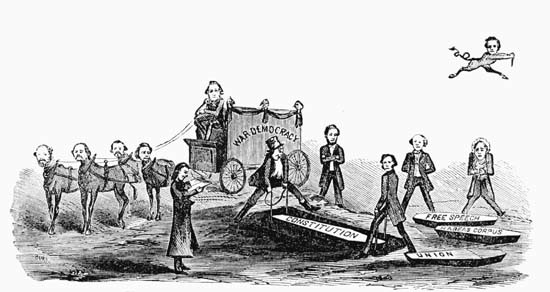
The Majer's Wonderful Dream. The Grave of the Union.—Page 250.
After I got thru, ses I, "Kernel, what do you think of my dream?" He looked down on the floor, and then looked up, then he looked down agin and then he looked up. I see he was kinder worried, so I said nothin. Finally, he kicked his slipper off, and ses he, "Majer, do you know what good lether is?" "Wal," ses I, "Kernel, I used to know something about lether." "Wal," ses he, "what do you think of the lether in that slipper. Is it good?" "Yes," ses I, "I think it's pretty good." "Wal," ses he, "what kind is it?" Ses I, "It's calf-skin." "Wal," ses he, "kin you tell me whether the calf was a heifer or a steer?" "No," ses I, "I can't." "Wal," ses he, "I'm in jist the same fix about your dream. It is a good dream, but I can't tell whether it's a heifer or a steer. But I ruther reckon it's a steer!"
"Wal," ses I, "Kernel, you may think that my dream don't amount to anythin, but there are thousands of people who will see in it the fate of their country."
He didn't seem disposed to talk about it, however, and I let it drop. Since then I've been over to the Capitol once or twice, and looked around Washington a leetle. I never see such a change in a place since I was born. It's dirtier, nastier, and meaner lookin than ever. In fact, it is just like the country, all goin to ruin. If the devil is ever happy, I think he would be nigh about tickled to deth now-a-days. I guess everything is goin on to suit him to a fracshin. I kin tell you one thing. There is goin to be a bigger fite between Linkin and Chase for President than most pepil suppose. So look out for the musick ahed. I shall keep a watch on all the doins, and write you when the rumatiz, like the greenback market, aint too stringent.
Majer Jack Downing.