DOWNINGVILLE MILITIA. (continued 3)
Reading edition
"Wal," ses I, "Kernel, that's about my idee, too, and I don't beleeve, by the time they get through, either side will have a bed-blanket or even a hull shirt left. They'll be wus off than Billy Bradly when he fit with the catamount, who didn't have a rag left on him except the stock around his neck."
Here the conversashin dropped. The Kernel looked very solemncolly, and I thought I wouldn't say nothing to hurt his feelins.
There ain't enything new here jest now, except the arrival of new regiments. Seward feels as happy as a little gal with a new doll every time a regiment comes along. Stantin takes down his big book an adds it on to the number alreddy in the army, while Chase gets ready to issoo more greenbacks.
Your frend,
Majer Jack Downing.
LETTER XVI.
The Science of "Military Strategy"—The Major's Opinion Upon it—A Call From the Secretary of the American and Foreign Benevolent Society for Ameliorating the Condition of the Colored Race—His Speech—The President's Reply—A Curious Prayer—The Major's Opinion on Slavery —The Critical Condition of Affairs—Mr. Lincoln Tells a Story.
Washington, Sept. 2, 1862.
To the Editers of The Cawcashin:
Surs:—Sence I writ you last I've been studyin military strutegy. It is a grate science. Our army, down in Virginny, has been in grate strates lately, an if it hadn't been for military strutegy it would have all been taken prisoners. Ses the Kernel to me, the other day, ses he, "Majer, what do you think that military strutegy consists in?" "Wal," ses I, "Kernel, it consists in gettin out of your enemy's way wen he's too much for you, an gettin in his way wen you're too much for him." Ses I, "Kernel, I don't know whether that is down in the books, but that's the common sense view of the subject." "Wal," ses Linkin, "whatever strutegy consists in, we don't seem to have a bit of it, for we get in the enemy's way jest wen he's too strong for us, an get out of his way wen he ain't too strong for us. I'm gettin eenamost discouraged with this kind of military strategy." "Wal," ses I, "Kernel, you've got too many Ginnerals an too many armies. There's too many fellers, with more brass in their faces than there is in their buttons, who want to be the biggest toad in the puddle. Now, there can't be but one big toad, an so there can't be but one head Ginneral. You ought to make one man Command-in-Cheef, an make him take the field, so that he can see for himself how matters are goin. Ginneral Hallick, here in Washinton, ain't the thing."
"Wal, Majer, there is no use of cryin over spilt milk. The troops down in Virginny have been very roughly handled agin by the rebils, an have got so mixed up that it will require a grate deal of strutegy to get them straitened out. The question is, what is to be done?"
Jest as I was about to give the Kernel some advice, who should come in but Sumnure, an a feller with a white handkercher around his neck, an two or three other solemn-lookin chaps. The feller in a white kercher spoke up, an ses he, "Mr. President, we're come to sympathize with you in the nashin's afflicshin, for the Lord has agin beat us with stripes—ah. Mr. President, I'm chief Secretary of the American and Foreign Benevolent Society for Ameliorating the Condishin of the Colored Race—ah—an I have been appinted Cheerman of a Committee to wait on you an express to you our opinions in the present fearful crisis in our country's history. Our society, which is composed of all the most pious maiden ladies in our town—ah—who are over forty years of age, an, therefore, may be considered wise and discreet, desire me to express to you their deep conviction that God will never bless our armies with victory—ah—so long as you do not fight for the freedom of our dearly beloved colored brethren—ah. Our Society, Mr. President, has given the condishin of our colored brethren great attenshin—ah. You can judge of the extent of our labor wen I inform you that the sisters of our Society have distributed the past year to our colored brethren in Liberia, 500 flannel shirts—ah—600 wool socks—ah—100 Bibles—ah—100 Tracts on Temperance—ah—500 toothpicks—ah—and a large supply of cologne water—ah! We should have been glad to have supplied the sufferin bondmen of the same oppressed race in our own country, but the vile rebellion of the infernal slaveholders has prevented. We ask you now to proclaim liberty to the captives, and 'let the people go'—ah. Do not let your heart be hardened as Parroh's was, but save our land from sorrow, an our armies from further defeat by a decree of righteousness. Then will the Lord smile on us, an then shall glory cover the land—ah."
I believe I've got that speech down purty nigh as the feller delivered it, for he spoke very slow an stately, as if he was tryin to make an impreshin. Wen he got thru, Linkin got up, and ses he, "Mr. Secretary, I'm kinder glad to see you, and will only say that we need all the help about these times we can get, an if I thought the Lord would only help us lick the rebils, I would free the niggers. An if I thought he would help us by freein 'em, I would do that. In fact, whatever I do, an what—I don't do, I do it, or I don't do it, jest as I think the Lord will be most likely to help us. The great thing is to get the help of the Lord, an I shall adopt new views on this pint jest as far as I think they are good views." Wen Linkin got thru, I pulled him by the coat-tail, an ses I, "Kernel, Seward himself could not have beat that non-committal speech." Ses he, "Hush, Majer, don't throw all the fat into the fire." Jest then the feller in the white hankercher spoke up, an ses he, "let us pray," an at it he went. Ses he, "Oh Lord, throw grate lite upon the mind of our Chief Magustrate—ah—give us victorys over the rebils—ah—give us this yere grate victorys—ah—not such little victories as we had last yere—ah—but crush the rebils with the arm of thy power. Amen—ah." After this, they all shuck hands, an went away. After they had gone, ses the Kernel, ses he, "Majer, that's a wonderful pious chap." "Yes," ses I, "Kernel, I think he is, in his way, but," ses I, "findin falt with the Lord, bekase He don't give us bigger victories, ain't much like the Christians of arly days." Ses I, "His prayer for big victories reminds me of old Joe Bunker's prayer. Joe was a wicked old sinner who swore wus than a saleyur. One day he was a swarein' kos he didn't hev better corn. Some one told him he orter pray for good corn, if he wanted it. So one day some one was goin' long the road by the old feller's corn-field, and hearin' a noise, they stopped, and who should the noise cum from but the miserly old skinflint Bunker, who was prayin. Ses he, 'Oh, Lord! give us a good crop of corn this yere, long ears, long as your arm, not sich d—d little nubsbins as we had last yere.' Now," ses I, "Kernel, I think thar's a great deal of simularity 'tween them two prayers, and I think the Lord is jest about as likely to answer one as 'tother." Ses I, "Kernel, you could bust up fifteen Unions easier than you could destroy slavery." Ses he, "Majer, I don't see into that ezackly, and I'd like to know the reason why." "Wal," ses I, "Kernel, the reason is jest this: men made the Union, but God made slavery, and I tell you," ses I, "Kernel, when you undertake to butt agin that, you butt agin a big subjec." Ses I, "Ain't every body been fightin slavery for the last thirty years, and haven't they all cum off second best, while nigger slavery has been growin' and expandin in spite of 'em? God made the nigger to sarve and obey the white man, and until he's altered and made anuther being, you can't make him enything but a sarvent. These fellers, like that white cravated chap, who was jest here, and who employ their time sendin flannel shirts and tooth-picks to the wild nigger in Afriky, don't know nothin' more about niggers than they do 'bout the interior of the arth. You might presarve all the brains they've got in a drop of brandy, and they would have as much sea-room as a tad-pole in Lake Superior."
"Wal," ses Linkin, ses he, "Majer, let's drop the nigger jest now, as I want to ask you whether you think the rebils kin take Washington?" "Wal," ses I, "Kernel, that depends upon strutegy agin. Ef you keep Ginnerals in the field who don't pay eny attention to 'lines of retrete,' afore you know it, Kernel, that feller with a Stonewall in his name, will be around on the North side of the White House, an I'm afeered my 'line of retrete' to Downingville will be cut off." "That's so, Majer, and my retrete to Springfield may be a hard road to travel." When Linkin made this remark, he looked kinder oneasy. I didn't know what to say, so I did jest what I allers do in that case, I whistled! Ses Linkin, ses he, "Majer, are you whistlin to keep your courage up?" Ses I, "No, Kernel, I ain't afraid a mite, but," ses I, "I'm in what old Deacon Doolittle calls a quandary." Ses he, "What's your quandary?" "Wal," ses I, "I was thinkin what I would do ef the rebils should take Washington." The Kernel didn't say nothin for about a minute. He looked very serious, and finally, ses he, "Majer, we're in a tight place, an there is no use denyin it, but it don't do any good to get into a fit of hysterices about it." "Yes," ses I, "Kernel, but it makes me feel solem to see this grate Old Ship of State knockin around, an, may be, jest reddy to sink." "Wal, Majer," ses the Kernel, "that remark reminds me of a story. A good many years ago, an old feller, a free an easy chap, owned a steamboat on the Missippi river, an he was a grate fiddler. He had nothing to do, an ginnerally went up an down the river on the boat, spending his time in fiddlin, an tellin stories. One day the boat struck a snag, an was fast fillin with water. The old feller was in the cabin sawin away on his fiddle when the boat struck, but he paid no attenshin to it, but kept rite on fiddlin. Finally, one of the passengers came in an told him that the captain warn't tryin to save the boat as he ought, and that she would be lost in ten minutes. 'Wal,' ses the old feller, 'she's been a loosin concarn for five years,' and he kept on fiddlin. Pretty soon another passenger rushed in, and screamed out 'She's settlin very fast.' Ses he, 'I wish she'd settle with me before she goes down,' an still he kept on fiddlin. The next that was seen of him he was swimmin ashore, with his fiddle under his arm an the bow in his mouth. Now, Majer, if they take Washington, and the ship sinks, we'll swim ashore!"
"Yes," ses I, "Kernel, and I suppose you will take the nigger with you, jest as that old feller did the fiddle, for the nigger has been the fiddle your party has played on!"
The Kernel didn't seem to like this application of his story, but he didn't say a word. I felt very solemn, for I couldn't help feelin eenamost like crying when I thought how this grate nashin might all be shipwrecked afore he knew it, by a set of fellers who have been so taken up with the nigger as to let the country go to destruction.
I went to bed that nite with a heavy hart, an had a terribul attack of bilyusness, which I had to take nigh onto a gallon of elder-bark tea to cure. Sence then I've been better, an if God spares my life I'll keep you posted about our nashinal affairs as long as there is a nashin.
Your frend,
Majer Jack Downing.
LETTER XVII.
A Cabinet Meeting—The President Calls for the Opinion of Each Member—Speeches of Seward, Chase, Stanton, Blair, Welles, Smith and Bates—The Major Called on for an Opinion—The Peperage Log Story—The Majer oposes an Armistice—No Conclusion Arrived at.
Washington, Sept. 13th, 1862.
To the Editers of The Cawcashin:
Surs:—Sech a time as we've had here sence I writ you last, you never heered tell on. One time we all thought that the Secesh would take us, bag and baggage; but we feel easier now, an everybody is hopin that the crysis is past. Rite in the midst of the tribbelation, Linkin called a meetin of the Cabynet to consult on the tryin state of affairs, an he insisted that I must meet with 'em, as it was no time to stand on precidents an ceterys, an beside, he sed he wanted the help of every ounce of loyal brains in the country. Ses he, "Majer, I kin depend on you, for though you sometimes give me a hard hit, yet you've allers got the good of your country at hart." Ses I, "Kernel, I'm much obleeged to you for your good opinion, an I kin assure you that every word of it is true. Ef there's a man on this arth that has a truer love for his country than I have, I would like to see him;" an ses I, "Kernel, I'll tell you why my country seems so dear to me. I'm an old man now, nigh on eighty years old; I recollect when Jefferson beat that old Federal, John Adams, in 1800. I warn't old enough then to vote for him, though I wanted to; but wen he run the second time I voted for him, an done all I could for his election. Wal, I've been a Dimmecrat from that day rite down to the old Ginneral's time, an I'm a Dimmecrat yit; but I love my country above all parties. An one reason why my country is so dear to me is, because I haven't got enything else to love now. Nigh about all my relashins are dead an gone, an there ain't enything on arth left me to love but my country; an wen I see it distracted, divided an bleedin, it makes me cry; an," ses I, "Kernel, I can't help it."
"Wal," ses the Kernel, "Majer, it's oncommon hard for old men like you, I know; but you jest meet with the Cabynet this mornin, an let us see ef some new plan can't be adopted to get out of this scrape."
So wen the time cum, I took my hickery, an went in. Purty soon the different members cum droppin in, one by one, an all seemed highly tickled to see me except Seward, who has never forgiven me for exposin his decepshin on Linkin wen he altered my "Constitushinal Teliskope." After they all got seated, ses Linkin, ses he, "Gentlemen, there's no use eny longer of doin like the ostrich does—stick our heads in a sandbank an say that we 'don't see it,' for we're whipped an driven back—in a word, we have failed. Now, the rale question is, Why have we failed? What is the cause of it? Jest as soon as we kin find out the reason of our failure, we shall know what to do to remedy it. Now," ses the Kernel, "I want every one of you to give me your frank, blunt opinion as to the reason. First, I will call on Mr. Seward."
Seward got up, lookin as pale as a sheet, an ses he, "Wal, it ain't my fault. I've paid no attenshin to the war, but have had my hands full in keepin furrin nashins from interferin, an I've succeeded; but ef I should give my opinion of the cause of the failure of our efforts to restore the Union, I would say it was owin entirely to the ultra-Republicans, who wanted to kill slavery before they scotched it. This let the cat out of our bag before the rite time. It aroused an united the South an divided the North. They saw what we were after. Ef my policy had been followed of pacifyin the South an of talkin 'Union' to the North, we would have scotched the snake of slavery, an then we could have killed it at our leisure."
Then Linkin called Chase. He commenced by saying that he did not agree with Mr. Seward as to the cause of our failure. He sed it was jest this dilly-dally policy that had ruined us. Congress had done its duty, but the President had not yet dared to make the rebils feel the power of Congress. He sed he had kept the army supplied with "greenbacks," an that was all he had to do. He had done his duty, but he didn't beleeve we would ever succeed until we fit for liberty an the overthrow of slavery. We should allers fail to restore the Union until we did it.
Then Stantin spoke. He sed "he thought one grate cause of our failure was because he had not kept on issooing his proclamashins, as he did at first. He sed he thought his proclamashin about 'the sperit of the Lord' enabled our soldiers to take Nashville. Then," ses he, "Ginneral McClellan is too slow. He might have been made for a ralerode engineer, where there was no hurry about buildin the road, but he was never cut out for a Ginneral. He was a failure, and hence it wos a failure all round."
Then Blair spoke up. "Wal," ses he, "ef there's a man done his dooty, it's me. I've stopped every paper in the mails that wouldn't endorse the policy of the Administrashin; hence the people have only seen arguments on one side. Ef we've failed, therefore, it can't be because the people's readin hasn't been well looked after. I haven't allowed their minds to be pisened by eny 'copper-head' Dimmocratic doctrines. Nothin but anti-slavery sentiments kin get through the mails now. Ef we've failed, I think it must be because Seward and Stantin have not been more strict in arrestin men who talked——"
Here Seward an Stantin both jumped up an declared that Blair was very onjust, an sed they had arrested every man they could get anything agin, an a good menny that they couldn't get anything agin.
Wal, Blair sed, "enyhow, the failure was not his fault. Ef they didn't beleeve him, let them ask his father, who knew more about politics than eny other man in the country!"
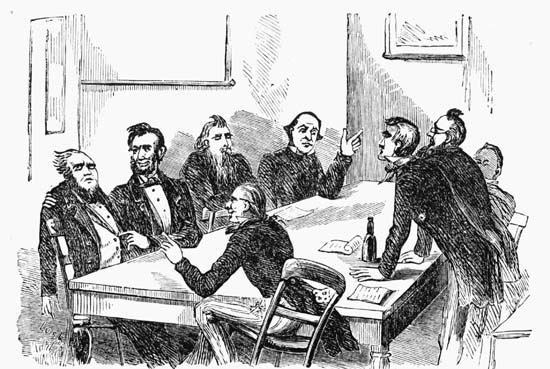
"Seward an' Stantin both jumped up an' declared that Blair was very onjust."—page 154.
Then old Welles got up, looking very sleepy. He sed "the failure could not be charged agin the Navy. It was the most wide-awake institushin of the age. It had achieved all the victories." [Here Stantin jumped up agin, but Welles wouldn't yield the floor.] "The army couldn't do anything without his gunboats. Every time the rebils got at them, they had had to retrete to his gunboats. In his opinion the army had failed, because it could not carry his gunboats with it. He sed he had been try in to invent a plan to furnish each regiment with a gunboat for land service. Ef he could do that, he thought Richmond might be taken early next spring! The only thing in all the war that had not been a failure were his gunboats!"
Then Mr. Smith, an old man from out West, got up. He sed "he belonged to the interior, and didn't know much about what was goin on. He had heered say there was a war in progress, and that there had been some pretty tall fightin, but he didn't know whether it had been a success or a failure. Ef we had failed, he thought it must be because we had not been successful, an ef we had succeeded, he thought it must be because we hadn't failed!"
Mr. Bates sed "he agreed with Mr. Smith, except in one pint. He had heerd, within a day or two, for the first time, that we had failed. Upon lookin over Blackstun to see ef there was eny case like it, he had been much disappinted in not findin eny. He thought we must have failed because we had not follered Blackstun."
After he got thru, Linkin called upon me. I jest hauled up my old hickery and laid it on the tabil, an then puttin my elbows on the tabil to rest myself, I began. Ses I, "Kernel, I feel kinder scary to giv my opinion rite here, after sech a display of larnin an eloquince; but," ses I, "as I understand the questshin, it is this: We've been fightin to restore the Union, an we've failed. Now, what is the cause of the failure?" Ses I, "Is that it, Kernel?" Ses he, "Yes, Majer; that's it, exactly." "Wal," ses I, "I allers want to get on the track afore I start, an then I kin tell purty nigh where I will fetch up. Now," ses I, "Kernel, I want to ask you a questshin: Did you ever try to split a peperage log!" "No," ses he, "Majer, I never did. Nobody would be sech a consarned fool as to try an split a peperage log." "Wal," ses I, "Kernel, suppose some feller should cum to you an tell you that he had been a year an a half tryin to split a peperage log, an couldn't do it, that he had failed, an wanted you to tell him what to do, what would you say to him?"—"Say to him!—why, I should tell him he might jest as well whistle at the log as to try to split it—that it warn't in the natur of sech knotty, nerly, cross-grained timber to split; in other words, that he was tryin to do an onpossibul thing." "Now," ses I, "Kernel, that's jest my idee about tryin to save this Union by fightin! You're tryin to do an onpossibul thing. After a year an a half of fightin, you all acknowledge that you have failed, an all the Cabynet is wonderin why you have failed. Now, it ain't no wonder to me. You have failed jest because, in the very natur of things, what you are tryin to do can't be done in that way. You're takin the rong way to do it."
Wen I sed this, you never did see sech a flutter. Stantin turned very red in the face, and sed "that I orter be sent to Fort Lafayette." I telled him that I wasn't afeered of all the Forts this side of Purgotary, and that I should speak my mind till my dyin day, let what would happen. That cooled him down. Then I told the Cabynet that the only way to get out of this scrape was to have an armistiss, stop the fightin, and go to talkin—that both sides had had enuf of bloodshed now to satisfy them, an that the only way to get at a settlement was to do that. They took a vote on it, an all voted for it except Linkin, Chase and Welles. The Kernel sed he was so committed to the Abolishin Governors of the North, that he couldn't go for the armistiss. Chase sed, "ef it comes to that, then all the money has been spent for nothin, an I shall be cussed for the debt forever an ever." Old Welles sed that he thought we should be successful jest as soon as he got his new Patent Land Gunboats in operashin, an he was for fightin the thing out! The other members of the Cabynet sed they thought they could back out without much trubbel. Seward sed he never see a hole so small that he couldn't, on a pinch, get through, especially with Weed to help him. He thought he should turn Dimmocrat! Stantin sed he intended to jine the church, and turn Methodist precher. Blair sed he didn't know what he should do till he consulted his father! He knew the old man could help him out. Smith an Bates sed they should return to the buzzum of their families, an, if necessary for their safety, put on krinoline!
No conclusion, however, was cum to about the armistiss. The Kernel can't bring himself up to the idee yet. Ef the Governors were only in favor of it, he should do it at once. So I suppose, for the present, we shall keep on tryin to do an onpossibul thing—to git the Union by fightin for it. Depend upon it, tryin to split peperage logs ain't nothin to it.
Yours till deth,
Major Jack Downing.
LETTER XVIII.
The Major not Ill—The President has "the Gripes"—The Witch-Hazel Medicine—Going to the bottom of a Subject—The Democrats and the War—The Emancipation Proclamation—A Visit to Gen. McClellan's Army—The Soldiers Cool—Mr. Lincoln tells a Story—"Sloshing About."
Washington, Oct. 6th, 1862.
To the Editers of The Cawcashin:
Surs:—I see you sed in your paper, last week, that perhaps I had the rheumatiz, and that that was the resin why I had not writ you. Now, you were dredfully mistaken, for I aint had a twinge of the rheumatics for a long time. The resin I did not write last week was jest this: Rite off, after Linkin had issooed that Abolishin Proclymashin, he was taken with a terribul fit of the gripes. There was noos received that some of the sojers were gettin onruly, and refusin to fight for the nigger, an I thought one spell that the Kernel would go crazy. He walked the floor all nite, an looked as ef he would die. Finerally it brought on the gripes, an then his condishin was terribul. I tried elder bark tea, but it didn't do a mite of good, so I telled him there warn't but one medicin that would cure him, an that was witch hazel sticks mixed up with molasses. So I sent fur some twigs an cut em up in about inch pieces, and put the molasses on, an stirred it all up. The Kernel looked at it very sharp, an ses he, "Majer, you aint going to give me rale fence to drink, are you? The remedy will be wus than the disease." "Wal," ses I, "Kernel, then that will be jest like your Abolishin Proclymashin," an I kept on mixin it with a big spoon. "Now," ses I, "Kernel, the good pints of this medicin are, that as it goes thru a feller it cleans him completely out. It confiscates, eradicates, obliterates an conflusticates everything. It's equal to your Abolishin Proclymashin an the Confiscashin Bill rolled into one." Ses I, "Kernel, there's only one thing about it that's wrong. Sometimes the sticks get twisted together, or tangled up like the logs comin down the river, in Maine in the spring of the year, and it requires a purty hard jar to start 'em loose. But," ses I, "there's no danger of it's killin anybody, and there's no way for you to get rid of that gripin but by takin it." The Kernel looked at it purty sharp, an ses he, "Majer, I can't stand this innard arthquake much longer, an ef you say that that rale fence will cure me, I'll swallow it ef it takes the har off my hed." So I jest told him to take it, an down he put it as easy as ef it had ben geniwine Borbone. He hadn't had it down but a little while before he began to get wus. He walked the floor an groaned as ef he was goin to die. Ses he, "Majer, this infernal stuff will kill me, sure. I believe I've swallowed a dose of pitchfork tines, or a half-pint of darnin needles. It reminds me of a story, Majer, but I feel too bad to tell it. It's the very first time in my life I was ever so far gone." I see at a glance what was the matter. The sticks had got tangled together, an lodged fast, an I knew there was no time to be lost. So ses I, "Kernel, I kin cure you. You jest cum here an sit down in this cheer." He cum up, and wen he went to set down, I jerked the cheer rite out from under him, an down he cum kerslap on the floor. I tell you it made the hull house shake; but I knowed he must get a good jar, or it was a gone case with him. It made him see stars for a little while, for the Kernel, you know, is long-geared, an it was no jokin matter for him to fall so far. But it was all over within a minnet, an wen he got up he sed he felt like another man; but, ses he, "Majer, that's what I call goin to the bottom of a subject." "Wal," ses I, "Kernel, that's jest what you are tryin to do on the slavery questshin, an ef you don't see stars on that before you get thru with it, I'll wonder." Ses I, "Kernel, do you expect Dimmicrats are goin to support you on freein the niggers?" "Wal," ses he, "Majer, not the rale, geniwine Dimmicrats; but you see you've got a grate lot of fellers in your party who call themselves Dimmicrats, who aint Dimmicrats at all. You've had the offices in your party so long, that you've naterally attracted a hull lot of chaps who only want offices. These fellers have mostly been the leaders of your party for years an years, an now, wen we've got the offices, an there aint scarcely a chance that the South will ever have eny more to give 'em, they all cum to us, an I kin get 'em at almost eny price, from a Brigadier-Generalship down to a quarter of a dollar. I've tried to git some geniwine Dimmicrats to mix in, but you can't touch em." Ses I, "Kernel, I guess you'll find that the grate bulk of the Dimmicrats won't fite to free the niggers. They can't be sech a pack of derned fools." "You've got too high an opinion of your party, Majer," ses the Kernel. "There's a grate menny more derned fools in it than you've got eny idee of. You say they won't fite to put down slavery. Didn't they say they wouldn't fite to coerce the South? And didn't they do it? Didn't they say they would only defend the Capital, and wouldn't invade Virginia, and didn't they do it?"
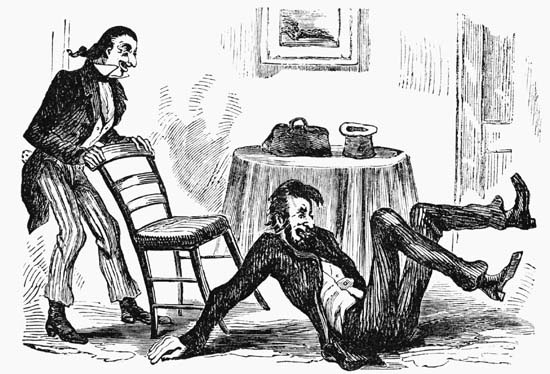
"Majer, that is what I call goin' to the bottom of a subject."—Page 161.
"Yes," ses I, "Kernel, I must own that's the truth; but," ses I, "they called God to witness ef the war was ever made an anti-slavery war, they would throw down their arms." "Yes," ses he, "but don't they say now that they aint got nothing to do with the policy of the government, an that their only duty is to fite." "Wal," ses I, "Kernel, sum of 'em have sed that, but it can't be possibul that that's the gineral sentiment. Ef they follow that principul, then ef you should proclaim yourself Emperor or King, an tell 'em to fite to establish a monarchy, they would do that." "That's drivin your idees a little too far, Majer, as you ginnerally do. But what do you think about our goin up to the army an reviewin the sojers, and seein whether I aint jest as popelar as ever I was?" "Wal," ses I, "Kernel, I think that that is a good idee, an I kin judge purty nigh how your Proclymashin sets on the stumacks of the sojers from the way they cheer you. Ef they cheer as loud as they did wen they were down at Harrisin Landin, I shall be mistaken." So we started off the next day for Ginneral McClellan's head-quarters in a speshal train. First we went to Ginneral Sumnure's head-quarters, and it warn't long afore Ginneral McClellan cum there. too. There was sum talk about the Proclymashin, an Linkin told the Ginneral that there were two great resins why he had made it. One was to stop furrin nashins from interferin, an the other was to make the rebils cum to terms. He thought it would feteh 'em, sure.
Ginneral McClellan didn' say a word, one way nor tother, but looked oncommon solemn, and axed the Kernel whether he didn't want to revew the troops. I saw at once that the Ginneral didn't like it, and that he wanted to turn the subject. Then we started off and took a look at the troops on Merryland Hights and Bollyvare Hights, and all around Mr. Harper's ferry. Mr. Harper warn't hum, and so we didn't see him, and the ferry warn't in good order nether, the resen bein that the rebils had been there and destroyed eenamost everything. As we were goin along, ses I, "Kernel, them cheers don't sound like they did down on the Jeemes River." The Kernel didn't say enything, but looked very serious. Wen Ginneral McClellan showed himself, you oughter have heerd the sojers yell and scream, and wave their hats. I never see the Kernel look so pale and thin, and I couldn't get a word out of him. As for makin a speech, it warn't to be thought on. After we got all done reviewin the sojers, the Kernel and all hands of us come down from the Hights, and sot down near the road on an old wagin. Linkin told some stories to pass away the time, an purty soon we went back to Ginneral Somnure's head-quarters, where we staid all nite. The next mornin we went to Ginneral McClellan's head-quarters, an then over the battle field of Auntyeatem. The next day we cum hum, both of us purty nigh tired out. The Kernel pulled off his boots as soon as he got in the house, as he almost allus does, an I got out my pipe for a smoke.
"Wal," ses I, "Kernel, what do you think of your visit?" Ses he, "Majer, it's jest as you told me. That Proclymashin of mine ain't popular, and I knowed it wouldn't be. But jest see how I was situated. There was the Abolishin Guvernurs drivin me on one side, an ther was France an England on the other side. What was I to do? I couldn't stand still. I couldn't go back. So I had to "let her rip." I've ben poleing around, Majer, ever sence I've been President, trying to touch bottom, an I couldn't find it. Now I hope I'll git it." "Yes," ses I, "Kernel, but may be your pole warnt a constitutional pole. Ef it had ben, you would hev found bottom long ago." Ses I, "Depend on it, Kernel, there ain't no bottom where you are poleing, and ef you keep on till doomsday, you won't find eny."
Ses I, "Kernel, don't you know that you said in your inaugerole that you had no rite to interfere with slavery, an that you didn't intend to?"
Ses he, "Did I, Majer? I've forgot all about it. The truth is, Majer, when I look back the two years I've been President, it reminds me of a story:—Old Bill Jones got drunk one election day, out in Illinoy, an had a hand in several fites before nite. The next day he was brought up before a Justess of the Peace, an the Justess inquired, 'Mr. Jones, did you strike Tom Smith yesterday?' 'Wal, I don't know, Judge,' ses Bill, 'I was sloshin around considerabul, an can't exzactly say what I did.' 'Wal, Mr. Jones, did you hit Jim Wattles?' 'Wal, now, Judge, I can't be sartin; the truth is, I was sloshin around most of the day, I reckon.' 'Now, Mr. Jones, tell me whether you struck Dick Robinson?' 'Can't say, Judge,' replied Bill. 'I believe, on the hull, I was sloshin around about all day.' 'Wal, Mr. Jones,' said the Justess, 'what do you mean by "sloshin around?"' 'Wal, Judge,' said Bill, '"sloshin around" is jest going rite thru a crowd, an mowin your swath, hitten rite an left everybody you meet slap over the face an eyes.' Now, the truth is, Majer, I've been 'sloshin around' sence I've been President, hittin in the dark, an not knowin exzacly where I struck. This Proclymashin of mine is a hit in the dark, but as I am the first anti-slavery President, I've got to mark out a new track, an hence do as old Bill Jones did, keep 'sloshin around.'"
"Wall," ses I, "Kernel, that's resky business, an ef you don't 'slosh' once too often, it will be a wonder. But," ses I, "Kernel, I'me terribul tired after this trip, an what do you say to havin a little old rye before we go to bed?"—"That's jest what I was thinkin of, Majer." The Kernel then told the feller in bad close, who does chores for us, to get us some, an we both tuk a good swig of genewine rye-juice, an went to bed. I was eenamost tuckered out, but this mornin I feel nigh about as good as ever agin.
Yours till deth,
Majer Jack Downing.
LETTER XIX.
The President Nervous—The State Elections—Mr. Lincoln Astonished —He Takes Cordial—Mr. Seward Turns Democrat—The Major Tells a Story—Mr. Seward and the Major Take a Drink—How John Van Buren got Gen. Scott's Letter—Mr. Stanton on the Elections.
Washington, Oct. 20th, 1862.
To the Editers of The Cawcashin:
Surs: Wal, the Kernel has ben sick agin. It is astonishin how littel takes him down now-a-days. His constitushin seems to be eenamost clean gone. Old rye don't do much good, an I've tried all sorts of medicin, but nothin seems to work well. This time his narves were terribly worked up, an he was so fidgety, that I koncluded to try Godfrey's Cordial. This cooled him down a dood deal, and but not until he tuk nigh unto four or five bottles full. The cause of all this flutter was the recent elecshins in Ohio, Indiany an Pennsylvany. The Kernel had been told by Sumnure, Greeley an Andrews that the only way to carry the elecshins this fall, was to issoo an emancipashun proclamashun; that if he didn't do it, the party would be completely whipped out in every State. So he koncluded to try it, but wen the returns cum in, you never did see such a woe-begone lookin man. One nite he heerd sum bad news from Ohio, an gettin up in his nite gown, he cum to my room and axed what I thought about it. I struck a light an got out my slate. The Kernel had Greeley's last year's almanac in his hands. Ses he, "Majer, let's go down to the telegraf offis, and see how the majorities run, an we can be able to give a guess that will cum as nigh to it as the jump of a rabbit." So I jist put on my duds, an off we went. The news cum in thick an fast, an as the feller at the telegraf read off the figgers, I put 'em down on my slate, an the Kernel compared them with his own majorities in Greeley's primer. I see he was turnin all sorts of colors, an finally, ses he, "Majer, we are gone jist as kompletely as if we were up Salt River now, instead of bein here. I'de jest like to swap places with sum hoss-jockey, an go into the hoss contract line." Ses he, "Majer, let's go hum. I've seen all of this elephant that I want to." So he crammed his coat-tail pocket full of despatches, an off we started. When he got hum, ses he, "Majer, my administrashin is the biggest failyure that ever tuk place in the history of this or eny other country. I now see that jest as plain as I see that bottle of old rye there. I've listened to those infernal fools, Sumnure an Greeley, an a pretty scrape they have got me in."
Ses I, "Kernel, it ain't my natur to hit a man wen he is down, or to hurt anybody's feelins by referrin to the past. But," ses I, "don't you rekollect the story about 'applyin the principle?'" Ses he, "Yes, I do; I recollect it well." "Wal," ses I, "now see the result of 'applyin the principle.' I told you then that you'd get scorched wus than Zenas Humspun did in meddlin with the telegraf, if you undertook to carry out the principle of Abolishun, but you sed the thing must tech the bottom, an you was bound to put it through. Now, you see, the people don't support you. They don't want niggers made equal to white men, nor they don't want 'em freed to be a tax on 'em. A few fellers like Greeley, whose brains all seem to run to bran-bread, an free luv, or some other moonstruck nonsense, an some larned fools like Sumnure, want to try the experiment, but they don't represent the people. So you see, Kernel, that in applyin the principle you have kicked yourself over, an I only menshin it to show you that if he had followed my advice you would not have had these grate defeats to mourn over."
The Kernel looked very solem, an ses he, "Majer, I know I'd been a great deal better off if I'd followed your advice all through these trubbils, but you see I had to go with my party, and if it had carried me to the other side of Jordon, I s'pose I should have gone with it."
That nite I thought the Kernel would go into spasms, he was so nervous. I got some hot water, an soaked his feet in it, rubbed his bowels with brandy, an laid flannel on 'em, an bathed his temples in camfire an rum. But he grew wus all the time. Finally, I began to pore the Cordial down him, an then he commenced to revive. But he didn't sleep scacely a wink all nite. In the mornin he was the most limpsy piece of mankind I ever did see. I ralely believe he might have been tied in a knot like an eel, he was so limber.
Jest a little while after breakfast, who should come in but Seward? He hadn't hardly spoken to me sence I blowed him for alterin the Kernel's Constitushinal Teliskope, but this mornin he was as perlite an as clever as he could be. Ses he, "Majer, the elecshin news is good, an our party is successful." Ses I, "Mr. Seward, I don't understand you." "Why, Majer," ses he—and he put on one of the queerest smiles I ever see on a man's face—"don't you know I have turned Dimmocrat?" Ses I, "You don't say so." "Yes," ses he, "I'm a Dimmocrat now, an no mistake." The Kernel looked as if thunder had struck him. "Wal," ses I, "Mr. Seward, that reminds me of a story, as the Kernel would say." "Wal," ses he, "Majer, what is it? I always like to hear your stories. They are so pat." "Wal," ses I, "mebby this will turn out to be a little patter than you like; but, howsoever, as I never spile a good story for acquaintance sake, I will tell it. Once on a time, it is said, an old coon went out of a night to get some fodder among the cornfields, an did not return to his hole until near mornin. Wen he got hum he saw a skunk had taken possession of his hole. He went up, an ses he, 'Who's there?' The skunk replied, 'A coon.' 'Are you a coon?' 'Yes,' said the skunk, 'I'm a coon.' 'Wal,' sed the coon, 'you don't look like a coon; you don't act like a coon, and I'll be darned ef you smell like a coon.'"
"Now," ses I, "Mr. Seward, you may be a Dimmocrat, but you don't look like one, nor act like one, nor smell like one, an I'll be darned ef I believe you are one."
Ses he, "Majer, you are rather personal." "Wal," ses I, "I don't mean any offence, an," ses I, "if you really mean to be a Dimmocrat, let's take a drink of old rye over the victories in Ohio, Pennsylvany and Indiany." So he cum up an we both took a good swig of wiskey. The Kernel looked at us an grit his teeth. "Wal," ses he, "ef you are goin to rejoice in my defeat, I'll go over an call on Stantin, an see ef he can't cheer me up." So the Kernel went off. After he'd gone, Seward an I tuk another nip of the old rye, an purty soon we tasted of it agin. The Seckretary is a capital drinker, an he knows what good licker is as well as eny feller I ever see. Finally he got in a very good humer, an ses he, "Majer, we've been bad friends long enough." So he actually hugged me, and sed there warn't a man that ever lived that he loved so much as the old Ginneral, an next to him his friend Majer Downing. Wen I thought I'd got him in a good humer an he was very talkative, ses I, "Mr. Seckretary, kin you tell me how John Van Buren got that letter of Ginneral Scott's?" Ses he, "Yes, Majer, I kin. You know I don't want that feller Wadswurth elected, for he's my bitter political inemy; so the way the letter got out was this:—Weed, you know, is my chum. Now, we have an understandin that everything that I can't tell him I put in my right hand coat-tail pocket. You see then I can deny that I made it public. That pocket is Weed's pocket, an he always goes to it for secrets. Wal, I put the letter in that pocket, an Weed got it from there. Weed also has just such a pocket. All smart politishins have such a pocket. Now, Weed's chum is Ben Welch, Commissary Ginneral, an Ben got it out of Weed's pocket. Now, John has long been a chum of Ben's, an he got it out of Ben's pocket. That's the way that this letter got out, that there is so much mystery about."
Rite off after this the Kernel came in, an we had to drop the conversashin, for Seward gave me the wink as much as to say that he didn't want Linkin to know everything about it.
Then I asked the Kernel what Stantin sed. He sed Stantin was in favor of issooing a proclamashin, over the grate victories of the Administrashin in Ohio, Indiany, Pennsylvany an Iway. He sed the people didn't put any faith in newspapers any more, an a proclamashin declarin that the elecshins had all gone favorabul would be believed without winkin. Stantin thinks there ain't nothin so powerful as a proclamashin. Seward said afore it was done, the Cabbynet had better be called together. Here the matter dropped, an as the Kernel looked uncommon blue, I left him to his own reflecshins, an went up-stairs to my room.
Yours till deth,
Majer Jack Downing.
LETTER XX.
The New York Election—Mr. Lincoln Tells a Story—Cannot Do Justice to the Subject—Mr. Lincoln Feels Bad—The Major Amuses him by a Joke—How to get up a Message—Keeping a Party Together—The Excelsior Political Prepared Glue—The Different Stripes of Abolitionists— Boating on the Mississippi River—Poleing Along.
Washington, Nov. 10th, 1862.
To the Editers of The Cawcashin:
I expect you were very much surprised in not gettin a letter from me last week, but the truth is, I got one partly writ jest as the news of the elecshins in New York an Jersey cum in, an I should have finished it an sent it on ef the Kernel had not been taken down sick so sudden. Wen the rumor fust cum that York city had gone over thirty thousand for Seemore, an that Fernandow an Ben. Wood an Jeemes Brooks had been elected to Congriss, the Kernel didn't say a word, but looked as ef he'd drop down thru the floor. I didn't like to speak fust, but I see the Kernel warn't going to, an so ses I, "How do you feel, Mr. Presidint?" "Wal," ses he, "Majer, I'll tell you a story. A good meny years ago there lived in lower Kentuck an old feller named Josh Miller. Now, it was ginerally reckoned in that part of the country that old Josh could out-swear eny feller that ever lived. Josh was a kind of gineral teamster, an had a two-hoss wagon with which he did chores for everybody round the village. One day he had on a load of ashes, an was goin up a steep hill, sittin on the fore part of his wagon. Wen about half way up the hind-board of his wagon cum out, an old Josh not lookin round, nigh about all the ashes jarred out, so wen he got to the top of the hill he didn't have a pan full left. He stopped his hosses, however, an got out, an a hull lot of fellers, who knew the ability of old Josh in the swearin line, gathered around expecting to here the tallest kind of strong words. The old feller looked fust at his wagon an then at the ashes all strewed along the road, an finally ses he, 'Boys, there's no use in tryin—I can't do jestice to the subject.' An now, Majer," ses the Kernel, "That jest my condition now—I can't do jestice to the subject, an I don't feel like talkin; in fact, I can't talk."
I see the Kernel felt very bad, an ef he couldn't talk nor tell stories, I didn't know wat on arth might happen. I was afeered he would get so full that sumthin like the dropsy would set in. An sure enuf, that nite not a word did he speak, nor a story did he tell. The consekence was, he began to swell an bloat like a mad porkepine. I see at once that I must turn doctor agin, or there was no tellin how soon he might kick the bucket. He was growin wus fast, actually beginnin to look blue. So ses I, "Kernel, there's no help for it; you must be tapped!" "Tapped!" ses he, "Majer, tapped! There warn't enything ever tapped in my house that lasted more that a week. Oh no! I ain't reddy to die yet." I see the "rulin pashin was strong in deth," jest as the poet's say; but as soon as I got a joke out of him, I knew that he would survive. So thinks I to myself, I'll see ef I can fetch him to by another joke; so ses I, "Kernel, suppose 'tappin' should kill you, you would go to a world of spirits!"
Wen I said this, he jumped rite up out of his chair, laughin, an takin me by the hand, ses he, "Majer, you are the best frend I've got. Wen I'm sick you doctor me, an wen I'm down spereted you jest joke me rite out of the dumps." Ses he, "Majer, I've a good mind to make you Commander-in-Cheef of the Army." "No, no," ses I, "Kernel, don't do that, for I should think you had sumthin agin me, an wanted to hand me over to the Abolishinists to be punished!"
The Kernel and I have also been bizzy sence I wrote you last in getting up the next message. He has been ritin his ideas on little slips of paper about two inches wide, as they have happened to pop in his head, an then submitten 'em to me to sort of polish up. The Kernel ses that ritin a message is a good deal like gettin out timber for a barn in the woods. Fust, you want the sills, then the posts, then the girders, then the plates, an finally the rafters. We ain't got the sills fairly hewed out and squared yit. The truth is, the Kernel is kinder worried as to how exactly to lay the foundashin. Wilson, who is now here, ses the sills must be of Abolishin timber, and no mistake. I telled the Kernel that sich stuff was the poorest kind of bass-wood, an wouldn't stand nohow. Then he thought of puttin in a mixture of Abolishin timber an sum constitutional saw-logs, but I telled him that that would make it so cross-grained that it wouldn't bear eny weight at all, an by the time we got the rafters on it would all smash down in a pile. "Wal," ses he, "Majer, I must do sumthin to keep my party together. I must contrive sum sort of a mixture that won't look too much Abolishin, an yet that won't drive off the old, genewine friends of freedom." "Wal," ses I, "I don't think your party kin hold together much longer, enyhow. It seems to me it is mity nigh now fallen to pieces, an it won't take much longer to knock it into so menny pieces that you can't no more putty 'em together than you can find the tail of a rainbow."
"Wal," ses the Kernel, "Majer, don't you think I've done well in keepin it together as long as I have?" Ses I, "Yes, Kernel, ef there's a feller in this country that ought to git out a patent for 'Excelsior Political Prepared Glue,' it is you. You've kept together the most cross-grained, knotty, knerly lot of political timber that ever was made up into eny political party." Ses I, "There's the Greeley stripe. Now, it's enuf to give any party the dyspepsy to have such a set of bran-bread, free-luv, long-haired set of fellers in it. An ther's Gerrit Smith an his stripe, a kind of maroon-colored, mongrel breed of politicians, sumthin like a cross between a Jamacy nigger an an Esquimaw; an then ther's Wendell Phillips an old Garrison, sort of Abolishin alligators; an fineally you've got a sort of half-an-half fellers in your party who try to be conservative, who quote Blackstun and the law dicschinnaries, an set great stress upon being very moderate. Now, how you've contrived, Kernel, to keep all these different ingredients together is a mystery." "Wal, Majer, ef I hadn't larn't sumthin about boatin on the Mississippi River, wen I was young, I don't believe I would ever have been able to steer the ship of State at all." "Why," ses I, "how is that?" "Wal," ses he, "goin up the Mississippi River is a good deal like being Presidint. Sumtimes you have to go one way and sumtimes another. Sumtimes you go slam rite in one bank an sumtimes in t'other, and then it ain't at all oncommon to get on a sand-bar, an lay there no one can tell how long. Now, Majer, that's a good deal like being Presidint, an you see I've kept my party together by jest goin first one way an then t'other. Wen the Abolishin tide cum along strong, I'de jest let the vessel foller the current, go with it, an wen she struck the other shore, of course, it would take another tack. Sumtimes, when all hands got a quarrelin, I jest let her rip rite on a sand-bar, and there let her lay until I made 'em settle their disputes. But, I tell you, Majer, there's one that has been the best of all to keep my party together. Wen they've got purty mutinous, I've threatened to discharge all hands an get a new set. Then you ought to see how soon they stop quarrelin. Ther's nothin they so much dred as to lose the offices. Take away the cow that gives the milk, an they would all blat jest like weaned calves. So wen I stop the ship an tell them that I'm goin to clear the deck an put on a new crew, I tell you they are as whist as mice. So you see, I go poleing along. First this way, then that, jest like goin up the Mississippi River, for all the world."
"Wal," ses I, "Kernel, that seems to me a rather hap-hazard, no-policy way of bein Presidint. It ain't statesmanlike." "Wal, Majer, mebby it is and mebby it ain't; but I'm goin to make things shake now, sence the elecshins are over. Things have got to be more lively."
I didn't say nothin, for I see the Kernel was gettin his back up. At last, ses I, "Kernel, have you tried eny of that old rye lately?" Ses he, "No, Majer, I ain't, but I feel like wettin my gills to-nite. How do you feel?" "Wal," ses I, "Kernel, a little good whiskey never goes agin the grain." At that the Kernel sent for the feller who does chores, an we both took a swig. Wen I thought he was in purty good humor, ses I, "Kernel, why did you remove McClellin?" Ses he, "Majer, I can't tell you now, but jest recollect my story about 'polein around,' an gettin in 'Abolishin currents,' an you kin guess." I sed nothin, for I see the Kernel was very mum, so I bid him good-nite, and slept as sound on that old rye as I ever did wen I was a boy. The Kernel is famous for good whiskey, anyhow.
Yours, till deth,
Majer Jack Downing.
LETTER XXI.
The Message—A Cabinet Council—Speeches of Seward, Chase, Stanton, Welles, Blair and Bates—Mr. Lincoln Tells a Story—The Major Gives His Opinion—Mr. Chase Accuses Him of Disloyalty—The Major Demands a Retraction—It is Given.
Washington, Nov. 22, 1862.
To the Editers of The Cawcashin:
Surs:—Wal, the messige ain't done yet. The Kernel keeps tinkerin at it a little every day. I tell him he is jest like a cooper hammerin at a barrel. He keeps poundin away, an when he gits thru, he is rite around jest where he started from. The other day I telled the Kernel that it mite hurry up matters by havin a Cabinet Council, and perhaps by gettin all heds together we mite git the messige in sum sort of shape. Congress would meet afore long, an there was no time to loose. The Kernel sed he thought that would be a good idee, an so one was called. The Kernel insisted that I should be present, though I didn't much want to be, sence I knew how Seward was trying to play the conservative and turn Dimmycrat. Howsoever, I determined to go but to say nothin. The Kernel opened the ball by tellin all hands how that he an the Majer had been to work at the messige for some weeks, off an on, like farmers sortin their corn, but they couldn't git the docyment into ship-shape exactly, an hence he had called 'em together to hear their opinions on the subject, an to larn how each department, stood. He sed he wanted to tech on all subjects, an fust he would ask Mr. Seward about our furrin affairs. Seward got up, lookin very pale, an the fust thing he sed was, that he believed Seemore was elected Guvernor of New York. Mr. Chase wanted to know "what that had to do with foreign affairs, but," ses he, an here he looked very knowin, "perhaps Mr. Seward kin tell how Seemore cum to be elected?" At this Seward brushed up an asked him "what he meant?" "Wal," ses he, "I mean jest this, that if you an Weed had not thrown cold water on Wadsworth, Seemore would never have been elected." "That's false," ses Seward, an Chase jumped up as if he was goin to do sumthin, but the Kernel at once interfered, an sed that he didn't send for 'em to quarrel about the elecshins, which were bad enough, Lord knows, but he wanted to know how the furrin affairs stood. Seward sed, "that, comin to the pint, furrin affairs never looked better. We were at peace with all the world, an he didn't doubt but with the aid of his friend Weed, and a liberal use of secret service money, he would be able to keep the peace. He sed it looked now as if, in sixty days, that all idee of furrin intervenshin for the rebils would be given up, an then the rebelyun would be smashed at once."
Then the Kernel asked Mr. Chase how the financies stood. Wal, Chase sed that everything was working splendid; that only the other day he got a loan in Wall street above par; that everything was risin in price, an that the people was tickled to deth with the good-lookin notes he got out; that they liked 'em so well, an they were so much handier than gold an silver, that they didn't use enything else lately. He sed he thought he was going to be set down as the greatest financier since the days of Liecurgus, who made money out of iron, an thus made all the people rich at once. He said that he would make 'em all rich, ef paper didn't get too high, an there was some danger of it, as the pesky rebils had all the cotton to make it of. Jest get that, an he would snap his fingers at the hull world.
Then Stantin got up. He sed everything was now progressin finely sence the Ralerode Sooperintendent had been discharged. He didn't doubt but Burnside would be in Richmond by the time Congress met, an he thought it was so sure, that he advised Linkin to put it in his Message at once. He sed his idee was, as soon as Richmond was taken, to issoo a proclamashin appointing a day of thanksgiv'n an prayer for our victory over the rebils. He sed, ef his plans had been followed, we would have been in the rebil Capital long ago, but it was all rite now, and no one need have eny fears.
Then grandfather Welles spoke. He sed Mr. Stantin seemed to think that the army was goin to do all, but he could tell him that he would find that his gunboats were to play a big part. He had been all summer buildin a hull lot of iron-plated monsters, an ef the war didn't cum to an end too soon, they would make the fur fly. At all events, they would be reddy to celebrate peace, which would be somethin. For his part, he didn't think the war was nigh ended; yet in fact, he didn't see how it could end until all the contracts were finished. It would'nt do to disappint so many good members of the party, who hadn't yet had their turn buyin vessels on commission, or makin gunboats.
Then Mr. Blair got up, lookin as if he thought that wisdom would surely die when he did. He sed he reckoned that the country was safe. He sed he had kept a pretty close watch on the newspapers to see ef eny of them opposed the war or advocated slavery. He thought that the people never had had sich advantages in the Post-Office as they had had sence he was Postmaster-Gineral. The people, he sed, used to have to pick out the papers they wanted to take themselves, now he did it for 'em. He sed he thought he knew best, too, what was good for them, for his father was an editor a good meny years, an when he needed informashin he allers called on the old man! When Blair sot down, the Kernel called upon Mr. Bates, but he had gone to sleep, so they skipped him and called upon Mr. Smith. He sed that the interior department was in a flourishin condishin, but he hed lately heered that the loco focos had agin carried Indianny, and it had so worried him as to give him the tooth-ache. Ef they wanted to know anythin more about this department, he would ask his chief clark. Here the Kernel asked Seward ef he wouldn't wake up Mr. Bates. Seward jest walked up, tuk his finger and thumb and pinched the old man's nose. As he was breathin very hard thru it, he jumped up as ef he had ben pricked with a pin. Ses he, "Have the rebils took Saint Lewis?" Seward telled him that this was a Cabbynet Council. "Aye," ses he, "what's up?" "Wal," ses Linkin, "we want to know the condishin of your department?" Ses he, "I ain't a military Ginneral, an ain't got command of no department!" The old man warn't fairly awake yet; ses Seward, ses he, "I guess I'll have to give him another pinch." "Now," ses the Kernel, "that reminds me of a story. An old Dominy down in Connecticut used to have a very sleepy congregashin. One day, wen a good many were asleep, he stopped rite in the middle of his sermon, and called out, 'Deacon Giles, sing the 119th Psalm, to the tune of Old Hundred.' The Deacon commenced and sung one verse. Wen he got thru, the Dominy yelled out at the top of his voice, 'sing another varse, Deacon; they ain't all awake yit.'" Wile all hands were laughing at the Kernel's story, Mr. Bates got putty wide awake, and sed that his business had got sorter mixed up with Stantin's, and in fact there warnt any courts or judges or juries now, an mity little need of Atturny Ginnerals—the Ginnerals were all of another kind. He sed wen the war was over he meant to write out a legal opinion agin it, but he was afeered it wouldn't be loyal to do it now, and so he spent most of his time in reading a bound volume of the Christian Almanac, which he had for fifty years back. He thought the country was in a very prosperous condishin, for he drew his salary regular.
After he got thru, the Kernel called on me to make sum remarks, but I telled him "I didn't cum there to say enything, but only to listen, an to see ef I could larn enough of what was goin on to complete the message." They all set in then, especially Seward, an sed I must give my impreshins, ef nothin more. "Wal," I telled 'em, "ef I sed enything I should be jest as blunt as a pump-handle, an they mustn't take no offence; an that so far as I was consarned, I might jest as well go to a singin school to larn to dance as to have cum here to find enything about the state of the country. Every one of 'em seemed to be thinkin about himself, an nothin about the country. Because they drew their salary regularly, an had enough to eat and drink, they thought nobody was hurt. I telled 'em that I guessed they all had on 'Glorification Spectacles,' an that everything was magnified to 'em. Then I sed that jest what the Kernel wanted to know to put in his message was, how many sojers we had, an how much they were costin; an how many sailyurs we had, an how many ships, an how much they cost. Then I telled 'em that the people would like to know how many poor fellers had lost their lives sence the war begun; how many had been crippled, &c., &c.; an how much the debt would be after we all got thru; an finally, what great good we had got by it all." Here Chase spoke up. Ses he, "We'll establish freedom an restore the Union." "Wal," ses I, "ef you want four millions of niggers to take keer of, you're welcome to 'em, but as for restorin the Union by war, so far it's jest been like climbin a greased pole; as fast as you climb up you slip back, an," ses I, "it will be so to the eend of the chapter, unless I'me mistaken." Ses Chase, ses he, "The Majer is disloyal." Wen he sed that I jumped rite up with my hickory, an ses I, "Ain't your name Salmon?" Ses he, "Yes." "Wal," ses I, "it won't be long if you don't take that back." I never see a feller look so scart. Ses he, "Majer, I didn't mean eny offence, an so I'll take it back, for I think you mean well." I telled him "that I didn't allow enybody to say or to intimate that I warnt a friend to the Constitushin and the Union."
The Kernel here spoke an sed that his Cabbynet was a good deal like old Josh Pendleton's boys out in lower Illinoy. They allers cum hum every New Years to see the old man an have a talk of old times, but afore they got thru they allers had a regular fite. So he thought he'd adjurn the Cabbynet for fear there would be a scrimmage here.
Then they all took their departure, an the messige ain't no nearer done than ever. The Kernel an I have set up nite after nite, an drank old rye, but it is no use, we can't get it in ship-shape form. The Kernel ses he guesses he will jest get the messige out in rough and send it into Congris, an let Sumnure, Chandler, Lovejoy an Thad Stevens lick it into shape.
Yourn till deth,
Majer Jack Downing.
LETTER XXII.
The Message Finished—Mr. Sumner says it is not Grammatical—The Major's Excuse—Mr. Sumner Finds Fault with the Major's Spelling—The Major Stumps Him—He Gives His Views on "Edication"—Mr. Lincoln Proposes a Connundrum—The Major Tells a Story—Mr. Seward's Opinion on the War.
Washington, Dec. 6th, 1862.
To the Editers of The Cawcashin:
Surs:—Wal, I'm glad to say that Congriss has got together, an the Messige has been red an digested. He wouldn't let Seward or Chase have enything to do with it, but he jest mauled it all out himself. The next day arter the Messige was sent in, Sumnure cum in an sed the Messige warn't exactly grammatikal in all its parts. I telled him that "I guessed ef he had to work around short corners as the Kernel did, without gettin tripped up, he would find it mity hard work to get everything jest according to grammer." I telled him "grammer warn't of eny ackount wile the rebellyun lasted—that, like the Constitushin, the grammer was suspended, or locked up where habus korpus couldn't get at it. In fact," ses I, "Mr. Sumnure, I think that eny man who talks about its bein necessary to obsarve the laws of grammer, or any other laws, wen a nashin is in a deth struggle with traiturs, is a disloyal person, an orter to be sent to Fort La Fieit." Wen I sed this, Sumnure turned all sorts of colors, an ses he, "Wal, Majer, perhaps you're rite about grammer; but I think you orter spell the President's name rite in your letters. It's a disrespect to the Cheef Majestrate not to do it." "Wal," ses I, "Mr. Sumnure, I've got my own idees on spellin. Spellin is a good deel like sparkin the gals—it's jest as a feller takes a noshin. My idee is, ef I spell a word so as to git its sound, I'm rite, an I don't keer wat you say, it's the only rule of spellin that holds good in the long run. Now," ses I, "ef L-i-n-k-i-n don't spell Linkin, what on arth does it spell?" That seemed to stump him. "But," ses he, "Majer, there's some ginneral rules that orter be observed—rules that the schools all use." "Wal," ses I, "I don't know much about schools, an I guess the Kernel don't nether. I went to school six weeks, an the Kernel ses he went six months. School larnin is mity poor truck to put into a feller's hed onless he's got a good deal of brains there. There's more edicated fools now in the world than there are fools of eny other kind, an there's a great menny of them, Lord knows. And," ses I, "it's those edicated fools that make all the trubbil."
"Why, Majer," ses he, "you ain't an enemy to edication, I hope."
"Wal, no, Mr. Senator, I ain't no enemy to edication; I only hate edicated fools."
Ses he, "Majer, what do you mean by edicated fools?"
"Wal," ses I, "wen I was a boy, an went to school the six weeks I speak of, there was a boy in my class who could beat me a spellin an readin, an in eenamost everything, but I could lick him jest as easy as I could whistle. He hadn't eny more spunk, or pluck, or courage than a sick kitten, an mighty little genewine common sense. His father, however, sent him to college, an the fust thing I heerd of him, the papers were callin him a larned man, an he ain't done enything ever sence but to blab at Abolishin meetins an make Abolishin speeches. Now," ses I, "that's wat I call an edicated fool. Jest like the larned pig, he can do wat he larns to do or sees done; but as for real common sense to tell wether a thing is rite or rong, he ain't worth eny more for it than a bull-dog is to catch rats."
Sumnure looked kinder streaked wen I sed this, but I didn't say a word, an jest here the Kernel, who had been down stairs to get his boot-jack, cum in. Ses he, "Good mornin, Mr. Sumnure. I'll bet you one of Chase's greenbacks," ses he, "that you can't tell why this boot-jack is like an offis-seeker." Sumnure sed he couldn't. "Wal," ses the Kernel, "because it sticks close to the heels of the Presidint."
I telled the Kernel how that Sumnure sed that the Messige warn't grammatikal. "Wal," ses he, "I beleeve everything goes rong sence I became Presidint. The country is upside down; the niggers are more trubbul than ever before; the white men are cuttin one another's throats, an it seems as if Bedlam was let loose; an now the grammer has been violated, they say. Wal, I wonder wat on arth I am fit for. I never succeeded well in flat-botein; I allers had poor craps wen I tried to be a farmer; I was too tall to split rails handy; and, as a lawyer, I warn't enything more than from poor to middlin. Ef I can't be Presidint, I don't see wat on arth I was made for."
"Wal," ses I, "Kernel, perhaps you are like the old Quaker's dog." Ses he, "How was that, Majer?" "Wal," ses I, "I'll tell you the story. Up in Maine, not far from Downingville, there used to live an old Quaker named Hezekiah Peabody. He had a yaller dog that was allus loungin around the house. One day Sol Hopkins, a rough old feller, cum along, an ses he, 'Mr. Peabody, I want a dog to hunt foxes. Do you think your dog is good for foxes?' 'Now,' ses the Quaker, 'neighbor Solomon, I never tried the dog on foxes for the huntin of any animals is not my business; but if thee wishes a dog for foxes, accordin to the Scripters, this dog must be a good dog for foxes.' 'Wal, will you warrant him a good dog for foxes?' 'I cannot do that, neighbor Solomon, for I never tried him on foxes; but, accordin to the Scripters, thee can be sure the dog is good for foxes.' So old Sol, thinkin that Scripter proof must be good, give the Quaker five dollars for the dog. He took him hum, an the next day he saw a fox runnin across one of his lots. So he called the dog an showed him the fox, but he wouldn't stir an inch after him. This made old Sol terribul mad, an the next day he took the dog back to the Quaker, an ses he, in his rough way: 'Mr. Peabody, this dog is not worth a dam!' 'Tut, tut, neighbor Solomon, thee shouldn't speak profanely with thy lips.' 'That may be,' ses old Sol, 'but didn't you tell me that this dog was good for foxes.' 'No, neighbor Solomon, I think not. I said accordin to Scripters he must be good for foxes.' 'Wal,' ses old Sol, 'how do you make that out?' 'Wal, neighbor, the Scripters say, "that there is nothin made in vain," an as I had tried that dog on everything else except fox-huntin, I thought that that must be what he was made for!' "Now," ses I, "Kernel, I hope it won't turn out that you are like the old Quaker's dog, 'made in vain,' or, as old Sol. Hopkins expressed it, 'not worth a d——!' but," ses I, "ef you don't restore this Union before your term expires, the people will think that you were a good deal worse than the Quaker's dog, for if he warn't good for enything, he didn't do any particular harm."
The Kernel didn't seem to like this story much, for ses he, "Majer, I think you are getin kinder personel." Ses I, "No, Kernel; I don't mean to be, but you know stories sometimes will fit closer than you think for when you begin to tell 'em."
Jest here Seward cum in, an with his church-yard smile, ses he, "Good mornin, Mr. President. I've got good news from England. There won't be any intervenshin now, an the rebellyun will all be over in 60 days. My friend Weed thinks so, too."
"What's up, Boss?" ses Linkin. That's the name he calls Seward by. "Oh," ses he, rubbin his hands, "don't you see by the papers what a large amount of money the merchants in York are subscribin for the poor, patient, starving English workmen. God bless 'em." Here Seward drew a deep sigh, and then ses he, "It will produce such a good effect in England! Intervenshin is dead. The rebellyun is crushed, an all by this grand an noble idee of mine to feed the starvin poor. What filanthropy will do, when it is done right!" An here Seward commenced rubbin his hands an walkin about the room, an actin like a gal that is jest goin to get married. I didn't say enything, an the Kernel didn't say enything either, an it warn't a minut afore Seward dodged out of the door as quick as he cum in. After he hed gone, ses I, "Kernel, how many times has Seward hed the rebellyun suppressed?" "Oh," ses he, "he goes to sleep every night with the sartin belief that the Union will be restored by daylight; that Jeff Davis will be hanging on a sour apple tree by noon, an that he will be elected next President by sundown." "Wal," ses I, "Kernel, I think you've got a queer cabinet." "Yes," ses he, "that I have. Seward thinks that his ritin letters to Europe is goin to overthrow the rebellyun. Chase thinks it can't be done, except by his greenbacks an freein the niggers. Old grandfather Welles is sure that there is nothin will restore the Union except his gunboats; while Blair feels sure that he kin do it by stoppin Dimmecratic papers!" Ses I, "Why don't you change 'em?" "Wal," ses he, "what's the use of swappin jackets? There ain't nothin to be made by it. No, I won't change my Cabynet onless I'm druv to it. It's bad enough now, but Lord only knows what it might be ef I ondertake to change it."
I was in hopes I could induce Linkin to put in some new men, an get out Chase, Seward, Stantin an Blair. But it's no use. So we shall jog along after the old fashion. Where we shall be in the spring no one kin tell. Congriss has gone to work in arnest to fix up the financies, an to take keer that the Dimmecrats don't sue Linkin for suspendin the habus korpus. The filanthropists are also bizzy, an they are goin to give all the niggers here a Christmas dinner, which, I suppose, is expected to last 'em the year round. Eatin like a Turk one day an starvin 364, is, accordin to my idees, a poor way of livin.
Yours, till deth,
Major Jack Downing.
LETTER XXIII.
The Major Goes to See the Postmaster-General about Stopping Papers—Mr. Blair Promises to Release Them—The President Again in Trouble—A Change in the Cabinet Demanded—The Major Suggests a Remedy for "the Crysis."
Washington, Dec. 20, 1862.
To the Editers of The Cawcashin:
Surs:—Wal, ef I ain't been bizzy sence I writ you last, I wouldn't say so. I got your letter about seein Blair on the questshin of sendin The Cawcashin in the mails, an I hadn't eny doubt but he would do it as soon as I put the subjec to him in the rite light. Blair's father, "Parson Blair," as he used to be called in the old Ginneral's time, an I used to be very thick. He helped me sifer a good deal wen I was postin the Ginneral up about Biddle's Bank matters. But I hadn't seen the old man for a long time ontel I called on him tother day. He was dredful glad to see me, an shuck my hand as ef he thought there warn't no feelin in it. Ses he, "Majer, it's a long time sence we've met, an I know you are a loyal man, for there ain't no follerer of Ginneral Jackson that could be enything else." Ses I, "Ef there's a loyal man in this country, I'm one. I go for puttin down every feller that's opposed to the Constitushin, I don't keer who he is. I only wish we had an Old Hickery to step in now an jest deal out jestiss all around, without any parshality. I guess there's a good menny fellers that don't expect it, who might get histed." "Wal," ses he, "Majer, I'm of your idee exactly. The truth is, I'm thinkin that this administrashin is played out. The Ultrys will ruin it." "Wal," ses I, "Mister Blair, I've cum to see you about another matter. Your son Montgummery, who used to be a little shaver in the old Ginneral's time, has got the place of Amos Kindle, an he has been stoppin Dimmycratic papers in the mails." "Oh no," ses he, "I guess not; only sum disloyal sheets." "No," ses I, "I'll give you a hunderd dollars for every word of disloyalty agin the Constitushin you'll find in that paper." Here I took a Cawcashin out of my pocket, an handed it to him. He looked it over an couldn't find nothin to object to. Then I showed him the motto at its head, taken from his own words about the freedom of the press, an then I telled him I wanted him to go with me to Montgummery, an see ef the thing couldn't be fixed. So we went over, an you never see a man stare so as Montgummery did. Ses he, "Majer Downing, I'm tickled to see you. I think you have slighted me sence you've been in Washington. You've been to see nigh about all the members of the Cabynet except me." "Wal," ses I, "I don't go around much, except on bizness for the Kernel; but now," ses I, "I've cum on another arrand; I've cum to see why you don't allow all the Dimmycratic newspapers to go in the mails?" "Wal," ses he, "Majer, that's jest wat I'm goin to do. It was bad bizness for us that we ever stopped these papers. It made more votes for the Dimmycratic party than eny other cause. The truth is, it never was my policy. I never did beleeve in it, and now they all see it must be given up." Ses I, "Mister Blair, ef you didn't beleeve in it, you orter have refused to do it. That ain't the way the old Ginneral acted, an he's my model. Ef he thought enything was rong, there warn't a mortal man, high or low, that could have got him to do it. He would have died afore he would do wat his conscence told him warn't right, an it's them kind of men that are great men, an will save our country, ef it ever is saved." "Wal," ses he, "Majer, you're about right, an I don't think I shall stay in this bote much longer. Things are goin from bad to wus." "Yes," ses I, "they are like old Sol Hopkins's dyin cow, 'gettin no better very fast.'" "But," ses he, "Majer, you can rest easy on the papers. We are goin back to the Free Press Principul, an let the people have their own way." "Wal," ses I, "I'm glad to hear it. It's about time there was a change."
So I bid him good-by, an went back to see the Kernel, who I found in a peck of trubbil. Ses I, "What's the matter now!" for I saw at a glance that sumthin was up. Ses I, "Is Burnside whipped agin, or is Stonewall Jackson in our rear?" "No," ses he, "Majer, nothin of that sort, but sumthin jest about as bad." "Wal," ses I, "what is it?" "Wal," ses he, "there has jest been a committy here from the Senit who demand that I shall change my Cabbynet. They say we don't have eny success, an the peopul demand a change." Ses I, "Did you kick em down stairs?" "No," ses he, "I didn't." "Wal," ses I, "you orter. They mite jest as well ask you to resign." Ses I, "Don't your Cabbynet agree in your policy? Don't they do as you desire?" "Yes," ses he, "they do." "Wal," ses I, "then what's the use of changin? If you intend to change your policy, then it is reasonable to ask you to change your Cabbynet, but otherways not." "Wal," ses he, "Majer, that's my idee exactly, but I didn't tell em so; I thought I would wait an see what you thought of it." "Wal," ses I, "I see the hull cause of the rumpus. The defeat of Burnside has made em so wrathy that they didn't know what to do, an they thought they must find fault about sumthin." Ses I, "Fighten the rebils is jest for all the world like bar huntin. A good menny years ago, when it was common up in Maine, nigh about all the nabors would now an then turn out to hunt a bar. If they caught him they used to have a grand time, get up a big supper an drink whisky till they all got how cum you so. But if they didn't ketch the bar, then one was blamin tother, an tother anuther, an sumtimes the affair would end by gettin into a regular fite all around. Jest so it is now. If Burnside had whipped the rebils, it would all have been right." Ses Linkin, ses he, "Major, you're right. But what am I do? They komplain about the Cabbynet, an want me to change it." "Wal," ses I, "Kernel, I tell you how to fix it. Get the Committy and Cabbynet face to face, an let 'em quarrel it out." "That would be a capital idee, Majer, but how am I to do it?" "Wal," ses I, "you jest call the Cabbynet together for twelve o'clock to-morrow, an then send for the Committy, an put 'em in the same room together, an see how the happy family will manage." The Kernel was struck with the idee, an so the next day the Cabbynet were assembled, an pooty soon after the Committy, with Fessenden as Cheerman, made their appearance. You never see a more flustircated set of people in this world than these men were. But there was no backin out. The Kernel called the meetin to order, an sed he had received a good many komplaints, an he wanted the matter fully discussed. Fessenden got up an sed that the peeple were gettin tired of the war, an that the only way to satisfy 'em was to change the Cabbynet. Burnside had been defeated, Banks had been sent a great ways off, when he was wanted at home, the sojers warn't paid, the gunboats warn't finished, &c., &c. Chase got up first; he sed if the sojers warn't paid it warn't his fault. The fact was, that paper had riz onexpectedly, an his stock was low. Jest as soon as paper got more plenty, an he got the new patent National Ten Cylendar Revolvin Machine at work, the sojers would be all paid regular. Then Stantin got up, puffin like a porpuss. Ses he, "Mr. President, these ere remarks are impertinent, an if I had my way, I would send every one of this Committy to the Old Capitol. I'de like to know what these men know about war, and strategy. Why, they talk about the defeat of Burnside. It is nonsense, sir; he ain't been defeated! The people are humbugged by the newspapers. It's a pity there's a newspaper in the land. They interfere with my strategy. Burnside has gained a great success. He has discovered the strength of the enemy's works at that pint, an now we know that some other route is the one to take, an not that one. Ef it had not been for this battle, we shouldn't have found that out. This Committy of old gentlemen, or old women, I had almost said, don't understand the art of war. Their talk is sheer impertinence. I'de squelch em with a proclamashin, if no other way."
Then grandfather Welles got up, an sed he didn't like to have fault found because his gun-boats warn't reddy. He sed he would like to see eny one who had worked harder than he had. He sed he hadn't slept but fourteen hours a day for six months, while his naturel rest required eighteen. He hed sacrificed all that for the good of his country, and he didn't believe one of the Committy hed done as much. Blair got up and said he didn't keer how quick they turned him out. He was reddy to go eny time, as he thought the thing was about played out. Bates sed he thought things looked more cheerful than ever before, as he hed jest discovered that niggers could be citizens, and that the Dred Scott decision was a humbug. When they all got thru, there was a ginnerel talk all around, and they finally cum to the conclushin that there warn't eny reason for a change after all, an they all went off in a pretty good humor.
So the great Cabbynet crysis ended, and the Kernel feels like a new man. My idee of gettin them all together face to face, the Kernel ses, saved the nashun. That nite we set up till after midnight, and finally, after takin a good swig of Old Rye, went to bed. The next morning the Kernel was as merry as a lark, and could tell stories as well as ever.
Yours till deth,
Majer Jack Downing.
LETTER XXIV.
The Emancipation Proclamation—The Way to Get Richmond—Splitting the Union—The Major Tells a Story about Splitting—The President Gets Indignant—Seizes the Boot-Jack—The Major Pacifies Him—A Dream—The Major Returns to Downingville.
Downingville, State of Maine, February 4th, 1863.
To the Editers of The Cawcashin:
Surs:—I expect you have bin kinder puzzled to know why you ain't heered from me in so long a time. I expect you'll wonder, too, why my letter is dated Downingville instead of Washington. Wal, I'll have to narrate the hull story:—You know the last letter I rit you was jest afore the first of Jinewary, when the Kernel had promised to issoo his Free Nigger Proclamashin. I was allers teetotally down on it, an I thought I should persuade him out of it, an tharby save the great disgrace an stane it would be on our country. But the truth is, the Kernel an I had a row about it, an I left. The story I'll tell jest as it tuk place: The mornin after New Year's I cum down stairs, an the Kernel was settin in his cheer with his feet on the tabil. "Wal," ses he, "I've done it." "Done what?" ses I. "Why," ses he, "I've signed the Proclamashin." "Wal," ses I, "you had better have signed your own deth warrant, for that is the deth warrant of the Union." Ses he, "Majer, I'm sorry you're so hard on that." "Wal," ses I, "Kernel, I ain't too hard on it, as you'll find out to your sorror." "Now, Majer, let me ask you one thing. We must take Richmond, an ain't we tried every way but this? Ain't we gone by the Shanandore Vally, by Jeemes River, by Manasses, an yet we can't get to Richmond? We must weaken the rebils afore we can do it, an this is the way to effect it."
Ses I, "Kernel, don't you know there is one way to get to Richmond that you ain't tried yet?" "No," ses he, "I didn't know it." "Wal," ses I, "there is." "Wal," ses he, "what on arth is it?" "Wal," ses I, "it is the Constitushinal way!" Ses I, "You've bin tryin to git there agin the Constitushin, an you can't do it that way. Ef you hadn't called out 75,000 men to whip South Caroliny, old Virginny would never have left you, an you could have got to Richmond jest as easy as old grandfather Welles kin go to sleep."
"Wal," ses he, "Majer, mebby that's so, but you can't dip up spilt milk. Ef the thing is wrong, it's gone so far now that we may as well drive it thru an see ef we can't clinch it on tother side." "But," ses I, "there ain't eny tother side to this questshin, eny more than there is a white side to a nigger or black side to a white man, an you may drive on and on, an you won't get thru." "Wal," ses the Kernel, "what will come of it then, Majer?" "Wal," ses I, "you will split the Union, but that is all you kin do." "Wal," ses he, "Majer, that would be jest like my tarnel luck. I never got hold of but one thing in my life that I didn't split." Ses I, "What was that?" Ses he, "A taller candle, an I defy all creashin to split that." Ses I, "Kernel, I guess you must be some relashin to the feller out West who split up all the churches." Ses he, "How was that?" "Wal," ses I, "ef I tell you the story, you must not get mad, for I'm afeered it will set putty clus." Ses he, "Majer, I can stand a joak better than eny other feller you ever see." "Wal," ses I, "here goes: There was a feller out West who got converted, or thought he did, an jined the Episcopal church. He hadn't bin in it long afore he got the members by the ears, an split it all up an broke it down. After he had done all the hurt he could, he went an jined the Presbyterian church, an he hadn't bin there long afore he split that all up. Then he went an united with the Baptist church. It warn't long afore they were all split up an broke to pieces. Being turned out from there, he went an jined the Methodist church. He soon got that church into hot water. One day, when the ministers were consultin as to what to do with him, ses one of them, ses he, 'I've bin prayin most fervently that that man may go to hell!' 'Tut, tut, brother,' says the Elder, 'how can you do so? You should pray for him that he may be better, and be fitted to go to Heaven.' 'No,' ses he, 'I don't think so. I've prayed earnestly that he might go to hell, an I'll tell you why. He has split up an broken up every church an neighborhood he was ever in, an ef he should go to Satan's dominions, I think he might split an break up that place, an you know what a blessing that would be.'"