DOWNINGVILLE MILITIA. (continued 2)
Reading edition
"But," ses I, "Kernel, can't they see how the thing has worked in places whar nigger equality has been tried?" "That don't settle the question, Majer. Peepil are jest like hogs in that respect. Did you ever see a lot of hot swill put in a trough, an every single hog in the pen would go an stick in his snoot an get it burned? Not one would larn from the others. After we've tried nigger equality, we'll know what it is, an how we like it. We must apply the principle, an in some way, you may depend upon it Majer, all the niggers down South will be sot free."
"Wal," ses I, "Kernel, I guess that there are other folks who think jest as you do, for somebody has sent me some varses in relashin to the nex great emancipashin which is to cum off, cut from some noospaper. I will read 'em to you:
THE EMANCIPATION BALL,
GIVEN TO FOUR MILLIONS OF NEGROES, BY THE GREAT REPUBLICAN P-A-I-R-T-Y.
Anodder Great Ball is soon to be, De like of which you nebber did see, De bids is out I's seen a few, De guests I know, and so do you. Lubly Rosa! Sambo come! Don't you hear de banjo? Tum! Tum! Tum! De fust on de list is Mistah Snow, And de nex is Jeemes and Dinah Crow; Chalk and ivory! heels and shins! White man wait till the dance begins! Lubly Rosa! Sambo come! Don't you hear de banjo? Tum! Tum! Tum! Pompey Smash, and his lady fair! You may bet your life dey will bofe be dare! And Mistah Ducklegs—bully for he! Such a gizzard foot you nebber did see. Lubly Rosa! Sambo come! Don't you hear de banjo? Tum! Tum! Tum! And Gumbo Squash wid his bressed grin, His curling har, and his cho-shin— De King ob Hearts will come to de Bal, Let the gals look out for dare feckshuns all! Lubly Rosa! Sambo come! Don't you hear de banjo? Tum! Tum! Tum! Ole Uncle Ned, frow down dat hoe! And Dinah, drop dat kitchen dough! All Dixie's free, wid noffin to do But to dance all night, and all day too. Lubly Rosa! Sambo come! Don't you hear de banjo? Tum! Tum! Tum! De white trash dey have nuffin to say, But to work! work! and de taxes pay; While the bressed darkies dance dere fill, Let de white trash foot de fiddler's bill! Lubly Rosa! Sambo come! Don't you hear de banjo! Tum! Tum! Tum! White Men! White Men! Sure as you're born, The crows are going to take your corn! They surround your fields on every tree, And they blacken the sky as far as we see. Lubly Rosa! Sambo stay, In the land of Dixie, Far away."
Linkin laughed at it when I got thru, an sed it done very well for some sore-hed Dimmycrat, but that Whittiur could write one on 'tother side that this would not be a primin to. I telled him Whittiur might make better poetry, but I doubted whether ther would as much truth in it as this had.
Linkin ses he wants me to study up the finances for him. He ses the debt is gettin fearful, an as I am good at cyferin, he ses I must try to help him out on that subject. He wants to put it in his nex message. It is some time since I did such work, but if I feel like it, I will go into it, an will write you how I get along.
Your frend,
Majer Jack Downing.
LETTER VIII.
Matters get Confused—The "Kernel and the Major" Compelled to go to Fortress Monroe to Straighten Things Out—Mr. Lincoln Takes his Revolver—The Major Sticks to His Hickory—Arrival at Fort Monroe—They go on a "Tippergraphical Rekonnisanze"—A Night Alarm—Secretary Stanton Tries to get on the President's Pantaloons.
Washington, May 13th, 1862.
To the Editers of The Cawcashin:
Surs:—Wal, if I ain't eenamost tired out, I wouldn't say so. Wen I writ you last, I told you that Linkin wanted me to look into the financies and cifer where we was a comin to, but I ain't had time to do it yet. Things have ben in a kind of a dubbel and twisted snarl here lately. Sekretary Stantin and Gins. McClellin and McDowell have been almost by the ears. One of em halls Linkin one way and another t'other way, until he got eenamost crazy. McClellin wanted more sojers. Stantin sed he didn't have em for him. McDowell sed he wanted more, and Banks wanted more. So you see here was a pretty kittle of fish. Finally, Mr. Linkin, ses he, "Majer, wat on erth shall I do?" "Wal," ses I, "Kernel, I tell you my idee. You better go down to Fort Monrow, an see for yourself. I allers found, when I had a lot of hands in the field a mowin, there was nothin like havin the boss on hand. If he ain't there, they all want to be boss." "Wal," ses Linkin, "I think that is a good plan, Majer; and if you will go along with me, I will go down there, and if I don't straiten things out there, my name ain't Abe Linkin. But, Major, how shall we go?" "Wal," ses I, "Kernel, do jist as Ginneral Jackson used to; step of kinder unbeknown to eny one, but you kin invite all your a mind to go along." "Wal," ses he, "I guess I'll take Chase and Stantin along. I want Stantin so as to ask questions; an if I leave Chase here, he an Seward will git a quarrelin sure as you live. I never see two men so jealous of each other. They both want to be President so bad, that I expect nothin else but some day they'll steal my old boots."
The next day Linkin got all ready, put on his best close, and slicked up so he looked purty nice. Then he got his six-barreled revolver, and put it in his side coat pocket. Ses I, "Kernel, what on arth do want of revolvers?" "Wal," ses he, "Majer, aint we goin down to the land of the Secesh, and who knows but we may git in an ambushcade?" "Wal," ses I, "Kernel, that's a fact; but I shan't carry anything but my old hickory. Ginneral Jackson cum pretty nigh killin a man once with his hickory, and I believe, Kernel, old as I am, I'de give any Secesher a pretty good tussel with that old shag bark."
"Wal," ses Linkin, "I wan't brought up that way. I'de rather have an ax than any other weepin, for I believe I could split the Southern Confederacy into rails in a week, and fence it in, if it were only fashionable to warfare in that manner; but you see, Majer, we've got to lick the rebils according to science, or John Bull and Looe Napoleon will kick up a rumpus. So I'll have to stick to revolvers."
"Wal," ses I, "Kernel, that's right; but give me the hickory. If I don't defend myself with that, then my name ain't Majer Jack Downing. I ain't goin to make a masked battery of myself."
So we all got reddy and went off in the Miamy, so quiet like, that Washington peeple didn't scasely know it. Ginneral Wool was terribully tickled to see us, and he shook me by the hand jest as hard as he could. I hadn't seen the old Ginneral for a great manny years, but he don't seem a mite older than he did nigh on twenty years ago. The next day after we got there, we had a council of war, and it was decided to attack Norfolk. But how to do it was the question. "Wal," ses Linkin, "I tell you what, I know somethin about boatin, and the Majer here he is quick at eenamost anything. So we'll go on a tippergraphical rekonnisanze to-morrow." Ses I, "Kernel, them big words may be all right, but I'll be darned if I believe they're English." Ses I, "Ain't it jist as easy to say that we're goin on a military tower of obsevashin?"
The next mornin we started off in the Miamy, and went towards Norfolk. Every place we cum to, the naval offesers sed wouldn't answer to land troops on. It couldn't be done. Finerally, I showed Linkin a spot close in shore, and ses he, "Them old canal-botes up there at the Fort, that you sed looked as if they were the runin gear of Noah's ark, are fit for nothin else but to be towed over here for the troops to land on." Ses I, "Kernel, that's so, and if the sea captains can't do it, I kin, for I sailed a sloop once down in Maine, and I know sumthin about the bizness." So wen Linkin pinted out the spot, they tried to find fault agin, and talked about the tide and the sinkin of the boats, etc. Just then I stepped up, and ses I, "Mr. President, I'm an old man, but if you want sojers landed there, I'll land 'em safe and sound as a pipe stem; if I don't, then my name ain't Majer Jack Downing." Wen the brass button, pompous chaps heered me say that I was Majer Jack Downing, you never seen a wisker set of fellers. They all at once began to make apologys, and sed that they would try it, that they guessed it could be done, and so on. I see thru the fellers at once. They didn't want Linkin to have eny of the credit of it; but when they see that I was goin to do it, and take all the credit, then they were willin to go to work. I ralely believe there ain't a officer in the navy or army but what expects to get glory enuff in this war to make him a President. Wal, after we fixed on this place, we all went back to the Fort, and Ginneral Wool give us all first rate rooms in the offiser's quarters. The next mornin, bright and arly, the sojers were off, and Ginneral Wool leadin 'em. As it turned out, everything went off jest as slick as could be. The rebils had cut sticks and run, and there was no one to take. The Ginneral went into town, run up the stars and stripes, and it was all over with. Norfolk was ours.
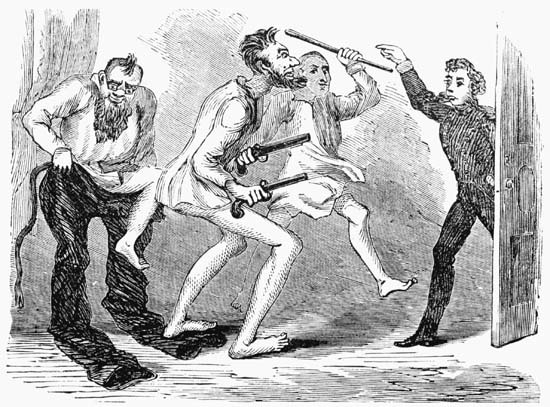
"I'm darned if the critter warnt bizzy tryin' to git on Linkin's trowsers."—Page 80.
Ginneral Wool was so tickled with his success that the old man cum post haste back agin, late at nite, to tell Linkin and Stantin of it. We had all got to bed. We slept in rooms that jined each other, Linkin occupyin the middle room, an myself an Stantin one on each side, with the doors openin into Linkin's room. Wen we went to bed, ses the Kernel to me, kinder jokin, ses he, "Majer, if the Secesh attack us to-nite, you must have your hickory reddy." Ses I, "Kernel, look out for your revolver, an put it under your piller, so you kin grab it handy." Wal, what should happen along towards mornin but a most terribul noise, some one beatin, an stampin, an yellin, like all possessed. First, I thought of the Secesh, and I grabbed my hickory at once, an made for the Kernel's room in my nite-shirt to see how he was feelin. I came pretty nigh bustin my sides a laughin, for there Linkin stood up on a cheer, lookin for all the world like a treed porcupine; his hair stood on eends, and he was a shaking his pistol around as if he meant to shoot. Ses I, "Hold on, Kernel; don't fire. Let's see what this rumpus is all about before you shoot." Stantin, was in Linkin's room, lookin like a spook in his white nite-gown; an I'm darned if the critter warn't bizzy trying to git on Linkin's trowsers! He got 'em on after a fashen, but his legs didn't more than go half thru 'em, an there he stood kinder tangled up like, lookin awful sorry about somethin, as if he'ed wanted to issue a bulletin an couldn't? All the while the noise kept growin louder, an finally ses I, "Who on arth is that makin such a tarnal racket?" "It's me. It's me," ses a voice. Ses I, "Who is me? Are you Union or Secesh?" "I'm Ginneral Wool," ses he, "an I want to tell you the noose." Now, we didn't no more expect to see Ginneral Wool than we did Jeff Davis; but sure enuff, it was him, and he cum thunderin in an brought his old cane down on the floor with a ring. Ses he, "Norfolk is ours, by ——." I won't put in the swearing part. You never did see such a change. Linkin jumped down out of the cheer, and ketched the old Ginneral by the hand, and cum pretty nigh shakin it off, while Stantin took him rite in his arms. Wen the story had all been heerd, and Linkin went to look for his trowsers, there was Stantin with his legs in 'em, holden them up by his hands. Ses I, "Kernel, Mr. Stantin will get to be President if you ain't kerful, for I see he's got on the President's trowsers." Wen I sed that, I thought Stantin would wilt. He looked awfully struck up, but sed he'd no idee them was Linkin's trowsers, and he backed out of them quick.
The next day there was great rejoicing in the hull army, and we all cum back to Washington in the Miamy. I've jist got back, and have only had time to write you this letter. Wen yew hear from me agin I hope I shan't be so tired, and try to give you a more interesting letter.
Your friend,
Majer Jack Downing.
LETTER IX.
The Major Figures on the "Nashinal Debt"—Horse Contracts and "Abolishin Preechers"—Banks Defeated—The Major Suggests a New Fashioned Shield expressly for Retreats—A Wheelbarrow for every Soldier!—Excitement in Washington—The President not Scared "a Hooter"
Washington, May 26th, 1862.
To the Editers of The Cawcashin:
Surs:—Sence I writ you last, I've been figering on the nashinul debt, and I tell you what it is, it is jest about the most intricit subjec I ever got hold of. I've used up two duzzen slates and about a cart load of slate pencils. Linkin has sent on to York for a fresh supply, and wen they cum I'm goin' at it agin. Squire Biddle's Bank warn't a primin to this war debt. You see the contracters and the pollyticians, and the Members of Congress and the Guvernors of the States, and the editers and even the Abolishin preechers are mixed up in it cleen to their ize. It's very queer how so many of these preechers have had hoss contracts. It seems as if Abolishin and hoss jockeying goes together. One pius chap wrote on the back of his contract, "An horse is a vain thing for safety. Put your trust in the Lord." I should think that such hosses as he furnished would be a vain thing for safety, for nigh about the hull of 'em was spavined, or ring-boned, or foundered, or had the blind staggers. I tell you it's edefyin to look over these contracts. Linkin has giv me a cart blank to pry into the hull subjec, but Chase squirms terribully wen I questshin him close. But I ain't got half done. The other day, as I was porerin over my last slate, which was pretty nigh sifered full, Linkin sent for me in a grate hurry. I started rite off, wunderin what on arth was up. Wen I went in, the Kernel had his cote off and his sleeves rolled up, an ses he, "Majer, do you know where I kin get a first-rate axe?" Ses I, "Kernel, I know where there is the best axe that ever chopped wood, but," ses I, "it's way up in Downingville." Ses he, "That won't do, Majer; I must have an axe rite off, or I shall bust; I can't live unless I work off this steem." I see the Kernel had on a high-pressure excitement, and ses I, "Hold on a minnit, Kernel, and tell me what on arth's the matter?" "Matter!" ses he, "jest read that, Majer, and tell me whether you don't think that that infernal cuss, Stantin, ought to be kicked out of the Cabinet?" I took up the paper and there was a despatch from Ginneral Banks, sayin how the rebils had licked him and was drivin him back like all possessed, and all because Stantin had takin away his troops and sent 'em away where they warn't wanted. Ses I, "Kernel, I have had a good deal of doubt about that feller, Stantin, ever sence he tried to get on your trowsers down at Fort Munrow. You see you can't never depend a grate deal on a turn coat. He once perfessed to be a pro-slavery man, but now he goes in for the Abolishinists even stronger than the Simon-pures. I tell you, Kernel, you better look out for him." "Wal," ses Linkin, "we ain't got no time to talk about that. The Secesh are almost on Washington agin, and jest think what France and England will say. Why, Seward rote 'em at the last steamer that it was all over—that New Orleans was open—that Richmond would be taken in a few days; and here, by this stupid blunder, we are agin jest back where we were a year ago, and I've got to call fer more troops to defend the Capital. What on arth will we do?" "Wal," ses I, "Kernel, if swarein or even choppin wood do any good, I would advise you to do one or both; but you see they won't. So put on your coat and let's talk this matter over." So we jest went over the subjec, and soon decided what to do. I tell you we made the telegraff fly all day Sunday, and by night we all began to feel a grate deal easier. That nite the Kernel and I had a long talk, and I told him I had invented a new military system to prevent the dangers of a retreat, and that, ef it had been adopted in Ginneral Banks' case he would have come off with all his men, and almost without a scratch. The Kernel he was dredful anxious to know what it was. So I told him that my idee was to have every man supplied with a sheet-iron shield, about five foot long and about two foot wide, to strap rite on his back when he commenced to retreat. Then the enemy might fire as hard as they pleased, while our sojers could take their time and not be compelled to run themselves out of breath.
"Wal," ses Linkin, "how would they carry it when marchin?" He thought he had me there, but ses I, "Kernel, my plan involves a hull change in the art of war. Insted of so many baggage waggins and such long trains, I would have a wheelbarrow for every sojer! Don't you see," ses I, "Kernel, how nice that would work? Every man could carry his own vittals, and his ammunition, his shield, &c., &c., jest as complete as could be. Wen there was any fighten to be done, the wheelbarrows could all be placed in the rear, the sojers arm themselves and go out and fight. If they were whipped all they would have to do would be to fall back to the wheelbarrows, strap on their shield and walk off! There would be no runnin then to get out of the reach of bullets, and retreats of thirty-five miles a day would be useless. With an army of that kind, Kernel, we could subdue the Southern Confederacy in 'sixty days,' and make out Seward a prophet after all." "I'm afraid, Majer, it's too late in the day to introduce your new military system. This infernal Southern Confederacy has got to be whipped pretty soon with such old hosses and waggins as we have got, or this Union is split jest as sure as my name is Abe Linkin. You see, Majer, you can't make a whistle out of a pig's tail, and it seems to me jest about impossibul ever to make Union men agin out of the rebils. However, they shan't have Washington, ef I have to call every man in the North here to defend it." Ses I, "Kernel, that's right. I'de stick to the White House until the top blowed off and the cellar caved in."
You better believe we've been in an awful excitement here sence the news about Banks cum. Seward looks paler than ever, while Chase is skeert half to deth for fear of its effect on the Treasury. The Kernel and I, however, keep cool, and we are getting things pretty well straightened out, so ef the Secesh come here now, they may wish they had never got so nigh Washington.
Linkin ses "he warn't skeered a hooter, but was only rarin mad." At any rate, he looked awful savage, and ef he had had my axe, I ralely believe he might have split rails enough to fence the Southern Confederacy in.
I had intended to be back to Downingville before the first of June, but Linkin says he won't hear of my goin until he sees more daylight down South. I must be there the 4th of July, at any rate, for I never allow that day to go by without reviewin the Downingville melisha.
Your friend,
Majer Jack Downing.
LETTER X.
The Major Troubled with his old Complaint, the "Rumatics"—He Examines the Finances—Mr. Chase Frightened—The Major Figures up the Accounts on His Slate—Returns and Shows the Result to Mr. Lincoln—He is Astounded—The "Kernel and the Majer" Take Some Old Rye—The Major Proposes to Return to Downingville to Spend the 4th of July.
Washington, June 8th, 1862.
To the Editers of The Cawcashin:
Surs:—It has been mity onpleasant wether sence I writ you last, an I have had a rale sharp twinge of the rumatics. These cold rains in June are hard on a constitushin that has had a tussle with nigh on to about eighty winters; but howsever, with a little elder bark tee, my favorit remedy wen it's mixed with a good deal of old rye, I've got now about as good as new agin. So the other day I telled Linkin I was going to finish up my sifering on the financies. He sed he wished I would, for he was alreddy beginning to think about laying the foundashin for his nex message, an he wanted the facts to put in. So I telled him he must give me a letter of authority that I might show the Seckatary of the Treasury, so that he would see that I warn't eny common chap coming to pry into what was none of my business. So Linkin sat down an writ a letter as follows:
"Dear Sur:—Majer Jack Downing is authorized to examine into the state of the financies in partickelar.
"A. Linkin."
Wen the Kernel first writ the letter, he didn't have on the last two words in italicks. I asked him to put 'em on, an he did. "Majer, what do you want them words for?" "Wal," ses I, "Kernel, them words will puzzle Chase eenamost to death, an will so trubbel him that he will think ef he dares to keep back the truth, that you'll be sure to give him his walkin papers. You see, Kernel, you must be a little mysterous with these pollyticians, or else they don't get afeered of you."
I then put the letter in my hat, rite under the linin, an, takin my slate under my arm, and my hickory in my hand, I started for the Treasury buildin. It aint far from the White House, an I soon got there. It's a mity big pile of stones, I tell you, and must have cost a heep of money to have got it fixed up so nice. Jest as I was goin in the door, I met Mr. Chase comin out. He knew me an I knew him, tho' he didn't suspect for a minnit what I was after. Ses he, "Majer, I'm mighty tickled to see you. It does my heart good to see a genuwine loyal man in these days of rebellyn, an I know you're one." "Wal," says I, "Mr. Seckatary, ef Ginneral Jackson was a loyal man, then I'm one, and ef he warn't loyal then there ain't eny sich thing as loyalty." Ses he, "Majer, you're rite, an what kin I do for you this mornin?" "Wal," says I, "Mr. Seckatary, I've come around to inquire into the state of the financies. The President ses he's very busy, an bein as I was good at figers, he wanted me to jest take a look at the books an see how the ackounts stand."
Wen I sed this, I see he didn't look pleased at all. He began to make sum sort of apologies, that the ackounts were behindhand, and so on, but I telled him I warn't partickelar about all the little items, an that I only wanted to get at the ginneral sum; but as he still seemed to be hesitatin, thinks I to myself, now's the time to show him the President's letter—that will fix him, sure. So I took off my hat and showed it to him. Wen he red it he was as perlite as a nigger wen he wants to humbug you. He looked at it a long time before he sed enything. Wen he did speak, ses he, "Majer, what do these last words 'in partickelar' mean?" "Wal," ses I, "I don't know as I can tell. The President put 'em in there, and I didn't ask him what he meant by 'em." You see, I warn't goin to be fool enough to let him think I had suggested his putting 'em there, for that would have spoilt all my plans. I see he was worried, an that was jest what I wanted.
After that he asked me to come in his office, and he began to tell me that the financies were in a very prosperous condishun. He took down a big book which he sed his clarks had prepared for him, so that he could see every Saturday night jest how much the Government was in debt. I took a look at it, but I couldn't tell head nor tail to it. He sed they kept their books by dubbel entry. I telled him that I should think that a single entry would be as many times as such a debt as ours ought to be chalked down. "Now," ses I, "Mr. Seckatary, I want to get at this subject in a way that 'plain people,' as the Kernel says, can understand it." Ses I, "What is the debt now?" "Wal," ses he, "it is $491,000,000." "Is that all?" ses I. "Why, in your report last winter you estimated that it would be $517,000,000, and you don't say that it is less than the estimate." "Wal," ses he, "Majer, that is what the books say." "Now," ses I, "Mr. Seckatary, them books by dubbel entry ain't worth a peck of saw-dust. There was Deacon Doolittle's son, Hosea, of Downingville, who went to York and set up the dry-goods business. Wen he failed, his books showed that he was worth two hundred thousand dollars, and yet he didn't have money enough to get his wife hum to his father's. You see dubbel entry is a good deal like riding two horses at once; you can't manage 'em, and things get so kinder mixed up in profit and loss, and notes payable and notes receevable, that you can't tell how you stand. Now," ses I, "Mr. Seckatary, I want to ask you some questshins by single entry, and I will put the ansers down on the slate." Ses I, "Didn't you say in your report that the estemate for the army was for 400,000 soldiers, $400,000,000; for 500,000 soldiers, $500,000,000, and so on?" "Yes, Majer, that was the statement, I beleeve." "Wal, now," ses I, "we can figer this down in short meter. How many soldiers have you had?" "Wal," ses he, "over 600,000 have been paid for, nigh about 700,000." "Now," ses I, "Mr. Seckatary, you don't want any dubbel entry, or threbbel entry to get at that; the multiplicashun tabel is just as good a document as I want. Take that and my slate, and I ken figer it up in a minnit. You see, there is $700,000,000 at one slap. Your books may show what you have paid, but you see, Mr. Seckatary, you are running this war on credit, and because you ain't paid all your debts, that is no sign that you won't have to. Besides," ses I, "Mr. Seckatary, you have made, you know, some miscalculashuns, and mebby you may make more. In your first report in July, 1861, I've ben readin it keerfully, and I've got it marked down on the slate here, you sed the expenses for 1862 would be $318,000,000, but in December, you said they would be $543,000,000. Now, here was mistake of over $200,000,000. You sed in July, the tariff would yield $57,000,000. In December you said you could not calculate on over $32,000,000. You estemated the receipts from land sales, in July, at $3,000,000. You cut it down in December to $2,300,000; and now Congress, by passing the Homestead bill, will whittle it all off. Here, you see, are some great mistakes, but there are some on the other side of the account. There are some items of expenses, too, which you have omitted. There's the $30,000,000 recently passed to settle up Cameron's ackounts. Then there is a $100,000,000 of outstandin debts. Then there is $100 bounty to each soldier, which, by the time the war is over will amount to $100,000,000 anyhow. Then there is $1,000,000 given to buy the niggers in this District. Let us see how much that makes. I'll add it up—$250,000,000, which, added to the $700,000,000, makes $950,000,000, as the present debt Uncle Sam has on his shoulders. You might just as well call it a Thousand Million of Dollars and be done with it."
Wen I got through, the Seckatary looked amazin red in the face, and ses he, "Majer, the truth is, where there is so many peopul spendin money its mity hard to keep track of all the items." "Wal," ses I, "there ain't only one more pint on which I want to show you you have made a mistake. In December last, you calkelated that the war expenses for 1863 would be $360,000,000, but the House has already passed bills for the army amounting to $520,000,000. Then you thought, Mr. Seckatary, that the war would be ended by July, but here it is about that time, and we only seem to be jest fairly getting into the shank of the fight."
"Wal, to tell the truth, Majer, this war has disappinted the hull of us, but I think I havn't been so foolish as Seward. I never sed it would end in 'sixty days.'"
"That's so," ses I, "but you see there's nothin like tellin the truth rite out, and its allus very bad to deceive the people on money matters. You may love the niggers, Mr. Seckratary, as much as you want to, but don't try to pull the wool over white folks' eyes, or let other people do it, for it will break down the administration as sure as my name is Majer Jack Downing."
"Wal," ses he, "Majer, that's so, and when I send in my next report, I'm goin to jest speak rite out. I've tried to do my best to keep down expenses, but I can't, and when I get another chance I'me goin to put the blame where it belongs."
Ses I, "That's rite, Mr. Seckratary. Don't let the raskils git clear without bein exposed. But ef you undertake to cover up their tracks, you will come out jest as old Squire Biddle did in that United States Bank matter."
I then bid the Seckratary "good mornin," and started back to the White House. He was very perlite to me, and said he hoped the President and me would look at the subjeck favorably. I telled him that the Kernel would do what was jest rite, and that ef he would only keep a sharp lookout on the plunderers and stealers, I would be his friend till deth. He sed he would, and we shook hands and parted.
Wen I got back Linkin sot in a cheer fast asleep, with his feet up on a tabel. I giv the tabel a rap with my hickory, and the Kernel stratened up jest like openin a jack nife, and ses he, "Was I asleep, Majer?" "Yes, jest as solid as a saw-log. What on arth makes you sleep," ses I, "rite in the middle of the day?" "Wal," ses he, "Majer, the truth is, I was readin the Nashinal Intelligencer!" "Sure enuf," ses I, "that's worse than opium." "But," says he, "what about the finances?" Then I showed him the slate, and how I had figered up the debt, and told him all I sed to Mr. Chase. I never see a man so flustrated as Linkin was. "Wal," ses he, "Majer, ef I was only back to Illinoy safe and sound, you wouldn't never ketch me a runnin for President agin. I had no idee that the debt was anything like this. But ef the music has to be faced, I'll face it. There's one thing, Majer, that we've got the advantage of any other administrashin in. We can say that this debt was a 'military necessity!' That cuts off debate." "Wal," ses I, "Kernel, perhaps the people will be satisfied with that, and perhaps they won't. Any how, that won't make it any easier to pay the taxis." "Wal," says Linkin, "we'll leave that subjec to posterity." Ses I, "Is that fair, Kernel, to burden posterity in that fashun?" "Wal," ses he, "what's posterity ever done for us?"
The Kernel then took down the figers off my slate in his book, and sed he would keep 'em for his nex message.
Then Linkin, ses he, "Majer, you've worked like a nailer on these figers, an it's an awful dry an tough subjec. So I think you better have some old rye to sort of top off with." Then he called the feller in purty bad clothes, who does arrands, and telled him to bring out the black bottle. "Now, Majer," ses the Kernel, "take a good swig. It will be healthy for your rumatiz. As for me, I'll jest take a little for company sake. I don't drink myself, you know, Majer, but I like to have a little old rye aroun; an I allus tell the old woman ef there's eny of it missin not to ask eny questshins." After we got dun drinking, ses I, "Kernel, I have been here with you ever sence the 1st of February, an wen I cum I didn't expec to stay more than a month. Now, the 4th of July is comin along close at hand, an I must be thinking about gettin back to Downingville, for I must be there before the 4th. Now," ses I, "Kernel, ef you'll only go along with me down there, as Ginneral Jackson did, I'll promise you a great recepshun."
"Wal," ses he, "Majer, I can't go. The truth is, the rebils need watchin. But you tell the Downingville folks that jest as soon as the rebelyun is put down, I'm comin down ther. A town that can turn out such a loyall regiment as the 'Downingville Insensibles,' and such talented officers as Insine Stebbins, must be, as we Westerners say, 'a heep of a place.' I'm sorry to have you go, Majer, but I hope you'll be able to cum back after the nashinul annyversary."
"Wal," ses I, "Kernel, I can't promis, but I'll see how my rumatiz gets on."
I shall pack up in a few days, onless somethin onexpected occurs, and it may be the next time you heer from me, will be from Downingville. If you print this letter, I hope you'll apologize for its dullness, for figgers are mity dry readin for most peepel. However, ef they don't study into figgers about these days, it won't be long, I'me afeered, before they'll be sorry they didn't.
Your frend,
Majer Jack Downing.
LETTER XI.
The Major Does not go to Downingville—Loses His Hickory—Gets a Bottle of Whiskey by Adams Express Co.—The Major Declines to Sign the Receipt at First—Whiskey and the Constitution—"The Constitushinal Teliskope"—A Magical Change—Mr. Seward's Trick—The Major Discovers it—A Negro in It.
Washington, June 18, 1862.
To the Editers of The Cawcashin:
Surs:—I expect you'll be struck all aback to git anuther letter from me, dated Washington, and I'm kinder surprised myself, for I expected to be in Downingville, long afore this. But you'll see by the time you git through this letter, that it was impossibul for me to leave. I got my trunks all packed up and ready to start, when lo! and beheld, my hickery, that Ginneral Jackson give me, was missin! Now, I couldn't no more travil without my hickery cane then I could sodder up this broken Union with skim milk. I told Linkin I was all ready, but that my hickery was missin. So he called the feller in putty bad close, who does chores around the White House, and asked him if he'd seen it? He sed he hadn't. Then I reckollected that there had been a Cabbynet meetin the night before, and it struck me that some of the members had walked off with it. So Linkin sent the feller around to see. After he'd gone, I told Linkin ef any of 'em had it that I'd bet it was Stantin, for ses I, "Kernel, ever sense he tried to get on your trowsers down to Fort Monrow, he's acted jest as ef he wanted to play Ginneral Jackson, and ef he can git a piece of hickery that the old Ginneral has handled, he'd think that he was on the road to glory." Sure enuf he had it, but pretended it was all a mistake, jest as he did when I caught him in the Kernel's trowsers. Depend upon it, Stantin needs watchin, for he is one of them kind of fellers who's got it into ther head that they are forordained for somethin, and they don't know what.
The loss of my hickery kept me over one day longer, and the next day I got the bottle of Borebon whiskey which you sent to me. A feller by the name of Adams fetched it, and he wouldn't take any pay for his trubble either. I asked him ef he was eny relashin to Phil Adams, who used to keep a tanyard in Downingville, as he was a very clever man, and used to do enything for his naybors for nothin. The chap laughed rite out loud at this, and sed "He didn't see it." Ses I, "What don't you see?" "Wal," sed he, "never mind, old feller, about tellin long stories, but jest put your name rite down there," and he handed out a big book full of writin. Ses I, "Mr. Adams, I never put my name to enything that I don't understand." Ses I, "That may be a secesh docyment for all I know." Ses the feller, ses he, "Git out! this is only a receipt for that bottle." "Wal," ses I, "ef that's all, then here goes." So I got my spectacles and a quill pen, for I never rite with eny of the new-fangled kinds, and I jest rote out "Majer Jack Downing" in a stile that made the fellow stare. Ses I, "Mr. Adams, you have some awful poor riters among the fellers you deal with, but I ain't ashamed of that ritin enywhere." The chap he looked at it a moment, and then he looked at me, and finally ses he, "Bully for you," and in a jiffy he was off, without even shakin hands or sayin good by.
After he was gone I took the bottle into Linkin's room and opened it. "Now," ses I, "Kernel, let's try this licker." "Wal," ses he, "Major, I'm a good judge of Borebon, for it comes from my old State of Kentuck." Wen Linkin saw the name on the bottle, "Mr. Cotton, 306 Washington street, N.Y.," ses he, "Major, do you think this is loyal wiskey?" "Why," ses I, "Kernel, what makes you ask that questshin?" "Wal," ses he, "don't you see the man's name is Cotton!" "Now," ses I, "Kernel, what an idee that is! Do you suppose it would be dangerous for him to live down in Secesh, where they are burning cotton as fast as they kin?" "Wal, never mind the name, Majer, let us taste of the wiskey. I can tell whether its loyal or not." So I opened the bottle and poured out some, and the Kernel took a good swig. I also took a snifter, and we both pronounced it A No. 1 licker, and loyal, too. "Now," ses I, "Kernel, can you tell me why this wiskey is like the Constitushin of the United States?" "No," ses he, "I don't see eny simularity." "Wal," ses I, "Kernel, this wiskey was made for White Men, jest as the Constitushin was." Ses he, "Majer, how do you know it was made for white men?" "Wal," see I, "it is jest as plain to me as daylight. You see, Kernel, the licker agrees with you. It tastes good. It won't hurt you; in a word, it corresponds with natur. That's a sign it was made for you. Jest so it was with the Constitushin. It applies to white men exactly, and they've always got along together with it fust rate. Now, you give this wiskey to the niggers, and they get drunk on it, and cut up all sorts of scrapes, but white men, whom it was made for, know jest how to use it, and it don't do them eny hurt. Jest so with the Constitushin; you apply it to niggers and it is jest as bad for 'em as wiskey. They don't know how to use it, an they'll destroy everything, an make themselves an everybody else ten times worse off." "Wal," ses the Kernel, ses he, "Majer, I wish I could see how it is that the Constitushin don't apply to niggers jest as much as to white men." Ses I, "Kernel, you don't look at the Constitushin thru constitushinal spectacles. That Chicago Platform bothers you." "Now," ses I, "Kernel, ef I'll make you a Constitushinal Tellskope, will you promise me to use it? If you will, it will be about as good a guide to you as ef I staid here all summer myself?" Ses I, "It will show the Constitushin as it is, an the Union as it was." Wen I spoke of this, Linkin sed he'd be tickled eenamost to deth ef I would make him one. So I told him I could do it in one day, an that although I was very anxus to get hum, yet I'd fix this up before I started. So I jest went up to my room and began to plan. I had a pair of old spectacles, which Ginneral Jackson give me, and I knew that the glasses were jest as sound constitushinal glasses as were ever looked thru. So I took 'em out of the cases, an got a magnifyin glass and put between 'em, an fixed 'em in a long, narrer box. It took me about all day before I got it finished. Wen it was all done, I looked thru it, and you never see sech a glorious site. I could see jest as ef it was the hull Union layin out before me. There was the Stars and Stripes, an the eagle, an thirty millions of white people, all happy an contented, an joy an prosperity smilin everywhere. An the sky seemed to be bendin down so as to almost tech the arth, an away up in the clouds I could see rais of light streemin forth, an I thought I could even see the angil robes of Washington, an Jefferson, an Madison, and the old Ginneral lookin down, an rite over the hull was the words, "Glory" and "Peace," in grate big letters. It was raley beautiful. I got a lookin at it, an forgot all about myself, in a sort of a reveree, and wen I cum to, I found I'd been cryin, because, you see, that was the Union as it was, an not as it is now. In fact, wen I got awake, I found it was eenamost pitch dark, an so Linkin couldn't look thru the Teliskope that nite. Then I got a piece of chalk, an marked it "Linkin's Teliskope," an took it to him.
"There," ses I, "Kernel, that Teliskope is done, an to-morrow you kin take a look at the Union as it was, an the Constitushin as it is." Ses I, "The scene is a glorious one." So I left the Teliskope in Linkin's room that nite, an went to bed.
The next morning after I got my breakfast, I went in, "And now," ses I, "Kernel, we must try the Teliskope." So I thought I'd look thru fust to see ef the glasses were set all rite, wen I was never so took aback in my life. Instead of the joy and happiness, and the smilin faces, and the thirty millions of white people, the rais of lite in the sky with "Glory and Peace" on em, all was dark and dismal. All I could see was some 4,000,000 of niggers, and war, and bloodshed, and misery, camps full of sick sojers and broken waggons, wimmen and children cryin, and the sky was black, and away up on a black cloud, in letters still blacker, I could see the words "Negro Freedom and War."
I jumped back as ef I was hit wen I saw it. Ses Linkin, "What's the matter, Majer?" Ses I, "Kernel, that Teliskope is all out of order. It ain't rite." But Linkin sed he hadn't teched it, so I was puzzled. So after thinkin awhile, ses I, "Kernel, was there enybody here last nite after I went away!" "Yes," ses he, "Boss Seward came in for a while and talked over matters." Ses I, "Did he tech this?" "Wal, he was lookin kinder inquirin at it, and I telled him what it was, and he seemed to be grately struck, and examined it very clus."
"No," ses I, "that ackounts for it. The pesky critter has been playin one of his cunnin tricks on me; but my name ain't Jack Downing ef I don't expose him. No true constitushinal Teliskope will giv such a view as that of the Union." So I sot down and took out my jack nife, and went to work takin it all apart. I found the box all rite; there warnt enything in the tube, and I was puzzlin myself what could be the matter, when I slipped up the magnifying glass, and rite back of it was a little bit of a paper nigger, black as the ace of spades, that that feller Seward had cunninly slipped in there! You see that at once ackounted for the hull troubbel, for the magnifin glass reflected the nigger instead of what it would, naterally, the white man. After I took the nigger out, it was all rite agin, and wen Linkin looked thru it, he was perfectly astonished. "Now," ses I, "Kernel, you see that it is tryin to put the nigger where he don't belong that is the cause of all our trubbel. He don't belong in the Constitushin, and when we undertake to put him ther it won't work. This trick of Seward's jest shows you what he's up to. Now, Kernel, I'm going to start for Downingville arly to-morrow mornin, and I'll leave you this Teliskope so you can take a look at the Union as it was, and don't you let Seward or Sumner, or any of them fellers, get hold of it. Wen you get puzzled, jest go and look thru that, and you may depend upon it it will lead you strate. If you get inter eny deep troubbel, write me and I'll give you my advice, or ef you can't get along without me, I'll come back after the Fourth is over, and stay with you till you get out of this scrape with the rebils. I told you I would stick to you, and I will." So I bid good bye to the Kernel and his wife that nite, reddy to start in the early train in the mornin.
I intend to give you a full ackount of the celebrashin of the Fourth at Downingville. Insine Stebbins, of the Downingville Insensibles, who writ the piece of poetry on Mrs. Linkin's ball, and who was wounded at Chickenhominy and cum hum with a furlong, is to be orater of the occashin. Jerusha Matilda Jenkins, the darter of Deacon Jenkins, and who went down to Port Roile to teech the contrarybands their primers, will also be there. The Insine is a very smart chap, ef he is a niggerite, and I expect he'll do himself creditable.
Excuse this long letter, and beleeve me
Yours till deth,
Majer Jack Downing.
LETTER XII.
The Major Disappointed—Meets the President at West Point—Sees Gen. Scott—They Talk over Strategy—Returns to Philadelphia with the President—Makes a Speech at Jersey City—Mr. Lincoln also Speaks— Meets Seward at the Astor House—A Wheel within a Wheel—Mr. Seward Caught.
Downingville, July 5, 1862.
To the Editers of The Cawcashin:
I don't beleeve ther is enything that so sorter gets all my runnin-gear out of order as onsartinty. Wen I writ you last, I was jest leavin Washington, and wen you come to hear how I've scooted round the country sence, you will be astonished. You see I hurried on hum as fast as I could go, because I wanted to get to Downingville in time to see that the arrangements for the 4th were got up in the rite stile. But wen I got to Boston, I was struck all up in a heep by gettin a telliegraff from Linkin, tellin me not to go eny further till I heerd from him. That puzzled me terribully, and I was in an awful state of onsartinty. Thinks I to myself, now there's sumthin up. What on arth can it be? Has that feller Stantin been cuttin up eny more of his capers? But I was so puzzled that I couldn't imagin wat was to pay. But I waited a few days, and then I got a letter from the Kernel, in which he sed he wanted me to meet him at West Pint with Ginneral Scott, as ther was sum grate struttygy goin on which he wanted to advise about. Then I knowed ther was sum trubbel sumwher, so I jest packed up my trunks and tuk the ralerode for Allbanee, so as to cum down the North River to West Pint. I got ther in the nite, jest afore Linkin cum, arly in the mornin.
I didn't sleep a wink, but jest went rite over the river in the one hoss ferry-bote they've got there, and waited at the depow for the Kernel. He was eenamost as glad to see me as he was wen I fust went to Washington. He tuk me by the hand, and ses he, "Majer, I feel a good deal safer wen you're around, for I know you won't deceeve me." Ses I, "Kernel, that's what I never do to eny man. Ef he don't like my plane talk, then he needn't heer it, but ef I talk at all, I must talk out the blunt truth." "Wal," ses he, "Majer, we will go over and see the old Ginneral, and then I will lay all my trubbel before you."
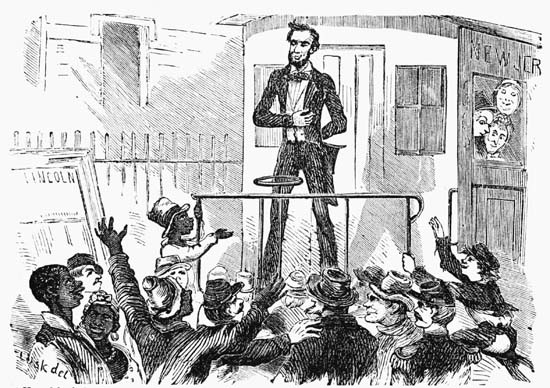
"He sed he jest cum out to see and be seen, and didn't intend to blab enything about public affairs."—Page 111.
After we got our brakefast, we went to the old Ginneral's room, and, takin out the maps, we went at it. I never studied geographee faster in my life than we did then. The Kernel sed the news from Ginneral McClellan was that he would be compelled to go to the Jeemes River for his supplize, and the grate questshin was, whether he cud turn his right wing around so as to swing agin the river jest like opening a barn dore. Ginneral Scott sed he thought it mite be done, provided it was done quick enuff. I telled em I hed often noticed that wen I opened one barn dore all at once there would cum a gust of wind, an open would go the other in spite of all I could do. Ses I, "Kernel, ef the rebels should pitch at the left wing while the rite is swingin, then both dores would be open, an they might both get off the hinges." Ginneral Scott sed he was afrade it might work that way, but ef the thing cum to the worst, he didn't see eny help for it. You see, the army nigh Richmond was in a tite fix, an Linkin knew it. Wen the Kernel telled Ginneral Scott how it was, the old man cried, and sed he didn't want to live to see the rebils whip that grate army. The whole country have been in a grate fogo about what Linkin went to see Scott about, but that was all. Wen he went away the next day, he sed he wanted me to see Seward, an ef Ginneral McClellan got defeated, advise with him as to what to do. So I went with the Kernel back as far as Filadelfy, where I thought I stop a few days to see how things would turn out. Wen we got to Jarsey City, the people wanted the Kernel to make a speech. He sed first he wouldn't go out, but finally the cheers got so loud that I telled him he must go. "Wal," ses he, "Majer, I can't. You jest go and tell em that I am too tired." So I stepped out on the platform and swingin my hickery around, ses I, "Feller-citizens, the President has been up two or three nites travellin, and he ain't abil to speak. You must excuse him." Wen they heered that, it didn't suit em at all, and a good meny yelled out, "Who are you?" Then I remembered that I had forgot to tell em who I was. So I stepped out, and ses I, "I'me Majer Jack Downing." Then you had ought to hev heered em cheer, and Linkin, you know is a queer feller, and wants to know all that's goin on, so he cum out to see what was the matter. After he cum out, of course, he couldn't back out of a little speech. He sed he "jest cum out to see and be seen, and didn't intend to blab enything about public affairs." The whistle soon sounded, and off we went. Nothing happened on the way, and I bid the Kernel good bye in Filadelfy, and went to the Continental Hotel to wait and see how the battle cum off. They have nigger waiters here, dressed up like Quakers, and that is the reason they call it a Continental hotel—so they say.
In a few days I saw how the battle had turned, and I knew Seward would be along. The Kernel sent me a telliegraff that he would be at the Aster House such a day, and I agreed to meet him there. I was determined to smoke the old fox out this time, ef it was in my power, and so I began to study him. Weed was there, who thinks he is very cunnin, and Governor Morgan and others. McClellan bein compelled to retreat from Richmond, they all thought that France and England would interfere, and what was to be done? Seward sed we must put the best face on matters we could, and raise more men to fight the rebils, and that by showin a bold front we might frighten off the Uropean powers. He sed he thought it might all be settled in "sixty days" yet, and ef McClellan couldn't settle it by fightin, he could by deeplomacy. He sed "he would run the machine as long as ther was a linchpin left, and let John Bull and Looe Napoleon do their best." Weed wanted to know, ef we had a war with England, wether it wouldn't be better to have it carried on by contrack. He thought the government might let it out and make money by the operashin. He sed he could furnish the powder and shoddy, and wouldn't charge over five per cent. commission. Gov. Morgan sed he was in favor of a war with England, and as it would be mostly a naval fight, the government would need a good menny vessels, and he had a brother who was a capital judge of sich matters. Stetson sed he thought a war with England would improve bizness in York, specially hotel-keepin, and as the Aster House was handy down town, it would be a first-rate place for officers' head-quarters.
After they all got through, they asked me my opinion. I turned rite to Mr. Seward, and ses I, "Boss, I'm goin to speak plane." Ses he, "That's rite, Majer. No one can find fault with you. You're a loyal man, and you've a rite to speak your mind." "Now," ses I, "in the first place, Boss, I want to ask you a plane questshin. We all know you are runnin the government machine, and whenever I look at a machine, I want to know what the drivin wheel is made of. You see if that is all rite, things will go putty nigh rite." Ses Seward, ses he, "Majer, I've got a model of my machine here, and ef you would like to look at it you kin." So he took out a little curious-looking box, and out of the box a machine. It was a cute-lookin affair. "There," ses he, "do you see that big wheel?—that's the drivin wheel." I looked at it, an I see it was marked aroun the rim, "The Union and the Constitushin." "Wal," ses I, "Boss, that looks all rite. Eny machine that runs on that basis must be runnin rite. But," ses I, "somehow it don't seem to work well. We ought not to get into so much trubbil ef we were jest runnin on the old constitushinal basis." "Wal," ses he, "Majer, you see so it is." "Now," ses I, "Boss, there's somethin rong sumwhere. Either the ile is poor or the stuff is bad, or our government machine on that basis would run jest as slick as greese."
The more I looked at the machine the more it puzzled me. I knew what a fox Seward was, an I remembered how he stuck the little nigger in Linkin's Teliskope. So all at once the old sayin that "there's allers a wheel within a wheel," popped into my hed. I didn't say it out loud, but I sed, ses I, "Boss, will you let me see whether there ain't sumthin rong about that?" Ses he, "Sartinly, Majer—go ahed." So I jest out with my jack knife an went at it. I tuck it all apart. Wen I went at the wheel I saw the Boss begin to wince, but I went rite on, an purty soon I saw, sure enough, the outside wheel was only a sham, for the rale wheel which run the government machine was marked "Higher Law—Abolition." "Now," ses I, "Boss Seward, I'm done with you. Here's a wheel within a wheel, jest as I expected. It shows what an infarnal hypocrite you are, and ef you're a mind to fite John Bull or the South, or all the world, as long as you run on that wheel, I won't help you." So I jest tuck my hickery an went out of the room. You never see such a dumbfounded, scart set of men in your life, an Seward looked as ef he would craul through an auger hole. I cum rite on after that to Downingville, but I didn't get here in time to see about the arrangements. The Insine made his orashin and Jerusha sung the oad prepared for the occashin. My letter is so long that I can't tell you enything about it, but wen I rite agin I may, ef sumthin more important don't happen.
Yours, till deth,
Majer Jack Downing.
LETTER XIII.
The Major Returns to Washington—Things Get Mixed Up—Lincoln and the Panther—Splittin Rails and the Union—The Major and the President Visit Gen. McClellan's Army—Going up James River—Alarm of the Rebels—Exciting Scene on Board the Boat—Nobody Hurt—The President Reviews the Troops at Harrison's Landing—The Return Trip—The President and Party Bathe in the Potomac—Almost a Catastrophe—The Major's Life-Preserver—The Moral of it—The President Proposes a Conundrum.
Washington, July 21, 1862.
To the Editers of The Cawcashin:
Wal, here I am back agin to Washington. I didn't expect to cum on before fall, at eny rate, but I got a letter from Linkin, tellin me he couldn't do without me, no how. He sed that the bars were all down since I left, and that the cattle, an hosses, an hogs, an sheep, an mules, were all mixed up together. Now, every farmer knows what a mess it makes of it wen you git fat cattle, an the cows, an the sheep, an hosses, an hogs, all muddled together in one lot. I see, at once, the pickle Linkin was in, an so I detarmined to push off for Washington once more, an see ef I couldn't help him out. It was oncommon hot wether, an it pulled down purty hard on a constitushin which has had to go thru about eighty sich summers. Howsoever, no one ought to stand about hot wether in the sarvice of his country, even ef he don't git a salary, or have a contrack, or some brother or son where he kin make a pile. I never had a cent for all I've done, and wouldn't take it. I think, ef there is any human critter on arth who is meaner than another, it is the one who plunders the people, all the while purtending to be a patriot. Wen I arriv, ses I, "Kernel, what's the matter?" Ses he, "Majer, did you ever hear of the story of a man who caught a panther by the tail?" Ses I, "Yes, Kernel, I have." "Wal," ses he, "I'm that man. I've got the biggest he-panther by the tail that you ever heerd tell of. Ef I was splittin rails I'de know jist what to do." "Why," ses I, "Kernel, what could you do then?" "Wal," ses he, "jest stick his tail in the crack of the log, knock out the wedge, and run. But you see, Majer, I ain't splittin rails now, an that plan won't work." "Now," ses I, "Kernel, you ain't splittin rails, but I'm afeerd you're splittin somethin else." Ses he, "What?" Ses I, "The Union!" "Now, Majer," ses the Kernel, "you don't think I want to split the Union, do you?" "No," ses I, "I don't know as you're raley tryin to split it, but then you've been such a splitter all your life, that perhaps you are doin it unbeknown to yourself. You see, Kernel, as long as you stick to them Abolishinists, jest so long the Union will not only stay split, but the split will grow wider. They are the wedge an you are the mallet. You jest knock the wedge out, an the Union will cum together jest like shuttin up a jack-nife. You see, they hold that some of the States have got an institushin which they consider rong, and they are detarmined to uproot it. In tryin to do that, they'll split everything all to smash, an by the time they get thru, it will look as ef lightnin had struck this country from Maine to Texas, in spots not more than six inches apart."
"Wal," ses the Kernel, ses he, "Majer, that brings up a great moral questshin, as the nigger said when he was stealin chickens, an we ain't got time to discuss it now. You see, Majer, I sent for you to know what I better do about McClellan. I git all sorts of contradictory stories from his army, an I'm puzzled most to deth to know what to do." "Wal," ses I, "Kernel, there's nothin like goin in the field yourself, an examine for yourself ef you want to know how things stand." "Wal," ses he, "that's jest what I've been thinkin of, an as you're a military man, I wanted you to go with me." I telled him I had no objecshin to goin, an that ef I had a fair chance I thought I could tell about how things looked. So we got reddy, and the Kernel asked old Blair's son Frank and Sekertary Stantin's chief clark to go along with us. We went down the Potomack, an jest called at Fort Monrow, and then went up the Jeems River to Harrisin Landin. Goin up the river we kept a sharp look-out for the rebils, who line the bank and shoot at our botes. I told the Kernel that he must be mitey kerful an not get hit, as the way stocks would tumble in Wall street would be a caushin. So I tuk him down stairs wen we come to the dangerous places. There they had the bote lined with bales of hay. Ses he, "Majer, which way does the shootin cum from?" "Wal," ses I, "Kernel, there's no tellin, but," ses I, "you better get behind that bale, for it's a big one, an here's another on t'other side, so I guess you'll be safe." While he was settin there, ses he, "Majer, I ain't afeerd a hooter, but you see I didn't want them seceshers to brag about killin me." "No," ses I, "Kernel, that wouldn't do eny how." Jest then "bang" went sumthin like a shot. The Kernel jumped about ten feet, rite across the bote, and hit Frank Blair with his left boot rite where he ought not to. Frank thought he'd been struck with a cannon-ball, and tumbled over, leavin the seat of honor uppermost. Stantin's chief clark acted as ef he'd been eatin poke-berries, and had an awful gripin in the bowels. It seems one of the bales of hay had been tipped over when the Kernel give his big jump, an hit the chap rite in his bread-basket. We were all purty badly scart, for I tell you it makes a feller feel mighty narvous wen he's in an inemies country, an may be hit eny moment with a cannon-ball or a Minny bullet. Shootin will do very well as long as sumbody else is shot at; but wen it cums to yourself, it makes you feel week in the jints, an sumtimes brings on the die-area. Wen we cum to find out, however, we learned we had a scare for nothin. The pilot, in turning one of the short bends in the river, had jerked on his chains too hard, an snapped one of them rite in two. This noise was what sounded down in the cabin like a shot.
Wen we got to the landin, Ginneral McClellan had hosses reddy for all of us to ride. Linkin chose a black one, and got on. Ses I, "Kernel, is black your favorite color?" Ses he, "Majer, no joking now. This is serious bisiness." So I got a white one. I can't ride quite so handy as I did thirty or forty years, yet it is not every nag that could throw me now. Linkin's sterrups were too short for his legs, though they were let out jest as long as they could be. It kinked him up a good deal, an before we got through reviewing the troops, ses he, "Majer, I can't stand this bendin of my jints. I'm going to remedy it;" and so he jest turned one leg over the hoss's neck and rode sideways the rest of the time. The sojers cheered him as we went along, an seemed mity glad to see him. In one place he got up on a brestwork an made a short speech to 'em. He wound up by telling 'em that he had Majer Jack Downing, Ginneral Jackson's old frend, with him. When he sed that, the cheers were dubbled, an I paid my respects to the complyment by takin off my hat an makin jest about the neetest bow that ever was.
After we had seen all the troops an made all the inquiries we wanted to, we cum away. The seseshers did not trubbel us comin down the river, an we soon once more were sailin up the Potomack. Comin up the river the day was warm, an we all felt first rate that McClellan was as well off as he was; the Kernel said he felt jest as if he would like to have a swim. All hands agreed it would be a capital chance, an so Linkin, and Blair, and Stantin's chief clark, undressed for a splurge in the water. The Kernal asked me to go in too, but I telled him that, hot as it was, my rumatiz would not allow it. Wen they got about reddy, now, ses I, "Kernel, look out and don't go where the water is too deep, for if you get tuckered out or have the cramp, you may not get back to the bote." He sed "there warnt eny danger—that he hed swum the Mississippi River nigh about all over wen he was a boy, and that he guessed he could stand the Potomack." So off they went. Linkin could outswim the hull party, and Blair an the other feller with him looked like sunfish alongside a sturgeon. I thought likely Linkin mite overdo himself, or get the cramp or sumthin, so I jest went to my valese and tuk out my patent gutty perchy life-preserver. I ment to have it reddy if enything happened. Wal, I hadn't more than got back to the side of the bote, wen I seed the Kernel flounderin and kickin, and blowin, as ef he was chokin.
Blair and Stantin's chief clark were tryin to help him, but it was like the blind ledin the blind, an sech another muss in the water you never did see. I saw it was time for my life-preserver, so I jest blowed it up and hollered out to Linkin to ketch hold of it, an told Blair an the other feller to let him alone, that that would save him. Wen Linkin got hold of it he jest raised himself rite up, an looked as happy as a boy with a new hat. He floated rite along towards the bote, an soon cum aboard. Ses he, "Majer, I owe you a debt of etarnal gratitude. You've saved my life." Ses he, "Majer, this life-preserver of yours is the greatest article ever invented. Wen I get dressed I want to examine it." So, purty soon, he cum in, an ses he, "Let's take a good look at it." So I showed it to him. The first thing he saw on one side of it was the following words: "The Constitution as it is, and the Union as it was." Ses he, "Majer, what have you got that motto on a life-preserver for?" "Wal," ses I, "Kernel, I put that there because of the similarity between the two things. Now, that preserver saved your life, didn't it?" "Yes," ses he, "Majer, it did." "Wal, the sentiment in those words is the life-preserver of the country. You can't any more save the country without stickin to them, than you could have saved yourself without holdin on to the life-preserver. You must stick to the Constitution as it is, and not as Sumner and Greeley want it." The Kernel began to look kinder struck up wen he see how I had him, an so, seein my advantage, I kept on. Ses I, "Kernel, the truth is, you are just now in swimmin with Greeley, an Sumner, an Wilson, an Lovejoy, an Thad. Stevens, an it is no wonder the country is like you was jest now, chokin and gaspin, and just reddy to sink. You must git out of such kumpany, an the only way to do it is to lay hold of the "Constitushin as it is," and ef you do that, you'll save the country jest as easy as I saved you with that life-preserver." Ses he, "Majer, hold up, you're drivin your hoss rite into my stable, an you don't give me a chance to say whoa." Ses I, "Kernel, go ahed, an ef you can refute what I've sed, I'd like to see you." Ses he, "Majer, do you know why a man's face is like the eend of an old-fashioned house?" Ses I, "No, Kernel, can't say I do," "Wal," ses he, "because it's his gabble eend." "Wal," ses I, "that may be a good joke, but after all, Kernel, it don't answer my arguments." But I couldn't get another word on politics out of Linkin that day. He seemed to keep up more of a thinkin than I'd ever seen him before. We all got home to the White House safe that nite, an, on the hull, the trip had not only bin pleasant, but profitable, for it will lead to some grate changes in a few days.
Yours, till deth,
Majer Jack Downing.
LETTER XIV.
The President Has an Attack of Fever and Ague—The Major Prescribes Elder Bark Tea—A Fearful Mistake—The Bark Scraped the Wrong Way—Mr. Lincoln has to be Rolled—Stanton, Seward and the Major—A Ludicrous Scene—The "Kernel" comes to and Begins to Joke—The Moral of Taking the Wrong Medicine—"The Irrepressible Conflict."
Washington, August 1, 1862.
To the Editers of The Cawcashin:
Surs:—I tell you I've had my hands full since I writ you last. Linkin has been nigh about down sick with the fever an ager. Of course it wouldn't do to let the tel-lie-graf git hold of it, for it would scare Wall street in spasms, and knock stocks down wus than the retreat of Ginneral McClellan. So Stantin put his sensership on the news, an that was the end of it, while I went to work as I could to cure the Kernel up. You see, the Kernel, for the last month or so, has been very much broke of his sleep. Sumtimes he's up nigh about the hull nite consulten with Stantin, an Hallick, an Seward, an the nite air has been too much for him. The banks of the Potomick in July an August are mity hard on the constitushin, an ef there is any bilyusness in a man, its purty sure to bring it out. Linkin says his constitushin is just like the war, so far, nigh about all billyus. One day I went into the Kernel's room, an seein he looked kinder blue about the gills, ses I, "Kernel, what's the matter?" Ses he, "Majer, I feel as cold as a frozen turnip." Ses I, "Kernel, ain't you gettin the ager?" Ses he, "No, Majer, I don't think I'm gettin it, for I've got it already." "Wal," ses I, "Kernel, ef there is eny feller on arth who can cure the fever an ager, it's me." "Wal," says he, "Majer, I wish you would go ahead, for I can't afford to be sick now. The truth is, ef I had a good ax an some chestnut timber I could soon work off the shakes myself. I used to have them when I was a boy, powerful bad, but I could jest go out eny mornin and break an ager by splitting up a hundred rails as a breakfast spell; but now I s'pose I must dose myself with some sort of pizen doctor stuff, just because it wouldn't look well for a President to split rails." "No," ses I, "Kernel, you needn't take eny pizen stuff. I'll fix you sum medecin which was a grate favorite with Ginneral Jackson, an it will cure you up as sure as my name's Downing." Ses he, "What is it?" Ses I, "It's elder bark tea." So I jest went to work and got the feller in bad close, who does chores around the White House, to go out into the sububs an scrape me sum bark. I told him very particaler how to do it, an to be very kerful an not to scrape it roundabout-ways of the wood. You see, elder bark is the queerest stuff in the world. If you scrape it down it acts as a fisic, an if you scrape it upwards it becomes an emetick, while by scrapin it around-ways, it ain't nuther one thing nor tother, but just raises a young arthquake gripin an panein a feller as ef the cholery, an yaller fever, an kronick rumatiz had all got hold of him at once. Purty soon the feller cum back, and I went to work makin the tea. After I got it fixed, I went in an give it to Linkin, who was shakin away as ef he would fall apart. "Now," says I, "Kernel, ef you feel bad in the nite jest call me, and I will see what's the matter." Nigh about mornin sum one was rappin at my door like all possessed. I bounded out as spry as I could, an down stairs I went. There was Linkin agroanin an writhin, an lookin as pale as a ghost, an as lean and lank as a rail. They had sent for Seward an Stantin, an all hands were in a terribul excitement. Seward seemed to be awfully worried. Ses he, "Major, what would we do if Linkin dies, for he's the only one of us left that the peeple's got eny faith in at all?" Stantin didn't say nothin, but he was lookin round, I thought, to see where the Kernel's trowsers was. As soon as I got a fair look at the Kernel, an felt his pulze, I began to suspect what was the matter. The fust thing I did was to call the feller in bad close who got the elder bark, an ask him particular how he scraped it. Cum to find out, the numskull had cut the bushes down, an then scraped them around, jest what I had telled him not to do. I comprehended the situashin in a jiffy. Ses I, "Mr. Seward, I understand all about this case, an ef you'll stand back about four inches, an do jest as I tell you, we'll have the Kernel all rite in no time." Then, turnin round, ses I, "Stantin, I want you to lend a hand, too, and make yourself ginnerally useful, an don't run off an issoo a proclamashin afore you know what is what." "Now," ses I, "the feller that got the elder bark for the Kernel scraped it the rong way, an the medicine won't work. The only way to get it rite is to roll the Kernel over fourteen times clean across the floor. It is a tough remedy, but desput diseases require desput remedies." So I telled Seward an Stantin to take hold, and the way we rolled the Kernel over an over was a caushin. It seemed as ef it might break every bone in his body, for his frame is so sharp an so full of angles that it jarred an jolted like rollin over a wagin wheel wen there's no fellers on the spokes. Finally he cum to, an we lifted him on the bed, an in a little while he felt like another person. Seward an Stantin looked skeert yet, but I telled them they needn't have no fears—that the Kernel was as sound as a dollar. Stantin said he'd hurt his spine in rollin Linkin; at eny rate, he puffed an blowed like a porpose. I telled him to go home an take some of Chase's "greenbacks" for a poultice, an ef that didn't cure him, then there warn't no virtue in "legal tenders." Seward sed, as I was sich a good doctor he'd like to know what was good for pizen. Wen he was a boy he sed he pizened one of his feet, an that it had allers trubbled him, more or less, ever sence. I telled him to get one of Sumner's speeches, an bind on the place, for there warn't enything like pizen to draw out pizen, and I thought Sumner's speeches would draw pizen out of ded men, and that I wondered the doctors hadn't got to usin them for bringin to life people who had killed themselves with laudalum, prussick acid, an sich things.
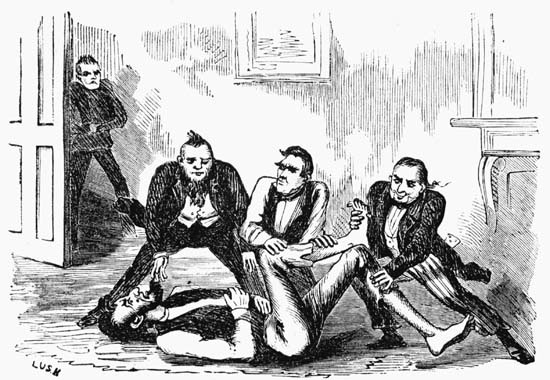
"So I telled Seward an' Stanten to take hold, and the way we rolled the Kernel over was a caushin."—Page 128.
As soon as the Kernel cum to, he begun to joke. Ses he, "Majer, do you know why you and Seward and Stantin rollin me on the floor were like men spredin hay in a meadow?" Ses I, "No, Kernel, I don't, unless the pitchen and rollin are a good deal alike." "No, no," ses he, "Majer, the reason is because it was done to cure me!" "Now," ses I, "Kernel, that is purty sharp, but do you know why your sickness is like the Union?" "No," ses he, "I don't see into that, unless it's because we're both haven a tough time of it." "No," ses I, "that ain't it." "Wal," ses he, "what is it?" "Wal," ses I, "because it has been takin the rong medicen!" Ses he, "How is that, Major? I don't understand you." "Wal," ses I, "it's jest here. You know that feller who does chores for you scraped the elder bark the wrong way, and wen you took it, it come nigh on to killin you. But I didn't know but what it was all rite, and so I give it to you. Now, jest so it's been ever sence you've been President. Seward's been the feller who has been scrapin the medicen for the Union, an he has scraped it all the rong way, an you've been giving it all the time without knowing it. You see, the hull country has got the gripes and the shakes, jest as you had a little while ago, and it all cum from Seward's rong kind of medicen. You see, Seward is tryin to make the people swallow the 'irrepressible conflict,' which is fixed about as follows:
Higher Law 2 oz.
Confiscation 2 oz.
Taxation 2 oz.
Justice 0 oz.
Abolition 8 oz.
(well mixed.)"
"Now, Kernel, such a dose as that would give any country a worse set of spasms and agers then were ever heard of before. Old John Dumbutter, the laziest man I ever knew in Maine, sed he once had the fever an ager in Mishegan so that it shook the buttons off his coat; but such medicen as Seward is givin the country now will shake even the tail fethers out of the grate American Eagle."
Ses Linkin, ses he, "Hold on, Majer, don't pour sich hot shot into me when I'm sick." So I held up; but I tell you, the Kernel has felt very blue sence that time. One day ses he, "Majer, what a grate mistake I made in not makin Crittenden's compromise the basis of my administration; but it's no use cryin over spilt milk. The leaders of our party wanted the Chicago platform put through, and I'm the man to do what I undertake or sink in the attempt." "Or split the Union?" ses I. "Wal," ses he, "I don't know about that, but what's in the way must cum down."
Things look very bad here jest now, and we all feel afraid that they may be worse instead of better. Stantin wants to issoo a proclamashin which he thinks will set all things rite, but Seward ses proclamashins are played out. Linkin thought at one time to put out a call for a day of fastin and prayer, but Hallack is opposed to it. So things are workin along now kinder slip shod, but I'll try to keep you posted as usual.
Yourn till deth,
Majer Jack Downing.
LETTER XV.
Gen. McClellan's Change of Base—A Bear Story—A Delegation of Clergymen—The Major's Opinion on Negroes and "Edecated Peepul"—How General Jackson Saw Through Them—How the War is to End—Mr. Lincoln Tells Another Story.
Washington, August 14, 1862.
To the Editers of The Cawcashin:
Surs:—It has been jest about the hottest wether, sence I writ you last, I ever did see. The Kernel ses he feels as limpsey as an eel, an I tell you it has taken the starch out of the hull of us. Ef I don't write a letter this time worth printin, it will be because my idees have all kinder oozed out through my skin. One day the Kernel ses to me, ses he, "Majer, what do you think about McClellan's new base on the Jeemes River?" "Wal," ses I, "Kernel, it reminds me for all the world of old Truxton Miller's bar hunt, away up in the north part of Maine, when I was boy." The Kernel likes to hear a story as well as to tell one, so he insisted that I should tell him all about it. So I proceeded: Ses I, "Old Truxton was the most noted bar hunter in all that part, an it warnt often when he got started after a bar that it ever got away. He could yell an holler equal to wild Injins, an he ginerally scart away all the varmints for several miles around. One spring the bars had been very trubbelsome, carryin off his sheep, lambs, an even calves an yearlins, and Truxton vowed he'd go an attack the bars in their den. So off he started with his dubbel-barrelled shot gun an his big dog, Harcules, for a regular bar hunt. He soon got on their track, an he followed them to their den. Jest as one was goin in he let go his gun an took one of 'em in the thigh. This only made matters worse, for out come two or three others, an soon the old feller was tackled on all sides. He felt pretty safe with Harcules, but soon the bars made for the dog, an they tore him to pieces in a jiffy. Truxton shot one of 'em, but that put the infernals in the rest, an the old feller had to 'skedaddle,' as they say in these days. Seeing a tree handy by he started to go up, but a powerful beast fetched him a wipe with his paw an tore off the seat of his trowsers. He got away an that was all, an looked down on the bars in dismay. Now," ses I, "Kernel, I think that McClellan's 'new base' is something like old Truxton's. But all his neighbors turned out, an finally got the old feller out of his danger, an when he come down he made this remark, ses he, 'Neighbors, it's one thing to hunt a bar, but it's quite another thing when the bar hunts you!'" So ses I, "Kernel, it's one thing to hunt the secesh, but it's quite another thing when the secesh hunts you, an it appears to me as if McClellan is treed in his 'new base.'" "Wal, Majer," ses the Kernel, "how are we to get him away?" "Wal," ses I, "do jest as old Truxton's neighbors did—Scare off the bars! Scare off the secesh! Get around 'em on all sides an make them believe you are goin to attack 'em from every quarter, an they will soon scatter so that the Ginnerel can change his base agin. Call it 'a great piece of strutegy,' and the people won't know the difference." "Wal," ses the Kernel, "that's jest what has got to be done, and though it's a mity dangerous movement, rite in the face of the rebils, yet it must be done, or all the troops will die of disinterry where they are." Before this letter reaches your readers the telliegraf will announce the hull movement.
The other day the Kernel had a call from some nigger preachers. He sent for 'em to have a talk about seein whether they wouldn't consent to go to Centril America, but they didn't seem to like it much. They sed they would think about it and report. I told the Kernel that when he got niggers to immigrate, that the next thing he could do would be to get the kinks out of their hair. Ses he, "Why not, Majer?" "Wal," ses I, "because it ain't their natur." Ses I, "Kernel, you talk to these niggers jest as if they were white people, all except their color. You seem to think that they will do something for their posterity, sacrifice something, but they won't. The nigger only cares for the present. The mulattoes have some of the talents of the white men, but the nigger not a bit."
"Now, Majer," ses Linkin, "you are prejudiced. Don't all the great men of the world, all the larned men of Europe, and all Christian phylanthropists, don't they all consider it the highest duty to try an elevate the black race?" "Now," ses I, "Kernel, I don't care a blue postage stamp for all the great men in the world. A little plain mother wit I have always found better than a stack of book larnin, an ef any one will jest take up the nigger race an study it out practically, they will see that it has allers been the same uncivilized, heathin people when white folks did not have control of 'em. You send 'em to Centril America, an in a gineration or so they will be again eatin lizards an worshipping snakes, as they do in Africa now."
Ses I, "Kernel, there's no peepul in the world so likely to lead you astray as edecated peepul. They are all mad as March hares on this nigger questshin, jest as they were in old Cotton Mather's time on witches. Edecated peepul, Kernel, ain't got any more wit or common sense than other folks, but they try to make you believe they have, an will talk high-falutin words jest to frighten you if they kin. They tried that on the old Ginneral in the days of the Biddle Bank, but they couldn't budge him an inch. One time the bankers and moneylenders and brokers in Wall street, sent on a committee to see the Ginneral, to honey fuggle him into not vetoing the Bank bill. Ogden Huffman, then the greatest orater, an jest the smartest lawyer York had, was sent on as spokesman. He could talk jest as slick as grease, and knew more law in a minnit than the old Ginneral did in all day. One night he staid till almost mornin talkin and talkin, scoldin a little an palaverin a good deal more. The old Ginneral didn't say much, only once in a while puttin in a questshin. Finally Huffman got reddy to go, an axed what the Ginneral thought of the argements he had made. The old Ginneral pushed his spectacles up on his forehead, run his fingers through his hair, an jumpin out of his cheer, walked across the room as if he was tarein mad, rite up to Mr. Huffman. When he got there, ses he, 'Mr. Lawyer, your talk is all very pretty, very eloquent, an very larned with Latin, but (an here he fetched his old hickory down on the floor) I shall veto that Bank of Biddle's, by the Eternal!' You see the old Ginneral couldn't hold a candil to Huffman, as far as larnin an talk went, but he had the genuine common sense that seen rite through the hull subject. So I tell you, Kernel, don't put your trust in edecated peepul. Ef the hull world thinks that you kin make a white man out of a nigger it only shows that the hull world is made up of fools."
"Wal," ses Linkin, "that all may be very true, but you see, Majer, I've got these contrybands on my hands, an I've got to fish or cut bait. We've only got a few thousand free now, an the peepul in the North are in arms to murder 'em ef I send any more there. I shall soon have two wars on my hands ef I don't contrive some plan to get rid of the kinky heads. You, see, Majer, a fire in front an a fire in the rear will be too much of a good thing."
"I see, I see, Kernel," ses I, "you've got to change your base."
"Exactly, Majer, you hit the nail rite on the hed."
"Wal," ses I, "Kernel, I can't give you a bit of advice except what I have all along. Put the negro in his place, an he won't be a bit of trubbel to you, but as long as you try to get along with him out of his place, you'll be in hot water. As for goin to Centril America, they won't go thar eny sooner than they will to Kamscatky."
"Wal," ses Linkin, ses he, "if they won't do that, we shall all pretty soon be in a nice kittle of fish."
"Wal," ses I, "Kernel, can you tell me how you think this war is goin to end?"
"Wal, Major, I can't exactly see through the hull subject yet, but I'll tell you a story that about expresses my present idees of the subject. One night at a tavern out in Illinoy, two drunken men were sent to sleep in the same room. Now there was two beds in the room, but they were so drunk that they both got in one bed, but did not know it. No sooner in than one sung out to the other, 'I say, Bill, some feller is in my bed.' The other sung out in reply, 'I say, Jim, some feller is in my bed, too.' After swearing at the landlord for a while for not givin 'em single beds, Bill sung out, 'I say, Jim, I'm goin to kick my feller out of bed.' Wal, ses Bill, so am I.' So at it they went, kickin like all possessed, until both of 'em lay sprawlin out on the floor. They had kicked themselves out of bed! Now, Major, I guess that will be jest about how this war will end. The way we're goin on, both the North an the South will kick one another out of bed before they stop, and out of house and home, too."