LETTERS OF FELIX MENDELSSOHN. (continued 4)
Felix Moscheles translation
And so the Philharmonic Society seems tumbling to pieces. Oh dear! oh dear! how sad that is! It is true they have worried me a good deal of late; still I have a sort of affection for the old familiar institution, and hope they may yet conceive the brilliant idea of appointing Moscheles as sole conductor; that would be the infallible remedy to save them (see Chorley’s MS. receipts).
And how are your children? Does Emily keep up her playing? Does she compose? And does Felix drop down all of a heap in his popular character of the dead man? We are all right, thank goodness! My wife has been in such good health all this time that I cannot be sufficiently thankful. There is, however, much to manage and arrange with three little soprano singers in the house, and that is why she returns your kind messages through me. Sophy desires her very best love, and repeats it three times, emphasizing alternately each of the three words; and I say, should you ever feel inclined to write such another truly charming letter by the side of the tea-urn, so enjoyable to your distant friends, drawing them into your family circle, then think of
Yours,
Felix Mendelssohn Bartholdy.
June 15, 1841.
My dear Friend,—How shall I thank you for those two beautiful “Studies” you sent me! I cannot tell you how much I have found in them to enjoy and to admire, and how grateful I am that you should select me as the first to send them to, in advance of the whole musical world, that takes so lively an interest in all you write. That is truly kind of you.
To tell the truth, it is the one in D minor that is my favorite, particularly in that modulation on the seventh, after the long F , and the return to D minor, passing through C and E flat. But then there is that lively one in F major, which I love more and more each time I play it. And
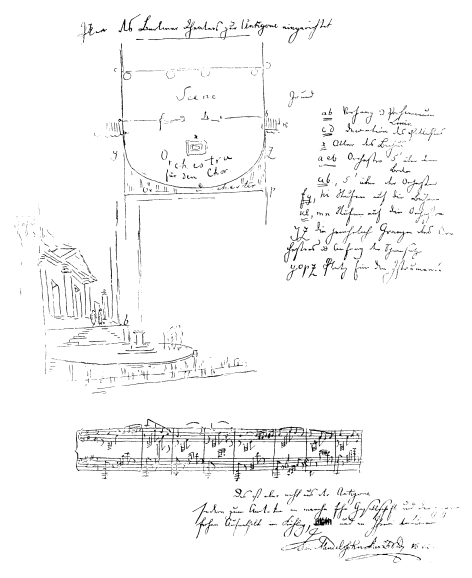
24. Stage Arrangements at Berlin. Fac-simile of Drawing by Mendelssohn. (See explanation in the List of Illustrations.)
finally, they are both so truly Moscheles that it is hard to choose! Well, there they are, both of them; so there is no necessity to make a choice.
Will you allow me an observation,—the only one that occurred to me? There is something in the last two bars of the D minor Study, the end of which I otherwise like so much, that sounds strange to my ear. The long rest on the seventh, and then the F in the melody (half a bar before the last) gives to that passage a melodious coloring that does not seem to me quite in keeping with the general character of the Study. I think some simpler, bolder final chord would be more in harmony with the whole. It is a trifling objection, you see, and perhaps I am altogether wrong; so excuse the liberty and set me right.
It does strut along so splendidly, that D minor Study; and I can play it pretty well already too. The one in F I cannot manage at all yet, although I have tried hard.
Your putting at the head of them the words “Without characteristic names,” is, I can see, an allusion to my pert remarks in Gotha. Well, you must pardon them, as well as all others in the past, and possibly in the future. Let me thank you too, my dear friend, in my wife’s name and in my own, for the dedication of your Songs. It is a kind gift we shall ever value.
You will have heard that I am going for a year to Berlin. I could not refuse, but fully intend to return at the end of the time. I would rather be here than there. To be sure, I am to rejoice in the title of Kapellmeister, to get a lot of money, and to have no special duties, either at the theatre or elsewhere,—in fact, to be quite my own master; but with all that, I don’t quite like it. I shall be there in about ten days; and as soon as I can tell you more about it, you shall hear from me.
Yours ever,
Felix Mendelssohn Bartholdy.
In June, 1842, Mendelssohn once more returned to London, this time accompanied by his wife; and so at last Mrs. Moscheles had the opportunity, to which she had been looking forward so long, of making Cécile Mendelssohn’s acquaintance, and of welcoming her to England. They met, as might be expected, fully disposed to indorse the bond of friendship that united their husbands. Sympathetically attracted to one another at the outset, they soon exchanged the more formal mode of address for the affectionate “Du,” therein following the example of their husbands, who, years ago, had in the same way taken the pledge of brotherhood. Their friendship continued and remained unchanged until the premature death of Cécile Mendelssohn.
On the 13th of June Mendelssohn conducted his A minor Symphony for the first time in the Philharmonic. He played with Moscheles in a concert arranged by the latter for the benefit of
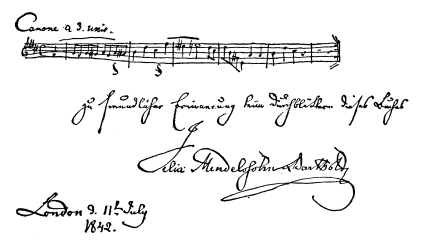
25. Fac-simile from a Letter written in July, 1842.
the sufferers from the Hamburg fire,—a venture which was eminently successful, the net receipts amounting to £650. Sophocles’s “Antigone” was performed in Moscheles’s house, Mendelssohn being at the piano; the choir, however, it appears, did not prove equal to the occasion. It was during this stay that Mendelssohn spent the pleasant hours with Queen Victoria and Prince Albert, of which he gives so graphic a description in his letters to his mother.
Berlin, Oct 8, 1842.
Dear Mrs. Moscheles,—I returned three days ago, and will not delay writing you a letter on this broad sheet of paper. What it will contain, you guess; but I write it in fear and trembling, for my mother assures me she has it from you yourself that you intended leaving Hamburg at the beginning of October, to return to England, without stopping at either Leipzig or Berlin. That would really be too bad! But I cannot quite believe it, and so venture to write you a regular letter of invitation:—
Mr. Felix Mendelssohn Bartholdy presents his compliments to Mr. and Mrs. Moscheles, and is simply craving for Mr. and Mrs. Moscheles’s visit to Berlin for at least a fortnight. The country, music, and that sort of thing, in and about Berlin, are, to be sure, not worthy to be placed before them; if, however, a most hearty welcome can make the sandy soil appear fruitful, and the musicians inspired, nothing shall be neglected to produce the desired effect. The whole population of No. 3 Leipzigerstrasse joins in this most humble invitation. Dinner on the table at three o’clock. Il y aura un violon.
I wish you would say “Yes,” and come. Wouldn’t we enjoy it!
But, joking apart, dear Mrs. Moscheles, and you, my dear friend, should you still be in Hamburg, and these lines reach you there, then do not break our hearts by passing us by. Had I but known a little sooner when I should be here again, I should have written ere this; but we returned only four days ago from Switzerland and the South of Germany. Everything was uncertain, as it is still. However, here we are, and shall certainly remain for the next fortnight, so I say again, Come! If I could only send you a starling trained to say, Come! Come! True, my dear Moscheles, I should have nothing newer to show you in the way of compositions than the Song without Words in A major, which you had to hear but too often last spring. What with eating, drinking, walking, sketching, enjoying myself, and not caring for the morrow, I have not been able to write anything new. You, I am sure, will have all the more new and interesting things to show me. But even supposing we made no music at all, how delightful would it be to spend
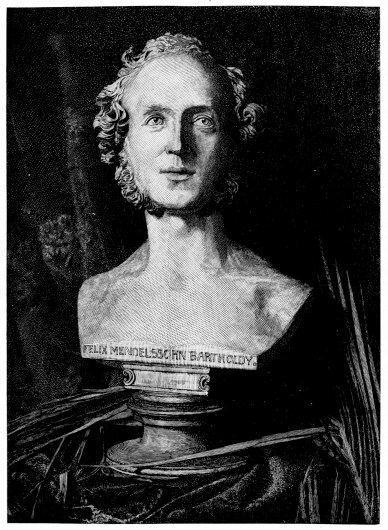
26. MENDELSSOHN.
A BUST MODELLED FROM LIFE BY PROFESSOR RIETSCHEL
some time together in Germany! We should see and hear much more of one another, in peace and quietness, than we could in the rush of a London season, crowded as you are there with work, and I with leisure. You would meet Klingemann too; we are daily expecting him; he must have been in Hanover for some time already. Once more, to wind up, Come!
Now that our wanderings are concluded, we doubly feel what a happy summer we have spent, what English comfort we have enjoyed, what happiness and what never-to-be-forgotten kindness we have experienced. It was delightful indeed! And then, on our return home, we could not help saying that in the whole five months in which we wandered over land and sea, by steam or on muleback, across roads and rocks, we could not remember one unpleasant moment, not one dull day, but that we had been enabled to enjoy everything in undisturbed delight and health. Then I felt as though we never could be thankful enough, and ought never to pray for anything but a continuance of such happiness. From first to last we have felt deeply grateful for the mercies showered upon us, the remembrance of which will never leave us as long as we live. In Switzerland—oh, well, of that I could talk for whole evenings, till you were thoroughly tired of my long stories, as dull and dry as the incidents they would describe were lively and bright. Then came a delightful fortnight with the Souchays at Frankfurt, then Leipzig and the first Subscription Concert. They flattered themselves you would have come to it, dear Moscheles; for David told me they had specially invited you. Hauptmann’s first Mass was performed at St. Thomas’s Church; then we had three new violin Quartets by Schumann, the first of which most particularly delighted me. Madame Schumann played Weber’s Concertstück, and some Thalberg, as beautifully and with as much fire as ever. Here I found all well,—that is, music excepted, which, Heaven knows, is anything but well. They are performing “William Tell” for the wedding festivities, curtailed into three acts, and they call it “the composer’s arrangement for the Parisian stage,” and are racking their brains to discover whether Rossini had any call to write operas or not. The Weissbier, the cabs, cakes, and officials are wonderful here, but not much besides.
I have requested an audience of the King, with a view to obtaining his most gracious permission to depart; but what with the wedding, his journey, etc., I have not yet been received. Should I be more successful next week, I hope to be in my well-known Leipzig home in another fortnight; but it must be with a really good grace that he allows me to retire, for I love him too well, and owe him too much, to let it be otherwise.
Oh, how my pen has run away with me! I dare not touch the next page, which Cécile wants. So let me add, on this one, love to the children, and my wishes for your welfare, but, above all, the wish for an early and happy meeting.
Ever your
Felix Mendelssohn Bartholdy.
Leipzig, Nov. 18, 1842.
My dearest Friend,—How busy I have been lately you may gather from the fact of my only answering your delightful letter of the 20th to-day. But my chief reason for delay was that I wished to answer with due care and full consideration that part of it which mentions your intention of returning to Germany. This is a matter of so much importance to all of us, and I am so immensely delighted at the prospect, that at first I could not bring myself to think of it quietly and impartially. Now I have looked at it in every light, and of nothing else will I write to-day. If you really mean to leave England,—and from what you say I can no longer doubt you are in earnest,—this is the best time you could select, particularly if you thought of giving Berlin the preference. It appears to me that just now, when the King is so unmistakably anxious to secure for his capital artists of great reputation, a mere hint from you would suffice to elicit the most acceptable offers from that quarter. Such a hint is necessary, as, without it, nobody would believe, any more than I did at first, that you are really inclined to give up your position in England. Now, you have the very man in London to whom you might casually drop a word. You are on a confidential footing with him; and whilst, on the one hand, he has the warmest friendship and esteem for you, on the other, his suggestions and counsels have the greatest weight with the King of Prussia. Of course, I mean Bunsen.[48] If you were to speak to him, mentioning in a general way your intention of returning to Germany, I am sure a few words would suffice, and he would do his very best to secure to the King and to Berlin the honor of possessing you,—for as an honor any town of Germany you may select will look upon it. That, perhaps, you do not know; but then I do, most positively. To be sure, there is no official position—I mean no regular programme of musical duties—suitable for you, any more than there is for me, or for any musician whose heart is in his work; so my departure from Berlin would leave no place vacant for another to occupy. The very fact that no such place exists is the cause of my hesitating so long.
Now, however, it is decided that I am to have nothing to do with the Berlin public, but only with the King, whose qualities of head and heart I value so highly that they weigh heavier in the scale than half a dozen Berlin publics. Whether I am there or not, an excellent and honorable position would be open to you. But just think how delightful it would be if I did return, and we lived in the same place and saw our old dreams, that seemed so unattainable, actually realized! But that is a picture I will not attempt to draw in this letter. That I may have to return to Berlin, you see from the above. Probably it may be next year.
But suppose, now, that the thing you thought feasible in Berlin should take shape in Leipzig! Not that I should think of offering you the post I have held here, merely as conductor of the Subscription Concerts; but there is every reason to believe that that office may be supplemented by the directorship of a musical school, which will probably be started within the next twelvemonth. Might not a combination of that kind suit you? The salary would scarcely be more than twelve hundred thalers, to begin with; but I have no doubt things would soon improve all round. The King of Saxony will probably grant the funds requisite for founding the institution; and considering the influential and central position of Leipzig, I am confident that excellent results might be anticipated. The principal outlines of the scheme are to be settled before the end of the year. I am bound up with it, heart and soul. But then the first and most important question arises, Who is to be at the head of it? Now, just see how all difficulties would be at once solved if, in answer to that question, we could put your name! Regular lessons there would be scarcely any to give,—only the general supervision of the whole institution to undertake. You would have Hauptmann (who is at the head of the St. Thomas choir), David, Becker, etc., to work with you; and there would be the twenty Subscription Concerts to conduct.
Now, what do you think of it? Just turn it over in your mind, and let me know the result soon, very soon. I fancy these will not be the only letters we shall exchange on the subject. The matter is of importance, not only to yourself but to all Germany; and the former consideration, you know, would be quite enough for me.
So now give me your views as candidly as I have given you mine; and let me thank you a thousand times, and tell you how proud I am of being taken into your confidence. I do hope and trust we Germans shall get you back amongst us.
If you do not like to mention the matter to Bunsen, I am quite ready to look about for another opening. But Bunsen is the right man, I am certain. However, first of all, let us see what you think of the two different plans.
Kindest remembrances to your wife. I will try to fit an orchestral dress on to the Broadley piece; and if I succeed, will send it to you without delay. For the present, I am still without books or music, and have composed nothing but a Sonata for piano and cello. However, the boxes arrived yesterday; to-morrow we unpack them, and then we will set to work in good earnest.
Remain ever my friend, as I am yours,
Felix Mendelssohn Bartholdy.
The above-mentioned scheme concerning the establishment of a Conservatorio in Leipzig was carried out in March of the following year. The other plan, that of living and working together in the same city, was ardently pursued by the two friends, until it was realized in the autumn of 1846, when Moscheles left London to accept an appointment as professor at the Conservatorio of Leipzig. The next letters show the friendly spirit in which Mendelssohn worked to bring about the result, and the solicitude with which he entered into every detail that might smooth the path for Moscheles and make his new home attractive. Moscheles, on the other hand, did not hesitate to abandon the brilliant and more lucrative position he occupied in London, in order to devote himself, by the side of his friend, to what he believed to be the highest and truest aims of Art.
Leipzig, Jan. 16, 1843.
My dear Friend,—I have to thank you and your wife for three very kind letters; excuse my not having done so before. At a time like that which we have passed through, when one feels completely unhinged and cannot regain one’s peace of mind, when all seems dark and hopeless, it is but gradually one can attempt to return to one’s occupations, even to the pleasantest of them.[49]
During the first days of darkness not even music, or the thought of music, could afford me any consolation; but my old love for it soon returned, and now my little study, with its view on to the fields and far beyond, is a refuge, in which I gather fresh strength, and can sometimes feel more cheerful. Any attempt to divert my thoughts into another channel only tends to increase my sorrow, and leaves me more depressed than before. I am sure you will forgive my not having written sooner; you may read between the lines that I really could not have done so, and that even now I find it difficult to take up the pen.
The Scena for Mr. Broadley accompanies this letter. I have thrown in a Fugue, and fancy it is the best piece of the whole. It is the gingerbreadnut they give into the bargain at the sweet-stuff shop. The idea of it occurred to me in happier days, and I then scored the first three pieces; the fourth I had commenced when the great trouble came upon us, and I had to leave everything for weeks just where it was. Now I have finished it, and beg you to give it with my regards to Mr. Broadley. Perhaps I may write and enclose a line to him, besides. Thanks for your kind offer about publishers in England. Under other circumstances I would have accepted, as I have so often done before; but just now I need not trouble you, having every reason to be satisfied with my present publishers.
The transaction with Addison and Benedict was of quite a different nature. Benedict told me last spring they wished to have my Symphony; that was all that was said about it. So I wrote to them offering it on the same terms as the former one. They certainly had given me a better price than the other publishers, either at that time or since. They thought it too much, and so I gave the piece to my ordinary publishers at the ordinary price, and therewith the matter ended. Lately, Benedict wrote me one of the kindest letters imaginable, that truly delighted and touched me, and in which I only regretted one thing,—that towards the end he mentions this long-forgotten incident. But the beginning is so kind and good that it would take a hundred such allusions to business transactions to outweigh the impression of his affectionate words. Tell him that, with my best love. And now I have not yet thanked you for your very kind and valuable present to Carl.[50] I was going to say you had given me more pleasure than him, because I so thoroughly enjoy these bright and graceful combinations; but the boy is so much in love with the music, and is so proud of his present from Uncle Moscheles, that nothing can surpass his delight,—in fact, you have started him on his musical career, for every morning after breakfast he insists on my teaching him his notes. And the other day, when he had to write to his godfather Bendemann, and Cécile asked what she was to put for him to copy, he said, “I have got notes from Uncle Moscheles;” which he wrote somewhat in this style:—

But, for all the crookedness of his letters, he feels just as happy and grateful as you or I would. Why, our letters are quite as crippled, if we compare them and their words to the sense they should convey.
I postpone saying anything in reference to the chief subject of our last letters till I am in a fresher and brighter mood. But I should like to know soon if you have really spoken to Bunsen, and what he said. The King of Prussia, I know, does not confine himself to native talent. Proposals would certainly not be expected from you, but would be made to you, whether coming from here or elsewhere.
Ever yours,
Felix Mendelssohn Bartholdy.
Leipzig, April 15, 1843.
My dear Friend,—Thanks for your letter of March 10, which was anything but a dry business memorandum, as it announced itself, but one of those kind and friendly letters which I always most heartily welcome. But now, do tell me what can have given you the idea that I was appointed Director of the Leipzig Music School, and that “all plans of our living together in Germany would vanish into thin air,” etc. I am not appointed, and I am as anxious to have you here as ever, and confidently trust our plans will not prove castles in the air. You must have taken some newspaper paragraph for gospel truth; and you know that in my opinion they have been known to fall very short of that. These are really the facts:—
Three years ago I endeavored to found a music-school in Leipzig; and after endless interviews and exchanges of letters with some prominent men here, and also with the King, I felt, on my return from Berlin, that there was no time to be lost, and that it was a case of now or never. My engagements in Berlin did not allow of my accepting a permanent appointment here; but I took the matter in hand last November, and, having got the necessary funds, the school was opened, and I engaged to act as one of the teachers during the time I should remain here. I wrote to you then, and expressed my ardent desire to see you eventually at the head of the institution. Nothing has changed my desire since; only, what was then a long-cherished plan became four weeks ago a reality, and promises to bear good fruit.
Now, if we could only persuade you to come! Whether I am here or not, it would be equally desirable to have you at the head of the institution. So far the Board of Directors is composed of only five gentlemen, none of whom are musicians. The six teachers are subordinate to them, but amongst themselves they are on an equal footing. But I believe that later on, when the institution develops, as seems very likely to be the case, a change will be necessary, and a musical man will have to join the Directors, or even to take the lead independently. And that is the position which, in connection with the Subscription Concerts, would be worthy of your acceptance. The difficulty is to get them to make you a definite proposal, both from a business and a musical point of view. No doubt, they would all like to have you here; but liking and wishing and thinking alone will not do it; and how absolutely necessary it is to come to a clear understanding in such matters, I should have learnt during the course of my negotiations in Berlin, had I not already been aware of the fact.
Have you received an offer from Prague to take the directorship of the Conservatorium there? Spohr’s name was mentioned in connection with it, and so was yours. That he was asked, and that he refused, I know for a fact. I am anxious to hear whether there is any foundation for the rumor connecting your name with it.
I do not know what the appointment is like, but am enough of a patriot to wish that you lived in Germany rather than in England. The paper is at an end, so good-by.
Yours ever,
Felix Mendelssohn Bartholdy.
Leipzig, April 30, 1843.
My dear Friend,—Our last letters crossed on the road. A thousand thanks for yours that I received a few days ago. You know what heartfelt pleasure it gives me every time I see that well-known handwriting of yours on the address, and how grateful I am to you for writing to me, overwhelmed as you are by every kind of claim on your time. It would certainly be better if we need never correspond, and could exchange ideas verbally from one end of the year to the other, and that in Germany too! That is a prospect I am less than ever inclined to give up; only, I don’t quite see my way to the where and the how. So, in the mean while, accept my thanks for the letter. The terms at our music school are two hundred thalers per annum; the cost of living here, at all decently, would amount at least to two hundred thalers. Young Englishmen, who usually live rather better, would probably require from two hundred and fifty to three hundred thalers,—say fifty or sixty pounds per annum.
The school has made a fair start; new pupils are almost daily joining, and the number of lessons and of teachers has had to be considerably increased. There are already thirty odd pupils, twelve of whom are instructed free of charge, and some of them are very promising.
We are afflicted, however, with two veritable maladies, which I mean to fight with all my might as long as I have anything to do with the institution. First, the Directors want to enlarge and to expand,—build houses and hire rooms,—whilst I maintain that for the next ten years the two large rooms that we have, and in which instruction can be given simultaneously, are quite sufficient. And then the pupils all want to compose and to theorize, whilst I believe that the principal thing that can and ought to be taught is sound practical work,—sound playing and keeping time, sound knowledge of sound music, etc. Out of that, all other knowledge grows of itself; and what is beyond is not a matter of teaching, but must come as a gift from above. Don’t you agree with me? That I am not the man to turn art into mere mechanism, I need not say. But whither am I wandering? I have got into chatting instead of writing the two lines I intended. So now good-by.
Yours ever,
Felix Mendelssohn Bartholdy.
In a letter of the 5th of April, 1844, Moscheles communicates to Mendelssohn the desire of the Handel Society, that Mendelssohn should prepare a new edition of the “Messiah.” Moscheles had announced a concert for the 1st of June; and, in view of Mendelssohn’s expected visit to England, he writes to ask him whether he is inclined to play on that occasion some new piece of his own composition for two performers. “Have you got anything of that kind amongst your manuscripts,” he says; “or, if not, might not Jupiter evolve something Minerva-like from his fertile brain?”
Leipzig, April 12, 1844.
My dearest Friend,—A thousand thanks for that dear, kind letter of yours, that I received (with the one from the Handel Society) just as I was leaving Berlin. Several weeks must elapse before I can knock at your door, as I shall be travelling slowly, and stopping at various places. But I will not postpone thanking you for your letter, and telling you how much pleasure it has given me. If you knew how deeply rooted is my heart-felt regard, how warm my admiration for you and your music, there would be no need to say how delighted I am that you will allow me to play at your concert and to appear in public by your side. But I know you are too unassuming ever to listen to anything of the kind; and the fact is, when it is put into words it really does not look genuine. So I had better write nothing more about it,—only this much, that I am at all times truly happy to make music with you, whether in public or in private. In whatever way you can use me, I am at your service. Let me write out parts, or collect tickets, or do anything else. If you can turn me to account, you will make me truly happy and grateful.
I do not think I have anything ready for two pianofortes. There are those Variations on a theme in B flat; I like them very well in a room, but they are not at all suited for public performance. What I should like best would be to write something new by that time; but time is short. Could not we play something on the organ, or even improvise together, or write ourselves a four-hand Fugue for the organ? Well, as I said before, you decide as to the what and how, and I am ready. At the latest, I shall be in London by the first week in May.
I have the greatest desire to accept the very gratifying offer of the Handel Society; but I have written to Macfarren to say that I cannot give a definite answer until I have had an opportunity of verbal communication. There can be no objection, I suppose, to the delay. Some of the editorial duties (especially preparing the Introduction) I doubt if I should be able to undertake; and that makes a verbal understanding desirable.
Thank you for correcting the proofs of my “Book of Songs;” thank you for the invitation to play at your concert; in fact, thank you for all these twenty years that I have known you, and in which you have shown me nothing but kindness.
Ever yours,
Felix M.
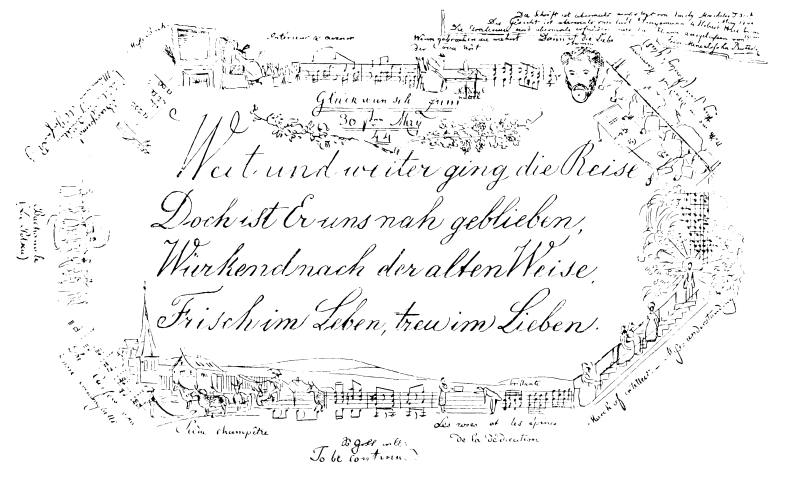
27. Mendelssohn’s Congratulations to Moscheles, May 30, 1844. (See page 245.)
Mendelssohn had been requested by the Handel Society to prepare an edition of the Oratorio “Israel in Egypt.” Later on, a difficulty arose in reference to the notation. Moscheles says, in a letter to Mendelssohn: “A meeting was convened to discuss the subject; and after a lively debate it was decided that the only way to put before the public that notation which you saw in the original manuscript, and which you wish to adopt, would be to publish a fac-simile of it. But that, to be sure, would be out of keeping with the three works already published by the Society.”
On the 8th of May Mendelssohn came to London, where he was as enthusiastically received as ever, whether he appeared before the public as a composer, a conductor, or a pianist. In Moscheles’s concert he played, with him and Thalberg, Bach’s Triple Concerto; in which his performance, and especially his improvisation of the Cadenza, is described as simply miraculous. On another occasion he played Moscheles’s “Hommage à Handel,” for two performers, with the composer; at the Philharmonic he conducted for the first time his “Walpurgisnacht.”
As on former occasions, he was a constant and welcome guest in Chester Place. In celebration of Moscheles’s birthday, he drew a second page of illustrations, referring to Moscheles’s works, as a sequel to the one he made in 1832. “The writing,” he says, “is again Emily’s; the poem, Klingemann’s; the design is again invented and the ink-blots omitted by Felix Mendelssohn Bartholdy.” Amongst the various humorous allusions to Moscheles’s works, we find his song “Silent Love,” represented by a padlock closing the composer’s mouth. The “March of intellect, Miss-understanding,” allude to the “Harmonized Scales” written by Moscheles for his youngest daughter, Clara. The “Scène champêtre” illustrates the “Concerto Pastorale.” “Les Roses et les épines de la dédication” show us Moscheles presenting his Concerto to Mendelssohn, who is bowing and profusely thanking, quite unconscious of the difficult passage which is lying in wait for him behind his back. The following is the translation of the lines in the centre of the page:—
“On and still on, the journey went, Yet has he kept us all in view— Working in age with youth’s content, In living—fresh, in loving—true.”[51]
Mendelssohn left London on the 10th of July; two months later he and Moscheles met in Frankfurt. Another drawing illustrates an amusing incident at a concert that Moscheles gave in that city. It is described in a letter from Moscheles’s daughter Emily:—[52]
“The room, long before the concert began, was crammed full, and still the people were coming. ‘What will the Frankfurters say when they find no seats?’ said Mendelssohn to Rosenhain. ‘Let us try to hire some chairs. Come along!’ Off they were, but it was no easy matter to get chairs; for, it being the time of the fair, there were none to spare in the crowded hotels. At last they found four dozen in a small inn. ‘These must be sent immediately,’ says Mendelssohn. ‘But who is to pay?’ inquires the landlord. ‘A great artist, Moscheles, who is giving a concert. It is all right; your money is safe.’ ‘Stop a minute!’ says the canny landlord; ‘those great artists often give concerts, pocket the money, and then disappear. I must have something down.’ Mendelssohn and Rosenhain empty their pockets, which happen to be poorly filled. The landlord, however, is satisfied, and they hurry off to the concert-room with an instalment of chairs inside and outside their cab, the rest following.
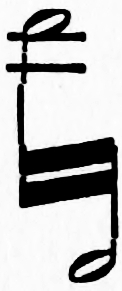
“Another little incident that pleased Mendelssohn mightily, was a certain C far down in the bass, which my father unexpectedly put in as he was playing his A flat Study. ‘That took me by surprise,’ he said; ‘it has a splendid effect, and ought not to be forgotten. I must put it down at once in Mrs. Moscheles’s album.’ He did so, drawing at the same time the cab, Rosenhain, himself, chairs, and all, but only half a horse. ‘I can’t draw that by heart,’ he said.”
Frankfurt, March 7, 1845.
My dear Friend,—It really was too kind of you to sit down and have a talk with me on paper, in the good old style. Now I will just leave everything to take care of itself till I have returned your chat and thanked you for your never-varying kindness to me. What you say of musicians and their doings in England, is certainly far from satisfactory; but where are doings ever satisfactory? Our inner life it is that is worth living; but then that is a very different thing to our outer doings,—something very much better. Conducting and getting up public performances is all very well in its way; but the result, even for the public, does not go far. A little better, a little worse, what does it matter? How soon it is forgotten! And what is it but our inner life, our calm and peaceful moments, that act and react on all this, that impel us and lead us onwards, taking all that public business in tow, and dragging it here and there, whichever way it should go?
That is the language of a Philistine (you will say), of a domestic animal, or a snail. And yet there is some truth in it; and one book of your “Studies” has had more influence on the public and on art than I don’t know how many morning and evening concerts in I don’t know how many years.
Do you see what I am driving at? I should so much like to get that four-hand Sonata of yours, or some four-hand Studies, or, for that, some two-hand ones, or whatever else you might send. But, to be sure, your season is beginning; and how little time is left you for composing and for your own
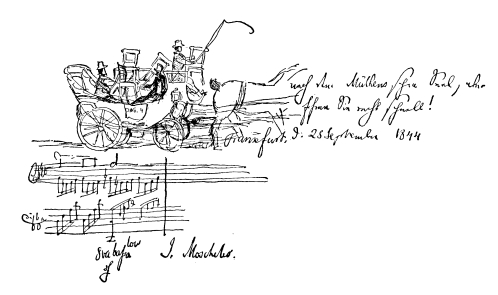
28. Incidents of a Concert at Frankfurt. A Pen Drawing by Mendelssohn. (See page 246.)
self, I know full well. But don’t let the English Misses make you forget the German Misses, and their necessary adjuncts the Misters, who are waiting for that four-hand Sonata.
As for your feeling hurt by anything the Directors of the Philharmonic may have decided upon amongst themselves, I can only say you do them too much honor; their counsels can scarcely pretend to such distinction. On the contrary, I must confess that after I saw more of them last year, my good opinion was very much shaken, and my belief, too, in the future prospects of the Society. I very much doubt whether anything important can be expected of it; although, to be sure, the end will not come as long as the public opens its purse-strings. But the fact of the matter is, there are some very indifferent representatives of the musical profession that want to take the lead, and are allowed to do so; and the consequence is, as usual, that misunderstandings arise, intrigues follow, and the main object to be pursued is neglected. C’est tout comme chez nous. Do not ask where the nous is. It is everywhere. Just the old thing,—the inner life I was speaking of on the other page: da capo del segno fino al e poi.

I regret the difficulty with the Handel Society, but I cannot alter my views on the subject. On less important points I am ready to give way; as, for instance, in reference to the accidentals,—although there, too, I prefer the old method, on account of the long bars. But I cannot possibly introduce my marks of expression into a score of Handel’s, nor my tempi, nor anything else, unless it is to be made perfectly clear what is mine and what Handel’s; and as he has put his pianos and fortes and his figured basses where he thought them necessary, I must either omit them or leave the public in doubt as to which is his marking and which mine. It would be no great trouble to any one who agrees with my marking, to have it copied from the pianoforte arrangement into the score. On the other hand, it would be no slight evil if the edition did not clearly distinguish between Handel’s and the editor’s views. I must say that the interest I take in the Society is entirely dependent on the decision in reference to this point. The edition of the “Anthems” was so unsatisfactory, on account of the new marking, that I would never use it for the purposes of a public performance. I wish to know, above all things, what is Handel’s and what is not. This desire the Council shared with me last year; but now the opposite views seem to prevail, and if they are adopted, I for one (and a good many with me, I believe) will much prefer the old edition, with its incorrect notes, to the new one with its various conceptions and consequent marking. All that I have written to Macfarren. I trust you are not angry with me for speaking out so plainly. My opinion is so intimately connected with what I have held to be right, all my life, that I could not possibly alter it.
We have had little music here lately. But one great treat was the performance, at a private house, of Cherubini’s second Requiem, in D minor. They had given it six months’ study, and it went accordingly. André has just sent the original score of Mozart’s C major Symphony (“Jupiter”) for my perusal. I must write out something from it for you that will amuse you. Eleven bars before the end, it formerly stood thus:—
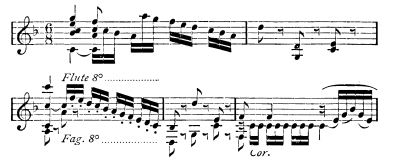
The whole repetition of the theme he has written on an inserted leaf; the above passage is struck out, and only comes in three bars before the end. Isn’t it a happy alteration? The repetition of the seven bars is one of the passages in that Symphony I love best.
But here our gossip must end.
Yours ever,
Felix Mendelssohn Bartholdy.
“Israel in Egypt” was eventually edited by Mendelssohn, appearing in 1845-1846. On the titlepage and in the preface he most carefully guards against any possible misconception, and says: “The editor is alone responsible for the directions of ‘piano’ and ‘forte,’ and other marks of expression; for all such descriptions of the movements as stand within brackets (those which are not so placed being the only indications for which the original manuscripts furnish authority); for the suggestion of the tempi according to Maelzel’s metronome; and for the figuring of the organ part. The adaptation of the instrumental parts for the pianoforte, intended as an accompaniment to the voices in the absence of the orchestra, is by the editor; for this, also, he alone is responsible.”
Frankfurt, April 12, 1845.
My dear Friend,—You must have been as delighted at the news of Klingemann’s engagement and the prospect of his being married soon, as I was. No, not quite so much; for when the news came, I danced about the room for fully five minutes, to the astonishment of Cécile, who thought I was out of my senses. Well, it has been a pet wish of mine for ever so long, and now that it is about to be realized I can scarcely believe it. I had given up all hopes of its coming to pass, and now that it has come I am doubly glad. It seems, too, so desirable and excellent a match that I feel sure it must bring happiness.
With us, thank Heaven, all is well. Cécile is in good health and spirits, the children are flourishing, spring is approaching; what more can mortal man desire?
You complain of the musical shortcomings in your part of the world. Well, things are not brilliant here; yet, for all that, one does occasionally get to hear something good. Add to that the balmy air of spring, the piano, and some sheets of music paper, and, after all, life is bearable.
Your old and very affectionate friend,
Felix M. B.
Berlin, Nov. 13, 1845.
My dear Friend,—There is a rumor afloat in Leipzig, and I have met with it more than once since my return, that you might possibly take up your abode there, and devote yourself chiefly to the Conservatorio, thus carrying out, to the advantage of the Leipzigers, your old plan of settling in Germany. I must say I did not put much faith in the report. The difference between London and Leipzig is so great that I could scarcely fancy you would ever make up your mind to leave the former for the latter. But the other day I heard it asserted positively at an evening party that you had said you were disposed to settle in Leipzig. Some one had the news from Hamburg. Unlikely as it seems, I cannot help writing to ask whether there possibly might be some foundation for the rumor, and, secondly, whether I could do anything to convert such possibility into a certainty. I need not tell you how anxious I am to know, and how important the matter is, not only to me, but to all true lovers of music in Germany. So pray write as soon as possible how it really stands, and tell me point blank what steps should be taken to persuade you, if you are to be persuaded at all; or if you are only thinking of it in a general way and as a possible contingency, then just give me an outline of your ideas in an equally general way.
Nothing would be better and simpler, to be sure, if you really were inclined to decide for Leipzig, than to go straight there and to settle all details personally. But for the present, my only question is whether there is any truth at all in the report, or whether it is all idle talk, such as often gets about, without any foundation whatever. I believe, if you wrote to say there was a remote chance, the Leipzig Town Council would petition you in a body, the burgomaster at their head. Of my personal joy I say nothing to-day. I merely write as a Leipziger. When I heard the report the other day, I was suddenly seized with patriotic feelings for Leipzig, and I said to myself, “If I could but do something to bring this about!”
Good-by. I have been here for the last three weeks, to conduct performances of my “Athalie,” “Œdipus,” and some other things.
Yours ever,
F. M.
Moscheles writes:
Nov. 28, 1845.
My dear Friend,—As in the times of the Greeks the household gods were enthroned in every house and were surrounded by love and reverence, so you too have a special shrine devoted to you in Chester Place,—in our hearts rather and in our daily thoughts of you and yours.... Now let me first thank you for the cordial and hearty words you write on the prospects of my settling in Germany. My wishes in that direction are ever present,—smouldering embers that your friendly intervention, your influence, and, above all, the sacred spark of your genius, may kindle into a bright flame. Your questions remind me of those you put to me as we were walking arm in arm along the wide streets of London; they were the same, and now as then I have the same answer to give: Yes—yes—yes! I have grown indifferent to the so-called attractions of the great world; the taste of the day does not suit me, and I do not care to make any concessions to it, whether in public or in private life. What I aspire to, is an appropriate sphere of musical activity, interesting surroundings, you by my side, and finally Germany.
The position of head teacher of the pianoforte at the Leipzig Conservatorio would be very acceptable to me; and I readily assume that you are the Director of the whole establishment, and that I could work in the same spirit that, from your first appearance in Leipzig, you infused into the art life of that musical centre.
Leipzig, Dec. 20, 1845.
My dear Friend,—I most gladly take up the pen to-day; for I believe and trust that this letter may be instrumental in bringing about the realization of a wish which we Leipzigers, and more especially I personally, have long had at heart, remote as seemed the possibility of its fulfilment.
Yesterday I learned that the Directors of the Conservatorio were about to write to you officially. Their offers, which will be in your hands in a few days, will at least prove to you how fully they appreciate the desirability of securing you and your services for Leipzig. I hear they have based their proposals on the suggestions you made in your letter to me, and which I submitted to them on my return. The salary they offer you is more than double that of any other professor; they agree to the leave of absence, and, in fact, accede to one and all of your wishes. When you come to consider that they are ready to draw to the fullest extent on the means at their disposal, and further, that it would be hard to find elsewhere so influential and independent a position, I trust you will be disposed to accept their proposals. I feel all the more confident of the result, knowing, as I do, your ideas on the state of things here as compared with that in England, and remembering how much in earnest you were when we last talked the subject over.
The sum which is to be offered to you (if my information is correct) is small, according to English notions, but not so, measured by a German standard. Nor is it small when you take into consideration that it represents a fixed salary for only two or three lessons daily, and when you make allowance for the time of ten weeks’ leave of absence; so that, if you choose to give two or three private lessons besides, you will be in a more remunerative position than most musical men in this country, and yet not have to give more than four or five lessons daily. That would be light work for you, accustomed as you are to the incredible exertions of London life. You would have leisure enough, and to spare; and what splendid fruit that might bear for art and for your friends! I cannot for a moment doubt that, under the circumstances, you will appreciate the change; and I must say that, from what I hear of the petty doings over there, and from what I experienced myself eighteen months ago, I can fully understand that every year brings you fresh cause for dissatisfaction, and a growing desire to turn your back on it all. And, really, the position you are asked to occupy is not unworthy of your acceptance.
One point I must answer, to correct a misapprehension: I am not, and never shall be, the Director of the school. I stand in precisely the same kind of position that it is hoped you may occupy. The duties of my department are the reading of compositions, etc.; and as I was one of the founders of the school, and am acquainted with its weak points, I lend a hand here and there until we are more firmly established. I look upon it as an element of stability that we should have no musical director placed in authority above the professors,—head masters, as we call them. These—Hauptmann, Becker, David, and myself (may I soon be able to add your name!)—form a committee of management on all musical matters, subordinate to the Directors only, inasmuch as these select the teachers, manage the business, and are generally the representatives of the Institute. But all musical matters are submitted to the committee of teachers, or to the special professor whom they may concern. So, for instance, any question relating to harmony would be referred to Hauptmann, whilst Becker would deal with what concerns the organ. The Board of Directors consists exclusively of prominent citizens,—non-musicians,—who give their services gratuitously.
And now let me request that if there is anything you do not wish to mention officially, you will inform me, and give me an opportunity of contributing to the success of a negotiation which may prove more fruitful in its results than any we have hitherto undertaken in the interests of music.
“I scarcely venture to hope, so much do I wish it,” says your wife; and I, with a better right, echo her words,—for if you both only wish it half as much as I do, I fancy I may venture to hope.
And now, best thanks for your letter from Paris, that crossed mine on the road; and my congratulations on your successes, and the dedication at St. Cloud. As regards the Sonata[53] itself, it is of no use putting the many questions about it which I am so anxious and impatient to have answered; but I will make sure that Kistner lets me have the manuscript without an hour’s delay. And just fancy, now, how grand it will be when we get that kind of thing before all kings of the French! I do believe the Leipzigers will get too proud; and yet I should be happy for their sakes. You see I can write of nothing else to-day. Good-by; let me hear from you soon.
Ever yours, F. M.
The following letter is in answer to Moscheles’s question in reference to the cost of living in Leipzig:—
Leipzig, Jan. 17, 1846.
My dear Friend,—Your last letter, and that of your wife, gave me the greatest pleasure, for they seem to hold out a promise that our wish to have you here will be fulfilled. I do hope and trust we are not mistaken. On the day that brings your consent I will drain my best bottle of wine, and cap it with a cup of champagne. I hasten to answer your questions, having duly consulted my wife and her account-books with the following result: The price of a flat—consisting of seven or eight rooms, with kitchen and appurtenances—varies from three hundred to three hundred and fifty thalers.[54] For that sum it should be handsome and cheerful; and as regards the situation, should leave nothing to be desired. Servants would cost about one hundred to one hundred and ten thalers per annum, all depending, to be sure, on what you require. Male servants are not much in demand here, their wages varying from three to twelve thalers per month. A good cook gets forty thalers a year; a housemaid, thirty-two. If you add to these a lady’s-maid, who could sew and make dresses, you would reach about the above-mentioned figure. Should you require, in addition to these, a man-servant, that, to be sure, would increase the expense; but living as others do here, I think you would scarcely need one. Wood—that is, fuel for kitchen, stoves, etc.—is dear, and may amount to one hundred and fifty or two hundred thalers for a family of five, with servants. Rates and taxes are next to nothing: eight or ten thalers a year would cover all. In a word, I think you would live very well and comfortably on from eighteen hundred to two thousand thalers. It is difficult to fix the terms for your lessons, even approximatively, for there is no precedent in Leipzig to go by. Madame Schumann-Wieck had two thalers, but at that price found only few pupils, and those mostly among foreigners spending a short time here. I think that would be different with you, and am confident that if you chose to say one thaler and a half you would be overrun by applicants. The same probably would be the case at two thalers. And so I return to what I said in my last letter: I believe that, putting together the salary from the Conservatorio and what you would make by private lessons and the publication of compositions (even if you published ever so little, but I trust it would be ever so much), your income would suffice for your expenditure, and it would still be open to you to draw on your capital or to leave it to bear interest. I do not think I have in any way looked at things in too favorable a light in giving you these estimates. I certainly made them after due consideration, and in accordance with my experience of this place.
Now I have but to add that I have no doubt your furniture will be allowed to pass free of duty (in fact, I don’t mind making bold to guarantee that at once); further, that I certainly have composed a “Lauda Sion” for a church festival at Liege; and finally, that we are all well, and thinking of you, and expecting with the greatest impatience your next letter, which is to bring us the welcome news that you are coming.
Ever yours,
Felix Mendelssohn Bartholdy.
Moscheles writes:—
London, Jan. 26, 1846.
A thousand thanks, my dear friend, for that kindest of letters. In its way it is as complete as you are yourself in all your creations. Whether at the Piano or the Organ, from the Song to the Oratorio, in Canon, Fugue, or Symphony; with the pen (vide certain birthday illustrations) or with the brush on the Bridge of Sighs—always the same: bright, gifted, and genial. I am only sorry that my warm appreciation of your qualities gives me no great advantage over your other admirers; however, in one respect I am in advance of them, and that is, in the thanks I owe you. My answer to the Directors I enclose; please seal and deliver it.
On the 3d of February Moscheles writes:—
“Elated as we were at the prospect before us, our spirits were further raised by an unexpected invitation to conduct the Birmingham Festival that I received the other day. Coupled with that, is the good news that you have promised to take part in it, and to produce a new work of yours on that occasion; so you can fancy that all is indeed sunshine to me.”
Leipzig, Feb. 11, 1846.
Hurrah! your decision is taken, you are coming! Let every one of these lines rejoice! A more welcome piece of news I have not received since I have been here, and one that promises so rich a harvest for all of us. There was a flutter of excitement, such as I have never witnessed in our ranks, when I produced your letter at the Board meeting the other day. I had kept it all to myself, to lay before the Directors on that occasion; and when the time came, I announced that I had received your answer, and here it was with your acceptance, black on white. They were for answering at once; but as there were several of them, it took a few days, so that you get their letter with mine to-day. Not only the leave of absence for three months, but anything and everything you may desire, will, I am sure, be agreed to. In fact, it is in everybody’s interest that you should be made perfectly comfortable; and I do believe you will be satisfied, and will not be unfavorably impressed by the difference between the stirring metropolis and our petty provincialism. This much is certain, that you can nowhere find better intentions, and a heartier desire on all sides to make you feel at home, than here. Since the Fates have decreed that you shall return to Germany, and since you cannot, in this most excellent but somewhat peculiar country, hope to escape a certain amount of gossip and twaddle, whichever place of abode you may select, I think you will have no reason to regret your choice having fallen on Leipzig, and I trust you will like it better and better every year.
My personal feelings I cannot adequately express. How could I tell you what it is to me, when I think that you are really coming; that you are going to live here for good, you and yours, and that what seemed a castle in the air is about to become a tangible reality; that we shall be together, not merely to run through the dissipations of a season, but to enjoy an intimate and uninterrupted intercourse? I shall have a few houses painted rose-color as soon as you really are within our walls. But it needs not that; your arrival alone will give the whole place a new complexion. But what is the use of my scribbling, when you are coming, and we can thank you verbally? Not that that is necessary; you know too well, without words, how overjoyed we are. Cécile will write a few words for herself.
Now, you must soon let me have a long, domestic, non-musical letter, like my last one, so that we can arrange and settle various things for you before you arrive. Isn’t it delightful that we have got to that point already?
Your second letter, with the Birmingham news, just comes too. They have truly done well in securing you as a conductor; and how splendid it would be if we could meet there! About my “Elijah,” however, I shall not be able to decide
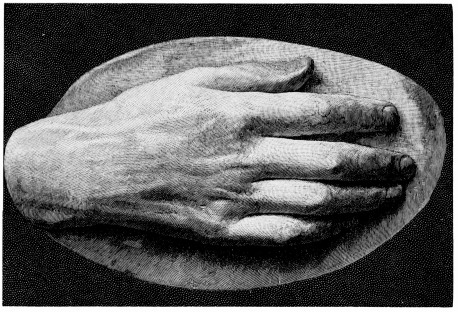
29. From a Cast of Mendelssohn’s Hand.
anything before the middle of next month. The fact is, my health frequently leaves much to be desired; and all this conducting and performing often fatigues me greatly. At such times I scarcely believe I shall be strong enough to go through a musical festival again. If I possibly can, I most certainly shall go; but as there is considerable doubt of my being able to do so, I am doubly glad to know that the matter is in your hands, feeling sure that thus all must go well.
The letter to Jenny Lind I have sent to Berlin; and when I see her a few weeks hence, I will put it strongly to her, but I scarcely believe she will be at liberty to accept. It is wonderful how she is sought after on all sides, and I believe her engagements are fully made up to the end of the year.
Beethoven’s “Ruins of Athens,” or rather my selections from that work, would be appropriate, but they have not yet appeared in print. I believe Ewer & Co. have the score and the copyright. Pischek, I trust, you will be able to secure; he would be an important acquisition. More of all that next time. For to-day, good-by. Once more, thanks and—hurrah! you are coming!
Ever yours,
Felix.
In reference to the “Sonate Symphonique,” Mendelssohn wrote to Messrs. Stern & Co., publishers, in Berlin:—
Leipzig, March 20, 1846.
To Messrs. Stern & Co., Music Publishers, Berlin:
Gentlemen,—Kapellmeister Taubert, who is leaving to-morrow for Berlin, brings you the proofs of Moscheles’s Sonata. I have played it with him, and have looked it carefully through without having discovered a single fault, and am happy to find the work of my friend and teacher so judiciously and correctly presented. I am
Yours truly,
Felix Mendelssohn Bartholdy.
Leipzig, April 20, 1846.
My dear Friend,—Many thanks for your last letter, which I received yesterday. Although I dare say you have heard through Klingemann that I hope to complete my Oratorio, I write myself to-day to tell you so. If my health continues as satisfactory as it is at present, I feel confident I can be ready in time, and will give some sheets to the copyist within the next few days, with a view of forwarding them to you without delay. Towards Whitsuntide I trust the chief pieces of the first part and some of the second will be in your hands. That will be soon enough, will it not? I am still undecided whether I shall have the parts printed, as Mr. Moore desires. Why should they not be copied out just as well? If, contrary to expectation, I should not have finished, I have enough other manuscripts in readiness, so that I might, as Mr. Moore suggests, conduct some other new piece of mine. My “Athalie,” for instance, is now in England, and, if I am not mistaken, is being translated by Bartholomew; so, if the worst comes to the worst, those Choruses could be sung. But, as I said before, I trust that will not be necessary; and if it is not otherwise decreed, I most surely mean to go to Birmingham. How delightful to see you all again! Excuse my writing so hurriedly; I am quite incapable of putting together a sensible letter.—But just one more question: Is it not quite time that you should give me your orders for Leipzig? That you will be here by next autumn, I take for granted, and my wife and I ought to set about making all the necessary preparations. So please let us know.
Thanks for your kind and friendly words in reference to my work, and a thousand thanks for that beautiful four-hand Sonata of yours, the proofs of which I corrected and then got as a present into the bargain. I only wish the time had come already for us to sit together at the piano and play it.
Best love to your wife and children from
Yours ever,
Felix.
Leipzig, May 8, 1846.
My dear Friend,—In about a fortnight I hope to send you the score of the first part of my Oratorio (with the exception of some of the Solo numbers), that is to say, considerably more than one half of it. The Choruses of the second part will, I trust, be in your hands in June, the rest to follow early in July. I should much like Bartholomew to make the translation, with Klingemann’s occasional advice. Could that be managed? Then I absolutely require a first-rate high baritone. Can such a one be found? And what I most require now is an answer to my last letter, saying that you are all well and happy, and thinking of me.
Yours ever,
Felix Mendelssohn Bartholdy.
Leipzig, May 11, 1846.
My dear Friend,—I see by Mr. Moore’s letter, which you enclosed, that he would rather have the parts printed. I have no objection; but the question arises whether an English firm would be ready to publish them under the conditions that Simrock agreed to; namely, that any alterations I might think necessary should be made in the plates, even if that necessitated new ones being engraved. Will you be so kind as to talk this point over with Mr. Buxton, of Ewer & Co., to whom I should best like to give the manuscript for publication. As there are so many copies required for Birmingham (42 Sopranos, 20 Violins, etc.), I have no doubt of his assent.
Then there is another point on which I want your help, or at least your advice. I mean the question of terms for the work (Choral edition, etc.). What do you think I ought to ask for it in England? I wished Mr. Buxton to make me an offer, as I had had some applications for the copyright from other quarters; and whilst giving him the preference, I should not like him to be the loser, or to lose myself by the transaction. He, however, leaves the matter entirely in my hands, and says he will be agreeable to whatever I propose. What do you think, in justice to him and to myself, I ought to ask? Please give me your advice; this matter ought to be settled before the parts are printed. But now please let me have definite instructions by return of post whether I am to send the score only, or a copy of the parts also. If, as Mr. Moore desires, I am to send the latter, that will not prevent my forwarding the score of the first part of the Oratorio to you in ten or twelve days; so that the translation can be made from that, whilst the parts can be copied from my manuscript.
If after all there is no baritone to be got, the whole thing falls to the ground and the Oratorio cannot be performed. Are neither Pischek, Staudigl, or Oberhöfer possible, as the French say? The latter, I believe, does not know English; so it rests with the two others. Good-by. Don’t forget instructions about house-hunting in Leipzig. Please copy the enclosed; it too concerns the Birmingham Festival. Excuse trouble and haste.
As ever yours,
Felix M. B.
P. S. How would it be if I had the orchestra parts printed in Germany and brought them over with me? The vocal parts, at any rate, would have to be printed in England, on account of the English words.
Of the singers named, it was Staudigl who was eventually selected to sing the part of Elijah at Birmingham.
In answer to Mendelssohn’s question, what terms he should make for the copyright of his Oratorio, Moscheles writes:—
“I quite feel the responsibility of advising you in the matter; for if fifty years hence it is said, ‘Mendelssohn received only so many pounds sterling for this grandest of works, this inexhaustible mine of wealth to the editor, and that at the suggestion of Moscheles,’ my ashes will be disturbed in their rest. Well, well, you will nod your venerable head, and say, ‘Never mind; Moscheles meant well.’
“You do not say what other offers you had, besides that from Buxton. I think you will find him straightforward in his dealings, and ready to recognize that the market value of your productions is constantly increasing. So I should say you might ask £50 more than you did for the ‘Hymn of Praise.’
“One point to take into consideration is whether this work is richer than the other in Solos, these being a better source of income to the publisher than Choruses.”
Moscheles had probably forgotten the fact that Mendelssohn received only £25 for his “Hymn of Praise” from Messrs. Novello. The same firm bought the copyright of his “Elijah,” in June, 1847, for 250 guineas.
It may be interesting to mention here some of the prices given for other works of Mendelssohn by Messrs. Novello. For his music to Sophocles’s “Antigone,” £30 10s.; Duo for Piano and Violin in D, Op. 58, £12 12s.; “Walpurgisnacht,” £24; Music to “A Midsummer Night’s Dream” (not including Overture), £47 5s.; “Hear my Prayer, O Lord,” £4; Concerto for Violin and Orchestra, Op. 64, £10 10s.; Book 6 of “Songs without Words,” Op. 67, £25; Trio in D minor for Piano, Violin, and Violoncello, Op. 49, £10 10s.; Trio in C minor for ditto, Op. 66, £20; Six Songs, Op. 71, £20.
Leipzig, May 23, 1846.
My dear Friend,—As I am leaving this evening for the Rhine, and have not yet heard from you in answer to my last letter, I send to-day a complete copy of the first part of my “Elijah” to Messrs. Hüttner & Co., Ewer’s correspondents in Hamburg, to be forwarded to you through Mr. Buxton. I enclose also a copy of the words. This and the score please place at once in Mr. Bartholomew’s hands, for the purposes of translation.
May you find something in my score to please you; and may you at least recognize my good intentions, and reward them with your usual kindness and friendship!
Ever yours,
Felix.
The next letter refers to the following incident: Mendelssohn had conducted the Philharmonic Concerts during the season of the preceding year. On one occasion he arrived late at a rehearsal, owing to unavoidable causes, and was so discourteously received by some of the members of the orchestra that he laid down his baton and refused to proceed. Some of the Directors who were present succeeded, not without difficulty, in pacifying him; the offenders were requested to leave the room, and he was finally persuaded to resume his office.
Leipzig, June 26, 1846.
My dear Friend,—The occasion of these lines is a passage in Mr. Moore’s letter, in which he says: “Nearly the whole of the Philharmonic band are engaged; a few only are left out, who made themselves unpleasant when you were there.”
Now, I strongly object to this restriction; and as I fancy you can exercise your authority in the matter, I address my protest to you, and beg you to communicate it to Mr. Moore. There is nothing I hate more than the reviving of bygone disputes; it is bad enough that they should have occurred. This one of the Philharmonic is, as far as I am concerned, dead and buried, and must on no account have any influence on the selection made for the Birmingham Festival. If men are to be rejected because they are incompetent, that is not my business and I have nothing to say in the matter; but if it is because “they made themselves unpleasant when I was there,” I consider that an injustice, against which I protest. Any further disturbance on the part of these gentlemen, I am sure, is not to be feared. That at least is my belief, shared probably by all concerned. So you will sincerely oblige me by having the selection made exactly as if I were not coming to England. The only consideration that can be shown me is not to take me into consideration at all. You will do me a favor by putting this very strongly to Mr. Moore, and requesting him to let the matter drop. If my wishes are to be complied with, the incident must herewith end. Should it be otherwise, I shall write another dozen letters in protest against what I should consider a spirit of vindictiveness. Excuse all this.
Ever yours,
Felix.
Leipzig, July 12, 1846.
My dear Friend,—In answer to your letter let me say without delay that the last time I passed through Birmingham the touch of the organ appeared to me so heavy that I could not venture to perform upon it in public. If however it is materially improved, I shall be happy to play one of my Sonatas; but I should not wish this to be announced before I had tried the organ myself.
With great pleasure, or rather with—Well, you know what it is to me to sit at the piano with you, and it needs no words to assure you that I am at all times ready. You decide, please, what it shall be; my head is quite full of “Elijah” just now. The Double Concerto of Bach is beautiful, but not brilliant; that of Mozart rather the other way. Anyhow, I will bring the former. But I must really be excused as regards playing a Solo. As it is, I feel the strain of conducting more than I used, and am no longer capable of playing a Solo and conducting a new piece of my own at the same concert. Some other instrumental number had better be put on the programme; that seems to me more appropriate, too, than having two pieces for the piano. Now, please let me know soon the date fixed for the Festival, as Mr. Moore has not yet informed me; also who is going to sing the Solos in my Oratorio. When “Saint Paul” was performed in Birmingham, it was followed by a selection from Handel’s Oratorios; I much disapproved of this, and trust it is not to be the case this time.
Please answer all these questions, and tell me the latest date you can allow for my arrival;
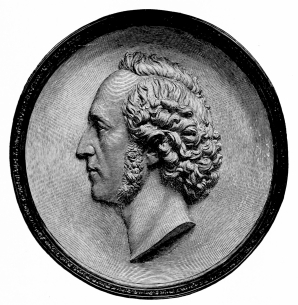
30. Medallion of Mendelssohn. Modelled by Knauer, of Leipzig, soon after the composer’s death, and presented to the Directors of the Gewandhaus.
earlier I shall not be able to come, but I hope I may find time to remain a little afterwards. In the course of next week I will send the last part of the manuscript.
It is not yet settled whether my wife goes with me, but I think she will.
With kindest messages, ever yours,
Felix M. B.
Leipzig, July 28, 1846.
My dear Friend,—Many thanks for your letter of the 18th, giving me the dates of the Festival and of the rehearsals. Your and Mr. Moore’s former letters had not stated these definitely; but now that I know them I can make my plans accordingly, and will be in London on the 17th, in good time for the rehearsal of the 20th. I should be glad if the Solos could be rehearsed at the piano on the 19th.
As the morning performances are to last three hours, the “Elijah,” which according to my calculation takes two hours, will not be enough by itself. But then I hope it can be so arranged that a whole piece, not a selection, can be given in addition to it, in the same way as the “Stabat Mater” stands on the programme for the first day. To be sure, it must rest with the Committee whether they will give one or two pieces before; but, however that may be, don’t let us have a ragout afterwards. If there must be three hours, do pray arrange it so that a single piece of three quarters of an hour’s duration be chosen. Besides, it would be a pity to spoil a programme which, as a whole, has a certain look of distinction about it.
And now I hope and trust we may soon meet again. Best love to all. My Cécile, I am sorry to say, will not be able to accompany me; too many reasons stand in the way of her doing so.
Yours ever,
Felix Mendelssohn Bartholdy.
Notwithstanding Moscheles’s efforts, Mendelssohn’s wishes were not complied with. After the performance of the Oratorio, Mario sang an air from Mozart’s “Davide penitente,” Grisi an air by Cimarosa, and the concert ended with a Chorus by Handel.
Leipzig, Aug. 9, 1846.
My dear Friend,—Once more a line (as our letters have crossed) to say that I hope to be in London on the 17th, travelling viâ Ostend and Dover.
All else about Miss Bassano, etc., verbally.
I have just gone through the orchestra parts of the Oratorio, and have corrected a number of faults, whereby I hope to have saved you much time. Good-by,—soon to meet.
Yours ever,
Felix M. B.
On the 18th of August Mendelssohn arrived in London, and on the following day a first rehearsal of the Solos was held at Chester Place. The Oratorio was performed on the 28th of August. On the 29th Moscheles wrote: “Your visit to Birmingham, and the production of your ‘Elijah,’ have opened a new world of art to me; your work has made an impression on my mind that can never be effaced. If I did not tell you so last night, when so many were pressing forward to congratulate you, it was because I fancied I felt more, and had more to say, than they. Besides, I preferred writing, to tell you how deeply impressed I am; for if I do so verbally, you will only give me the obsolete answer that dates from your boyhood,—‘There is much room for improvement; give me your advice,’ etc.,—and that, from you to me, is out of place. Improve, correct, as much as you think right; tell me why and wherefore you make this or that alteration; let me learn from you, and gratefully acknowledge that it is so. You might well put Beethoven’s motto,[55] ‘Man, help thyself!’ on your coat of arms; for God has endowed you with rare gifts, that permit you to approach Him in the true spirit of devotion and reverence.”
Hobart Place, Eaton Square, Aug. 29, 1846.
My dear Friend,—Your letter, which I just receive, makes me truly happy. Let me thank you cordially for the friendly sympathy and for the indulgence with which you have listened to my music. Your kind words of praise are more to me than words from any other quarter, and a great deal more than I deserve, according to my own estimation. Thanks, thanks! that is all I can say just now, although I should like to add so much. But I will wait till we meet in a day or two, or perhaps till we are taking some quiet stroll together round the city walls of Leipzig or elsewhere. Thanks again, and may you ever preserve your friendship and kind indulgence for me.
Yours for ever and a day,
Felix Mendelssohn Bartholdy.
Leipzig, Oct. 8, 1846.
My dear Friend,—I hasten to answer your kind steamer letter, and to say that I ordered the rooms in the “Blumenberg” a few days after my return, according to the memorandum in my pocket-book, which your wife dictated. I called once more at the hotel, on receiving your letter, and made sure that all was prepared for your arrival on the 21st. The maid with the requisite capacity for sewing is engaged, and we have been offered two most eligible suites of rooms for you, which are now anxiously awaiting your arrival.
The main point, however, I want to answer, my dear Moscheles, is that referring to your best mode of travelling. I must decidedly advise you to take Extrapost, not only because it is far more convenient when you are a party of five going so long a distance, but because I believe it to be no more expensive, in fact rather less so, than the Schnellpost, Courier, or any other means of conveyance, all necessitating your travelling day and night. The only difficulty might be your not having a carriage of your own,—that is, if, as I believe, you have not taken one with you. But it just happens that my mother-in-law, who is here, intends returning to Frankfurt towards the end of the month or early in November, and wishes to take Extrapost. Now, if you could hire a carriage, you would have the use of it one way, and my mother-in-law would be glad to take it for the return journey. Thus the only difficulty is overcome, and you would be obliging her into the bargain. I have not the slightest doubt this mode of travelling would be far the most convenient and agreeable for all of you, and therefore most decidedly advise it in preference to any other. You know that if you want to travel as quickly in Germany as you do in England, you must not take Extrapost, but Courier-horses, which is expensive, although not as compared to England. If however you do not care for such extra speed, you give the postilion a tip of ten or twelve groschen, and you will do the German mile in about three quarters of an hour. Leaving at seven o’clock in the morning, you will be the first evening in Butlar, the second in Weimar, where you will find very good accommodation in the Erbprinz. Please let me know when you start, and about what time you expect to be here, so that we may meet and welcome you on your arrival.
Everybody here is rejoicing at the prospect of your coming, especially the musicians, more especially those of the Conservatorio; but far ahead of any of them,
Yours,
Felix M. B.
Moscheles writes that he expects to arrive on the 21st of October, and adds: “I go to Leipzig hopeful of the future, and filled with the most pleasant expectations. On the one hand I look back to England and its art-aspiring people with the warmest appreciation. On the other I rejoice at the prospect of living amongst the cultivated and art-loving citizens of Leipzig.” He arrived on the day fixed, when, as his diary says, Mendelssohn received him with the affection of a brother, and rendered him the services of a practised courier. The long-cherished plan was realized, and Moscheles soon entered on his new duties at the Conservatorio.
Moscheles was soon comfortably settled in his new quarters in Gerhard’s Garten,—a spot of historical interest. There the Battle of Leipzig was once fiercely contested; now, however, it was peaceful and pleasant enough to make an exceptionally charming place of abode.
At the Conservatorio Moscheles entered on his new duties, which proved as congenial to his taste as he had expected. The pleasures, too, of daily musical and friendly intercourse with Mendelssohn he now enjoyed to the fullest extent.
On the 6th of January Moscheles writes: “It was a pleasant evening we spent at the Mendelssohns’. Our Felix was invited too, and was privileged to enjoy such music as usually falls to the lot of the initiated only. Joachim, our favorite, was there also. Mendelssohn played us some parts of his yet unpublished ‘Elijah,’ in which, since its performance in Birmingham, he has made sundry alterations, to which he attaches much importance; for instance, in those passages where the widow seeks help of Elijah he has given much more prominence to the part of the prophet.”
January 24.—“With David at Mendelssohn’s, who played and sang parts of his ‘Elijah’ to us. Among the changes and additions he has made, I was particularly struck by a Terzet in D major for two sopranos and one alto. All seems now to combine to make this work as varied as it is great.”
January 28.—“Mozart’s G minor Symphony at the Gewandhaus. Mendelssohn took the time of the last movement more moderately than is usually done, all chromatic modulations thus being brought out much more clearly than I have been accustomed to hear them.”
During a choir rehearsal of the “Elijah” in the Gewandhaus, Moscheles took notes of some of Mendelssohn’s directions:—
“‘Out with the vowels! The hea-thens. Who made the heavens and the wa-ters.’
“No. 5. ‘Rather err on the side of vigor than on the side of drowsiness.’
“No. 8. ‘From the very beginning the music must sound fresh—not only towards the end.’
“No. 20. ‘I want to hear Tone,—what one might call Music.’”
Mendelssohn’s last birthday, the 3d of February, 1847, was celebrated by his friends in Gerhard’s Garten. Old and young had made festive preparations for the occasion; in the Moscheleses’ drawing-room a stage had been erected, and every scrap of domestic talent was enlisted to entertain the hero of the day. Cécile Mendelssohn and her sister, Mrs. Schunck, opened the proceedings with a comic dialogue between two lady’s-maids, spoken in the Frankfurt dialect. Then the word “Ge-wand-haus” was enacted as a charade. Joachim, adorned with an eccentric wig, appeared as Paganini, and executed a brilliant improvisation on the G-string (in German, Ge-Saite). The scene between Pyramus and Thisbe in the “Midsummer Night’s Dream” followed and stood for Wand (wall). To illustrate the syllable Haus (house), Mrs. Moscheles had written a little domestic scene; and when, in the course of this, Moscheles, dressed as a cook, made his appearance, Mendelssohn burst into a truly Homeric fit of laughter. He was sitting in a large wicker-work arm-chair; and as, in the fulness of his enjoyment, he rocked to and fro, the chair joined in, bending and creaking in sympathetic rhythms. It was not till after a long interval that the cook could get a hearing. As a finale, the whole word was represented by the combined juvenile forces of the two families, each of the children being provided with some instrument, and Felix Moscheles wielding the conductor’s baton. Joachim led with a toy-violin. Of however doubtful a nature this musical treat may have been to Mendelssohn, he certainly entered most fully into the spirit of the thing, and appreciated every allusion to the real Gewandhaus; especially when Joachim made certain remarks in imitation of the master himself, Mendelssohn started off again, and the endurance of the sympathetic arm-chair was put to the utmost test.
After the performance, actors and public adjourned to the first floor, occupied by the Schuncks. In the centre of the supper-table stood the birthday cake, around which burned thirty-seven candles. At the foot of each, Mrs. Moscheles had written a few words descriptive of the year it represented,—from the cradle to the piano and the conductor’s desk; from his first attempt at composition to “Saint Paul,” “Elijah,” and the “Opera in spe.” In the centre stood the “Light of Life,” that was so soon to fail!
In the month of April of this year Mendelssohn visited England for the last time. He conducted three performances of “Elijah” in Exeter Hall, and was again active at the Philharmonic Concerts. On his return from England, the news reached him of the death of his sister Fanny Hensel. To her he had been linked throughout life by the closest musical sympathy and affinity, and it was thought he never quite recovered from the shock caused by her sudden death, rendered doubly painful by its occurring during his absence from Berlin, and at one of her own musical matinées.
At this time Moscheles and his wife, who were making a short visit in England, received the following letter from Mendelssohn:—
Baden-Baden, June 9, 1847.
My dear Mrs. Moscheles,—When I received your very kind letter, but could not answer it at once in the hurry of the last London days, I pictured to myself the pleasure of writing to you in a cheerful, pleasant tone, from some favorite spot in Switzerland, perhaps with illustrations or something of the sort. Now all that is changed. You know the heavy affliction which has befallen us, and how our inward and outward life has been shaken to its innermost depths, for a long, long time to come, perhaps forever. I am sure you sympathized with us in our irreparable loss, although you and Moscheles knew my sister but little. You can fancy, however, what I feel,—I, to whom she seemed present at all times, in every piece of music, and on all occasions, whether of happiness or of sorrow. Indeed, such is the case with us all; words are nothing at such a time; and yet I cannot speak of anything else. Forgive me, then, if these lines contain little else than hearty thanks for the letter above mentioned, which was another kindness added to the many which followed every step of my last visit to London.
We shall not go to Switzerland under the circumstances; for we could not now derive any real pleasure from the journey, and probably I shall return to the North sooner than I intended. I often feel irresistibly drawn to Berlin, where my youngest sister is now all alone. My brother has been here for the last week; and certainly nothing can do us so much good as our walks in the woods, the secluded and regular life we are leading here, and, above all, the hours we spend with the children. My brother has brought his contingent of young people; and they, as well as mine, are in excellent health and spirits, and delight everybody who sees them. Cécile too is quite well, thank Heaven; however, deeply afflicted.
I hope to hear a favorable account of your visit to England, and trust you will not remain too long; so that the Leipzigers, and, above all, those pianoforte pupils of yours, may get their full share of that instruction which they are thirsting for. The Londoners will, to be sure, say the same thing; but you have spent so many years amongst them that you must now do something for the German cockneys, or country cousins, or whatever you may choose to call them, whose faults I know as well as anybody, but who have also their good and admirable qualities, provided one can get over their cockneyism and old-fashioned ways. But that requires time, and it is for this reason I want you to come soon. What! I hear you say, that I may lose no time in getting used to the manners and customs of the natives? No, I answer; but to help us wage war on the pigtail.
Remember me kindly to all our dear English friends. I need not say that this letter is meant for Moscheles as well. Heaven grant health to you and yours! and remember kindly your
Felix Mendelssohn Bartholdy.
Of the numerous notes exchanged after Mendelssohn’s return we transcribe only the following:
Leipzig, Oct. 7, 1847.
My dear Friend,—As you kindly promised me your visit for to-morrow afternoon, could you not make it convenient to stay and spend the evening with us? And would not your wife, Mr. and Mrs. Roche, Serena, Felix, and Clara join you then, and take tea with us? That arrangement would give great pleasure to Cécile and the children.
Now, I hope you all think as they do, and will say yes, and delight
Yours (in the singular and plural),
Felix M. B.
This was the last note from the hand of Mendelssohn that Moscheles received. The days that the two friends should spend together on earth were numbered, but nothing foreboded the hour of separation that was so soon to strike. In Moscheles’s diary we find daily memoranda of the usual friendly intercourse with Mendelssohn.
So on the 3d of October:—“In the afternoon we treated ourselves to some Fugues and Gigues of Bach’s, and I was struck by Mendelssohn’s intimate acquaintance with them. Then he gave us an imitation on the piano of a certain Polka which had been inflicted on him daily by a band of street musicians in Frankfurt. The trivial as well as the serious is food to his mind, and his impressions on all sides are turned to account in his compositions.”
October 5.—“I spent the whole afternoon with Mendelssohn. He was pleased to see me, and we chatted confidentially on art and artists and Leipzig affairs generally. He played me a manuscript Quartet for string instruments in F minor, the four pieces of which are all in that sombre key. The impassioned character of the whole seems to me in keeping with his present frame of mind, shaken as he is to the heart’s core by the loss of his sister.”
October 7.—“Mendelssohn called to fetch me for a walk. In spite of the falling rain, we went to the Rosenthal, and time flew amid the most interesting conversations.”
October 8.—“Examination of pupils for reception at the Conservatorio. Mendelssohn, who took an active part in the proceedings, tested them in thoroughbass and wrote out examples on the blackboard. Whilst they were at work, he sketched the most delightful landscapes—ever a creative genius!... Passed a most interesting afternoon and evening with Mendelssohn. He played his Violoncello Sonata in D major with Rietz, and the two Beethoven Sonatas, Op. 102; then my Sonate Symphonique with me.”
On the following day, the 9th, another walk in the Rosenthal is recorded in the diary. It was a day not to be forgotten. Mendelssohn had much to tell of his last stay in England. He related the charming incidents of his visit to Queen Victoria and Prince Albert, and spoke of many mutual friends. At one o’clock he parted from the Moscheleses in the most cheerful mood; but it was only a few hours later that he was attacked by the illness from which he never recovered; and now followed days of anxiety and suspense, broken only by hopes that were not to be realized.
November 3.—“Mendelssohn better in the morning. In the afternoon another apoplectic stroke, depriving him of all consciousness. In the evening Charlotte and I, Madame Frege, David, and Schleinitz remained in the house till eleven o’clock.”
“Thursday, November 4.—Before the day dawned my Felix had been to inquire, but could only bring us the most disheartening news.”