LETTERS OF FELIX MENDELSSOHN. (continued 2)
Felix Moscheles translation
With best thanks I return the books you lent me, namely, Nathan, two volumes of Zschokke, the last volume of “Phantasie-Stücke,” and the musical paper; so please destroy whatever acknowledgment of these you may have. Please give bearer the address of that faithless laundress, with whom I should be in a rage if she were not under your immediate patronage.
Best love to Moscheles.
Felix Mendelssohn Bartholdy.
P. S. So far I have not yet learned to tie that cravat (I practised yesterday before the looking-glass); but it is beautiful all the same.
On the 29th of August Mendelssohn left London; and after a short stay in Berlin, he proceeded to Düsseldorf to assume his new duties as “Musikdirector.” He had accepted this position for three years, at a salary of six hundred thalers per annum, with three months’ leave of absence.
The original score of his Overture to the “Isles of Fingal” he gave to Moscheles. We reproduce
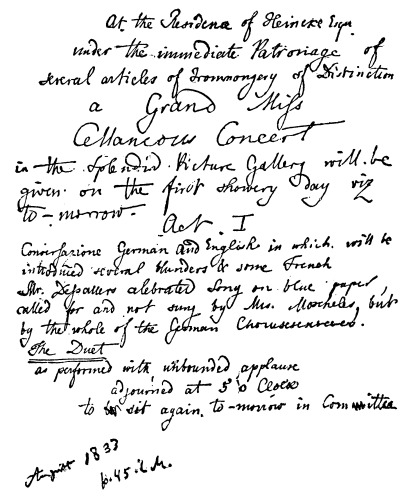
10. Fac-simile of Humorous Note. (See page 70.)
the first page of it. On perusing it some fifty years after it was written, Gounod made the note at the foot.[23]
Sept. 13, 1833.
Dear Mrs. Moscheles,—Here is Berlin, September 13, and my father once more safely lodged in the Leipzigerstrasse, and feeling quite well. I should write you a long and detailed letter, if I did not wish to send a few words without delay from this place, which we reached yesterday, and which I must leave again the day after to-morrow; you can fancy how the whole day is spent in the family circle, with neither time nor inclination for letter-writing. But to look back upon the anxious days I have gone through, to remember all the kindness shown me, to feel that I am relieved of a great responsibility, and to think of those who assisted me in bearing its weight,—that I have both leisure and inclination to do, and that is the purport of this letter. Here all are well and cheerful, and send their best love. My father was unlucky enough to tread a nail into his foot, as we were visiting my uncle’s place on the Rhine, on the very day the steamer brought us the Dirichlets.[24] So he was laid up again for several days, and had to perform the whole journey to Berlin stretched out in the coupé. This little accident caused him more depression than his serious illness in London, so that he felt excessively impatient to see his own home again, and almost despaired of it. This, and in particular our necessarily slow progress, with so many inns and nights’ lodgings, made the whole journey most irksome, and my own impatience became the greater for having to conceal it. But at last I felt happy indeed, as we drove into the well-known courtyard, and the journey was safely over. The foot was but slightly injured, and to-day my father is allowed to walk about.
Excuse haste. I shall write properly from Düsseldorf, where I must be in a few days. And now farewell to you both. My love to Felix, Emily, and Serena. Wish I could send her two carnations. Pray give them to her in my name.
Wishing you all happiness, I am yours,
Felix Mendelssohn Bartholdy.
Düsseldorf, Nov. 25, 1833.
Dear Mrs. Moscheles,—Should this piece of paper have turned red by the time Klingemann arrives, it will but reflect my blushes. But when once a man has become callous, he is no longer amenable to kindness and friendliness; callous he remains, and keeps on sinning to his heart’s content. And that, I am sorry to say, is my case. And this does not even pretend to be the answer to your most kind letter, but my own act of accusation, bearing witness that I really received your letter, and nevertheless remained deaf and dumb,
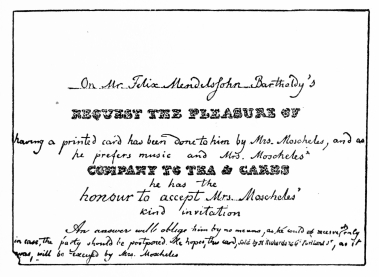
11. Card of Invitation filled in by Mendelssohn. (See page 70.)
and that you would be quite justified in not even reading all this. The truth is, that since I have got used to this place, I feel quite at home and settled in it. I am working a good deal for myself and for the outer world, and that, in other words, means that I am happy. This I ought to have described to you at full length, but could not (perhaps Klingemann can do so verbally), and so kept silent; but towards Christmas I mean to send you some new compositions and a letter as well, and then Moscheles must give me his opinion of the music, according to his promise. He will by that time have conducted my Overture in F, and will report about it, so that I shall have a letter in spite of my sins. Now, that is being hardened indeed! Better change the subject.
Herewith is the book of Songs formally made over to you, your heirs, executors, and assigns; if Klingemann doesn’t give it up, he is worse than a gazzo-ladro. I do intend sending you a proper book of manuscript songs at Christmas; but you won’t believe me, so I’ll set about writing it first.
And how about Moscheles’s four-hand Sonata?
After all, this is but a note, and I ought to conclude by saying: “I am truly sorry I cannot dine with you this day week, because I have a previous engagement at Mrs. Anderson’s.”
All love to Emily and Serena, and every good wish for your welfare. Should little Felix show his content by saying “Ba!” or otherwise prove his friendly disposition, you must tell him about his godfather, and give him his love. Now farewell, and fare ever well.
Yours,
Felix Mendelssohn Bartholdy.
Düsseldorf, Feb. 7, 1834.
My dear Friend,—Pardon my long silence; I know how guilty I am, but I reckon on your indulgence. I am so deeply buried in my work and papers, that even now I think I should not have emerged from them, were it not that a special circumstance obliges me to write to you. So let me pass over the last four months and all my excuses into the bargain, remembering what a dear old friend you are, and how ready to forgive.
Thus encouraged, I fancy myself in Chester Place, and wish you “Good-evening.” What I have to say is this: I have ventured to dedicate to you, without asking your permission, a piece which is to appear at Simrock’s, and which I am very fond of. But that is not what I was going to say. I had thought how nice it would be if you met with it during one of your trips to Germany; but now my Rondo Brillant is just finished, and I have the very greatest desire to dedicate that also to you: but I do not venture to do it without your special permission, for I am well aware that it is not the correct thing to ask leave to dedicate two pieces at once; and perhaps you will think it rather an odd proceeding on my part, but I cannot help it, I have set my mind upon it.
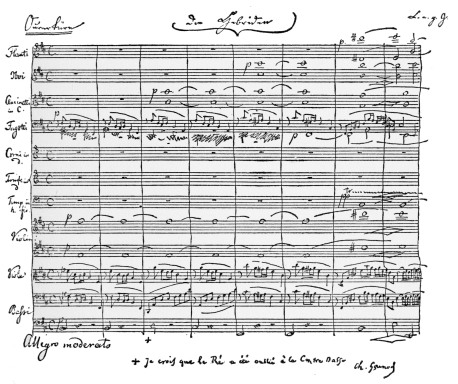
12. First Page of the Original Score of Mendelssohn’s Overture to the “Isles of Fingal,” given to Moscheles. On perusing it fifty years later, Gounod made the note appended. (See page 77.)
In general, I am not very partial to dedications, and have seldom made any; but in this case they are to convey a meaning, inasmuch as, not having been able to send you a letter for a long while, I wanted at least to let you have some of the work I have been doing. Write me a line on the subject, as the Rondo is to appear in Leipzig too; and once you have written that line you may feel inclined to add another, or perhaps a few more, as you did in your last kind letter, for which I have not even thanked you yet.
Klingemann is not prodigal of words, so that I have heard but little of London friends, and particularly little of those in Chester Place. What do you all look like? What can Felix say? Does Serena remember her humble servant with the carnations? And how fares the Sonata for four hands? Do tell me all about that and your other work. I would ask Mrs. Moscheles to let me know all about it, but I feel she must be so angry with me that I don’t think I can summon courage to write to her. The last of your compositions I heard of was the Impromptu for Mary Alexander, and since then I am sure you have produced all manner of delightful things. My own poverty in shaping new forms for the pianoforte once more struck me most forcibly whilst writing the Rondo. It is there I get into difficulties and have to toil and labor, and I am afraid you will notice that such was the case. Still, there are things in it which I believe are not bad, and some parts that I really like; but how I am to set about writing a calm and quiet piece (as you advised me last spring), I really do not know. All that passes through my head in the shape of pianoforte music is about as calm and quiet as Cheapside; and when I sit down to the piano and compel myself to start improvising ever so quietly, it is of no use,—by degrees I fall back into the old ways.
My new Scena,[25] however, which I am writing for the Philharmonic, will, I am afraid, be only too tame. But so much self-criticism is no good; so I stick to my work, and that means, in plain language, that I am well and happy.
I feel particularly comfortable in this place, having just as much official occupation as I want and like, and plenty of time to myself. When I do not feel inclined to compose, there is the conducting and rehearsing, and it is quite a pleasure to see how well and brightly things go; and then the place is so charmingly diminutive that you can always fancy yourself in your own room; and yet it is complete in its way. There is an opera, a choral society, an orchestra, church music, a public, and even a small opposition; it is simply delightful. I have joined a society formed for the improvement of our stage, and we are now rehearsing the “Wasserträger.” It is quite touching to see with what eagerness and appetite the singers pounce upon every hint, and what trouble they will take if anybody will be at the pains of teaching them; how they strain every nerve and really make our performances as perfect as can be imagined considering the means at our disposal. Last December I gave “Don Juan” (it was the first time I conducted an opera in public), and I can assure you many things went better and with more precision than I have heard them at some of the large and famous theatres, because from first to last every one concerned went in for it heart and soul; well, we had twenty rehearsals. The lessee of the theatre had, however, thought fit to raise the prices on account of the heavy expenses; and when, at the first performance of “Don Juan,” the curtain rose, the malcontent section of the public called for Signor Derossi like mad, and made a tremendous disturbance; after five minutes, order was restored, we began and went through the first act splendidly, constantly accompanied by applause; but lo and behold! as the curtain rises for the second act, the uproar breaks out afresh, with redoubled vigor and persistence. Well, I felt inclined to hand the whole concern over to the devil,—never did I conduct under such trying circumstances. I countermanded the opera which was announced for the next night, and declared I would have nothing more to do with the whole theatre; four days later I allowed myself to be talked over, gave a second performance of “Don Juan,” was received with hurrahs and a threefold flourish of trumpets, and now the “Wasserträger” is to follow. The opposition consists mainly of beerhouse keepers and waiters; in fact, by four o’clock P.M., half Düsseldorf is intoxicated. Anybody wanting to see me must call between eight and nine in the morning; it is quite useless attempting to do any kind of business in the afternoon.
Now, what do you think of such a discreditable state of things, and can you have anything more to say to such boors as we are?
By the by, Mr. Spring of Moscow is quite destroying my peace of mind. He would have it that he knew you very well, and I would not believe him on any account; at last he showed me a manuscript note of invitation from Chester Place, and I had to give in, but still I cannot digest him;—a pity that at his age, and with as little talent as he seems to have, he should be obliged to give concerts and make money.
Blagrove was here. I took him to our Choral Society, where we were just rehearsing the choruses from “Alexander’s Feast;” our performance produced the most excellent effect on him,—it sent him to sleep.
Can you not send me one or the other of your new things (a copy or whatever you like)? The gentleman who takes charge of this returns shortly, and would, I am sure, be the bearer of your parcel. So, if you have anything, please send it to Klingemann’s, and it shall be called for.
I hear from my mother that the “Gipsies’ March,” or rather the “April Variations,” are out. Is that the case; and if so, could I have a copy of them? I hope you have done a good deal of patching and polishing to my part,—you know, I am thinking of those restless passages of mine. The whole of the last number wants repairing or lining with a warm melody; it was too thin. The first variation, too, I hope you have turned inside out and padded. Don’t I speak as if I were Musikdirector Schneider? And can’t you send me one of Mori’s annual gems? But I must really take courage and another little sheet of paper and write to your wife, for I haven’t half done. Good-by—till we meet on the next page.
Your
F. Mendelssohn.
Düsseldorf, Feb. 7, 1834.
Dear Mrs. Moscheles,—It is only after having given two hours to writing to Moscheles, that I venture on the letter to you. Never have I so richly deserved a scolding as now; I say deserved, for I may not get it, you have so often let me off. What, as compared with my other delinquencies, are such trifling peccadilloes as talking German at dinner, not carving at the Stones’, having threadbare coat-buttons, and not paying compliments à la Hummel? But does it perhaps give you satisfaction to hear that I have a very bad conscience, or that I have some kind of feeling like a naughty child about to confess, or that Klingemann too has given up writing to me? To speak seriously, there are many minutes in the course of each day when I think of your dear home, wishing I were there, and enjoying the recollections of the time I have spent in it. That much you must believe; but whether out of such thoughts grows a letter or not, depends more or less upon chance. I am sorry to say I shall not be going to England this spring. I mean to have a good spell of work, and have something to show for it before I stir from here. You can hardly imagine how much better and brighter I feel for the last two months’ work, and how much easier I get on with it; so I must keep it up, and get into full swing. My birthday just came in time to remind me how necessary this was. Of my life here, I have already written a good deal to Moscheles. The other day we gave “Egmont” with Beethoven’s music. I doubly enjoyed it, for I hadn’t heard anything of his for a long time.
By the by, you are rather opposed to Goethe in some things; so I recommend you to read a newly published correspondence between him and Zelter, in which you will find plenty of matter to confirm your opinion; and yet I should vigorously oppose you, and stand up for my old favorite as formerly. Do you know the chorus on Lord Byron, which occurs in the second part of “Faust” and begins with “Nicht allein”? Should you not know it, pray read it at once, for I believe it will please
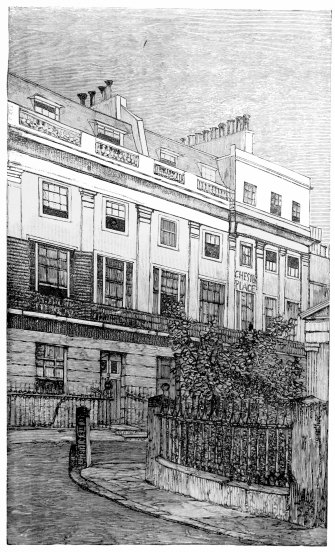
13. Chester Place. From a Drawing made by Mendelssohn in an autograph album given by him to his godchild. (See page 69.)
you. Just now English tea-time is coming on, and with it I feel all my fear vanishing. To-day there is a grand déjeuner dansant,—of all the hateful Berlin institutions the one I hate the most. A nice set they are! They meet at half-past eleven A.M., and spend their time eating and drinking until one o’clock next morning. There are few things so unsightly in my eyes, whether it is done in broad daylight, which is one way; or whether the shutters are closed at midday, and the chandeliers lighted, as they do at Court in Berlin. Besides, there has been dancing for the last fortnight, usually up to five o’clock in the morning, with Prince Frederick taking the lead, giving as many balls and accepting as many invitations as possible. I have been saved all these splendors by a bad cold, which has confined me to my room for more than a week. I am getting over it now; but it will serve as an excuse for keeping aloof until the end of the Carnival. So you see that we too are metropolitan to the best of our abilities; and if this page of mine has not made you feel quite Berlinese or Bœotian, an account of all our dinner-parties, I am sure, would.
I wanted to send you some new songs, but must again put it off, as I have a great deal to prepare for this parcel. I should like to know, too, how you are getting on with your singing,—whether you practise sometimes, and follow the wise rules of your wise professor.[26] You want to know whether I am rapidly degenerating here, and whether I stand in awe of any one as I did of you with regard to elegance, or rather neatness? Madame Hübner, whom you must have seen at Berlin, does sometimes take me to task, and sees at a glance, on my entering a room, some shortcoming which it might take me six months to notice; but she is not as good a Mentor as you, so that I fear you will find me quite run wild, should I venture again out of my backwoods; and as for my capacity for tying a cravat with taste, that will be a thing of the past. But when we meet, you will find me as willing a pupil as ever.
Love to Emily and Serena and to my little godson. The little man cannot yet understand it, but never mind. Adieu then, and be well and happy.
Ever your
Felix Mendelssohn Bartholdy.
On the 12th of February, 1834, Moscheles writes:—
I have read and studied your Overture (“Melusine”) with ever-growing interest; and let me say, in the fewest of words, that it is a splendid work. It is marked by vigorous and spirited conception, unity, and originality. Thus impressed, I proceeded to the first rehearsal, after having gone through it privately with Mori. But it was not an easy matter to moderate the orchestra in the piano parts; especially at the outset they would make a desperate plunge, and the trumpets were somewhat surprised at having to fall in with their 7th on C. I winced and groaned, and made them begin again three times. The contrasting storms went as if Neptune held the sceptre; but when the voices of the Sirens were to disarm that boisterous ruler, I had to call for piano, piano! piano! at the top of my voice, bending down to the ground, à la Beethoven,[27] and in vain trying to restrain the ferocious violins and basses. However, at a second reading things went better. The work was studied with the liveliest interest, and received with the fullest appreciation. I hope to bring out the lights and shades still better at the performance. You have given the horns and trumpets, alternately, the
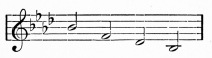
which they rendered splendidly with stopping and damping.
After yours I had Berlioz’s Overture, “Les Francs Juges,” to conduct. We were all curious to know what the result of French genius would be. I say French, for so far no other country but France has recognized Berlioz as a genius. But, oh! what a rattling of brass, fit for the Porte Saint-Martin! What cruel, wicked scoring! as if to prove that our ancestors were no better than pedants! And, oh! again, for the contrast of the middle subject, that would console us with a vaudeville melody, such as you could not hear to more advantage in “L’Ours et le Pacha,” or the “Viennese in Berlin.” Then the mystic element,—a progression of screeching harmonies, unintelligible to all but the March cats! To show that something terrible is agitating the fevered brain of the composer, an apoplectic stroke of the big drum shakes to shivers the efforts of the whole orchestra, as also the auditory nerves of the assembled audience....
Our “Gipsies’ March” is out,—in London at Cramer’s, in Paris at Schlesinger’s, in Leipzig at Kistner’s. Kistner has sent a copy in our name to Frau von Goethe, to whom we have dedicated the piece. You approve of that dedication to her, don’t you? Your half-share of the proceeds is, eight Napoleons from Schlesinger, eight Louis d’or from Kistner, and fifteen to twenty pounds from Cramer.
I will carefully keep the account; so, if you want money, draw on your banker and friend,
I. Moscheles.
Düsseldorf, April, 1834.
My dear Moscheles,—I cannot tell you how much pleasure those letters from you and from your wife gave me. I don’t think the post ever put me in such high spirits before. I certainly never felt so happy and elated for days together
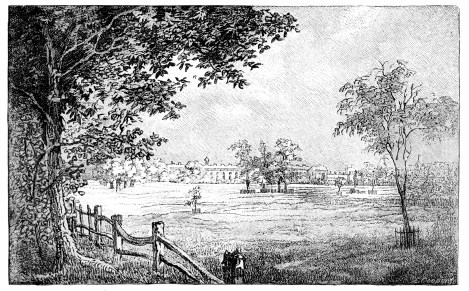
14. Regent’s Park. From a Sketch made by Mendelssohn in an autograph album given by him to his godchild. (See page 69.)
as I did after getting them. You know how often I am beset by grievous misgivings, how I cannot do anything to my satisfaction, and how, when such doubts lay hold of me, I fancy the whole world must be aware of my shortcomings, even more than I am myself, and must overlook the very existence of my works. But such kind and friendly words as you have written about my Overture give me greater pleasure than anything that I could hear after completing a composition. This I know for a certainty: you might have sent me three of the finest Russian orders or titles for the Overture without giving me one hour’s happiness such as I have had from your letter. Do you really know how kind and amiable you were? Because, if you do, I need not attempt to thank you.
But now let me say how grateful I am for all the trouble you have taken with my Overture. It is quite a painful feeling to have a piece performed and not to be present, not to know what succeeded and what went wrong; but when you are conducting I really feel less nervous than if I were there myself, for no one can take more interest in his own works than you do in those of others, and then you can hear and take note of a hundred things that the composer, preoccupied as he is, has no time or mind for.
I had already heard from Klingemann what a true friend you had been to my Overture, and now your description puts it all so visibly before me. After reading your letter, I took up the score, and played it straight through from beginning to end, and felt that I liked it better than before.
By the way, you complain of the difficulty in getting the pianos observed; and as I was playing the piece over again, it struck me that that was really my fault. It is easily remedied, for the whole thing, I believe, is due to the marks of expression; if you have those altered in the parts, it will be set right at once. First, everything should be marked one degree weaker; that is, where there is a p in the wind instruments, it should be pp; instead of mf, piano; instead of f, mf. The pp alone might remain, as I particularly dislike ppp. The sf’s, however, should be everywhere struck out, as they really are quite wrong, no abrupt accent being meant, but a gradual swelling of the tone, which is sufficiently indicated by the . The same again wherever the

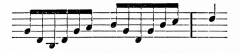
etc. recurs; in all such passages the sf’s should be done away with; and in the strings as well: for instance, at the very opening, and where the trumpets first come in, it should be pp; the f’s should simply disappear. Klingemann would, I am sure, oblige me by making these alterations in the score, a copyist would transfer them to the parts, and then the whole thing would sound twice as mermaidish.
What you say of Berlioz’s Overture I thoroughly agree with. It is a chaotic, prosaic piece, and yet more humanly conceived than some of his others. I always felt inclined to say with Faust,—
“He ran around, he ran about, His thirst in puddles laving; He gnawed and scratched the house throughout, But nothing cured his raving; And driven at last, in open day, He ran into the kitchen.”
For his orchestration is such a frightful muddle, such an incongruous mess, that one ought to wash one’s hands after handling one of his scores. Besides, it really is a shame to set nothing but murder, misery, and wailing to music; even if it were well done, it would simply give us a record of atrocities. At first he made me quite melancholy, because his judgments on others are so clever, so cool, and correct, he seems so thoroughly sensible, and yet he does not perceive that his own works are such rubbishy nonsense. I am very glad to hear what you say about the “Gipsy Variations;” but do tell me whether you are not treating me much too liberally, for I never in my life should have dreamed of such high terms as now fall to my share alone. The E flat for the horns and trumpets I put down trusting to luck, and hoping that Providence would show the players some way to do it; if they have new contrivances for it, so much the better.
You sent me word not to let Mori have anything more gratis, on account of his indiscretion; I am doubly sorry for this, as I have just presented him with a manuscript, to make up for having kept him waiting six months for the Rondo. I did not like the idea of his having to pardon any shortcoming of mine, so I thought it the best way out of the difficulty, and now, although regretting the circumstance, I must of course keep my word; but for the future I will act upon your hint. That piece for Fanny Stone I should of all things like to write, but how am I to compose something easy? Well, I will set about it, and do my best to avoid octaves and broken chords; then there will be no ornamental passages at all, for you know I never write any others. No, but really I will look out seriously for a piece that I can dedicate to her.
But now I must write a few lines to your wife and beg her soon to let me have more of such good news about my dear Master Felix and Miss Serena and the grown-up young lady.
I suppress my thanks to you, dear Mrs. Moscheles, for all the kind things you say; I only wish I could now and then write something which would give you real pleasure, and that I could believe myself worthy of doing so.
I have just had a letter from my sister in Berlin. She tells me you had written all about the Overture to my father, and had given him immense pleasure; and there again I must particularly thank you, for you know how pleasant it is to have one’s praises sung to one’s parents.
I do wish I could once more call Emily “Du,” but this spring I shan’t be able to get away; in fact, I shall probably not travel at all, but buy a horse, and ride and swim and work all through the summer. Next spring, when, please God, I once more knock at the door of No. 3 Chester Place, I shall speak English and say, “You;” that will appear less strange to me than the formal “Sie.” Then, when I return some day a long time hence, I shall sit and play at écarté whilst she dances, and shall notice Mr. Stone or some other young man extremely attentive to her. To be sure, he will have to be very cautious about it, for fear of losing your good graces. And then Felix will show me the score of his first Symphony and play it with Serena. By that time I shall be a vieux garçon or a ci-devant jeune homme,—but this isn’t a pleasant subject; better drop it; it was really you who put me on to it by your artful allusions to the better things awaiting me, and by your remarks about the soirée at the Taylors’, and about Mrs. Handley, who, by the side of her husband, must look like a white mouse by the side of a black tom-cat, or like a duet for clarinet and double bassoon, or kid gloves and a Warsaw dressing-gown, or vanilla ice next to roast beef, etc. You see at a glance that I am still a warm admirer of hers, or I should not compare her to such nice things, but rather to Maraschino ice, or a hautboy. I returned last night from a trip to Cologne, where I had to play at a charity concert, and where your description of the Cologne public and Cologne musicians, so dear to you, was most vividly brought back to my mind. I would rather live in any village than there; and much as I like Düsseldorf, I do not believe I could live for even a couple of months at Cologne.
I am taking regular lessons in water-colors now with one of our artists, and work most enthusiastically for several hours every Sunday morning. Shall I send you a sketch? And what country is it to represent? Switzerland or Italy? In the foreground I shall introduce a girl with a green apron and a carnation, to ingratiate myself with Serena. I only wish I had more leisure, but just now all my time is taken up by the rehearsals of the “Wasserträger.”
By the by, do you know a book by Thomas Moore[28] on religion? It has lately appeared; it is said to have gone through at least seventy editions, and to extinguish all Protestants, Dissenters, nations, and nationality. It is read here by all the Orthodox Catholics, and praised highly.
I have lately read Shakspeare’s “King John” for the first time. I do assure you it is downright heavenly, like everything else of his. But now I must end at once, or I shall begin talking about Goethe and Zelter’s letters, which I did not like much. You are of a different opinion, so my letter might become not only long, but tedious, which it is already; besides, the paper obliges me to conclude. Should Emily or Serena ask after me, or the baby be in good humor and crow, and should that American prodigy be so completely “finished” that not one finger remains untrained, or should some lady—thank Heaven—put off her lesson or not come, then, and that as soon as possible, let me have a few lines telling me that Chester Place is flourishing.
Once more thanks, and farewell.
Felix M. B.
Düsseldorf, May 11, 1834.
Dear Mrs. Moscheles,—On the very day I received your dear kind letter and the beautiful present, I was going to answer at full length, and with best thanks, but there arrived at the same time the news of my mother’s dangerous illness. To-day there is excellent news, thank God! My mother has been walking in the garden, and is quite herself, and of course so am I; and in this happy mood, when a great load has been taken off my mind, and I can breathe more freely, I sit down at once to write and thank you.
Not being able to cross over to you this year, I do hope and trust you will let me have a few lines now and then; for while I read them I am in Chester Place, I follow your descriptions, live through it all with you, rejoice at Lord Burghersh’s absence from the party, make remarks about Miss Masson’s delicate form of “couching her refusal,” abuse Masoni for that Beethoven Sonata, and admire Miss Use’s beauty, although I know it only by hearsay.
And how grateful I am to you, dear Moscheles, for doing my Rondo the honor of playing it at your concert! You may believe that I fully appreciate it, and feel greatly flattered; and now, if anybody abuses it ever so much, I shall still love the piece and hold it in high consideration. Please write me word if you like the accompaniments, or if you find fault with any part of them. I may perhaps write something of the kind in the course of this year, and should like to avoid former faults.
The cravat, however, dear Mrs. Moscheles, I put on at once, and, so adorned, went out for a ride. You must know I have bought a nice bay horse, and it gives me immense pleasure. When I went to the Hübners’ in the evening, Madame Hübner asked if that cravat was English too. I gave her your message, and she reciprocated it very sincerely. But you have not told me what composition I am to write in the time saved by this cravat which does not require tying. It is to you I shall owe the spare time, and you ought to say how I am to employ it. Shall I write pianoforte pieces, songs, or what else?
And so the people at the Philharmonic did not like my “Melusine”? Never mind; that won’t kill me. I felt sorry when you told me, and at once played the Overture through, to see if I too should dislike it; but it pleased me, and so there is no great harm done. Or do you think it would make you receive me less amiably at my next visit? That would be a pity, and I should much regret it; but I hope it won’t be the case. And perhaps it will be liked somewhere else, or I can write another one which will have more success. The first desideratum is to see a thing take shape and form on paper; and if, besides, I am fortunate enough to get such kind words about it as those I had from you and Moscheles, it has been well received, and I may go on quietly doing more work. I cannot understand your news that Moscheles’s new Concerto met with the same reception. I thought it as clear as sunshine that that must please the public, when played by him. But when is it to be published, that I may pounce upon it? Pray do excuse these disconnected sentences. Ries, the violin-player, is here (you remember his playing in Moscheles’s Trio at Berlin); he is going to give a concert to-morrow, and so I have been constantly interrupted by all sorts of people employed in the arrangements, and have to rehearse every day, in consequence of which my poor bay has not left its stable for the last three days (this, you see, is the principal subject on which my mind turns).
At Whitsuntide I must go to Aix-la-Chapelle to the musical festival, and am not the least inclined for it, since they perform pieces which my musical conscience revolts at; but go I must, for a quiet life, as the people of this place will have it that Ries and I are pope and anti-pope; and, Ries happening to conduct, they fancy me jaundiced with vexation, and think that I shall not go. But they are mistaken; I sip my “Maitrank,”—an excellent drink made of hock, aromatic herbs, and sugar,—and mean to go. This reminds me of Siboni. Oh, Siboni! how can you presume seriously to bring out your recipes for salad-mixing? And is De Vrught there too? And what sort of a figure does he cut at a dinner in Chester Place? Stop! By the by, have you heard of a Mademoiselle Meyer who has gone with her father from here to London to play the piano? She must, some time or other, pass in review before Moscheles, and I should like above all things to hear of her doings in London. The father would set me up here as his daughter’s rival, and has tried to abuse and vex me in every way, and, finding that I took no notice, is going to try what he can do in London.
Lovely weather we have had for some time, and there is every temptation to be perfectly idle, saunter about all day, and become a candidate for the title of Inspector of Nightingales, which they have conferred on an old lounger of this place. Warm days, and so delightfully long, and I have already begun my Oratorio, which is the reason I cannot go to the Westminster Abbey Festival, but must keep to my work. I have
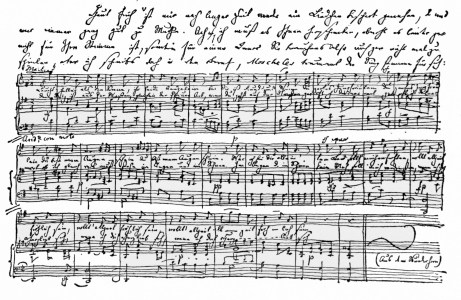
15. “Mailied,” in Letter of May 15, 1834, to Mrs. Moscheles. (See page 107.)
written a few Capriccios for the pianoforte (or Fantasias, or——) that I like very well, but an abominable Étude. This morning, for the first time after a long interval, a song has come to me; and such a present is at all times refreshing. I really must write it down for you, although I am sorry to say it is not at all suited for your voice, but rather for a tenor. You need not even play it; yet I write it down for you all the same. Moscheles can hum the melody to himself.
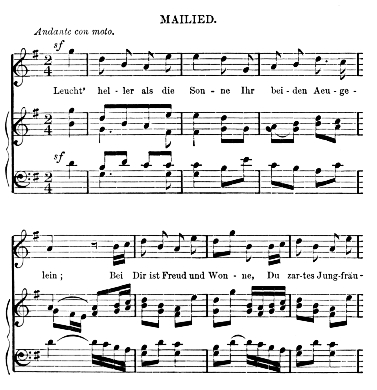
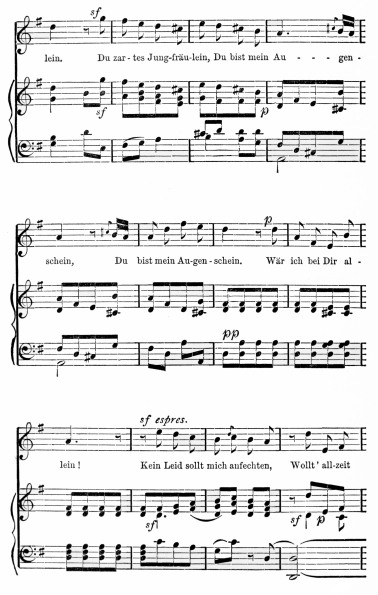
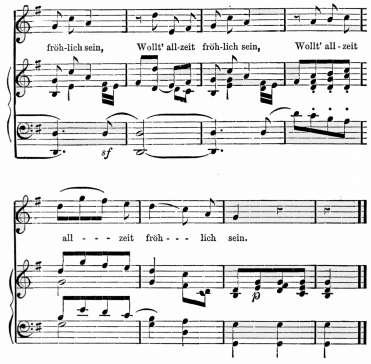
Dein Reiz is aus der Maassen Gleichwie der Pfauen Art, Wenn Du gehst auf der Strassen, Gar oft ich Deiner wart’ Gar oft ich Deiner wart’. Ob ich gleich viel muss stehn Im Regen und im Schnee, Im Regen und im Schnee, Kein Müh soll mich verdriessen, Wenn ich Dich Herzlieb seh’, Wenn ich Dich Herzlieb seh’, Wenn ich Dich Herzlieb seh’,. (Aus dem Wunderhorn.)
May 14.
This letter was begun three days ago, and I have not yet been able to finish it. Ries has left again. We played Beethoven’s grand Sonata in A minor, dedicated to Kreutzer, at his concert, and that by heart, which was great fun. I do not know whether I told Moscheles that the scores of my three overtures, “Midsummer Night’s Dream,” “Meeresstille,” and “Isles of Fingal,” will appear in a few days at Breitkopf & Härtel’s, which makes me unspeakably proud. As soon as they are to be had, they shall be presented to you, and I only wish I could have again dedicated them to you, my dear Moscheles; but as that wouldn’t do, my friends at home wished me to inscribe them to the Crown Prince, who has shown himself extremely gracious to me this last autumn. For my own part, I was thinking of the Philharmonic, and so it is undecided. A knotty point, you see.
And do you know, dear Mrs. Moscheles, that Varnhagen is going to be married again,—six months after his inconsolable book about his wife,—and that to my cousin Marianna Saaling. A young musician has just been here with an atrocious Fugue for me to look through; also another native genius who feels an impulse to write Chorales, enough to make one turn yellow with impatience; and yet he has written Chorales ever since I came here, the last always worse than the one before it; and as we go on being vexed with one another, there are some lovely scenes, he not being able to understand that I still find his compositions bad, and I that he has not improved them. I am, however, the very type of a good Cantor, and preach so much to the point that it is great fun to hear me. The lilies of the valley are out; how pleased I should be to send Serena some! But even without them, may she live and prosper, and Emily and Felix as well. And how about Emily’s tune? Now there is an end to my paper; indeed, I have talked nonsense enough.
Ever yours,
Felix Mendelssohn Bartholdy.
Düsseldorf, June 26, 1834.
You amiable couple in Chester Place!—Let me thank you a thousand times for that nice, good, kind letter that you have treated me to again; they are high days and holidays for me when I receive your letters, and can read them over and over again. If you, my dear Moscheles, thank me for the Rondo, I must thank you for thanking me; but I still maintain you are too indulgent. The other day, Dr. Frank, whom you know, came to Düsseldorf, and I wished to show him something of my A major Symphony. Not having it here, I began writing out the Andante again, and in so doing I came across so many errata that I got interested and wrote out the Minuet and Finale too, but with many necessary alterations; and whenever such occurred I thought of you, and of how you never said a word of blame, although you must have seen it all much better and plainer than I do now. The first movement I have not written down, because, if once I begin with that, I am afraid I shall have to alter the entire subject, beginning with the fourth bar,—and that means pretty nearly the whole first piece,—and I have no time for that just now. The dominant in the fourth bar strikes me as quite disagreeable; I think it should be the seventh (A-G). But many thanks to you and the Philharmonic for playing so much of my music. I am sure I am delighted, if only the public does not grumble!
And what do you say to their hissing little Herz? Why, that implies a high degree of culture! Has he consoled himself with guineas and pupils, or was it too crushing? You are particularly silent on the subject; and yet it is true, and Moritz Schlesinger will not be slow to triumph. Well, if he will only abstain from writing Variations for four hands, or, if that is too much to ask, if he will only avoid winding up with those Rondos that are so frightfully vulgar that I am ashamed to play them to decent people, then, for aught I care, let him be made King of the Belgians, or rather Semiquaver King, just as one says “Fire-King.” After all, I like him; he certainly is a characteristic figure of these times, of the year 1834; and as Art should be a mirror reflecting the character of the times,—as Hegel or some one else probably says somewhere,—he certainly does reflect most truly all salons and vanities, and a little yearning, and a deal of yawning, and kid gloves, and musk, a scent I abhor. If in his latter days he should take to the Romantic and write melancholy music, or to the Classical and give us fugues,—and I should not be surprised if he did,—Berlioz can compose a new symphony on him, “De la Vie d’un Artiste,” which I am sure will be better than the first.
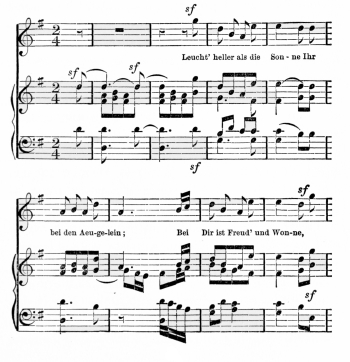
Stop; by the by, a few hours after my last letter was posted I altered the beginning of my “Wunderhornlied,” although I had not noticed the resemblance, and simply because I did not like it; and now comes your remark about the reminiscence, which is very striking. Who in the wide world will believe that I altered it before? You, for one, I hope. Anyhow, there is the date upon it, and the following beginning:—
What do I think of Vrught? I really have heard him too little to judge,—only once, and then he sang a song in two verses: the first quite simply and in his natural voice, so that I thought him the greatest singer I had ever heard,—it was truly beautiful; but in the second verse it was all shakes and skipping about, and I quickly changed my mind. Since then he has not behaved very well to me; but, for my part, I have no objection to giving him a copy of my Scena, only I do not think I can do so on account of the Philharmonic.
There is a passage in your letter, dear Mrs. Moscheles, that I protest I am mightily offended at. You say I declare that your letters are agreeable to me; and that I am sure I have never declared, because it is simply a fact. Besides, “agreeable” is not the right word: I am really grateful for the pleasure they give me. Then you say, too, I am not to care for public and critics; and that is just as bad. Am I not by trade an anti-public-caring musician, and an anti-critic-caring one into the bargain? What is Hecuba to me, and what the press (I mean the press that depresses)? And if this very day I had an idea for an Overture to Lord Eldon, in the form of a canon alla rovescia, or of a double fugue with a cantus firmus, write it I would, although I knew it could never become popular; how much more the lovely Melusina,—a very different subject! Only it certainly would be annoying if one never had a chance of hearing one’s things performed; but as you say that is not to be feared, let us wish the public and critics long life and happiness,—and me too,—and let me live to go to England next year.
Oh, Seigneur de Fahl, you live in my rooms! If rooms could speak, what stuff they would tell me next year, or what would they have told you! But I hope he is not going to remain in London, for if I could not have my rooms in No. 103 Great Portland Street it would put me out very much, since I lived there through so much of sweet and so much of bitter,—a whole chapter of my life.
Yes, certainly, my horse is more attractive than all the young ladies I knew in Berlin, it is so glossy and brown; then it looks so healthy and so very good-natured (and good-nature, every one knows, is not exactly what the Berlinese are noted for). However, I do not forswear marriage, for my father has prophesied that I shall never marry. There certainly is little hope of it just now, but I shall lose no opportunity of getting myself placed; and surely, if Varnhagen has succeeded twice, why should I not finally meet with some girl who would take me?
From Frau von Goethe I have a very kind letter, in which she sends me so many thanks for the Variations that I feel I ought to forward the greater part of them to you, my dear Moscheles.
Now let me write my message to Serena, and inform her that I shall pay her a visit next year, and present her with a large nosegay of pinks; and to Emily I will bring a brand-new tune, and teach it to her. Will you have some mustard or an oil picture?—those are the only choice productions of the place. And what am I to do in the mean while with my Choir, and the Opera, and my horse? Well, there’s plenty of time to think of that; so now good-night and au revoir!
When Moscheles has a moment of leisure let him send me a line and his best love. No more room to sign my name.
Moscheles gives Mendelssohn full particulars of the Birmingham Festival. An Oratorio of the Chevalier Neukomm’s and an unusually large number of the same composer’s works figured in the programme. “His style is Haydn’s,” says Moscheles; “occasionally elevated and bordering on Handel, but when you go into detail, you find many hackneyed modulations and figures. For the higher development of Art he has not done much, but in his ‘David’ there are numbers showing excellent workmanship and much ability in the use of all the means at his disposal.”
A Fantasia on the Organ he entitled “A Concert on a Lake, interrupted by a Thunderstorm.” The poetical element was missing, and the introduction of incidental thunderclaps and forked lightning on the organ only served to show up the weakness of construction in the whole thing.
Moscheles goes on to describe with enthusiasm the performance of the “Messiah” and of some of the most effective Choruses selected from “Israel in Egypt.” In speaking of the brass instruments, he says that the ophicleide is a very useful addition to the orchestra in large performances; “for,” he remarks, “just as you say of a steam-engine, it has ten-horse power, so of this you can say, it has ten-trombone power.”
Düsseldorf, Dec. 25, 1834.
Dear Moscheles,—Upon my word, I cannot stand my own base ingratitude any longer! I really must write at last. And why haven’t I done so for the last two months? I really cannot say, and certainly cannot find an excuse. The monkeys on the Orinoco, I recollect reading somewhere, do not talk because they have nothing to say, and I suppose I was somewhat of their kind; and then really I was at first in no mood for anything and had plenty of time, and then I was in high spirits and had no time at all,—in fact, I procrastinated. And now that I am about it, what in the name of worry am I to write about from Düsseldorf to a Londoner, and to such a one as you? Really this is such a mite of a place, where nothing ever happens. I cannot possibly send you the news that the Tories are in power. Never mind; I write that I may soon again hear from you. It is just because your letters give me so much pleasure, and bring your interesting life so vividly before me, that I would rather say nothing about our petty provincial affairs. Whilst you are driving at headlong speed, we are really driven like a herd of cattle.
I have one fault to find with your letter. But for Klingemann, I should not have known that you had composed an Overture to “Joan of Arc;” yet you surely cannot doubt that that, of all news, would interest me most. I congratulate you with all my heart if only on the choice of such an excellent and serious subject. I long to hear the Overture itself, but you are absolutely silent about it; in fact, I am quite in ignorance of what you have composed lately, or what you have got in your mind. Please give me full particulars of it,—in what key it is, how it is worked out, and how scored. If possible, jot down a few notes for me. And have you written nothing new for the piano? It would be quite a boon, for there is great dearth in that line.
Thanks for your description of the Festival; it is so graphic and interesting that I could have fancied myself there: I hear Neukomm extemporizing, and see Miss Rylands in the box. (Your account and your wife’s must be taken together.)
I quite agree with you in all you say about Neukomm’s music. Isn’t it wonderful that a man of such taste and refinement should not be able to transfer those qualities to his music? To say nothing of the fundamental ideas of his compositions, the working out seems so careless and commonplace. The Fantasia is probably an example of that kind of thing; and had I come as the most favorably predisposed of listeners, the very title would have scared me away. Then, again, that constant use of the brass! As a matter of sheer calculation it should be sparingly employed, let alone the question of Art! That’s where I admire Handel’s glorious style; when he brings up his kettledrums and trumpets towards the end, and thumps and batters about to his heart’s content, as if he meant to knock you down—no mortal man can remain unmoved. I really believe it is far better to imitate such work, than to overstrain the nerves of your audience, who, after all, will at last get accustomed to Cayenne pepper. There is Cherubini’s new Opera, “Ali Baba,” for instance, which I have just been looking through. I was delighted with some parts, but in others it grieved me to find him chiming in with that perverted new fad of the Parisians, winding up pieces, in themselves calm and dignified, with thunder-clap effects, scoring as if instruments were nothing and effect everything, three or four trombones blasting away at you as if the human ear could stand anything. Then the finales with their uncouth harmonies, tearing and dashing about, enough to make an end of you. How bright and sparkling, on the other hand, are some of the pieces in his former manner; between Faniska and Lodoiska, for instance, and this there really is as wide a difference as between a man and a scarecrow,—no wonder the Opera was a failure. To an admirer of old Cherubini’s it really is annoying that he should write such miserable stuff, and not have the pluck to resist the so-called taste of the day and of the public, (as if you and I were not part of the public, and didn’t live in these times as well, and didn’t want music adapted to our digestive capacities!) As for those who are not admirers of old Cherubini, they will not be satisfied anyhow, do what he may; for them he is too much himself in “Ali Baba,” and after the first three notes they spot their man and put him down as a “vieille perruque,” “rococo,” etc.
You will fancy I am in an all-devouring mood to-day; not at all,—I really don’t know what made me so pugnacious; on the contrary, I am in a most happy, peaceful frame of mind. It is Christmas Day; a fragrant odor of black gingerbread, with which I was regaled at the Schadows’ last night, pervades the room; all around are presents from home,—a lounging jacket, writing materials, confectionery, cup and saucer, etc. In the midst of such splendors I have been happy and cheerful all day long, and now in the evening that wicked pen of mine runs away with me. Düsseldorf, too, is not half as bad as I described it just now, and you would not be slow to appreciate it if you heard the members of our Choral Society sing their Sebastian Bach, true knights as they are. We are soon going to perform the “Seasons,” and during Lent the “Messiah;” in the last concert we had Weber’s “Lyre and Sword,” the first part of “Judas Maccabæus,” and the “Sinfonia Eroica.” I am held in tremendous respect here; but do you know, I think my ink has turned sour just now because my horse bolted with me this afternoon and ran like mad right through our Corso and half the town, straight to the stables. I kept my seat, but I was in such a rage; and weren’t the people just delighted to see the “Herr Musikdirector” racing along! And then really there are not enough pretty girls here; after all, one doesn’t want to be composing fugues and chorales all day long; but, upon my soul, I am getting so frumpy and old-fashioned that I dread the thought of putting on a dress-coat, and how I am to get on if I go to England next spring and have to wear shoes, I know not. Well, it will all come right again if I am really sufficiently advanced with my work in the spring to cross; and if so, you know with what feelings I look forward to No. 3 Chester Place.
My Oratorio is making great progress. I am working at the second part, and have just written a Chorus in F sharp minor (a lively chorus of heathens) which I thoroughly relish myself and should so much like to show you; in fact, I am ever so anxious to hear whether you are satisfied with my new work. I have lately written some Fugues, Songs without words and with words, and a few Studies, and should of all things like to take a new Concerto for piano with me to London, but of that I know nothing as yet. You once said it was time I should write a quiet, sober piece for the pianoforte, after all those restless ones; and that advice is always running in my head and stops me at the outset, for as soon as I think of a pianoforte piece, away I career, and scarcely am I off when I remember, “Moscheles said, etc.,” and there’s an end to the piece. But never mind, I’ll get the better of it yet; and if it turns out restless again, it will certainly not be for want of good intentions.
But now good-by, my dear Moscheles. When you have a leisure hour give me good news and much of it. Remain my friend, as I am yours,
Felix Mendelssohn Bartholdy.
With the following letter Mendelssohn sent a small, highly finished water-color drawing of the Bridge of Sighs at Venice to Mrs. Moscheles, which we reproduce.
Düsseldorf, Jan. 10, 1835.
Dear Mrs. Moscheles,—I ought to be kneeling on peas to do penance, all the time I am writing this letter, sinner that I am! And indeed, in my innermost heart, I am really on peas, when I think of my long silence. Such a shocking return for your kind letter after the Birmingham Festival! The courier who is to take my long-promised sketch to you leaves to-morrow, or I should scarcely have written to-day. The fact that I write only to accompany the sketch, you must not look upon as an aggravation of my offence,
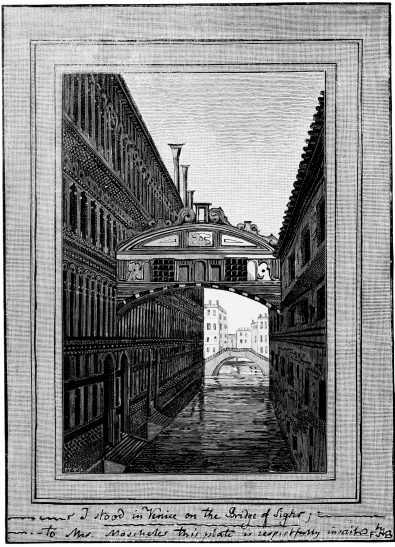
16. The Bridge of Sighs. From a Water-Color Drawing by Mendelssohn. (See page 122.)
but must interpret it favorably. You know, there are times when I feel but a poor mortal, and avoid speaking or even thinking about myself. Such tunes come upon me every now and then; and having no kind friend here to turn to for sympathy, I suffer more than elsewhere. If just on a day of that kind a letter reaches me like your last, I am carried into the midst of your busy interesting life, and, comparing that with the monotony of my own existence, I feel as if I could not write a word about myself; in such times, to speak of myself and my work, depresses me still more. Then I fancy I am but a nuisance, and don’t write to you. So it has been hitherto; but to-day I turn over a new leaf, and must present my water-color drawing to you, which I herewith do most gracefully. My most solemn and impressive bow you must here picture to yourself.
The sketch, taken at Venice in October, 1830, represents the Bridge of Sighs. Should it be out of drawing, you mustn’t set that down to me, but fancy the Doge’s palace just tumbling down, and consequently leaning on one side. The water is the partie honteuse. I have labored the whole morning to make it a little clearer, but it only got muddier; so there, again, imagine that the tide happens to be out, because then the water throughout Venice gets thick and muddy, and might look as unattractive as it does in my sketch. My sky, too, is rather murky; but a certain Nicolaï of Berlin has just published a stupid book meant to prove that there is nothing worth looking at in Italy,—that the country is devoid of beauty, and the people dull and heavy, no Weissbier, no oranges, and the sky no better than our own. If he speaks the truth, it would make the color of my sky right. Should my drawing, with all its shortcomings, find favor in your eyes, let me know, that I may make you another; for I am improving, and my next will be better; I might paint you a Swiss landscape, with meadows and houses, for nothing amuses me more. And now if I could only carry this one to you myself, and then and there alter it according to your suggestions!
I shall be glad if I can get to you in the spring; though, much as I desire it, I fear it will hardly be possible. I shall have done my work by that time just as I planned it; but the question is, Ought I to begin something fresh, and go on working quietly, or should I take a holiday? However, one thing I do know, and that is, if I treat myself to a visit to England this year, I will lead a very different life in London to what I did before,—trying to keep as quiet and retired as I do here, and not going into society unless really obliged to; but as to you, I shall inundate you with as many visits as you can endure. Till then I must work hard at my piano, for I fear I have lost ground a good deal. The other day, however, in telling a friend how Moscheles and I used to improvise together, and showing him some of the passages, I could have given anything to start for London, once more to enjoy the same pleasure; for not only do I play but little here myself, but I rarely get to hear others. On the other hand, there are what I call good days, and most enjoyable ones, when the work prospers, and I have a long morning to myself in my own quiet room; then life is charming indeed.
And pray, how do you all get on? Is there already some “miss” playing her scales downstairs in Moscheles’s study, or is he allowed a little leisure to compose and make music? Does little Felix cry very much? Has Emily grown? Of her growing up, you know I stand in mortal fear. I was going to send you another song to-day, but could not get on with it, which annoys me; so you must even rest satisfied with this dull, unmusical letter. And now farewell. May you all be happy and merry in this new year! May it bring you every blessing, and to me a happy meeting with you and Moscheles! All my belongings keep sending messages, which I never give you, although my father is always mentioning your kindness to him and his regard for you.
Ever yours,
Felix Mendelssohn Bartholdy.
Düsseldorf, Feb. 7, 1835.
Dear Moscheles, and dear Mrs. Moscheles,—I sent you two such stupid letters the other day by the courier that I really must try if I can’t put together a more sensible one to-day. I do feel sometimes as if all the world of Philistines had got the better of me, and I were a Philistine myself; at such times I cannot write, as I amply proved the other day.
To-day I composed a chorus for my Oratorio, and I am quite pleased with it. So what better can I do in the evening than put my happy mood into the shape of a letter to Chester Place, and send my best love to you all? I heard too from Klingemann to-day, and that always makes me feel holiday-like; and besides, it was so desperately foggy that I quite fancied myself in England during my ride; and then for the last few weeks the number of Philistines sitting on me has decreased; and then—and then—spring is coming, and spring weather has come already—so, after all, life is worth living. By the way, is there a word in English for Philister? I don’t believe there is. Oh, land of happiness!
True, they may re-elect Mr. Fleming to a seat in Parliament; they may sing “Lord God of Israel” to my “Ave,” which is much as if they sang “The Old English Gentleman” to Lutzow’s “Jagd;” but for all that they are not really Philisters. This is the place for the genuine article.
If I had seen Mrs. Moscheles at that ball I went to last night, where there were such quantities of tallow candles, and we had ham and potatoes for supper, and the boards were sprinkled after the first dance, not after the second (that would have been no use, the dust was so thick that you could hardly see the people), and they danced down the stove to the capital music of some worthy members of my band,—the whole thing got up by the Commercial Club, commonly called “The Parliament,”—and the ladies’ dresses—no, but these baffle description—only, had I seen Mrs. Moscheles there, and she me, in my best English cravat too, I should just have collapsed for very shame; for on these occasions I positively cannot believe there is such a thing in the whole place as a gentleman. Now, what I should like of all things would be to go and enjoy myself at the fair; surely it could not be ungenteeler, but undoubtedly jollier; only, you see my rank as Musikdirector does not allow of my taking such liberties, a fact that the Burgomaster himself has strongly impressed upon me. And then we have the glorious rivalry between Düsseldorf and Elberfeld, which is twelve miles off; Düsseldorf styling itself Athens, and dubbing Elberfeld Rio de Janeiro or Augsburg. And then all the girls are plain; and that is quite a misfortune, or at least a grievance. So I really associate only with artists, and they are very good fellows. As for Immermann,[29] with whom I used to be on friendly terms, he is completely immersed in theatrical business, Uechtritz in æsthetics, and Grabbe in the bottle,—three things I don’t much care for, least of all perhaps for æsthetics.
The other day I was asked to edit a musical review. I should have liked to call out the firm that made the request; for nothing seems to me more unsatisfactory or distasteful than a concern of that kind, in which you have to suit other people’s pleasure and take all the annoyance to yourself. The other day I received from a local composer some songs with guitar accompaniment, for my opinion. The first began thus:—
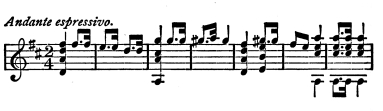
whereupon the voice comes in, and towards the end of the letter the man asks me whether in my judgment Handel was really the great man he is usually taken to be. Now, wouldn’t he do for the editor? What better qualification for the post than that song and that question?
But, to be serious again, my dear Moscheles, when you write tell me all you can about your new Overture to Joan of Arc, of which I have so far only been able to hear in a general way. Have you written anything besides the Overture, and if so, what? Are we not to have a third book of Studies? I do not believe there is in all Germany a single pianist, worthy or unworthy of the name, who does not know the first two books, and play them,—Heaven only knows how, to be sure,—and by publishing a third, you would really be conferring a boon on all musical people. Remember now, I want chapter and verse about everything you have been writing.
Among the new music you are constantly looking through, have you come across anything good? I have not seen anything that I quite liked. A book of Mazurkas by Chopin and a few new pieces of his are so mannered that they are hard to stand. Heller, too, has written two books of Songs that he had better have left unwritten. I so wish I could admire it all; but it is really so little to my taste, that I cannot. A few things there are, too, by some Berliners and Leipzigers, who would like to begin where Beethoven left off. They can “clear their throats” as he does, and “cough his cough,” and that is just all. To me it is like riding across the fields after the rain; on horseback they can dash along splendidly, even if they do get splashed, but when they try to walk, they get stuck fast in the mud. I have heard “Gustave III.” by Auber; in that kind of opera the music is fast becoming of secondary importance,—a good thing too. Yesterday I read in a French paper that Bellini is gazetted Knight of the Légion d’Honneur; Louise Vernet, whom I once upon a time admired so much, marries Delaroche the artist; and Urhan has written pianoforte pieces he calls “Lettres à Elle.” But I dare say you know all that, as well as the good news that the “Œuvres complètes de Moscheles” are about to appear at Schlesinger’s.
There, I am at the end of my paper just as I was going to begin in good earnest; it is quite as well, for I have nothing new to say, but only something old,—namely, my love to you all, and my longing to be with you once more. Well, next May I shall probably give one of my awkward knocks at your door. For the present, good-by; best love to Emily, Serena, and Felix, who I am sure speaks French by this time, or at any rate soon will. And now enough,—too much perhaps.
Ever yours,
Felix M. B.
Moscheles sent Mendelssohn his Overture to Joan of Arc; and two Songs on words by Uhland, “The Smith” and “In Autumn.”
Düsseldorf, March 25, 1835.
My dear Moscheles,—A thousand thanks for your kindness in sending me the two Songs and the Overture, and for the nice letter which came with them. It is too good of you. In your busy life, with so many demands on your time, you actually copy out music for me, and take pleasure in giving me pleasure! The mere sight of the parcel gladdened my very heart; and now that I have the contents, I long to hear the whole Overture, instead of having to fancy the single parts linked together. Now I have a clearer conception of the whole work, and am particularly delighted with the French March in the middle,—which, I am sure, must have a capital effect,—then the theme in minor at the end, and indeed the whole idea and conception. The Allegro Spiritoso is, I suppose, the principal section of the work; at least I cannot fancy it otherwise. And what about the end? Do you finish in minor with the Funeral March, or are “all standards slowly lowered at the king’s command”? The beginning of the minor March which you have written out for me is so fine that I long to know its conclusion. The March, I suppose, comes in towards the end; the trombones in answer to the muted Quartet must have a splendid effect.
You have given me nearly as much pleasure by the two Songs. They are so intrinsically German, not a bit French or English, never aiming at effect, and therefore producing the most agreeable effect upon me; for I cannot say how glad I am that you, in the midst of all your successes, have not lost the taste or love for such small, unobtrusive, beautiful songs. There is something truly artistic and truly German in that,—just what I delight to find in you. I like the Song in B major best, particularly the charming close, where the voice descends from F sharp while the accompaniment keeps on hammering away. So, too, the piano to the words “black forge” is delightful. In the Song in F, I particularly like the recurrence of the subject creeping in through the accompaniment at the words, “Ah, those were lovely dreams!” But will you allow me to mention a trifling matter with which I do not quite agree? There are a few nuances in the declamation,—or whatever else I may call it,—just at the beginning, to the words, “Yonder at the garden entrance,” where the quiet fall of the melody appears out of keeping, and where, musically speaking, the two half-bars seem to drag somewhat. I fancy it would sound livelier if they were omitted, and the melody went on without delay, so that, in the following bars, the words would not be dwelt upon at such length. Thus the word “glad” would get into the first bar, and the word “chords” into the second. This is still more striking at the word “soul,” in B major, where I feel confident the melody should go on without rest, as the verse goes on,—the word “again” belonging to “dost thou know,” according to the meaning of the text. So, also, I was struck by the long pause preceding the words “look around,” the accompaniment going on to A major, and then by the spinning out of the words “around them.” I fancy you might leave out one or two bars altogether.
But when I remember that I am writing to you, Moscheles, and that from me to you all this is very presumptuous, I am half afraid you will be offended—but no, I don’t mean that either, for I know you would not take offence at my straight-forwardness. If I tell you honestly where I think you have been less successful, it shows you that I am sincere where I appreciate, and that I thank you for all the rest.
What you say about Berlioz’s Symphony is literally true, I am sure; only I must add that the whole thing seems to me so dreadfully slow,—and what could be worse? A piece of music may be a piece of uncouth, crazy, barefaced impudence, and still have some “go” about it and be amusing; but this is simply insipid and altogether without life.
Some studies of Hiller’s I saw the other day I could not bring myself to like, either; which I am sorry for, because I am fond of him, and believe he has talent. But Paris, no doubt, is bad soil.
This page is to be devoted to my thanks for your kind letter, dear Mrs. Moscheles. You know how much I like London; so your pressing me to come is doubly kind. But I am sorry to say your letter arrived after I had decided to give up that pleasure this year. Klingemann will have told you so; and I need not add how sorry I am. Having, however, made up my mind to live and labor in Germany whilst I can, I could not refuse the conductorship of the Rhenish Musical Festival without materially injuring my position here; and as the Festival is held in June,—by which time I could not get back,—my favorite scheme has fallen to the ground. When I may take it up again I cannot say, but I trust it may be soon. Till then I must give up the extempore Fantasias for two performers, and the slow prestos, and the sugar-kaleidoscope, and the “Fall of Paris” knock. To lose all that for the sake of serious business is horrid; but how to help it?
There is an end of the paper, my dear Moscheles. Kindly accept the Overtures, and give me your opinion on them. The first has remained pretty nearly as it was; the two others are much altered. Let me hear all about your Concerto in C minor soon; I look forward to it with pleasure and impatience.
I must bid farewell, for to-day, to No. 3 Chester Place. Love to the children and the whole house.
F. Mendelssohn Bartholdy.
Berlin, Aug. 13, 1835.
My dear Moscheles,—I do not know how to thank you for your kind letter; it gave me the greatest pleasure, and I should certainly have answered it sooner; only, I really had neither mood nor leisure to write. You know my mother was taken very ill in Düsseldorf, and recovered but slowly, and she could only undertake the journey here with the greatest caution, I accompanying her. My anxiety, both before the journey and on the road, was so great that I could not collect my thoughts for anything, and I did not feel relieved till both parents once more settled down comfortably at home to their old habits. Now, thank God, all traces of past fatigues are fast disappearing, and they are so well, or rather so much better than before, that I breathe freely again. Anyhow, I should have written to you shortly, but to London; for I had no idea you were going to Hamburg so soon, and the news of your arrival quite took me by surprise; but now I should like to know all about your past and future movements. That you should think of going to St. Petersburg, I more or less expected, confident as I am that you would be worshipped there and overwhelmed with kindness. But how long do you mean to stay? When to start? To be sure, you return to England. And then I want to hear something of the past; for, capital as your lines about Aloys Schmidt and Benedict are, there must be something too to say about new publications by others; and above all I want full particulars of your own compositions, what pieces you are planning, and how your concert went off. Do write about it all when you have a leisure hour; you know what pleasure it gives me. Your last letter I showed my parents, and they fully appreciated your kind words. My father will add a few lines to these.
Your description of Aloys Schmidt’s tallow-candle soirée and the conversation on sevenths was so graphic that I really could smell the tallow, hear the quartet, taste the green tea, feel the oppressive dulness,—in fact, it is as if all my senses had had their share in the proceedings. What you say of Liszt’s harmonies is depressing. I had seen the thing at Düsseldorf, and put it aside with indifference because it simply seemed very stupid to me; but if that sort of stuff is noticed, and even admired, it is really provoking. But is that the case? I cannot believe that impartial people can take pleasure in discords or be in any way interested in them: whether a few reporters puff the piece or not, matters little; their articles will leave no more traces than the composition. What annoys me is that there is so little to throw into the other side of the balance; for what our Reissiger & Co. compose, though different, is just as shallow, and what Heller and Berlioz write is not music either, and even old Cherubini’s “Ali Baba” is dreadfully poor and borders on Auber. That is very sad.
But what is the use of grumbling about bad music? As if it could ever take the lead, even if all the world were to sing it; as if there were no good music left! All such things, however, make me feel the obligation of working hard and of exerting myself to put into shape to the best of my abilities that which I fancy to be music. I do feel sometimes as if I should never succeed; and to-day I am quite dissatisfied with my work, and should just like to write my Oratorio over again from beginning to end. But I am quite decided to bring it out at Frankfurt next winter, and at the Düsseldorf Musical Festival at Whitsuntide; so I must finish it now. Besides, I think I have worked too long at it; at least, I am quite impatient to get to other things, so it is evidently high time to end. I have got to recopy the whole score, and make a good many alterations and additions,—rather a heavy piece of work that often tires me. In the course of the winter I am going to write a Symphony in A minor, and get my “Walpurgisnacht” ready for publication.
And what about the next book of “Studies”? I am quite longing for it, and so are all pianoforte-players. I wish you would let us have it soon. Don’t you mean to do so? And how about the Sonata for four hands?
You know that I am going to spend next winter in Leipzig to conduct the Abonnement Concerts. I have only engaged myself from Michaelmas to Easter. I’m a little afraid of it, and can’t fancy a residence there agreeable. My plans for next spring, after the Musical Festival, rather point towards the South than towards England. So I must trust to chance for bringing us together, and that is perhaps better than all planning for the future. Good-by.
Yours ever,
Felix Mendelssohn Bartholdy.
My address for the present is Berlin; and from next September, Breitkopf & Härtel, Leipzig. Use it often.
At the close of the season Moscheles went to Hamburg with his family, from which place he announces to Mendelssohn his intention of visiting Leipzig for the purpose of seeing his mother, who was coming from Prague to meet him. He also speaks of his intention to give a concert in Leipzig.
Leipzig, Sept 5, 1835.
My dear Moscheles,—I hope and trust nothing may occur to prevent our once more spending a few happy days together. Your concert is being arranged, and so I shall have the twofold pleasure of seeing you and hearing your more important new works, and I need not tell you how much I shall enjoy that.
Your search after flowers in the arid regions of modern composition makes me quite melancholy. It is so disheartening to see how colorless the heroes of our day are. Sometimes it makes me feel inclined to think too indulgently of myself; at other times again the very reverse, and I feel thoroughly discouraged. Who is Mr. Elkamp who is writing a “Saint Paul”? Have you seen anything of his, and has it any merit or not?
If the Hamburgers look upon your appearance as an intermezzo between Chopin and Kalkbrenner, let them go to Jericho. I would soon put things into plain language, and ask them whether they consider the joint an intermezzo between mixed pickles, hashes, and fish patties, or whether it is not rather the other way. A comparison of that kind would, I believe, be most likely to come home to them. Kalkbrenner is the little fish patty.
Have you heard or seen anything of Lindenau the violinist? The last time I heard him, in Düsseldorf, I was exceedingly pleased with his playing. If you meet him, please remember me kindly to him, and ask whether he would come and play here. Good violinists seem to be scarce, and I should be glad if he would let us hear him soon. I am not quite clear as to the state of musical matters here. There seems to be plenty of music performed; but how much for the love of the thing, remains to be seen. That is, however, a vast subject, and we must discuss it accordingly, and rediscuss it, and say wise things about it; and may all that come to pass soon!
Just now Hauser comes in, and I tell him of my beautiful joke on Kalkbrenner; but he will have it that K. is more like an indigestible sausage, and I am to tell you so with his best love. Your kind offer of services reminds me of a favor you can do me on your way here. Klingemann wrote me the other day that he had had some money from you for me, and that you have a balance in my favor from Novello’s payments for the “Melodies.” If you could let my father have this on your way through Berlin, you would oblige me. Excuse my troubling you. I must end, or my letter won’t be in time. Pardon these hurried, good-for-nothing lines. Be sure you bring all your newest compositions with you; mind you do, it will be such a treat for me. And now, best love to wife and children, and good-by. Forget not
Yours,
Felix Mendelssohn Bartholdy.
On the 1st of October Moscheles arrived in Leipzig; there, as prearranged, he met his mother. The ten days passed in her company and in musical and friendly intercourse with Mendelssohn are amongst the happiest recorded in the diary. On the 2d of October he says: “I passed the evening with Felix; his friend Schleinitz, a lawyer, came in; he has a lovely tenor, and sang some of Felix’s songs.[30] Then Felix and I played my ‘Hommage à Handel’ for two performers; all my Studies he knows by heart, and he plays them beautifully.”
October 3.—“Rehearsal for the first Subscription Concert of the season. Mendelssohn appeared for the first time at the head of the Leipzig orchestra. He conducted with befitting dignity, exercising authority without pedantry, and was most cordially seconded by the members of the orchestra.”
In addition to Moscheles’s diary we have his letters written from Leipzig to his wife, who, with her children, had remained in Hamburg on a visit to her relatives.[31] Moscheles writes of meeting “a retiring but interesting young man, Robert Schumann,” and of “the admirable and unaffected playing of Clara Wieck,” afterwards Madame Schumann. He shows us Mendelssohn’s study, with “the bookcase,—a perfect storehouse of musical scores;” the writing-table, on which he notices the silver inkstand presented to Mendelssohn by the Philharmonic Society; the engravings on the wall; a delightful litter of scores and other music on the piano; “still,” he says, “cleanliness and neatness prevailing everywhere.” Then again we follow the two friends to the keyboard of the Erard, which stands in the middle of the room. They play, together and alternately, their latest compositions: some “Songs without Words,” Moscheles’s Concertos (Fantastique and Pathétique), and Mendelssohn’s Overture, “Calm Sea and Prosperous Voyage.” “Last night,” says Moscheles, “we played my Overture and his Octet together; it went swimmingly, and when we parted he lent me his cloak, for fear I should catch cold after so many hot notes. This morning he was rewarded with an extra piece of that cake my mother brought from Prague for us.”
The above-mentioned cake, originally intended for the expectant family in Hamburg, was destined to be sacrificed to the appetites of a small party of belated travellers. Moscheles, Mendelssohn, and his sister Madame Dirichlet with her family, had travelled together from Leipzig to Berlin, and on arriving at half-past one o’clock in the morning they had found the Mendelssohn house in deep slumbers and the larder closed; it was there the cake met its pleasant fate. “Pleasanter still,” says Moscheles, “was the awaking next morning. The meeting with the Mendelssohn family was quite touching; we embraced all round, and Felix’s happiness and overflowing spirits were quite childlike. As for myself, I was received as affectionately as if I belonged to the family.”
Though at first reluctant to delay his return to Hamburg, Moscheles finally yielded to the kindly pressure of his friends and remained with them.
Of his concert Moscheles wrote a glowing account; Mendelssohn indorses it in the following letter:—
Leipzig, Oct. 11, 1835.
I cannot forego the pleasure, dear Mrs. Moscheles, of sending you an account of the events of the last two days, although necessarily a short one, as I am beset by professional and non-professional visitors. It has really been too delightful, and such a pity you were not here to enjoy the treat Moscheles gave us all. Those two days were indeed thoroughly musical ones, with everybody full of excitement and genuine enthusiasm.
Let me begin with the concert of the day before yesterday; you know the programme, and you also know how Moscheles plays. Well, then, directly after his “Concerto Fantastique” the shouts of applause began, and the noise lasted throughout the evening, and continued at yesterday’s rehearsal, so that this evening’s concert promises to be one of the most glorious, the Leipzig people being half crazed. Besides, you know, the room was the most crowded we have had for years; but what pleased me most was the intense interest and delight which pervaded the audience.
When we got to the end of our duet,—and it did go well, I assure you,—the most deafening acclamations broke forth, so that we played the last eight or ten bars without anybody, not even ourselves, being able to hear whether we did it correctly; nor did they leave off clapping and cheering till they had us out again, to perform a second duet—of graceful bows. And now you may fancy how madly they went on after Moscheles’s “extempore playing.” It is true he produced some things bordering on witchcraft, which to this day I have not been able to understand, although he pretends they were nothing; but it was quite delightful to see how excited and appreciative the audience were. An English lady, rather blue, wanted to be introduced, and gave vent to her enthusiasm, whilst a score of Leipzig ladies of all colors waited for her to make room. (And here is the proper place to inform you that Moscheles was struck on two separate occasions by the beauty of a Leipzig lady, and each time informed me of the fact, in a discreet whisper; whereupon I threatened to let you know, which I hereby do.) Well, then, the Leipzig ladies came to the balustrade of the orchestra, and Moscheles made them a bow; then came the dignitaries of this place; then one or other of the art critics, who gave detailed reasons for their praise; and lastly the committee of our concerts (consisting of twelve gentlemen—not one lady), to beg that they might hear the Overture to “Joan of Arc” once more at this evening’s concert. A work of that kind has too many novel and striking points to be at once understood by band and audience, so that we look forward with delight to its repetition to-day. They have now played it four days in succession, and it will go to perfection; even at yesterday’s rehearsal it seemed like a new piece, and fresh beauties were brought out. The duet, too, has to be repeated by desire; and as Moscheles had already promised to play his Concerto in G minor (“Blue Devils”),[32] we shall, I think, have a splendid night of it.
Let me just add that at yesterday’s rehearsal Moscheles played his Concerto in a more masterly manner than I believe I have ever heard him play before, which is saying a great deal; the unanimous applause which followed must have given him some pleasure. It was the last piece of the rehearsal; the Overture had been played beautifully, and now we all—the unoccupied—formed a large circle around him. Mademoiselle Grabau, our prima donna, turned over the pages, the other singers standing close by; a Kammerherr,[33] who had expressly come from a distant place in the country, and who fancied himself a good pianist, kept his eyes fixed on Moscheles’s fingers; the band exerted itself to the utmost, and Moscheles played quite wonderfully and delighted everybody. I only wish you and he could have seen the smiles and nods of the band and the audience, their secret looks of astonishment, and the unutterable surprise of the Kammerherr. Accustomed as Moscheles is to such demonstrations, he must have been struck by this outburst. As to myself, I cannot sufficiently tell you how I am enjoying his visit. Alas! it is coming to an end, as he is returning to you the day after to-morrow; but it was a happy time, long to be remembered, and always with delight.
I am again interrupted, and I expect Moscheles in an hour to take me to his mother’s, where I am to play; so I am obliged to conclude, leaving him to give you verbally all the Leipzig news, which I should have preferred to do myself in this letter, if the Hamburg mail didn’t leave at ten o’clock.
Ever yours,
Felix Mendelssohn Bartholdy.
Mendelssohn again writes to Mrs. Moscheles:—
If you want to be angry with Moscheles for giving us another day, you must be angry with all the inmates of the Leipzigerstrasse No. 3; for they are all at fault. He wanted to proceed at once, although he only arrived last night, or rather this morning at half-past one o’clock; but we all bent the knee of persuasion, in addition to which the police would not deliver his passport. Then, again, you will have him in Hamburg, Holland, and London, whereas we shall have to part to-morrow, probably for a long time. In a word, I for one begged and prayed to my heart’s content; put yourself in my place, you would have done the same. Moscheles, on his return, will give you all our cordial messages; it is post-time. I close, and trust you will not frown on
Yours sincerely,
Felix Mendelssohn Bartholdy.
Moscheles remained three days with the Mendelssohns. To none did he give greater pleasure than to the elder Mendelssohn, who, afflicted as he was with partial blindness, derived the keenest enjoyment from music. On the last evening of
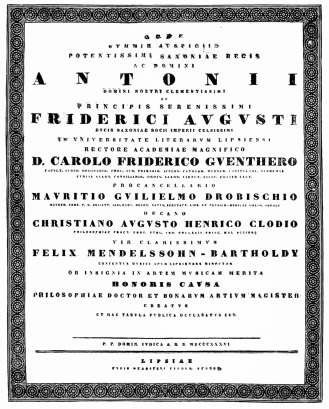
17. Fac-simile of Diploma given to Mendelssohn by the University of Leipzig. March 20, 1836.
Moscheles’s stay, he and Mendelssohn were improvising together; as the hour of departure approaches, the latter suddenly breaks in with the familiar bugle-call of the post-chaise. Moscheles answers with a solemn valedictory Andante; again he is interrupted by the warning notes of the bugle, and pressing forward, the two performers end with a brillant Finale. These days were amongst the last that Mendelssohn’s father was destined to enjoy. A heavy blow was in store for the Mendelssohn family and the wide circle of their friends. Abraham Mendelssohn died quite suddenly on the 19th of November.
Berlin, Nov. 25, 1835.
My dear Friend,—We have lost my father. He breathed his last tranquilly and peacefully on the 19th, in the morning, at half-past ten o’clock. He had long since wished it might be so, and God has heard him. May He give us strength to live on without him, and bear up under a loss we can scarcely realize! My mother and sisters are well; my mother an example to all, looking at the future with courage and fortitude. It was owing to you that I saw my father the last time, and for that I thank you. The remembrance of those two happy days is like a blessing that I shall carry through life. You knew him, and can judge how, with him, light and happiness have gone from me. I will strive to live as he would have wished me to live, had he been amongst us. To your wife my father was always sincerely attached, and grateful for all her kindness to him and to us all. She, too, has lost a friend, and so have all those who knew him well.