LETTERS OF FELIX MENDELSSOHN. (continued 3)
Felix Moscheles translation
I must return to Leipzig in a few days, and do my best to get through my duties there.
Good-by.
Yours,
F. Mendelssohn Bartholdy.
On his return to Leipzig he resumed his work with untiring energy; on the 22d of May of the following year (1836) he conducted the first performance of his Oratorio, “Saint Paul,” at the Düsseldorf Festival; he next went to Frankfurt to take the direction of the Saint Cecilia Choir, in place of his friend Schelble, who was incapacitated through illness. Here he first met that other Cecilia who was henceforth to become his guiding star, and who was eventually to exchange her name for his. They were engaged on the 9th of September, Mendelssohn’s mother communicating the welcome news to the Moscheles family.
Frankfurt, July 20, 1836.
My dear Friend,—It is an age since I wrote to you last; but it was a monotonous age, and I was not in a mood to write about it or anything else. Besides, you know that however much time passes without your hearing from me, there is not a day that does not in some way or other bring me nearer to you or remind me of your friendship, your work, and your life so beneficial to us all. I have not yet thanked you for that good kind letter of yours which reached me through Klingemann at the Music Festival, with your congratulations on its success. How the Oratorio went off you have heard long ago. There was much that pleased me at the performance, and much that dissatisfied me; and even now I am at work on certain parts of the pianoforte arrangement, which is to appear shortly, and on the orchestral score, so much is there that completely fails to express my idea,—in fact, does not even come near it. You have often advised me not to alter so much, and I am quite aware of the disadvantages of so doing; but if, on the one hand, I have been fortunate enough to render my idea in some parts of my work, and have no desire to change those, I cannot help striving, on the other hand, to render my idea in other parts, and, if possible, throughout.
But the task begins to weigh heavily upon me, as I am gradually more and more attracted by other work, and I wish I could look back upon the Oratorio as finally completed. Well, I hope in two months, at the outside, to send you the P. F. arrangement. But where will you be then? What a thing it is to be separated by land and sea! I hear a great deal about you and your work through people coming from London, and I read about it in the musical papers; besides, you write occasionally, and so does Klingemann; but if I compare all that with our meeting in Leipzig, or with those days in England, when it was a matter of course that I should know how you spent every morning and afternoon, then letter-writing does appear a very poor substitute. I suppose you will be going to the seaside on the English coast. I, too, am ordered sea-bathing, and shall have to swallow the bitter pill of a regular cure, and go in about a fortnight to Scheveningen, or rather to the Hague, where I can live quietly away from the bathing community, and drive out every morning to the sea for my ablutions. In the first days of September, when the Subscription Concerts begin, I must be back in Leipzig.
I wish I could finish a few Symphonies and that sort of thing in the course of the year, and more still I long to write an Opera; but of that I am afraid there is not the least prospect. I am looking in vain throughout all Germany and elsewhere for some one to help me realize this and other musical plans, and I despair of finding him. It is really absurd to think that in all Germany one should not be able to meet with a man who knows the stage and writes tolerable verses; and yet I positively believe there is none to be found. Altogether, this is a queer country. Much as I love it, I hate it in certain respects. Look at the musical men of this place, for instance; their doings are quite shameful. Considering the size and importance of the town, there is really a fair muster of excellent musicians, men of reputation and talent, who might do good work, and who, one would think, would do it willingly; so far that is the good side of Germany, but the fact is, they do nothing, and it were better they did not live together, and grumble, and complain, or brood over their grievances till it’s enough to give one the blues. Ries is by this time in England, I suppose; he considers he does not meet with due appreciation, and finds fault with the musicians, and yet does nothing to improve them. Aloys Schmidt takes his ease in the country, sighs over mankind in general,—a poor race at the best, full of envy and malice,—forgetting all the while that he, too, belongs to it. Hiller is here just now. People discuss wildly whether he is a great pianoforte-player or not, but they don’t go to hear him, and fancy that makes their judgment all the more impartial; so he, too, is leaving for Italy. The only man who succeeds is Guhr, who knows least and isn’t good for much; but he has a will of his own, and enforces it bon gré, mal gré, and the whole town lives in fear of him. But all that is bad, and the German Diet should interfere; for where so many musicians congregate in one place, they ought to be forced by the authorities to give us the benefit of a little music, and not only their philosophical views about it.
What have you been composing, and what are your plans for the autumn? I am anxious, too, to know how you have treated your scoring of the Bach Concerto. Taubert has, I suppose, been drowned in the whirl of pianists, and was little noticed. It could scarcely have been otherwise; I always thought he had not much talent. Thalberg, whom you portray so admirably, I should like to hear again; he must have developed wonderfully.
And do you know that my Oratorio is to be published in London, at Novello’s, and that his letter about it dropped from the skies into my hands the other day? And do you know, also, that Rossini, with Pixis, Francilla, the Swedish composer Lindblad, and the Polish straw-fiddler Gusikow, have all been through Frankfurt? But I must leave off writing and chatting. Good-by; best love to wife and children, and don’t forget
Yours,
F. Mendelssohn Bartholdy.
On the 14th of August Moscheles writes:—
My dear Felix,—You ask me about my scoring of the Bach Concerto. Well, it seemed to me that one might give it a kind of new varnish, by doing for it what Mozart had done with such perfect taste for the “Messiah,” when he added wind-instruments to the score. Only, fully aware as I was of the poverty of my pen as compared with that of the master, I naturally hesitated. If now, however, I have followed the great example before me, the worst that can be said of me is that I am but a poor imitator; and consoling myself with that reflection, I wrote Parts for one Flute, two Clarinets, two Bassoons, and two Corni. I mainly intended this wind-accompaniment to take the same position in the Concerto which is taken by the organ in the performance of a Mass.
Hauser kept his promise very punctually, and sent me two more of Bach’s Concertos,—one for three, and one for two pianofortes. I will shortly let you know what I already possess of Bach’s concert-music; perhaps you can help me to complete my collection. My thirst for more of his work is simply unquenchable.
Of the pianoforte-players, Thalberg is really the most interesting. Sound and genuine in his style of playing, he does not seem to seek after effect, however much he may do so in reality. In his combinations, capricious and fantasia-like as they are, all follows and develops itself so naturally that one easily overlooks the lack of unity and a certain Italian mannerism. In 1826 I gave him some instruction; and at that time already I became aware that he would little need me to do great things,—sans comparaison, like a certain Berlin youth, who soon threw aside all leading-strings, and donned the purple.
I find that at my age my fingers require to practise most carefully the exercises of former years, in order to keep pace with the times. I can manage to preserve them pliable and elastic, but I cannot make them any longer than they are; and that is just the road that modern pianists, like Chopin, Thalberg, etc., have taken, in order to develop their technique. To play your music, I have also to stretch my fingers to the fullest extent; but there they obey more naturally, because the mechanical construction of your passages is of secondary importance, as compared to the spirit which dictates them.
Moscheles, in thanking Mendelssohn for his last letter, says:—
“It is with so much pleasure I see your handwriting, your ideas and views have so much charm for me (although I occasionally think they may yet ripen to full maturity), I so fully recognize your genius, and am personally so much attached to you, that the word ‘friendship’ but inadequately expresses my feelings. Similarly, it is a source of happiness to me to know that your thoughts are often with me, aware, as I am, how constantly you are surrounded by an admiring circle of friends.”
In reference to the preparations for a performance of “Saint Paul” in England, he says:—
“I am glad to find that all promises well for your Oratorio in England. Novello, Sir George Smart, and the whole profession are looking forward to its production with sympathy and interest. Like Hercules, you have throttled Envy while still in the cradle.
“Klingemann, Smart, and Novello are busy directing Mr. Ball, the translator. I have offered to correct the proofs, but have not yet received them.”
Speier, April 6, 1837.
My dear Friend,—Forgive my not having written for so long; the fact that it is a week since I was married, and that this is my first letter to a friend, must be my excuse. I need not tell you, and could not, if I tried, how the events of last year have added new prospects of happiness to my life, how all that is good has become doubly dear to me, all that is bad easier to put up with, how happy were the last months, how heavenly the last days! Looking back to the past and planning for the future, my thoughts have often reverted to you in friendship and affection, and to the happy hours spent with you. Believe me, I am truly grateful to you and your wife, and can never forget how many kindnesses you have at all times heaped on me. I have heard about you, both from Schumann and Bennett, but more particularly from Klingemann, who in his last letter describes some of your soirées, and your playing of Scarlatti, Handel, and Bach. It must have been delightful and what is more delightful still, he drops a word about new “Studies” that you are going to play on one of these evenings. So you have at last written some; you cannot fancy how impatient I am to get them, what a treat it will be to me, and how refreshing to have something new to study. For really the piano music of the present day is such that I cannot make up my mind to play it through more than once; it is so desperately empty and poor that I usually get tired of it on the first page. I positively dislike Thalberg’s work as regards the composition; and the good piano passages seem to me of no earthly use, so little soul is there in them. I could no more play his music than I could ever make up my mind to play a note of Kalkbrenner’s; it goes against my nature, and I should feel mean if I attempted such fingerwork with a serious face. Chopin’s new things, too, I don’t quite like, and that is provoking. So, you see, it is doubly pleasant to think of the old “Studies” and to look forward to new ones. When shall we have them, and will there be more than one book?
Your wife, I suppose, I had better not address, for I am sure she is dreadfully angry; and, to say the truth, I am rather afraid of her. Nevertheless I do address her, for I want to speak of my wife, and say I hope she will not visit my sins upon her; on the contrary, she must be ready to like her and to love her a little when she becomes acquainted with her; and truly my dear Cécile deserves it, and I think I need not make any appeal to your wife, but simply introduce her and say, “This is Cécile,”—the rest will follow naturally. And do you know, it is quite possible I may bring her to you soon. I have had an invitation from Birmingham to conduct my “Saint Paul” at the Festival, and feel much inclined to accept. If I come, it may be in the autumn, or perhaps sooner, about the middle of August. But shall you be in England then? That is usually the time when you are away; it would be too great a pity if we weren’t to meet. I cannot ask you to let me know about your plans,—for such a correspondent as I am can beg for pardon, but not for an answer; so send me word through Klingemann. But if you have leisure, and are disposed to treat me to a few lines, please address, all through the summer, care of M. T. Herz, Frankfurt.
If we meet this year, as I do hope we shall, I shall have several new things to show you. I have worked a good deal lately, and mean to be still more industrious. I shall send your wife a new book of Songs which is to appear in a few days, as soon as I get it.
And now good-by, my dear, dear friend; best love to your wife, and to the children if they haven’t forgotten me and the carnations. If you see Klingemann tell him that I will shortly write to him, perhaps from Strassburg, where I am going to-morrow, from there to Freiburg and Bâle, and so back to Frankfurt. And now that I must end, I feel as if everything yet remained to be said. Forget not
Yours,
F. Mendelssohn Bartholdy.
In September of this year Mendelssohn went to Birmingham, where he conducted the Festival. To their mutual regret Mendelssohn and Moscheles did not meet in England on that occasion, as the latter had left London for Germany at the close of the season.
Leipzig, Dec. 12, 1837.
My dear Moscheles,—I cannot say I feel much of a correspondent to-day, so engrossed am I with the new life around and within me. This year, with all it has brought me, has been the happiest of my existence, and I daily appreciate the blessings it has bestowed. For the last week I have been installed with my Cécile in our own new quarters, everything has been made neat and comfortable, we have already had eight Subscription Concerts, and a performance of the Messiah in the Church, and I have a variety of work in my head and some on paper. So, you see, my occupations are much the same as usual, and the pressure from without at times greater. And yet nothing now upsets or troubles me, because my home is so happy and peaceful. So I trust you will forgive my long silence, if you ever resented it.
Of late I have spent some of my happiest hours with your new “Studies,” the first proofs of which Kistner sent me. I had already got the engraver to send me whatever he could just spare, a sheet at a time; that gave me but a very superficial acquaintance with them, but I was too impatient to wait. Now I have had to return my copy, after correcting a number of mistakes, to Kistner, who is over-anxious about the work, and still delays its ultimate appearance. However, I have had the whole thing in my hands for a day, and have enjoyed it thoroughly; as soon as I have a copy to myself, I intend practising my piano properly, and mastering the Studies, for it is a long time since I had any piano music I wanted to play over and over again; so you can fancy how I enjoy something new, to which I can give my whole heart.
I cannot go into details, not having a copy before me; but this much I know, that my greatest favorites begin at “Contradiction.” The whole piece in D flat major is so bright, and towards the end positively makes me laugh when it goes into D major and the whole story is repeated first in D major and then in D flat minor. And then the last bar fff is glorious. Quite your own self is that tender one in G major, just as if I heard you talk and play. But my greatest favorite is the “Nursery Tale,” so graceful and sprightly; above all, I like the part where the deep bass notes double the melody, as if a big bassoon or some other growler of an instrument came in; and then the first transition to B major and the return to E flat and the very last bars leggiero,—all that has fixed itself once for all in my mind. How very much I like the “Bacchanali,” “Terpsichore,” and in fact all of them, you can imagine. I am particularly struck by the difference between these and your former Studies;—not that I love the old ones less, but the new ones are for quite a different class of players, far in advance of the former; here the technical difficulties have become of secondary importance, and the intrinsic merits of the work have to be brought out. Once more a thousand thanks, and may you give us many more of the same kind!
Did you hear anything good in the musical line during your stay in Hamburg last summer? Our concerts led to my becoming acquainted with some of the musical men there, but they were not much to speak of. In fact, there is a lack of good new musical productions everywhere, and that tells on our concerts here.
This winter Clara Novello is giving us a fresh start, the public cordially greeting her as a new and most welcome acquisition. She makes la pluie et le beau temps. But where are we to get a new Symphony from? May I address your wife quite at the bottom of this page, and write down a Song for her?
Dec. 12, 1837.
Dear Mrs. Moscheles,—Though I don’t know whether you still care for me or my Songs, yet,
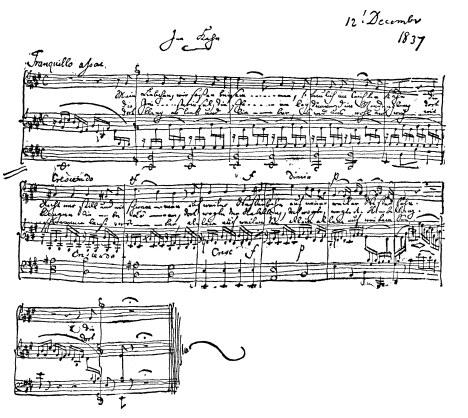
18. “Im Kahn.” Fac-simile from Letter of Dec. 12, 1837. (See page 163.)
from old habit, I have written this one down for you, whether you sing it or not; but I do wish you would. What a pity we missed each other this time in England! I could not get it into my head that we were really not to meet; and yet, with every day of my stay in London, the fact was painfully evident. My wife wishes to write herself to thank you for your kind words. It was dreadful to have to leave her in Germany. It would have been my greatest joy to show her England properly; but so much is certain, I have made up my mind not to leave her again at Düsseldorf when I have to go to Rotterdam. It was too abominable.
I have only this corner left to bid you good-by, and to beg for a sign of life and friendship when your time permits.[34] May we soon have a happy meeting!
Yours,
Felix Mendelssohn Bartholdy.
On the 23d of December Moscheles writes:—
Your letter of the 12th broke in on me like a ray of sunshine piercing an autumn fog. Were I subject to the blues, like so many sufferers in this fog-ridden city, your cheerful lines would have set me up for any length of time.
Your appreciation of my “Studies” gives me much pleasure. I did not feel called upon to aim at popularity with the general public, nor did I venture to believe that my work addressed itself to the more restricted circle of connoisseurs. That you, of all the Select, should welcome me with a Bravo, strengthens my faith in myself. Delighted I am, too, to find that you, with your master eye, should at once have hit on the passages that seem to me my more successful inspirations.
We cannot get over our regrets to have missed you in London and Birmingham; your triumphs in the latter place are being echoed all over England. Your “Saint Paul,” your pianoforte Concerto, and your performances on the organ, one and all, are unreservedly praised. I am glad to see that your Oratorio is announced by the Sacred Harmonic Society as “the popular Oratorio.” We so-called Directors of the Philharmonic Society are thirsting for something new in the line of Symphonies or Overtures. It is as hopeless a task to satisfy the wishes of the Society as it was in times gone by for the Danaïdes to fill their tub. Some would have us supply them with half a dozen posthumous Symphonies of Beethoven, complete or fragmentary; others want a place found on the programme for every attempt at composition made by native talent.
You have promised us your A major Symphony in its new shape, and we mean to keep you to your word, and hope you will not let us wait long. It is a great favorite of mine, and I feel as if I were going to meet a beautiful girl in a new dress, and were wondering whether that would make me admire her more than before. Nous verrons, nous entendrons. In the mean while I hold in safe keeping my Beauty attired as I first knew her (the original score), and remain faithful to her.
Liszt writes from Milan that several of his compositions are to be published in London, and that he intends dedicating one of them to me. May my fingers grow by then! He wishes to become better known in this country, as he proposes coming here shortly.
The “Gazette Musicale” exalts Berlioz’s Requiem above all music of all times. A new vista, it says, is opened! You know I am not a believer in this genius; tell me whether anything of his has been to your taste. Good-by; if my letter is welcome, reward me by soon letting me have one in return.
Ever your friend,
I. Moscheles.
Berlin, June 26, 1838.
My dear Friend,—I want your advice. You know that five years ago Erard presented me with one of his grand pianos. I took it first to Berlin, then to Düsseldorf, and lastly to Leipzig. Owing to such frequent shiftings, and possibly to some bad treatment, it is not fit for use in public, and not even to be depended on at home. In answer to my inquiry Erard suggests that I should send it to England to be repaired. I have ascertained that the Saxon Custom-house would allow it to be returned free of duty. Erard, on his side, has obtained the same leave in England; but the carriage there and back would come to a hundred and thirty odd thalers, and as that is about half what a new piano would cost me here, the question arises, Can I really expect a substantial improvement from the repairs? Give me your candid opinion on this.
You know I shall have to play in public occasionally in the course of the winter; and for that purpose, as well as for music at home, I want an instrument with a perfectly even and precise touch, responding freely and fully to my wants and wishes. The tone has retained its original power and beauty, and I should indeed be happy if the defective parts of the mechanism could be repaired. That, you see, is just the question; and as I am sure that similar cases must have come under your notice, I write to you for advice. If it could be done, I should think no sacrifice too great to preserve an instrument with such a splendid tone. As it is, however, I cannot use it at all; and last winter I had to play on borrowed pianos,—and very poor ones too. I ought to apologize for troubling you; but you alone know exactly what I desire and expect to find in a piano, and so to your judgment I appeal.
I suppose you know, through Hensel, that we are staying at my mother’s, and are spending delightful days with her and my sisters. I cannot say that my visit to Cologne was quite pleasant this time. You see I have lost the taste for anything I cannot share with my wife. I get to feel so restless and impatient that I am always calculating the day and hour of my return, and can think of nothing else.
We shall go back to Leipzig in August. And you,—where are you going this summer? When shall we see you in Germany? All those who like good music are longing for you. And what are you composing? I am working on a Symphony in B flat.[35] I have gone forward a step since last year, and could I but have the benefit of your opinion on my work occasionally, I should get along more rapidly. I have composed a few new Quartets for string instruments, a Sonata with violin and one with violoncello, besides a few trifles not published in England that I am waiting for an opportunity to send you.
Good-by, and best love to you all. I do hope the day may not be too far distant when I can introduce my Cécile to your wife. Pray tell her so. Fanny and I are making much music together; the day after to-morrow we are going to do my new Psalm in E flat. Her playing is more masterly than ever. Good-by once more, my dear friend, and may we soon meet again.
Yours,
Felix Mendelssohn Bartholdy.
Moscheles and his wife communicated on the subject of the piano with Mr. Erard, who at once expressed his readiness to present Mendelssohn with a new instrument. Writing to Mendelssohn on the subject, Moscheles says:—
“I shall choose an instrument for you myself, not omitting to bear in mind your favorite arpeggio passages, through which the melody seems to push its way. In other words, I shall test the piano with this passage from your Concerto,—
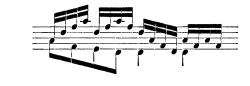
Berlin, July 11, 1838.
My dear Friend,—I enclose the certificate for Mr. Hogarth, addressed to you as you desire; also a few lines to him, which please forward with the enclosure when you have obliged me by reading and revising it and putting it into good English. I am afraid my English is very rusty; and as with you, such certificates are very frequently printed and published, I would rather no blunders were allowed to go forth to the world. So please turn them out one and all. I not only request you, but I hereby authorize you, to correct and to alter any and every thing, and to endow me with the right ideas expressed in an elegant style. “From,” “by,” “while,” have become so many unknown quantities to me; and I feel as nervous when I meet with them as I always do in the presence of distinguished strangers. Nor do I know whether I have said too little or too much. In the first case, put a few sforzandos; if it is the other way, soften a little. In fact, lend me a helping hand, as you have so often done before. Let us hope that, after all that, Mr. Hogarth’s purpose may be served. How much I am indebted to you for the great service you have done me about the piano! But can I really accept it without further ceremony? I can’t help feeling a doubt, though on the other hand I have the greatest desire to do so, as I am sadly in want of a good instrument. Would it not be meeting the difficulty half-way if I sent my piano to be repaired? For, after all, it might be possible to put it into good condition; and that would be to our mutual advantage. If the result was unsatisfactory I might still accept the kind offer of a new one. How would that do, my dear Moscheles? To be sure, I should rely on your judgment as to the completeness of the result. Or do you think I should simply accept the new one, taking Erard at his word,—such as I have it from Mrs. Moscheles,—and refer to her letter, in writing to him about it? Somehow or other I don’t seem to find the right way of putting it to him; so I am just waiting till I hear from you. You know you are my helper and adviser; may you never get tired of the office!
So you are going to remain in England all through the summer. What a pity that it was last year, not this, that I had to be there! When I do not find you at home, it seems just as if I had not been to London at all.
I am surprised to hear of Döhler’s being lionized. His playing only interested me the first time; afterwards he seemed to me very cold and calculating, and rather dull. What very different stuff Liszt and Chopin are made of! Why has Chopin never been to England? He has more soul in his little finger than all Döhler has from top to toe,—at least so it seemed to me. And Spontini!—do tell me all about him. I should so like to see what figure he cuts in London. Does he listen to music properly? Does he sometimes play himself, or does he there too give himself the airs of a big idol who may now and then devour a musician, but otherwise never moves a muscle? And does he deck himself out with all his decorations? How was Bennett’s new Concerto, of which he writes to me, received at the Philharmonic? And how did Mrs. Shaw sing? You know she is coming to Leipzig this year; just give me a line or two about her. Miss Novello has had a marvellous success here. And now good-by.
Yours ever,
Felix Mendelssohn Bartholdy.
Moscheles writes:—
“Bennett’s F minor Concerto is an excellent piece of work, and was received very warmly at the Philharmonic; that he has taken you for his model is, however, evident throughout. I have also made acquaintance with Henselt’s Studies, and find them very interesting and useful, although in style and form not varied enough. Anyhow, I prefer even the romantic sighs of love-warbling composers to the aggressive audacity of those torturers of harmony who would take the universe by storm. Chopin’s Studies have much charm for me, although there is a good deal in them that appears unscholarlike to me. I like the new set better than the former ones; so far I have never had an opportunity of hearing him play.”
Leipzig, Oct. 28, 1838.
My dear Friend,—Bennett brought me your very kind letter last week. A thousand thanks for it; a thousand thanks, too, for always being so true a friend, and occasionally telling me so. A letter from you fortifies me for weeks; and what you write about yourself and others is so much to the point, so absolutely yourself, that I can almost hear you talking, and myself saying how right you are, and how much I like listening to you. Were I but a little milder, and a little more impartial, and a little cleverer, and a little more of a good many other things, I might also have as clear a judgment as you; but I am so easily put out, and I get so impatient, where you appreciate what is good for its own sake, and look on what is bad as capable of improvement.
I am so glad to hear you are at work, and of all things composing a Concerto. What key is it in? What form? How difficult? When shall we get it? Tell me all about it. Have you composed anything lately; and if so, what? As for me, those troublesome measles have quite thrown me back, as you thought they would. Even now, my eyes are not quite the thing, and I am still so sensitive that the least exertion knocks me up. With all that, my room-door is always on the move, like a toll-bar or a baker’s door; and three weeks’ enforced captivity and idleness have put everything into such confusion that I do not see my way out of all the work that has accumulated. I had intended publishing several things at this time, instead of which here I am correcting parts, marking tempos, and attending to the long list of odiosa that are always sure to take a dire revenge on the man who dares neglect them. I have written three new violin Quartets that I wish I could show you, because I am pleased with them myself, and should so like to have your opinion. A new Symphony, too, I hope to finish soon. My Serenade, and the other pianoforte piece in B minor,[36] you will perhaps come across; if so, you must be indulgent, and look at them through those friendly spectacles of yours.
And now I have an urgent request in reference to my piano. You ask how I am satisfied with it; and beyond that question I have heard nothing whatever of it since it left Hamburg. I wrote to Erard, thanking him for his kind intention, as communicated by you, and saying how pleased I was at the prospect of having a new piano. The old one left Hamburg on the 10th of August, but I have not yet had a line from Erard, no notice of its arrival,—in fact, nothing. I should be much obliged if you would let me know by return of post how matters stand,—whether I shall get the old one back or a new one, when it is to leave London, and so on. Meanwhile I have to make shift with a miserable old thing that goes out on hire, and tough work it is.
We have quite an English congress here just now. Mrs. Shaw has made many friends by her beautiful singing, and the public is looking forward with great interest to Bennett’s new things. Clara Novello has been here too, and gave a concert which was well attended. On this occasion all manner of artistic rivalries and petty bickerings came to light, that would much better have remained in the dark. No, really, when these dear musicians begin to abuse one another, and to indulge in invective and backbiting, I could forswear all music, or rather all musicians. It does make me feel just like a cobbler; and yet it seems to be the fashion. I used to think it was only the way with the hacks of the profession; but the others are no better, and it takes a decent fellow with decent principles to resist the pernicious influence. Well, on the other hand, all this serves to show up what is good; and, by way of contrast, one doubly appreciates good art, good artists, letters from you, and—after all, this world of ours is not so bad.
Farewell, my dear friend; love from me and my wife to yours. How I wish we could soon be all together! Love to the children too.
Ever yours,
Felix Mendelssohn Bartholdy.
Moscheles, in speaking of a “Concerto Pastorale” which he is composing, says:—
“You can fancy how careful I had to be lest I should run my humble craft on to that mighty rock, the ‘Sinfonia Pastorale,’ and be dashed to pieces. But you know there are buildings of various dimensions; and if you cannot erect churches, you must be content to build chapels. So I made the venture.
“In my Concerto, the movements are as follows: the Andantino con moto, 3-8 time, is descriptive of holiday-making and rural festivity. The whole village is rejoicing; all, from the farmer to the laborer, have donned their Sunday attire. Next comes an Allegretto in F major, 2-4 time. The rustic piper fills the air with joyous strains; the village beauty and her swain are rapt in dreams of coming bliss. After that, the Adagio. The church bells are calling the congregation to their devotions, and the bride and bridegroom to the fulfilment of their wishes. The ceremony is over, their destinies are linked, and they are greeted by the distant echoes of the Allegretto. It grows livelier as it bursts forth in D major, inviting to harmless merrymaking. Finally, a whirlwind of octaves sets lads and lasses skipping and dancing in boisterous glee. The newly married couple go through a dance of honor with due decorum, and the rural fête is brought to a happy close.”
Dec. 10, 1838.
A thousand thanks, my dear friend, for your kind letter and all the trouble you have taken about the piano,—in fact, for all the love and kindness you always show me. To you alone I am indebted for that instrument, or rather you and your wife, who put the matter before Erard with so much tact and diplomacy; and it is only now, since I enjoy the happiness of playing on an instrument so full and rich in tone, that I realize how hard I should have found it to accustom myself to any other. So you see, my dear friend, how much I am in your debt. It is just as usual. “Thank you,” is all I can say; but you know how much more I feel.
But now to the most important part of your letter,—that which refers to Weimar. Upon my word, it is not an easy matter to give you a proper answer to your questions. When I think of your life in London, your independent position at the head of the musical profession, and your never-ceasing activity in public, and then again of Weimar, with its petty Court, and its still pettier “Hofmarschall” and “Intendanz” that superintend nothing,—when I think of the littleness that pervades everything, it would be madness to advise you to go. When I remember, on the other hand, your telling me that you had never wished to remain all your life in England, but rather to return to your own country and devote yourself to your art and your friends (and I believe that in your place I should feel as you do); and when I take into account that in Germany one town is about as good as another,—all small but sociable,—that the appointment is one of the best of its kind, that to you it would be an acquisition to have an orchestra at your disposal, to us to have a man like you in Hummel’s place, and secure a musician of your standing for Germany,—then I cannot help being in favor of Weimar. As far as I know, social resources are very limited there. The Court circle is the best, not to say the only one; there you still meet with intelligence and culture,—a relic of former days,—but that, too, is on the decline, and whether your wife would like it seems to me very doubtful. On the other hand, the orchestra is said to be excellent, and the singers at the Opera good; the Grand Duchess is a stanch friend to anybody she once likes, and with that, fairly musical herself; not very much to do, but enough opportunity to do much good,—just what would suit you. It is very difficult to put it impartially. You see it would be glorious to have a musician like you amongst us, giving his best work to Germany; but it seems so selfish to press you. Yet not to press you is decidedly too unselfish. Would it not be best for you to come over and look into the whole matter yourself? In a week you would get a clear insight into everything,—town, society, and orchestra; could make your own conditions, or take theirs into consideration,—in a word, you could thoroughly sift the matter. Couldn’t you manage that? It would be a great gain if only for the present you did not send an absolute refusal. Do write to me soon about it, for it touches me very much.
Thanks for so kindly giving me the outlines of your new Concerto; but now I am ever so desirous to know the whole. Where is it going to be published? If not here, I hope you will send me over a copy soon. How I should like to play a manuscript of yours; that would be a real treat!
I have been rather lazy of late. From the measles I dropped straight into so much conducting that I could scarcely do anything else, save take an occasional rest. Still, I have composed a new Sonata for the piano and violoncello and three violin Quartets, which are shortly to appear. As soon as these four things are out I shall send them to you, and hope you will give me your candid opinion; but mind you criticise, and tell me what should have been otherwise, and what I ought to have done better. You are getting too indulgent and too kindly appreciative of my work. Enough for to-day; best love to wife and children. Ever remain the true friends that you are, and write soon to
Yours,
Felix Mendelssohn Bartholdy.
I forgot to ask another favor of you. F. David, the leader of our orchestra, intends going to London next March, and wishes to play in public, if possible at the Philharmonic. Can you and will you help him to that end? I promised to ask you; and as he is a most excellent player, one of the very best we have in Germany, and as, besides, his compositions will give you pleasure,—for they are effective and brilliant, and yet well conceived and worked out,—and as he is also my very dear friend, I trust you may help him and oblige me.
Leipzig, Jan. 13, 1839.
My dear Friend,—I write to-day to ask two favors of you. You once kindly offered to interest yourself on behalf of my compositions in England, and to use your influence to place them more advantageously than I could (or than they deserve). I should never have thought of accepting that kind offer, were it not for a particular case in which I cannot help asking for your assistance. The Overture for two performers which I forward to you was to have appeared simultaneously at Simrock’s, in Bonn, and at Mori’s, in London; the date fixed for publication was approaching, when, the day before yesterday, I got a letter from Mori, in which he expresses himself in his usual curious way,—so much so, that it makes it impossible for me to send him the piece. Now, I should be much vexed if this were to prevent its publication in England, and so I write to ask whether you can put it into the hands of some other English firm, not Mori; I do not much mind on what terms. When you look it over you will see that it is a former work numbered “Op. 24,” written originally for wind instruments. I wanted it published because I thought it would give some people pleasure, and because it is easy and there are parts in it I like. If you find you can oblige me, please have it called “Duet for Two Performers” (not Overture), and put on the titlepage “Arranged from Op. 24.” I must ask you, too, to let me hear from you as soon as possible, as I have written to Bonn to stop the publication till I can receive and forward your answer (on account of the title). Pardon my troubling you. It really does seem rather strong, my coming to you with such a request, but you know it is your own fault if I treat you so unceremoniously. I should prefer not to have Novello for the publisher, but to Mori on no account would I give it. Rather than that, it should not appear in England at all: not that I am at all angry with him; he is too peculiar, and for all that he still remains what he was, “My dear Sir.”
My second request is in reference to David, about whom I wrote in my last long letter; an answer would much oblige him. He has written to his sister Mrs. Dulcken, asking whether she advises him to go to London in March for six or eight weeks, whether he would get an opportunity of playing his new Concerto at the Philharmonic, and what she thinks of his prospects, etc. But to this he has had no answer as yet. I had asked you to use your influence with the Directors of the Philharmonic, his talent being really remarkable both as regards his playing and his compositions; and in addition he is my very dear friend, and I feel you will be happy to know such a genuine German musician. As the time is approaching and he would have some preparations to make, I should be much obliged if you would give him a few words on the subject. Besides which I should much like a series of answers to my long letter, especially in reference to the Weimar plan. But no more bothering to-day; there has been quite enough of it in this letter. Give the kindest of messages from me to your wife, and ditto special ones from Cécile; love to the children, and an extra piece of pudding to Felix.
Do you know, I have been wishing and planning to go to London for four weeks in April (in May I must be back on the Rhine). It would be a very foolish thing to do, but none the less delightful; and how well I could bring my wife! As I say, I have the greatest desire, but I am afraid that that is all it will come to. Now, good-by! I wrote a dreadfully long letter to Klingemann, and he answered in quite a little tiny one; but give him my best love all the same.
Yours,
Felix Mendelssohn Bartholdy.
On the 29th of January, 1839, Moscheles writes:
“Herewith you receive the youngest child of my fancies, my ‘Concerto Pastorale.’ It has not yet seen the light of the musical world, and it is still a question whether it is destined to take a place in the goodly company of similar productions. So, in the mean while, I leave it under your kind care; in your hands it is bound to thrive.”
Moscheles sold the copyright of Mendelssohn’s Op. 24, mentioned in the preceding letter, to Messrs. Addison & Beale for twenty guineas. He says he has taken the liberty of altering some notes in the arrangement, so that nothing should stand in the way of its becoming popular with the young ladies.
David played his new Concerto at the Philharmonic on the 18th of March, and met with the most brilliant success. There, as in other concerts and musical gatherings, the purity of his style and his masterly execution were warmly appreciated.
All that Mendelssohn had written about his personal and artistic qualities was fully endorsed by Moscheles and his circle of friends. He soon became a favorite in Chester Place; and the foundation was laid for that friendship which was firmly cemented in later years, when he and Moscheles were colleagues at the Leipzig Conservatorio for nearly a quarter of a century.
Leipzig, Feb. 27, 1839.
My dear Friend,— ...Your kind letter of the 18th crossed mine on the road, and told me the disagreeable tale of the measles. How trying for all of you, especially for your dear wife! And yet it is better to go through it in your early days than to wait till you are a sedate and sober married couple like ourselves, who ought to be educating their children and conducting Oratorios, and have to lie in bed instead. However, I am thankful to say that we are out of the wood, and out of the maze of concerts too, and I’m at my own work again, and there I always feel like a fish in the water.
But now comes the letter with the “Concerto Pastorale” (hear, hear!).[37]
The bells of the above church are just ringing: F sharp, G sharp, D sharp, and D sharp, F sharp, G sharp.
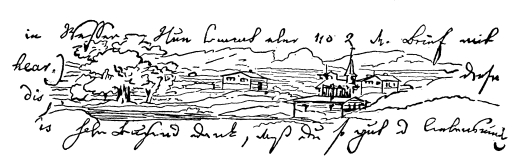
19. Fac-simile from Letter of Feb. 27, 1839. (See page 182.)
My dear Moscheles, let me thank you a thousand times for being so good and kind to me, and for the great pleasure you give me by intrusting your work to me. I hardly know what to thank you most for; I think, for sending it at all. But then there is your letting me have the manuscript, and then, again, all the enjoyment I derive from it. Since it came, not a day has passed without my playing it two or three times running, and each time with increased pleasure. I am quite aware I must hear it with orchestra before I can take it in completely, and that will be to-morrow fortnight at the concert for the benefit of the Orchestra Pension Fund. We always keep a choice morsel for that occasion; so, directly I heard of it, I announced the “Concerto Pastorale,” and the news was received with enthusiastic cheers. Now, I have to study desperately to get it up by that time, for it is as difficult as six others put together; and what is more, the difficulties must not be noticeable, it must all sound as fresh and light and airy as if everything went by itself. So that is what I am grinding at. So far it goes wretchedly: the end of the Adagio is specially troublesome, and won’t come out at all as it should; and that most delightful two-part Dance-subject sounds as if the girl were dancing on three legs and her young man on one,—not quite your intention, I presume. At the beginning, too, I sometimes hit C in the bass and then for a change G in the treble, and that would scarcely edify you. With all this, I am hopeful; for everything lies so conveniently for the fingers, that it is their fault if it does not come right, and they have really improved since the day before yesterday, and I do think I know how it ought to be played, and that is the great thing. How delightful that unexpected introduction of the bagpipes and the tender flute at the end of the Adagio, and the 3-8 time coolly stepping in! In fact, thanks and thanks again. I should not stop if I weren’t obliged to; but here comes No. 3, my Overture in C major, for which you found the right place with the right men (Cramer & Addison). I am quite ashamed of myself for having troubled you, but grateful too, and glad, for your managing all so well; that dedication to Miss Stone is a trump card, and then your writing to Simrock yourself. It is really too much kindness, my dear Moscheles; believe me, I thoroughly appreciate it, and feel deeply how much I am indebted to you.
You get this letter through David, who leaves for London with Bennett the day after to-morrow. Let me most warmly recommend him to you. He is as sympathetic, straightforward, and honest a man as ever was, a first-rate artist, and one of the few who love Art for its own sake, come what may. Please give him a kind reception,—he deserves it,—and assist him with your advice. Besides, if you wish to hear all about me and mine, nobody can better give you chapter and verse than he. We meet daily. I seldom make music without him, and what I compose he generally hears first. I wish you would let him play some of my new Quatuors to you; there are one or two amongst them I am pleased with myself, and I should like to know that I am right, and that you too are satisfied with them.
Chappell’s Opera is as yet in the clouds. He was here, and took back various messages from me to Planché (and others); that is two months ago, and I have not had a syllable from him. I suggested some alterations in the text, which he approved of, and promised to submit to Planché; in the mean while nothing can be done.
I have composed several Songs, and have begun a Psalm and a new pianoforte Trio. Think of that old duet for Clarinet and Corno di Bassetto coming to the surface again! Dear me! what an old sin of mine that is,—with perhaps some touches of virtue, if I recollect right! It may be the one in D flat or that in A flat major; for I wrote two for the Bärmanns, and they played them beautifully and con amore. Well, I thought these old pieces were dead and buried, and now they suddenly turn up again at Moritz Schlesinger’s. Not much to boast of,—this reappearance in his salons, from all I hear; but I suppose the old Duets are doomed to haunt the place in punishment of their sins.
Dreyschock is a young pianist from Prague, who must have practised like mad for several years, thus acquiring remarkable technical qualities and incredible powers of endurance, as for instance in his octave passages; but he is quite devoid of taste and musical culture. He plays some pieces so admirably that you fancy yourself in presence of a great artist, but immediately afterwards something else so poorly that you have to change your mind. The question is, Will he improve? Such as he is, he won’t go far; but he has fine means at his disposal, if he will only use them; and I hope and trust he may.
If in that performance of my Psalm at the Academy, they got into trouble with the Quintet it is lucky I was not there; for that is my favorite movement, and false notes make me savage.
Our concert season will close on the 21st instead of the 15th of March, as intended; and that obliges me, much to my regret, to abandon the idea of going to England this spring. I have to be in Düsseldorf early in May, at Whitsuntide, to conduct the Festival; so I must once more postpone the pleasure of introducing my wife to you and yours. Afterwards I shall probably spend a few months on the Rhine and then return here. What are your plans for the summer?
Another request: Let Cramer & Addison (or rather Addison & Beale) know that I will draw the money for the Overture about the middle of May. I would not trouble you, but they have to be advised in advance. Really my whole letter is made up of nothing but so many requests and so many thanks!
I wish the devil himself (or, for a change, ten thousand of them) would take the English custom of putting everything into the papers. Now, I am supposed to have written to the Philharmonic that I know of no German singer to compare with Miss Novello or Miss Shaw; the story is making the rounds of the German papers, the journalists repeating it a piacere. You can just fancy what a precious darling the German singers think me under the circumstances; and all that, when I never wrote anything of the kind. And now, my paper is full; so good-by! Take my thanks, preserve me your friendship, and—one more request—write soon; your letters do make me so happy. Kindest remembrances from self and wife to you and your wife, and may she ever remain the true and kind friend she is! Love to the children.
Yours,
Felix Mendelssohn Bartholdy.
Leipzig, April 4, 1839.
My dear Friend,—How happy I was to get your “Concerto Pastorale,” you know by my last letter. If I did not write about it again, it was because, though I had played it and got acquainted with it to a certain extent, I had yet many technical difficulties to master, and much more to study, before I could arrive at a free enjoyment of the work. And so it remained until I rehearsed it with orchestra, when for the first time I heard it properly, and began to understand it. Since then it has, if possible, grown still dearer to me; and I am sure it will become one of my favorites amongst your works. Every time I play it I like it better and better. We had two regular orchestral rehearsals, repeating the whole piece, as well as single movements. And so, when the evening came, it went very well and correctly, and you would have been satisfied,—that is, with the orchestra, not with me, I am afraid; for that night I was the victim of a dreadful cold (which, by the way, I have not got rid of yet), and at one time—it was just at the beginning of the Solo in the Adagio—a spasmodic fit of coughing threatened to bring me to a dead stop. So my playing was not as spirited as I should have liked it to be; but I got through it pretty correctly, excepting the octave passage,—some parts coming out better than they had ever done whilst I was studying them. The public applauded tremendously, and entered into the spirit of the work with more sympathy and feeling than I should have given them credit for. You know I am not generally an admirer of the public; but this time they did try to get at the meaning of the piece, and some of them had really arrived at a right conclusion and understanding. A desire was expressed on all sides to hear it again. But unluckily, this is just the end of our concert season; and now comes the annual fair, and our unmusical time, and I shall not play again here till next autumn. How long can I keep the parts? When will you want them in London? And now, my dear friend, once more a thousand thanks for the pleasure you have given us all; thanks for the fine composition you have contributed to our concerts; thanks in particular for having intrusted it to me.
We recently played a most remarkable and interesting Symphony by Franz Schubert. It is without doubt one of the best works we have lately heard. Throughout bright, fascinating, and original, it stands quite at the head of his instrumental works. Spohr’s Symphony, which we performed before, I suppose you will give in the Philharmonic. Lachner’s I liked but little; the others liked it less. David can tell you all about these. I have written a new Theatre-Overture[38] that has been quite a source of pleasure to me; also a Psalm (again vide David); some Songs without words (according to the “Hegira” of David), some with words; and now a Trio in D, and a Symphony in B, of which I will tell you more when they are finished.
Good-by, etc.,
Felix Mendelssohn Bartholdy.
In the following lines Moscheles introduces the well-known writer and musical critic. Henry F. Chorley:—
London, Aug. 17, 1839.
My dear Friend,—The bearer of these lines, Henry F. Chorley, is an excellent and highly cultivated young man; he is on the staff of the “Athenæum,” and has made himself a name as an author and as an enthusiastic lover of music, not only appreciating what is good, but discriminating between the good and the trivial. Above all, he has, for a long time past, been welcome at my house as a true and genial friend. He has an intimate acquaintance and full sympathy with you and your work. In a very exhaustive article published in the “Quarterly Review,” he has characteristically portrayed the most eminent pianists and composers; the sketch he draws of you there, is worthy of his subject.
Leipzig, Nov. 30, 1839.
My dear Friend,—I cannot understand why I so seldom write to you; for I thoroughly enjoy it when I do, and only wonder why I did not settle down to it before. What with the many visitors, and all kinds of business,—requests and behests that would really come more appropriately ten years hence than now, when I do not feel at all like settling down to a life of business,—I lose my head, and just do everything excepting that which gives me pleasure and which I ought to do. Well, you must be indulgent. Your letters make me happy for days to come, and I read them over and over again, and am grateful for your never-failing friendship and kindness. And how wonderful it all seems when I think of those days in Berlin when I first saw you, and you stretched out the hand of kindly encouragement to me, whilst the dii minorum gentium and all manner of little imps were making most horrible faces at me; and when I remember how, through all changes, you have never varied in your friendship and forbearance, and are now just what you were then, and how, after all, I am much the same as I was! To be sure, since then we have both become paterfamilias. By this time your daughter must be styled “Miss,” whereas mine only came into the world on the 2d of October; and whilst your boy is already playing his scales, mine is playing at nothing at all, not even at horse.
Your Paris letter gave me much pleasure, although what it describes is anything but pleasant. What a curious state of things seems to prevail there! To say the truth, I never felt very sympathetically disposed towards it; and all I have lately heard, through you and others, does not tend to improve my opinion. Vanity and outward show nowhere seem to play so prominent a part; and the fact that people do not pose only for stars, decorations, and stiff neckties, but for high art, and for souls replete with enthusiasm, does not mend matters. When I read your description of the soirée at Kalkbrenner’s, I see and hear it all. That anxiety to shine at the pianoforte, that greed for a poor little round of applause, the shallowness that underlies it all and is as pretentious as if such petty exhibitions were events of world-wide importance! To read about it is more than enough for me. After all, I prefer the German Philistine, with his nightcap and tobacco; although I am not the one to stand up in his defence, especially since the events in Hanover, which I followed with great interest, and which, I am sorry to say, do not reflect much credit on the German fatherland. So, on the whole, there is not much to be proud of on either side; and one cannot help being doubly grateful for that Art which has a life of its own far away from everything,—a solitude to which we can fly and be happy.
And now I want to know what you are writing. Chorley told me so much about some new “Studies;” when shall I get to see and play them? And so you are really going to dedicate your “Concerto Pastorale” to me? I don’t know how to set about telling you what pleasure it gives me, and how honored I feel to have my name associated with one of your works. Let me confess to you that you have fulfilled a long-standing wish of mine; for the C minor Capriccio appeared in Germany without my name, and now I am doubly happy to be identified with so important a work of yours. I will at once set to practising again, so as to do it more justice. It is curious how often I look through heaps of new music without feeling any inclination to practise, and then when I come across a piece that is really good, one that I must play, and can play with pleasure, I feel as if I had suddenly found a new set of fingers (some training they require, to be sure).
I want to write a new Concerto, but so far it is swimming about in my head in a shapeless condition. A new Oratorio, too, I have begun; but how it’s to end, and what is to come in the middle, Heaven only knows. My Trio I should so like to show you; it has grown quite dear to me, and I am confident there are things in it you would be satisfied with. Could I but bring you over here for a day or two, and play it to you, and have your criticisms and your advice as to what I should alter and what I might do better another time, then there would be a chance of my learning something; but at a distance, and by letter, it isn’t half the same thing. The publishers are pressing me to let them have it, and I want to do so; I only wish I could just once play it to you before.
As for the Opera for Chappell, I am sorry to say it is as much in the clouds as ever: the old trouble about the libretto! What is the use of beginning so important a work, with the absolute conviction that I could not make anything decent of it? Chorley, who has promised me his assistance, is a truly good fellow, for whose acquaintance I owe you many thanks; one seldom meets a man so highly cultivated, and at the same time so simple and natural. Remember me very kindly to him. I mean to write to him, and should have done so already if I did not feel the awkwardness of using that language which he writes so delightfully, and which I somewhat ill-treat. He seems to have been much pleased with our concerts; and in fact we might really do something grand if there were just a little more money to spend. That blessed money pulls us up at every step, and we don’t get on half as well as we should like to. On the one hand stand the Philistines who believe that Leipzig is Paris, and everything perfection, and that if our musicians were not starved it would no longer be Leipzig; on the other hand stand the musicians,—or rather they run as soon as they see a chance, and I even back them up with letters to help them out of their misery. A pretty business it would have been if you had kept our David! I should once for all have stuck in the mud, and should never have got on to decent orchestra legs again. His violin alone is worth ten good ones; and with that he is such a musician! Besides, really now, he leads quite an agreeable life here, and is petted and beloved by the public. No, him we positively cannot spare. Miss Meerti, who sends her kind regards, has won golden opinions here. She has a sympathetic and beautiful voice, and is a nice, amiable girl besides; she is quite a favorite with us, and is now going to Dresden, where she is invited to sing at Court.
I will make this letter a double one, and will enclose an old German ballad, in order to keep up the practice of sending a song to your wife. Excuse the postage.
Acting on your advice, I sent the “Study” to Schlesinger, though I cannot bear the fellow. He and Fétis make a pair, from whom may the gods preserve those they love! But then, to be sure, your name counterbalances a thousand or so of their calibre; and whatever you do, or wherever you go, there I follow with pleasure. I did not answer Schlesinger’s letter of last summer, because he had been rather too aggravating, and I wanted to leave him in peace, so that he might leave me in peace. However, thanks to your letter, I am now more mildly disposed; and after all, one publisher is as good as another. But I must say I do not think I shall ever get on well with this one. I declined to give anything to Pott in furtherance of his scheme; nor would you have done so, had you known all their doings and dealings in Germany with regard to monuments. They speculate on the names of great men in order to make themselves great names; they do a deal of trumpeting in the papers, and treat us to ever so much bad music with the real trumpets. If they will honor Handel in Halle, Mozart in Frankfurt and Salzburg, and Beethoven in Bonn, by founding good orchestras and performing their works properly and intelligently, I am their man. But I don’t care for their stones and blocks as long as their orchestras are only stumbling-blocks; nor for their Conservatorios in which there is nothing worth conserving. My present hobby is the improvement of our poor orchestra. After no end of letter-writing, soliciting, and importuning, I have succeeded in getting their salaries raised by five hundred thalers; and before I leave them I mean to get them double that amount. If that is granted, I won’t mind their setting a monument to Sebastian Bach in front of the Saint Thomas school; but first, mind you, the grant. You see I am a regular small-beer Leipziger. But really you would be touched if you could see and hear for yourself how my good fellows put heart and soul into their work, and strive to do their best.
I am very glad you improved your acquaintance and friendship with Chopin. He is certainly the most gifted of them all, and his playing has real charm. They say Liszt is coming here, and I should be very glad; for notwithstanding his unpalatable contributions to the papers, I am fully impressed both by his playing and by his striking personality. Berlioz’s programme, that you send me, is a very silly production. I wish I could see any pluck or originality in it, but to me it seems simply vapid and insipid. Has not Onslow written anything new? And old Cherubini? There is a man for you! I have got his “Abencerrages,” and am again and again enjoying his sparkling fire, his clever and unexpected transitions, and the neatness and grace with which he writes. I am truly grateful to the fine old gentleman. It is all so free, so bold and bright.
Now I must end, my dear, dear friend. I have been jumbling everything together, and chatting
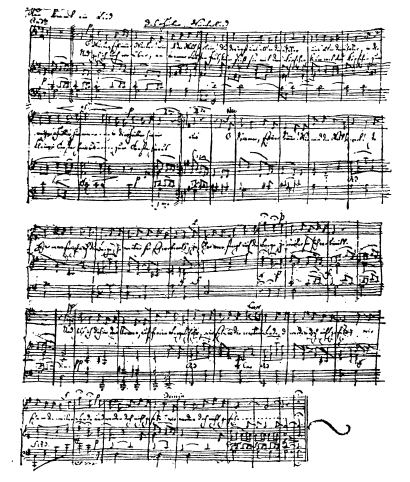
20. “Des Hirten Winterlied.” In Letter of Nov. 18, 1840, to Mrs. Moscheles. (See page 217.)
away as if I were sitting next to you by the piano. Would it were so! But for that I may have to wait some time; so, meanwhile, write to me and let me know what you are doing and what composing; and above all, tell me that you are my friend, as I am yours,
Felix Mendelssohn Bartholdy.
Leipzig, March 21, 1840. Beginning of Spring.
My dear Friend,—Those kind letters of yours and your wife’s came yesterday, and a most agreeable surprise they were. A thousand thanks. You cannot imagine how refreshing it is to me to get a letter from you. Besides all that is new and interesting in it, there is so much that comes straight from the heart, so much that is thoroughly Moscheles, that I quite fancy I hear you. And, do you know, one of the invigorating effects of your letters is the desire they give me to go to England, whereas, in truth, I fight rather shy of the journey. I don’t know how it is, but when I read your letter urging me to go to Birmingham, I am seized with the desire to be off. There is my wife, too, who is in favor of the journey, and who, this time, would like to accompany me; and that sets me to thinking that we might do worse than bring our wives together, and let them become friends; and then—and then—I long for the steamer and for the perfume of British coal, and I put in the daintiest touches to complete the pleasant picture. I wonder whether it is to be realized.
What you tell me about the Philharmonic and Lord Burghersh, I must say, does not particularly attract me; that the society should be losing ground, as you say, I most sincerely regret. It was so flourishing when I knew it, and had such a halo of glory round it, that I could not believe the evil I hear of it on all sides; but since you confirm such reports, they must be true.
Your remarks on Spohr’s C minor Symphony, I indorse word for word; and without knowing his historical Symphony, one feels how correct and fair your analysis of it must be, just as one can judge of the likeness of a portrait without knowing the subject.[39] But what an unlucky idea the whole thing is! After all, a joke is out of place in a serious orchestra. This leads me to a request that I meant to make long ago. Would you not let us have your own Symphony in C[40] for one of our concerts? I am sure it would be appreciated on all sides, and why should you withhold such a work from the public? For this winter it would be too late, as our last concert takes place on Thursday; but it might come as an opening feature of the concert season next autumn, if you are agreeable.
We have had an interesting musical time of it, this winter: Dreyschock, Prume, Madame Pleyel, Hiller, Ernst, and now, to wind up, Liszt. Our Subscription Concerts and the six Quartet evenings were more crowded than ever; and with their close the time has come when one longs for home music and no concerts. Liszt has been here for the last six days. He has given one concert, and announces another for next Tuesday; after which he goes to Dresden and to Paris, where he means to play; afterwards to London for the season, and then to Russia to spend the winter. His playing, which is quite masterly, and his subtle musical feeling, that finds its way to the very tips of his fingers, truly delighted me. His rapidity and suppleness, above all, his playing at sight, his memory, and his thorough musical insight, are qualities quite unique in their way, and that I have never seen surpassed. With all that, you find in him, when once you have penetrated beneath the surface of modern French polish, a good fellow and a true artist, whom you can’t help liking even if you disagree with him. The only thing that he seems to me to want is true talent for composition, I mean really original ideas. The things he played to me struck me as very incomplete, even when judged from his own point of view, which, to my mind, is not the right one. And, if I am not mistaken, that explains why Thalberg would meet with more success in many places,—England, for instance. He, in his way, is just perfect; he plays the pieces he has mastered, and there he stops: whereas Liszt’s whole performance is as unpremeditated, as wild and impetuous, as you would expect of a genius; but then I miss those genuinely original ideas which I naturally expect from a genius. A mere pianist he is not, nor does he give himself out as such; and that perhaps makes him appear less perfect than others whose talent cannot be compared with his. We are together the greater part of the day, and seem to be mutually attracted. His appreciation of you, and the cordial way in which he expresses it, have drawn me still nearer to him. It is a pity that he should be saddled with a manager and a secretary who, between them, succeeded in so thoroughly mismanaging things that the public were furious, and we had the greatest trouble to smooth matters to some extent for the second concert. The advertisements and subsequent modifications, the prices and the programme,—in fact, everything that Liszt himself did not do was objectionable; and consequently the mildest of Leipzigers were in a rage. By this time, however, they seem to have calmed down again.
A thousand thanks for your kind offer about my Trio. I need not trouble you again about its publication, as it is to appear at Ewer & Co.’s; but your offer to look through the proof-sheets is too tempting to refuse, however indiscreet my acceptance may be. So I have told Ewer to send you the proofs, and am sincerely obliged to you. They asked me for an arrangement for the flute instead of the violin, and I suggested that they should publish only the Andante and Scherzo in this form, under the title “Andante et Rondo (tiré de l’œuvre 49,” etc.); because the first and last movements appear too heavy and substantial for such an arrangement. However, I have left the decision in their hands. What do you advise? I have told them to consult you on any question which might arise. That, too, you must excuse; but, above all, let me soon know what you think of the work itself.
You know how highly I value your remarks, and how much at all times I learn from them. For that self-same reason I wish I could show you a new Psalm I have just written, and a Symphony I have begun. Well, perhaps that may be next autumn.
And now good-by. Yours ever,
Felix Mendelssohn Bartholdy.
Leipzig, July 2, 1840.
Dear Mrs. Moscheles,—I should have thanked you for your kind and friendly letter by return of post, had I been able to say anything certain about my visit to England. But that is so far impossible. What with constant conducting and preparing for public performances, I have lately been so knocked up that the doctor seriously advises me to take a few months’ rest before the beginning of our busy season in October. You can fancy that I shall only do so if necessity compels me; so one day I am quite resolved to go to England, and the next, I feel obliged to abandon the idea. To-day I leave for Mecklenburg, where, for some time past, I have promised to conduct a festival; and until we see what effect that has on my health, I cannot make any further plans. Should I, after that, feel strong enough to stand the fatigue of an English music festival, nothing shall detain me, and come I will. I shall let you know the when as soon as I can clearly see my way out of the ifs and buts....
And now farewell to you and yours; and to Moscheles, especially, the most cordial and hearty messages I can think of.
Yours,
Felix Mendelssohn Bartholdy.
Leipzig, Aug. 8, 1840.
Dear Mrs. Moscheles,—Hurrah! I’m coming. I cannot give you a date; for if I bring my wife[41] (as I hope and trust to do), I shall start in about a fortnight, whereas, if I come alone, I shall be in London on the 8th of September, remain for the Festival, and return immediately after it. In the latter case I should have to abandon the long-cherished plan of introducing my wife to the country of my predilection and the dear friends I have there.
I fully rely upon your remaining in England and going to Birmingham as you promised. What a delightful trip we could make of it! What a pleasure to see Moscheles again, and to hear him! And then, all his new compositions which I shall really get to know and enjoy, whereas hitherto I have had to be satisfied with a kind of a sort of a description, or half a bar here and there doled out to me by some friend just fresh from London. We’ll have a regular feast of music. I, for one, am hungrier and thirstier for it than ever. And my godson, and the two charming young ladies, now grown to the dignity of real “misses,”—I shall have to renew my friendship with them, or rather take it up where we left it; and possibly Emily may have some dim recollection of former pianoforte lessons, and Serena of certain carnations. I shall expect my godson to remember having met me at St. Pancras Church,[42] and to call me by my name. Of myself I can only say, you will find me a hopeless case. Whatever talent I might have shown for speaking the English language or behaving like a gentleman, has been lost in the atmosphere of German petty provincialism. In some things you will find me unchanged, but won’t it annoy you all the more that I have not improved? Well, all that crosses my mind occasionally; but then I console myself with the thought that you will be pleased to see an old friend, whether he is improved or not, cleverer or less clever, and will give him, as of old, your friendship and your indulgence. How glad that friend, on his part, is at the idea of soon finding himself in your family again, it needs no words to assure you. May we meet in health and happiness, and may you be as kindly disposed as ever to
Yours,
Felix Mendelssohn Bartholdy.
On the 18th of September Mendelssohn arrived in London. Mrs. Moscheles writes of him to her relatives in Hamburg:—
“Our dear Mendelssohn—I cannot call him otherwise—arrived at four o’clock, was with us at seven, just the same warm and genial friend as of old; bright, cordial, and hearty,—in a word, the type of a true man. Klingemann and Chorley joined him here at dinner; and in the evening Felix junior had such a tremendous romp with his godfather, that the whole house shook. One can scarcely realize that the man who was presently improvising in his grandest style, was the same as the Felix senior, the king of games and romps.”
On the 20th of September Mendelssohn and Moscheles went to Birmingham. From there the latter writes:—
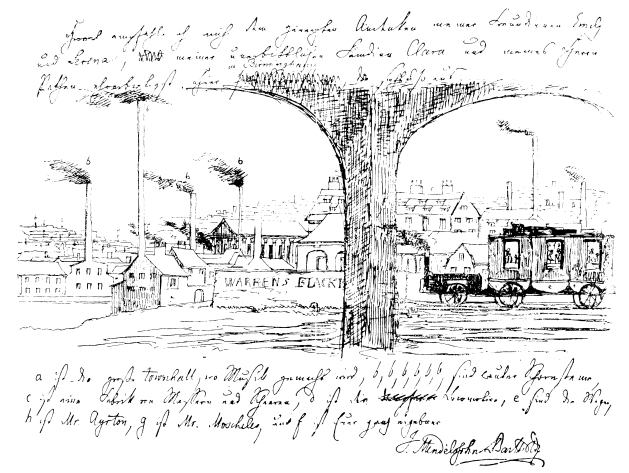
21. Birmingham. From a Pen Drawing by Mendelssohn. (See page 209.)
“Whilst all Birmingham was congratulating itself on having the heaven-born composer within its walls, and on the privilege of hearing him conduct his latest work, he, in the midst of a thousand duties, found leisure to make for the children a pen-and-ink sketch of the city, with its town hall, its houses, smoky chimneys, and all.”[43]
Further on Moscheles describes the performance of Mendelssohn’s “Hymn of Praise,” and ends with the words:—
“A powerful Fugue next breaks in triumphantly, the majestic tone of the organ resounds, and a double set of kettledrums marks the rhythm, much as a throbbing pulse marks the course of the life-blood through a man’s veins. Then follows a Chorale of such dignity, that involuntarily the whole audience rose from their seats as is usually done only during the ‘Hallelujah.’ Afterwards, when the hall was emptied, he played for three quarters of an hour on the organ, before a small circle of friends, just as if he had neither been hearing nor conducting music, but as if his day’s work was only then beginning.”
After a short stay in London, Mendelssohn, Moscheles, and Chorley started together for Leipzig. On the eve of his departure Mendelssohn made a pen-and-ink sketch in Mrs. Moscheles’s album, full of pleasant allusions to their stay in Birmingham. On the left he draws the Stork Hotel, in which they had taken up their quarters; and next to it a pair of scissors which he had presented to Mrs. Moscheles, and which are drawn stalking vaingloriously along and towering over the Town Hall, of Festival memories. Then comes the Bread-and-Butter Pudding, his favorite dish, the recipe of which he was carrying home with him.
Further on, the cravat which Mrs. Moscheles had given him. He was in the habit of protesting that he had never been able to master the art of adjusting his cravat, and that not until Mrs. Moscheles pronounced the magic words, “Pin it up,” was a flood of light thrown on the subject. Above the cravat the steamer stands in readiness for the morrow; below, the mail-coach and the luggage,—amongst the latter, a certain umbrella belonging to Moscheles, which Mendelssohn had unfortunately lost, is conspicuous.[44]
They started on the 3d of October; and their adventures by sea and land are recorded in a humorous letter penned by the trio of friends, Mendelssohn adding a little sketch of the pitching boat he had every reason to remember.[45]
During his ten days’ stay in Leipzig, Moscheles writes frequent letters to his wife. The following note of invitation Mendelssohn enclosed in one of them:—
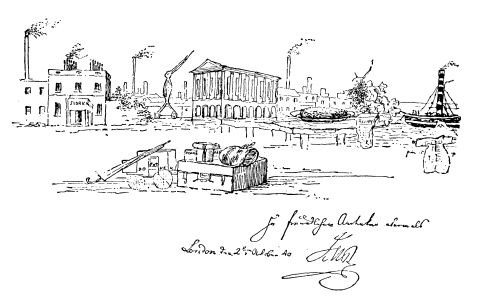
22. An Album Sketch by Mendelssohn. (See page 210.)
22. An Album Sketch by Mendelssohn. (See page 210.)
MRS. MOSCHELES
is respectfully invited to a musical evening party to be given on Monday, the 19th of October, at 6 o’clock precisely, in the rooms of the Gewandhaus, by
FELIX MENDELSSOHN BARTHOLDY,
there to hear his 42d Psalm, with Orchestra, his Overture to “Fingal’s Cave,” and Moscheles’s Overture to “Joan of Arc.” Moscheles, the “Father of Pianists” (as Fink calls him in the “Musical Gazette”), will play his G minor Concerto, as also Bach’s Triple Concerto, with Madame Schumann and Dr. F. Mendelssohn Bartholdy, in addition to which he will perform some of his characteristic Studies.
* * *
It is requested that this paper be presented at the doors; should, however, this request not be complied with, Professor Moscheles will have to proceed to London in order to receive that applause which here can but be incomplete.
An answer by return of post will oblige.
The “musical evening party” turned out a most brilliant one. Moscheles describes the bright and festive scene, and the charming way in which Mr. and Mrs. Mendelssohn received their three hundred guests. The chorus of one hundred and forty voices was most effective, and the Gewandhaus orchestra was never heard to better advantage.
After a short visit to his mother in Prague, Moscheles hurried back to London, reluctantly foregoing the pleasure he had promised himself of once more shaking hands with his friends before leaving Germany.
Leipzig, Nov. 18, 1840.
Dear Mrs. Moscheles,—I fancy Moscheles once more comfortably installed by your “fireside” (this can’t be expressed in German); so now I must write and send greetings, and say how often and with what heartfelt gratitude I remember our late meeting. After our parting there followed some pleasant days, which Moscheles’s and Chorley’s letters have long ago described to you. Now, however, that Moscheles has left us by train, and Chorley by Schnellpost, a quiet time has set in, with scarcely anything to describe,—for happiness itself is indescribable; and, indeed, I ought neither to form a wish nor to express a regret, when I enjoy, as I do at present, health and contentment with my wife and children, and have plenty of work to do; yet I must say we were truly sorry on receiving Moscheles’s letter, definitely putting off his return to us. He had become quite a member of the family during his short stay, and as such we parted from him. He seemed to be in most friendly sympathy with my wife; such feelings are generally mutual, and I know she took to him the very first day. But when will my prophecy be fulfilled, that you too will love my Cécile, and feel at home and intimate with her? Not this next spring, I fear; and whether Moscheles is so favorably impressed with Germany that he wishes soon to repeat his visit, that too remains to be seen; but I hope he did feel
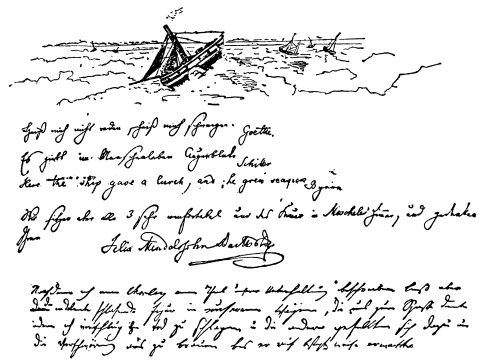
23. Fac-simile from the Joint Letter from Ostend. (See page 210; also, explanation in the List of Illustrations.)
what we all had at heart,—what every one of us would have liked to show in word and deed, if the very showing and saying had not been our weak point, though he will nowhere find it more strongly developed,—the most heartfelt reverence and love for himself and his work, and the most sincere gratitude for the immense enjoyment he has procured us. It is still our daily talk; and even little Carl[46] never passes a day without asking Papa, “How does my uncle Moschenes play?” Then I try to imitate it with my fists in A flat, six-eight time as well as I can, but the result is miserable. Now comes a song.[47] ...
I will give the pen to my wife, and only add love to the dear children, to whom pray remember me. This letter is for Moscheles too. How glad I was to hear of his successes in Prague, I need not say. I trust he thinks of us as we do of him, and that we may soon hear of his safe arrival. Farewell, dear Mrs. Moscheles.
Ever yours,
Felix Mendelssohn Bartholdy.
Leipzig, March 14, 1841.
Dear Moscheles,—Just as I was sitting down to answer your kindest of letters (dated the 9th inst.), in comes bright No. 2, with its graphic account of the Taylor evening, and its other capital and vivid descriptions. David must take you my answer to both, and my very best thanks for the pleasure they have given me. He leaves to-morrow. There is no need once more to recommend him, his wife, and their little daughter to you and yours. You know and appreciate him and his art already, and are sure to contribute more than your share towards making his stay agreeable. Mind you don’t get too fond of him, and keep him there altogether; we Germans could not allow that, for men and musicians of his stamp are not as thickly sown out here as you might fancy. So make as much of him as you like, but send him back well preserved afterwards.
And now to return to your two delightful letters. The first contained the enclosures from Broadley and instructions in reference to the German publication; they shall be punctually carried out. Please ask him to mention on the titlepage of the English edition that Simrock of Bonn is the German publisher. May I beg you to communicate this to him without delay? Make my excuses to him (and yourself) for not having sent the short prelude. I would gladly do so; but really, with the best will in the world, I could not write a short prelude to suit that piece without altering the whole form and giving it a pretentious coloring, which it should not have. I would rather leave it to the organist to tumble his fingers about at random, making it long or short as he likes, and as rich or poor as he can afford.
I do wish I could hear your Psalm. You know how much I should enjoy it. But how could I venture to make suggestions, or even to think them, when I am so full of the beauties I find in your work, and so thankful, as we all have reason to be, for what you give us in so full a measure? At any rate, you know that I, for one, feel deeply grateful for the bright products of your art; and I trust you will always let me have the new things you write, and particularly that you will not let me wait long for the Psalm and the two new “Studies.”
According to your kind permission, I have put together a book of your Songs, selected from the ten you sent me through Dr. Becker. Kistner required six for a book; so I chose the following: “Stumme Liebe,” by Probald; “Der Schmidt,” by Uhland; “Zuversicht,” by the Countess Hahn; “Das Reh,” by Uhland; “Im Herbst,” by Uhland; “Sakontala,” by Klingemann. The keys certainly follow in the maddest of ways,—F major, B major, and so on anyhow; but I have always found that not a soul thanks you for the loveliest sequence in keys, and that it is rather a change from slow to fast, from serious to lively, that is particularly in demand. So pray excuse this fricassee of sharps and flats.
Yours,
Felix Mendelssohn Bartholdy.
Leipzig, March 14, 1841.
Dear Mrs. Moscheles,—What a delightful letter of yours that was I received the day before yesterday, written beside the singing tea-urn, and taking me straight to Chester Place! By rights, my thanks ought to come in the shape of a song on one of these pages; but I cannot manage it to-day, and you must take these unmusical, prosaic, dry thanks for your musical, bright, poetical letter. For now, when our season is drawing to a close, you know from experience how hard-driven a man is,—and, to keep up the usual distinction, a musician into the bargain. Since January we are having an uninterrupted succession of musical doings, besides which the Leipzigers are so very sociable that at this time one is scarcely ever allowed a quiet evening at home. Our own house has become a lively centre too. Sophy Horsley has arrived, seems to feel at home with us, and is already making friends with my wife; and now we invite our friends, and they return the compliment. We speak German, French, and English, all in one breath; and all the while the orchestra is fiddling, trumpeting, and drumming every day, whilst one is expected to sit an hour and a half at supper, and sing four-part songs to a roast-beef accompaniment.
The only thing I regret in your charming letter is that you should have countenanced the strange attempts at making comparisons between Spohr and myself, or the petty cock-fights in which, for some inconceivable reason and much to my regret, we have been pitted against each other in England. I never had the slightest idea of such competition or rivalry. You may laugh at me, or possibly be vexed, at my taking up such a silly matter so seriously. But there is something serious at the bottom of it; and this pretended antagonism, imagined and started by Heaven knows whom, can in no way serve either of us, but must rather be detrimental to both. Besides, never could I appear as the opponent of a master of Spohr’s standing, whose greatness is so firmly established; for, even as a boy, I had the greatest esteem for him in every respect, and, with my riper years, this feeling has in no way been weakened.