Volume 1 — LECTURE IX. On the Study and Practice of Gothic Architecture.
Reading edition
Every day business and practical work to go on hand in hand with the study of ancient buildings—How best to be accomplished—The study from books—Artistic and archæological portions cannot be wholly disconnected—Heraldry—A knowledge of the history of art absolutely necessary for the study of Mediæval architecture—Greek art the parent of Gothic sculpture—Ruined cities of Central Syria—Mahometan styles—Our own form of church the direct inheritance from the earliest Christian temples—Training as artists—Choice among specimens of different Mediæval periods and styles—Examples especially recommended—Practical studies of ancient buildings in connection with their structural and mechanical qualities—Vaulting—Timber-work—Stone-work, etc., etc.—The actual practice of Mediæval architecture—The repairs and restoration of ancient buildings.
IN my last lecture I gave you an outline of the course of study requisite to obtaining a knowledge of Mediæval architecture, so far as this is to be done by the studying and sketching from ancient buildings. I purpose, in this, to carry on the same subject into other particulars, and also to offer some suggestions as to the actual practice of the revived style.
I might have appeared, in what I have said, almost to presuppose—what is improbable, if not impossible—that those whom I have been advising as to their studies have the entire command of their time, and are comparatively free from the demands of every-day business. I not only do not suppose, but should be as far as possible from desiring, this; for I am convinced that those whose usual occupations are not such as to familiarise them with the demands and the difficulties of practical work, and with the questions which are ever being suggested by actually working out the details of architecture for practical use, are not prepared to profit in the fullest degree from the study of old examples. This study, and the practical work to which it is the only key, must go on hand in hand. There are numberless intricacies and niceties; problems long since solved; difficulties ingeniously met; clever ways of making accidents, which in their own nature would cause a blemish, the means of adding beauty; numberless instances in which decorative or other treatment was the result of some practical reason which would at first sight appear to be merely a matter of taste; and a thousand other instructive and important matters which would be entirely passed over or fail of approving themselves to the understanding of the student who is not prepared to appreciate them by the suggestion to themselves of the same problems, the same difficulties, the same little knots to be untied, the same little intricacies to be unravelled, and the same calls for clever contrivance to meet accidental circumstances arising in their own daily practical work.
The man, on the other hand, who is always at practical work, without studying much from old examples, becomes dull and normal, or flighty and crotchety, according to the bent of his own mind; while, if he constantly supplies and revivifies his practical work by study from original examples, and fits his mind to receive these lessons by his practical work, he is prevented from becoming dull and lifeless by the constant suggestions of brightness and life which he receives, or from becoming crotchety and over fanciful by the reasonableness which he finds to pervade the objects which he studies, and the evident aim which they evince rather to chasten and conceal—to subject to the doctrine of reserve—their clever contrivances than to flaunt them obviously to public gaze.
To carry out this mutual co-operation of practical work and the study of old examples, I would recommend you always to note down any puzzle you fall into in your work, and any doubt as to how a perplexity is to be met or difficulty to be got over, and any uncertainty which may occur to you as to the best mode of treating a particular feature; so that, when you next go out sketching, you may have a list of questions for which you have to seek for practical answers from the old architects themselves, still speaking to us and instructing us through their works; and in the same way you may have, ever and anon, answers suggested by the old men to questions which you have not yet thought of asking, but which in your practical work you will soon find to arise. This playing of practice and study into each other’s hands will add vastly to the pleasure and profit of both, and will keep up a zealous and lively interest in your minds which will make your return to business only second in enjoyment to your setting out on a sketching tour; the one keeping alive by practical use the pleasure and interest of the lessons learned by the other.
I must now say a word, which perhaps ought to have come at the beginning of my last lecture, about preparation of another kind for this class of study.
I need hardly dwell upon the obvious necessity for having acquired at the outset, and for constantly continuing to acquire, a knowledge from books of the subject you are studying.
At the beginning of this century it was wholly unknown; since that time it has gradually become better and better understood; and it is clear that, to carry on this cumulative process, each generation of students must take as their basis the full amount of knowledge yet attained, and—riding as it were on the crest of the wave—must add their own progress to that attained by their predecessors. I will not attempt to enumerate books. If you are anxious to follow up the subject, you will already have found them out or will soon do so. I will mention, however, that you must not limit your reading to English works, for the French have done, I think, even more than our own countrymen to elucidate the subject; and among English writers let Professor Willis take a leading place as your instructor.
But what you have to learn from books is not architecture alone. I will not stop to insist on the necessity of general reading, just as every one should follow up: some of the usual classes of general reading are, however (if it were possible) even more directly important in their minute details to architects than to others: I would more especially instance historical knowledge, and all that tends to illustrate the changes which have influenced civilisation, and through it have borne more or less directly upon art.
Though antiquarianism is very distinct from art, and though the architectural student should be always on his guard against the danger of reversing the relative positions of the artistic and the archæological portions of his studies, it is nevertheless manifest that the two can never be wholly disconnected. You must, therefore, follow up antiquarian studies so far as they have a direct or a real bearing upon your main pursuit.
I would mention, in passing, that there is one antiquarian science which is a special link of connection between the present and the past: I refer to Heraldry, a branch of study which we too much neglect, but which has very strong claims upon our attention.
Then, again, you must always study the meaning and object of every ancient building which you are examining, that you may know how far its practical characteristics bear upon or are alien to such as belong to our own day. In ecclesiastical works this becomes a practical and necessary study; for, though the ritual uses and customs have greatly changed, many of them hold good in our own day, either directly or in some modified or parallel form, which connects the study of the ritual arrangements of ancient churches more or less directly with our own. The study, then, of ecclesiastical and ritual history and antiquities is one of those directly necessary to the church architect; though, as in the case of antiquarianism, he must avoid the danger of making it in any degree take the place, instead of assisting and guiding his study, of architecture itself.
I would here take the opportunity of urging upon those who purpose devoting themselves especially to Mediæval architecture the necessity of making themselves acquainted, in some reasonable degree at least, and the more thoroughly the better, with the whole range of the history of art. It is only by means of such knowledge that we are able to comprehend the true position which Mediæval architecture takes in the long stream of art history.
The classic styles are the parents of the Mediæval styles, and without a good knowledge of them the Gothic architect is unable to understand his own architecture. More than this, however: Greek art—properly so called—is the parent of Gothic sculpture, whether foliated or relating to the human figure; and in respect of the latter it is (next to nature) the best corrective of its faults. I urge upon you, therefore, the study of Greek sculpture of the best early schools, as a direct means of perfecting that of your own works.
Then again, with Roman architecture, and the course of its decadence: how replete is its history with anticipatory suggestions as to the rise of the new architecture which after a long period of darkness sprang up from its decayed roots! And equally instructive is the study of Byzantine architecture—that “light in a dark place” which was destined to shed its rays so beneficently on the rising, but yet embryo, arts of the Middle Ages.
A most interesting addition has recently been made to our knowledge of this style by the researches of the Count de Vogüé among the ruined cities recently discovered in the mountains of Central Syria.
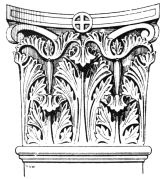
Fig. 192.—El Barah, Central Syria.
These cities seem to have been in prosperity up to the moment of the Mahometan conquest of Syria, but to have been suddenly deserted, as in one day, on the approach of the Arabian armies, and since then to have remained untouched but by the elements and earthquakes; so that they hand down to us the earlier Byzantine architecture (as practised in Syria) in the most perfect and instructive manner. In these wonderful cities we have not only the churches, but nearly every description of Byzantine building, either nearly perfect, or—when thrown down by earthquakes, as is often the case—with the parts still lying as they fell, so that the entire design can be perfectly understood.
These remains supply the connecting link between the Byzantine and the old Classic styles; but it is the later buildings, such as St. Mark’s at Venice, which give the link at the opposite end of the chain, connecting it with the churches of Aquitaine, and through them with our own Romanesque and transitional works; while the various productions of Byzantine art of the same period, with which Western Europe was so liberally supplied, became the germs from which much of the ornamentation of our own earlier works originated. All this it behoves the Gothic architect to study; nor should he neglect the parallel supplies of suggestions from the Mahometan styles—themselves the offspring of the Byzantine. But still more incumbent is it on him to follow out that direct catena by which, in Western Europe, the Roman style passed through the Early Basilican phase in Southern Italy, the Lombardic in Northern Italy,[82] and the various derivative forms of Romanesque in Southern France and Rhineland, as well as in the less familiar European countries.
In all these varied courses of gradual change it is yet more interesting, and far more profitable, to trace out—as distinct from all questions of architectural style—the ritual and practical changes through which the basilica, so early adopted as the great type of the Christian Church, became the parent of the typical form made use of to our own day and for our own churches, and those by which the later-introduced Greek cross was perfected into the form of the Byzantine churches, and the less usual circular type into that of a series of exceptional churches both in the East and West. The first of these catenæ, in particular, is most interesting to ourselves, as showing that our own form of church is our direct inheritance from the earliest Christian temple: and, though we may do well to consider how far the series of changes through which it has reached us may be advantageously followed up by any additional modification to meet the true demands of our own day, yet God forbid that we should so far forget the claims of our long descent as to let go this precious inheritance of our fathers![83]
There is, however, another more direct kind of preparation, on which I desire most urgently to insist. I mean your personal training as artists. True it is that your sketching tours will be a great means of promoting this; but this will not do alone: you must constantly strive to train your eye and your hand to artistic perception and skill. You should take lessons from first-rate teachers both in drawing and in colouring; you should take some means of training yourselves in drawing the human figure and in animal drawing, and even in modelling if opportunity permits. These means ought unquestionably to be afforded to the architectural students by this Academy as a special and most important and essential part of their training. That such is not the case at present is, I believe, the result of the cramped and insufficient housing which has been allowed us, and I do trust that this hindrance will soon be removed.[84]
You should further practise yourselves in drawing and modelling from natural leaves and flowers, and, side by side with this, in drawing from fine examples of sculptured foliage, whether natural or conventional, for which last-named object you have great facilities offered by the Architectural Museum; and all this, I would suggest, can be going on during the winter months when you cannot sketch from actual buildings. Without this training you will find yourselves at a great disadvantage in studying for original works; your attempts at drawing sculpture, whether figures or foliage, will disgust and dishearten you, and even your sketches from purely architectural objects will be both dispiriting to yourselves at the time, will fail to express the true feeling of the works themselves, and will convey no agreeable impressions when you revert to them in after years.
You will have gathered from incidental remarks as I have proceeded that I have not supposed you to limit your attention and study to architecture properly so called. Time does not allow me to go farther into the subject of collateral arts; but let me say that, as architecture unites all arts in one, so you must gather into her garner the spoils to be collected from the study of every art by which architecture may be ennobled and enriched.
I have said nothing in the course of the foregoing remarks as to the choice or preference you would have to exercise among specimens of different Mediæval periods and styles, but I have said enough to show that I do not suppose your studies of the old buildings in our own and neighbouring countries to be limited to one selected period, nor even to what can be strictly called Mediæval works, as much that is useful can be gathered (particularly in domestic work) from buildings of the sixteenth and seventeenth centuries. It is absolutely necessary, too, that you should understand and be familiar with all the varieties of our old architecture, because, though you may not follow them in your own works, you may be frequently called upon to restore them, though this reason is hardly necessary to lead you to master the whole range of Mediæval art.
Still, however, you cannot choose but follow more lovingly the works of the periods which most approve themselves to your minds as the days when art was the most vigorous, noble, and full of deep and true sentiment. For my own part, though I am less exclusive than many of my friends, I must confess that I find a difficulty in sketching, unless with a directly practical object, from works either so early as to be rude or so late as to be enervated. And while I beg you to make yourselves masters of the whole range, I am far from asking you to check the genial current of the soul by endeavouring to love all varieties alike, or to give equal attention to those which are and those which are not in harmony with your inner feelings.
I have dwelt much, in my earlier lectures, on the study of the vigorous and onward-striving works of the transition: and I confess that to me this is the most captivating period. I have already sufficiently indicated the leading examples of it, though you will find it interspersed with other styles all over the country. I think myself that no style is more calculated to excite a grandeur of sentiment, but none seems to me to have been so little studied from English examples, or rather, I should have said, from British examples, for it is as finely developed in Wales and in Scotland as it is in England. I have said a good deal about studying it as a historical phase of the style, but this, though necessary, is in point of fact a very secondary matter. You must much rather study it artistically, with reference to its intrinsic merits and its noble beauty, and morally, as illustrating the elevated sentiment and noble earnestness of those who, while pressing forward a new style of art, generated at every step such glorious productions.
I have said less, perhaps, and spoken with less enthusiasm of the fully-developed Early Pointed style, not from a lower appreciation of its merits, but because it seems rather a breathing-place—a point of attainment—in the march, than especially a point of noble pressing onward. Nor need I enumerate the special objects of study belonging to the period. They are sown broadcast over our own and neighbouring lands, and form the staple of our most magnificent, and a large proportion of our humble, Mediæval remains. No tour, however, is more prolific of instruction in this style than that of the northern abbeys, and this tour may be repeated again and again with ever fresh delight, and extended with great profit over the borders and far away into Scotland.
After this we come to another transition, and—the period of rest being at an end—we find again much of the same earnest striving as during the earlier transition. I would recommend a very special amount of study to be devoted to this style—for it is not reasonable to suppose that traceried windows are to be banished from our revival; and loving, as most of us do, the vigour of the earlier periods, this second transition—the connecting link between the earlier and the middle periods—offers most valuable material for our own developments: indeed, I cannot conceive of a more promising course of corrective training for those among us who have followed early and foreign work till it has grown into an actual mania, than to set themselves the task of following up, nolens volens, the minute study in all its details of a carefully selected series of work of this second English transition.
For such a course I would especially recommend the following examples:—
The greater part of Netley Abbey; all the eastern portions of Westminster Abbey; the eastern arm of Lincoln Cathedral;[85] the chapter-house[86] and cloisters at Salisbury; all that remains of Newstead Abbey; and the nave of Lichfield Cathedral. Of a period a shade later I would recommend the nave of St. Mary’s Abbey at York; the whole of Tintern Abbey; the chapter-houses at Southwell and at York, and the eastern parts at St. Albans. The two latter are, however, productions of the completed style rather than of the transition, and to give a list of objects of study in that style would be almost hopeless, for the country is filled with them. Nor do I admire so exclusively the earlier work as to exclude from the better half of our Mediæval range yet later specimens of the Middle Pointed. I cannot but think the gateways of St. Augustine’s at Canterbury, of Battle Abbey, and of that of Bury St. Edmund’s; the halls of Mayfield, Penshurst, and the lost hall at Worcester; the lost chapel and the still existing crypt of St. Stephen’s; the choir at Winchelsea; the Lady Chapel at Chichester; and a long list of other buildings of the earlier part of the fourteenth century, to be works claiming our high regard and admiration, and I consequently recommend them also to your careful study.
The very latest phase of the Decorated style is often weak, but I will not suppose you to be so much so as to be unable to sever its beauties from its faults, or to be in danger of condemning or admiring good and bad alike; and a yet more vigorous discretion is needed in studying from the works of the succeeding ages, though, all through, you will find not only objects of high intrinsic merit, but constant suggestions capable of being advantageously translated into a more vigorous style.[87]
A still more important subject I have as yet but incidentally touched upon. I refer to the practical character of your studies of ancient examples, as viewed in connection with the actual structural and mechanical qualities of the examples themselves, and the learning from ancient examples the principles of Mediæval construction and practical art, and their bearings upon our own constructive and practical operations. Thus, for example, you must give special and systematic study to the principles of vaulting as exemplified by Mediæval buildings. I have, in one of my lectures, recommended, as a prelude to such study, your reading Professor Willis’s paper on the subject in the Transactions of the Institute of British Architects and M. Viollet le Duc’s in his Dictionary. You will be the better prepared after this to work the subjects out for yourselves. It is a particularly difficult matter to study, both in its own nature and because the work is usually out of reach. You should watch for opportunities offered by scaffoldings being raised under vaultings, and make accurate measurements. You must study not only the lines and their setting out, but the stone cutting and jointing, and all kinds of practical questions, the very existence of which you cannot understand till you have given much attention to the subject. Then, when you have obtained a perfect insight into these questions, you will do well to consider whether there are or are not practical faults in the old work which we should do well to remedy. So in timber-work we should master the old system of construction, and then think how far it is perfect and where open to improvement, and also how far the old system as applied to oak is suited to our own constructions in fir, and what are the practical variations suggested by the material. And so on through stone-work, iron-work, brass-work (whether cast or wrought), lead-work, silver-work, and jewellery. You must not content yourselves with studying and sketching from the work as an architectural or decorative design, but must dissect and investigate it, and find out its construction, and how far that construction has modified or suggested its design, or how far this may result from not only the construction, but the nature of the material.
In respect of the metal-work and other kinds of decorative art, you will find great advantage from carefully reading Mr. Burges’s lectures, given some time back before the Society of Arts.
By thus following up your studies from all points of view, whether antiquarian, historical, artistic, ritual, utilitarian, or practical and mechanical, you will obtain that perfect understanding of Mediæval art which is necessary to enable you to carry on its revival and practice both with knowledge and intelligence.
I now come to the actual practice of the lessons learned by such a course of study as I have been endeavouring to shadow forth.
As I said on a former occasion, I will not go into the general question of the revival of Gothic architecture, but will assume it as a fait accompli, and proceed to consider some questions as to the practical carrying of it out.
One point which has given rise to much difference of opinion is the question of what period and variety of Mediæval architecture we should best take as the groundwork of our own developments.
When, during the long interval between the cessation of Mediæval architecture and our own day, it was temporarily returned to in any special instance, it seems to have been viewed rather as a dormant than an extinct art, and the style chosen was always its latest phase; as if it had only to be re-awakened at the point at which it had fallen asleep. And in the same manner, in our own day, nearly all the earlier works of the revival were in the latest form of the style, as if the revival was the mere prolongation of a chain, and to be attached to its last link.
This was the traditional phase in the revival. The interval had, however, been too lengthened to allow this imagined connection with the old but disused chain to hold good. People began to investigate and to philosophise and to write books about the style. All phases soon began to be equally known, and people could not help entertaining preferences. Rickman had awarded the palm to the Decorated; others preferred the Early English; and after a time all agreed that the latest link was the worst, and must not be adopted as the starting-point. Some tried Norman, some Early English, some Decorated. The Cambridge Camden Society seemed at first to favour Early English; but soon they laid their ban upon it, and preached a crusade against all but the sacred “Middle Pointed,” and even defined with minute accuracy the precise period of that style which they would stamp with their approval. It was to be the earliest phase of the later form of Middle Pointed; or, as a friend of mine jokingly defined it for them, the “Early late Middle Pointed.” Some, however, preferred the “late Early,” some the earliest Middle Pointed; and though a few still strayed into the heterodoxy of “First Pointed,” or even into deadlier errors, it came, after a time, to be a generally received opinion that the Middle style was the best groundwork for us to go upon, and that it might fairly be viewed that this had been so completely revived and re-adopted as to become the style of our Gothic Renaissance.
Though there was a good deal of nonsense current about it at the time, as if it were almost an article of religious faith, an “Articulus stantis aut cadentis Ecclesiæ,” there was, I must say, a great deal of common sense in the choice.
The early transitional style, though gloriously noble and vigorous, could not reasonably be re-adopted as a groundwork inasmuch as it was a transition, and that from a state of things with which we have a little or nothing in common. The developed Early Pointed had very strong claims, but failed of being what Dr. Whewell calls “complete Gothic.” Its fault was that there were certain features which, once known, could not be rejected, but which the Early Pointed had not. Its merits were positive and of the highest order; its defects were purely negative. The later Pointed had been pretty generally voted to be the production of the decline of the style, and the later half of the Middle Pointed showed unquestionable evidences that during its period the way for that decline had been preparing. The Early Middle Pointed was thus come to by an exhaustive process, as being at once “complete” and not on the decline, though some felt (and I confess to being of the number) that it might with advantage be invigorated by importing into it a good deal of the detail, and, even, perhaps, some whole features of the earlier style.
This general conclusion having been tacitly consented to, people naturally came to think that we ought to adhere to it as closely as might be, and for this reason: that the principle of a revival was only defensible in an extreme case, and nothing could defend it from the charge of frivolity if the revivers went on the principle of now reviving one style and now another; but that if all by general consent should determine on reviving one and the same style, as the groundwork for the future development of a style of our own, the revival would become invested with reality, reason, and vigour. The choice, then, of one style, and the adherence to it as a groundwork, seems to me to have been right, and I am very much disposed to believe that the choice come to, though its enforcement at that time bordered on fanaticism, was right also; at least in the main.
This promising theory, not to mention occasional tokens of rebellion at the somewhat tyrannical way in which it was attempted to be pressed, received a rude shock some ten years back through the competition for the erection of the cathedral at Lille. We had been in the habit in this country of speaking rather pityingly of the error of the French revivalists in selecting an earlier type for their groundwork than we had adopted; but the programme of this great European competition prescribed this early style, and our talented countrymen who won the palm leaped over the traces to such an extent, as absolutely to luxuriate in the till now forbidden art, even beyond what was demanded by the conditions, and beat the French out of the field in the intensity of their following out of the Early French style.
This was received with unlooked-for indulgence by those whose laws it set at nought; but so marked a condonation seemed to have been viewed as an act of emancipation, for, from that time forward, every one began to do that which was right in his own eyes.
There was at once a violent revulsion of feeling in favour of the earliest periods; and at the same time the long pent-up feelings of favour to the continental styles, excited by Mr. Ruskin and by foreign travel, were given their full swing, and for a time nothing could be early enough—nothing foreign enough—to satisfy the emancipated cravings. We all felt this, and acted on it in a greater or a less degree, and those who chose the less degree were heartily despised by those who chose the greater.[88] As time, however, rolled on, and cool reflection began to assert her sway, we again remembered that we were Englishmen, and that there was an English language in architecture, and we began again also to recollect that the course of Gothic architecture did not cease to create noble productions in the very period of its coming into existence. Some, on awakening to this consciousness, ran at once into the opposite extreme—condemning every lesson they had learned abroad, eschewing the early styles to which they had so recently sworn exclusive allegiance, and despising (according to prescribed custom) all who did not go so far in their new direction as they did themselves; but, on the whole, people now seem likely to settle down into a via media, in which I trust that common sense will be found to reside.
I would not have gone through this list of peccadilloes but for the purpose of warning you against their repetition. We have, I hope, “sown our wild oats.” Let us now take a steady and sensible course.
During the state of chaos which I have alluded to, our revival has suffered seriously from the follies, not so much of its own champions, as of a number of pretenders who had never studied the subject at all, but who, taking advantage of a period of disorder, palmed off upon the public designs, especially in domestic architecture, which—really the offspring of ignorance—were put forward as that of the prevailing taste—as original developments founded on something very early and very foreign; so early, indeed, and so foreign as to have never and nowhere existed. These productions have disfigured our streets and done more than anything to bring discredit on our revival.
Let us now consider what is the course which it becomes us to take in the selection of our groundwork.
I think that our experience of the last few years has suggested to us: first, the expediency of returning in some modified degree to the rule from which we had departed, of adopting as our normal type the architecture of one period, and that not the very earliest though still an early period; but, secondly, the desirableness of not making our self-imposed rule too strait; of, thirdly, making our revival distinctly English; though, fourthly, not refusing to enrich and amplify our English revival with the spoils of our foreign study.
I would, then, suggest that, while your basis should be the earliest form of what has been called “complete Gothic” (such, for example, as that of Westminster Abbey, the eastern part of Lincoln, Newstead Abbey, and the nave of Lichfield), this should be taken rather in a representative than in a literal sense; that your revived style and its developments should, in short, be based on the earlier and more vigorous half of Mediæval architecture, which earlier half should be represented by its central point, as a nucleus round which it rallies, and into which the beauties of the whole may be collected; that the point chosen should be inclusive of much which preceded and followed it, and exclusive of nothing with which it will consistently amalgamate. Nor would I condemn as latitudinarian an occasional departure, either forward or backward, from this point de départ; only asking that the early styles may be, in a certain degree, viewed as one in our revival, rather then split up into many, and their details, with proper judgment and self-restraint, be considered capable of being united, when occasion seems really and distinctly to call for it, in one work, or the earlier and less early forms be used, as may be preferred, for buildings intended to express more of vigour or of delicacy. I would not, however, advocate too free a use of this liberty, and would therefore propose that the early “completed” style, of which Westminster Abbey is our great type, should be always viewed as our central and normal type and rallying-point.[89]
Then, again, I would recommend a return, loyally and unreservedly, to English types. That is to say, that when there is nothing to call for a deviation from it, we should design as a matter of course in English. In doing this, however, I would act as a well-instructed and sensible English writer would act. He would (except under extraordinary circumstances) write in his own language, but would never be so suicidal as to refuse to enrich his mind, and through it his writings, by the study of foreign literature. He would, however, express thoughts thus learned in English; any passage adopted from foreign writers he would probably translate into English, excepting only where its ipsissima verba were of the essence of the quotation. So with the English architect. The architecture of his own country should be his normal type, but it would be madness for him to refuse the lessons he can learn abroad. The results of these lessons should, however, for the most part be translated into English, unless such translation would destroy their vigour and their meaning. He should, as I have often observed, do—not necessarily what, but—as the old architects did. It is patent that our Norman, our transitional Pointed, our traceried windows, and many of our minor details partake more or less of a foreign origin. True, they were not really imported from abroad, but our architects and those of France were working hand in hand and mutually aiding in the development of their common architecture; but our old builders never scrupled, nay, earnestly sought, to gather ideas wherever they went; and yet their productions, replete as they were with the riches gathered in foreign travel, were so unquestionably English that we detect any departure from them at once as a foreign interpolation. Let us endeavour in the same manner so to work in our foreign gatherings as not to disturb the homogeneous character of the whole, much less to suggest the idea that we are designing in a foreign dialect. We then need not fear even to learn and make use of the rich arts of Italian decoration, and still less the more kindred lessons taught us in France by the men who worked side by side with our own old architects.
We are all too apt to run into extremes. We run wildly into early or late, foreign or English work, according to the rage of the moment; and perhaps hate that which we last doted on, and despise in their turn all who hold opinions we once held ourselves or shall soon entertain. I do not condemn in toto a little of this tendency to mania, as it keeps up our zeal, but I would wish to restrain it and bring it within the range of reason; and I think that such a broad and liberal rule as I have suggested will tend to this end, without imposing a galling restraint or narrowing either our range of study or the wholesome variety of our practice.
In our own earliest style, and in the French examples down to a far later date, there is one feature which I confess I have a great love for—I mean the square and angular abacus. I think it is probably the feeling for this feature which has, more than any other, led to our tendency to follow French types. I would mention, however, that it is not necessarily a foreign feature, as it is found in our own earlier style, and sometimes (as in the side chapels of the nave at Chichester) is continued later; nor is it necessarily a very early form, as it was in France continued to a comparatively late date. I do not, therefore, see that we need deny ourselves its use. I would only moderate it, and use it and our own more typical round abacus, and our own moulded capital, as frequently as, and on at least equal terms with, the other.
In the form of arches, though keeping to typical forms as a rule, I would not deny myself the use of the round arch nor the plain segment where there is any practical reason for their introduction, only I would not use the abnormal forms frivolously or without a reason. I would assert the greatest liberty in such matters, yet restrain myself by common sense in the exercise of the liberty I claim.
I would again advise (particularly in the use you make of your foreign studies) the avoiding of queer, odd-looking features, for which there has of late been so eager an appetite. I believe that most of those we see in modern works are pure inventions for the sake of novelty and apparent cleverness. The little stumpy columns with gigantic capitals, and all the thousand-and-one pieces of quirkiness which one sees, are things which, I confess, I have rarely if ever found in old work in any country or of any period. We have really become so French of late, in our own imagination, that no Frenchman would recognise his native style as seen in our exaggerations of it. All this is a vulgar vice, and should be repudiated as a person of taste would all that is loud and vulgar in dress or in anything else.[90]
All this has led to much neglect of our own examples, and, when we use them, to our going too much in the contrary direction; and, from want of familiarity with the endless variety they contain, we have got into the way of confining ourselves to their most typical forms, whereas a careful study of our old examples would supply us with an infinity of varieties of the most charming kind.
It has for years been a question sub judice, whether architectural foliated carving, etc., ought to represent natural or purely conventional forms. I am not going to open up this controversy, but I think it right to urge upon you in your studies to follow up both, and to aid them by careful study of the actual objects of nature which are suggestive either of one or the other. The period I have recommended as our central rallying-point was just that at which the two kinds of foliage were used together and on equal terms. My own opinion is that no art can be a living one which founds its ornamentation wholly upon a bygone conventionalism. This does not, however, prove that we ought directly to copy nature as it comes before us. If we demand conventionalisms, though we may adopt those of our predecessors, we ought to be able to conventionalise for ourselves.
For my own part, as I equally admire several of the forms of foliated ornament I find in the range of works I claim as our types, I am content to use them each in their turn; but I cannot reject nature as the great guide, though the more we are able so far to conventionalise her productions and to “bring into service,” and suit them to the uses to be made of them, the better will our work be.
In sculpture I hold that we ought to be able to follow what is good and noble in the form of that art which belonged to the finest period of our architecture, and yet to unite it with the most perfect art which can be produced. Greek art unites perfectly with Gothic, but both demand the spirit and soul of the true artist, aided by the use of what he sees in actual life. I confess, however, that so little opportunity is allowed us for cultivating this art in connection with architecture, and so small the funds at our disposal, that we have fallen into the sin of putting our sculpture into the hands of men of a very inferior class—extemporised, in fact, from amongst our ordinary carvers; and the only wonder to me is, not that they do so badly, but so well as they do. This is a noble subject on which to follow out a new and higher aim, and the students of the Royal Academy might especially devote themselves to its realisation. I fear that we older architects shall not succeed, but we may claim aid of you who have better opportunities; and I would, as a help, suggest a course of study from the finest and purest Greek side by side with the best Gothic sculpture, endeavouring to unite their qualities, and to add to them what is to be gathered from the study of nature—not only the usual study of the human figure, but rather the importing into sculpture touches of nature and fact as they come before us.
To this also we need to add the study of animal sculpture, a point in which such artists as we are able to employ are usually, though not always, equally behind-hand.
Much the same may be said of figure painting when used in connection with architecture. We ought only to employ those who are really artists, but these should train themselves especially for the subject; and if the architect could fit himself for the work, so much the better, if he really does it well; though this can never become again the general practice.
I have said a little in my last lecture on the study of the old examples and fragments of painted glass which you fall in with; I would wish more formally and urgently to press this upon you.
The foreign fever, from which we are but now recovering, has told most severely upon this class of art; for not only has English stained glass been neglected as our practical guide—not only has the study of it been almost wholly abandoned—but its very conservation has been little cared for; and not only in the churches which contain beautiful fragments have they been contemptuously neglected as guides to the characters of new windows introduced, but they have been constantly and systematically expelled from the windows in which they exist, and for which expressly they were designed, to make way for new glass, designed without any reference to their character. We have long been in the habit of abusing, and justly, the village glaziers who turn out the beautiful fragments of ancient glass which occupy the heads of lights and the openings of tracery, to make way for uniform quarry glazing; but our glass painters are daily doing the same thing without remorse, and are the more inexcusable inasmuch as they cannot plead ignorance, and if they chose could make the design of their new windows a restoration of the old, and retain the old fragments in their proper places. It usually happens, however, that they never see the windows for which they prepare the glass, and are culpably innocent of all knowledge of whether they or others in the church retain remnants of the works of those who are, or ought to be, their masters.[91]
I have, in more than one instance, known that some of our best glass painters, when called on to introduce windows into our finest minsters, have completed their work without any knowledge of the fact that there remained exquisite remnants of the ancient and coeval glass belonging to windows corresponding with those they were supplying, and that of the finest periods of the art; and have consequently failed to assimilate their work to what was intended by the original builders.
The clergy, too, are often greatly to blame in this. Their eagerness for new glass often expels from their minds all care for the old. I have heard of a good-natured[92] archdeacon in one of the southern counties, who is ready to give to any friend specimens of the ancient glass he has supplanted by new in his “restored” church.
All this makes it incumbent on you to note and carefully to draw every fragment of stained glass which you meet with where it is exposed to be lost or neglected; and I would further urge on you the systematic and minute study of the better known examples, so that your knowledge of glass painting, as of architecture, may be based upon English examples. Our glass painters are open to the double charge of adhering to old precedent too religiously in its weakest point, and too lightly in its strongest; for though their works are far from being generally very close followings of the actual decorative designs of old glass, and particularly of English glass, they affect to follow the grotesque drawing of the old glass painters, and often greatly exaggerate it. I would rather reverse this, for the decorative portions of old glass are so perfect that it is impossible to surpass their beauty, while the figure drawing, though often full of deep and noble sentiment, is usually quaint and even grotesque.[93]
In respect, however, of the figure drawing, I am very far indeed from advising the repudiation in toto of the ancient manner. It is only the correction of the drawing that I advocate. I would adhere rigidly to the principle of representing the figures mainly (though not wholly) by means of sharp hard outline. We know from the Greek Vases (if, indeed, any proof were wanting where the fact is so obvious) that an outline may be as absolutely artistic as a finished painting. I would further adhere to the general sentiment and artistic style of the old glass, but I would urge that the sentiment and style should be followed out with as perfect drawing (were it possible) as an old Greek artist would have brought to bear upon it. As an imaginary illustration of what I mean, I would endeavour to realise what the result would be if pencil outline copies of the best thirteenth century figure subjects were placed in the hands of such a man as Flaxman, or any really high-class artist, capable of appreciating their sentiment and well versed in Greek art of the noblest period, for the purpose of simply correcting their drawing without changing their sentiment and motive. It is just such drawing as one may suppose to result from such a process that I would wish to see in our modern church windows. In secular works I would not oppose some departure from the rigidity of such a style, nor a little further addition of shading and high finish, though never to the concealment of the outline; and in both I would avoid all that is grotesque or over-quaint (excepting in subjects or figures which demand it, and where it is of the essence of the motive), as these qualities introduced into serious subjects are, to say the least, contrary to the general spirit of the age, and are, therefore, false and unreal.
In painted decorations on walls, etc., much greater liberty may be allowed. We have not here the material limiting the class of art made use of, and the treatment may therefore suit itself freely to the conditions suggested—first, by the purpose of the building; secondly, by its scale of decorative character and the limits of cost; and thirdly, by the more or less functional nature of the surface occupied. We may, in fact, vary from outline pure and simple to perfectly finished paintings, and from a severe and solemn treatment to any reasonable degree of lightness and freedom, according to the conditions: ever remembering that the more functional the surface, the less must be the apparent relief. A painting in a panel may have any amount of shadow and distance, while that occupying a wall, a pier, or a vault must be kept sufficiently flat as to avoid disturbing the functional character of the object which is the ground of the painting.
A great deal has been said about development in architecture, and a good deal of harm has resulted from it: not that development is to be objected to—far from it; but because true and genuine development will never be the result of direct and deliberate effort.
The true developments we have to look for are such as will be continually forced upon us by the necessities of new materials, new modes of construction, new requirements, and the altered habits and feelings of the age in which we are living; by the different modes of decoration which will from time to time offer themselves to our notice, and the importing into English architecture arts which had previously been peculiar to that of other countries and perhaps to wholly different styles. The conditions also prescribed by works in different climates—as in India, in North America, or in Australia—demand special development.
The frank and natural meeting of these new demands and new facilities will of itself produce developments enough to distinguish the works of our revival from those of old times, without our affecting to alter those elements of our style which are not naturally affected by any such conditions. I have said so much, however, on these subjects elsewhere, that I will not venture to crowd their multitudinous details into this lecture: only suggesting, in passing, that domestic architecture by its absolute demands must of necessity suggest very many new developments; that another wide field for novelty of treatment is offered by the wrought iron construction and fire-proof construction of our day; and that there still remains to us the solution of the noble problem of the introduction and naturalisation of the dome as a feature of our revived style.
I will now say a very few words on another branch of the practice of a Gothic architect: that which relates to the repairs and restoration of ancient buildings.
What I have said on the study of ancient examples as the one and only source of knowledge of architecture, of necessity carries with it the assertion of the value of those examples, whether of a higher or of a humbler class, and the condemnation of those who would deprive us of these monuments of ancient art or tamper with their genuineness or integrity. Yet, strange to say, a large number of the architects who take in hand the so-called restoration of our ancient buildings seem utterly devoid of all feeling for their value as authentic works of olden time. I know no subject connected with architecture more mournful and distressing than the way in which our old churches are but too generally dealt with. Many of our large towns contain one or more architects who systematically prey upon the surrounding churches, more or less ruining everything they touch, and that without remorse, and combating with the utmost energy every remonstrance against their destructive habits. Nor are they alone to blame. The clergy too often love to have it so. If they can get their churches made smart, they often seem to care little about the destruction of their antiquities; and thus, between them and their architects, whole counties are becoming denuded of a great part of the points of interest in their churches. Nay, the man who commits the greatest devastations often earns the greatest amount of commendation; and one who venerates an old building and seeks to preserve its antiquities has to fight for every inch of ground against the opposition of the parties interested in the work. These destructive tendencies are not limited to the minor features of churches, but often involve the whole buildings, or large parts of them, in destruction, and that without a shadow of necessity. One of these destroyers of churches is called in, and at once condemns all he does not fancy or which can be shown to be out of repair; the clergyman appeals to the neighbourhood for funds to meet the sad state of things portrayed by his architect; the whole or part of it is destroyed, and no regard to its former design is paid in its reconstruction. This is going on all over the country, with the applause of local magnates and the laudations of the local papers: the architect and his patrons glory in their success, while the country is robbed, one by one, of its invaluable and irreplaceable antiquities.[94]
Even the societies formed for the study of our antiquities fail to lift up their voices sufficiently against this fearful Vandalism, while many who should be the guardians of our ancient churches use specious arguments in confutation of the protests of those who dare to denounce the atrocities which are perpetrated.
I have expressed myself pretty fully on the subject elsewhere, and have spoken also about the spirit in which we should undertake such additions to old churches as absolute necessity demands; and I am happy to say that the Institute of British Architects have issued most judicious and strongly-worded codes of suggestions as to the treatment of old buildings, so that I trust the public will at some time be awakened to the monstrous course which is being too generally followed. I go over the ground on this occasion because I suppose myself to be addressing many of those to whose keeping our churches and other old buildings will be at a future time committed. I desire to warn you at the outset against following the steps of those whose misdeeds I have been proclaiming; and I close these lectures with an earnest entreaty that you will enter upon practice with a solemn vow to yourselves to be the determined and consistent protectors and conservators of those precious relics of former days, now consecrated by antiquity, and from which alone you learn the art which I am urging you to study.
“It were a pious work, I hear you say, To prop the falling ruin, and to stay The work of desolation. It may be That ye say right: but, oh, work tenderly: Beware lest one worn feature ye efface; Seek not to add one touch of modern grace; Handle with reverence each crumbling stone, Respect the very lichens o’er it grown; And bid each ancient monument to stand, Supported e’en as with a filial hand. ’Mid all the light a happier day has brought We work not yet as our forefathers wrought.”
END OF VOL. I.
FOOTNOTES:
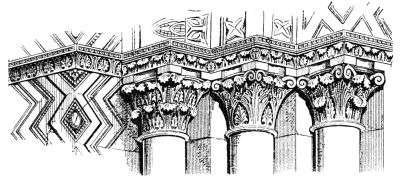
Fig. 28.—Capitals from the north-west Portal, Lincoln Cathedral.