VI MADAME SAINT-HUBERTY
Reading edition
ON a certain afternoon, early in September 1777, a rehearsal of Gluck’s Armide was about to begin at the Opera. The stage was crowded with the artistes of both sexes, their friends and their admirers, for, as we have said elsewhere, in those days it was the fashion to attend the rehearsals of any new opera or play which happened to be arousing unusual interest, and the fame of the little German composer was at its height.
It was a brilliant assembly; youth, beauty, talent, rank, and wealth were all represented there. The women especially were in full force, the queens of song and the stars of the dance: Duranceray, Beaumesnil, Sophie Arnould, Rosalie Levasseur, Laguerre, Heinel, Guimard, Peslin, Allard, Théodore, and a bevy of minor divinities, the demoiselles of the ballet and the ladies of the chorus, many of whose names, though unknown to dramatic fame, were already writ large in the annals of gallantry: the two Lilys, the blonde and the brunette; Lolotte, who had the finest horses in Paris; Droma, whose extravagance had so completely ruined a rich merchant of the Rue Saint-Honoré that nothing was left for the unfortunate man but to hang himself, and Rosette, for whose favours two abbés had recently fought.
A brilliant assembly and a bravely-dressed one too; for even the figurante drawing her eight hundred or a thousand livres a year seemed to find no difficulty in patronising the establishments of M. Pagelle, of Les Traits Galants, or M. Bertin, of the Grand Mogol. There was, however, an exception. In a remote corner sat a young woman alone, whose pale, drawn face bore the marks of cruel struggles and long suffering, and whose simple, black gown, patched in more than one place, afforded a striking contrast to the gorgeous toilettes around her. No one spoke to her, no one heeded her; the gay throng was too much occupied with its own affairs to have a thought to bestow on so insignificant a person, until a movement on her part happened to arrest the attention of a gorgeously-attired damsel, who, with a mocking smile, exclaimed: “Ah, tiens! voilà Madame La Ressource.”[168]
At these words, Gluck, who was talking with the conductor of the orchestra, abruptly terminated his conversation, and, turning round, exclaimed, in a voice which could be heard by all: “You have well named her Madame La Ressource, for one day she will be the resource of the Opera!”
This speech would appear to have been nothing more than a jest on the part of the composer; since never could he have even suspected, at that time, how fully his prediction was to be verified; never could he have foreseen the astonishing triumphs which awaited this humble coryphée, still confined to the rôles of confidante and secondary divinity. For the young woman, “thus derided by vice, thus defended by genius,” was none other than Anne Antoinette Cécile Clavel, known to fame as Madame Saint-Huberty!
The life of Antoinette Clavel had been a peculiarly sad one; one long course of privation, misfortunes, disappointments, and disillusions. Born at Strasburg, on December 15, 1756, she was now in her twenty-first year. Her father, a musician, formerly a member of a French troupe in the service of the Elector Palatine, and, at the time of Antoinette’s birth, attached to the Strasburg theatre, had commenced his little daughter’s musical education before she was well out of the nursery. The child, like Sophie Arnould, early gave promise of exceptional talent. At the age of twelve, she sang to her own harpsichord accompaniment, “with so much taste and sweetness that she excited the admiration of all who heard her.” The fame of her precocious talent quickly spread abroad, and the managers of several foreign and provincial theatres offered her engagements. But her father and mother, “cherishing in her the germ of those virtues with which they had inspired her, had no mind to deliver her youth into distant towns, to the danger of seduction by those amiable and opulent men who delight in the criminal victories they achieve over innocence,” refused to allow her to appear, except at the Strasburg theatre, where “they were able to direct at its outset a career so slippery for a young and inexperienced girl.”
Here she had the good fortune to attract the attention of the leader of the orchestra, Lemoine, a French composer who was later to achieve success in Paris. Lemoine, a kind-hearted and excellent man, gave the girl lessons and allotted her a part in a little piece of his own, Le Bouquet de Colinette. Never was there a more grateful pupil. In after years, Madame Saint-Huberty made the most heroic efforts to assure the success of the somewhat mediocre works of her first professor, of whose kindness to her when she was a child she could never speak without tears in her eyes.
“I used to go to his house in the morning,” she related to one of her friends. “As it was cold and he was not well off, he remained in bed until the morning rehearsal, in order to save wood. When I arrived to take my lesson, I used to find him rolled up in his blankets, with a great woollen night-cap on his head, which reached to his eyes. ‘Ah! there you are, little one,’ he would say to me, and would throw me one of the blankets, in which I wrapped myself as well as I could. Then I used to sing, beating time with my feet with all my strength, in order to keep them warm.
“In the evening, I accompanied my father to the theatre. Often I was a figurante, and Lemoine, who knew that we made but poor cheer at home, always contrived to give me some tit-bits, off which I might make a good supper.
“My father was indebted to him for several pupils, who paid him fairly well. Finally, he presented us to Count Branicki, an immensely wealthy nobleman, at whose house plays were frequently performed.”[169]
Antoinette Clavel had been engaged two or three years at the Strasburg theatre when there arrived in the city a man who described himself as director-general of the “Menus-Plaisirs” of the King of Prussia, and stated that the object of his visit was to seek for fresh talent for the French troupe at Berlin. In his presumed official capacity, he had no difficulty in procuring admission to the coulisses of the theatre, where he soon became on terms of friendly intimacy with the actors and actresses, and with Antoinette in particular. Claude Croisilles de Saint-Huberty, for by that high-sounding name was the gentleman known, was still young, but had seen much of the world, of good appearance, and a fluent talker, whose honeyed words were well calculated to excite the imagination of inexperienced women, for whom he had all the attraction of the successful adventurer.
He made such magnificent promises to Antoinette, and held out to her the hope of such a brilliant career, that, one fine day, in the spring of 1775, the young girl resolved to leave her parents secretly and follow M. Croisilles de Saint-Huberty to Berlin. Here disillusion awaited her. The pretended director of the “Menus-Plaisirs” of the King of Prussia proved to be merely the stage-manager of the French troupe, who could only very partially carry out the conditions of the engagement which had induced Mlle. Clavel to quit the paternal roof.
Whether Antoinette was Saint-Huberty’s mistress, or only, as she herself asserted, an ambitious young artiste decoyed away by the promise of an advantageous engagement is uncertain. But, however that may be, Saint-Huberty was exceedingly anxious to become her husband; nor is his motive difficult to understand. So far from having any right to the aristocratic patronymic he bore, he was the son of a merchant at Metz, named simply Croisilles, and had left home in order to gratify a passion for the stage. A needy and unscrupulous adventurer, he foresaw for the young singer a successful, and possibly a brilliant, career, upon the emoluments of which he might levy toll; while if, by chance, her success was not in accordance with his expectations, he would always be able to obtain the annulment of a marriage contracted in a foreign country and without the consent of the parents of either party. And so from morning until night he importuned Antoinette to marry him, expatiating upon the vast possessions of the house of Saint-Huberty—possessions well-nigh as boundless as his love for her—which, he declared, would one day be his, the brilliant future he could assure his wife, and so forth. Nor did he plead in vain. At the end of four or five months, the poor girl, alone in a foreign city, friendless, and almost penniless, had the weakness to consent; and the marriage was celebrated on September 10, 1775, in the parish of St. Hedgwig, the so-called Saint-Huberty being described as “native of France, stage-manager of the French troupe of his Majesty the King of Prussia,” and Antoinette as “Jungfrau Maria Antonia, native of Strasburg, actress.”[170]
The young bride was very speedily enlightened as to her husband’s real character and the motives which had led him to make her his wife. “The third night of our marriage,” she says, in a memoir which she subsequently drew up for an annulment of the union, “was marked by the grossest language on the part of the sieur Croisilles, accompanied by a pair of sound boxes on the ear, because the counterpane was more on my side than his.” And, a few weeks later, Saint-Huberty secretly quitted Berlin, carrying off everything of value that his wife possessed.
From Berlin, whence the too-pressing attentions of his creditors had been the cause of his abrupt departure, M. Saint-Huberty made his way to Warsaw, from which city he presently wrote to his wife, informing her that he had just formed an operatic company, whose first performance had been warmly applauded at the Polish Court, and that her assistance alone was wanting to make it worthy to perform before the sovereigns of the North.
The rascal’s pen must have been as persuasive as his tongue, since Antoinette at once decided to rejoin her husband. She arrived at Warsaw, only to find that the company which was supposed to have already achieved such great things had, as a matter of fact, never given anything but rehearsals. Finally, however, it gave its first performance in public and, thanks to the efforts of the young singer, appears to have made a very favourable impression.
Intoxicated with his success, Saint-Huberty determined to extend the scope of his operations and establish his troupe on a permanent basis. With this end in view, he started for Hamburg, “in search of suitable recruits,” after which he had the imprudence to visit Berlin. It was to venture into the lion’s den. Scarcely had he set foot in the town, than he was recognised, arrested, and thrown into prison, where his creditors announced their intention of keeping him until he should have paid the uttermost pfenning.
The troupe which he had left at Warsaw, deprived of its director and its salaries, for we may presume that M. Saint-Huberty had taken most of its available cash with him, found itself in a parlous condition. In the meantime, however, Antoinette had scored a great personal triumph in the opera of Zémire et Azor, when the reception she met with must have exceeded her fondest anticipations. Warsaw, in those days, was essentially a city of pleasure; and its upper classes prided themselves on following the manners and modes of Paris. The Opera was especially high in favour, and, as the public was not very discriminating and lavishly generous to those who earned its approbation, artistes of very mediocre talent, who in Paris would have been accounted fortunate to be received in nothing worse than silence, found themselves lauded to the skies and loaded with gifts. The enthusiasm evoked by Madame Saint-Huberty’s singing found vent in numerous valuable presents being made to the artiste, who was thus enabled to realise a sum of 12,000 livres, wherewith she proceeded to release her worthless husband from his Prussian dungeon. That gentleman, accordingly, returned to Warsaw; but his creditors in the Polish capital, encouraged by the success which had attended the proceedings of their fellow victims in Berlin, assumed so threatening an attitude that, after a brief period of repose, he judged it expedient to resume his travels, and, one fine night, suddenly disappeared.
According to his custom, M. Saint-Huberty did not depart with empty hands. This time he had carried off not only all his wife’s ready money, but even the contents of her wardrobe, including the costumes which she wore upon the stage, leaving her without resources and almost without clothes. Happily, a wealthy and generous Polish lady, the Princess Lubomirska, took compassion upon the unfortunate actress, refurnished her wardrobe, and gave her shelter for three months in her own palace.
Soon, however, difficulties arose with her husband’s numerous creditors, who endeavoured to fix upon her the responsibility for the debts which the fugitive impresario had contracted; and, in order to free herself from all responsibility in connection with his liabilities, Madame Saint-Huberty was obliged to obtain from the authorities at Warsaw a formal separation, in regard to property. And here is the declaration which she made on this occasion, bearing date March 17, 1777:
“Before the notaries and public officers of the ancient town of Warsaw, appearing in person, the noble dame Antoinette de Clavel, wife of the nobleman Philippe de Saint-Huberty, assisted for the present deed by the counsel of the nobleman Georges Godin, present and called by her to this effect: The said Antoinette de Clavel, being of sound mind and body, of her own full accord has freely and expressly declared and does declare by the present act: that having learned that the nobleman Philippe de Saint-Huberty, her husband, had quitted Warsaw, on account of the great number of debts by which he was overwhelmed, and being ignorant even of the place to which he had retired, and unwilling to be bound in any manner by the debts of her husband, which he had contracted without any participation on her part, she separates herself from all the goods and property generally of her said husband, excepting, nevertheless, the goods which she has acquired and brought with her; and the said dame de Clavel declares, moreover, by a formal declaration, that she makes no claim whatever to the said property, and approving entirely of the present separation from the goods of her husband, she has signed the present deed with her own hand.—Antoinette de Clavel, by marriage Saint-Huberty, J. Godin, as witness.”[171]
In the meanwhile, the “nobleman” referred to in the aforegoing document had settled in Vienna, from which city he wrote to his wife, to inform her that he had arranged to open an opera-house, which he was confident would be the means of assuring him an ample fortune, and to urge her to join him without delay. As may be supposed, after her sad experiences, the poor lady was inclined to regard these assurances with some suspicion; and, on the advice of the Princess Lubomirska, she, for some time, declined to leave Warsaw. But Saint-Huberty pleaded so eloquently in the letters which he continued to send her that ultimately she relented, and, in spite of the remonstrances of her kind-hearted patroness, took the road to Vienna.
Here she quickly found that the opera-house and the brilliant prospects had no existence, save in the imagination of M. Saint-Huberty, who was reduced to such straits as to be actually in want of bread, and had only sent for his wife in order to save himself from starvation. Happily, almost so soon as she arrived, circumstances compelled the impresario to quit Vienna in the same manner as he had quitted Berlin and Warsaw.
The young singer now found herself without an engagement, and free to go wherever she might choose. Like almost every operatic artiste, her thoughts had often turned towards the Académie Royale de Musique, where Gluck was now supreme, and she, accordingly, solicited an ordre de début. This was easily obtained, the Opera being just at that time sorely in need of fresh talent to fittingly interpret the master’s works, and, in April 1777, she set out for Paris. Arrived in the French capital, she lost no time in obtaining an introduction to the great composer, who, quick to recognise ability wherever he found it, promised to give her lessons himself,[172] and recommended her for a part in his forthcoming opera.
On September 23, 1777, Madame Saint-Huberty made her début in the small part of Mélisse, in Armide, and the Mercure de France referred to her performance in the following terms:
“She has an agreeable voice. She sings and acts with much delicacy of expression. She appears to be an excellent musician, and needs only a little stage experience in order to acquire greater development for her voice and greater ease for her acting.”
In spite of this encouraging notice,[173] the newcomer appears to have attracted but little attention, in the midst of an event of such importance as a new work by Gluck. Who, after all, was this modest débutante, beside such stars as Legros, Larrivée, Gélin, Rosalie Levasseur, and Mlle. Duranceray?
On first arriving in Paris, Madame Saint-Huberty had lodged in the Rue Sainte-Croix de la Bretonnerie, at the house of a dame Sorel, after which we find her residing successively at the Hôtel de Genève, the Hôtel de Bayonne, and the Hôtel des Treize-Provinces.[174] At all these places she lived alone, for, though her worthless husband had followed her to Paris, she very prudently refused to receive him back, until she was assured that he had mended his ways. As, however, he had no means of livelihood, and she could not allow him to starve, she obtained for him, through the good offices of Gluck, the post of wardrobe-keeper at the Opera, which, as one of her biographers very sensibly remarks, was scarcely a proper appointment for a gentleman with a weakness for carrying off other people’s garments and raising money upon them. M. Saint-Huberty was, as a matter of fact, very speedily discharged, upon which he revenged himself by hawking about the streets and “reading aloud in the cafés and even in certain private houses to which he was admitted,” a libellous pamphlet against the authorities of the Opera, composed by a confederate named Dodé de Jousserand. In order to keep himself in funds, he paid frequent visits to his unhappy wife, from whom he did not hesitate, when argument failed, to extort money by threats and even blows; while, when she had nothing to give him, he would seize upon any saleable article which happened to catch his eye, and carry it off. One day, while Madame Saint-Huberty was at the theatre, he swooped down and made a clear sweep of all the portable property of the luckless singer, who was compelled to lay a complaint against him before the commissary of police of her quarter. Here is the text of this document:
“In the year seventeen hundred and seventy-eight, Friday, the thirty-first of July, at nine o’clock of the evening, in the hôtel, and before us Joseph Chesnon fils, advocate to the Parliament, counsellor of the King, commissary to the Châlelet of Paris, appeared demoiselle Anne Antoinette Clavel, called Saint-Huberty, King’s pensioner at the Opera, who informed us that the sieur de Saint-Huberty, who claims to be married to her, in virtue of a pretended act of celebration in Berlin, has abused the confidence of the complainant for nearly three years, in order to install himself in her abode and to remain there in spite of her; to make himself master there, and even to maltreat her. He, nevertheless, several times left the house, but always carried away with him jewels and other property of the complainant, which he pledged and sold. He would again force his way in, but with empty hands, and the complainant was unable to do anything against such persecution, being without her papers.[175] Finally, this same day, while she was at the Opera, the sieur Saint-Huberty has again taken advantage of her confidence and her absence to carry off the goods, papers, and music of the complainant, including even music which belongs to the Opera.
“She finds herself in the greatest embarrassment, and the sieur Saint-Huberty is cunning enough to ask her, by a letter, dated Wednesday, the twenty-ninth of this month, for papers and goods which he has already taken the precaution to carry off. For which reasons, and in order that she may enjoy peace at home, of which the sieur Saint-Huberty has for a long time deprived her, and to force the said Saint-Huberty to restore to her her property, papers, and music, and, in particular, that which belongs to the Opera, she has come to lodge the present plaint against the sieur Saint-Huberty, requiring from us the act which we have given her and signing the minute in our presence.”[176]
On an order from the Lieutenant of Police, a portion of the stolen property was subsequently restored; but if Madame Saint-Huberty flattered herself that she was safe from further depredations, she was speedily undeceived. On August 10, she removed to a little apartment in the Rue de l’Arbre Sec, in the house of Gourdan, one of the King’s valets-de-chambre, for which she paid a rental of 490 livres and had furnished herself. Three weeks later, at seven o’clock in the morning, she was sleeping peacefully, dreaming perhaps of the time not far distant when all the musical world would be at her feet, when she was abruptly awakened by the entrance of four men, amongst whom she at once recognised the scoundrelly Saint-Huberty. That worthy, pointing to a person attired in the black garb of a commissary of police, to indicate that he had legal authority for what he was about to do, cried: “The pockets, Messieurs; search her pockets.” The hapless woman was then dragged from her bed, and, while the man in black held her in his arms, her husband showered blows upon her, after which he took a pair of scissors and cut the ribands of the pockets of her night-dress, inflicting several severe scratches in the process. Next, having possessed himself of her keys, he opened all the drawers and cupboards in the apartment, and proceeded to ransack them, at the same time addressing to his wife the most shocking language. Finally, a fifth person, also clad in black, entered, who announced himself as the procurator of the husband, but, like his fellows, only laughed at the poor actress’s distress, and declined to answer when she demanded to see his authority. When her husband and his confederates had taken their departure, Madame Saint-Huberty found that she had been robbed of a packet of twenty-two letters, “which, at first sight, appeared to be love-letters,” and a pair of diamond shoe-buckles of the value of six louis.
This outrage was, of course, made the subject of a complaint by its victim, of which the aforegoing account is a summary. But, as Saint-Huberty had really had legal authority for his proceedings, having had the audacity to declare to the police that his wife had “secretly quitted their common abode and carried away with her numerous effects belonging to him,” no steps could be taken against him. When, however, Madame Saint-Huberty threatened to retire from the Opera, “unless her personal safety were guaranteed,” she received an assurance that she need no longer fear the visits and assaults of her husband.
But, if the unhappy woman had contrived to secure herself against personal molestation, she was not yet free from trouble of another kind. Some weeks before the adventure which we have just related, she had succeeded in obtaining from Saint-Huberty, in return, we may be sure, for some pecuniary consideration, a formal renunciation of all claim to her professional earnings, whether derived from the Opera or from engagements at private concerts or other entertainments. By the law, however, she still remained answerable for his debts, and the cunning scoundrel now determined to obtain the money he required through the claims of fictitious creditors. On the demand of a certain demoiselle Guérin, who declared herself to be a creditor for the sum of 489 francs against the sieur Saint-Huberty and his wife, a formal objection was lodged to the payment of the dame Saint-Huberty’s salary; and, on October 2, 1778, the Châtelet declared this opposition good and valid, and made an order for the directors and treasurers of the Opera to deliver over to the sieur Saint-Huberty all sums due to his wife, until the debt should be liquidated.
Poor Madame Saint-Huberty was in despair. It was in vain that she protested that she knew nothing of the demoiselle Guérin, and had never been called upon by her, previous to the legal proceedings, to pay any debt. The officials of the Opera assured her that they were powerless in the matter. Deeply as they sympathised with her, they could pay her nothing, until she had obtained a recession of the order of the court.
This she, accordingly, endeavoured to procure. But the machinery of the law worked even more slowly in those days than at the present time, and it was not until March 19, 1779, that the appeal came on for hearing before the Parliament of Paris. Then, at last, Fortune declared itself on her side; for the judges, carried away apparently by the eloquence of the plaintiff’s advocate, Maître Mascassies, who, in a speech of several hours’ duration, traced the history of the stage from its origin to the middle of the eighteenth century, with special reference to the influence of the fall of Constantinople on the “Mysteries,” and the relative merits of the operas of Lulli and Rameau, reversed the decision of the Châtelet, ordered the authorities of the Opera to hand over to the singer her arrears of salary, and condemned Saint-Huberty and his confederates to pay all the costs of the proceedings.
Madame Saint-Huberty followed up this victory by another and more important one. Six months later, she instituted proceedings for a formal dissolution of her marriage on the following grounds:
(1) Omission of the publication of the banns in the parish of the father and mother of the bride.
(2) Absence of the curé of the bride’s parish.
(3) The fact that the marriage had been performed without the consent of the bride’s parents.
(4) Rape and seduction, which, without the employment of force, but merely “par mauvaises voyes et mauvaises artifices,” were held to be sufficient to invalidate a marriage.
The action was supported by Saint-Huberty’s father, the Metz merchant, an honest man, who appears to have been genuinely distressed by the misery which his son had brought upon this unfortunate girl; and, the husband himself having been induced to leave the matter to “the wisdom of the court,” on January 30, 1781, the marriage was finally annulled.[177]
Meanwhile, undeterred by her domestic troubles—troubles which might well have ruined the career of a less resolute and less courageous woman—Madame Saint-Huberty had been steadily working her way into the very front rank of her profession. Without friends, without a protector, but proud in her distress and sustained by an all-devouring ambition, she lived alone in her humble lodging, which she never left, save to go to the theatre for rehearsals and performances. “From morning till night she worked, studied, practised unceasingly. In time, her voice became more supple and perfectly under her control. She taught herself to move her long, thin arms with grace; she accustomed her countenance to reflect her passionate sensibility, to render her lively impressions. Finally, she got rid of her deplorable Alsatian accent.”[178]
Recognition, however, was slow to come. In 1778, the Mercure only mentions her as singing in unimportant parts in three or four operas, although she appears to have greatly pleased the musical critic of that journal by her rendering of an Italian arietta of Gluck, at a “concert spirituel” in December. During the whole of the following year, when the theatre was under the direction of Devismes, there is no reference to her whatever, except in a letter of Devismes’s successor, Dauvergne, in which he speaks of the young singer as weeping with despair, because she had not been allotted a part; and she seems, about this time, to have had serious thoughts of leaving the Opera altogether.[179] However, her perseverance was not wasted, for, towards the end of that year, she was received as a permanent member of the company, though less, it is believed, on account of her talent, than her willingness to do whatever was required of her. This was a great step gained, and, at length, in November 1780, she reaped the reward of all her labours and self-denial by being entrusted with the part of Angélique in the Roland (Orlando) of Piccini.
No one seems to have expected this opera to succeed. The composer himself believed its failure inevitable. The evening of the first representation, when he was about to start for the theatre, his family refused to accompany him, and, aware of his extremely sensitive nature used every persuasion to induce him to remain at home. His wife, his children, his friends were in tears. “One would have imagined that he was on his way to the scaffold.”
Piccini endeavoured to reassure them. “My children,” said he, “we are not in the midst of barbarians, but of the politest people in the world. If they do not approve of me as a musician, they will at least respect me as a man and a foreigner.” And he tore himself away.
A delightful surprise awaited him. Roland, so far from being a failure, was an unqualified triumph, and, at the conclusion of the performance, Piccini was escorted home by an enthusiastic crowd of admirers. This happy result was undoubtedly due, in the first instance, to Madame Saint-Huberty’s admirable rendering of the part of Angélique. “Where is Saint-Huberty? where is she?” cried the grateful composer, as the curtain fell to the accompaniment of round upon round of applause. “I wish to see her, to embrace her, to thank her, to tell her that I owe to her my success!”
The critic of the Mercure expresses himself as follows on the acting and singing of Madame Saint-Huberty in this her first important part:
“Having spoken of Roland, we shall seize this opportunity to say something of Madame Saint-Huberty, whose progress, every day more marked, merits a special mention. We have seen her with pleasure in the rôle of Angélique, in which she has, in many respects, acquitted herself very well. We invite her only to be careful of her articulation; she neglects it so far as to cause us to lose part of what she says. The fault is common to foreign singers or to those trained abroad.”
And the critic concludes by recommending her to be less prodigal of her gestures and not to raise her arms higher than was necessary.[180]
A month later, the singer gained another success, as Lise, in Le Seigneur bienfaisant, an indifferent work by Rochon de Chabannes and Floquet, when she rendered with such fiery energy the despair of the heroine that she fell ill from excess of emotion and was absent from the theatre for several weeks.
On her return, fresh triumphs awaited her. After successfully impersonating Églé, in the Thésée of Quinault, which had been set to music by Gossec, she replaced Rosalie Levasseur in the name-part in Gluck’s Iphigénie en Tauride (March 10, 1782),[181] in which, the Mercure declares that “she acquitted herself very well and deserved the praise which she received.” Next, she created the rôle of Laurette, in l’Inconnue persécutée, “with as much taste as intelligence,” and made an heroic, though unsuccessful, attempt to secure a favourable reception for the Électre of her old master Lemoine, the one-time conductor of the Strasburg orchestra.
Not content with doing her utmost on the stage on her old friend’s behalf, Madame Saint-Huberty employed the influence she was beginning to possess in the coulisses to compel the administration of the Opera to prolong the run of this very indifferent work, notwithstanding the unfavourable verdict of the public and the disastrous results such a course was likely to have upon the receipts. The administration resolved not to yield to such a preposterous demand, but, at the same time, unwilling to offend an actress who was becoming every day more necessary to them, had recourse to stratagem. They represented that they were perfectly willing to oblige Madame Saint-Huberty by continuing the representations of Électre; but, since the opera was not in itself a sufficient attraction to secure a full house, it would be advisable to wait for a few days, until the ever-popular ballet of Ninette à la Cour, in which Mlle. Guimard, it will be remembered, secured one of her greatest triumphs, could be given with it. Madame Saint-Huberty consented to the postponement, and the administration made use of the respite granted them to induce the Minister of the King’s Household, the supreme authority in matters concerning the Opera, “to order that the opera of Électre should be absolutely withdrawn from the theatre.”[182]
In those days, it was the fashion at the Opera to frequently present entire pieces composed of acts extracted from various works. These performances, called “Fragments,” were very popular with the patrons of the theatre, since they constituted but little strain upon the imagination, while the variety of their subjects and music provided an agreeable change. On September 24, 1782, four “fragments” were performed at the Opera, the most important of which was a new act by Moline and Edelmann, entitled Ariane dans l’Île de Naxos. Madame Saint-Huberty, who played the part of Ariane, had always had a strong predilection in favour of historical accuracy in stage costume, and, on the advice of the painter Moreau, who held similar views and had designed the dresses for this opera, she resolved to make a move in the direction of reform.
“We have seen, for the first time, on the stage,” says the Journal de Paris, “in the principal personage, the costume rigorously observed. These designs have been made on the advice of M. Moreau le jeune, favourably known in artistic circles by the number, the variety, and the continual beauty of his works.”
Levacher de Chamois, in his work on theatrical costume, has traced a description of the costume worn by Madame Saint-Huberty on this occasion:
“One saw this actress appear habited in a long linen tunic, fastened beneath the bosom; the legs bare and fitted with the ancient buskin. From the head descended gracefully several plaits of hair, which played about her shoulders. This costume, a novel one for the spectators and both true and elegant, was applauded with a kind of frenzy. But, in spite of the approval of the public, there arrived orders which one called ‘ministerial,’ forbidding Madame Saint-Huberty to appear in this beautiful costume, and at the second representation of the work she was obliged to resume the heavy and ridiculous accoutrements of our coquettes and prudes.”[183]
Notwithstanding this mortification, the actress had no reason to be dissatisfied with her performance of Ariane. It was indeed, for her, a veritable triumph. “As for Madame Saint-Huberty,” says the Journal de Paris, “we do not know which serves her the best, her face, her voice, or her acting; she knows how to give to each song inflections which occasion the most lively emotions.” And the musical critic of the Mercure writes: “Madame Saint-Huberty, in the opera of Ariane, has added yet further to the idea that one has always entertained of her intelligence and her talent. She played in a manner always animated and interesting, and sang with the greatest expression the music constantly loud and passionate of a long and difficult rôle.”
Guinguéné, in his notice on the life and works of Piccini, declares that Madame Saint-Huberty owed to the protection of the celebrated composer the fact that her name was not erased from the books of the Opera after her brilliant rendering of the part of Ariane, since she had shown on this occasion views too independent and a talent too original to suit the views of the authorities of that institution. “The success which she had obtained in it excited the petty passions of the coulisses. They were prepared to drive her from the Opera, and Piccini alone sustained her. He recalled to those who were the powers of the State the witty and sensible mot of Gluck; he predicted that they would speedily have need of her, and that they would be only too happy to have her. His selection of her for the interesting part of Sangarede and the superior manner in which she rendered not only the music, but the scenes as well, moved the entire public in her favour and gave her a settled position on the stage of which she was for ten years the glory.”[184]
The revival of Atys had taken place at the beginning of the year 1783, when Madame Saint-Huberty played the heroine with an enthusiasm which gave a new lease of life to that fine opera. “Thus,” says M. Jullien, “she found herself dividing her sympathies between the two hostile camps, and lending, in turn, the assistance of her great talent to the two rival composers: to Gluck, who had given her her first opportunity at the Opera, to Piccini, who had helped her to retain her position there.”[185]
MADAME SAINT-HUBERTY From an engraving by Colinet after the drawing by Le Moine

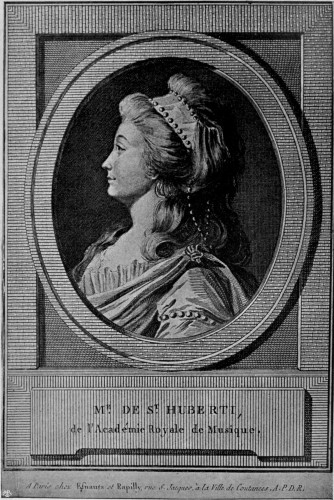
A little time before, on November 27, 1782, the actress had given proof of a talent of rare versatility by rendering with much gaiety and charm the part of Rosette, in Grétry’s l’Embarras des Richesses.[186] This piece, notwithstanding some delightful music and Madame Saint-Huberty’s successful impersonation of the heroine, failed, mainly through the ineptitude of the libretto—the production of one Lourdet de Sans-Terre, surnamed by the wits Lourdeau Sans-Tête—which contained some of the most amazing anachronisms ever perpetrated by a presumably educated writer. Thus, the inhabitants of Athens, in the time of Pericles, are made to fast during Lent, flirt with opera-girls, and pay their debts in louis d’or; while, in the ballet, dances are executed by American savages! Bad though it was, however, l’Embarras des Richesses is still remembered, having been rescued from well-merited oblivion by the following amusing epigram:
“Embarras d’intérêt, Embarras dans les rôles, Embarras dans ballet, Embarras de paroles, Des embarras en sorte Que tout est embarras, Mais venez à la porte, Vous n’en trouverez pas.”
On February 28, 1783, Sacchini’s Renaud was produced, with Rosalie Levasseur in the part of Armide. Her rendering of the part, however, was not considered satisfactory, and, at the fourth representation, she was replaced by Madame Saint-Huberty, who was thus enabled to set the seal upon her reputation. For where Rosalie had been found wanting, she succeeded and succeeded brilliantly, and, by her conversion of a threatened failure into a complete triumph, saved at one stroke the poor musician and the honour of the Opera, which, in cancelling its agreement with Sacchini—about which there had been some talk after the cool manner in which Renaud had been at first received—would have lost the composer’s two masterpieces, Dardanus and Œdipe à Colone.[187]
Madame Saint-Huberty was not a pretty woman. She had neither the beautiful eyes nor the willowy grace of Sophie Arnould. She was short and thick-set, with long, thin arms, a large mouth and a “nez de soubrette”; in a word, an “ignoble figure,” as the ungallant art critic of the Mémoires secrets calls her, in his notice of Madame Vallayer Coster’s portrait of the actress, as Dido, exhibited at the Salon of 1785.
But it was quite another Madame Saint-Huberty who appeared on the boards of the Opera. “That metamorphosis, that transformation on the stage, which some actresses obtain in a fashion so marvellous, the Saint-Huberty pushed beyond the bounds of imagination, thanks to incredible labours, thanks to victories achieved every day over her unpleasing person, thanks to acquisitions apparently impossible, thanks to a remarkable intelligence, thanks to a very wide knowledge of the theatre and all its effects, thanks to a profound study of the characters she represented, whose sentiments and emotions of the soul she rendered, so to speak, ‘in a palpable manner,’ thanks, finally, to what her talent possessed of her heart and of the passion which dwelt in her. And she succeeded in effecting a well-nigh physical transformation; in giving to her figure nobility, elegance; in moving with gestures of pride or of touching grace. And she appeared seductive and desirable to the amorous eyes of the audience.”[188]
The great services which Madame Saint-Huberty had already rendered to the Opera, and the wonderful talent which she had displayed in the various difficult rôles entrusted to her, made the administration keenly alive to the importance of definitely attaching to the theatre an artiste of such exceptional ability, whose value to them was immensely enhanced by the approaching retirement of Mlle. Laguerre and the decline of Rosalie Levasseur. During the year 1782, Madame Saint-Huberty had only received 5500 livres, a very inadequate remuneration for the attraction which she exercised over the public; and, fully aware of her own value, she had been at no pains to conceal her dissatisfaction. On November 22, 1782, La Ferté, the Intendant des Menus, wrote to Amelot, the Minister of the King’s Household, pointing out the importance of having the matter settled without delay. “She (Madame Saint-Huberty) is a very troublesome person,” he says; “but we cannot dispense with her, in view of the indifferent services and the unwillingness of the demoiselle Levasseur. All that we can hope for is that the dame Saint-Huberty will make the conditions as little onerous as possible, and I suppose there will be no hesitation in according her the Court pension of 1500 livres destined at first for the demoiselle Laguerre.”
After some further correspondence on the subject, the prima donna was invited to formulate her demands. They were as follows:
(1) 3000 livres ordinary salary.
(2) Payment of firing, lights, and so forth.
(3) An annual gratification extraordinaire of 3000 livres.
(4) A pension of 1500 livres on the musical establishment of the King.
(5) A congé of two months every year, including the Easter recess. This was, of course, to enable her to “star” in the provinces.
(6) None of her rôles to be entrusted to any other actress, save at her own request.
La Ferté agreed readily enough to four of these proposals; indeed, the first two had already been accorded, while, as we have just seen, he himself had recommended the granting of the fourth. But he annotated the third: “To promise it when circumstances permit”; and he declared the sixth “impossible, as being contrary to the regulations.”
Madame Saint-Huberty’s reply was to temporarily retire from the Opera, on the plea of ill-health, and to announce that she contemplated leaving the stage altogether.
Then La Ferté submitted to Amelot an arrangement whereby the sum of 8000 livres a year was assured to the singer, independently of allowances for firing, lights, and so forth, and of a pension of 1500 livres on the musical establishment of the King, which would give her an annual income of 9500 livres. She was also to be permitted to give two private concerts every year, the expenses to be borne by the administration of the Opera. These, it was calculated, would bring her another 3000 livres. Finally, she was to be granted the congé she demanded, on condition that she should not take it at a time when her services were particularly necessary to the Opera or during the visit of the Court to Fontainebleau.
On February 27, 1783, the Minister wrote to Madame Saint-Huberty, to inform her of these proposals, as follows:
“Rendering to your talents and your zeal, Mademoiselle, all the justice that they deserve, I afforded myself the pleasure to give an account of them to his Majesty, who, in consequence, has willingly consented to authorise me to announce to you that he has placed you on his musical establishment for the sum of 1500 francs, to begin from January 1, 1782, which gives you the benefit of a year in advance. Secondly, to complete by a gratification an annual salary of 8000 francs at the Opera; that is to say that, supposing your place of first subject should only produce, for example, 7000 francs, then the Court would give you 1000 francs to make up the 8000 francs. You will also be accorded every year a congé of two months. Finally, his Majesty consents to your giving every year, if that be agreeable to you, two concerts for your own benefit. His Majesty’s intention is that ‘these particular favours should remain entirely secret.’ I am very pleased at having been able to contribute towards securing them for you. You will kindly advise me promptly of the receipt of this letter.”
To this letter Madame Saint-Huberty vouchsafed no reply; and, after waiting until the middle of March, the Minister wrote again:
“The King inquired this morning, Mademoiselle, what reply you had made to the letter which he authorised me to write to you. His Majesty was not a little surprised when I informed him that I had not yet received it. He charges me to demand of you a positive reply as promptly as possible. I do not doubt that it will be such as the King has the right to expect.”
But this letter, like the first, remained unacknowledged.
In the face of the obstinate silence of the actress, supported by public opinion, which now began to declare itself in her favour, the Minister’s position became so embarrassing that La Ferté counselled him, on the occasion of a concert given at his hôtel, in which Madame Saint-Huberty was to take part, to have recourse to the following little stratagem. He advised Amelot to speak privately to the singer before the concert began, and, in the event of his failing to obtain a satisfactory reply, all the Minister’s personal friends, by previous arrangement, should demand of Madame Saint-Huberty, after she had concluded her song, whether she had definitely decided to remain at the Opera, and that Amelot should then announce that he had done everything in his power to retain her services. The luckless Intendant des Menus saw in this species of public explanation the only way of giving the lie to the report spread everywhere by the actress that she was leaving the Opera, because she found it impossible to obtain adequate remuneration.
Finally, on March 20, 1783, the Minister, the Intendant, and the administration of the Opera were forced to capitulate and to submit to all the conditions imposed by the singer, stipulating only that Madame Saint-Huberty should maintain the strictest secrecy concerning the matter, lest the jealousy of her colleagues might lead them also to demand higher salaries, and that she should engage to remain at the Opera for eight years.[189]
And at the bottom of the letter in which Amelot announced their surrender, the triumphant prima donna wrote as follows:
“In conformity with the arrangements made in this letter, I engage myself to remain at the Opera for the space of eight years, to begin from the first of January, 1784.
“(Signed) De Saint-Huberty.
Executed this 22 March 1783.
Eight months after her victory over the authorities of the Académie Royale de Musique, Madame Saint-Huberty reached the apogee of her fame by her impersonation of Dido, in Piccini’s celebrated opera of that name.
When he had accepted the engagement which the Baron de Breteuil, the French Ambassador at Naples, had offered him, Piccini had fondly imagined that he would find a position at once honourable and tranquil. He came to Paris, and had no sooner arrived, than he perceived that those who had summoned him thither had been prompted by no other motive than that of pitting him against the composer who was then revolutionising the French lyric stage. The poor musician was naturally much troubled by this discovery, but all arrangements were concluded, and he had no option but to accept the situation.
Naturally amiable and modest, Piccini was the last man in the world to engage of his own free will in this miserable war, which would doubtless have speedily ceased, had it not been for the conduct of the philosophers and men of letters, many of whom knew scarcely anything of music and cared even less, but who, infected by the mania for disputation so prevalent in the eighteenth century, rushed into the contest with a violence as ridiculous as it was disastrous to the interests of Art, and envenomed it by their epigrams and recriminations.[190] That the labours of Piccini were adversely effected by the false position in which he found himself there can be little doubt, and his success, under such circumstances, is, therefore, all the more deserving of admiration.
Roland and Atys had succeeded, in spite of the efforts of the Gluckists, who had combated their success by every means in their power; but Iphigénie en Tauride failed. The struggle was unequal: Piccini, though capable of contending with Gluck, was unable to conquer him. Mortified, discouraged, eager only for rest and tranquillity, he resolved to compose no more, but he had counted without his librettist and faithful ally, Marmontel. The Maréchal de Duras, Gentleman of the Chamber in waiting that year, had demanded of Marmontel an entirely new opera, to be played before the Court during its annual sojourn at Fontainebleau. Marmontel replied that he could promise nothing, unless Piccini would consent to collaborate with him again, and suggested that, in order to arouse the composer from the state of dejection into which he had fallen, the marshal should persuade the Queen to change the annual gratification which the Italian had hitherto received into a perpetual pension. And this the marshal readily promised to do.
“He asked for and obtained it,” continues Marmontel, “and when Piccini went with me to thank him: ‘It is to the Queen,’ said he, ‘that you must show your gratitude, by composing for her this year a fine opera.’
“ ‘I do not ask anything better,’ said Piccini, as he left us, ‘but what opera shall it be?’
“ ‘We must compose,’ said I, ‘the opera of Didon. I have long been revolving the plan of it. But I forewarn you that I mean to unfold my ideas at length; that you will have long scenes to set to music, and that in these scenes I shall require a recitative as natural as simple repetitions. Your Italian cadences are monotonous; the accents of our language are more favourable and better supported. I beg you to mark it down in the same manner as I repeat it.’
“ ‘Well,’ said he, ‘we shall see.’
“In this manner we formed the design of bestowing on recitative that ease, that truth of expression which was so favourable to the performance of the celebrated actress for whom the character of Dido was intended.
“The time was short: I wrote the poem with great rapidity, and, in order to withdraw Piccini from the distractions of Paris, I invited him to come and compose with me in my country-house, for I had a very agreeable one, where we lived as a family during the summer months. On his arrival there, he set to work, and when he had completed his task, Saint-Huberty, the actress who was to play the part of Didon, was invited to come and dine with us. She sang the part, at night, from beginning to end, and entered into the spirit of it so thoroughly that I fancied she was on the stage. Piccini was delighted.”[191]
At the moment when Marmontel and Piccini judged it advisable to put Didon into rehearsal, Madame Saint-Huberty was entitled to the annual congé which she had stipulated for and obtained some months previously; and she had made arrangements for a tour in Provence. She took her part with her, however, telling the authors that they could rehearse the opera without her, as they could rely upon her knowing her music quite thoroughly before she returned, and probably before any one else would be ready.
The rehearsals began at Fontainebleau, the part of the heroine being, as a rule, taken by a chorus-singer, who, without attempting to sing Madame Saint-Huberty’s music from beginning to end, read the part and did her best to replace the prima donna in the concerted pieces. On two or three occasions, however, Mlle. Maillard, a young actress, for whom the Intendant La Ferté had a very pronounced tendresse, was entrusted with the principal rôle.
The real Dido, meanwhile, was making a high successful tour in Provence, where she was everywhere received with enthusiasm. At Aix, she caught such a severe cold that for a time she lost her voice, but had, fortunately, fully recovered its use by the time she returned to Paris. “The part of Didon,” she wrote to one of her friends in Provence, “having been composed for me, for my voice, and being the only very interesting part in this piece, it will be impossible to give it anywhere without me. This looks like conceit on my part, but I will explain the matter to you. The part of Didon is all acting. The recitative is so well composed that it is impossible to sing it.
“An immense number of persons had attended the early rehearsals of Didon, and had come to the conclusion that it was one of Piccini’s worst productions. But Piccini consoled himself by saying: ‘Wait till my Didon comes!’ At the first rehearsal, which took place with myself in the part, every one said: ‘Ah! he has recomposed the greater part of his opera!’ And yet only four days had elapsed since the previous rehearsal. Piccini heard it and remarked: ‘No, Messieurs, I have altered nothing in the part. But until now Didon was being played without Didon.’ ”
From which letter it will be gathered that undue modesty was not one of Madame Saint-Huberty’s failings.
The day of the first representation drew near. The great singer resolved to carry out a radical change in her costume. She held, as Mlle. Clairon had held, that in order to faithfully represent the personages of antiquity, it was absolutely essential to investigate their manners and their characters, and to ascertain exactly the garments which they were in the habit of wearing.[192] She regarded the theatre as a picture which cannot hope to produce illusion, save by the fortunate accord of all its elements, and she was far from meeting with this accord in tragedy, in which the verse transported the audience to Rome or Sparta, but in which one saw appear Greeks wearing brocaded robes, with turbans on their heads, and Roman ladies with long trains borne by pages.[193]
This time she succeeded better than in Ariane, and went to the extreme of simplicity. She announced that the costume she proposed to adopt was an exact copy of a design by Moreau le jeune, sent from Rome, where the artist then was. The tunic was of linen, the buskins laced on the bare foot, the crown encircled by a veil, which fell down her back, the mantle of purple, the robe fastened by a girdle below the bosom.
We may imagine the astonishment of the committee of the Opera, of La Ferté, and of Amelot, when Madame Saint-Huberty, with Moreau’s design in her hand, insisted that a costume exactly resembling it should be forthwith ordered for her. “She thus dared to patronise new ideas and to introduce to the Opera a costume designed by this reformer, whom they believed they had conquered.”[194] All the authorities were up in arms against these exorbitant pretensions, but the actress’s genius had rendered her all-powerful; her wishes could no longer be ignored, and they were obliged to yield. But every day the lady became more exacting in her demands, and poor La Ferté was driven to his wits’ end to satisfy them. “I have just ordered Madame Saint-Huberty’s robe,” he writes to Amelot; “but it is terrible!” And again: “I have endeavoured to satisfy Madame Saint-Huberty’s caprices in making her decide to content herself with some changes in her robe for the part of Didon!” Unhappy Intendant! The actress was now indeed taking an ample revenge for the rebuff she had sustained in Ariane.
Didon was at length presented on October 16, 1783. It was a dazzling triumph for both composer and actress. Never had such enthusiasm been witnessed at the Court. Louis XVI., though, as a rule, he did not care for opera, was delighted and declared that “this opera had given him as much pleasure as a fine tragedy.” To mark his satisfaction, he at once decided that a pension of 1500 livres should be bestowed on the principal actress, and sent the Maréchal de Duras to compliment her and inform her of the pleasure she had afforded him.
“This,” writes one who was present, “was the finest scene of the evening. When the Maréchal de Duras arrived behind the scenes, followed by a crowd of courtiers in gala dress, Madame Saint-Huberty had not yet had time to change her costume. She was standing up, the crown on her head, draped in the purple mantle of the Queen of Carthage. Marmontel and Piccini, intoxicated with joy, had thrown themselves at her feet and were kissing her hands. One would have called them two criminals, whose lives she had just spared. They only rose when M. de Duras approached to repeat what the King had said. The actress listened to the marshal, and her countenance, still animated by inspiration, became illumined with the joy of this new triumph. The blush of pride rose to her forehead. She had so much grandeur, nobility, and majesty in her bearing, with these men at her feet, that better even than when upon the stage she conveyed the idea of the Queen of Carthage. All the great nobles present had the appearance of being only her courtiers.”
Métra describes this scene in the ironical tone characteristic of him. He represents Piccini precipitating himself at the feet of the singer, and amorously squeezing her hand. He shows us Marmontel, although more slow to bend the knee, employing vows and the most tender expressions to assure her that she arouses in his heart the most novel and the most lively emotions. And he concludes: “What a pleasing contrast to picture to oneself in this scene Saint-Huberty, still clothed in the purple of Didon, receiving with dignity the incense of great noblemen and men of letters, and to behold her, as a voluptuary of the time found her, two days later, in Paris, playing a game of piquet with her page, at the end of a table covered with a coarse and dirty dishcloth!”
In Paris, the opera and the singer obtained an even greater triumph than at Fontainebleau. The evening of the first representation (December 1, 1783) was “an evening of transports and delirium.” The public could not find means to express its admiration. At the conclusion of the impressive song,
“Ah! que je fus bien inspirée,”
the audience rose in a body and interrupted the performance with frenzied applause. At the touching air,
“Ah! prends pitié de ma faiblesse,”
there was not, we are assured, a dry eye in the whole house. “What more glorious triumph,” writes one of the actress’s biographers, “could this poor artiste in her days of toil and misery have ever dreamed of!”[195]
Among the critics, not a dissentient voice was heard; all joined in a chorus of praise of Didon and the great lyric tragédienne. “Madame Saint-Huberty,” wrote the Mémoires secrets, “played the part with the highest talent. She excelled even herself, and showed herself not less a great actress than an accomplished singer.” “It is the voice of Todi; it is the acting of Clairon!” cries Grimm. “It is a model which has not been seen on the stage for a long time, and will not soon be seen again.”
And Guinguéné, in his valuable study of the life and works of Piccini, writes: “The talent of this sublime actress has its origin in her extreme sensibility. An air might be better sung, but it would be impossible to give to any air, to any recitative, a truer, more passionate expression. No action could be more dramatic than hers, no silence more eloquent. One still recalls her terrible dumb-show, her tragic immobility; and the awful expression of her countenance during the long ritornello of the chorus of the priests, towards the end of the third act, and while the chorus is being sung.
“At the performance she did no more than replace herself in the position in which she had naturally found herself at the first general rehearsal. Some one spoke to her of the impression she had seemed to feel, and which she communicated to the whole audience.
“ ‘I really experienced it,’ she answered. ‘After the tenth bar, I felt as if I were dead.’[196]
“This reply,” remarks Gaboriau, “reveals the whole secret of the great lyric tragédienne’s talent. An actress of genius, she knew how to keep her head, but she surrendered her whole heart, her whole soul. She really suffered the grief which she expressed in so heartrending a manner; she really felt as if she were dying. And to such a point was this true that, after each performance, she was so ill and exhausted that she needed several hours to recover herself.”[197]
It has been said that Madame Saint-Huberty was an infinitely better actress than she was a singer. This, however, was certainly not the case. Castil-Blaze declares her to have been the first vocalist worthy of the name who appeared at the French Opera; while one of her biographers points out that Piccini would never have composed for her so difficult an air as that beginning: “Ah! que je fus bien inspirée,” had he not known her to possess a cultivated voice, full of charm and expression.
But the best proof that she really could lay claim to exceptional vocal as well as dramatic talent, and was not merely “an actress who spoke song”—to borrow Grétry’s definition of Madame Dugazon—is the success which attended her appearance at the “Concerts Spirituels,” where she took her place beside Mara and Todi, and acquitted herself so well that some critics went so far as to speak of her as a formidable rival to these eminent singers.
The success of Didon continued unabated. At each performance, Madame Saint-Huberty “seemed to add something to the purity of tone, to the truth of expression, to the profundity of sensibility which she had displayed on the first evening.”[198] At each performance a fresh ovation awaited her. On January 14, 1784, at the twelfth representation of the Opera, she was the recipient of an honour which up to that time was absolutely without precedent in France.
“At the end of the second act,” writes Grimm, “which terminated with the pathetic trio between Énée, Didon, and her sister, a crown of laurel, badly aimed, fell into the orchestra. The person at whose feet it fell placed it on the edge of the stage. The public, with loud cries, demanded that it should be placed on Didon’s head, which was done, by the demoiselle Gavaudan, to the accompaniment of unanimous and prolonged applause. The actress, surprised and almost overwhelmed with confusion, experienced a shock so great that it was, for the moment, feared that she would be unable to finish her part.... This crown of laurel was tied with a white ribbon on which was embroidered these words: Didon et Saint-Huberty sont immortelles.”[199]
Apropos of this coronation, La Ferté wrote to Amelot:
“Another trouble, Monseigneur. I do not know whether you have been informed that on Friday evening last a crown, bearing the inscription: ‘À la immortelle Saint-Huberty,’ was thrown upon the stage. The actress who was playing with her picked it up and placed it on Madame Saint-Huberty’s head. This episode, apparently the result of an arrangement concerted with the demoiselle Saint-Huberty, cannot be ignored; for those who in this manner give crowns (an incident hitherto without example in the theatre in connection with an actor) might equally accustom themselves to throw baked apples and oranges, as happens in England, at an actor who does not meet with their approbation. The confusion would then be beyond remedy!”
The Intendant then goes on to say that the honour paid her had not rendered Madame Saint-Huberty more accommodating, since she had refused to play on the following Tuesday, and, as the receipts for that evening would inevitably show a great decrease, if Didon were not performed, he suggests that the prima donna should be replaced by Mlle. Maillard, whom, as we have mentioned elsewhere, M. de la Ferté honoured with his favours. The old Intendant must have been very much in love or exceedingly deaf, for he actually goes so far as to assure Amelot that Mlle. Maillard’s voice is one which may well excite the envy of Madame Saint-Huberty.
Mlle. Maillard secured the appearance she coveted, though Madame Saint-Huberty protested vigorously against her being allowed to play the part, on the ground that it was an infringement of the last clause of the agreement of the previous March, which provided that no other actress should be allowed to play any part which she had created, save at her own suggestion. But the young lady must have regretted her misplaced ambition, for the public, learning of its idol’s feeling in the matter, accorded her anything but a flattering reception.
The acclamations of Court and capital did not content Madame Saint-Huberty; she desired the applause of the whole of France, and she received it. The enthusiasm of the provinces indeed reached the point of absurdity; a royal progress could hardly have been more splendid.
At Marseilles, the first city of importance which she visited, and where she gave no less than twenty-three representations, it was resolved to organise a magnificent fête in her honour. Cannon thundered salutes, the vessels in the harbour were decorated with flags, and, in the evening, the entire city was illuminated. An eight-oared gondola, lined throughout with satin and furnished with velvet cushions, had been prepared for the occasion, in which the prima donna embarked, arrayed in a Greek costume of the most extravagant richness, the gift of the ladies of Marseilles. The gondola was then rowed out to sea, escorted by more than one hundred vessels of various kinds, including several barges filled with musicians. Aquatic sports were held, the victors in which had the felicity of being crowned by the heroine of the day.
On her return to land, the cannon again fired salutes; the whole population had flocked to the quays. The diva was conducted, through an avenue of illuminated pavilions, to a pleasure-house, where she rested for a while in a salon of verdure lighted by coloured lanterns. Then she entered a tent, in which a temporary theatre had been constructed, where an allegorical play was performed in her honour, and Apollo crowned her with laurel as the “tenth” Muse. A ball followed, during which Madame Saint-Huberty occupied a seat on a daïs between Melpomene and Thalia. Finally, a splendid supper, to which sixty of the principal inhabitants of Marseilles sat down, was served in a room protected by a wooden grill, to guard the idol against the too-pressing attentions of her worshippers. At dessert, Madame Saint-Huberty sang several couplets in the Provençal patois, the people joining in the chorus. The enthusiasm of the city on this memorable night was indescribable, and spread far into the country.
When, at length, the prima donna contrived to tear herself away from her admirers at Marseilles, an extra horse had to be harnessed to her post-chaise, to draw the trophies of her twenty-three performances, which included more than a hundred crowns.
At Toulouse, if the fêtes were less splendid, there was no diminution in the enthusiasm of the public. In the third act of Didon, the performance was suddenly stopped, while twelve young girls, dressed in white, advanced towards Madame Saint-Huberty. They carried a basket of flowers surmounted by a crown, which their leader begged the singer to accept, as “the tribute of a grateful country.”
At Strasburg—her birthplace and the town where she had made her first appearance on the stage—which she visited in the summer of 1787, the ovations continued. There, amongst a thousand other compliments in verse, of various degrees of merit, she received the following gallant madrigal:
“Romains qui vous vantez d’une illustre origine, Voyez d’où dépendait votre empire naissant: Didon n’eut pas de charme assez puissant Pour arrêter la fuite où son amant s’obstine; Mais si l’autre Didon, ornement de ces lieux, Eût été reine de Carthage, Il eût, pour la servir, abandonné ses dieux, Et votre beau pays serait encore sauvage.”
These verses have been ascribed by Edmond de Concourt, Gaboriau, and several other writers to no less a personage than Napoleon Bonaparte, then a young officer of artillery. But they are in error, for M. Adolphe Jullien, who has carefully investigated the matter, points out that Napoleon passed the whole of the year 1787 not at Strasburg, but in Corsica.
Space forbids us to give more than a very brief account of the remaining triumphs of this truly great artiste, who, no matter how unfavourable the verdict of the public and the critics might be in regard to some of the works in which she appeared, was always herself assured of applause and commendation. In the title-part of the Chimène of Sacchini, as Délie, in the Tibulle et Délie of Fuzelier and Mlle. de Beaumesnil, as Hypermnestre, in that superb opera of the Danaïdes, which made the name of Salieri worthy to rank with those of Gluck, Piccini, and Sacchini, she astonished and delighted the musical world scarcely less than she had in Piccini’s masterpiece. And such was her passionate love of her art and her amazing capacity for hard work that all these four most difficult and most varied rôles—Didon, Chimène, Délie, and Hypermnestre, of which three at least are among the most beautiful figures to which the lyric art has lent life—were studied, mastered, and represented within the space of some seven months: from October 16, 1783 to April 26, 1784.[200]
Two years after the great success of their Didon, Marmontel and Piccini reappeared on the stage of the Opera with Pénélope. Unfortunately, the vogue which the preceding work had obtained had aroused too many expectations in regard to this new essay—author and composer, so to speak, were the victims of their own excellence—and though Pénélope was, in its way, a fine opera, it was received in comparative silence. All the critics, however, were agreed that Madame Saint-Huberty, in the part of the virtuous wife of Ulysses, was superb, and that she had seldom been heard to more advantage than in the two airs: “Je le vois, cette ombre errante,” and “Il est affreux, il est horrible,” and in the scene where Telemachus comes to announce the return of her husband.
It was Madame Saint-Huberty again who, in May, 1786, rescued from complete disaster the Thémistocle of Philidor, which, after a tolerably good reception by the Court, had been greeted, at first, by the town with marked disfavour; and it was not one of her least successes to have invested with life the inanimate figure of the heroine, Mandane.
In November of the same year, the singer was able to discharge the debt of gratitude which she owed to her first master, Lemoine. Lemoine, it will be remembered had, some years before, produced an Électre, which had failed, in spite of the heroic efforts of his former pupil. Now, however, he had composed a far more important work on the subject of Phædra, from which he expected great things; and Madame Saint-Huberty exerted all her influence to secure it precedence over the Œdipe of Sacchini, who was also impatiently awaiting his turn.
Unhappily, she succeeded. Sacchini had the Queen’s promise that his work should be the first to be performed before the Court, at Fontainebleau; but one day Marie Antoinette approached him, and said, with tears in her eyes: “M. Sacchini; it is said that I show too much favour to foreigners. I have been so earnestly solicited to allow the Phèdre of M. Lemoine to be performed, in place of your Œdipe, that I could not refuse. You see my position; forgive me.”
The poor Italian was so bitterly disappointed at the indefinite postponement of the work, upon which he had based so many hopes, that he fell ill that same evening and died, three months later, without having been able to assist at the production of the masterpiece which was to render his name immortal.[201]
Lemoine’s Phèdre, the precedence for which had been so dearly purchased, was coldly received by the Court, and still more coldly by the town; and it was in vain that Madame Saint-Huberty called to her aid all her genius to save the work of her old master. At the third performance the theatre was almost empty. Ultimately, however, it proved a success, thanks to the ingenious intervention of a friend of the composer.
This friend was Quidor, the police-inspector who had been charged with the pursuit of the dancer Nivelon.[202] Quidor had under his professional supervision a great number of ladies of easy virtue, whom he invited, “in a manner which did not permit of any refusal,” to attend and to make their friends attend the performances of Phèdre. The theatre, deserted at the third representation, was crammed to suffocation at the fifth; dazzling toilettes appeared in all the boxes, while the applause was positively deafening; for the ingenious inspector had filled the pit and galleries with police in plain clothes, with orders not to spare their hands or voices.
This strategy was attended with complete success. The performers recovered their spirits, which had been naturally much damped by having to sing to empty boxes, and rendered full justice to what was really an admirable work; at the tenth representation the true public began to arrive, found the music charming, and joined heartily in the applause.[203]
The character of Madame Saint-Huberty was far less agreeable than her talent. Dauvergne, the director of the Opera, declared that she was the most abandoned woman in his theatre—which was to say a good deal—and, in a letter to Amelot, cited by Edmond de Goncourt, in his monograph on the actress, charges her with the most revolting vices—the same of which Sophie Arnould and Mlle. Raucourt had formerly been accused. Moreover, she was insolent and exacting, and wearied the administration with her caprices and pretensions.
“She is a great musician,” writes La Ferté, in 1784, to Amelot, “abounding in talent and essential to the Academy. If Nature had not lavished upon her all the necessary qualifications, Art would have created a prodigy in her favour. This artiste is too well aware that she is necessary to the Opera, in default of persons who can replace her with advantage. She is full of pretensions; she has intelligence, but a bad disposition. She must be humoured, but not spoilt, otherwise she will make herself, so to speak, the sovereign arbitrix of the Opera.”[204]
During a visit to Lyons, in 1785, where she was received with the same enthusiasm as elsewhere in the provinces, Madame Saint-Huberty conceived a violent fancy for the local tenor, one Saint-Aubin by name, who took the part of Énée in Didon, and did not rest content with making love to him on the stage. When her congé expired, nothing would satisfy her but that the fascinating tenor should follow her to Paris, and no sooner had she returned to the capital than she persuaded the administration to engage him for the Opera, and an ordre de début was accordingly despatched to Lyons:
“De Par Le Roi:
“The sieur Saint-Aubin, tenor of the Lyons theatre, is directed to come immediately to Paris, to make his début on the stage of the Opera.
“Executed at Paris, etc.”
In vain did the management of the Lyons theatre represent that the services of the sieur Saint-Aubin could not possibly be dispensed with; that there was no one to replace him; that he had anticipated his salary to the extent of 3433 livres, 4 sols.; that the theatre, already in a bad way financially, would be completely ruined by his departure, and so forth. The authorities in Paris, spurred on by the amorous prima donna, were inexorable, and the sieur Saint-Aubin had to obey. He made his début on December 9, 1785, as Atys, in Piccini’s opera of that name, and was pronounced by the critics a tolerably good singer, but far too stout for a lover—at least on the stage.
After a year of love duets with Madame Saint-Huberty, the passion of the stout tenor began to cool. The husband awoke in him; he remembered that he had left at Lyons a young and charming wife and two pretty children, and manifested a strong inclination to rejoin them. Fearful of losing her lover altogether, the prima donna resigned herself to sharing him with another, and a second imperious summons, in the King’s name, brought to Paris the young wife and the two children. And that is how Madame Saint-Aubin, afterwards a great attraction at the Opéra-Comique, was introduced to the Paris stage.
The arrogance and caprices of Madame Saint-Huberty increased every year; the letters of Dauvergne to La Ferté and Amelot teem with complaints in regard to her conduct. On May 22, 1785, the lady had promised the director to sing the following evening in Armide, and that opera had duly been announced. But, at eleven o’clock the next morning, a message came that Madame Saint-Huberty was not fit to sing, that she had temporarily lost her voice; but that she was about to try a remedy which she had never yet known to fail, and would let him know definitely at two o’clock whether she would appear or not. An hour later, a friend of the singer called upon Dauvergne to inform him that the remedy had not yet had the desired effect, but that, if at four o’clock the lost voice had returned, its owner would “make an effort.” Finally, almost at the last moment, Madame Saint-Huberty sent a servant to announce that it was absolutely impossible for her to appear that evening; and an actress, who was only very imperfectly acquainted with the part—for, since no one was allowed to replace the imperious prima donna, save with her own consent, it was worth no one’s while to understudy her—was compelled to sing the difficult rôle of Armide, and to be soundly hissed for her pains.
A few days later, Madame Saint-Huberty started for her annual tour in the provinces. On the eve of her departure, there was a terrible scene, in the green-room, between the actress and Dauvergne, because the latter had very properly declined to allow the lady to carry away with her ten costumes, the property of the theatre, the removal of which would have rendered it impossible to play any of the operas for which they had been designed until Madame Saint-Huberty returned or fresh ones had been made.
The arrogance and insolence of the prima donna seem to have reached a climax in the year 1787. On January 13, at a general meeting of the company, called for the purpose of examining the accounts, Madame Saint-Huberty rising from her seat, “not like a reasonable woman, but like a Fury,” denounced Vion, the conductor of the orchestra, who had apparently declined to allow her to take liberties with the time, as incapable of holding the bâton, and demanded his immediate dismissal, vowing that if he appeared again in the orchestra, she would, no matter what might be the result, refuse to sing her part.
At the end of the following March, some days before the annual closing of the theatre, and without troubling to ask permission, the actress started off for Alsace, with the view of singing at the Strasburg theatre. She was, however, speedily followed by a courier, with a letter for the director at Strasburg, forbidding him to allow her to appear, and orders for the lady to return immediately to Paris.
She obeyed, burning with indignation and resolved no longer to submit to such humiliations, and wrote to the long-suffering Dauvergne the following letter:
“The trouble, the disgust and the vexation occasioned me by the reprimands and threats which your continual complaints bring upon me from the Minister (Amelot), far from increasing my courage, affect my health and strength, and will end by bringing about what is so ardently desired: the renunciation of my engagement, which it is wished to annul, and my definite retirement from the theatre; for it is impossible for me to support any longer such vexations. You know, Monsieur, that I am not ignorant how much you hate me, and that I expect to feel all the effects of your hatred.”
However, in spite of this letter, Madame Saint-Huberty did not actually retire from the Opera until more than three years later.
Not only did Madame Saint-Huberty treat the wishes of the authorities of the Opera with contempt, but she encouraged others to follow her example. In September 1786, a certain Mlle. Gavaudan, one of her particular friends, relying on her support, refused to sing in a now forgotten opera called Le Toison d’Or, presumably because she considered the rôle of Calliope, for which she had been cast, unworthy of her talents. Thereupon, Dauvergne, according to the custom in such cases, obtained a lettre de cachet, in virtue of which the recalcitrant actress was carried off to the prison of La Force, where she would appear to have been treated as a first-class misdemeanant. Madame Saint-Huberty was furious at the punishment meted out to her protégée; threatened the director that she would employ all the influence at her command to have him driven ignominiously from his post, and demanded that Mlle. Gavaudan should be permitted to leave the prison, in order that she might dine with her and sing her part in Sacchini’s Œnone, before the general rehearsal. This request was granted; but the pleasure of the two friends was somewhat marred by the fact that a police-agent was deputed to accompany the young lady to the prima donna’s house and escort her back to prison afterwards. Madame Saint-Huberty then wrote an impertinent letter to La Ferté, insisting on the immediate and unconditional release of her friend; but failed to obtain any satisfaction in that quarter; and, shortly afterwards, Mlle. Gavaudan, having been threatened with a period of solitary confinement, if she continued contumacious, decided to capitulate, and sang the despised part of Calliope very charmingly, notwithstanding the fact that she was in a state of semi-intoxication at the time.
A prolific source of dispute between Madame Saint-Huberty and the administration of the Opera, and one in which the singer is certainly entitled to every sympathy, was her determination to wear the costumes appropriate to the parts she played. The chief objection on the part of the authorities to gratify her wishes in this respect was on the score of expense, for never was theatre conducted with such sordid, such cheeseparing, economy as the Paris Opera. In 1784, a special general meeting of the committee was considered necessary to examine the design of a costume which Madame Saint-Huberty desired for the part of Armide, and to decide whether she should be permitted to have it. “The committee,” says the report on the subject addressed to Amelot, “considering that this part, in which Madame Saint-Huberty has not yet been seen, might give to the work the charm of novelty and procure for the Opera advantageous receipts during several representations, believes that they ought to give to Madame Saint-Huberty the satisfaction she deserves, the more so since she has no objection to sharing the part with Mlle. Levasseur, it having been arranged that, in case she should be indisposed, the dress should be worn by the actresses who replace her.”
In the margin of this report, the Minister writes as follows: “Good for this time only, and without the establishment of a precedent. All the members, without distinction, must wear the costumes provided for them by the administration, so long as they are in a fit state to be worn.”[205]
But the authorities were seldom so complacent. Two years later, there was a sharp difference of opinion in regard to the necessity of certain costumes which Madame Saint-Huberty had demanded for the operas of Pénélope and Alceste; and La Ferté wrote to the singer the following letter:
“It is not M. de la Laistic, Madame, who decides what dresses are to be made for the performances before the Court, but the persons appointed by the King to supervise the costumes and the expenses. I cannot disguise from you that at Fontainebleau there was much displeasure about the dress which you exacted, and which, almost on your sole authority, you had caused to be made for the part of Pénélope, which appeared in no way suitable either to the position of that princess, so long afflicted, or to the magnificence of the period, fabulous though it was. You must have noticed that it was not thought becoming for you to wear it in Paris.... To-day, you demand a simpler dress for Alceste.... Finally, I am going to send your letter to M. Bocquet,[206] that he may consult with M. Dauvergne and cause what is necessary to be done. You must be convinced of our desire to satisfy you in all reasonable things, and to be agreeable to you. But, at the same time, you ought to understand that you are obliged to conform, like all your comrades, and those who played the first parts before you, to the regulations and to the costumes selected for them. For, if each one desired to dress according to individual taste, the result would be inextricable confusion, and an expenditure both useless and ruinous for the King and the Opera....”[207]
Then, in September 1788, we find Dauvergne writing to La Ferté that fresh complications had arisen, because Madame Saint-Huberty had demanded two new dresses for the part of Chimène, in Sacchini’s opera of that name, and one for each of her four attendants. He finds comfort, however, in the reflection, that, in the event of the lady refusing to sing, owing to her request not being acceded to, he has provided himself with no less than four substitutes.
About the same time, there was a good deal of friction between Madame Saint-Huberty and the administration on the subject of a chignon, which the prima donna had taken upon herself to order, without apparently consulting the committee. The bill for this chignon, the design for which had been submitted to a number of experts, was pronounced by the committee “horribly dear,” and they unanimously decided that in future none must be ordered, unless the sketch and the estimate had first been approved by themselves.
The amours of the great actresses, danseuses, and singers of the eighteenth century occupy almost as much space in the memoirs and correspondence of the time as their professional triumphs. With a regularity and a wealth of detail which would be beyond all praise, if applied to some more worthy subject, the Bachaumonts and Métras recount day by day the private history of these courtesan-artistes, register the births and deaths of their fleeting attachments, and give us without interruption the long succession of noble and wealthy admirers who succumbed to their charms. But the career of Madame Saint-Huberty seems to have provided the chroniclers of contemporary scandal with singularly little which they deem worthy to be transmitted to posterity. Possibly, as one of the biographers suggests, this is to be accounted for by the humble social position occupied by those whom she honoured with her favours; for the Vol plus haut credits the queen of the Opera with tender relations with several third-rate financiers and obscure concert-singers, to whom, of course, must be added the tenor Saint-Aubin. However, that may be, the only lover of any social distinction that we hear of is the Marquis de Louvois,[208] until, during the last years of her career at the Opera, the singer developed a sincere and lasting attachment for the Comte de Launai d’Antraigues.
Louis de Launai d’Antraigues—a very handsome man, according to Madame Vigée Lebrun—was born about 1755, at Ville-Neuve-de-Berg, in Le Vivarais. He claimed descent from the celebrated d’Antraigues, the companion-in-arms of Henri IV., to whom that monarch wrote, in 1588: “...I hope that you are by this time recovered of the wound that you received at Coutras, fighting so valiantly by my side; and, if it be as I hope, do not fail (for by God’s aid, in a little while, we shall have fighting to do, and, consequently, great need of your services) to start immediately to rejoin us.” Later, when the count was sitting in the States-General, as the representative of Le Vivarais, this claim, which would have entitled him to certain privileges, was contested; but he was indisputably of good family, and his mother was a Saint-Priest, sister to the Minister of that name. He appears to have begun life in the army in the Regiment du Vivarais, which, however, he soon quitted, according to one account, because he had declined to fight a duel. Afterwards, he spent several years in foreign travel, and on his return to France, divided his time between his country-seat and Paris, where he frequented the society of philosophers and men of science, among whom were Jean Jacques Rousseau and the Montgolfiers.
An ardent politician and possessed of considerable literary gifts, he, in 1788, made his début as a publicist by a Mémoire sur les états généraux, leurs droits et la manière de les convoquer, which showed a marked predilection for republican government, and created no small sensation. However, his opinions underwent a sudden and startling transformation soon after he had taken his seat in the States-General, and thenceforth he combated with warmth the very doctrines of which he had once been the ardent advocate. So complete a volte-face naturally excited the ridicule and contempt of his former political friends, and Mirabeau, in a published letter addressed to him, compared him to a weather-cock; but that he was animated by sincere conviction there can be no question.
At what period began the connection between the count and the singer, which was to end in so tragic a manner, is uncertain. But, according to a letter written by d’Antraigues to his wife, after their secret marriage in 1790, their first relations went back to 1783. However that may be, d’Antraigues did not immediately become the lady’s lover, for his early letters, several of which were in the possession of Edmond de Goncourt, at the time when he wrote his monograph on the actress, reveal him as still in the character of a soupirant, and a very humble one at that. “I beg you,” one of these epistles concludes, “to continue your kindness towards me, and to be well assured of the esteem and attachment with which you have inspired me.”
Gradually, however, the esteem and attachment develop into a warmer feeling, and we find him imploring her not to forget “a man who loves her heart and her virtues,” though two hundred leagues separate them. One of these later letters, written in answer to some complaints of Madame Saint-Huberty in regard to the envious and jealous persons by whom she was surrounded, is of interest, since it shows that at the height of her fame the great singer still led a simple life, and that, even if she were the abandoned woman that Dauvergne declared her to be, she did not stoop to venal amours:
“I have heard them (her enemies), it is true, seek to turn you into ridicule, accuse you of loving to save money, jeer at your simplicity, and laugh at you for driving about Paris in a hackney-coach. But I have also seen honest and excellent men love and admire you on account of this very simplicity. Do you think that one can see, without sympathy, without enthusiasm, an amiable and celebrated woman leave her house in a hackney-coach, when it would be easy for her to be drawn in the gilded chariot of vice and infamy? It is beautiful, it is noble, to exhibit honesty and virtue in the haunt of baseness, greed, and the most abject passions. It is sweet to see talent in all its brilliancy associated with the virtues of a noble soul. It is delightful, for those who can appreciate it, to be able to yield to the most true enthusiasm. It is glorious for the woman who inspires it not to excite in the heart of her admirers that regret which is occasioned by the sight of a sublime talent exercised by a man or woman who personally, is contemptible.”[209]
Madame Saint-Huberty, on her side, was far from insensible to the count’s devotion. Writing from Bordeaux, in September 1784, she informed him that she keeps his bust in her room, and that all the crowns she receives in the theatre from her enthusiastic admirers she places on his head. And, at length, three years later, comes a very tender and charming letter, which shows us that the thin dividing line between friendship and love has already been passed:
“Endeavour to make Cabanis love me a little, in order that he may cure me.[210] I fear to die, since thou hast told me that thou dost believe that thou canst love me always. I believe thee, so far as it is in me to believe that which does not depend on ourselves. See what it is to love people for themselves or their virtues. For myself, I am well assured that I shall love thee always, whatever may happen, because before I loved thee, I desired for thee all thy good qualities.... My beloved, when I think that nothing stands in the way of our happiness, my heart thrills with pleasure; but this thought does not render the present moment very agreeable. I am working to become independent, and I am killing myself.
“If I have lost, by the constant labours and fatigues which I have undergone, the freshness of youth, in which coarse-grained men find pleasure, I hope that, in forming my heart on that of the one I love, it will take the place of all that another than thyself might desire. I love thee with passion, and it is not blind; thou canst not change thy nature, and that is all that interests me in thee.”
Madame Saint-Huberty’s assertion that she was “killing herself” was merely a figure of speech; but, at the same time, there was no disputing the fact that the immense amount of work she voluntarily imposed on herself during her provincial tours had told heavily upon her, and was gradually destroying the freshness of her voice, so that she now never sang more than twice a week, and had been compelled to abandon several of her most famous rôles, which she dared no longer attempt. “Yesterday,” writes Dauvergne to La Ferté, “the demoiselle Saint-Huberty appeared to the public to have lost much of her voice. I predicted to you that this woman would not last another two years. I am persuaded that, if she makes another provincial tour, she will finish herself altogether.” Nevertheless, she still retained her hold on the affections of the public, and, on the evenings on which she was announced to sing, all Paris flocked to the Boulevard Saint-Martin.