LALLA ROOKH (continued 3)
Reading edition
To weep alone in that high bower,
And watch, and look along the deep
For him whose smiles first made her weep;—
But watching, weeping, all was vain,
She never saw his bark again.
The owlet’s solitary cry,
The night-hawk, flitting darkly by,
And oft the hateful carrion bird,
Heavily flapping his clogg’d wing,
Which reek’d with that day’s banqueting—
Was all she saw, was all she heard.
210’Tis the eighth morn—Al Hassan’s brow
Is brighten’d with unusual joy—
What mighty mischief glads him now,
Who never smiles but to destroy?
The sparkle upon Herkend’s Sea,
When toss’d at midnight furiously,[261]
Tells not of wreck and ruin nigh,
More surely than that smiling eye!
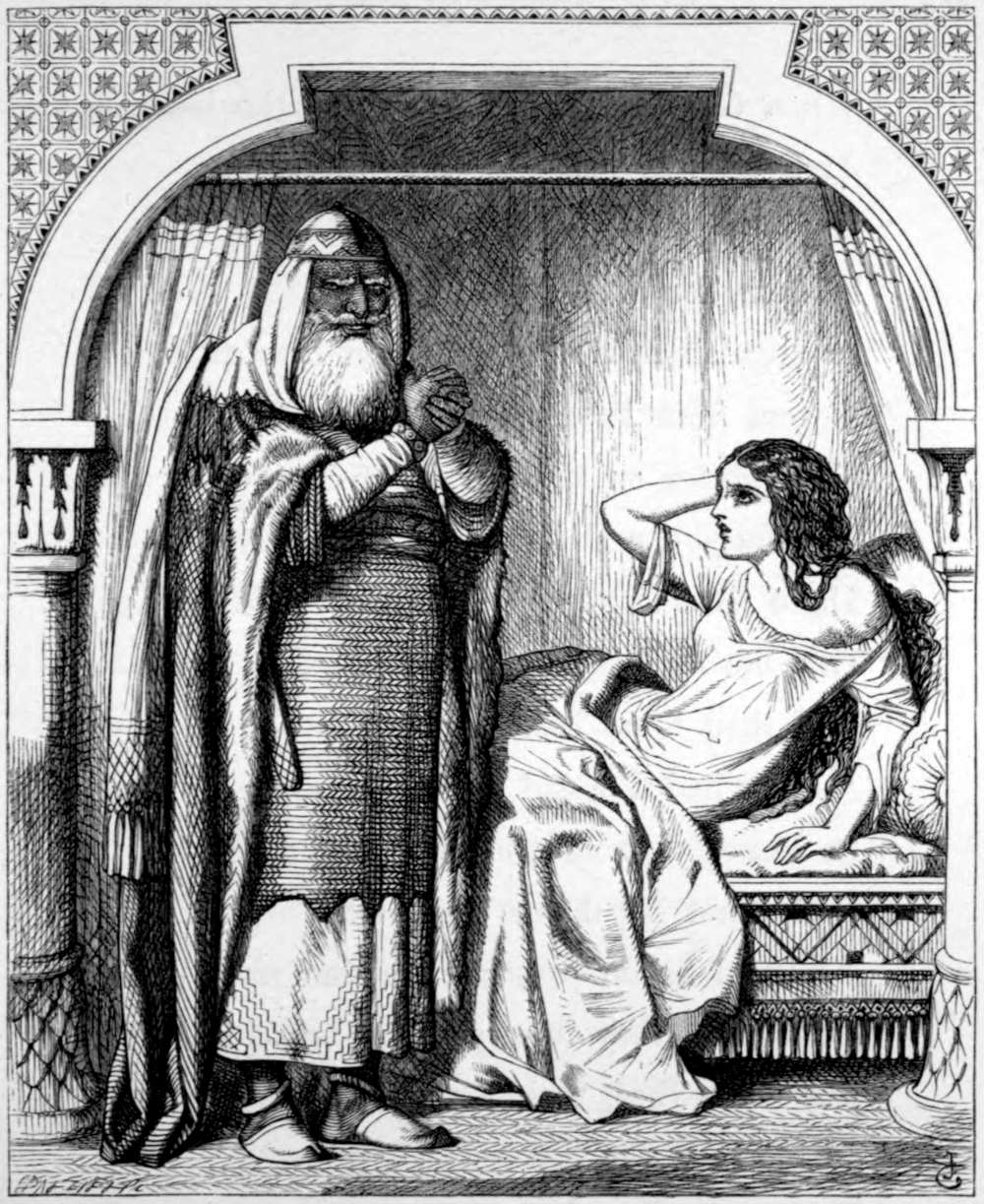
“Up, daughter, up—the Kerna’s[262] breath
“Has blown a blast would waken death,
“And yet thou sleep’st—up, child, and see
“This blessed day for Heaven and me,
“A day more rich in Pagan blood
“Than ever flash’d o’er Oman’s flood.
“Before another dawn shall shine,
“His head—heart—limbs—will all be mine;
“This very night his blood shall steep
“These hands all over ere I sleep!”—
“His blood!” she faintly scream’d—her mind
Still singling one from all mankind—
“Yes—spite of his ravines and towers,
“Hafed, my child, this night is ours.
“Thanks to all-conquering treachery,
“Without whose aid the links accurst,
“That bind these impious slaves, would be
“Too strong for Alla’s self to burst!
211“That rebel fiend, whose blade has spread
“My path with piles of Moslem dead,
“Whose baffling spells had almost driven
“Back from their course the Swords of Heaven,
“This night, with all his band, shall know
“How deep an Arab’s steel can go,
212“When God and Vengeance speed the blow.
“And—Prophet! by that holy wreath
“Thou wor’st on Ohod’s field of death,[263]
“I swear, for every sob that parts
“In anguish from these heathen hearts,
“A gem from Persia’s plunder’d mines
“Shall glitter on thy Shrine of Shrines.
“But, ha!—she sinks—that look so wild—
“Those livid lips—my child, my child,
“This life of blood befits not thee,
“And thou must back to Araby.
“Ne’er had I risk’d thy timid sex
“In scenes that man himself might dread,
“Had I not hop’d our every tread
“Would be on prostrate Persian necks—
“Curst race, they offer swords instead!
“But cheer thee, maid,—the wind that now
“Is blowing o’er thy feverish brow,
“To-day shall waft thee from the shore;
“And, ere a drop of this night’s gore
“Have time to chill in yonder towers,
“Thou’lt see thy own sweet Arab bowers!”
His bloody boast was all too true;
There lurk’d one wretch among the few
Whom Hafed’s eagle eye could count
213Around him on that Fiery Mount,—
One miscreant, who for gold betray’d
The pathway through the valley’s shade
To those high towers, where Freedom stood
In her last hold of flame and blood.
Left on the field last dreadful night,
When, sallying from their Sacred height,
The Ghebers fought hope’s farewell fight,
He lay—but died not with the brave;
That sun, which should have gilt his grave,
Saw him a traitor and a slave;—
And, while the few, who thence return’d
To their high rocky fortress mourn’d
For him among the matchless dead
They left behind on glory’s bed,
He liv’d, and, in the face of morn,
Laugh’d them and Faith and Heaven to scorn.
Oh for a tongue to curse the slave,
Whose treason, like a deadly blight,
Comes o’er the councils of the brave,
And blasts them in their hour of might!
May Life’s unblessed cup for him
Be drugg’d with treacheries to the brim,—
With hopes, that but allure to fly,
With joys, that vanish while he sips,
214Like Dead Sea fruits, that tempt the eye,
But turn to ashes on the lips![264]
His country’s curse, his children’s shame,
Outcast of virtue, peace, and fame,
May he, at last, with lips of flame
On the parch’d desert thirsting die,—
While lakes, that shone in mockery nigh,[265]
Are fading off, untouch’d, untasted,
Like the once glorious hopes he blasted!
And, when from earth his spirit flies,
Just Prophet, let the damn’d one dwell
Full in the sight of Paradise,
Beholding heaven, and feeling hell!
215Lalla Rookh had, the night before, been visited by a dream which, in spite of the impending fate of poor Hafed, made her heart more than usually cheerful during the morning, and gave her cheeks all the freshened animation of a flower that the Bid-musk had just passed over.[266] She fancied that she was sailing on that Eastern Ocean, where the sea-gipsies, who live for ever on the water,[267] enjoy a perpetual summer in wandering from isle to isle, when she saw a small gilded bark approaching her. It was like one of those boats which the Maldivian islanders send adrift, at the mercy of winds and waves, loaded with perfumes, flowers, and odoriferous wood, as an offering to the Spirit whom they call King of the Sea. At first, this little bark appeared to be empty, but, on coming nearer⸺
She had proceeded thus far in relating the dream to her Ladies, when Feramorz appeared at the door of the pavilion. In his presence, of course, every thing else was forgotten, and the continuance of the story was instantly requested by all. Fresh wood of aloes was set to burn in the cassolets;—the violet sherbets[268] were hastily handed round, and after a short prelude on his lute, in the pathetic measure of Nava,[269] which is always used to express the lamentations of absent lovers, the Poet thus continued:—
216
The day is lowering—stilly black
Sleeps the grim wave, while heaven’s rack,
Dispers’d and wild, ’twixt earth and sky
Hangs like a shatter’d canopy.
There’s not a cloud in that blue plain
But tells of storm to come or past;—
Here, flying loosely as the mane
Of a young war-horse in the blast;—
There, roll’d in masses dark and swelling,
As proud to be the thunder’s dwelling!
217While some, already burst and riven,
Seem melting down the verge of heaven;
As though the infant storm had rent
The mighty womb that gave him birth,
And, having swept the firmament,
Was now in fierce career for earth.
On earth ’twas yet all calm around,
A pulseless silence, dread, profound,
More awful than the tempest’s sound.
The diver steer’d for Ormus’ bowers,
And moor’d his skiff till calmer hours;
The sea-birds, with portentous screech,
Flew fast to land;—upon the beach
The pilot oft had paus’d, with glance
Turn’d upward to that wild expanse;—
And all was boding, drear, and dark
As her own soul, when Hinda’s bark
Went slowly from the Persian shore.—
No music tim’d her parting oar,[270]
Nor friends upon the lessening strand
Linger’d, to wave the unseen hand,
Or speak the farewell, heard no more;—
But lone, unheeded, from the bay
The vessel takes its mournful way,
Like some ill-destin’d bark that steers
In silence through the Gate of Tears.[271]
218And where was stern Al Hassan then?
Could not that saintly scourge of men
From bloodshed and devotion spare
One minute for a farewell there?
No—close within, in changeful fits
Of cursing and of prayer, he sits
In savage loneliness to brood
Upon the coming night of blood,—
With that keen second-scent of death,
By which the vulture snuffs his food
In the still warm and living breath![272]
While o’er the wave his weeping daughter
Is wafted from these scenes of slaughter,—
As a young bird of Babylon,[273]
Let loose to tell of victory won,
Flies home, with wing, ah! not unstain’d
By the red hands that held her chain’d.
And does the long-left home she seeks
Light up no gladness on her cheeks?
The flowers she nurs’d—the well-known groves,
Where oft in dreams her spirit roves—
Once more to see her dear gazelles
Come bounding with their silver bells;
Her birds’ new plumage to behold,
And the gay, gleaming fishes count,
219She left, all filleted with gold,
Shooting around their jasper fount;[274]
Her little garden mosque to see,
And once again, at evening hour,
To tell her ruby rosary[275]
In her own sweet acacia bower.—
Can these delights, that wait her now,
Call up no sunshine on her brow?
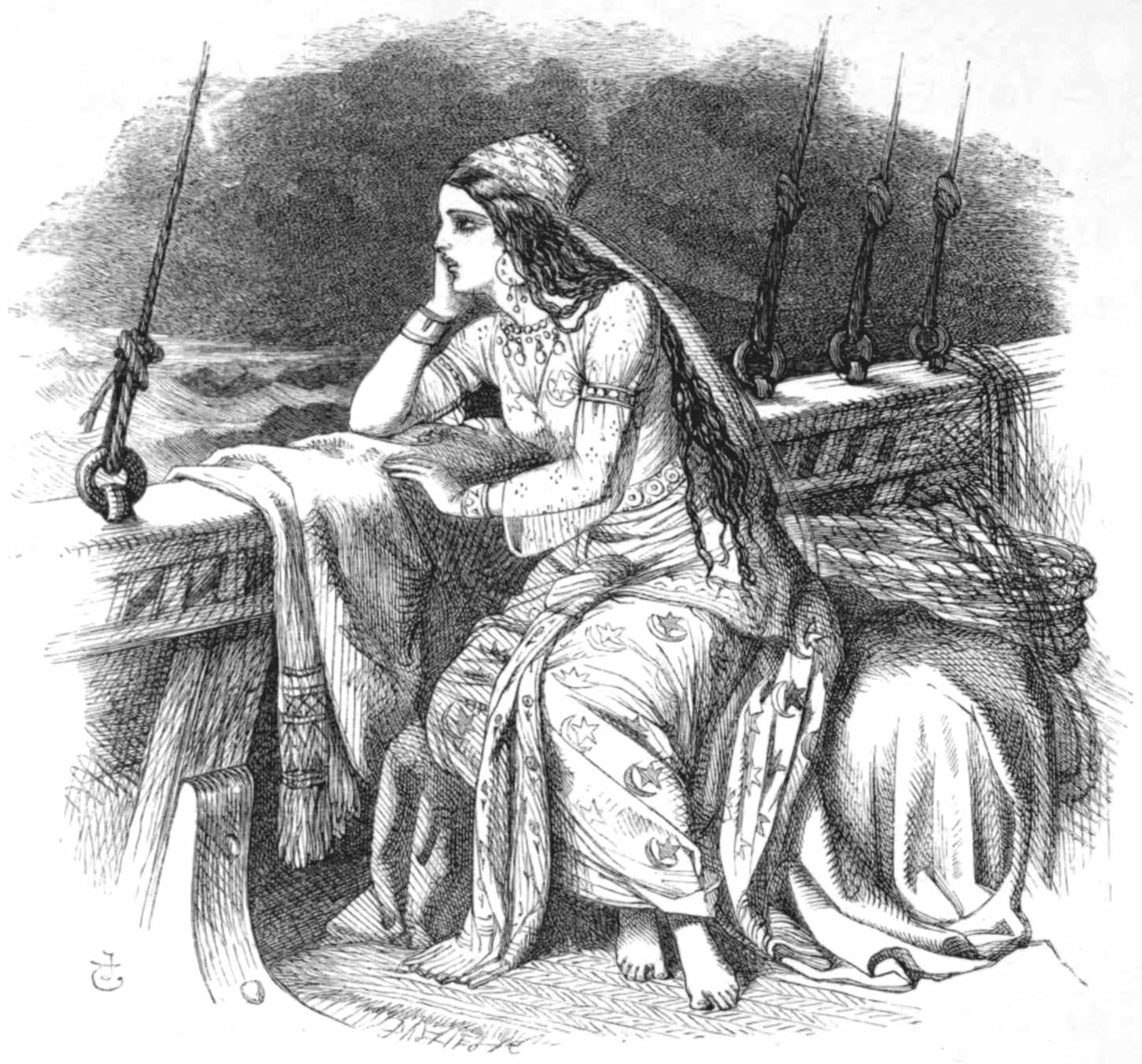
No,—silent, from her train apart,—
As if e’en now she felt at heart
The chill of her approaching doom,—
She sits, all lovely in her gloom
As a pale Angel of the Grave;
And o’er the wide, tempestuous wave,
Looks, with a shudder, to those towers,
Where, in a few short awful hours,
Blood, blood, in streaming tides shall run.
Foul incense for to-morrow’s sun!
“Where art thou, glorious stranger! thou,
“So loved, so lost, where art thou now?
“Foe—Gheber—infidel—whate’er
“The’ unhallow’d name thou’rt doom’d to bear,
“Still glorious—still to this fond heart
“Dear as its blood, whate’er thou art!
“Yes—Alla, dreadful Alla! yes—
“If there be wrong, be crime in this,
220“Let the black waves that round us roll,
“Whelm me this instant, ere my soul,
“Forgetting faith—home—father—all—
“Before its earthly idol fall,
“Nor worship e’en Thyself above him—
“For, oh, so wildly do I love him,
“Thy Paradise itself were dim
“And joyless, if not shared with him!”
Her hands were clasp’d—her eyes upturn’d,
Dropping their tears like moonlight rain;
And, though her lip, fond raver! burn’d
With words of passion, bold, profane,
Yet was there light around her brow,
A holiness in those dark eyes,
Which show’d, though wandering earthward now,
Her spirit’s home was in the skies.
Yes—for a spirit pure as hers
Is always pure, e’en while it errs;
As sunshine, broken in the rill,
Though turn’d astray, is sunshine still!
So wholly had her mind forgot
All thoughts but one, she heeded not
The rising storm—the wave that cast
A moment’s midnight, as it pass’d—
221Nor heard the frequent shout, the tread
Of gathering tumult o’er her head—
Clash’d swords, and tongues that seem’d to vie
With the rude riot of the sky.—
But, hark!—that war-whoop on the deck—
That crash, as if each engine there,
Masts, sails, and all, were gone to wreck,
Mid yells and stampings of despair!
Merciful Heaven! what can it be?
’Tis not the storm, though fearfully
The ship has shudder’d as she rode
O’er mountain-waves—“Forgive me, God!
“Forgive me”—shrieked the maid, and knelt,
Trembling all over—for she felt
As if her judgment-hour was near
While crouching round, half dead with fear,
Her handmaids clung, nor breath’d, nor stirr’d—
When, hark!—a second crash—a third—
And now, as if a bolt of thunder
Had riv’n the labouring planks asunder,
The deck falls in—what horrors then!
Blood, waves, and tackle, swords and men
Come mix’d together through the chasm,—
Some wretches in their dying spasm
Still fighting on—and some that call
“For God and Iran!” as they fall!
222
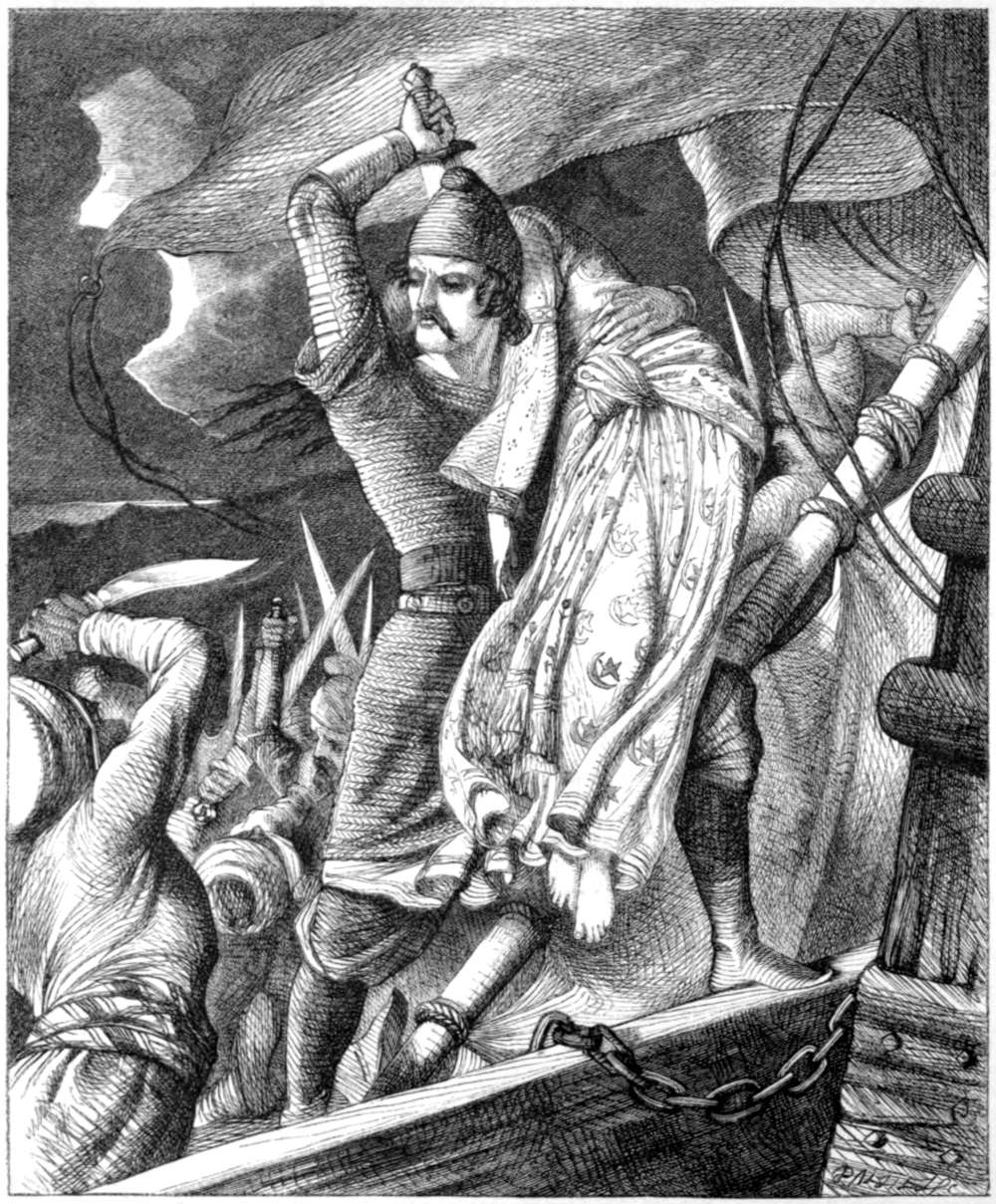
Whose was the hand that turn’d away
The perils of the’ infuriate fray,
And snatch’d her breathless from beneath
This wilderment of wreck and death?
She knew not—for a faintness came
Chill o’er her, and her sinking frame
223Amid the ruins of that hour
Lay, like a pale and scorched flower,
Beneath the red volcano’s shower.
But, oh! the sights and sounds of dread
That shock’d her ere her senses fled!
The yawning deck—the crowd that strove
Upon the tottering planks above—
The sail, whose fragments, shivering o’er
The strugglers’ heads, all dash’d with gore,
Flutter’d like bloody flags—the clash
Of sabres, and the lightning’s flash
Upon their blades, high toss’d about
Like meteor brands[276]—as if throughout
The elements one fury ran,
One general rage, that left a doubt
Which was the fiercer, Heaven or Man!
Once too—but no—it could not be—
’Twas fancy all—yet once she thought,
While yet her fading eyes could see,
High on the ruin’d deck she caught
A glimpse of that unearthly form,
That glory of her soul,—e’en then,
Amid the whirl of wreck and storm,
Shining above his fellow-men,
As, on some black and troublous night,
224The Star of Egypt,[277] whose proud light
Never hath beam’d on those who rest
In the White Islands of the West,[278]
Burns through the storm with looks of flame
That put Heaven’s cloudier eyes to shame.
But no—’twas but the minute’s dream—
A fantasy—and ere the scream
Had half-way pass’d her pallid lips,
A death-like swoon, a chill eclipse
Of soul and sense its darkness spread
Around her, and she sunk, as dead.
How calm, how beautiful comes on
The stilly hour, when storms are gone;
When warring winds have died away,
And clouds, beneath the glancing ray,
Melt off, and leave the land and sea
Sleeping in bright tranquillity,—
Fresh as if Day again were born,
Again upon the lap of Morn!—
When the light blossoms, rudely torn
And scatter’d at the whirlwind’s will,
Hang floating in the pure air still,
Filling it all with precious balm,
In gratitude for this sweet calm;—
And every drop the thunder-showers
225Have left upon the grass and flowers
Sparkles, as ’twere that lightning-gem[279]
Whose liquid flame is born of them!
When, ’stead of one unchanging breeze,
There blow a thousand gentle airs,
And each a different perfume bears,—
As if the loveliest plants and trees
Had vassal breezes of their own
To watch and wait on them alone,
And waft no other breath than theirs:
When the blue waters rise and fall,
In sleepy sunshine mantling all;
And e’en that swell the tempest leaves
Is like the full and silent heaves
Of lovers’ hearts, when newly blest,
Too newly to be quite at rest.
Such was the golden hour that broke
Upon the world, when Hinda woke
From her long trance, and heard around
No motion but the water’s sound
Rippling against the vessel’s side,
As slow it mounted o’er the tide.—
But where is she?—her eyes are dark,
Are wilder’d still—is this the bark,
The same, that from Harmozia’s bay
226Bore her at morn—whose bloody way
The sea-dog track’d?—no—strange and new
Is all that meets her wondering view.
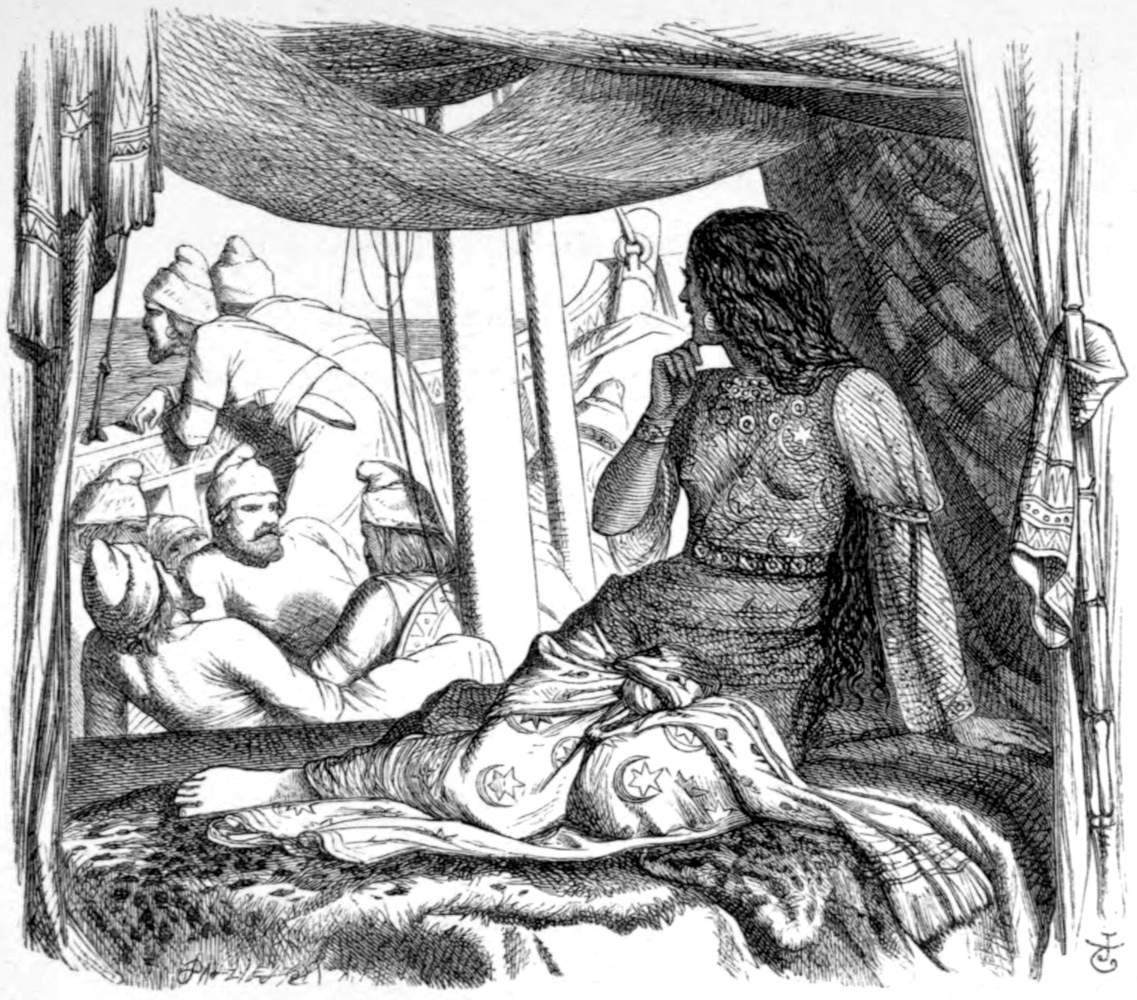
Upon a galliot’s deck she lies,
Beneath no rich pavilion’s shade,—
No plumes to fan her sleeping eyes,
Nor jasmine on her pillow laid.
But the rude litter, roughly spread
With war-cloaks, is her homely bed,
And shawl and sash, on javelins hung,
For awning o’er her head are flung.
Shuddering she look’d around—there lay
A group of warriors in the sun,
Resting their limbs, as for that day
Their ministry of death were done.
Some gazing on the drowsy sea,
Lost in unconscious reverie;
And some, who seem’d but ill to brook
That sluggish calm, with many a look
To the slack sail impatient cast,
As loose it flagg’d around the mast.
Blest Alla! who shall save her now?
There’s not in all that warrior band
One Arab sword, one turban’d brow
From her own Faithful Moslem land.
227Their garb—the leathern belt[280] that wraps
Each yellow vest[281]—that rebel hue—
The Tartar fleece upon their caps[282]—
Yes—yes—her fears are all too true,
And Heaven hath, in this dreadful hour,
Abandon’d her to Hafed’s power;—
Hafed, the Gheber!—at the thought
Her very heart’s blood chills within;
He, whom her soul was hourly taught
To loathe, as some foul fiend of sin,
Some minister, whom Hell had sent
To spread its blast, where’er he went,
228And fling, as o’er our earth he trod,
His shadow betwixt man and God!
And she is now his captive,—thrown
In his fierce hands, alive, alone;
His the infuriate band she sees,
All infidels—all enemies!
What was the daring hope that then
Cross’d her like lightning, as again,
With boldness that despair had lent,
She darted through that armed crowd
A look so searching, so intent,
That e’en the sternest warrior bow’d
Abash’d, when he her glances caught,
As if he guess’d whose form they sought.
But no—she sees him not—’tis gone,
The vision that before her shone
Through all the maze of blood and storm,
Is fled—’twas but a phantom form—
One of those passing, rainbow dreams,
Half light, half shade, which Fancy’s beams
Paint on the fleeting mists that roll
In trance or slumber round the soul.
But now the bark, with livelier bound,
Scales the blue wave—the crew’s in motion,
The oars are out, and with light sound
229Break the bright mirror of the ocean,
Scattering its brilliant fragments round.
And now she sees—with horror sees,
Their course is tow’rd that mountain-hold,—
Those towers, that make her life-blood freeze,
Where Mecca’s godless enemies
Lie, like beleaguer’d scorpions, roll’d
In their last deadly, venomous fold!
Amid the’ illumin’d land and flood
Sunless that mighty mountain stood;
Save where, above its awful head,
There shone a flaming cloud, blood-red,
As ’twere the flag of destiny
Hung out to mark where death would be!
Had her bewilder’d mind the power
Of thought in this terrific hour,
She well might marvel where or how
Man’s foot could scale that mountain’s brow,
Since ne’er had Arab heard or known
Of path but through the glen alone.—
But every thought was lost in fear,
When, as their bounding bark drew near
The craggy base, she felt the waves
Hurry them tow’rd those dismal caves,
That from the Deep in windings pass
230Beneath that Mount’s volcanic mass;—
And loud a voice on deck commands
To lower the mast and light the brands!—
Instantly o’er the dashing tide
Within a cavern’s mouth they glide,
Gloomy as that eternal Porch
Through which departed spirits go:—
Not e’en the flare of brand and torch
Its flickering light could further throw
Than the thick flood that boil’d below.
Silent they floated—as if each
Sat breathless, and too aw’d for speech
In that dark chasm, where even sound
Seem’d dark,—so sullenly around
The goblin echoes of the cave
Mutter’d it o’er the long black wave,
As ’twere some secret of the grave!
But soft—they pause—the current turns
Beneath them from its onward track;—
Some mighty, unseen barrier spurns
The vexed tide, all foaming, back,
And scarce the oars’ redoubled force
Can stem the eddy’s whirling force;
When, hark!—some desperate foot has sprung
Among the rocks—the chain is flung—
231The oars are up—the grapple clings,
And the toss’d bark in moorings swings.
Just then, a day-beam through the shade
Broke tremulous—but, ere the maid
Can see from whence the brightness steals,
Upon her brow she shuddering feels
A viewless hand, that promptly ties
A bandage round her burning eyes;
While the rude litter where she lies,
Uplifted by the warrior throng,
O’er the steep rocks is borne along.
Blest power of sunshine!—genial Day,
What balm, what life is in thy ray!
To feel thee is such real bliss,
That had the world no joy but this,
To sit in sunshine calm and sweet,—
It were a world too exquisite
For man to leave it for the gloom,
The deep, cold shadow of the tomb.
E’en Hinda, though she saw not where
Or whither wound the perilous road,
Yet knew by that awakening air,
Which suddenly around her glow’d,
That they had risen from darkness then,
And breath’d the sunny world again!
232But soon this balmy freshness fled—
For now the steepy labyrinth led
Through damp and gloom—’mid crash of boughs,
And fall of loosen’d crags that rouse
The leopard from his hungry sleep,
Who, starting, thinks each crag a prey,
And long is heard, from steep to steep,
Chasing them down their thundering way!
The jackal’s cry—the distant moan
Of the hyæna, fierce and lone—
And that eternal saddening sound
Of torrents in the glen beneath,
As ’twere the ever-dark Profound
That rolls beneath the Bridge of Death!
All, all is fearful—e’en to see,
To gaze on those terrific things
She now but blindly hears, would be
Relief to her imaginings;
Since never yet was shape so dread,
But Fancy, thus in darkness thrown
And by such sounds of horror fed,
Could frame more dreadful of her own.
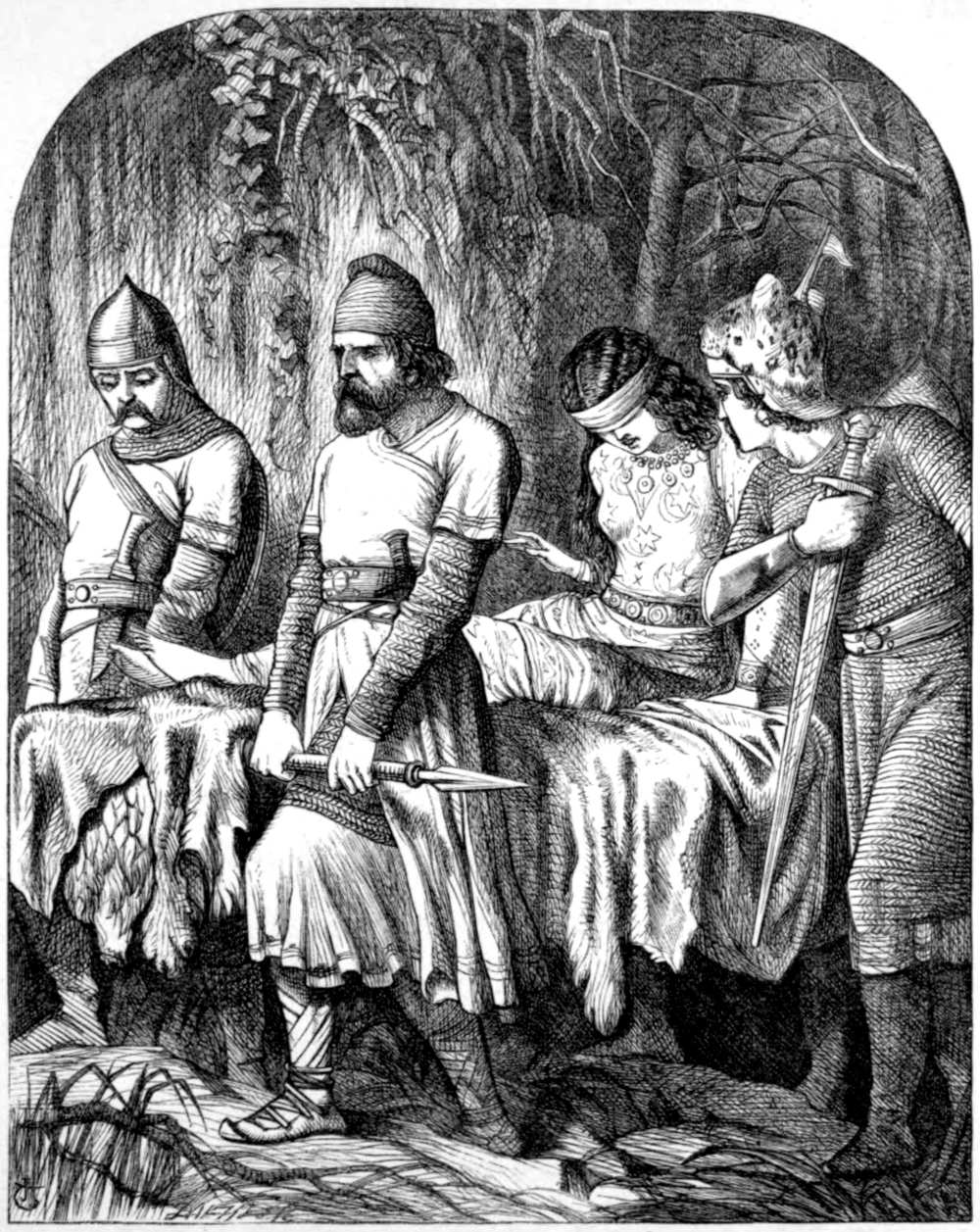
But does she dream? has Fear again
Perplex’d the workings of her brain,
Or did a voice, all music, then
233Come from the gloom, low whispering near—
“Tremble not, love, thy Gheber’s here!”
She does not dream—all sense, all ear,
She drinks the words, “Thy Gheber’s here.”
’Twas his own voice—she could not err—
Throughout the breathing world’s extent
234There was but one such voice for her,
So kind, so soft, so eloquent!
Oh, sooner shall the rose of May
Mistake her own sweet nightingale,
And to some meaner minstrel’s lay
Open her bosom’s glowing veil,[283]
Than Love shall ever doubt a tone,
A breath of the beloved one!
Though blest, ’mid all her ills, to think
She has that one beloved near,
Whose smile, though met on ruin’s brink,
Hath power to make e’en ruin dear,—
Yet soon this gleam of rapture, crost
By fears for him, is chill’d and lost.
How shall the ruthless Hafed brook
That one of Gheber blood should look,
With aught but curses in his eye,
On her—a maid of Araby—
A Moslem maid—the child of him,
Whose bloody banner’s dire success
Hath left their altars cold and dim,
And their fair land a wilderness!
And, worse than all, that night of blood
Which comes so fast—oh! who shall stay
The sword, that once hath tasted food
235Of Persian hearts, or turn its way?
What arm shall then the victim cover,
Or from her father shield her lover?
“Save him, my God!” she inly cries—
“Save him this night—and if thine eyes
“Have ever welcom’d with delight
“The sinner’s tears, the sacrifice
“Of sinners’ hearts—guard him this night,
“And here, before thy throne, I swear
“From my heart’s inmost core to tear
“Love, hope, remembrance, though they be
“Link’d with each quivering life-string there,
“And give it bleeding all to Thee!
“Let him but live,—the burning tear,
“The sighs, so sinful, yet so dear,
“Which have been all too much his own,
“Shall from this hour be Heaven’s alone.
“Youth pass’d in penitence, and age
“In long and painful pilgrimage,
“Shall leave no traces of the flame
“That wastes me now—nor shall his name
“E’er bless my lips, but when I pray
“For his dear spirit, that away
“Casting from its angelic ray
“The’ eclipse of earth, he, too, may shine
236“Redeem’d, all glorious and all Thine!
“Think—think what victory to win
“One radiant soul like his from sin,—
“One wandering star of virtue back
“To its own native, heaven-ward track!
“Let him but live, and both are Thine,
“Together Thine—for, blest or crost,
“Living or dead, his doom is mine,
“And, if he perish, both are lost!”
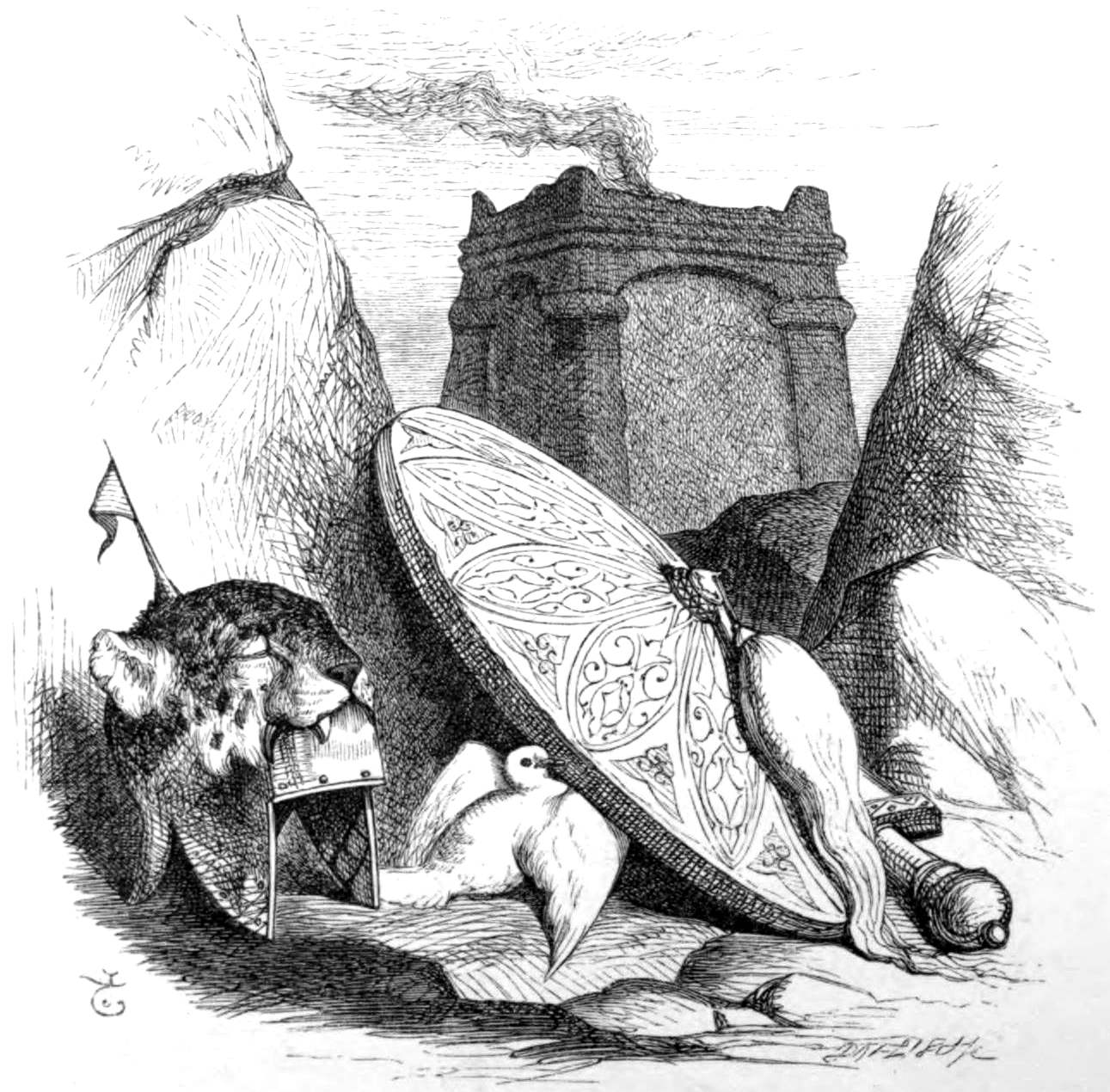
237The next evening Lalla Rookh was entreated by her Ladies to continue the relation of her wonderful dream; but the fearful interest that hung round the fate of Hinda and her lover had completely removed every trace of it from her mind;—much to the disappointment of a fair seer or two in her train, who prided themselves on their skill in interpreting visions, and who had already remarked, as an unlucky omen, that the Princess, on the very morning after the dream, had worn a silk dyed with the blossoms of the sorrowful tree, Nilica.[284]
Fadladeen, whose indignation had more than once broken out during the recital of some parts of this heterodox poem, seemed at length to have made up his mind to the infliction; and took his seat this evening with all the patience of a martyr, while the Poet resumed his profane and seditious story as follows:—
238
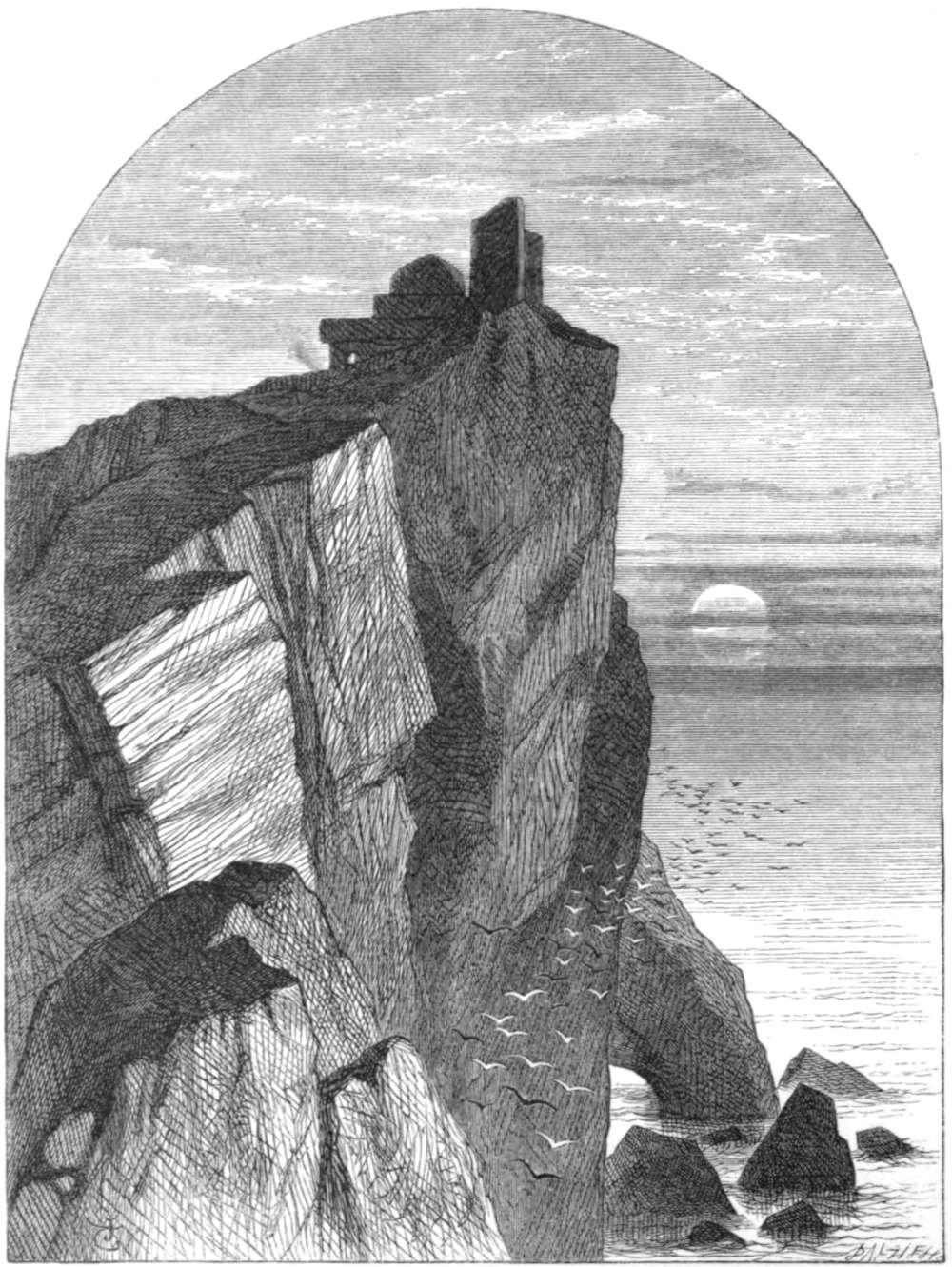
To tearless eyes and hearts at ease
The leafy shores and sun-bright seas,
That lay beneath that mountain’s height,
Had been a fair enchanting sight.
’Twas one of those ambrosial eves
A day of storm so often leaves
239At its calm setting—when the West
Opens her golden bowers of rest,
And a moist radiance from the skies
Shoots trembling down, as from the eyes
Of some meek penitent, whose last
Bright hours atone for dark ones past,
And whose sweet tears, o’er wrong forgiven,
Shine, as they fall, with light from heaven!
’Twas stillness all—the winds that late
Had rush’d through Kerman’s almond groves,
And shaken from her bowers of date
That cooling feast the traveller loves,[285]
Now, lull’d to languor, scarcely curl
The Green Sea wave, whose waters gleam
Limpid, as if her mines of pearl
Were melted all to form the stream:
And her fair islets, small and bright,
With their green shores reflected there,
Look like those Peri isles of light,
That hang by spell-work in the air.
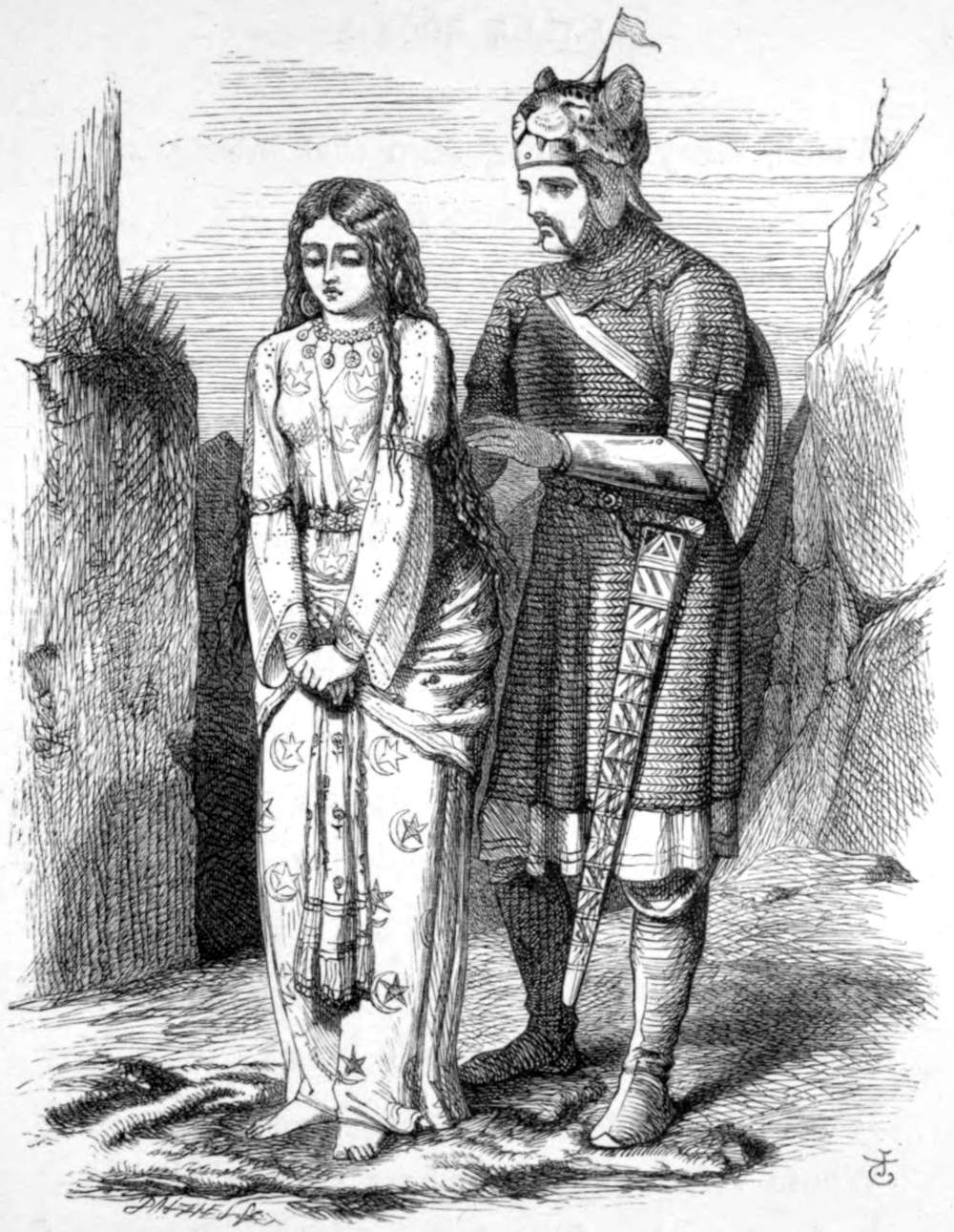
But vainly did those glories burst
On Hinda’s dazzled eyes, when first
The bandage from her brow was taken,
And, pale and aw’d as those who waken
240In their dark tombs—when, scowling near,
The Searchers of the Grave[286] appear,—
She shuddering turn’d to read her fate
In the fierce eyes that flash’d around;
And saw those towers all desolate,
That o’er her head terrific frown’d,
As if defying e’en the smile
Of that soft heaven to gild their pile.
In vain, with mingled hope and fear,
She looks for him whose voice so dear
Had come, like music, to her ear—
Strange, mocking dream! again ’tis fled.
And oh, the shoots, the pangs of dread
That through her inmost bosom run,
When voices from without proclaim
“Hafed, the Chief”—and, one by one,
The warriors shout that fearful name!
He comes—the rock resounds his tread—
How shall she dare to lift her head,
Or meet those eyes whose scorching glare
Not Yemen’s boldest sons can bear?
In whose red beam, the Moslem tells,
Such rank and deadly lustre dwells,
As in those hellish fires that light
The mandrake’s charnel leaves at night.[287]
How shall she bear that voice’s tone,
241At whose loud battle-cry alone
Whole squadrons oft in panic ran,
Scatter’d like some vast caravan,
When, stretch’d at evening round the well,
They hear the thirsting tiger’s yell!
Breathless she stands, with eyes cast down,
Shrinking beneath the fiery frown,
242Which, fancy tells her, from that brow
Is flashing o’er her fiercely now:
And shuddering as she hears the tread
Of his retiring warrior band.—
Never was pause so full of dread;
Till Hafed with a trembling hand
Took hers, and, leaning o’er her, said,
“Hinda;”—that word was all he spoke,
And ’twas enough—the shriek that broke
From her full bosom, told the rest.—
Panting with terror, joy, surprise,
The maid but lifts her wondering eyes,
To hide them on her Gheber’s breast!
’Tis he, ’tis he—the man of blood,
The fellest of the Fire-fiend’s brood,
Hafed, the demon of the fight,
Whose voice unnerves, whose glances blight,—
Is her own loved Gheber, mild
And glorious as when first he smil’d
In her lone tower, and left such beams
Of his pure eye to light her dreams,
That she believ’d her bower had given
Rest to some wanderer from heaven!
Moments there are, and this was one,
Snatch’d like a minute’s gleam of sun
243Amid the black Simoom’s eclipse—
Or, like those verdant spots that bloom
Around the crater’s burning lips,
Sweetening the very edge of doom!
The past—the future—all that Fate
Can bring of dark or desperate
Around such hours, but makes them cast
Intenser radiance while they last!
Even he, this youth—though dimm’d and gone
Each star of Hope that cheer’d him on—
His glories lost—his cause betray’d—
Iran, his dear-lov’d country made
A land of carcasses and slaves,
One dreary waste of chains and graves!—
Himself but lingering, dead at heart,
To see the last, long struggling breath
Of Liberty’s great soul depart,
Then lay him down and share her death—
Even he, so sunk in wretchedness,
With doom still darker gathering o’er him,
Yet, in this moment’s pure caress,
In the mild eyes that shone before him,
Beaming that blest assurance, worth
All other transports known on earth,
That he was lov’d—well, warmly lov’d—
244Oh! in this precious hour he prov’d
How deep, how thorough-felt the glow
Of rapture, kindling out of woe;—
How exquisite one single drop
Of bliss, thus sparkling to the top
Of misery’s cup—how keenly quaff’d,
Though death must follow on the draught!
She, too, while gazing on those eyes
That sink into her soul so deep,
Forgets all fears, all miseries,
Or feels them like a wretch in sleep,
Whom fancy cheats into a smile,
Who dreams of joy, and sobs the while!
The mighty Ruins where they stood,
Upon the mount’s high, rocky verge,
Lay open tow’rds the ocean flood,
Where lightly o’er the illumin’d surge
Many a fair bark that, all the day,
Had lurk’d in sheltering creek or bay,
Now bounded on, and gave their sails,
Yet dripping, to the evening gales;
Like eagles, when the storm is done,
Spreading their wet wings in the sun.
The beauteous clouds, though daylight’s Star
Had sunk behind the hills of Lar,
245Were still with lingering glories bright,—
As if, to grace the gorgeous West,
The Spirit of departing Light
That eve had left his sunny vest
Behind him, ere he wing’d his flight.
Never was scene so form’d for love!
Beneath them waves of crystal move
In silent swell—Heaven glows above,
And their pure hearts, to transport given,
Swell like the wave, and glow like Heaven.
But, ah! too soon that dream is past—
Again, again her fear returns;—
Night, dreadful night, is gathering last,
More faintly the horizon burns,
And every rosy tint that lay
On the smooth sea hath died away.
Hastily to the darkening skies
A glance she casts—then wildly cries
“At night, he said—and, look, ’tis near—
“Fly, fly—if yet thou lov’st me, fly—
“Soon will his murderous band be here,
“And I shall see thee bleed and die.—
“Hush! heard’st thou not the tramp of men
“Sounding from yonder fearful glen?—
“Perhaps e’en now they climb the wood—
246“Fly, fly—though still the West is bright,
“He’ll come—oh! yes—he wants thy blood—
“I know him—he’ll not wait for night!”
In terrors e’en to agony
She clings around the wondering Chief;—
“Alas, poor wilder’d maid! to me
“Thou ow’st this raving trance of grief.
“Lost as I am, nought ever grew
“Beneath my shade but perish’d too—
“My doom is like the Dead Sea air,
“And nothing lives that enters there!
“Why were our barks together driven
“Beneath this morning’s furious heaven?
“Why, when I saw the prize that chance
“Had thrown into my desperate arms,—
“When, casting but a single glance
“Upon thy pale and prostrate charms,
“I vow’d (though watching viewless o’er
“Thy safety through that hour’s alarms)
“To meet the’ unmanning sight no more—
“Why have I broke that heart-wrung vow?
“Why weakly, madly met thee now?—
“Start not—that noise is but the shock
“Of torrents through yon valley hurl’d—
“Dread nothing here—upon this rock
247“We stand above the jarring world,
“Alike beyond its hope—its dread—
“In gloomy safety, like the Dead!
“Or, could e’en earth and hell unite
“In league to storm this Sacred Height,
“Fear nothing thou—myself, to-night,
“And each o’erlooking star that dwells
“Near God will be thy sentinels;—
“And, ere to-morrow’s dawn shall glow,
“Back to thy sire⸺”
“Back to thy sire⸺”“To-morrow!—no—”
The maiden scream’d—“thou’lt never see
“To-morrow’s sun—death, death will be
“The night-cry through each reeking tower,
“Unless we fly, ay, fly this hour!
“Thou art betray’d—some wretch who knew
“That dreadful glen’s mysterious clew—
“Nay, doubt not—by yon stars, ’tis true—
“Hath sold thee to my vengeful sire;
“This morning, with that smile so dire
“He wears in joy, he told me all,
“And stamp’d in triumph through our hall,
“As though thy heart already beat
“Its last life-throb beneath his feet!
“Good Heaven, how little dream’d I then
“His victim was my own lov’d youth!—
248“Fly—send—let some one watch the glen—
“By all my hopes of heaven ’tis truth!”
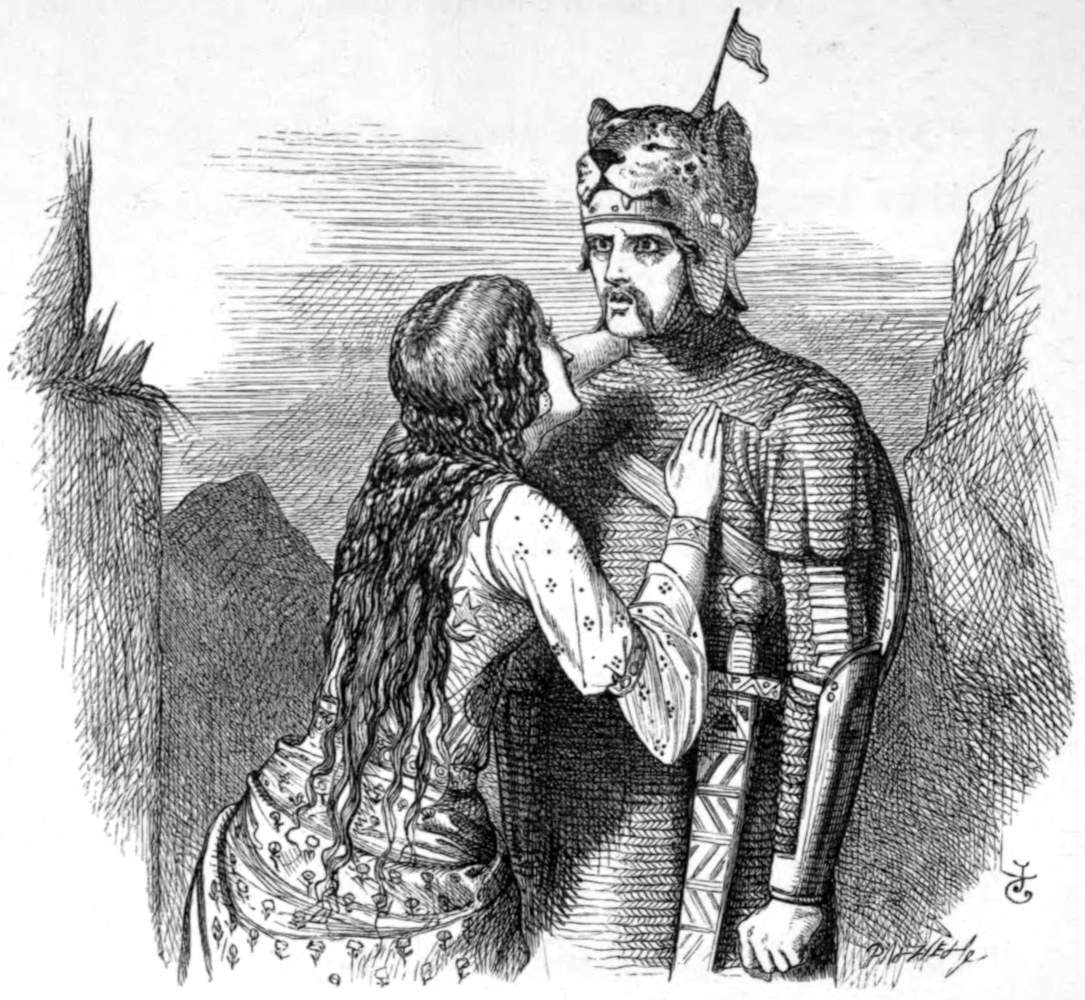
Oh! colder than the wind that freezes
Founts, that but now in sunshine play’d,
Is that congealing pang which seizes
The trusting bosom, when betray’d.
He felt it—deeply felt—and stood,
As if the tale had frozen his blood,
So maz’d and motionless was he;—
Like one whom sudden spells enchant,
249Or some mute, marble habitant
Of the still Halls of Ishmonie![288]
But soon the painful chill was o’er,
And his great soul, herself once more,
Look’d from his brow in all the rays
Of her best, happiest, grandest days.
Never, in moment most elate,
Did that high spirit loftier rise;—
While bright, serene, determinate,
His looks are lifted to the skies,
As if the signal lights of Fate
Were shining in those awful eyes!
’Tis come—his hour of martyrdom
In Iran’s sacred cause is come;
And, though his life hath pass’d away
Like lightning on a stormy day,
Yet shall his death-hour leave a track
Of glory, permanent and bright,
To which the brave of after-times,
The suffering brave, shall long look back
With proud regret,—and by its light
Watch through the hours of slavery’s night
For vengeance on the’ oppressor’s crimes.
This rock, his monument aloft,
Shall speak the tale to many an age;
250And hither bards and heroes oft
Shall come in secret pilgrimage,
And bring their warrior sons, and tell
The wondering boys where Hafed fell;
And swear them on those lone remains
Of their lost country’s ancient fanes,
Never—while breath of life shall live
Within them—never to forgive
The’ accursed race, whose ruthless chain
Hath left on Iran’s neck a stain
Blood, blood alone can cleanse again!
Such are the swelling thoughts that now
Enthrone themselves on Hafed’s brow;
And ne’er did saint of Issa[289] gaze
On the red wreath, for martyrs twin’d,
More proudly than the youth surveys
That pile, which through the gloom behind,
Half lighted by the altar’s fire,
Glimmers—his destin’d funeral pyre!
Heap’d by his own, his comrades’ hands,
Of every wood of odorous breath,
There, by the Fire-God’s shrine it stands,
Ready to fold in radiant death
The few still left of those who swore
To perish there, when hope was o’er—
251The few, to whom that couch of flame,
Which rescues them from bonds and shame,
Is sweet and welcome as the bed
For their own infant Prophet spread,
When pitying Heaven to roses turn’d
The death-flames that beneath him burn’d![290]
With watchfulness the maid attends
His rapid glance, where’er it bends—
Why shoot his eyes such awful beams?
What plans he now? what thinks or dreams?
Alas! why stands he musing here,
When every moment teems with fear?
“Hafed, my own beloved Lord,”
She kneeling cries—“first, last ador’d!
“If in that soul thou’st ever felt
“Half what thy lips impassioned swore,
“Here, on my knees that never knelt
“To any but their God before,
“I pray thee, as thou lov’st me, fly—
“Now, now—ere yet their blades are nigh.
“Oh haste—the bark that bore me hither
“Can waft us o’er yon darkening sea
“East—west—alas, I care not whither,
“So thou art safe, and I with thee!
“Go where we will, this hand is thine,
252“Those eyes before me smiling thus,
“Through good and ill, through storm and shine,
“The world’s a world of love for us!
“On some calm, blessed shore we’ll dwell,
“Where ’tis no crime to love too well;—
“Where thus to worship tenderly
“An erring child of light like thee
“Will not be sin—or, if it be,
“Where we may weep our faults away,
“Together kneeling, night and day,
“Thou, for my sake, at Alla’s shrine,
“And I—at any God’s, for thine!”
Wildly these passionate words she spoke—
Then hung her head, and wept for shame;
Sobbing, as if her heart-string broke
With every deep-heav’d sob that came.
While he, young, warm—oh! wonder not
If, for a moment, pride and fame,
His oath—his cause—that shrine of flame,
And Iran’s self are all forgot
For her whom at his feet he sees
Kneeling in speechless agonies.
No, blame him not, if Hope awhile
Dawn’d in his soul, and threw her smile
O’er hours to come—o’er days and nights,
253Wing’d with those precious, pure delights
Which she, who bends all beauteous there,
Was born to kindle and to share.
A tear or two, which, as he bow’d
To raise the suppliant, trembling stole,
First warn’d him of this dangerous cloud
Of softness passing o’er his soul.
Starting, he brush’d the drops away,
Unworthy o’er that cheek to stray;—
Like one who, on the morn of fight,
Shakes from his sword the dews of night,
That had but dimm’d, not stain’d its light.
Yet, though subdued the’ unnerving thrill,
Its warmth, its weakness linger’d still
So touching in each look and tone,
That the fond, fearing, hoping maid
Half counted on the flight she pray’d,
Half thought the hero’s soul was grown
As soft, as yielding as her own,
And smil’d and bless’d him, while he said,—
“Yes—if there be some happier sphere,
“Where fadeless truth like ours is dear,—
“If there be any land of rest
“For those who love and ne’er forget,
“Oh! comfort thee—for safe and blest
“We’ll meet in that calm region yet!”
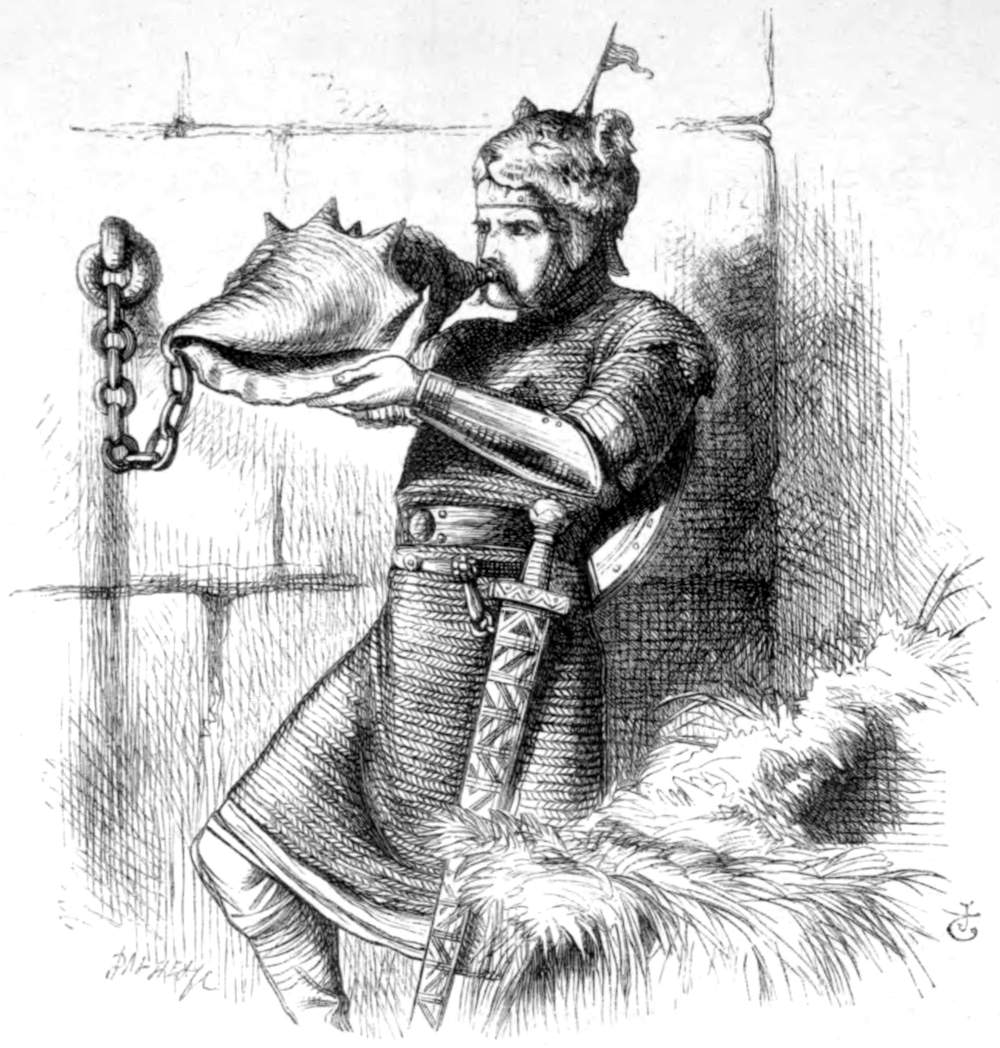
254Scarce had she time to ask her heart
If good or ill these words impart,
When the rous’d youth impatient flew
To the tower-wall, where, high in view,
A ponderous sea-horn[291] hung, and blew
A signal, deep and dread as those
The storm-fiend at his rising blows.—
Full well his Chieftains, sworn and true
Through life and death, that signal knew;
For ’twas the’ appointed warring-blast,
The’ alarm, to tell when hope was past,
And the tremendous death-die cast!
255And there, upon the mouldering tower,
Hath hung this sea-horn many an hour,
Ready to sound o’er land and sea
That dirge-note of the brave and free.
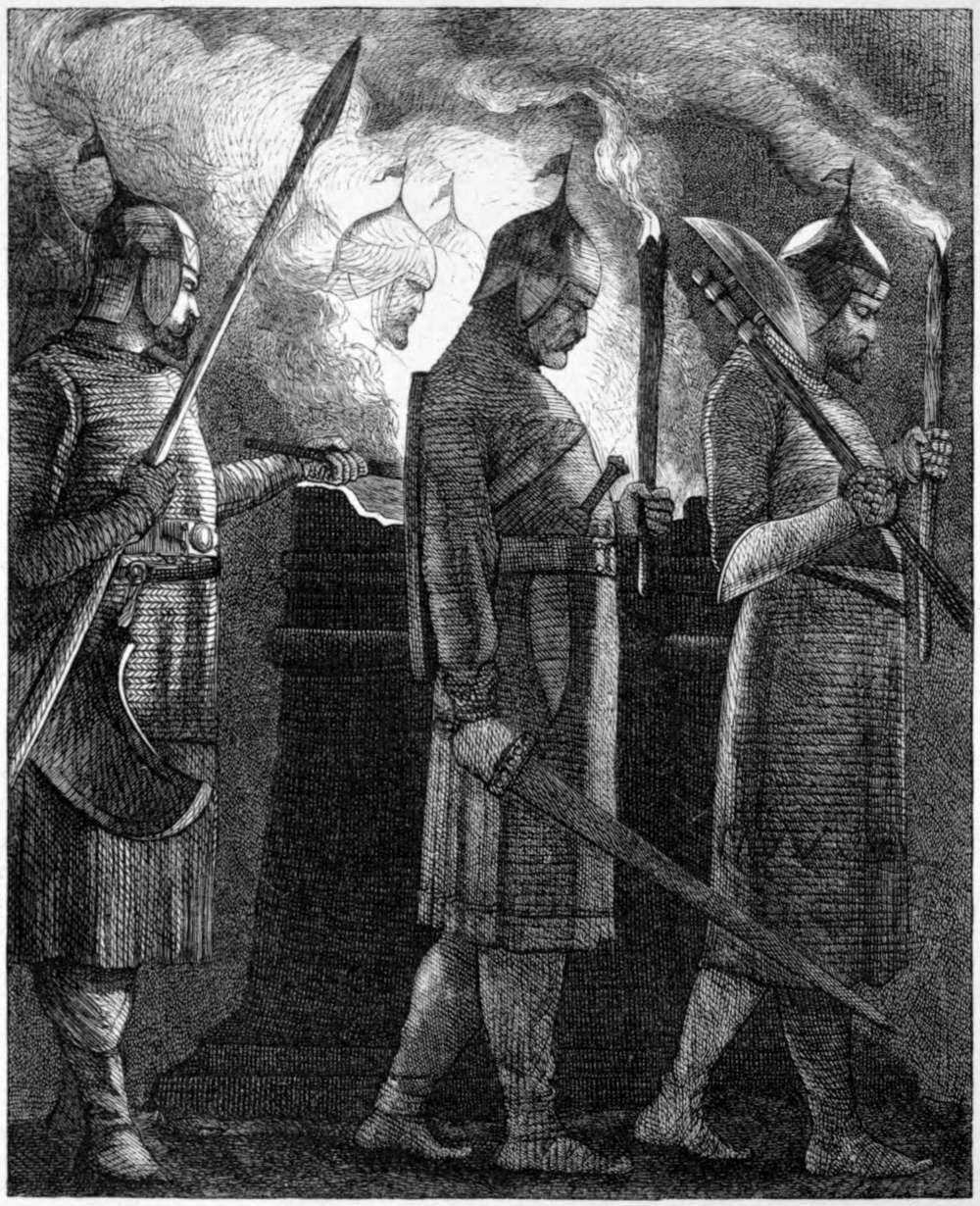
They came—his Chieftains at the call
Came slowly round, and with them all—
Alas, how few!—the worn remains
Of those who late o’er Kerman’s plains
Went gaily prancing to the clash
Of Moorish zel and tymbalon,
Catching new hope from every flash
Of their long lances in the sun,
And, as their coursers charg’d the wind,
And the white ox-tails stream’d behind,[292]
Looking, as if the steeds they rode
Were wing’d, and every Chief a God!
How fallen, how alter’d now! how wan
Each scarr’d and faded visage shone,
As round the burning shrine they came!—
How deadly was the glare it cast,
As mute they pass’d before the flame
To light their torches as they pass’d!
’Twas silence all—the youth had plann’d
The duties of his soldier-band;
And each determin’d brow declares
His faithful Chieftains well know theirs.
256
But minutes speed—night gems the skies—
And oh, how soon, ye blessed eyes,
That look from heaven, ye may behold
Sights that will turn your star-fires cold!
Breathless with awe, impatience, hope,
The maiden sees the veteran group
Her litter silently prepare,
257And lay it at her trembling feet;—
And now the youth, with gentle care,
Hath placed her in the shelter’d seat,
And press’d her hand—that lingering press
Of hands, that for the last time sever;
Of hearts, whose pulse of happiness,
When that hold breaks, is dead for ever.
And yet to her this sad caress
Gives hope—so fondly hope can err!
’Twas joy, she thought, joy’s mute excess—
Their happy flight’s dear harbinger;
’Twas warmth—assurance—tenderness—
’Twas any thing but leaving her.
“Haste, haste!” she cried, “the clouds grow dark,
“But still, ere night, we’ll reach the bark;
“And by to-morrow’s dawn—oh bliss!
“With thee upon the sun-bright deep,
“Far off, I’ll but remember this,
“As some dark vanish’d dream of sleep;
“And thou⸺” but ah!—he answers not—
Good Heaven!—and does she go alone?
She now has reach’d that dismal spot,
Where, some hours since, his voice’s tone
Had come to soothe her fears and ills,
Sweet as the angel Israfil’s,[293]
258When every leaf on Eden’s tree
Is trembling to his minstrelsy—
Yet now—oh, now, he is not nigh.—
“Hafed! my Hafed!—if it be
“Thy will, thy doom this night to die,
“Let me but stay to die with thee,
“And I will bless thy lovèd name,
“Till the last life-breath leave this frame.
“Oh! let our lips, our cheeks be laid
“But near each other while they fade;
“Let us but mix our parting breaths,
“And I can die ten thousand deaths!
“You too, who hurry me away
“So cruelly, one moment stay—
“Oh! stay—one moment is not much—
“He yet may come—for him I pray—
“Hafed! dear Hafed!—” all the way
In wild lamentings, that would touch
A heart of stone, she shriek’d his name
To the dark woods—no Hafed came:—
No—hapless pair—you’ve look’d your last:—
Your hearts should both have broken then:
The dream is o’er—your doom is cast—
You’ll never meet on earth again!
259Alas for him, who hears her cries!
Still half-way down the steep he stands,
Watching with fix’d and feverish eyes
The glimmer of those burning brands,
That down the rocks, with mournful ray,
Light all he loves on earth away!
Hopeless as they who, far at sea,
By the cold moon have just consign’d
The corse of one, lov’d tenderly,
To the bleak flood they leave behind;
And on the deck still lingering stay,
And long look back, with sad delay,
To watch the moonlight on the wave,
That ripples o’er that cheerless grave.
But see—he starts—what heard he then?
That dreadful shout!—across the glen
From the land-side it comes, and loud
Rings through the chasm; as if the crowd
Of fearful things, that haunt that dell,
Its Gholes and Dives and shapes of hell,
Had all in one dread howl broke out,
So loud, so terrible that shout!
“They come—the Moslems come!” he cries,
His proud soul mounting to his eyes,—
“Now, Spirits of the Brave, who roam
260“Enfranchis’d through yon starry dome,
“Rejoice—for souls of kindred fire
“Are on the wing to join your choir!”
He said—and, light as bridegrooms bound
To their young loves, reclimb’d the steep
And gain’d the Shrine—his Chiefs stood round—
Their swords, as with instinctive leap,
Together, at that cry accurst,
Had from their sheaths, like sunbeams, burst.
And hark!—again—again it rings;
Near and more near its echoings
Peal through the chasm—oh! who that then
Had seen those listening warrior-men,
With their swords grasp’d, their eyes of flame
Turn’d on their Chief—could doubt the shame,
The’ indignant shame with which they thrill
To hear those shouts and yet stand still?
He read their thoughts—they were his own—
“What! while our arms can wield these blades,
“Shall we die tamely? die alone?
“Without one victim to our shades,
“One Moslem heart, where, buried deep,
“The sabre from its toil may sleep?
“No—God of Iran’s burning skies!
“Thou scorn’st the’ inglorious sacrifice.
261“No—though of all earth’s hope bereft,
“Life, swords, and vengeance still are left.
“We’ll make yon valley’s reeking caves
“Live in the awe-struck minds of men,
“Till tyrants shudder, when their slaves
“Tell of the Ghebers’ bloody glen.
“Follow, brave hearts!—this pile remains
“Our refuge still from life and chains;
“But his the best, the holiest bed,
“Who sinks entomb’d in Moslem dead!”
Down the precipitous rocks they sprung,
While vigour, more than human, strung
Each arm and heart.—The’ exulting foe
Still through the dark defiles below,
Track’d by his torches’ lurid fire,
Wound slow, as through Golconda’s vale[294]
The mighty serpent, in his ire,
Glides on with glittering, deadly trail.
No torch the Ghebers need—so well
They know each mystery of the dell,
So oft have, in their wanderings,
Cross’d the wild race that round them dwell,
The very tigers from their delves
Look out, and let them pass, as things
Untam’d and fearless like themselves!
262There was a deep ravine, that lay
Yet darkling in the Moslem’s way;
Fit spot to make invaders rue
The many fallen before the few.
The torrents from that morning’s sky
Had fill’d the narrow chasm breast high,
And, on each side, aloft and wild,
Huge cliffs and toppling crags were pil’d,—
The guards with which young Freedom lines
The pathways to her mountain-shrines.
Here, at this pass, the scanty band
Of Iran’s last avengers stand;
Here wait, in silence like the dead,
And listen for the Moslem’s tread
So anxiously, the carrion-bird
Above them flaps his wing unheard!
They come—that plunge into the water
Gives signal for the work of slaughter.
Now, Ghebers, now—if e’er your blades
Had point or prowess, prove them now—
Woe to the file that foremost wades!
They come—a falchion greets each brow,
And, as they tumble, trunk on trunk,
Beneath the gory waters sunk,
Still o’er their drowning bodies press
263New victims quick and numberless;
Till scarce an arm in Hafed’s band,
So fierce their toil, hath power to stir,
But listless from each crimson hand
The sword hangs, clogg’d with massacre.
Never was horde of tyrants met
With bloodier welcome—never yet
To patriot vengeance hath the sword
More terrible libations pour’d!
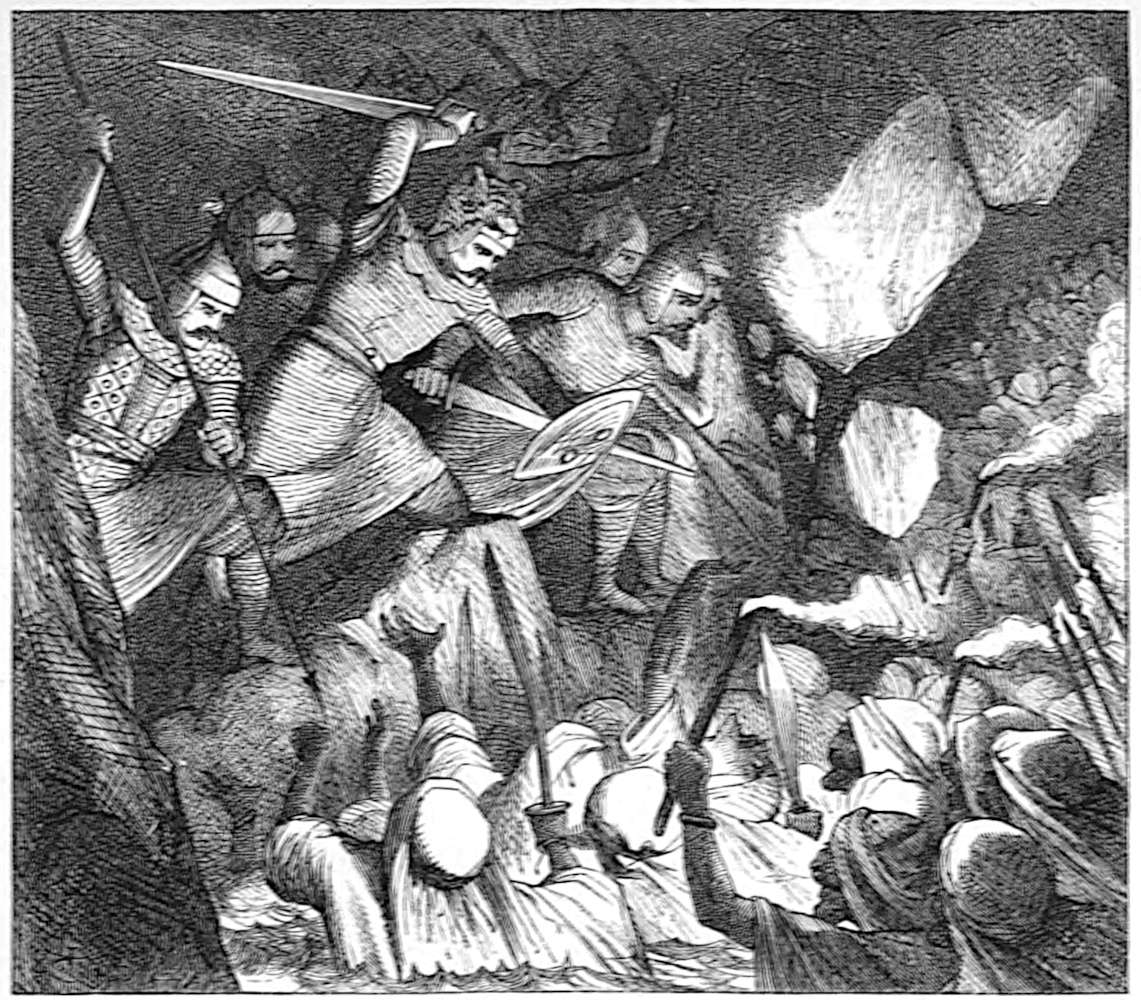
All up the dreary, long ravine,
By the red, murky glimmer seen
264Of half-quench’d brands that o’er the flood
Lie scatter’d round and burn in blood,
What ruin glares! what carnage swims!
Heads, blazing turbans, quivering limbs,
Lost swords that, dropp’d from many a hand,
In that thick pool of slaughter stand;—
Wretches who wading, half on fire
From the toss’d brands that round them fly,
’Twixt flood and flame in shrieks expire;—
And some who, grasp’d by those that die,
Sink woundless with them, smother’d o’er
In their dead brethren’s gushing gore!
But vainly hundreds, thousands bleed,
Still hundreds, thousands more succeed;
Countless as tow’rds some flame at night
The North’s dark insects wing their flight,
And quench or perish in its light,
To this terrific spot they pour—
Till, bridg’d with Moslem bodies o’er,
It bears aloft their slippery tread,
And o’er the dying and the dead,
Tremendous causeway! on they pass.
Then, hapless Ghebers, then, alas,
What hope was left for you? for you,
Whose yet warm pile of sacrifice
265Is smoking in their vengeful eyes?—
Whose swords how keen, how fierce they knew,
And burn with shame to find how few?
Crush’d down by that vast multitude,
Some found their graves where first they stood;
While some with hardier struggle died,
And still fought on by Hafed’s side,
Who, fronting to the foe, trod back
Tow’rds the high towers his gory track;
And, as a lion swept away
By sudden swell of Jordan’s pride
From the wild covert where he lay,[295]
Long battles with the o’erwhelming tide,
So fought he back with fierce delay,
And kept both foes and fate at bay.
But whither now? their track is lost,
Their prey escap’d—guide, torches gone—
By torrent-beds and labyrinths crost,
The scatter’d crowd rush blindly on—
“Curse on those tardy lights that wind,”
They panting cry, “so far behind;
“Oh for a bloodhound’s precious scent,
“To track the way the Gheber went!”
Vain wish—confusedly along
266They rush, more desperate as more wrong:
Till, wilder’d by the far-off lights,
Yet glittering up those gloomy heights,
Their footing, maz’d and lost, they miss,
And down the darkling precipice
Are dash’d into the deep abyss;
Or midway hang, impal’d on rocks,
A banquet, yet alive, for flocks
Of ravening vultures,—while the dell
Re-echoes with each horrible yell.
Those sounds—the last to vengeance dear,
That e’er shall ring in Hafed’s ear,—
Now reached him, as aloft, alone,
Upon the steep way breathless thrown,
He lay beside his reeking blade,
Resign’d, as if life’s task were o’er,
Its last blood-offering amply paid,
And Iran’s self could claim no more.
One only thought, one lingering beam
Now broke across his dizzy dream
Of pain and weariness—’twas she,
His heart’s pure planet, shining yet
Above the waste of memory,
When all life’s other lights were set.
And never to his mind before
267Her image such enchantment wore.
It seem’d as if each thought that stain’d,
Each fear that chill’d their loves was past,
And not one cloud of earth remain’d
Between him and her radiance cast;—
As if to charms, before so bright,
New grace from other worlds was given,
And his soul saw her by the light
Now breaking o’er itself from heaven!
A voice spoke near him—’twas the tone
Of a lov’d friend, the only one
Of all his warriors, left with life
From that short night’s tremendous strife.—
“And must we then, my Chief, die here?
“Foes round us, and the Shrine so near!”
These words have rous’d the last remains
Of life within him—“what! not yet
“Beyond the reach of Moslem chains!”
The thought could make e’en Death forget
His icy bondage—with a bound
He springs, all bleeding, from the ground,
And grasps his comrade’s arm, now grown
E’en feebler, heavier than his own,
And up the painful pathway leads,
Death gaining on each step he treads.
268Speed them, thou God, who heard’st their vow!
They mount—they bleed—oh, save them now!—
The crags are red they’ve clamber’d o’er,
The rock-weeds dripping with their gore;—
Thy blade too, Hafed, false at length,
Now breaks beneath thy tottering strength!
Haste, haste—the voices of the Foe
Come near and nearer from below—
One effort more—thank Heaven! ’tis past,
They’ve gain’d the topmost steep at last.
And now they touch the temple’s walls,
Now Hafed sees the Fire divine—
When, lo!—his weak, worn comrade falls
Dead on the threshold of the Shrine.
“Alas, brave soul, too quickly fled!
“And must I leave thee withering here,
“The sport of every ruffian’s tread,
“The mark for every coward’s spear?
“No, by yon altar’s sacred beams!”
He cries, and, with a strength that seems
Not of this world, uplifts the frame
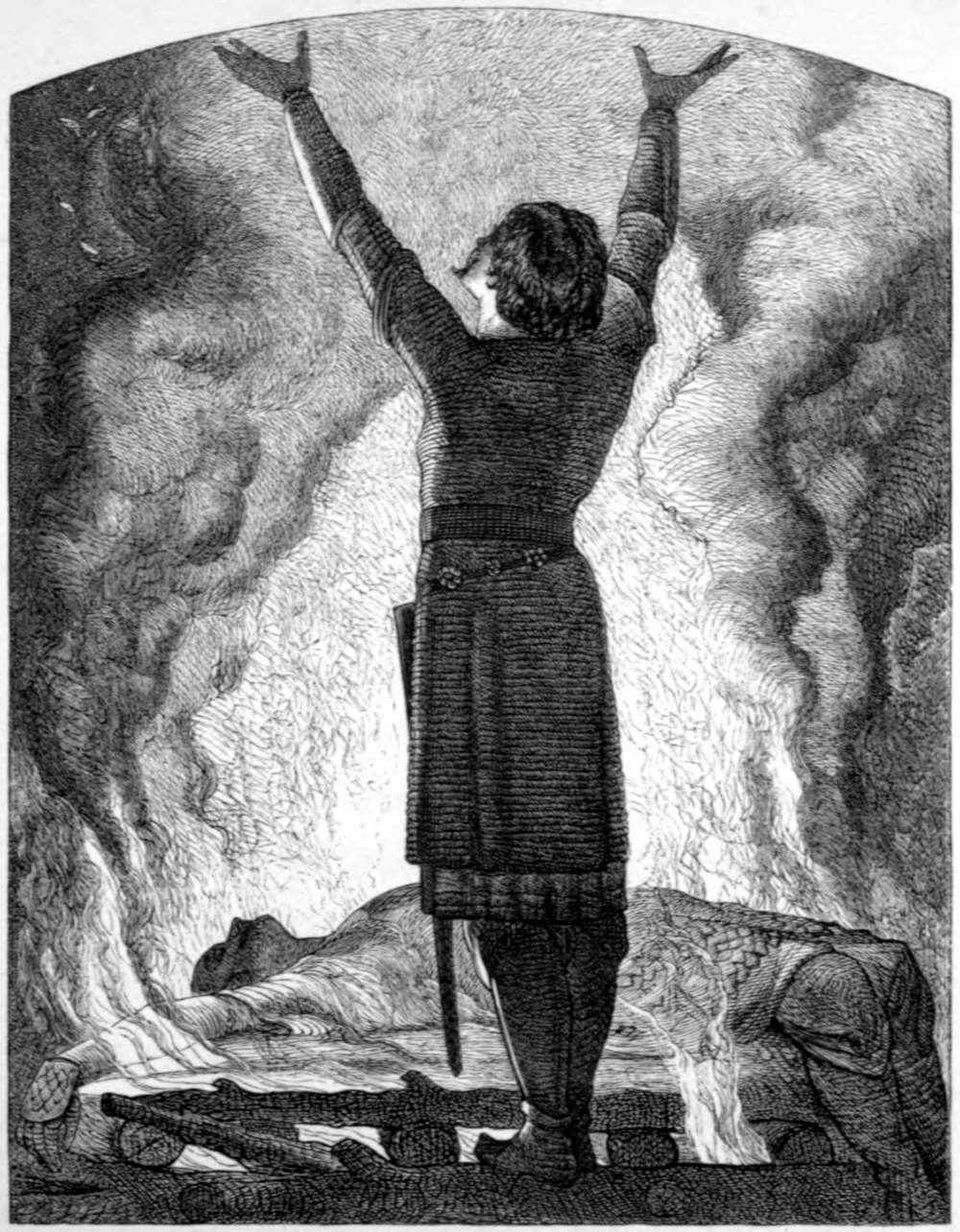
Of the fallen Chief, and tow’rds the flame
Bears him along;—with death-damp hand
The corpse upon the pyre he lays,
Then lights the consecrated brand,
And fires the pile, whose sudden blaze
269Like lightning bursts o’er Oman’s Sea.—
“Now, Freedom’s God! I come to Thee,”
The youth exclaims, and with a smile
Of triumph vaulting on the pile
In that last effort, ere the fires
Have harm’d one glorious limb, expires!
270
What shriek was that on Oman’s tide?
It came from yonder drifting bark,
That just hath caught upon her side
The death-light—and again is dark.
It is the boat—ah, why delay’d?—
That bears the wretched Moslem maid;
Confided to the watchful care
Of a small veteran band, with whom
Their generous Chieftain would not share
The secret of his final doom,
But hop’d when Hinda, safe and free,
Was render’d to her father’s eyes,
Their pardon, full and prompt, would be
The ransom of so dear a prize.—
Unconscious, thus, of Hafed’s fate,
And proud to guard their beauteous freight,
Scarce had they clear’d the surfy waves
That foam around those frightful caves,
When the curst war-whoops, known so well,
Came echoing from the distant dell—
Sudden each oar, upheld and still,
Hung dripping o’er the vessel’s side,
And, driving at the current’s will,
They rock’d along the whispering tide;
While every eye, in mute dismay,
Was tow’rd that fatal mountain turn’d,
271Where the dim altar’s quivering ray
As yet all lone and tranquil burn’d.
Oh! ’tis not, Hinda, in the power
Of Fancy’s most terrific touch
To paint thy pangs in that dread hour—
Thy silent agony—’twas such
As those who feel could paint too well,
But none e’er felt and lived to tell!
’Twas not alone the dreary state
Of a lorn spirit crush’d by fate,
When, though no more remains to dread,
The panic chill will not depart;—
When, though the inmate Hope be dead,
Her ghost still haunts the mouldering heart.
No—pleasures, hopes, affections gone,
The wretch may bear, and yet live on,
Like things, within the cold rock found
Alive, when all’s congeal’d around.
But there’s a blank repose in this,
A calm stagnation, that were bliss
To the keen, burning, harrowing pain,
Now felt through all thy breast and brain;—
That spasm of terror, mute, intense,
That breathless, agonis’d suspense,
272From whose hot throb, whose deadly aching,
The heart hath no relief but breaking!
Calm is the wave—heaven’s brilliant lights
Reflected dance beneath the prow;—
Time was when, on such lovely nights,
She who is there, so desolate now,
Could sit all cheerful, though alone,
And ask no happier joy than seeing
That starlight o’er the waters thrown—
No joy but that, to make her blest,
And the fresh, buoyant sense of Being,
Which bounds in youth’s yet careless breast,—
Itself a star, not borrowing light,
But in its own glad essence bright.
How different now!—but, hark, again
The yell of havoc rings—brave men!
In vain, with beating hearts, ye stand
On the bark’s edge—in vain each hand
Half draws the falchion from its sheath;
All’s o’er—in rust your blades may lie:—
He, at whose word they’ve scatter’d death,
E’en now, this night, himself must die!
Well may ye look to yon dim tower,
And ask, and wondering guess what means
The battle-cry at this dead hour—
273Ah! she could tell you—she, who leans
Unheeded there, pale, sunk, aghast,
With brow against the dew-cold mast;—
Too well she knows—her more than life,
Her soul’s first idol and its last,
Lies bleeding in that murderous strife.
But see—what moves upon the height?
Some signal!—’tis a torch’s light.
What bodes its solitary glare?
In gasping silence tow’rd the Shrine
All eyes are turn’d—thine, Hinda, thine
Fix their last fading life-beams there.
’Twas but a moment—fierce and high
The death-pile blaz’d into the sky,
And far away, o’er rock and flood
Its melancholy radiance sent;
While Hafed, like a vision, stood
Reveal’d before the burning pyre,
Tall, shadowy, like a Spirit of Fire
Shrin’d in its own grand element!
“’Tis he!”—the shuddering maid exclaims,—
But, while she speaks, he’s seen no more;
High burst in air the funeral flames,
And Iran’s hopes and hers are o’er!
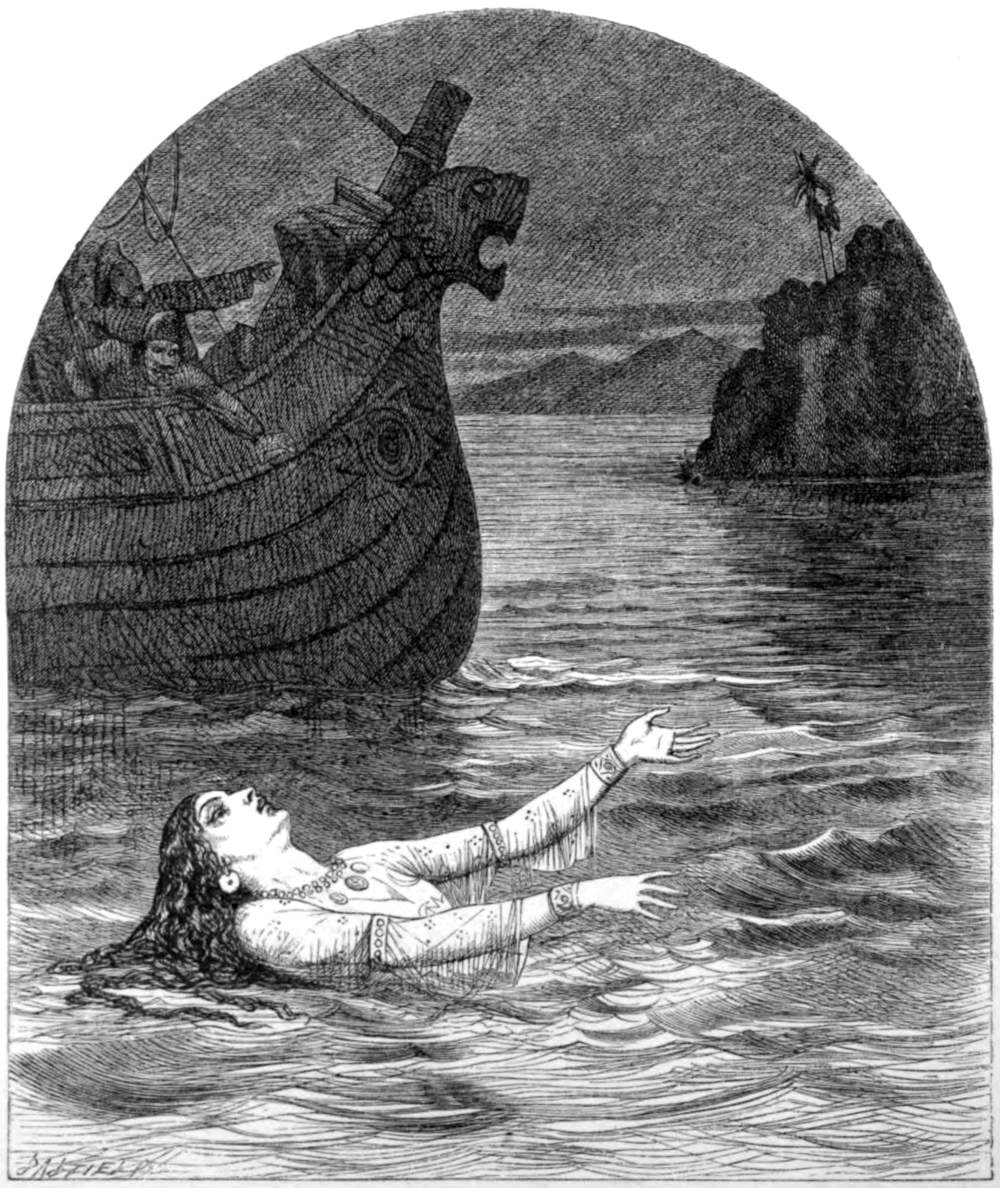
274One wild, heart-broken shriek she gave;
Then sprung, as if to reach that blaze,
Where still she fix’d her dying gaze,—
And, gazing, sunk into the wave,
Deep, deep,—where never care or pain
Shall reach her innocent heart again!
275
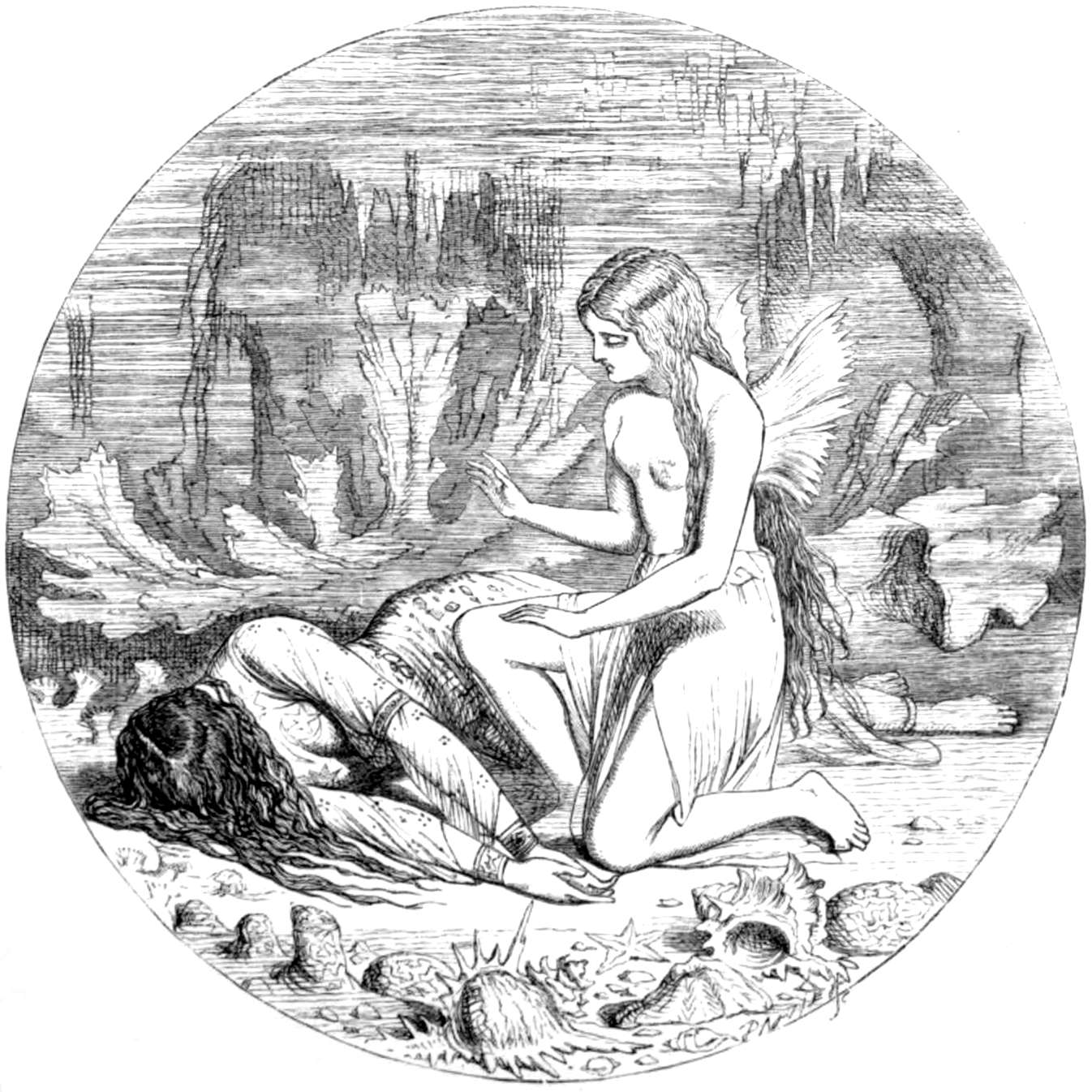
Farewell—farewell to thee, Araby’s daughter!
(Thus warbled a Peri beneath the dark sea,)
No pearl ever lay, under Oman’s green water,
More pure in its shell than thy Spirit in thee.
Oh! fair as the sea-flower close to thee growing,
How light was thy heart till Love’s witchery came,
Like the wind of the south[296] o’er a summer lute blowing,
And hush’d all its music, and withered its frame!
But long, upon Araby’s green sunny highlands,
Shall maids and their lovers remember the doom
Of her, who lies sleeping among the Pearl Islands,
With nought but the sea-star[297] to light up her tomb.
And still, when the merry date-season is burning,[298]
And calls to the palm-groves the young and the old,
The happiest there, from their pastime returning
At sunset, will weep when thy story is told.
276The young village-maid, when with flowers she dresses
Her dark flowing hair for some festival day,
Will think of thy fate till, neglecting her tresses,
She mournfully turns from the mirror away.
Nor shall Iran, belov’d of her Hero! forget thee—
Though tyrants watch over her tears as they start,
Close, close by the side of that Hero she’ll set thee,
Embalm’d in the innermost shrine of her heart.
Farewell—be it ours to embellish thy pillow
With every thing beauteous that grows in the deep;
Each flower of the rock and each gem of the billow
Shall sweeten thy bed and illumine thy sleep.
Around thee shall glisten the loveliest amber
That ever the sorrowing sea-bird has wept;[299]
With many a shell, in whose hollow-wreath’d chamber
We, Peris of Ocean, by moonlight have slept.
We’ll dive where the gardens of coral lie darkling,
And plant all the rosiest stems at thy head;
We’ll seek where the sands of the Caspian[300] are sparkling,
And gather their gold to strew over thy bed.
277Farewell—farewell—until Pity’s sweet fountain
Is lost in the hearts of the fair and the brave,
They’ll weep for the Chieftain who died on that mountain,
They’ll weep for the Maiden who sleeps in this wave.
278The singular placidity with which Fadladeen had listened, during the latter part of this obnoxious story, surprised the Princess and Feramorz exceedingly; and even inclined towards him the hearts of these unsuspicious young persons, who little knew the source of a complacency so marvellous. The truth was, he had been organising, for the last few days, a most notable plan of persecution against the poet, in consequence of some passages that had fallen from him on the second evening of recital,—which appeared to this worthy Chamberlain to contain language and principles, for which nothing short of the summary criticism of the Chabuk[301] would be advisable. It was his intention, therefore, immediately on their arrival at Cashmere, to give information to the King of Bucharia of the very dangerous sentiments of his minstrel; and if, unfortunately, that monarch did not act with suitable vigour on the occasion, (that is, if he did not give the Chabuk to Feramorz, and a place to Fadladeen,) there would be an end, he feared, of all legitimate government in Bucharia. He could not help, however, auguring better both for himself and the cause of potentates in general; and it was the pleasure arising from these mingled anticipations that diffused such unusual satisfaction through his features, and made his eyes shine out, like poppies of the desert, over the wide and lifeless wilderness of that countenance.
279Having decided upon the Poet’s chastisement in this manner, he thought it but humanity to spare him the minor tortures of criticism. Accordingly, when they assembled the following evening in the pavilion, and Lalla Rookh was expecting to see all the beauties of her bard melt away, one by one, in the acidity of criticism, like pearls in the cup of the Egyptian queen,—he agreeably disappointed her, by merely saying, with an ironical smile, that the merits of such a poem deserved to be tried at a much higher tribunal; and then suddenly passed off into a panegyric upon all Mussulman sovereigns, more particularly his august and Imperial master, Aurungzebe,—the wisest and best of the descendants of Timur,—who, among other great things he had done for mankind, had given to him, Fadladeen, the very profitable posts of Betel-carrier, and Taster of Sherbets to the Emperor, Chief Holder of the Girdle of Beautiful Forms,[302] and Grand Nazir, or Chamberlain of the Haram.
They were now not far from that Forbidden River,[303] beyond which no pure Hindoo can pass; and were reposing for a time in the rich valley of Hussun Abdaul, which had always been a favourite resting-place of the Emperors in their annual migrations to Cashmere. Here often had the Light of the Faith, Jehan-Guire, been known to wander with his beloved and beautiful Nourmahal: and 280here would Lalla Rookh have been happy to remain for ever, giving up the throne of Bucharia and the world, for Feramorz and love in this sweet, lonely valley. But the time was now fast approaching when she must see him no longer,—or, what was still worse, behold him with eyes whose every look belonged to another; and there was a melancholy preciousness in these last moments, which made her heart cling to them as it would to life. During the latter paid of the journey, indeed, she had sunk into a deep sadness, from which nothing but the presence of the young minstrel could awake her. Like those lamps in tombs, which only light up when the air is admitted, it was only at his approach that her eyes became smiling and animated. But here, in this dear valley, every moment appeared an age of pleasure; she saw him all day, and was, therefore, all day happy,—resembling, she often thought, that people of Zinge, who attribute the unfading cheerfulness they enjoy to one genial star that rises nightly over their heads.[304]
The whole party, indeed, seemed in their liveliest mood during the few days they passed in this delightful solitude. The young attendants of the Princess, who were here allowed a much freer range than they could safely be indulged with in a less sequestered place, ran wild among the gardens and bounded through the meadows, lightly 281as young roes over the aromatic plains of Tibet. While Fadladeen, in addition to the spiritual comfort derived by him from a pilgrimage to the tomb of the Saint from whom the valley is named, had also opportunities of indulging, in a small way, his taste for victims, by putting to death some hundreds of those unfortunate little lizards,[305] which all pious Mussulmans make it a point to kill;—taking for granted, that the manner in which the creature hangs its head is meant as a mimicry of the attitude in which the Faithful say their prayers.
About two miles from Hussun Abdaul were those Royal Gardens,[306] which had grown beautiful under the care of so many lovely eyes, and were beautiful still, though those eyes could see them no longer. This place, with its flowers, and its holy silence, interrupted only by the dipping of the wings of birds in its marble basins filled with the pure water of those hills, was to Lalla Rookh all that her heart could fancy of fragrance, coolness, and almost heavenly tranquillity. As the Prophet said of Damascus, “it was too delicious;”[307]—and here, in listening to the sweet voice of Feramorz, or reading in his eyes what yet he never dared to tell her, the most exquisite moments of her whole life were passed. One evening, when they had been talking of the Sultana Nourmahal, the Light of the Haram,[308] who had so often 282wandered among these flowers, and fed with her own hands, in those marble basins, the small shining fishes of which she was so fond,[309]—the youth, in order to delay the moment of separation, proposed to recite a short story, or rather rhapsody, of which this adored Sultana was the heroine. It related, he said, to the reconcilement of a sort of lovers’ quarrel which took place between her and the Emperor during a Feast of Roses at Cashmere; and would remind the Princess of that difference between Haroun-al-Raschid and his fair mistress Marida,[310] which was so happily made up by the soft strains of the musician, Moussali. As the story was chiefly to be told in song, and Feramorz had unluckily forgotten his own lute in the valley, he borrowed the vina of Lalla Rookh’s little Persian slave, and thus began:—
The Light of the Haram
285
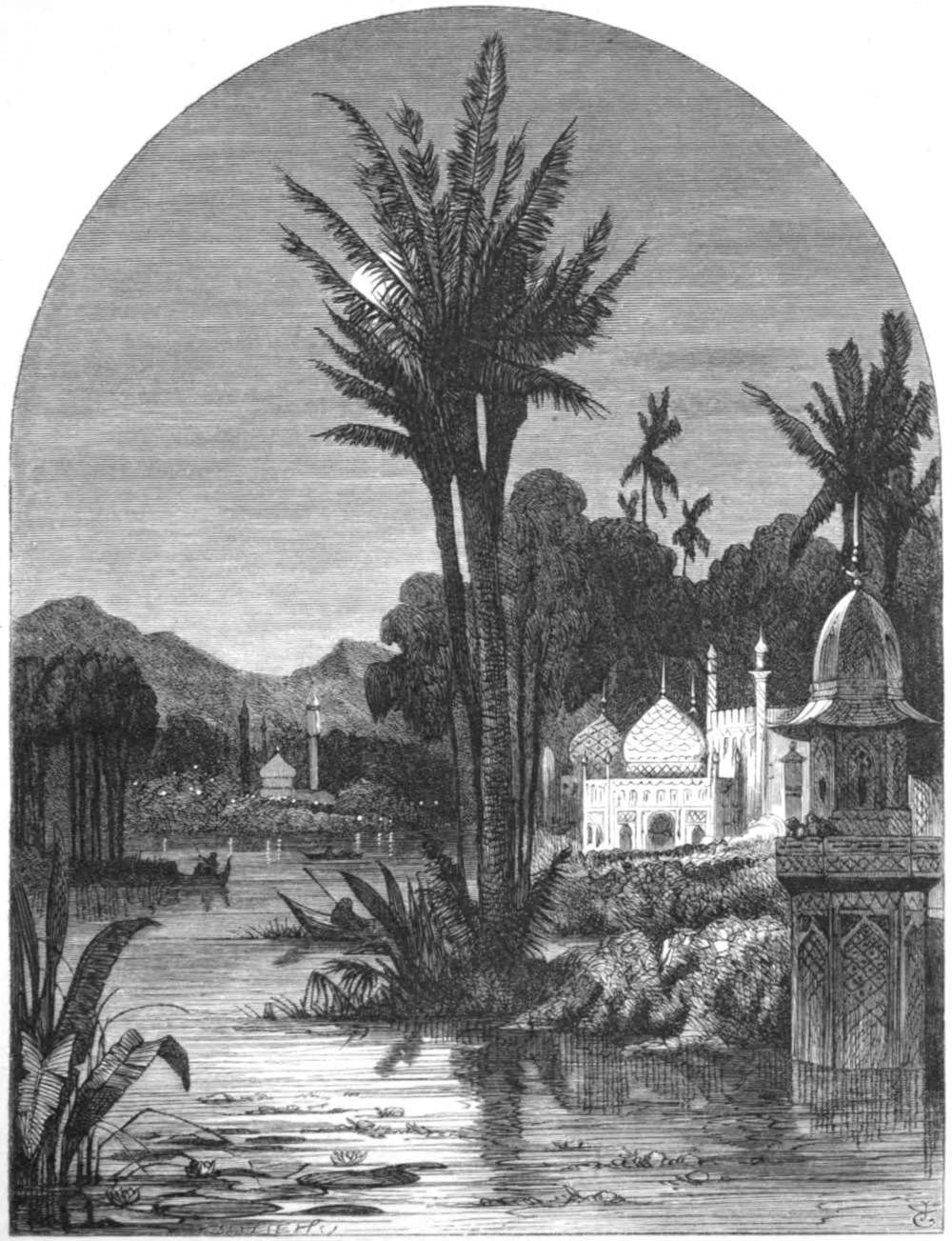
Who has not heard of the vale of Cashmere,
With its roses the brightest that earth ever gave,[311]
Its temples, and grottos, and fountains as clear
As the love-lighted eyes that hang over their wave?
286Oh! to see it at sunset,—when warm o’er the Lake
Its splendour at parting a summer eve throws,
Like a bride, full of blushes, when lingering to take
A last look of her mirror at night ere she goes!—
When the shrines through the foliage are gleaming half shown,
And each hallows the hour by some rites of its own.
Here the music of pray’r from a minaret swells,
Here the Magian his urn, full of perfume, is swinging,
And here, at the altar, a zone of sweet bells
Round the waist of some fair Indian dancer is ringing.[312]
Or to see it by moonlight,—when mellowly shines
The light o’er its palaces, gardens, and shrines;
When the water-falls gleam, like a quick fall of stars,
And the nightingale’s hymn from the Isle of Chenars
Is broken by laughs and light echoes of feet
From the cool, shining walks where the young people meet.—
Or at morn, when the magic of daylight awakes
A new wonder each minute, as slowly it breaks,
Hills, cupolas, fountains, call’d forth every one
Out of darkness, as if but just born of the Sun.
When the Spirit of Fragrance is up with the day,
From his Haram of night-flowers stealing away;
And the wind, full of wantonness, woos like a lover
The young aspen-trees,[313] till they tremble all over.
287When the East is as warm as the light of first hopes,
And Day, with his banner of radiance unfurl’d,
Shines in through the mountainous portal[314] that opes,
Sublime, from that Valley of bliss to the world!
But never yet, by night or day,
In dew of spring or summer’s ray,
Did the sweet Valley shine so gay
As now it shines—all love and light,
Visions by day and feasts by night!
A happier smile illumes each brow,
With quicker spread each heart uncloses,
And all is ecstasy—for now
The Valley holds its Feast of Roses;[315]
The joyous Time, when pleasures pour
Profusely round, and, in their shower,
Hearts open, like the Season’s Rose,—
The Flow’ret of a hundred leaves,[316]
Expanding while the dew-fall flows,
And every leaf its balm receives.
’Twas when the hour of evening came
Upon the Lake, serene and cool,
When Day had hid his sultry flame
Behind the palms of Baramoule,[317]
When maids began to lift their heads,
288Refresh’d from their embroider’d beds,
Where they had slept the sun away,
And wak’d to moonlight and to play.
All were abroad—the busiest hive
On Bela’s[318] hills is less alive,
When saffron-beds are full in flower,
Than look’d the Valley in that hour.
A thousand restless torches play’d
Through every grove and island shade;
A thousand sparkling lamps were set
On every dome and minaret;
And fields and pathways, far and near,
Were lighted by a blaze so clear,
That you could see, in wandering round,
The smallest rose-leaf on the ground.
Yet did the maids and matrons leave
Their veils at home, that brilliant eve;
And there were glancing eyes about,
And cheeks, that would not dare shine out
In open day, but thought they might
Look lovely then, because ’twas night.
And all were free, and wandering,
And all exclaim’d to all they met,
That never did the summer bring
So gay a Feast of Roses yet;—
The moon had never shed a light
289So clear as that which bless’d them there;
The roses ne’er shone half so bright,
Nor they themselves look’d half so fair.
And what a wilderness of flowers!
It seem’d as though from all the bowers
And fairest fields of all the year,
The mingled spoil were scatter’d here.
The Lake, too, like a garden breathes,
With the rich buds that o’er it lie,—
As if a shower of fairy wreaths
Had fall’n upon it from the sky!
And then the sounds of joy,—the beat
Of tabors and of dancing feet;—
The minaret-crier’s chaunt of glee
Sung from his lighted gallery,[319]
And answered by a ziraleet
From neighbouring Haram, wild and sweet;—
The merry laughter, echoing
From gardens, where the silken swing[320]
Wafts some delighted girl above
The top leaves of the orange grove;
Or, from those infant groups at play
Among the tents[321] that line the way,
Flinging, unaw’d by slave or mother,
Handfuls of roses at each other.—
290Then, the sounds from the Lake, the low whispering in boats,
As they shoot through the moonlight;—the dipping of oars.
And the wild, airy warbling that every where floats,
Through the groves, round the islands, as if all the shores,
Like those of Kathay, utter’d music, and gave
An answer in song to the kiss of each wave.[322]
But the gentlest of all are those sounds, full of feeling,
That soft from the lute of some lover are stealing,—
Some lover, who knows all the heart-touching power
Of a lute and a sigh in this magical hour.
Oh! best of delights as it every where is
To be near the lov’d One,—what a rapture is his
Who in moonlight and music thus sweetly may glide
O’er the Lake of Cashmere, with that One by his side!
If woman can make the worst wilderness dear,
Think, think what a Heaven she must make of Cashmere!
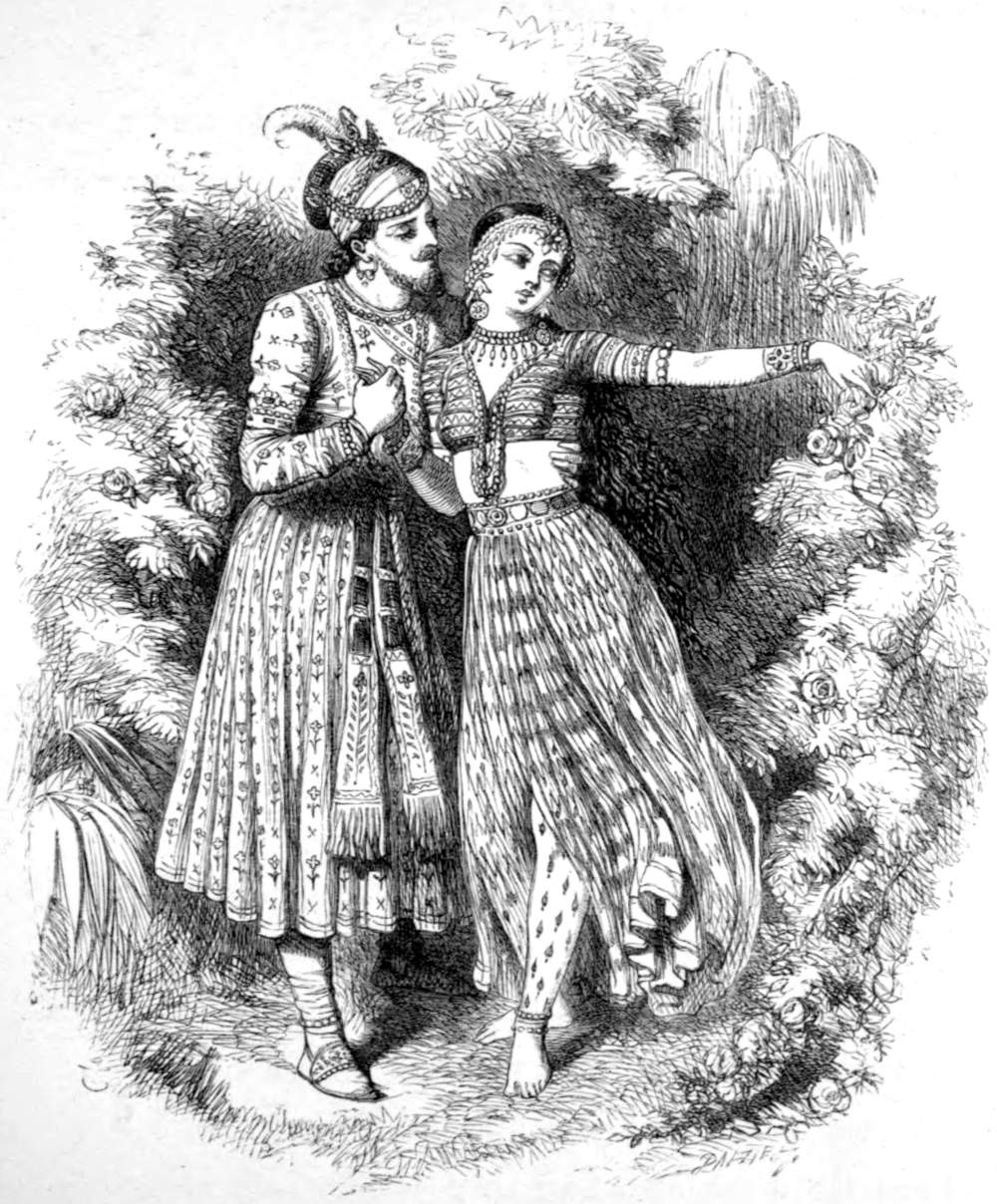
So felt the magnificent Son of Acbar,[323]
When from power and pomp and the trophies of war
He flew to that Valley, forgetting them all
With the Light of the Haram, his young Nourmahal.
When free and uncrown’d as the Conqueror rov’d
By the banks of that Lake, with his only belov’d,
He saw, in the wreaths she would playfully snatch
291From the hedges, a glory his crown could not match,
And preferr’d in his heart the least ringlet that curl’d
Down her exquisite neck to the throne of the world.
There’s a beauty, for ever unchangingly bright,
Like the long, sunny lapse of a summer-day’s light,
292Shining on, shining on, by no shadow made tender,
Till Love falls asleep in its sameness of splendour.
This was not the beauty—oh, nothing like this,
That to young Nourmahal gave such magic of bliss!
But that loveliness, ever in motion, which plays
Like the light upon autumn’s soft shadowy days,
Now here and now there, giving warmth as it flies
From the lip to the cheek, from the cheek to the eyes;
Now melting in mist and now breaking in gleams,
Like the glimpses a saint hath of Heav’n in his dreams.
When pensive, it seem’d as if that very grace,
That charm of all others, was born with her face!
And when angry,—for ev’n in the tranquillest climes
Light breezes will ruffle the blossoms sometimes—
The short, passing anger but seem’d to awaken
New beauty, like flowers that are sweetest when shaken.
If tenderness touch’d her, the dark of her eye
At once took a darker, a heavenlier dye,
From the depth of whose shadow, like holy revealings
From innermost shrines, came the light of her feelings.
Then her mirth—oh! ’twas sportive as ever took wing
From the heart with a burst, like the wild-bird in spring;
Illum’d by a wit that would fascinate sages,
Yet playful as Peris just loos’d from their cages.[324]
While her laugh, full of life, without any control
But the sweet one of gracefulness, rung from her soul;
293And where it most sparkled no glance could discover,
In lip, cheek, or eyes, for she brighten’d all over,—
Like any fair lake that the breeze is upon,
When it breaks into dimples and laughs in the sun.
Such, such were the peerless enchantments that gave
Nourmahal the proud Lord of the East for her slave:
And though bright was his Haram,—a living parterre
Of the flowers[325] of this planet—though treasures were there,
For which Soliman’s self might have giv’n all the store
That the navy from Ophir e’er wing’d to his shore,
Yet dim before her were the smiles of them all,
And the Light of his Haram was young Nourmahal!
But where is she now, this night of joy,
When bliss is every heart’s employ?—
When all around her is so bright,
So like the visions of a trance,
That one might think, who came by chance
Into the vale this happy night,
He saw that City of Delight[326]
In Fairy-land, whose streets and towers
Are made of gems and light and flowers!—
Where is the lov’d Sultana? where,
When mirth brings out the young and fair,
Does she, the fairest, hide her brow,
In melancholy stillness now?
294Alas!—how light a cause may move
Dissension between hearts that love!
Hearts that the world in vain had tried,
And sorrow but more closely tied;
That stood the storm, when waves were rough,
Yet in a sunny hour fall off,
Like ships that have gone down at sea,
When heaven was all tranquillity!
A something, light as air—a look,
A word unkind or wrongly taken—
Oh! love, that tempests never shook,
A breath, a touch like this hath shaken.
And ruder words will soon rush in
To spread the breach that words begin;
And eyes forget the gentle ray
They wore in courtship’s smiling day;
And voices lose the tone that shed
A tenderness round all they said;
Till fast declining, one by one,
The sweetnesses of love are gone,
And hearts, so lately mingled, seem
Like broken clouds,—or like the stream,
That smiling left the mountain’s brow
As though its waters ne’er could sever,
Yet, ere it reach the plain below,
Breaks into floods, that part for ever.
295
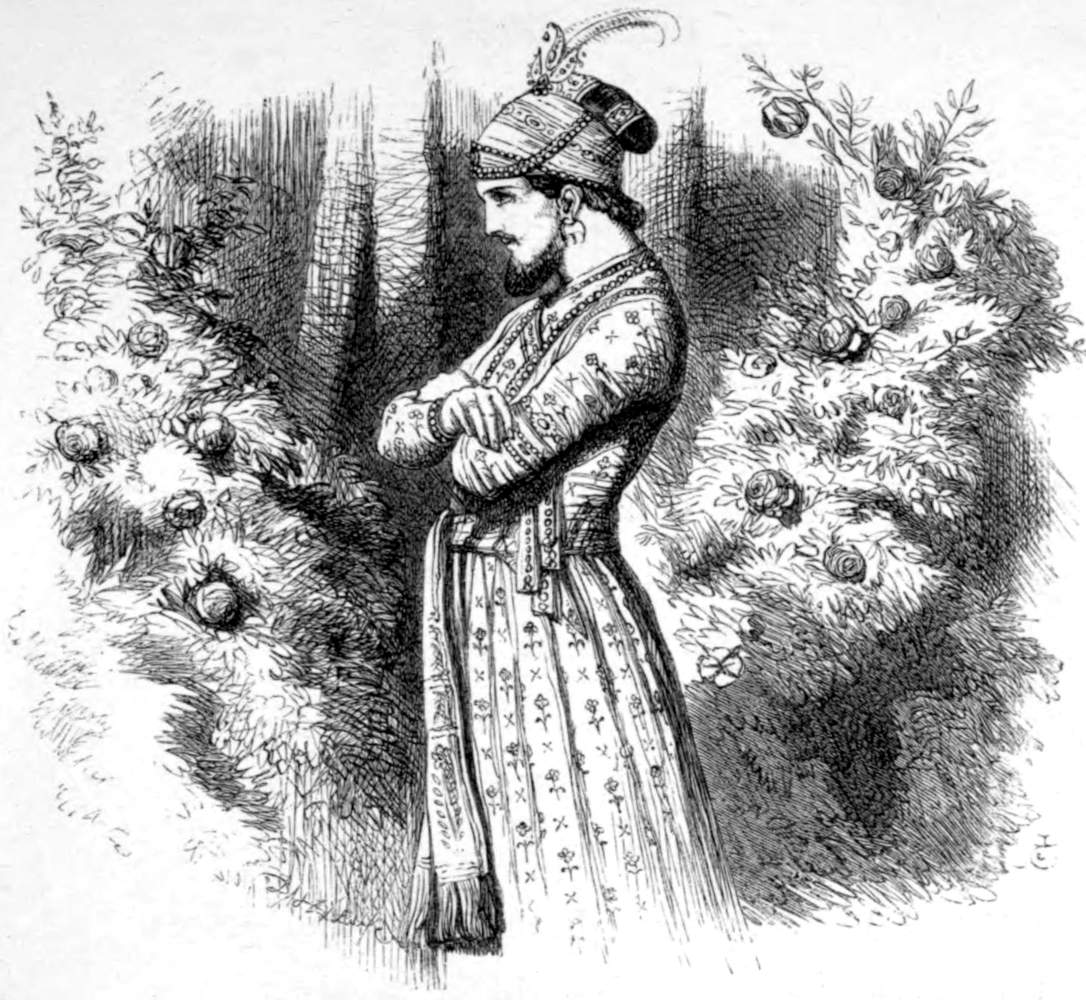
Oh, you, that have the charge of Love,
Keep him in rosy bondage bound,
As in the Fields of Bliss above
He sits, with flow’rets fetter’d round;[327]—
Loose not a tie that round him clings,
Nor ever let him use his wings;
For e’en an hour, a minute’s flight
Will rob the plumes of half their light.
Like that celestial bird,—whose nest
Is found beneath far Eastern skies,—
Whose wings, though radiant when at rest,
Lose all their glory when he flies![328]
296Some difference, of this dangerous kind,—
By which, though light, the links that bind
The fondest hearts may soon be riven;
Some shadow in Love’s summer heaven,
Which, though a fleecy speck at first,
May yet in awful thunder burst;—
Such cloud it is that now hangs over
The heart of the Imperial Lover,
And far hath banish’d from his sight
His Nourmahal, his Haram’s Light!
Hence is it, on this happy night,
When Pleasure through the fields and groves
Has let loose all her world of loves,
And every heart has found its own,
He wanders, joyless and alone,
And weary as that bird of Thrace,
Whose pinion knows no resting place.[329]
In vain the loveliest cheeks and eyes
This Eden of the Earth supplies
Come crowding round—the cheeks are pale,
The eyes are dim:—though rich the spot
With every flow’r this earth has got,
What is it to the nightingale,
If there his darling rose is not?[330]
In vain the Valley’s smiling throng
Worship him, as he moves along;
297He heeds them not—one smile of hers
Is worth a world of worshippers.
They but the Star’s adorers are,
She is the Heav’n that lights the Star!
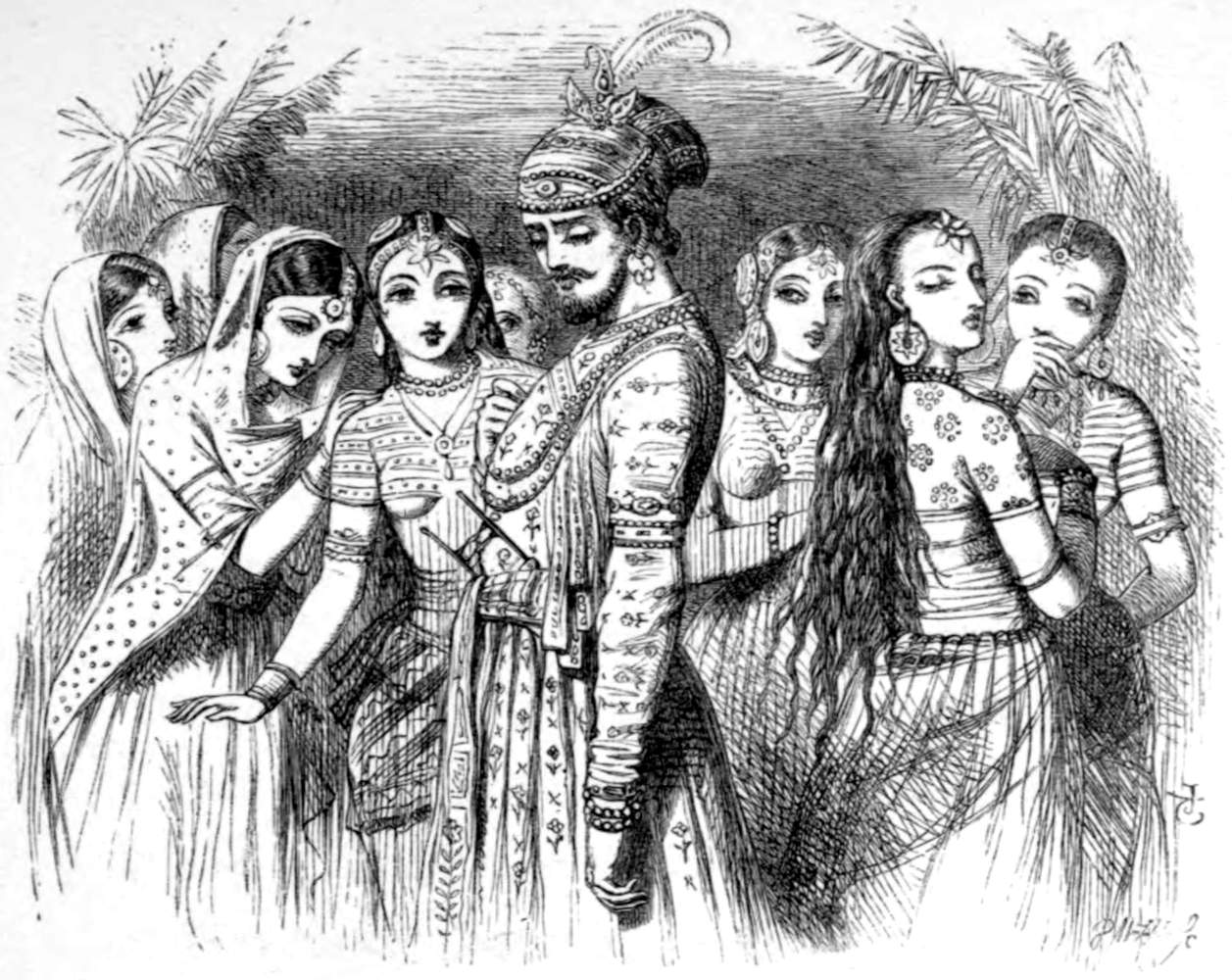
Hence is it, too, that Nourmahal,
Amid the luxuries of this hour,
Far from the joyous festival,
Sits in her own sequester’d bower,
With no one near, to soothe or aid,
But that inspir’d and wondrous maid,
Namouna, the Enchantress;—one,
298O’er whom his race the golden sun
For unremember’d years has run,
Yet never saw her blooming brow
Younger or fairer than ’tis now.
Nay, rather,—as the west wind’s sigh
Freshens the flower it passes by,—
Time’s wing but seem’d, in stealing o’er,
To leave her lovelier than before.
Yet on her smiles a sadness hung,
And when, as oft, she spoke or sung
Of other worlds, there came a light
From her dark eyes so strangely bright,
That all believ’d nor man nor earth
Were conscious of Namouna’s birth!
All spells and talismans she knew,
From the great Mantra,[331] which around
The Air’s sublimer Spirits drew,
To the gold gems[332] of Afric, bound
Upon the wandering Arab’s arm,
To keep him from the Siltim’s[333] harm.
And she had pledg’d her powerful art,—
Pledg’d it with all the zeal and heart
Of one who knew, though high her sphere,
What ’twas to lose a love so dear,—
To find some spell that should recall
Her Selim’s[334] smile to Nourmahal!
299’Twas midnight—through the lattice, wreath’d
With woodbine, many a perfume breath’d
From plants that wake when others sleep,
From timid jasmine buds, that keep
Their odour to themselves all day,
But, when the sun-light dies away,
Let the delicious secret out
To every breeze that roams about;—
When thus Namouna:—“’Tis the hour
“That scatters spells on herb and flower,
“And garlands might be gather’d now,
“That, twin’d around the sleeper’s brow,
“Would make him dream of such delights,
“Such miracles and dazzling sights,
“As Genii of the Sun behold,
“At evening, from their tents of gold
“Upon the’ horizon—where they play
“Till twilight comes, and, ray by ray,
“Their sunny mansions melt away.
“Now, too, a chaplet might be wreath’d
“Of buds o’er which the moon has breath’d,
“Which worn by her, whose love has stray’d,
“Might bring some Peri from the skies,
“Some sprite, whose very soul is made
“Of flow’rets’ breaths and lovers’ sighs,
“And who might tell⸺”
300“And who might tell⸺”“For me, for me,”
Cried Nourmahal impatiently,—
“Oh! twine that wreath for me to-night.”
Then, rapidly, with foot as light
As the young musk-roe’s, out she flew,
To cull each shining leaf that grew
Beneath the moonlight’s hallowing beams,
For this enchanted Wreath of Dreams.
Anemones and Seas of Gold,[335]
And new-blown lilies of the river,
And those sweet flow’rets, that unfold
Their buds on Camadeva’s quiver;[336]
The tube-rose, with her silvery light,
That in the Gardens of Malay
Is call’d the Mistress of the Night,[337]
So like a bride, scented and bright,
She comes out when the sun’s away;—
Amaranths, such as crown the maids
That wander through Zamara’s shades;[338]—
And the white moon-flower, as it shows,
On Serendib’s high crags, to those
Who near the isle at evening sail,
Scenting her clove-trees in the gale;
In short, all flow’rets and all plants,
From the divine Amrita tree,[339]
That blesses heaven’s inhabitants
301With fruits of immortality,
Down to the basil tuft,[340] that waves
Its fragrant blossom over graves,
And to the humble rosemary,
Whose sweets so thanklessly are shed
To scent the desert[341] and the dead:—
All in that garden bloom, and all
Are gather’d by young Nourmahal,
Who heaps her baskets with the flowers
And leaves, till they can hold no more;
Then to Namouna flies, and showers
Upon her lap the shining store.
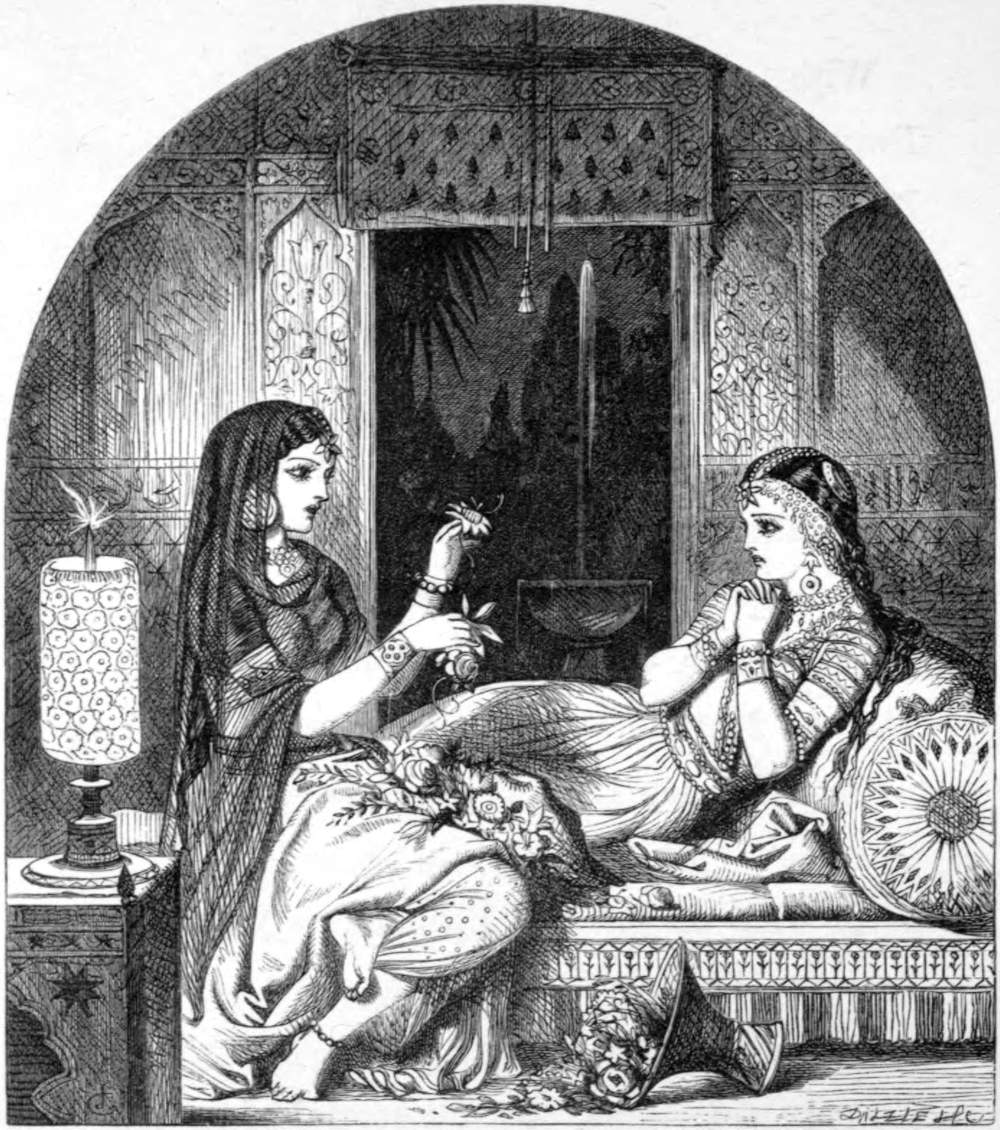
With what delight the’ Enchantress views
So many buds, bath’d with the dews
And beams of that bless’d hour!—her glance
Spoke something, past all mortal pleasures,
As, in a kind of holy trance,
She hung above those fragrant treasures,
Bending to drink their balmy airs,
As if she mix’d her soul with theirs.
And ’twas, indeed, the perfume shed
From flow’rs and scented flame, that fed
Her charmèd life—for none had e’er
Beheld her taste of mortal fare,
Nor ever in aught earthly dip,
302But the morn’s dew, her roseate lip.
Fill’d with the cool, inspiring smell,
The’ Enchantress now begins her spell,
Thus singing as she winds and weaves
In mystic form the glittering leaves:—
303
I know where the winged visions dwell
That around the night-bed play;
I know each herb and flow’ret’s bell,
Where they hide their wings by day.
Then hasten we, maid,
To twine our braid,
To-morrow the dreams and flowers will fade.
The image of love, that nightly flies
To visit the bashful maid,
Steals from the jasmine flower, that sighs
Its soul, like her, in the shade.
The dream of a future, happier hour,
That alights on misery’s brow,
Springs out of the silvery almond-flower,
That blooms on a leafless bough.[342]
Then hasten we, maid,
To twine our braid,
To-morrow the dreams and flowers will fade.
The visions, that oft to worldly eyes
The glitter of mines unfold,
Inhabit the mountain-herb,[343] that dyes
The tooth of the fawn like gold.
The phantom shapes—oh touch not them—
That appal the murderer’s sight,
Lurk in the fleshly mandrake’s stem,
304That shrieks, when pluck’d at night!
Then hasten we, maid,
To twine our braid,
To-morrow the dreams and flowers will fade.
The dream of the injur’d, patient mind,
That smiles at the wrongs of men,
Is found in the bruis’d and wounded rind
Of the cinnamon, sweetest then.
Then hasten we, maid,
To twine our braid,
To-morrow the dreams and flowers will fade.
No sooner was the flowery crown
Plac’d on her head, than sleep came down,
Gently as nights of summer fall,
Upon the lids of Nourmahal;—
And, suddenly, a tuneful breeze,
As full of small, rich harmonies
As ever wind, that o’er the tents
Of Azab[344] blew, was full of scents,
Steals on her ear, and floats and swells.
Like the first air of morning creeping
Into those wreathy, Red-Sea shells,
Where Love himself, of old, lay sleeping;[345]
And now a Spirit form’d, ’twould seem,
305Of music and of light,—so fair,
So brilliantly his features beam,
And such a sound is in the air
Of sweetness when he waves his wings,—
Hovers around her, and thus sings:—
From Chindara’s[346] warbling fount I come,
Call’d by that moonlight garland’s spell;
306From Chindara’s fount, my fairy home,
Where in music, morn and night, I dwell:
Where lutes in the air are heard about,
And voices are singing the whole day long,
And every sigh the heart breathes out
Is turn’d, as it leaves the lips, to song!
Hither I come
From my fairy home,
And if there’s a magic in Music’s strain,
I swear by the breath
Of that moonlight wreath,
Thy Lover shall sigh at thy feet again.
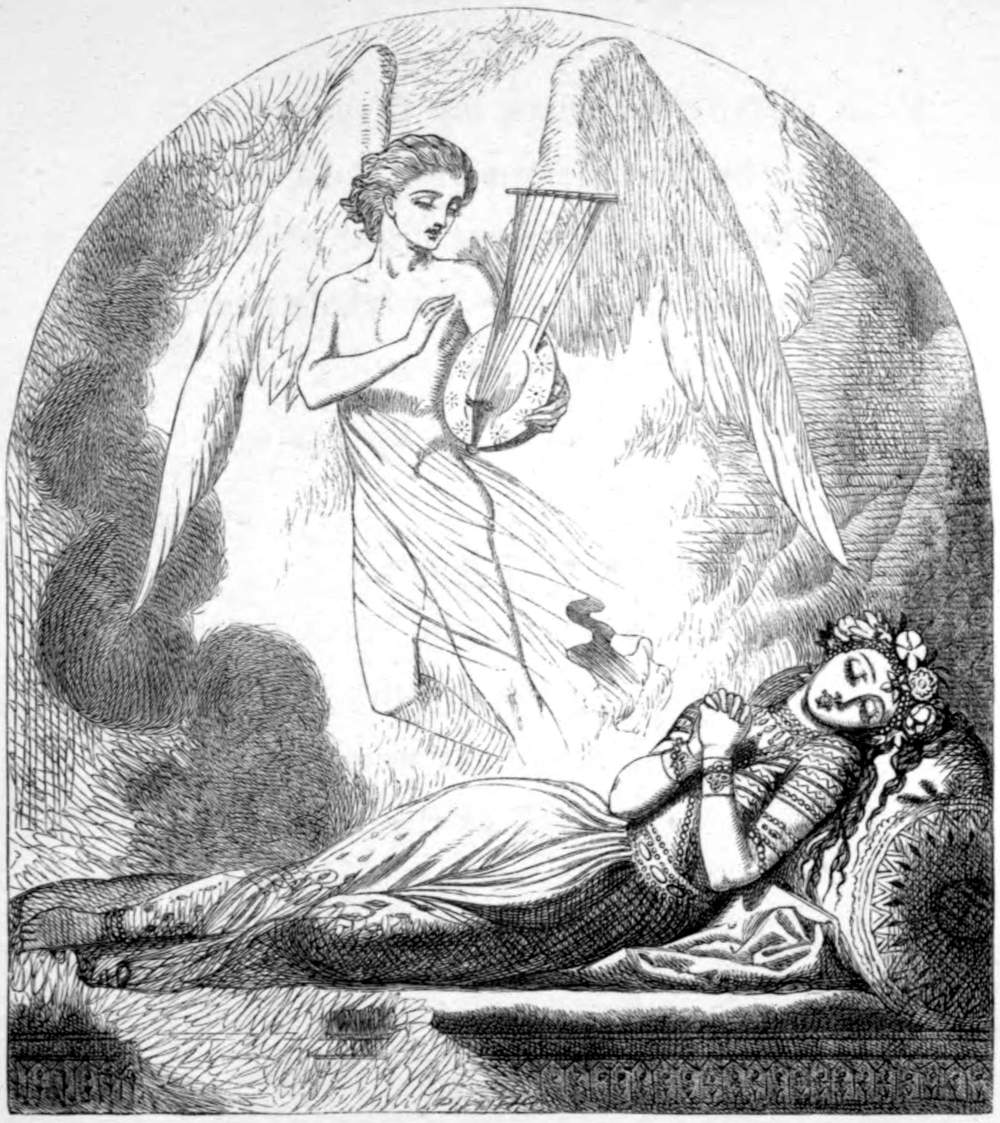
For mine is the lay that lightly floats,
And mine are the murmuring, dying notes,
That fall as soft as snow on the sea,
And melt in the heart as instantly:—
And the passionate strain that, deeply going,
Refines the bosom it trembles through,
As the musk-wind, over the water blowing,
Ruffles the wave, but sweetens it too.
Mine is the charm, whose mystic sway
The Spirits of past Delight obey;—
Let but the tuneful talisman sound,
And they come, like Genii, hovering round.
307And mine is the gentle song that bears
From soul to soul, the wishes of love,
As a bird, that wafts through genial airs
The cinnamon-seed from grove to grove.[347]
’Tis I that mingle in one sweet measure
The past, the present, and future of pleasure;[348]
When Memory links the tone that is gone
With the blissful tone that’s still in the ear;
And Hope from a heavenly note flies on
To a note more heavenly still that is near.
The warrior’s heart, when touch’d by me,
Can as downy soft and as yielding be
As his own white plume, that high amid death
Through the field has shone—yet moves with a breath!
And oh, how the eyes of Beauty glisten,
When Music has reach’d her inward soul,
Like the silent stars, that wink and listen
While Heaven’s eternal melodies roll.
So, hither I come
From my fairy home,
And if there’s a magic in Music’s strain,
I swear by the breath
Of that moonlight wreath,
Thy Lover shall sigh at thy feet again.
308’Tis dawn—at least that earlier dawn,
Whose glimpses are again withdrawn,[349]
As if the morn had wak’d, and then
Shut close her lids of light again.
And Nourmahal is up, and trying
The wonders of her lute, whose strings—
Oh, bliss!—now murmur like the sighing
From that ambrosial Spirit’s wings.
And then, her voice—’tis more than human—
Never, till now, had it been given
To lips of any mortal woman
To utter notes so fresh from heaven;
Sweet as the breath of angel sighs,
When angel sighs are most divine.—
“Oh! let it last till night,” she cries,
“And he is more than ever mine.”
And hourly she renews the lay,
So fearful lest its heavenly sweetness
Should, ere the evening, fade away,—
For things so heavenly have such fleetness!
But, far from fading, it but grows
Richer, diviner as it flows;
Till rapt she dwells on every string,
And pours again each sound along,
Like echo, lost and languishing,
In love with her own wondrous song.
309That evening, (trusting that his soul
Might be from haunting love releas’d
By mirth, by music, and the bowl,)
The’ Imperial Selim held a feast
In his magnificent Shalimar:[350]—
In whose Saloons, when the first star
Of evening o’er the waters trembled,
The Valley’s loveliest all assembled;
All the bright creatures that, like dreams,
Glide through its foliage, and drink beams
Of beauty from its founts and streams;[351]
And all those wandering minstrel-maids,
Who leave—how can they leave?—the shades
Of that dear Valley, and are found
Singing in gardens of the South[352]
Those songs, that ne’er so sweetly sound
As from a young Cashmerian’s mouth.
There, too, the Haram’s inmates smile;—
Maids from the West, with sun-bright hair,
And from the Garden of the Nile,
Delicate as the roses there;[353]—
Daughters of Love from Cyprus’ rocks,
With Paphian diamonds in their locks;[354]—
Light Peri forms, such as there are
On the gold meads of Candahar;[355]
And they, before whose sleepy eyes,
310In their own bright Kathaian bowers,
Sparkle such rainbow butterflies,
That they might fancy the rich flowers,
That round them in the sun lay sighing,
Had been by magic all set flying.[356]
Every thing young, every thing fair
From East and West is blushing there,
Except—except—oh, Nourmahal!
Thou loveliest, dearest of them all,
The one, whose smile shone out alone,
Amidst a world the only one;
Whose light, among so many lights,
Was like that star on starry nights,
The seaman singles from the sky,
To steer his bark for ever by!
Thou wert not there—so Selim thought,
And every thing seem’d drear without thee;
But, ah! thou wert, thou wert,—and brought
Thy charm of song all fresh about thee.
Mingling unnoticed with a band
Of lutanists from many a land,
And veil’d by such a mask as shades
The features of young Arab maids,[357]—
A mask that leaves but one eye free,
To do its best in witchery,—
311She rov’d, with beating heart, around,
And waited, trembling, for the minute,
When she might try if still the sound
Of her lov’d lute had magic in it.
The board was spread with fruits and wine;
With grapes of gold, like those that shine
On Casbin’s hills;[358]—pomegranates full
Of melting sweetness, and the pears,
And sunniest apples[359] that Caubul
In all its thousand gardens[360]bears;—
Plantains, the golden and the green,
Malaya’s nectar’d mangusteen;[361]
Prunes of Bokara, and sweet nuts
From the far groves of Samarcand,
And Basra dates, and apricots,
Seed of the Sun,[362] from Iran’s land;—
With rich conserve of Visna cherries,[363]
Of orange flowers, and of those berries
That, wild and fresh, the young gazelles
Feed on in Erac’s rocky dells.[364]
All these in richest vases smile,
In baskets of pure santal-wood,
And urns of porcelain from that isle[365]
Sunk underneath the Indian flood,
Whence oft the lucky diver brings
312Vases to grace the halls of kings.
Wines, too, of every clime and hue,
Around their liquid lustre threw;
Amber Rosolli,[366]—the bright dew
From vineyards of the Green-Sea gushing;[367]
And Shiraz wine, that richly ran
As if that jewel, large and rare,
The ruby for which Kublai-Khan
Offer’d a city’s wealth,[368] was blushing
Melted within the goblets there!
And amply Selim quaffs of each,
And seems resolv’d the flood shall reach
His inward heart,—shedding around
A genial deluge, as they run,
That soon shall leave no spot undrown’d,
For Love to rest his wings upon.
He little knew how well the boy
Can float upon a goblet’s streams,
Lighting them with his smile of joy;—
As bards have seen him in their dreams,
Down the blue Ganges laughing glide
Upon a rosy lotus wreath,[369]
Catching new lustre from the tide
That with his image shone beneath.
313But what are cups, without the aid
Of song to speed them as they flow?
And see—a lovely Georgian maid,
With all the bloom, the freshen’d glow
Of her own country maidens’ looks,
When warm they rise from Teflis’ brooks;[370]
And with an eye, whose restless ray,
Full, floating, dark—oh, he, who knows
His heart is weak, of heaven should pray
To guard him from such eyes as those!—
With a voluptuous wildness flings
Her snowy hand across the strings
Of a syrinda,[371] and thus sings:—
Come hither, come hither—by night and by day,
We linger in pleasures that never are gone;
Like the waves of the summer, as one dies away,
Another as sweet and as shining comes on.
And the love that is o’er, in expiring, gives birth
To a new one as warm, as unequall’d in bliss;
And, oh! if there be an Elysium on earth,
It is this, it is this.[372]
Here maidens are sighing, and fragrant their sigh
As the flower of the Amra just op’d by a bee;[373]
314And precious their tears as that rain from the sky,[374]
Which turns into pearls as it falls in the sea.
Oh! think what the kiss and the smile must be worth
When the sigh and the tear are so perfect in bliss,
And own if there be an Elysium on earth,
It is this, it is this.
Here sparkles the nectar, that, hallow’d by love,
Could draw down those angels of old from their sphere,
Who for wine of this earth[375] left the fountains above,
And forgot heaven’s stars for the eyes we have here.
And, bless’d with the odour our goblet gives forth,
What Spirit the sweets of his Eden would miss?
For, oh! if there be an Elysium on earth,
It is this, it is this.
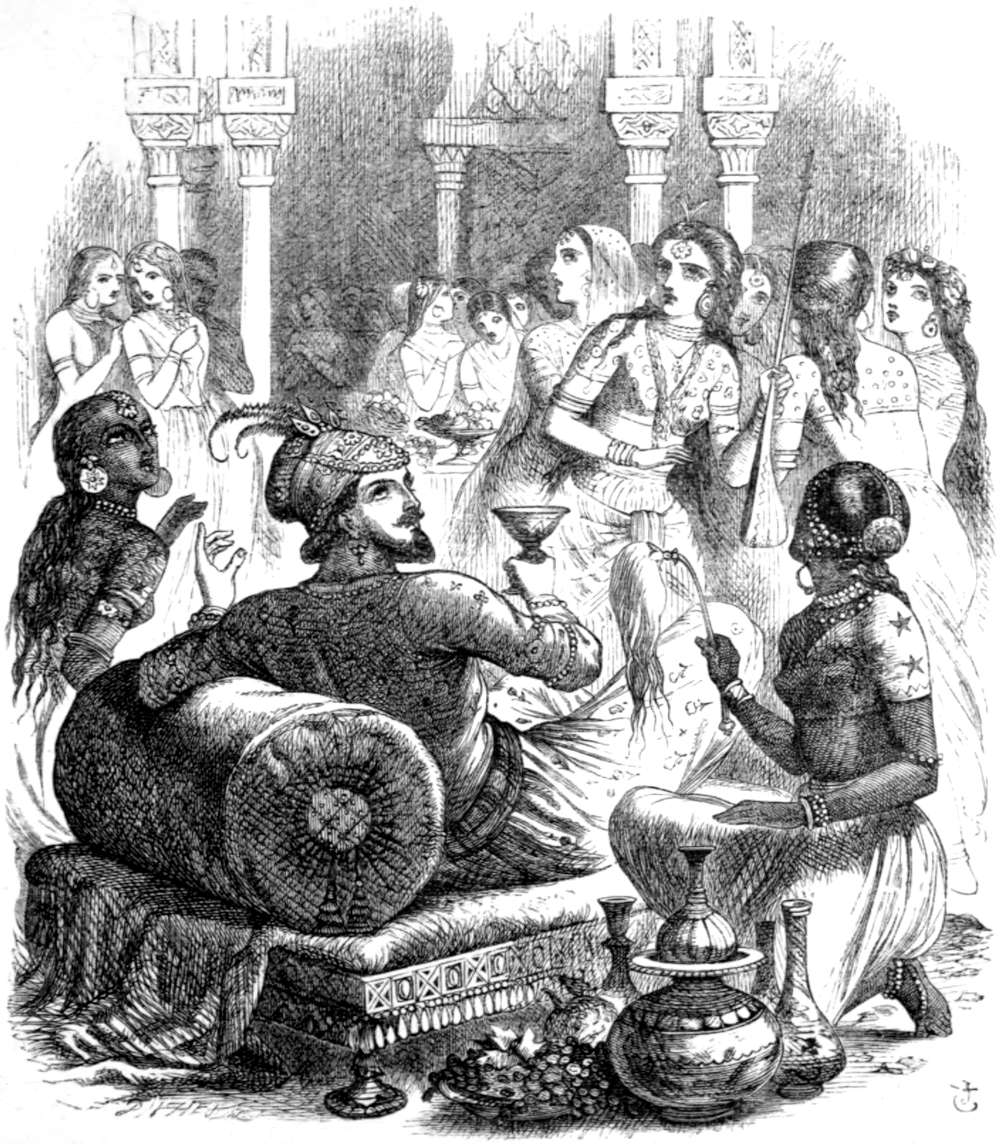
The Georgian’s song was scarcely mute,
When the same measure, sound for sound,
Was caught up by another lute,
And so divinely breathed around,
That all stood hush’d and wondering,
And turn’d and look’d into the air,
As if they thought to see the wing
Of Israfil,[376] the Angel, there;—
315So powerfully on every soul
That new, enchanted measure stole.
While now a voice, sweet as the note
Of the charm’d lute, was heard to float
Along its chords, and so entwine
Its sounds with theirs, that none knew whether
The voice or lute was most divine,
So wondrously they went together:—
316
There’s a bliss beyond all that the minstrel has told,
When two, that are link’d in one heavenly tie,
With heart never changing, and brow never cold,
Love on through all ills, and love on till they die!
One hour of a passion so sacred is worth
Whole ages of heartless and wandering bliss;
And, oh! if there be an Elysium on earth,
It is this, it is this.
Twas not the air, ’twas not the words,
But that deep magic in the chords
And in the lips, that gave such power
As music knew not till that hour.
At once a hundred voices said,
“It is the mask’d Arabian maid!”
While Selim, who had felt the strain
Deepest of any, and had lain
Some minutes rapt, as in a trance,
After the fairy sounds were o’er,
Too inly touched for utterance,
Now motion’d with his hand for more:—
317Fly to the desert, fly with me,
Our Arab tents are rude for thee;
But, oh! the choice what heart can doubt,
Of tents with love, or thrones without?
Our rocks are rough, but smiling there
The’ acacia waves her yellow hair,
Lonely and sweet, nor lov’d the less
For flowering in a wilderness.
Our sands are bare, but down their slope
The silvery-footed antelope
As gracefully and gaily springs
As o’er the marble courts of kings.
Then come—thy Arab maid will be
The lov’d and lone acacia-tree,
The antelope, whose feet shall bless
With their light sound thy loneliness.
Oh! there are looks and tones that dart
An instant sunshine through the heart,—
As if the soul that minute caught
Some treasure it through life had sought;
As if the very lips and eyes,
Predestin’d to have all our sighs,
318And never be forgot again,
Sparkled and spoke before us then!
So came thy every glance and tone,
When first on me they breath’d and shone;
New, as if brought from other spheres,
Yet welcome as if loved for years.
Then fly with me,—if thou hast known
No other flame, nor falsely thrown
A gem away, that thou hadst sworn
Should ever in thy heart be worn.
Come, if the love thou hast for me
Is pure and fresh as mine for thee,—
Fresh as the fountain under ground,
When first ’tis by the lapwing found.[377]
But if for me thou dost forsake
Some other maid, and rudely break
Her worshipp’d image from its base,
To give to me the ruin’d place;—
Then, fare thee well—I’d rather make
My bower upon some icy lake
When thawing suns begin to shine,
Than trust to love so false as thine!
319There was a pathos in this lay,
That, e’en without enchantment’s art,
Would instantly have found its way
Deep into Selim’s burning heart;
But, breathing, as it did, a tone
To earthly lutes and lips unknown;
With every chord fresh from the touch
Of Music’s Spirit,—’twas too much!
Starting, he dash’d away the cup,—
Which, all the time of this sweet air,
His hand had held, untasted, up,
As if ’twere fix’d by magic there,—
And naming her, so long unnam’d,
So long unseen, wildly exclaim’d,
“Oh Nourmahal! oh Nourmahal!
“Hadst thou but sung this witching strain,
“I could forget—forgive thee all,
“And never leave those eyes again.”
The mask is off—the charm is wrought—
And Selim to his heart has caught,
In blushes, more than ever bright,
His Nourmahal, his Haram’s Light!
And well do vanish’d frowns enhance
The charm of every brightened glance;
320And dearer seems each dawning smile
For having lost its light awhile:
And, happier now for all her sighs,
As on his arm her head reposes,
She whispers him with laughing eyes,
“Remember, love, the Feast of Roses!”
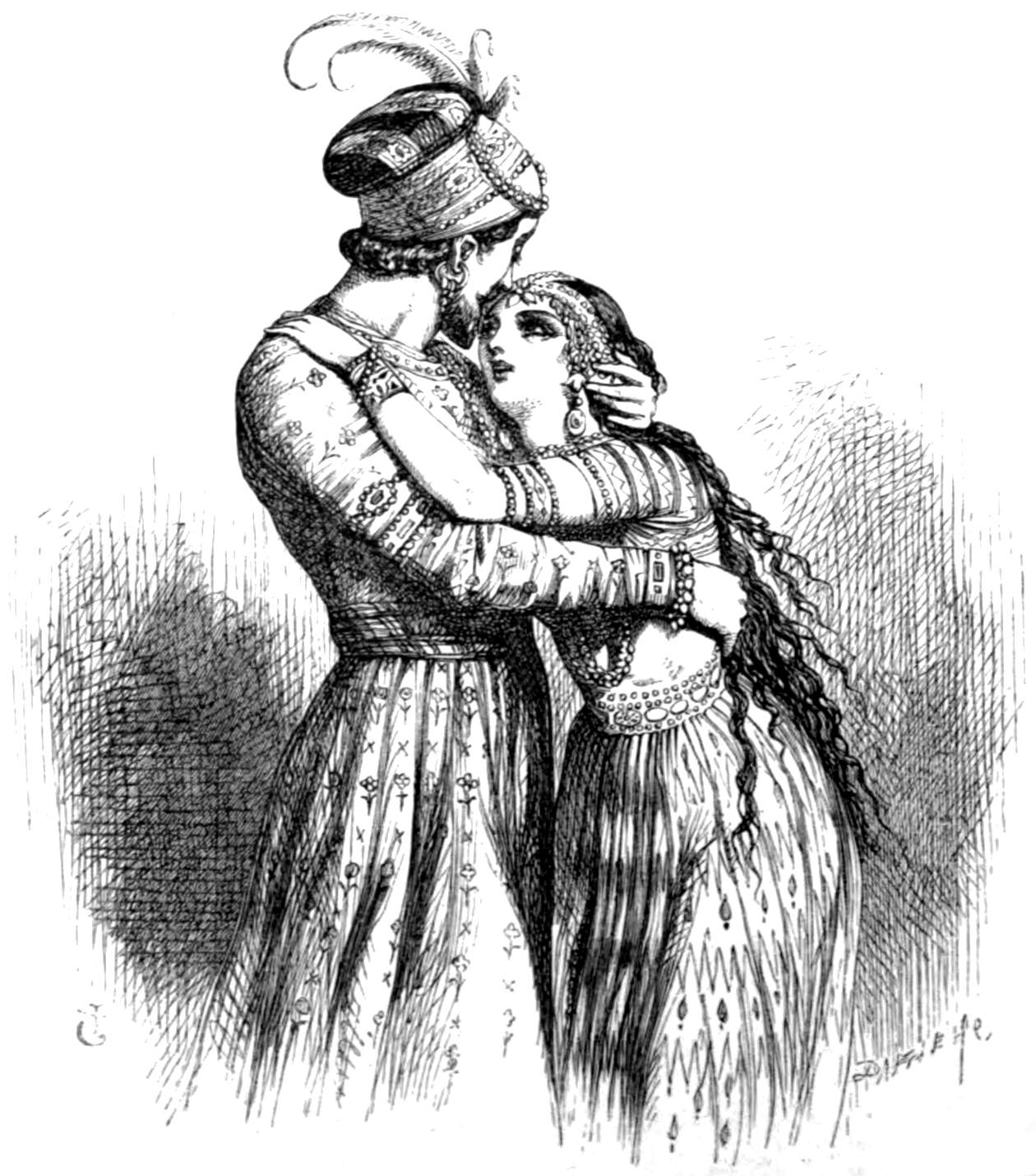
321
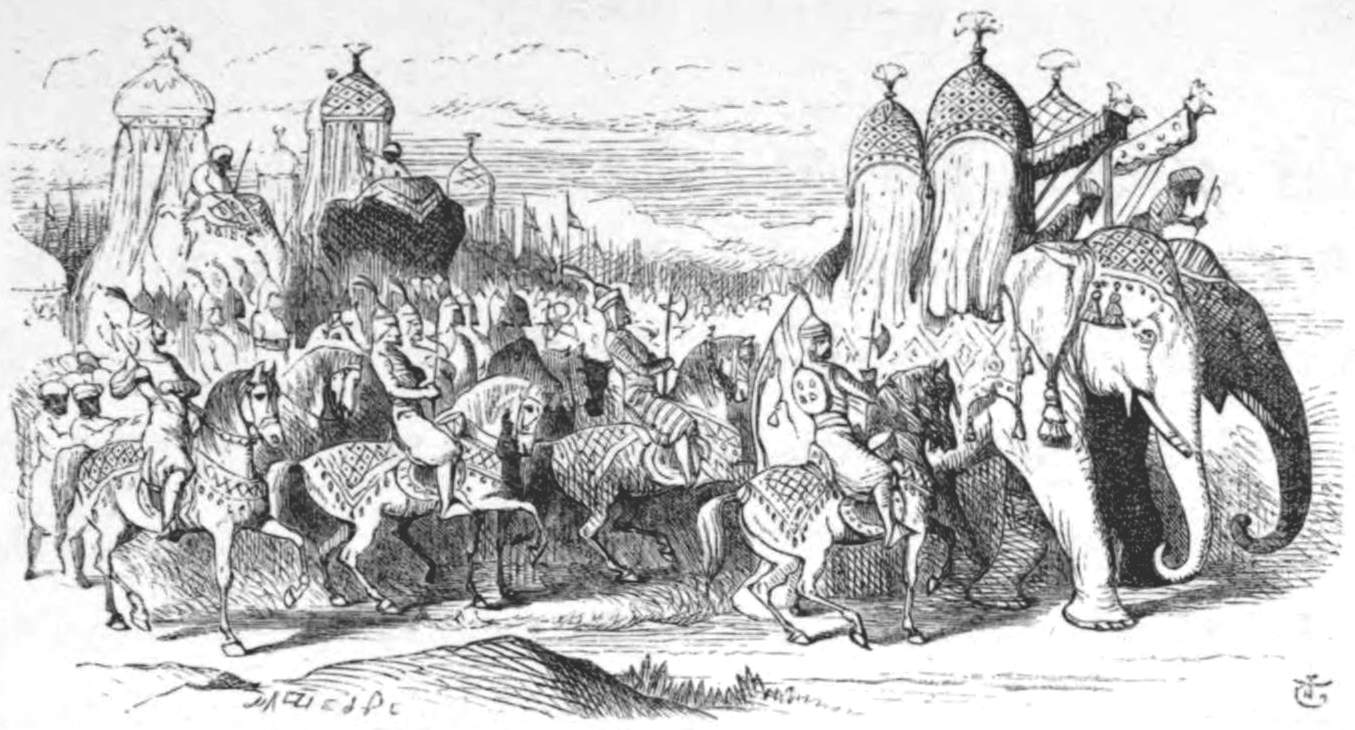
Fadladeen, at the conclusion of this light rhapsody, took occasion to sum up his opinion of the young Cashmerian’s poetry,—of which, he trusted, they had that evening heard the last. Having recapitulated the epithets, “frivolous”—“inharmonious”—“nonsensical,” he proceeded to say that, viewing it in the most favourable light, it resembled one of those Maldivian boats, to which the Princess had alluded in the relation of her dream,[378]—a slight, gilded thing, sent adrift without rudder or ballast, and with nothing but vapid sweets and faded flowers on board. The profusion, indeed, of flowers and birds, which this poet had ready on all occasions,—not to mention dews, gems, &c.—was a most oppressive kind of opulence to his hearers; and had the unlucky effect of giving to his style all the glitter of the flower-garden without its method, and all the flutter of the aviary without its song. In addition to this, he chose his subjects badly, and was always most inspired by the worst 322parts of them. The charms of paganism, the merits of rebellion,—these were the themes honoured with his particular enthusiasm; and, in the poem just recited, one of his most palatable passages was in praise of that beverage of the Unfaithful, wine;—“being, perhaps,” said he, relaxing into a smile, as conscious of his own character in the Haram on this point, “one of those bards, whose fancy owes all its illumination to the grape, like that painted porcelain,[379] so curious and so rare, whose images are only visible when liquor is poured into it.” Upon the whole, it was his opinion, from the specimens which they had heard, and which, he begged to say, were the most tiresome part of the journey, that—whatever other merits this well-dressed young gentleman might possess—poetry was by no means his proper avocation: “and indeed,” concluded the critic, “from his fondness for flowers and for birds, I would venture to suggest that a florist or a bird-catcher is a much more suitable calling for him than a poet.”
They had now begun to ascend those barren mountains, which separate Cashmere from the rest of India; and, as the heats were intolerable, and the time of their encampments limited to the few hours necessary for refreshment and repose, there was an end to all their delightful evenings, and Lalla Rookh saw no 323more of Feramorz. She now felt that her short dream of happiness was over, and that she had nothing but the recollection of its few blissful hours, like the one draught of sweet water that serves the camel across the wilderness, to be her heart’s refreshment during the dreary waste of life that was before her. The blight that had fallen upon her spirits soon found its way to her cheek, and her ladies saw with regret—though not without some suspicion of the cause—that the beauty of their mistress, of which they were almost as proud as of their own, was fast vanishing away at the very moment of all when she had most need of it. What must the King of Bucharia feel, when, instead of the lively and beautiful Lalla Rookh, whom the poets of Delhi had described as more perfect than the divinest images in the house of Azor,[380] he should receive a pale and inanimate victim, upon whose cheek neither health nor pleasure bloomed, and from whose eyes Love had fled,—to hide himself in her heart?