LALLA ROOKH (continued 2)
Reading edition
Catching the tempest’s momentary light!
And hath not this brought the proud spirit low?
Nor dash’d his brow, nor check’d his daring? No.
Though half the wretches, whom at night he led
To thrones and victory, lie disgrac’d and dead,
Yet morning hears him, with unshrinking crest,
Still vaunt of thrones, and victory to the rest;—
And they believe him!—oh, the lover may
Distrust that look which steals his soul away;—
101The babe may cease to think that it can play
With Heaven’s rainbow;—alchymists may doubt
The shining gold their crucible gives out;
But Faith, fanatic Faith, once wedded fast
To some dear falsehood, hugs it to the last.
And well the’ Impostor knew all lures and arts,
That Lucifer e’er taught to tangle hearts;
Nor, ’mid these last bold workings of his plot
Against men’s souls, is Zelica forgot.
Ill-fated Zelica! had reason been
Awake, through half the horrors thou hast seen,
Thou never couldst have borne it—Death had come
At once, and taken thy wrung spirit home.
But ’twas not so—a torpor, a suspense
Of thought, almost of life, came o’er the’ intense
And passionate struggles of that fearful night,
When her last hope of peace and heaven took flight:
And though, at times, a gleam of frenzy broke,—
As through some dull volcano’s veil of smoke
Ominous flashings now and then will start,
Which show the fire’s still busy at its heart;
Yet was she mostly wrapp’d in solemn gloom,—
Not such as Azim’s, brooding o’er its doom,
And calm without, as is the brow of death,
While busy worms are gnawing underneath,—
102But in a blank and pulseless torpor, free
From thought or pain, a seal’d-up apathy,
Which left her oft, with scarce one living thrill,
The cold, pale victim of her torturer’s will.
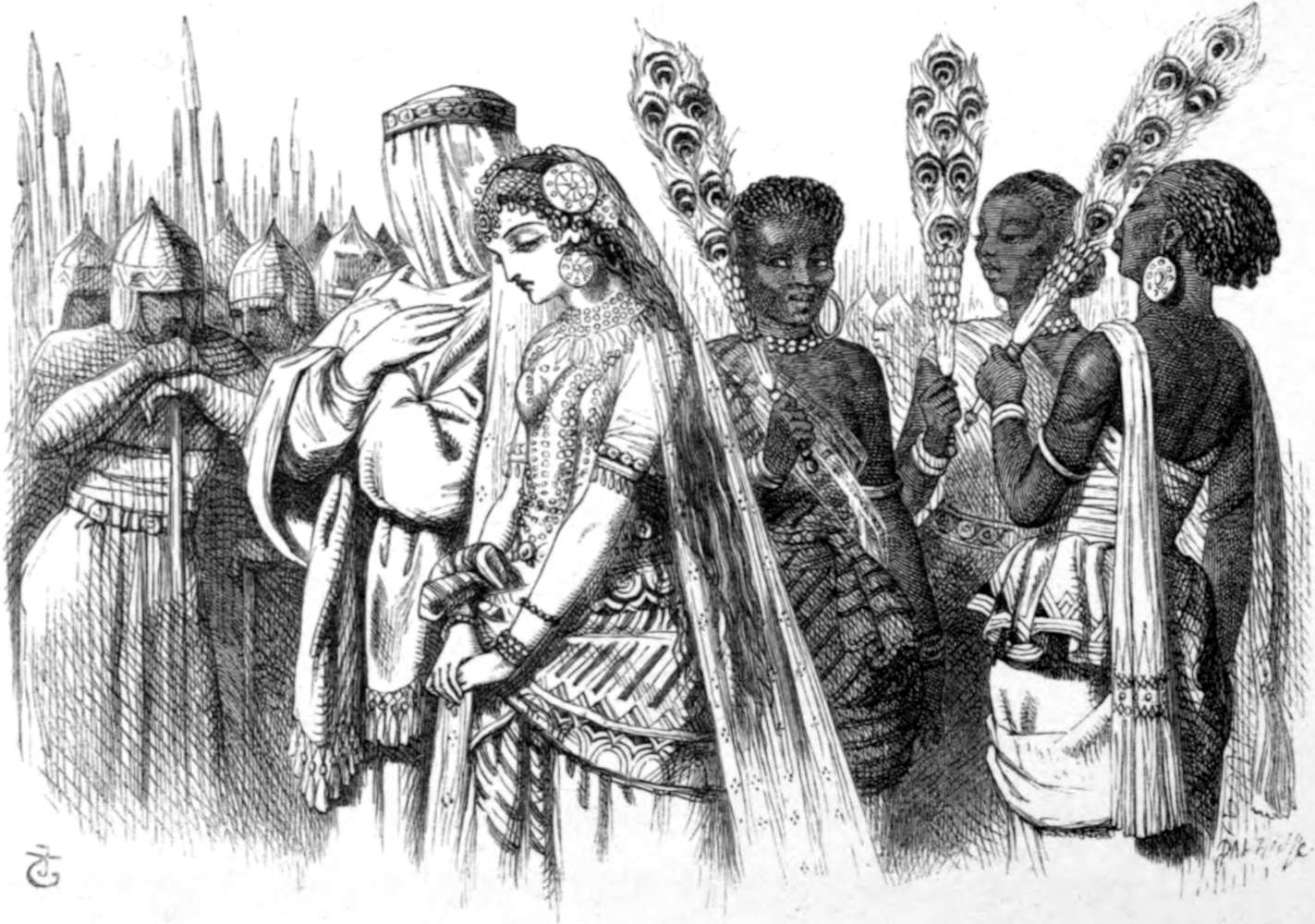
Again, as in Merou, he had her deck’d
Gorgeously out, the Priestess of the sect;
And led her glittering forth before the eyes
Of his rude train, as to a sacrifice,—
Pallid as she, the young, devoted Bride
Of the fierce Nile, when, deck’d in all the pride
Of nuptial pomp, she sinks into his tide.[140]
And while the wretched maid hung down her head,
103And stood, as one just risen from the dead,
Amid that gazing crowd, the fiend would tell
His credulous slaves it was some charm or spell
Possess’d her now,—and from that darken’d trance
Should dawn ere long their Faith’s deliverance.
Or if, at times, goaded by guilty shame,
Her soul was rous’d, and words of wildness came,
Instant the bold blasphemer would translate
Her ravings into oracles of fate,
Would hail heaven’s signals in her flashing eyes,
And call her shrieks the language of the skies!
But vain at length his arts—despair is seen
Gathering around; and famine comes to glean
All that the sword had left unreap’d:—in vain
At morn and eve across the northern plain
He looks impatient for the promis’d spears
Of the wild Hordes and Tartar mountaineers;
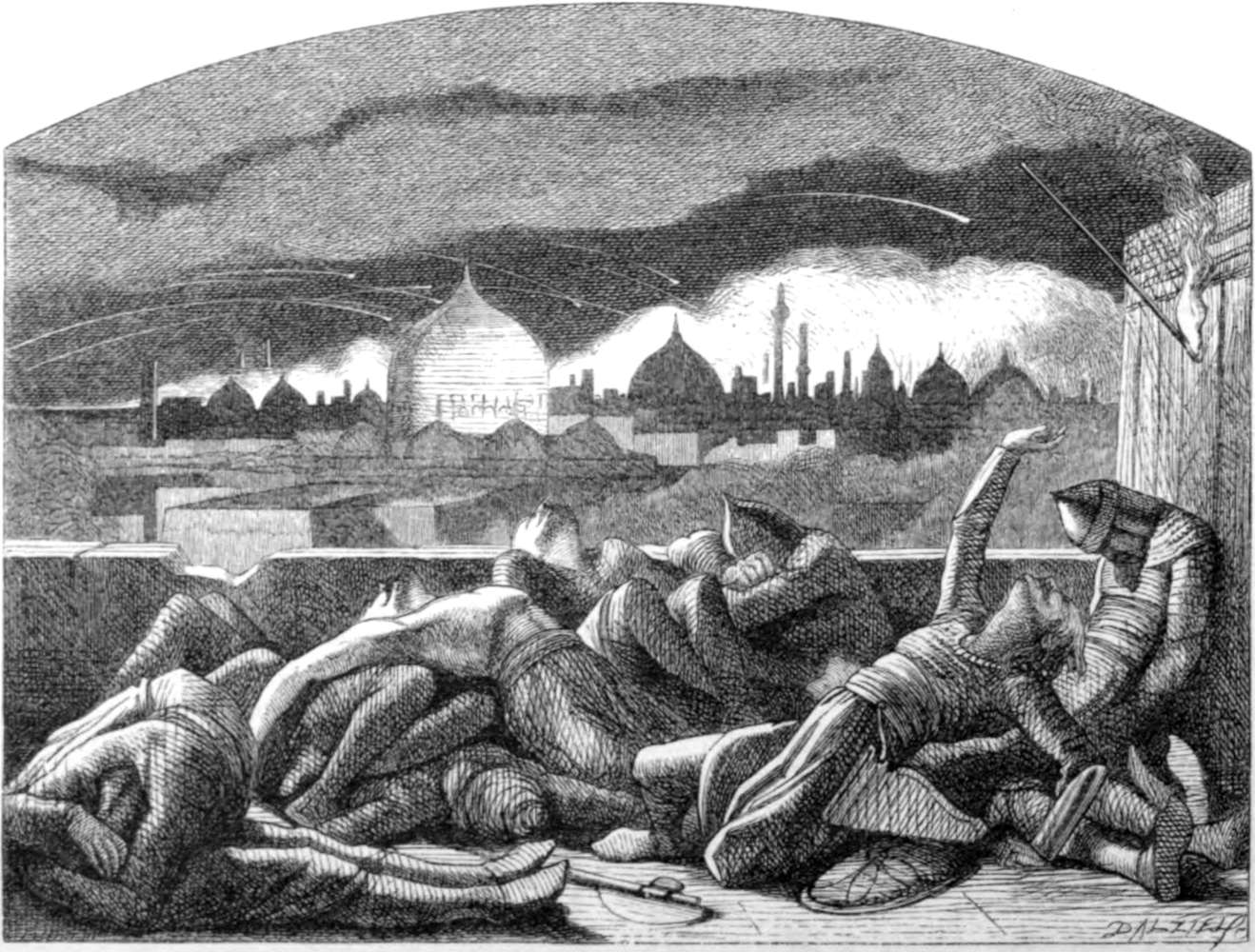
They come not—while his fierce beleaguerers pour
Engines of havoc in, unknown before,[141]
And horrible as new;[142]—javelins, that fly
Enwreath’d with smoky flames through the dark sky,
And red-hot globes, that, opening as they mount,
Discharge, as from a kindled Naphtha fount,[143]
Showers of consuming fire o’er all below;
Looking, as through the’ illumin’d night they go,
104Like those wild birds[144] that by the Magians oft,
At festivals of fire, were sent aloft
Into the air, with blazing faggots tied
To their huge wings, scattering combustion wide.
All night the groans of wretches who expire
In agony, beneath these darts of fire,
Ring through the city—while, descending o’er
Its shrines and domes and streets of sycamore,—
Its lone bazaars, with their bright cloths of gold,
Since the last peaceful pageant left unroll’d,—
Its beauteous marble baths, whose idle jets
Now gush with blood,—and its tall minarets,
105That late have stood up in the evening glare
Of the red sun, unhallow’d by a prayer;—
O’er each, in turn, the dreadful flame-bolts fall,
And death and conflagration throughout all
The desolate city hold high festival!
Mokanna sees the world is his no more;—
One sting at parting, and his grasp is o’er.
“What! drooping now?”—thus, with unblushing cheek,
He hails the few, who yet can hear him speak,
Of all those famish’d slaves around him lying,
And by the light of blazing temples dying;—
“What!—drooping now?—now, when at length we press
“Home o’er the very threshold of success;
“When Alla from our ranks hath thinn’d away
“Those grosser branches, that kept out his ray
“Of favour from us, and we stand at length
“Heirs of his light and children of his strength,
“The chosen few, who shall survive the fall
“Of Kings and Thrones, triumphant over all!
“Have you then lost, weak murmurers as you are,
“All faith in him, who was your Light, your Star?
“Have you forgot the eye of glory, hid
“Beneath this Veil, the flashing of whose lid
“Could, like a sun-stroke of the desert, wither
“Millions of such as yonder Chief brings hither?
106“Long have its lightnings slept—too long—but now
“All earth shall feel the’ unveiling of this brow!
“To-night—yes, sainted men! this very night,
“I bid you all to a fair festal rite,
“Where—having deep refresh’d each weary limb
“With viands, such as feast Heaven’s cherubim,
“And kindled up your souls, now sunk and dim,
“With that pure wine the Dark-ey’d Maids above
“Keep, seal’d with precious musk, for those they love,[145]—
“I will myself uncurtain in your sight
“The wonders of this brow’s ineffable light;
“Then lead you forth, and with a wink disperse
“Yon myriads, howling through the universe!”
Eager they listen—while each accent darts
New life into their chill’d and hope-sick hearts;
Such treacherous life as the cool draught supplies
To him upon the stake, who drinks and dies!
Wildly they point their lances to the light
Of the fast sinking sun, and shout “To-night!”—
“To-night,” their Chief re-echoes in a voice
Of fiend-like mockery that bids hell rejoice.
Deluded victims!—never hath this earth
Seen mourning half so mournful as their mirth.
Here, to the few, whose iron frames had stood
This racking waste of famine and of blood,
107Faint, dying wretches clung, from whom the shout
Of triumph like a maniac’s laugh broke out:—
There, others, lighted by the smould’ring fire,
Danc’d like wan ghosts about a funeral pyre,
Among the dead and dying, strew’d around;—
While some pale wretch look’d on, and from his wound
Plucking the fiery dart by which he bled,
In ghastly transport wav’d it o’er his head!
’Twas more than midnight now—a fearful pause
Had follow’d the long shouts, the wild applause,
That lately from those Royal Gardens burst,
Where the Veil’d demon held his feast accurst,
When Zelica—alas, poor ruin’d heart,
In every horror doom’d to bear its part!—
Was bidden to the banquet by a slave,
Who, while his quivering lip the summons gave,
Grew black, as though the shadows of the grave
Compass’d him round, and, ere he could repeat
His message through, fell lifeless at her feet!
Shuddering she went—a soul-felt pang of fear,
A presage that her own dark doom was near,
Rous’d every feeling, and brought Reason back
Once more, to writhe her last upon the rack.
All round seem’d tranquil—even the foe had ceas’d,
As if aware of that demoniac feast,
108His fiery bolts; and though the heavens look’d red,
’Twas but some distant conflagration’s spread.
But hark—she stops—she listens—dreadful tone,
’Tis her Tormentor’s laugh—and now, a groan,
A long death-groan comes with it:—can this be
The place of mirth, the bower of revelry?
She enters—Holy Alla, what a sight
Was there before her! By the glimmering light
Of the pale dawn, mix’d with the flare of brands
That round lay burning, dropp’d from lifeless hands,
She saw the board, in splendid mockery spread,
Rich censers breathing—garlands overhead—
The urns, the cups, from which they late had quaff’d,
All gold and gems, but—what had been the draught?
Oh! who need ask, that saw those livid guests,
With their swoll’n heads sunk black’ning on their breasts,
Or looking pale to Heaven with glassy glare,
As if they sought but saw no mercy there;
As if they felt, though poison rack’d them through,
Remorse the deadlier torment of the two!
While some, the bravest, hardiest in the train
Of their false Chief, who on the battle-plain
Would have met death with transport by his side,
Here mute and helpless gasp’d;—but, as they died,
Look’d horrible vengeance with their eyes’ last strain,
And clench’d the slack’ning hand at him in vain.
109
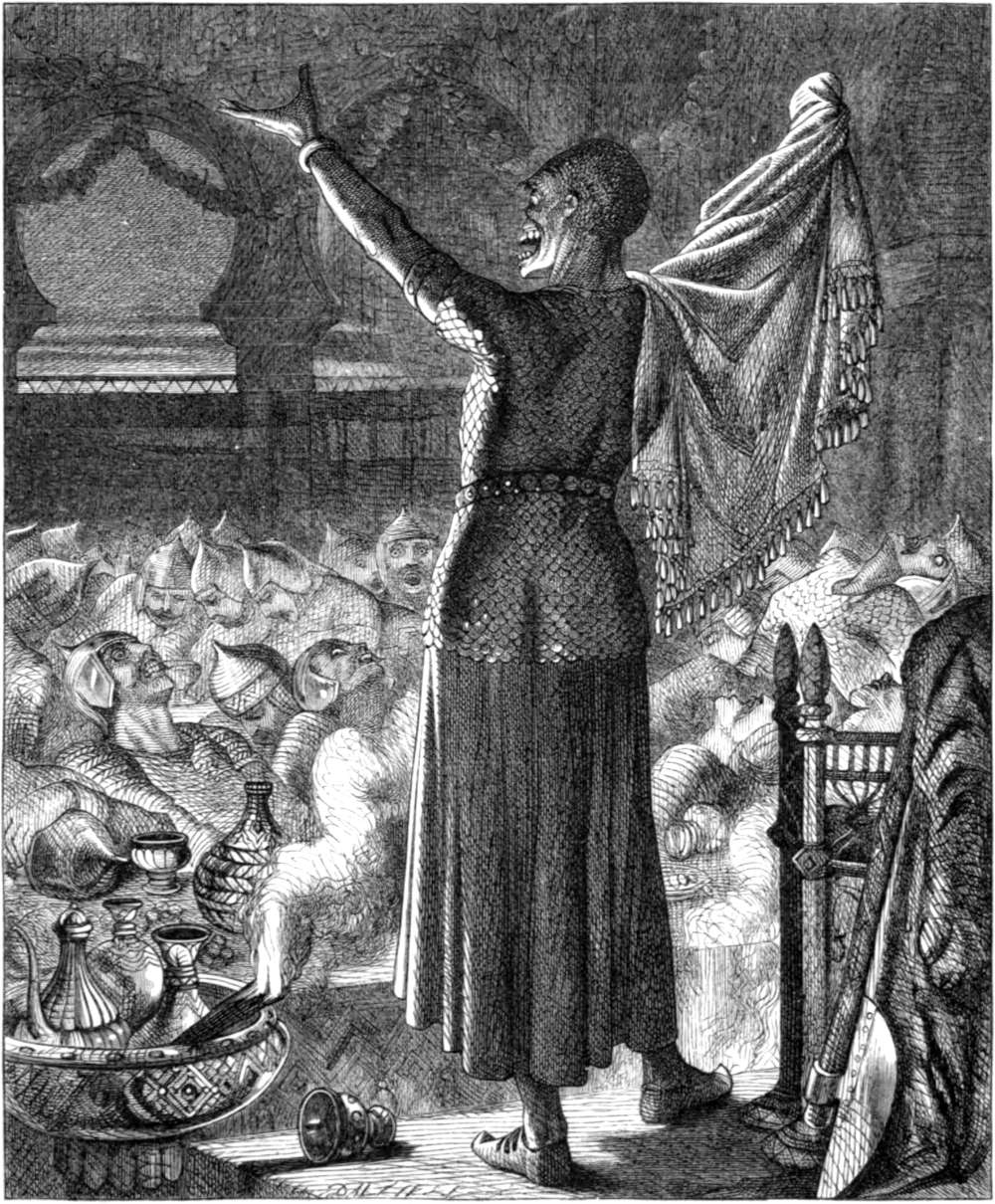
Dreadful it was to see the ghastly stare,
The stony look of horror and despair,
Which some of these expiring victims cast
Upon their souls’ tormentor to the last;—
Upon that mocking Fiend, whose Veil, now rais’d,
Show’d them, as in death’s agony they gazed,
110Not the long promis’d light, the brow, whose beaming
Was to come forth, all conquering, all redeeming,
But features horribler than Hell e’er trac’d
On its own brood;—no Demon of the Waste,[146]
No church-yard Ghole, caught lingering in the light
Of the blest sun, e’er blasted human sight
With lineaments so foul, so fierce as those
The’ Impostor, now in grinning mockery, shows:—
“There, ye wise Saints, behold your Light, your Star—
“Ye would be dupes and victims, and ye are.
“Is it enough? or must I, while a thrill
“Lives in your sapient bosoms, cheat you still?
“Swear that the burning death ye feel within
“Is but the trance with which Heaven’s joys begin;
“That this foul visage, foul as e’er disgrac’d
“Even monstrous man, is—after God’s own taste;
“And that—but see!—ere I have half-way said
“My greetings through, the’ uncourteous souls are fled.
“Farewell, sweet spirits! not in vain ye die,
“If Eblis loves you half so well as I.—
“Ha, my young bride!—’tis well—take thou thy seat;
“Nay come—no shuddering—didst thou never meet
“The dead before?—they grac’d our wedding, sweet;
“And these, my guests to-night, have brimm’d so true
“Their parting cups, that thou shalt pledge one too.
“But—how is this?—all empty? all drunk up?
111“Hot lips have been before thee in the cup,
“Young bride,—yet stay—one precious drop remains,
“Enough to warm a gentle Priestess’ veins;—
“Here, drink—and should thy lover’s conquering arms
“Speed hither, ere thy lip lose all its charms,
“Give him but half this venom in thy kiss,
“And I’ll forgive my haughty rival’s bliss!
“For me—I too must die—but not like these
“Vile, rankling things, to fester in the breeze;
“To have this brow in ruffian triumph shown,
“With all death’s grimness added to its own,
“And rot to dust beneath the taunting eyes
“Of slaves, exclaiming, ‘There his Godship lies!
“No—cursed race—since first my soul drew breath,
“They’ve been my dupes, and shall be even in death.
“Thou see’st yon cistern in the shade—’tis fill’d
“With burning drugs, for this last hour distill’d:[147]—
“There will I plunge me, in that liquid flame—
“Fit bath to lave a dying Prophet’s frame!—
“There perish, all—ere pulse of thine shall fail—
“Nor leave one limb to tell mankind the tale.
“So shall my votaries, wheresoe’er they rave,
“Proclaim that Heaven took back the Saint it gave;—
“That I’ve but vanish’d from this earth awhile,
“To come again, with bright, unshrouded smile!
112“So shall they build me altars in their zeal,
“Where knaves shall minister, and fools shall kneel;
“Where Faith may mutter o’er her mystic spell,
“Written in blood—and Bigotry may swell
“The sail he spreads for Heaven with blasts from hell!
“So shall my banner, through long ages, be
“The rallying sign of fraud and anarchy:—
“Kings yet unborn shall rue Mokanna’s name,
“And, though I die, my spirit, still the same,
“Shall walk abroad in all the stormy strife,
“And guilt, and blood, that were its bliss in life.
“But, hark! their battering engine shakes the wall—
“Why, let it shake—thus I can brave them all.
“No trace of me shall greet them, when they come,
“And I can trust thy faith, for—thou’lt be dumb.
“Now mark how readily a wretch like me,
“In one bold plunge, commences Deity!”
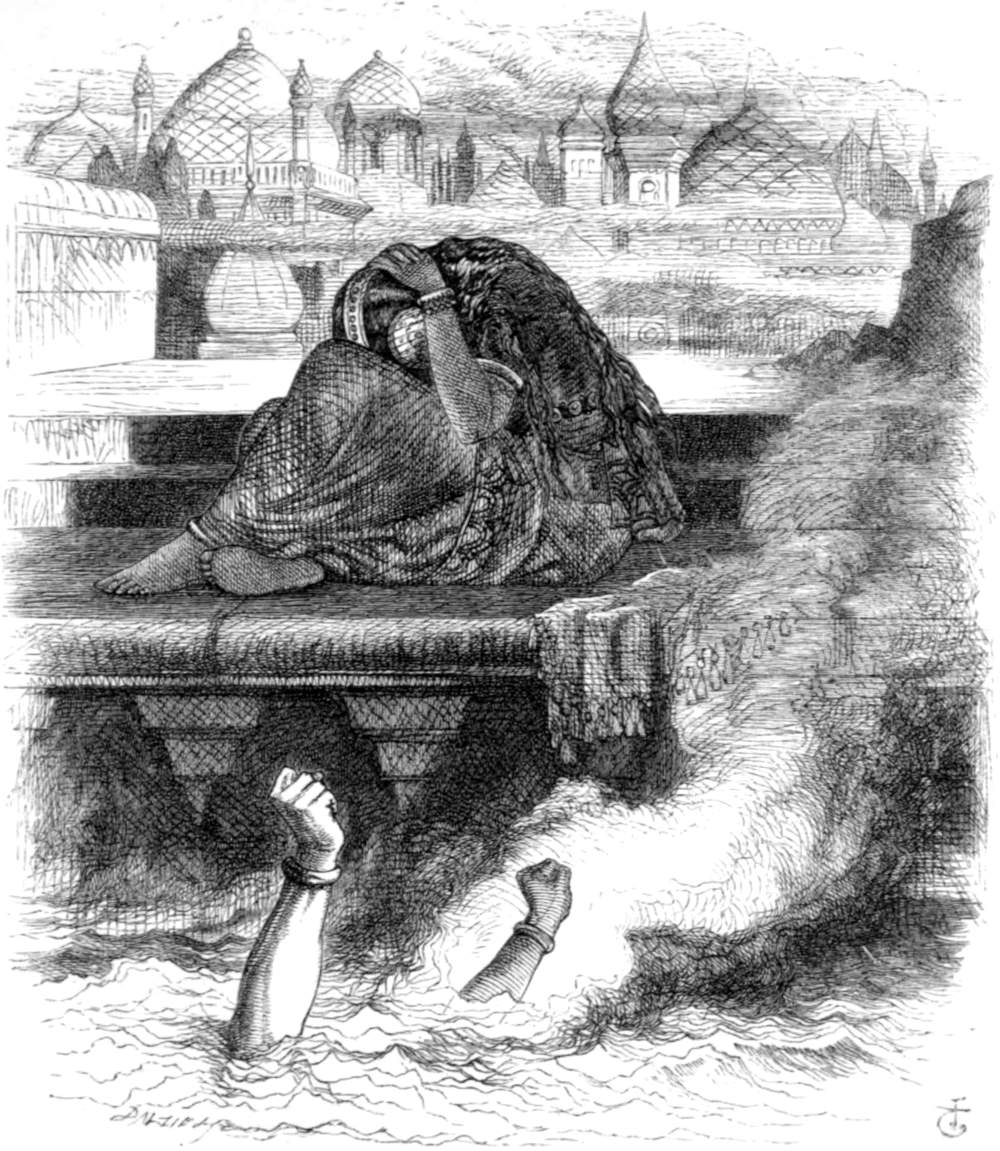
He sprung and sunk, as the last words were said—
Quick clos’d the burning waters o’er his head,
And Zelica was left—within the ring
Of those wide walls the only living thing;
The only wretched one, still curs’d with breath,
In all that frightful wilderness of death!
More like some bloodless ghost—such as, they tell,
In the lone Cities of the Silent[148] dwell,
113And there, unseen of all but Alla, sit
Each by its own pale carcass, watching it.
But morn is up, and a fresh warfare stirs
Throughout the camp of the beleaguerers.
Their globes of fire (the dread artillery lent
By Greece to conquering Mahadi) are spent;
And now the scorpion’s shaft, the quarry sent
114From high balistas, and the shielding throng
Of soldiers swinging the huge ram along,
All speak the’ impatient Islamite’s intent
To try, at length, if tower and battlement
And bastion’d wall be not less hard to win,
Less tough to break down than the hearts within.
First in impatience and in toil is he,
The burning Azim—oh! could he but see
The’ Impostor once alive within his grasp,
Not the gaunt lion’s hug, nor boa’s clasp,
Could match that gripe of vengeance, or keep pace
With the fell heartiness of Hate’s embrace!
Loud rings the ponderous ram against the walls;
Now shake the ramparts, now a buttress falls,
But still no breach—“Once more, one mighty swing
“Of all your beams, together thundering!”
There—the wall shakes—the shouting troops exult,
“Quick, quick discharge your weightiest catapult
“Right on that spot, and Neksheb is our own!”
’Tis done—the battlements come crashing down,
And the huge wall, by that stroke riven in two,
Yawning, like some old crater, rent anew,
Shows the dim, desolate city smoking through.
But strange! no signs of life—nought living seen
Above, below—what can this stillness mean?
115A minute’s pause suspends all hearts and eyes—
“In through the breach,” impetuous Azim cries;
But the cool Caliph, fearful of some wile
In this blank stillness, checks the troops awhile.—
Just then, a figure, with slow step, advanc’d
Forth from the ruin’d walls, and, as there glanc’d
A sunbeam over it, all eyes could see
The well-known Silver Veil!—“’Tis He, ’tis He,
“Mokanna, and alone!” they shout around;
Young Azim from his steed springs to the ground—
“Mine, Holy Caliph! mine,” he cries, “the task
“To crush yon daring wretch—’tis all I ask.”
Eager he darts to meet the demon foe,
Who still across wide heaps of ruin slow
And falteringly comes, till they are near;
Then, with a bound, rushes on Azim’s spear,
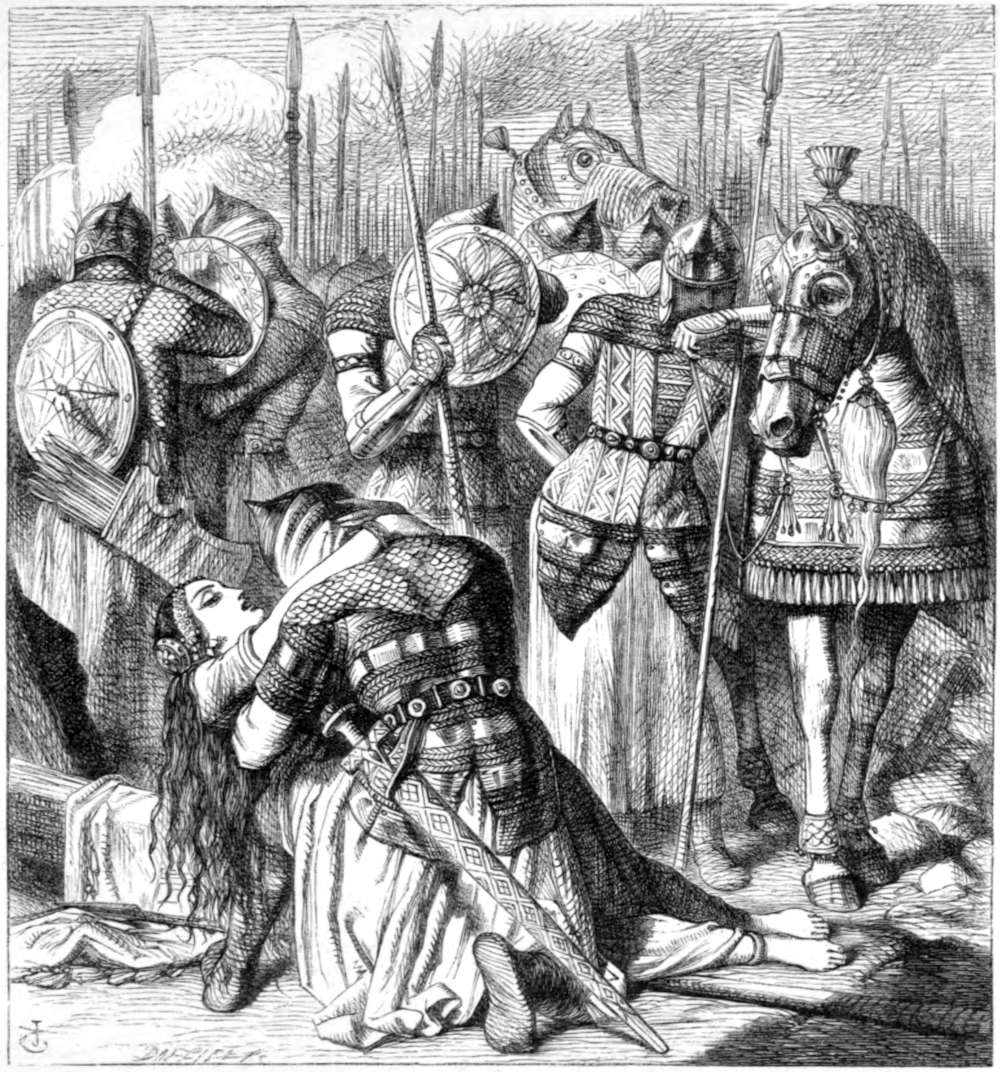
And, casting off the Veil in falling, shows—
Oh!—’tis his Zelica’s life-blood that flows!
“I meant not, Azim,” soothingly she said,
As on his trembling arm she lean’d her head,
And, looking in his face, saw anguish there
Beyond all wounds the quivering flesh can bear—
“I meant not thou shouldst have the pain of this:—
“Though death, with thee thus tasted, is a bliss
“Thou wouldst not rob me of, didst thou but know
116“How oft I’ve pray’d to God I might die so!
“But the Fiend’s venom was too scant and slow;—
“To linger on were maddening—and I thought
“If once that Veil—nay, look not on it—caught
“The eyes of your fierce soldiery, I should be
“Struck by a thousand death-darts instantly.
“But this is sweeter—oh! believe me, yes—
“I would not change this sad, but dear caress,
“This death within thy arms I would not give
“For the most smiling life the happiest live!
“All, that stood dark and drear before the eye
“Of my stray’d soul, is passing swiftly by;
“A light comes o’er me from those looks of love,
“Like the first dawn of mercy from above;
“And if thy lips but tell me I’m forgiven,
“Angels will echo the blest words in Heaven!
“But live, my Azim;—oh! to call thee mine
“Thus once again! my Azim—dream divine!
“Live, if thou ever lov’dst me, if to meet
“Thy Zelica hereafter would be sweet,
“Oh, live to pray for her—to bend the knee
“Morning and night before that Deity,
“To whom pure lips and hearts without a stain,
“As thine are, Azim, never breath’d in vain,—
“And pray that He may pardon her,—may take
“Compassion on her soul for thy dear sake,
117“And, nought remembering but her love to thee,
“Make her all thine, all His, eternally!
“Go to those happy fields where first we twin’d
“Our youthful hearts together—every wind
“That meets thee there, fresh from the well-known flowers,
“Will bring the sweetness of those innocent hours
“Back to thy soul, and mayst thou feel again
“For thy poor Zelica as thou didst then.
118“So shall thy orisons, like dew that flies
“To Heaven upon the morning’s sunshine, rise
“With all love’s earliest ardour to the skies!
“And should they—but, alas, my senses fail—
“Oh for one minute!—should thy prayers prevail—
“If pardon’d souls may, from that World of Bliss,
“Reveal their joy to those they love in this—
“I’ll come to thee—in some sweet dream—and tell—
“Oh Heaven—I die—dear love! farewell, farewell.”
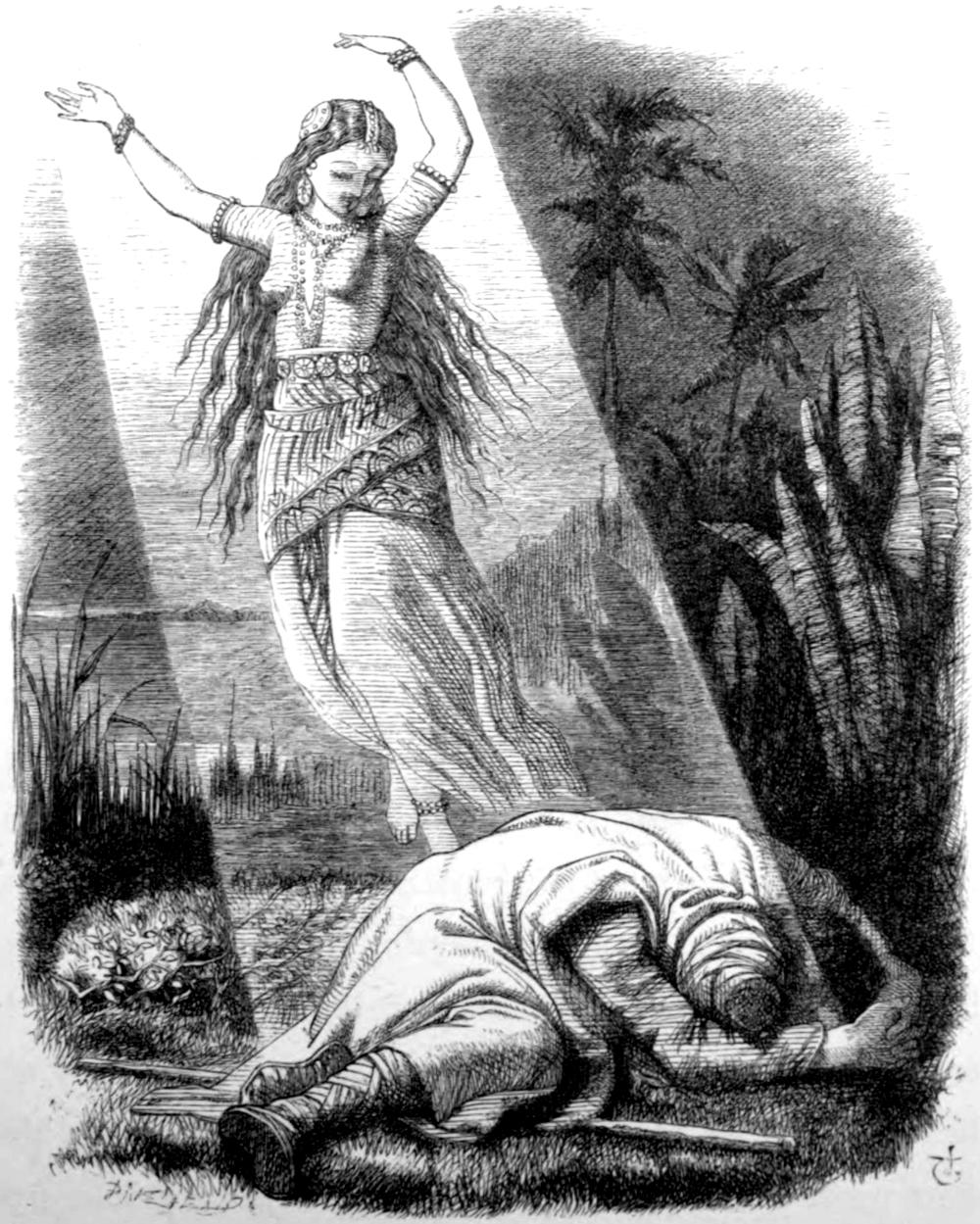
Time fleeted—years on years had pass’d away,
And few of those who, on that mournful day,
Had stood, with pity in their eyes, to see
The maiden’s death and the youth’s agony,
Were living still—when, by a rustic grave,
Beside the swift Amoo’s transparent wave,
An aged man, who had grown aged there
By that lone grave, morning and night in prayer,
For the last time knelt down—and, though the shade
Of death hung darkening over him, there play’d
A gleam of rapture on his eye and cheek,
That brighten’d even Death—like the last streak
Of intense glory on the’ horizon’s brim,
When night o’er all the rest hangs chill and dim.
His soul had seen a Vision, while he slept;
She, for whose spirit he had pray’d and wept
119So many years, had come to him, all drest
In angel smiles, and told him she was blest!
For this the old man breath’d his thanks and died.—
And there, upon the banks of that lov’d tide,
He and his Zelica sleep side by side.
120The story of the Veiled Prophet of Khorassan being ended, they were now doomed to hear Fadladeen’s criticisms upon it. A series of disappointments and accidents had occurred to this learned Chamberlain during the journey. In the first place, those couriers stationed, as in the reign of Shah Jehan, between Delhi and the Western coast of India, to secure a constant supply of mangoes for the Royal Table, had, by some cruel irregularity, failed in their duty, and to eat any mangoes but those of Mazagong was, of course, impossible.[149] In the next place, the elephant, laden with his fine antique porcelain,[150] had, in an unusual fit of liveliness, shattered the whole set to pieces:—an irreparable loss, as many of the vessels were so exquisitely old, as to have been used under the Emperors Yan and Chun, who reigned many ages before the dynasty of Tang. His Koran, too, supposed to be the identical copy between the leaves of which Mahomet’s favourite pigeon used to nestle, had been mislaid by his Koran-bearer three whole days; not without much spiritual alarm to Fadladeen, who, though professing to hold with other loyal and orthodox Mussulmans, that salvation could only be found in the Koran, was strongly suspected of believing in his heart, that it could only be found in his own particular copy of it. When to all these grievances 121is added the obstinacy of the cooks, in putting the pepper of Canara into his dishes instead of the cinnamon of Serendib, we may easily suppose that he came to the task of criticism with, at least, a sufficient degree of irritability for the purpose.
“In order,” said he, importantly swinging about his chaplet of pearls, “to convey with clearness my opinion of the story this young man has related, it is necessary to take a review of all the stories that have ever⸺”—“My good Fadladeen!” exclaimed the Princess, interrupting him, “we really do not deserve that you should give yourself so much trouble. Your opinion of the poem we have just heard will, I have no doubt, be abundantly edifying, without any further waste of your valuable erudition.”—“If that be all,” replied the critic,—evidently mortified at not being allowed to show how much he knew about every thing but the subject immediately before him—“if that be all that is required, the matter is easily despatched.” He then proceeded to analyse the poem, in that strain (so well known to the unfortunate bards of Delhi), whose censures were an infliction from which few recovered, and whose very praises were like the honey extracted from the bitter flowers of the aloe. The chief personages of the story were, if he rightly understood them, an ill-favoured gentleman, with 122a veil over his face;—a young lady, whose reason went and came, according as it suited the poet’s convenience to be sensible or otherwise;—and a youth in one of those hideous Bucharian bonnets, who took the aforesaid gentleman in a veil for a Divinity. “From such materials,” said he, “what can be expected?—after rivalling each other in long speeches and absurdities, through some thousands of lines as indigestible as the filberts of Berdaa, our friend in the veil jumps into a tub of aquafortis; the young lady dies in a set speech, whose only recommendation is that it is her last; and the lover lives on to a good old age for the laudable purpose of seeing her ghost, which he at last happily accomplishes, and expires. This, you will allow, is a fair summary of the story; and if Nasser, the Arabian merchant, told no better,[151] our Holy Prophet (to whom be all honour and glory!) had no need to be jealous of his abilities for story-telling.”
With respect to the style, it was worthy of the matter;—it had not even those politic contrivances of structure, which make up for the commonness of the thoughts by the peculiarity of the manner, nor that stately poetical phraseology by which sentiments mean in themselves, like the blacksmith’s[152] apron converted into a banner, are so easily gilt and embroidered into consequence. Then, as to the versification, it was, to 123say no worse of it, execrable: it had neither the copious flow of Ferdosi, the sweetness of Hafez, nor the sententious march of Sadi; but appeared to him, in the uneasy heaviness of its movements, to have been modelled upon the gait of a very tired dromedary. The licences, too, in which it indulged, were unpardonable;—for instance, this line, and the poem abounded with such:—
Like the faint, exquisite music of a dream.
“What critic that can count,” said Fadladeen, “and has his full complement of fingers to count withal, would tolerate for an instant such syllabic superfluities?” He here looked round, and discovered that most of his audience were asleep; while the glimmering lamps seemed inclined to follow their example. It became necessary, therefore, however painful to himself, to put an end to his valuable animadversions for the present, and he accordingly concluded, with an air of dignified candour, thus:—“Notwithstanding the observations which I have thought it my duty to make, it is by no means my wish to discourage the young man:—so far from it, indeed, that if he will but totally alter his style of writing and thinking, I have very little doubt that I shall be vastly pleased with him.”
Some days elapsed, after this harangue of the Great Chamberlain, before Lalla Rookh could venture to ask 124for another story. The youth was still a welcome guest in the pavilion—to one heart, perhaps, too dangerously welcome:—but all mention of poetry was, as if by common consent, avoided. Though none of the party had much respect for Fadladeen, yet his censures, thus magisterially delivered, evidently made an impression on them all. The Poet himself, to whom criticism was quite a new operation, (being wholly unknown in that Paradise of the Indies, Cashmere,) felt the shock as it is generally felt at first, till use has made it more tolerable to the patient;—the Ladies began to suspect that they ought not to be pleased, and seemed to conclude that there must have been much good sense in what Fadladeen said, from its having sent them all so soundly to sleep;—while the self-complacent Chamberlain was left to triumph in the idea of having, for the hundred and fiftieth time in his life, extinguished a Poet. Lalla Rookh alone—and Love knew why—persisted in being delighted with all she had heard, and in resolving to hear more as speedily as possible. Her manner, however, of first returning to the subject was unlucky. It was while they rested during the heat of noon near a fountain, on which some hand had rudely traced those well-known words from the Garden of Sadi,—“Many, like me, have viewed this fountain, but they are gone, and their eyes are closed for ever!”—that 125she took occasion, from the melancholy beauty of this passage, to dwell upon the charms of poetry in general. “It is true,” she said, “few poets can imitate that sublime bird, which flies always in the air, and never touches the earth:[153]—it is only once in many ages a Genius appears, whose words, like those on the Written Mountain, last for ever:[154] but still there are some, as delightful, perhaps, though not so wonderful, who, if not stars over our head, are at least flowers along our path, and whose sweetness of the moment we ought gratefully to inhale, without calling upon them for a brightness and a durability beyond their nature. In short,” continued she, blushing, as if conscious of being caught in an oration, “it is quite cruel that a poet cannot wander through his regions of enchantment, without having a critic for ever, like the old Man of the Sea, upon his back!”[155]—Fadladeen, it was plain, took this last luckless allusion to himself, and would treasure it up in his mind as a whetstone for his next criticism. A sudden silence ensued; and the Princess, glancing a look at Feramorz, saw plainly she must wait for a more courageous moment.
But the glories of Nature, and her wild fragrant airs, playing freshly over the current of youthful spirits, will soon heal even deeper wounds than the dull Fadladeens 126of this world can inflict. In an evening or two after, they came to the small Valley of Gardens, which had been planted by order of the Emperor, for his favourite sister Rochinara, during their progress to Cashmere, some years before; and never was there a more sparkling assemblage of sweets, since the Gulzar-e-Irem, or Rose-bower of Irem. Every precious flower was there to be found, that poetry, or love, or religion has ever consecrated; from the dark hyacinth, to which Hafez compares his mistress’s hair,[156] to the Cámalatá, by whose rosy blossoms the heaven of Indra is scented.[157] As they sat in the cool fragrance of this delicious spot, and Lalla Rookh remarked that she could fancy it the abode of that Flower-loving Nymph whom they worship in the temples of Kathay,[158] or of one of those Peris, those beautiful creatures of the air, who live upon perfumes, and to whom a place like this might make some amends for the Paradise they have lost,—the young Poet, in whose eyes she appeared, while she spoke, to be one of the bright spiritual creatures she was describing, said hesitatingly that he remembered a Story of a Peri, which, if the Princess had no objection, he would venture to relate. “It is,” said he, with an appealing look to Fadladeen, “in a lighter and humbler strain than the other:” then, striking a few careless but melancholy chords on his kitar, he thus began:—
Paradise & the Peri
129
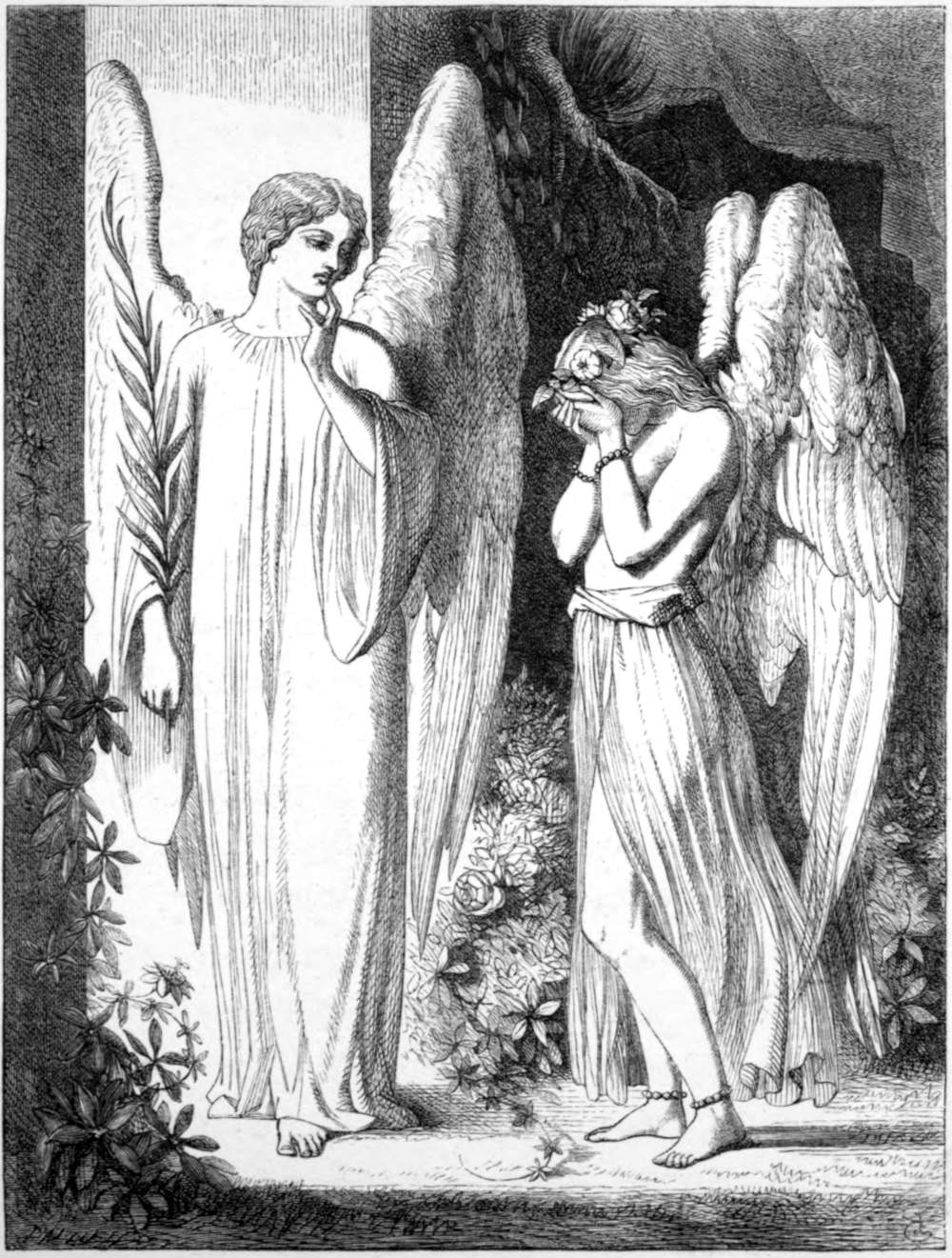
One morn a Peri at the gate
Of Eden stood, disconsolate;
And as she listen’d to the Springs
Of Life within, like music flowing,
130And caught the light upon her wings
Through the half-open portal glowing,
She wept to think her recreant race
Should e’er have lost that glorious place!
“How happy,” exclaim’d this child of air,
“Are the holy Spirits who wander there,
“Mid flowers that never shall fade or fall;
“Though mine are the gardens of earth and sea,
“And the stars themselves have flowers for me,
“One blossom of Heaven out-blooms them all!
“Though sunny the Lake of cool Cashmere,
“With its plane-tree Isle reflected clear,[159]
“And sweetly the founts of that Valley fall;
“Though bright are the waters of Sing-su-hay,
“And the golden floods that thitherward stray,[160]
“Yet—oh, ’tis only the Blest can say
“How the waters of Heaven outshine them all!
“Go, wing thy flight from star to star,
“From world to luminous world, as far
“As the universe spreads its flaming wall:
“Take all the pleasures of all the spheres,
“And multiply each through endless years,
“One minute of Heaven is worth them all!”
131
The glorious Angel, who was keeping
The gates of Light, beheld her weeping;
And, as he nearer drew and listen’d
To her sad song, a tear-drop glisten’d
Within his eyelids, like the spray
From Eden’s fountain, when it lies
On the blue flower, which—Bramins say—
Blooms nowhere but in Paradise.[161]
“Nymph of a fair but erring line!”
Gently he said—“One hope is thine.
“’Tis written in the Book of Fate,
“The Peri yet may be forgiven
“Who brings to this Eternal gate
“The Gift that is most dear to Heaven!
“Go, seek it, and redeem thy sin—
“’Tis sweet to let the Pardon’d in.”
Rapidly as comets run
To the’ embraces of the Sun;—
Fleeter than the starry brands
Flung at night from angel hands,[162]
At those dark and daring sprites
Who would climb the’ empyreal heights,
Down the blue vault the Peri flies,
And, lighted earthward by a glance
132That just then broke from morning’s eyes,
Hung hovering o’er our world’s expanse.
But whither shall the Spirit go
To find this gift for Heaven?—“I know
“The wealth,” she cries, “of every urn,
“In which unnumber’d rubies burn,
“Beneath the pillars of Chilminar;[163]
“I know where the Isles of Perfume are,
“Many a fathom down in the sea,
“To the south of sun-bright Araby;[164]
“I know, too, where the Genii hid
“The jewell’d cup of their King Jamshid,[165]
“With Life’s elixir sparkling high—
“But gifts like these are not for the sky.
“Where was there ever a gem that shone
“Like the steps of Alla’s wonderful Throne?
“And the Drops of Life—oh! what would they be
“In the boundless Deep of Eternity?”
While thus she mus’d, her pinions fann’d
The air of that sweet Indian land,
Whose air is balm; whose ocean spreads
O’er coral rocks, and amber beds:[166]
Whose mountains, pregnant by the beam
Of the warm sun, with diamonds teem;
133Whose rivulets are like rich brides,
Lovely, with gold beneath their tides;
Whose sandal groves and bowers of spice
Might be a Peri’s Paradise!
But crimson now her rivers ran
With human blood—the smell of death
Came reeking from those spicy bowers,
And man, the sacrifice of man,
Mingled his taint with every breath
Up wafted from the innocent flowers.
Land of the Sun! what foot invades
Thy Pagods and thy pillar’d shades[167]—
Thy cavern shrines, and Idol stones,
Thy Monarchs and their thousand Thrones?[168]
’Tis He of Gazna[169]—fierce in wrath
He comes, and India’s diadems
Lie scatter’d in his ruinous path.—
His bloodhounds he adorns with gems,
Torn from the violated necks
Of many a young and lov’d Sultana;[170]
Maidens, within their pure Zenana,
Priests in the very fane he slaughters,
And choaks up with the glittering wrecks
Of golden shrines the sacred waters!
Downward the Peri turns her gaze,
And, through the war-field’s bloody haze
134Beholds a youthful warrior stand,
Alone, beside his native river,—
The red blade broken in his hand,
And the last arrow in his quiver.
“Live,” said the Conqueror, “live to share
“The trophies and the crowns I bear!”
Silent that youthful warrior stood—
Silent he pointed to the flood
All crimson with his country’s blood,
Then sent his last remaining dart,
For answer, to the’ Invader’s heart.
False flew the shaft, though pointed well;
The Tyrant liv’d, the Hero fell!—
Yet mark’d the Peri where he lay,
And, when the rush of war was past,
Swiftly descending on a ray
Of morning light, she caught the last—
Last glorious drop his heart had shed,
Before its free-born spirit fled!
“Be this,” she cried, as she wing’d her flight,
“My welcome gift at the Gates of Light.
“Though foul are the drops that oft distil
“On the field of warfare, blood like this,
“For Liberty shed, so holy is,[171]
135“It would not stain the purest rill,
“That sparkles among the Bowers of Bliss!
“Oh, if there be, on this earthly sphere,
“A boon, an offering Heaven holds dear,
“’Tis the last libation Liberty draws
“From the heart that bleeds and breaks in her cause!”
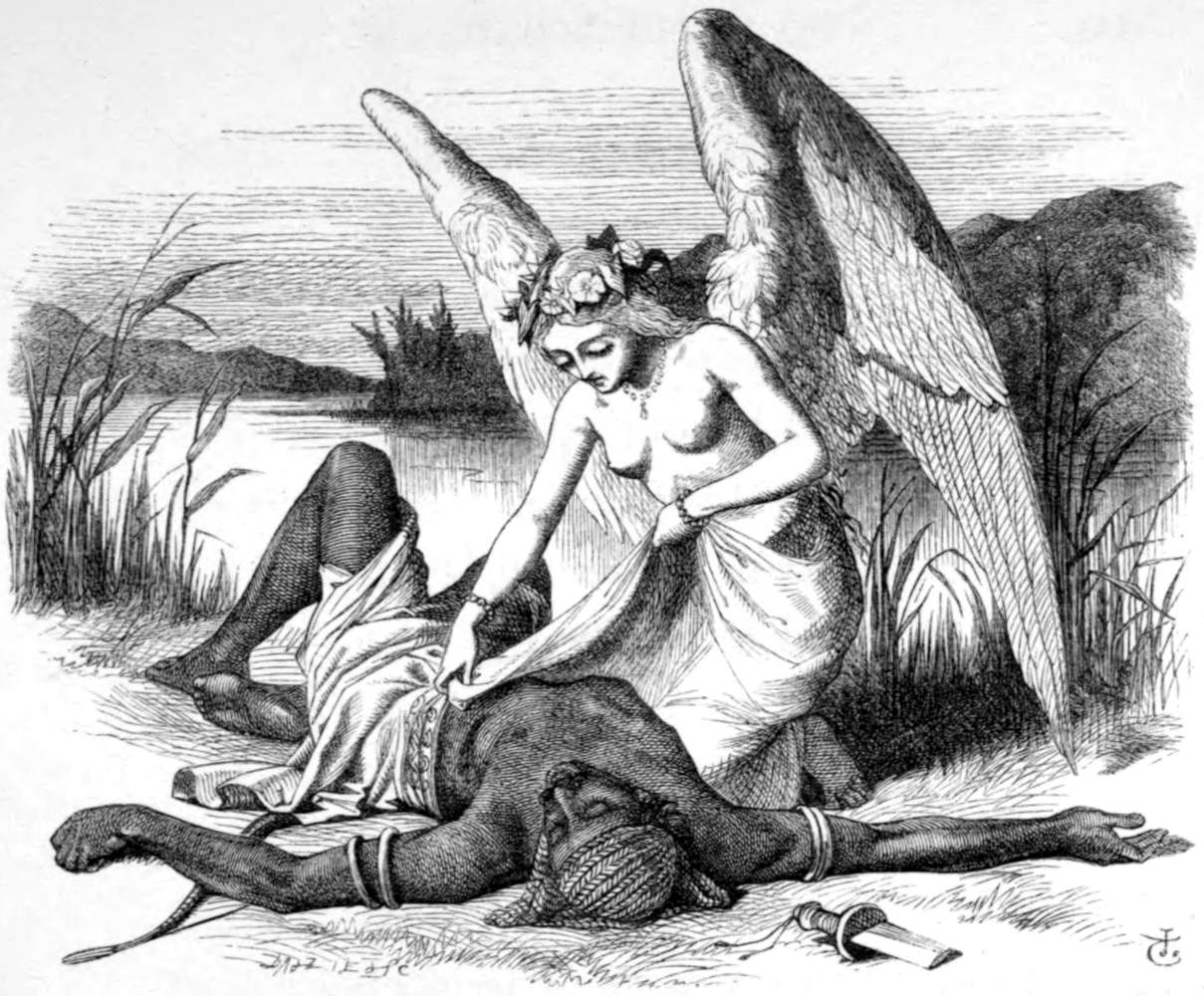
“Sweet,” said the Angel, as she gave
The gift into his radiant hand,
“Sweet is our welcome of the Brave
“Who die thus for their native Land.—
“But see—alas!—the crystal bar
136“Of Eden moves not—holier far
“Than even this drop the boon must be,
“That opes the Gates of Heaven for thee!”
Her first fond hope of Eden blighted,
Now among Afric’s lunar Mountains,[172]
Far to the South the Peri lighted;
And sleek’d her plumage at the fountains
Of that Egyptian tide—whose birth
Is hidden from the sons of earth
Deep in those solitary woods,
Where oft the Genii of the Floods
Dance round the cradle of their Nile,
And hail the new-born Giant’s smile.[173]
Thence over Egypt’s palmy groves,
Her grots, and sepulchres of Kings,[174]
The exil’d Spirit sighing roves;
And now hangs listening to the doves
In warm Rosetta’s vale[175]—now loves
To watch the moonlight on the wings
Of the white pelicans that break
The azure calm of Mœris’ Lake.[176]
’Twas a fair scene—a Land more bright
Never did mortal eye behold!
Who could have thought, that saw this night
Those valleys and their fruits of gold
137Basking in Heaven’s serenest light;—
Those groups of lovely date-trees bending
Languidly their leaf-crown’d heads,
Like youthful maids, when sleep descending
Warns them to their silken beds;[177]—
Those virgin lilies, all the night
Bathing their beauties in the lake,
That they may rise more fresh and bright,
When their beloved Sun’s awake;—
Those ruin’d shrines and towers that seem
The relics of a splendid dream;
Amid whose fairy loneliness
Nought but the lapwing’s cry is heard,
Nought seen but (when the shadows, flitting
Fast from the moon, unsheath its gleam,)
Some purple-wing’d Sultana[178] sitting
Upon a column, motionless
And glittering like an Idol bird!—
Who could have thought, that there, even there,
Amid those scenes so still and fair,
The Demon of the Plague hath cast
From his hot wing a deadlier blast,
More mortal far than ever came
From the red Desert’s sands of flame!
So quick, that every living thing
Of human shape, touch’d by his wing,
138Like plants, where the Simoom hath past,
At once falls black and withering!
The sun went down on many a brow,
Which, full of bloom and freshness then,
Is rankling in the pest-house now,
And ne’er will feel that sun again.
And, oh! to see the’ unburied heaps
On which the lonely moonlight sleeps—
The very vultures turn away,
And sicken at so foul a prey!
Only the fierce hyæna stalks[179]
Throughout the city’s desolate walks[180]
At midnight, and his carnage plies:—
Woe to the half-dead wretch, who meets
The glaring of those large blue eyes[181]
Amid the darkness of the streets!
“Poor race of men!” said the pitying Spirit,
“Dearly ye pay for your primal Fall—
“Some flow’rets of Eden ye still inherit,
“But the trail of the Serpent is over them all!”
She wept—the air grew pure and clear
Around her, as the bright drops ran;
For there’s a magic in each tear
Such kindly Spirits weep for man!
Just then beneath some orange trees,
139Whose fruit and blossoms in the breeze
Were wantoning together, free,
Like age at play with infancy—
Beneath that fresh and springing bower,
Close by the Lake, she heard the moan
Of one who, at this silent hour,
Had thither stolen to die alone.
One who in life, where’er he mov’d,
Drew after him the hearts of many;
Yet now, as though he ne’er were lov’d,
Dies here unseen, unwept by any!
None to watch near him—none to slake
The fire that in his bosom lies,
With even a sprinkle from that lake,
Which shines so cool before his eyes.
No voice, well known through many a day,
To speak the last, the parting word,
Which, when all other sounds decay,
Is still like distant music heard;—
That tender farewell on the shore
Of this rude world, when all is o’er,
Which cheers the spirit, ere its bark
Puts off into the unknown Dark.
Deserted youth! one thought alone
Shed joy around his soul in death—
140That she, whom he for years had known,
And lov’d, and might have call’d his own,
Was safe from this foul midnight’s breath,—
Safe in her father’s princely halls,
Where the cool airs from fountain falls,
Freshly perfum’d by many a brand
Of the sweet wood from India’s land,
Were pure as she whose brow they fann’d.
But see—who yonder comes by stealth,[182]
This melancholy bower to seek,
Like a young envoy, sent by Health,
With rosy gifts upon her cheek?
’Tis she—far off, through moonlight dim,
He knew his own betrothed bride,
She, who would rather die with him,
Than live to gain the world beside!—
Her arms are round her lover now,
His livid cheek to hers she presses,
And dips, to bind his burning brow,
In the cool lake her loosen’d tresses.
Ah! once, how little did he think
An hour would come, when he should shrink
With horror from that dear embrace,
Those gentle arms, that were to him
Holy as is the cradling place
141Of Eden’s infant cherubim!
And now he yields—now turns away,
Shuddering as if the venom lay
All in those proffer’d lips alone—
Those lips that, then so fearless grown,
Never until that instant came
Near his unask’d or without shame.
“Oh! let me only breathe the air,
“That blessed air, that’s breath’d by thee,
“And, whether on its wings it bear
“Healing or death, ’tis sweet to me!
“There—drink my tears, while yet they fall—
“Would that my bosom’s blood were balm,
“And, well thou know’st, I’d shed it all,
“To give thy brow one minute’s calm.
“Nay, turn not from me that dear face—
“Am I not thine—thy own lov’d bride—
“The one, the chosen one, whose place
“In life or death is by thy side?
“Think’st thou that she, whose only light,
“In this dim world, from thee hath shone,
“Could bear the long, the cheerless night,
“That must be hers when thou art gone?
“That I can live, and let thee go,
“Who art my life itself?—No, no—
“When the stem dies, the leaf that grew
142“Out of its heart must perish too!
“Then turn to me, my own love, turn,
“Before, like thee, I fade and burn;
“Cling to these yet cool lips, and share
“The last pure life that lingers there!”
She fails—she sinks—as dies the lamp
In charnel airs, or cavern-damp,
So quickly do his baleful sighs
Quench all the sweet light of her eyes.
One struggle—and his pain is past—
Her lover is no longer living!
One kiss the maiden gives, one last,
Long kiss, which she expires in giving!
“Sleep,” said the Peri, as softly she stole
The farewell sigh of that vanishing soul,
As true as e’er warm’d a woman’s breast—
“Sleep on, in visions of odour rest,
“In balmier airs than ever yet stirr’d
“The’ enchanted pile of that lonely bird,
“Who sings at the last his own death-lay,[183]
“And in music and perfume dies away!”
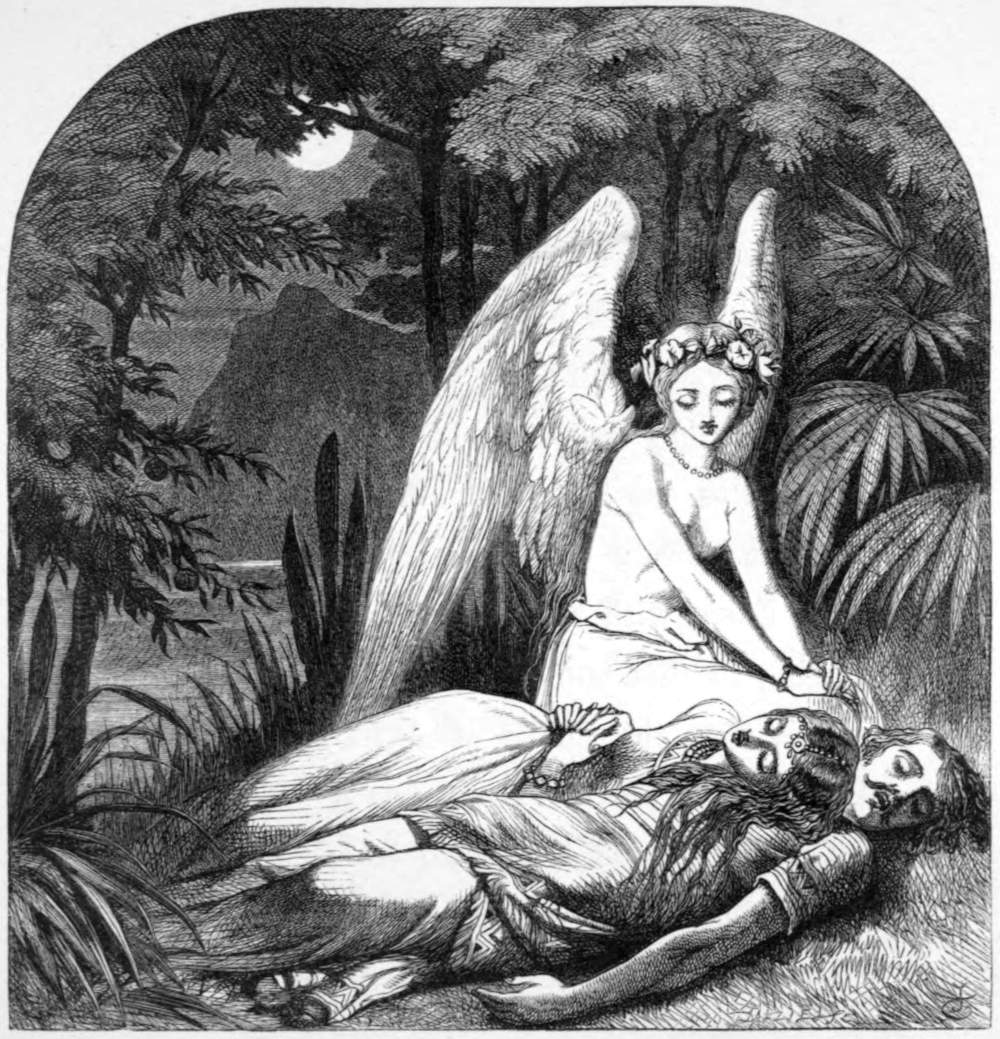
Thus saying, from her lips she spread
Unearthly breathings through the place,
And shook her sparkling wreath, and shed
143Such lustre o’er each paly face,
That like two lovely saints they seem’d,
Upon the eve of doomsday taken
From their dim graves, in odour sleeping;
While that benevolent Peri beam’d
Like their good angel, calmly keeping
Watch o’er them till their souls would waken.
144But morn is blushing in the sky;
Again the Peri soars above,
Bearing to Heaven that precious sigh
Of pure self-sacrificing love.
High throbb’d her heart, with hope elate,
The’ Elysian palm she soon shall win,
For the bright Spirit at the gate
Smil’d as she gave that offering in;
And she already hears the trees
Of Eden, with their crystal bells
Ringing in that ambrosial breeze
That from the throne of Alla swells;
And she can see the starry bowls
That lie around that lucid lake,
Upon whose banks admitted Souls
Their first sweet draught of glory take![184]
But, ah! even Peris’ hopes are vain—
Again the Fates forbade, again
The’ immortal barrier clos’d—“Not yet,”
The Angel said as, with regret,
He shut from her that glimpse of glory—
“True was the maiden, and her story,
“Written in light o’er Alla’s head,
“By seraph eyes shall long be read.
“But, Peri, see—the crystal bar
145“Of Eden moves not—holier far
“Than even this sigh the boon must be
“That opes the Gates of Heaven for thee.”
Now, upon Syria’s land of roses[185]
Softly the light of Eve reposes,
And, like a glory, the broad sun
Hangs over sainted Lebanon;
Whose head in wintry grandeur towers,
And whitens with eternal sleet,
While summer, in a vale of flowers,
Is sleeping rosy at his feet.
To one, who look’d from upper air
O’er all the’ enchanted regions there,
How beauteous must have been the glow,
The life, the sparkling from below!
Fair gardens, shining streams, with ranks
Of golden melons on their banks,
More golden where the sun-light falls;
Gay lizards, glittering on the walls[186]
Of ruin’d shrines, busy and bright
As they were all alive with light;
And, yet more splendid, numerous flocks
Of pigeons, settling on the rocks,
With their rich restless wings, that gleam
146Variously in the crimson beam
Of the warm West,—as if inlaid
With brilliants from the mine, or made
Of tearless rainbows, such as span
The’ unclouded skies of Peristan.
And then the mingling sounds that come
Of shepherd’s ancient reed,[187] with hum
Of the wild bees of Palestine,[188]
Banqueting through the flowery vales;
And, Jordan, those sweet banks of thine,
And woods, so full of nightingales.[189]
But nought can charm the luckless Peri;
Her soul is sad—her wings are weary—
Joyless she sees the Sun look down
On that great Temple, once his own,[190]
Whose lonely columns stand sublime,
Flinging their shadows from on high,
Like dials, which the wizard, Time,
Had rais’d to count his ages by!
Yet haply there may lie conceal’d
Beneath those Chambers of the Sun,
Some amulet of gems anneal’d
In upper fires, some tablet seal’d
With the great name of Solomon,
147Which, spell’d by her illumin’d eyes,
May teach her where, beneath the moon,
In earth or ocean, lies the boon,
The charm, that can restore so soon
An erring Spirit to the skies.
Cheer’d by this hope she bends her thither;—
Still laughs the radiant eye of Heaven,
Nor have the golden bowers of Even
In the rich West begun to wither;—
When, o’er the vale of Balbec winging
Slowly, she sees a child at play,
Among the rosy wild flowers singing,
As rosy and as wild as they;
Chasing, with eager hands and eyes,
The beautiful blue damsel flies,[191]
That flutter’d round the jasmine stems,
Like wingèd flowers or flying gems:—
And, near the boy, who tir’d with play
Now nestling ’mid the roses lay,
She saw a wearied man dismount
From his hot steed, and on the brink
Of a small imaret’s rustic fount[192]
Impatient fling him down to drink.
Then swift his haggard brow he turn’d
To the fair child, who fearless sat,
148Though never yet hath day-beam burn’d
Upon a brow more fierce than that,—
Sullenly fierce—a mixture dire,
Like thunder-clouds, of gloom and fire;
In which the Peri’s eye could read
Dark tales of many a ruthless deed;
149The ruin’d maid—the shrine profan’d—
Oaths broken—and the threshold stain’d
With blood of guests!—there written, all,
Black as the damning drops that fall
From the denouncing Angel’s pen,
Ere Mercy weeps them out again.
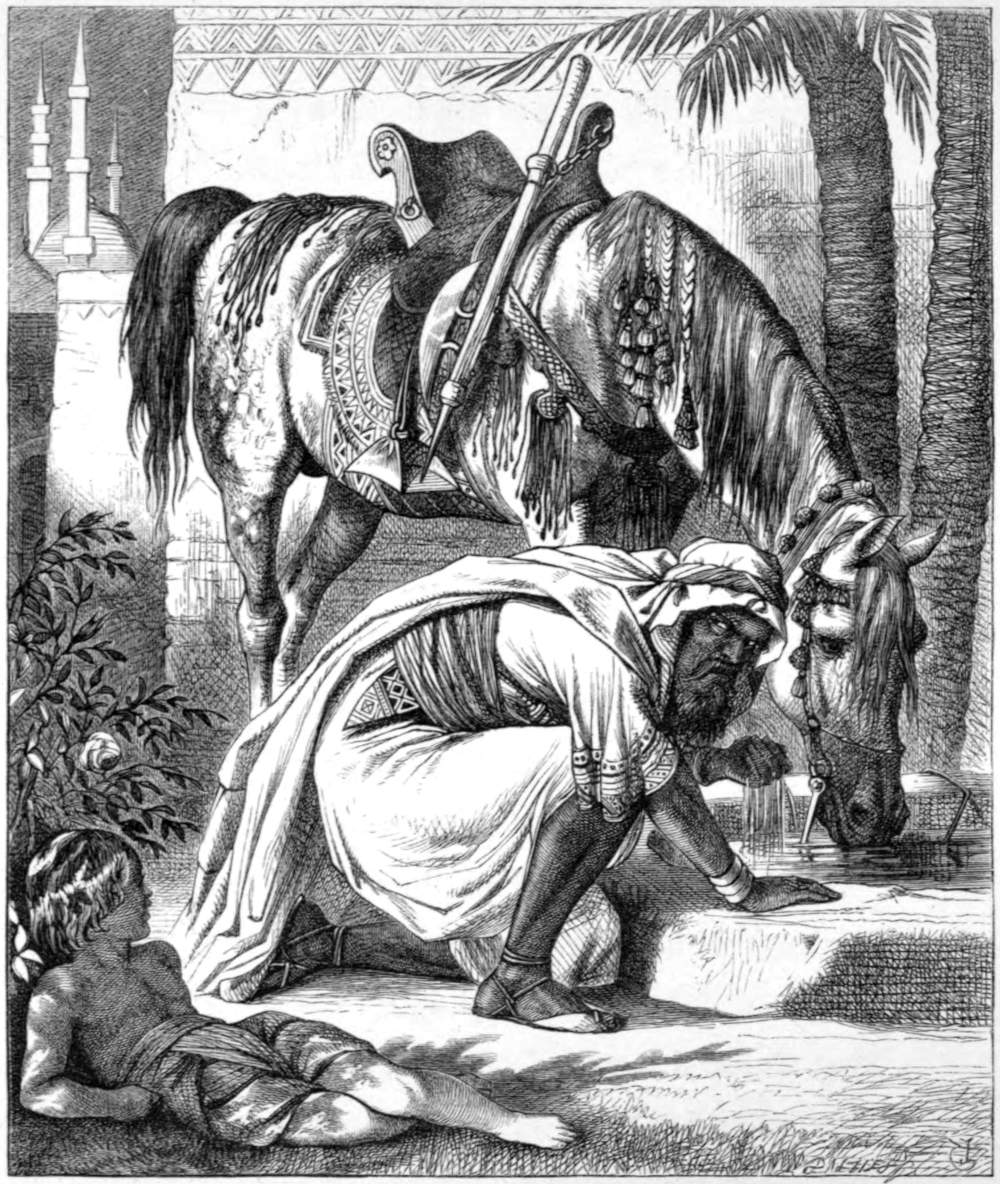
Yet tranquil now that man of crime
(As if the balmy evening time
Soften’d his spirit) look’d and lay,
Watching the rosy infant’s play:—
Though still, whene’er his eye by chance
Fell on the boy’s, its lurid glance
Met that unclouded joyous gaze,
As torches that have burnt all night
Through some impure and godless rite,
Encounter morning’s glorious rays.
But, hark! the vesper call to prayer,
As slow the orb of daylight sets,
Is rising sweetly on the air,
From Syria’s thousand minarets!
The boy has started from the bed
Of flowers, where he had laid his head,
And down upon the fragrant sod
Kneels,[193] with his forehead to the south,
150Lisping the’ eternal name of God
From Purity’s own cherub mouth,
And looking, while his hands and eyes
Are lifted to the glowing skies,
Like a stray babe of Paradise,
Just lighted on that flowery plain,
And seeking for its home again.
Oh! ’twas a sight—that Heaven—that child—
A scene, which might have well beguil’d
Even haughty Eblis of a sigh
For glories lost and peace gone by!
And how felt he, the wretched Man
Reclining there—while memory ran
O’er many a year of guilt and strife,
Flew o’er the dark flood of his life,
Nor found one sunny resting-place,
Nor brought him back one branch of grace!
“There was a time,” he said, in mild,
Heart-humbled tones—“thou blessed child!
“When, young and haply pure as thou,
“I look’d and pray’d like thee—but now—”
He hung his head—each nobler aim,
And hope, and feeling, which had slept
From boyhood’s hour, that instant came
Fresh o’er him, and he wept—he wept!
151
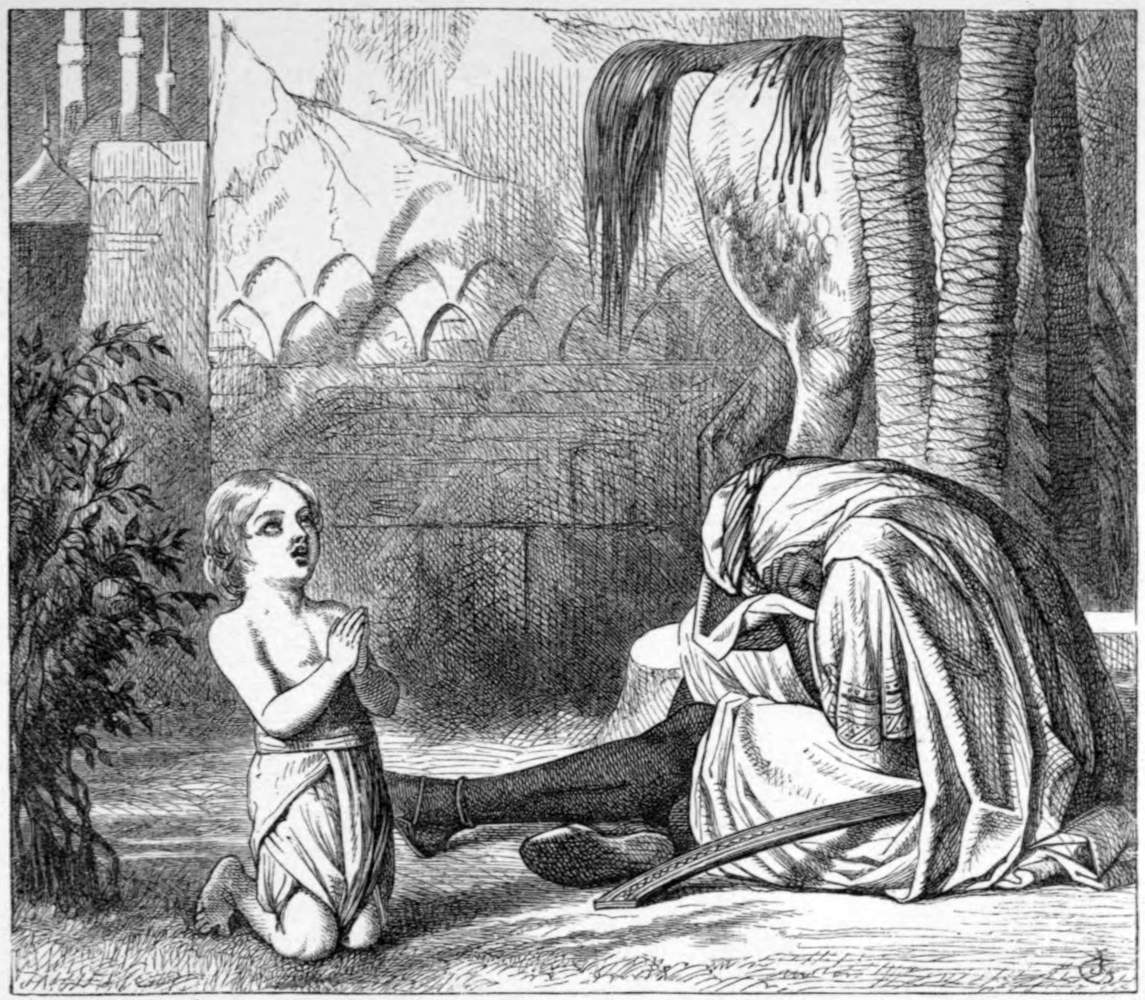
Blest tears of soul-felt penitence!
In whose benign, redeeming flow
Is felt the first, the only sense
Of guiltless joy that guilt can know.
“There’s a drop,” said the Peri, “that down from the moon
“Falls through the withering airs of June
“Upon Egypt’s land,[194] of so healing a power,
“So balmy a virtue, that e’en in the hour
“The drop descends, contagion dies,
“And health re-animates earth and skies!—
“Oh, is it not thus, thou man of sin,
152“The precious tears of repentance fall?
“Though foul thy fiery plagues within,
“One heavenly drop hath dispell’d them all!”
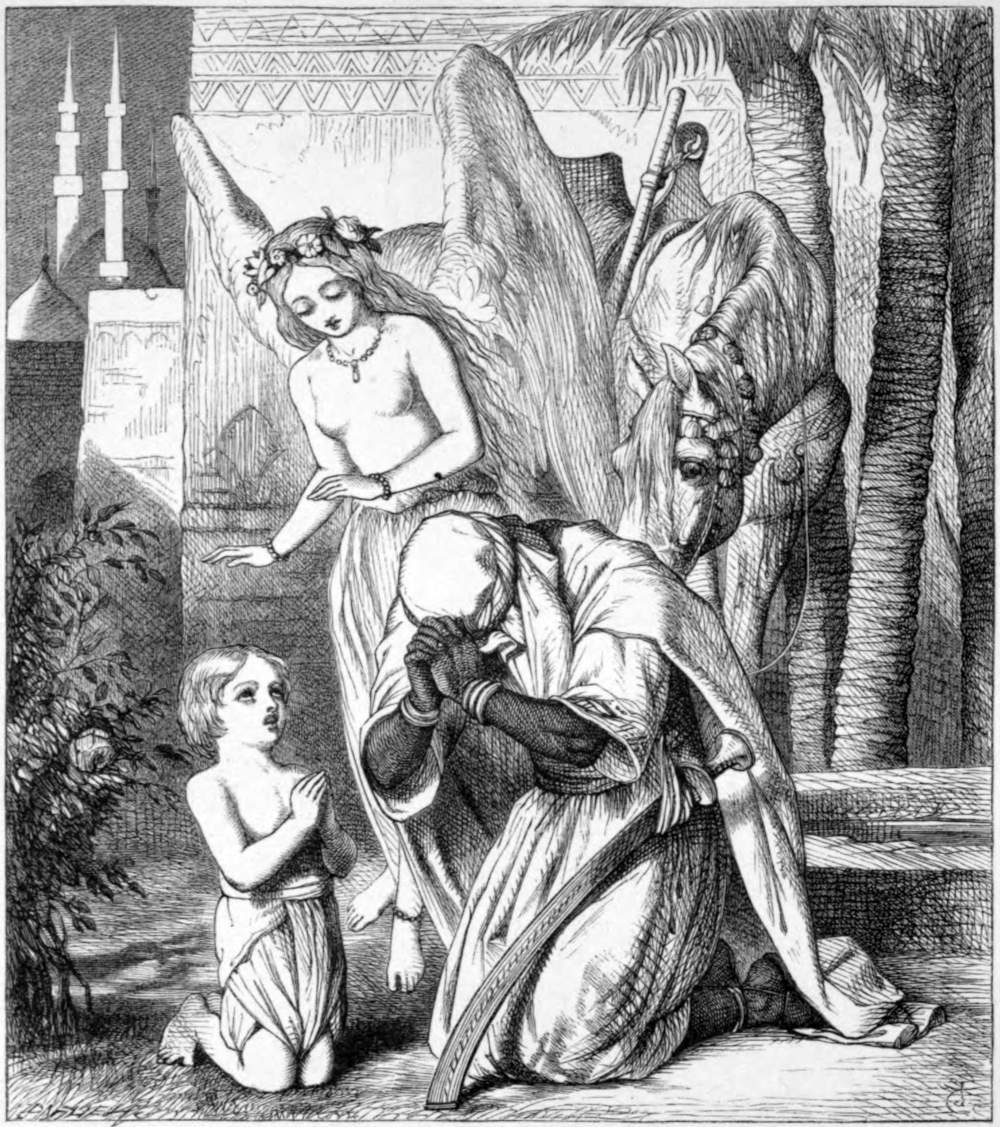
And now—behold him kneeling there
By the child’s side, in humble prayer,
While the same sunbeam shines upon
The guilty and the guiltless one,
153And hymns of joy proclaim through Heaven
The triumph of a Soul Forgiven!
’Twas when the golden orb had set,
While on their knees they linger’d yet,
There fell a light more lovely far
Than ever came from sun or star,
Upon the tear that, warm and meek,
Dew’d that repentant sinner’s cheek.
To mortal eye this light might seem
A northern flash or meteor beam—
But well the’ enraptur’d Peri knew
’Twas a bright smile the Angel threw
From Heaven’s gate, to hail that tear
Her harbinger of glory near!
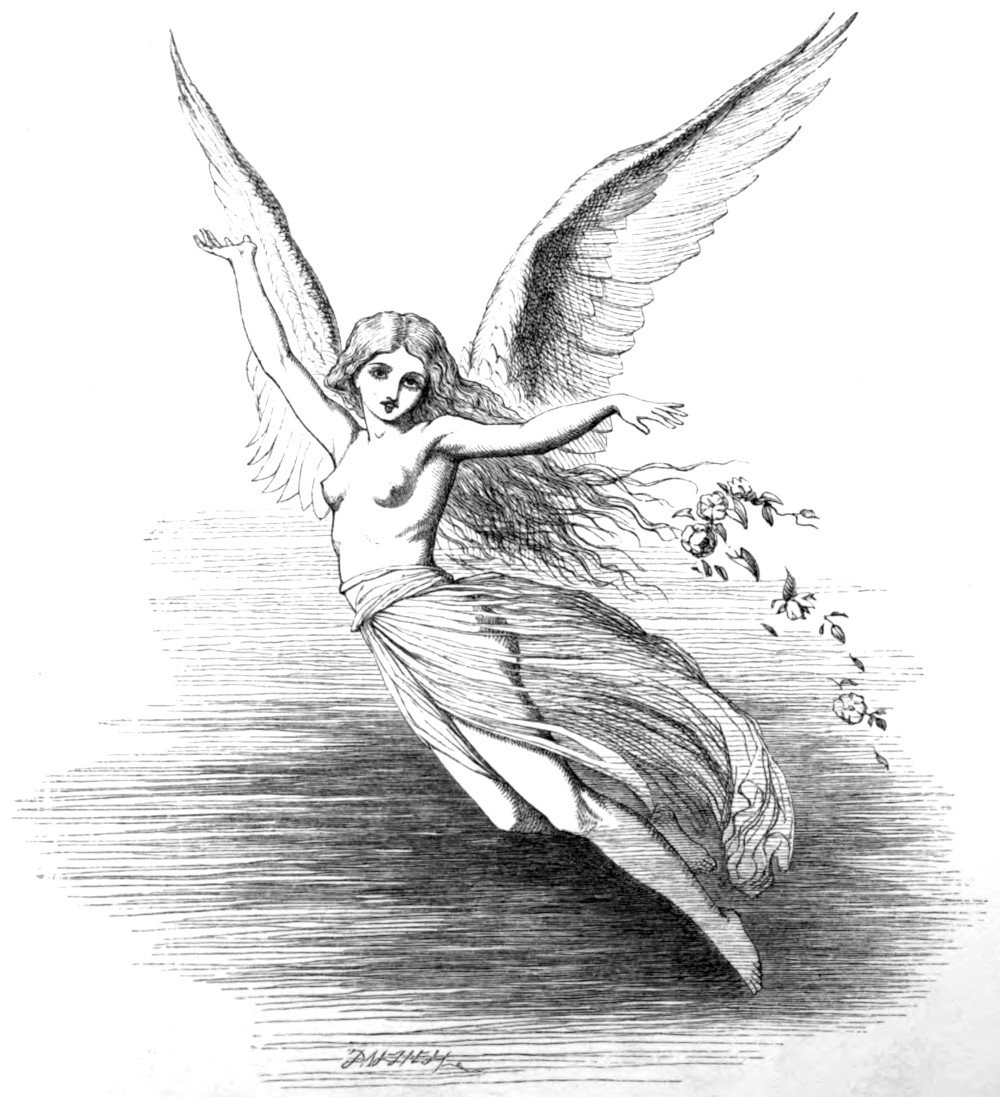
“Joy, joy for ever! my task is done—
“The Gates are pass’d, and Heaven is won!
“Oh! am I not happy? I am, I am—
“To thee, sweet Eden! how dark and sad
“Are the diamond turrets of Shadukiam,[195]
“And the fragrant bowers of Amberabad!
“Farewell, ye odours of Earth, that die
“Passing away like a lover’s sigh;—
“My feast is now of the Tooba Tree,[196]
“Whose scent is the breath of Eternity!
154“Farewell, ye vanishing flowers, that shone
“In my fairy wreath, so bright and brief;—
“Oh! what are the brightest that e’er have blown,
“To the lote-tree, springing by Alla’s throne,[197]
“Whose flowers have a soul in every leaf!
“Joy, joy for ever!—my task is done—
“The Gates are pass’d, and Heaven is won!”
155“And this,” said the Great Chamberlain, “is poetry! this flimsy manufacture of the brain, which, in comparison with the lofty and durable monuments of genius, is as the gold filigree-work of Zamara beside the eternal architecture of Egypt!” After this gorgeous sentence, which, with a few more of the same kind, Fadladeen kept by him for rare and important occasions, he proceeded to the anatomy of the short poem just recited. The lax and easy kind of metre in which it was written ought to be denounced, he said, as one of the leading causes of the alarming growth of poetry in our times. If some check were not given to this lawless facility, we should soon be over-run by a race of bards as numerous and as shallow as the hundred and twenty thousand Streams of Basra.[198] They who succeeded in this style deserved chastisement for their very success;—as warriors have been punished, even after gaining a victory, because they had taken the liberty of gaining it in an irregular or unestablished manner. What, then, was to be said to those who failed? to those who presumed, as in the present lamentable instance, to imitate the license and ease of the bolder sons of song, without any of that grace or vigour which gave a dignity even to negligence;—who, like them, flung the jereed[199] carelessly, but not, like them, to the mark;—“and who,” said he, raising his voice, to excite 156a proper degree of wakefulness in his hearers, “contrive to appear heavy and constrained in the midst of all the latitude they allow themselves, like one of those young pagans that dance before the Princess, who is ingenious enough to move as if her limbs were fettered, in a pair of the lightest and loosest drawers of Masulipatam!”
It was but little suitable, he continued, to the grave march of criticism to follow this fantastical Peri, of whom they had just heard, through all her flights and adventures between earth and heaven; but he could not help adverting to the puerile conceitedness of the Three Gifts which she is supposed to carry to the skies,—a drop of blood, forsooth, a sigh, and a tear! How the first of these articles was delivered into the Angel’s “radiant hand” he professed himself at a loss to discover; and as to the safe carriage of the sigh and the tear, such Peris and such poets were beings by far too incomprehensible for him even to guess how they managed such matters. “But, in short,” said he, “it is a waste of time and patience to dwell longer upon a thing so incurably frivolous,—puny even among its own puny race, and such as only the Banyan Hospital[200] for Sick Insects should undertake.”
In vain did Lalla Rookh try to soften this inexorable critic; in vain did she resort to her most eloquent 157common-places,—reminding him that poets were a timid and sensitive race, whose sweetness was not to be drawn forth, like that of the fragrant grass near the Ganges, by crushing and trampling upon them;[201]—that severity often extinguished every chance of the perfection which it demanded; and that, after all, perfection was like the Mountain of the Talisman,—no one had ever yet reached its summit.[202] Neither these gentle axioms, nor the still gentler looks with which they were inculcated, could lower for one instant the elevation of Fadladeen’s eyebrows, or charm him into any thing like encouragement, or even toleration, of her poet. Toleration, indeed, was not among the weaknesses of Fadladeen:—he carried the same spirit into matters of poetry and of religion, and, though little versed in the beauties or sublimities of either, was a perfect master of the art of persecution in both. His zeal was the same, too, in either pursuit; whether the game before him was pagans or poetasters,—worshippers of cows, or writers of epics.
They had now arrived at the splendid city of Lahore, whose mausoleums and shrines, magnificent and numberless, where Death appeared to share equal honours with Heaven, would have powerfully affected the heart and imagination of Lalla Rookh, if feelings more of this earth had not taken entire possession of her already. She 158was here met by messengers, despatched from Cashmere, who informed her that the King had arrived in the Valley, and was himself superintending the sumptuous preparations that were then making in the Saloons of the Shalimar for her reception. The chill she felt on receiving this intelligence,—which to a bride whose heart was free and light would have brought only images of affection and pleasure,—convinced her that her peace was gone for ever, and that she was in love, irretrievably in love, with young Feramorz. The veil had fallen off in which this passion at first disguises itself, and to know that she loved was now as painful as to love without knowing it had been delicious. Feramorz, too,—what misery would be his, if the sweet hours of intercourse so imprudently allowed them should have stolen into his heart the same fatal fascination as into hers;—if, notwithstanding her rank, and the modest homage he always paid to it, even he should have yielded to the influence of those long and happy interviews, where music, poetry, the delightful scenes of nature,—all had tended to bring their hearts close together, and to waken by every means that too ready passion, which often, like the young of the desert-bird, is warmed into life by the eyes alone![203] She saw but one way to preserve herself from being culpable as well as unhappy, and this, however painful, she was resolved to adopt. Feramorz must no more be admitted 159to her presence. To have strayed so far into the dangerous labyrinth was wrong, but to linger in it, while the clue was yet in her hand, would be criminal. Though the heart she had to offer to the King of Bucharia might be cold and broken, it should at least be pure; and she must only endeavour to forget the short dream of happiness she had enjoyed,—like that Arabian shepherd, who, in wandering into the wilderness, caught a glimpse of the Gardens of Irim, and then lost them again for ever![204]
The arrival of the young Bride at Lahore was celebrated in the most enthusiastic manner. The Rajas and Omras in her train, who had kept at a certain distance during the journey, and never encamped nearer to the Princess than was strictly necessary for her safeguard, here rode in splendid cavalcade through the city, and distributed the most costly presents to the crowd. Engines were erected in all the squares, which cast forth showers of confectionery among the people; while the artisans, in chariots[205] adorned with tinsel and flying streamers, exhibited the badges of their respective trades through the streets. Such brilliant displays of life and pageantry among the palaces, and domes, and gilded minarets of Lahore, made the city altogether like a place of enchantment;—particularly on the day when Lalla Rookh set out again upon her journey, when she was accompanied to the gate by all 160the fairest and richest of the nobility, and rode along between ranks of beautiful boys and girls, who kept waving over their heads plates of gold and silver flowers,[206] and then threw them around to be gathered by the populace.
For many days after their departure from Lahore, a considerable degree of gloom hung over the whole party. Lalla Rookh, who had intended to make illness her excuse for not admitting the young minstrel, as usual, to the pavilion, soon found that to feign indisposition was unnecessary;—Fadladeen felt the loss of the good road they had hitherto travelled, and was very near cursing Jehan-Guire (of blessed memory!) for not having continued his delectable alley of trees,[207] at least as far as the mountains of Cashmere;—while the Ladies, who had nothing now to do all day but to be fanned by peacocks’ feathers and listen to Fadladeen, seemed heartily weary of the life they led, and, in spite of all the Great Chamberlain’s criticisms, were so tasteless as to wish for the poet again. One evening, as they were proceeding to their place of rest for the night, the Princess, who, for the freer enjoyment of the air, had mounted her favourite Arabian palfrey, in passing by a small grove, heard the notes of a lute from within its leaves, and a voice, which she but too well knew, singing the following words:—
161Tell me not of joys above,
If that world can give no bliss,
Truer, happier than the Love
Which enslaves our souls in this.
Tell me not of Houris’ eyes;—
Far from me their dangerous glow,
If those looks that light the skies
Wound like some that burn below.
Who, that feels what Love is here,
All its falsehood—all its pain—
Would, for even Elysium’s sphere,
Risk the fatal dream again?
Who, that midst a desert’s heat
Sees the waters fade away,
Would not rather die than meet
Streams again as false as they?
The tone of melancholy defiance in which these words were uttered, went to Lalla Rookh’s heart;—and, as she reluctantly rode on, she could not help feeling it to 162be a sad but still sweet certainty, that Feramorz was to the full as enamoured and miserable as herself.
The place where they encamped that evening was the first delightful spot they had come to since they left Lahore. On one side of them was a grove full of small Hindoo temples, and planted with the most graceful trees of the East; where the tamarind, the cassia, and the silken plantains of Ceylon were mingled in rich contrast with the high fanlike foliage of the Palmyra,—that favourite tree of the luxurious bird that lights up the chambers of its nest with fire-flies.[208] In the middle of the lawn where the pavilion stood there was a tank surrounded by small mangoe-trees, on the clear cold waters of which floated multitudes of the beautiful red lotus;[209] while at a distance stood the ruins of a strange and awful-looking tower, which seemed old enough to have been the temple of some religion no longer known, and which spoke the voice of desolation in the midst of all that bloom and loveliness. This singular ruin excited the wonder and conjectures of all. Lalla Rookh guessed in vain, and the all-pretending Fadladeen, who had never till this journey been beyond the precincts of Delhi, was proceeding most learnedly to show that he knew nothing whatever about the matter, when one of the Ladies suggested that perhaps Feramorz could satisfy 163their curiosity. They were now approaching his native mountains, and this tower might perhaps be a relic of some of those dark superstitions, which had prevailed in that country before the light of Islam dawned upon it. The Chamberlain, who usually preferred his own ignorance to the best knowledge that any one else could give him, was by no means pleased with this officious reference; and the Princess, too, was about to interpose a faint word of objection, but, before either of them could speak, a slave was despatched for Feramorz, who, in a very few minutes, made his appearance before them—looking so pale and unhappy in Lalla Rookh’s eyes, that she repented already of her cruelty in having so long excluded him.
That venerable tower, he told them, was the remains of an ancient Fire-temple, built by those Ghebers or Persians of the old religion, who, many hundred years since, had fled hither from their Arab conquerors,[210] preferring liberty and their altars in a foreign land to the alternative of apostasy or persecution in their own. It was impossible, he added, not to feel interested in the many glorious but unsuccessful struggles, which had been made by these original natives of Persia to cast off the yoke of their bigoted conquerors. Like their own Fire in the Burning Field at Bakou,[211] when suppressed in 164one place, they had but broken out with fresh flame in another; and, as a native of Cashmere, of that fair and Holy Valley, which had in the same manner become the prey of strangers,[212] and seen her ancient shrines and native princes swept away before the march of her intolerant invaders, he felt a sympathy, he owned, with the sufferings of the persecuted Ghebers, which every monument like this before them but tended more powerfully to awaken.
It was the first time that Feramorz had ever ventured upon so much prose before Fadladeen, and it may easily be conceived what effect such prose as this must have produced upon that most orthodox and most pagan-hating personage. He sat for some minutes aghast, ejaculating only at intervals, “Bigoted conquerors!—sympathy with Fire-worshippers!”[213]—while Feramorz, happy to take advantage of this almost speechless horror of the Chamberlain, proceeded to say that he knew a melancholy story, connected with the events of one of those struggles of the brave Fire-worshippers against their Arab masters, which, if the evening was not too far advanced, he should have much pleasure in being allowed to relate to the Princess. It was impossible for Lalla Rookh to refuse;—he had never before looked half so animated; and when he spoke of the Holy Valley his 165eyes had sparkled, she thought, like the talismanic characters on the scimitar of Solomon. Her consent was therefore most readily granted; and while Fadladeen sat in unspeakable dismay, expecting treason and abomination in every line, the poet thus began his story of the Fire-worshippers:—
The Fire Worshippers
169
’Tis moonlight over Oman’s Sea;[214]
Her banks of pearl and palmy isles
Bask in the night-beam beauteously,
And her blue waters sleep in smiles.
’Tis moonlight in Harmozia’s[215] walls,
And through her Emir’s porphyry halls,
Where, some hours since, was heard the swell
Of trumpet and the clash of zel,[216]
Bidding the bright-eyed sun farewell;—
The peaceful sun, whom better suits
The music of the bulbul’s nest,
Or the light touch of lovers’ lutes,
170To sing him to his golden rest.
All hush’d—there’s not a breeze in motion;
The shore is silent as the ocean.
If zephyrs come, so light they come,
Nor leaf is stirr’d nor wave is driven;—
The wind-tower on the Emir’s dome[217]
Can hardly win a breath from heaven.
Even he, that tyrant Arab, sleeps
Calm, while a nation round him weeps;
While curses load the air he breathes,
And falchions from unnumbered sheaths
Are starting to avenge the shame
His race hath brought on Iran’s[218] name.
Hard, heartless Chief, unmov’d alike
Mid eyes that weep, and swords that strike;—
One of that saintly, murderous brood,
To carnage and the Koran given,
Who think through unbelievers’ blood
Lies their directest path to heaven;—
One, who will pause and kneel unshod
In the warm blood his hand hath pour’d,
To mutter o’er some text of God
Engraven on his reeking sword;[219]—
Nay, who can coolly note the line,
The letter of those words divine,
171To which his blade, with searching art,
Had sunk into its victim’s heart!
Just Alla! what must be thy look,
When such a wretch before thee stands
Unblushing, with thy Sacred Book,—
Turning the leaves with blood-stain’d hands,
And wresting from its page sublime
His creed of lust, and hate, and crime;—
Even as those bees of Trebizond,
Which, from the sunniest flowers that glad
With their pure smile the gardens round,
Draw venom forth that drives men mad.[220]
Never did fierce Arabia send
A satrap forth more direly great;
Never was Iran doom’d to bend
Beneath a yoke of deadlier weight.
Her throne had fallen—her pride was crush’d—
Her sons were willing slaves, nor blush’d,
In their own land,—no more their own,—
To crouch beneath a stranger’s throne.
Her towers, where Mithra once had burn’d,
To Moslem shrines—oh shame!—were turn’d,
Where slaves, converted by the sword,
Their mean, apostate worship pour’d,
172And curs’d the faith their sires ador’d.
Yet has she hearts, mid all this ill,
O’er all this wreck high buoyant still
With hope and vengeance;—hearts that yet—
Like gems, in darkness, issuing rays
They’ve treasur’d from the sun that’s set,—
Beam all the light of long-lost days!
And swords she hath, nor weak nor slow
To second all such hearts can dare;
As he shall know, well, dearly know,
Who sleeps in moonlight luxury there,
Tranquil as if his spirit lay
Becalm’d in Heaven’s approving ray.
Sleep on—for purer eyes than thine
Those waves are hush’d, those planets shine;
Sleep on, and be thy rest unmov’d
By the white moonbeam’s dazzling power;—
None but the loving and the lov’d
Should be awake at this sweet hour.
And see—where, high above those rocks
That o’er the deep their shadows fling,
Yon turret stands;—where ebon locks,
As glossy as a heron’s wing
Upon the turban of a king,[221]
Hang from the lattice, long and wild—
173’Tis she, that Emir’s blooming child,
All truth and tenderness and grace,
Though born of such ungentle race;—
An image of Youth’s radiant Fountain
Springing in a desolate mountain![222]
Oh what a pure and sacred thing
Is Beauty, curtain’d from the sight
Of the gross world, illumining
One only mansion with her light!
Unseen by man’s disturbing eye,—
The flower that blooms beneath the sea,
Too deep for sunbeams, doth not lie
Hid in more chaste obscurity.
So, Hinda, have thy face and mind,
Like holy mysteries, lain enshrin’d.
And oh, what transport for a lover
To lift the veil that shades them o’er!—
Like those who, all at once, discover
In the lone deep some fairy shore,
Where mortal never trod before,
And sleep and wake in scented airs
No lip had ever breath’d but theirs.
Beautiful are the maids that glide,
On summer-eves, through Yemen’s[223] dales,
174And bright the glancing looks they hide
Behind their litters’ roseate veils;—
And brides, as delicate and fair
As the white jasmine flowers they wear,
Hath Yemen in her blissful clime,
Who, lull’d in cool kiosk or bower,[224]
Before their mirrors count the time,[225]
And grow still lovelier every hour.
But never yet hath bride or maid
In Araby’s gay Haram smil’d,
Whose boasted brightness would not fade
Before Al Hassan’s blooming child.
Light as the angel shapes that bless
An infant’s dream, yet not the less
Rich in all woman’s loveliness;—
With eyes so pure, that from their ray
Dark Vice would turn abash’d away,
Blinded like serpents, when they gaze
Upon the emerald’s virgin blaze;[226]—
Yet fill’d with all youth’s sweet desires,
Mingling the meek and vestal fires
Of other worlds with all the bliss,
The fond, weak tenderness of this:
A soul, too, more than half divine,
Where, through some shades of earthly feeling.
175Religion’s soften’d glories shine,
Like light through summer foliage stealing,
Shedding a glow of such mild hue,
So warm, and yet so shadowy too,
As makes the very darkness there
More beautiful than light elsewhere.
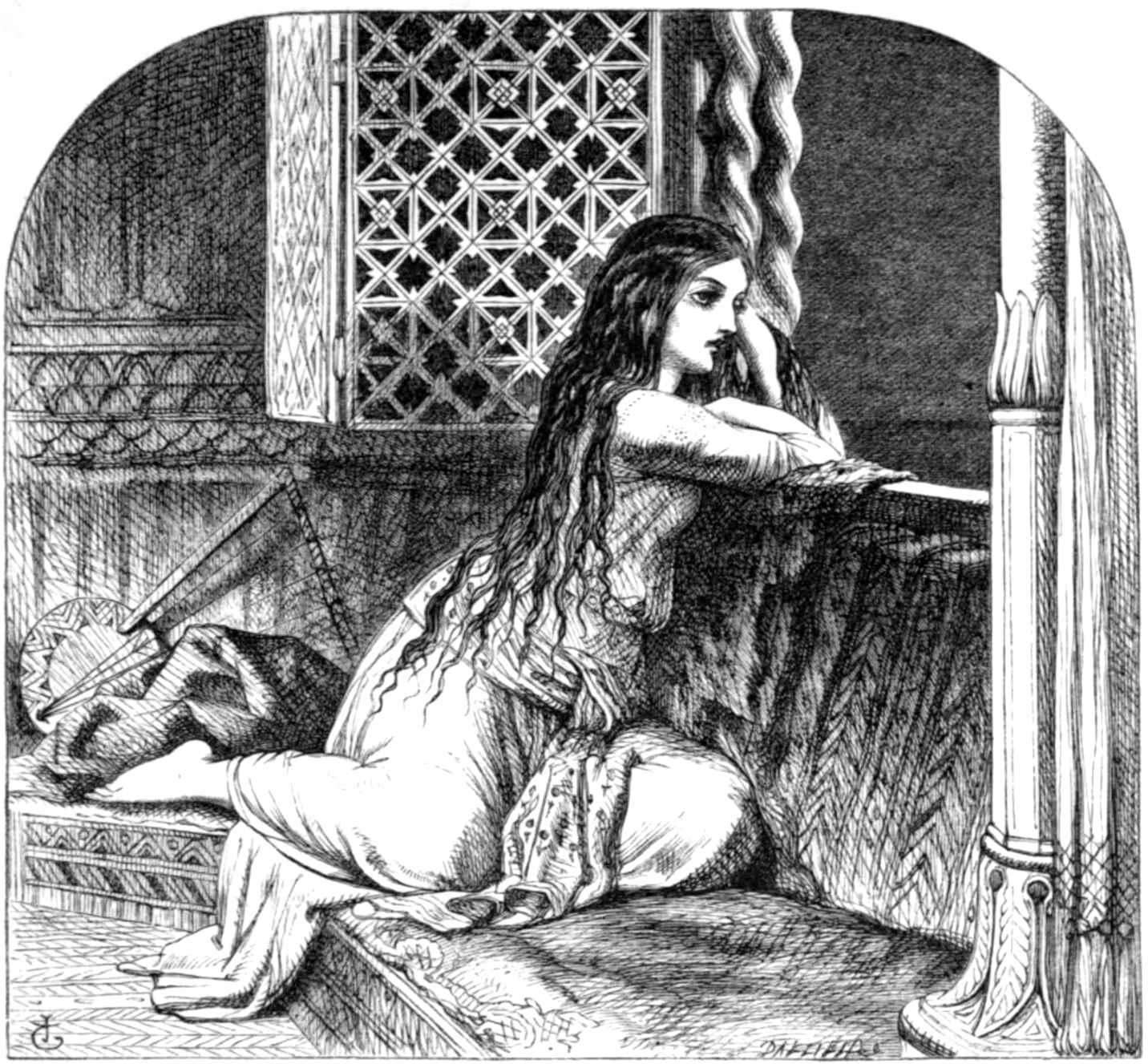
Such is the maid who, at this hour,
Hath risen from her restless sleep,
And sits alone in that high bower,
Watching the still and shining deep.
Ah! ’twas not thus,—with tearful eyes
And beating heart,—she used to gaze
On the magnificent earth and skies,
In her own land, in happier days.
Why looks she now so anxious down
Among those rocks, whose rugged frown
Blackens the mirror of the deep?
Whom waits she all this lonely night?
Too rough the rocks, too bold the steep,
For man to scale that turret’s height!—
So deem’d at least her thoughtful sire,
When high, to catch the cool night-air,
After the day-beam’s withering fire,[227]
He built her bower of freshness there,
176And had it deck’d with costliest skill,
And fondly thought it safe as fair:—
Think, reverend dreamer! think so still,
Nor wake to learn what Love can dare;—
Love, all-defying Love, who sees
No charm in trophies won with ease;—
Whose rarest, dearest fruits of bliss
Are pluck’d on Danger’s precipice!
Bolder than they who dare not dive
For pearls, but when the sea’s at rest,
Love, in the tempest most alive,
Hath ever held that pearl the best
He finds beneath the stormiest water.
Yes—Araby’s unrivall’d daughter,
Though high that tower, that rock-way rude,
There’s one who, but to kiss thy cheek,
Would climb the’ untrodden solitude
Of Ararat’s tremendous peak,[228]
And think its steeps, though dark and dread,
Heaven’s pathways, if to thee they led!
Even now thou seest the flashing spray,
That lights his oar’s impatient way;—
Even now thou hear’st the sudden shock
Of his swift bark against the rock,
And stretchest down thy arms of snow,
As if to lift him from below!
177Like her to whom, at dead of night,
The bridegroom, with his locks of light,[229]
Came, in the flush of love and pride,
And scal’d the terrace of his bride;—
When, as she saw him rashly spring,
And midway up in danger cling,
She flung him down her long black hair,
Exclaiming, breathless, “There, love, there!”
And scarce did manlier nerve uphold
The hero Zal in that fond hour,
Than wings the youth who, fleet and bold,
Now climbs the rocks to Hinda’s bower.
See—light as up their granite steeps
The rock-goats of Arabia clamber,[230]
Fearless from crag to crag he leaps,
And now is in the maiden’s chamber.
She loves—but knows not whom she loves,
Nor what his race, nor whence he came;—
Like one who meets, in Indian groves,
Some beauteous bird without a name,
Brought by the last ambrosial breeze,
From isles in the’ undiscover’d seas,
To show his plumage for a day
To wondering eyes, and wing away!
Will he thus fly—her nameless lover?
178Alla forbid! ’twas by a moon
As fair as this, while singing over
Some ditty to her soft Kanoon,[231]
Alone, at this same witching hour,
She first beheld his radiant eyes
Gleam through the lattice of the bower,
Where nightly now they mix their sighs;
And thought some spirit of the air
(For what could waft a mortal there?)
Was pausing on his moonlight way
To listen to her lonely lay!
This fancy ne’er hath left her mind:
And—though, when terror’s swoon had past,
She saw a youth, of mortal kind,
Before her in obeisance cast,—
Yet often since, when he hath spoken
Strange, awful words,—and gleams have broken
From his dark eyes, too bright to bear,
Oh! she hath fear’d her soul was given
To some unhallow’d child of air,
Some erring Spirit cast from heaven,
Like those angelic youths of old,
Who burn’d for maids of mortal mould,
Bewilder’d left the glorious skies,
And lost their heaven for woman’s eyes.
Fond girl! nor fiend nor angel he
179Who woos thy young simplicity;
But one of earth’s impassion’d sons,
As warm in love, as fierce in ire,
As the best heart whose current runs
Full of the Day-God’s living fire.
But quench’d to-night that ardour seems,
And pale his cheek, and sunk his brow;—
Never before, but in her dreams,
Had she beheld him pale as now:
And those were dreams of troubled sleep,
From which ’twas joy to wake and weep;
Visions, that will not be forgot,
But sadden every waking scene,
Like warning ghosts, that leave the spot
All wither’d where they once have been.
“How sweetly,” said the trembling maid,
Of her own gentle voice afraid,
So long had they in silence stood,
Looking upon that tranquil flood—
“How sweetly does the moon-beam smile
“To-night upon yon leafy isle!
“Oft, in my fancy’s wanderings,
“I’ve wish’d that little isle had wings,
“And we, within its fairy bowers,
“Were wafted off to seas unknown,
180“Where not a pulse should beat but ours,
“And we might live, love, die alone!
“Far from the cruel and the cold,—
“Where the bright eyes of angels only
“Should come around us, to behold
“A paradise so pure and lonely.
“Would this be world enough for thee?”—
Playful she turn’d, that he might see
The passing smile her cheek put on;
But when she mark’d how mournfully
His eyes met hers, that smile was gone;
And, bursting into heart-felt tears,
“Yes, yes,” she cried, “my hourly fears,
“My dreams have boded all too right—
“We part—for ever part—to-night!
“I knew, I knew it could not last—
“’Twas bright, ’twas heavenly, but ’tis past
“Oh! ever thus, from childhood’s hour,
“I’ve seen my fondest hopes decay;
“I never lov’d a tree or flower,
“But ’twas the first to fade away.
“I never nurs’d a dear gazelle,
“To glad me with its soft black eye,
“But when it came to know me well,
“And love me, it was sure to die!
“Now too—the joy most like divine
181“Of all I ever dreamt or knew,
“To see thee, hear thee, call thee mine,—
“Oh misery! must I lose that too?
Yet go—on peril’s brink we meet;—
“Those frightful rocks—that treacherous sea—
182“No, never come again—though sweet,
“Though heaven, it may be death to thee.
“Farewell—and blessings on thy way,
“Where’er thou goest, beloved stranger!
“Better to sit and watch that ray,
“And think thee safe, though far away,
“Than have thee near me, and in danger!”
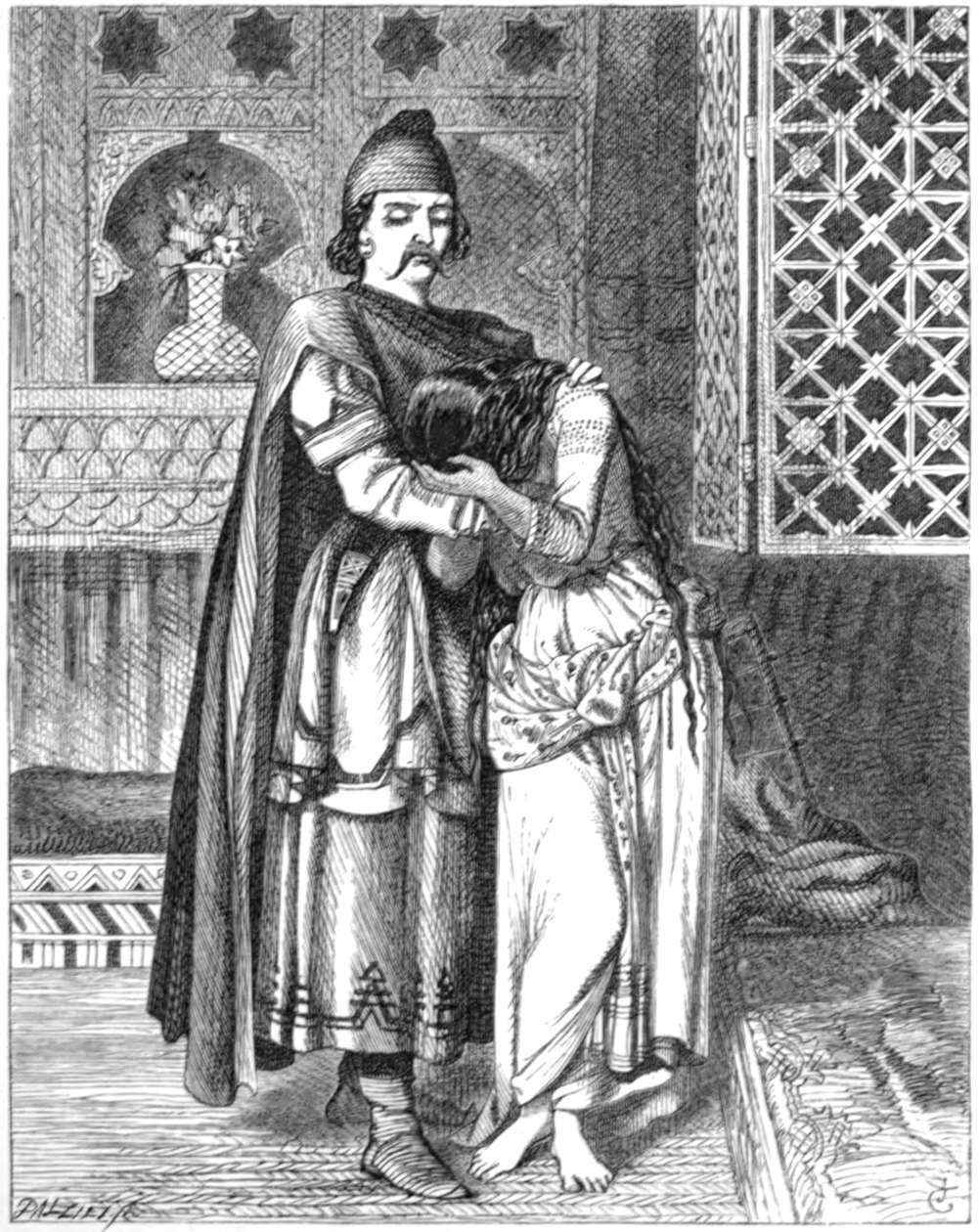
“Danger!—oh, tempt me not to boast—”
The youth exclaim’d—“thou little know’st
“What he can brave, who, born and nurst
“In Danger’s paths, has dar’d her worst;
“Upon whose ear the signal word
“Of strife and death is hourly breaking;
“Who sleeps with head upon the sword
“His fever’d hand must grasp in waking.
“Danger!—”
“Danger!—”“Say on—thou fear’st not then,
“And we may meet—oft meet again?”
“Oh! look not so—beneath the skies
“I now fear nothing but those eyes.
“If aught on earth could charm or force
“My spirit from its destin’d course,—
“If aught could make this soul forget
“The bond to which its seal is set,
183“’Twould be those eyes;—they, only they,
“Could melt that sacred seal away!
“But no—’tis fix’d—my awful doom
“Is fix’d—on this side of the tomb
“We meet no more;—why, why did Heaven
“Mingle two souls that earth has riven,
“Has rent asunder wide as ours?
“Oh, Arab maid, as soon the Powers
“Of Light and Darkness may combine,
“As I be link’d with thee or thine!
“Thy Father⸺”
“Thy Father⸺”“Holy Alla save
“His grey head from that lightning glance!
“Thou know’st him not—he loves the brave;
“Nor lives there under heaven’s expanse
“One who would prize, would worship thee
“And thy bold spirit, more than he.
“Oft when, in childhood, I have play’d
“With the bright falchion by his side,
“I’ve heard him swear his lisping maid
“In time should be a warrior’s bride.
“And still, whene’er at Haram hours
“I take him cool sherbets and flowers,
“He tells me, when in playful mood,
“A hero shall my bridegroom be,
“Since maids are best in battle woo’d,
184“And won with shouts of victory!
“Nay, turn not from me—thou alone
“Art form’d to make both hearts thy own.
“Go—join his sacred ranks—thou know’st
“The’ unholy strife these Persians wage:—
“Good Heaven, that frown!—even now thou glow’st
“With more than mortal warrior’s rage.
“Haste to the camp by morning’s light,
“And, when that sword is raised in fight,
“Oh still remember, Love and I
“Beneath its shadow trembling lie!
“One victory o’er those Slaves of Fire,
“Those impious Ghebers, whom my sire
“Abhors⸺”
“Abhors”“Hold, hold—thy words are death—”
The stranger cried, as wild he flung
His mantle back, and show’d beneath
The Gheber belt that round him clung.—[232]
“Here, maiden, look—weep—blush to see
“All that thy sire abhors in me!
“Yes—I am of that impious race,
“Those Slaves of Fire, who, morn and even,
“Hail their Creator’s dwelling-place
“Among the living lights of heaven:[233]
“Yes—I am of that outcast few,
“To Iran and to vengeance true,
185“Who curse the hour your Arabs came
“To desolate our shrines of flame,
“And swear, before God’s burning eye,
“To break our country’s chains, or die!
“Thy bigot sire,—nay, tremble not,—
“He, who gave birth to those dear eyes,
186“With me is sacred as the spot
“From which our fires of worship rise!
“But know—’twas he I sought that night,
“When, from my watch-boat on the sea,
“I caught this turret’s glimmering light,
“And up the rude rocks desperately
“Rush’d to my prey—thou know’st the rest—
“I climb’d the gory vulture’s nest,
“And found a trembling dove within;—
“Thine, thine the victory—thine the sin—
“If Love hath made one thought his own,
“That Vengeance claims first—last—alone!
“Oh! had we never, never met,
“Or could this heart e’en now forget
“How link’d, how bless’d we might have been,
“Had fate not frown’d so dark between!
“Hadst thou been born a Persian maid,
“In neighbouring valleys had we dwelt,
“Through the same fields in childhood play’d,
“At the same kindling altar knelt,—
“Then, then, while all those nameless ties,
“In which the charm of Country lies,
“Had round our hearts been hourly spun,
“Till Iran’s cause and thine were one;
“While in thy lute’s awakening sigh
“I heard the voice of days gone by,
187“And saw, in every smile of thine,
“Returning hours of glory shine;—
“While the wrong’d Spirit of our Land
“Liv’d, look’d, and spoke her wrongs through thee,—
“God! who could then this sword withstand?
“Its very flash were victory!
“But now—estrang’d, divorc’d for ever,
“Far as the grasp of Fate can sever;
“Our only ties what love has wove,—
“In faith, friends, country, sunder’d wide;
“And then, then only, true to love,
“When false to all that’s dear beside!
“Thy father Iran’s deadliest foe—
“Thyself perhaps, even now—but no—
“Hate never look’d so lovely yet!
“No—sacred to thy soul will be
“The land of him who could forget
“All but that bleeding land for thee.
“When other eyes shall see, unmov’d,
“Her widows mourn, her warriors fall,
“Thou’lt think how well one Gheber lov’d,
“And for his sake thou’lt weep for all!
“But look⸺”
“But look”With sudden start he turn’d
And pointed to the distant wave,
Where lights, like charnel meteors, burn’d
188Bluely, as o’er some seaman’s grave;
And fiery darts, at intervals,[234]
Flew up all sparkling from the main,
As if each star that nightly falls,
Were shooting back to heaven again.
“My signal lights!—I must away—
“Both, both are ruin’d, if I stay.
“Farewell—sweet life! thou cling’st in vain—
“Now, Vengeance, I am thine again!”
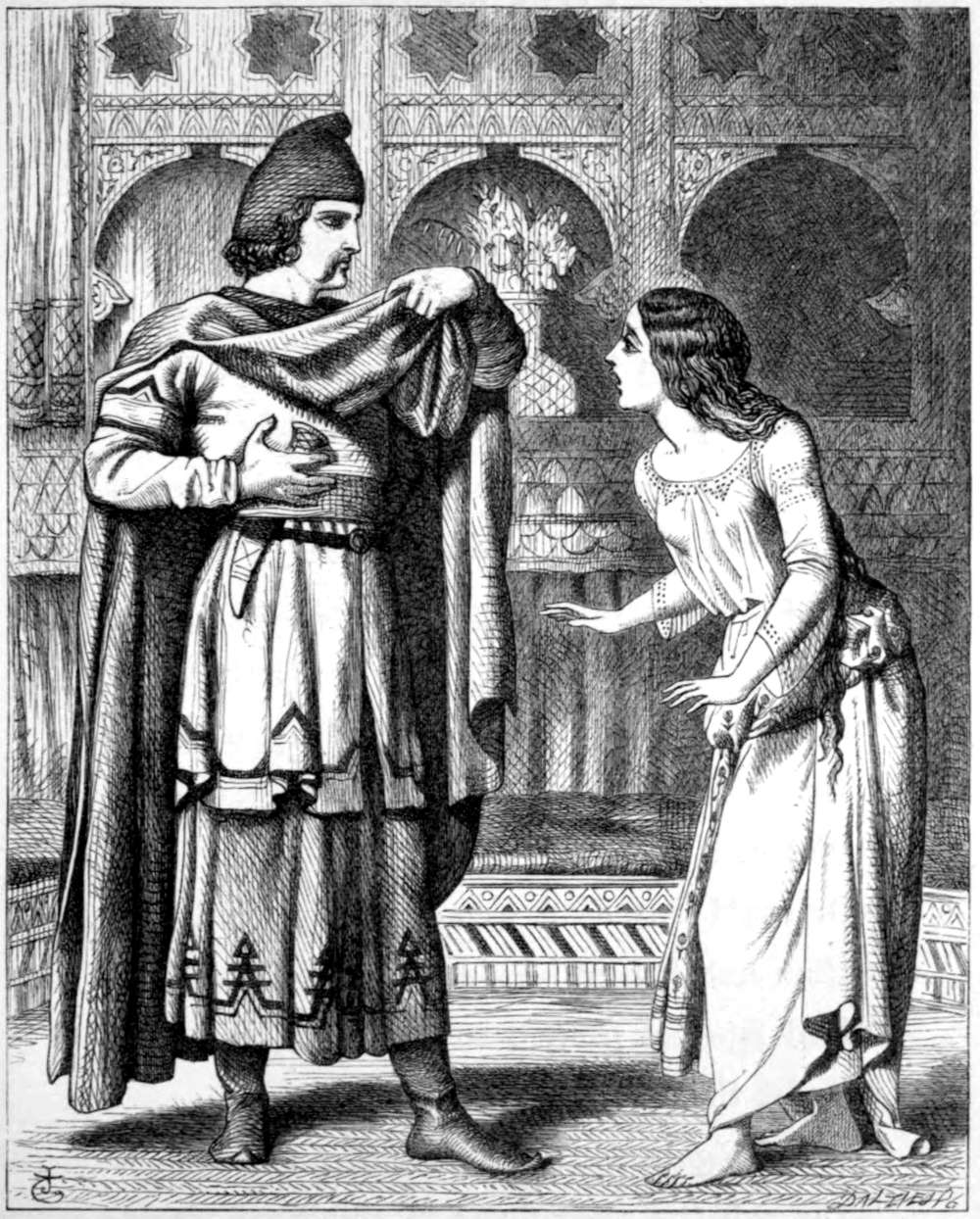
Fiercely he broke away, nor stopp’d,
Nor look’d—but from the lattice dropp’d
Down ’mid the pointed crags beneath,
As if he fled from love to death.
While pale and mute young Hinda stood
Nor mov’d, till in the silent flood
A momentary plunge below
Startled her from her trance of woe;—
Shrieking she to the lattice flew,
“I come—I come—if in that tide
“Thou sleep’st to-night, I’ll sleep there too,
“In death’s cold wedlock, by thy side.
“Oh! I would ask no happier bed
“Than the chill wave my love lies under:—
“Sweeter to rest together dead,
“Far sweeter, than to live asunder!”
189But no—their hour is not yet come—
Again she sees his pinnace fly,
Wafting him fleetly to his home,
Where’er that ill-starr’d home may lie;
And calm and smooth it seem’d to win
Its moonlight way before the wind,
As if it bore all peace within,
Nor left one breaking heart behind!
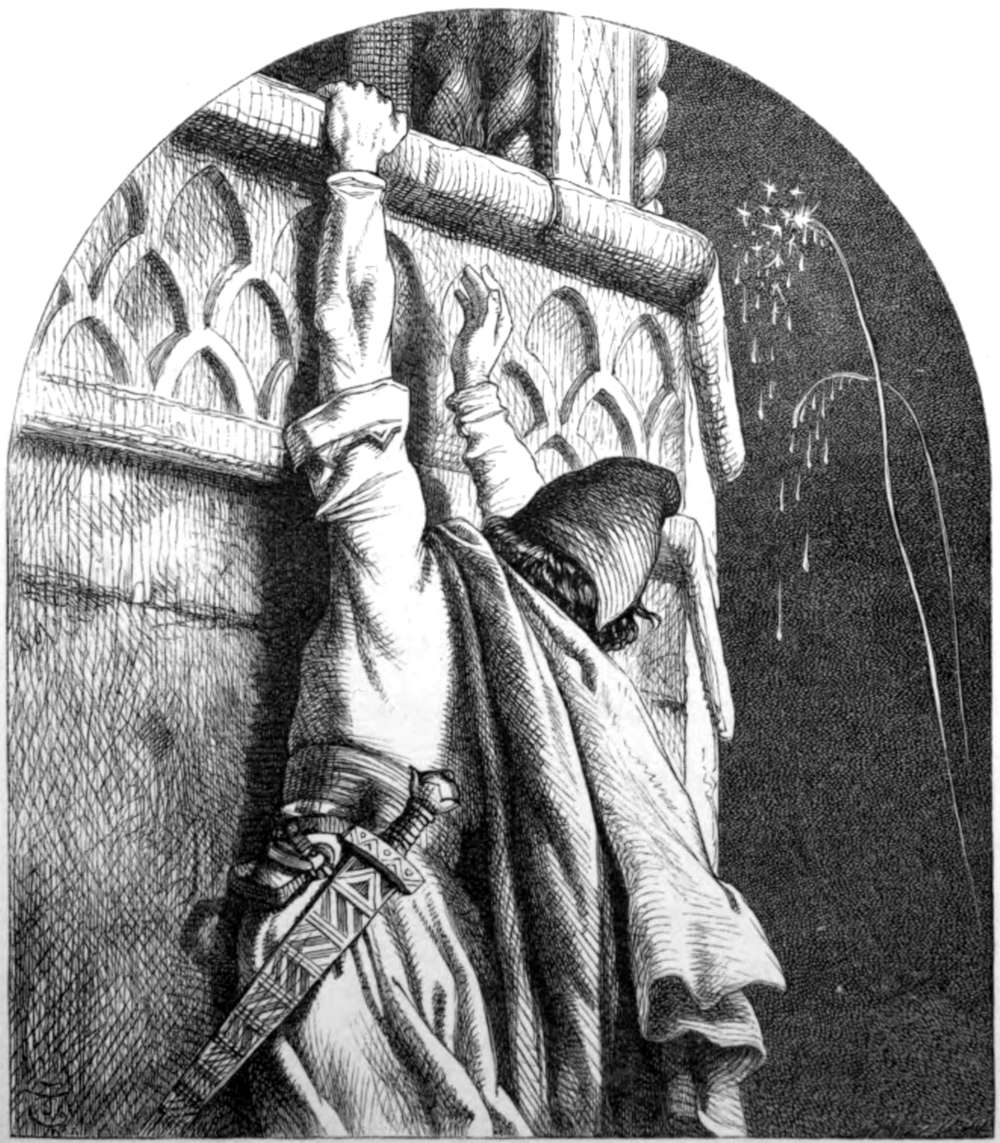
190The Princess, whose heart was sad enough already, could have wished that Feramorz had chosen a less melancholy story; as it is only to the happy that tears are a luxury. Her Ladies, however, were by no means sorry that love was once more the Poet’s theme; for, whenever he spoke of love, they said, his voice was as sweet as if he had chewed the leaves of that enchanted tree, which grows over the tomb of the musician, Tan-Sein.[235]
Their road all the morning had lain through a very dreary country;—through valleys, covered with a low bushy jungle, where, in more than one place, the awful signal of the bamboo staff,[236] with the white flag at its top, reminded the traveller that, in that very spot, the tiger had made some human creature his victim. It was, therefore, with much pleasure that they arrived at sunset in a safe and lovely glen, and encamped under one of those holy trees, whose smooth columns and spreading roofs seem to destine them for natural temples of religion. Beneath this spacious shade, some pious hands had erected a row of pillars ornamented with the most beautiful porcelain,[237] which now supplied the use 191of mirrors to the young maidens, as they adjusted their hair in descending from the palankeens. Here, while, as usual, the Princess sat listening anxiously, with Fadladeen in one of his loftiest moods of criticism by her side, the young Poet, leaning against a branch of the tree, thus continued his story:—
192
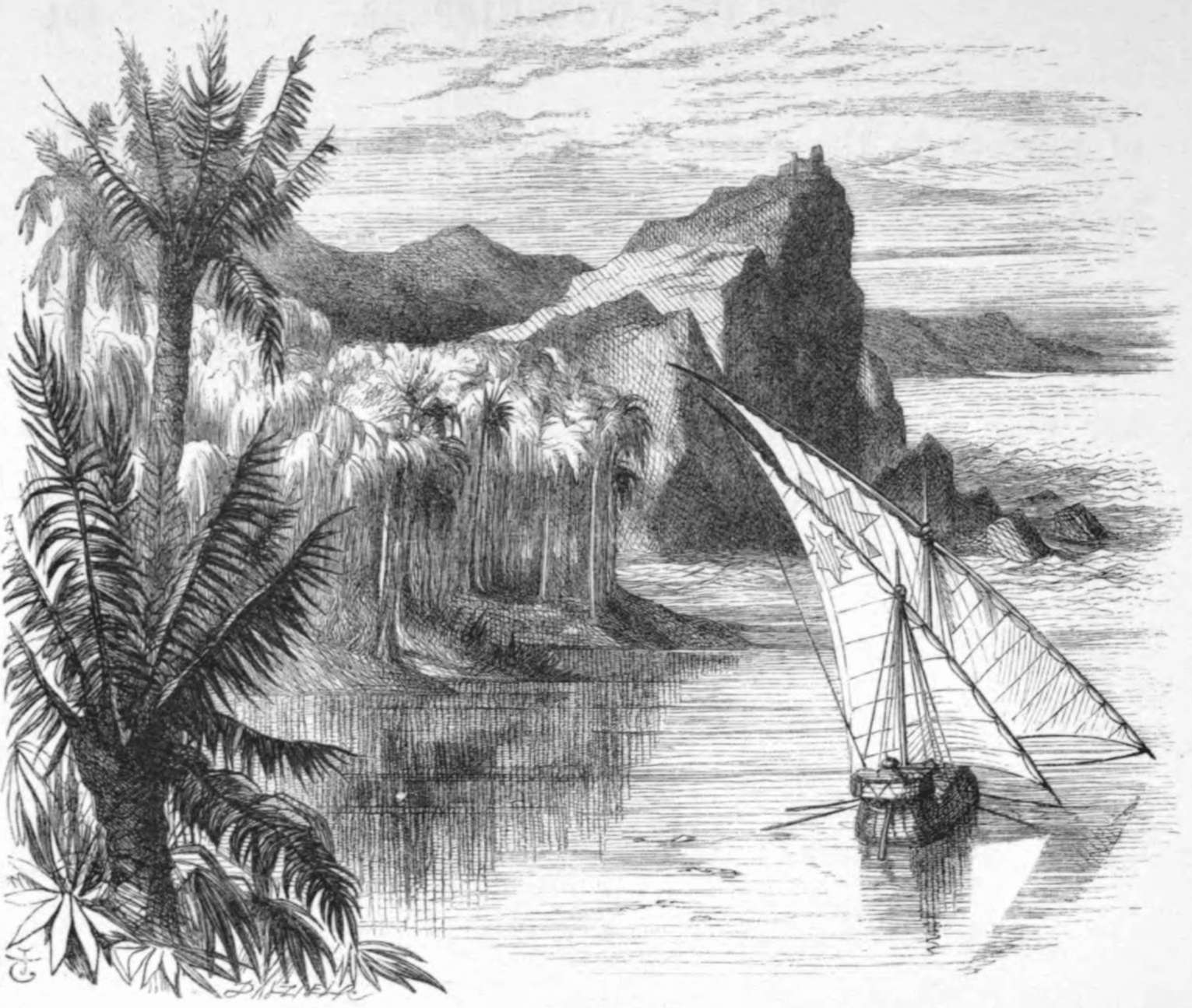
The morn hath risen clear and calm,
And o’er the Green Sea[238] palely shines,
Revealing Bahrein’s[239] groves of palm,
And lighting Kishma’s[239] amber vines.
Fresh smell the shores of Araby,
While breezes from the Indian sea
Blow round Selama’s[240] sainted cape,
And curl the shining flood beneath,—
Whose waves are rich with many a grape,
And cocoa-nut and flowery wreath,
Which pious seamen, as they pass’d,
Had tow’rd that holy headland cast—
193Oblations to the Genii there
For gentle skies and breezes fair!
The nightingale now bends her flight[241]
From the high trees, where all the night
She sung so sweet, with none to listen;
And hides her from the morning star
Where thickets of pomegranate glisten
In the clear dawn,—bespangled o’er
With dew, whose night drops would not stain
The best and brightest scimitar[242]
That ever youthful Sultan wore
On the first morning of his reign.
And see—the Sun himself!—on wings
Of glory up the East he springs.
Angel of Light! who from the time
Those heavens began their march sublime,
Hath first of all the starry choir
Trod in his Maker’s steps of fire!
Where are the days, thou wondrous sphere,
When Iran, like a sun-flower, turn’d
To meet that eye where’er it burn’d?—
When, from the banks of Bendemeer
To the nut-groves of Samarcand,
Thy temples flam’d o’er all the land?
Where are they? ask the shades of them
194Who, on Cadessia’s[243] bloody plains,
Saw fierce invaders pluck the gem
From Iran’s broken diadem,
And bind her ancient faith in chains:—
Ask the poor exile, cast alone
On foreign shores, unlov’d, unknown,
Beyond the Caspian’s Iron Gates,[244]
Or on the snowy Mossian mountains,
Far from his beauteous land of dates,
Her jasmine bowers and sunny fountains:
Yet happier so than if he trod
His own belov’d, but blighted, sod,
Beneath a despot stranger’s nod!—
Oh, he would rather houseless roam
Where Freedom and his God may lead,
Than be the sleekest slave at home
That crouches to the conqueror’s creed!
Is Iran’s pride then gone for ever,
Quench’d with the flame in Mithra’s caves?—
No—she has sons, that never—never—
Will stoop to be the Moslem’s slaves,
While heaven has light or earth has graves;—
Spirits of fire, that brood not long,
But flash resentment back for wrong;
And hearts where, slow but deep, the seeds
Of vengeance ripen into deeds,
195Till, in some treacherous hour of calm,
They burst, like Zeilan’s giant palm,[245]
Whose buds fly open with a sound
That shakes the pigmy forests round!
Yes, Emir! he, who scal’d that tower,
And, had he reach’d thy slumbering breast,
Had taught thee, in a Gheber’s power
How safe e’en tyrant heads may rest—
Is one of many, brave as he,
Who loathe thy haughty race and thee;
Who, though they know the strife is vain,
Who, though they know the riven chain
Snaps but to enter in the heart
Of him who rends its links apart,
Yet dare the issue,—blest to be
E’en for one bleeding moment free,
And die in pangs of liberty!
Thou know’st them well—’tis some moons since
Thy turban’d troops and blood-red flags,
Thou satrap of a bigot Prince,
Have swarm’d among these Green Sea crags;
Yet here, e’en here, a sacred band,
Ay, in the portal of that land
Thou, Arab, dar’st to call thy own,
Their spears across thy path have thrown;
196Here—ere the winds half wing’d thee o’er—
Rebellion brav’d thee from the shore.
Rebellion! foul, dishonouring word,
Whose wrongful blight so oft has stain’d
The holiest cause that tongue or sword
Of mortal ever lost or gain’d.
How many a spirit, born to bless,
Hath sunk beneath that withering name,
Whom but a day’s, an hour’s success
Had wafted to eternal fame!
As exhalations, when they burst
From the warm earth, if chill’d at first,
If check’d in soaring from the plain,
Darken to fogs and sink again;—
But, if they once triumphant spread
Their wings above the mountain-head,
Become enthroned in upper air,
And turn to sun-bright glories there!
And who is he, that wields the might
Of Freedom on the Green Sea brink,
Before whose sabre’s dazzling light[246]
The eyes of Yemen’s warriors wink?
Who comes, embower’d in the spears
Of Kerman’s hardy mountaineers?—
197Those mountaineers that truest, last,
Cling to their country’s ancient rites,
As if that God, whose eyelids cast
Their closing gleam on Iran’s heights,
Among her snowy mountains threw
The last light of his worship too!
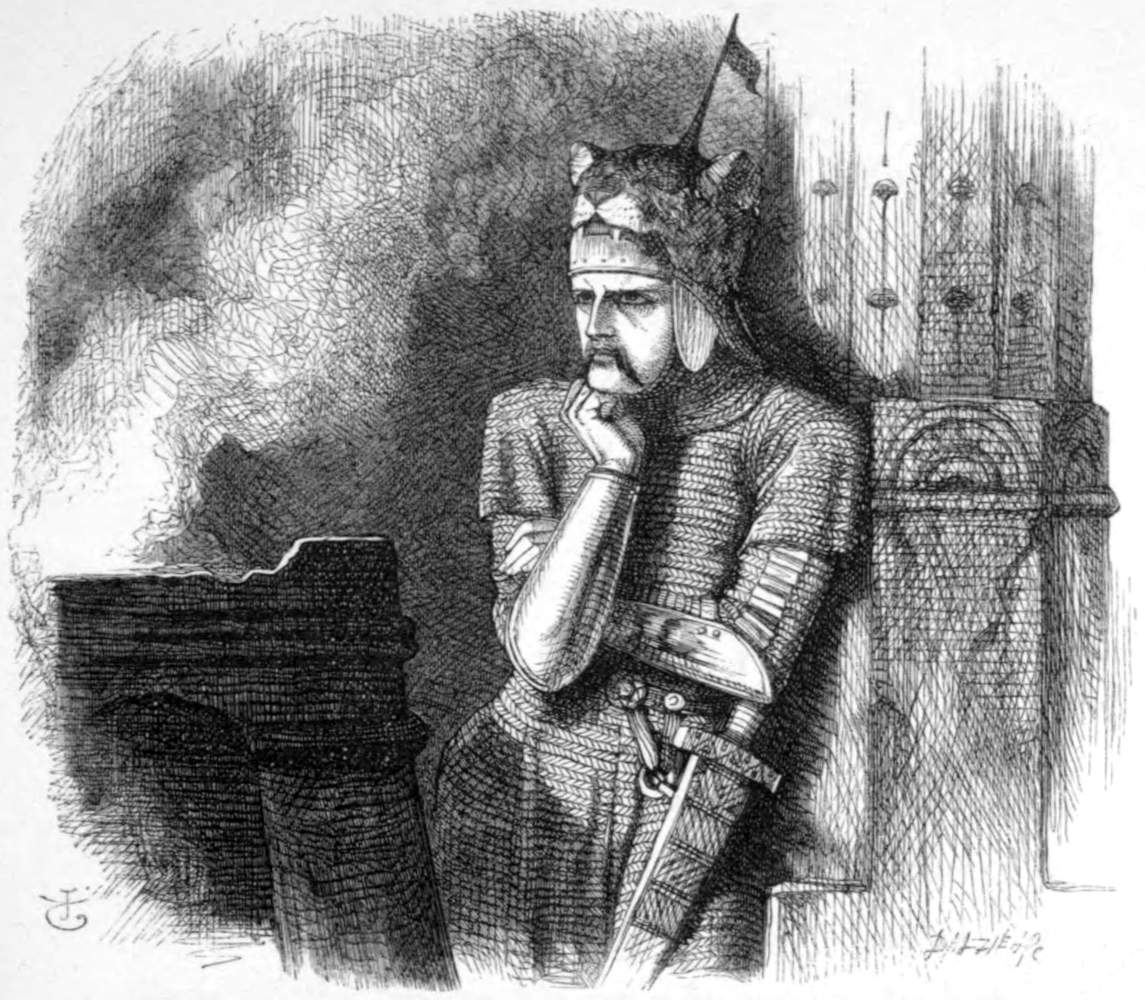
’Tis Hafed—name of fear, whose sound
Chills like the muttering of a charm!—
Shout but that awful name around,
And palsy shakes the manliest arm.
198’Tis Hafed, most accurs’d and dire
(So rank’d by Moslem hate and ire)
Of all the rebel Sons of Fire;
Of whose malign, tremendous power
The Arabs, at their mid-watch hour,
Such tales of fearful wonder tell,
That each affrighted sentinel
Pulls down his cowl upon his eyes,
Lest Hafed in the midst should rise!
A man, they say, of monstrous birth,
A mingled race of flame and earth,
Sprung from those old, enchanted kings,[247]
Who in their fairy helms, of yore,
A feather from the mystic wings
Of the Simoorgh resistless wore;
And gifted by the Fiends of Fire,
Who groan’d to see their shrines expire,
With charms that, all in vain withstood,
Would drown the Koran’s light in blood!
Such were the tales, that won belief,
And such the colouring Fancy gave
To a young, warm, and dauntless Chief,—
One who, no more than mortal brave,
Fought for the land his soul ador’d,
For happy homes and altars free,—
199His only talisman, the sword,
His only spell-word, Liberty!
One of that ancient hero line,
Along whose glorious current shine
Names, that have sanctified their blood;
As Lebanon’s small mountain-flood
Is render’d holy by the ranks
Of sainted cedars on its banks.[248]
’Twas not for him to crouch the knee
Tamely to Moslem tyranny;
’Twas not for him, whose soul was cast
In the bright mould of ages past,
Whose melancholy spirit, fed
With all the glories of the dead,
Though fram’d for Iran’s happiest years,
Was born among her chains and tears!—
’Twas not for him to swell the crowd
Of slavish heads, that shrinking bow’d
Before the Moslem, as he pass’d,
Like shrubs beneath the poison-blast—
No—far he fled—indignant fled
The pageant of his country’s shame;
While every tear her children shed
Fell on his soul like drops of flame;
And, as a lover hails the dawn
Of a first smile, so welcom’d he
200The sparkle of the first sword drawn
For vengeance and for liberty!
But vain was valour—vain the flower
Of Kerman, in that deathful hour,
Against Al Hassan’s whelming power.—
In vain they met him, helm to helm,
Upon the threshold of that realm
He came in bigot pomp to sway,
And with their corpses block’d his way—
In vain—for every lance they rais’d,
Thousands around the conqueror blaz’d;
For every arm that lin’d their shore,
Myriads of slaves were wafted o’er,—
A bloody, bold, and countless crowd,
Before whose swarm as fast they bow’d
As dates beneath the locust cloud.
There stood—but one short league away
From old Harmozia’s sultry bay—
A rocky mountain, o’er the Sea
Of Oman beetling awfully:[249]
A last and solitary link
Of those stupendous chains that reach
From the broad Caspian’s reedy brink
Down winding to the Green Sea beach.
201Around its base the bare rocks stood,
Like naked giants, in the flood,
As if to guard the Gulf across;
While, on its peak, that brav’d the sky,
A ruin’d Temple tower’d, so high
That oft the sleeping albatross[250]
Struck the wild ruins with her wing,
And from her cloud-rock’d slumbering
Started—to find man’s dwelling there
In her own silent fields of air!
Beneath, terrific caverns gave
Dark welcome to each stormy wave
That dash’d, like midnight revellers, in;—
And such the strange, mysterious din
At times throughout those caverns roll’d,—
And such the fearful wonders told
Of restless sprites imprison’d there,
That bold were Moslem, who would dare,
At twilight hour, to steer his skiff
Beneath the Gheber’s lonely cliff.[251]
On the land side, those towers sublime,
That seem’d above the grasp of Time,
Were sever’d from the haunts of men
By a wide, deep, and wizard glen,
So fathomless, so full of gloom,
202No eye could pierce the void between:
It seem’d a place where Gholes might come
With their foul banquets from the tomb,
And in its caverns feed unseen.
Like distant thunder, from below,
The sound of many torrents came,
Too deep for eye or ear to know
If ’twere the sea’s imprison’d flow,
Or floods of ever-restless flame.
For, each ravine, each rocky spire
Of that vast mountain stood on fire;[252]
And, though for ever past the days
When God was worshipp’d in the blaze
That from its lofty altar shone,—
Though fled the priests, the votaries gone,
Still did the mighty flame burn on,[253]
Through chance and change, through good and ill,
Like its own God’s eternal will,
Deep, constant, bright, unquenchable!
Thither the vanquish’d Hafed led
His little army’s last remains;—
“Welcome, terrific glen!” he said,
“Thy gloom, that Eblis’ self might dread,
“Is Heaven to him who flies from chains!”
203O’er a dark, narrow bridge-way, known
To him and to his Chiefs alone,
They cross’d the chasm and gain’d the towers,—
“This home,” he cried, “at least is ours;—
“Here we may bleed, unmock’d by hymns
“Of Moslem triumph o’er our head;
“Here we may fall, nor leave our limbs
“To quiver to the Moslem’s tread.
“Stretch’d on this rock, while vultures’ beaks
“Are whetted on our yet warm cheeks,
“Here—happy that no tyrant’s eye
“Gloats on our torments—we may die!”—
’Twas night when to those towers they came,
And gloomily the fitful flame,
That from the ruin’d altar broke,
Glar’d on his features, as he spoke:—
“’Tis o’er—what men could do, we’ve done—
“If Iran will look tamely on,
“And see her priests, her warriors driven
“Before a sensual bigot’s nod,
“A wretch, who shrines his lusts in heaven,
“And makes a pander of his God;
“If her proud sons, her high-born souls,
“Men, in whose veins—oh last disgrace!
204“The blood of Zal and Rustam[254] rolls,—
“If they will court this upstart race,
“And turn from Mithra’s ancient ray,
“To kneel at shrines of yesterday;
“If they will crouch to Iran’s foes,
“Why, let them—till the land’s despair
“Cries out to Heaven, and bondage grows
“Too vile for e’en the vile to bear!
“Till shame at last, long hidden, burns
“Their inmost core, and conscience turns
“Each coward tear the slave lets fall
“Back on his heart in drops of gall.
“But here, at least, are arms unchain’d,
“And souls that thraldom never stain’d;—
“This spot, at least, no foot of slave
“Or satrap ever yet profan’d;
“And though but few—though fast the wave
“Of life is ebbing from our veins,
“Enough for vengeance still remains.
“As panthers, after set of sun,
“Rush from the roots of Lebanon
“Across the dark sea-robber’s way,[255]
“We’ll bound upon our startled prey;
“And when some hearts that proudest swell
“Have felt our falchion’s last farewell;
“When Hope’s expiring throb is o’er,
205“And e’en despair can prompt no more,
“This spot shall be the sacred grave
“Of the last few who, vainly brave,
“Die for the land they cannot save!”
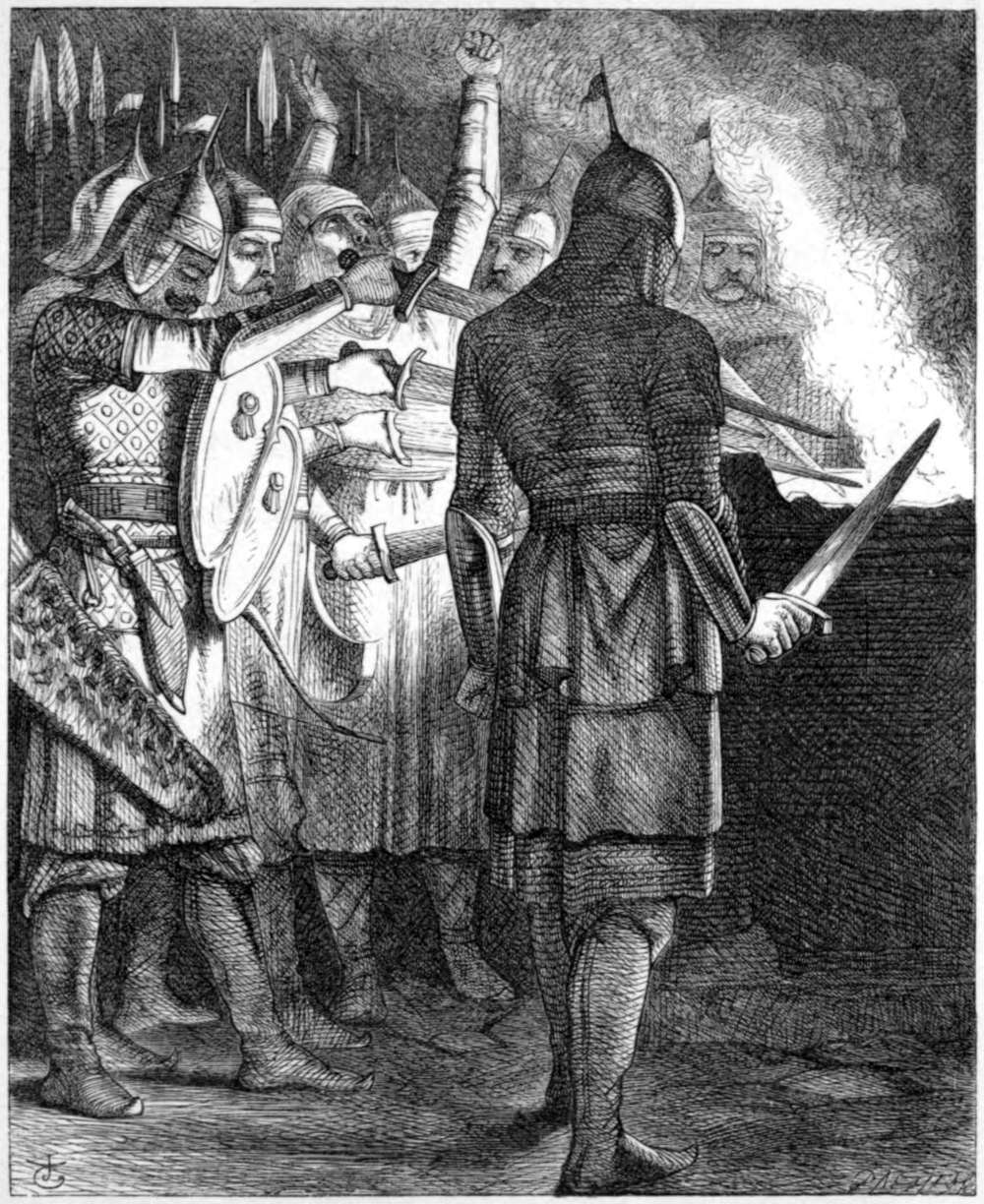
His Chiefs stood round—each shining blade
Upon the broken altar laid—
206And though so wild and desolate
Those courts, where once the Mighty sate;
No longer on those mouldering towers
Was seen the feast of fruits and flowers,
With which of old the Magi fed
The wandering Spirits of their Dead;[256]
Though neither priest nor rites were there,
Nor charmed leaf of pure pomegranate;[257]
Nor hymn, nor censer’s fragrant air,
Nor symbol of their worshipp’d planet;[258]
Yet the same God that heard their sires
Heard them, while on that altar’s fires
They swore[259] the latest, holiest deed
Of the few hearts, still left to bleed,
Should be, in Iran’s injur’d name,
To die upon that Mount of Flame—
The last of all her patriot line,
Before her last untrampled Shrine!
Brave, suffering souls! they little knew
How many a tear their injuries drew
From one meek maid, one gentle foe,
Whom love first touch’d with others’ woe—
Whose life, as free from thought as sin,
Slept like a lake, till Love threw in
His talisman, and woke the tide,
207And spread its trembling circles wide.
Once, Emir! thy unheeding child,
’Mid all this havoc, bloom’d and smil’d,—
Tranquil as on some battle plain
The Persian lily shines and towers,[260]
Before the combat’s reddening stain
Hath fall’n upon her golden flowers.
Light-hearted maid, unaw’d, unmov’d,
While Heaven but spar’d the sire she lov’d,
Once at thy evening tales of blood
Unlistening and aloof she stood—
And oft, when thou hast pac’d along
Thy Haram halls with furious heat,
Hast thou not curs’d her cheerful song,
That came across thee, calm and sweet,
Like lutes of angels, touch’d so near
Hell’s confines, that the damn’d can hear!
Far other feelings Love hath brought—
Her soul all flame, her brow all sadness,
She now has but the one dear thought,
And thinks that o’er, almost to madness!
Oft doth her sinking heart recall
His words—“For my sake weep for all;”
And bitterly, as day on day
Of rebel carnage fast succeeds,
208She weeps a lover snatch’d away
In every Gheber wretch that bleeds.
There’s not a sabre meets her eye,
But with his life-blood seems to swim;
There’s not an arrow wings the sky,
But fancy turns its point to him.
No more she brings with footstep light
Al Hassan’s falchion for the fight;
And—had he look’d with clearer sight,
Had not the mists, that ever rise
From a foul spirit, dimm’d his eyes—
He would have mark’d her shuddering frame,
When from the field of blood he came,
The faltering speech—the look estrang’d—
Voice, step, and life, and beauty chang’d—
He would have mark’d all this, and known
Such change is wrought by Love alone!
Ah! not the Love, that should have bless’d
So young, so innocent a breast;
Not the pure, open, prosperous Love,
That, pledg’d on earth and seal’d above,
Grows in the world’s approving eyes,
In friendship’s smile and home’s caress,
Collecting all the heart’s sweet ties
Into one knot of happiness!
209No, Hinda, no,—thy fatal flame
Is nurs’d in silence, sorrow, shame;—
A passion, without hope or pleasure,
In thy soul’s darkness buried deep,
It lies, like some ill-gotten treasure,—
Some idol, without shrine or name,
O’er which its pale-eyed votaries keep
Unholy watch, while others sleep.
Seven nights have darken’d Oman’s sea,
Since last, beneath the moonlight ray,
She saw his light oar rapidly
Hurry her Gheber’s bark away,—
And still she goes, at midnight hour,