JOURNEY TO LAPLAND. (continued 3)
Charles Troilius translation
The milk-strainers are made of straw, and not very clean.
September 20.
Brabestad, not far distant, is a small town, though twice the size of Tornea, standing on a peninsula by the sea.
In the hospital of Cronby are many maniacs, whose insanity is said to have arisen from jealousy of the conduct of their wives. One of them, whose wife was a very old woman, took this fancy, supposing her to intrigue with several other men. Possibly in these cases impotence, or perhaps some fantastic concupiscence, may have been a cause of the derangement.
About this neighbourhood it is the custom to administer to women in labour a very nauseous medicine, which is called Hittatran, or Casual Train-oil; so termed because it is obtained from the carcases of such seals as, having been killed early in the spring, have been left among the broken ice till they are by chance cast upon the shore. They are consequently putrid, and the oil is so offensive, that few persons, except such as are in great extremity, or not very nice, can be brought to take it. In general Castor is here considered as a sheet-anchor in such cases, as being found by long experience very effectual in bringing on the labour-pains. Others take saffron infused in wine. For after-pains they swallow, as at Kimi, a few drops of blood from the umbilical cord, not only in the woman's first lying-in, but every subsequent one.
Some Finlanders, as I was told, have a method by which they pretend to catch bears, with a sort of magic. This is done by procuring some of the bear's dung, fresh and warm if possible, and mixing it with that of one of their own cows. The consequence is said to be, that the bear will be attracted by sympathy to come after the cow; an effect certainly not more wonderful than many sympathies upon record.
There is a fish in the lakes near Pyhejorki which is called Muicu. Bishop Terserus, a Dalecarlian, bishop of Abo, says that he has seen at this place a fish named Muicu, which is no other than the Blikta, taken in the lake of Silian in his native country. How true this may be I know not, but I saw plainly that this Muicu is the Small Sijk (Salmo Albula), such as is found in Smoland.
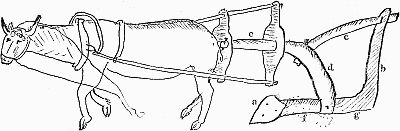
The following figure represents a plough used here, drawn by an ox. The share, a, is of iron, a span long. The part b is four spans high; c is four spans long; d and e, three spans each; f, g, four spans. The ends of the shafts are connected by a curved piece of wood, which keeps them from the shoulders of the animal, and supports them.
September 21.
Being the feast of St. Matthew the apostle, I went to church at Gambla Carleby. Here is an introductory school, to prepare children for that at Cronby.
I passed on to Jacobstadt, which has a remarkably good harbour. Ships are able to load and unload close to the quay.
September 22.
Leaving Jacobstadt, I arrived at the town of New Carleby, which is nearly as big as Wexiö. Every one of the streets is laid with timbers, placed cross-wise, instead of stones, like a bridge, which has a handsome appearance. The harbour of this place is near the river, a quarter of a mile from the town. Vessels when laden indeed can scarcely come within half a mile. On the shore lay vast piles of wood, destined to be conveyed to Stockholm for fuel.
The country-people have, in every one of their mills, an instrument made of six or seven blades or hatchets, serving to cut chaff into small pieces in a trough, in order to grind it afterwards with their barley.
Rotkäl (Brassica oleracea κ, Sp. Pl. 932, Napo brassica, or Stalk-cabbage) is dried for winter use; when it is boiled, and given with the liquor to the cattle.
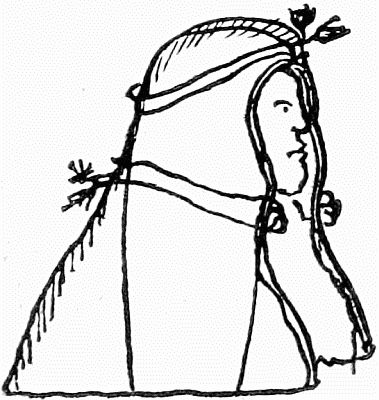
The women at this place wear a hood, or neckcloth, as they call it, of grey walmal cloth, but only in bad weather. It is tied with a black ribband in the fore part. When they ride on horseback, they carry the whip slung at their back.
To stir up the pot, when boiling, they use a stick with several projecting bits of wood at the bottom, (not unlike a chocolate-mill,) which is rolled between their hands.
In the evening of this day I arrived at Wasa.
September 23.
I went to church at Wasa, and visited also the palace, situated on the south-west side of the city, the school, and other public buildings. This is a handsome little town enough. It is the residence of the governor.
Not far from the town, and indeed close to the walls, is a reputed copper-mine, the working of which was discontinued, after an excavation had been made to the depth of five or six fathoms. The ore has a glittering micaceous appearance, and gives a stain like black lead. The sand about it is a loose talc, as if spontaneously decomposed. I do not indeed believe that it contains any copper or other metal; which seems to have been the opinion of those who so soon gave over the pursuit.
The rustics here trust to three doctors, Beaver's-gall, Bear's-gall, and Pallavinus. (By a chemical sign annexed, it appears that Linnæus here meant brandy, but the word itself is not explained.)
This day being Sunday, I saw the girls all going bare-headed to church. They each, however, carried an oblong-oval hat, supported by broad coloured ribbands, the ends of which hung down.
September 24.
In my way from New Carleby to this place (the day before yesterday) I had observed a kind of plough in use, different from any I had before seen. This was almost always drawn by a horse, seldom by an ox. The latter, when used, had the same harness as the horse, but without a girth. Over its back indeed passes a band like a saddle-girth, which is kept upon the neck of the animal to prevent the harness sliding forward; but for horses they use no such thing. See the figure.
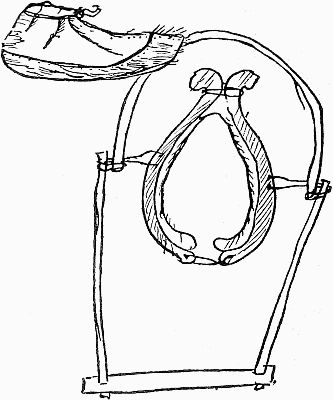
The shoes worn at this place in some measure resemble half-boots. The soles are of untanned leather, with the hair upon it; the upper leathers made of tanned seal-skin, and tied round the ankle with strings. (A representation of one of these shoes accompanies the last figure.)
Hypericum (perforatum), Scrophularia (nodosa), Bidens (cernua?) occurred to me here, for the first time in all my journey. The three species of Ribes (rubrum, alpinum and nigrum,) were in prodigious abundance.
September 25.
At sun-rise I took my departure from Wasa. The pines in the forest were stripped of their bark, so that vast tracts were covered with nothing but such naked trees. No more was left on each trunk, to the height of three ells or three and a half, than a small strip of bark, about the breadth of four fingers, generally on the north side, to prevent its being ... (here is a word not to be decyphered). The trees are left standing for six or seven years afterwards, and are then cut down close to the roots, being also headed a little above the naked part. The heads or branches either serve for firing, or, as often happens, are left to rot on the ground.
Three miles below Wasa I recognised the Climbing Nightshade (Solanum Dulcamara). In the town itself I had noticed (Leonurus) Cardiaca, and Henbane (Hyoscyamus niger). Near the shore grew Salix oleæfolia with its berries, (Hippophaë rhamnoides). It is known by the name of Finnbær or Surbær, (Finn-berries, or Sour berries). The fruit is situated below the leaves, as in the Alder. The footstalks are two lines long. Berries bluntly oval, of a tawny orange-colour, three or four lines long, smooth, sour, having a watery pulp mixed with ochraceous matter. Seed solitary, roundish-oblong, slightly compressed, obtuse, attached by its lower edge to a membrane which enfolds it. When this cover is removed, the seed itself appears brown and polished, having a longitudinal groove at each side. The fishermen eat these berries bruised, by way of sauce to their fresh fish, but I thought them rather too acid.
September 26.
I passed Christina (Christinestadt), but before coming to that place, noticed at Nerpis a very extensive tract of land, which had formerly been a fine meadow, the soil being extremely good. But at present it was so entirely overrun with tumps (originally perhaps formed of Carex cæspitosa) that it produced little or nothing. These tumps were crowded almost over one another, and were overgrown by Polytrichum (Hair-moss), which had come to its full stature, and rendered most of them nearly black. There was scarcely room for the cattle to make their way to any food between the tumps.
In the passages of all the houses hung nets, used for catching bears. These are made of ropes of Lindenbast, (the inner bark of the lime-tree, Tilia europæa,) full as thick as a bridle or rein. The meshes when stretched are each three quarters of an ell wide. The height of the net is equal to the stature of a man. Such nets, supported by poles, are set up in a line of one hundred fathoms in extent, the lower side close to the ground. The bear is driven into them by the people hunting him on all sides.
September 27.
This day I observed a mode of brewing in a kneading trough, which stood on a table, and its end being made so as to slide up and down, the wort is easily poured out.
Below the town of Christina, I first found the Lathyrus viciæformis (L. palustris), and Water Cresses, (Sisymbrium Nasturtium); also Campanula persicifolia and (Sedum) Telephium.
September 28.
I was glad when I had done with the very bad road which extends from the Lappfierd near Christina, to Hwisbofiahl, towards Biorreborg; a highway it cannot be called, for it is exactly like the road between the town of Umoea and Granoen. (See v. 1. 141.)
Near Sastmola I first recognised the Acer (platanoides) and Filix fœmina ramosa (Aspidium Filix-fœmina?)
The road from Hwisbofiahl to Giolbohl lies along the coast. The grass here was remarkably tall, and full of all sorts of plants; as the Ribes insipidum (alpinum), called by the inhabitants Degbaer, in the greatest abundance. (Viburnum) Opulus and (Lonicera) Xylosteum here first re-appeared after my long absence.
N. B. The shrub which Mr. Hojer informs us grows on this island, with blackish-brown berries, may perhaps be the Xylosteum, as the colour of the leaves seemed to agree very well. (Were it not for the above indication of the colour of the berries, it might, from the Flora Suecica, be suspected that Linnæus had, in these two paragraphs, written by mistake Xylosteum for Periclymenum.)
The alpine Stone Bramble, Rubus saxatilis, was extremely plentiful; and the Cultivated Hop (Humulus Lupulus), growing wild, afforded me great pleasure, as I contemplated its ingenious manner of curling round the Aspen trees (Populus tremula). Here also (Anemone) Hepatica, and the Cracca with toothed wings (stipulæ) and striated flowers, (Vicia sylvatica,) as well as the Orobus vernus, once more greeted me. The grass with a dense spike-like panicle, whose stems serve for cleaning the inside of tobacco-pipes, (Agrostis arundinacea,) grows copiously in this part of the country; and reached higher than my head. The marshes abound with Iris (Pseud-acorus) and with Cyperus (probably Scirpus maritimus).
The greater part of the road I had travelled hitherto from Kimi lay so near the shore, that, even in the woody parts of it, the sea was frequently visible through the forests.
September 29.
I travelled the whole of Michaelmas-day.
When a Finlander has fired at a bear, he immediately runs to one side, for the animal, if not killed, is sure to run directly forward, towards the smoke; by which means the man escapes out of his reach.
The peasants who reside near the cliffs or rising ground judge by the crows (Corvus Cornix), of the approach of bad weather; for these birds seek the marshy country in the evening, before it comes on.
Ulvila churchyard seemed to abound with sculls. I reckoned forty of them in one heap. This churchyard is built round, after the old fashion.
On entering one of the stove-huts of the inhabitants here, it was so hot, that I thought my nose would have been burnt off. Nevertheless, the people within seemed comfortable enough, and the boys, clad in skins, were running up and down the couch. The stove is constructed like that of a bagnio in Smoland, but upon it is piled a great heap of flat stones, to the height of a man. The old women sit in these huts half naked.
Between Hyfoeda and Taftnen is a river almost navigable. In some parts, as I was told, it is nine fathoms deep, and in one place is a ferry across this river. Half a mile from hence southward, close to the road, between two small bridges which are near each other, I noticed a sand-hill of very fine sand, in differently-coloured strata, some white, others reddish-purple.
In the evening I arrived at the town of Abo, which is as large as Orebro, and well built. It has often been ruined by the enemy, and often burnt down by accidental fires, which, if not occasioned otherwise, might easily happen from the stoves of the huts. I remarked that these stoves were less lofty than some I had seen, and that several stones lay loosely piled on one another above the opening, which serve to retain the heat.
September 30.
The Finnish liquor called Lura is prepared like other beer, except not being boiled, instead of which red-hot stones are thrown into it. Hence its purgative quality from the iron.
Here I saw a flying squirrel (Sciurus volans) from Tavasthia.
The long black rat, with a white lower lip, catches birds, both on trees and in the water. He holds fast by his claws, and bites with his four prominent teeth. The Finlanders call this animal Mink. (This seems to be Viverra Lutreola, Faun. Suec. ed. 2. 5.)
A quarter of a mile from the city is a mineral spring, of which Tillands has taken notice. (See v. 1. 43, note.) It is older than that of Medevi (near Vadstena). The current is so strong that one of the burghers of the city has built a mill, to which the water is led, but it does not always go. Near the town a mine has lately been opened, containing iron here and there, with small quantities of pyrites. The mountain itself is a black mica, immediately adjoining to the city.
The library here is miserable. There are two colleges close together.
October 5.
I departed from Abo. The corn-fields of Finland are beautiful, and resemble those of East Gothland in their wide extent and level surface.
There are regular ferry boats at stated times to take passengers to the isle of Aland.
October 6.
I arrived at the place, near Brandoen, where I was to go on board the ferry-boat. The shore is a red rock. Passed over to the island of Aland, the whole of which consists of the same kind of red rock. The palace of Castelholm, at present falling fast into ruins, is built of this sort of stone.
The women use for dyeing a sort of rock Lichenoides, of a brown stercoraceous colour, (perhaps Lichen stygius, or omphalodes,) which they boil in water with alum. But Walmal cloth, and stockings, are dyed without alum. Some add a little Arnotto (Bixa Orelana).
Shoes like short half-boots are worn here made of seal-skin.
October 7.
In the evening of this day I passed over the plain of Aland. There were abundance of Finn-berries (Hippophaë rhamnoides) by the road.
October 8.
I sailed over the sea of Aland.
October 9.
Near Esbro an iron mine has lately been opened. About the church are sundry sepulchral monuments. I noticed on the small surrounding hills, as well as at Musangen, very fine and lofty plants of juniper resembling cypresses, the branches erect and close, assuming a conical or pyramidal figure.
October 10.
About one o'clock in the afternoon I arrived safe at Upsal.
To the Maker and Preserver of all things be praise, honour and glory for ever!
Some observations relative to the Seal, Phoca vitulina.
There are two kinds (or varieties) of this animal. The Gr[)a] Si[)a]l (Grey Seal) is the largest, of a grey colour, lighter, and slightly clouded on the back. The Wikare Si[)a]l (Creek Seal) is smaller, black on the back, and very cloudy or wavy at the sides. Otherwise there is no difference between them.
The whelp at its birth is perfectly white, being covered with white hair about an inch long, which it loses in four or five weeks, and becomes quite black. At the same period it acquires more activity and shyness than at first. The upper fore teeth are six, very small, resembling those of a dog. The eye-teeth slightly enlarged at their outer edge, as in the dog, and furnished with a little notch at their base. Grinders six. Whiskers remarkably large. There are two nipples a little below the navel, which the female has a power of drawing in, so as to leave holes large enough to admit the finger. She lets them out at pleasure to her young one.
The seal lies on its back while sleeping, either on the ice or on rocks. They couple soon after the feast of St. Matthew, September 21; and the grey seal brings forth its young in January, the creek seal in February. The male runs round and round the female many times, with a yelping noise, being very careful not to be observed.
When the female has young, the male is very savage, and continually attends to protect her. She brings forth but one at a birth, which at first is dull and stupid, easily caught. If thrown into the water, however, he exerts himself with some activity, and returns to the shore, not having as yet acquired any shyness. But by the time all his first coat of white hair is fallen off, he begins to be timid. The growth of the young seals is very rapid.
The seal, when out of the water, can hardly distinguish objects at half a quarter of a mile's distance at the utmost. But in foggy and dull weather he sees better than in sunshine. He never remains in the water during moon-light nights. His hearing is acute though he has no external ears, and his scent is also very quick. He can remain under water for nearly half a quarter of an hour; but by that time he must, at the peril of his life, come to the surface to breathe, which he often does within a fathom of the shore, and he afterwards spouts out water.
Nets for catching seals are set right out into the sea, from some promontory, to the distance of twenty fathoms. These are examined every morning, to see what is caught. They are chiefly set from St. Bartholomew (August 24), when the moon is in her wane, till over St. Matthew's day, September 21.
Grey seals are hunted in winter till Lady-day. They lie upon the ice, often in great numbers, close to a hole which they have made in it. When they come out of the water by this opening upon the surface of the ice, the water they bring with them freezes about its margin, so that in time the edges become elevated, and it looks like a well. If it should freeze over, they travel to the south-west, till they can get at water, always proceeding straight forward, even though they meet with mountains in their way; and they return in the same direct line back again. The hunters go with large poles, carefully approaching the creek seal till they get near enough to fire at him before he is aware. The grey seal is taken with a sort of hook or harpoon.
The seals are able to penetrate through the ice from beneath, lying on their backs under water, be it ever so thick, but cannot make their way into it from above.
END OF THE TOUR.