JOURNEY TO LAPLAND. (continued 2)
Charles Troilius translation
The latter were generally open, so that they might readily be discerned by the whiteness of their inside; but when the water is very much agitated, the animals immediately close their shells, though destitute of eyes or ears.
The form of the shell is elliptic-oblong, with a contraction, or shallow notch as it were, about the middle of their outer margin. The man opened them by means of a whilk shell, which he thrust with violence between the valves, for it is impossible to effect this with the finger only. He introduced the point of the whilk in the centre of the base, or broader end, of the muscle, searching for the pearls chiefly towards the other end, on the inside of the valve. If the inside of the latter be white, the pearl is white; but if dark or reddish, the pearl is of the same colour.
When it was first discovered that this neighbourhood produced pearls, the river at Purkijaur was the place where the principal pearl-fishery was established. But now it is nearly exhausted. When the discovery of this bed of pearl muscles was first made, it is said the shells were in such abundance that nobody could reach the bottom of them, which is far from being the case at present.
There is no external sign about the shell, by which it is possible to know whether it contains a pearl or not. Consequently many thousands are destroyed to no purpose before one pearl is found. It is also a great pity that all the muscles are killed in consequence of this examination. Each pearl is either attached to the shell, or loose. They are found at all seasons of the year, and are sometimes thrown out of the shell spontaneously by its inhabitant.
I witnessed at this place what appeared to me a very extraordinary phenomenon, a pike in whose stomach, when opened, was found a young duck entire. The peasant who was my companion told me he had many times seen the same thing.
July 27.
The reindeer fed with evident avidity on the great water Horsetail (Equisetum fluviatile), which the Laplanders call Aske, though it was in a dry state, and though they will not eat common hay. How unaccountably negligent are the Laplanders, not to collect in the course of summer a stack of this plant and of the Reindeer-moss (Lichen rangiferinus) for winter fodder! They would then have some provision for the herd, when the country is covered with an impenetrable crust of frozen snow, and not hazard the loss of all they are worth in the world.
The inhabitants of Westbothnia, to defend themselves against the bites of gnats, besmear their skin with a mixture of tar and fish-grease, or some other kind of fat. They keep this composition in a horn which hangs at their side. The Laplanders however give themselves no trouble about any such matter.
In order to add to the pungency of the tobacco which they are in the habit of chewing, the Laplanders mix with it the root of Angelica. (A. Archangelica is preferred, but when that is not at hand, the sylvestris is used, as appears from the Flora Lapponica.)
The women wear their belts in the same manner as the men, except when they are big with child, in which case the belt must necessarily be placed much higher than ordinary.
This day I found the little heart-leaved Ophrys (O. cordata) growing, as it usually does, amongst the Rubus Chamæmorus, whilst I was gathering the fruit of the latter. Also the least Pinguicula (P. villosa); but its leaves were withered, and the fruit was ripe, which is heartshaped and emarginate, of two valves and one cell. The last-mentioned plant grew among White-moss (Sphagnum palustre. These specimens are still preserved in the Linnæan herbarium.)
The bird called (by the Swedes) Lappskata, Rödfogel in Westbothland, Gvousach in Lapland, (Corvus infaustus, Faun. Suec. 32. Lath. Ind. 159. Lanius infaustus, Syst. Nat. v. 1. 138,) is of a small size, but it audaciously lays hold of any thing it can find, being so far from timid that it flew away with part of our provisions as we sat at table. This bird seems nearly allied to the Jay (Corvus glandarius).
It is only in winter the clothes of the Laplanders have any sort of lining, except that these people generally wear, next the stomach, the skin of a young reindeer fawn. The sleeves of their coats are not fixed to the jacket, or body of the garment. The part which covers the shoulder folds over the top of the sleeve, in the shape of a wedge. A seam reaches the whole length of the jacket, from top to bottom, on each side, the jacket becoming gradually wider, downward. It reaches as low as the middle of the leg. The collar is for the most part blue, stitched with white thread.
The reindeer are not slaughtered in the same manner as cattle usually are either at Stockholm or in Smoland. The animal being secured with a halter, the Laplander takes his spear and sticks it into the thorax behind the shoulder, so as to pierce the heart. By this means the blood collects in the cavity of the thorax, none of it appearing externally. After the skin is flayed off, the blood is found coagulated in the thorax, from whence it is extracted, and bruised into a soft mass. With this the poorer sort of people make a kind of soup, by boiling along with it the brains of the animal, which the rich do not eat. The testicles are never eaten by any sort of people. The penis serves to make a thong to draw the sledges.
Such of the Laplanders as inhabit the forests go to the alps at midsummer and return about St. Laurence's day (August 10th); and the mountain Laplanders descend into the lower country between the first of November and Christmas, and go back again about Lady-day.
All kinds of clothing made of skins are sewed with sinews of animals, as before described; but those of walmal cloth, with hempen thread purchased from the neighbouring countries.
July 28.
To-day I found the Pseudo-helleborine; (possibly Cypripedium Calceolus, not before mentioned in this journal.)
All the little rills and rivulets hereabouts produced a Potamogeton, which I was doubtful whether to distinguish from the common kind, as it varies excessively in appearance, but the leaves are more grassy. (P. gramineum, as appears from the Flora Lapponica, yet nothing can be less like the "common kind," if by the latter be meant the natans, which, with the perfoliatum and gramineum, compose the catalogue of species in Fl. Lapp.)
Hereabouts grew the Juncus with three seeds (capsules) at the top of the stem, which also I observed to be sometimes reflexed. (J. triglumis; see Fl. Lapp. ed. 2. 90.)
Several days ago the forests had been set on fire by lightning, and the flames raged at this time with great violence, owing to the drought of the season. In many different places, perhaps in nine or ten that came under my notice, the devastation extended several miles' distance. I traversed a space three quarters of a mile in extent which was entirely burnt, so that Flora, instead of appearing in her gay and verdant attire, was in deep sable, a spectacle more abhorrent to my feelings than to see her clad in the white livery of winter, for this, though it destroys the herbage, leaves the roots in safety, which the fire does not. The fire was nearly extinguished in most of the spots we visited, except in ant-hills, and dry trunks of trees. After we had travelled about half a quarter of a mile across one of these scenes of desolation, the wind began to blow with rather more force than it had done, upon which a sudden noise arose in the half-burnt forest, such as I can only compare to what may be imagined among a large army attacked by an enemy. We knew not whither to turn our steps. The smoke would not suffer us to remain where we were, nor durst we turn back. It seemed best to hasten forward, in hopes of speedily reaching the outskirts of the wood; but in this we were disappointed. We ran as fast as we could, in order to avoid being crushed by the falling trees, some of which threatened us every minute. Sometimes the fall of a huge trunk was so sudden, that we stood aghast, not knowing whither to turn to escape destruction, and throwing ourselves entirely on the protection of Providence. In one instance a large tree fell exactly between me and my guide, who walked not more than a fathom from me, but, thanks to God! we both escaped in safety. We were not a little rejoiced when this perilous adventure terminated, for we had felt all the while like a couple of outlaws, in momentary fear of surprise.
I have long ago related my sufferings from gnats in the course of my Lapland expedition. In this place I was still more incommoded by some very small flies, about a line in length and very narrow. Their breast was of a blueish grey. Front of the head whitish, with black eyes. Wings pellucid. Body greyish, oblong and narrow. A white scale was placed on each side at the insertion of the wings. The legs were black, with a white joint in the middle of each, the base being speckled. The hind part of the shoulders was whitish. Antennæ simple, minute, parallel, and pointing right forward. The wings lay one over the other so as to resemble a single one, notched at the extremity, when the insect was at rest. Each of us was beset by a whole legion of these flies towards sun-set. What rendered them peculiarly troublesome was their manner of running over the face, and flying into the nose, mouth and eyes. When they were approaching in order to inflict their bite, they were not to be driven away by our blowing ever so hard. The Laplanders call these insects Mockere, alluding to the smallness of their head; the Swedes Knott. (Culex reptans. Linnæus mentions in the Fauna Suecica the extremely tiresome noise made by these gnats in their approach.) They covered our linen so as to render it quite black. It was to no purpose to attempt to drive them away. (See v. 1. 208.)
I visited the Laxholms, islands so called from the salmon fishery. Here the Common Salmon (Salmo Salar, named Lax by the Swedes,) is found with the under jaw occasionally hooked, which variety is termed Kroklax, or Hooked Salmon. I inquired whether this hooked kind was esteemed a distinct species, or whether a difference arising from age; to both which questions I was answered in the negative. I was shown fish of the smallest size, which had in proportion as large a hook to the lower jaw as the largest. Bonge has therefore fallen into an error in his dissertation upon salmon. (Daniel Bonge, Dissertatio de Salmonum naturâ, corumque apud Ostrobothnienses piscatione, Upsal. 1730. 4to. under the presidency of Professor Roberg, with wooden cuts.) I inquired whether the hooked salmon were furnished with roe or with milt. I was answered that they had always milt. On opening seven of them I found this verified, whereas four salmon which were not hooked had all of them roes. The hooked (or male) salmon is so called, because the point of its lower jaw is bent inward, and has a taper form, resembling a finger; while on the contrary the upper is furnished with a cavity to receive that point, embracing it like a sheath, for about half its length. The female fish has a more obtuse lower jaw, but not less inflexed, there being only a very slight furrow in the upper one; so that the two sexes may be distinguished from each other by these marks from the earliest age.
Those who fish for salmon come to this place about a fortnight before midsummer, and remain till St. Bartholomew's day, August 24th, as during that space of time the salmon keep ascending the river. After the day last mentioned none of the fishermen remain. Few of the fish escape being taken, so as to return down the river. At Michaelmas the fishermen come here again, when they catch a smaller sort of salmon.
This day I observed the harvest beginning. The corn now cutting, though sown but a few days before midsummer, was nevertheless quite ripe. The lent rye was not yet ripe enough to be cut, but the winter rye ripens some time before the other corn. Thus it appears that corn (barley) springs up and ripens at this place in the space of sixty days.
In my walks I gathered the berries of the Strawberry-leaved Bramble (Rubus arcticus), which proved delicious. They have somewhat of the flavour of Blackberries (Rubus fruticosus), but are more agreeable. This fruit does not separate from its calyx like other specie of its genus. It is a compound berry, in size and structure somewhat between what the Smolanders call Kodden (Rubus saxatilis), and Raspberries (R. idæus). Its colour is a brownish crimson.
The (Pedicularis) Sceptrum Carolinum is perennial, with scales, not a fibrous tuft or beard, at the root[7]. The stem is round, not quadrangular. Calyx five-cleft[8]. Lower lip regular, divided into three equal segments.
Pedicularis with a purple head (Bartsia alpina. Linn. Sp. Pl. 839. Engl. Bot. t. 361. Euphrasia. Fl. Lapp. n. 246.) shows an affinity to the Crista Galli (Rhinanthus) in its calyx, which is divided into four equal acute segments. The fruit is ovate and acute, compressed at the point. Lower lip straight. All the other Pediculares, except Sceptrum Carolinum, have an oblique fruit.
Here and there grew specimens of Heath (Erica vulgaris) with tufted branches, looking like a pruned spruce fir, and very beautiful.
The water of the river now began to decrease, in consequence of which it became clearer, and it was more difficult to catch any fish.
Scarcely any species of Carex was to be found this season but what had some degree of smut or ustilago about its spikes, consisting of little globular black bodies, changing to dust.
July 29.
Tanning of leather is thus performed by the Laplanders.
The scaly cuticle of the birch being first stripped off, the bark is then scraped from the tree and boiled fresh in water, for about as long a time as is requisite to boil fish; being afterwards set by to cool, to a certain degree, that it may not injure the hide by being too hot. The latter, having previously been scalded, by dipping into luke-warm water, is then soaked in the decoction of bark, and the vessel containing it sunk into a hole dug in the ground, at the extremity of the hut. The hide is taken out every day, and softened in luke-warm water, till the hair becomes loose, when it is scraped off by such a knife as tanners use. The skin is then replaced in the tan when cool, without any previous drying, till the third day after the hair comes off, when it is hung up to dry in the shade. When the leather is but half dry, they often cut it up for shoes, which are always made by the women, without any last. The thread used for the purpose is that made of tendons.
Some persons never scald the hide, but scrape off the hair with a knife, soak it a little in water, and then plunge it into the tan.
Near Swartlär I noticed a mineral spring, but whatever may be its qualities, nobody has yet made any inquiries concerning them.
The river Lulea divides into two branches, not far above the bounds of Lapmark and Westbothnia, one of which is called the little river Lulea, whose origin is among the mountains towards Hyttan, the other Stor Lulea, running from the alps in Nörbattra.
July 30.
On examining the cultivated Hop (Humulus Lupulus), I found the structure of the female as follows. Calyx consisting of an universal involucrum of four leaves, and a partial one, likewise of four ovate leaves, containing eight florets, each of which has an ovate spatha, of a very large size with respect to the rudiments of the fruit. Petals none. Pistils two, horn-like. Stigmas acute. Seed-vessel none, the base of the spatha enclosing the seed, which is solitary.
The shore of the river Lulea produced, in excessive abundance, the Water Sedum (Tillæa aquatica); likewise the Aquatic Dwarf Plantain (Limosella aquatica). The Spiked Water-grass, with a bent stem, here grew above other plants, twisting its leaves round them, like a sort of bindweed. (Alopecurus geniculatus β. Sp. Pl. 89. See Fl. Lapp. n. 38.)
The Water Sedum (Tillæa aquatica) proved no less plentiful by the sides of the roads.
In the river I gathered an herb, which I was doubtful whether to refer to Stellaria (Callitriche), to Potamogeton, or to the Aponogeton of Pontedera. (This appears to have been the latter, Zannichellia palustris.)
I reached the old town of Lulea in the evening.
It rained and thundered violently during the whole night.
July 31.
This day I had intended to prosecute my journey towards Tornea, but a heavy rain, with tremendous thunder and lightning, confined me entirely to the house.
The wife of the principal clergyman of Lulea, on whose accuracy I have the greatest possible dependance, assured me that she had, at the posthouse of Biorsiö, in the parish of Torp, in Medelpad, seen large quantities of the Yellow Aconite (Aconitum lycoctonum; see vol. 1. 36), collected and boiled for the use of the table, like cabbage. This astonished her very much, as she knew it to be used in Jemtland to poison flies. When she expressed her apprehensions about eating of this herb, the maid-servant laughed at her, telling her it was much too good to be so slighted.
Hares are always hunted in this part of the country, and the dogs are trained not to bark. If they offend in this respect they are sure of a beating.
August 1.
I found some Truffles (Lycoperdon Tuber) between Heden and Swartlä.
Near the road grew Glaux (maritima), as well as the Narrow-leaved Sea Plantain (Plantago maritima), and Small-leaved Angelica (A. sylvestris). On a bank I observed Triticum maritimum. (This last is thought by Dr. Afzelius to be Elymus arenarius. See Fl. Lapp. ed. 2 n. 34.)
Here various plants, which I had found blossoming at Umœa, were now laden with fruit, as the Mesomora (Cornus suecica), Vaccinia (Whortle-berries), Chamæmorus (Rubus Chamæmorus, Cloud-berry), and Chamærubus (R. saxatilis, Stone Bramble), all which vied with each other in the profusion of their berries. But little Ling (Erica) was to be seen.
The hills are but trifling. Rising grounds, which had partly been burnt, were covered with Spruce firs, and even with Reindeer-moss (Lichen rangiferinus).
Towards evening I arrived at Tornea. The weather was fine.
Near Grotnäs, situated opposite to the church of Calix, is a ferry to convey passengers to this church, adjoining to which the inhabitants of Lulea and Tornea keep a fair.
The river produces abundance of Flote-grass, which at this time bore its spikes or heads of flowers. I had long been acquainted with the plant, it being very abundant in this country as well as in Smoland, and had wondered what species it could be; especially as I never heard of any botanist who had met with the fructification. It is a Sparganium, whose leaves are very long, reaching a fathom or two, according to the depth of the water, and floating on its surface. They are convex at their back, except in the lower part, which is flat on both sides. (This plant named Flotagræs, or Flote-grass, in Linnæus's native country of Smoland, is the Sparganium n. 345* of Fl. Lapp., in the second edition of which work I have called it S. natans, on his own authority in the Flora Suecica and Species Plantarum; but in English Botany, v. 4. 273, and Fl. Brit. 962, this error is corrected, so far at least as concerns the original Lapland specimen, which is unquestionably S. simplex, Engl. Bot. v. 11. t. 745, a species he did not, in his works, distinguish from our common S. ramosum, t. 744. I am now persuaded he confounded this simplex with the natans in his Lapland tour, as well as in his herbarium, where the original specimens of the two are pinned together.)
August. 2
They dry their corn upon drying sheds as is practised in Smoland. The cross piece is turned towards the south, but the method here differs from that of the Smolanders in one respect. The latter place one sheaf on the top of another, but the inhabitants of Westbothnia lay the sheaves cross-wise, in an alternate order, each thinking their own method the best for procuring the most complete ventilation. In this country fifteen sheaves are lodged under each shed, without supporters; but in Smoland twelve only, ten of which are in the main pile and two at the sides. The Smolanders therefore are able to reach high enough to place their uppermost sheaves by hand, but the inhabitants of Westbothnia find it necessary to be provided with what they term a Skyllkrok, or Rick-hook, consisting of a round pole, with a transverse projecting piece of wood, (like a direction-post in England, as appears by the sketch in the manuscript,) by means of which each sheaf is lifted up.
On a heath very near the river Sangis I noticed some earth of a red colour. The dry part of the forest which had been burnt down, produced Reindeer-moss (Lichen rangiferinus) in such abundance, that the whole face of the ground was covered with it.
The evening was fine when I reached Zangis (or Sangis), where I took leave of my native tongue.
August 3.
At sun-rise the marshes were all white with hoar frost. In the preceding night winter had paid his first visit, and slept in the lap of the lovely Flora. I did not observe that she had suffered from her rude visitor, except with regard to the Dracontium (Calla palustris), the leaves of which assumed a pallid aspect. The plants latest in bloom at this place, are Erica (vulgaris), the Red-flowered Persicaria (Polygonum Persicaria), and Hieracium præmorsum (Leontodon autumnale, Sp. Pl. 1123. Hedypnois autumnalis, Fl. Brit. 826. Engl. Bot. t. 830.)
On leaving Sangis, I left my mother-tongue behind me. At Saris I met with native Finlanders only, whose language was unintelligible to me.
Here grew the Masarooth (Selinum palustre) with a proliferous umbel.
The mouse-traps used here are made like those for catching squirrels; which I have already described.
Between Zeivis (perhaps Saris) and Tornea are three ferries to pass. In my way I noticed a new species of Stellaria (Callitriche), of a small size, not leafy at the top, erect, not creeping like the S. minor; (see Fl. Lapp. n. 2. var. γ.) It had the appearance of Potamogeton graminifolium (gramineum). (What particular state or appearance of the Callitriche this might be, does not appear, nor is it mentioned in Fl. Lapp.)
I reached Tornea by three o'clock.
TORNEA.
August 4.
A reindeer may be driven in a carriage twelve (Swedish) miles in a day, or, at the utmost, fifteen; but the animal is generally killed immediately afterwards with the Laplanders' spears, and eaten.
The Laplanders are perhaps so called from the (Swedish) word lappa, to sew or patch together, because their garments usually answer to that description.
The degree of cold is certainly greater on the alps than in less elevated regions; for instance, it is colder in Jamtland than at Tornea, though the former lies about one hundred miles further south. Thus it appears that the cause of the severity of the cold does not depend so much on the approach towards the pole, as on the elevation of the ground, which ought to be carefully observed. Hence the plants of the north of Lapland are such only as are capable of resisting the most severe and long-continued cold, and hence snow lies on the alps of Italy.
Alpine plants are, for the most part, perennial, except the Little Blue Centaury (Gentiana nivalis), and perhaps the Single-flowered Lychnis (apetala). I wish botanists would endeavour to discover and make known any new kinds of pulse or grain, especially such as are of a hardy constitution, and not likely to suffer from the severity of winter. Some are perhaps to be found among the grasses. It is necessary to ascertain what degree of northern latitude they would bear, and whether they are capable of growing within the frigid zone. It is worthy of inquiry in what respects the Alps, properly so called (of Switzerland,) agree with ours of Lapland, as well as how far, and by what means, they are susceptible of culture. The descriptions that have been given of them may be consulted. The Greenland alps would also be worth examining, to see how far these different countries agree in their native plants, in varieties of situation, and in plenty of soil, compared with the proportion of rocks or large stones. Do they all agree in the diminutive stature of their plants?
The tranquil existence of the Laplanders answers to Ovid's description of the golden age, and to the pastoral state as depicted by Virgil. It recalls the remembrance of the patriarchal life, and the poetical descriptions of the Elysian fields.
So many Finlanders crowded about me, that I scarcely knew what to do. They were all blear-eyed to such a degree as to be nearly blind. Many of them were perfectly deprived of sight, and ninety-nine out of a hundred that were so had their eyes shut. It seems in vain to prescribe any remedy for this evil, so long as its cause is every where so prevalent. This consists in their smoky dwellings. If I had the management of these Finlanders, I would tie them up to the wall and give them fifteen pair of lashes apiece till they made chimneys to their huts, especially as they have such plenty of fire-wood. This improvement in the comfort of their dwellings might surely be accomplished by the authority of the chief magistrate, for I have not been able to learn any sufficient reason for their adherence to their old way of building. If people thirty or forty years of age are thus afflicted, what must become of them by the time they are seventy?
The Finlander's scythe is represented in the annexed figure.
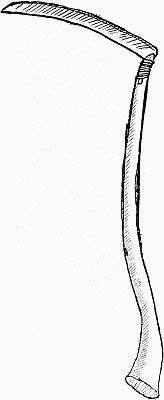
The handle is rather above two feet in length, straight for about the space of a foot from the part where the blade is bound on. Afterwards it is slightly curved outwards, and then again, towards the apex, in some degree inwards so as to make a straight line with the base. The top is thicker than any other part. The blade of the scythe is, like that used in our country, about a foot and a half long, and an inch and half broad, very slightly curved. Its back is, like that of our scythes, thickened on one side. The mower takes hold of the top with his left hand, so that the back of the scythe is uppermost, but grasps with his right the part where the above-described curvature ends, so as to be able to give the edge a turn upwards. As he moves forward, he mows first on the right, and then on the left, only turning his hands, and not lifting the scythe, but merely presenting each side of its blade alternately to the ground.
On the south-west side of the town, across a small bay, lies a mineral spring. The water is not ill-tasted. Indeed this is one of the best mineral waters I have met with in the north; but it lies very low, appearing to derive its origin from a stream that runs above, so that its water comes out soiled, as it were, from the earth, and is covered with scum.
August 5.
Every body at Tornea was continually talking to me of a distemper to which their horned cattle are subject, and which kills many of them in the course of the winter, but especially in the spring, when they lose from fifty to a hundred head of cattle almost every year. On walking to examine the meadow into which they are first turned out to grass, I found it a bog or marsh, where the Water Hemlock, Cicuta aquatica, (C. virosa, Sp. Pl. 366. Fl. Lapp. n. 103. Engl. Bot. t. 479.) grew in abundance, and had evidently been cropped plentifully by the animals in feeding. It seemed probable therefore that they eat it most in the spring, when first turned into this pasture; whence it proves so much more extensively fatal than in summer, when perhaps they only pick up a plant here and there. It grows in all the moist meadows which are mown for hay; consequently the cattle take it likewise in their winter food, and therefore perish, more or less, during that time of the year. We learn from Wepfer's experiments, who gave it to various kinds of animals, what violent symptoms it occasions. See his book. Nothing appeared to me so interesting, during my visit to Tornea, as to examine into the cause and remedy of this evil. If my ideas be right, the whole might be prevented by employing a woman for a month to eradicate all the Cicuta; by which this town, small as it is, might save above two hundred silver dollars. I was informed that the cattle dying from this cause become so infectious, that they cannot be flayed without great danger. The persons employed in that business have their hands greatly swelled by touching the carcase, and several have lost their lives in consequence. The plant in question, therefore, agrees in qualities with the Œnanthe, as it does likewise in place of growth and outward appearance, especially in the pinnæ of its leaves.[9]
The meadows hereabouts, among the thickets towards the shore of the bay, afforded me the following plants.
1. Veronica (maritima), with an erect stem, branched in the upper part, and bearing numerous spikes. Lower leaves acute, cordate-oblong, sharply serrated, the upper ones lanceolate, serrated, two, three, or four together, opposite on the stalk. Corolla tubular, divided two thirds of its length into two lips, of which the upper is the broadest, ovate, obtuse, and nearly erect; the lower three-cleft, the middle segment narrowest, but all of equal length. Stamens two, very long, awlshaped, situated at the separation of the two lips. Hence the flower is of the personate kind. Pistil reflexed. Capsule heartshaped, narrow at the upper edge. The flowers are numerous in each spike.
2. Selleri, (Apium graveolens[10],) unless I am much mistaken. The petals are white, spreading, and acute. The partial umbels are broad. The general one has very rarely one or two (leaves of an involucrum?).
3. Galium parisiense (uliginosum), with a square, furrowed, procumbent stem. The leaves are lanceolate, broader towards the extremity, acute, armed with little prickles as well as the stem. The flower is not tubular, nor the seeds prickly. The latter are white, as is also the flower. Four leaves grow together in the lower part of the stem, but in the upper part six. Under the little umbels of flowers are either four or two.
4. Galium album (boreale). Stem square, erect, branched, especially in the upper part. Leaves four together, sessile, rather broader towards their base, three-nerved, slightly reflexed at the margin. There are two leaves to each of the lesser umbels. Seeds two, roundish, joined into a didymous shape, downy. Flower not tubular.
5. Cruciata, if I am not mistaken. (Galium palustre, that is, Cruciata palustris alba of Tournefort.) Leaves four, ovate-oblong, bluntish, narrower towards their base. Flower, I believe, not tubular. See what I gathered in the woody parts of Lulean Lapland. (This was the same species, as appears by the Fl. Lapp.)
6. Clymenum parisiense (Lathyrus palustris). Stem triangular, two of its angles ending in wings, or having a dilated compressed border. There are two little oblong pointed angular leaflets at the insertion of the leaves, which latter are pinnated, ending in a tendril, and composed of two or three pair of nearly lanceolate pinnæ. The flowers are violet-coloured, three or four on each common stalk.
7. Angelica tenuifolia (sylvestris), which I would define A. umbellulis globosis. The general umbel, though often naked, is commonly furnished with one, two, or as far as five, very slender leaves; each partial one has often as many as eight. It is curious that when the plant blooms vigorously, none of the stalks of the umbel can be seen, but the flowers form a complete ball, like the Double Guelder-rose (Sambucus Opulus, flore pleno,) or the Globe Thistle (Echinops Sphærocephalus). The petals are lanceolate and spreading. Stem striated, or slightly furrowed.
8. Cicuta aquatica of Wepfer (C. virosa above mentioned). I am disposed to refer this plant to Œnanthe, on account of its external aspect, which is wonderfully like the last-mentioned genus. I must examine whether their flowers agree. The footstalks are hollow, inflated, and erect. Pinnæ three, rarely four, pair, of a narrow lanceolate shape. Those on the stem have from three to seven serratures each, but the radical ones have more, all distinct; and sometimes the lowermost serrature, at the lower edge, grows out into a sort of spurious pinnula. The top of the stem bears from one to three umbels; the general umbel being naked, or rarely furnished with a solitary leaflet[11]. The partial ones have seven short, narrow, acute leaflets. The tips of the petals are inflexed.
9. (Pedicularis) Sceptrum Carolinum. Its capsules are rose-coloured, its flowers yellowish white tipped with flesh-colour, and obtuse. The capsules are about equal to the interstices of the spike, which all together is about four inches long.
August 6.
The day of the holy sabbath, and therefore a day of recreation for both mind and body. I saw in the church (of Tornea) a memorial of King Charles the XIth's own observation of the sun on the 14th of June, 1694. The sun was visible on that night till very near twelve, when a small cloud hid it from the sight. It was however above the horizon[12]. In winter the sun does not rise above the horizon, but at the solstice it becomes visible. Could it be seen from the pole?
The young women in Finland have much more swelling bosoms than those of Lapland; the latter accord best with the description of the poet,
"Quales cruda viro puella servat." (Mart. lib. 8. ep. 63.)
August 7.
The town of Tornea stands on a small island, inhabited close to the shore on the south-west side. I call it an island, because it is bounded on the north by a swamp; on the south-east by the great river of Tornea; on the west and south-west by an arm of the sea, like a large river in appearance, but so shallow that no vessel can approach within a mile of the town on that side. This arm of the sea was formerly the king's road, (a channel obliged to be kept open,) but now it is almost dry in summer time, on the north side, towards the swamp.
I ascended the steeple from whence his majesty king Charles the Eleventh saw the sun at midnight on the 14th of June, 1694.
August 8.
Nothing worth notice occurred.
August 9.
Leaving Tornea, I proceeded to Kimi, where is a large salmon fishery, for which this place is remarkable, as Liminge is for its meadows, and Storlionis for its cornfields, but the last yield the greatest profit.
August 10.
I stayed at the house of the principal clergyman in Kimi till the 11th. This day I gathered a sort of Pink, Caryophyllus, with reflexed petals of a purplish colour, divided into many segments almost to their base. The claws, not contracted at the summit, bear on the upper side, at the bend, a tuft of dull-coloured hairs. (This was the beautiful and fragrant Dianthus superbus.) Also a Salix with appendages at the base of its leaves. (What species this was, does not appear.) At the shore of the great river grew Alsine repens, foliis gramineis, (Stellaria uliginosa, Fl. Brit. 476. Engl. Bot. t. 1074.)
Lying-in women at this place are accustomed to drink brandy seasoned with pepper, partly for the sake of its intoxicating quality, by way of a narcotic, and partly to bring on the labour pains. The clergyman's wife told me an infallible method, as she said, to prevent the pains which often follow childbirth. When the woman's first child is born, and the umbilical cord divided, a spoonful of the blood is given her to swallow. This is to be practised at every succeeding labour, and I was assured that each would be rendered more easy, without any after pains.
In East Bothnia, as well as in Medelpad, it is customary to have the dairy superintended by a superior female servant, called the fäbodar, who receives for each cow one pound of butter and one of cheese, besides a pound of mesosmör. (See v. 1. 197.)
To obtain a greater quantity of butter, the milk is set by, either in a cellar or in a double-walled house, to be kept as cold as possible, for at least two days, or so long as that it will not stick to the finger. The milk will not turn sour, but will become very thin and blue, while the cream collects on the top, of considerable thickness and in great perfection. The cream being taken off, and put into the churn, often proves so rich, that after it has been churned but a short time, if the churn be laid on one side nothing will run out. It is no small labour to churn such cream.
Of the remaining milk cheese is made, being warmed before it is coagulated. If the milk has begun to turn sour, it will not do for this purpose. Such thin milk as this is not very fit for eating, but the whey which separates from it in the making of cheese, is by some people made into syra. (See v. 1. 243. n. 11.) This is done merely by putting it, when cool, into a vessel or cask, when, if set by for a considerable time, it will become extremely tough. Most usually however it is boiled, and then kept for two or three days, when, some new milk being added, it is boiled up again to the consistence of flummery, and then set by in some kind of vessel. If it remains for a long while without being touched, it grows hard, and becomes mesosmör. (v. 1. 243. n. 12.) The blue milk above mentioned may be boiled like fresh milk, and does not readily turn sour.
Gos-mjölk, or rather Gäs-mjölk, (from the Swedish verb gäsa, to work or ferment,) is made as follows. The butter-milk is set by in a tub till it begins to ferment, when about a third or fourth part of the quantity of fresh milk is added, the whole being allowed to work once more. A serum by this time is formed at the bottom, which is drawn off by means of a cock or tap, in the bottom of the tub, and used immediately for food. A similar portion of fresh milk is then put to the remainder, when more whey is, in due time, deposited. This practice is repeated from time to time for the space of a fortnight, at the end of which the milk in the tub becomes of a thick consistence, and is excellent eating.
Servet-mjölk (Napkin Milk) is made by taking a quantity of sour milk just beginning to ferment, when bubbles, like hydatids as it were, are formed between the cream and the milk. This is cut across in various directions, and the thicker substance taken off and hung up in a napkin, that the liquid part may drain away. What remains in the napkin acquires a firm consistence, and is eaten along with fresh sweet cream.
EAST BOTHLAND.
August 11.
I departed from the house of the chief clergyman of Kimi, whose name is Forbus or Forbers, and that of his wife Christian.
Here I observed the Lumme of Wormius, (Colymbus arcticus; see v. 1. 27.) Its outermost toes were largest, and most naked; the next, or middlemost, smaller; the thumb, or inner most, very small.
A skin of a squirrel, that had been caught in winter, was white towards the end of the rump, as were also the outermost toes, and the ears.
In my journey this day I met with the Stratiotes (aloides), and the Butomus (umbellatus); as well as the Mesomora (Cornus suecica), the spotted Palma Christi (Orchis maculata), and the Gnidium. (This last could be no other than the Mezereon, Daphne Mezereum, formerly called Coccognidium.)
I found also the Ladies' Slipper (Cypripedium Calceolus), but it was almost out of flower.
The calyx consists of four long, coloured, lanceolate leaves, two of which, the upper and lower, are longer and broader than the two lateral ones. Petals two, the uppermost inversely ovate, reflexed, bearing the anthers. Is it the pistil? The lowermost inflated, obtuse, about an inch long. Anthers two. Fruit below the flower, of one cell, oval, with three principal and three smaller angles, splitting laterally into three valves, having a central column between them. The seeds adhere longitudinally to the middle of the placenta (or receptacle). The herb has the aspect of Veratrum.
August 12.
The forests hereabouts are composed of Birch and Spruce fir mixed with Pine (Pinus sylvestris), and a little Juniper (Juniperus communis). The herbaceous plants grow luxuriantly in these woods, and attain a remarkable height. Berries of the Wild Vine (Rubus saxatilis), the Vaccinium (Whortleberry), Mesomora (Cornus suecica), Empetrum (Crow or Crake-berry), and (Rubus) Chamæmorus, are here in abundance. The (Pedicularis) Sceptrum Carolinum presents itself every where in the highway.
The pales, with which the fields are fenced off, are placed horizontally against upright posts.
The houses, or rather smoke-huts, are called Pyrter in this part of the country. In these there is no proper fire-place, but the whole is an oven, as it were, consisting of the four walls of the house, with a flat cieling. In the latter is a hole by way of chimney, but not partially covered by any kind of lid, or trap-door, as in Norway, (see vol. 1. 357,) so that when the fire, made on a hearth under this opening, is very smoky, it might be entirely opened to let out the smoke. There is indeed a sort of wooden window in the roof, but it is rarely opened. The people think themselves the warmer because the smoke can escape by the door only, and are persuaded that they should be frozen to death if they had a chimney; which opinion seems to me altogether absurd. Would it not be better to have chimneys, with a moderate degree of warmth, than a heat like that of a bagnio, with blind and sore eyes, and a black sooty house? They lie on the floor in the midst of this smoke, and that is their only bed. Notwithstanding their opinion, I cannot help thinking that full as much cold air enters by the door, as there could by a chimney. They are so anxious to keep themselves warm, that they do not venture to have any windows, only shutters in their stead; indeed they seem to be as fond of darkness as owls. I peeped into one of these houses through a shutter, and within was perfect darkness. Nevertheless there were several children and other persons in the dwelling. I could distinguish nothing but what seemed to me a pair of glaring fiery eyes, like the devil, in a sort of large jug. On looking more attentively, I perceived that the object before me was actually a jug or pot, in which I had already remarked that they were accustomed to carry lighted embers, when wanted, to their neighbours.
I am sure the peasants of Smoland often make a fire sufficient to roast them alive, though their houses are furnished with chimneys, and their fires are made, as at this place, with small pieces of wood. To say the truth, few persons can be of opinion that such excessive heat, in the winter of this very severe climate, can be wholesome.
I have already mentioned that the inhabitants of these smoky dwellings have no beds, but actually sleep on the floor. In the summer season, however, they generally sleep in their barns. Round the inside of the above-described hut or cottage, are ranged various tubs or wooden vessels. In one corner, opposite to the spot where the fire is made, stands a table.
As it would be impossible to bear a fire in these dwellings during the heats of summer, their owners have another building which serves them for a kitchen. This is almost of the shape of the Laplanders' huts, but double their width and height, consisting of cloven beams or posts, such as are used for the fences of the fields, only not covered in, like the dwellings of the Laplanders. In the centre, where all the posts meet at the top, the pot is suspended over the fire. Here they boil their provisions, distil brandy, &c.
The stage-houses[13] are constructed like those seen at some posthouses in our part of the country, having the centre of the roof raised on longitudinal timbers. They are lofty, but narrow. The wooden walls curve outwards towards the top.
This year the crops of corn proved very bad in this neighbourhood, so that the inhabitants were obliged to chop their chaff, with the upper part of the straw, as fine as possible, of which, when ground, they made bread. Others preferred the bark of Pine-trees (Pinus sylvestris) for this purpose. The fields of rye, sown in the autumn, were at this time quite green. The winter rye, sown last year, was not yet cut. The sheaves are not laid upon any stage, or under any cover, but are placed ten together in a heap, standing nearly upright, the uppermost sheaf being laid across, so as to shelter the others. They are afterwards carried into the kilns, which at this place have exactly the appearance of bagnios, with ovens built of boulder stones.
The fastenings of the doors are quite different here from those used in Smoland, which are fixed into the floor, and capable of being raised or depressed at pleasure. The fastening here is a kind of long button upon the door, on the side where the hinges are fixed, which being turned horizontally over the door-post, prevents the opening of the door.
By the road side grew an Amanita (Agaric) with a stalk two inches high, and as thick as a goose-quill. Its head was hemispherical; pale above; concave beneath, with loose gills. (Probably Agaricus n. 499. Fl. Lapp. ed. 2. 373. Fl. Suec. n. 1217. ed. 2. 446.)
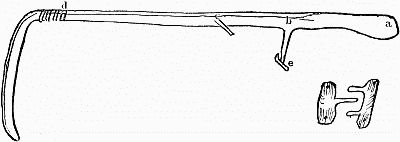
The scythes used in this country nearly resemble those of the Norwegians, but differ in this respect, that the upper projection from the handle stands out horizontally, see figure e, b, while the lower, c, is perpendicular, and the top, a, which rests against the arm, is flattened. The mower is therefore obliged to take hold of the foremost projection, with his left hand, under the main handle. The advantage of this is, that he is able to move forward in a nearly upright posture. The Norwegian however walks still more erect in mowing. The proportions of this Kimi scythe are as follows: From a to b one foot and a half; b to c two palms and a half; c to d two feet; the breadth at b two inches in a right line. The length of the projection b is three inches; and of c the same. The blade is like our Smoland ones, but stands at an acute angle with the handle.
The harrow consists of four or five links, in each of which are twelve joints. These have alternately one and two projecting pieces each. (See the figure annexed to the scythe just described, p. 159)
In the stage-houses (see p. 156,) boilers are fixed in the walls, for boiling horse-dung, which is given as food to the cattle; as well as to heat water for pouring on reindeer moss (Lichen rangiferinus), which is also used for the same purpose; but such diet gives a loathsome taste to their milk. In the roof of these houses hams and salmon are smoke-dried.
During the winter the people are obliged to work in their miserable cabins or Pyrter, when they open their shutters; but nevertheless find themselves sufficiently warm.
The annexed cut represents a sort of plough, used at Kimi.
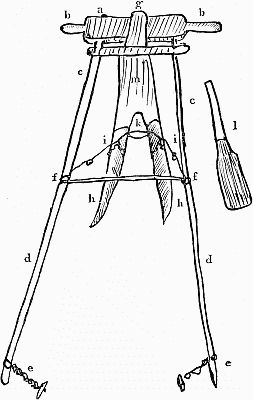
a, the base, is three palms long and one broad.
b, b, handles, each a palm in length.
c, d, shafts, six feet long, and of a round figure.
e, e, chains by which the shafts are attached to the collar or yoke. The distance betwixt e and e is three feet.
f, f, a straight or flat cross bandage.
g, m, the base of the plough-share, three feet in length, and two palms and a half broad.
h, h, points of the share, five palms long; distant at their base one foot three inches, at their extremities two feet.
i, i, a chain of long links, fastened to a ring that embraces the base of each point of the share, into which chain, at k, is introduced the handle l; this acts so as to bring the points together rather than to separate them.
It must be observed that the inner edge of these points is turned downward, so that when the handle or spatula l is put in at k, and is laid upon one of them, the earth is thrown on one side, and this is done alternately with the two points. The part m is slightly curved, as well as the points proceeding from it. When it is intended to make a deep trench, as in cutting through turf in the marshes, l is laid parallel to m, while the rings at f, f, as well as at i, i, prevent the plough-share from going too far downward.
No kind of plough is used at Tornea, all the ground being turned over with the spade. The same is the case at Kimi, except in the fields where rye is sown, and these are ploughed with the plough just described.
It is a common custom at Kimi to furnish out a table with five or six plates, and as many spoons, napkins, &c., though only one or two persons are expected to dinner. There is at the post-house a free table (or ordinary).
In the land belonging to the clergyman of Kimi, I found the (Lythrum) Salicaria with a very unusual aspect, having alternate leaves, and a solitary flower in the bosom of each. (The original specimens in the Linnæan herbarium have two or more flowers to the upper leaves.)
My intention was to have extended my journey into the province of East Bothnia; but on applying at the post-house, I could neither procure a horse, nor any thing to eat, for the inhabitants either could not, or would not, understand me. I therefore took leave of them the same day I arrived, and turned my steps backward.
The Finlanders in East Bothland are dressed very much like the Laplanders, and therefore agree with them in general appearance. Their dress is the same with respect to their cap, their light-grey jacket, their breeches reaching down to the feet, their half-boots, their belt into which they stick their knife, and the use of hooks and eyes upon their clothes instead of buttons. But they differ in not having a high collar, and in wearing a shirt and neckcloth, as well as in having their coat open before. They stick nothing into their girdle but a knife, though some people carry a key at the end of it. Their breeches are tied round the knees.
At church I observed some men with a girdle of black list, just as it was rent from the cloth, wound two or three times round the waist, which formed a contrast with their grey jackets. The women however dress in articles purchased from other countries, and make quite a different appearance from the Lapland females.
East Bothnia, being a low country, abounds in marshes, bogs, and fens. The grass is tall; but still there is such a deficiency of hay, that they buy up horse-dung at Tornea, and boil it, as I have said, in the boilers built up in some of their houses; in which also they boil water to pour over the reindeer moss.
The bread used by the inhabitants of this country in the present season of scarcity was made principally of chaff cut fine and ground.
The winter rye, sown but this day se'n-night, had already sprung up, and made the fields quite green.
I returned back to Tornea in the evening.
August 13.
This being a fast day, I heard a sermon in the Finnish tongue, preached at the church of Tornea. A lawful wife was churched, after her lying-in; which ceremony was performed in the choir, near the elevated part. The women in general had either naturally white hair, or hair that had once been brown, now turned grey. Very few had it red. They wear their hair rather straight.
The physiognomy of both men and women is phlegmatic and stupid; the body clumsy, the complexion bad, and the features destitute of all delicacy of form or expression.
The boundary between West Bothnia and East Bothnia is not formed by the river of Kimi, but by another smaller stream, not far distant, on the left.
They catch Sijk (Salmo Lavaretus) in a curious manner at this place. These fish, like the common salmon, swim against the stream, and for that reason are to be caught only near large falls of the river, which they are unable to ascend. The fisherman, being furnished with a net fixed at the end of a long pole, strips himself naked up to the waist, and walks into the middle of the strongest cascade. To prevent accidents from the force of the water, a rope is often tied round his waist, the other end of which is held fast by a friend on shore. Thus they catch the fish below the fall.
Seals are taken by various means, being either shot with fire-arms, or caught in a net. The latter, three or four fathoms high, is made of hempen cord, as thick as a goose-quill, each mesh being two spans wide. This net is kept upright in the water by means of oblong floats of wood, and has no stones at the bottom. Four or five such nets are frequently tied to the ends of each other, and a large stone is attached to the last, bound about with willow or osier, which serves to keep the nets steady. These are set in places where the seals are known to hide themselves, for those animals do the fishermen great damage, not only by devouring fish, but by tearing the fishing nets, from the destruction of which the haunts of the seals are discovered. When a seal comes in the way of the above-described nets, he either thrusts his head between the meshes, getting more and more entangled the more he pushes forward, or, as often happens, he is caught by the foot.
On a sand-hill near the church at Tornea, grew, in great abundance, Gramen spicâ triticeâ maritimum, (Triticum radice repente, foliis rigidis; Fl. Lapp. n. 34, which, in the second edition of that work, p. 23, I have, by the persuasion of my intelligent friend Dr. Afzelius, referred to Elymus arenarius, and what Linnæus here says, confirms this determination.) Its blue leaves looked quite different from all others, and very handsome. I picked some seeds from the spikes, which were as large as grains of rye. Hence I was induced to consider whether this plant might not serve as a kind of corn, to be cultivated on such dry and blowing sands, provided the proper method of managing it could be discovered, which surely would not be a very difficult task. The advantage of this would be that, by such means, many sandy tracts, where nothing else will grow, might be turned to advantage; and the perennial roots, which no other corn has, would of course save the trouble of sowing it annually. Perhaps even these roots themselves might, in hard times, serve for food.
The tall Finlander Daniel Cajanus, at Stockholm, born in this part of East Bothland, was the son of a clergyman. At his birth he was no bigger than the generality of children, and his health was very indifferent, particularly with regard to his chest, till the age of twelve or fifteen years.
I was informed that the inhabitants of this neighbourhood often hear thunder in the alps during winter.
In the alps of Tornea cold is brought by a south wind, and mild weather comes from the north, because of the sea.
The Laplanders consult several natural objects by way of compass as they travel.
1. Large Pine-trees, which bear more copious branches on their southern side than towards the north.
2. Ant-hills, the south sides of which bear grass, the northern whortle-berries.
3. Aspen trees, whose bark is rough on the north side, smooth on the opposite part.
4. Old withered Pines are clothed, on the north side, with the black Usnea, or filamentous Lichen (L. jubatus).
By such marks as these they are able to find their way through pathless forests. Have we any guides so certain?
When these people kill any wild reindeer with fire-arms in summer, they lodge the carcase in a cold cellar, and cut it up as they want it for provision.
I observed a curious kind of lime-stone burnt at Kimi, Tornea, and other places round the neighbouring sea-coast.
August 14.
A very rainy day. A silver ore from Hjortot has been assayed by the Mineral Board, and found to contain forty per cent. lead, but only three or four of silver.
August 15.
Near the ferry at Tornea I picked up the Fresh-water Sponge, Spongia lacustris of Newton, (S. lacustris; Syst. Nat. v. 1. 1299. Linnæus here refers to Mr. Newton, the friend of Ray, who found the Sponge in question in the Norwich river, where it still exists. It is however denominated in Ray's Synopsis, S. ramosa fluviatilis, not lacustris. Linnæus quoted from memory.)
August 16.
In dissecting the flower of Artemisia (vulgaris), I was struck with its very curious conformation. (This alludes to the want of a limb to the corolla of the female or marginal florets. See Fl. Lapp. ed. 2. 244.)
August 17.
I went by sea from Tornea to Calix. The wind proved contrary. The islands abounded with Whortle-berries, and with the fruit of Rubus saxatilis. On one called Korsholm I met with a sort of Behen. Can it be the same with that which grows in cornfields? Their different parts are tolerably alike. This grew among the pebbles of the beach. Its calyx is oblong. Leaves narrow. Stem erect. Fruit of one cell. In other respects it resembles Behen. (This was Cucubalus (Behen) variety the third, or γ, Fl. Lapp. n. 180. ed. 2. 149. Silene maritima, Fl. Brit. 468. Engl. Bot. t. 957. We have found it remain for many years unchanged in a garden, propagating itself by seed, though Linnæus reports that the third year he could not distinguish his from our common Silene inflata, his Cucubalus Behen.)
ŒCONOMICAL REMARKS concerning THE NEIGHBOURHOOD OF TORNEA.
The soil is various, sometimes clay, sometimes sand. The corn-fields are sown every other year, and lie fallow the intermediate seasons, half of each field lying fallow, while the other half is cultivated. The former is ploughed during the whole summer, to prevent the growth of grass or weeds, which might exhaust it. Barley is sown in these open fields only. Rye is cultivated on land that has recently been cleared of its wood by burning, but not in any great quantities. Turnips and Rye are sown together in one crop, and not, as usual in other places, Turnips one year and Rye the other. Rye bread is reserved to treat visitors. Barley bread is of three different qualities; 1. made of the unmixed barley; 2. of a mixture of barley and chaff; 3. of chaff without any addition, except now and then a handfull or two of barley. This last is their Spis-bröd, or household-bread.
The plough is of the same construction as that used in Westbothland.
Almost every person, except such as are very poor, catches as many of the small kind of Herrings, called Strœmming (Clupea Harengus β, Membras of old authors,) as are necessary for the support of his family. Those who are not otherwise employed in spring and autumn, catch them for sale afterwards to such as have not time to take any for themselves. These fish begin to spawn about the 18th of May, and continue till about the 16th of June. After the latter period they go into the small inlets among the rocks, and are taken by means of large nets till St. Peter's day, June 29th. This is called the large Strœmming fishery. From St. Peter's day till St. Bartholomew's (Aug. 24th), or even later, they are taken likewise with nets in their usual haunts. These fish are found with milt as well as roe throughout the summer.
One barrel of sour Strœmming is as valuable as two of the salted sort, the former being greatly preferred. A peasant whose family consists of a dozen people, takes half a barrel of salt Strœmming for his whole supply, and this is used to make a kind of soup when boiled with turnips; but he takes a barrel and three quarters of sour Strœmming, which is eaten without any preparation, like smoked and salted meat. If the director of the family is a good œconomist, he will never allow it to be boiled or roasted. They let the fish which is to make sour Strœmming lie for three or four hours only before they take out the entrails, after which it is washed in a small coarse sieve, till most of the blood is removed. It is then salted, in the proportion of thirty pounds of ordinary salt to each barrel of fish. The fish destined to make salt Strœmming must be much more carefully washed, for if the least drop of blood remains it will turn sour. Every barrel of this requires a quarter of a barrel of salt which is disposed in layers, alternately with layers of fish. Each layer of fish and salt are rubbed together with the hands, till a sort of scum rises on the top.
Another way of preparing salt Strœmming is to make so strong a brine that the entire fish, thrown into the tub, will not sink. They put in only so many of the fish as can readily be stirred about in the brine. If the tub be so full that the brine does not entirely cover the Strœmming, more is added, and the whole is suffered to remain for some days. The fish is afterwards gutted in the following manner. A person puts ten or twelve of them on the thumb of his left hand, in such a manner that the back of each fish is turned towards the palm. He then very dexterously loosens the gills with his right hand, pinching out the gills and intestines at once; which is performed with great quickness. The fish are then put into a rope basket, and salted as before. When they have remained thus for a couple of days, they are put into other baskets, in order that the brine may drain away, and finally are packed up in new kegs for keeping, without any further salting. A hole is bored in each tub, just above the lowermost hoop, to draw off the brine, which is always collecting from the fish, and if permitted to remain, will cause the whole to turn sour; but the same method is not practised for the sour Strœmming. This last is in its greatest perfection about St. James's day (July 25th).
These people have three meals a day in summer, besides breakfast, and the sour Strœmming always makes a part of their dinner, as well as of the preceding refreshment. The fish, after being repeatedly squeezed, is laid between two slices of bread, and so eaten. After it they take some sour preparation of milk, without cream. Sometimes indeed they eat a bit of cheese, or bread and butter; but they never eat meat after the sour Strœmming. Their vegetable food consists of cabbage, pease, or turnips, the first being generally eaten on Sundays. Pease are eaten once a week, except when the cabbage is deficient, and then they supply its place. Turnips and salt Strœmming are generally eaten in a morning, in the following manner. When the turnips are boiled nearly enough, the fish is put to them, but not before, lest it should be broken to pieces. To this some flour is added; and they drink sour milk after it. Their supper always consists of flummery, made of barley-meal. Before they first go out in a morning they eat either bread and butter, or bread and cheese, but they prefer the former. The mixed bread (made of corn and chaff) is their ordinary portion; good bread, made entirely of corn, they seldom or ever taste. It is reserved for visitors, or for very extraordinary occasions. Their mixed or household bread, being baked in cakes as thin as paper, is eaten by laying four or five such cakes together upon each other. They are never unprovided with ale in their cellars, to treat visitors, though their ordinary drink is table beer. In summer time they always drink Syra, (see vol. i. p. 243.)
The peasants themselves eat but very little of their own mutton, and chiefly the shoulder and brisket. The rest they sell; scarcely any is kept in the house but the above parts, with the marrow-bones, which they break to get at the marrow. The heads and feet of sheep, goats, and hogs, are salted and dried, being, when wanted, boiled with pease, and not ill-tasted. The legs of sheep, cut off at the knee, are often boiled fresh; the fat which floats on the top being collected and preserved in a horn or pot, as very useful to grease small ropes, and wheels. The legs and feet thus boiled are afterwards thrown away, not eaten. The head and feet of a calf are usually pickled.
For fire-wood these people use birch-wood. They burn no candles in their houses. They go to smoke themselves with the Finlanders in their huts.
The hay is mown here in the same manner as in Upland, and the corn is managed in the same way as in Smoland. When the season is dry, they prefer drying the corn in heaps in the open air, as before described; but in wet weather they have recourse to sheds. The hay is spread out till dry, and afterwards carried, without being made into cocks.
They raise as many hops as are wanted for each family, and have perhaps a few pounds over, for sale.
Their pales are high, made of pine-wood, and placed sloping.
The milk is set in the cellar, in deep tubs made of alder wood, by which they obtain a great proportion of cream, even two fingers' thick. This cream is stirred up with the milk, warmed, and then coagulated, for making cheese. Another mode is with butter-milk, to which they add a sixth part of fresh milk, that has stood one day and been skimmed. This mixture, being first warmed, is then coagulated. The cheese thus made is preferred to the former, and often eaten in preference to butter.
Between Midsummer and St. James's day (July 25th), the whey is collected, after the cheese is made; which, after boiling for some hours, is set by to cool. When cold, it is barrelled up for winter use. Poor people and old women beg or buy it, a small bottle-full at a time. To one pot of sour milk they add a fourth part of Syra; and these together have the taste of what they term Filbunke, which is sour milk with the cream on, just beginning to ferment, and of which they make Servet-mjölk; (see p. 150.)
Thick milk (perhaps Mesosmör, see vol. i. p. 243,) is often kept in barrels till winter, as is the meal made of fir-bark, when both serve for winter provision.
Syra is so very sour as not to be eatable by itself. When they have no milk to dilute it with, they add an equal quantity of water to the Syra, and mix the whole with flummery, which mixture they prefer to small beer.
Butter is now and then made of goat's milk; but it is very strong, and quite as white as that made of the milk of the rein-deer.
August 18.
On islands near the shore I saw a Salix with leaves like the cultivated olive. It is a shrub three feet high, but growing in a spreading manner. Stem grey, with roundish dusky solitary buds, of a very large size, in proportion to the plant. Leaves gradually larger (upwards?), oblong-lanceolate, bluntish, on scarcely perceptible footstalks, furnished with an obtuse longitudinal rib beneath, but no veins. Their upper surface is green, sprinkled all over with minute white dots; very slightly channelled, and paler, along the nerve. (This appears to have been S. rosmarinifolia.)
August 19.
At the fair of Calix I obtained some information concerning the commerce of this country, which is very different from that of almost every place in the world besides, insomuch that I am unable to determine which party makes his market of the other. The townsman thinks it is himself who cheats the peasant, but I verily believe he is the party who is cheated.
1. The general plan of traffic here is bartering one article for another.
2. The merchant generally carries his goods home to the peasant's residence in the country, at whatever distance it may be, or else conveys them to the fair, from whence the purchaser is to fetch them.
3. When a townsman sets up trade as a merchant, his principal aim is to get as many country-people to connect themselves with him as possible, who are to supply him with their produce. These are termed Gield-bonder, or creditors.
4. The advantage the peasants have in thus confiding to the merchant the whole of their goods, is, that the latter pays their taxes for them to the collector, which must be done either in ready money, or bills of exchange.
5. When the merchant receives the goods from the countryman, no price is fixed upon them between the parties; but when the former returns from Stockholm, he sets down in his accompt-book nearly the sum for which he has disposed of the articles there. In this the peasant trusts to the honour of the merchant, and is paid accordingly.
6. These prices are not communicated to the countryman immediately, nor does he know the price of the salt, tobacco, corn, and other articles, with which the merchant supplies him in return, till they settle accompts; which does not take place till the end of every year, or perhaps not so frequently.
7. As long as a peasant keeps to one merchant, he is allowed credit, and obtains advances of any money for which he may have occasion, even although the goods delivered do not amount to the interest of the sum lent, which is sometimes equal to 1000 dollars. But if he carries any of his goods to another merchant, he must immediately pay what he owes to his original correspondent, or suffer a sequestration of his property.
8. The countryman never brings his own goods to market, unless he happens to be going that way, in which case he usually takes them with him, but otherwise it is expected the merchant should fetch them.
9. When the towns of this part of the country were first built, each had certain parishes appropriated to it, and these were called the trading district of each town, in which no person who did not belong to the town had a right to trade. These exclusive privileges were subsequently annulled by royal authority, and free markets were established, where strangers as well as the neighbouring inhabitants were equally permitted to trade. This open trade has not however taken place at Calix, partly because the peasants are situated at so great a distance from one another, and partly because the merchants in the town conceive that such a plan would ruin them, they being in that case obliged to buy and sell for ready money.
10. Here are no free markets, properly speaking, but only Upbördsmoten (periodical meetings of the collectors of the revenues with the peasants). At these times the townsmen and the peasants meet together at the place of rendezvous, as at Calix every year on the 19th of August, and at Tornea in the depth of winter.
The inconveniences of the above plan of trade are,
1. The merchant lays considerable sums fast, with which he might otherwise extend his commerce.
2. He has the trouble of carrying his goods to the house of the peasant, where-ever it may be, up the country, and of bringing what he takes in exchange from the place of rendezvous to his own house in town.
3. The consequence of such a plan is, that many a merchant has outstanding debts to the amount of 100,000 dollars, the greater part of which he may never get paid.
The inconveniences to the countryman are,
1. He runs in debt more than he can ever pay.
2. The merchant has the advantage of fixing what price he chooses on his goods.
3. He is not allowed to take any measures for his own profit.
The collar of the shirts, worn by the inhabitants of Finland and East Bothland in this neighbourhood, resembles ours, their sleeves being more like those of a woman's shift.
Young women here commonly wear the bosom open, and have nothing over their shift, which is gathered round the waist like a petticoat.
The country of East Bothland is chiefly inhabited about the sea-coast, and on the banks of rivers.
An Aurora borealis was seen in the night of the 18th of August, and had been visible for a week past, so early does it begin here.
The rowers of the boat in which I pursued my progress had blisters on their hands caused by pulling at the oars. Their specific was the ladle with which they had just been stirring the pot where fish was boiling. This they applied, hot as it was, to the part affected, and the blisters disappeared.
What is here called Taim is a sort of salmon, two spans in length at most, the tail scarcely cloven, the mouth not hooked, but otherwise like the common kind. (This is probably the Salmo salar in a young state; and may perhaps be the Laxunge, or Salmo minor, vulgari similis, Artedi Spec. 50, not 80, mentioned in Fauna Suecica, ed. 2. 122, though Linnæus has no allusion there to the Taim.)
As soon as the corn is carried from the field, it is usual to thrash it slightly, that whatever is loose may come away, and not be lost in the barn, as also that the coarser part may be separated from the finer.
The flail is about a yard long, and rather thick.
The roofs in this part of the country are made of the bark of birch-trees, not covered over with any turf, but held fast by round poles, as thick as one's arm, whose upper extremities, alternately longer and shorter, reach to the ridge, and being bored through, are fastened to it, in such a manner that their ends project about a span each way beyond the ridge, crossing each other. Being thicker at their lower ends, they lie almost close together. Within this there is often a false roof, like a cieling, covered over with birch-bark and earth; but this is only when the house is wished to be very warm.
At the residence of the Governor of the Province at Calix, I saw three swans, which, having been taken when young, were as tame as domestic geese, to which these birds are so much alike in every respect, that I can have no doubt of their belonging to one genus. Their bill is flat, and black at the extremity, as well as the margins, convex and somewhat angular in the middle, so far at least that the swelling part terminates in an angle. The middle is fleshy, where the oblong nostrils are situated; the base flat or quadrangular, with two sinuses pointing upwards, and pale-coloured. The margin is toothed just like the Concha Veneris (Cypræa).
A carriage called Stotting is used here, for bringing home wood for fuel in winter, over the ice and snow. It is made of birch-wood, and resembles a sledge.
The length of this machine from a to b is three feet and a half, the breadth of each beam four inches and a half; their thickness two inches, except in the middle, at d, where it is three inches and a half, though in all the other parts of equal dimensions. The transverse bar, c, is one foot and a half long, three inches and a half broad, and is elevated four inches above the longitudinal pieces. e, e, are two slender triangular pieces, two feet in length, and two inches in thickness. f, f, are about one palm and a half each in length and breadth. h is curved upwards about two palms and a half out of the straight line. g is two feet long between the main beams, three inches and a half broad, but scarcely one in thickness.
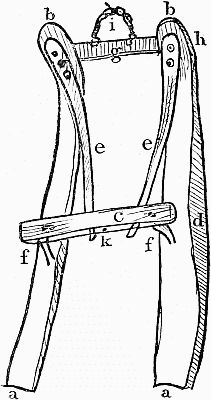
The sledges, or beams, a, b, differ from the common ones in being broader, and in the elevation or thickness of each at d. The transverse beam c, on which the load is laid, is bored through at each end, to receive the supporting pieces. The slender bars e, e, which may be termed clavicles, are broadest in the fore part, where they also are bored through, and fastened with pegs, serving to give stability to the cross beam c. Two of these carriages are tied together, one behind the other, through the hole in the cross beam, at k. The loop, i, is made of birchen twigs.
At Calix I found the Hippuris (vulgaris) with forked branches; Pentaphylloides facie fragariæ, (Potentilla rupestris?); and Eruca foliis sinapeos. (What this was does not appear.)
I noticed lime-stone in the cliff at Calix and Tornea.
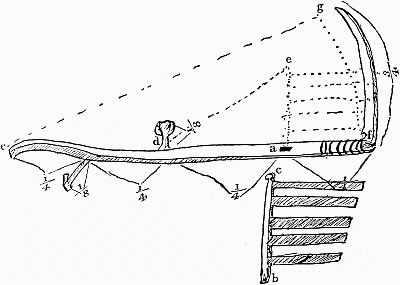
The scythe which serves at Cronby in East Bothland, for mowing barley, is made exactly like the common one of the Finlanders, with the foremost handle underneath, but, that nothing may be wasted or lost, the machine b c is fixed to the scythe, b being stuck into the hole at a, and fastened with a pin through it at the other side. A cord is tied from the other end c to the handle d, before the scythe is used. The lower, or shortest, bar of this appendage scarcely extends beyond the extremity of the scythe at f. Its position is regulated by a cord, according to the inclination of the blade f g.
The length of the main handle of the scythe, e f, is two ells.
August 31.
I collected and described various species of Fungi.
(Here follow descriptions or characters of several species of Agaricus, Boletus and Hydnum, given more correctly in the Flora Lapponica.)
September 3.
I stood sponsor to the son of the Burgomaster Geyer Svanberg, who was born the preceding night, or rather between one and two in the morning. He was named Geyer.
Mr. Svanberg told me the (Cotyledon) Umbilicus Veneris grew on a hill called Karvick, near Wallivari to the north. (This probably was not confirmed, as the plant does not occur in Flo. Suecica.)
September 4.
I went to Biorknas, in order to be instructed in the art of assaying.
September 9.
I examined the fish called in West Bothland Natting, (Petromyzon fluviatilis.) Its upper jaw is acutely notched, resembling two teeth. The lower has seven small teeth, of which the two outermost are largest. Mouth in the under side of the head, gaping, oval, rather compressed. There are seven openings in a row behind the eyes, gradually larger as they recede from thence. The fins have no visible rays, but merely streaks, yet they are not adipose, or fat, fins. There is a prominent orifice on the top of the head. The pericardium is cartilaginous. The fish is a span long. Its hind fin triangular.
These (lampreys) are caught at this time of the year, when the nights grow dark, in hollow timbers of a conical shape, resembling the wicker baskets used for catching eels. The entrance is made smooth and even. These timbers are laid, at the depth of two ells, in the river, and kept down with stones, the opening being turned to meet the current.
Some such traps are made of willow-twigs not bigger than goose-quills, platted close together into the same shape, and are two ells in length.
I was told that the Laplanders are accustomed to preserve blood of the reindeer in rennet-bags through the winter till spring, when they boil it with water, and drink it.
Tar is obtained in the following manner. A cavity, of an inversely conical shape, is dug in a hill, and then lined with hewn timbers, nine ells in length each, so as to form a sort of funnel. This again is lined with bark of pine-trees, so as to prevent the tar draining away into the ground between the timbers. At the bottom is another funnel or vessel of wood to receive the tar, which runs from thence into a trough, closed on all sides, except a hole where the point of the said funnel is inserted, and another at the extremity, closed with a moveable plug, from which the tar is received into vessels and taken away. Roots of fir, cut to pieces, are placed upright in the large funnel above, so as to leave a convexity over the bottom, and the whole being covered with turf is set on fire, against the wind. Care is taken, by varying the admission of air, to prevent its burning too fast, or unequally; and by this means they procure both tar and charcoal.
September 14.
I took my leave of Biorknas. The weather was cold and rainy. Such of the forest trees as are of a deciduous nature had now assumed a pallid hue, in consequence of the cold nights; but the evergreens, with their needle-shaped leaves, standing among them, seemed to defy the cold, and were rendered conspicuous by their dark-green colour. The high wind scattered the withered leaves over my path. How useful are the usual storms of autumn to disperse ripe seeds, and plant colonies far from the parent trees! The hills appeared sandy; and such places as had been burnt were now perfectly white with Reindeer Moss, (Lichen rangiferinus,) which grew so close together, as hardly to leave any room for the Ling. It ornamented the sides of the roads like the Iceland Moss, (Lichen islandicus.)
Some part of the road consisted of a reddish-brown earth, such as I had observed in the early part of my journey near Umœa. I was told that it was excellent for red paint. At length I reached Zingis, and in the evening arrived at Tornea, entirely wet through.
September 15.
I observed how they manage their corn at this season. They have no barns to lay it into, but it is placed between poles, all the ears directed to one side, in stacks two or three ells long, and very high. If the corn be not quite dry, it is first spread abroad. Afterwards it is dried in a kiln, and thrashed on a floor. How liable must it be to take fire, and how much must unavoidably be spilt in consequence of such management!
I received 100 dollars, of copper-money, from the chief clergyman.
I learned here that Tansy (Tanacetum vulgare) and Mugwort (Artemisia vulgaris) are used to make a fomentation or bath, wonderfully useful for women in labour, who are accustomed to sit over the steam of these herbs. I had observed the people at every house drying Tansy, but could meet with nobody who would inform me to what use it was destined.
September 16.
This day I again left Tornea for Kimi. There are six ferries between these two places, over the river Kokama, which passes near Kimi. Two miles from hence are the boundaries of East and West Bothnia. Lime-stone attracted my notice all the way along the road to Norbotn; it was yellow on the outside, whitish within.
September 17.
I departed from the posthouse of Kimi. The weather was unfavourable, for it rained all day long. I took up my lodging in the evening at the posthouse of Jö. This part of the country lies very low, abounding with marshes and numerous small rivulets, but few hills. There is plenty of grass. The buildings are bad. The forests consist chiefly of Birch, intermixed with the acifoliæ (slender-leaved evergreens). Of these last the Juniper was remarkable for its abundance and large size, so as to be almost arborescent. The Birch and the dwarf Willows had now become pale, but the Sorbus (Mountain ash, Pyrus aucuparia, Fl. Brit.) had assumed a red hue, as well as all the mosses. (Pedicularis) Sceptrum Carolinum appeared every where by the roadside. Thalictrum (flavum) and Scutellaria (galericulata) were less frequent, but Golden-rod (Solidago Virga aurea), Trollius (europæus), (Spiræa) Ulmaria, and Epilobium (palustre?) were plentiful, as was the sweet Milium (effusum), with the Gramen ramosum (probably Aira cæspitosa.)
The inhabitants were in their smoky huts, with their eyes full of smoke, and the tears running from them. Nevertheless they seemed more studious of warmth than careful of their eyesight.
The same sort of plough is used here as at Kimi.
I had frequent views of the sea through the woods on the right hand. Wherever the waves had thrown up sand-hills grew a pea with a triangular stem, a white creeping perennial root, and thick leaves alternately pinnate, (Pisum maritimum).
Near Jö I noticed a pit-fall designed to catch wolves. This was dug in a hill, at no great distance from the house. Around it within were eleven pales or stakes, placed upright and close together. In the centre stood a pole, which, as well as the pales, was on a level with the surface of the ground. The pole supported a wheel, over which were laid boards, so as entirely to cover it, in such a manner that if the wolf, when caught, should be able to climb up as high as the wheel, he might not get any further.
The peasants of this upper part of East Bothnia, children of darkness in their houses, are no less so in their slovenly appearance, chiefly owing to their uncombed hair. Their breeches reach as low as the feet, and are white, and they wear a sort of short cloak, sewed together in front.—Their disposition is quarrelsome. Their habitations are infected with a smell of sour fish, like sour Strœmming, for they are kept very dirty. These people speak no other language than the Finlandish.
Here and there by the road I had this day travelled, I noticed the Sea Wheat-grass, (Elymus arenarius. See Fl. Lapp. ed. 2. n. 34.)
September 18.
I travelled from Jö to Ulaborg. The rye was bound into sheaves, ten of which were piled up together in a heap, the ears at the top of each being brought close together, and another sheath being placed, in an inverted position, upon them, the whole was sheltered from wet. The barley was not set upright, but laid on one side, in such a manner that the ears were all turned inward, and the straw stood outward all round. On the top of each little stack thus formed, a reversed sheath was put, as a kind of covering.
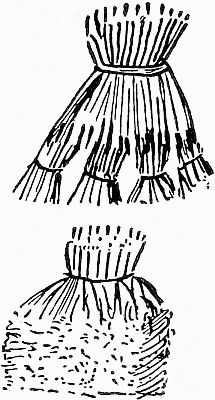
The villages consisted of the same kind of smoky huts I have already described.
(The annexed cut seems to be a representation of one of these dwellings, at which Linnæus was so indignant.)
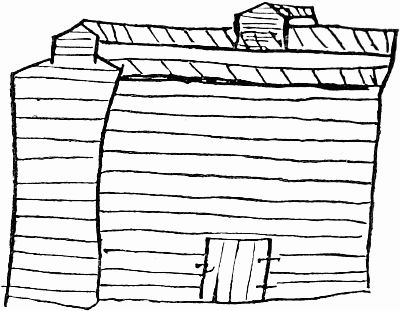
Near the ferry of Haukipudas, stones are collected from the shore, which, though nothing but concretions of sand and small pebbles, are so firm as to serve for the construction of ovens. At one spot, where the river had excavated the sandy bank, it was evident that the cement, which combines these particles together, is no other than a rust of iron. The stones in general hereabouts are very fine-grained, and break easily. They have all the appearance of containing a portion of iron. Some were more rugged and rusty than the rest.
A kind of boats used here to navigate rapid and dangerous parts of the rivers, are made of thin planks of spruce fir, and are four or five fathoms long, and about one broad in their middle. The sides are five or six quarters of an ell deep; the extremities compressed. The middle of the boat is nearly semicylindrical, the keel being raised up, or hollowed as it were by the dilatation of the sides, in which all the importance and peculiarity of the contrivance consists, for without this the vessel would be much more easily overset in rapid and shelvy places. Some of these boats have no prominent keel at all; others are furnished with a slight one, chiefly in their forepart, which is a little the highest, in order to bear the better any shocks from striking against stones; so that if this part be able to pass, the rest of the vessel may go in safety.
One sort of nets used for catching Sijk-fish, (Salmo Lavaretus, or Gwiniad, before mentioned) are five spans high, and of a considerable length, the meshes very small. There are loop-holes at the top, large enough to admit two fingers, bordered with birch bark, whose edges are sewn together. (See 1, 2, 3, 4 in the figure.) The stones (5, 6, 7) at the bottom are but small, covered with birch bark. The nets are set near the sandy shore.
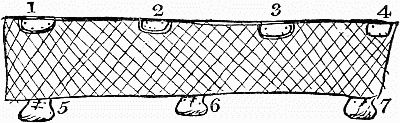
Another kind of net, used for catching the same fish, is placed in the strongest part of a current or water-fall. It resembles a receiving net, except being not so deep. The length is three ells, breadth two, and depth one. This is fixed very steadily, by means of poles, in the middle of the very strongest and most confined current, against the stream, so that when the fish attempts to pass upwards, by the narrow passages on each side the net, he finds it impracticable, and is thrown back by the force of the water, generally into the net, out of which he can never escape, but is taken out at leisure.
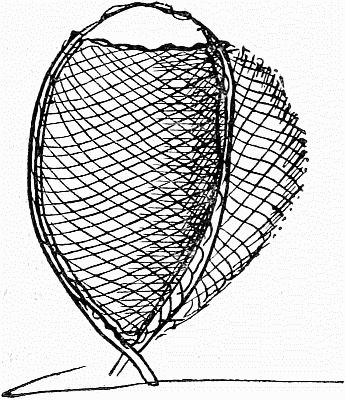
Near Ulaborg is a mineral spring, not yet made any use of. The taste of the water seemed good. This spring is situated close to the town, on a small island, where there is a sawing-mill.
In the church I noticed the monument of Messenius, with his effigy made to the life. He is actually buried here[14]. This church is one of the longest I ever saw built of wood, but its height is not correspondent. The arms of the town are displayed on the pulpit. Ulaborg is almost as large as Lund.
September 19.
After attending divine service I left this place. Sledges in use here are constructed with a cross board to rest the feet against. (a, seems to be a bandage or belt, to keep the traveller from being suddenly jolted out of this vehicle, and b is the part to rest the back or head against; but there are no references in the manuscript to these letters of the sketch.)
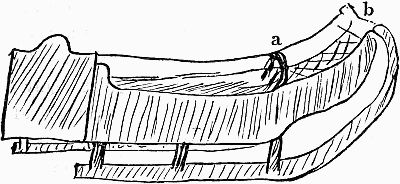
I now came in sight of the extensive meadows of Limingo, more spacious than all the meadow-ground of Tornea and Rödbeck together. (Tuneld says in his Geography, that the meadows of Limingo, and cornfields of the neighbouring parish of Storkyrro, are famous to a proverb for their great extent.) At first the land seemed a perfect marsh, filled with Horsetail (Equisetum fluviatile), and especially with Reed, Arundo (Phragmites), which last grew in such abundance as to resemble a forest. The Water Hemlock, Cicutaria aquatica, Cicuta virosa; (see p. 136), was very plentiful by the road-side. This led me to inquire whether the cattle ever fed there? I was answered by the peasants in the affirmative, with a question in my turn, whether I could give them any advice on the subject, for they had lost a great many; adding similar particulars to what I had heard at Tornea.
Red Currants (Ribes rubrum) grew all the way by the road, as well as Lenticula (Lemna or Duck-weed), and the Lichenoides of which powder is made was observable on the trees. (Lichen prunastri, said to have been used for hair-powder.)
The meadow of Limingo is two miles in length. The best part of the land, near the village of that name, was now occupied by the horned cattle. The land here is more elevated and less marshy, though somewhat impaired by tumps (of Carex cæspitosa). If but a third part of it were cultivated, according to the Scanian mode of husbandry, it would be of more value than the whole is at present. I was told that the whole marsh might be laid dry, by cutting a channel down to the seashore; but it was feared that the land might in consequence become covered with White Moss (Sphagnum palustre), which would render it altogether unprofitable.
About a thousand hay-cocks were now before me on the meadow, but none of them consisting of more than a horse could draw. They never here use more than a single horse or ox at a time for draught. Each of these cocks was raised from the ground on a kind of scaffold, supported by several cross poles. Some of the Water Iris (Iris Pseud'acorus) was mixed with the hay.