Book 4 — Chapter VI.
Reading edition
PROJECTS OF WILLIAM THE TESTY FOR INCREASING THE CURRENCY—HE IS OUTWITTED BY THE YANKEES—THE GREAT OYSTER WAR.
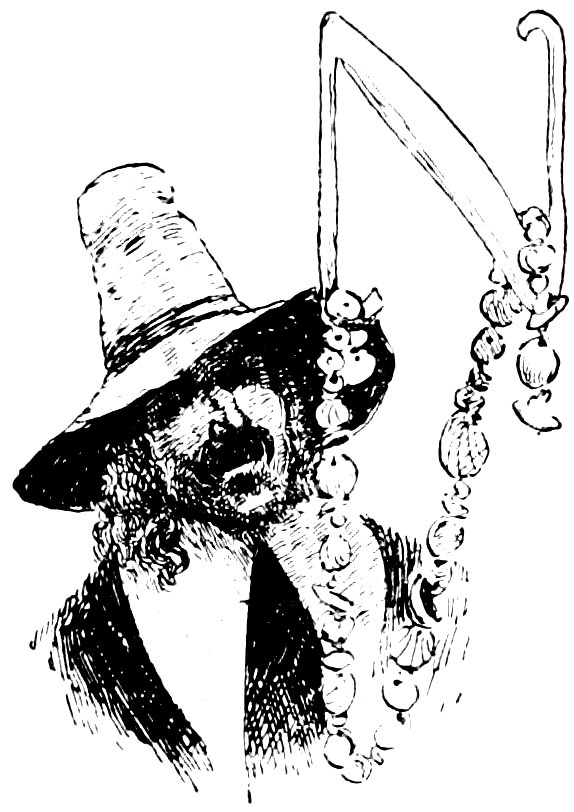
Next to his projects for the suppression of poverty may be classed those of William the Testy for increasing the wealth of New Amsterdam. Solomon, of whose character for wisdom the little governor was somewhat emulous, had made gold and silver as plenty as the stones in the streets of Jerusalem. William Kieft could not pretend to vie with him as to the precious metals, but he determined, as an equivalent, to flood the streets of New Amsterdam with Indian money. This was nothing more nor less than strings of beads wrought of clams, periwinkles, and other shell-fish, and called seawant or wampum. These had formed a 358native currency among the simple savages, who were content to take them of the Dutchmen in exchange for peltries. In an unlucky moment, William the Testy, seeing this money of easy production, conceived the project of making it the current coin of the province. It is true it had an intrinsic value among the Indians, who used it to ornament their robes and moccasins, but among the honest burghers it had no more intrinsic value than those rags which form the paper currency of modern days. This consideration, however, had no weight with William Kieft. He began by paying all the servants of the company, and all the debts of government, in strings of wampum. He sent emissaries to sweep the shores of Long Island, which was the Ophir of this modern Solomon, and abounded in shell-fish. These were transported in loads to New Amsterdam, coined into Indian money, and launched into circulation.
And now, for a time, affairs went on swimmingly; money became as plentiful as in the modern days of paper currency, and, to use the popular phrase, “a wonderful impulse was given to public prosperity.” Yankee traders poured into the province, buying everything they could lay their hands on, and paying the worthy Dutchmen their own price—in Indian 359money. If the latter, however, attempted to pay the Yankees in the same coin for their tin ware and wooden bowls, the case was altered; nothing would do but Dutch guilders and such like “metallic currency.” What was worse, the Yankees introduced an inferior kind of wampum made of oyster-shells, with which they deluged the province, carrying off in exchange all the silver and gold, the Dutch herrings, and Dutch cheeses: thus early did the knowing men of the east manifest their skill in bargaining the New Amsterdammers out of the oyster, and leaving them the shell.[36]
It was a long time before William the Testy was made sensible how completely his grand project of finance was turned against him by his eastern neighbors; nor would he probably have ever found it out, had not tidings been brought him that the Yankees had made a descent upon Long Island, and had established 360a kind of mint at Oyster Bay, where they were coining up all the oyster-banks.
Now this was making a vital attack upon the province in a double sense, financial and gastronomical. Ever since the council-dinner of Oloffe the Dreamer at the founding of New Amsterdam, at which banquet the oyster figured so conspicuously, this divine shell-fish has been held in a kind of superstitious reverence at the Manhattoes; as witness the temples erected to its cult in every street and lane and alley. In fact, it is the standard luxury of the place, as is the terrapin at Philadelphia, the soft crab at Baltimore, or the canvas-back at Washington.
The seizure of Oyster Bay, therefore, was an outrage not merely on the pockets, but the larders of the New Amsterdammers; the whole community was aroused, and an oyster crusade was immediately set on foot against the Yankees. 361Every stout trencherman hastened to the standard; nay, some of the most corpulent burgomasters and schepens joined the expedition as a corps de reserve, only to be called into action when the sacking commenced.
The conduct of the expedition was intrusted to a valiant Dutchman, who for size and weight might have matched with Colbrand the Danish champion, slain by Guy of Warwick. He was famous throughout the province for strength of arm and skill at quarter-staff, and hence was named Stoffel Brinkerhoff, or rather Brinkerhoofd, that is to say Stoffel, the head-breaker.
This sturdy commander, who was a man of few words but vigorous deeds, led his troops resolutely on through Nineveh, and Babylon, and Jericho, and Patch-hog, and other Long Island towns, without encountering any difficulty of note; though it is said that some of the burgomasters gave out at Hardscramble Hill and Hungry Hollow, and that others lost heart and turned back at Pusspanick. With the rest he made good his march until he arrived in the neighborhood of Oyster Bay.
Here he was encountered by a host of Yankee warriors, headed by Preserved Fish, and Habakkuk Nutter, and Return Strong, and Zerubabbel Fisk, and Determined Cock! 362at the sound of whose names Stoffel Brinkerhoff verily believed the whole parliament of Praise-God Barebones had been let loose upon him. He soon found, however, that they were merely the “selectmen” of the settlement, armed with no weapon but the tongue, and disposed only to meet him on the field of argument. Stoffel had but one mode of arguing, that was, with the cudgel; but he used it with such effect that he routed his antagonists, broke up the settlement, and would have driven the inhabitants into the sea if they had not managed to escape across the Sound to the mainland by the Devil’s stepping-stones, which remain to this day monuments of this great Dutch victory over the Yankees.
Stoffel Brinkerhoff made great spoil of oysters and clams, coined and uncoined, and then set out on his return to the Manhattoes. A grand triumph, after the manner of the ancients, was prepared for him by William the Testy. He entered new Amsterdam as a conqueror, mounted on a Narraganset pacer. Five dried codfish on poles, standards taken from the enemy, were borne before him, and an immense store of oysters and clams, Weathersfield onions, and Yankee “notions” formed the spolia opima; while several coiners of 363oyster-shells were led captive to grace the hero’s triumph.
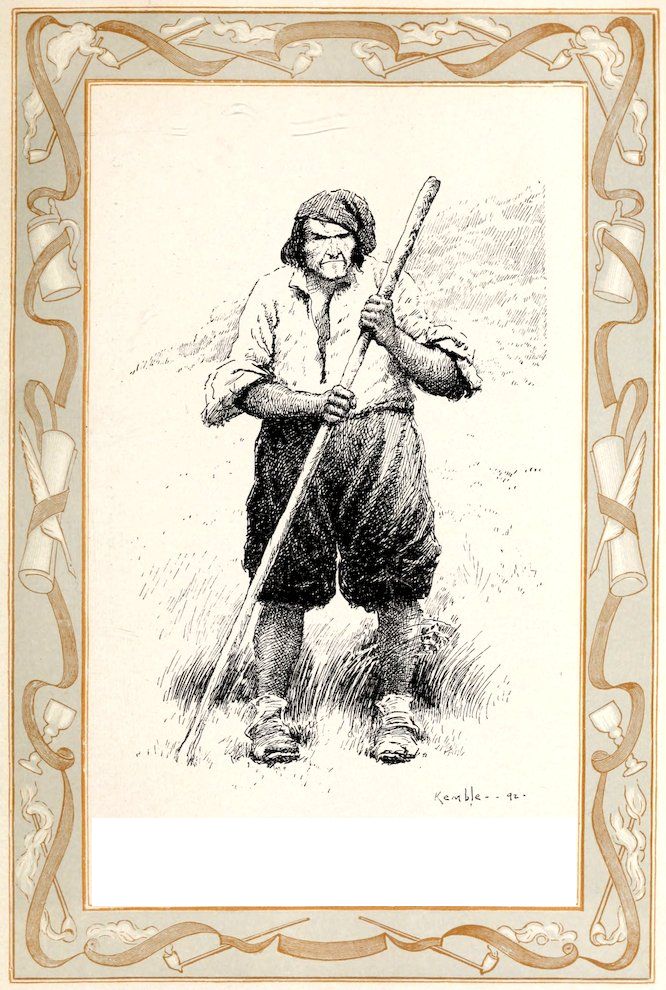
STOFFEL BRINKERHOFF.
364The procession was accompanied by a full band of boys and negroes, performing on the popular instruments of rattle-bones and clam-shells, while Antony Van Corlear sounded his trumpet from the ramparts.
A great banquet was served up in the stadthouse from the clams and oysters taken from the enemy; while the governor sent the shells privately to the mint, and had them coined into Indian money, with which he paid his troops.
It is moreover said that the governor, calling to mind the practice among the ancients to honor their victorious general with public statutes, passed a magnanimous decree, by which every tavern-keeper was permitted to paint the head of Stoffel Brinkerhoff upon his sign!
END OF VOLUME I.
TRANSCRIBER’S NOTES
Typos fixed; non-standard spelling and dialect retained.
Used numbers for footnotes, placing them all at the end of the last chapter.
The image borders on some images match the standard design used throughout the volume.
Included the original cover and endpaper.
The image used for the cover was adapted from the original to display the title and author.