Book 1 — Chapter IV.
Reading edition
SHOWING THE GREAT DIFFICULTY PHILOSOPHERS HAVE HAD IN PEOPLING AMERICA; AND HOW THE ABORIGINES CAME TO BE BEGOTTEN BY ACCIDENT—TO THE GREAT RELIEF AND SATISFACTION OF THE AUTHOR.
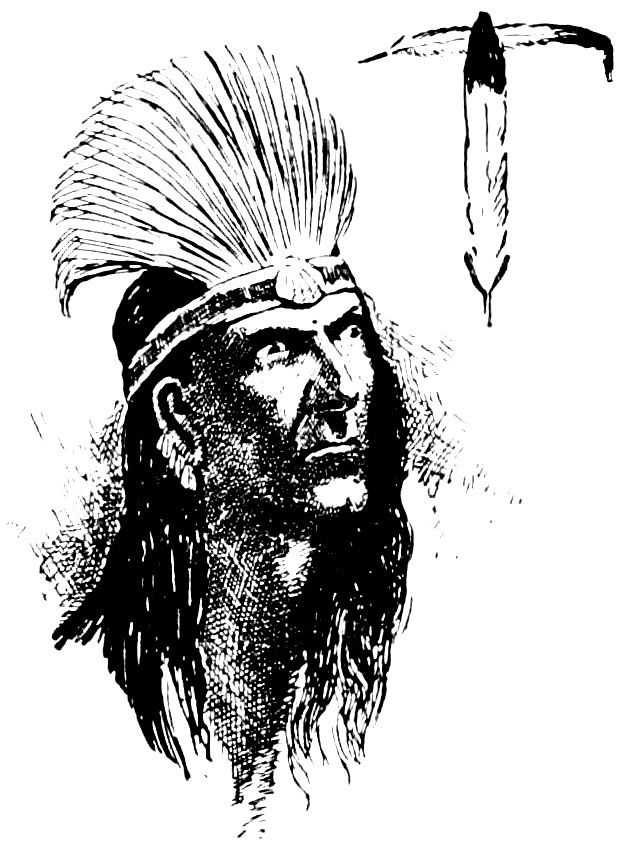
The next inquiry at which we arrive in the regular course of our history is to ascertain, if possible, how this country was originally peopled,—a point fruitful of incredible embarrassments; for unless we prove that the Aborigines did absolutely come from somewhere, it will be immediately asserted, in this age of skepticism, that they did not come at all; and if they did not come at all, then was this country never populated,—a conclusion perfectly agreeable to the rules of logic, but wholly irreconcilable to every feeling of humanity, inasmuch as it must syllogistically 73prove fatal to the innumerable Aborigines of this populous region.
To avert so dire a sophism, and to rescue from logical annihilation so many millions of fellow-creatures, how many wings of geese have been plundered! what oceans of ink have been benevolently drained! and how many capacious heads of learned historians have been addled, and forever confounded! I pause with reverential awe, when I contemplate the ponderous tomes, in different languages, with which they have endeavored to solve this question, so important to the happiness of society, but so involved in clouds of impenetrable obscurity.
Historian after historian has engaged in the endless circle of hypothetical argument, and after leading us a weary chase through octavos, quartos, and folios, has let us out at the end of his work just as wise as we were at the beginning. It was doubtless some philosophical wild-goose chase of the kind that made the old poet Macrobius rail in such a passion at curiosity, which he anathematizes most heartily as “an irksome agonizing care, a superstitious industry about unprofitable things, an itching humor to see what is not to be seen, and to be doing what signifies nothing when it is done.” But to proceed.
74Of the claims of the children of Noah to the original population of this country I shall say nothing, as they have already been touched upon in my last chapter. The claimants next in celebrity are the descendants of Abraham. Thus, Christoval Colon (vulgarly called Columbus) when he first discovered the gold mines of Hispaniola, immediately concluded, with a shrewdness that would have done honor to a philosopher, that he had found the ancient Ophir, from whence Solomon procured the gold for embellishing the temple at Jerusalem; nay, Colon even imagined that he saw the remains of furnaces of veritable Hebraic construction, employed in refining the precious ore.
So golden a conjecture, tinctured with such fascinating extravagance, was too tempting not to be immediately snapped at by the gudgeons of learning; and, accordingly, there were divers profound writers ready to swear to its correctness, and to bring in their usual load of authorities, and wise surmises, wherewithal to prop it up. Vetablus and Robertus Stephens declared nothing could be more clear; Arius Montanus, without the least hesitation, asserts that Mexico was the true Ophir, and the Jews the early settlers of the country; while Possevin, Becan, and several other sagacious writers, 75lug in a supposed prophecy of the fourth book of Esdras, which being inserted in the mighty hypothesis, like the key-stone of an arch, gives it, in their opinion, perpetual durability.
Scarce, however, have they completed their goodly superstructure, than in trudges a phalanx of opposite authors, with Hans de Laet, the great Dutchman, at their head, and at one blow tumbles the whole fabric about their ears. Hans, in fact, contradicts outright all the Israelitish claims to the first settlement of this country, attributing all those equivocal symptoms, and traces of Christianity and Judaism, which have been said to be found in divers provinces of the new world, to the Devil, who has always affected to counterfeit the worship of the true Deity. “A remark,” says the knowing old Padre d’Acosta, “made by all good authors who have spoken of the religion of nations newly discovered, and founded besides on the authority of the fathers of the church.” Some writers, again, among whom it is with much regret I am compelled to mention Lopez de Gomara, and Juan de Leri, insinuate that the Canaanites, being driven from the land of promise by the Jews, were seized with such a panic that they fled without looking behind them, until, stopping to take breath, they found themselves safe 76in America. As they brought neither their national language, manners, nor features with them, it is supposed they left them behind in the hurry of their flight;—I cannot give my faith to this opinion.
I pass over the supposition of the learned Grotius,—who being both an ambassador and a Dutchman to boot, is entitled to great respect,—that North America was peopled by a strolling company of Norwegians, and that Peru was founded by a colony from China,—Manco, or Mango Capac, the first Incas, being himself a Chinese. Nor shall I more than barely mention, that father Kircher ascribes the settlement of America to the Egyptians, Rudbeck to the Scandinavians, Charron to the Gauls, Juffredus Petri to a skating party from Friesland, Milius to the Celtæ, Marinocus the Sicilian to the Romans, Le Compte to the Phœnicians, Postel to the Moors, Martyn d’Angleria to the Abyssinians, together with the sage surmise of De Laet, that England, Ireland, and the Orcades may contend for that honor.
77
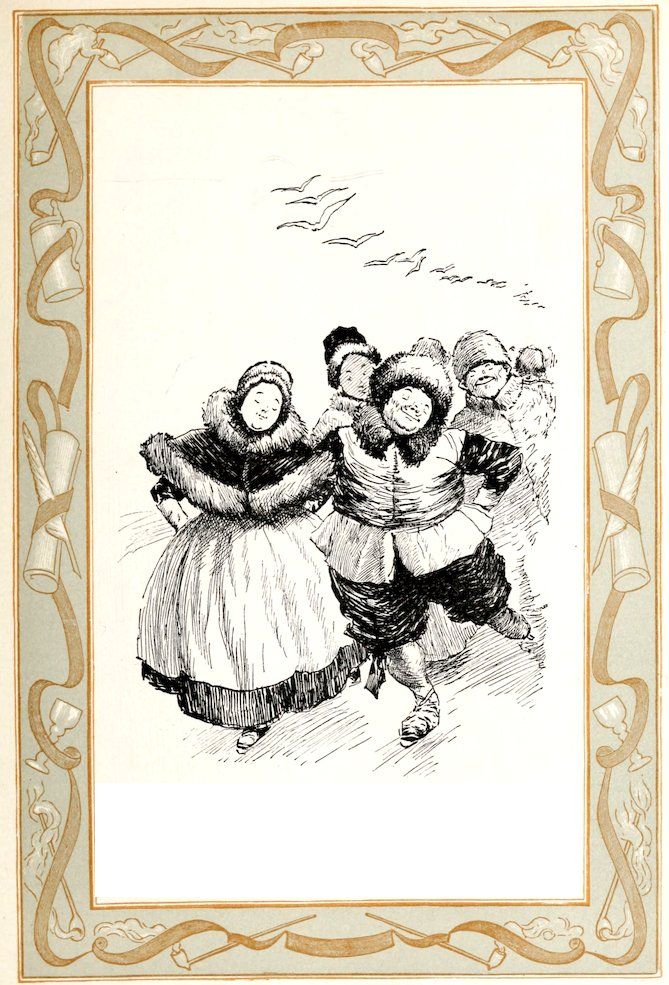
THE PEOPLE OF NORTH AMERICA ACCORDING TO PETRI.
Nor will I bestow any more attention or credit to the idea that America is the fairy region of Zipangri, described by that dreaming traveller, Marco Polo, the Venetian; or that it comprises the visionary island of Atlantis, described by Plato. Neither will I stop to investigate 78the heathenish assertion of Paracelsus, that each hemisphere of the globe was originally furnished with an Adam and Eve; or the more flattering opinion of Dr. Romayne, supported by many nameless authorities, that Adam was of the Indian race; or the startling conjecture of Buffon, Helvetius, and Darwin, so highly honorable to mankind, that the whole human species is accidentally descended from a remarkable family of monkeys!
This last conjecture, I must own, came upon me very suddenly and very ungraciously. I have often beheld the clown in a pantomime, while gazing in stupid wonder at the extravagant gambols of a harlequin, all at once electrified by a sudden stroke of the wooden sword across his shoulders. Little did I think, at such times, that it would ever fall to my lot to be treated with equal discourtesy, and that, while I was quietly beholding these grave philosophers, emulating the eccentric transformations of the hero of pantomime, they would on a sudden turn upon me and my readers, and with one hypothetical flourish metamorphose us into beasts! I determined from that moment not to burn my fingers with any more of their theories, but content myself with detailing the different methods by which they transported the descendants of these ancient and 79respectable monkeys to this great field of theoretical warfare.
This was done either by migrations by land or transmigrations by water. Thus Padre Joseph d’Acosta enumerates three passages by land; first, by the north of Europe; secondly, by the north of Asia; and thirdly, by the regions southward of the Straits of Magellan. The learned Grotius marches his Norwegians by a pleasant route across frozen rivers and arms of the sea, through Iceland, Greenland, Estotiland, and Naremberga; and various writers, among whom are Angleria, De Hornn, and Buffon, anxious for the accommodation of these travellers, have fastened the two continents together by a strong chain of deductions,—by which means they could pass over dry-shod. But should even this fail, Pinkerton, that industrious old gentleman, who compiles books, and manufactures Geographies, has constructed a natural bridge of ice, from continent, to continent, at the distance of four or five miles from Behring’s Straits,—for which he is entitled to the grateful thanks of all the wandering Aborigines who ever did or ever will pass over it.
It is an evil much to be lamented, that none of the worthy writers above quoted could ever commence his work without immediately declaring 80hostilities against every writer who had treated of the same subject. In this particular, authors may be compared to a certain sagacious bird, which in building its nest is sure to pull to pieces the nests of all the birds in its neighborhood. This unhappy propensity tends grievously to impede the progress of sound knowledge. Theories are at best but brittle productions, and when once committed to the stream, they should take care that, like the notable pots which were fellow-voyagers, they do not crack each other.
My chief surprise is, that among the many writers I have noticed, no one has attempted to prove that this country was peopled from the moon,—or that the first inhabitants floated hither on islands of ice, as white bears cruise about the northern oceans,—or that they were conveyed hither by balloons, as modern aëronauts pass from Dover to Calais,—or by witchcraft, as Simon Magus posted among the stars,—or after the manner of the renowned Scythian Abaris, who, like the New England witches on full-blooded broomsticks, made most unheard of journeys on the back of a golden arrow, given him by the Hyperborean Apollo.
81
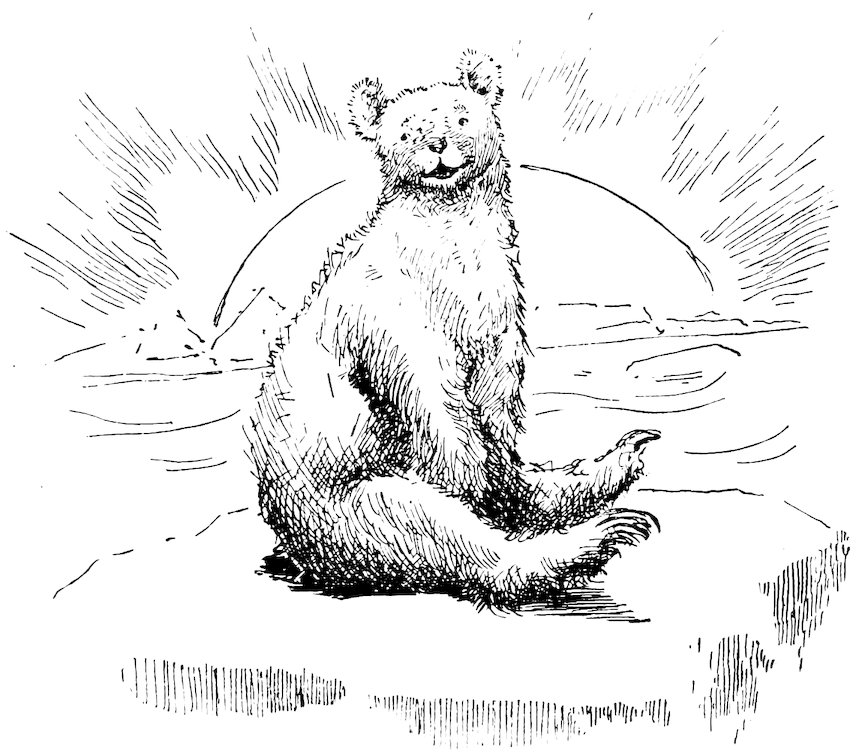
“AS WHITE BEARS CRUISE ABOUT THE NORTHERN OCEANS.”
But there is still one more mode left by which this country could have been peopled, which I have reserved for the last, because I consider it worth all the rest: it is—by accident! Speaking of the islands of Solomon, New Guinea, and New Holland, the profound father Charlevoix observes, “in fine, all these countries are peopled, and it is possible some have been so by accident. Now if it could have happened in that manner, why might it not have been at the same time, and by the same means with the other parts of the globe?” This ingenious mode of deducing certain conclusions from possible premises is an improvement 82in syllogistic skill, and proves the good father superior even to Archimedes, for he can turn the world without anything to rest his lever upon. It is only surpassed by the dexterity with which the sturdy old Jesuit, in another place, cuts the gordian knot:—“Nothing,” says he, “is more easy. The inhabitants of both hemispheres are certainly the descendants of the same father. The common father of mankind received an express order from Heaven to people the world, and accordingly it has been peopled. To bring this about it was necessary to overcome all difficulties in the way, and they have also been overcome!” Pious logician! How does he put all the herd of laborious theorists to the blush, by explaining, in five words, what it has cost them volumes to prove they knew nothing about!
From all the authorities here quoted, and a variety of others which I have consulted, but which are omitted through fear of fatiguing the unlearned reader, I can only draw the following conclusions, which luckily, however, are sufficient for my purpose. First, that this part of the world has actually been peopled, (Q. E. D.) to support which we have living proofs in the numerous tribes of Indians that inhabit it. Secondly, that it has been peopled in five hundred different ways, as proved by a 83cloud of authors who, from the positiveness of their assertions, seem to have been eyewitnesses to the fact. Thirdly, that the people of this country had a variety of fathers, which, as it may not be thought much to their credit by the common run of readers, the less we say on the subject the better. The question, therefore, I trust, is forever at rest.
84