Book 2 — Chapter VII.
Reading edition
HOW THE PEOPLE OF PAVONIA MIGRATED FROM COMMUNIPAW TO THE ISLAND OF MANNA-HATTA—AND HOW OLOFFE THE DREAMER PROVED HIMSELF A GREAT LAND-SPECULATOR
It having been solemnly resolved that the seat of empire should be removed from the green shores of Pavonia to the pleasant island of Manna-hata, everybody was anxious to embark under the standard of Oloffe the Dreamer, and to be among the first sharers of the promised land. A day was appointed for the grand migration, and on that day little Communipaw was in a buzz and a bustle like a hive in swarming-time. Houses were turned inside out and stripped of the venerable furniture which had come from Holland; all the community, great and small, 190black and white, man, woman, and child, was in commotion, forming lines from the houses to the water-side, like lines of ants from an ant-hill; everybody laden with some article of household furniture; while busy housewives plied backwards and forwards along the lines, helping everything forward by the nimbleness of their tongues.
By degrees a fleet of boats and canoes were piled up with all kinds of household articles: ponderous tables; chests of drawers resplendent with brass ornaments; quaint corner-cupboards; beds and bedsteads; with any quantity of pots, kettles, frying-pans, and Dutch ovens. In each boat embarked a whole family, from the robustious burgher down to the cats and dogs and little negroes. In this way they set off across the mouth of the Hudson, under the guidance of Oloffe the Dreamer, who hoisted his standard on the leading boat.
This memorable migration took place on the first of May, and was long cited in tradition as the grand moving. The anniversary of it was piously observed among the “sons of the pilgrims of Communipaw,” by turning their houses topsy-turvy and carrying all the furniture through the streets, in emblem of the swarming of the parent-hive; and this is the real origin of the universal agitation and 191“moving” by which this most restless of cities is literally turned out of doors on every May-day.
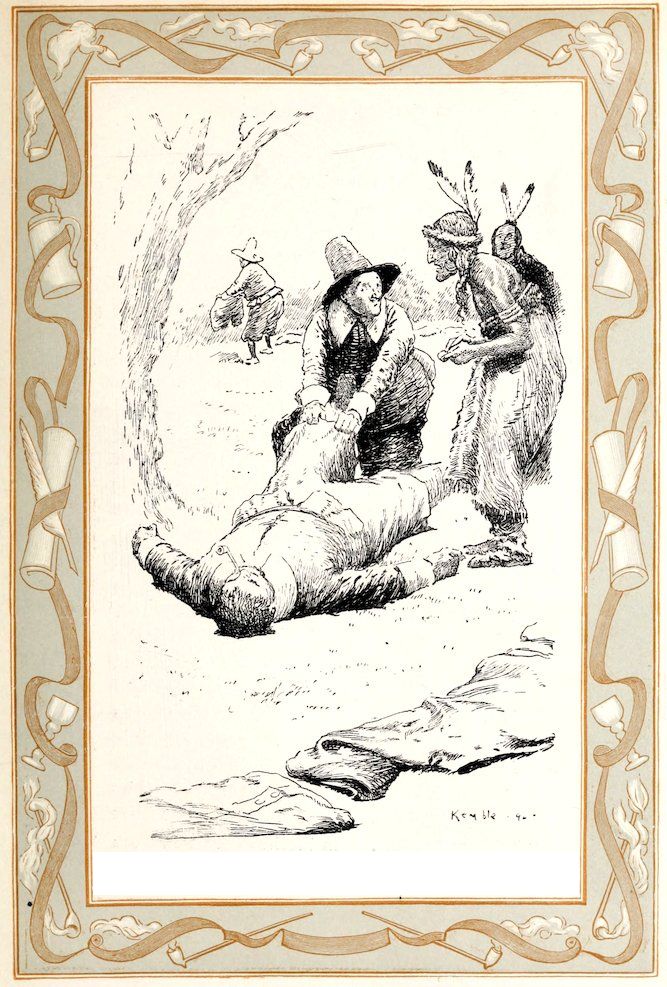
MYNHEER TEN BROECK AS A LAND SURVEYOR.
192As the little squadron from Communipaw drew near to the shores of Manna-hata, a sachem, at the head of a band of warriors, appeared to oppose their landing. Some of the most zealous of the pilgrims were for chastising this insolence with powder and ball, according to the approved mode of discoverers; but the sage Oloffe gave them the significant sign of St. Nicholas, laying his finger beside his nose and winking hard with one eye; whereupon his followers perceived that there was something sagacious in the wind. He now addressed the Indians in the blandest terms; and made such tempting display of beads, hawks’-bells, and red blankets, that he was soon permitted to land, and a great land-speculation ensued. And here let me give the true story of the original purchase of the site of this renowned city, about which so much has been said and written. Some affirm that the first cost was but sixty guilders. The learned Dominie Heckwelder records a tradition[33] that the Dutch discoverers bargained for only so much land as the hide of a bullock would cover; but that 193they cut the hide in strips no thicker than a child’s finger, so as to take in a large portion of land, and to take in the Indians into the bargain. This, however, is an old fable which the worthy Dominie may have borrowed from antiquity. The true version is, that Oloffe Van Kortlandt bargained for just so much land as a man could cover with his nether garments. The terms being concluded, he produced his friend Mynheer Ten Broeck as the man whose breeches were to be used in measurement. The simple savages, whose ideas of man’s nether garments had never expanded beyond the dimensions of a breech-clout, stared with astonishment and dismay as they beheld this bulbous-bottomed burgher peeled like an onion, and breeches after breeches spread forth over the land until they covered the actual site of this venerable city.
This is the true history of the adroit bargain by which the island of Manhattan was bought for sixty guilders; and in corroboration of it I will add, that Mynheer Ten Breeches, for his services on this memorable occasion, was elevated to the office of land-measurer; which he afterwards exercised in the colony.
194