Front matter
Reading edition
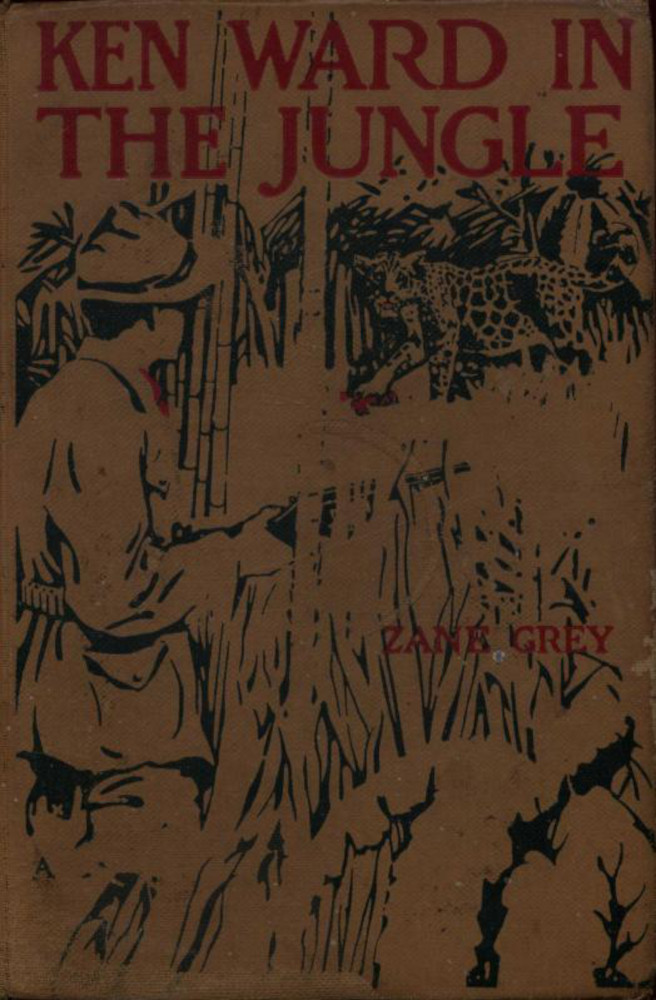
Cover art
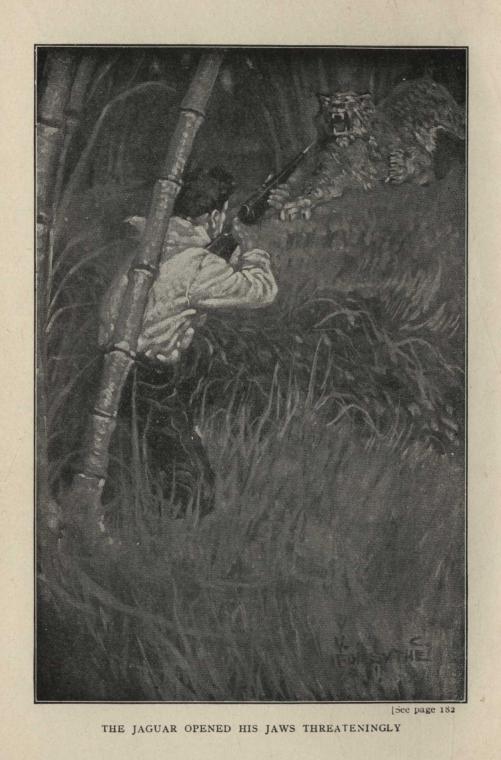
THE JAGUAR OPENED HIS JAWS THREATENINGLY (see page 182)
KEN WARD IN THE JUNGLE
BY
ZANE GREY
AUTHOR OF THE YOUNG FORESTER, THE YOUNG PITCHER, THE YOUNG LION HUNTER, THE U. P. TRAIL, ETC.
ILLUSTRATED
NEW YORK GROSSET & DUNLAP PUBLISHERS
Published by Arrangement with Harper & Brothers Made in the United States of America
COPYRIGHT, 1912, BY HARPER & BROTHERS
PRINTED IN THE UNITED STATES OF AMERICA
CONTENTS
CHAP.
The Prize
The Home of the Tarpon
An Indian Boatman
At the Jungle River
The First Camp
Wilderness Life
Running the Rapids
The First Tiger-cat
In the White Water
Lost!
An Army of Snakes
Catching Strange Fish
A Turkey-Hunt
A Fight with a Jaguar
The Vicious Garrapatoes
Field Work of a Naturalist
A Mixed-up Tiger-hunt
Watching a Runway
Adventures with Crocodiles
Treed by Wild Pigs
The Leaping Tarpon
Stricken Down
Out of the Jungle
KEN WARD IN THE JUNGLE
I
THE PRIZE
"What a change from the Arizona desert!"
The words broke from the lips of Ken Ward as he leaned from the window of the train which was bearing his brother and himself over the plateau to Tampico in Tamaulipas, the southeastern state of Mexico. He had caught sight of a river leaping out between heavily wooded slopes and plunging down in the most beautiful waterfall he had ever seen.
"Look, Hal," he cried.
The first fall was a long white streak, ending in a dark pool; below came cascade after cascade, fall after fall, some wide, others narrow, and all white and green against the yellow rock. Then the train curved round a spur of the mountain, descended to a level, to be lost in a luxuriance of jungle growth.
It was indeed a change for Ken Ward, young forester, pitcher of the varsity nine at school, and hunter of lions in the Arizona cañons. Here he was entering the jungle of the tropics. The rifles and the camp outfit on the seat beside his brother Hal and himself spoke of coming adventures. Before them lay an unknown wilderness--the semi-tropical jungle. And the future was to show that the mystery of the jungle was stranger even than their imaginings.
It was not love of adventure alone or interest in the strange new forest growths that had drawn Ken to the jungle. His uncle, the one who had gotten Ken letters from the Forestry Department at Washington, had been proud of Ken's Arizona achievements. This uncle was a member of the American Geographical Society and a fellow of the New York Museum of Natural History. He wanted Ken to try his hand at field work in the jungle of Mexico, and if that was successful, then to explore the ruined cities of wild Yucatan. If Ken made good as an explorer his reward was to be a trip to Equatorial Africa after big game. And of course that trip meant opportunity to see England and France, and, what meant more to Ken, a chance to see the great forests of Germany, where forestry had been carried on for three hundred years.
In spite of the fact that the inducement was irresistible, and that Ken's father was as proud and eager as Ken's uncle to have him make a name for himself, and that Hal would be allowed to go with him, Ken had hesitated. There was the responsibility for Hal and the absolute certainty that Hal could not keep out of mischief. Still Ken simply could not have gone to Mexico leaving his brother at home broken-hearted.
At last the thing had been decided. It was Hal's ambition to be a naturalist and to collect specimens, and the uncle had held out possible recognition from the Smithsonian Institution at Washington. Perhaps he might find a new variety of some animal to which the scientists would attach his name. Then the lad was passionately eager to see Ken win that trip to Africa. There had been much study of maps and books of travel, science, and natural history. There had been the most careful instruction and equipment for semi-tropical camp life. The uncle had given Ken valuable lessons in map-drawing, in estimating distance and topography, and he had indicated any one of several rivers in the jungle belt of Mexico. Traversing one hundred miles of unknown jungle river, with intelligent observation and accurate reports, would win the prize for Ken Ward. Now the race was on. Would Ken win?
Presently the train crossed a bridge. Ken Ward had a brief glance at clear green water, at great cypress-trees, gray and graceful with long, silvery, waving moss, and at the tangled, colorful banks. A water-fowl black as coal, with white-crested wings, skimmed the water in swift wild flight, to disappear up the shady river-lane. Then the train clattered on, and, a mile or more beyond the bridge, stopped at a station called Valles. In the distance could be seen the thatched palm-leaf huts and red-tiled roofs of a hamlet.
The boys got out to stretch their legs. The warm, sweet, balmy air was a new and novel thing to them. They strolled up and down the gravel walk, watching the natives. Hal said he rather liked the looks of their brown bare feet and the thin cotton trousers and shirts, but he fancied the enormous sombreros were too heavy and unwieldy. Ken spoke to several pleasant-faced Mexicans, each of whom replied: "No sabe, Señor."
The ticket agent at the station was an American, and from the way he smiled and spoke Ken knew he was more than glad to see one of his own kind. So, after Ken had replied to many questions about the States, he began to ask some of his own.
"What's the name of the waterfall we passed?"
"Micas Falls," replied the agent.
"And the river?"
"It's called the Santa Rosa."
"Where does it go?"
The agent did not know, except that it disappeared in the jungle. Southward the country was wild. The villages were few and all along the railroad; and at Valles the river swung away to the southwest.
"But it must flow into the Panuco River," said Ken. He had studied maps of Mexico and had learned all that it was possible to learn before he undertook the journey.
"Why, yes, it must find the Panuco somewhere down over the mountain," answered the agent.
"Then there are rapids in this little river?" asked Ken, in growing interest.
"Well, I guess. It's all rapids."
"How far to Tampico by rail?" went on Ken.
"Something over a hundred miles."
"Any game in the jungle hereabouts--or along the Santa Rosa?" continued Ken.
The man laughed, and laughed in such a way that Ken did not need his assertion that it was not safe to go into the jungle.
Whereupon Ken Ward became so thoughtful that he did not hear the talk that followed between the agent and Hal. The engine bell roused him into action, and with Hal he hurried back to their seats. And then the train sped on. But the beauty of Micas Falls and the wildness of the Santa Rosa remained with Ken. Where did that river go? How many waterfalls and rapids did it have? What teeming life must be along its rich banks! It haunted Ken. He wanted to learn the mystery of the jungle. There was the same longing which had gotten him into the wild adventures in Penetier Forest and the Grand Cañon country of Arizona. And all at once flashed over him the thought that here was the jungle river for him to explore.
"Why, that's the very thing," he said, thinking aloud.
"What's wrong with you," asked Hal, "talking to yourself that way?"
Ken did not explain. The train clattered between green walls of jungle, and occasionally stopped at a station. But the thought of the jungle haunted him until the train arrived at Tampico.
Ken had the name of an American hotel, and that was all he knew about Tampico. The station was crowded with natives. Man after man accosted the boys, jabbering excitedly in Mexican. Some of these showed brass badges bearing a number and the word Cargodore.
"Hal, I believe these fellows are porters or baggage-men," said Ken. And he showed his trunk check to one of them. The fellow jerked it out of Ken's hand and ran off. The boys ran after him. They were relieved to see him enter a shed full of baggage. And they were amazed to see him kneel down and take their trunk on his back. It was a big trunk and heavy. The man was small and light.
"It 'll smash him!" cried Hal.
But the little cargodore walked off with the trunk on his back. Then Ken and Hal saw other cargodores packing trunks. The boys kept close to their man and used their eyes with exceeding interest. The sun was setting, and the square, colored buildings looked as if they were in a picture of Spain.
"Look at the boats--canoes!" cried Hal, as they crossed a canal.
Ken saw long narrow canoes that had been hollowed out from straight tree-trunks. They were of every size, and some of the paddles were enormous. Crowds of natives were jabbering and jostling each other at a rude wharf.
"Look back," called Hal, who seemed to have a hundred eyes.
Ken saw a wide, beautiful river, shining red in the sunset. Palm-trees on the distant shore showed black against the horizon.
"Hal, that's the Panuco. What a river!"
"Makes the Susquehanna look like a creek," was Hal's comment.
The cargodore led the boys through a plaza, down a narrow street to the hotel. Here they were made to feel at home. The proprietor was a kindly American. The hotel was crowded, and many of the guests were Englishmen there for the tarpon-fishing, with sportsmen from the States, and settlers coming in to take up new lands. It was pleasant for Ken and Hal to hear their own language once more. After dinner they sallied forth to see the town. But the narrow dark streets and the blanketed natives stealing silently along were not particularly inviting. The boys got no farther than the plaza, where they sat down on a bench. It was wholly different from any American town. Ken suspected that Hal was getting homesick, for the boy was quiet and inactive.
"I don't like this place," said Hal. "What 'd you ever want to drag me way down here for?"
"Humph! drag you? Say, you pestered the life out of me, and bothered Dad till he was mad, and worried mother sick to let you come on this trip."
Hal hung his head.
"Now, you're not going to show a streak of yellow?" asked Ken. He knew how to stir his brother.
Hal rose to the attack and scornfully repudiated the insinuation. Ken replied that they were in a new country and must not reach conclusions too hastily.
"I liked it back up there at the little village where we saw the green river and the big trees with the gray streamers on them," said Hal.
"Well, I liked that myself," rejoined Ken. "I'd like to go back there and put a boat in the river and come all the way here."
Ken had almost unconsciously expressed the thought that had been forming in his mind. Hal turned slowly and looked at his brother.
"Ken, that 'd be great--that's what we came for!"
"I should say so," replied Ken.
"Well?" asked Hal, simply.
That question annoyed Ken. Had he not come south to go into the jungle? Had he come with any intention of shirking the danger of a wild trip? There was a subtle flattery in Hal's question.
"That Santa Rosa River runs through the jungle," went on Hal. "It flows into the Panuco somewhere. You know we figured out on the map that the Panuco's the only big river in this jungle. That's all we want to know. And, Ken, you know you're a born boatman. Why, look at the rapids we've shot on the Susquehanna. Remember that trip we came down the Juniata? The water was high, too. Ken, you can take a boat down that Santa Rosa!"
"By George! I believe I can," exclaimed Ken, and he thrilled at the thought.
"Ken, let's go. You'll win the prize, and I'll get specimens. Think what we'd have to tell Jim Williams and Dick Leslie when we go West next summer!"
"Oh, Hal, I know--but this idea of a trip seems too wild."
"Maybe it wouldn't be so wild."
In all fairness Ken could not deny this, so he kept silent.
"Ken, listen," went on Hal, and now he was quite cool. "If we'd promised the Governor not to take a wild trip I wouldn't say another word. But we're absolutely free."
"That's why we ought to be more careful. Dad trusts me."
"He trusts you because he knows you can take care of yourself, and me, too. You're a wonder, Ken. Why, if you once made up your mind, you'd make that Santa Rosa River look like a canal."
Ken began to fear that he would not be proof against the haunting call of that jungle river and the flattering persuasion of his brother and the ever-present ambition to show his uncle what he could do.
"Hal, if I didn't have you with me I'd already have made up my mind to tackle this river."
That appeared to insult Hal.
"All I've got to say is I'd be a help to you--not a drag," he said, with some warmth.
"You're always a help, Hal. I can't say anything against your willingness. But you know your weakness. By George! you made trouble enough for me in Arizona. On a trip such as this you'd drive me crazy."
"Ken, I won't make any rash promises. I don't want to queer myself with you. But I'm all right."
"Look here, Hal; let's wait. We've only got to Tampico. Maybe such a trip is impracticable--impossible. Let's find out more about the country."
Hal appeared to take this in good spirit. The boys returned to the hotel and went to bed. Hal promptly fell asleep. But Ken Ward lay awake a long time thinking of the green Santa Rosa, with its magnificent moss-festooned cypresses. And when he did go to sleep it was to dream of the beautiful waterfowl with the white-crested wings, and he was following it on its wild flight down the dark, mysterious river-trail into the jungle.
II
THE HOME OF THE TARPON
Hal's homesickness might never have been in evidence at all, to judge from the way the boy, awakening at dawn, began to talk about the Santa Rosa trip.
"Well," said Ken, as he rolled out of bed, "I guess we're in for it."
"Ken, will we go?" asked Hal, eagerly.
"I'm on the fence."
"But you're leaning on the jungle side?"
"Yes, kid--I'm slipping."
Hal opened his lips to let out a regular Hiram Bent yell, when Ken clapped a hand over his mouth.
"Hold on--we're in the hotel yet."
It took the brothers long to dress, because they could not keep away from the window. The sun was rising in rosy glory over misty lagoons. Clouds of creamy mist rolled above the broad Panuco. Wild ducks were flying low. The tiled roofs of the stone houses gleamed brightly, and the palm-trees glistened with dew. The soft breeze that blew in was warm, sweet, and fragrant.
After breakfast the boys went out to the front and found the hotel lobby full of fishermen and their native boatmen. It was an interesting sight, as well as a surprise, for Ken and Hal did not know that Tampico was as famous for fishing as it was for hunting. The huge rods and reels amazed them.
"What kind of fish do these fellows fish for?" asked Hal.
Ken was well enough acquainted with sport to know something about tarpon, but he had never seen one of the great silver fish. And he was speechless when Hal led him into a room upon the walls of which were mounted specimens of tarpon from six to seven feet in length and half as wide as a door.
"Say, Ken! We've come to the right place. Those fishermen are all going out to fish for such whales as these here."
"Hal, we never saw a big fish before," said Ken. "And before we leave Tampico we'll know what it means to hook tarpon."
"I'm with you," replied Hal, gazing doubtfully and wonderingly at a fish almost twice as big as himself.
Then Ken, being a practical student of fishing, as of other kinds of sport, began to stroll round the lobby with an intent to learn. He closely scrutinized the tackle. And he found that the bait used was a white mullet six to ten inches long, a little fish which resembled the chub. Ken did not like the long, cruel gaff which seemed a necessary adjunct to each outfit of tackle, and he vowed that in his fishing for tarpon he would dispense with it.
Ken was not backward about asking questions, and he learned that Tampico, during the winter months, was a rendezvous for sportsmen from all over the world. For the most part, they came to catch the leaping tarpon; the shooting along the Panuco, however, was as well worth while as the fishing. But Ken could not learn anything about the Santa Rosa River. The tierra caliente, or hot belt, along the curve of the Gulf was intersected by small streams, many of them unknown and unnamed. The Panuco swung round to the west and had its source somewhere up in the mountains. Ken decided that the Santa Rosa was one of its headwaters. Valles lay up on the first swell of higher ground, and was distant from Tampico some six hours by train. So, reckoning with the meandering course of jungle streams, Ken calculated he would have something like one hundred and seventy-five miles to travel by water from Valles to Tampico. There were Indian huts strung along the Panuco River, and fifty miles inland a village named Panuco. What lay between Panuco and Valles, up over the wild steppes of that jungle, Ken Ward could only conjecture.
Presently he came upon Hal in conversation with an American boy, who at once volunteered to show them around. So they set out, and were soon becoming well acquainted. Their guide said he was from Kansas; had been working in the railroad offices for two years; and was now taking a vacation. His name was George Alling. Under his guidance the boys spent several interesting hours going about the city. During this walk Hal showed his first tendency to revert to his natural bent of mind. Not for long could Hal Ward exist without making trouble for something. In this case it was buzzards, of which the streets of Tampico were full. In fact, George explained, the buzzards were the only street-cleaning department in the town. They were as tame as tame turkeys, and Hal could not resist the desire to chase them. And he could be made to stop only after a white-helmeted officer had threatened him. George explained further that although Tampico had no game-laws it protected these buzzard-scavengers of the streets.
The market-house at the canal wharf was one place where Ken thought Hal would forget himself in the bustle and din and color. All was so strange and new. Indeed, for a time Hal appeared to be absorbed in his surroundings, but when he came to a stall where a man had parrots and racoons and small deer, and three little yellow, black-spotted tiger-cats, as George called them, then once more Ken had to take Hal in tow. Outside along the wharf were moored a hundred or more canoes of manifold variety. All had been hewn from solid tree-trunks. Some were long, slender, graceful, pretty to look at, and easy to handle in shallow lagoons, but Ken thought them too heavy and cumbersome for fast water. Happening just then to remember Micas Falls, Ken had a momentary chill and a check to his enthusiasm for the jungle trip. What if he encountered, in coming down the Santa Rosa, some such series of cascades as those which made Micas Falls!
It was about noon when George led the boys out to the banks of the broad Panuco. Both Hal and Ken were suffering from the heat. They had removed their coats, and were now very glad to rest in the shade.
"This is a nice cool day," said George, and he looked cool.
"We've got on our heavy clothes, and this tropic sun is new to us," replied Ken. "Say, Hal--"
A crash in the water near the shore interrupted Ken.
"Was that a rhinoceros?" inquired Hal.
"Savalo," said George.
"What's that?"
"Silver king. A tarpon. Look around and you'll see one break water. There are some fishermen trolling down-stream. Watch. Maybe one will hook a fish presently. Then you'll see some jumping."
It was cool in the shade, as the brothers soon discovered, and they spent a delightful hour watching the river and the wild fowl and the tarpon. Ken and Hal were always lucky. Things happened for their benefit and pleasure. Not only did they see many tarpon swirl like bars of silver on the water, but a fisherman hooked one of the great fish not fifty yards from where the boys sat. And they held their breath, and with starting eyes watched the marvelous leaps and dashes of the tarpon till, as he shot up in a last mighty effort, wagging his head, slapping his huge gills, and flinging the hook like a bullet, he plunged back free.
"Nine out of ten get away," remarked George.
"Did you ever catch one?" asked Hal.
"Sure."
"Hal, I've got to have some of this fishing," said Ken. "But if we start at it now--would we ever get that jungle trip?"
"Oh, Ken, you've made up your mind to go!" exclaimed Hal, in glee.
"No, I haven't," protested Ken.
"Yes, you have," declared Hal. "I know you." And the whoop that he had suppressed in the hotel he now let out with good measure.
Naturally George was interested, and at his inquiry Ken told him the idea for the Santa Rosa trip.
"Take me along," said George. There was a note of American spirit in his voice, a laugh on his lips, and a flash in his eyes that made Ken look at him attentively. He was a slim youth, not much Hal's senior, and Ken thought if ever a boy had been fashioned to be a boon comrade of Hal Ward this George Alling was the boy.
"What do you think of the trip?" inquired Ken, curiously.
"Fine. We'll have some fun. We'll get a boat and a mozo--"
"What's a mozo?"
"A native boatman."
"That's a good idea. I hadn't thought of a boatman to help row. But the boat is the particular thing. I wouldn't risk a trip in one of those canoes."
"Come on, I'll find a boat," said George.
And before he knew it George and Hal were leading him back from the river. George led him down narrow lanes, between painted stone houses and iron-barred windows, till they reached the canal. They entered a yard where buzzards, goats, and razor-back pigs were contesting over the scavenger rights. George went into a boat-house and pointed out a long, light, wide skiff with a flat bottom. Ken did not need George's praise, or the shining light in Hal's eyes, or the boat-keeper's importunities to make him eager to try this particular boat. Ken Ward knew a boat when he saw one. He jumped in, shoved it out, rowed up the canal, pulled and turned, backed water, and tried every stroke he knew. Then he rested on the oars and whistled. Hal's shout of delight made him stop whistling. Those two boys would have him started on the trip if he did not look sharp.
"It's a dandy boat," said Ken.
"Only a peso a day, Ken," went on Hal. "One dollar Mex--fifty cents in our money. Quick, Ken, hire it before somebody else gets it."
"Sure I'll hire the boat," replied Ken; "but Hal, it's not for that Santa Rosa trip. We'll have to forget that."
"Forget your grandmother!" cried Hal. And then it was plain that he tried valiantly to control himself, to hide his joy, to pretend to agree with Ken's ultimatum.
Ken had a feeling that his brother knew him perfectly, and he was divided between anger and amusement. They returned to the hotel and lounged in the lobby. The proprietor was talking with some Americans, and as he now appeared to be at leisure he introduced the brothers and made himself agreeable. Moreover, he knew George Alling well. They began to chat, and Ken was considerably annoyed to hear George calmly state that he and his new-found friends intended to send a boat up to Valles and come down an unknown jungle river.
The proprietor laughed, and, though the laugh was not unpleasant, somehow it nettled Ken Ward.
"Why not go?" he asked, quietly, and he looked at the hotel man.
"My boy, you can't undertake any trip like that."
"Why not?" persisted Ken. "Is there any law here to prevent our going into the jungle?"
"There's no law. No one could stop you. But, my lad, what's the sense of taking such a fool trip? The river here is full of tarpon right now. There are millions of ducks and geese on the lagoons. You can shoot deer and wild turkey right on the edge of town. If you want tiger and javelin, go out to one of the ranches where they have dogs to hunt with, where you'll have a chance for your life. These tigers and boars will kill a man. There's all the sport any one wants right close to Tampico."
"I don't see how all that makes a reason why we shouldn't come down the Santa Rosa," replied Ken. "We want to explore--map the river."
The hotel man seemed nettled in return.
"You're only kids. It 'd be crazy to start out on that wild trip."
It was on Ken's lips to mention a few of the adventures which he believed justly gave him a right to have pride and confidence in his ability. But he forbore.
"It's a fool trip," continued the proprietor. "You don't know this river. You don't know where you'll come out. It's wild up in that jungle. I've hunted up at Valles, and no native I ever met would go a mile from the village. If you take a mozo he'll get soaked with canya. He'll stick a knife in you or run off and leave you when you most need help. Nobody ever explored that river. It 'll likely be full of swamps, sandbars, bogs. You'd get fever. Then the crocodiles, the boars, the bats, the snakes, the tigers! Why, if you could face these you'd still have the ticks--the worst of all. The ticks would drive men crazy, let alone boys. It's no undertaking for a boy."
The mention of all these dangers would have tipped the balance for Ken in favor of the Santa Rosa trip, even if the hint of his callowness had not roused his spirit.
"Thank you. I'm sure you mean kindly," said Ken. "But I'm going to Valles and I'll come down that jungle river."
III
AN INDIAN BOATMAN
The moment the decision was made Ken felt both sorry and glad. He got the excited boys outside away from the critical and anxious proprietor. And Ken decided it was incumbent upon him to adopt a serious and responsible manner, which he was far from feeling. So he tried to be as cool as Hiram Bent, with a fatherly interest in the two wild boys who were to accompany him down the Santa Rosa.
"Now, George, steer us around till we find a mozo," said Ken. "Then we'll buy an outfit and get started on this trip before you can say Jack Robinson."
All the mozos the boys interviewed were eager to get work; however, when made acquainted with the nature of the trip they refused point blank.
"Tigre!" exclaimed one.
"Javelin!" exclaimed another.
The big spotted jaguar of the jungle and the wild boar, or peccary, were held in much dread by the natives.
"These natives will climb a tree at sight of a tiger or pig," said George. "For my part I'm afraid of the garrapatoes and the pinilius."
"What 're they?" asked Hal.
"Ticks--jungle ticks. Just wait till you make their acquaintance."
Finally the boys met a mozo named Pepe, who had often rowed a boat for George. Pepe looked sadly in need of a job; still he did not ask for it. George said that Pepe had been one of the best boatmen on the river until canya, the fiery white liquor to which the natives were addicted, had ruined his reputation. Pepe wore an old sombrero, a cotton, shirt and sash, and ragged trousers. He was barefooted. Ken noted the set of his muscular neck, his brawny shoulders and arms, and appreciated the years of rowing that had developed them. But Pepe's haggard face, deadened eyes, and listless manner gave Ken pause. Still, Ken reflected, there was never any telling what a man might do, if approached right. Pepe's dejection excited Ken's sympathy. So Ken clapped him on the shoulder, and, with George acting as interpreter, offered Pepe work for several weeks at three pesos a day. That was more than treble the mozo's wage. Pepe nearly fell off the canal bridge, where he was sitting, and a light as warm and bright as sunshine flashed into his face.
"Si, Señor--Si, Señor," he began to jabber, and waved his brown hands.
Ken suspected that Pepe needed a job and a little kind treatment. He was sure of it when George said Pepe's wife and children were in want. Somehow Ken conceived a liking for Pepe, and believed he could trust him. He thought he knew how to deal with poor Pepe. So he gave him money, told him to get a change of clothes and a pair of shoes, and come to the hotel next day.
"He'll spend the money for canya, and not show up to-morrow," said George.
"I don't know anything about your natives, but that fellow will come," declared Ken.
It appeared that the whole American colony in Tampico had been acquainted with Ken Ward's project, and made a business to waylay the boys at each corner. They called the trip a wild-goose chase. They declared it was a dime-novel idea, and could hardly take Ken seriously. They mingled astonishment with amusement and concern. They advised Ken not to go, and declared they would not let him go. Over and over again the boys were assured of the peril from ticks, bats, boars, crocodiles, snakes, tigers, and fevers.
"That's what I'm taking the trip for," snapped Ken, driven to desperation by all this nagging.
"Well, young man, I admire your nerve," concluded the hotel man. "If you're determined to go, we can't stop you. And there's some things we would like you to find out for us. How far do tarpon run up the Panuco River? Do they spawn up there? How big are the new-born fish? I'll furnish you with tackle and preserved mullet, for bait. We've always wondered about how far tarpon go up into fresh water. Keep your eye open for signs of oil. Also look at the timber. And be sure to make a map of the river."
When it came to getting the boat shipped the boys met with more obstacles. But for the friendly offices of a Texan, an employee of the railroad, they would never have been able to convince the native shipping agent that a boat was merchandise. The Texan arranged the matter and got Ken a freight bill. He took an entirely different view of Ken's enterprise, compared with that of other Americans, and in a cool, drawling voice, which somehow reminded Ken of Jim Williams, he said:
"Shore you-all will have the time of your lives. I worked at Valles for a year. That jungle is full of game. I killed three big tigers. You-all want to look out for those big yellow devils. One in every three will jump for a man. There's nothing but shoot, then. And the wild pigs are bad. They put me up a tree more than once. I don't know much about the Santa Rosa. Its source is above Micas Falls. Never heard where it goes. I know it's full of crocodiles and rapids. Never saw a boat or a canoe at Valles. And say--there are big black snakes in the jungle. Look out for them, too. Shore you-all have sport a-comin'."
Ken thanked the Texan, and as he went on up-street, for all his sober thoughtfulness, he was as eager as Hal or George. However, his position as their guardian would not permit any show of extravagant enthusiasm.
Ken bought blankets, cooking utensils, and supplies for three weeks. There was not such a thing as a tent in Tampico. The best the boys could get for a shelter was a long strip of canvas nine feet wide.
"That 'll keep off the wet," said Ken, "but it won't keep out the mosquitoes and things."
"Couldn't keep 'em out if we had six tents," replied George.
The remainder of that day the boys were busy packing the outfit.
Pepe presented himself at the hotel next morning an entirely different person. He was clean-shaven, and no longer disheveled. He wore a new sombrero, a white cotton shirt, a red sash, and blue trousers. He earned a small bundle, a pair of shoes, and a long machete. The dignity with which he approached before all the other mozos was not lost upon Ken Ward. A sharp scrutiny satisfied him that Pepe had not been drinking. Ken gave him several errands to do. Then he ordered the outfit taken to the station in Pepe's charge.
The boys went down early in the afternoon. It was the time when the mozos were returning from the day's tarpon-fishing on the river, and they, with the cargodores, streamed to and fro on the platform. Pepe was there standing guard over Ken's outfit. He had lost his fame among his old associates, and for long had been an outsider. Here he was in charge of a pile of fine guns, fishing-tackle, baggage, and supplies--a collection representing a fortune to him and his simple class. He had been trusted with it. It was under his eye. All his old associates passed by to see him there. That was a great time for Pepe. He looked bright, alert, and supremely happy. It would have fared ill with thieves or loafers who would have made themselves free with any of the articles under his watchful eye.
The train pulled out of Tampico at five o'clock, and Hal's "We're off!" was expressive.
The railroad lay along the river-bank, and the broad Panuco was rippling with the incoming tide. If Ken and Hal had not already found George to be invaluable as a companion in this strange country they would have discovered it then. For George could translate Pepe's talk, and explain much that otherwise would have been dark to the brothers. Wild ducks dotted the green surface, and spurts showed where playful ravalo were breaking water. Great green-backed tarpon rolled their silver sides against the little waves. White cranes and blue herons stood like statues upon the reedy bars. Low down over the opposite bank of the river a long line of wild geese winged its way toward a shimmering lagoon. And against the gold and crimson of the sunset sky a flight of wild fowl stood out in bold black relief. The train crossed the Tamesi River and began to draw away from the Panuco. On the right, wide marshes, gleaming purple in the darkening light, led the eye far beyond to endless pale lagoons. Birds of many kinds skimmed the weedy flats. George pointed out a flock of aigrets, the beautiful wild fowl with the priceless plumes. Then there was a string of pink flamingoes, tall, grotesque, wading along with waddling stride, feeding with heads under water.
"Great!" exclaimed Ken Ward.
"It's all so different from Arizona," said Hal.
At Tamos, twelve miles out of Tampico, the train entered the jungle. Thereafter the boys could see nothing but the impenetrable green walls that lined the track. At dusk the train reached a station called Las Palmas, and then began to ascend the first step of the mountain. The ascent was steep, and, when it was accomplished, Ken looked down and decided that step of the mountain was between two and three thousand feet high. The moon was in its first quarter, and Ken, studying this tropical moon, found it large, radiant, and a wonderful green-gold. It shed a soft luminous glow down upon the sleeping, tangled web of jungle. It was new and strange to Ken, so vastly different from barren desert or iron-ribbed cañon, and it thrilled him with nameless charm.
The train once more entered jungle walls, and as the boys could not see anything out of the windows they lay back in their seats and waited for the ride to end. They were due at Valles at ten o'clock, and the impatient Hal complained that they would never get there. At length a sharp whistle from the engine caused Pepe to turn to the boys with a smile.
"Valles," he said.
With rattle and clank the train came to a halt. Ken sent George and Pepe out, and he and Hal hurriedly handed the luggage through the open window. When the last piece had been passed into Pepe's big hands the boys made a rush for the door, and jumped off as the train started.
"Say, but it's dark," said Hal.
As the train with its lights passed out of sight Ken found himself in what seemed a pitchy blackness. He could not see the boys. And he felt a little cold sinking of his heart at the thought of such black nights on an unknown jungle river.
IV
AT THE JUNGLE RIVER
Presently, as Ken's eyes became accustomed to the change, the darkness gave place to pale moonlight. A crowd of chattering natives, with wide sombreros on their heads and blankets over their shoulders, moved round the little stone station. Visitors were rare in Valles, as was manifested by the curiosity aroused by the boys and the pile of luggage.
"Ask Pepe to find some kind of lodging for the night," said Ken to George.
Pepe began to question the natives, and soon was lost in the crowd. Awhile after, as Ken was making up his mind they might have to camp on the station platform, a queer low 'bus drawn by six little mules creaked up. Pepe jumped off the seat beside the driver, and began to stow the luggage away in the 'bus. Then the boys piled in behind, and were soon bowling along a white moonlit road. The soft voices of natives greeted their passing.
Valles appeared to be about a mile from the station, and as they entered the village Ken made out rows of thatched huts, and here and there a more pretentious habitation of stone. At length the driver halted before a rambling house, partly stone and partly thatch. There were no lights; in fact, Ken did not see a light in the village. George told the boys to take what luggage each could carry and follow the guide. Inside the house it was as dark as a dungeon. The boys bumped into things and fell over each other trying to keep close to the barefooted and mysterious guide. Finally they climbed to a kind of loft, where the moonlight streamed in at the open sides.
"What do you think of this?" panted Hal, who had struggled with a heavy load of luggage. Pepe and the guide went down to fetch up the remainder of the outfit. Ken thought it best to stand still until he knew just where he was. But Hal and George began moving about in the loft. It was very large and gloomy, and seemed open, yet full of objects. Hal jostled into something which creaked and fell with a crash. Then followed a yell, a jabbering of a frightened native, and a scuffling about.
"Hal, what 'd you do?" called Ken, severely.
"You can search me," replied Hal Ward. "One thing--I busted my shin."
"He knocked over a bed with some one sleeping in it," said George.
Pepe arrived in the loft then and soon soothed the injured feelings of the native who had been so rudely disturbed. He then led the boys to their cots, which were no more than heavy strips of canvas stretched over tall frameworks. They appeared to be enormously high for beds. Ken's was as high as his head, and Ken was tall for his age.
"Say, I'll never get up into this thing," burst out Hal. "These people must be afraid to sleep near the floor. George, why are these cots so high?"
"I reckon to keep the pigs and dogs and all that from sleeping with the natives," answered George. "Besides, the higher you sleep in Mexico the farther you get from creeping, crawling things."
Ken had been of half a mind to sleep on the floor, but George's remark had persuaded him to risk the lofty cot. It was most awkward to climb into. Ken tried several times without success, and once he just escaped a fall. By dint of muscle and a good vault he finally landed in the center of his canvas. From there he listened to his more unfortunate comrades. Pepe got into his without much difficulty. George, however, in climbing up, on about the fifth attempt swung over too hard and rolled off on the other side. The thump he made when he dropped jarred the whole loft. From the various growls out of the darkness it developed that the loft was full of sleepers, who were not pleased at this invasion. Then Hal's cot collapsed, and went down with a crash. And Hal sat on the flattened thing and laughed.
"Mucho malo," Pepe said, and he laughed, too. Then he had to get out and put up Hal's trestle bed. Hal once again went to climbing up the framework, and this time, with Pepe's aid, managed to surmount it.
"George, what does Pepe mean by mucho malo?" asked Hal.
"Bad--very much bad," replied George.
"Nix--tell him nix. This is fine," said Hal.
"Boys, if you don't want to sleep yourselves, shut up so the rest of us can," ordered Ken.
He liked the sense of humor and the good fighting spirit of the boys, and fancied they were the best attributes in comrades on a wild trip. For a long time he heard a kind of shuddering sound, which he imagined was Hal's cot quivering as the boy laughed. Then absolute quiet prevailed, the boys slept, and Ken felt himself drifting.
When he awakened the sun was shining through the holes in the thatched roof. Pepe was up, and the other native sleepers were gone. Ken and the boys descended from their perches without any tumbles, had a breakfast that was palatable--although even George could not name what they ate--and then were ready for the day.
Valles consisted of a few stone houses and many thatched huts of bamboo and palm. There was only one street, and it was full of pigs, dogs, and buzzards. The inhabitants manifested a kindly interest and curiosity, which changed to consternation when they learned of the boys' project. Pepe questioned many natives, and all he could learn about the Santa Rosa was that there was an impassable waterfall some few kilometers below Valles. Ken gritted his teeth and said they would have to get past it. Pepe did not encounter a man who had ever heard of the headwaters of the Panuco River. There were only a few fields under cultivation around Valles, and they were inclosed by impenetrable jungle. It seemed useless to try to find out anything about the river. But Pepe's advisers in the village told enough about tigre and javelin to make Hal's hair stand on end, and George turn pale, and Ken himself wish they had not come. It all gave Ken both a thrill and a shock.
There was not much conversation among the boys on the drive back to the station. However, sight of the boat, which had come by freight, stirred Ken with renewed spirit, and through him that was communicated to the others.
The hardest task, so far, developed in the matter of transporting boat and supplies out to the river. Ken had hoped to get a handcar and haul the outfit on the track down to where the bridge crossed the Santa Rosa. But there was no hand-car. Then came the staggering information that there was no wagon which would carry the boat, and then worse still in the fact that there was no road. This discouraged Ken; nevertheless he had not the least idea of giving up. He sent Pepe out to tell the natives there must be some way to get the outfit to the river.
Finally Pepe found a fellow who had a cart. This fellow claimed he knew a trail that went to a point from which it would be easy to carry the boat to the river. Ken had Pepe hire the man at once.
"Bring on your old cart," said the irrepressible Hal.
That cart turned out to be a remarkable vehicle. It consisted of a narrow body between enormously high wheels. A trio of little mules was hitched to it. The driver willingly agreed to haul the boat and outfit for one peso, but when he drove up to the platform to be surrounded by neighbors, he suddenly discovered that he could not possibly accommodate the boys. Patiently Pepe tried to persuade him. No, the thing was impossible. He made no excuses, but he looked mysterious.
"George, tell Pepe to offer him five pesos," said Ken.
Pepe came out bluntly with the inducement, and the driver began to sweat. From the look of his eyes Ken fancied he had not earned so much money in a year. Still he was cunning, and his whispering neighbors lent him support. He had the only cart in the village, and evidently it seemed that fortune had come to knock at least once at his door. He shook his head.
Ken held up both hands with fingers spread. "Ten pesos," he said.
The driver, like a crazy man, began to jabber his consent.
The boys lifted the boat upon the cart, and tied it fast in front so that the stern would not sag. Then they packed the rest of the outfit inside.
Ken was surprised to see how easily the little mules trotted off with such a big load. At the edge of the jungle he looked back toward the station. The motley crowd of natives were watching, making excited gestures, and all talking at once. The driver drove into a narrow trail, which closed behind him. Pepe led on foot, brushing aside the thick foliage. Ken drew a breath of relief as he passed into the cool shade. The sun was very hot. Hal and George brought up the rear, talking fast.
The trail was lined and overgrown with slender trees, standing very close, making dense shade. Many birds, some of beautiful coloring, flitted in the branches. In about an hour the driver entered a little clearing where there were several thatched huts. Ken heard the puffing of an engine, and, looking through the trees, he saw the railroad and knew they had arrived at the pumping-station and the bridge over the Santa Rosa.
Pepe lost no time in rounding up six natives to carry the boat. They did not seem anxious to oblige Pepe, although they plainly wanted the money he offered. The trouble was the boat, at which they looked askance. As in the case with the driver, however, the weight and clinking of added silver overcame their reluctance. They easily lifted the boat upon their shoulders. And as they entered the trail, making a strange procession in the close-bordering foliage, they encountered two natives, who jumped and ran, yelling: "La diable! La diable!"
"What ails those gazabos?" asked Hal.
"They're scared," replied George. "They thought the boat was the devil."
If Ken needed any more than had already come to him about the wildness of the Santa Rosa, he had it in the frightened cries and bewilderment of these natives. They had never seen a boat. The Santa Rosa was a beautiful wild river upon which boats were unknown. Ken had not hoped for so much. And now that the die was cast he faced the trip with tingling gladness.
"George and Hal, you stay behind to watch the outfit. Pepe and I will carry what we can and follow the boat. I'll send back after you," said Ken.
Then as he followed Pepe and the natives down the trail there was a deep satisfaction within him. He heard the soft rush of water over stones and the mourning of turtledoves. He rounded a little hill to come abruptly upon the dense green mass of river foliage. Giant cypress-trees, bearded with gray moss, fringed the banks. Through the dark green of leaves Ken caught sight of light-green water. Birds rose all about him. There were rustlings in the thick underbrush and the whir of ducks. The natives penetrated the dark shade and came out to an open, grassy point.
The Santa Rosa, glistening, green, swift, murmured at Ken's feet. The natives dropped the boat into the water, and with Pepe went back for the rest of the outfit. Ken looked up the shady lane of the river and thought of the moment when he had crossed the bridge in the train. Then, as much as he had longed to be there, he had not dared to hope it. And here he was! How strange it was, just then, to see a large black duck with white-crested wings sweep by as swift as the wind! Ken had seen that wild fowl, or one of his kind, and it had haunted him.
V
THE FIRST CAMP
In less than an hour all the outfit had been carried down to the river, and the boys sat in the shade, cooling off, happily conscious that they had made an auspicious start.
It took Ken only a moment to decide to make camp there and the next day try to reach Micas Falls. The mountains appeared close at hand, and were so lofty that, early in the afternoon as it was, the westering sun hung over the blue summits. The notch where the Santa Rosa cut through the range stood out clear, and at most it was not more than eighteen miles distant. So Ken planned to spend a day pulling up the river, and then to turn for the down-stream trip.
"Come, boys, let's make camp," said Ken.
He sent Pepe with his long machete into the brush to cut fire-wood. Hal he set to making a stone fireplace, which work the boy rather prided himself upon doing well. Ken got George to help him to put up the strip of canvas. They stretched a rope between two trees, threw the canvas over it, and pegged down the ends.
"Say, how 're we going to sleep?" inquired Hal, suddenly.
"Sleep? Why, on our backs, of course," retorted Ken, who could read Hal's mind.
"If we don't have some hot old times keeping things out of this tent, I'm a lobster," said George, dubiously. "I'm going to sleep in the middle."
"You're a brave boy, George," replied Ken.
"Me for between Ken and Pepe," added Hal.
"And you're twice as brave," said Ken. "I dare say Pepe and I will be able to keep things from getting at you."
Just as Pepe came into camp staggering under a load of wood, a flock of russet-colored ducks swung round the bend. They alighted near the shore at a point opposite the camp. The way George and Hal made headers into the pile of luggage for their guns gave Ken an inkling of what he might expect from these lads. He groaned, and then he laughed. George came up out of the luggage first, and he had a .22-caliber rifle, which he quickly loaded and fired into the flock. He crippled one; the others flew up-stream. Then George began to waste shells trying to kill the crippled duck. Hal got into action with his .22. They bounced bullets off the water all around the duck, but they could not hit it.
Pepe grew as excited as the boys, and he jumped into the boat and with a long stick began to pole out into the stream. Ken had to caution George and Hal to lower their guns and not shoot Pepe. Below camp and just under the bridge the water ran into a shallow rift. The duck got onto the current and went round the bend, with Pepe poling in pursuit and George and Hal yelling along the shore. When they returned a little later, they had the duck, which was of an unknown species to Ken. Pepe had fallen overboard; George was wet to his knees; and, though Hal did not show any marks of undue exertion, his eyes would have enlightened any beholder. The fact was that they were glowing with the excitement of the chase. It amused Ken. He felt that he had to try to stifle his own enthusiasm. There had to be one old head in the party. But if he did have qualms over the possibilities of the boys to worry him with their probable escapades, he still felt happy at their boundless life and spirit.
It was about the middle of the afternoon, and the heat had become intense. Ken realized it doubly when he saw Pepe favoring the shade. George and Hal were hot, but they appeared to be too supremely satisfied with their surroundings to care about that.
During this hot spell, which lasted from three o'clock until five, there was a quiet and a lack of life around camp that surprised Ken. It was slumberland; even the insects seemed drowsy. Not a duck and scarcely a bird passed by. Ken heard the mourning of turtle-doves, and was at once struck with the singular deep, full tone. Several trains crossed the bridge, and at intervals the engine at the pumping-tank puffed and chugged. From time to time a native walked out upon the bridge to stare long and curiously at the camp.
When the sun set behind the mountain a hard breeze swept down the river. Ken did not know what to make of it, and at first thought there was going to be a storm. Pepe explained that the wind blew that way every day after sunset. For a while it tossed the willows, and waved the Spaniard's-beard upon the cypresses. Then as suddenly as it had come it died away, taking the heat with it.
Whereupon the boys began to get supper.
"George, do you know anything about this water?" asked Ken. "Is it safe?"
George supposed it was all right, but he did not know. The matter of water had bothered Ken more than any other thing in consideration of the trip. This river-water was cool and clear; it apparently was safe. But Ken decided not to take any chances, and to boil all the water used. All at once George yelled, "Canvasbacks!" and made a dive for his gun. Ken saw a flock of ducks swiftly winging flight up-stream.
"Hold on, George; don't shoot," called Ken. "Let's go a little slow at the start."
George appeared to be disappointed, though he promptly obeyed.
Then the boys had supper, finding the russet duck much to their taste. Ken made a note of Pepe's capacity, and was glad there were prospects of plenty of meat. While they were eating, a group of natives gathered on the bridge. Ken would not have liked to interpret their opinion of his party from their actions.
Night came on almost before the boys were ready for it. They replenished the camp-fire, and sat around it, looking into the red blaze and then out into the flickering shadows. Ken thought the time propitious for a little lecture he had to give the boys, and he remembered how old Hiram Bent had talked to him and Hal that first night down under the great black rim-wall of the Grand Cañon.
"Well, fellows," began Ken, "we're started, we're here, and the trip looks great to me. Now, as I am responsible, I intend to be boss. I want you boys to do what I tell you. I may make mistakes, but if I do I'll take them on my shoulders. Let's try to make the trip a great success. Let's be careful. We're not game-hogs. We'll not kill any more than we can eat. I want you boys to be careful with your guns. Think all the time where you're pointing them. And as to thinking, we'd do well to use our heads all the time. We've no idea what we're going up against in this jungle."
Both boys listened to Ken with attention and respect, but they did not bind themselves by any promises.
Ken had got out the mosquito-netting, expecting any moment to find it very serviceable; however, to his surprise it was not needed. When it came time to go to bed, Hal and George did not forget to slip in between Pepe and Ken. The open-sided tent might keep off rain or dew, but for all the other protection it afforded, the boys might as well have slept outside. Nevertheless they were soon fast asleep. Ken awoke a couple of times during the night and rolled over to find a softer spot in the hard bed. These times he heard only the incessant hum of insects.
When he opened his eyes in the gray morning light, he did hear something that made him sit up with a start. It was a deep booming sound, different from anything that he had ever heard. Ken called Pepe, and that roused the boys.
"Listen," said Ken.
In a little while the sound was repeated, a heavy "boo-oom! ... boo-oom!" There was a resemblance to the first strong beats of a drumming grouse, only infinitely wilder.
Pepe called it something like "faisan real."
"What's that?" asked Hal.
The name was as new to Ken as the noise itself. Pepe explained through George that it was made by a huge black bird not unlike a turkey. It had a golden plume, and could run as fast as a deer. The boys rolled out, all having conceived a desire to see such a strange bird. The sound was not repeated. Almost immediately, however, the thicket across the river awoke to another sound, as much a contrast to the boom as could be imagined. It was a bird medley. At first Ken thought of magpies, but Pepe dispelled this illusion with another name hard to pronounce.
"Chicalocki," he said.
And that seemed just like what they were singing. It was a sharp, clear song--"Chic-a-lock-i ... chic-a-lock-i," and to judge from the full chorus there must have been many birds.
"They're a land of pheasant," added George, "and make fine pot-stews."
The chicalocki ceased their salute to the morning, and then, as the river mist melted away under the rising sun, other birds took it up. Notes new to Ken burst upon the air. And familiar old songs thrilled him, made him think of summer days on the Susquehanna--the sweet carol of the meadow-lark, the whistle of the quail, the mellow, sad call of the swamp-blackbird. The songs blended in an exquisite harmony.
"Why, some of them are our own birds come south for the winter," declared Hal.
"It's music," said Ken.
"Just wait," laughed George.
It dawned upon Ken then that George was a fellow who had the mysterious airs of a prophet hinting dire things.
Ken did not know what to wait for, but he enjoyed the suggestion and anticipated much. Ducks began to whir by; flocks of blackbirds alighted in the trees across the river. Suddenly Hal jumped up, and Ken was astounded at a great discordant screeching and a sweeping rush of myriads of wings. Ken looked up to see the largest flock of birds he had ever seen.
"Parrots," he yelled.
Indeed they were, and they let the boys know it. They flew across the river, wheeled to come back, all the time screeching, and then they swooped down into the tops of the cypress-trees.
"Red-heads," said George. "Just wait till you see the yellow-heads!"
At the moment the red-heads were quite sufficient for Ken. They broke out into a chattering, screaming, cackling discordance. It was plainly directed at the boys. These intelligent birds were curious and resentful. As Pepe put it, they were scolding. Ken enjoyed it for a full half-hour and reveled in the din. That morning serenade was worth the trip. Presently the parrots flew away, and Ken was surprised to find that most of the other birds had ceased singing. They had set about the business of the day--something it was nigh time for Ken to consider.
Breakfast over, the boys broke camp, eager for the adventures that they felt to be before them.
VI
WILDERNESS LIFE
"Now for the big job, boys," called Ken. "Any ideas will be welcome, but don't all talk at once."
And this job was the packing of the outfit in the boat. It was a study for Ken, and he found himself thanking his lucky stars that he had packed boats for trips on rapid rivers. George and Hal came to the fore with remarkable advice which Ken was at the pains of rejecting. And as fast as one wonderful idea emanated from the fertile minds another one came in. At last Ken lost patience.
"Kids, it's going to take brains to pack this boat," he said, with some scorn.
And when Hal remarked that in that case he did not see how they ever were going to pack the boat, Ken drove both boys away and engaged Pepe to help.
The boat had to be packed for a long trip, with many things taken into consideration. The very best way to pack it must be decided upon and thereafter held to strictly. Balance was all-important; comfort and elbow-room were not to be overlooked; a flat surface easy to crawl and jump over was absolutely necessary. Fortunately, the boat was large and roomy, although not heavy. The first thing Ken did was to cut out the narrow bow-seat. Here he packed a small bucket of preserved mullet, some bottles of kerosene and canya, and a lantern. The small, flat trunk, full of supplies, went in next. Two boxes with the rest of the supplies filled up the space between the trunk and the rowing-seat. By slipping an extra pair of oars, coils of rope, the ax, and a few other articles between the gunwales and the trunk and boxes Ken made them fit snugly. He cut off a piece of the canvas, and, folding it, he laid it with the blankets lengthwise over the top. This made a level surface, one that could be gotten over quickly, or a place to sleep, for that matter, and effectually disposed of the bow half of the boat. Of course the boat sank deep at the bow, but Ken calculated when they were all aboard their weight would effect an even balance.
The bags with clothing Ken put under the second seat. Then he arranged the other piece of canvas so that it projected up back of the stern of the boat. He was thinking of the waves to be buffeted in going stern first down-stream through the rapids. The fishing-tackle and guns he laid flat from seat to seat. Last of all he placed the ammunition on one side next the gunwale, and the suit-case carrying camera, films, medicines, on the other.
"Come now, fellows," called Ken. "Hal, you and George take the second seat. Pepe will take the oars. I'll sit in the stern."
Pepe pushed off, jumped to his place, and grasped the oars. Ken was delighted to find the boat trim, and more buoyant than he had dared to hope.
"We're off," cried Hal, and he whooped. And George exercised his already well-developed faculty of imitating Hal.
Pepe bent to the oars, and under his powerful strokes the boat glided up-stream. Soon the bridge disappeared. Ken had expected a long, shady ride, but it did not turn out so. Shallow water and gravelly rapids made rowing impossible.
"Pile out, boys, and pull," said Ken.
The boys had dressed for wading and rough work, and went overboard with a will. Pulling, at first, was not hard work. They were fresh and eager, and hauled the boat up swift, shallow channels, making nearly as good time as when rowing in smooth water. Then, as the sun began to get hot, splashing in the cool river was pleasant. They passed little islands green with willows and came to high clay-banks gradually wearing away, and then met with rocky restrictions in the stream-bed. From round a bend came a hollow roar of a deeper rapid. Ken found it a swift-rushing incline, very narrow, and hard to pull along. The margin of the river was hidden and obstructed by willows so that the boys could see very little ahead.
When they got above this fall the water was deep and still. Entering the boat again, they turned a curve into a long, beautiful stretch of river.
"Ah! this 's something like," said Hal.
The green, shady lane was alive with birds and water-fowl. Ducks of various kinds rose before the boat. White, blue, gray, and speckled herons, some six feet tall, lined the low bars, and flew only at near approach. There were many varieties of bitterns, one kind with a purple back and white breast. They were very tame and sat on the overhanging branches, uttering dismal croaks. Everywhere was the flash and glitter and gleam of birds in flight, up and down and across the river.
Hal took his camera and tried to get pictures.
The strangeness, beauty, and life of this jungle stream absorbed Ken. He did not take his guns from their cases. The water was bright green and very deep; here and there were the swirls of playing fish. The banks were high and densely covered with a luxuriant foliage. Huge cypress-trees, moss-covered, leaned half-way across the river. Giant gray-barked ceibas spread long branches thickly tufted with aloes, orchids, and other jungle parasites. Palm-trees lifted slender stems and graceful broad-leaved heads. Clumps of bamboo spread an enormous green arch out over the banks. These bamboo-trees were particularly beautiful to Ken. A hundred yellow, black-circled stems grew out of the ground close together, and as they rose high they gracefully leaned their bodies and drooped their tips. The leaves were arrowy, exquisite in their fineness.
He looked up the long river-lane, bright in the sun, dark and still under the moss-veiled cypresses, at the turning vines and blossoming creepers, at the changeful web of moving birds, and indulged to the fullest that haunting sense for wild places.
"Chicalocki," said Pepe, suddenly.
A flock of long-tailed birds, resembling the pheasant in body, was sailing across the river. Again George made a dive for a gun. This one was a sixteen-gage and worn out. He shot twice at the birds on the wing. Then Pepe rowed under the overhanging branches, and George killed three chicalocki with his rifle. They were olive green in color, and the long tail had a brownish cast. Heavy and plump, they promised fine eating.
"Pato real!" yelled Pepe, pointing excitedly up the river.
Several black fowl, as large as geese, hove in sight, flying pretty low. Ken caught a glimpse of wide, white-crested wings, and knew then that these were the birds he had seen.
"Load up and get ready," he said to George. "They're coming fast--shoot ahead of them."
How swift and powerful they were on the wing! They swooped up when they saw the boat, and offered a splendid target. The little sixteen-gage rang out. Ken heard the shot strike. The leader stopped in midair, dipped, and plunged with a sounding splash. Ken picked him up and found him to be most beautiful, and as large and heavy as a goose. His black feathers shone with the latent green luster of an opal, and the pure white of the shoulder of the wings made a remarkable contrast.
"George, we've got enough meat for to-day, more than we can use. Don't shoot any more," said Ken.
Pepe resumed rowing, and Ken told him to keep under the overhanging branches and to row without splashing. He was skilled in the use of the oars, so the boat glided along silently. Ken felt he was rewarded for this stealth. Birds of rare and brilliant plumage flitted among the branches. There was one, a long, slender bird, gold and black with a white ring round its neck. There were little yellow-breasted kingfishers no larger than a wren, and great red-breasted kingfishers with blue backs and tufted heads. The boat passed under a leaning ceiba-tree that was covered with orchids. Ken saw the slim, sharp head of a snake dart from among the leaves. His neck was as thick as Ken's wrist.
"What kind of a snake, Pepe?" whispered Ken, as he fingered the trigger of George's gun. But Pepe did not see the snake, and then Ken thought better of disturbing the silence with a gunshot. He was reminded, however, that the Texan had told him of snakes in this jungle, some of which measured more than fifteen feet and were as large as a man's leg.
Most of the way the bank was too high and steep and overgrown for any animal to get down to the water. Still there were dry gullies, or arroyos, every few hundred yards, and these showed the tracks of animals, but Pepe could not tell what species from the boat. Often Ken heard the pattering of hard feet, and then he would see a little cloud of dust in one of these drinking-places. So he cautioned Pepe to row slower and closer in to the bank.
"Look there! lemme out!" whispered Hal, and he seemed to be on the point of jumping overboard.
"Coons," said George. "Oh, a lot of them. There--some young ones."
Ken saw that they had come abruptly upon a band of racoons, not less than thirty in number, some big, some little, and a few like tiny balls of fur, and all had long white-ringed tails. What a scampering the big ones set up! The little ones were frightened, and the smallest so tame they scarcely made any effort to escape. Pepe swung the boat in to the bank, and reaching out he caught a baby racoon and handed it to Hal.
"Whoop! We'll catch things and tame them," exclaimed Hal, much delighted, and he proceeded to tie the little racoon under the seat.
"Sure, we'll get a whole menagerie," said George.
So they went on up-stream. Often Ken motioned Pepe to stop in dark, cool places under the golden-green canopy of bamboos. He was as much fascinated by the beautiful foliage and tree growths as by the wild life. Hal appeared more taken up with the fluttering of birds in the thick jungle, rustlings, and soft, stealthy steps. Then as they moved on Ken whispered and pointed out a black animal vanishing in the thicket. Three times he caught sight of a spotted form slipping away in the shade. George saw it the last time, and whispered: "Tiger-cat! Let's get him."
"What's that, Ken, a kind of a wildcat?" asked Hal.
"Yes." Ken took George's .32-caliber and tried to find a way up the bank. There was no place to climb up unless he dragged himself up branches of trees or drooping bamboos, and this he did not care to attempt encumbered with a rifle. Only here and there could he see over the matted roots and creepers. Then the sound of rapids put hunting out of his mind.
"Boys, we've got Micas Falls to reach," he said, and told Pepe to row on.
The long stretch of deep river ended in a wide, shallow, noisy rapid. Fir-trees lined the banks. The palms, cypresses, bamboos, and the flowery, mossy growths were not here in evidence. Thickly wooded hills rose on each side. The jungle looked sear and yellow.
The boys began to wade up the rapid, and before they had reached the head of it Pepe yelled and jumped back from where he was wading at the bow. He took an oar and began to punch at something in the water, at the same time calling out.
"Crocodile!" cried George, and he climbed in the boat. Hal was not slow in following suit. Then Ken saw Pepe hitting a small crocodile, which lashed out with its tail and disappeared.
"Come out of there," called Ken to the boys. "We can't pull you up-stream."
"Say, I don't want to step on one of those ugly brutes," protested Hal.
"Look sharp, then. Come out."
Above the rapid extended a quarter-mile stretch where Pepe could row, and beyond that another long rapid. When the boys had waded up that it was only to come to another. It began to be hard work. But Ken kept the boys buckled down, and they made fair progress. They pulled up through eighteen rapids, and covered distance that Ken estimated to be about ten miles. The blue mountain loomed closer and higher, yet Ken began to have doubts of reaching Micas Falls that day.
Moreover, as they ascended the stream, the rapids grew rougher.
"It 'll be great coming down," panted Hal.
Finally they reached a rapid which had long dinned in Ken's ears. All the water in the river rushed down on the right-hand side through a channel scarcely twenty feet wide. It was deep and swift. With the aid of ropes, and by dint of much hard wading and pulling, the boys got the boat up. A little farther on was another bothersome rapid. At last they came to a succession of falls, steps in the river, that barred farther advance up-stream.
Here Ken climbed up on the bank, to find the country hilly and open, with patches of jungle and palm groves leading up to the mountains. Then he caught a glint of Micas Falls, and decided that it would be impossible to get there. He made what observations he could, and returned to camp.
"Boys, here's where we stop," said Ken. "It 'll be all down-stream now, and I'm glad."
There was no doubt that the boys were equally glad. They made camp on a grassy bench above a foam-flecked pool. Ken left the others to get things in shape for supper, and, taking his camera, he hurried off to try to get a picture of Micas Falls. He found open places and by-paths through the brushy forest. He saw evidences of forest fire, and then knew what had ruined that part of the jungle. There were no birds. It was farther than he had estimated to the foothill he had marked, but, loath to give up, he kept on and finally reached a steep, thorny ascent. Going up he nearly suffocated with heat. He felt rewarded for his exertions when he saw Micas Falls glistening in the distance. It was like a string of green fans connected by silver ribbons. He remained there watching it while the sun set in the golden notch between the mountains.
On the way back to camp he waded through a flat overgrown with coarse grass and bushes. Here he jumped a herd of deer, eight in number. These small, sleek, gray deer appeared tame, and if there had been sufficient light, Ken would have photographed them. It cost him an effort to decide not to fetch his rifle, but as he had meat enough in camp there was nothing to do except let the deer go.
When he got back to the river Pepe grinned at him, and, pointing to little red specks on his shirt, he said:
"Pinilius."
"Aha! the ticks!" exclaimed Ken.
They were exceedingly small, not to be seen without close scrutiny. They could not be brushed off, so Ken began laboriously to pick them off. Pepe and George laughed, and Hal appeared to derive some sort of enjoyment from the incident.
"Say, these ticks don't bother me any," declared Ken.
Pepe grunted; and George called out, "Just wait till you get the big fellows--the garrapatoes."
It developed presently that the grass and bushes on the camp-site contained millions of the ticks. Ken found several of the larger ticks--almost the size of his little finger-nail--but he did not get bitten. Pepe and George, however, had no such good luck, as was manifested at different times. By the time they had cut down the bushes and carried in a stock of fire-wood, both were covered with the little pests. Hal found a spot where there appeared to be none, and here he stayed.
Pepe and George had the bad habit of smoking, and Ken saw them burning the ticks off shirt-sleeves and trousers-legs, using the fiery end of their cigarettes. This feat did not puzzle Ken anything like the one where they held the red point of the cigarettes close to their naked flesh. Ken, and Hal, too, had to see that performance at close range.
"Why do you do that?" asked Ken.
"Popping ticks," replied George. He and Pepe were as sober as judges.
The fact of the matter was soon clear to Ken. The ticks stuck on as if glued. When the hot end of the burning cigarette was held within a quarter of an inch of them they simply blew up, exploded with a pop. Ken could easily distinguish between the tiny pop of an exploding pinilius and the heavier pop of a garrapato.
"But, boy, while you're taking time to do that, half a dozen other ticks can bite you!" exclaimed Ken.
"Sure they can," replied George. "But if they get on me I'll kill 'em. I don't mind the little ones--it's the big boys I hate."
On the other hand, Pepe seemed to mind most the pinilius.
"Say, from now on you fellows will be Garrapato George and Pinilius Pepe."
"Pretty soon you'll laugh on the other side of your face," said George. "In three days you'll be popping ticks yourself."
Just then Hal let out a yell and began to hunt for a tick that had bit him. If there was anything that could bother Hal Ward it was a crawling bug of some kind.
"I'll have to christen you too, brother," said Ken, gurgling with mirth. "A very felicitous name--Hollering Hal!"
Despite the humor of the thing, Ken really saw its serious side. When he found the grass under his feet alive with ticks he cast about in his mind for some way to get rid of them. And he hit upon a remedy. On the ridge above the bench was a palm-tree, and under it were many dead palm leaves. These were large in size, had long stems, and were as dry as tinder. Ken lighted one, and it made a flaming hot torch. It did not take him long to scorch all the ticks near that camp.
The boys had supper and enjoyed it hugely. The scene went well with the camp-fire and game-dinner. They gazed out over the foaming pool, the brawling rapids, to the tufted palm-trees, and above them the dark-blue mountain. At dusk Hal and George were so tired they went to bed and at once dropped into slumber. Pepe sat smoking before the slumbering fire.
And Ken chose that quiet hour to begin the map of the river, and to set down in his note-book his observations on the mountains and in the valley, and what he had seen that day of bird, animal, and plant life in the jungle.
VII
RUNNING THE RAPIDS
Some time in the night a yell awakened Ken. He sat up, clutching his revolver. The white moonlight made all as clear as day. Hal lay deep in slumber. George was raising himself, half aroused. But Pepe was gone.
Ken heard a thrashing about outside. Leaping up he ran out, and was frightened to see Pepe beating and clawing and tearing at himself like a man possessed of demons.
"Pepe, what's wrong?" shouted Ken.
It seemed that Pepe only grew more violent in his wrestling about. Then Ken was sure Pepe had been stung by a scorpion or bitten by a snake.
But he was dumfounded to see George bound like an apparition out of the tent and begin evolutions that made Pepe's look slow.
"Hey, what's wrong with you jumping-jacks?" yelled Ken.
George was as grimly silent as an Indian running the gantlet, but Ken thought it doubtful if any Indian ever slapped and tore at his body in George's frantic manner. To add to the mystery Hal suddenly popped out of the tent. He was yelling in a way to do justice to the name Ken had lately given him, and, as for wild and whirling antics, his were simply marvelous.
"Good land!" ejaculated Ken. Had the boys all gone mad? Despite his alarm, Ken had to roar with laughter at those three dancing figures in the moonlight. A rush of ideas went through Ken's confused mind. And the last prompted him to look in the tent.
He saw a wide bar of black crossing the moonlit ground, the grass, and the blankets. This bar moved. It was alive. Bending low Ken descried that it was made by ants. An army of jungle ants on a march! They had come in a straight line along the base of the little hill and their passageway led under the canvas. Pepe happened to be the first in line, and they had surged over him. As he had awakened, and jumped up of course, the ants had begun to bite. The same in turn happened to George and then Hal.
Ken was immensely relieved, and had his laugh out. The stream of ants moved steadily and quite rapidly, and soon passed from sight. By this time Pepe and the boys had threshed themselves free of ants and into some degree of composure.
"Say, you nightmare fellows! Come back to bed," said Ken. "Any one would think something had really happened to you."
Pepe snorted, which made Ken think the native understood something of English. And the boys grumbled loudly.
"Ants! Ants as big as wasps! They bit worse than helgramites," declared Hal. "Oh, they missed you. You always are lucky. I'm not afraid of all the old jaguars in this jungle. But I can't stand biting, crawling bugs. I wish you hadn't made me come on this darn trip."
"Ha! Ha!" laughed Ken.
"Just wait, Hal," put in George, grimly. "Just wait. It's coming to him!"
The boys slept well the remainder of the night and, owing to the break in their rest, did not awaken early. The sun shone hot when Ken rolled out; a creamy mist was dissolving over the curve of the mountain-range; parrots were screeching in the near-by trees.
After breakfast Ken set about packing the boat as it had been done the day before.
"I think we'll do well to leave the trunk in the boat after this, unless we find a place where we want to make a permanent camp for a while," said Ken.
Before departing he carefully looked over the ground to see that nothing was left, and espied a heavy fish-line which George had baited, set, and forgotten.
"Hey, George, pull up your trot-line. It looks pretty much stretched to me. Maybe you've got a fish."
Ken happened to be busy at the boat when George started to take in the line. An exclamation from Pepe, George's yell, and a loud splash made Ken jump up in double-quick time. Hal also came running.
George was staggering on the bank, leaning back hard on the heavy line. A long, angry swirl in the pool told of a powerful fish. It was likely to pull George in.
"Let go the line!" yelled Ken.
But George was not letting go of any fish-lines. He yelled for Pepe, and went down on his knees before Pepe got to him. Both then pulled on the line. The fish, or whatever it was at the other end, gave a mighty jerk that almost dragged the two off the bank.
"Play him, play him!" shouted Ken. "You've got plenty of line. Give him some."
Hal now added his weight and strength, and the three of them, unmindful of Ken's advice, hauled back with might and main. The line parted and they sprawled on the grass.
"What a sockdologer!" exclaimed Hal.
"I had that hook baited with a big piece of duck meat," said George. "We must have been hooked to a crocodile. Things are happening to us."
"Yes, so I've noticed," replied Ken, dryly. "But if you fellows hadn't pulled so hard you might have landed that thing, whatever it was. All aboard now. We must be on the move--we don't know what we have before us."
When they got into the boat Ken took the oars, much to Pepe's surprise. It was necessary to explain to him that Ken would handle the boat in swift water. They shoved off, and Ken sent one regretful glance up the river, at the shady aisle between the green banks, at the white rapids, and the great colored dome of the mountain. He almost hesitated, for he desired to see more of that jungle-covered mountain. But something already warned Ken to lose no time in the trip down the Santa Rosa. There did not seem to be any reason for hurry, yet he felt it necessary. But he asked Pepe many questions and kept George busy interpreting names of trees and flowers and wild creatures.
Going down-stream on any river, mostly, would have been pleasure, but drifting on the swift current of the Santa Rosa and rowing under the wonderful moss-bearded cypresses was almost like a dream. It was too beautiful to seem real. The smooth stretch before the first rapid was short, however, and then all Ken's attention had to be given to the handling of the boat. He saw that George and Pepe both expected to get out and wade down the rapids as they had waded up. He had a surprise in store for them. The rapids that he could not shoot would have to be pretty bad.
"You're getting close," shouted George, warningly.
With two sweeps of the oars Ken turned the boat stern first down-stream, then dipped on the low green incline, and sailed down toward the waves. They struck the first wave with a shock, and the water flew all over the boys. Pepe was tremendously excited; he yelled and made wild motions with his hands; George looked a little frightened. Hal enjoyed it. Whatever the rapid appeared to them, it was magnificent to Ken; and it was play to manage the boat in such water. A little pull on one oar and then on the other kept the stern straight down-stream. The channel he could make out a long way ahead. He amused himself by watching George and Pepe. There were stones in the channel, and the water rose angrily about them. A glance was enough to tell that he could float over these without striking. But the boys thought they were going to hit every stone, and were uneasy all the time. Twice he had to work to pass ledges and sunken trees upon which the current bore down hard. When Ken neared one of these he dipped the oars and pulled back to stop or lessen the momentum; then a stroke turned the boat half broadside to the current. That would force it to one side, and another stroke would turn the boat straight. At the bottom of this rapid they encountered a long triangle of choppy waves that they bumped and splashed over. They came through with nothing wet but the raised flap of canvas in the stern.
Pepe regarded Ken with admiring eyes, and called him grande mozo.
"Shooting rapids is great sport," proclaimed George.
They drifted through several little rifts, and then stopped at the head of the narrow chute that had been such a stumbling-block on the way up. Looked at from above, this long, narrow channel, with several S curves, was a fascinating bit of water for a canoeist. It tempted Ken to shoot it even with the boat. But he remembered the four-foot waves at the bottom, and besides he resented the importunity of the spirit of daring so early in the game. Risk, and perhaps peril, would come soon enough. So he decided to walk along the shore and float the boat through with a rope.
The thing looked a good deal easier than it turned out to be. Half-way through, at the narrowest point and most abrupt curve, Pepe misunderstood directions and pulled hard on the bow-rope, when he should have let it slack.
The boat swung in, nearly smashing Ken against the bank, and the sweeping current began to swell dangerously near the gunwale.
"Let go! Let go!" yelled Ken. "George, make him let go!"
But George, who was trying to get the rope out of Pepe's muscular hands, suddenly made a dive for his rifle.
"Deer! deer!" he cried, hurriedly throwing a shell into the chamber. He shot downstream, and Ken, looking that way, saw several deer under the firs on a rocky flat. George shot three more times, and the bullets went "spinging" into the trees. The deer bounded out of sight.
When Ken turned again, water was roaring into the boat. He was being pressed harder into the bank, and he saw disaster ahead.
"Loosen the rope--tell him, George," yelled Ken.
Pepe only pulled the harder.
"Quick, or we're ruined," cried Ken.
George shouted in Spanish, and Pepe promptly dropped the rope in the water. That was the worst thing he could have done.
"Grab the rope!" ordered Ken, wildly. "Grab the bow! Don't let it swing out! Hal!"
Before either boy could reach it the bow swung out into the current. Ken was not only helpless, but in a dangerous position. He struggled to get out from where the swinging stern was wedging him into the bank, but could not budge. Fearing that all the outfit would be lost in the river, he held on to the boat and called for some one to catch the rope.
George pushed Pepe head first into the swift current. Pepe came up, caught the rope, and then went under again. The boat swung round and, now half full of water, got away from Ken. It gathered headway. Ken leaped out on the ledge and ran along with the boat. It careened round the bad curve and shot down-stream. Pepe was still under water.
"He's drowned! He's drowned!" cried George.
Hal took a header right off the ledge, came up, and swam with a few sharp strokes to the drifting boat. He gained the bow, grasped it, and then pulled on the rope.
Ken had a sickening feeling that Pepe might be drowned. Suddenly Pepe appeared like a brown porpoise. He was touching bottom in places and holding back on the rope. Then the current rolled him over and over. The boat drifted back of a rocky point into shallow water. Hal gave a haul that helped to swing it out of the dangerous current. Then Pepe came up, and he, too, pulled hard. Just as Ken plunged in the boat sank in two feet of water. Ken's grip, containing camera, films, and other perishable goods, was on top, and he got it just in time. He threw it out on the rocks. Then together the boys lifted the boat and hauled the bow well up on the shore.
"Pretty lucky!" exclaimed Ken, as he flopped down.
"Doggone it!" yelled Hal, suddenly. And he dove for the boat, and splashed round in the water under his seat, to bring forth a very limp and drenched little racoon.
"Good! he's all right," said Ken.
Pepe said "Mucho malo," and pointed to his shins, which bore several large bumps from contact with the rocks in the channel.
"I should say mucha malo," growled George.
He jerked open his grip, and, throwing out articles of wet clothing--for which he had no concern--he gazed in dismay at his whole store of cigarettes wet by the water.
"So that's all you care for," said Ken, severely. "Young man, I'll have something to say to you presently. All hands now to unpack the boat."
Fortunately nothing had been carried away. That part of the supplies which would have been affected by water was packed in tin cases, and so suffered no damage. The ammunition was waterproof. Ken's Parker hammerless and his 351 automatic rifle were full of water, and so were George's guns and Hal's. While they took their weapons apart, wiped them, and laid them in the sun, Pepe spread out the rest of the things and then baled out the boat. The sun was so hot that everything dried quickly and was not any the worse for the wetting. The boys lost scarcely an hour by the accident. Before the start Ken took George and Pepe to task, and when he finished they were both very sober and quiet.
Ken observed, however, that by the time they had run the next rapid they were enjoying themselves again. Then came a long succession of rapids which Ken shot without anything approaching a mishap. When they drifted into the level stretch Pepe relieved him at the oars. They glided down-stream under the drooping bamboo, under the silken streamers of silvery moss, under the dark, cool bowers of matted vine and blossoming creepers. And as they passed this time the jungle silence awoke to the crack of George's .22 and the discordant cry of river fowl. Ken's guns were both at hand, and the rifle was loaded, but he did not use either. He contented himself with snapping a picture here and there and watching the bamboo thickets and the mouths of the little dry ravines.
That ride was again so interesting, so full of sound and action and color, that it seemed a very short one. The murmur of the water on the rocks told Ken that it was time to change seats with Pepe. They drifted down two short rapids, and then came to the gravelly channels between the islands noted on the way up. The water was shallow down these rippling channels; and, fearing they might strike a stone, Ken tumbled out over the bow and, wading slowly, let the boat down to still water again. He was about to get in when he espied what he thought was an alligator lying along a log near the river. He pointed it out to Pepe.