Front matter (continued 2)
Reading edition
That worthy yelled gleefully in Mexican, and reached for his machete.
"Iguana!" exclaimed George. "I've heard it's good to eat."
The reptile had a body about four feet long and a very long tail. Its color was a steely blue-black on top, and it had a blunt, rounded head.
Pepe slipped out of the boat and began to wade ashore. When the iguana raised itself on short, stumpy legs George shot at it, and missed, as usual. But he effectually frightened the reptile, which started to climb the bank with much nimbleness. Pepe began to run, brandishing his long machete. George plunged into the water in hot pursuit, and then Hal yielded to the call of the chase. Pepe reached the iguana before it got up the bank, aimed a mighty blow with his machete, and would surely have cut the reptile in two pieces if the blade had not caught on an overhanging branch. Then Pepe fell up the bank and barely grasped the tail of the iguana. Pepe hauled back, and Pepe was powerful. The frantic creature dug its feet in the clay-bank and held on for dear life. But Pepe was too strong. He jerked the iguana down and flung it square upon George, who had begun to climb the bank.
George uttered an awful yell, as if he expected to be torn asunder, and rolled down, with the reptile on top of him. Ken saw that it was as badly frightened as George. But Hal did not see this. And he happened to have gained a little sand-bar below the bank, in which direction the iguana started with wonderful celerity. Then Hal made a jump that Ken believed was a record.
Remarkably awkward as that iguana was, he could surely cover ground with his stumpy legs. Again he dashed up the bank. Pepe got close enough once more, and again he swung the machete. The blow cut off a piece of the long tail, but the only effect this produced was to make the iguana run all the faster. It disappeared over the bank, with Pepe scrambling close behind. Then followed a tremendous crashing in the dry thickets, after which the iguana could be heard rattling and tearing away through the jungle. Pepe returned to the boat with the crestfallen boys, and he was much concerned over the failure to catch the big lizard, which he said made fine eating.
"What next?" asked George, ruefully, and at that the boys all laughed.
"The fun is we don't have any idea what's coming off," said Hal.
"Boys, if you brave hunters had thought to throw a little salt on that lizard's tail you might have caught him," added Ken.
Presently Pepe espied another iguana in the forks of a tree, and he rowed ashore. This lizard was only a small one, not over two feet in length, but he created some excitement among the boys. George wanted him to eat, and Hal wanted the skin for a specimen, and Ken wanted to see what the lizard looked like close at hand. So they all clamored for Pepe to use caution and to be quick.
When Pepe started up the tree the iguana came down on the other side, quick as a squirrel. Then they had a race round the trunk until Pepe ended it with a well-directed blow from his machete.
Hal began to skin the iguana.
"Ken, I'm going to have trouble preserving specimens in this hot place," he said.
"Salt and alum will do the trick. Remember what old Hiram used to say," replied Ken.
Shortly after that the boat passed the scene of the first camp, and then drifted under the railroad bridge.
Hal and George, and Pepe too, looked as if they were occupied with the same thought troubling Ken--that once beyond the bridge they would plunge into the jungle wilderness from which there could be no turning back.
VIII
THE FIRST TIGER-CAT
The Santa Rosa opened out wide, and ran swiftly over smooth rock. Deep cracks, a foot or so wide, crossed the river diagonally, and fish darted in and out.
The boys had about half a mile of this, when, after turning a hilly bend, they entered a long rapid. It was a wonderful stretch of river to look down.
"By George!" said Ken, as he stood up to survey it. "This is great!"
"It's all right now," added George, with his peculiar implication as to the future.
"What gets me is the feeling of what might be round the next bend," said Hal.
This indeed, Ken thought, made the fascination of such travel. The water was swift and smooth and shallow. There was scarcely a wave or ripple. At times the boat stuck fast on the flat rock, and the boys would have to get out to shove off. As far ahead as Ken could see extended this wide slant of water. On the left rose a thick line of huge cypresses all festooned with gray moss that drooped to the water; on the right rose a bare bluff of crumbling rock. It looked like blue clay baked and cracked by the sun. A few palms fringed the top.
"Say, we can beat this," said Ken, as for the twentieth time the boys had to step out and shove off a flat, shallow place. "Two of you in the bow and Pepe with me in the stern, feet overboard."
The little channels ran every way, making it necessary often to turn the boat. Ken's idea was to drift along and keep the boat from grounding by an occasional kick.
"Ken manages to think of something once in a while," observed Hal.
Then the boat drifted down-stream, whirling round and round. Here Pepe would drop his brown foot in and kick his end clear of a shallow ledge; there George would make a great splash when his turn came to ward off from a rock; and again Hal would give a greater kick than was necessary to the righting of the boat. Probably Hal was much influenced by the fact that when he kicked hard he destroyed the lazy equilibrium of his companions.
It dawned upon Ken that here was a new and unique way to travel down a river. It was different from anything he had ever tried before. The water was swift and seldom more than a foot deep, except in diagonal cracks that ribbed the river-bed. This long, shut-in stretch appeared to be endless. But for the quick, gliding movement of the boat, which made a little breeze, the heat would have been intolerable. When one of Hal's kicks made Ken lurch overboard to sit down ludicrously, the cool water sent thrills over him. Instead of retaliating on Hal, he was glad to be wet. And the others, soon discovering the reason for Ken's remarkable good-nature, went overboard and lay flat in the cool ripples. Then little clouds of steam began to rise from their soaked clothes.
Ken began to have an idea that he had been wise in boiling the water which they drank. They all suffered from a parching thirst. Pepe scooped up water in his hand; George did likewise, and then Hal.
"You've all got to stop that," ordered Ken, sharply. "No drinking this water unless it's boiled."
The boys obeyed, for the hour, but they soon forgot, or deliberately allayed their thirst despite Ken's command. Ken himself found his thirst unbearable. He squeezed the juice of a wild lime into a cup of water and drank that. Then he insisted on giving the boys doses of quinine and anti-malaria pills, which treatment he meant to continue daily.
Toward the lower part of that rapid, where the water grew deeper, fish began to be so numerous that the boys kicked at many as they darted under the boat. There were thousands of small fish and some large ones. Occasionally, as a big fellow lunged for a crack in the rock, he would make the water roar. There was a fish that resembled a mullet, and another that Hal said was some kind of bass with a blue tail. Pepe chopped at them with his machete; George whacked with an oar; Hal stood up in the boat and shot at them with his .22 rifle.
"Say, I've got to see what that blue-tailed bass looks like," said Ken. "You fellows will never get one."
Whereupon Ken jointed up a small rod and, putting on a spinner, began to cast it about. He felt two light fish hit it. Then came a heavy shock that momentarily checked the boat. The water foamed as the line cut through, and Ken was just about to jump off the boat to wade and follow the fish, when it broke the leader.
"That was a fine exhibition," remarked the critical Hal.
"What's the matter with you?" retorted Ken, who was sensitive as to his fishing abilities. "It was a big fish. He broke things."
"Haven't you got a reel on that rod and fifty yards of line?" queried Hal.
Ken did not have another spinner, and he tried an artificial minnow, but could not get a strike on it. He took Hal's gun and shot at several of the blue-tailed fish, but though he made them jump out of the water like a real northern black-bass, it was all of no avail.
Then Hal caught one with a swoop of the landing net. It was a beautiful fish, and it did have a blue tail. Pepe could not name it, nor could Ken classify it, so Hal was sure he had secured a rare specimen.
When the boat drifted round a bend to enter another long, wide, shallow rapid, the boys demurred a little at the sameness of things. The bare blue bluffs persisted, and the line of gray-veiled cypresses and the strange formation of stream-bed. Five more miles of drifting under the glaring sun made George and Hal lie back in the boat, under an improvised sun-shade. The ride was novel and strange to Ken Ward, and did not pall upon him, though he suffered from the heat and glare. He sat on the bow, occasionally kicking the boat off a rock.
All at once a tense whisper from Pepe brought Ken round with a jerk. Pepe was pointing down along the right-hand shore. George heard, and, raising himself, called excitedly: "Buck! buck!"
Ken saw a fine deer leap back from the water and start to climb the side of a gully that indented the bluff. Snatching up the .351 rifle, he shoved in the safety catch. The distance was far--perhaps two hundred yards--but without elevating the sights he let drive. A cloud of dust puffed up under the nose of the climbing deer.
"Wow!" yelled George, and Pepe began to jabber. Hal sprang up, nearly falling overboard, and he shouted: "Give it to him, Ken!"
The deer bounded up a steep, winding trail, his white flag standing, his reddish coat glistening. Ken fired again. The bullet sent up a white puff of dust, this time nearer still. That shot gave Ken the range, and he pulled the automatic again--and again. Each bullet hit closer. The boys were now holding their breath, watching, waiting. Ken aimed a little firmer and finer at the space ahead of the deer--for in that instant he remembered what the old hunter on Penetier had told him--and he pulled the trigger twice.
The buck plunged down, slipped off the trail, and, raising a cloud of dust, rolled over and over. Then it fell sheer into space, and whirled down to strike the rock with a sodden crash.
It was Ken's first shooting on this trip, and he could not help adding a cry of exultation to the yells of his admiring comrades.
"Guess you didn't plug him!" exclaimed Hal Ward, with flashing eyes.
Wading, the boys pulled the boat ashore. Pepe pronounced the buck to be very large, but to Ken, remembering the deer in Coconino Forest, it appeared small. If there was an unbroken bone left in that deer, Ken greatly missed his guess. He and Pepe cut out the haunch least crushed by the fail.
"There's no need to carry along more meat than we can use," said George. "It spoils overnight. That's the worst of this jungle, I've heard hunters say."
Hal screwed up his face in the manner he affected when he tried to imitate old Hiram Bent. "Wal, youngster, I reckon I'm right an' down proud of thet shootin'. You air comin' along."
Ken was as pleased as Hal, but he replied, soberly: "Well, kid, I hope I can hold as straight as that when we run up against a jaguar."
"Do you think we'll see one?" asked Hal.
"Just you wait!" exclaimed George, replying for Ken. "Pepe says we'll have to sleep in the boat, and anchor the boat in the middle of the river."
"What for?"
"To keep those big yellow tigers from eating us up."
"How nice!" replied Hal, with a rather forced laugh.
So, talking and laughing, the boys resumed their down-stream journey. Ken, who was always watching with sharp eyes, saw buzzards appear, as if by magic. Before the boat was half a mile down the river buzzards were circling over the remains of the deer. These birds of prey did not fly from the jungle on either side of the stream. They sailed, dropped down from the clear blue sky where they had been invisible. How wonderful that was to Ken! Nature had endowed these vulture-like birds with wonderful scent or instinct or sight, or all combined. But Ken believed that it was power of sight which brought the buzzards so quickly to the scene of the killing. He watched them circling, sweeping down till a curve in the river hid them from view.
And with this bend came a welcome change. The bluff played out in a rocky slope below which the green jungle was relief to aching eyes. As the boys made this point, the evening breeze began to blow. They beached the boat and unloaded to make camp.
"We haven't had any work to-day, but we're all tired just the same," observed Ken.
"The heat makes a fellow tired," said George.
They were fortunate in finding a grassy plot where there appeared to be but few ticks and other creeping things. That evening it was a little surprise to Ken to realize how sensitive he had begun to feel about these jungle vermin.
Pepe went up the bank for fire-wood. Ken heard him slashing away with his machete. Then this sound ceased, and Pepe yelled in fright. Ken and George caught up guns as they bounded into the thicket; Hal started to follow, likewise armed. Ken led the way through a thorny brake to come suddenly upon Pepe. At the same instant Ken caught a glimpse of gray, black-striped forms slipping away in the jungle. Pepe shouted out something.
"Tiger-cats!" exclaimed George.
Ken held up his finger to enjoin silence. With that he stole cautiously forward, the others noiselessly at his heels. The thicket was lined with well-beaten trails, and by following these and stooping low it was possible to go ahead without rustling the brush. Owing to the gathering twilight Ken could not see very far. When he stopped to listen he heard the faint crackling of dead brush and soft, quick steps. He had not proceeded far when pattering footsteps halted him. Ken dropped to his knee. The boys knelt behind him, and Pepe whispered. Peering along the trail Ken saw what he took for a wildcat. Its boldness amazed him. Surely it had heard him, but instead of bounding into the thicket it crouched not more than twenty-five feet away. Ken took a quick shot at the gray huddled form. It jerked, stretched out, and lay still. Then a crashing in the brush, and gray streaks down the trail told Ken of more game.
"There they go. Peg away at them," called Ken.
George and Hal burned a good deal of powder and sent much lead whistling through the dry branches, but the gray forms vanished in the jungle.
"We got one, anyway," said Ken.
He advanced to find his quarry quite dead. It was bigger than any wildcat Ken had ever seen. The color was a grayish yellow, almost white, lined and spotted with black. Ken lifted it and found it heavy enough to make a good load.
"He's a beauty," said Hal.
"Pepe says it's a tiger-cat," remarked George. "There are two or three kinds besides the big tiger. We may run into a lot of them and get some skins."
It was almost dark when they reached camp. While Pepe and Hal skinned the tiger-cat and stretched the pelt over a framework of sticks the other boys got supper. They were all very hungry and tired, and pleased with the events of the day. As they sat round the camp-fire there was a constant whirring of water-fowl over their heads and an incessant hum of insects from the jungle.
"Ken, does it feel as wild to you here as on Buckskin Mountain?" asked Hal.
"Oh yes, much wilder, Hal," replied his brother. "And it's different, somehow. Out in Arizona there was always the glorious expectancy of to-morrow's fun or sport. Here I have a kind of worry--a feeling--"
But he concluded it wiser to keep to himself that strange feeling of dread which came over him at odd moments.
"It suits me," said Hal. "I want to get a lot of things and keep them alive. Of course, I want specimens. I'd like some skins for my den, too. But I don't care so much about killing things."
"Just wait!" retorted George, who evidently took Hal's remark as a reflection upon his weakness. "Just wait! You'll be shooting pretty soon for your life."
"Now, George, what do you mean by that?" questioned Ken, determined to pin George down to facts. "You said you didn't really know anything about this jungle. Why are you always predicting disaster for us?"
"Why? Because I've heard things about the jungle," retorted George. "And Pepe says wait till we get down off the mountain. He doesn't know anything, either. But it's his instinct--Pepe's half Indian. So I say, too, wait till we get down in the jungle!"
"Confound you! Where are we now?" queried Ken.
"The real jungle is the lowland. There we'll find the tigers and the crocodiles and the wild cattle and wild pigs."
"Bring on your old pigs and things," replied Hal.
But Ken looked into the glowing embers of the camp-fire and was silent. When he got out his note-book and began his drawing, he forgot the worry and dread in the interest of his task. He was astonished at his memory, to see how he could remember every turn in the river and yet not lose his sense of direction. He could tell almost perfectly the distance traveled, because he knew so well just how much a boat would cover in swift or slow waters in a given time. He thought he could give a fairly correct estimate of the drop of the river. And, as for descriptions of the jungle life along the shores, that was a delight, all except trying to understand and remember and spell the names given to him by Pepe. Ken imagined Pepe spoke a mixture of Toltec, Aztec, Indian, Spanish, and English.
IX
IN THE WHITE WATER
Upon awakening next morning Ken found the sun an hour high. He was stiff and sore and thirsty. Pepe and the boys slept so soundly it seemed selfish to wake them.
All around camp there was a melodious concourse of birds. But the parrots did not make a visit that morning. While Ken was washing in the river a troop of deer came down to the bar on the opposite side. Ken ran for his rifle, and by mistake took up George's .32. He had a splendid shot at less than one hundred yards. But the bullet dropped fifteen feet in front of the leading buck. The deer ran into the deep, bushy willows.
"That gun's leaded," muttered Ken. "It didn't shoot where I aimed."
Pepe jumped up; George rolled out of his blanket with one eye still glued shut; and Hal stretched and yawned and groaned.
"Do I have to get up?" he asked.
"Shore, lad," said Ken, mimicking Jim Williams, "or I'll hev to be reconsiderin' that idee of mine about you bein' pards with me."
Such mention of Hal's ranger friend brought the boy out of his lazy bed with amusing alacrity.
"Rustle breakfast, now, you fellows," said Ken, and, taking his rifle, he started off to climb the high river bluff.
It was his idea to establish firmly in mind the trend of the mountain-range, and the relation of the river to it. The difficulty in mapping the river would come after it left the mountains to wind away into the wide lowlands. The matter of climbing the bluff would have been easy but for the fact that he wished to avoid contact with grass, brush, trees, even dead branches, as all were covered with ticks. The upper half of the bluff was bare, and when he reached that part he soon surmounted it. Ken faced south with something of eagerness. Fortunately the mist had dissolved under the warm rays of the sun, affording an unobstructed view. That scene was wild and haunting, yet different from what his fancy had pictured. The great expanse of jungle was gray, the green line of cypress, palm, and bamboo following the southward course of the river. The mountain-range some ten miles distant sloped to the south and faded away in the haze. The river disappeared in rich dark verdure, and but for it, which afforded a water-road back to civilization, Ken would have been lost in a dense gray-green overgrowth of tropical wilderness. Once or twice he thought he caught the faint roar of a waterfall on the morning breeze, yet could not be sure, and he returned toward camp with a sober appreciation of the difficulty of his enterprise and a more thrilling sense of its hazard and charm.
"Didn't see anything to peg at, eh?" greeted Hal. "Well, get your teeth in some of this venison before it's all gone."
Soon they were under way again, Pepe strong and willing at the oars. This time Ken had his rifle and shotgun close at hand, ready for use. Half a mile below, the river, running still and deep, entered a shaded waterway so narrow that in places the branches of wide-spreading and leaning cypresses met and intertwined their moss-fringed foliage. This lane was a paradise for birds, that ranged from huge speckled cranes, six feet high, to little yellow birds almost too small to see.
Black squirrels were numerous and very tame. In fact, all the creatures along this shaded stream were so fearless that it was easy to see they had never heard a shot. Ken awoke sleepy cranes with his fishing-rod and once pushed a blue heron off a log. He heard animals of some species running back from the bank, out could not see them. All at once a soft breeze coming up-stream bore a deep roar of tumbling rapids. The sensation of dread which had bothered Ken occasionally now returned and fixed itself in his mind. He was in the jungle of Mexico, and knew not what lay ahead of him. But if he had been in the wilds of unexplored Brazil and had heard that roar, it would have been familiar to him. In his canoe experience on the swift streams of Pennsylvania Ken Ward had learned, long before he came to rapids, to judge what they were from the sound. His attention wandered from the beautiful birds, the moss-shaded bowers, and the overhanging jungle. He listened to the heavy, sullen roar of the rapids.
"That water sounds different," remarked George.
"Grande," said Pepe, with a smile.
"Pretty heavy, Ken, eh?" asked Hal, looking quickly at his brother.
But Ken Ward made his face a mask, and betrayed nothing of the grim nature of his thought. Pepe and the boys had little idea of danger, and they had now a blind faith in Ken.
"I dare say we'll get used to that roar," replied Ken, easily, and he began to pack his guns away in their cases.
Hal forgot his momentary anxiety; Pepe rowed on, leisurely; and George lounged in his seat. There was no menace for them in that dull, continuous roar.
But Ken knew they would soon be in fast water and before long would drop down into the real wilderness. It was not now too late to go back up the river, but soon that would be impossible. Keeping a sharp lookout ahead, Ken revolved in mind the necessity for caution and skilful handling of the boat. But he realized, too, that overzealousness on the side of caution was a worse thing for such a trip than sheer recklessness. Good judgment in looking over rapids, a quick eye to pick the best channel, then a daring spirit--that was the ideal to be striven for in going down swift rivers.
Presently Ken saw a break in the level surface of the water. He took Pepe's place at the oars, and, as usual, turned the boat stern first down-stream. The banks were low and shelved out in rocky points. This relieved Ken, for he saw that he could land just above the falls. What he feared was a narrow gorge impossible to portage round or go through. As the boat approached the break the roar seemed to divide itself, hollow and shallow near at hand, rushing and heavy farther on.
Ken rowed close to the bank and landed on the first strip of rock. He got out and, walking along this ledge, soon reached the fall. It was a straight drop of some twelve or fifteen feet. The water was shallow all the way across.
"Boys, this is easy," said Ken. "We'll pack the outfit round the fall, and slide the boat over."
But Ken did not say anything about the white water extending below the fall as far as he could see. From here came the sullen roar that had worried him.
Portaging the supplies around that place turned out to be far from easy. The portage was not long nor rugged, but the cracked, water-worn, rock made going very difficult. The boys often stumbled. Pepe fell and broke open a box, and almost broke his leg. Ken had a hard knock. Then, when it came to carrying the trunk, one at each corner, progress was laborious and annoying. Full two hours were lost in transporting the outfit around the fall.
Below there was a wide, shelving apron, over which the water ran a foot or so in depth. Ken stationed Pepe and the boys there, and went up to get the boat. He waded out with it. Ken saw that his end of this business was going to be simple enough, but he had doubts as to what would happen to the boys.
"Brace yourselves, now," he yelled. "When I drop her over she'll come a-humming. Hang on if she drags you a mile!"
Wading out deeper Ken let the boat swing down with the current till the stern projected over the fall. He had trouble in keeping his footing, for the rock was slippery. Then with a yell he ran the stern far out over the drop, bore down hard on the bow, and shoved off.
The boat shot out and down, to alight with a heavy souse. Then it leaped into the swift current. George got his hands on it first, and went down like a ninepin. The boat floated over him. The bow struck Hal, and would have dragged him away had not Pepe laid powerful hands on the stern. They waded to the lower ledge.
"Didn't ship a bucketful," said Hal. "Fine work, Ken."
"I got all the water," added the drenched and dripping George.
"Bail out, boys, and repack, while I look below," said Ken.
He went down-stream a little way to take a survey of the rapids. If those rapids had been back in Pennsylvania, Ken felt that he could have gone at them in delight. If the jungle country had been such that damage to boat or supplies could have been remedied or replaced, these rapids would not have appeared so bad. Ken walked up and down looking over the long white inclines more than was wise, and he hesitated about going into them. But it had to be done. So he went back to the boys. Then he took the oars with gripping fingers.
"George, can you swim?" he asked.
"I'm a second cousin to a fish," replied George.
"All right. We're off. Now, if we upset, hang to the boat, if you can, and hold up your legs. George, tell Pepe."
Ken backed the boat out from the shore. To his right in the middle of the narrow river was a racy current that he kept out of as long as possible. But presently he was drawn into it, and the boat shot forward, headed into the first incline, and went racing smoothly down toward the white waves of the rapids.
This was a trying moment for Ken. Grip as hard as he might, the oar-handles slipped in his sweaty hands.
The boys were yelling, but Ken could not hear for the din of roaring waters. The boat sailed down with swift, gliding motion. When it thumped into the back-lash of the first big waves the water threshed around and over the boys. Then they were in the thick of rush and roar. Ken knew he was not handling the boat well. It grazed stones that should have been easy to avoid, and bumped on hidden ones, and got half broadside to the current. Pepe, by quick action with an oar, pushed the stern aside from collision with more than one rock. Several times Ken missed a stroke when a powerful one was needed. He passed between stones so close together that he had to ship the oars. It was all rapid water, this stretch, but the bad places, with sunken rocks, falls, and big waves, were strung out at such distances apart that Ken had time to get the boat going right before entering them.
Ken saw scarcely anything of the banks of the river. They blurred in his sight. Sometimes they were near, sometimes far. The boat turned corners where rocky ledges pointed out, constricting the stream and making a curved channel. What lay around the curve was always a question and a cause for suspense. Often the boat raced down a chute and straight toward a rocky wall. Ken would pull back with all his might, and Pepe would break the shock by striking the wall with his oar.
More than once Pepe had a narrow escape from being knocked overboard. George tried to keep him from standing up. Finally at the end of a long rapid, Pepe, who had the stern-seat, jumped up and yelled. Ken saw a stone directly in the path of the boat, and he pulled back on the oars with a quick, strong jerk. Pepe shot out of the stern as if he had been flung from a catapult. He swam with the current while the boat drifted. He reached smooth water and the shore before Ken could pick him up.
It was fun for everybody but Ken. There were three inches of water in the boat. The canvas, however, had been arranged to protect guns, grips, and supplies. George had been wet before he entered the rapids, so a little additional water did not matter to him. Hal was almost as wet as Pepe.
"I'm glad that's past," said Ken.
With that long rapid behind him he felt different. It was what he had needed. His nervousness disappeared and he had no dread of the next fall. While the boys bailed out the boat Ken rested and thought. He had made mistakes in that rapid just passed. Luck had favored him. He went over the mistakes and saw where he had been wrong, and how he could have avoided them if he had felt right. Ken realized now that this was a daredevil trip. And the daredevil in him had been shut up in dread. It took just that nervous dread, and the hard work, blunders and accidents, the danger and luck, to liberate the spirit that would make the trip a success. Pepe and George were loud in their praises of Ken. But they did not appreciate the real hazard of the undertaking, and if Hal did he was too much of a wild boy to care.
"All aboard," called George.
Then they were on their way again. Ken found himself listening for rapids. It was no surprise to hear a dull roar round the next bend. His hair rose stiffly under his hat. But this time he did not feel the chill, the uncertainty, the lack of confidence that had before weakened him.
At the head of a long, shallow incline the boys tumbled overboard, Ken and Hal at the bow, Pepe and George at the stern. They waded with the bow up-stream. The water tore around their legs, rising higher and higher. Soon Pepe and George had to climb in the boat, for the water became so deep and swift they could not wade.
"Jump in, Hal," called Ken.
Then he held to the bow an instant longer, wading a little farther down. This was ticklish business, and all depended upon Ken. He got the stern of the boat straight in line with the channel he wanted to run, then he leaped aboard and made for the oars. The boat sped down. At the bottom of this incline was a mass of leaping green and white waves. The blunt stern of the boat made a great splash and the water flew over the boys. They came through the roar and hiss and spray to glide into a mill-race current.
"Never saw such swift water!" exclaimed Ken.
This incline ended in a sullen plunge between two huge rocks. Ken saw the danger long before it became evident to his companions. There was no other way to shoot the rapid. He could not reach the shore. He must pass between the rocks. Ken pushed on one oar, then on the other, till he got the boat in line, and then he pushed with both oars. The boat flew down that incline. It went so swiftly that if it had hit one of the rocks it would have been smashed to kindling wood. Hal crouched low. George's face was white. And Pepe leaned forward with his big arms outstretched, ready to try to prevent a collision.
Down! down with the speed of the wind! The boat flashed between the black stones. Then it was raised aloft, light as a feather, to crash into the back-lashers. The din deafened Ken; the spray blinded him. The boat seemed to split a white pall of water, then, with many a bounce, drifted out of that rapid into little choppy waves, and from them into another long, smooth runway.
Ken rested, and had nothing to say. Pepe shook his black head. Hal looked at his brother. George had forgotten his rifle. No one spoke.
Soon Ken had more work on hand. For round another corner lay more fast water. The boat dipped on a low fall, and went down into the midst of green waves with here and there ugly rocks splitting the current. The stream-bed was continually new and strange to Ken, and he had never seen such queer formation of rocks. This rapid, however, was easy to navigate. A slanting channel of swift water connected it with another rapid. Ken backed into that one, passed through, only to face another. And so it went for a long succession of shallow rapids.
A turn in the winding lane of cypresses revealed walls of gray, between which the river disappeared.
"Aha!" muttered Ken.
"Ken, I'll bet this is the place you've been looking for," said Hal.
The absence of any roar of water emboldened Ken. Nearing the head of the ravine, he stood upon the seat and looked ahead. But Ken could not see many rods ahead. The ravine turned, and it was the deceiving turns in the river that he had feared. What a strange sensation Ken had when he backed the boat into the mouth of that gorge! He was forced against his will. Yet there seemed to be a kind of blood-tingling pleasure in the prospect.
The current caught the boat and drew it between the gray-green walls of rock.
"It's coming to us," said the doubtful George.
The current ran all of six miles an hour. This was not half as fast as the boys had traveled in rapids, but it appeared swift enough because of the nearness of the overshadowing walls. In the shade the water took on a different coloring. It was brown and oily. It slid along silently. It was deep, and the swirling current suggested power. Here and there long, creeping ferns covered the steep stone sides, and above ran a stream of blue sky fringed by leaning palms. Once Hal put his hands to his lips and yelled: "Hel-lo!" The yell seemed to rip the silence and began to clap from wall to wall. It gathered quickness until it clapped in one fiendish rattle. Then it wound away from the passage, growing fainter and fainter, and at last died in a hollow echo.
"Don't do that again," ordered Ken.
He began to wish he could see the end of that gorge. But it grew narrower, and the shade changed to twilight, and there were no long, straight stretches. The river kept turning corners. Quick to note the slightest change in conditions, Ken felt a breeze, merely a zephyr, fan his hot face. The current had almost imperceptibly quickened. Yet it was still silent. Then on the gentle wind came a low murmur. Ken's pulse beat fast. Turning his ear down-stream, he strained his hearing. The low murmur ceased. Perhaps he had imagined it. Still he kept listening. There! Again it came, low, far away, strange. It might have been the wind in the palms. But no, he could not possibly persuade himself it was wind. And as that faint breeze stopped he lost the sound once more. The river was silent, and the boat, and the boys--it was a silent ride. Ken divined that his companions were enraptured. But this ride had no beauty, no charm for him.
There! Another faint puff of wind, and again the low murmur! He fancied it was louder. He was beginning to feel an icy dread when all was still once more. So the boat drifted swiftly on with never a gurgle of water about her gunwales. The river gleamed in brown shadows. Ken saw bubbles rise and break on the surface, and there was a slight rise or swell of the water toward the center of the channel. This bothered him. He could not understand it. But then there had been many other queer formations of rock and freaks of current along this river.
The boat glided on and turned another corner, the sharpest one yet. A long, shadowy water-lane, walled in to the very sides, opened up to Ken's keen gaze. The water here began to race onward, still wonderfully silent. And now the breeze carried a low roar. It was changeable yet persistent. It deepened.
Once more Ken felt his hair rise under his hat. Cold sweat wet his skin. Despite the pounding of his heart and the throb of his veins, his blood seemed to clog, to freeze, to stand still.
That roar was the roar of rapids. Impossible to go back! If there had been four sets of oars, Ken and his comrades could not row the heavy boat back up that swift, sliding river.
They must go on.
X
LOST!
"Ken, old man, do you hear that?" questioned Hal, waking from his trance.
George likewise rose out of his lazy contentment. "Must be rapids," he muttered. "If we strike rapids in this gorge it's all day with us. What did I tell you!"
Pepe's dark, searching eyes rested on Ken.
But Ken had no word for any of them. He was fighting an icy numbness, and the weakness of muscle and the whirl of his mind. It was thought of responsibility that saved him from collapse.
"It's up to you, old man," said Hal, quietly.
In a moment like this the boy could not wholly be deceived.
Ken got a grip upon himself. He looked down the long, narrow lane of glancing water. Some hundred yards on, it made another turn round a corner, and from this dim curve came the roar. The current was hurrying the boat toward it, but not fast enough to suit Ken. He wanted to see the worst, to get into the thick of it, to overcome it. So he helped the boat along. A few moments sufficed to cover that gliding stretch of river, yet to Ken it seemed never to have an end. The roar steadily increased. The current became still stronger. Ken saw eruptions of water rising as from an explosion beneath the surface. Whirlpools raced along with the boat. The dim, high walls re-echoed the roaring of the water.
The first thing Ken saw when he sailed round that corner was a widening of the chasm and bright sunlight ahead. Perhaps an eighth of a mile below the steep walls ended abruptly. Next in quick glance he saw a narrow channel of leaping, tossing, curling white-crested waves under sunlighted mist and spray.
Pulling powerfully back and to the left Ken brought the boat alongside the cliff. Then he shipped his oars.
"Hold hard," he yelled, and he grasped the stone. The boys complied, and thus stopped the boat. Ken stood up on the seat. It was a bad place he looked down into, but he could not see any rocks. And rocks were what he feared most.
"Hold tight, boys," he said. Then he got Pepe to come to him and sit on the seat. Ken stepped up on Pepe's shoulders and, by holding to the rock, was able to get a good view of the rapid. It was not a rapid at all, but a constriction of the channel, and also a steep slant. The water rushed down so swiftly to get through that it swelled in the center in a long frothy ridge of waves. The water was deep. Ken could not see any bumps or splits or white-wreathed rocks, such as were conspicuous in a rapid. The peril here for Ken was to let the boat hit the wall or turn broadside or get out of that long swelling ridge.
He stepped down and turned to the white-faced boys. He had to yell close to them to make them hear him in the roar.
"I--can--run--this--place. But--you've got--to help. Pull--the canvas--up higher in the stern--and hold it."
Then he directed Pepe to kneel in the bow of the boat with an oar and be ready to push off from the walls.
If Ken had looked again or hesitated a moment he would have lost his nerve. He recognized that fact. And he shoved off instantly. Once the boat had begun to glide down, gathering momentum, he felt his teeth grind hard and his muscles grow tense. He had to bend his head from side to side to see beyond the canvas George and Hal were holding round their shoulders. He believed with that acting as a buffer in the stern he could go pounding through those waves. Then he was in the middle of the channel, and the boat fairly sailed along. Ken kept his oars poised, ready to drop either one for a stroke. All he wanted was to enter those foaming, tumultuous waves with his boat pointed right. He knew he could not hope to see anything low down after he entered the race. He calculated that the last instant would give him an opportunity to get his direction in line with some object.
Then, even as he planned it, the boat dipped on a beautiful glassy incline, and glided down toward the engulfing, roaring waves. Above them, just in the center, Ken caught sight of the tufted top of a palm-tree. That was his landmark!
The boat shot into a great, curling, back-lashing wave. There was a heavy shock, a pause, and then Ken felt himself lifted high, while a huge sheet of water rose fan-shape behind the buffer in the stern. Walls and sky and tree faded under a watery curtain. Then the boat shot on again; the light came, the sky shone, and Ken saw his palm-tree. He pulled hard on the right oar to get the stern back in line. Another heavy shock, a pause, a blinding shower of water, and then the downward rush! Ken got a fleeting glimpse of his guiding mark, and sunk the left oar deep for a strong stroke. The beating of the waves upon the upraised oars almost threw him out of the boat. The wrestling waters hissed and bellowed. Down the boat shot and up, to pound and pound, and then again shoot down. Through the pall of mist and spray Ken always got a glimpse, quick as lightning, of the palm-tree, and like a demon he plunged in his oars to keep the boat in line. He was only dimly conscious of the awfulness of the place. But he was not afraid. He felt his action as being inspirited by something grim and determined. He was fighting the river.
All at once a grating jar behind told him the bow had hit a stone or a wall. He did not dare look back. The most fleeting instant of time might be the one for him to see his guiding mark. Then the boat lurched under him, lifted high with bow up, and lightened. He knew Pepe had been pitched overboard.
In spite of the horror of the moment, Ken realized that the lightening of the boat made it more buoyant, easier to handle. That weight in the bow had given him an unbalanced craft. But now one stroke here and one there kept the stern straight. The palm-tree loomed higher and closer through the brightening mist. Ken no longer felt the presence of the walls. The thunderous roar had begun to lose some of its volume. Then with a crash through a lashing wave the boat raced out into the open light. Ken saw a beautiful foam-covered pool, down toward which the boat kept bumping over a succession of diminishing waves.
He gave a start of joy to see Pepe's black head bobbing in the choppy channel. Pepe had beat the boat to the outlet. He was swimming easily, and evidently he had not been injured.
Ken turned the bow toward him. But Pepe did not need any help, and a few more strokes put him in shallow water. Ken discovered that the boat, once out of the current, was exceedingly loggy and hard to row. It was half full of water. Ken's remaining strength went to pull ashore, and there he staggered out and dropped on the rocky bank.
The blue sky was very beautiful and sweet to look at just then. But Ken had to close his eyes. He did not have strength left to keep them open. For a while all seemed dim and obscure to him. Then he felt a dizziness, which in turn succeeded to a racing riot of his nerves and veins. His heart gradually resumed a normal beat, and his bursting lungs seemed to heal. A sickening languor lay upon him. He could not hold little stones which he felt under his fingers. He could not raise his hands. The life appeared to have gone from his legs.
All this passed, at length, and, hearing Hal's voice, Ken sat up. The outfit was drying in the sun; Pepe was bailing out the boat; George was wiping his guns; and Hal was nursing a very disheveled little racoon.
"You can bring on any old thing now, for all I care," said Hal. "I'd shoot Lachine Rapids with Ken at the oars."
"He's a fine boatman," replied George. "Weren't you scared when we were in the middle of that darned place?"
"Me? Naw!"
"Well, I was scared, and don't you forget it," said Ken to them.
"You were all in, Ken," replied Hal. "Never saw you so tuckered out. The day you and Prince went after the cougar along that cañon precipice--you were all in that time. George, it took Ken six hours to climb out of that hole."
"Tell me about it," said George, all eyes.
"No stories now," put in Ken. "The sun is still high. We've got to be on our way. Let's look over the lay of the land."
Below the pool was a bold, rocky bluff, round which the river split. What branch to take was a matter of doubt and anxiety to Ken. Evidently this bluff was an island. It had a yellow front and long bare ledges leading into the river.
Ken climbed the bluff, accompanied by the boys, and found it covered with palm-trees. Up there everything was so dry and hot that it did not seem to be jungle at all. Even the palms were yellow and parched. Pepe stood the heat, but the others could not endure it. Ken took one long look at the surrounding country, so wild and dry and still, and then led the way down the loose, dusty shelves.
Thereupon he surveyed the right branch of the river and followed it a little distance. The stream here foamed and swirled among jagged rocks. At the foot of this rapid stretched the first dead water Ken had encountered for miles. A flock of wild geese rose from under his feet and flew down-stream.
"Geese!" exclaimed Ken. "I wonder if that means we are getting down near lagoons or big waters. George, wild geese don't frequent little streams, do they?"
"There's no telling where you'll find them in this country," answered George. "I've chased them right in our orange groves."
They returned to look at the left branch of the river. It was open and one continuous succession of low steps. That would have decided Ken even if the greater volume of water had not gone down on this left side. As far as he could see was a wide, open river running over little ledges. It looked to be the easiest and swiftest navigation he had come upon, and so indeed it proved. The water was swift, and always dropped over some ledge in a rounded fall that was safe for him to shoot. It was great fun going over these places. The boys hung their feet over the gunwales most of the time, sliding them along the slippery ledge or giving a kick to help the momentum. When they came to a fall, Ken would drop off the bow, hold the boat back and swing it straight, then jump in, and over it would go--souse!
There were so many of these ledges, and they were so close together, that going over them grew to be a habit. It induced carelessness. The boat drifted to a brow of a fall full four feet high. Ken, who was at the bow. leaped off just in time to save the boat. He held on while the swift water surged about his knees. He yelled for the boys to jump. As the stern where they sat was already over the fall it was somewhat difficult to make the boys vacate quickly enough.
"Tumble out! Quick!" bawled Ken. "Do you think I'm Samson?"
Over they went, up to their necks in the boiling foam, and not a second too soon, for Ken could hold the boat no longer. It went over smoothly, just dipping the stern under water. If the boys had remained aboard, the boat would have swamped. As it was, Pepe managed to catch the rope, which Ken had wisely thrown out, and he drifted down to the next ledge. Ken found this nearly as high as the last one. So he sent the boys below to catch the boat. This worked all right. The shelves slanted slightly, with the shallow part of the water just at the break of the ledge. They passed half a dozen of these, making good time, and before they knew it were again in a deep, smooth jungle lane with bamboo and streamers of moss waving over them.
The shade was cool, and Ken settled down in the stern-seat, grateful for a rest. To his surprise, he did not see a bird. The jungle was asleep. Once or twice Ken fancied he heard the tinkle and gurgle of water running over rocks. The boat glided along silently, with Pepe rowing leisurely, George asleep, Hal dreaming.
Ken watched the beautiful green banks. They were high, a mass of big-leafed vines, flowering and fragrant, above which towered the jungle giants. Ken wanted to get out and study those forest trees. But he made no effort to act upon his good intentions, and felt that he must take the most of his forestry study at long range. He was reveling in the cool recesses under the leaning cypresses, in the soft swish of bearded moss, and the strange rustle of palms, in the dreamy hum of the resting jungle, when his pleasure was brought to an abrupt end.
"Santa Maria!" yelled Pepe.
George woke up with a start. Hal had been jarred out of his day-dream, and looked resentful. Ken gazed about him with the feeling of a man going into a trance, instead of coming out of one.
The boat was fast on a mud-bank. That branch of the river ended right there. The boys had come all those miles to run into a blind pocket.
Ken's glance at the high yellow bank, here crumbling and bare, told him there was no outlet. He had a sensation of blank dismay.
"Gee!" exclaimed Hal, softly.
George rubbed his eyes; and, searching for a cigarette, he muttered: "We're lost! I said it was coming to us. We've got to go back!"
XI
AN ARMY OF SNAKES
For a moment Ken Ward was utterly crushed under the weight of this sudden blow. It was so sudden that he had no time to think; or his mind was clamped on the idea of attempting to haul the boat up that long, insurmountable series of falls.
"It 'll be an awful job," burst out Hal.
No doubt in the mind of each boy was the same idea--the long haul, wading over slippery rocks; the weariness of pushing legs against the swift current; the packing of supplies uphill; and then the toil of lifting the heavy boat up over a fall.
"Mucho malo," said Pepe, and he groaned. That was significant, coming from a mozo, who thought nothing of rowing forty miles in a day.
"Oh, but it's tough luck," cried Ken. "Why didn't I choose the right branch of this pesky river?"
"I think you used your head at that," said Hal. "Most of the water came down on this side. Where did it go?"
Hal had hit the vital question, and it cleared Ken's brain.
"Hal, you're talking sense. Where did that water go? It couldn't all have sunk into the earth. We'll find out. We won't try to go back. We can't go back."
Pepe shoved off the oozy mud, and, reluctantly, as if he appreciated the dilemma, he turned the boat and rowed along the shore. As soon as Ken had recovered somewhat he decided there must be an outlet which he had missed. This reminded him that at a point not far back he had heard the tinkle and gurgle of unseen water flowing over rocks.
He directed Pepe to row slowly along the bank that he thought was the island side. As they glided under the drooping bamboos and silky curtains of moss George began to call out: "Low bridge! Low bridge!" For a boy who was forever voicing ill-omened suggestions as to what might soon happen he was extraordinarily cheerful.
There were places where all had to lie flat and others where Pepe had to use his machete. This disturbed the siesta of many aquatic birds, most of which flew swiftly away. But there were many of the gray-breasted, blue-backed bitterns that did not take to flight. These croaked dismally, and looked down upon the boys with strange, protruding eyes.
"Those darn birds 'll give me the willies," declared Hal. "George, you just look like them when you croak about what's coming to us."
"Just wait!" retorted George. "It 'll come, all right. Then I'll have the fun of seeing you scared silly."
"What! You'll not do anything of the kind!" cried Hal, hotly. "I've been in places where such--such a skinny little sap-head as you--"
"Here, you kids stop wrangling," ordered Ken, who sensed hostilities in the air. "We've got trouble enough."
Suddenly Ken signaled Pepe to stop rowing.
"Boys, I hear running water. Aha! Here's a current. See--it's making right under this bank."
Before them was a high wall of broad-leaved vines, so thick that nothing could be seen through them. Apparently this luxuriant canopy concealed the bank. Pepe poked an oar into it, but found nothing solid.
"Pepe, cut a way through. We've got to see where this water runs."
It was then that Ken came to a full appreciation of a machete. He had often fancied it a much less serviceable tool than an ax. Pepe flashed the long, bright blade up, down, and around, and presently the boat was its own length in a green tunnel. Pepe kept on slashing while Ken poled the boat in and the other boys dumped the cut foliage overboard. Soon they got through this mass of hanging vine and creeper. Much to Ken's surprise and delight, he found no high bank, but low, flat ground, densely wooded, through which ran a narrow, deep outlet of the river.
"By all that's lucky!" ejaculated Ken.
George and Hal whooped their pleasure, and Pepe rubbed his muscular hands. Then all fell silent. The deep, penetrating silence of that jungle was not provocative of speech. The shade was so black that when a ray of sunlight did manage to pierce the dense canopy overhead it resembled a brilliant golden spear. A few lofty palms and a few clumps of bamboo rather emphasized the lack of these particular species in this forest. Nor was there any of the familiar streaming moss hanging from the trees. This glen was green, cool, dark. It did not smell exactly swampy, but rank, like a place where many water plants were growing.
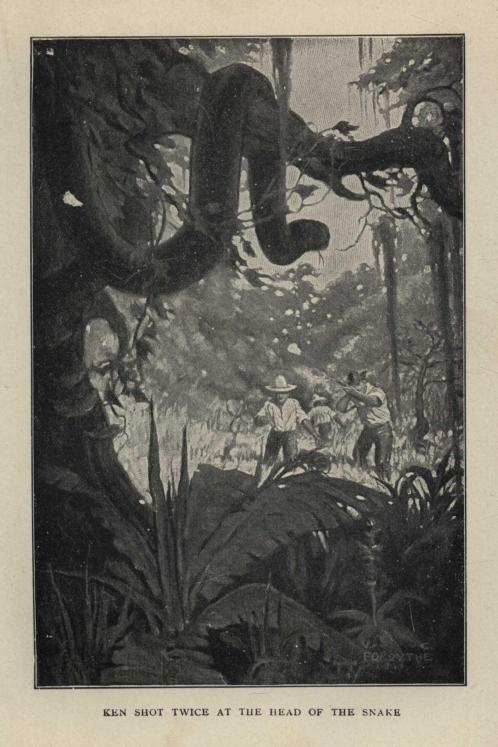
KEN SHOT TWICE AT THE HEAD OF THE SNAKE
The outlet was so narrow that Ken was not able to use the oars. Still, as the current was swift, the boat went along rapidly. He saw a light ahead and heard the babble of water. The current quickened, and the boat drifted suddenly upon the edge of an oval glade, where the hot sun beat down. A series of abrupt mossy benches, over which the stream slid almost noiselessly, blocked further progress.
The first thing about this glade that Ken noted particularly, after the difficulties presented by the steep steps, was the multitude of snakes sunning themselves along the line of further progress.
"Boys, it 'll be great wading down there, hey?" he queried.
Pepe grumbled for the first time on the trip. Ken gathered from the native's looks and speech that he did not like snakes.
"Watch me peg 'em!" yelled Hal, and he began to throw stones with remarkable accuracy. "Hike, you brown sons-of-guns!"
George, not to be outdone, made a dive for his .22 and began to pop as if he had no love for snakes. Ken had doubts about this species. The snakes were short, thick, dull brown in color, and the way they slipped into the stream proved they were water-snakes. Ken had never read of a brown water-moccasin, so he doubted that these belonged to that poisonous family. Anyway, snakes were the least of his troubles.
"Boys, you're doing fine," he said. "There are about a thousand snakes there, and you've hit about six."
He walked down through the glade into the forest, and was overjoyed to hear once more the heavy roar of rapids. He went on. The timber grew thinner, and light penetrated the jungle. Presently he saw the gleam of water through the trees. Then he hurried back.
"All right, boys," he shouted. "Here's the river."
The boys were so immensely relieved that packing the outfit round the waterfalls was work they set about with alacrity. Ken, who had on his boots, broke a trail through the ferns and deep moss. Pepe, being barefoot, wasted time looking for snakes. George teased him. But Pepe was deadly serious. And the way he stepped and looked made Ken thoughtful. He had made his last trip with supplies, and was about to start back to solve the problem of getting the boat down, when a hoarse yell resounded through the sleeping jungle. Parrots screeched, and other birds set up a cackling.
Ken bounded up the slope.
"Santa Maria!" cried Pepe.
Ken followed the direction indicated by Pepe's staring eyes and trembling finger. Hanging from a limb of a tree was a huge black-snake. It was as thick as Ken's leg. The branch upon which it poised its neck so gracefully was ten feet high, and the tail curled into the ferns on the ground.
"Boys, it's one of the big fellows," cried Ken.
"Didn't I tell you!" yelled George, running down for his gun.
Hal seemed rooted to the spot. Pepe began to jabber. Ken watched the snake, and felt instinctively from its sinister looks that it was dangerous. George came running back with his .32 and waved it in the air as he shot. He was so frightened that he forgot to aim. Ken took the rifle from him.
"You can't hit him with this. Run after your shotgun. Quick!"
But the sixteen-gage was clogged with a shell that would not eject. Ken's guns were in their cases.
"Holy smoke!" cried George. "He's coming down."
The black-snake moved his body and began to slide toward the tree-trunk.
Ken shot twice at the head of the snake. It was a slow-swaying mark hard to hit. The reptile stopped and poised wonderfully on the limb. He was not coiled about it, but lay over it with about four feet of neck waving, swaying to and fro. He watched the boys, and his tongue, like a thin, black streak, darted out viciously.
Ken could not hit the head, so he sent a bullet through the thick part of the body. Swift as a gleam the snake darted from the limb.
"Santa Maria!" yelled Pepe, and he ran off.
"Look out, boys," shouted Ken. He picked up Pepe's machete and took to his heels. George and Hal scrambled before him. They ran a hundred yards or more, and Ken halted in an open rocky spot. He was angry, and a little ashamed that he had run. The snake did not pursue, and probably was as badly frightened as the boys had been. Pepe stopped some distance away, and Hal and George came cautiously back.
"I don't see anything of him," said Ken. "I'm going back."
He walked slowly, keeping a sharp outlook, and, returning to the glade, found blood-stains under the tree. The snake had disappeared without leaving a trail.
"If I'd had my shotgun ready!" exclaimed Ken, in disgust. And he made a note that in the future he would be prepared to shoot.
"Wasn't he a whopper, Ken?" said Hal. "We ought to have got his hide. What a fine specimen!"
"Boys, you drive away those few little snakes while I figure on a way to get the boat down."
"Not on your life!" replied Hal.
George ably sustained Hal's objection.
"Mucho malo," said Pepe, and then added a loud "No" in English.
"All right, my brave comrades," rejoined Ken, scornfully. "As I've not done any work yet or taken any risks, I'll drive the snakes away."
With Pepe's machete he cut a long forked pole, trimmed it, and, armed with this weapon, he assaulted the rolls and bands and balls of brown snakes. He stalked boldly down upon them, pushed and poled, and even kicked them off the mossy banks. Hal could not stand that, and presently he got a pole and went to Ken's assistance.
"Who's hollering now?" he yelled to George.
Whereupon George cut a long branch and joined the battle. They whacked and threshed and pounded, keeping time with yells. Everywhere along the wet benches slipped and splashed the snakes. But after they were driven into the water they did not swim away. They dove under the banks and then stretched out their pointed heads from the dripping edge of moss.
"Say, fellows, we're making it worse for us," declared Ken. "See, the brown devils won't swim off. We'd better have left them on the bank. Let's catch one and see if he'll bite."
He tried to pick up one on his pole, but it slipped off. George fished after another. Hal put the end of his stick down inside the coil of still another and pitched it. The brown, wriggling, wet snake shot straight at the unsuspecting George, and struck him and momentarily wound about him.
"Augrrh!" bawled George, flinging off the reptile and leaping back. "What 'd you do that for? I'll punch you!"
"George, he didn't mean it," said Ken. "It was an accident. Come on, let's tease that fellow and see if he'll bite."
The snake coiled and raised his flat head and darted a wicked tongue out and watched with bright, beady eyes, but he did not strike. Ken went as close as he thought safe and studied the snake.
"Boys, his head isn't a triangle, and there are no little pits under his eyes. Those are two signs of a poisonous snake. I don't believe this fellow's one."
"He'll be a dead snake, b' gosh," replied George, and he fell to pounding it with his pole.
"Don't smash him. I want the skin," yelled Hal.
Ken pondered on the situation before him.
"Come, the sooner we get at this the better," he said.
There was a succession of benches through which the stream zigzagged and tumbled. These benches were rock ledges over which moss had grown fully a foot thick, and they were so oozy and slippery that it was no easy task to walk upon them. Then they were steep, so steep that it was remarkable how the water ran over them so smoothly, with very little noise or break. It was altogether a new kind of waterfall to Ken. But if the snakes had not been hidden there, navigation would have presented an easier problem.
"Come on boys, alongside now, and hold back," he ordered, gripping the bow.
Exactly what happened the next few seconds was not clear in his mind. There was a rush, and all were being dragged by the boat. The glade seemed to whizz past. There were some sodden thumps, a great splashing, a check--and lo! they were over several benches. It was the quickest and easiest descent he had ever made down a steep waterfall.
"Fine!" ejaculated George, wiping the ooze from his face.
"Yes, it was fine," Ken replied. "But unless this boat has wings something 'll happen soon."
Below was a long, swift curve of water, very narrow and steep, with a moss-covered rock dividing the lower end. Ken imagined if there was a repetition of the first descent the boat would be smashed on that rock. He ordered Pepe, who was of course the strongest, to go below and jump to the rock. There he might prevent a collision.
Pepe obeyed, but as he went he yelled and doubled up in contortions as he leaped over snakes in the moss.
Then gently, gingerly the boys started the boat off the bench, where it had lodged. George was at the stern, Ken and Hal at the bow. Suddenly Hal shrieked and jumped straight up, to land in the boat.
"Snakes!" he howled.
"Give us a rest!" cried Ken, in disgust.
The boat moved as if instinct with life. It dipped, then--wheeze! it dove over the bench. Hal was thrown off his feet, fell back on the gunwale, and thence into the snaky moss. George went sprawling face downward into the slimy ooze, and Ken was jerked clear off the bench into the stream. He got his footing and stood firm in water to his waist, and he had the bow-rope coiled round his hands.
"Help! Help!" he yelled, as he felt the dragging weight too much for him.
If Ken retarded the progress of the boat at all, it was not much. George saw his distress and the danger menacing the boat, and he leaped valiantly forward. As he dashed down a slippery slant his feet flew up higher than where his head had been; he actually turned over in the air, and fell with a great sop.
Hal had been trying to reach Ken, but here he stopped and roared with laughter.
Despite Ken's anger and fear of snakes, and his greater fear for the boat, he likewise had to let out a peal of laughter. That tumble of George's was great. Then Ken's footing gave way and he went down. His mouth filled with nasty water, nearly strangling him. He was almost blinded, too. His arms seemed to be wrenched out of their sockets, and he felt himself bumping over moss-covered rocks as soft as cushions. Slimy ropes or roots of vegetation, that felt like snakes, brushed his face and made him cold and sick. It was impossible to hold the boat any longer. He lodged against a stone, and the swift water forced him upon it. Blinking and coughing, he stuck fast.
Ken saw the boat headed like a dart for the rock where Pepe stood.
"Let 'er go!" yelled Ken. "Don't try to stop her. Pepe, you'll be smashed!"
Pepe acted like a man determined to make up for past cowardice. He made a great show of brave intentions. He was not afraid of a boat. He braced himself and reached out with his brawny arms. Ken feared for the obstinate native's life, for the boat moved with remarkable velocity.
At the last second Pepe's courage vanished. He turned tail to get out of the way. But he slipped. The boat shot toward him and the blunt stern struck him with a dull thud. Pepe sailed into the air, over the rock, and went down cleaving the water.
The boat slipped over the stone as easily as if it had been a wave and, gliding into still water below, lodged on the bank.
Ken crawled out of the stream, and when he ascertained that no one was injured he stretched himself on the ground and gave up to mirth. Pepe resembled a drowned rat; Hal was an object to wonder at; and George, in his coating of slime and with strings of moss in his hair, was the funniest thing Ken had ever seen. It was somewhat of a surprise to him to discover, presently, that the boys were convulsed with fiendish glee over the way he himself looked.
By and by they recovered, and, with many a merry jest and chuckle of satisfaction, they repacked the boat and proceeded on their way. No further obstacle hindered them. They drifted out of the shady jungle into the sunlit river.
In half a mile of drifting the heat of the sun dried the boys' clothes. The water was so hot that it fairly steamed. Once more the boat entered a placid aisle over which the magnificent gray-wreathed cypresses bowed, and the west wind waved long ribbons of moss, and wild fowl winged reluctant flight.
Ken took advantage of this tranquil stretch of river to work on his map. He realized that he must use every spare moment and put down his drawings and notes as often as time and travel permitted. It had dawned on Ken that rapids and snakes, and all the dangers along the river, made his task of observation and study one apt to be put into eclipse at times. Once or twice he landed on shore to climb a bluff, and was pleased each time to see that he had lined a comparatively true course on his map. He had doubts of its absolute accuracy, yet he could not help having pride in his work. So far so good, he thought, and hoped for good-fortune farther down the river.
XII
CATCHING STRANGE FISH
Beyond a bend in the river the boys came upon an island with a narrow, shaded channel on one side, a wide shoal on the other, and a group of huge cypresses at the up-stream end.
"Looks good to me," said Hal.
The instant Ken saw the island he knew it was the place he had long been seeking to make a permanent camp for a few days. They landed, to find an ideal camping site. The ground under the cypresses was flat, dry, and covered with short grass. Not a ray of sunlight penetrated the foliage. A pile of driftwood had lodged against one of the trees, and this made easy the question of fire-wood.
"Great!" exclaimed Ken. "Come on, let's look over the ground."
The island was about two hundred yards long, and the lower end was hidden by a growth of willows. Bursting through this, the boys saw a weedy flat leading into a wide, shallow back-eddy. Great numbers of ducks were sporting and feeding. The stones of the rocky shore were lined with sleeping ducks. Herons of all colors and sizes waded about, or slept on one leg. Snipe ran everywhere. There was a great squawking and flapping of wings. But at least half the number of waterfowl were too tame or too lazy to fly.
Ken returned to camp with his comrades, all highly elated over the prospects. The best feature about this beautiful island was the absence of ticks and snakes.
"Boys, this is the place," said Ken. "We'll hang up here for a while. Maybe we won't strike another such nice place to stay."
So they unloaded the boat, taking everything out, and proceeded to pitch a camp that was a delight. They were all loud in expressions of satisfaction. Then Pepe set about leisurely peeling potatoes; George took his gun and slipped off toward the lower end of the island; Hal made a pen for his racoon, and then more pens, as if he meant to capture a menagerie; and Ken made a comfortable lounging-bed under a cypress. He wanted to forget that nagging worry as to farther descent of the river, and to enjoy this place.
"Bang!" went George's sixteen-gage. A loud whirring of wings followed, and the air was full of ducks.
"Never touched one!" yelled Hal, in taunting voice.
A flock of teal skimmed the water and disappeared up-stream. The shot awakened parrots in the trees, where for a while there was clamor. Ken saw George wade out into the shoal and pick up three ducks.
"Pot-shot!" exclaimed Hal, disgustedly. "Why couldn't he be a sport and shoot them on the fly?"
George crossed to the opposite shore and, climbing a bare place, stood looking before him.
"Hey, George, don't go far," called Ken.
"Fine place over here," replied George, and, waving his hand, he passed into the bushes out of sight.
Ken lay back upon his blanket with a blissful sense of rest and contentment. Many a time he had lain so, looking up through the broad leaves of a sycamore or the lacy foliage of a birch or the delicate crisscross of millions of pine needles. This overhead canopy, however, was different. Only here and there could he catch little slivers of blue sky. The graceful streamers of exquisite moss hung like tassels of silver. In the dead stillness of noonday they seemed to float curved in the shape in which the last soft breeze had left them. High upon a branch he saw a red-headed parrot hanging back downward, after the fashion of a monkey. Then there were two parrots asleep in the fork of a branch. It was the middle of the day, and all things seemed tired and sleepy. The deep channel murmured drowsily, and the wide expanse of river on the other side lapped lazily at the shore. The only other sound was the mourning of turtle-doves, one near and another far away. Again the full richness, the mellow sweetness of this song struck Ken forcibly. He remembered that all the way down the river he had heard that mournful note. It was beautiful but melancholy. Somehow it made him think that it had broken the dreamy stillness of the jungle noonday long, long ago. It was sweet but sad and old. He did not like to hear it.
Ken yielded to the soothing influence of the hour and fell asleep. When he awoke there was George, standing partially undressed and very soberly popping ticks. He had enlisted the services of Pepe, and, to judge from the remarks of both, they needed still more assistance.
"Say, Garrapato George, many ticks over there?"
"Ticks!" shouted George, wildly, waving his cigarette. "Millions of 'em! And there's--ouch! Kill that one, Pepe. Wow! he's as big as a penny. There's game over there. It's a flat with some kind of berry bush. There's lots of trails. I saw cat-tracks, and I scared up wild turkeys--"
"Turkeys!" Ken exclaimed, eagerly.
"You bet. I saw a dozen. How they can run! I didn't flush them. Then I saw a flock of those black and white ducks, like the big fellow I shot. They were feeding. I believe they're Muscovy ducks."
"I'm sure I don't know, but we can call them that."
"Well, I'd got a shot, too, but I saw some gray things sneaking in the bushes. I thought they were pigs, so I got out of there quick."
"You mean javelin?"
"Yep, I mean wild pigs. Oh! We've struck the place for game. I'll bet it's coming to us."
When George anticipated pleasurable events he was the most happy of companions. It was good to look forward. He was continually expecting things to happen; he was always looking ahead with great eagerness. But unfortunately he had a twist of mind toward the unfavorable side of events, and so always had the boys fearful.
"Well, pigs or no pigs, ticks or no ticks, we'll hunt and fish, and see all there is to see," declared Ken, and he went back to his lounging.
When he came out of that lazy spell, George and Hal were fishing. George had Ken's rod, and it happened to be the one Ken thought most of.
"Do you know how to fish?" he asked.
"I've caught tarpon bigger'n you," retorted George.
That fact was indeed too much for Ken, and he had nothing to do but risk his beloved rod in George's hands. And the way George swung it about, slashed branches with it, dropped the tip in the water, was exceedingly alarming to Ken. The boy would break the tip in a minute. Yet Ken could not take his rod away from a boy who had caught tarpon.
There were fish breaking water. Where a little while before the river had been smooth, now it was ruffled by ravalo, gar, and other fish Pepe could not name. But George and Hal did not get a bite. They tried all their artificial flies and spoons and minnows, then the preserved mullet, and finally several kinds of meat.
"Bah! they want pie," said Hal.
For Ken Ward to see little and big fish capering around under his very nose and not be able to hook one was exasperating. He shot a small fish, not unlike a pickerel, and had the boys bait with that. Still no strike was forthcoming.
This put Ken on his mettle. He rigged up a minnow tackle, and, going to the lower end of the island, he tried to catch some minnows. There were plenty of them in the shallow water, but they would not bite. Finally Ken waded in the shoal and turned over stones. He found some snails almost as large as mussels, and with these he hurried back to the boys.
"Here, if you don't get a bite on one of these I'm no fisherman," said Ken. "Try one."
George got his hands on the new bait in advance of Hal and so threw his hook into the water first. No sooner had the bait sunk than he got a strong pull.
"There! Careful now," said Ken.
George jerked up, hooking a fish that made the rod look like a buggy-whip.
"Give me the rod," yelled Ken, trying to take it.
"It's my fish," yelled back George.
He held on and hauled with all his might. A long, finely built fish, green as emerald, split the water and churned it into foam. Then, sweeping out in strong dash, it broke Ken's rod square in the middle. Ken eyed the wreck with sorrow, and George with no little disapproval.
"You said you knew how to fish," protested Ken.
"Those split-bamboo rods are no good," replied George. "They won't hold a fish."
"George, you're a grand fisherman!" observed Hal, with a chuckle. "Why, you only dreamed you've caught tarpon."
Just then Hal had a tremendous strike. He was nearly hauled off the bank. But he recovered his balance and clung to his nodding rod. Hal's rod was heavy cane, and his line was thick enough to suit. So nothing broke. The little brass reel buzzed and rattled.
"I've got a whale!" yelled Hal.
"It's a big gar--alligator-gar," said George. "You haven't got him. He's got you."
The fish broke water, showing long, open jaws with teeth like saw-teeth. It threshed about and broke away. Hal reeled in to find the hook straightened out. Then George kindly commented upon the very skilful manner in which Hal had handled the gar. For a wonder Hal did not reply.
By four o'clock, when Ken sat down to supper, he was so thirsty that his mouth puckered as dry as if he had been eating green persimmons. This matter of thirst had become serious. Twice each day Ken had boiled a pot of water, into which he mixed cocoa, sugar, and condensed milk, and begged the boys to drink that and nothing else. Nevertheless Pepe and George, and occasionally Hal, would drink unboiled water. For this meal the boys had venison and duck, and canned vegetables and fruit, so they fared sumptuously.
Pepe pointed to a string of Muscovy ducks sailing up the river. George had a good shot at the tail end of the flock, and did not even loosen a feather. Then a line of cranes and herons passed over the island. When a small bunch of teal flew by, to be followed by several canvasbacks, Ken ran for his shotgun. It was a fine hammerless, a hard-shooting gun, and one Ken used for grouse-hunting. In his hurry he grasped a handful of the first shells he came to and, when he ran to the river-bank, found they were loads of small shot. He decided to try them anyhow.
While Pepe leisurely finished the supper Ken and George and Hal sat on the bank watching for ducks. Just before the sun went down a hard wind blew, making difficult shooting. Every few moments ducks would whir by. George's gun missed fire often, and when it did work all right, he missed the ducks. To Ken's surprise he found the load of small shot very deadly. He could sometimes reach a duck at eighty yards. The little brown ducks and teal he stopped as if they had hit a stone wall. He dropped a canvasback with the sheer dead plunge that he liked. Ken thought a crippled duck enough to make a hunter quit shooting. With six ducks killed, he decided to lay aside his gun for that time, when Pepe pointed down the river.
"Pato real," he said.
Ken looked eagerly and saw three of the big black ducks flying as high as the treetops and coming fast. Snapping a couple of shells in the gun, Ken stood ready. At the end of the island two of the ducks wheeled to the left, but the big leader came on like a thunderbolt. To Ken he made a canvasback seem slow. Ken caught him over the sights of the gun, followed him up till he was abreast and beyond; then, sweeping a little ahead of him, Ken pulled both triggers. The Muscovy swooped up and almost stopped in his flight while a cloud of black feathers puffed away on the wind. He sagged a little, recovered, and flew on as strong as ever. The small shot were not heavy enough to stop him.
"We'll need big loads for the Muscovies and the turkeys," said George.
"We've all sizes up to BB's," replied Ken. "George, let's take a walk over there where you saw the turkeys. It's early yet."
Then Pepe told George if they wanted to see game at that hour the thing to do was to sit still in camp and watch the game come down to the river to drink. And he pointed down-stream to a herd of small deer quietly walking out on the bar.
"After all the noise we made!" exclaimed Ken. "Well, this beats me. George, we'll stay right here and not shoot again to-night. I've an idea we'll see something worth while."
It was Pepe's idea, but Ken instantly saw its possibilities. There were no tributaries to the river or springs in that dry jungle, and, as manifestly the whole country abounded in game, it must troop down to the river in the cool of the evening to allay the hot day's thirst. The boys were perfectly situated for watching the dark bank on the channel side of the island as well as the open bars on the other. The huge cypresses cast shadows that even in daylight effectually concealed them. They put out the camp-fire and, taking comfortable seats in the folds of the great gnarled roots, began to watch and listen.
The vanguard of thirsty deer had prepared Ken for something remarkable, and he was in no wise disappointed. The trooping of deer down to the water's edge and the flight of wild fowl up-stream increased in proportion to the gathering shadows of twilight. The deer must have got a scent, for they raised their long ears and stood still as statues, gazing across toward the upper end of the island. But they showed no fear. It was only when they had drunk their fill and wheeled about to go up the narrow trails over the bank that they showed uneasiness and haste. This made Ken wonder if they were fearful of being ambushed by jaguars. Soon the dark line of deer along the shore shaded into the darkness of night. Then Ken heard soft splashes and an occasional patter of hard hoofs. The whir of wings had ceased.
A low exclamation from Pepe brought attention to interesting developments closer at hand.
"Javelin!" he whispered.
On the channel side of the island was impenetrable pitchy blackness. Ken tried to pierce it with straining eyes, but he could not even make out the shore-line that he knew was only ten yards distant. Still he could hear, and that was thrilling enough. Everywhere on this side, along the edge of the water and up the steep bank, were faint tickings of twigs and soft rustlings of leaves. Then there was a continuous sound, so low as to be almost inaudible, that resembled nothing Ken could think of so much as a long line of softly dripping water. It swelled in volume to a tiny roll, and ended in a sharp clicking on rocks and a gentle splashing in the water. A drove of javelin had come down to drink. Occasionally the glint of green eyes made the darkness all the more weird. Suddenly a long, piercing wail, a keen cry almost human, quivered into the silence.
"Panther!" Ken whispered, instantly, to the boys. It was a different cry from that of the lion of the cañon, but there was a strange wild note that betrayed the species. A stillness fell, dead as that of a subterranean cavern. Strain his ears as he might, Ken could not detect the slightest sound. It was as if no javelin or any other animals had come down to drink. That listening, palpitating moment seemed endless. What mystery of wild life it meant, that silence following the cry of the panther! Then the jungle sounds recommenced--the swishing of water, the brushing in the thicket, stealthy padded footsteps, the faint snapping of twigs. Some kind of a cat uttered an unearthly squall. Close upon this the clattering of deer up the bank on the other side rang out sharply. The deer were running, and the striking of the little hoofs ceased in short order. Ken listened intently. From far over the bank came a sound not unlike a cough--deep, hoarse, inexpressibly wild and menacing.
"Tigre!" cried Pepe, gripping Ken hard with both hands. He could feel him trembling. It showed how the native of the jungle-belt feared the jaguar.
Again the cough rasped out, nearer and louder this time. It was not a courage-provoking sound, and seemed on second thought more of a growl than a cough. Ken felt safe on the island; nevertheless, he took up his rifle.
"That's a tiger," whispered George. "I heard one once from the porch of the Alamitas hacienda."
A third time the jaguar told of his arrival upon the night scene. Ken was excited, and had a thrill of fear. He made up his mind to listen with clearer ears, but the cough or growl was not repeated.
Then a silence set in, so unbroken that it seemed haunted by the echoes of those wild jungle cries. Perhaps Ken had the haunting echoes in mind. He knew what had sent the deer away and stilled the splashings and creepings. It was the hoarse voice of the lord of the jungle.
Pepe and the boys, too, fell under the spell of the hour. They did not break the charm by talking. Giant fireflies accentuated the ebony blackness and a low hum of insects riveted the attention on the stillness. Ken could not understand why he was more thoughtful on this trip than he had ever been before. Somehow he felt immeasurably older. Probably that was because it had seemed necessary for him to act like a man, even if he was only a boy.
The black mantle of night lifted from under the cypresses, leaving a gloom that slowly paled. Through the dark foliage, low down over the bank, appeared the white tropical moon. Shimmering gleams chased the shadows across the ripples, and slowly the river brightened to a silver sheen.
A great peace fell upon the jungle world. How white, how wild, how wonderful! It only made the island more beautiful and lonely. The thought of leaving it gave Ken Ward a pang. Almost he wished he were a savage.
And he lay there thinking of the wild places that he could never see, where the sun shone, the wind blew, the twilight shadowed, the rain fell; where the colors and beauties changed with the passing hours; where a myriad of wild creatures preyed upon each other and night never darkened but upon strife and death.
XIII
A TURKEY-HUNT
Upon awakening in the early morning Ken found his state one of huge enjoyment. He was still lazily tired, but the dead drag and ache had gone from his bones. A cool breeze wafted the mist from the river, breaking it up into clouds, between which streamed rosy shafts of sunlight. Wood-smoke from the fire Pepe was starting blew fragrantly over him. A hundred thousand birds seemed to be trying to burst their throats. The air was full of music. He lay still, listening to this melodious herald of the day till it ceased.
Then a flock of parrots approached and circled over the island, screeching like a band of flying imps. Presently they alighted in the cypresses, bending the branches to a breaking-point and giving the trees a spotted appearance of green and red. Pepe waved his hand toward another flock sweeping over.
"Parrakeets," he said.
These birds were a solid green, much smaller than the red-heads, with longer tails. They appeared wilder than the red-heads, and flew higher, circling the same way and screeching, but they did not alight. Other flocks sailed presently from all directions. The last one was a cloud of parrots, a shining green and yellow mass several acres in extent. They flew still higher than the parrakeets.
"Yellow-heads!" shouted George. "They're the big fellows, the talkers. If there ain't a million of 'em!"
The boys ate breakfast in a din that made conversation useless. The red-heads swooped down upon the island, and the two unfriendly species flew back and forth, manifestly trying to drive the boys off. The mist had blown away, the sun was shining bright, when the myriad of parrots, in large and small flocks, departed to other jungle haunts.
Pepe rowed across the wide shoal to the sand-bars. There in the soft ooze, among the hundreds of deer-tracks, Ken found a jaguar-track larger than his spread hand. It was different from a lion-track, yet he could not distinguish just what the difference was. Pepe, who had accompanied the boys to carry the rifles and game, pointed to the track and said, vehemently:
"Tigre!" He pronounced it "tee-gray." And he added, "Grande!"
"Big he certainly is," Ken replied. "Boys, we'll kill this jaguar. We'll bait this drinking-trail with a deer carcass and watch to-night."
Once upon the bank, Ken was surprised to see a wide stretch of comparatively flat land. It was covered with a low vegetation, with here and there palm-trees on the little ridges and bamboo clumps down in the swales. Beyond the flat rose the dark line of dense jungle. It was not clear to Ken why that low piece of ground was not overgrown with the matted thickets and vines and big trees characteristic of other parts of the jungle. They struck into one of the trails, and had not gone a hundred paces when they espied a herd of deer. The grass and low bushes almost covered them. George handed his shotgun to Pepe and took his rifle.
"Shoot low," said Ken.
George pulled the trigger, and with the report a deer went down, but it was not the one Ken was looking at, nor the one at which he believed George had aimed. The rest of the herd bounded away, to disappear in a swale. Wading through bushes and grass, they found George's quarry, a small deer weighing perhaps sixty pounds. Pepe carried it over to the trail. Ken noted that he was exceedingly happy to carry the rifles. They went on at random, somehow feeling that, no matter in what direction, they would run into something to shoot at.