Front matter (continued 4)
Reading edition
"Get in--hustle!" he called, falling aboard. "You're always saying it's coming to us. Here's where!"
George had hardly got into the boat when the crocodile pulled it off shore, and away it went, sailing down-stream.
"Whoop! All aboard for Panuco!" yelled Hal.
"Now, Pepe, you don't need to row any more--we've a water-horse," Ken added.
But Pepe did not enter into the spirit of the occasion. He kept calling on the saints and crying, "Mucho malo." George and Ken and Hal, however, were hilarious. They had not yet had experience enough to know crocodiles.
Faster and faster they went. The water began to surge away from the bow and leave a gurgling wake behind the stern. Soon the boat reached the middle of the river where the water was deepest, and the lasso went almost straight down.
Ken felt the stern of the boat gradually lifted, and then, in alarm, he saw the front end sinking in the water. The crocodile was hauling the bow under.
"Pepe--your machete--cut the lasso!" he ordered, sharply. George had to repeat the order.
Wildly Pepe searched under the seat and along the gunwales. He could not find the machete.
"Cut the rope!" Ken thundered. "Use a knife, the ax--anything--only cut it--and cut it quick!"
Pepe could find nothing. Knife in hand, Ken leaped over his head, sprawled headlong over the trunk, and slashed the taut lasso just as the water began to roar into the boat. The bow bobbed up as a cork that had been under. But the boat had shipped six inches of water.
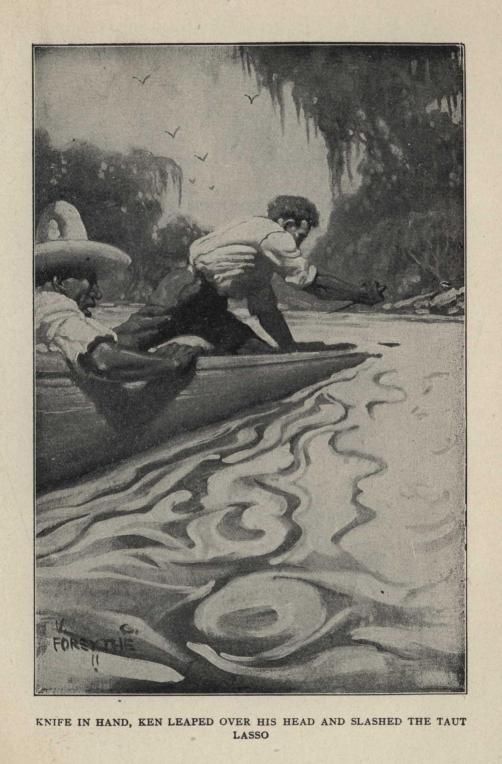
KNIFE IN HAND, KEN LEAPED OVER HIS HEAD AND SLASHED THE TAUT LASSO
"Row ashore, Pepe. Steady, there. Trim the boat, George."
They beached at a hard clay-bank and rested a little before unloading to turn out the water.
"Grande!" observed Pepe.
"Yes; he was big," assented George.
"I wonder what's going to happen to us next," added Hal.
Ken Ward looked at these companions of his and he laughed outright. "Well, if you all don't take the cake for nerve!"
XX
TREED BY WILD PIGS
Pepe's long years of mozo work, rowing for tarpon fishermen, now stood the boys in good stead. All the hot hours of the day he bent steadily to the oars. Occasionally they came to rifts, but these were not difficult to pass, being mere swift, shallow channels over sandy bottom. The rocks and the rapids were things of the past.
George lay in a kind of stupor, and Hal lolled in his seat. Ken, however, kept alert, and as the afternoon wore on began to be annoyed at the scarcity of camp-sites.
The muddy margins of the river, the steep banks, and the tick-infested forests offered few places where it was possible to rest, to say nothing of sleep. Every turn in the widening river gave Ken hope, which resulted in disappointment. He found consolation, however, in the fact that every turn and every hour put him so much farther on the way.
About five o'clock Ken had unexpected good luck in shape of a small sand-bar cut off from the mainland, and therefore free of cattle-tracks. It was clean and dry, with a pile of driftwood at one end.
"Tumble out, boys," called Ken, as Pepe beached the boat. "We'll pitch camp here."
Neither Hal nor George showed any alacrity. Ken watched his brother; he feared to see some of the symptoms of George's sickness. Both lads, however, seemed cheerful, though too tired to be of much use in the pitching of camp.
Ken could not recover his former good spirits. There was a sense of foreboding in his mind that all was not well, that he must hurry, hurry. And although George appeared to be holding his own, Hal healthy enough, and Pepe's brooding quiet at least no worse, Ken could not rid himself of gloom. If he had answered the question that knocked at his mind he would have admitted a certainty of disaster. So he kept active, and when there were no more tasks for that day he worked on his note-book, and then watched the flight of wild fowl.
The farther down the river the boys traveled the more numerous were the herons and cranes and ducks. But they saw no more of the beautiful pato real, as Pepe called them, or the little russet-colored ducks, or the dismal-voiced bitterns. On the other hand, wild geese were common, and there were flocks and flocks of teal and canvasbacks.
Pepe, as usual, cooked duck. And he had to eat it. George had lost his appetite altogether. Hal had lost his taste for meat, at least. And Ken made a frugal meal of rice.
"Boys," he said, "the less you eat from now on the better for you."
It took resolution to drink the cocoa, for Ken could not shut out remembrance of the green water and the shore-line of dead and decaying cattle. Still, he was parched with thirst; he had to drink. That night he slept ten hours without turning over. Next morning he had to shake Pepe to rouse him.
Ken took turns at the oars with Pepe. It was not only that he fancied Pepe was weakening and in need of an occasional rest, but the fact that he wanted to be occupied, and especially to keep in good condition. They made thirty miles by four o'clock, and most of it against a breeze. Not in the whole distance did they pass half a dozen places fit for a camp. Toward evening the river narrowed again, resembling somewhat the Santa Rosa of earlier acquaintance. The magnificent dark forests crowded high on the banks, always screened and curtained by gray moss, as if to keep their secrets.
The sun was just tipping with gold the mossy crests of a grove of giant ceibas, when the boys rounded a bend to come upon the first ledge of rocks for two days. A low, grassy promontory invited the eyes searching for camping-ground. This spot appeared ideal; it certainly was beautiful. The ledge jutted into the river almost to the opposite shore, forcing the water to rush through a rocky trough into a great foam-spotted pool below.
They could not pitch the tent, since the stony ground would not admit stakes, so they laid the canvas flat. Pepe went up the bank with his machete in search of firewood. To Ken's utmost delight he found a little spring of sweet water trickling from the ledge, and by digging a hole was enabled to get a drink, the first one in more than a week.
A little later, as he was spreading the blankets, George called his attention to shouts up in the woods.
"Pepe's treed something," Ken said. "Take your gun and hunt him up."
Ken went on making a bed and busying himself about camp, with little heed to George's departure. Presently, however, he was startled by unmistakable sounds of alarm. George and Pepe were yelling in unison, and, from the sound, appeared to be quite a distance away.
"What the deuce!" Ken ejaculated, snatching up his rifle. He snapped a clip in the magazine and dropped several loaded clips and a box of extra shells into his coat pocket. After his adventure with the jaguar he decided never again to find himself short of ammunition. Running up the sloping bank, he entered the forest, shouting for his companions. Answering cries came from in front and a little to the left. He could not make out what was said.
Save for drooping moss the forest was comparatively open, and at a hundred paces from the river-bank were glades covered with thickets and long grass and short palm-trees. The ground sloped upward quite perceptibly.
"Hey, boys, where are you?" called Ken.
Pepe's shrill yells mingled with George's shouts. At first their meaning was unintelligible, but after calling twice Ken understood.
"Javelin! Go back! Javelin! We're treed! Wild pigs! Santa Maria! Run for your life!"
This was certainly enlightening and rather embarrassing. Ken remembered the other time the boys had made him run, and he grew hot with anger.
"I'll be blessed if I'll run!" he said, in the pride of conceit and wounded vanity. Whereupon he began to climb the slope, stopping every few steps to listen and look. Ken wondered what had made Pepe go so far for fire-wood; still, there was nothing but green wood all about. Walking round a clump of seared and yellow palms that rustled in the breeze, Ken suddenly espied George's white shirt. He was in a scrubby sapling not fifteen feet from the ground. Then Ken espied Pepe, perched in the forks of a ceiba, high above the thickets and low shrubbery. Ken was scarcely more than a dozen rods from them down the gradual slope. Both saw him at once.
"Run, you Indian! Run!" bawled George, waving his hands.
George implored Ken to fly to save his precious life.
"What for? you fools! I don't see anything to run from," Ken shouted back. His temper had soured a little during the last few days.
"You'd better run, or you'll have to climb," replied George. "Wild pigs--a thousand of 'em!"
"Where?"
"Right under us. There! Oh, if they see you! Listen to this." He broke off a branch, trimmed it of leaves, and flung it down. Ken heard a low, trampling roar of many hard little feet, brushings in the thicket, and cracking of twigs. As close as he was, however, he could not see a moving object. The dead grass and brush were several feet high, up to his waist in spots, and, though he changed position several times, no javelin did he see.
"You want to look out. Say, man, these are wild pigs--boars, I tell you! They'll kill you!" bellowed George.
"Are you going to stay up there all night?" Ken asked, sarcastically.
"We'll stay till they go away."
"All right, I'll scare them away," Ken replied, and, suiting action to word, he worked the automatic as fast as it would shoot, aiming into the thicket under George.
Of all the foolish things a nettled hunter ever did that was the worst. A roar answered the echoes of the rifle, and the roar rose from every side of the trees the victims were in. Nervously Ken clamped a fresh clip of shells into the rifle. Clouds of dust arose, and strange little squeals and grunts seemed to come from every quarter. Then the grass and bushes were suddenly torn apart by swift gray forms with glittering eyes. They were everywhere.
"Run! Run!" shrieked George, high above the tumult.
For a thrilling instant Ken stood his ground and fired at the bobbing gray backs. But every break made in the ranks by the powerful shells filled in a flash. Before that vicious charge he wavered, then ran as if pursued by demons.
The way was downhill. Ken tripped, fell, rolled over and over, then, still clutching the rifle, rose with a bound and fled. The javelin had gained. They were at his heels. He ran like a deer. Then, seeing a low branch, he leaped for it, grasped it with one hand, and, crooking an elbow round it, swung with the old giant swing.
Before Ken knew how it had happened he was astride a dangerously swaying branch directly over a troop of brownish-gray, sharp-snouted, fiendish-eyed little peccaries.
Some were young and sleek, others were old and rough; some had little yellow teeth or tusks, and all pointed their sharp noses upward, as if expecting him to fall into their very mouths. Feeling safe, once more Ken loaded the rifle and began to kill the biggest, most vicious javelin. When he had killed twelve in twelve shots, he saw that shooting a few would be of no avail. There were hundreds, it seemed, and he had scarcely fifty shells left. Moreover, the rifle-barrel grew so hot that it burnt his hands. Hearing George's yell, he replied, somewhat to his disgust:
"I'm all right, George--only treed. How 're you?"
"Pigs all gone--they chased you--Pepe thinks we can risk running."
"Don't take any chances," Ken yelled, in answer.
"Hi! Hi! What's wrong with you gazabos?" came Hal's yell from down the slope.
"Go back to the boat," shouted Ken.
"What for?"
"We're all treed by javelin--wild pigs."
"I've got to see that," was Hal's reply.
Ken called a sharp, angry order for Hal to keep away. But Hal did not obey. Ken heard him coming, and presently saw him enter one of the little glades. He had Ken's shotgun, and was peering cautiously about.
"Ken, where are you?"
"Here! Didn't I tell you to keep away? The pigs heard you--some of them are edging out there. Look out! Run, kid, run!"
A troop of javelin flashed into the glade. Hal saw them and raised the shotgun.
Boom! He shot both barrels.
The shot tore through the brush all around Ken, but fortunately beneath him. Neither the noise nor the lead stopped the pugnacious little peccaries.
Hal dropped Ken's hammerless and fled.
"Run faster!" yelled George, who evidently enjoyed Hal's plight. "They'll get you! Run hard!"
The lad was running close to the record when he disappeared.
In trying to find a more comfortable posture, so he could apply himself to an interesting study of his captors, Ken made the startling discovery that the branch which upheld him was splitting from the tree-trunk. His heart began to pound in his breast; then it went up into his throat. Every move he made--for he had started to edge toward the tree--widened the little white split.
"Boys, my branch is breaking!" he called, piercingly.
"Can't you get another?" returned George.
"No; I daren't move! Hurry, boys! If you don't scare these brutes off I'm a goner!"
Ken's eyes were riveted upon the gap where the branch was slowly separating from the tree-trunk. He glanced about to see if he could not leap to another branch. There was nothing near that would hold him. In desperation he resolved to drop the rifle, cautiously get to his feet upon the branch, and with one spring try to reach the tree. When about to act upon this last chance he heard Pepe's shrill yell and a crashing in the brush. Then followed the unmistakable roar and crackling of fire. Pepe had fired the brush--no, he was making his way toward Ken, armed with a huge torch.
"Pepe, you'll fire the jungle!" cried Ken, forgetting what was at stake and that Pepe could not understand much English. But Ken had been in one forest-fire and remembered it with horror.
The javelin stirred uneasily, and ran around under Ken, tumbling over one another.
When Pepe burst through the brush, holding before him long-stemmed palm leaves flaring in hissing flames, the whole pack of pigs bowled away into the forest at breakneck speed.
Ken leaped down, and the branch came with him. George came running up, his face white, his eyes big. Behind him rose a roar that Ken thought might be another drove of pigs till he saw smoke and flame.
"Boys, the jungle's on fire. Run for the river!"
In their hurry they miscalculated the location of camp and dashed out of the jungle over a steep bank, and they all had a tumble. It was necessary to wade to reach the rocky ledge.
Ken shook hands with Pepe.
"George, tell him that was a nervy thing to do. He saved my life, I do believe."
"You fellows did a lot of hollering," said Hal, from his perch in the boat.
"Say, young man, you've got to go back after my gun. Why didn't you do what I told you? Foolish, to run into danger that way!" declared Ken, severely.
"You don't suppose I was going to overlook a chance to see Ken Ward treed, do you?"
"Well, you saw him, and that was no joke. But I wish Pepe could have scared those pigs off without firing the jungle."
"Pepe says it 'll give the ticks a good roasting," said George.
"We'll have roast pig, anyway," added Ken.
He kept watching the jungle back of the camp as if he expected it to blow up like a powder-mine. But this Tamaulipas jungle was not Penetier Forest. A cloud of smoke rolled up; there was a frequent roaring of dry palms; but the green growths did not burn. It was not much of a forest-fire, and Ken concluded that it would soon burn out.
So he took advantage of the waning daylight to spread out his map and plot in the day's travel. This time Hal watched him with a quiet attention that was both flattering and stimulating; and at the conclusion of the task he said:
"Well, Ken, we're having sport, but we're doing something more--something worth while."
XXI
THE LEAPING TARPON
Just before dark, when the boys were at supper, a swarm of black mosquitoes swooped down upon camp.
Pepe could not have shown more fear at angry snakes, and he began to pile green wood and leaves on the fire to make a heavy smoke.
These mosquitoes were very large, black-bodied, with white-barred wings. Their bite was as painful as the sting of a bee. After threshing about until tired out the boys went to bed. But it was only to get up again, for the mosquitoes could bite through two thicknesses of blanket.
For a wonder every one was quiet. Even George did not grumble. The only thing to do was to sit or stand in the smoke of the campfire. The boys wore their gloves and wrapped blankets round heads and shoulders. They crouched over the fire until tired of that position, then stood up till they could stand no longer. It was a wretched, sleepless night with the bloodthirsty mosquitoes humming about like a swarm of bees. They did not go away until dawn.
"That's what I get for losing the mosquito-netting," said Ken, wearily.
Breakfast was not a cheerful meal, despite the fact that the boys all tried to brace up.
George's condition showed Ken the necessity for renewed efforts to get out of the jungle. Pepe appeared heavy and slow, and, what was more alarming, he had lost his appetite. Hal was cross, but seemed to keep well. It was hard enough for Ken to persuade George and Pepe to take the bitter doses of quinine, and Hal positively refused.
"It makes me sick, I tell you," said Hal, impatiently.
"But Hal, you ought to be guided by my judgment now," replied Ken, gently.
"I don't care. I've had enough of bitter pills."
"I ask you--as a favor?" persisted Ken, quietly.
"No!"
"Well, then, I'll have to make you take them."
"Wha-at?" roared Hal.
"If necessary, I'll throw you down and pry open your mouth and get Pepe to stuff these pills down your throat. There!" went on Ken, and now he did not recognize his own voice.
Hal looked quickly at his brother, and was amazed and all at once shaken.
"Why, Ken--" he faltered.
"I ought to have made you take them before," interrupted Ken. "But I've been too easy. Now, Hal, listen--and you, too, George. I've made a bad mess of this trip. I got you into this jungle, and I ought to have taken better care of you, whether you would or not. George has fever. Pepe is getting it. I'm afraid you won't escape. You all would drink unboiled water."
"Ken, that's all right, but you can get fever from the bites of the ticks," said George.
"I dare say. But just the same you could have been careful about the water. Not only that--look how careless we have been. Think of the things that have happened! We've gotten almost wild on this trip. We don't realize. But wait till we get home. Then we'll hardly be able to believe we ever had these adventures. But our foolishness, our carelessness, must stop right here. If we can't profit by our lucky escapes yesterday--from that lassoed crocodile and the wild pigs--we are simply no good. I love fun and sport. But there's a limit. Hal, remember what old Hiram told you about being foolhardily brave. I think we have been wonderfully lucky. Now let's deserve our good luck. Let's not prove what that Tampico hotel-man said. Let's show we are not just wild-goose-chasing boys. I put it to you straight. I think the real test is yet to come, and I want you to help me. No more tricks. No more drinking unboiled water. No more shooting except in self-defense. We must not eat any more meat. No more careless wandering up the banks. No chances. See? And fight the fever. Don't give up. Then when we get out of this awful jungle we can look back at our adventures--and, better, we can be sure we've learned a lot. We shall have accomplished something, and that's learning. Now, how about it? Will you help me?"
"You can just bet your life," replied George, and he held out his hand.
"Ken, I'm with you," was Hal's quiet promise; and Ken knew from the way the lad spoke that he was in dead earnest. When it came to the last ditch Hal Ward was as true as steel. He took the raw, bitter quinine Ken offered and swallowed it without a grimace.
"Good!" exclaimed Ken. "Now, boys, let's pack. Hal, you let your menagerie go. There's no use keeping your pets any longer. George, you make yourself a bed on the trunk, and fix a palm-leaf sun-shelter. Then lie down."
When the boat had been packed and all was in readiness for the start, George was sound asleep. They shoved off into the current. Pepe and Ken took turns at the oars, making five miles an hour.
As on the day before, they glided under the shadows of the great moss-twined cypresses, along the muddy banks where crocodiles basked in the sun and gaunt cattle came down to drink. Once the boat turned a bushy point to startle a large flock of wild turkeys, perhaps thirty-five in number. They had been resting in the cool sand along the river. Some ran up the bank, some half-dozen flew right over the boat, and most of them squatted down as if to evade detection. Thereafter turkeys and ducks and geese became so common as to be monotonous.
About one o'clock Ken sighted a thatched bamboo and palm-leaf hut on the bank.
"Oh, boys, look! look!" cried Ken, joyfully.
Hal was as pleased as Ken, and George roused out of his slumber. Pepe grinned and nodded his head.
Some naked little children ran like quail. A disheveled black head peeped out of a door, then swiftly vanished.
"Indians," said George.
"I don't care," replied Ken, "they're human beings--people. We're getting somewhere."
From there on the little bamboo huts were frequently sighted. And soon Ken saw a large one situated upon a high bluff. Ken was wondering if these natives would be hospitable.
Upon rounding the next bend the boys came unexpectedly upon a connecting river. It was twice as wide as the Santa Rosa, and quite swift.
"Tamaulipas," said Pepe.
"Hooray! boys, this is the source of the Panuco, sure as you're born," cried Ken. "I told you we were getting somewhere."
He was overcome with the discovery. This meant success.
"Savalo! Savalo!" exclaimed Pepe, pointing.
"Tarpon! Tarpon! What do you think of that? 'Way up here! We must be a long distance from tide-water," said George.
Ken looked around over the broad pool below the junction of the two rivers. And here and there he saw swirls, and big splashes, and then the silver sides of rolling tarpon.
"Boys, seeing we've packed that can of preserved mullet all the way, and those thundering heavy tackles, let's try for tarpon," suggested Ken.
It was wonderful to see how the boys responded. Pepe was no longer slow and heavy. George forgot he was sick. Hal, who loved to fish better than to hunt, was as enthusiastic as on the first day.
"Ken, let me boss this job," said George, as he began to rig the tackles. "Pepe will row; you and Hal sit back here and troll. I'll make myself useful. Open the can. See, I hook the mullet just back of the head, letting the bar come out free. There! Now run out about forty feet of line. Steady the butt of the rod under your leg. Put your left hand above the reel. Hold the handle of the reel in your right, and hold it hard. The drag is in the handle. Now when a tarpon takes the bait, jerk with all your might. Their mouths are like iron, and it's hard to get a hook to stick."
Pepe rowed at a smooth, even stroke and made for the great curve of the pool where tarpon were breaking water.
"If they're on the feed, we'll have more sport than we've had yet," said George.
Ken was fascinated, and saw that Hal was going to have the best time of the trip. Also Ken was very curious to have a tarpon strike. He had no idea what it would be like. Presently, when the boat glided among the rolling fish and there was prospect of one striking at any moment, Ken could not subdue a mounting excitement.
"Steady now--be ready," warned George.
Suddenly Hal's line straightened. The lad yelled and jerked at the same instant. There came a roar of splitting waters, and a beautiful silver fish, longer than Hal himself, shot up into the air. The tarpon shook himself and dropped back into the water with a crash.
Hal was speechless. He wound in his line to find the bait gone.
"Threw the hook," said George, as he reached into the can for another bait. "He wasn't so big. You'll get used to losing 'em. There! try again."
Ken had felt several gentle tugs at his line, as if tarpon were rolling across it. And indeed he saw several fish swim right over where his line disappeared in the water. There were splashes all around the boat, some gentle swishes and others hard, cutting rushes. Then his line straightened with a heavy jerk. He forgot to try to hook the fish; indeed, he had no time. The tarpon came half out of the water, wagged his head, and plumped back. Ken had not hooked the fish, nor had the fish got the bait. So Ken again let out his line.
The next thing which happened was that the boys both had strikes at the same instant. Hal stood up, and as his tarpon leaped it pulled him forward, and he fell into the stern-seat. His reel-handle rattled on the gunwale. The line hissed. Ken leaned back and jerked. His fish did not break water, but he was wonderfully active under the surface. Pepe was jabbering. George was yelling. Hal's fish was tearing the water to shreds. He crossed Ken's fish; the lines fouled, and then slacked. Ken began to wind in. Hal rose to do likewise.
"Gee!" he whispered, with round eyes.
Both lines had been broken. George made light of this incident, and tied on two more leaders and hooks and baited afresh.
"The fish are on the feed, boys. It's a cinch you'll each catch one. Better troll one at a time, unless you can stand for crossed lines."
But Ken and Hal were too eager to catch a tarpon to troll one at a time, so once more they let their lines out. A tarpon took Hal's bait right under the stern of the boat. Hal struck with all his might. This fish came up with a tremendous splash, drenching the boys. His great, gleaming silver sides glistened in the sun. He curved his body and straightened out with a snap like the breaking of a board, and he threw the hook whistling into the air.
Before Hal had baited up, Ken got another strike. This fish made five leaps, one after the other, and upon the last threw the hook like a bullet. As he plunged down, a beautiful rainbow appeared in the misty spray.
"Hal, do you see that rainbow?" cried Ken, quickly. "There's a sight for a fisherman!"
This time in turn, before Ken started to troll, Hal hooked another tarpon. This one was not so large, but he was active. His first rush was a long surge on the surface. He sent the spray in two streaks like a motor-boat. Then he sounded.
"Hang on, Hal!" yelled George and Ken in unison.
Hal was bent almost double and his head was bobbing under the strain. He could not hold the drag. The line was whizzing out.
"You got that one hooked," shouted George. "Let go the reel--drop the handle. Let him run."
He complied, and then his fish began a marvelous exhibition of lofty tumbling. He seemed never to stay down at all. Now he shot up, mouth wide, gills spread, eyes wild, and he shook himself like a wet dog. Then he dropped back, and before the boys had time to think where he might be he came up several rods to the right and cracked his gills like pistol-shots. He skittered on his tail and stood on his head and dropped flat with a heavy smack. Then he stayed under and began to tug.
"Hang on, now," cried George. "Wind in. Hold him tight. Don't give him an inch unless he jumps."
This was heartbreaking work for Hal. He toiled to keep the line in. He grew red in the face. He dripped with sweat. He panted for breath. But he hung on.
Ken saw how skilfully Pepe managed the boat. The mozo seemed to know just which way the fish headed, and always kept the boat straight. Sometimes he rowed back and lent his help to Hal. But this appeared to anger the tarpon, for the line told he was coming to the surface. Then, as Pepe ceased to let him feel the weight of the boat, the tarpon sank again. So the battle went on round and round the great pool. After an hour of it Hal looked ready to drop.
"Land him alone if you can," said Ken. "He's tiring, Hal."
"I'll--land him--or--or bust!" panted Hal.
"Look out, now!" warned George again. "He's coming up. See the line. Be ready to trim the boat if he drops aboard. Wow!"
The tarpon slipped smoothly out of the water and shot right over the bow of the boat. Quick-witted George flung out his hand and threw Hal's rod round in time to save the line from catching. The fish went down, came up wagging his head, and then fell with sullen splash.
"He's done," yelled George. "Now, Hal, hold him for all you're worth. Not an inch of line!"
Pepe headed the boat for a sandy beach; and Hal, looking as if about to have a stroke of apoplexy, clung desperately to the bending rod. The tarpon rolled and lashed his tail, but his power was mostly gone. Gradually he ceased to roll, until by the time Pepe reached shore he was sliding wearily through the water, his silvery side glittering in the light.
The boat grated on the sand. Pepe leaped out. Then he grasped Hal's line, slipped his hands down to the long wire leader, and with a quick, powerful pull slid the tarpon out upon the beach.
"Oh-h!" gasped Hal, with glistening eyes. "Oh-h! Ken, just look!"
"I'm looking, son, and don't you forget it."
The tarpon lay inert, a beautiful silver-scaled creature that looked as if he had just come from a bath of melted opals. The great dark eyes were fixed and staring, the tail moved feebly, the long dorsal fin quivered.
He measured five feet six inches in length, which was one inch more than Hal's height.
"Ken, the boys back home will never believe I caught him," said Hal, in distress.
"Take his picture to prove it," replied Ken.
Hal photographed his catch. Pepe took out the hook, showing, as he did so, the great iron-like plates in the mouth of the fish.
"No wonder it's hard to hook them," said Ken.
Hal certainly wanted his beautiful fish to go back, free and little hurt, to the river. But also he wanted him for a specimen. Hal deliberated. Evidently he was considering the labor of skinning such a huge fish and the difficulty of preserving and packing the hide.
"Say, Hal, wouldn't you like to see me hook one?" queried Ken, patiently.
That brought Hal to his senses.
"Sure, Ken, old man, I want you to catch one--a big one--bigger than mine," replied Hal, and restored the fish to the water.
They all watched the liberated tarpon swim wearily off and slip down under the water.
"He'll have something to tell the rest, won't he?" said George.
In a few minutes the boat was again in the center of the great pool among the rolling tarpon. Ken had a strike immediately. He missed. Then he tried again. And in a short space of time he saw five tarpon in the air, one after the other, and not one did he hook securely. He got six leaps out of one, however, and that was almost as good as landing him.
"There 're some whales here," said George.
"Grande savalo," added Pepe, and he rowed over to where a huge fish was rolling.
"Oh, I don't want to hook the biggest one first," protested Ken.
Pepe rowed to and fro. The boys were busy trying to see the rolling tarpon. There would be a souse on one side, then a splash on the other, then a thump behind. What with trying to locate all these fish and still keep an eye on Ken's line the boys almost dislocated their necks.
Then, quick as a flash, Ken had a strike that pulled him out of his seat to his knees. He could not jerk. His line was like a wire. It began to rise. With all his strength he held on. The water broke in a hollow, slow roar, and a huge humpbacked tarpon seemed to be climbing into the air. But he did not get all the way out, and he plunged back with a thunderous crash. He made as much noise as if a horse had fallen off a bridge.
The handle of the reel slipped out of Ken's grasp, and it was well. The tarpon made a long, wonderful run and showed on the surface a hundred yards from the boat. He was irresistibly powerful. Ken was astounded and thrilled at his strength and speed. There, far away from the boat, the tarpon leaped magnificently, clearing the water, and then went down. He did not come up again.
"Ken, he's a whale," said George. "I believe he's well hooked. He won't jump any more. And you've got a job on your hands."
"I want him to jump."
"The big ones seldom break water after the first rush or so."
"Ken, it's coming to you with that fellow," said Hal. "My left arm is paralyzed. Honestly, I can pinch it and not feel the pain."
Pepe worked the boat closer and Ken reeled in yard after yard of line. The tarpon was headed down-stream, and he kept up a steady, strong strain.
"Let him tow the boat," said George. "Hold the drag, Ken. Let him tow the boat."
"What!" exclaimed Ken, in amaze.
"Oh, he'll do it, all right."
And so it proved. Ken's tarpon, once headed with the current, did not turn, and he towed the boat.
"This is a new way for me to tire out a fish," said Ken. "What do you think of it, Hal?"
Hal's eyes glistened.
"This is fishing. Ken, did you see him when he came up?"
"Not very clearly. I had buck-fever. You know how a grouse looks when he flushes right under your feet--a kind of brown blur. Well, this was the same, only silver."
At the end of what Ken judged to be a mile the tarpon was still going. At the end of the second mile he was tired. And three miles down the river from where the fish was hooked Pepe beached the boat on a sandbar and hauled ashore a tarpon six feet ten inches long.
Here Ken echoed Hal's panting gasp of wonder and exultation. As he sat down on the boat to rest he had no feeling in his left arm, and little in his right. His knuckles were skinned and bloody. No game of baseball he had ever pitched had taken his strength like the conquest of this magnificent fish.
"Hal, we'll have some more of this fishing when we get to Tampico," said Ken. "Why, this beats hunting. You have the sport, and you needn't kill anything. This tarpon isn't hurt."
So Ken photographed his prize and measured him, and, taking a last lingering glance at the great green back, the silver-bronze sides, the foot-wide flukes of the tail, at the whole quivering fire-tinted length, he slid the tarpon back into the river.
XXII
STRICKEN DOWN
Much as Ken would have liked to go back to that pool, he did not think of it twice. And as soon as the excitement had subsided and the journey was resumed, George and Hal, and Pepe, too, settled down into a silent weariness that made Ken anxious.
During the afternoon Ken saw Pepe slowly droop lower and lower at the oars till the time came when he could scarcely lift them to make a stroke. And when Ken relieved him of them, Pepe fell like a log in the boat.
George slept. Hal seemed to be fighting stupor. Pepe lay motionless on his seat. They were all going down with the fever, that Ken knew, and it took all his courage to face the situation. It warmed his heart to see how Hal was trying to bear up under a languor that must have been well-nigh impossible to resist. At last Hal said:
"Ken, let me row." He would not admit that he was sick.
Ken thought it would do Hal no harm to work. But Ken did not want to lose time. So he hit upon a plan that pleased him. There was an extra pair of oars in the boat. Ken fashioned rude pegs from a stick and drove these down into the cleat inside the gunwales. With stout rope he tied the oars to the pegs, which answered fairly well as oarlocks. Then they had a double set of oars going, and made much better time.
George woke and declared that he must take a turn at the oars. So Ken let him row, too, and rested himself. He had a grim foreboding that he would need all his strength.
The succeeding few hours before sunset George and Hal more than made up for all their delinquencies of the past. At first it was not very hard for them to row; but soon they began to weary, then weaken. Neither one, however, would give up. Ken let them row, knowing that it was good for them. Slower and slower grew George's strokes, there were times when he jerked up spasmodically and made an effort, only to weaken again. At last, with a groan he dropped the oars. Ken had to lift him back into the bow.
Hal was not so sick as George, and therefore not so weak. He lasted longer. Ken had seen the lad stick to many a hard job, but never as he did to this one. Hal was making good his promise. There were times when his breath came in whistles. He would stop and pant awhile, then row on. Ken pretended he did not notice. But he had never been so proud of his brother nor loved him so well.
"Ken, old man," said Hal, presently. "I was--wrong--about the water. I ought to have obeyed you. I--I'm pretty sick."
What a confession for Hal Ward!
Ken turned in time to see Hal vomit over the gunwale.
"It's pretty tough, Hal," said Ken, as he reached out to hold his brother's head; "but you're game. I'm so glad to see that."
Whereupon Hal went back to his oars and stayed till he dropped. Ken lifted him and laid him beside George.
Ken rowed on with his eyes ever in search of a camping-site. But there was no place to camp. The muddy banks were too narrow at the bottom, too marshy and filthy. And they were too steep to climb to the top.
The sun set. Twilight fell. Darkness came on, and still Ken rowed down the river. At last he decided to make a night of it at the oars. He preferred to risk the dangers of the river at night rather than spend miserable hours in the mud. Rousing the boys, he forced them to swallow a little cold rice and some more quinine. Then he covered them with blankets, and had scarce completed the task when they were deep in slumber.
Then the strange, dense tropical night settled down upon Ken. The oars were almost noiseless, and the water gurgled softly from the bow. Overhead the expanse was dark blue, with a few palpitating stars. The river was shrouded in gray gloom, and the banks were lost in black obscurity. Great fireflies emphasized the darkness. He trusted a good deal to luck in the matter of going right; yet he kept his ear keen for the sound of quickening current, and turned every few strokes to peer sharply into the gloom. He seemed to have little sense of peril, for, though he hit submerged logs and stranded on bars, he kept on unmindful, and by and by lost what anxiety he had felt. The strange wildness of the river at night, the gray, veiled space into which he rowed unheeding began to work upon his mind.
That was a night to remember--a night of sounds and smells, of the feeling of the cool mist, the sight of long, dark forest-line and a golden moon half hidden by clouds. Prominent among these was the trill of river frogs. The trill of a northern frog was music, but that of these great, silver-throated jungle frogs was more than music. Close at hand one would thrill Ken with mellow, rich notes; and then from far would come the answer, a sweet, high tenor, wilder than any other wilderness sound, long sustained, dying away till he held his breath to listen.
So the hours passed; and the moon went down into the weird shadows, and the Southern Cross rose pale and wonderful.
Gradually the stars vanished in a kind of brightening gray, and dawn was at hand. Ken felt weary for sleep, and his arms and back ached. Morning came, with its steely light on the river, the rolling and melting of vapors, the flight of ducks and call of birds. The rosy sun brought no cheer.
Ken beached the boat on a sand-bar. While he was building a fire George raised his head and groaned. But neither Pepe nor Hal moved. Ken cooked rice and boiled cocoa, which he choked down. He opened a can of fruit and found that most welcome. Then he lifted George's head, shook him, roused him, and held him, and made him eat and drink. Nor did he neglect to put a liberal dose of quinine in the food. Pepe was easily managed, but poor Hal was almost unable to swallow. Something terribly grim mingled with a strong, passionate thrill as Ken looked at Hal's haggard face. Then Ken Ward knew how much he could stand, what work he could do to get his brother out of the jungle.
He covered the boys again and pushed out the boat. At the moment he felt a strength that he had never felt before. There was a good, swift current in the river, and Ken was at great pains to keep in it. The channel ran from one side of the river to the other. Many times Ken stranded on sandy shoals and had to stand up and pole the boat into deeper water. This was work that required all his attention. It required more than patience. But as he rowed and poled and drifted he studied the shallow ripples and learned to avoid the places where the boat would not float.
There were stretches of river where the water was comparatively deep, and along these he rested and watched the shores as he drifted by. He saw no Indian huts that morning. The jungle loomed high and dark, a matted gray wall. The heat made the river glare and smoke. Then where the current quickened he rowed steadily and easily, husbanding his strength.
More than all else, even the ravings of Hal in fever, the thing that wore on Ken and made him gloomy was the mourning of turtle-doves. As there had been thousands of these beautiful birds along the Santa Rosa River, so there were millions along the Panuco. Trees were blue with doves. There was an incessant soft, sad moaning. He fought his nervous, sensitive imaginings. And for a time he would conquer the sense of some sad omen sung by the doves. Then the monotony, the endless sweet "coo-ooo-ooo," seemed to drown him in melancholy sound. There were three distinct tones--a moan, swelling to full ring, and dying away: "Coo-ooo-ooo--coo-ooo-ooo."
All the afternoon the mourning, haunting song filled Ken Ward's ears. And when the sun set and night came, with relief to his tortured ear but not to mind, Ken kept on without a stop.
The day had slipped behind Ken with the miles, and now it was again dark. It seemed that he had little sense of time. But his faculties of sight and hearing were singularly acute. Otherwise his mind was like the weird gloom into which he was drifting.
Before the stars came out the blackness was as thick as pitch. He could not see a yard ahead. He backed the boat stern first down-stream and listened for the soft murmur of ripples on shoals. He avoided these by hearing alone. Occasionally a huge, dark pile of driftwood barred his passage, and he would have to go round it. Snags loomed up specter-like in his path, seemingly to reach for him with long, gaunt arms. Sometimes he drifted upon sand-bars, from which he would patiently pole the boat.
When the heavy dew began to fall he put on his waterproof coat. The night grew chill. Then the stars shone out. This lightened the river. Yet everywhere were shadows. Besides, clouds of mist hung low, in places obscuring the stars.
Ken turned the boat bow first downstream and rowed with slow, even stroke. He no longer felt tired. He seemed to have the strength of a giant. He fancied that with one great heave he could lift the boat out of the water or break the oars. From time to time he ceased to row, and, turning his head, he looked and listened. The river had numerous bends, and it was difficult for Ken to keep in the middle channel. He managed pretty well to keep right by watching the dark shore-line where it met the deep-blue sky. In the bends the deepest water ran close to the shore of the outside curve. And under these high banks and the leaning cypresses shadows were thicker and blacker than in the earlier night. There was mystery in them that Ken felt.
The sounds he heard when he stopped during these cautious resting intervals were the splashes of fish breaking water, the low hum of insects, and the trill of frogs. The mourning of the doves during daylight had haunted him, and now he felt the same sensation at this long-sustained, exquisitely sweet trill. It pierced him, racked him, and at last, from sheer exhaustion of his sensibilities, he seemed not to hear it any more, but to have it in his brain.
The moon rose behind the left-hand jungle wall, silvered half of the river and the opposite line of cypresses, then hid under clouds.
Suddenly, near or far away, down the river Ken saw a wavering light. It was too large for a firefly, and too steady. He took it for a Jack-o'-lantern. And for a while it enhanced the unreality, the ghostliness of the river. But it was the means of bringing Ken out of his dreamy gloom. It made him think. The light was moving. It was too wavering for a Jack-o'-lantern. It was coming up-stream. It grew larger.
Then, as suddenly as it had appeared, it vanished. Ken lost sight of it under a deep shadow of overhanging shore. As he reached a point opposite to where it disappeared he thought he heard a voice. But he could not be sure. He did not trust his ears. The incident, however, gave him a chill. What a lonesome ride! He was alone on that unknown river with three sick boys in the boat. Their lives depended upon his care, his strength, his skill, his sight and hearing. And the realization, striking him afresh, steeled his arms again and his spirit.
The night wore on. The moon disappeared entirely. The mists hung low like dim sheets along the water. Ken was wringing-wet with dew. Long periods of rowing he broke with short intervals of drifting, when he rested at the oars.
Then drowsiness attacked him. For hours it seemed he fought it off. But at length it grew overpowering. Only hard rowing would keep him awake. And, as he wanted to reserve his strength, he did not dare exert himself violently. He could not keep his eyes open. Time after time he found himself rowing when he was half asleep. The boat drifted against a log and stopped. Ken drooped over his oars and slept, and yet he seemed not altogether to lose consciousness. He roused again to row on.
It occurred to him presently that he might let the boat drift and take naps between whiles. When he drifted against a log or a sand-bar the jar would awaken him. The current was sluggish. There seemed to be no danger whatever. He must try to keep his strength. A little sleep would refresh him. So he reasoned, and fell asleep over the oars.
Sooner or later--he never knew how long after he had fallen asleep--a little jar awakened him. Then the gurgle and murmur of water near him and the rush and roar of a swift current farther off made him look up with a violent start. All about him was wide, gray gloom. Yet he could see the dark, glancing gleam of the water. Movement of the oars told him the boat was fast on a sand-bar. That relieved him, for he was not drifting at the moment into the swift current he heard. Ken peered keenly into the gloom. Gradually he made out a long, dark line running diagonally ahead of him and toward the right-hand shore. It could not be an island or a sand-bar or a shore-line. It could not be piles of driftwood. There was a strange regularity in the dark upheavals of this looming object. Ken studied it. He studied the black, glancing water. Whatever the line was, it appeared to shunt the current over to the right, whence came the low rush and roar.
Altogether it was a wild, strange place. Ken felt a fear of something he could not name. It was the river--the night--the loneliness--the unknown about him and before him.
Suddenly he saw a dull, red light far down the river. He stiffened in his seat. Then he saw another red light. They were like two red eyes. Ken shook himself to see if he had nightmare. No; the boat was there; the current was there; the boys were there, dark and silent under their blankets. This was no dream. Ken's fancy conjured up some red-eyed river demon come to destroy him and his charges. He scorned the fancy, laughed at it. But, all the same, in that dark, weird place, with the murmuring of notes in his ears and with those strange red eyes glowing in the distance, he could not help what his emotions made the truth. He was freezing to the marrow, writhing in a clammy sweat when a low "chug-chug-chug" enlightened him. The red eyes were those of a steamboat.
A steamboat on the wild Panuco! Ken scarcely believed his own judgment. Then he remembered that George said there were a couple of boats plying up and down the lower Panuco, mostly transporting timber and cattle. Besides, he had proof of his judgment in the long, dark line that had so puzzled him--it was a breakwater. It turned the current to the left, where there evidently was a channel.
The great, red eyes gleamed closer, the "chug-chug-chug" sounded louder. Then another sound amazed Ken--a man's voice crying out steadily and monotonously.
Ken wanted to rouse the boys and Pepe, but he refrained. It was best for them to sleep. How surprised they would be when he told them about the boat that passed in the night! Ken now clearly heard the splashing of paddles, the chug of machinery, and the man's voice. He was singsonging: "Dos y media, dos y media, dos y media."
Ken understood a little Mexican, and this strange cry became clear to him. The man was taking soundings with a lead and crying out to the pilot. Dos y media meant two and a half feet of water. Then the steam-boat loomed black in the gray gloom. It was pushing a low, flat barge. Ken could not see the man taking soundings, but he heard him and knew he was on the front end of the barge. The boat passed at fair speed, and it cheered Ken. For he certainly ought to be able to take a rowboat where a steamboat had passed. And, besides, he must be getting somewhere near the little village of Panuco.
He poled off the bar and along the breakwater to the channel. It was narrow and swift. He wondered how the pilot of the steamboat had navigated in the gloom. He slipped down-stream, presently to find himself once more in a wide river. Refreshed by his sleep and encouraged by the meeting with the steamboat, Ken settled down to steady rowing.
The stars paled, the mist thickened, fog obscured the water and shore; then all turned gray, lightened, and dawn broke. The sun burst out. Ken saw thatched huts high on the banks and occasionally natives. This encouraged him all the more.
He was not hungry, but he was sick for a drink. He had to fight himself to keep from drinking the dirty river-water. How different it was here from the clear green of the upper Santa Rosa! Ken would have given his best gun for one juicy orange. George was restless and rolling about, calling for water; Hal lay in slumber or stupor; and Pepe sat up. He was a sick-looking fellow, but he was better; and that cheered Ken as nothing yet had.
Ken beached the boat on a sandy shore, and once again forced down a little rice and cocoa. Pepe would not eat, yet he drank a little. George was burning up with fever, and drank a full cup. Hal did not stir, and Ken thought it best to let him lie.
As Ken resumed the journey the next thing to attract his attention was a long canoe moored below one of the thatched huts. This afforded him great satisfaction. At least he had passed the jungle wilderness, where there was nothing that even suggested civilization. In the next few miles he noticed several canoes and as many natives. Then he passed a canoe that was paddled by two half-naked bronze Indians. Pepe hailed them, but either they were too unfriendly to reply or they did not understand him.
Some distance below Pepe espied a banana grove, and he motioned Ken to row ashore. Ken did so with pleasure at the thought of getting some fresh fruit. There was a canoe moored to the roots of a tree and a path leading up the steep bank. Pepe got out and laboriously toiled up the bare path. He was gone a good while.
Presently Ken heard shouts, then the bang of a lightly loaded gun, then yells from Pepe.
"What on earth!" cried Ken, looking up in affright.
Pepe appeared with his arms full of red bananas. He jumped and staggered down the path and almost fell into the boat. But he hung on to the bananas.
"Santa Maria!" gasped Pepe, pointing to little bloody spots on the calf of his leg.
"Pepe, you've been shot!" ejaculated Ken. "You stole the fruit--somebody shot you!"
Pepe howled his affirmative. Ken was angry at himself, angrier at Pepe, and angriest at the native who had done the shooting. With a strong shove Ken put the boat out and then rowed hard down-stream. As he rounded a bend a hundred yards below he saw three natives come tumbling down the path. They had a gun. They leaped into the canoe. They meant pursuit.
"Say, but this is a pretty kettle of fish!" muttered Ken, and he bent to the oars.
Of course Pepe had been in the wrong. He should have paid for the bananas or asked for them. All the same, Ken was not in any humor to be fooled with by excitable natives. He had a sick brother in the boat and meant to get that lad out of the jungle as quickly as will and strength could do it. He certainly did not intend to be stopped by a few miserable Indians angry over the loss of a few bananas. If it had not been for the gun, Ken would have stopped long enough to pay for the fruit. But he could not risk it now. So he pulled a strong stroke down-stream.
The worst of the matter developed when Pepe peeled one of the bananas. It was too green to eat.
Presently the native canoe hove in sight round the bend. All three men were paddling. They made the long craft fly through the water. Ken saw instantly that they would overhaul him in a long race, and this added to his resentment. Pepe looked back and jabbered and shook his brawny fists at the natives. Ken was glad to see that the long stretch of river below did not show a canoe or hut along the banks. He preferred to be overhauled, if he had to be, in a rather lonely spot.
It was wonderful how those natives propelled that log canoe. And when one of the three dropped his paddle to pick up the gun, the speed of the canoe seemed not to diminish. They knew the channels, and so gained on Ken. He had to pick the best he could choose at short notice, and sometimes he chose poorly.
Two miles or more below the bend the natives with the gun deliberately fired, presumably at Pepe. The shot scattered and skipped along the water and did not come near the boat. Nevertheless, as the canoe was gaining and the crazy native was reloading, Ken saw he would soon be within range. Something had to be done.
Ken wondered if he could not frighten those natives. They had probably never heard the quick reports of a repeating rifle, let alone the stinging cracks of an automatic. Ken decided it would be worth trying. But he must have a chance to get the gun out of its case and load it.
That chance came presently. The natives, in paddling diagonally across a narrow channel, ran aground in the sand. They were fast for only a few moments, but in that time Ken had got out the little rifle and loaded it.
Pepe's dark face turned a dirty white, and his eyes dilated. He imagined Ken was going to kill some of his countrymen. But Pepe never murmured. He rubbed the place in his leg where he had been shot, and looked back.
Ken rowed on, now leisurely. There was a hot anger within him, but he had it in control. He knew what he was about. Again the native fired, and again his range was short. The distance was perhaps two hundred yards.
Ken waited until the canoe, in crossing one of the many narrow places, was broadside toward him. Then he raised the automatic. There were at least ten feet in the middle of the canoe where it was safe for him to hit without harm to the natives. And there he aimed. The motion of his boat made it rather hard to keep the sights right. He was cool, careful; he aimed low, between gunwale and the water, and steadily he pulled the trigger--once, twice, three times, four, five.
The steel-jacketed bullets "spoued" on the water and "cracked" into the canoe. They evidently split both gunwales low down at the water-line. The yelling, terror-stricken natives plunged about, and what with their actions and the great split in the middle the canoe filled and sank. The natives were not over their depth; that was plainly evident. Moreover, it was equally evident that they dared not wade in the quicksand. So they swam to the shallower water, and there, like huge turtles, floundered toward the shore.
XXIII
OUT OF THE JUNGLE
Before the natives had reached the shore they were hidden from Ken's sight by leaning cypress-trees. Ken, however, had no fear for their safety. He was sorry to cause the Indians' loss of a gun and a canoe; nevertheless, he was not far from echoing Pepe's repeated: "Bueno! Bueno! Bueno!"
Upon examination Ken found two little bloody holes in the muscles of Pepe's leg. A single shot had passed through. Ken bathed the wounds with an antiseptic lotion and bound them with clean bandages.
Pepe appeared to be pretty weak, so Ken did not ask him to take the oars. Then, pulling with long, steady stroke, Ken set out to put a long stretch between him and the angry natives. The current was swift, and Ken made five miles or more an hour. He kept that pace for three hours without a rest. And then he gave out. It seemed that all at once he weakened. His back bore an immense burden. His arms were lead, and his hands were useless. There was an occasional mist or veil before his sight. He was wet, hot, breathless, numb. But he knew he was safe from pursuit. So he rested and let the boat drift.
George sat up, green in the face, a most miserable-looking boy. But that he could sit up at all was hopeful.
"Oh, my head!" he moaned. "Is there anything I can drink? My mouth is dry--pasted shut."
Ken had two lemons he had been saving. He cut one in halves and divided it between Pepe and George. The relief the sour lemon afforded both showed Ken how wise he had been to save the lemons. Then he roused Hal, and, lifting the lad's head, made him drink a little of the juice. Hal was a sick boy, too weak to sit up without help.
"Don't--you worry--Ken," he said. "I'm going--to be--all right."
Hal was still fighting.
Ken readjusted the palm-leaf shelter over the boys so as to shade them effectually from the hot sun, and then he went back to the oars.
As he tried once more to row, Ken was reminded of the terrible lassitude that had overtaken him the day he had made the six-hour climb out of the Grand Cañon. The sensation now was worse, but Ken had others depending upon his exertions, and that spurred him to the effort which otherwise would have been impossible.
It was really not rowing that Ken accomplished. It was a weary puttering with oars he could not lift, handles he could not hold. At best he managed to guide the boat into the swiftest channels. Whenever he felt that he was just about to collapse, then he would look at Hal's pale face. That would revive him. So the hot hours dragged by.
They came, after several miles, upon more huts and natives. And farther down they met canoes on the river. Pepe interrogated the natives. According to George, who listened, Panuco was far, far away, many kilometers. This was most disheartening. Another native said the village was just round the next bend. This was most nappy information. But it turned out to be a lie. There was no village around any particular bend--nothing save bare banks for miles. The stretches of the river were long, and bends far apart.
Ken fell asleep. When he awoke he found Pepe at the oars. Watching him, Ken fancied he was recovering, and was overjoyed.
About four o'clock in the afternoon Pepe rowed ashore and beached the boat at the foot of a trail leading up to a large bamboo and thatch hut. This time Ken thought it well to accompany Pepe. And as he climbed the path he found his legs stiffer and shakier than ever before.
Ken saw a cleared space in which were several commodious huts, gardens, and flowers. There was a grassy yard in which little naked children were playing with tame deer and tiger-cats. Parrots were screeching, and other tame birds fluttered about. It appeared a real paradise to Ken.
Two very kindly disposed and wondering native women made them welcome. Then Ken and Pepe went down to the boat and carried Hal up, and went back for George.
It developed that the native women knew just what to do for the fever-stricken boys. They made some kind of a native drink for them, and after that gave them hot milk and chicken and rice soup. George improved rapidly, and Hal brightened a little and showed signs of gathering strength.
Ken could not eat until he had something to quench his thirst. Upon inquiring, Pepe found that the natives used the river-water. Ken could not drink that. Then Pepe pointed out an orange-tree, and Ken made a dive for it. The ground was littered with oranges. Collecting an armful, Ken sat under the tree and with wild haste began to squeeze the juice into his mouth. Never had anything before tasted so cool, so sweet, so life-giving! He felt a cool, wet sensation steal all through his body. He never knew till that moment how really wonderful and precious an orange could be. He thought that as he would hate mourning turtle-doves all the rest of his life, so he would love the sight and smell and taste of oranges. And he demolished twenty-two before he satisfied his almost insatiable thirst. After that the chicken and rice made him feel like a new boy.
Then Ken made beds under a kind of porch, and he lay down in one, stretched out languidly and gratefully, as if he never intended to move again, and his eyes seemed to be glued shut.
When he awoke the sun was shining in his face. When he had gone to bed it had been shining at his back. He consulted his watch. He had slept seventeen hours.
When he got up and found Pepe as well as before he had been taken with the fever and George on his feet and Hal awake and actually smiling, Ken experienced a sensation of unutterable thankfulness. A terrible burden slipped from his shoulders. For a moment he felt a dimming of his eyes and a lump in his throat.
"How about you, Ken, old man?" inquired Hal, with a hint of his usual spirit.
"Wal, youngster, I reckon fer a man who's been through some right pert happenin's, I'm in tol'able shape," drawled Ken.
"I'll bet two dollars you've been up against it," declared Hal, solemnly.
Then, as they sat to an appetizing breakfast, Ken gave them a brief account of the incidents of the two days and two nights when they were too ill to know anything.
It was a question whether George's voluble eulogy of Ken's feat or Hal's silent, bright-eyed pride in his brother was the greater compliment.
Finally Hal said: "Won't that tickle Jim Williams when we tell him how you split up the Indians' canoe and spilled them into the river?"
Then Ken conceived the idea of climbing into the giant ceiba that stood high on the edge of the bluff. It was hard work, but he accomplished it, and from a fork in the top-most branches he looked out. That was a warm, rich, wonderful scene. Ken felt that he would never forget it. His interest now, however, was not so much in its beauty and wildness. His keen eye followed the river as it wound away into the jungle, and when he could no longer see the bright ribbon of water he followed its course by the line of magnificent trees. It was possible to trace the meandering course of the river clear to the rise of the mountains, dim and blue in the distance. And from here Ken made more observations and notes.
As he went over in his mind the map and notes and report he had prepared he felt that he had made good. He had explored and mapped more than a hundred miles of wild jungle river. He felt confident that he had earned the trip to England and the German forests. He might win a hunting trip on the vast uplands of British East Africa. But he felt also that the reward of his uncle's and his father's pride would be more to him. That was a great moment for Ken Ward. And there was yet much more that he could do to make this exploring trip a success.
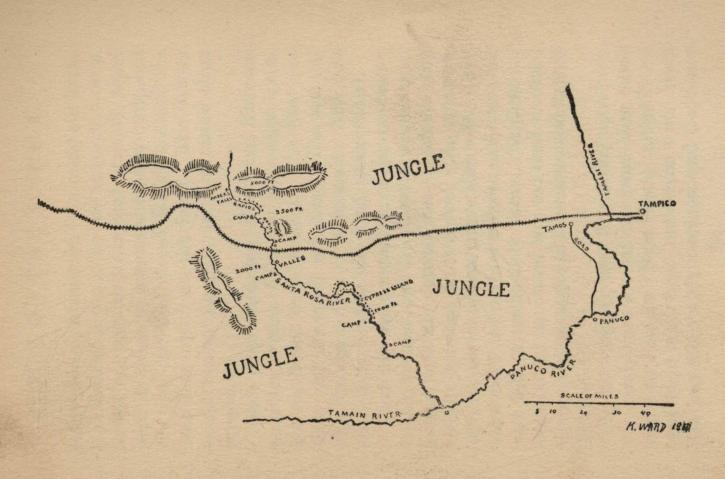
Ken Ward's Map
When he joined the others he found that Pepe had learned that the village of Panuco was distant a day or a night by canoe. How many miles or kilometers Pepe could not learn. Ken decided it would be best to go on at once. It was not easy to leave that pleasant place, with its music of parrots and other birds, and the tiger-cats that played like kittens, and the deer that ate from the hand. The women would accept no pay, so Ken made them presents.
Once more embarked, Ken found his mood reverting to that of the last forty-eight hours. He could not keep cheerful. The river was dirty and the smell sickening. The sun was like the open door of a furnace. And Ken soon discovered he was tired, utterly tired.
That day was a repetition of the one before, hotter, wearier, and the stretches of river were longer, and the natives met in canoes were stolidly ignorant of distance. The mourning of turtle-doves almost drove Ken wild. There were miles and miles of willows, and every tree was full of melancholy doves. At dusk the boys halted on a sand-bar, too tired to cook a dinner, and sprawled in the warm sand to sleep like logs.
In the morning they brightened up a little, for surely just around the bend they would come to Panuco. Pepe rowed faithfully on, and bend after bend lured Ken with deceit. He was filled with weariness and disgust, so tired he could hardly lift his hand, so sleepy he could scarcely keep his eyes open. He hated the wide, glassy stretches of river and the muddy banks and dusty cattle.
At noon they came unexpectedly upon a cluster of thatched huts, to find that they made up the village of Panuco. Ken was sick, for he had expected a little town where they could get some drinking-water and hire a launch to speed them down to Tampico. This appeared little more than the other places he had passed, and he climbed up the bank wearily, thinking of the long fifty miles still to go.
But Panuco was bigger and better than it looked from the river. The boys found a clean, comfortable inn, where they dined well, and learned to their joy that a coach left in an hour for Tamos to meet the five-o'clock train to Tampico.
They hired a mozo to row the boat to Tampico and, carrying the lighter things, boarded the coach, and, behind six mules, were soon bowling over a good level road.
It was here that the spirit of Ken's mood again changed, and somehow seemed subtly conveyed to the others. The gloom faded away as Ken had seen the mist-clouds dissolve in the morning sunlight. It was the end of another wild trip. Hal was ill, but a rest and proper care would soon bring him around. Ken had some trophies and pictures, but he also had memories. And he believed he had acquired an accurate knowledge of the jungle and its wild nature, and he had mapped the river from Micas Falls to Panuco.
"Well, it certainly did come to us, didn't it?" asked George, naïvely, for the hundredth time. "Didn't I tell you? By gosh, I can't remember what did come off. But we had a dandy time."
"Great!" replied Ken. "I had more than I wanted. I'll never spring another stunt like this one!"
Hal gazed smilingly at his brother.
"Bah! Ken Ward, bring on your next old trip!"
Which proved decidedly that Hal was getting better and that he alone understood his brother.
Pepe listened and rubbed his big hands, and there was a light in his dark eyes.
Ken laughed. It was good to feel happy just then; it was enough to feel safe and glad in the present, with responsibility removed, without a thought of the future.
Yet, when some miles across country he saw the little town of Tamos shining red-roofed against the sky, he came into his own again. The old calling, haunting love of wild places and wild nature returned, and with dreamy eyes he looked out. He saw the same beauty and life and wildness. Beyond the glimmering lagoons stretched the dim, dark jungle. A flock of flamingoes showed pink across the water. Ducks dotted the weedy marshes. And low down on the rosy horizon a long curved line of wild geese sailed into the sunset.
When the boys arrived at Tampico and George had secured comfortable lodgings for them, the first thing Ken did was to put Hal to bed. It required main strength to do this. Ken was not taking any chances with tropical fever, and he sent for a doctor.
It was not clear whether the faces Hal made were at the little dried-up doctor or at the medicine he administered. However, it was very clear that Hal made fun of him and grew bolder the more he believed the man could not understand English.
Ken liked the silent, kindly physician, and remonstrated with Hal, and often, just to keep Hal's mind occupied, he would talk of the university and baseball, topics that were absorbing to the boy.
And one day, as the doctor was leaving, he turned to Ken with a twinkle in his eyes and said in perfect English: "I won't need to come any more."
Hal's jaw began to drop.
"Your brother is all right," went on the doctor. "But he's a fresh kid, and he'll never make the Wayne Varsity--or a good explorer, either--till he gets over that freshness. I'm a Wayne man myself. Class of '82. Good day, boys."
Ken Ward was astounded. "By George! What do you think of that? He's a Wayne med. I'll have to look him up. And, Hal, he was just right about you."
Hal looked extremely crestfallen and remorseful.
"I'm always getting jars."
It took a whole day for him to recover his usual spirits.
Ken had promptly sent the specimens and his notes to his uncle, and as the days passed the boys began to look anxiously for some news. In ten days Hal was as well as ever, and then the boys had such sport with the tarpon and big sharks and alligator-gars that they almost forgot about the rewards they had striven so hard for and hoped to win. But finally, when the mail arrived from home, they were at once happy and fearful. George was with them that evening, and shared their excitement and suspense. Hal's letters were from his mother and his sister, and they were read first. Judge Ward's letter to Ken was fatherly and solicitous, but brief. He gave the boys six more weeks, cautioned them to be sensible and to profit by their opportunity, and he inclosed a bank-draft. Not a word about rewards!
Ken's fingers trembled a little as he tore open the uncle's letter. He read it aloud:
DEAR KEN,--Congratulations! You've done well. You win the trip to Africa. Hal's work also was good--several specimens accepted by the Smithsonian. I'll back you for the Yucatan trip. Will send letters to the American consul at Progreso, and arrange for you to meet the Austrian archæologist Maler, who I hope will take you in hand.
I want you to make a study of some of the ruins of Yucatan, which I believe are as wonderful as any in Egypt. I advise you to make this trip short and to the point, for there are indications of coming revolution throughout Mexico.
With best wishes,
UNCLE G.
The old varsity cheer rang out from Ken, and Hal began a war-dance. Then both boys pounced upon George, and for a few moments made life miserable for him.
"And I can't go with you!" he exclaimed, sorrowfully.
Both Ken and Hal shared his disappointment. But presently. George brightened up. The smile came back which he always wore when prophesying the uncertain adventures of the future.
"Well, anyway, I'll be safe home. And you fellows! You'll be getting yours when you're lost in the wilderness of Yucatan!"
THE END
* * * * * * * *
There's More to Follow!
More stories of the sort you like; more, probably, by the author of this one; more than 500 titles all told by writers of world-wide reputation, in the Authors' Alphabetical List which you will find on the reverse side of the wrapper of this book. Look it over before you lay it aside. There are books here you are sure to want--some, possibly, that you have always wanted.
It is a selected list; every book in it has achieved a certain measure of success.
The Grosset & Dunlap list is not only the greatest Index of Good Fiction available, it represents in addition a generally accepted Standard of Value. It will pay you to
Look on the Other Side of the Wrapper!
In case the wrapper is lost write to the publishers for a complete catalog.
* * * * * * * *
ZANE GREY'S NOVELS
May be had wherever books are sold. Ask for Grosset and Dunlap's list.
THE CALL OF THE CANYON WANDERER OF THE WASTELAND TO THE LAST MAN THE MYSTERIOUS RIDER THE MAN OF THE FOREST THE DESERT OF WHEAT THE U. P. TRAIL WILDFIRE THE BORDER LEGION THE RAINBOW TRAIL THE HERITAGE OF THE DESERT RIDERS OF THE PURPLE SAGE THE LIGHT OF WESTERN STARS THE LAST OF THE PLAINSMEN THE LONE STAR RANGER DESERT GOLD BETTY ZANE THE DAY OF THE BEAST
* * * * *
LAST OF THE GREAT SCOUTS
The life story of "Buffalo Bill" by his sister Helen Cody Wetmore, with Foreword and conclusion by Zane Grey.
ZANE GREY'S BOOKS FOR BOYS
KEN WARD IN THE JUNGLE THE YOUNG LION HUNTER THE YOUNG FORESTER THE YOUNG PITCHER THE SHORT STOP THE RED-HEADED OUTFIELD AND OTHER BASEBALL STORIES
* * * * *
NOVELS OF FRONTIER LIFE
WILLIAM MACLEOD RAINE
May be had wherever books are sold. Ask for Grosset & Dunlap's list
BIG-TOWN ROUND-UP, THE BRAND BLOTTERS BUCKY O'CONNOR CROOKED TRAILS AND STRAIGHT DAUGHTER OF THE DONS, A DESERT'S PRICE, THE FIGHTING EDGE, THE GUNSIGHT PASS HIGHGRADER, THE IRONHEART MAN FOUR-SQUARE, A MAN-SIZE MAVERICKS OH, YOU TEX! PIRATE OF PANAMA, THE RIDGWAY OF MONTANA SHERIFF'S SON, THE STEVE YEAGER TANGLED TRAILS TEXAS RANGER, A VISION SPLENDID, THE WYOMING YUKON TRAIL, THE
* * * * *
JAMES OLIVER CURWOOD'S
STORIES OF ADVENTURE
May be had wherever books are sold. Ask for Grosset & Dunlap's list
THE COUNTRY BEYOND THE FLAMING FOREST THE VALLEY OF SILENT MEN THE RIVER'S END THE GOLDEN SNARE NOMADS OF THE NORTH KAZAN BAREE, SON OF KAZAN THE COURAGE OF CAPTAIN PLUM THE DANGER TRAIL THE HUNTED WOMAN THE FLOWER OF THE NORTH THE GRIZZLY KING ISOBEL THE WOLF HUNTERS THE GOLD HUNTERS THE COURAGE OF MARGE O'DOONE BACK TO GOD'S COUNTRY
Ask for Complete free list of G. & D. Popular Copyrighted Fiction
* * * * *
EDGAR RICE BURROUGH'S NOVELS
May be had wherever books are sold. Ask for Grosset and Dunlap's list
BANDIT OF HELL'S BEND, THE CAVE GIRL, THE LAND THAT TIME FORGOT, THE TARZAN AND THE ANT MEN TARZAN AND THE GOLDEN LION TARZAN THE TERRIBLE TARZAN THE UNTAMED JUNGLE TALES OF TARZAN AT THE EARTH'S CORE THE MUCKER A PRINCESS OF MARS THE GODS OF MARS THE WARLORD OF MARS THUVIA, MAID OF MARS THE CHESSMEN OF MARS
GROSSET & DUNLAP, PUBLISHERS, NEW YORK