"A Story of the Early Days of Papal Rome"
Reading edition
Chapter One.
The Two Pontiffs.
The glorious sun rose in undimmed splendour on a morning in the early part of the fourth century over everlasting Rome, his rays glancing on countless temples, statues, columns, and towers, on long lines of aqueducts and other public edifices, and on the proud mansions of the patricians which covered the slopes and crowned the summits of her seven hills. The populace were already astir, bent on keeping holiday, for a grand festival was about to be held in honour of Jupiter Optimus Maximus and his two associate divinities Juno and Minerva. The flamens, with their assistants, and the vestal virgins, aided by many fair patrician matrons and maidens eager to show their piety and to gain the favour of the gods, had been labouring all night in decorating the temples; and already the porticoes and the interior columns appeared adorned with wreaths and festoons of green leaves and gay flowers; while wax tapers in silver candlesticks, on countless shrines, had been prepared for lighting at the appointed moment. At the entrance of each temple, either fixed in the wall or standing on a tripod, was an acquiminarium,—a basin of silver or gold, freshly filled to the brim with holy-water, with which salt had been united; a minor flamen in white robes, with brush in hand, standing ready to sprinkle any who might desire the purging process. Others of their fraternity were busy hanging up in the temples of Aesculapius votive offerings—in the shape of arms, legs, and other parts of the human body, representing the limbs of his worshippers, which by his powerful instrumentality had been restored to health. Bands of musicians with a variety of instruments, and dancers in scanty dresses, were moving about singing and playing, and exhibiting their terpsichorean performances before the temples and minor shrines erected at the corners of the principal highways. The fronts of the shrines were, like the temples, adorned with wreaths of flowers; while tapers, in horn lanterns, burned before them. Swarms also of mendicant priests, habited in coarse robes, with shaven crowns, and huge sacks at their backs, were parading the streets going from house to house begging for doles, and holding up small images of the gods to be adored by the ignorant populace; never failing to bestow their heaviest maledictions on those who refused them alms, cursing them as Christian atheists.
It was yet early when two persons, quitting the Curia Hostilia at the foot of the Coelian Hill, took their way past the magnificent Flavian Amphitheatre towards the Sacra Via. Their costume was alike, and consisted of a fine toga, with a deep purple border, and on the head an apex—a conical cap surmounted by a spike of olive-wood—which showed them to belong to the Holy College of the Pontiffs. The dress of the elder of the two had, in addition, stripes of purple, marking his superior rank. To prevent their togas from being soiled by the dust on the road, they had drawn them up under their right shoulders, so as to allow the skirts to hang gracefully over their left arms, exhibiting the richly-embroidered thongs which secured their sandals. They passed onward with a dignified and haughty air. Both were fine-looking men. The elder possessed a handsome countenance; his firm-set mouth, high brow, and keen piercing eyes, showed determination and acuteness of intellect, though at the same time the expression was rather repulsive than pleasing. His companion’s features were less handsome, and it might have been seen at a glance that he was fond of the good things of life.
They had nearly reached the colossal statue of Nero—now wearing the head of Apollo, placed on it by Vespasian instead of that of the tyrant—which towered almost as high as the lofty walls of the amphitheatre. After having hitherto kept silence, absorbed in his own thoughts, the elder pontiff addressed the younger.
“We shall triumph still, Gaius, though, by the Immortals, these Christians have made fearful progress of late. They swarm in this city, and even, as I hear, throughout every part of the world; for since the time when the Emperor Diocletian wisely resolved to put them down, by destroying the places where they met to worship, preventing their secret assemblies, and burning their books, they have once more risen in an audacious manner and walk about with all the airs of freedmen. I hope ere long to see the arena of the amphitheatre again filled with the atheists, struggling unarmed against the wild beasts let in on them, to tear them limb from limb. I well remember many such a scene. The populace delight in it even more than in the games of Carinus, the magnificent displays of the Naumachia, or even than in the combats of a thousand gladiators. The exhibition we have prepared for to-day will do much, I suspect, to win back the fickle multitude to the worship of the gods. The ignorant naturally delight in gorgeous shows and spectacles of all sorts, incapable as they are of comprehending the refinements of philosophy; and when they benefit by the flesh of the victims distributed among them, they will, depend on it, be strong advocates for the continuance of sacrifices to the gods.”
“I hope, Coecus, that we shall succeed, but in truth these Christians have hitherto shown a wonderful amount of obstinacy, not only in adhering to their mysteries, but in propagating them in all directions. I cannot understand their faith—without even a visible representation of a God before which to bow down, or a single object for the eye to fix on,” observed the younger pontiff. “I know, however, something about their belief; but even were I not a pontiff I should object to it. In addition to the hatred they display towards the ancient religion, they would deprive us poor mortals of all the pleasures of life. They rail against rich viands and generous wines; and, by Bacchus, were they to have their way, the gods and, what is of more consequence, we their priests, would no longer be supported, and these our magnificent temples would fall to decay. Still, I confess that, would they consent to worship publicly before the shrines of the gods, they might, as far as I am concerned, practise their rites in secret, and attend, as they are wont to do, to the sick and suffering. I have less hatred for them than contempt.”
“For my part, I hate them with an undying hatred, if it is of the accursed Nazarenes you speak, Gaius,” said Coecus, gnashing his teeth.
“You speak, Coecus, of these Nazarenes with less than your usual philosophical calmness,” observed the younger pontiff.
“I have cause to do so; one of the vile wretches dared to cross my path and rob me of a jewel I valued more than life itself,” exclaimed the elder pontiff, his eyes flashing and his lips quivering with rage. “While yet the hot blood of youth coursed through my veins, I met the beautiful Eugenia, daughter of the patrician Gentianus, at an exhibition of the Naumachia. To see her once was to love, to adore her: in grace and beauty she surpassed Venus herself; in majesty of form she was Juno’s rival; while on her brow sate the calm dignity of Minerva. I soon obtained an introduction to Gentianus; and though I found him somewhat reserved, I had reason to believe that he was not unfavourable to my suit. Eugenia, aware of the admiration she had excited, received me kindly, and I did everything I could think of to gain her good graces. Matters were progressing favourably, when I perceived a change in her and her father. I was admitted as before, but her manner became cold and distant, and Gentianus no longer looked on me with a favourable eye. I discovered, as I believed, the cause. A rival had appeared, Severus by name, a stranger in Rome; not in good looks, in figure, or manners to be compared to me. I watched Severus with a jealous eye, and employed spies to track his footsteps. I learnt that he attended the secret meetings of the Nazarenes. He had, in truth, a soft and silvery tongue, and by his art and eloquence had won over Eugenia and Gentianus to his accursed faith. Still, knowing that wealth is all-potent in Rome as elsewhere, I resolved to demand the hand of Eugenia of her father. He neither refused nor accepted my offer, but, instead, endeavoured to explain to me the doctrines of the new faith. Astonished, I bluntly asked whether he had himself adopted them, ‘I have,’ he replied, ‘and as a Christian I could not allow my daughter to wed an idolater!’—for so he dared to call me. I dissembled my anger while he continued speaking, decrying the immortal gods, and endeavouring to induce me to adopt the tenets of his religion. It may have been, at that time, that Severus was not, as I supposed, affianced to Eugenia; but ere long they were betrothed, and she ultimately became his wife. Still, I could not abandon all hope of winning her—a dagger might end her husband’s life—and while brooding over my disappointment, and seeking for some means of gratifying my love and revenge, the edict of Diocletian against the Christians was promulgated. Numbers of the fanatics were seized, and once more the Flavian Amphitheatre witnessed their tortures and death—some compelled to do battle with trained gladiators, others, naked and unarmed, to struggle with ferocious lions. The time for which I yearned had now arrived. I fully expected to get the hated Severus and his father-in-law, Gentianus, into my power, resolving not to rest till I had given the former over to the wild beasts, and compelled the old man to renounce his creed and consent to his daughter becoming my bride. Believing that their capture was certain, I set off with a band of faithful followers, and surrounded their house; but on breaking open the door, what was my rage to discover that my intended prey had fled! I sent emissaries, under various disguises, to every part of the city to search for them; I ascertained, however, that scarcely an hour before I visited their house, they had left it, and made their way out of the city towards the entrance of those numerous galleries hewn in the sand-rock far down beneath the surface of the earth. Not to be defeated, I ordered a trusty band to search for the fugitives in those subterranean regions, but having no wish to descend to Avernus before my time, I myself remained outside. My people were some time away; they came back at length, dragging four or five trembling wretches of the meaner sort, while their swords were dripping with the blood of several others they had slain. Whether or not the chief quarry had escaped, I was left in doubt, as they brought no token to prove who were those who had fallen, and they vowed that they would not return to run the risk of losing their way and perishing miserably amid the labyrinthine passages of that underground region. The shades of evening compelled me at last to return to the city with the wretched prisoners who had been captured, and I registered a vow at the shrine of Bellona that I would wreak my vengeance on the heads of Gentianus and Severus should I ever get them into my power. In vain, however, did I seek for Eugenia and her father: they had either made their escape from the neighbourhood of Rome or had carefully concealed themselves underground. I had good reason, however, ere long to know that the latter was the case. I have since in vain searched for them; concealed by their fellow-religionists, they have eluded my vigilance. That abominable edict which our politic emperor issued at Milan, allowing the Christians to enjoy their religion in peace, made me abandon all expectation of being able to wreak my vengeance on the head of Severus by open means, though I still cherished the hope that he would come forth from his hiding-place, when the assassin’s dagger would quickly have finished his career and given me my still-beloved Eugenia. Still, I have reason to believe that they are in existence, and that Gentianus, knowing that I am not likely to break my vow, is afraid to issue from his concealment; notwithstanding that on the revocation of the edicts by Maxentius the Nazarenes have generally ventured forth from their hiding-places. They have, indeed, since then, in vast numbers, appeared in public, openly declaring their creed, and diligently endeavouring to obtain proselytes from all classes,—thus daringly showing their hatred and contempt of the gods whose priests we are. It is high time, indeed, since the emperors no longer care to preserve the ancient faith, that we should be up and doing, and if we cannot employ open means, should by craft and subtlety put a stop to the pernicious system. What say you, Gaius?”
“I can fully enter into your feelings,” observed Gaius. “I myself have been crossed more than once by these Nazarenes; although, were it not that our order is in some peril, I confess that I have felt no great antipathy to them. Indeed, some years ago, my only sister Livia became indoctrinated with their opinions, and married one of them. He was seized, and died, with many hundreds more, in yonder arena but she escaped, and disappeared for some years from sight. I again at length met her, reduced to great distress, supported, I believe, by her co-religionists; but so poverty-stricken were they that they could afford her but the common necessaries of life. She was a sweet and gentle creature and, though I condemned her heresy, I had not the heart to leave her to perish. You will say, Coecus, that I should have been more stoical, but I had a motive which will excuse me in your sight. She had an only child, a handsome boy, the young Jovinian, who reminded me of her in the days of her youth and beauty. Once, too. I should have said, she tended me when I was sick, and might have died, in spite of all the offerings my friends made to Aesculapius, and the skill of the physicians who attended me, had it not been for her watchful care. Gratitude induced me to visit her; I procured the best assistance medical skill could afford; but whether it was counteracted by the visits of her Nazarene friends I know not,—so the gods willed it, she gradually sank. Her only thoughts seemed to be about the welfare of her boy, and in spite of all the offers I made to give him a college education befitting his patrician rank—for his father was of our order as well as his mother—and to watch over his advancement in life, she would not yield him to me, but preferred rather to confide him to the care of a miserable poverty-stricken relative, who was the means originally of her perversion from the ancient faith. Visiting her one day, I found her boy with her. She was evidently much worse. In vain I endeavoured to console her: she breathed her last shortly afterwards. It was truly piteous to hear the child calling on her to speak to him. At length, discovering the truth, he sank fainting over her inanimate body. I took him in my arms, and, in spite of his struggles, bore him away, intending to send the Libertinarii to arrange for poor Livia’s funeral. Wrapping him in a lacerna, and shrouding his head in the hood to stifle his cries, I committed him to the slaves in attendance outside, who carried him off to our college, where he could be well looked after. As they bore him along the narrow streets several persons, who were, I suspect, Nazarenes, looked out from the overhanging balconies to watch us. My object was to prevent my relative Amulius from discovering what had become of the boy. I had little doubt that I should soon reconcile him to the change, and teach him to worship the gods of his fathers. I have had, I must own, more difficulty than I had expected. He was continually talking of his mother, but not with the sorrow I should have anticipated, as he seemed satisfied that she was in the realms of bliss—a glorious place in which she had taught him to believe,—while he offered petitions to some unknown being to help and support him, and to keep him faithful to the creed with which she had indoctrinated his young mind. It seemed surprising that at so early an age he should be so determined in his belief. He, indeed, as I understood him, prayed continually to an Almighty God, to whom he could approach boldly by the intercession of One he called Jesus, without the intervention of demigod or priests. I gained more knowledge of the extraordinary faith of the Nazarenes from the young boy than I had hitherto possessed. It seems wonderfully simple. They believe that one Almighty God rules the universe; that man was placed on the earth free to accept or reject this mighty God, but bound to obedience; that being disobedient, he and all his descendants have become prone to sin, but yet this Almighty Being, loving men, sent One, a portion of Himself, down on earth, born of a woman; who, offering Himself as a sacrifice for their sins, was put to death on the accursed Cross, thus satisfying the Almighty’s justice, the guiltless One being punished instead of the guilty. Thus all who believe on Him are considered free from sin and reconciled to the great Being whom, by their sins, they have offended. Can you understand this doctrine, Coecus?”
“Not in the slightest degree,” answered the pontiff, who had been paying but little attention to what his companion was saying, his mind being engaged on projects for the maintenance of his order, which he had good reason to fear was in danger. “It is to me incomprehensible.”
“So, by Bacchus, it is to me, though I understand with tolerable clearness the principles of the system,” observed Gaius. “What I greatly object to in it is, that these Nazarenes seem to require no priests nor sacrifices, and worship without any forms or ceremonies, as they declare that this Jesus is their sole priest, and that He is at the right hand of their great God, pleading His own sacrifice, whereby all their sins were purged away. I have done my utmost, I should say, as in duty bound, to drive such notions out of the mind of my nephew. I forgot to mention that after I had made such arrangements for the funeral of my sister as became her rank, when the Libertinarii arrived with the slaves to wash and anoint the body, to place a coin on its mouth to pay the ferryman in Hades, and to plant a branch of cypress at the door of the house in which she died, it was found that the Nazarenes had removed it, in order to inter it according to their own rites, some way without the city, instead of allowing it to be carried, as I should have wished, on a handsome praetrum, followed by mourners and bands of music, to the bustum, there to be consumed on the funeral pyre.”
“It matters little what became of the poor dame; she must have been a weak creature,” observed Coecus, in a supercilious tone, re-arranging the folds of his toga and walking on.
Chapter Two.
Rome in the Fourth Century.
The two pontiffs had proceeded some way, when Coecus stopped. “What have you done, Gaius, with this young nephew of yours?” he asked. “Have you managed by this time to teach him the worship of the gods?”
“As to my success, I can say but little,” answered Gaius. “A strict watch is, however, kept over him; for I believe that he would escape from me even now, could he obtain the opportunity. I have an affection for him, and hope in time, as he grows older and gains more intelligence, to make him see the folly of the faith his mother adopted, and to induct him into our mysteries. I have already endeavoured to make him understand that he need not believe in the gods more than we do, or in the tricks of the augurs, of whom Cicero wittily observes, ‘It is a wonder they can ever look each other in the face without laughing.’”
“If you care for his welfare you will follow the plan you have adopted, and we may have the lad elected some day as a member of our college,” said Coecus. “We must be very careful of our interests, and I doubt not that if we are wise we shall still retain the management of the sacred affairs of the city, and may even extend our influence over the whole country, whatever changes time may bring about. For my part, I have confidence that our system will endure, and that we shall still retain the power we have hitherto enjoyed.”
“May the gods favour us!” answered Gaius. “Happily, the people are easily deceived and led, though the patricians may give us some trouble.”
“We can manage them by showing that it is to their interest to support us,” observed Coecus: “I have not studied human nature without discovering the follies and absurdities to which the minds of men, no matter their rank, are ready to submit. Think what a vast amount of intellect and skill, aided by the labours of the abject toilers for their daily bread, has been employed in erecting these superb temples and magnificent statues of the gods; and yet we despise both one and the other, except for their external beauty, which we can appreciate even better than they do.”
The pontiff, as he spoke, stretched his right hand over the scene of architectural magnificence which, as he and his companion looked westward, was displayed to their eyes. They had just passed through the arch of Titus, on the top of the Summa Sacra Via, when the Capitol, with all its glories, suddenly burst on their view. On the summit of the hill was seen the vast and magnificent temple of Jupiter Optimus Maximus, with those of Juno and Minerva on either side, its roof of gilded tiles vying in splendour with the eastern sun now shining on it, and deriving additional lustre from the background of that deep blue Italian sky against which its outlines were sharply defined. A complete forest of high pillars, perfect examples of the art of the greatest sculptors of Greece, supported the lofty roof. The pediment and acroterium were adorned with statues—scarcely, however, to be distinguished at that distance. Near the temple stood a colossal statue of Jupiter, the majestic features of the face, turned towards them, being clearly discerned. Not far off was another gigantic statue of Apollo; while around the principal temple were clustered others of lesser size, as if to do it homage, the intervals and the space in front being adorned with statues, which appeared at that distance like living men and women. A depression of short extent separated the Capitol from another abrupt elevation, on the summit of which stood the citadel, or acropolis, crowned by the magnificent temple of Juno Moneta, also surrounded by similar temples,—the elegant one of Jupiter Tonans, another, that of Fortuna, and the temple of Honour et Virtus. On each side the ground was covered, almost to the verge of the Forum, with thickly-clustered dwellings, but of no great height, so that the view from the sumptuous mansions on the Palatine of the sacred and triumphal processions which passed that way should not be obstructed. Close to them was the dwelling of the Rex Sacrificulus, while on the left appeared the temples of Vesta and of Castor, behind which ran the Nova Via, directly at the base of the Palatine. Descending a steep declivity, beneath the arch of Fornix Fabian us, on the left, stood the Regia, or house of the Pontifex Maximus, and at the corner of the Forum beyond it rose the superb temples of Antoninus and Faustina, and that of Divus Julius, as the first Caesar was called when he took rank among the gods. The temple stood on the spot where his body had been consumed at his apotheosis. The Forum, which they had now reached, was surrounded by magnificent buildings, many others crowning the neighbouring hills to a hundred feet in height, giving it an air of extraordinary grandeur. On looking eastward, on the crest of the Aria Capitolina was seen, lined by a double row of porticoes one above the other, the Tabularium of Catullus. Below it, to the north, stood the Temple of Concord, and on a lower level, nearer the Forum, rose the temple of Saturn, its pediment surmounted with figures of Tritons blowing horns. In front of it was the Milliarium Aureum, or gilded milestone, set up by Augustus as a standard for distances within the walls. Behind it lay another small temple—that of Ops; and visible from the Forum, on the eastern face of the hill, was the ill-famed Tarpeian Rock, whence criminals condemned to death were wont to be precipitated. At the upper end of the Forum, under the Capitoline Hill, was the Comitium, adorned with fresco paintings, and covered with numerous statues surrounding the tribunals of the Praetor Urbanus. Here also was the sacred fig-tree, the Ficus Ruminalis, under which Romulus and Remus were nursed by the wolf, so the populace believed. On the south-western extremity of the Forum was the Basilica Julia, and not far off the still more magnificent temple of Castor, from its position on a lofty terrace visible on all sides. Farther on, at no great distance from the arch of Severus, in front of the Curia, was another celebrated temple, the last we shall mention, of bronze—that of Janus Bifrons, the two-faced deity, the index of peace or war. Many more buildings surrounding the Forum might be mentioned,—the Aedes Vesta, encircled by a grove, near the temple of Castor, and the column of Phocas,—while to the north was the Forum Augusti, with its Curia. A fine road between the Capitoline and Quirinal Hills led into the Campus Martius, through the splendid Forum of Trajan. Numerous other temples of equal grandeur were visible, the porticoes, or chief entrances, looking, whenever possible, westward, which side was at the same time faced by the divinity within, so that persons offering prayers or sacrifices at the altar looked towards the east; the eastward position being considered of the greatest importance by the superstitious idolaters of old. The custom, originating among the worshippers of the Sun, who were wont to watch for the appearance of their divinity above the horizon, had been generally imitated by the heathen world, though the source whence it had been derived was forgotten. When it was impracticable to build a temple in the favourite position, it was placed, like that of Jupiter Maximus, in such a manner that the greater portion of the city could be seen from it; and when erected by the side of a street or road, it was always so situated that the passers-by might look in to salute the divinity, to obtain a sprinkling of holy-water, and to leave their votive offerings in the eager hands of the watchful flamens.
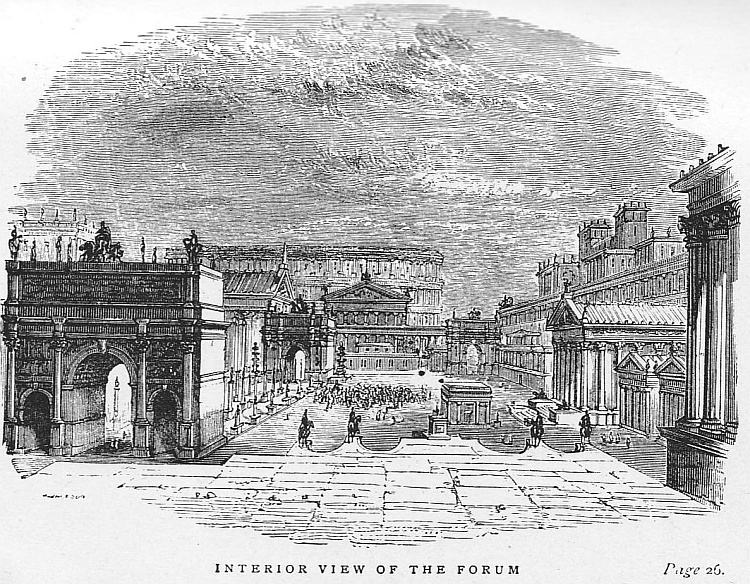
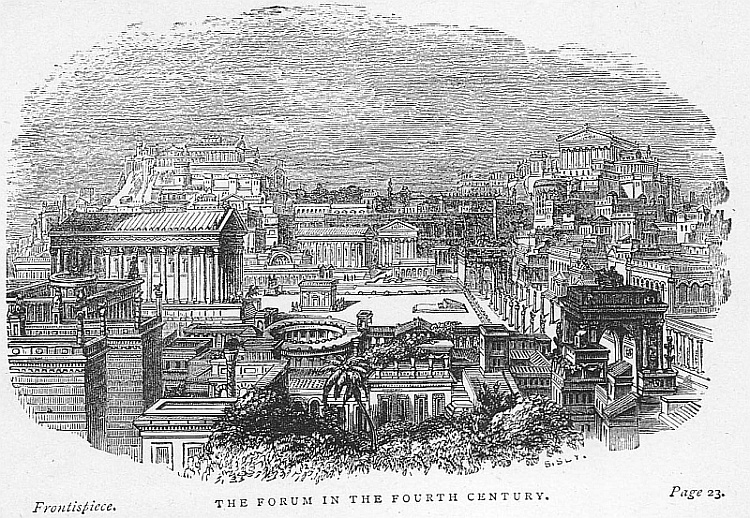
The two pontiffs, little regarding the magnificent scene which has been described, hurried into the Regia, or house of the Pontifex Maximus—for though the office had long been held solely by the emperors, the building was inhabited by the chief pontiff and several of his principal coadjutors. It stood hard by the house of the vestal virgins, who were especially committed to the care of the pontiffs. They had, indeed, the lives and liberties of the fair damsels under their complete control, and could, should a vestal be found guilty of breaking her vows, punish her with imprisonment, or put her to death by entombing her while still alive. Entering by the ostium, the two pontiffs passed onwards through the several courts known as the atrium and the cavum coedium into the tablinum, where, having thrown themselves upon couches surrounding the central table, ready slaves removed their sandals and head-gear, while others brought water to wash their hands and feet. A third party meantime spread the table for the prandium with various dishes, hot as well as cold, fish, eggs, and refreshing beverages, light wines, and the seductive calda. The pontiffs took good care, whatever the outside world might say about the matter, to live well on “what the gods provided.”
“We have had a fatiguing walk, and require something to restore our exhausted strength, while a hard day’s work is before us; but I have never prepared with greater zest to engage in a spectacle such as is about to take place, convinced as I am that it will repay us for all our trouble,” remarked Coecus.
They were soon joined by several other pontiffs, who came to hear the result of their visit to the Curia Hostilia, and to make final arrangements concerning the order of the procession.
Chapter Three.
The Catacombs.
At the time that the two pontiffs were leaving the Curia Hostilia, a female slave was making her way along the Appian Road, about two miles from her home. She wore over her usual dark dress a coarse laena, which served to conceal a basket filled with provisions which she carried on her arm. Turning off to the left, she followed a slightly beaten track, scarcely perceptible to the ordinary eye. After pursuing it for some distance, she again crossed a track of wild and barren ground till she reached a hollow or basin of some extent. Stopping at the edge, she looked carefully around, and then rapidly descending the slope, was completely hidden from the view of any one who might be passing in the distance. Reaching the bottom of the basin, which had the appearance of a huge sand-pit long since disused, she directed her course towards what was seemingly a heap of large stones piled up against the side. Stooping down, however, she discovered a space large enough to admit her, and, by bending her head, she passed through it, when she was once more able to stand erect. Stopping an instant, she produced from beneath her cloak a lantern, and, quickly lighting it, proceeded without hesitation along a passage hewn in the sandstone rock, about ten feet in height and five or six in width. Casting the light before her as she went on, she carefully noted the passages which branched off on either hand. Into one of these, after proceeding for five or six hundred yards, she entered, after minutely examining a mark on the wall—a sign to her that it was the one she sought. Still on she went, not a sound reaching her ear, till she reached what appeared to be a heap of rubbish piled up before her. Throwing the light of the lantern on one side of it, she discovered an opening similar to the one through which she had entered the subterranean labyrinth. As she advanced, the light of her lamp glancing on the walls revealed numerous slabs let into them, on which various inscriptions, with significant symbols, were rudely carved, marking them as the tombs of those who had departed in the faith of Jesus, to sleep in peace till summoned by the last trump to meet their risen Lord. Here the crown and palm-branch marked the resting-places of those who had been faithful unto death, triumphing over sin, the world, and the devil; farther on was an anchor, typifying the Christian’s hope, sure and steadfast; here a ship entering harbour, to signify an entrance into the everlasting kingdom; there a dove, and an olive-branch, the everlasting peace enjoyed by those who slept within. Still more numerous were the simple and short epitaphs, some with merely the words, “In Christ;” others, “He sleeps in peace.” On some were rude emblems denoting the trade or name of those buried within; on others were figures of men or women standing with outstretched hands and open palms—the universal posture of prayer.
But the eye of the slave paused not to rest on any of these objects, though she did not fail to notice them as she moved along. Stopping again to trim her lamp, she listened for a moment, but her ear was unable to catch the slightest sound. She then proceeded more cautiously than before, till she reached the top of a flight of steps, down which she descended into another passage, which extended to a distance far greater than the rays from her lantern could penetrate. Counting her steps, she stopped at a spot where was a large slab of stone, on which certain figures were carved, understood only by the initiated, scarcely to be distinguished from the wall of the gallery, and which appeared to be let into it. She touched it on one side, when it opened, and she proceeded as before. Here and there a faint ray of light came down from above, the aperture through which it had passed serving to ventilate the gallery, the atmosphere of which would otherwise have been insupportable. Advancing some way farther, she again stopped and listened, when human voices united in melodious song reached her ear. She now hurried on with more confidence than before. She could distinguish the words: they were those of a hymn such as Christians alone, imbued with the true light of the Gospel, could have uttered.
The countenance of the girl, hitherto grave and anxious, beamed with a calm joy as she drank in the words. Moving forward for some fifty yards or more, she stood in front of a deep recess, considerably higher, and several times wider, than the passage which had conducted her to it. It resembled, indeed, a deep archway supported by simple columns, but was otherwise totally unadorned. On either side, on rough benches, were seated about twenty persons, who, as shown by their costumes, were of varied ranks, from the patrician in his toga and the high-born lady with fringed dress to the humble fossor or excavator. They varied also in age: some were far advanced in life, others were grave men and matrons, and among them was a young girl scarcely past her days of childhood. At the further end of the chamber, near a small table, sat a man of venerable aspect, clothed as a patrician, with a white beard hanging over his breast. A scroll was in his hand, from which, by the light of a lamp standing on the table, he was reading aloud.
Rolling up the scroll, he rose and addressed the assembly. The slave, advancing slowly, and placing her basket on the ground, took her seat at the outer end of one of the benches. He had already made some remarks, when he continued—“Ye have not so learnt Christ. He, our risen Lord, is our one Mediator between God and man. He has assured us that we require no other intercessor, but if we trust in His perfect sacrifice He will take us by the hand and present us, clothed in his pure and spotless robes, to the All-pure and All-holy One. He, the God of love and mercy, requires no penances, no lacerations of the body, no abstinence from lawful pursuits, no works of any sort to fit us for approaching Him. All, all he demands is faith in our risen Lord, His dear Son, whom He gave, and who willingly came, urged by love unspeakable to fallen man, to die, instead of the sinner returning to Him. He requires no human soul departing from the body to pass through purifying fires, as the foolish heathen believe, to fit that soul to come to Him; the blood of Jesus Christ alone cleanseth from all sin—that fountain which gushed forth on Calvary is flowing still, as efficacious as ever—that one sacrifice superseded all other sacrifices. No other is acceptable to Jehovah. Oh, the love, the love of Jesus!—that love surpassing all human understanding, unequalled by the love of created beings, of the angels in heaven for sinful man: that sympathy exhibited at the grave of Lazarus, that love shown at the time the Lord wept as he thought on the woes coming upon Jerusalem,—that love, that sympathy, exists bright and undiminished as ever, and will exist through all eternity, for surely it is part and parcel of the Divine Nature, an attribute of the Almighty. That ear, ever open to the petitions of those who came to Him when He walked on earth, does that become dull or hard of hearing? No, surely no! He is as ready as ever to hear all who come to Him desiring to be cleansed of sin. Does He, who while on earth knew what was in the heart of man, not see now into the inmost recesses of the soul? Can he who has numbered every hair of our heads, without whose knowledge not a sparrow falls to the ground, no longer watch over those who trust to Him? Can He who went about doing good—curing the sick, restoring the lunatics to reason, giving sight to the blind, feeding the multitudes—who blessed the marriage feast at Cana of Galilee, who mixed freely in all social intercourse with his fellow-men—can He, I ask, take pleasure in seeing men and women exclude themselves from their fellow-beings, emaciate and weaken the body and mind by fastings, vigils, flagellations, such as are practised by idolaters? Oh no! our King demands a willing joyous, active service from His subjects. He would have them look to Him as their example, strengthening the mind and body, that they may the better go about and do good, as He did to their fellow-men!
“I speak of these things, beloved brethren and sisters, because I see evil times coming on the assemblies of Christ’s followers. Already many, departing from the true faith as taught by the apostles, believe in foolish fables devised by Satan, to mislead, if possible, the very elect; offering prayers to other mediators, men and women like themselves—to those who, though martyrs, required as much as we all do the cleansing blood of Jesus to purify them from sin: even to Mary of Nazareth, the honoured mother of the Lord, do they pray—to her whom He committed to the care and keeping of the beloved disciple, knowing that she required the support of a fellow-creature. And—oh, miserable folly!—some are even placing value on dead men’s bones; as if, when the soul has departed, those remnants of humanity are aught else but the dust from whence they were taken. As senseless are they as the idolaters who fall down before the images of the false gods. I warn you, beloved ones, brethren and sisters in the faith, pray for grace to be guided and directed aright, that you may keep free from the erroneous practices, the idolatries, into which so many, naming the name of Christ, are daily falling. Already the enemies of the truth, the emissaries of Satan, are up and doing; and as Christians depart from the simplicity of the Gospel as it is in Christ Jesus, so does the great opponent of the Gospel gain an influence over them, and lead them away captive at his will.
“I beseech you, then, be warned; seek for grace to hold fast the faith, ever looking to Jesus, its Author and Finisher, for guidance and support, imitating closely His walk on earth; be armed with the shield of truth, the breastplate of faith, and the helmet of salvation!”
The venerable speaker sat down, and another rose—a person of middle age, and grave, dignified demeanour—apparently, from the tone of authority with which he spoke, an elder of the assembly. His address was also one of warning: he pointed out the danger to which Christians were exposed, now that they were no longer persecuted by the rulers of the earth, from the false teaching of the philosophers, who had embraced some of the tenets of their faith, as well as from others, who, not going to the fountain-head—to Moses and the prophets, to the Gospels and Epistles—brought forward notions and ideas of their own. Especially, too, he warned them against the danger to which the assemblies were exposed from the wealth now flowing freely into the hands of those in authority, intended for the widows and orphans, and the support of hospitals for the sick, but which, as he pointed out, had in too many other places been diverted from its proper object, and expended in enabling the bishops to appear with the pomp and show of worldly rulers. “Let us,” he concluded, “pray that the Holy Spirit may give us grace that we may continue to worship the Father, through the mediation of our Blessed Lord and Master, according to the example set us by the apostles, and in withstand the numerous heresies which are making inroads among the assemblies of Christians.”
Again all rose, and, led by their venerable president, lifted up their voices in prayer. Another hymn was sung, and the president then taking a loaf of bread, wrapped in a cloth, broke it, and poured out some wine from an amphora into a cup. After reading from the Gospel the institution of the Lord’s Supper, he distributed the bread and wine to each individual of the assembly, simply saying, “As Christ’s body was broken for us on the accursed tree, and as His blood was shed for us, so do we eat this broken bread and drink this wine in remembrance that he died for our sins, offering thereby a full and sufficient propitiation, and that He rose again, and ascended into heaven, to take His seat at the right hand of God, and there to plead His death for the remission of the sins of all who believe in Him.”
The young slave, who had partaken with the rest of the bread and wine, now rose, and presented her basket of provisions, as sent by the presbyter Amulius and the assembly in his house, to their beloved brethren and sisters, Gentianus, Severus, Eugenia, and the rest.
“Say that Gentianus and his child return their heartfelt thanks,” replied the aged president. “Do you, Severus, distribute the food to our brethren,” he added, turning to the presbyter, who advanced to take it; and, aided by the female slave and another person, he gave a portion of the contents to each of the company. There was an ample supply, both of food and wine, for all present, and still the basket was not half emptied. Before any one commenced eating the president uttered a short prayer, that their Heavenly Father would bless the food to the strengthening of their bodies and the support of their spiritual life. It was then eaten with thankfulness, while a cheerful conversation was carried on among all present. Gentianus then beckoned to the slave.
“What news do you bring from the city, Rufina? Has Amulius sent any message by you?” he asked.
“Alas! my lord Gentianus, although Augustus supports the Christians in the East, the heathens in Rome still struggle desperately to maintain their supremacy,” replied the slave. “They dare not openly oppress believers, but by every secret means they endeavour to overthrow the faith; and knowing that Coecus still seeks your life and that of my lord Severus, Amulius advises you to remain in concealment till happier times arrive. That will be, he hopes, ere long; for already the emperor—though, alas, himself ignorant of the truth—professes to have become a Christian, and has raised Christians to posts of power and dignity in the state and in his army; many heathen temples, where abominable rites were wont to be practised, have by his orders been closed; and information has been received that he purposes to interfere with those in Rome, to prohibit the practice of magic arts, the impostures of the augurs, and to place the Christians on an equal footing with the idolaters.”
This announcement, which would, it might have been supposed, have produced unmitigated satisfaction among the assembly, was listened to by Gentianus with the gravity he had before maintained. “Timeo Danaos et dona ferentes—I fear the Greeks even when bringing gifts. The man who through jealousy put to death his eldest son, who has murdered without compunction his nephews and other relatives, can have none of the spirit of Christ, and any support he affords the Christians must be given from political motives,” he observed. “Let us not be deceived by them, my beloved brethren; outward prosperity and the patronage of the great ones of the earth are far more fraught with danger to the true faith than were the persecutions we have gone through; already have many been seduced from the truth by the allurements of wealth and the desire to obtain worldly dignities and power. And now, Rufina,” he continued, after speaking for some time on the same subject, “what account do you bring us of the young Jovinian? Has he succeeded in escaping from the power of his uncle, the pontiff Gaius?”
“No; he is still held captive, and strictly watched,” answered Rufina. “I have in vain endeavoured to communicate with him through the Numidian who has him in charge. His faith must be put to a sore trial, but the presbyter Amulius believes that he has been too well instructed in the truth to depart from it.”
“Let us pray that grace may be given him to hold firmly to the faith,” said Gentianus. “I feel a deep interest in the youth, for his sainted mother was brought out of darkness into the blessed light of the Gospel by my instructions, and I know how earnestly she prayed that her only child should remain faithful, even though martyrdom might be the consequence. Could Jovinian escape from his guardians, he might here remain concealed, and be further established in the faith, till Gaius has abandoned all search for him, or an opportunity offers of flying with you, Severus and Eugenia, to some place where you may be safe from pursuit.”
“I would, as a sacred duty, take charge of the orphan boy, and instruct him in the truth, so that he may be qualified to perform his duty in spreading the Gospel,” said Severus.
“And I will let him share a mother’s love with our young Julia,” said Eugenia.
“Tell Amulius what you have heard, Rufina,” said Gentianus; “and now return to the city, thank those who have provided for our necessities, and bring us, we pray thee, intelligence of anything important Amulius deems it necessary to send.”
The assembly now broke up. Rufina returned by the way she had come, accompanied by several persons who had visited the abode of Gentianus for the purpose of joining in the religious meeting, but who lived above ground in the neighbourhood of Rome. Some regained the upper world by different outlets; besides Gentianus and his household, a few only, who for some cause had reason to dread the hostility of the idolaters still, remaining in those subterranean passages. Here, in chambers excavated in the soft rock, they had their dwellings, which they quitted only at night to enjoy the fresh air, when trusty persons were placed on the watch to give notice of the approach of any who might betray them. Many of the fossors or excavators had from the early days of Christianity been converted, and had thus been able to act as guides to the fugitives from persecution, and to hollow out chambers in the remoter parts of the galleries where they could live without being discovered, unless, as was sometimes the case, they were betrayed by the treachery of pretended Christians.
Chapter Four.
The Procession.
The sun had scarcely risen half-way to the meridian when the head of the sacrificial procession streamed forth from the Temple of Peace, in the wide forum belonging to which its component parts had been collected and arranged. Preceded by banners came the pontiffs of the sacred college, walking under silken canopies to shield their persons from the sun’s burning rays. They were followed by the augurs in saffron and purple togas, wearing on their heads the conical caps with spikes of olive-wood, and carrying the litui—long staffs with golden crooks at the ends (Note 1). Then came the tubicini, or trumpeters, sounding loudly on their curved instruments of bronze with shrill notes, and the tubas, straight silver trumpets, hollowing them, with various ensigns and insignia, emerged the chief flamens, wearing the laena and apex, with wreaths of laurel. Now, after a profusion of banners, appeared a chariot drawn by four white steeds, richly adorned with wreaths, bearing along a magnificent statue of Jupiter Tonans (Note 2), with thunderbolts in hand, followed by superb statues, larger than life, of Mars, Apollo, Juno, Venus, and Minerva—the goddesses habited in robes either supplied by pious matrons or from the properties of the temples. The car of Juno, adorned with peacocks’ feathers (Note 3), that of the Cytherean Venus, with apple in hand, was drawn along, her car bearing imitations of swans and doves, and ornamented with wreaths of myrtle and roses. The car of Minerva followed, the goddess represented by a gigantic statue, a sphinx in the middle of the helmet, supported on either side by griffins, while standing on her car were huge dragons, cocks, and owls, with branches of the olive-tree arranged upon it. All these cars were drawn, not by horses, but by young patricians, who eagerly sought the opportunity to perform so grateful a service to the deities they worshipped. In a long line came other gods and goddesses, not seated in cars, but placed on high platforms, carried by men, some appearing singly and others in groups, representing the various actions for which they were renowned. Between each god or goddess walked youths, swinging censers, emitting as they moved them to and fro sweet odours grateful to their divinities. The bearers of the almost countless images were, like those who drew the chariots, mostly patricians, or young men of wealth of plebeian family, who thus sought an easy mode of exhibiting their piety.
Now came, preceded by lictors with their fasces, the vestal virgins, seated in silver chariots drawn by milk-white steeds, followed closely by another band of flamens, leading a long line of hostia (oxen to be sacrificed), their horns richly gilded, their heads adorned with wreaths, each animal led by a victimarius. So numerous were they, that it appeared as if the line would never end; for Coecus had arranged to offer up a whole hecatomb of victims.
Following the hostia came another band of trumpeters with numerous banners, the ornaments at their summits glittering in the sun; with a band of inferior priests, minor flamens, popos (Note 4), and other attendants at the temples, chanting loudly in honour of their gods; while next came large parties of citizens in festive dresses, eager to show their affection for the long-established religion of their ancestors; the whole followed by a body of troops, with their standards unfurled, and other insignia held aloft. The procession, as seen from a distance, had indeed the appearance of some enormous serpent with shining scales, as, emerging from the precincts of the temple, it wound its way along through the narrow streets, past the temples of Venus and Rome, under the colossal statue of Nero, on the outside of which scaffolding had been erected, affording accommodation to thousands of spectators; then turning westward, under the arch of Titus, and between the numerous temples which lined that portion of the Sacra Via, through the Forum Romanum, under the arch of Severus; when, gaining the Capitol, it proceeded direct towards the temple of Jupiter Optimus. Here the head of the vast column, the pontiffs, the flamens, and the augurs, as they arrived, gathered in due order under the porch,—the various statues of the gods being ranged on either side, the vestal virgins taking the post of honour awarded to them, while the people arranged themselves so as to leave an open space round the numerous altars, which stood prepared for the sacrifice of the victims. The animals, as they came up held by the victimarii, were arranged in front of the altars; when the flamens, having strewed their heads with roasted barley-meal, the popos, stripped and girt ready, advanced with huge hammers in their belts; then, at a signal from the chief pontiff, the fires were lighted, and each of the performers having been previously sprinkled with holy-water, the popos, holding up the heads of the animals, gave the fatal blow which brought them to the ground; when, the deadly knives being plunged into the victims’ hearts, they were rapidly and skilfully dismembered. The augurs, with due care, examined the intestines, which, being placed on the altars, were now strewed with barley-meal; and as the fires blazed up, wine was poured forth, and incense thrown upon them; the trumpets the meantime sounding, and the choristers loudly singing hymns in praise of Jupiter and the immortal gods. As the incense rose in thick clouds towards the sky from the multitudes of altars, the pontiff delivered a stirring oration to the people in praise of the gods, exhorting them to continue firm to their worship. As the pontiff ceased, the whole temple became filled with the sweet-scented smoke of the incense, the drums sounded out their loudest notes, and as the people shouted forth their vows to adhere to the ancient faith under which Rome had become great and powerful, many declared that the gods were seen to smile in approval of their piety.
When the procession first emerged from the temple, close to where Gaius walked was seen a powerful Numidian slave, holding by the hand a young and handsome boy. Every now and then Gaius glanced at the latter, apparently to observe what so imposing a scene was producing on his mind. The boy appeared to pay but little attention to the pageant; but though he did not struggle, he walked as one who felt himself a captive, and his eye ranged eagerly over the countenances of the spectators, especially on those who stood far back in the crowd, as if he were searching for some one with whom he desired to speak. He made but short replies to the slave, who seemed to take pleasure in telling him the names of the temples, and describing the attributes of those gods to whom they were dedicated. At length, when the temple of Jupiter, on the Capitoline Hill, was reached, and Gaius stood, with others of the pontiffs, on the steps, the Numidian led the boy to a position behind his master, where he could see all that was going forward. The victims had been slain, and their entrails were still burning, when, at a sign from Gaius, the Numidian brought forward the lad.
“This must have been an interesting sight for you, my dear Jovinian,” said Gaius to his nephew; “let me see that you appreciate it. Come, you shall have the privilege of taking part in the sacrifice. A flamen will give you some incense: cast it on the altar; the act is a simple one, and will prove a grateful offering to the Immortals.”
“I would obey you, uncle, in all the things of life,” answered Jovinian firmly; “but understand that the God we Christians adore is a spirit, and desires to be worshipped from the heart in spirit and in truth, and that the offering of incense, even to Him, is offensive as it is vain; much more so is it when burnt in honour of those who are no gods, but the foolish imaginings of ignorant men; and I will not do what is displeasing to Him, and would bitterly grieve the heart of my beloved mother, could she see me.”
“Boy! boy! how dare you use language such as this to me, a Roman pontiff!” exclaimed Gaius, becoming angry; then, after a moment, resuming his calm demeanour, he continued, “What folly is this, that you should object to so trifling an act as that I wish you to perform!”
“No act, however trifling, if offensive to the true God, can be performed without sin,” answered Jovinian. “I am told that thousands submitted to be torn to pieces, or crucified, or to be slain by gladiators, in yonder Flavian amphitheatre, rather than act as you would have me do.”
“Remember, Jovinian, that I have the power to compel you to do as I desire,” said Gaius; “it is not for my own pleasure, but to satisfy the scruples of my principal, and to prove that you are a true child of ancient Rome.”
“Uncle, I will not do this sinful thing,” answered the boy, in a tone of determination in which Gaius had never before heard him speak. “You may order the Numidian to flog me, you may refuse me food, or have me put to death with any tortures you can devise, but I tell you I possess a strength beyond my own. It is that which God gives to those who trust Him. He is omnipotent, and nothing human can withstand His power. Therefore, I say again, you cannot compel me.”
Gaius was astonished at the bold answer of his young relative, and was afraid to press the point, lest the bystanders might overhear the conversation. He accordingly judged it prudent to commit him again to the care of the Numidian, directing the slave, as he valued his life, not to let the boy escape. Meantime the augurs had been examining with sagacious looks the entrails of the slain animals, and soon unanimously announced with authoritative voices that the gods were pleased with the liberal sacrifices offered to them, and that, undoubtedly, as long as Rome itself should stand, their ancient faith would continue, in spite of the assaults made on it by the Christians and other atheists. The vast multitude shouted loudly at the announcement, their cries being taken up by those who stood at the eastern brink of the Capitoline Hill, and echoed by the masses who thronged the streets along the Forum even to the Flavian Amphitheatre, where many remained to watch the return of the procession to the spot whence it had set out. The carcases of the beasts not consumed were distributed liberally among the families of the inferior flamens and servitors at the temples, the begging priests pushing eagerly forward to get a share of the flesh, of which there was enough to supply large numbers of the people. Coecus, again marshalling his forces, led the way from the temple, the various performers following in due order. “This day’s work, as I foretold would be the case, has been a success, Gaius,” he observed to the younger pontiff, as with stately step they marched along through the Forum. “We must devise others of a similar nature to amuse the populace, and use every effort to win back those of the patricians who are showing indifference to the worship of the gods. Provided we employ proper measures, they can be as easily gulled as the ignorant multitude; but we must suit the bait to the nature of the birds to be caught.”
“I feel not so certain of success. Those who have once adopted the principles of the Nazarenes are not likely to be won back again,” answered Gaius. “I have lately had an example of the obstinacy of these people; they are not to be influenced by persuasion or dread of consequences. We know how they behaved in former ages; and even when Diocletian found that they were dangerous to the state, and allowed them to receive the punishment they deserved, they still persevered in propagating their faith, unmoved by the dread of the fate awaiting them. Then what can we expect now that the emperor patronises them, and, as it is reported, actually professes to have become a Christian?”
“By Bacchus! then we must find another mode of acting,” said Coecus. “If we cannot destroy, we can corrupt their faith, and, depend on it, success will attend our efforts.”
Meantime young Jovinian, attended by the Numidian, had returned to his uncle’s abode. Gaius, taking the hint from Coecus, still hoped to win over his nephew, for whom he entertained all the affection a man of his nature was capable of feeling. Observing that the boy suffered from confinement, he allowed him to take walks through the city, closely attended by the Numidian Eros—who was charged, however, to keep a strict watch on him, that he might be prevented from making his escape or communicating with any of his mother’s Christian friends.
Note 1. Ever since borne by the bishops of the Roman Church.
Note 2. One day to appear in the edifice dedicated to Saint Peter, to act the part of the apostle; the ignorant multitude being taught by the modern flamens devoutly to kiss its toe.
Note 3. Still used in the papal processions.
Note 4. The popes were priests appointed to put the victims to death.
Chapter Five.
The Young Captive.
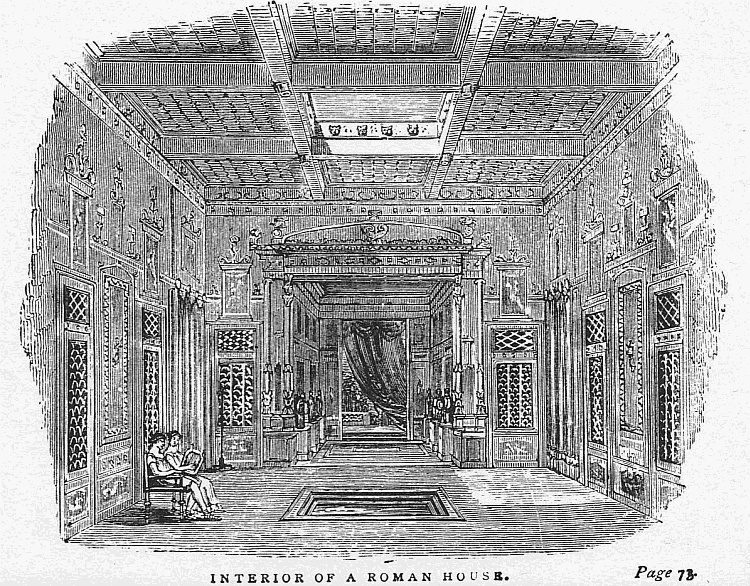
Jovinian was treated with much consideration by his uncle Gaius. He enjoyed the privilege of a room to himself, in which he could read without interruption, and to which his meals were generally carried. When, however, he went to the door, he found the Numidian, or another slave who acted as his assistant, stretched on a mat at the entrance, or seated on a stool close at hand. He had thus evidence that he was treated as a captive, and suspected of being desirous of making his escape. He was abundantly supplied with books,—Horace, Virgil, and Ovid for lighter reading, and translations of the works of Plato and his disciples for his more serious studies. But beautiful as was the language, he turned from them with disgust, so full of sophistries did they appear. There was one book which he took up with greater satisfaction than all the others. He had obtained it when out walking one day with Eros, and the Numidian’s watchful eye was for a short period averted from him. While gazing at a spectacle exhibited in one of the temples, Jovinian had recognised his friend the presbyter Amulius, who was coming quickly towards him. Before Eros had looked round, Amulius had slipped into his hand a roll of parchment; he immediately concealed it in his bosom. He was on the point of whispering, “Oh, take me with you!” and stretching out his hand to his relative, when Eros turned round. The Numidian seemed to have suspected his design, for he immediately grasped him by the arm, and took care for the remainder of the walk not to withdraw his eye from him.
On reaching home, Jovinian eagerly examined the roll. He discovered, to his delight, that it was the Gospel written by the apostle John. The roll contained another small piece of vellum, on which were written some lines from Amulius, urging him to practise the gift of patience, and to remain firm to the principles delivered to him by his beloved mother. Henceforth the book was his constant study, and from its page he drew consolation and instruction. One morning Eros, entering his chamber, inquired whether he was disposed to go out and enjoy the air. He thankfully agreed to the proposal, and having concealed his precious volume beneath his dress, he accompanied the Numidian. It was a day on which one of the numerous festivals held in honour of the gods was being celebrated in the city. The streets were thronged by persons of all ranks and ages, the shrines as usual lighted up and decorated with flowers, the lower order of priests were going about collecting contributions for their temples, and holding up the small images of their gods. They were passing the temple of Bellona, the Isis of the Egyptians, when Eros, grasping Jovinian’s arm, pulled him in.
“Here is a scene worth witnessing,” he observed; “see how devoted are the worshippers of the great goddess.”
Unlike most of the other temples, it was enclosed by walls to exclude the light of day. Following the windings of a narrow passage, the Numidian and the reluctant youth found themselves in a gallery within the temple, which appeared shrouded in gloom, except at the further end, where, above the altar, was seen, surrounded by pale lights, the statue of the goddess standing on a crescent moon, holding a globe in her hand; while before her were several closely-shorn, bare-footed priests, habited in linen garments, now bending low before her, now lifting up their hands in the attitude of prayer, while the whole area was filled with a multitude of persons in rapid motion, from whom issued cries and groans, above which could be distinguished the sound of the whips echoing through the edifice.
For some minutes, Jovinian’s eye, unaccustomed to the darkness, could not see what was taking place; but at length he perceived that all the persons below him were armed with whips, with which they were unmercifully flagellating, not each other, but their own bodies stripped naked to the waist. Some, from their dark skins, were apparently Egyptians, but many among them were evidently Romans. Now some of the priests, throwing off their robes, and seizing whips, which lay beside the altar, joined the mad throng, shouting and encouraging them to perseverance in the extraordinary performance. While this scene was enacting, several other persons appeared, issuing from doors on either side of the altar. Among them, Jovinian, to his surprise, distinguished his uncle Gaius, with Coecus and other pontiffs, who stood by, while a flamen, with his back to the people, lifted up his hands above his head, as if offering sacrifice to the goddess.
“What can induce those people thus to torment themselves?” asked Jovinian. “It appears to me as if they had all gone mad together!”
“Know you not that we stand in the temple of the Queen of Heaven, the most ancient goddess known to mortals?” exclaimed the Numidian. “These, her votaries, are thus inflicting pain on their bodies to purify themselves from sin, and be able to approach her shrine and merit her approval and affection.”
“Can it be possible that people are so ignorant as to suppose that any being of a divine nature can take pleasure in mortal suffering?” asked Jovinian. “How different must she be to the true God, so full of mercy and loving-kindness, who delights in showering blessings on His worshippers! Let us go hence; I can no longer stay to witness such egregious folly and wickedness.”
Still the Numidian seemed inclined to linger; but Jovinian, breaking from him, made his way towards the passage by which they had entered, and Eros was compelled to follow for fear of losing sight of his charge. Jovinian breathed more freely when he got into the open air. He was too much lost in thought to make any further remark to his companion. As they proceeded on their walk they passed numerous shrines, before each of which Eros stopped, and lifting up his hands, invoked the idol, seeming to care very little which of the gods or goddesses it represented.
“Can those marble figures render you any service, think you?” asked Jovinian, as they walked on.
“I know not; but my betters say so, and it is as well to be on the safe side,” answered the Numidian, with a shrug of his shoulders.
“But suppose they represent demons instead of divine beings, if you invoke them they are more likely to do you harm than good; and knowing, as I do, that there is but one true, all-powerful God, I am sure that He does not allow any inferior creatures to interfere between Him and man,” replied Jovinian. “We, who are His children through faith in His Son, can go direct to Him in prayer, requiring no other intercessor but our Lord and Master, nor any symbol to aid us in worshipping Him.”
“Yours seems a very simple faith; and if I thought that the one great and all-powerful God of whom you speak would hear my prayers and grant them, I would cease to worship all the gods and goddesses, whose very names I have a difficulty in remembering, and would trust only to Him,” answered Eros.
“You would act most wisely and happily for yourself,” said Jovinian. “Come with me into yonder building; I see several persons entering who, by their dress and demeanour, I know to be Christians.”
Eros made no objection. The edifice was enclosed by a wall, which shut out those within from public gaze. Passing through a door, they entered a spacious hall capable of containing several hundred persons. No statues nor pictures were to be seen; at the further end was a raised desk, at which stood a lector or reader, while a higher desk at the same part of the building, formed like a rostrum, served for the preacher who was to address the congregation. In the centre stood a long table, with seats round it, while the remainder of the area was filled with benches in rows, so arranged that their occupants could look towards the lector and preacher. The building was filling fast; in a few minutes all the seats were occupied. Shortly afterwards an aged man, habited in a toga, entering, took his seat on a chair close to the rostrum; then, standing up, after a minute of silent prayer, he gave out a hymn, in which the whole of the congregation joined. Portions of the Gospel and Epistles were read; a prayer was then offered up, in which all the congregation joined. After another hymn, the presbyter ascended the rostrum, and delivered an address. It explained simply the principles of the Christian faith, and the plan of salvation offered by God to sinful man. Eros listened attentively, and drank in every word. He sighed when it terminated. Another hymn having been sung, the congregation began to separate.
“Would that I could hear more of it!” the slave observed to Jovinian; “after this I can never again pray to the stocks and stones which I have hitherto called my gods.”
“You can come as often as you like; and there are several other places in Rome where assemblies of the faithful are wont to be held, thanks to the liberality of the emperor, who allows the Christians to meet everywhere as they desire,” said Jovinian. “But I would urge you to speak forthwith to the presbyter who delivered the discourse, or to the venerable overseer who presided; or, if you would prefer it, I would take you to the house of my relative Amulius. He is always ready to give instruction; and there are some, I fear, holding false doctrines, who would mislead you as to the principles of our holy faith.”
“What, do you Christians differ from each other in your belief?” asked the Numidian, in a tone of surprise.
“Alas! I am told that there are many who call themselves Christians, holding opinions contrary to those taught by the Holy Scriptures,” said Jovinian; “but they differ greatly one from the other. Such was the case even in the time of the apostles, and we cannot expect it to be otherwise at present, when men in their pride of reason refuse to submit themselves to the plain teaching of Christ.”
“You appear to have thought much on these subjects, for one so young,” observed the Numidian.
“I have been well instructed by those who know the truth, and have ever sought guidance from God’s Holy Spirit,” answered Jovinian.
Eros was silent; he was pondering deeply on what he had heard.
Jovinian, on his return to the college, retired to his room. Gaius was still absent; he was too much engaged when he returned, fortunately for Jovinian, to question him as to where he had been during his walk. The pontiff was acute enough to discover that he was not likely to win his nephew over to a belief in idolatry; but he hoped, by giving him the writings of the Greek philosophers, and of their numerous disciples and imitators of the present time, so to draw his mind away from the truth that he might be willing to enter into his schemes, and to become in reality a sceptic in all religious matters, as he was himself, with one exception: if, indeed, he had any belief, it was in the great goddess of Babylon—Astarte or Ashtaroth, the Queen of Heaven—whose worship, having spread through Asia into Egypt, had, with that of her son Horos, long been established in Italy under different names. In Egypt she was known as Isis, in Rome as Bellona. He, as was the case with the other pontiffs, had long been initiated into her mysteries, and he trusted that in time his nephew would be qualified to become one of her votaries. Her worship had, indeed, ever been the most popular, and provided that could be maintained, he felt sure that it would successfully oppose the two principles of the Christian faith, which he understood to consist in the belief of one God and one mediator between God and man. He was not aware of the power of simple faith when he thus entertained hopes of winning over his nephew, or that Jovinian went daily to the fountain-head to seek for that strength he so much needed in order to resist the temptations presented to him. Jovinian soon discovered the tendency of the works his uncle gave him, and as he read he sought for grace to refute their sophistries; nor did he seek in vain. He found, however, that it was wise not to enter into discussions with Gaius, who fully believed that ere long his nephew’s faith would be completely overcome. The pontiff now began to open his views to Jovinian, and to excite his ambition with the prospect, should he follow his advice, of becoming great and powerful, and ruling his fellow-creatures through their superstition, he frequently invited him out, taking the precaution to have a slave following close at hand to stop him should he attempt to escape, though he believed that there was now little probability of his doing so. At length, so complete was the confidence he placed in him, that he allowed him to be present at the councils of the pontiffs, where, seated, his book in hand, at the further end of the hall, his presence was not observed. Jovinian, very naturally, did not object to this, nor could he fail to be interested in the discussions he frequently overheard.
Chapter Six.
A Debate.
At length, one evening, the whole of the pontiffs of the sacred college were assembled, and it was evident from their manner that a matter of more than usual importance was to be brought forward. The gods being invoked, and the usual forms hurried over, Coecus, who acted as president, rose.
“Friends and brother pontiffs,” he began, “disastrous news has reached me. You well know that the emperor has long been favourable to the Christians. He has now openly declared himself a convert to their faith. His motive it is easy to perceive: he considers that the Christians throughout the empire already outnumber the followers of the ancient faith; and perchance he hopes to obtain pardon from the God of the Christians for the murder of his son, the hapless Crispus, of his wife, the traduced Fausta, of his nephew, and brother-in-law, Licinius, and the many others his jealousy has doomed to death. Be that as it may, his acts show enmity to the ancient faith; he has already in the East destroyed numerous temples of the gods, and prohibited the celebration of many of those august mysteries which have existed from time immemorial. Holding, as he does, the office of Pontifex Maximus, putting us and our holy college on one side, he has taken upon himself the right to raise the ministers of the Christians to high ranks and dignities, and has issued edicts accordingly, so that from henceforth those men whom we have hitherto looked down upon will, claiming the authority of the emperor, vaunt it over us; and, what is of more consequence, will obtain the revenues which have hitherto flowed into our coffers; while we, neglected and degraded, must sink into insignificance. Are we, I ask, my friends, tamely to submit to such treatment? Are no means to be found to arrest the progress of this pestiferous religion, which so many of wealth and rank are eagerly embracing, and which, now it has become fashionable at court, will still further increase? Can no one suggest a scheme by which we may retain our office, and still, as of yore, govern the minds of the multitude? Unless some plan can be devised, I warn you all that our course is run, and penury and neglect must be our lot.”
Silence followed the address of Coecus—a groan alone now and then escaping from the bosoms of the pontiffs; for they had not watched the rapid increase of the Christian faith among all ranks without being conscious that the system which they supported was tottering to its base. At length, one by one, they broke silence; but their proposals were treated as vain and useless by the sagacious Coecus.
“We have but one resource, my friends,” he answered; “far from giving way to despair, I feel confident that it will succeed, if carried out with due wisdom and secrecy. But we must be united, and by forming strict rules for our guidance, we shall still retain our power and influence, and govern the minds, not only of the people of Rome, but of those of the nations subject to her. We ourselves must become Christians! Some few may doubt our conversion, but the great mass will gladly welcome us, and continue to pay us the honour we have hitherto received. I say not this till after profound reflection. Our sacred college will still exist, and by the exertion of our influence, we shall obtain the appointment of the bishops and presbyters of the Christians, chosen either from our own body or from among such men as we shall find ready to support us. We shall have but to change the names of the gods. Already have many of the Christians begun to worship those whom they esteem holy or who were put to death in the times of Nero, Diocletian, and other emperors. Their folly will greatly facilitate our object, and it will matter little to us under what names the immortal gods are worshipped. We may, by proper caution, induce them to adore our own great goddess, the Queen of Heaven,—she who has been, shall be, and whose mysterious existence none among mortals can comprehend. Be it known to you, my friends, that He whom these Nazarenes worship, the Prophet of Nazareth, was, they say, born of a woman; and surely, as they adore Him, so may they easily be induced to adore His mother; and it appears to me that they can be led away from the worship they pay to Him, to offer it to one whom we would present to them in the place of that human mother. Thus shall we by degrees wean them from the faith they now hold,—if we cannot openly oppose the progress of this new religion, we can corrupt it,—and if the gods and goddesses of ancient Rome are overthrown, we can place other objects of worship in their stead, or re-name them, rather, from the persons whom the Christians are wont to regard with respect. Those who have been taught to worship a dead Caesar will as willingly fall down before the statue of a woman whom they consider a saint; thus it will give us but little trouble to change the religious observances and ceremonies to which the people have been accustomed to suit the new religion. Let us not, then, give way to despair: Rome will continue, as of yore, faithful to the worship of the ancient gods, and we, their priests, shall retain our power and influence.”
The scheme proposed by Coecus met with general approbation. Jovinian had retained his seat, his eyes fixed on his manuscript, but attentively listening to all that was uttered. The words he heard, “If we cannot overcome, we can corrupt,” especially struck his ear; he was too well acquainted with the errors which had crept in among the assemblies of the Christians not to be sensible that even those who held the faith might be led astray: how much more easily might the ignorant idolaters be led to worship any objects presented to them! As he sat motionless in his place of concealment, yet more of the scheme was revealed; the characters of the very persons who were to be made its instruments were discussed. A feeling of horror and dismay crept over him. Could he by any means be enabled to counteract it? He resolved to take counsel of his aged friend, Gentianus. So strictly had he hitherto been watched that he knew full well the difficulties to be encountered in making his escape; should his uncle Gaius discover that he had been present he would guard him still more closely. He dared not move lest he might be seen; at present he was concealed from the assembled pontiffs by a pillar, but the slightest movement might betray him. At length the conclave broke up, and drawing their togas around them, the pontiffs retired. Jovinian, trembling at the thought of the dark scheme he had discovered, made his way back to his room. Helpless as he was, he felt unable to do anything to counteract the plans of the conspirators, yet it was at all events his duty to make them known to the leading Christians of Rome; but whom among them could he trust besides Amulius, and Gentianus and his family? The first, though a presbyter, and a faithful and earnest man, might not have the courage to denounce a person of power and influence like the pontiff Coecus, supported as he was not only by the members of his college, but by all the wealthy philosophers and idolaters in Rome. Amulius might even doubt the accuracy of his statements; Gentianus was far more likely to believe them, could he manage to communicate with him. Should, however, Gaius suspect that he had been present at the conference, he would be kept a far closer prisoner than before. Was Eros to be trusted? He could not have failed to discover that Jovinian had been absent from his room,—he might have informed Gaius of the fact. Though Eros had professed to be deeply interested in what he had heard at the assembly of the Christians, it was doubtful whether he had been really converted; even if he were so, the dread of the consequences to himself should his captive regain his liberty, might prevent him from conniving at his escape. Jovinian, therefore, felt it would be prudent not to trust him; and, eager as he was to get away, he endeavoured to appear reconciled to his lot. From principle as well as from disposition, anything like duplicity was especially hateful to him, but he was driven to practise it, as affording him the only prospect of escaping from the thraldom in which he was held. Gaius appeared to be completely deceived; he spoke more openly to his nephew than he had hitherto done, though at the same time he was too wary not to keep the same strict watch over him as at first. He now frequently took him out when he went abroad to visit the temples to give directions to the flamens and to advise them how to comport themselves in the perilous circumstances in which they were placed. One and all were alarmed at the information which constantly reached them of the emperor’s opposition to the ancient faith, and the support and patronage he afforded the Christians. Already numerous conversions had taken place among the patricians, as well as among persons of inferior rank; whole families who had hitherto appeared to be staunch idolaters now professed themselves Christians. They not only met together openly for worship in several parts of the city, but had already begun to erect several churches; while money contributed by the faithful for the support of widows and orphans and others in distress flowed into the coffers of their bishop. Wherever Gaius went the flamens met him with sad countenances; though after he had held conversation with them in private, they generally appeared to become more cheerful.
He was one day paying a domiciliary visit to the temple of Apollo, having entered by the door sacred to the flamens in the rear of the edifice. Gaius had a long conversation with the chief flamen while Jovinian was allowed to amuse himself with looking over some ancient manuscripts kept in a chest in the room in which they were sitting. The flamen listened attentively to the remarks of his superior.
“By the Immortals, we need not despair, Coecus guiding us!” he exclaimed; “whatever he proposes, he may depend on our carrying out to the letter.”
“Then listen, Flaccus,” said Gaius; “we can no longer hide from the people the progress made by the new faith, or that it is patronised by the emperor; but we may persuade them that the gods are grieved at the abandonment of their ancient worship; or should a pestilence occur, or an earthquake, or a storm of unusual violence, we may easily make them believe that the infliction has been sent as a punishment for their infidelity. Would that such would occur! it would help us greatly in our object. In the meantime, we can employ such means as are at our disposal. It would be well if we could make all the statues of the gods in Rome weep together, or roll their eyes, or groan in concert.”
“The thought is a bright one,” answered Flaccus; “by means of arrangements in the interior of our statue we can reach the head, and through the two small holes in the corners of the eyes press forth from a sponge a rivulet of water, if we so wish. I will then, from before the altar, announce the cause of the great Apollo’s grief, and urge his votaries to renewed devotion, and to withstand the pernicious teachings of the Christians.”
“The temple is already well filled, and the sooner we play the—I mean, the sooner the miracle is performed the better, for delays are dangerous,” said Gaius.
“We might perform it at once,” answered Flaccus; “but we require a boy of small size who can climb up into the head of the statue; and my own son, whom I can trust, is sick at home. The youth yonder, however, though somewhat big, might manage to climb up without much difficulty.” As he spoke he looked towards Jovinian. “You can confide in him that he will not betray us?”
“I am not certain on that point,” answered Gaius; and calling to his nephew he desired him to swear that he would not reveal what he was about to communicate.
“If lawful, I am ready to do whatever you desire,” answered Jovinian.
“Can it be otherwise, foolish boy, when I wish it?” exclaimed Gaius. “Know you not that I have the power to force you to do whatever I may require?”
“I will, at all events, promise not to repeat whatever you may think fit to say to me,” said Jovinian.
“I wish you, then, simply to play off a trick upon the ignorant people collected in the temple,” said Gaius. “See here: all you have to do is to climb into the head of the statue through the trap which the flamen Licinius Flaccus will show you, and to press a sponge into the hollows of the eyes till you have emptied the amphora which you will take up with you. Be not startled if you hear some deep groans close to your ears; they will be uttered by the flamens, and will serve to give more effect to the flowing of the tears.”
“Pardon me, but I cannot take part in such a device,” answered Jovinian. “I have given my promise not to repeat what you have told me; but obey you in this matter I cannot.”
Gaius, whose aim was to gain the affections of his nephew, restrained his rising anger, and turning to the flamen, observed, “You must find some other boy of smaller size, for my nephew is, I suspect, too big properly to perform the task.”
“I am unwilling to lose this opportunity of working on the minds of the people,” answered Flaccus; “I will, therefore, send for my son, or some other boy who can be trusted.”
He immediately went out. While he was absent, Gaius lectured his nephew; but Jovinian was firm, and even ventured to expostulate on the subject with Gaius, who, however, only laughed at him for his folly, as he called it. In a short time the flamen returned, bringing a short and slight lad, who was directed what to do. Two of the flamens remained behind, while the rest entered the temple. The boy was led to a trap-door at the back of the altar, while two flamens mounted to a gallery level with the head of the statue. Presently groans were heard, so deep and mournful that it seemed scarcely possible they could be uttered by a human being, while cries and shouts arose from the temple, and the words which reached Jovinian’s ears were, “The great god is weeping! Apollo mourns! Woe, woe to Rome!”
He was thankful when at length Gaius, taking his hand, led him from the temple. On their way through the streets they heard people talking of the wonderful miracle which had just been witnessed in the temple of Apollo.
“The god sheds tears at the thoughts of being driven ignominiously from the city where he has so long dwelt!” exclaimed some. “Did you hear how he groaned? Fearful! What will next happen? It is a wonder the great Jove and all the gods did not descend from their pedestals and drive these Nazarene infidels into the Tiber.”
“It would be a worthy deed, and well-pleasing to the Immortals, if you, who carry weapons, were to attack the wretches, and treat them as they deserve,” whispered Gaius to the crowd of idolaters among whom he was making his way. Just then a line of twelve lictors appeared carrying the fasces, making way for one of the consuls, who walked along with dignified pace on some official business.
“Silly people!” he remarked, as he heard the exclamations of the crowd; “you will, ere long, see the statues of the Nazarene saints weeping if you obstinately refuse to follow the faith our august emperor has adopted.”
He smiled as he saluted Gaius, and their eyes met; but the presence of the lictors restrained them, and they separated, going towards their respective homes. Gaius did not speak a word to Jovinian till they reached the college. “Go to your room: I will follow you there,” said the pontiff to his nephew, in a sterner tone than he was wont to use. Jovinian was prepared for a severe lecture. He prayed that he might have grace to act consistently with his profession. In a short time Gaius appeared, and having ordered Eros, who was at his post, to retire, he threw himself on the couch by the table on which Jovinian’s books were placed.
“Of what folly have you been guilty!” he exclaimed; “what induced you to refuse to take part in a harmless deceit, such as has been frequently practised on occasions of necessity, when it has been important to awaken the slumbering faith of the votaries of the gods? Know you not that it is one of our chief maxims that deceit of any sort is lawful when the result is likely to prove beneficial, and that evil may be done provided a good object is to be attained? You have been miserably taught if you do not understand this.”
“According to the precepts of the faith I hold, no deception can be practised and no evil done without offending a pure and a holy God, who looks upon all deceit as sinful, and cannot sanction the slightest approach to sin,” answered Jovinian, boldly. “I could not, without offending Him whom I serve, have assisted in the imposture practised on the ignorant multitude. I promised not to speak of what I heard, or I would tell the people of the trick played upon them, and thus win them to the worship of the one true God.”
“What is this I hear?” exclaimed Gaius; “I had hopes that you had been weaned from your folly, and would have been ready to follow the career I have marked out for you. Should I disown you and turn you out into the world, by what means can you support your miserable existence?”
“The Lord I desire to serve cares for those who love Him,” answered Jovinian, without hesitation. “I have no fear of what man can do to me. I speak with no disrespect to you, my uncle—I am ready to obey you in all things lawful.”
“You are a foolish and obstinate boy,” exclaimed Gaius. “I will, however, give you a further trial. Only do as I desire, and you may retain your Christian faith; but if you thwart my plans, I must use sterner measures than I have hitherto adopted. Perhaps ere long you will discover that I am not so much opposed to the faith of the Nazarenes as you now fancy.”
Gains rose, and leaving Jovinian to reflect on what he had said, returned to the hall, where the other pontiffs were assembled to discuss the subject which now occupied all their thoughts.
Chapter Seven.
The Escape.
Jovinian’s position became excessively trying. He was more strictly watched than before; it was evident that Gaius had lost all confidence in him. Still he did not abandon the hope of escaping; he did not wish to commit Eros, who, should he connive at his escape, would be severely punished; he had, however, hopes that the mind of the Numidian was gradually opening to spiritual truth. Whenever Gaius was abroad, and Eros had no fear of being interrupted, he entered Jovinian’s room, and begged him to read from the wonderful book he possessed. This Jovinian gladly did, and the humble slave gradually began to comprehend the faith which his proud master rejected. Though Jovinian was convinced that Eros had become a true Christian, yet still he would not tempt him to assist in his escape. Eros had early become interested in his young captive; he was now deeply attached to him. He observed with an eye of affection that the confinement to which he was subjected was injuring his health. “He requires fresh air and exercise, and the society of those of like mind,” Eros said to himself. “I must persuade the pontiff to let him go out as before, or, if my petition is refused, I will run all risks, and give him his liberty. He has not asked me to set him free, because he believes I should be the sufferer; but, as he has given me the greatest blessing I can enjoy on earth, I am bound, in gratitude, to enable him to do what his heart desires.”