"A Story of the Early Days of Papal Rome" (continued 3)
Reading edition
They were about to enter one of the carriages, when Amulius remarked, “We have brought two other travellers who are desirous of accompanying you.” Ongoing to the litters he handed out two females habited in the ordinary dress of Roman ladies.
Jovinian at once recognised in one of them, although their heads were veiled, the vestal Marcia. As those around him were all of the faithful, there was no necessity for concealment.
The other lady was introduced by Marcia,—she was Coelia, whose life she had been the means of preserving. Marcia now explained that she and another vestal, who had also become a Christian, and was particularly attached to Coelia, had been placed by Fausta in charge of the prisoner, and that, having taken her place, she had allowed her to escape, aided by Christian friends, who had been watching outside the temple. They were under the guidance of Eros—he having, with the ever-active Rufina, been the means of perfecting the plan for her release. “The unhappy Vestalis Maxima,” she added, “when on her return to the temple she discovered that so many of those under her rule had become Christians that the sacred fire itself had been allowed to go out, and that even Coecus, as she supposed, had deserted the ancient faith, stabbed herself in despair.”
Just as Jovinian was stepping into the petorrita he found his hand grasped. Looking up, he saw Eros.
“I am to accompany you with the other runners on foot,” he said, “and I have a favour to ask: it is that you will entreat Severus to allow me to go with you, for Rome is no place for me, and I will gladly serve him faithfully without wages.”
Jovinian willingly promised to do what Eros desired, feeling sure that the request would not be refused.
The direct road to the port of Rome was about sixteen miles; but as a considerable circuit would have to be made, it would occupy a large portion of the day. The friends, therefore, who had come out of Rome, returned, and the travelling party set out. The first part of the journey was by by-paths, and being somewhat rough, the mules could only proceed at a slow rate. When once the high road was gained they were able to move much faster. It was well paved with slabs skilfully joined, which formed a smooth stony surface, enabling the wheels of the vehicles to run easily along. Here and there villas were seen, the inhabitants of which were still wrapt in slumber.
The travellers—although their equipages were simple—were received with respect at the inns where they stopped to rest their mules or partake of refreshment. They selected those whose hosts were Christians, and who welcomed them as brethren. Ostia was inhabited by a considerable number of Christians, engaged in commercial pursuits, and who had collected there from various parts of the world. The church of Ostia, said to have been formed in the days of the apostle Paul, was presided over by an aged bishop, with several presbyters and deacons. That it was of great antiquity was certain, as the apostle, while remaining at the port, when either embarking or landing on his journeys to and from Rome, would undoubtedly have gained many proselytes to the faith.
Jovinian passed his time happily in company with Julia, to whom he was attached with all the strength of his ardent nature. Notwithstanding his present happiness, he did not feel altogether secure while remaining in the neighbourhood of Rome. His uncle Gaius, who possessed, he believed, a legal claim over him, might discover his retreat, and prevent him from quitting the country. About Eros he had no fear, for having been once set free, the emancipated slave could not again legally be forced back into captivity, Eros himself, however, was not quite so well satisfied about the matter, and had, with the permission of the master of the Dolphin, gone on board, and obtained concealment in the hold. It might have been wise in Jovinian to have followed his example—at all events to have lived on board the vessel until his friends were ready to embark. Instead of that he went everywhere about the town with them, and attended public worship. They were to go on board early in the morning, and to sail as soon as the tide was high enough to enable the Dolphin to cross over the bar. Many of the principal Christians in Ostia accompanied the party down to the place of embarkation, where a boat was waiting to convey them on board the Dolphin, which lay with her sails loose out in the stream.
Severus, with his wife, and Marcia and Coelia, had already taken their seats; and Jovinian, who had walked down by the side of Julia, was on the point of assisting her on board, when he felt his arm seized, and a man in the dress of an emissary of the law exhibited an official document before his eyes. “You are, young sir, still a minor; your uncle Gaius claims you as his ward; resistance is vain, for I can summon those who would compel you to obey,” said the officer.
Julia clung to Jovinian’s other arm. “Oh, come, come!” she whispered: “he cannot detain you, and the boat will in an instant be away from the shore.”
Jovinian felt greatly inclined to follow this hint. As he was strong and active, by a strenuous effort he might shake himself free from the officer’s grasp. It was a great trial to him. Severus, whose attention had been called to what was occurring, stepped forward at once to his assistance; but the officer, fearing that a rescue was intended, summoned his attendants, dragged Jovinian from the strand, and delivered him to them. His numerous Christian friends could not, on principle, resist the law under which the officer professed to be acting.
In vain Julia entreated Jovinian to return to the boat; he was too securely held to make his escape. The mariners were anxious to sail, and not to lose the advantage of the wind and tide.
Severus had but a short time to speak a few words to his young friend. “The law must not be disobeyed,” he said; “but let me urge you to hold fast to the truth; we will pray for you and welcome you joyfully whenever you can quit Rome and join us.”
“I look forward to the day when I shall be free, and able to hasten to wherever you are settled,” answered Jovinian. “Your prayers will support me; I, too, will pray for myself, that I may be kept to the truth.”
The heathen officer could not be induced to allow Jovinian to exchange further farewells with his friends, being still afraid—seeing the number of persons around—that an attempt might be made to rescue his prisoner. They did their utmost to console him, after the boat pushed off; but it was with an aching heart that he saw the sails spread, and the Dolphin gliding out into the blue sea, which shone brightly in the rays of the rising sun, beyond the harbour.
Jovinian, with a heavy heart, walked with the officer to the inn, where the vehicle was waiting which was to convey him back to Rome. The blow he had received was so sudden that he could not for some time recover from it. He had been looking forward to days of happiness in the company of Julia and her parents, when his faith would have been strengthened, and he would have been able to profit by the guidance and instruction of Severus. He was now, once more, he supposed, to be exposed to the importunities of his uncle to turn idolater: and although he trusted that he should not be moved, it would be painful to be continually engaged in controversies with his relative. From the treatment he had before received, he was not much afraid that force would be used; at the same time he could not tell to what devices Gaius might resort to influence him. He fervently prayed that he might have strength to resist them.
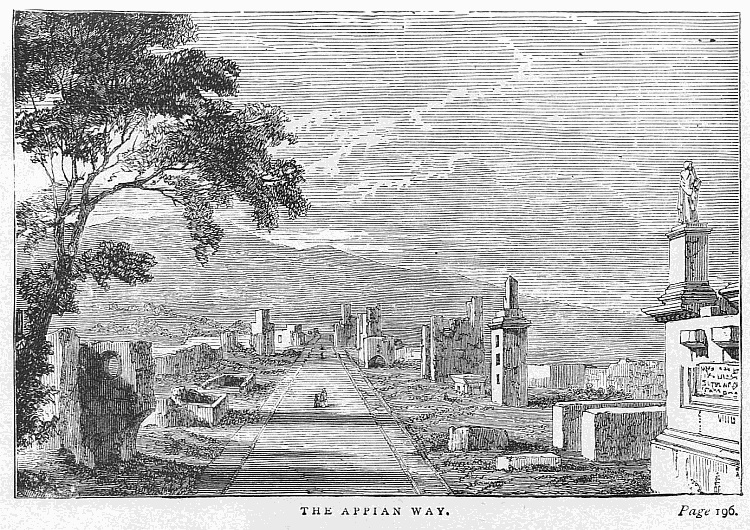
On reaching the inn, the officer desired him to enter the petorrita which stood with the horses put to, before the door, and then took a seat by his side. The driver urging on his steeds, the carriage moved forward, the officials in attendance, with their garments girt about them, following rapidly on foot. The road, worn by the heavy waggons passing along it, was in several places full of ruts and holes, over which the vehicle went jolting on, the driver caring very little for the shaking his passengers were receiving. No stoppages were made, as the officer had been directed to return without delay to Rome. At length the Appian way—the high road between the capital and the south—was reached, when the carriage moved on more smoothly. They now passed between numerous sepulchres,—monuments erected on both sides the road, in which the ashes of many generations of the noble dead reposed. Jovinian recognised more than one in which his own heathen ancestors were interred. A feeling of gratitude to heaven rose to his heart at the thought that his own beloved mother had accepted the truth in her early youth, and that he had been born under the full light of the Gospel. Several large buildings were passed—that of the sanctuary of Mars, as it was called, beyond the city, within whose walls criminals flying from justice could obtain safety. The carriage then, passing under one of those vast structures of masonry erected to carry water into the city, entered Rome by the Porta Caperia. The vehicle could now proceed but slowly, as obstacles of all sorts occurred every moment. Sometimes a large waggon conveying building materials stopped the way. The streets were also blocked up by the booths of hucksters, butchers, vintners, pastry-cooks, and vendors of articles of all descriptions. Some of the passengers of the lower orders amused themselves by jeering at the young occupant of the carriage, when they recognised the officer of the law, and suggested that he was probably some Thespio who had been robbing his master, or filching the goods from the stalls. Egyptian jugglers were performing their wonderful tricks, allowing the most venomous snakes to wind themselves round their arms and necks,—the crowd which had collected around them showing no inclination to make way for the carriage. Here also could be seen boys selling sulphur matches, others carrying huge basins of boiled pease, a dish of which they dispensed to the poorest classes for the smallest coin.
As they entered the city Jovinian was much struck by observing masons dismantling two or three of the smaller heathen temples, which had been held in but slight consideration—mules and carts being engaged in carrying off the materials.
In their places new edifices were in course of erection, the beams and stones being wound aloft by cranes fixed on the summit of the portions already erected. It appeared to him that there was much more life and bustle in the city than he had ever before observed; but his silent custodian would afford him no information on the subject. “That is not my business,” he answered, when Jovinian asked a question; “your uncle Gaius will inform you all about the matter, young man.”
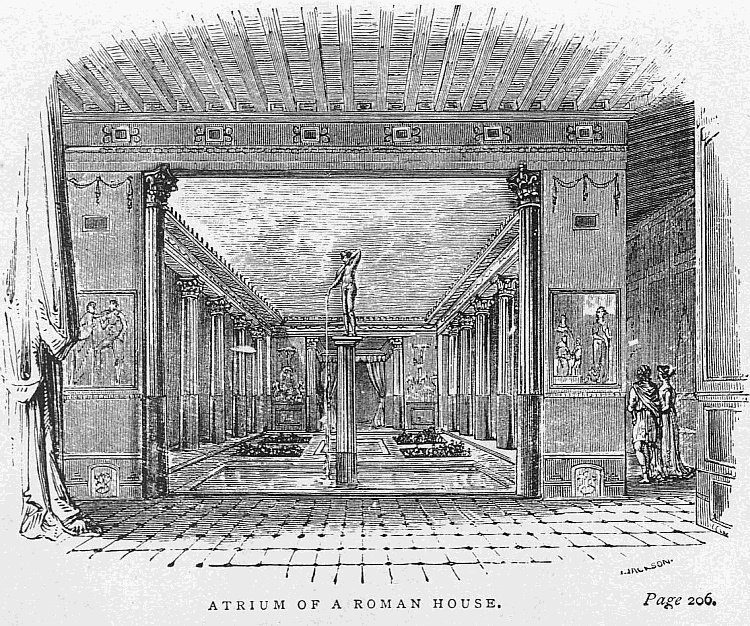
Jovinian had expected to drive up to the college of the pontiffs; but before reaching it the carriage turned off to the left, and stopped at a mansion under the Palatine hill. As it drew up before the ostium—the entrance to the house—two slaves came forth, whose countenances Jovinian did not recognise. They seemed, however, to expect him, and the officer, without hesitation, delivered him into their hands, following, as they conducted him through the atrium into an inner court, in a small room at the side of which he saw his uncle reclining. Several books were on the table before him. Gaius rose, and put out his hand to receive his nephew, his countenance exhibiting no sign of anger. The officer, having formally delivered his charge into the hands of Gaius, retired, and the uncle and nephew were left alone.
“And so you would have deserted me, your only relative, and followed the fortunes of strangers?” said Gaius, in a half-pathetic, half-comic tone, but which certainly exhibited not the slightest feeling of resentment.
“I escaped from you, my uncle, because you desired me to embrace a faith I abhor; and although I have now been brought back, I shall be still, I trust, withheld from following your counsels.”
“Ah! that is a matter which troubles me. I am thankful I did not succeed,” exclaimed Gaius, in the same tone as before; “I have seen that the system of idolatry is rotten, since the emperor and other good men have deserted it; and I wish to be instructed in the doctrines of the faith you hold.”
Jovinian was struck, as he well might be, with astonishment at hearing this, although he did not express his feelings. As he gazed steadily at the countenance of Gaius, he thought that he detected a twinkle in his eye which much belied his assertion. “I would thankfully be the means of bringing you to a knowledge of the truth,” he said at length, “but God alone can enlighten your mind.”
“Well, well, all I require you to do is to instruct me in the articles of your belief, and in the forms of your worship, and I may hope in a few weeks to make a very respectable appearance as a Christian; and if you prove an intelligent tutor I will allow you all the liberty you may desire. You can visit our relative, the presbyter Amulius, or any other friend you may desire to see, and report to them the progress I am making.”
“What, my uncle, are you really serious in your wish to become a Christian?” asked Jovinian, who had not forgotten the discussion he had overheard among the pontiffs, although he felt it would not be prudent to let his uncle know that he had been an eavesdropper on the occasion.
“Of course I am,” answered Gaius. “Surely the religion which the emperor adopts must be one we must all desire to follow.”
Jovinian sighed; he knew the truth too well to be deceived by his uncle’s remark, and he felt that, even should Gaius have some faint wish to become a Christian, he was very far as yet from the kingdom of heaven. He resolved, however, to do what he conceived to be his duty, and to instruct Gaius as far as he was able in the principles of Christianity. He judged it wise not to complain of being dragged away from his friends—supposing his uncle had a legal power to act as he had done—and he hoped when his services were no longer required that he should be allowed to rejoin Severus.
Chapter Fifteen.
Jovinian and his Uncle.
Jovinian was treated with much kindness, and allowed all the liberty he desired—being permitted to visit Amulius and the few other friends he possessed. He still had doubts of his uncle’s sincerity. He could not forget the scheme proposed by Coecus; and Gaius might desire to take the step he proposed for the sole object of forwarding it.
Still, the temptations to join the religion professed by the emperor were great. It might pave the way to honour and wealth. Although many doubted that the emperor was really a Christian, the edicts he had issued showed that he was influenced by Christian counsellors. Among them were those for the abolition of the punishment by crucifixion, the encouragement of the emancipation of slaves, the prohibition of gladiatorial games, and the discouragement of infanticide.
Another edict ordered the use of prayers for the army; but that to which perhaps even the idolaters least objected was one for the observance of the Sabbath throughout all the cities and towns in the empire. The Christians, however, were greatly puzzled when they found it designated as “Dies solis,” or Sunday; and it was supposed, not without justice, that the emperor selected that title in consequence of his lingering affection towards the worship of the sun, to which he had, in former times, been addicted. The other days in the week were, to please the idolaters, called after the names of the various gods, and especially dedicated to them. The second day was Luna’s day, sacred to the moon; the next was Mercury’s day; while Jupiter and Venus had also their days; so that the populace were still kept in remembrance of their ancient gods and goddesses, although they were professedly Christians.
Jovinian found it no easy task to instruct his uncle in the truths of Christianity. Gaius readily understood and remembered the facts mentioned in the Bible; but he appeared utterly unable to comprehend their spiritual meaning, although he listened to all his nephew said.
“How is it that I see so many sects and divisions among those who call themselves Christians?” he asked: “bishops, presbyters, and people in one place quarrelling and disputing with those in another. I hear of Athanasius and Miletius, Eusebius, Arius, and numberless other heads of your sects, condemning each other,—the one party refusing to hold communion with the other, while both profess to serve the same Lord, whom you call Christ. Now look at the system of religion which has prevailed undisturbed for centuries in Rome. We have had no quarrels or disputes, and all have submitted implicitly to us, their pontiffs, the directors of their rites and ceremonies. Our men and women have been at liberty to worship the gods and goddesses they have preferred. We have added new demigods as occasion required, nor did we refuse to place the divinities of other nations in the Pantheon, whenever they could prove a good title to the honour. We have raised our emperors after death, however little we may have loved them in their lifetime, to the same advanced rank. I do not say that the religion in which you are attempting to instruct me may not prove in the end the best, especially as it has been adopted by the emperor; but you must acknowledge that the worship of the immortal gods has the advantage of antiquity to recommend it, and that under it Rome became great and powerful, and conquered the world.”
Jovinian was puzzled how to answer some of these objections. He could not deny that disputes raged furiously among the Christian churches, especially in the East, and that many of the bishops seemed more intent on increasing their worldly wealth and dignity than on spreading the Gospel. In regard to the immortal gods, he asked his uncle whether he had ever seriously believed in their existence, or had the slightest authority for supposing that they were other than creatures of the imagination?
“Well, well,—as to that, the people believed in them, and we, the directors of their religious rites, have reaped the benefit of their superstition,” answered Gaius.
“But you must acknowledge,” said Jovinian, “that idolatry has debased the people with its numberless obscene and cruel rites, that the consciences of its votaries have become scathed, and have allowed them to indulge in the grossest crimes without shame or remorse. Now, on the contrary, while we acknowledge that we are vile and sinful beings, utterly unfit to enjoy a pure and holy heaven, yet we know that God has provided a way by which we can be made pure and holy, have our sins put away and forgiven, at the same time that we are bound to strive to imitate our Saviour, and to live pure and holy lives, free from the rebuke of a rude and perverse generation.”
“That may be,” answered Gaius; “but I wish to have the cause of these dissensions of which I hear explained to me, that I may decide whether I shall join Athanasius, Miletius, Arius, or any other party.”
Jovinian hastened to consult Amulius how he should reply to Gaius.
“Remember that the apostles have told us that from the first these dissensions have existed among those calling themselves Christians,” answered the presbyter. “Instead of becoming ‘as little children,’ and submitting themselves to the teaching of the Holy Spirit through God’s written Word, they bring their crude philosophy, their pride of intellect, their passions, their lust of power and wealth, into the creeds they endeavour to form. Most of them, it is true, profess to be guided by the Holy Spirit; but they act like a person who invites a charioteer to drive his horses, and then seizes the reins and turns them in any direction he may please. I have long watched the fearful struggle going on between the Prince of this world, the real supporter of idolatry, and the true faith as it is in Christ; and the signs I have observed too surely warn me that the former will triumph.
“Although the emperor professes to be a Christian, all his acts show that the mists of heathen darkness have not been dispelled from his mind, and that the encouragement he affords nominally to the Christians is fraught with the greatest danger to the true Church of Christ. Here in Rome, especially, I apprehend the worst. As you well know, the Romans are more wedded to idolatry than the inhabitants of any other city in the Empire. They still cling to it, notwithstanding the favour shown by the emperor to the Christian Church.
“The emperor, who is resolved to have uniformity of faith, and to make all his subjects Christians if he can, will not fail to offer such bribes as are not likely to be refused by the heathen leaders. Still, though he may wish to encourage the Christians in Rome, he has no affection for Rome itself, and would gladly forget that such a city exists, for it was here that some of his darkest crimes were committed.
“Here also he was insulted by the idolatrous Romans in a way he can never forget. I was a witness of the scene. Soon after his arrival a magnificent ceremony was held to celebrate the Battle of Regillus, when, as the idolaters believe, the twin gods Castor and Pollux, having fought for Rome, galloped on their fleet steeds to bring the glad tidings to the city. The aim of the idolaters was to surpass all previous anniversaries. The temples were lighted up, and decorated as usual, victims smoked on every altar, and all the members of the equestrian order, numbering five thousand horsemen, clothed in purple, and crowned with olive-leaves, rode in state to the Forum. It was altogether one of the most splendid pageants ever seen at Rome; and it was supposed that Constantino would take part, as previous emperors had done, in the religious rites usual on the occasion. But this he positively refused to do, and it was reported that he openly indulged in his sarcastic humour, by jeering at the sham knights and the empty pomp he beheld while watching the procession in the distance from his palace.
“I can see him now,—his countenance handsome, his figure tall, although somewhat stout and broad-shouldered,—and his whole appearance betokening sturdy health and vigour. His eye had a peculiar brightness, such as few men’s possess, and I especially noted it when it assumed, as it did several times, a glare which could not fail to remind me of that of a lion; while, as he uttered his remarks, he threw back his head, bringing out the full proportions of his thick neck. Rough and unrefined in appearance, his voice was remarkable for its gentleness and softness. In those days he had not assumed, as is now the case, that splendour of costume which he has copied from the princes of the East. He carried simply a spear in his hand, as an insignia of his office, and to show that by the spear he had won and intended to keep his Empire. Since then, I hear that he never goes abroad without a helmet bound round with an oriental diadem studded with jewels, that his robe is a purple silk richly embroidered with pearls and flowers worked in gold, while he wears wigs of false hair of various colours, a short beard ornamenting his chin. On this occasion he appeared simply as a victorious general. His refusal to join in the religious ceremonies usual on the occasion so displeased the turbulent populace that they threatened vengeance of all sorts. Some of the most evil disposed proposed to attack the Christians at whose instigation it was supposed the emperor had acted; others dared even to throw stones at the head of his statue.
“When a courtier rushed in, bringing news of the outrage, he smiled, and passing his hand over his face, observed,—‘Truly it is surprising, but I feel not in the least hurt; nothing do I find amiss in my head, nothing in my face.’ Although he had thus received the news so calmly, it created a disgust in his mind, both against the city and religion of Rome, which he has never overcome; and to this day he speaks of Rome—alas! with too much justice—as an ‘idolatrous and abandoned city.’ In spite of the wealth and influence of our bishop, our numbers, compared to that of the population, have continued to be small; and had it not been for the refuge afforded by the subterranean galleries outside the city, the church in Rome during the days of persecution would have been extinguished.”
Jovinian was allowed to pursue his studies at home under such tutors as Amulius recommended.
Many months thus passed away, faster than he could have supposed possible.
Gaius now treated his nephew with apparently perfect confidence, speaking unreservedly to him on matters of all sorts.
Jovinian thus heard much more of what was going on than he otherwise probably would have done. He found that both Gaius and Coecus—although professedly Christians, as were some of the other pontiffs—visited the college frequently, on which occasions discussions were held with closed doors. So great at length became the confidence which Gaius reposed in his nephew, that he invited him frequently to attend these meetings,—extracting a promise, however, that he would not divulge what he heard. On these occasions the pontiffs discussed the plans that had been proposed for maintaining their rank and position in Rome. Those who professed to have become Christians appeared to be and evidently were, on most friendly terms with the idolaters, all being united by a common interest. Their great object was to maintain their college in its integrity.
“We may thus,” observed Coecus one day, when visiting Gaius, “by keeping up our influence over the mass of the people, secure the election of the candidate of whom we approve to the office of bishop or any other dignities of the Church. We may select some of our own brethren, or any other persons whom we deem suitable.”
The plan was universally approved of. Its fruit was to be observed in after years, when the bishops of Rome found themselves controlled by the college of cardinals, the successors of the pontiffs.
Christianity appeared to be making great progress in Rome. Several new churches and basilicas were in course of erection, and even some of the heathen temples were being converted so as to suit the worship of the Christians.
The idolaters generally, however, objected to allow their temples to be so employed. Jovinian was greatly struck by the appearance of the statues which adorned the new places of worship, and he recognised among them some which had undoubtedly been heathen idols. In several of the churches were statues representing the virgin Mary, which had previously acted the parts of Isis, Juno, Venus, or some other goddess; and he could not help remarking that by far the larger number of worshippers bent before these statues and offered them the same respect which they had been accustomed to pay to the heathen goddesses. Among those who met at the college of pontiffs was a visitor who had come from a college long-established at Mount Carmel, where students in the Babylonian worship were instructed: he was said to be learnt in magical science. He spoke, however, of his admiration of the Christian faith, and came, it appeared, to discuss with Coecus and the other pontiffs the possibility of uniting it to the ancient faith without offending the followers of the latter. The idolaters seemed so completely in favour of this proposal that Coecus expressed his confidence that it would succeed.
Jovinian was sick at heart at all he saw. His uncle Gaius, although he had obtained the rank of a presbyter, was too evidently no nearer the truth than he was before. Idolatry still prevailed in all directions. In few places of Christian worship was the truth faithfully preached. Even Amulius appeared to be going with the stream, or, at all events, to be making but slight efforts to stem it. “I, too, shall be carried away if I remain,” said Jovinian to himself; “it is a sin to expose myself to temptation.”
The bishop, who had long been at the head of the Church, died, and another was elected whose character was but little known, although Jovinian observed that Coecus, Gaius, and other pontiffs were very active in his election. He had not long been seated in the episcopal chair when he, too, died; and soon after news came that the emperor had expired. He had received the rite of baptism on his death-bed; but it was evident that he was not of Christ when it became known that he had expressed his belief that his brothers had poisoned him, and had charged his son, Constantius, to put them and their offspring to death,—a charge too faithfully fulfilled.
He was preparing for an expedition against Persia when sickness overtook him. Feeling that it was mortal, he desired to be baptised—a stop he had hitherto not taken, although he had for years presided at councils and preached to his people, and even been designated as the “Bishop of bishops.” He was received as a catechumen in the church of Heliopolis; he then moved to his palace in the suburbs of Nicomedia, when, calling Eusebius and several other bishops around him, he desired to have the rite administered. Here, having laid aside his purple robes, he was habited in white, and thus, stretched on his death-bed, he received baptism from the hands of Eusebius. One of his last acts was to recall Athanasius, a rival of Eusebius, who had been banished. Thus, with calmness and dignity, he awaited death. His last will he gave into the custody of his chaplain Eustiocius, to be delivered to his eldest son, Constantius, who was now absent; and on the 22nd of May, in the sixty-fourth year of his age, after a reign of thirty years, he expired. His body was conveyed in a coffin of gold to Constantinople, where it lay three months in state, with lights burning around and guards watching. On Eustiocius exhibiting the will to the bishops of Nicomedia, so alarmed were they at the contents that they placed it for security in the hands of the dead man, there to remain until Constantius should appear to receive it. When his eldest son arrived and read the document, he found that the emperor expressed in it his conviction that he had been poisoned by his brothers and their children, and he called—so it was expressed—on Constantius to avenge his death. This fact alone proves, that whatever amount of Christian knowledge the emperor might have possessed, he had not understood its chief principles, at all events. Constantius faithfully fulfilled his father’s dying bequest by the massacre of his uncles and their offspring, amounting to no less than six persons, two alone escaping.
The idolatrous population of Rome, when the tidings reached them, ignoring the fact of his having professed himself a Christian, resolved to regard the deceased emperor as one in the series of Caesars. A picture of his apotheosis was exhibited. Festivals were instituted in his honour. He was enrolled, as had been his predecessors, whatever their character, among the gods of Olympus, and incense was offered before his statues. The true Christians in Rome mourned at what took place, but their influence was weak compared to that of the idolaters, supported as the latter were evidently by many who had professed to embrace the new faith. Jovinian resolved no longer to remain in Rome, but to join, as soon as possible, his friend Severus, who, with his wife and daughter, were anxiously, they wrote word, looking for his arrival. To Jovinian’s surprise, Gaius offered no objection. “Go and dwell with those of like mind with yourself; you are too honest for us Romans, and will never, I see, make a figure either in the Church or State. Men, to succeed here, must regard all creeds alike; supple courtiers, who are hampered by no ideas of honour or integrity, but know the importance of filling their coffers while the sun shines. You, Jovinian, will die a poor and unknown man if you remain in Rome, whereas in some country district, should you enter the Church, you may rise to the dignity of a presbyter,”—and Gaius laughed ironically. “Farewell, my nephew; we have disputed occasionally, but remembering that you are the only child of my poor sister Livia, I have always had the truest regard for you.”
Jovinian, feeling that it was his duty, was about once more to place the simple truths of the Gospel before his uncle, and to entreat him to accept them.
“Cease, cease! my good nephew,” exclaimed Gaius. “I settled that matter in my own mind long ago, when I resolved on the course I am taking. I intend to enjoy the good things of this life while I can obtain them, and leave the affairs of the future to take care of themselves.”
Farewell visits were paid to Amulius and others, who sent brotherly greetings to Severus; and Jovinian, bidding adieu, as he thought it probable, for ever to Rome, set out on his journey northward.
Chapter Sixteen.
The Journey—The First Introduction of Monasteries into Italy.
Jovinian had settled to proceed by land instead of going by sea to Genoa, as Severus had done. Amulius and several other persons in Rome wished to make him the bearer of letters to various Christian friends residing in different parts on the northern road. As no public means of conveyance existed in those days, it was customary to send epistles either by the hand of special messengers or by those travellers proceeding in the desired direction. Jovinian would thus enjoy the benefits of finding a house to rest at, and a kind greeting at many of his stages. At some places he would, however, have to stop at a roadside inn, or at the hut of a peasant. His attendant, Largus, rode alongside him, leading a mule which carried their baggage, among which were books for his own use and others to be presented to Severus.
Neither Jovinian nor Largus carried arms. Any attempt to defend themselves against robbers would be useless, for should such make an attack on them, they would do so in overwhelming numbers; while bears and wolves were not likely to be met with in the regions through which they were to pass.
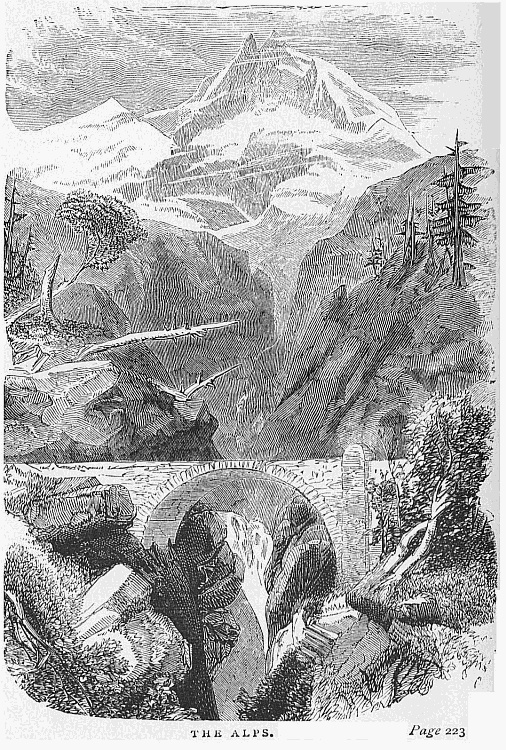
The road for the first part of the way was tolerably level, so that good progress was made. Etruria, with its ancient temples and shrines of the gods, to the worship of whom the people still tenaciously clung, was traversed. Then, after crossing the Amis—near the town of Pise, where a day was spent with Christian friends—a more mountainous region was entered near Luca. Now the road led along the sides of the lofty Apennines, towards Liguria. Jovinian had relieved his mind by delivering most of his letters, and as from a height he had ascended he beheld the Cottian Alps, their lofty peaks capped with snow, he anticipated a happy termination to his journey. But he had still many rugged mountain passes to traverse. The day was drawing to a close, and neither he nor Largus were certain where they would find shelter for the night. Rugged and precipitous rocks rose up on the right hand, while on the left yawned deep chasms, unfathomable to the eye. The stones, as they slipped beneath the horses’ feet, went bounding down until the sound died away in the depths below. To proceed faster than they were going was impossible without the risk of falling over the precipices, but the path was descending; and at last a gorge was reached, the sides so lofty that it appeared as if the sun could never penetrate to the bottom.
“Surely no human beings can fix their habitations in such a spot as this, and we shall have to pass the night under the blue vault of heaven,” observed Jovinian.
“We must push on, and find our way out of it before darkness sets in,” answered Largus.
Just as he spoke some figures were seen descending from the heights above, leaping from rock to rock. They made their way towards the travellers.
“Who can they be?” asked Jovinian.
“I do not like their looks; if they are honest I shall be very much surprised,” said Largus.
The two travellers did not attempt to alter their pace, seeing that they could not escape by flight. No shafts were aimed at them, and in a short time they found themselves surrounded by a party of armed men, with unkempt hair, long beards, and soil-stained garments, which showed the wild life they were accustomed to lead.
“Who are you, and where are you going?” asked the leader of the robbers—for such it was very evident they were. He drew a dagger as he spoke, and held it ready to strike Jovinian.
“We are simple travellers, carrying but few articles which you would deem of value—our necessary garments and some books,” answered Jovinian.
“And what about your money?” asked the robber, laughing; “that is of more consequence to us than the articles you mention; however, we will not stop here. You must spend a night with us. You cannot reach any human abode before dark, and we will take the opportunity of looking into these matters.”
Jovinian and Largus could only comply, and, attended by the robbers, they proceeded in the direction in which they were before going. They were soon out of the gorge, and entered a region even more wild and barren than the one they had left.
Black rocks lay scattered about, amid which a rapid stream hissed and roared along through a narrow bed. Further off, on the other side of a broad valley, rose precipitous cliffs, rent by the convulsions of Nature, which had formed dark gorges between them. In some places the mouths of gloomy caverns could be distinguished in the sides of the cliffs—fit abodes for wild beasts, or lawless men such as those into whose power the travellers had fallen. Towards one of these caves the robbers were conducting their captives, when suddenly from behind a rock a person started forth, whom Jovinian, from his strange appearance, took to be a madman or some being possessed of an evil spirit, driven from the haunts of men. If is dress, of coarse texture, stained with dirt, hung in rags and tatters about him, exposing a hair garment, worn next his skin. His person was emaciated in the extreme, his hair cut close, his head and neck sprinkled with ashes. He waved about him a staff, which he carried in his hand.
“What are ye about, ye men of violence?” he exclaimed, pointing his staff at the robbers. “Begone! fly! or be prepared for the vengeance of one who knows how to protect the innocent!”
The robbers drew back, trembling with fear; and as the recluse—for such he was—continued waving his staff, they took fairly to flight, and left Jovinian and Largus to pursue their way with their mules and baggage.
Jovinian, as he now observed the strange being to whom he was so much indebted, was reminded of those heathen eremites of whom he had read as long existing in the far East, who, by self-imposed tortures, abstinence from the society of their kind, and long prayers, hoped to merit a blissful immortality among the shadows of the blessed. Wishing to thank the recluse for the services just rendered, he rode towards him.
“You are, I judge by your appearance and bearing, Christians, and as such are welcome to rest during the coming night in my abode, for you can reach no other shelter before nightfall,” said the recluse, without listening to Jovinian’s thanks. “Or, should you be moved by the holy life led by me and my companions, you shall be at liberty to take up your residence with us.”
Jovinian thought it wise to make no reply to the last part of his invitation, but gladly accepted the shelter offered him.
“Follow me, then,” said the recluse; and, making use of his staff to support his steps, he strode on over the rough ground before the travellers towards one of the gorges which opened out at some distance before them, mounting the steep sides of the hill at a pace with which the horses could hardly keep up. He stopped before a wooden porch built of logs, at the entrance of a cavern.
“Your steeds will find grass at the bottom of the gorge, and water at a rill which trickles out of the mountain-side; here no one will molest them—even those bold outlaws dare not approach my abode,” said the recluse, as he signed to Jovinian and Largus to dismount. Fortunately the travellers had brought provisions, or they would have fared but ill on the lentils and water which constituted the food of the recluse. Bringing water from a neighbouring rill in a large bowl, their host insisted on washing the travellers’ feet—although not until they saw it would cause offence longer to refuse did they permit him to perform this act of humiliation.
As the shades of evening drew on, a voice was suddenly heard chanting a hymn from the opposite side of the gulf. It was echoed by another further up, until nearly a dozen voices had joined in the solemn strains.
“They are my brethren who have come here to dwell, and devote themselves to calm contemplation, fasting, prayers, and penance,” said the recluse. “You shall be made known to them to-morrow, and hear the words of heavenly wisdom taught from their lips.”
Jovinian and Largus made their beds by the aid of their saddles and horse-cloths in the outer porch, and were glad that they were not invited to enter the interior of the cavern. It appeared dirty in the extreme.
Mephitic odours pervaded the air. At the further end was a rough cross formed of wood, in front of which two palms were burning. They saw their host prostrate himself before it, and lie at full length with his arms stretched out for a long period; but he did not invite them to join in his devotions. He then rose and closed the intermediate door, so as to shut himself out from their view. Occasionally, during the night, they heard the sound of a lash, while groans and cries issued from the cell. Suddenly, as they were just dropping off to sleep, they were aroused by a voice from within: “Begone, Mercury—I know thee well, and thy ever-changing form; licentious messenger of uncleanness, thou canst not deceive me; and thou, mighty Jove, ended is thy reign, thy thunderbolts fall harmlessly, thy lightnings cannot strike me.” Thus, one after the other, the heathen gods were addressed as if they were present endeavouring to win back the anchorite to their worship.
At daybreak next morning their host roused up his guests, and invited them to join him in prayer. So extravagant were the expressions he uttered that Jovinian could with difficulty retain a due composure.
While they were breaking their fast, the recluse, who refused to eat, recounted to them numbers of miracles which he affirmed that he had performed, but which Jovinian was convinced—were he not purposely imposing upon them—were the hallucinations of a disordered brain. Jovinian could not fail to observe in his unhappy host a vain-glorious exaltation of self, and a spirit of pride combined with a false humility, which the system of asceticism was so calculated to foster. He saw, too, that this vain attempt to merit the favour of God arose from utter ignorance of God’s loving and merciful character, that it set at nought Christ’s finished work—His blood which cleanseth from all sin,—and was directly opposed to all the teaching of the Gospel.
His host afterwards entreated Jovinian to remain a few days, that he might learn more of the mode of life; and practices of himself and his associates.
“Before I can join you I must consult the holy volume which is my rule of faith, and ascertain whether your practices are in accordance with its precepts,” answered Jovinian. “I have not so learnt Christ, and I cannot believe that He who spent His ministry on earth in going about doing good among human beings would have His followers spend their lives where they can be of no use to any one.”
The pale brow of the anchorite flushed as he heard the young man speak. “Come, you may think better of my proposal; but I will now take you to visit my associates.”
The tour which Jovinian made among the other huts rather strengthened than altered his first impression. The inmates, he observed, were profoundly ignorant of Christian truth; a self-righteous ignoring of the righteousness of Christ prevailed universally among them. Some had probably been mad when they resorted to their present mode of life, and others had produced madness by their self-inflicted tortures or abstinence from proper nourishment. When he spoke to them he found that they were far from living in brotherly love: jealousy and ill-will prevailed, while several, asserting their superior sanctity, accused the others of being guilty of all sorts of horrible crimes.
Such was the commencement in Italy of the anchorite or monkish system, which had long existed in the East, and which soon spread over the western part of Christendom.
Jovinian returned to the hut; and, desiring Largus to saddle the horses without delay, bade farewell to their host.
“You will come back and join us?” said the anchorite, not at all aware of the impression made on Jovinian’s mind.
“Not until I find that the system you are pursuing is according to God’s way, and that I can thereby promote His honour and glory,” was the answer.
“Alas, alas!” exclaimed the anchorite, as Jovinian and his attendant rode off; “you will never gain heaven if you thus refuse our way of seeking it.”
Jovinian made no reply; arguments were useless with one who appeared little better than a madman.
Chapter Seventeen.
The Meeting.
As Jovinian and his attendant proceeded over the rugged paths, they naturally looked out somewhat anxiously to reaching their journey’s end in safety.
For several days they were compelled to put up at the huts of the mountaineers, and twice to seek shelter in caverns which it was evident had been used by other wayfarers. They were now travelling over some of the Cottian Alps. Here the mountains, broken by precipices, amid which they had to wind their way, rose on every side—the rocky bulwarks of those secluded valleys towards which they were directing their course. Here crag rose above crag, enormous masses of rock extending into the glens beneath—abysses of a depth which the eye could not penetrate. Innumerable springs of water gushed forth from the rocks, some uniting and forming torrents, which dashed foaming downwards into the hollows below. At length, surmounting a lofty ridge, they looked down upon a valley which presented scenery of the most beautiful description. So completely encircled was it by a rocky chain of mountains, that it appeared as if no rough winds could ever disturb its tranquillity. Sparkling fountains, issuing from the sides of the hills, made their way towards a bright stream which flowed at the bottom of the valley, irrigating the land in its course. The declivities were clothed with trees of every description, among which were numbers bearing fruit—the mulberry, the chestnut, the cherry, the walnut, and others. Cottages could be seen scattered about in every direction, showing that this favoured spot was thickly inhabited.
Here and there were dwellings of greater pretensions, which peeped forth from amid the groves. One edifice specially struck Jovinian: it had the form of a basilica such as those lately erected in Rome, and he had no doubt that it was used for Christian worship. No heathen temples were anywhere seen, although here and there a mass of ruins might have marked the spot where the shrine of an idol had stood. Jovinian’s heart beat more joyously than it had done for a long time. One of those residences, he was certain, must be the abode of Severus. Many months had passed since he last had heard from him, and a still longer period since he had been able to despatch a letter to his friend. Jovinian, therefore, was not expected; but his arrival would, he hoped, cause pleasure as well as surprise. The travellers, therefore, did not spend many moments in contemplating the enchanting scenery spread out before them, but, urging on their steeds, descended by a narrow pathway, leading from the heights they had gained through a deep gorge, which had to be passed before the valley could be entered. From the first peasant they met they inquired the way to the house of Severus.
“It is hard by the basilica which he has had erected for us,” was the answer; “and if Christians, as I know you to be, you will be welcomed as brethren, for so every one is received who comes in that character to his door.”
Already the shadows of the mountains were extending over the valley. They drew near a villa of elegant form, although not of costly materials; and Jovinian observed Severus walking to and fro on the terrace before the entrance. Throwing himself from his horse, Jovinian advanced towards his friend, who immediately recognised him, although he had grown into manhood since their separation.
Hurrying forward, Severus embraced him warmly. “We did not doubt your faithfulness, but we feared some accident had happened to you, since no letter has reached us for a year or more,” said Severus. “You will rejoice the hearts of my wife and child, who have been most anxious about you.”
Jovinian was soon in the presence of Eugenia and Julia—the latter blushing as she received his affectionate greeting.
“I have never had cause to regret coming here instead of remaining at Rome,” said Severus. “Although I hold that we are bound to bravely fight the good fight of faith against the world, the flesh, and the devil—being in the world, yet not of it—I should have proved of far less benefit to my fellow-creatures in Rome than, by God’s grace, I have been able to be here by faithfully preaching the pure Gospel, instructing the children, and advancing at the same time the temporal interests of the community. I have not confined myself to this valley alone, but have visited many others surrounding it. It is with gratitude to our Heavenly Father I am able to say that not a heathen temple remains within them, and that the people have mostly, if not altogether, abandoned all their idolatrous practices and superstitions; but still there is much work to be done, as there ever will be while the prince of this world has power over the children of men; and to that work, I trust, my beloved son, you will, from henceforth, devote yourself.” Such was Jovinian’s earnest desire.
It was with no small pleasure that he again met Eros, who greeted him with warm affection. The once ignorant slave had become the trusted overseer of Severus’ property, and at the same time an active promoter of the truth. There were two other persons of whom Jovinian wished to hear—Marcia and Coelia.
“They are both happily married, and are mothers. Marcia resides at the further end of this valley, and Coelia in the one beyond, where their husbands, greatly aided by them, minister to the spiritual wants of their neighbours,” was the answer.
Jovinian, who visited them, could scarcely recognise in the cheerful smiling matrons the once unhappy vestals.
Before long Jovinian became the husband of Julia; and he found in her an active helpmate in all his efforts for the good of the people among whom they had cast their lot.
Chapter Eighteen.
Jovinian revisits his Native City.
Years passed by; Jovinian became a deacon and presbyter of the Church of the valleys, and, in conjunction with other faithful men, was the means of extending the blessings of the Gospel among the inhabitants of even the most remote districts. No sound of the tumults which agitated the larger portion of the western empire penetrated to these remote valleys. The news which came from Rome was unsatisfactory. Revolts and cruel warfare had occurred in various directions. Magnentius had assumed the imperial purple. The tide of war had extended westward, in the very neighbourhood of the valleys of the Cottian Alps. A battle had been fought, when, the usurper being defeated, Constantius became sole master of the Roman empire. In the council held at Milan he obtained the banishment of Athanasius of Alexandria, a bishop highly respected for his orthodoxy; and Arianism was once more in the ascendency. Christianity, by the accounts received, appeared to be spreading at Rome, but so corrupted by idolatry that in many respects it could scarcely be distinguished from the old faith. At length Julian became master of the Roman empire, and, for a short time, the heathen system was declared to be the religion of the state.
Many at Rome, and elsewhere, who had been supposed Christians, now openly resumed their idolatrous practices, proving the real character of their faith.
By the death of Julian—who was shortly after succeeded by Valentinian—Christianity once more obtained the support of a sovereign.
For many years Jovinian and Julia enjoyed uninterrupted happiness, and were blessed with a numerous family.
At length Severus and Eugenia, both advanced in years, were taken from them, their places being well filled by their daughter and her husband. Although contented with his lot, and knowing that he was of use in the position he filled, Jovinian had for long desired to re-visit Rome, and ascertain for himself the state of affairs in regard to the Church in that city. He hoped that he should find some faithful men with whom he could hold brotherly intercourse, and that he might return to the home of his adoption with fresh strength and knowledge. He had now a son who would be able to perform the duties he had taken upon himself; and Julia so ably ruled his household that he could leave his home for a period without detriment. Although she naturally felt some anxiety at the thoughts of his performing so long a journey, she did not attempt to alter his resolution, believing that he would thereby benefit those he was about to visit, and gain for himself spiritual strength.
Instead of travelling by land—the fatigues of which he was less able to endure than he had been on his former journey northward—he decided on proceeding to the nearest port at which he could embark. Even then he had many fatigues to endure, a mountainous region to traverse, and torrents to pass over. Under the providence of God, however, the port was reached in safety. He found a vessel on the point of sailing for Ostia, and, after a rapid passage, he landed at that town.
He had reason to mourn the changes he everywhere witnessed. The former bishop had long been dead, and his successor seemed bent on gaining proselytes by every possible means.
There were several new Christian churches; but as Jovinian entered them he saw people prostrating themselves before figures closely resembling the heathen gods. A few persons seemed somewhat dissatisfied with the state of things; but in the whole place he found nobody to whom he could speak openly as to a brother.
His stay, therefore, was short; and engaging a vehicle, he hastened on to Rome, by the same road he had taken when compelled to return by his uncle Gaius. On approaching the sanctuary of Mars, the driver, who professed to be a Christian, informed him that it had been taken possession of by a body of holy recluses. On getting near the gate, a man was seen rushing with frantic speed, a sword dripping gore in his hand, as if he were flying from the avengers of blood. As the murderer neared the gate, it was thrown open; and springing in, he was received by several men in long coarse garments, and at once the door was closed. When the officers of the law arrived, they were refused admission. “We claim the ancient privileges of the place,” cried the monks. The officers, not venturing to dispute the point, returned to the city.
“What will the recluses do with the murderer?” asked Jovinian of the driver.
“He will become one of them,” was the answer. “Several of their number have been guilty of like crimes, and have thus escaped from justice!”
From what Jovinian had witnessed at Ostia, he was somewhat prepared for the scene which Rome presented as he drove through the streets. Christian basilicas—some of considerable magnificence—rose in every direction; but a large number of heathen temples remained, a few only having been pulled down to afford sites or materials for the before-mentioned edifices. Many temples were, however, closed, while others had been slightly altered to fit them for the Christian worship. At the corners of the streets were shrines, as in days of yore. They one and all contained female statues, which the driver told Jovinian were those of the mother of God. In the arms of several of the statues was an infant, who, his loquacious guide informed him, was “Jesus,” her son. Jovinian recognised the figures as those of the Babylonian Astarte and her son Horos: she, under the name of Isis, had long been worshipped in Rome.
Amulius had gone to be with the Lord whom he served on earth; but he had left a son, Prudentius, who had inherited his property, and had invited Jovinian to take up his abode with him should he ever visit Rome.
Prudentius—who had been a mere boy when he had last seen Jovinian—remembered him with affection, and warmly greeted him on his arrival. He had a numerous family, whom he had brought up in the simple faith of the Gospel; but he expressed his anxiety lest they should be led away by the corruptions which everywhere prevailed.
“By my father’s wish I refrained from entering the ministry, and have practised the law instead,” observed Prudentius. “It was his opinion that I should thus be far more free to advocate the truth,—for, had I become a deacon or presbyter, I should have been under the orders of superiors who were too likely to support the errors long creeping in among us.”
“I had heard that the inhabitants of Rome had become almost universally Christians,” said Jovinian.
“Alas, alas! they are so only nominally,” answered his friend. “Paganism in a modified form prevails as of yore. The more abominable rites, it is true, have been suppressed; but although the people have been taught no longer to trust in the heathen gods, they have retained their superstitions and the larger portion of their former customs. The aim of the bishops and other leaders in the Church has been to amalgamate the two systems, so as to induce the pagans to more readily afford them their support.
“Recently multitudes have been added to the Church; but, as you will have an opportunity of judging, the number of faithful men among us is few indeed. Our present bishop is, it is said, very ill; and, should he die, we have reason to fear no improvement will take place under his successor.
“The Arians are still numerous at Rome, and will make an effort to have a bishop of their own profession elected. Damasus, a presbyter, who has lately appeared among us, is said to have been educated among the recluses of Mount Carmel, in the East,—a college which I have ample reason to believe supports the Babylonian worship so prevalent in all parts. He has been received here by a powerful party, of whom I have ever had the greatest mistrust, as I have observed that they are among the chief promoters of the worship of the Virgin Mary, which is so rapidly gaining ground in the city. These men belong to what is known as the ‘Holy College,’ and are the successors of the heathen pontiffs, by whom, after the latter had become Christians, they were successively elected. They exercise almost as much influence among the Christian population as their predecessors did among the heathen.”
Jovinian recollected the plans he had heard discussed by Coecus, and saw too clearly how successfully they had been carried out.
On inquiring of his friend for information about the last days of his uncle, who had long been dead, Prudentius replied, “Yes: hearing he was ill, my father, being a relative, went to visit him, and afford him the last consolation of religion; but Gaius made no sign, and, turning his face to the wall, so died.”
“The pontiff Coecus: what ending did he make?” asked Jovinian.
“He lived to a great age, and, when Julian attempted to overthrow the Christian Church, he openly advocated the restoration of the heathen temples; but, finding that his plans were unsuccessful, he took poison and so died, and went to his place,” answered Prudentius.
“But the harm he has done lived after him,” observed Jovinian; and he then recounted to his friend the knowledge he had gained of the plans of the pontiffs for the destruction of religion.
Many days passed by; and the more Jovinian saw of the state of things in Rome, the more convinced he was that those plans had been fearfully successful.
The Bishop, Liberius, was declining rapidly, and great excitement prevailed among those who would take part in the election of his successor. A fresh candidate had appeared, in the person of Ursinus—a man of considerable influence in Rome, who had lately become a deacon, but who was in no way distinguished for his Christian virtues.
Jovinian and Prudentius had together been visiting some of the churches, and were returning with heavy hearts at what they saw, when they met Juventius, the city prefect.
“The Bishop Liberius can live but a few hours longer,” observed the prefect. “I feel greatly anxious as to what may happen. Armed men are collecting from all quarters, and repairing, some to the residence of Damasus and others to that of Ursinus; and I much fear that the rival factions will resort to force instead of waiting the result of a legal election.”
“Can these men believe themselves to be ministers of our holy Religion, followers of Him who exhorted His disciples to love one another, to refrain from violence, and do all the good they can to their fellow-creatures?” exclaimed Prudentius. “Alas, alas! how do they differ from those who in the early ages gained the love and respect even of the heathen!”
As they were speaking, a man rushed past them, crying as he ran, “The bishop is dead! the bishop is dead!”
“Then I must summon my guards to preserve order,” observed Juventius, hurrying off.
“Can the prefect possibly fear that those who are desirous of becoming the leaders of Christ’s flock should resort to force of arms?” exclaimed Jovinian.
“He has observed what has been taking place in the city for some days past, since the illness of Liberius became known, and he considers the temporal value of the post the candidates are seeking,” answered Prudentius. “If we wish to avoid the risk of getting entangled among the mob, it would be wise to return home.”
The two friends were at this time at a considerable distance from the house of Prudentius. They accordingly bent their steps as he advised. They were approaching the Basilica Sicininus, when they saw advancing towards it a large body of armed men, headed by a person whom Prudentius recognised as Ursinus, one of the candidates for the vacant bishopric. This basilica being the principal church, it was considered that the party which held it would have the best chance of success. Another band directly afterwards came rushing along from an opposite direction, evidently with the intention of endeavouring to intercept the first.
The two friends, with the greatest difficulty, avoided being carried on with the tumultuous throng by stepping into a deep archway which happily presented itself. They observed, however, that the first party gained the threshold of the entrance to the church, and with loud shouts and shrieks took possession. The second band attempting to force a way in, being less numerous, was driven off, leaving several dead on the ground, while others were bleeding from severe wounds.
As they retreated they uttered cries of vengeance, threatening ere long to return and drive out the occupants of the sacred edifice.
Jovinian and Prudentius now again attempted to make their way homeward; but they were once more stopped by having to avoid a band led by Ursinus, who issued out of the church, leaving a strong garrison within it. Before long they met another party of the supporters of Damasus, whom, however, they put to flight. Now reaching the abodes of some of their opponents, they broke into the houses, which, having thrown out the furniture, they set on fire.
This example was quickly imitated by others of the opposite party. The friends had not gone far when they caught sight of Damasus himself, at the head of a larger band than had yet appeared, supported by several presbyters, deacons, and other officials, while among them appeared a party of men wearing cowls and coarse garments, who were evidently monks invited by Damasus to assist him. Whether ecclesiastics or not, the whole multitude carried arms, spears, swords, or daggers. They were encountered by a band of the hitherto victorious followers of Ursinus. A fierce fight took place under the walls of the burning houses; neither party would give way, and many had fallen, when Juventius, the city prefect, appeared with his guards. In vain he shouted and ordered the combatants to desist; no one listened to him, until, rushing forward, he endeavoured to separate them.
Indignant at his interference, the leaders turned their rage towards him, and, attacked by both parties, he was compelled to retreat. A part of the maddened mob pursued him, shouting out that as he was a civil officer he had no business to interfere in the affairs of the Church. Finding not only that all his efforts to restore order were futile, but that the rioters were sufficiently strong to overpower him, he, together with his guards, escaped for safety into the suburbs.
The wildest disorder and confusion prevailed throughout the streets of Rome during that night.
Not without great risk to themselves had Jovinian and Prudentius been able to reach home.
From the roof to which they mounted they could see fires blazing in all directions, while the shrieks and cries of the enraged factions rose up from the streets—some near, and others in the far distance.
Whenever the followers of Ursinus met those of Damasus, they attacked each other with the greatest fury.
During the whole night the tumult raged. In the morning bodies of dead men were seen scattered about in all directions. Ursinus still held the basilica, which his followers began to fortify. The party of Damasus resolved to dislodge them. For this purpose he and his supporters were employed the whole day in gathering together all they could induce to join them. Heathens, provided they came armed, were as welcome as others. The prospect of sacking the houses of the other party afforded them sufficient temptations. Once more did the prefect attempt to restore order; but barely escaped with his life. The voting for the two rival candidates for the bishopric had been going on,—first one party, then the other, being at the head of the poll. The rage of the rival factions increased when either appeared to be successful or were losing ground. The tumult raged with even greater violence than on the previous night. Now Damasus, at the head of an organised band, advanced through the streets towards the basilica. Ursinus himself, with a less numerous party, in vain attempted to reach it, in order to support its garrison. The doors were burst open, and the forces of Damasus rushed in. A fearful combat took place. The edifice in which prayers and hymns of praise were wont to ascend resounded with the frantic shouts of the combatants, with the shrieks of the wounded and the groans of the dying. For hours the fight continued to rage. Now the assailants gained an entrance; now they were again driven out by the desperate efforts of the besieged, who believed that a general massacre would take place should they once be overcome.
At length so many of their number had fallen, that, bursting through the door opposite to that at which the chief attack was going on, they made their escape, pursued by their enemies. The party of Damasus, flushed with victory, drove back the followers of Ursinus wherever they were met; and he himself, believing that his cause was lost, retreated with a few of his ecclesiastical supporters from the city.
When morning broke he was nowhere to be found. His few followers wisely retired to their homes; and the prefect, returning, was at length able to restore order.
Fearful were the scenes which Rome presented, as Jovinian and Prudentius once more ventured forth. Smoking ruins in all directions; corpses scattered in every street; some, where the combat had been fiercest, lay in heaps, many blackened and charred by the burning houses near which they had fallen. Fighting had taken place in several other churches besides the Basilica of Sicininus, and blood stained their pavements; the bodies of many of the dead still lay where they had fallen. Prudentius proposed going on to the Basilica of Sicininus, where the fiercest struggle had taken place. On entering the church they started back with horror. Before them lay, with distorted countenances and in attitudes showing the ferocity with which they had fought, scattered throughout every part of the building, the corpses of the slain. They were chiefly those of the defeated party, although several of their opponents had of course fallen. On counting them, they were found to number one hundred and thirty-seven. The prefect had issued orders for the interment of the dead. It had been a question whether they should receive Christian burial, or be deposited together in one of the catacombs outside the walls. But Damasus insisted that the followers of Ursinus only should be thus buried,—“he having arranged,” he said, “a fitting funeral for those who had fallen as martyrs for the truth.”
Prudentius, when he met the prefect, inquired whether he intended to bring Damasus and his followers to account for the tumult.
“It is more than I dare do!” he answered. “Were I to make the attempt, it would probably cause another outbreak, with equally disastrous results. Supported by the emperor, your Christian bishop has more power than I have, and I must allow him full licence to promote, as he thinks best, what he calls the interests of religion. I leave you to judge, however, whether the late events are calculated to recommend it to the minds of the heathen. The Romans may yet rue the day they consented to be ruled by their bishops.”
Damasus was declared duly elected, by the presbyters and deacons, and the Christian population of Rome.
The following day he paraded through the streets in a handsome chariot, attended by a numerous body-guard richly clothed. In his hand he carried the Lituus,—the long used insignia of the augurs, since known as the bishop’s crozier,—proving that he considered himself to be their lineal successor.
Having taken up his residence in the palace of the Lateran, he gave a magnificent banquet to his chief supporters, which was said to surpass in sumptuousness those, not only of the more wealthy citizens, but of the emperor himself. He had become possessed of the wealth left by his predecessor, and had reason to be sure that more would, ere long, flow into his coffers from the piety of the matrons of Rome. In this he was not mistaken; eternal happiness being freely promised to all who would thus enrich the Church. Many pious people also devoted their wealth to the building of basilicas, to which they claimed the right of appointing the ministers, following the example of those who had erected heathen temples, of selecting the priests to attend them.
Every day Jovinian remained at Rome brought more sorrow to his heart.
There were still many heathen temples; and from the Altar of Victory—which had been restored by Julian—the smoke of sacrifices ascended. In many of the basilicas statues which he recognised as those of Isis, or some other heathen goddess, now generally clothed in rich garments, held most prominent places. Numerous other clothed statues were placed in niches with lamps burning before them. Jovinian had no difficulty in distinguishing those which had before represented the heathen gods and goddesses from the figures of the apostles and martyrs, also carved in wood or stone—the latter exhibiting a melancholy proof of the decadence of art in the capital. Everywhere, indeed, he found that the plan of Coecus had been successful. The worship of the Babylonian goddess, under her new name, prevailed throughout the city. Although Christianity had not been crushed, it had been fearfully corrupted; in reality, idolatry had won the victory in the battle which it had long been waging with the Christian faith; no longer in Rome was the simple Gospel preached. Flowery discourses, at which the people signified their approval by loud applause, were delivered from the pulpits. The Christian ministers now appeared in the same rich garments which had been worn by the heathen priests. Relics were adored, and supposed to work miracles; prayers were offered up for the dead, and to the martyrs, as well as to her whom they called “Mary the virgin mother;” people were taught that penances were meritorious; ascetic practices were inculcated; the existence of purgatorial fires, as believed in by the heathen, was taught as a reality, from which the dead could be emancipated alone by the prayers of the priests; while so notorious had become the efforts of the clergy to obtain wealth from the devout among the female sex, that an edict was published by the emperor forbidding ecclesiastics to receive any gifts, inheritance or legacy, at the hands of devout women, and the ministers were compelled, according to custom, to publish this decree from all the pulpits in the city,—thus becoming the heralds of their own rapacious propensities.
In vain Jovinian made every effort to stem the tide of corruption. He preached, whenever he could obtain an opportunity, in the churches, faithfully pointing out the fearful errors into which the Christians were falling, until every basilica was closed against him. He continued, however, to preach in the houses of a few faithful men, and even at times in the open streets; but at length—branded by the bishop as a heretic and a disturber of the public peace—he received an order forthwith to quit the city. As his liberty, if not his life, would have been in danger had he ventured to disobey the order issued by the powerful pontiff, he bade farewell to Prudentius, and turned his face northward.
From the tranquil valleys among which he had taken up his abode he often wrote to his friend, and received letters in return. In one of them Prudentius, giving way to despair, thus expressed his opinion: “By the unholy union which has been effected, idolatry has strangled Christianity in her baneful embrace (Note 1), and has sent forth instead a gaudily-dressed being, which, calling herself the True Faith, insists that all mankind shall fall down and worship as she dictates.”
“Be not in despair, my friend,” answered Jovinian. “God has promised to protect His Church; and be assured that He will raise up faithful men in coming ages who will protest against all these corruptions, and the time will come when the simple Gospel will be again faithfully preached, and the practices of the apostolic age be restored even in Rome itself, where the mystery of iniquity has begun its fearful reign.”
The End.
Note 1. Sir Isaac Newton states that before the end of the fourth century the idolatrous worship of the Virgin Mary had been universally established, while nearly all the corrupt practices of the Church of Rome had been already commenced, although many of her dogmas were not introduced till centuries later.
|
Chapter 1
| |
Chapter 2
| |
Chapter 3
| |
Chapter 4
| |
Chapter 5
| |
Chapter 6
| |
Chapter 7
| |
Chapter 8
| |
Chapter 9
| |
Chapter 10
| |
Chapter 11
| |
Chapter 12
| |
Chapter 13
| |
Chapter 14
| |
Chapter 15
| |
Chapter 16
| |
Chapter 17
| |
Chapter 18
|