"A Story of the Early Days of Papal Rome" (continued 2)
Reading edition
With these thoughts in his mind, Eros went to his master, and strongly urged that, unless the young Jovinian were allowed to go out and breathe the pure air, he would fall sick, and very likely die. His request was granted much more easily than he had expected.
“Take him forth, then,” answered Gaius; “but beware, slave, lest the youth escape your vigilance; you will be answerable with your life for his safe custody.”
“The life of the slave is in the hands of his master,” answered Eros. “The air is fresh and cool; a walk into the country will restore vigour to his limbs and the colour to his pale cheek.”
“See to it, and let me hear a better account of him,” observed the pontiff, as the slave left his presence.
“Joyful news I bring!” said Eros, as he entered the chamber; “we may set off without delay. Let me advise you not to leave your gospel behind, nor any article that you value.”
Jovinian did not enquire why Eros gave this advice, but gladly accompanied the slave into the open air.
“In what direction shall we go?” he asked.
“We will take the way at the foot of the Palatine, and along the banks of the Tiber,” answered Eros; “then round by the Aventine hill, and return home by the Flavian amphitheatre.”
“That seems a somewhat long circuit to make,” replied Jovinian.
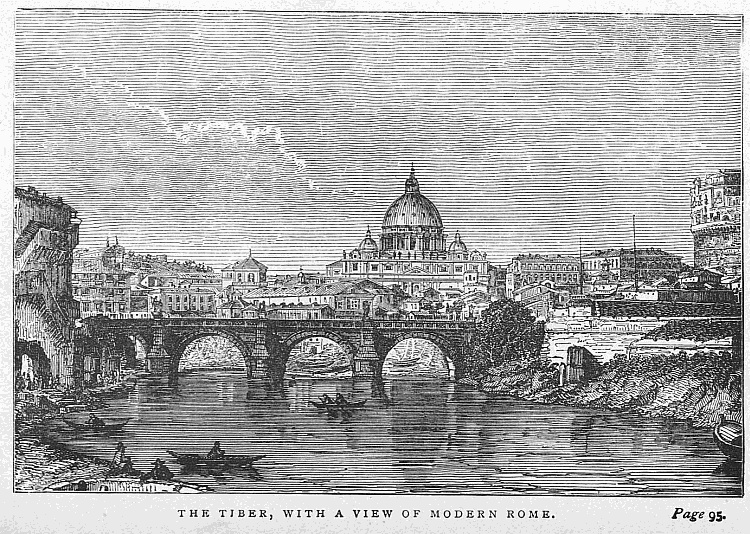
“The fresh air will enable you to enjoy it, and possibly you may be induced to prolong your walk,” replied the Numidian. Every step they took Jovinian felt inclined to proceed farther and farther. Instead, however, of following the road along the bank of the river, Eros turned off to the left, and passing through the nearest gate of the city, struck directly across the country. They had gone on for some distance, when a female was seen approaching them. She stopped as she observed Jovinian. “Surely I know you!” she exclaimed, taking his hands, “though grown so much and become so manly. Have you forgotten Rufina?”
“No, indeed! never can I forget one who was ever so faithful to my beloved mother,” answered Jovinian: “but how happens it that we have thus met?”
“I have long been watching for you,” answered Rufina, in a low voice, drawing Jovinian aside. “There are some friends not far off who greatly desire to embrace you—one especially, by whom your mother Livia was greatly beloved: Eugenia, now the wife of the presbyter Severus—and should you desire to escape from the thraldom in which you are held, they will afford you a secure asylum where the pontiff Gaius can never find you. Fear not,” she added, as she observed Jovinian glance towards Eros; “the Numidian will not stop you. I have communicated with him, and promised to secure his safety. Though he may not accompany you, he can no longer willingly serve a heathen master, and the price of his freedom has been provided.”
“Can you assure me of this?” asked Jovinian. “Much as I desire to obtain my liberty, I would not risk the safety of Eros, now that he is a Christian; and terrible would be his punishment were Gaius to discover that he had willingly allowed me to escape.”
“I will speak to him, and his answer shall convince you that I am not mistaken,” said Rufina; and, advancing towards Eros, she told him what Jovinian had said, adding, “I will now bid you farewell.”
“I desire not to impede you from going whithersoever you wish, though grieved that I may not accompany you,” said Eros. “My prayer is that we shall soon meet again, and that I may serve you as a freedman; and I rejoice to know that no longer as a slave shall I be compelled to act the guard and spy upon you. Farewell, Jovinian: Rufina forbids me to follow your footsteps, or I would thankfully accompany you. But do not be alarmed about my safety; she has provided a refuge where I can remain concealed, for I would avoid the enmity of Gaius,—he is aware that I know too many of the secrets of the college to allow me to retain my liberty, or even my life, could he get me into his power.”
Jovinian, satisfied on hearing that Eros was cared for, followed Rufina, who hastily led him along over the uncultivated country, which even in her palmiest days surrounded the city, till they reached one of the entrances to those subterranean labyrinths which have already been described. Jovinian followed her without hesitation; he had been well acquainted with them in his younger days, when he had dwelt in concealment with his mother and many other Christians. A well-trimmed lamp, which Rufina found within, enabled her to guide him through the intricate turnings of the labyrinth. Although several years had elapsed since he had entered them, he recognised, as they went along, many of the tombs of those who had departed in the faith. She stopped suddenly before one of them; he read the inscription on it. “Livia, the well-beloved! She rests in Christ.” The symbol above it was a dove, with an anchor carved on its breast. He gazed at it earnestly, and knew at once that it indicated his mother’s tomb.
“They brought her here to rest in peace, as she desired. And may I ever possess that sure and certain hope, the anchor of the soul, which enabled her to endure without wavering the storms and trials of life,” he mused.
Rufina stopped to throw a light on the slab, unwilling to interrupt his meditations, and remained without speaking. At length she observed, “We must hurry on, or the oil in the lamp may be exhausted before we reach our destination.”
They continued their course, proceeding along several galleries,—now descending some flights of steps, now ascending others,—till they reached a slab of stone, which resembled many they had passed, let into the wall, with rude inscriptions on them. Rufina knocked three times on the slab with a small mallet which she carried in her basket. Placing her ear against the slab, she listened, when, in the course of a few minutes, she heard the sound of a bolt being withdrawn, and the stone slowly swung back, allowing an opening sufficiently large for a person to pass through. Rufina taking the hand of her young companion, they entered, when the slab was immediately closed behind them. So rapid had been their movements, that to any one following them they would seem to have vanished. The janitor, a humble fossor, after saluting Rufina as a sister, led them on to the end of a long passage, when another door, of a similar character to the first, being opened for them to pass through, they found themselves, after advancing a short distance further, at the entrance of a small hall, from the roof of which hung a silver lamp, its rays casting a pale light on several persons assembled within. Jovinian hung back, not recognising those he saw before him; but no sooner had Rufina stated who he was than he heard himself greeted by friendly voices.
“Welcome, son of our well-beloved: thou hast been faithful as she was!” said the aged Gentianus, who was seated at a table in the centre of the hall. He drew Jovinian towards him, and placing his hand on the lad’s head, gazed into his face as he spoke. “We indeed rejoice that you have escaped from the power of the pontiff Gaius, and still more that you have resisted the temptations he offered you to depart from the faith. May the Holy Spirit ever strengthen and support you in the fiery trials you may be called on to go through. The mystery of iniquity doth already work, and who shall escape its toils? Those alone who cling fast to Christ. May you be among them, my son!”
Much more to the same effect was said by the patrician Gentianus, when his daughter Eugenia, and her husband Severus, advancing, welcomed Jovinian. His mother’s dearest friend was well disposed to treat him with affection. By her side was a young girl—her daughter Julia. As the maiden took his hand, Jovinian gazed at her with admiration. Her lovely features beamed with intelligence, and the light of Christian virtue. Firm in the faith, had the days of persecution returned she would have been ready to suffer martyrdom rather than renounce the Saviour who had bought her. Since their childhood Jovinian and Julia had not met, for Gentianus and his household had resided far away to the south, on the sunny slopes of the Apennines, where he and Severus had devoted themselves to the spreading of the truth among their heathen neighbours of all ranks. They had lately returned, called by important business, both secular and on matters relating to the Church; but, warned of the undying hostility of Coecus the pontiff, they had judged it prudent to take up their residence in their former abode, whence, undiscovered, they could communicate freely with their friends in the city, and afford an asylum to those Christian converts who might be compelled to escape from the malice of their idolatrous relatives. There was persecution even in those days; for though heathenism, as a system, was crumbling away, and few of the better educated or wealthy believed in the myths of the gods of Olympus, yet many clung to the ancient faith, or rather to its form, simply because it was ancient, and their ancestors were supposed to have believed in it. These persons in most instances treated with supreme contempt, and often with great cruelty, any of their relatives or dependents who openly professed a belief in Christ, refusing to have any transactions with them, and endeavouring to ruin or drive them into exile. Still more terrible were the penalties inflicted by the sacerdotal orders on any of their number who, abandoning idolatry, embraced the truth. If unable to escape from Rome, the dagger or poison too generally overtook them. Their safest place of refuge was in the subterranean galleries in which Jovinian now found himself. Thus it happened that he met numerous visitors at the abode of Gentianus. He had been conversing with his old friends, when he saw emerging into the light a lady of radiant beauty, habited in white, without the slightest ornament on her dress or head, a purple band round her forehead confining her close-cut hair. A second glance convinced him that he had seen her before, seated in a silver chariot on the day of the procession.
“Who is she?” he asked of Julia.
“She is the vestal Marcia,” was the answer. “Already the light of truth has entered the dark recesses of the temple; Marcia has received it, and would escape from the thraldom in which she is held, but that she has a young sister, Coelia, also a vestal, who is yet undecided. Coelia has heard the Gospel, and imbibed many of its truths, but the shackles of superstition are still around her; and while she dreads the malignity of Coecus should he discover that her faith in the false goddess has been shaken, she cannot resolve on flight. Marcia has come to seek counsel of Gentianus on the matter.”
“Surely he will advise her to urge her sister no longer to delay!” urged Jovinian. “Would that I could tell her all that I know of that fearful man! He will hesitate at no deed, however dark, so that he may attain his ends.”
Taking Jovinian’s hand, Julia, rapid in all her actions, made him known to Marcia. He, being under no vow of secrecy with regard to the aims of the pontiffs, briefly explained them to her.
“And are such the men who have so long directed the rites and ceremonies of the time-honoured religion of Rome!” she exclaimed. “Alas! how have we been duped. They themselves do not even believe in the false gods they pretend to worship.”
“Not only have they long held sway over the religious affairs of idolatrous Rome, but will continue to lead and govern in our future Rome, unless her sons and daughters adhere to the simple truths of our holy faith as taught by the apostles in the blessed Gospel,” said Gentianus, solemnly.
These words sank deeply into Jovinian’s mind. He never forgot them.
The vestal Marcia, having a dark robe thrown over her white dress, conducted by the guide—a Christian slave like Rufina, who had brought her to the abode of Gentianus—returned to the temple of Vesta.
Chapter Eight.
Relics.
Several days passed by. The small company in this remote portion of those vast galleries waited anxiously for news from the upper world. They had themselves no fear of discovery; for treachery alone, which they had no cause to dread, could betray their retreat. Other parts, however, of that underground labyrinth were frequently visited by large numbers of Christians from the city; and that he might converse with them, Severus, accompanied by Jovinian, guided by an aged fossor, traversed the galleries in various directions. What he saw and heard caused him deep grief as he passed by the groups he here and there found assembled. Some had come to visit the tombs of relatives or friends slain during the Diocletian persecutions, or who had died in later days. They were standing with arms outstretched, and open palms. Several were praying aloud. Severus stopped to listen.
“Cease, friend, cease, I entreat you!” he exclaimed. “Is it possible that you, a Christian, can be addressing the spirit of a departed brother? Have you so learnt Christ? Know you not that His ear is ever open to our prayers; that His heart beats in sympathy with all in distress; and that you are dishonouring Him by attempting to employ any other mediator between God the Father and ourselves than our one sole great High-priest, the risen Saviour of the world!”
Some to whom Severus spoke stared without answering; others defended the practice, which had lately, copied from the heathens, been creeping in among professing Christians; a few only listened respectfully to the arguments the presbyter brought against it.
Severus and his companions passed on till they reached some vaults, or rather enlargements of the galleries. Here numerous persons were assembled, employed in eating and drinking before the tombs contained within the walls. They were holding love-feasts in commemoration of their departed friends; but already the simplicity of the custom had been changed, as was shown by the flushed brows of several of the revellers; while some, more abstemious, were kneeling or prostrate on the ground, offering up prayers to the dead martyrs.
Severus, before passing on, warned them of their sin and folly. “O foolish people, whence have you derived these revellings, this custom of praying to the dead? Surely from the idolaters by whom you are surrounded!” he exclaimed. “Instead of being lights shining in the midst of a dark world, you have become as the blind leaders of the blind. Beware, lest the light you have be altogether taken away!”
Guided by the aged fossor, he and his companions made their way to those parts where in the days of the earlier persecutions the bodies of the few martyrs which had been rescued by their friends had been deposited. Great was the astonishment of Severus to find several persons with pickaxes and spades engaged in breaking open the tombs, and placing the mouldering remains in metal and wooden boxes.
“Why are you thus disturbing the bodies of the departed saints?” he exclaimed, as he stopped among them. “Could you not allow them to rest till summoned to rise by the trump of the archangel? Whither are you about to convey them? How do you intend to dispose of them?”
No one at first replied to those questions.
At length one, who appeared to be a deacon or exorcist, advancing, answered, “We have been assured that the bones of martyrs can cure diseases of all sorts, and work many other miracles; and as few can come here to benefit by them, we are about to convey the sacred relics to shrines where all may visit them; and some we would send to foreign lands, where they may assist in spreading the blessed Gospel.”
“Say rather, O foolish men, where they may tend to confirm the heathen in their ignorance. The very idea is taken from the idolaters, who worship blocks and stones, or any objects presented to them by their false priests. Could, even in their lifetime, these departed saints have cured any of the maladies which flesh is heir to? Then much less can their poor rotting bones, which ere long will be dust. With which of those bones, with which of those particles of dust, will their spirits be pleased to dwell, in order to impart such healing power? Oh, folly unspeakable! to think that the saints of God have further concern with the frail tenement they have shaken off! They are with Christ, to whom alone let me urge you to address your prayers. His arm is not shortened; His love is not lessened. As he healed the sick when he walked on earth, so can He cure if He thinks fit those who apply to Him.”
Much more Severus said; and he was continuing to address the people, some of whom were moved by his arguments, when a cry was raised that soldiers were in the galleries. Presently the ruddy glare of torches was seen in the far distance.
“Hasten this way,” cried the fossor, who suspected that, whatever the object of the soldiers’ visit, those he had in charge might be placed in danger. Severus and Jovinian followed him, as he rapidly retreated in a direction opposite to that in which the lights were seen. Loud shouts were heard echoing through the galleries. It was evident that the soldiers were in pursuit of some one. The sounds drew nearer. The fossor ran as fast as his aged limbs would allow; his companions supporting him. Numerous long passages were traversed.
“The soldiers have a guide with them, or they would not venture thus far,” said the fossor; “but we may still escape them.”
As he spoke he led the way through a narrow opening. Severus followed; Jovinian was about to do so, but he turned for a moment to ascertain the distance their pursuers still were from them. He then passed through the opening, but the light from the fossor’s lantern was not visible, he feared to cry out, lest his voice might betray him. He groped his way forward with outstretched arms. He felt convinced that of two passages he had taken the wrong one. He turned to retrace his steps. In a few seconds a bright light flashed in his eyes, and he found himself in the hands, of several Roman soldiers, who roughly demanded what had become of his companions.
When Jovinian and Eros made their escape from the college Gaius was absent, and was not expected to return till the next morning. Of this the Numidian was aware, and had taken advantage of the occasion.
On the return of the pontiff, somewhat later in the day than usual, when he inquired for his nephew, he was told by a slave, afraid of speaking the truth, that Jovinian had gone forth to walk with Eros, and had not yet come back. Supposing that they had simply taken advantage of the permission he had granted, he took no further trouble about the matter, but, throwing himself on a couch, called for a cup of Falernian to quench his thirst. He was about to order a second when Coecus entered. A frown was on his brow, and his countenance wore a moody aspect. He sat down opposite to Gaius, who, looking up, observed, “If aught troubles you, follow my example, and quaff a cup or two of this generous wine. Nothing so effectually dissipates the mists which are apt to gather at times round our brains and obscure the vision.”
Coecus turned his eyes away with an expression of contempt from his convivial companion, and muttered something inaudible. “I have ample cause for anger and annoyance,” he said, at length. “What think you? This pestiferous doctrine of the Nazarenes has found its way even into the temple of Vesta. On entering unexpectedly, as it proved, to visit our fair charges, I found the vestal Coelia, who ought to have been attending to the sacred fire, so absorbed in reading a book that the flames were almost extinguished. She started on seeing me, and endeavoured to conceal the roll; but I snatched it from her, and as I glanced my eye over the pages, great was my astonishment and indignation to discover that it was not the production of one of our poets, which I might have pardoned her for reading, but a portion of what the Nazarenes call their Scriptures! I cast it on the altar, and, as it was consuming, I watched the expression of grief which overspread her countenance, as if she were beholding the destruction of some precious object. I demanded whence she had obtained the roll, but she stubbornly refused to inform me. I threatened her with condign punishment; but, folding her arms on her bosom, she claimed her right as a Roman maiden to peruse a work approved of by Augustus. ‘As a vestal, sworn to obey the rules of your order, you have no right to read what may shake your confidence in the great goddess to whom your life is dedicated,’ I answered. Much more I said, using persuasions and threats to learn how she had obtained the roll, and whether others in the temple had imbibed any of these Christian doctrines. Vain, however, were all my efforts. I did not expect to find one so young and gentle so determined. I reminded her that she might be condemned for breaking her vows, and of the fearful punishment which would follow. She smiled, as if she dared my power. While we were speaking the sacred fire went out. She seemed in no way appalled, but handing me two pieces of wood from a felix arbour, suggested that I should at once re-light it. As in duty bound I should have scourged her for her neglect, but her youth and beauty forbade such a proceeding, especially as I had been partly the cause of the catastrophe. I followed her advice, and the flame soon burned up again brightly. Reminding her of the double punishment she had incurred, I sent another vestal to take her place, and delivered her over to the charge of the Vestalis Maxima, with strict injunctions to the venerable dame to keep a strict watch over her movements, and to report to me all she says, and with whom she holds communication. We must afford her liberty, or it will be difficult to convict her. It is a question for consideration whether we should assert the supremacy of our ancient laws, and make an example of the vestal Coelia—there will be no difficulty in proving that she has broken her vows—or whether the time has arrived for assuming the masks we have designed, and at once declaring ourselves convinced of the truth of the Christian doctrine.”
“I dread the task we should impose on ourselves if we turn Christians, and would therefore defer the day as long as possible,” answered Gaius, stretching himself on his couch.
“In that case the vestal Coelia must die,” said Coecus, in a calm tone. “We can have no half measures. If we do not swim with the tide, we must stamp out this creed at once.”
“No easy matter, considering, as I understand, that it has existed well-nigh three hundred years, in spite of all the efforts made to destroy it, since a certain Paul, a man of no mean ability, visited our city on several occasions,” observed Gaius. “Had our fathers known in those days to what this doctrine was tending, they would have nipped it in the bud, and we should have been saved a vast amount of trouble.”
“It is useless regretting the past,” said Coecus; “we must keep our eyes steadily fixed on the future. But, I repeat, that I have no hope of destroying the name of Christian.”
Chapter Nine.
The Captured Rescued.
Coecus, finding that his companion had fallen asleep, set himself to consider his plans with regard to the hapless Coelia. He held to the opinions put forth by some of the leading heathen philosophers of that age, that the end justifies the means, and no feeling of compunction as to the cruel fate he designed for the young vestal entered his heart. He was of the material of which arch-inquisitors were in after years to be made. There would be no difficulty in that corrupt city to obtain evidence to condemn his victim, as well as to prove that the partner of her supposed guilt had escaped. After resting for some time, he went forth again to make the arrangements he had determined on.
When, late in the day, Gaius awoke, he sent for his nephew, and, after some inquiries, discovered that Jovinian and Eros had been absent since the previous forenoon. At first he could not bring himself to believe that they had really escaped; but his inquiries at length convinced him of the fact, and, moreover, that Eros had been known to accompany Jovinian to some of the Christian places of worship. “Then the wretched slave has himself been led to embrace this new doctrine,” he exclaimed. “It may be suited to such as he; but, notwithstanding, if I can capture him, he shall be made to pay the full penalty of his crime.”
The pontiff was, in truth, as much annoyed as it was in his nature to be; but he was disposed to vent his anger on the head of Eros rather than on that of his nephew.
Several days passed by, and no information could he obtain as to where the fugitives were concealed. From a few words let drop by Coecus, he at length began to hope that he might recover Jovinian. The chief pontiff had heard that the man he hated above all others on earth—the presbyter Severus—was again in the neighbourhood of Rome; and from the friendship which had existed between his sister and Eugenia, he suspected that Jovinian, if he knew of her abode, would have gone there. What Coecus intended to do he did not say, but the muttered threats of vengeance in which he indulged showed the evil feelings rankling in his bosom. Assassins were to be found, even in those days, to perform any deed of blood required of them; vice was rampant; and crimes of all soils were committed with comparative impunity. But Rome even thus was purer than it became in after ages; the people had been taught to respect the laws, criminals did not always escape the arm of justice, and no inconsiderable Christian community, leading pure and faultless lives, leavened the mass, and contributed to keep the heathen in check.
Coecus had to proceed with more caution than suited his bold and impulsive character. He succeeded, however, in persuading the chief civil authorities that there were some persons with designs dangerous to the state concealed in the underground galleries in the neighbourhood of the city, and in obtaining a guard of soldiers to search for them. He, with some difficulty, obtained a guide who professed to be acquainted with all the intricate turnings of the galleries, and, moreover, to know Severus and Eugenia by sight. Coecus, who was well aware that considerable danger might attend the expedition, had no intention of accompanying it, but remained in Rome, indulging himself in the hope that he should at length destroy his old rival, or get him into his power, while he at the same time exulted in the idea that, from the measures he was taking, he should prolong the existence of idolatry as the religion of the state. One of his plans was to organise another procession in honour of one of the gods, similar to that which has been described; for such spectacles, he knew, were at all times attractive to the populace, and it mattered little to them whether Bacchus, Apollo, Venus, or any other divinity had the most prominent position in the exhibition.
He had given directions to the vestals to prepare for the ceremony, in which, as usual, they would be expected to take a leading part; and he guessed that, should any besides Coelia be tainted with the new doctrines, they would endeavour to escape appearing on the occasion. Coelia herself remained under the strict charge of the Vestalis Maxima, whose office was in later days to be represented by that of the mother superior of a nunnery. The Vestalis Fausta being long past her prime, and having spent her life within the walls of the temple, had no interests beyond them. Her temper had become soured, her better feelings seared; and being thus a willing instrument in the hands of the pontiffs, she was ready to execute any act of tyranny and cruelty they might direct. Her mind, narrowed by the dull routine of duties she had so long performed, she was a devout worshipper of the goddess she served; and she heard with the utmost horror and dismay that one of those under her charge had embraced the hated doctrines of those whom she called the atheist Nazarenes. Poor Coelia had no hope of mercy from such a person. Marcia, finding that she herself was not suspected, kept her own counsel, determined at all costs to rescue her friend. It was a sore trial to her, for she felt herself guilty of dishonouring Christ while continuing to serve in the temple of a false deity.
The pontiffs, meantime, were busily engaged in arranging the details of the procession. Gaius troubled himself less than the other pontiffs about the matter. He especially disliked the exertion of the long march through the city, and he doubted whether the result would be as satisfactory as Coecus anticipated. He was seated in the college, when it was announced that a female slave desired to see him. He directed that she should be admitted, when Rufina entered. Taking a bag of coin from under her cloak, she, without hesitation advanced to where he sat.
“I have come to bring the price of one who was your slave, but desires manumission,” she said calmly, offering the bag of money to the pontiff. “It contains thirty solidi, the full value you can claim for Eros, he of whom I speak,” she continued, seeing that Gaius did not put forth his hand to receive the bag. “Me might have escaped beyond pursuit, and allowed you to lose his value, but, as a Christian, he knows that such would be wrong, and therefore I have been sent to pay it into your hands.”
“The Numidian Eros a Christian! such an idea is folly!” exclaimed Gaius, starting up with more animation in his tone and manner than he had hitherto shown. “If he is a Christian, he thus only adds to his crime. The money he must have stolen—probably from me; I refuse, however, to receive it. Let him return to the bondage from which he has escaped, or if I discover him he will rue the consequences. And for yourself, girl, as you have ventured in here, unless you inform me where he is hidden, and will promise to assist in his recovery, I will detain you and punish you as you deserve with the scourge.”
“I came to do the bidding of my master; and should any harm befall me, there is one to whom he will appeal for justice—the emperor,” answered Rufina, without betraying the slightest fear. “You dare not detain me. Again I offer the value of your once slave, and, though you refuse, I have fulfilled my duty, and must be gone.”
Gaius was almost speechless at what he considered the unexampled audacity of the slave girl; and as he still refused to take the bag, Rufina, while he was considering what to do, turned, and left the hall. Before her figure had disappeared among the marble columns he started up, and summoning one of his attendants, often employed in secret matters, he directed him to follow Rufina, but to keep himself concealed, to obtain what assistance he might require and not to return without bringing back Eros and Jovinian as his captives. The slave, instantly comprehending what was required of him, started off to execute his master’s orders.
The pontiff sank down again upon his couch. “Though I have lost the solidi, I shall have the satisfaction of wreaking my vengeance on the head of the Numidian,—and, what is of more consequence, shall recover my graceless nephew,” he said to himself, stretching out his arms and giving a yawn. “Ungrateful as he has been, I will still afford him another chance.”
On the appearance of Coecus, Gaius told him of the hopes he entertained of recovering Jovinian and his runaway slave.
“The vile wretch of whom you speak must receive the full penalty of his crime, or we shall have all the slaves in Rome turning Christians and claiming their freedom,” observed Coecus. “As to your nephew, the bed of the Tiber will be the safest place to which you can consign him. The young atheist, with the early training he has received, will never become a trustworthy supporter of the ancient gods.”
“I will try him, notwithstanding,” answered Gaius; “but I have not caught him yet.”
Several more days passed by; but neither Jovinian nor Eros had been captured, and Gaius began to fear that he had lost his money and his revenge.
The pontiffs had been seated in conclave, and were on the point of separating, when a message was brought to Gaius. A gleam of satisfaction passed over his countenance.
“Stay, fathers, for a few moments,” he said. “A rascally slave who, forsooth, has taken it into his head to turn Christian, and to decamp, moreover, with my nephew, of whom he had charge, has been captured, I would question the vile wretch as to what has become of the youth; and failing to draw forth the information, as I think likely, we will make some sport of the slave before he is sent off to receive the punishment he merits.”
The countenance of Coecus exhibited a look of disgust, as if he had no desire to be troubled in the matter; but three or four of the other pontiffs acquiescing, Gaius directed that the Numidian should be brought in. Eros soon appeared, heavily manacled, with a guard of four armed men, who watched narrowly every movement he made, and kept their weapons ready for use, as if they feared that even now he would endeavour to escape.
The prisoner advanced with an undaunted countenance, and head erect, as if perfectly fearless of the stern judges before whom he stood. In vain Gaius inquired what had become of Jovinian. Eros replied that he had parted from him outside the gates, that he had gone with a friend, and that more about him he knew not. He acknowledged without hesitation that he had sinned against his master in allowing the youth committed to his charge to depart, and that he was ready to pay the penalty of his fault. “Wretched being! you have heaped crime upon crime,” exclaimed Gaius: “you have endeavoured to escape from slavery, you have disobeyed my commands, and, as I understand, deny the existence of the immortal gods, and, following the example of the impious Nazarenes, refuse to worship them.”
“I worship One who is willing and able to save me, who died that I might be set free, and who has forgiven me all my sins,” answered the Numidian.
“What blasphemy is this we hear!” exclaimed several of the pontiffs in chorus. “He does not deny his crime, and yet talks of his sins being forgiven. Away with him. Let the cross be his doom!”
Gains, who had no wish to lose the services of a valuable slave, pleaded that a less severe doom than death would be sufficient, and suggested that instead he should be subjected to the ordinary punishment inflicted on runaway slaves—that of being hung up by the hands with weights attached to his feet, exposed to the noonday sun till he should faint from exhaustion. The other pontiffs, however, were inexorable. The slave had been brought before them for trial, and his death alone would satisfy their cruelty. Perhaps they took a secret pleasure in annoying their brother pontiff.
Coecus decided the matter, though he had apparently taken no interest in the discussion. “Let the wretch die the vilest of deaths. He has dishonoured the immortal gods!” he muttered. “It may advance our cause, as it will serve to bring into contempt the name of their founder, when the Christians see a base slave suffering the death he was said to have endured.”
Short time was allowed to the Numidian to prepare for his doom. He was to suffer not as a martyr, but as a runaway slave. Strictly guarded all night, he passed it in prayer and in singing hymns to the Saviour he had so lately learnt to love and trust. Early in the morning he was led forth to be conducted outside the city, bearing on his shoulders a heavy beam with a crosspiece attached, on which his arms were to be extended till death should put an end to his sufferings.
As Eros, staggering under the heavy weight of the cross, proceeded through the streets of Rome, many there were who looked on with horror and dismay at the spectacle. Coecus, more thoughtful than Gaius, had provided a guard, for he well knew that the Christians were already sufficiently numerous and powerful to have effected a rescue should they have discovered that he was really suffering for holding to the faith of the Gospel. A crowd had collected, and was following, composed chiefly of such idlers as are invariably attracted by any spectacle, though it may even be to see a fellow-creature put to death. Gaius and some of the other pontiffs walked at some distance behind, the motives which induced them to come being in no way superior to that of the vulgar mass. The condemned slave and his guards had proceeded some distance, when a litter, preceded by a lictor, was seen approaching. It stopped, for the crowd was too dense to allow it to pass; Eros cast up his eyes, and met those of the vestal Marcia, horror-struck at what she saw. The love of life, the dread of the torture prepared for him, prompted the condemned slave. Throwing down his burden, before his guards could stop him, he sprang towards the litter, and, clasping the vestal’s feet, claimed her protection.
“It is given,” she answered. “Citizens of Rome, the right is mine, as you all know, to set this criminal free. Let no man lay hands on him.”
“He is free! he is free!” shouted several persons from among the crowd. “The ancient laws of Rome must be supported.”
The guards and some others seemed unwilling to be disappointed of their prey, but the lictors kept them off; and some, evidently recognising Eros as a Christian, gathering round, bore him off out of sight just as Gaius and his companions arrived on the spot. They dared not disallow the claim made by Marcia, for it had been the privilege of the vestals from time immemorial, should they meet a criminal going to execution, to demand his release, provided the encounter was accidental, and that such was the case in this instance there appeared to be no doubt.
Marcia proceeded on her way, and Gaius, who was not altogether displeased at the occurrence, as he hoped to recover his slave, returned to the college.
Chapter Ten.
The Trial of the Vestal.
The vestal Coelia was summoned to undergo her trial before the college of pontiffs seated in council.
She stood looking pale but undaunted in their presence. The pontiff Coecus was her judge, and at the same time one of her accusers. With the others she was not allowed to be confronted.
She acknowledged without hesitation that the sacred fire had gone out while under her charge, and she condescended so far to defend herself as to remind Coecus that it was in consequence of his holding her for so long a time in conversation. She confessed also that she had been reading a book held in respect by the Nazarenes, and she claimed the right of a free-born Roman to peruse the work, which was one well known to be approved of by the emperor.
“You may have a right to read that or any other work, but not to imbibe the principles of that accursed sect which it advocates,” answered Coecus; “and that you do hold them you have acknowledged to me.”
“And I pray for grace that I may hold them to the end,” replied Coelia, looking the pontiff calmly in the face as she held her hands clasped hanging down before her.
“She admits that the sacred fire was extinguished in consequence of her carelessness,” exclaimed Coecus, turning to the other pontiffs; “nor does she express the slightest regret at her horrible sin. One guilty of so terrible a crime is capable of committing any other wickedness, however odious; and that she has done so, and that she has broken her vows, has been proved by the witnesses we have examined. That she is no longer worthy of being numbered among the vestals of Rome, I have already placed sufficient evidence before you.”
Coecus read over the false accusation which had been brought against the vestal. The guilty participator of her crime had escaped, he observed, but would undoubtedly be captured. Still, from the oaths of the several witnesses—which he named—her guilt was evident.
A flush mantled on the brow of the young vestal as she heard herself accused of a crime so foreign to her nature; yet she did not quail before that of her stern judge and accuser.
“You know, and these my other judges know, that I am innocent,” she said, in a voice which trembled but slightly. “If I am to be put to death, I am ready to die, if you have a right to destroy me, as a Roman maiden, with fame unsullied; I am guilty only of no longer believing in the goddess to whom in my childhood and ignorance my vows were made. I confess myself a Christian, and confess also that I desire to escape from longer serving the false goddess in whom you pretend to believe. But I indignantly deny the terrible accusation brought against me, which you yourself know to be utterly false.”
“Away with the girl: terror has made her mad!” cried the enraged pontiff, forgetting the dignity of his position, and shaking his fists fiercely at the accused maiden.
Coelia did not reply, but raising her hands to heaven—the only time she had altered the position which she had from the first maintained—she implored that protection which He in whom she believed was able and willing to afford.
She did not deign to plead to her cruel judges. She saw clearly that, for some object of their own, they had pre-determined on her destruction. She calmly waited to hear what more they had to say.
Coecus, standing up, pronounced her doom—that which from time immemorial had been inflicted on vestals who had been guilty of breaking their vows.
Her garments—worn by the vestals—and badges of office were to be taken from her, and she was to be habited as a corpse, placed in a litter, and borne through the Forum, attended by her relatives and friends, with all the ceremony of a real funeral. Then she was to be carried to the Campus Sceleratus, situated close to the Colline Gate, just within the city walls. In this spot a small vault underground, as in other cases, would have been prepared. It would contain a couch, a lamp, and a table, with a jar of water and a small amount of food.
Had the Pontifex Maximus been in Rome, it would have been his duty to take a chief part in the ceremony. Having lifted up his hands, he would have opened the litter, led forth the culprit, and placed her on the steps of the ladder by which she would be compelled to descend to the subterranean cell, and he would there have delivered her over to the common executioner and his assistants. They would lead her down into her living tomb, draw up the ladder, and then fill in the passage to the vault with earth so as to make the surface level with the surrounding ground.
Here the hapless vestal, deprived of all marks of respect ordinarily paid to the spirits of the departed, would be left to perish miserably by starvation, should terror not have previously deprived her of life.
Such was the doom pronounced on Coelia.
She heard it unmoved, and walked with unfaltering steps between two of the officers of the pontiff, to be delivered back to Fausta, the Vestalis Maxima, who was in waiting to receive her. Not an expression of pity escaped the lips of the old vestal, although she knew as well as Coecus that Coelia was innocent of the graver crime of which she was charged. But her heart had become hardened and scathed; not a grain of sympathy for her fellow-creatures remained in her bosom.
She believed she was acting in a way pleasing to the goddess she served; and she would have been ready to sacrifice her nearest relatives, if by so doing she would have advanced the cause of idolatry. She was aware that she no longer retained the affection of any of the vestals under her charge. Marsh and irritable, she ruled them with a rod of iron; and believed that the service of the temple was never so faithfully performed as it had been since she became its principal priestess. Fausta has since had countless imitators, most of whom have been as completely deceived as she was.
Coelia was conducted back to the cell in which she had before been confined, beneath the floor of the temple, where only the coarsest viands were allowed her to sustain nature. She was guarded night and day by two vestals, who were directed to summon assistance should they require it. Coecus was satisfied that the death of the vestal would prove to the multitude that the ancient religion of Rome was still paramount, notwithstanding the predilections of the emperor in favour of Christianity, and the privileges he was inclined to grant to the Nazarenes. He therefore hardened his heart against all feeling of pity at the terrible fate about to be inflicted on the innocent maiden, and now prepared, with all the energy of his nature, to make arrangements for the grand procession about to take place, and which he had resolved should precede the cruel ceremony he had determined to carry out. He was well aware that the Emperor Constantine would forbid so barbarous an act; but as he was engaged in the East in building his new city, it was impossible for him to hear of it for a long time to come, and although, when he became cognisant of what had occurred, he would undoubtedly blame the pontiffs, Coecus believed that he and the other members of the college had yet sufficient influence in Rome to set even Augustus himself at defiance.
The day broke bright and beautiful. All the altars in the temples and the shrines in the streets were gaily decorated with wreaths and flowers; while banners and gaily-coloured cloths were hung out from the windows, or over the walls of the private houses, in the streets through which the procession was to pass. As usual, numbers of religious mendicants—belonging to a brotherhood devoted to begging—with huge satchels on their backs, and figures of gods or demigods in their hands, were on foot, eager to collect contributions from the multitude assembled on the occasion. The members of several other heathen brotherhoods also might have been seen hurrying through the city, to take their part in the spectacle.
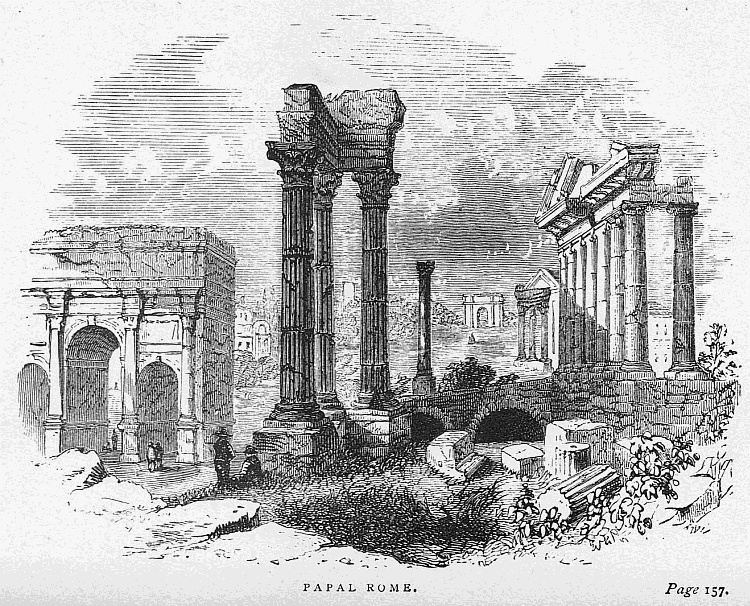
Now the procession streamed forth from the temple of Flora, which formed one of a line of magnificent temples extending from the Flavian amphitheatre to the north of the Palatine and Capitoline hills—that of Rome and Venus being the most easterly, and nearest to the amphitheatre. As it appeared, shouts of joy and applause were raised by the multitude. There had been no lack of persons ready to perform the duty of carrying the banners and figures of the gods and the goddesses. Coecus had also secured the assistance of as large a number of the female part of the population as he could collect, for he believed that could he keep them attached to the old faith, there would be less danger of their husbands becoming its opponents. Some hundreds of dames and damsels dressed in white, their heads adorned with glittering jewels and bright wreaths, issued from the temple, scattering handfuls of flowers before and around them. Bands of musicians performed their most lively airs suited to the occasion; vast numbers of young children, dressed likewise in white, with floral ornaments, chanted at intervals hymns in honour of the goddess. Priests also, of numerous temples, with shorn crowns, there were, carrying banners or figures of the gods they served, or sacred relics. The heathen magistrates and officers of state had willingly consented to attend and exhibit themselves in the procession, although the Christians had universally refused, under any pretence, to take a part in the idolatrous performance. Coecus, as he watched the pageant winding its enormous length along the streets, the banners and gilded statues glittering in the sun, before he took his accustomed place with his brother pontiffs, felt satisfied that the larger portion of the population of Rome still sided with them.
Gaius alone, as he walked along, muttered not a few expressions of discontent. “To say the least of it, these processions are a bore,” he grumbled. “They may please the mob, but sensible men ridicule them; and we who superintend them, and have thus to parade through the streets, have become the laughing-stock of all the wise men and philosophers. It will in no way benefit us, notwithstanding the trouble we take in the matter: how completely I have failed of convincing my young nephew of the advisability of the worship of the immortal gods his running away and refusing to return is strong evidence. As to putting to death this poor girl Coelia, I do not half like it. The emperor will visit us with his anger should her Christian friends prove her innocence, as they are sure to attempt doing. They are wonderfully active in defending their own friends, when they can do so by means of the law, without having recourse to force. This may be on account of their mean and timid spirits; though it is said that they fight well in battle, and that the emperor places great dependence on their courage and fidelity. Well, well, ‘Times change, and we must change with them,’ as one of our poets sings; but for my part I would rather have retained our old-fashioned ways. What has endured so long must be the best. The oldest religion cannot but be the right one, at all events most suited to the multitude, while it has not failed to bring a copious revenue into our coffers, and that, after all, is the matter of chief consequence to us. All the accounts, however, which come from Byzantium show that Augustus is becoming more and more inclined to favour these Christians. I wish that Coecus hid not been so obstinate, and would at once have consented to abandon our failing cause.”
When passing close to the Arch of Constantino, which had been erected after the visit of the emperor to Rome close to the Flavian amphitheatre, he glanced up at it with a look of contempt. “What can be expected of our Romans nowadays, when the whole architectural talent of our city can only produce a monstrosity like that!” he observed to a brother pontiff walking next to him. “‘The times are changed, and we must change with them,’” he repeated, “if we wish to retain our position.”
The other pontiff only shook his head, and groaned.
Chapter Eleven.
Released.
As the procession moved along towards the Sacra Via, Gaius observed a number of persons of a better class standing aloof, and watching it with looks far removed from admiration. Although the most earnest Christians kept away from such exhibitions, there were several people of good position who he knew had embraced the new faith, while there were others, among whom he recognised a poet, an architect, a sculptor, two or three philosophers, and some other men of intellect, who, although not Christians, he suspected had no belief in the immortal gods of Rome, as they were wont to look with most supreme contempt on spectacles such as that in which he was taking a part.
“There they stand, sneering at us,” he muttered; “perhaps they come to look as they believe it to be for the last time at our gods and goddesses parading our city; but they are mistaken,—our old divinities will hold their places still in the faith and affections of the people, albeit they may be habited in somewhat different garments.”
Now and then the eye of Gaius caught that of some young gallant, who nodded to him familiarly, and smiled at his evident annoyance as he endeavoured to keep up his dignity. The procession moved along towards the Capitoline Hill, on which stood the great temple of Jupiter, where the chief ceremonies of the day were to be performed. The people waved garlands, and shouted, the more devout prostrating themselves before the statues as they passed along, until the hill was gained. Coecus had taken care to have a large number of animals ready for the sacrifice, so that the people might not be stinted in their expected portions of meat. He well knew that they chiefly valued these ceremonies for the food they were certain to obtain after them.
The procession once more filed off through the streets, depositing the figures of the gods and goddesses in their respective temples and shrines; but the business of the day was not over. Coecus and his brother pontiffs had undertaken to superintend a ceremony of a very different character.
On arriving at the temple of Vesta they there found Fausta prepared for the part she was to play. Within the court was seen a litter closely covered in, borne by men with shrouded faces, and habited in dark robes. Its appearance was lugubrious in the extreme.
“Have you prepared the guilty creature for her just doom?” asked Coecus of the Vestalis Maxima.
“She awaits you in her cell,” answered Fausta; “but you have not as yet inflicted the scourging—which, according to the ancient custom, she should suffer.”
“We will omit it in her case,” answered Coecus, with whom his brother pontiffs had previously pleaded, even their minds revolting at causing one so young and innocent to suffer such degradation. “It would of necessity have to be inflicted in private; therefore, no one will know whether or not she has suffered. No object therefore will be gained,” observed Coecus.
“Are we in these days thus to neglect our ancient customs?” exclaimed Fausta. “That she is young and beautiful is no reason why she should escape the punishment which is her due.”
The pontiff made no reply; perhaps even he discerned the love of cruelty which the remark of the ancient priestess exhibited.
“I am thankful I have not to submit to the discipline which the old virgin is inclined to inflict on her disciples,” muttered Gaius. “I would as lief see a tigress deprived of her cubs placed in charge of a flock of sheep as a band of young maidens given to the custody of a bitter old woman like Fausta. If they were not inclined to act naughtily before, they would be driven to do so, in very despair, when subject to her tender mercies.”
“We can delay no longer,” said Coecus to the elder vestal; “let the criminal be brought forth and placed in the litter.”
His orders were obeyed. After a short interval a figure, closely veiled, in coarse attire, was conducted out, and unresistingly placed in the litter. Coecus then gave the word to the bearers and attendants to move on. Fausta and three other vestals accompanied the funeral procession, but no weeping relatives and friends—as in most instances would have been the case—followed Coelia. She was alone in the world, without loving kindred. Her male relations were far away with the armies of the emperor, and her mother, sisters, and female connexions, had been removed by death since she, in her extreme youth, had been dedicated by her heathen father to the service of the goddess.
She was thus considered a fit victim, whose barbarous fate there was no one to revenge. Marcia had spoken of her as her sister, but she was a sister only of the affections. Slowly the mournful procession moved on, and a stranger would have supposed that a corpse was being borne to the funeral pile; but those who watched at a distance knew well—from the direction it was taking, to the Campus Sceleratus—that there was a terrible fate prepared for the occupant of the litter. Such a spectacle had not been for a long time seen in Rome, and did not fail to attract a large number of the population.
Gaius, who was looking about him, remarked amongst the crowd a considerable number of persons whom he knew to be Christians, who walked along with sad and averted looks. Some he recognised as presbyters and deacons, and other officers of the Christian Church. He felt no little surprise at seeing them: he even fancied that he saw the Christian bishop; but as his costume differed but slightly from the rest of the people, he was uncertain that such was the case. Me did not feel altogether satisfied about the matter; but still, as they were unarmed, he believed that, even should they feel inclined to rescue the doomed vestal, they would not make the attempt. “What can it mean?” said he to himself. “I wish that Coecus had left the matter alone; it is my belief that we shall gain nothing by the death of this young creature, and we shall have much greater difficulty hereafter, when we pretend to turn Christians, in persuading these presbyters and others that we are in earnest. However, it is too late now to expostulate with him. Coecus is a man who, having once determined on carrying out an object, is not to be deterred from it.” The Campus Sceleratus was at length reached. It was a gloomy spot, and was called the Campus Sceleratus, because it was here that vestal virgins convicted of breaking their vows had for ages past been entombed alive; for even although doomed to this fearful punishment, they retained the privilege of being interred within the walls. Ruin and desolation reigned around, for only the poorest and most abandoned were willing to erect their abodes in the neighbourhood of a spot deemed accursed. Beyond rose the dark walls erected around the city—a sign of the degeneracy of the inhabitants, whose breasts and stout arms in former days had been considered sufficient for its protection. Near it was the Porta Collina, from whence started two important roads (the Via Salaria and the Via Nomentana), passing close to the enormous baths erected by the Emperor Diocletian. Thus, people from all parts of the city had easy access to the spot. A large crowd soon collected. Even some of the frequenters of the bath sauntered forth, prompted by their curiosity to see what was taking place.
Coecus had kept his intention a secret; how it had become known he could not tell. Although he wished to have some spectators who were likely to approve of his proceedings, he had no desire to have them witnessed by so large and mixed a concourse. Still, he was determined to go through with what he had undertaken.
The litter stopped near the centre of the field, on the summit of a slight elevation.
The earth turned up in heaps showed the entrance to the horrible tomb prepared for the hapless vestal. The sun was now sinking behind the Pincian hill, but still shot forth its rays above the trees which crowned its summit, and lighted up the dark litter and those who stood around. In the hollow below were the fossors, with the public executioner and his attendants, ready to receive the doomed vestal and to lead her into her tomb. Coecus, who had to perform the part which would have been taken by the Pontifex Maximus—a dignity long held by the emperors, as it was still by Constantino—raised his hands to the skies; but his words, if he uttered any, were not heard. He then gave directions to the bearers to place the litter on the ground, and advanced, in order to lead forth his victim. He started back. Without assistance a figure rose from within, and stepped forth, when, casting off the dark garment which shrouded her, instead of Coelia, the vestal Marcia, in her white robes, with a purple fillet encircling her brow, appeared in all her radiant beauty.
“She whom you cruel men would have destroyed has escaped!” she said. “Me you cannot accuse of the crime with which you falsely charged her. My eyes have been opened; from henceforth no longer will I serve your false goddesses! I declare myself a Christian, and appeal for protection to the emperor. Ah! you dare not stop me,” she added, as Coecus, hoping that what she had said had not been heard by those around, stepped forward to grasp her arm. At the same moment several persons were seen approaching, who were at once perceived to be presbyters and other men of influence in the Christian Church. They were attended by several lictors and other officers of the law.
Coecus drew back as Marcia spoke, but his presence of mind did not desert him.
“I see that there is One who protects the Christians more powerful than the gods of the ancients,” he exclaimed. “We were ignorantly endeavouring to perform what we considered our duty; but it is evident that a miracle—of which I have heard the Christians speak—has been wrought. Brother pontiffs, what say you? For my own part I am inclined to embrace the faith which has become that of the fair and beautiful Marcia.”
“Anything you please,” muttered Gaius in a low voice; “but it seems to me that we have gained but little by this proceeding.”
Coecus, however, was, as has been seen, a man of prompt action. Ordering the fossors to fill in the tomb, he declared that from henceforth no vestal should be buried on that spot. He expressed his belief that he had been greatly deceived by some of the witnesses who had been suborned to swear falsely against the innocent Coelia. He then advanced towards Amulius, and the other presbyters, and expressed his wish to be instructed in their faith. “I will,” he added, “in the meantime retain my position as chief of the pontiffs; but it shall be that we may together design the means of advancing further the Christian religion.”
Whether or not Amulius and the other presbyters trusted to the expressions of Coecus it was difficult to say, but the larger number of persons among the crowd, many of whom were Christians, believed him; while the idolaters, who had been wont to look up to him as the director of their religious mysteries, were unable to comprehend the meaning of the wonderful change which had taken place. That the chief pontiff of Rome, who had clung to her idolatries, and even defied the emperor after he had expressed himself openly in favour of the new faith, should thus suddenly declare his intention of becoming a Christian, seemed to them a thing altogether incomprehensible.
The first rejoiced under the idea that they had gained a great accession to their strength, since the chief of their opponents had thus openly declared himself willing to become one of their number; while to the crowd of heathens it was a matter of indifference, so long as they should receive their accustomed doles of food, and could enjoy the spectacles with which they had so long been indulged.
Chapter Twelve.
Captured.
When Jovinian found himself in the hands of the Roman soldier, he naturally struggled to get free. He was held fast, however, by the man who had seized him.
“Why, by Mars, I believe he must be the youth we were sent to look for with the slave Eros whom we captured yesterday and took back to his master, the pontiff Gaius,” exclaimed the soldier, holding his torch so that the light fell on Jovinian’s countenance.
“Whether or not you speak the truth, I am a Roman citizen, guilty of no crime, with perfect right, prompted by whatever cause, to visit these galleries,” answered Jovinian, feeling that his best course was to put a bold face upon the matter, and not to exhibit any signs of fear.
“You cannot deny that you are the youth we are in search of—the nephew of the pontiff Gaius,” said the soldier. “Although we may have missed the larger game we were sent to hunt down, we have secured you, and shall obtain the reward promised us; so come along.”
“What! and give up the search for the others we expected to capture!” observed another soldier. “The youth was in company with two or more persons. Will you consent to lead us to where your friends are concealed?” he continued, addressing Jovinian; “it will be well for you if you do, for if we take them we will allow you to go free.” So debased was the soldier, that it did not occur to him that he was making a proposal which was sure to be refused, “I know not where those you speak of have gone, nor would I lead you to them if I did,” answered Jovinian. “I insist, however, on being set at liberty. By what authority do you detain me?”
“By that of the grip I have on your arm,” answered the soldier, laughing; “your boldness proves you to be the youth we were sent to look after; so come along, I say, and if you will not show us the way your friends have taken we must try and find it ourselves.”
While the man was speaking some of his companions discovered the gallery along which Jovinian had been endeavouring to make his escape. “This way, this way!” cried several of the soldiers; “they must have gone down here, and we shall soon overtake them.”
The party, dragging Jovinian with them, entered the gallery; but he observed that most of their torches were nearly burnt out, and he knew that if they continued on long they would be left in total darkness. This, however, the soldiers did not appear to have thought of. Jovinian was relieved of all anxiety about his friend Severus and the fossor from finding the soldiers proceeding along the gallery by which he had at first attempted to escape until convinced that it was not the path he ought to have followed. What he had expected soon happened: first one torch went out, then another.
“We must beat a retreat, or we shall be losing our way,” said the man who held him, calling to his comrades. “No time to lose! Quick! quick!—our safest plan is to retreat by the road we entered; let all the torches be put out except one, which will suffice to guide us; these galleries have no end, they say, or may conduct, for what I know, to the infernal regions.”
Even the plan proposed availed the party but little. They had made their way much farther than they supposed along the galleries.
The first torch was quickly burnt out, a second and third were soon after extinguished; and in a short time, before they had got to any great distance from the entrance to the gallery where Jovinian had been captured, the torch alone of the soldier who held him by the arm was left alight.
“Here, Bassus,” said his captor, addressing a comrade, “hold him fast and bring him along. I will go ahead and lead the way, or we shall be left in darkness.”
The speaker hurried forward, and Jovinian felt his arm clasped by his fresh guardian.
Directly afterwards the other man, in his eagerness, stumbled over a block of stone, and dropped his torch into a pool of water, by which it was immediately extinguished. The men groped their way in the direction they had before been going. “On! on!” cried their leader: “we must escape from this as fast as we can.”
Other passages turned off from the gallery they had been following; and, as a natural consequence, some of the men went into one of them, others into a second, and more into a third, and then, suspecting that they were going wrong, they tried to retrace their steps, and in a short time completely lost themselves.
Jovinian and his guard had not gone far when the latter whispered to him, “If you know the road out of this, and wish to make your escape, you are welcome to do so. It is my belief that we shall be all lost in this labyrinth; the further we go the less hope there will be for you. I would not involve you in our destruction. I am a Christian, and would gladly accompany you, but I must not desert my comrades.” As Bassus spoke he released his captive’s arm.
Jovinian was at first inclined to doubt the man, but this last remark convinced him that Bassus was a follower of the Lord.
“If you will accompany me I will try and find the way,” he said; “and would rather have you with me than be alone.”
“No, no; go, and save yourself,” said Bassus. “I am committing a military crime in letting you go; but I feel sure that I shall never be questioned on the subject.”
At length Jovinian, finding that he could not persuade Bassus to accompany him, took his advice. With arms outstretched before him, he hastened along the gallery away from the soldiers. He had carefully noted the distance he had come since leaving the mouth of the passage along which Severus and the fossor, he was now satisfied, had proceeded. He hoped that they would come back and look for him, and if not, that he might be led by Providence to the abode of Gentianus. For some time he could hear the soldiers shouting to each other, but their cries grew fainter and fainter. The entrance to the gallery he was seeking for was on the left side, and then he ought, he supposed, to take the first opening on the right, instead, as he had before done, of going straight forward. On he went, but in the darkness his progress was of necessity very slow; still, as he had the path mapped, as it were, clearly in his mind, he proceeded without hesitation. At last he entered the gallery he was seeking for.
Chapter Thirteen.
The Assassins.
The way before Jovinian was now unknown, and he had to walk with the greatest caution. He might meet with some pit, or hole, or flight of steps, or the gallery might turn off abruptly to the right or left. He had heard that persons had been lost in these galleries, and wandered about for days, unable to find their way out, when they had sunk down from hunger and fatigue, and died. These were, however, heathens who had gone in pursuit of the Christian fugitives. The God of the Christians, he knew, would be watching over him; he, therefore, had no cowardly fears, but went forward in the full confidence that he would be protected.
Even with a torch the undertaking would have been a difficult one. It appeared to him that he had gone on for half an hour or more. Every now and then he shouted out, in the hope that Severus might hear him; but no answer came to his cries, except an occasional echo from the galleries on either hand. He remembered that he and his friends had proceeded a considerable distance before they encountered the soldiers, so that it must of necessity take him a long time to get back. He was surprised that Severus and the fossor had not come to look for him, feeling confident that he was following the gallery they had taken. How much longer he wandered on he could scarcely tell. At times he felt almost inclined to sit down in despair; but then he said to himself, “He who watches over Israel neither slumbers nor sleeps; I will trust to Him,” and with renewed courage he went on. Although he might not discover the abode of Gentianus, or find his way out of the catacomb, he was sure to encounter some of the persons who might come to visit the tombs of the martyrs, or to pray at the graves of their relatives, and they would certainly render him all the assistance in their power.
It also occurred to him that other parties might have been sent in search of Gentianus and Severus, and it would be dangerous to fall into their hands.
He might conceal himself, however, should he discover any suspicious-looking persons approaching. He was too anxious to experience any sensation of hunger; but he at length began to feel very weary. He fancied, indeed, that he must already have been groping his way for several hours. If so, he could hardly have proceeded in a straight line, and might, for aught he could tell, be actually turning back in the direction from which he had come. “Had I myself only to depend on, such might be the case!—but the God of love and mercy will lead me; I will trust Him,” he exclaimed.
Becoming accustomed to the darkness, he found that he could move much faster than at first, and, with his hands stretched out, the instant his fingers came in contact with the rock, he was able easily to avoid it. At length his feet struck against a slab of stone. It was the facing of a tomb, which had never been placed in its intended position. This showed him that he was in a part of the galleries likely to be visited, and reminded him also that he might probably stumble over other similar impediments.
He sat down to rest, at the same time listening for a sound which might assist to guide him, should persons perchance be in any of the neighbouring galleries. He had sat thus for some time, and was on the point of moving onwards, when a faint cry reached his ear; it came from the direction towards which he had been proceeding, he had gone a few paces, when he saw a light streaming along the gallery, on the left. He hurried towards it. As he approached the spot from whence the light shone forth, he observed that it issued from a lantern held by a female, whom he recognised as Rufina. Another female was bending over a person who lay stretched on the ground. The first was Julia, the other Eugenia, whom she appeared to be endeavouring to restore to animation, uttering, at the same time, expressions of grief and endearment. “Oh, mother! mother! speak to me,” she exclaimed. “Revive! the danger is over; we have escaped our pursuers, and are safe here!” So engaged were Julia and Rufina in their efforts to recall Eugenia to consciousness that they had not heard Jovinian approach. Rufina, her ear catching the sound of footsteps, at length perceived him. At first she cast towards him a look of alarm, but discovering who he was, she uttered an exclamation of joy. “Here is Jovinian, dear lady,” she exclaimed; “your husband Severus cannot be far off, and we shall be able to escape from the wretches who were following us.” From what Jovinian heard, he knew that Severus and his guide must still be wandering about the galleries, or else that they had been overtaken by some of the parties sent to capture them. Unwilling, however, to deprive his friends of the hopes Rufina had endeavoured to raise, he did not express his fears; but, kneeling down by the side of Eugenia, he tried to assist Julia and Rufina in restoring her to animation.
“There is a fountain near,” he said; “I heard the sound of the water bubbling forth as I came along: very likely a cup or basin may have been left near it to enable passers-by to drink; let me take the lantern, and I will quickly return.”
“Oh, go! go!” said Julia; “we shall not fear to remain in darkness.”
He was not disappointed in his expectations; a small metal cup was placed in a niche by the side of the rock, out of which the water bubbled forth, making its escape by some hidden course beneath the ground. This showed that the gallery must be frequently visited.
Jovinian hastened back with the cool liquid, with which Julia bathed her mother’s brow and lips, pouring a small quantity down her throat.
Julia thanked him more by her looks than with her lips. “Oh, see! she is reviving now,” she exclaimed.
After a short time Eugenia was able to sit up, and declared herself strong enough to proceed, should it be necessary.
“We are as safe here as in any other part of the gallery,” observed Rufina. “Should any person approach, we can seek for shelter in one of the many passages which turn off close to us.”
Eugenia’s first inquiry was for her husband.
“I trust that he is safe,” answered Jovinian; and he then described how he had been parted from him. His answer appeared rather to increase than to calm Eugenia’s alarm. Jovinian now inquired of Rufina what had caused them to take to flight; for he was unwilling to question either Julia or her mother, who was, indeed, little able to answer him.
“It was I who have been the instrument in God’s hands of warning them of the dangers with which they were threatened, and of assisting them to escape from their heathen enemies,” answered Rufina. “It happened in this wise: Eros had ventured forth, unwisely as it proved, from his hiding-place, when he was captured by some emissaries of your uncle Gaius. We mourned him as lost, feeling sure that his life would be sacrificed to the vengeance of the pontiff. We were not mistaken: he was doomed to be crucified. The night before he was to suffer, when it was believed by his guards that he would never again hold communication with his fellow-creatures, he sat with heavy chains on his legs and arms; they, either supposing him to be asleep, or not caring whether he heard or not, began to talk of various projects on foot; some of those, which only showed in what vile offices they were engaged, were matters of indifference to him. At length, however, they spoke of a design for the destruction of Gentianus and Severus. They hoped to obtain a guide—one well acquainted with the galleries, a recreant to the faith of the Gospel—and by his means they felt sure of accomplishing their object.
“What he heard brought deep grief to the heart of Eros. A slave bound in chains and expecting to die on the morrow, he could render no assistance to the noble patrician who was thus placed in such fearful jeopardy, and about whom I had so often spoken to him.” Rufina then described how the life of Eros had been saved by the vestal Marcia. “As soon as he was at liberty,” she continued, “he hastened to me, and told me what he had heard—I being better able to warn our friends than any one he knew. There was not a moment to be lost, he said, for that very day the assassins would set out on their search. Eros offered to accompany me; but this I declined, and hastened as fast as my feet would convey me to the entrance of the galleries. After much difficulty I found the ladies, Eugenia and Julia, with the patrician Gentianus; I warned them of the approach of the assassins, entreating Gentianus to fly with his daughter and Julia.
“‘I should only impede them,’ he answered. ‘Rufina, I charge you conduct them to a place of safety; I will remain here; I am prepared for whatever Heaven will allow my enemies to do.’
“In vain we pleaded with him. He made his commands imperative on us. ‘Seek for Severus, and warn him,’ he added; ‘his life is of more value than mine; he may still live to preach the Gospel and to exhort sinners to turn to the Saviour.’ Again he charged us to fly, in a way we could not disobey; and Eugenia, who had ever implicitly followed his commands, taking Julia by the hand, accompanied me in the direction I considered the safest.
“Scarcely had we left the gallery when we heard the shouts of the assassins, as, led by their treacherous guide, they burst into the long-concealed chamber. I judged by their voices that they were expressing their disappointment at not discovering Severus. The guide, either knowing his way no farther, or having performed what he had undertaken, must have refused to lead them on, for they did not follow us, as I feared they would have done. I could not leave Eugenia and Julia, or I would have retraced my steps, and endeavoured to ascertain the direction they had taken. Judging by the sounds I heard, I believed that, dreading to remain in the gallery, they had endeavoured to regain the upper world.”
Jovinian trusted that such might be the case; but greatly feared they were more likely to have gone in search of Severus. He offered to try and find his way to the abode of Gentianus, if Rufina could give him sufficient directions. “I have been so many hours moving in the dark that I do not fear to make the attempt,” he said, “and the lamp hanging to the roof, which it is not likely has been extinguished, will guide me when I approach the chamber.”
Eugenia, deeply anxious to know what had occurred to her father, gladly accepted Jovinian’s offer.
“Oh that I might go with, you!” said Julia, taking his hand.
“No,” said Rufina; “it will be far safer for you to go alone.” And she then proceeded to give him such directions as he believed would enable him to direct his course aright.
He set out, counting his steps, that he might not fail to know the distance he had traversed. More than once he stopped, fearing that he had missed his way; but, feeling the importance of his errand, he persevered in his endeavour, and so well did he remember his directions, that he made no mistake. At length he reached the entrance to the gallery which led to the chamber. It had been left open by Rufina, who had been unable to shut it, and at the farther end he saw the faint light of the lamp still burning. He stopped and listened. No sound reached his ear. He feared that the assassins, disappointed at not finding their chief victim, had wreaked their anger on the head of his aged father-in-law. He hurried forward as he approached the chamber, hoping to see Gentianus still seated in his chair; but the chair was empty. In another minute he was kneeling beside the old man, who was stretched his length on the ground. Jovinian at first thought that Gentianus was dead; but as he lifted up the head of his venerable friend, the few faint words uttered by Gentianus showed him that he was still conscious.
“Have they escaped?” he asked; “have my beloved Eugenia and Julia been preserved from the daggers of the assassins? And Severus,—can you give me news of him, my son? or have their cruel weapons struck him down?”
Jovinian replied that he had but just left Eugenia and Julia, and trusted that Severus, being accompanied by the fossor, would have been enabled to conceal himself from the assassins, even should they have gone in pursuit of him. “But can I render you no aid?” he continued; “let me endeavour to staunch the blood which flows from your side.”
“It is too late now,” answered Gentianus; “you must not attempt to move me. I know not how many daggers entered my body, though the hands of those who desired my death failed to strike home. I would forgive them, as I would also the relentless foe by whom they were despatched on their bloody errand. Hasten back, my son, and bring my beloved daughter and child; I would thankfully see them once more ere I die.”
Jovinian rose to obey the commands of Gentianus. As he did so he heard footsteps approaching. Stopping a moment, he recognised Severus and the fossor. “Heaven has sent you assistance!” he said, again kneeling down by the side of his wounded friend. Ere long Severus joined him, and they together endeavoured to ascertain the injuries received by the old man.
“It is useless,” said Gentianus; “you cannot for long prolong my life, and I am willing to depart, and to be with Christ. Go, Jovinian, summon my beloved daughter and her child; I would speak to them again ere my spirit wings its flight to Him who has gone before to prepare a place for me.”
Severus, struck with horror at what he saw, had scarcely spoken, nor had he time to inquire by whom Gentianus had been wounded; but the words he heard assured him that his wife and daughter were still safe.
Jovinian would have gone alone, but the old fossor, who carried a lantern, at a sign from Severus, accompanied him, and he was thus able, much more speedily than otherwise would have been the case, to return to where he had left his female friends.
He endeavoured to prepare Eugenia and Julia for what had occurred, his heart at the same time beating with gratitude to Heaven for enabling them to escape the fearful danger to which they had been exposed. What had caused the assassins to retreat he could not tell; but he dreaded that they might return, and discover Severus. He resolved, therefore, to advise his friend to seek immediately some other place of concealment.
Gentianus was still conscious when they regained the chamber; indeed, he appeared to have somewhat recovered his strength. His daughter and grandchild threw themselves down beside him, and assisted Severus in supporting his head.
“Do not mourn over me, my children,” he said, taking Eugenia’s hand. “The days of my pilgrimage were naturally drawing to a close; God in His mercy has allowed them to be somewhat shortened, and has saved me from witnessing the result of the corruptions and errors which have crept in among our brethren at Rome in consequence of their departure from the clear teaching of the blessed Gospel. They having neglected the light which was in them, it is becoming darkness. I see it but too plainly,—the greed of riches and power possesses the hearts of many of those who should have been the humble overseers of Christ’s flock; and the presbyters and deacons but too willingly support them, for the sake of sharing the wealth they seek to acquire.
“Many rejoice that the emperor supports the Christians, and has bestowed worldly rank and dignity on the overseers and presbyters; but I warn you, my children, that he is a far greater foe to the true Church of Christ than those monarchs who have been deemed its greatest persecutors. Oh, let me charge you, my beloved ones, to cling closely to the simple Gospel! Be living stones of the temple of which Christ is the chief corner-stone! Let not Satan succeed in inducing you, with the offer of wealth, dignity, or honours, to depart from the truth. Endeavour by God’s grace to stem the tide, and never cease to protest against the errors and corruptions which have crept in among those who have a name to live, but are dead. Seek for guidance and direction with prayer and supplication, and, if you find that you cannot succeed, go to some other land, and preach the truth of the Gospel among its heathen inhabitants; ground them soundly in the faith, teaching them that there must be no compromise, that they must turn to the true God, and worship Him in spirit and truth through Christ, abandoning all their idolatrous practices, that they must live as Christians lived in the apostolic days, not looking to emperors, or rulers, or men great in the world’s eye for support, but to Christ the risen One alone.”
“With God’s grace I will follow your counsel,” said Severus, to whom Gentianus had stretched out his hand. Jovinian also took it, and with deep earnestness repeated the same words.
“Now, my children, I feel myself sinking. My beloved Eugenia, I leave you with confidence under the protection of Severus.” Then, taking Julia’s hand, he placed it in that of Jovinian. “May heaven give you life and strength, and may you, together, fight the good fight of faith, and prove a blessing to each other, as God, in His loving-kindness, has ordained that those united with His will shall ever be to one another.”
Jovinian pressed Julia’s hand. “With her, I promise, thankfully and joyfully, to obey your wishes,” he said.
Thus were Jovinian and Julia betrothed.
The old man continued to address those grouped around him, while Rufina and the fossor kept watch at the two entrances to the chamber.
The voice of Gentianus grew fainter and fainter. It ceased at last, and his children knew that his spirit had departed.
Chapter Fourteen.
Departure from Rome.
Although Severus would have gladly remained, and have spread the Gospel among the benighted inhabitants of the capital, he reluctantly determined to follow the counsel of his father-in-law, and the advice now given him by his friends, and to retire to a region on which he had long fixed his thoughts. It was among the western spurs of the Alps, where exists a series of secluded vales inhabited by an industrious and primitive population, and where the great apostle to the Gentiles had, it was said, converted many to the truth. Here, therefore, he would receive a welcome from many brethren in the faith, and be the means of aiding and supporting them, and yet further extending among the surrounding people the blessings of Christianity.
Instead of travelling by land—a long and tedious journey, with many steep and rugged passes to traverse—he determined to embark at Ostia, from whence a pleasant voyage over the waters of the Mediterranean of three or four days, should the wind prove favourable, would enable him to reach the port at which he hoped to disembark.
Jovinian, on hearing his plans, entreated that he might be permitted to accompany him, although Amulius had offered the youth a home, should he have desired to remain in Rome and continue his studies. Severus gladly accepted Jovinian’s offer to bear him company.
“I would not willingly have parted from you, my son,” he said, “although I wished to leave you free to follow the bent of your own inclination. I will also gladly assist you in the studies which you may desire to pursue.”
Jovinian expressed his thanks—his only fear being that his uncle Gaius might attempt to detain him. He was aware that the pontiff, being his nearest relative, had some legal claim over him; and he knew too well also, even had such not been the case, that might often prevailed over right in Rome, as elsewhere. It was therefore settled that he should pass the time before the commencement of the journey with Severus and his family.
During their stay news reached the party in the catacombs of the events which had taken place at Rome: of the pontiffs’ last unsuccessful effort to promote the cause of paganism; of the escape of the vestal Coelia; and of the strange and almost incredible report that Coecus himself had declared his readiness to embrace Christianity.
“Then the pontiff has already commenced his project for destroying the true faith which I heard discussed,” observed Jovinian to Severus.
“Would that we could warn our Christian friends not to trust him! They might influence a few; but I fear that the multitude would rather confide in one who will ever be ready to pander to their tastes than in those who have their true interest at heart,” answered Severus. “We must use every effort, however; and Amulius and other faithful friends will, I trust, not be deceived.”
Then came further news from Byzantium. The emperor, although not baptised, had given undoubted proof of his desire to be considered a Christian. He had held conferences with Christian bishops and presbyters, and had issued decrees bestowing rank and dignity on numerous bishops. It was said that he intended dividing the empire into four ecclesiastical departments, after the model of the several civil divisions. Thus there were to be four prefectures, containing thirteen dioceses, which embraced one hundred and sixteen provinces. Over these ecclesiastical officers were to preside, bearing the titles of patriarchs, metropolitans or archbishops, and simple bishops,—dignified titles hitherto unknown in the Christian Church! One chief object of the emperor in thus bestowing rank and wealth on the Christian ministers was to obtain their assistance in governing the State by means of the religious sentiment or superstition of the people. The Christians had hitherto been the most docile and loyal of his subjects, as their faith inculcated implicit obedience to magistrates and all established authorities. His successors were to find that the semi-paganism which he had established under the name of Christianity had no such effect on the minds of their subjects, and that they were as ready to take up arms and resort to force whenever their passions were aroused as the heathens had been.
These, and other events of a similar character, confirmed Severus in his resolution to quit the country.
At length the day he was free to depart arrived. Amulius had made all the necessary preparation. Three “petorritas”—the ordinary carriages at that time in use—drawn by mules, arrived at a convenient spot near the entrance to the galleries. Two litters also came—their occupants remaining concealed within. Amulius and several friends, who had come to bid Severus and his family farewell, stepped out of the petorritas. Garments and several necessary articles had been purchased by Amulius for the use of the family, and these were already packed in the carriages. The faithful Rufina was to return to her master, but remained to the last with those whom she had so essentially served. Severus led forth his wife, and Jovinian followed with Julia.