← Table of contents
Journeys Through Bookland, Vol. 6

CHRISTMAS IN OLD TIME

Reading edition

By Sir Walter Scott

Heap on more wood!356-1—the wind is chill; But let it whistle as it will, We’ll keep our Christmas merry still. Each age has deem’d the new-born year The fittest time for festal cheer:356-2 And well our Christian sires of old Loved when the year its course had roll’d, And brought blithe Christmas back again, With all his hospitable train.356-3 Domestic and religious rite356-4 Gave honor to the holy night; On Christmas Eve the bells were rung;356-5 On Christmas Eve the mass356-6 was sung: That only night in all the year, Saw the stoled priest the chalice rear.356-7 The damsel donn’d her kirtle sheen;356-8

The hall was dress’d with holly green; Forth to the wood did merry-men go, To gather in the mistletoe.357-9 Then open’d wide the baron’s hall To vassal,357-10 tenant,357-11 serf,357-12 and all; Power laid his rod of rule aside,357-13 And ceremony doff’d his pride.357-14 The heir, with roses in his shoes,357-15 That night might village partner choose;357-16 The lord, underogating,357-17 share The vulgar game of “post and pair.”357-18 All hail’d, with uncontroll’d delight And general voice, the happy night, That to the cottage, as the crown, Brought tidings of Salvation down.357-19

The fire, with well-dried logs supplied, Went roaring up the chimney wide; The huge hall-table’s oaken face, Scrubb’d till it shone, the day to grace, Bore then upon its massive board No mark to part the squire and lord.358-20 Then was brought in the lusty brawn,358-21 By old blue-coated serving-man; Then the grim boar’s head frown’d on high, Crested with bays and rosemary.358-22 Well can the green-garb’d ranger358-23 tell, How, when, and where, the monster fell; What dogs before his death he tore, And all the baiting of the boar.358-24 The wassail358-25 round, in good brown bowls, Garnish’d with ribbons, blithely trowls.358-26

There the huge sirloin reek’d; hard by Plum-porridge stood, and Christmas pie;358-27 Nor fail’d old Scotland to produce, At such high tide, her savory goose. Then came the merry maskers in, And carols roar’d with blithesome din: If unmelodious was the song, It was a hearty note, and strong. Who lists may in their mumming see Traces of ancient mystery;359-28 White shirts supplied the masquerade, And smutted cheeks the visors made;—359-29 But, O! what maskers, richly dight, Can boast of bosoms, half so light!359-30 England was merry England, when Old Christmas brought his sports again. ’Twas Christmas broach’d the mightiest ale; ’Twas Christmas told the merriest tale; A Christmas gambol oft could cheer The poor man’s heart through half the year.
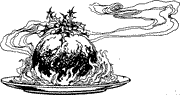
Christmas pudding
Christmas pudding

Notes in this chapter

Note 1 · Is there a stove or a fireplace in the room where the poet sees Christmas kept?Note 2 · What is cheer? What is festal cheer?Note 3 · What is a “train”? How could it be called a hospitable train? Whose train was it?Note 4 · What is a rite?Note 5 · What bells were rung?Note 6 · What is a mass?Note 7 · What is a stoled priest? What is a chalice? What did the priest do when he reared the chalice?Note 8 · The kirtle was a dress-skirt or outer petticoat. Sheen means gay or bright.Note 9 · What is mistletoe? Is there anything peculiar in its habits of growth? What did they want of it? What custom is still said to follow the useNote 10 · A vassal was one of the followers of the baron and paid for protection or for lands he held by fighting in the baron’s troops or rendering sNote 11 · A tenant held lands or houses, for which he paid some form of rent.Note 12 · A serf was a slave.Note 13 · At Christmastime even the powerful were willing to cease from ruling and join with the common people.Note 14 · Instead of grand ceremonies, everybody joined in simple amusements, without pride or prejudice.Note 15 · Who was the heir? What was he heir to? Why did he have roses in his shoes?Note 16 · Was he permitted to dance with village maidens at any other time?Note 17 · Without losing any of his dignity.Note 18 · An old-fashioned game of cards.Note 19 · Who brought the tidings of Salvation? To whom was it brought? Who was “the crown”?Note 20 · A lord was one who had power and authority, while a squire was merely an attendant upon a lord.Note 21 · Brawn, in England, is a preparation of meat, generally sheep’s head, pig’s head, hock of beef, or boar’s meat, boiled and seasoned, and run Note 22 · What are bays? What is rosemary? Why should the boar’s head be called crested? Where was it? Why was it there? Why does the poet say it frowNote 23 · Who was a ranger? What did he do? Do you see any reason for his being green-garbed?Note 24 · What is meant by baiting? Who tore the dogs? Why did he tear them? What made the monster fall?Note 25 · Wassail (wossil): the liquor in which they drank their toasts, and which signified the good cheer of Christmastime.Note 26 · Moves about; that is, the liquor in good brown bowls was merrily passed along the table from hand to hand.Note 27 · What was near the sirloin? How many kinds of meat were there on the table? Is anything mentioned besides meat? Do you suppose they had otherNote 28 · In the mumming or acting of these maskers could be seen traces of the ancient mystic plays in which religious lessons were given in plays thNote 29 · Did the maskers have rich costumes? What did they wear over their faces? How did they conceal their clothing?Note 30 · Does the poet think that rich maskers would enjoy their pleasure as much as the old-fashioned Christmas merrymakers?
Explore with AITake your curiosity a little further.

Reading settings