THE COUNTRY SQUIRE
Reading edition
Translated From The Spanish of Thomas Yriarte
A country squire of greater wealth than wit (For fools are often blessed with fortune’s smile), Had built a splendid house and furnished it In splendid style.
“One thing is wanting,” said a friend; “for though The rooms are fine, the furniture profuse, You lack a library, dear sir, for show, If not for use.”
“’Tis true, but zounds!” replied the squire with glee, “The lumber-room in yonder northern wing (I wonder I ne’er thought of it) will be The very thing.
“I’ll have it fitted up without delay With shelves and presses of the newest mode, And rarest wood, befitting every way A squire’s abode.
“And when the whole is ready, I’ll dispatch My coachman—a most knowing fellow—down To buy me, by admeasurement, a batch Of books in town.”
But ere the library was half supplied With all its pomps of cabinet and shelf, The booby squire repented him, and cried Unto himself:
“This room is much more roomy than I thought; Ten thousand volumes hardly would suffice To fill it, and would cost, however bought, A plaguey price.
THE SQUIRE’S LIBRARY
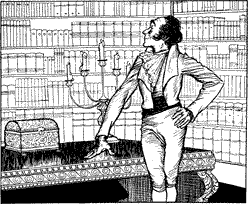
“Now, as I only want them for their looks, It might, on second thoughts, be just as good, And cost me next to nothing, if the books Were made of wood.
“It shall be so, I’ll give the shaven deal A coat of paint—a colorable dress, To look like calf or vellum and conceal Its nakedness.
“And, gilt and lettered with the author’s name, Whatever is most excellent and rare Shall be, or seem to be (’tis all the same), Assembled there.”
The work was done, the simulated hoards Of wit and wisdom round the chamber stood, In binding some; and some, of course, in boards Where all were wood.
From bulky folios down to slender twelves The choicest tomes, in many an even row Displayed their lettered backs upon the shelves, A goodly show.
With such a stock as seemingly surpassed The best collections ever formed in Spain, What wonder if the owner grew at last Supremely vain?
What wonder, as he paced from shelf to shelf And conned their titles, that the squire began, Despite his ignorance, to think himself A learned man?
Let every amateur, who merely looks To backs and binding, take the hint, and sell His costly library—for painted books Would serve as well.
Poetry means more to us and we get more enjoyment from reading it when we understand some of the difficulties that the poet has in writing it and can recognize those things which make it poetry in form.
For instance, you will notice in the poem which we have just read that every stanza has four lines; that, in printing, the first and third lines begin close to the margin, while the second and fourth lines begin a little farther in on the page—that is, they are indented. Now if you will look at the ends of the lines you will see that the words with which the first and third lines terminate are in rhyme, and that the words with which the second and fourth lines terminate are in rhyme. In other words, the indentation at beginning of lines in poetry calls attention to the rhymes.
It is true throughout The Country Squire that every pair of lines taken alternately ends in rhymes which are perfect or nearly so. Now a perfect rhyme is one in which the two rhyming syllables are both accented, the vowel sound and the consonants which follow the vowels are identical, and the sounds preceding the vowel are different. For instance, the words smile and style rhyme. Both of these are monosyllables and hence accented. The vowel sound is the long sound of i; the consonant sound of l follows. The sounds preceding the i are similar but not identical, represented by sm in the first case and st in the second. In the fifth stanza the first line ends with the word dispatch, the third with the word batch. This rhyme is perfect, because the accent on the word dispatch is naturally on the second syllable. In the ninth stanza the word dress is made to rhyme with nakedness. This is not strictly perfect, for the natural accent of nakedness is on the first syllable.
It may be interesting for beginners to work out the rhyme scheme of a poem and write it down. This is very easily done. Take the first stanza in The Country Squire. Represent the rhyming syllable of the first line by a, the rhyming syllable of the second line by b. It follows then that the rhyming syllable of the third line must be represented by a, and the rhyming syllable of the fourth line by b. Writing these letters in succession we have the nonsense word abab, which will always stand for stanzas of this kind. If you are interested in this turn to the studies at the end of the next poem, To My Infant Son.