JOURNEYS IN PERSIA AND KURDISTAN (continued 7)
Reading edition
Some bad horse-fights worried the remainder of the march, which included the ascent of an anemone-covered hill, 7700 feet high, from which we got the first view of the Ardal valley, much cultivated, till it narrows and is lost among mountains, now partly covered with snow. In the centre is a large building with a tower, the spring residence of the Ilkhani, whose goodwill it is necessary to secure. Through a magnificent gorge in the mountains passes the now famous Karun. A clatter of rain and a strong wind greeted our entrance into the valley, where we were met by some horsemen from the Ilkhani.
The great Ardal plateau is itself treeless, though the lower spurs of the Kuh-i-Sabz on the south side are well wooded with the belut, a species of oak. There is much cultivation, and at this season the uncultivated ground is covered with the great green leaves of a fodder plant, the Centaurea alata, which a little later are cut, dried, and stacked. The rivers of the plateau are the Karun and Sabzu on the south side, and the river of Shamsabad, which brings to the Karun the drainage of the Chahar Mahals, and enters the valley through a magnificent tang or chasm on its north side, called Darkash Warkash. The village of Ardal is eighty-five miles from Isfahan, on the Shuster caravan route, and is about 200 from Shuster. Its altitude is 5970 feet, its Long. 50° 50′ E. and its Lat. 32° N.
On arriving here the grandeur of the Ilkhani's house faded away. Except for the fortified tower it looks like a second-rate caravanserai. The village, such as there is of it, is crowded on a steep slope outside the "Palace." It is a miserable hamlet of low windowless mud hovels, with uneven mud floors, one or two feet lower than the ground outside, built in yards with ruinous walls, and full of heaps and holes. It is an olla podrida of dark, poor, smoky mud huts; narrow dirt-heaped alleys, with bones and offal lying about; gaunt yelping dogs; bottle-green slimy pools, and ruins. The people are as dirty as the houses, but they are fine in physique and face, as if only the fittest survive. There is an imamzada, much visited on Fridays, on an adjacent slope. The snow lies here five feet deep in winter, it is said.
When we arrived the roofs and balconies of the Ilkhani's house were crowded with people looking out for us. The Agha called at once, and I sent my letter of introduction from the Amin-es-Sultan. Presents arrived, formal visits were paid, the Ilkhani's principal wife appointed an hour at which to receive me, and a number of dismounted horsemen came and escorted me to the palace. The chief feature of the house is a large audience-chamber over the entrance, in which the chief holds a daily durbar, the deep balcony outside being usually thronged by crowds of tribesmen, all having free access to him. The coming and going are incessant.
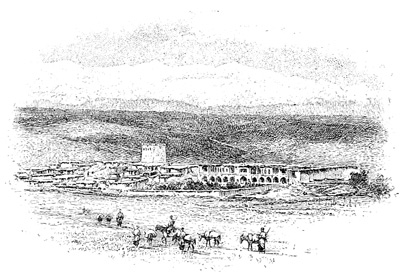
CASTLE OF ARDAL.
The palace or castle is like a two-storied caravanserai, enclosing a large untidy courtyard, round which are stables and cow-houses, and dens for soldiers and servants. In the outer front of the building are deep recessed arches, with rooms opening upon them, in which the Isfahan traders, who come here for a month, expose their wares. Passing under the Ilkhani's audience-chamber by a broad arched passage with deep recesses on both sides, and through the forlorn uneven courtyard, a long, dark arched passage leads into a second courtyard, where there is an attempt at ornament by means of tanks and willows. Round this are a number of living-rooms for the Ilkhani's sons and their families, and here is the andarun, or house of the women. On the far side is the Fort, a tall square tower with loopholes and embrasures.
A Cerberus guards the entrance to the andarun, but he allowed Mirza to accompany me. A few steps lead up from the courtyard into a lofty oblong room, with a deep cushioned recess containing a fireplace. The roof rests on wooden pillars. The front of the room facing the courtyard is entirely of fretwork filled in with pale blue and amber glass. The recess and part of the floor were covered with very beautiful blue and white grounded carpets, made by the women. The principal wife, a comely wide-mouthed woman of forty, advanced to meet me, kissed my hand, raised it to her brow, and sat down on a large carpet squab, while the other wives led me into the recess, and seated me on a pile of cushions, taking their places in a row on the floor opposite, but scarcely raising their eyes, and never speaking one word. The rest of the room was full of women and children standing, and many more blocked up the doorways, all crowding forward in spite of objurgations and smart slaps frequently administered by the principal wife.
The three young wives are Bakhtiaris, and their style of beauty is novel to me—straight noses, wide mouths, thin lips, and long chins. Each has three stars tattooed on her chin, one in the centre of the forehead, and several on the back of the hands. The eyebrows are not only elongated with indigo, but are made to meet across the nose. The finger-nails, and inside of the hands, are stained with henna. The hair hangs round their wild, handsome faces, down to their collar-bones, in loose, heavy, but not uncleanly masses.
Among the "well-to-do" Bakhtiari women, as among the Persians, the hair receives very great attention, although it is seldom exhibited. It is naturally jet black, and very abundant. It is washed at least once a week with a thin paste of a yellowish clay found among the Zard-Kuh mountains, which has a very cleansing effect.
But the women are not content with their hair as it is, and alter its tinge by elaborate arts. They make a thick paste of henna, leave it on for two hours, and then wash it off. The result is a rich auburn tint. A similar paste, made of powdered indigo leaves, is then plastered over the hair for two hours. On its removal the locks are dark green, but in twenty-four hours more they become a rich blue-black. The process needs repeating about every twenty days, but it helps to fill up the infinite leisure of life. It is performed by the bath attendants.
In justice to my sex I must add that the men dye their hair to an equal extent with the women, from the shining blue-black of the Shah's moustache to the brilliant orange of the beard of Hadji Hussein, by which he forfeits, though not in Persian estimation, the respect due to age.
Some of the Ilkhani's children and grand-children have the hair dyed with henna alone to a rich auburn tint, which is very becoming to the auburn eyes and delicate paleness of some of them.
The wives wore enormously full black silk trousers, drawn tight at the ankles, with an interregnum between them and short black vests, loose and open in front; and black silk sheets attached to a band fixed on the head enveloped their persons. They have, as is usual among these people, small and beautiful hands, with taper fingers and nails carefully kept. The chief wife, who rules the others, rumour says, was also dressed in black. She has a certain degree of comely dignity about her, and having seen something of the outer world in a pilgrimage to Mecca viâ Baghdad, returning by Egypt and Persia, and having also lived in Tihran, her intelligence has been somewhat awakened. The Bakhtiari women generally are neither veiled nor secluded, but the higher chiefs who have been at the capital think it chic to adopt the Persian customs regarding women, and the inferior chiefs, when they have houses, follow their example.
My conversation with the "queen" consisted chiefly of question and answer, varied by an occasional divergence on her part into an animated talk with Mirza Yusuf. Among the many questions asked were these: at what age our women marry? how many wives the Agha has? how long our women are allowed to keep their boys with them? why I do not dye my hair? if I know of anything to take away wrinkles? to whiten teeth? etc., if our men divorce their wives when they are forty? why Mr. —— had refused a Bakhtiari wife? if I am travelling to collect herbs? if I am looking for the plant which if found would turn the base metals into gold? etc.
She said they had very dull lives, and knew nothing of any customs but their own; that they would like to see the Agha, who, they heard, was a head taller than their tallest men; that they hoped I should be at Chigakhor when they were there, as it would be less dull, and she apologised for not offering tea or sweetmeats, as it is the fast of the Ramazan, which they observe very strictly. I told them that the Agha wished to take their photographs, and the Hadji Ilkhani along with them. They were quite delighted, but it occurred to them that they must first get the Ilkhani's consent. This was refused, and one of his sons, whose wife is very handsome, said, "We cannot allow pictures to be made of our women. It is not our custom. We cannot allow pictures of our women to be in strange hands. No good women have their pictures taken. Among the tribes you may find women base enough to be photographed." The chief wife offered to make me a present of her grandson, to whom I am giving a tonic, if I can make him strong and cure his deafness. He is a pale precocious child of ten, with hazel eyes and hair made artificially auburn.
When the remarkably frivolous conversation flagged, they brought children afflicted with such maladies as ophthalmia, scabies, and sore eyes to be cured, but rejected my dictum that a copious use of soap and water must precede all remedies. Among the adults headaches, loss of appetite, and dyspepsia seem the prevailing ailments. Love potions were asked for, and charms to bring back lost love, with special earnestness, and the woful looks assumed when I told the applicants that I could do nothing for them were sadly suggestive. There could not have been fewer than sixty women and children in the room, many, indeed most of them, fearfully dirty in dress and person. Among them were several negro and mulatto slaves. When I came away the balconies and arches of the Ilkhani's house were full of men, anxious to have a good view of the Feringhi woman, but there was no rudeness there, or in the village, which I walked through afterwards with a courtesy escort of several dismounted horsemen.
After this the Ilkhani asked me to go to see a man who is very ill, and sent two of his retainers with me. It must be understood that Mirza Yusuf goes with me everywhere as attendant and interpreter. The house was a dark room, with a shed outside, in a filthy yard, in which children, goats, and dogs were rolling over each other in a foot of powdered mud. Crowds of men were standing in and about the shed. I made my way through them, moving them to right and left with my hands, with the recognised supremacy of a Hakīm! There were some wadded quilts on the ground, and another covered a form of which nothing was visible but two feet, deadly cold. The only account that the bystanders could give of the illness was, that four days ago the man fainted, and that since he had not been able to eat, speak, or move. The face was covered with several folds of a very dirty chadar. On removing it I was startled by seeing, not a sick man, but the open mouth, gasping respiration, and glassy eyes of a dying man. His nostrils had been stuffed with moist mud and a chopped aromatic herb. The feet were uncovered, and the limbs were quite cold. There was no cruelty in this. The men about him were most kind, but absolutely ignorant.
I told them that he could hardly survive the night, and that all I could do was to help him to die comfortably. They said with one clamorous voice that they would do whatever I told them, and in the remaining hours they kept their word. I bade them cleanse the mud from his nostrils, wrap the feet and legs in warm cloths, give him air, and not crowd round him. Under less solemn circumstances I should have been amused with the absolute docility with which these big savage-looking men obeyed me. I cut up a blanket, and when they had heated some water in their poor fashion, showed them how to prepare fomentations, put on the first myself, and bathed his face and hands.
He was clothed in rags of felt and cotton, evidently never changed since the day they were put on, though he was what they call "rich,"—a great owner of mares, flocks, and herds,—and the skin was scaly with decades of dirt. I ventured to pour a little sal-volatile and water down his throat, and the glassy eyeballs moved a little. I asked the bystanders if, as Moslems, they would object to his taking some spirits medicinally? They were willing, but said there was no arak in the Bakhtiari country, a happy exemption! The Agha's kindness supplied some whisky, of which from that time the dying man took a teaspoonful, much diluted, every two hours, tossed down his throat with a spoon, Allah being always invoked. There was no woman's gentleness to soothe his last hours. A wife in the dark den inside was weaving, and once came out and looked carelessly at him, but men did for him all that he required with a tenderness and kindness which were very pleasing. Before I left they asked for directions over again, and one of the Ilkhani's retainers wrote them down.
At night the Ilkhani sent to say that the man was much better and he hoped I would go and see him. The scene was yet more weird than in the daytime. A crowd of men were sitting and standing round a fire outside the shed, and four were watching the dying man. The whisky had revived him, his pulse was better, the fomentation had relieved the pain, and when it was reapplied he had uttered the word "good." I tried to make them understand it was only a last flicker of life, but they thought he would recover, and the Ilkhani sent to know what food he should have.
At dawn "death music," wild and sweet, rang out on the still air; he died painlessly at midnight, and was carried to the grave twelve hours later.
When people are very ill their friends give them food and medicine (if a Hakīm be attainable), till, in their judgment, the case is hopeless. Then they send for a mollah; who reads the Koran in a very loud sing-song tone till death ensues, the last thirst being alleviated meantime by sharbat dropped into the mouth. Camphor and other sweet spices are burned at the grave. If they burn well and all is pure afterwards, they say that the deceased person has gone to heaven; if they burn feebly and smokily, and there is any unpleasantness from the grave, they say that the spirit is in perdition. A Bakhtiari grave is a very shallow trench.
The watchers were kind, and carried out my directions faithfully. I give these minute details to show how much even simple nursing can do to mitigate suffering among a people so extremely ignorant as the Bakhtiaris are not only of the way to tend the sick, but of the virtues of the medicinal plants which grow in abundance around them. A medical man itinerating among their camps with a light hospital tent and some simple instruments and medicines could do a great deal of healing, and much also to break down the strong prejudice which exists against Christianity. Here, as elsewhere, the Hakīm is respected. Going in that capacity I found the people docile, respectful, and even grateful. Had I gone among them in any other, a Christian Feringhi woman would certainly have encountered rudeness and worse.
The Ilkhani, who has not been in a hurry to call, made a formal visit to-day with his brother, Reza Kuli Khan, his eldest son Lutf, another son, Ghulam, with bad eyes, and a crowd of retainers. The Hadji Ilkhani,—Imam Kuli Khan, the great feudal chief of the Bakhtiari tribes, is a quiet-looking middle-aged man with a short black beard, a parchment-coloured complexion, and a face somewhat lined, with a slightly sinister expression at times. He wore a white felt cap, a blue full-skirted coat lined with green, another of fine buff kerseymere under it, with a girdle, and very wide black silk trousers.
He is a man of some dignity of deportment, and his usual expression is somewhat kindly and courteous. He is a devout Moslem, and has a finely-illuminated copy of the Koran, which he spends much time in reading. He is not generally regarded as a very capable or powerful man, and is at variance with the Ilbegi, who, though nominally second chief, practically shares his power. In fact, at this time serious intrigues are going on, and some say that the adherents of the two chiefs would not be unwilling to come to open war.
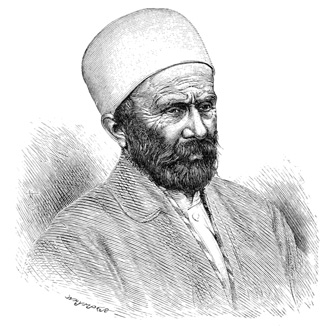
IMAM KULI KHAN.
The greatest men who in this century have filled the office of Ilkhani both perished miserably. The fate of Sir H. Layard's friend, Mehemet Taki Khan, is well known to all readers of the Early Recollections, but it was possibly less unexpected than that of Hussein Kuli Khan, brother of the present Ilkhani, and father of the Ilbegi Isfandyar Khan. This man was evidently an enlightened and able ruler; he suppressed brigandage with a firm hand, and desired to see the Mohammerah-Shuster-Isfahan route fairly opened to trade. He went so far as to promise Mr. Mackenzie, of one of the leading Persian Gulf firms, in writing, that he would hold himself personally responsible for the safety of caravans in their passage through his territory, and would repay any losses by robbery. He agreed to take a third share of the cost of the necessary steamers on the Karun, and to furnish 100 mules for land transport between Shuster and Isfahan.[51]
It appears that Persian jealousy was excited by his enterprising spirit; he fell under the displeasure of the Zil-es-Sultan, and in 1882 was put to death by poison while on his annual visit of homage. The present Ilkhani, who succeeded him, warned possibly by his brother's fate, is said to show little, if any, interest in commercial enterprise, and to have made the somewhat shrewd remark that the English "under the dress of the merchant often conceal the uniform of the soldier."
In 1888 the Shah relented towards Hussein Kuli Khan's sons, the eldest of whom, Isfandyar Khan, had been in prison for seven years, and they with their uncle, Reza Kuli Khan, descended with their followers and a small Persian army upon the plain of Chigakhor, where they surprised and defeated the Hadji Ilkhani. His brother, Reza, was thereupon recognised by the Shah as Ilkhani, and Isfandyar as Ilbegi, with the substance of power. Another turn of the wheel of fortune, and the brothers became respectively Ilkhani and Governor of the Chahar Mahals, and their nephew is reinstated as Ilbegi.[52]
The Ilkhani's word is law, within broad limits, among the numerous tribes of Bakhtiari Lurs who have consented to recognise him as their feudal head, and it has been estimated that in a popular quarrel he could bring from 8000 to 10,000 armed horsemen into the field. He is judge as well as ruler, but in certain cases there is a possible appeal to Tihran from his decisions. He is appointed by the Shah, with a salary of 1000 tumans a year, but a strong man in his position could be practically independent.
It can scarcely be supposed that the present Ilkhani will long retain his uneasy seat against the intrigues at the Persian court, and with a powerful and popular rival close at hand. It is manifestly the interest of the Shah's government to weaken the tribal power, and extinguish the authority and independence of the principal chiefs, and the Oriental method of attaining this end is by plots and intrigues at the capital, by creating and fomenting local quarrels, and by oppressive taxation. It is not wonderful, therefore, that many of the principal Khans, whose immemorial freedom has been encroached upon in many recent years by the Tihran Government, should look forward to a day when one of the Western powers will occupy south-west Persia, and give them security.
The Hadji Ilkhani, for the people always prefix the religious title, discussed the proposed journey, promised me an escort of a horseman and a tufangchi, or foot-soldier, begged us to consider ourselves here and everywhere as his guests, and to ask for all we want, here and elsewhere. His brother, Reza Kuli Khan, who has played an important part in tribal affairs, resembles him, but the sinister look is more persistent on his face. He was much depressed by the fear that he was going blind, but on trying my glasses he found he could see. The surprise of the old-sighted people when they find that spectacles renew their youth is most interesting.
Another visitor has been the Ilbegi, Isfandyar Khan. Though not tall, he is very good-looking, and has beautiful hands and feet. He is able, powerful, and ambitious, inspires his adherents with great personal devotion, and is regarded by many as the "coming man." He was in Tihran when I was in Julfa, and hearing from one of the Ministers that I was about to visit the Bakhtiari country, he wrote to a general of cavalry in Isfahan, asking him to provide me with an escort if I needed it. I was glad to thank him for his courtesy in this matter, and for more substantial help. Before his visit, his retainer, Mansur, brought me the money of which I had been robbed in Kahva Rukh! This man absolutely refused a present, saying that his liege lord would nearly kill him if he took one. Isfandyar Khan welcomed me kindly, regretting much that my first night under Bakhtiari rule should have been marked by a robbery. He said that before his day the tribesmen not only robbed, but killed, and that he had reduced them to such order that he was surprised as well as shocked at this occurrence. I replied that it occurred in a Persian village, and that in many countries one might be robbed, but in none that I knew of would such quick restitution be made.
In cases of robbery, the Ilkhani sends round to the ketchudas or headmen of the camps or villages of the offending district, to replace the money, as in my case, or the value of the thing taken, after which the thief must be caught if possible. When caught, the headmen consult as to his punishment, which may be the cutting off of a hand or nose, or to be severely branded. In any case he must be for the future a marked man. I gather that the most severe penalties are rarely inflicted. I hope the fine of 800 krans levied on Kahva Rukh may stimulate the people to surrender the thief. I agreed to forego 200 krans, as Isfandyar Khan says that his men raised all they could, and the remaining sum would have to be paid by himself.
After a good deal of earnest conversation he became frivolous! He asked the Agha his age, and guessed it at thirty-five. On being enlightened he asked if he dyed his hair, and if his teeth were his own. Then he said that he dyed his own hair, and wore artificial teeth. He also asked my age. He and Lutf and Ghulam, the Ilkhani's sons, who accompanied him, possess superb watches, with two dials, and an arrangement for showing the phases of the moon.
Having accepted an invitation from the Ilbegi to visit him at Naghun, a village ten miles from Ardal, accompanied by Lutf and Ghulam, we were ready at seven, the hour appointed, as the day promised to be very hot. Eight o'clock came, nine o'clock, half-past nine, and on sending to see if the young Khans were coming, the servants replied that they had "no orders to wake them." So we Europeans broiled three hours in the sun at the pleasure of "barbarians"!
During the Ramazan these people revel from sunset to sunrise, with feasting, music, singing, and merriment, and then they lie in bed till noon or later, to abridge the long hours of the fast. "Is it such a fast that I have chosen?" may well be asked.
The noise during the night in the Ilkhani's palace is tremendous. The festivities begin soon after sunset and go on till an hour before dawn. Odours agreeable to Bakhtiari noses are wafted down to my tent, but I do not find them appetising. An eatable called zalabi is in great request during the Ramazan. It is made by mixing sugar and starch with oil of sesamum, and is poured on ready heated copper trays, and frizzled into fritters. Masses of eggs mixed with rice, clarified butter, and jams, concealing balls of highly-spiced mincemeat, kabobs, and mutton stewed with preserved lemon juice and onions are favourite dishes at the Ilkhani's.
Besides the music and singing, the "Court" entertains itself nightly with performing monkeys and dancing men, besides story-tellers, and reciters of the poetry of Hafiz. It is satisfactory to know that the uproarious merriment which drifts down to my tent along with odours of perpetual frying, owes none of its inspiration to alcohol, coffee and sharbat being the drinks consumed.
We rode without a guide down the Ardal valley, took the worst road through some deep and blazing gulches, found the sun fierce, and the treelessness irksome, saw much ploughing, made a long ascent, and stopped short of the village of Naghun at a large walled garden on the arid hillside, which irrigation has turned into a shady paradise of pear, apricot, and walnut trees, with a luxurious undergrowth of roses and pomegranates. The young Khans galloped up just as we did, laughing heartily at having slept so late. All the village men were gathered to see the Feringhis, and the Ilbegi and his brothers received us at the garden gate, all shaking hands. Certainly this Khan has much power in his face, and his dignified and easy manner is that of a leader of men. His dress was becoming, a handsome dark blue cloak lined with scarlet, and with a deep fur collar, over his ordinary costume.
So much has been said and written about the Bakhtiaris being "savages" or "semi-savages," that the entertainment which followed was quite a surprise to me. Two fine canopy tents were pitched in the shade, and handsome carpets were laid in them, and under a spreading walnut tree a karsi, or fire cover, covered with a rug, served as a table, and cigarettes, a bowl of ice, a glass jug of sharbat, and some tumblers were neatly arranged upon it. Iron chairs were provided for the European guests, and the Ilbegi, his brothers, the Ilkhani's sons, and others sat round the border of the carpet on which they were placed. There were fully fifty attendants. Into the midst of this masculine crowd, a male nurse brought the Ilbegi's youngest child, a dark, quiet, pale, wistful little girl of four years old, a daintily-dressed little creature, with a crimson velvet cap, and a green and crimson velvet frock. She was gentle and confiding, and liked to remain with me.
After a long conversation on subjects more or less worth speaking upon, our hosts retired, to sleep under the trees, leaving us to eat, and a number of servants brought in a large karsi covered with food. Several yards of blanket bread, or "flapjacks," served as a table-cloth, and another for the dish-cover of a huge pillau in the centre. Cruets, plates, knives and forks, iced water, Russian lemonade, and tumblers were all provided. The dinner consisted of pillau, lamb cutlets, a curried fowl, celery with sour sauce, clotted cream, and sour milk. The food was well cooked and clean, and the servants, rough as they looked, were dexterous and attentive.
After dinner, by the Ilbegi's wish, I paid a visit to the ladies of his haram. Naghun rivals the other villages of the tribes in containing the meanest and worst permanent habitations I have ever seen. Isfandyar Khan's house is a mud building surrounding a courtyard, through which the visitor passes into another, round which are the women's apartments. Both yards were forlorn, uneven, and malodorous, from the heaps of offal and rubbish lying under the hot sun. I was received by fifteen ladies in a pleasant, clean, whitewashed apartment, with bright rugs and silk-covered pillows on the floor, and glass bottles and other ornaments in the takchahs.
At the top of the room I was welcomed, not by the principal wife, but by a portly middle-aged woman, the Khan's sister, and evidently the duenna of the haram, as not one of the other women ventured to speak, or to offer any courtesies. A chair was provided for me with a karsi in front of it, covered with trays of gaz and other sweetmeats. Mirza and a male attendant stood in the doorway, and outside shoals of women and children on tip-toe were struggling for a glance into the room. Several slaves were present, coal-black, woolly-headed, huge-mouthed negresses. The fifteen ladies held their gay chadars to their faces so as to show only one eye, so I sent Mirza behind a curtain and asked for the pleasure of seeing their faces, when they all unveiled with shrieks of laughter.
The result was disappointing. The women were all young, or youngish, but only one was really handsome. The wives are brunettes with long chins. They wore gay chadars of muslin, short gold-embroidered jackets, gauze chemises, and bright-coloured balloon trousers. Three of the others wore black satin balloon trousers, black silk jackets, yellow gauze vests, and black chadars spotted with white. These three were literally moon-faced, like the representations of the moon on old clocks, a type I have not yet seen. All wear the hair brought to the front, where it hangs in wavy masses on each side of the face. They wore black silk gold-embroidered skull-caps, set back on their heads, and long chains of gold coins from the back to the ear, with two, three, or four long necklaces of the same in which the coins were very large and handsome. One wife, a young creature, was poorly dressed, very dejected-looking, and destitute of ornaments. Her mother has since pleaded for something "to bring back her husband's love." The eyebrows were painted with indigo and were made to meet in a point on the bridge of the nose. Each had one stained or tattooed star on her forehead, three on her chin, and a galaxy on the back of each hand.
Before Mirza reappeared they huddled themselves up in their chadars and sat motionless against the wall as before. After tea I had quite a lively conversation with the Khan's sister, who has been to Basrah, Baghdad, and Mecca.
Besides the usual questions as to my age, dyeing my hair, painting my face, etc., with suggestions on the improvement which their methods would make on my eyes and eyebrows, she asked a little about my journeys, about the marriage customs of England, about divorce, the position of women with us, their freedom, horsemanship, and amusements. She said, "We don't ride, we sit on horses." Dancing for amusement she could not understand. "Our servants dance for us," she said. The dancing of men and women together, and the evening dress of Englishwomen, she thought contrary to the elementary principles of morality. I wanted them to have their photographs taken, but they said, "It is not the custom of our country; no good women have their pictures taken, we should have many things said against us if we were made into pictures."
They wanted to give me presents, but I made my usual excuse, that I have made a rule not to receive presents in travelling; then they said that they would go and see me in my tent at Chigakhor, their summer quarters, and that I could not refuse what they took in their own hands. They greatly desired to see the Agha, of whose imposing physique they had heard, but they said that the Khan would not like them to go to the garden, and that their wish must remain ungratified. "We lead such dull lives," the Khan's sister exclaimed; "we never see any one or go anywhere." It seems that the slightest development of intellect awakens them to the consciousness of this deplorable dulness, of which, fortunately, the unawakened intelligence is unaware. As a fact, two of the ladies have not been out of the Ardal valley, and are looking forward to the migration to the Chigakhor valley as to a great gaiety.
They asked me if I could read, and if I made carpets? They invariably ask if I have a husband and children, and when I tell them that I am a widow and childless, they simulate weeping for one or two minutes, a hypocrisy which, though it proceeds from a kindly feeling, has a very painful effect. Their occupation in the winter is a little carpet-weaving, which takes the place of our "fancy-work." They also make a species of nougat, from the manna found on the oaks on some of their mountains, mixed with chopped almonds and rose-water. When I concluded my visit they sent a servant with me with a tray of this and other sweetmeats of their own making.
The party in the garden was a very merry one. The Bakhtiaris love fun, and shrieked with laughter at many things. This jollity, however, did not exclude topics of interesting talk. During this time Karun, a handsome chestnut Arab, and my horse Screw had a fierce fight, and Karim, a Beloochi, in separating them had his arm severely crunched and torn, the large muscles being exposed and lacerated. He was brought in faint and bleeding and in great pain, and will not be of any use for some time. The Agha asked the Ilbegi for two lads to go with him to help his servants. The answer was, "We are a wandering people, Bakhtiaris cannot be servants, but some of our young men will go with you,"—and three brothers joined us there, absolute savages in their ways. A cow was offered for the march, and on the Agha jocularly saying that he should have all the milk, the Ilbegi said that I should have one to myself, and sent two. He complained that I did not ask for anything, and said that I was their guest so long as I was in their country, and must treat them as brothers and ask for all I need. "Don't feel as if you were in a foreign land" he said; "we love the English."
I. L. B.
LETTER XV
Ardal, May 14.
The week spent here has passed rapidly. There is much coming and going. My camp is by the side of a frequented pathway, close to a delicious spring, much resorted to by Ilyat women, who draw water in mussocks and copper pots, and gossip there. The Ilyats are on the march to their summer quarters, and the steady tramp of their flocks and herds and the bleating of their sheep is heard at intervals throughout the nights. Sometimes one of their horses or cows stumbles over the tent ropes and nearly brings the tent down. Servants of the Ilkhani with messages and presents of curds, celery pickled in sour cream, and apricots, go to and fro. Sick people come at intervals all day long, and the medicine chest is in hourly requisition.
The sick are not always satisfied with occasional visits to the Hakīm's tent: a man, who has a little daughter ill of jaundice, after coming twice for medicine, has brought a tent, and has established himself in it with his child close to me, and a woman with bad eyes has also pitched a tent near mine; at present thirteen people come twice daily to have zinc lotion dropped into their eyes. The fame of the "tabloids" has been widely spread, and if I take common powders out of papers, or liquids out of bottles, the people shake their heads and say they do not want those, but "the fine medicines out of the leather box." To such an extent is this preference carried that they reject decoctions of a species of artemisia, a powerful tonic, unless I put tabloids of permanganate of potash (Condy's fluid) into the bottle before their eyes.
They have no idea of the difference between curable and incurable maladies. Many people, stone blind, have come long distances for eye-lotion, and to-night a man nearly blind came in, leading a man totally blind for eight years, asking me to restore his sight. The blind had led the blind from a camp twenty-four miles off! Octogenarians believe that I can give them back their hearing, and men with crippled or paralysed limbs think that if I would give them some "Feringhi ointment," of which they have heard, they would be restored. Some come to stare at a Feringhi lady, others to see my tent, which they occasionally say is "fit for Allah," and the general result is that I have very little time to myself.
The Ardal plateau is really pretty at this season, and I have had many pleasant evening gallops over soft green grass and soft red earth. The view from the tent is pleasant: on the one side the green slopes which fall down to the precipices which overhang the Karun, with the snowy mountains, deeply cleft, of the region which is still a geographical mystery beyond them; on the other, mountains of naked rock with grass running up into their ravines, and between them and me billows of grass and wild flowers. A barley slope comes down to my tent. The stalks are only six inches long, and the ears, though ripe, contain almost nothing. Every evening a servant of the Ilkhani brings three little wild boars to feed on the grain. Farther down the path are the servants' and muleteers' camps, surrounded by packing-cases, yekdans, mule-bags, nose-bags, gear of all kinds, and the usual litter of an encampment.
The men, whether Indian, Persian, Beloochi, or Bakhtiari, are all quiet and well-behaved. The motto of the camps is "Silence is golden." Hadji Hussein is quiet in manner and speech, and though he has seven muleteers, yells and shouts are unknown.
There is something exciting in the prospect of travelling through a region much of which is unknown and unmapped, and overlooked hitherto by both geographical and commercial enterprise; and in the prospective good fortune of learning the manners and customs of tribes untouched by European influence, and about whose reception of a Feringhi woman doleful prophecies have been made.
Tur, May 18.—The last day at Ardal was a busy one. Several of the Khans called to take leave. I made a farewell visit to the Ilkhani's haram; people came for medicines at intervals from 5 a.m. till 9 p.m.; numberless eye-lotions had to be prepared; stores, straps, ropes, and equipments had to be looked to; presents to be given to the Ilkhani's servants; native shoes, with webbing tops and rag soles, to be hunted for to replace boots which could not be mended, and it was late before the preparations were completed. During the night some of my tent ropes were snapped by a stampede of mules, and a heavy thunderstorm coming on with wind and rain, the tent flapped about my ears till dawn.
It was very hot when we left the next morning. The promised escort was not forthcoming. The details of each day's march have been much alike. I start early, taking Mirza with me with the shuldari, halt usually half-way, and have a frugal lunch of milk and biscuits, read till the caravan has passed, rest in my tent for an hour, and ride on till I reach the spot chosen for the camp. Occasionally on arriving it is found that the place selected on local evidence is unsuitable, or the water is scanty or bad, and we march farther. The greatest luxury is to find the tent pitched, the camp bed put up, and the kettle boiling for afternoon tea. I rest, write, and work till near sunset, when I dine on mutton and rice, and go to bed soon after dark, as I breakfast at four. An hour or two is taken up daily with giving medicines to sick people.
There are no villages, but camps occur frequently. The three young savages brought from Naghun are very amusing from the savage freedom of their ways, but they exasperate the servants by quizzing and mimicking them. The cows are useless. Between them they give at most a teacupful of milk, and generally none. Either the calves or the boys take it, or the marches are too much for them. In the Ilyat camps there is plenty, but as it is customary to mix the milk of sheep, goats, and cows, and to milk the animals with dirty hands into dirty copper pots, and almost at once to turn the milk into a sour mass, like whipped cream in appearance, by shaking it with some "leaven" in a dirty goat-skin, a European cannot always drink it. Indeed, it goes through every variety of bad taste.
The camps halt on Sundays, and the men highly appreciate the rest. They sleep, smoke, wash and mend their clothes, and are in good humour and excellent trim on Monday morning, and the mules show their unconscious appreciation of a holiday by coming into camp kicking and frolicking.
The baggage animals are fine, powerful mules and horses, with not a sore back among them. The pack saddles and tackle are all in good order. The caravan is led by a horse caparisoned with many bells and tassels, a splendid little gray fellow, full of pluck and fire, called Cock o' the Walk. He comes in at the end of a long march, arching his neck, shaking his magnificent mane, and occasionally kicking off his load. Sometimes he knocks down two or three men, dashes off with his load at a gallop, and even when hobbled manages to hop up to the two Arabs and challenge them to a fight. These handsome horses have some of the qualities for which their breed is famous, and are as surefooted as goats, but they are very noisy, and they hate each other and disturb the peace of the camp by their constant attempts to fight. My horse, Screw, can go wherever a mule can find foothold. He is ugly, morose, a great fighter, and most uninteresting. The donkeys and a fat retriever are destitute of "salient points."
Hadji Hussein, the charvadar, has elevated his profession into an art. On reaching camp, after unloading, each muleteer takes away the five animals for which he is responsible, and liberates them, with the saddles on, to graze. After a time they drive them into camp, remove the saddles, and groom them thoroughly, while the saddler goes over the equipments, and does any repairs that are needed. After the grooming each muleteer, having examined the feet of his animals, reports upon them, and Hadji replaces all lost shoes and nails. The saddles and the juls or blankets are then put on, the mules are watered in batches of five, and are turned loose for the night to feed, with two muleteers to watch them by turns. Hadji, whose soft voice and courteous manners make all dealings with him agreeable, receives his orders for the morrow, and he with his young son, Abbas Ali, and the rest of the muleteers, camp near my tent, cook their supper of blanket bread with mast or curds, roll their heads and persons in blankets, put their feet to the fire, and are soon asleep, but Hadji gets up two or three times in the night to look after his valuable property.
At 4 a.m. or earlier, the mules are driven into camp, and are made fast to ropes, which are arranged the previous night by pegging them down in an oblong forty feet by twenty. Nose-bags with grain are put on; and as the loads are got ready the mules are loaded, with Hadji's help and supervision. No noise is allowed during this operation.
After an hour or more the caravan moves, led by Cock o' the Walk, usually with two men at his head to moderate his impetuosity for a time, with a guide; and Hadji on his fine-looking saddle mule looks after the safety of everything. He is punctual, drives fast and steadily, and always reaches the camping-ground in good time. When he gets near it he dismounts, and putting on the air of "your most obedient servant," leads in Cock o' the Walk. He is really a very gentlemanly man for his position, but is unfortunately avaricious, and though he has amassed what is, for Persia, a very large fortune, he wears very poor clothes, and eats sparingly of the poorest food. He is a big man of fifty, wears blue cotton clothing and a red turban, is very florid, and having a white or very gray beard, has dyed it an orange red with henna.
My servants have fallen fairly well into their work, but are frightfully slow. All pitch the tents, and Hassan cooks, washes, packs the cooking and table equipments, and saddles my horse. Mirza Yusuf interprets, waits on me, packs the tent furnishings, rides with me, and is always within hearing of my whistle. He is good, truthful, and intelligent, sketches with some talent, is always cheerful, never grumbles, is quite indifferent to personal comfort, gets on well with the people, is obliging to every one, is always ready to interpret, and though well educated has the good sense not to regard any work as "menial." Mehemet Ali, the "superfluity," is a scamp, and, I fear, dishonest. The servants feed themselves on a kran (8d.) a day, allowed as "road money." Sheep are driven with us, and are turned into mutton as required. Really, they follow us, attaching themselves to the gray horses, and feeding almost among their feet. My food consists of roast mutton, rice, chapatties, tea, and milk, without luxuries or variety. Life is very simple and very free from purposeless bothers. The days are becoming very hot, but the nights are cool. The black flies and the sand-flies are the chief tormentors.
On leaving Ardal we passed very shortly into a region little traversed by Europeans, embracing remarkable gorges and singularly abrupt turns in ravines, through which the Karun, here a deep and powerful stream, finds its way. A deep descent over grassy hills to a rude village in a valley and a steep ascent took us to the four booths, which are the summer quarters of our former escort, Rustem Khan, who received us with courteous hospitality, and regaled us with fresh cow's milk in a copper basin. He introduced me to twelve women and a number of children, nearly all with sore eyes. There is not a shadow of privacy in these tents, with open fronts and sides. The carpets, which are made by the women, serve as chairs, tables, and beds, and the low wall of roughly-heaped stones at the back for trunks and wardrobe, for on it they keep their "things" in immense saddle-bags made of handsome rugs. The visible furniture consists of a big copper bowl for food, a small one for milk, a huge copper pot for clarifying butter, and a goat-skin suspended from three poles, which is jerked by two women seated on the ground, and is used for churning butter and making curds.
A steep ascent gives a superb view of a confused sea of mountains, and of a precipitous and tremendous gorge, the Tang-i-Ardal, through which the Karun passes, making a singularly abrupt turn after leaving a narrow and apparently inaccessible cañon or rift on the south side of the Ardal valley. A steep zigzag descent of 600 feet in less than three-quarters of a mile brings the path down to the Karun, a deep bottle-green river, now swirling in drifts of foam, now resting momentarily in quiet depths, but always giving an impression of volume and power. Large and small land turtles abound in that fiercely hot gorge of from 1000 to 2000 feet deep. The narrow road crosses the river on a bridge of two arches, and proceeds for some distance at a considerable height on its right bank. There I saw natural wood for the first time since crossing the Zagros mountains in January, and though the oak, ash, and maple are poor and stunted, their slender shade was delicious. Roses, irises, St. John's wort, and other flowers were abundant.
The path ascends past a clear spring, up steep zigzags to a graveyard in which are several stone lions, rudely carved, of natural size, facing Mecca-wards, with pistols, swords, and daggers carved in relief on their sides, marking the graves of fighting men. On this magnificent point above the Karun a few hovels, deserted in summer, surrounded by apricot trees form the village of Duashda Imams, which has a superb view of the extraordinary and sinuous chasm through which the Karun passes for many miles, thundering on its jagged and fretted course between gigantic and nearly perpendicular cliffs of limestone and conglomerate. Near this village the pistachio is abundant, and planes, willows, and a large-leaved clematis vary the foliage.
Leaving the river at this point, a somewhat illegible path leads through "park-like" scenery, fair slopes of grass and flowers sprinkled with oaks singly or in clumps, glades among trees in their first fresh green, and evermore as a background gray mountains slashed with snow.
In the midst of these pretty uplands is the Ilyat encampment of Martaza, with its black tents, donkeys, sheep, goats, and big fierce dogs, which vociferously rushed upon Downie, the retriever, and were themselves rushed upon and gripped by a number of women. The people, having been informed of our intended arrival by Reza Kuli Khan, had arranged a large tent with carpets and cushions, but we pitched the camps eventually on an oak-covered slope, out of the way of the noise, curiosity, and evil odours of Martaza. Water is very scarce there, three wells or pools, fouled by the feet of animals, being the only supply.
I rested on my dhurrie under an oak till the caravan came up. It was a sweet place, but was soon invaded, and for the rest of the day quiet and privacy were out of the question, for presently appeared a fine, florid, buxom dame, loud of speech, followed by a number of women and children, all as dirty as it is possible to be, and all crowded round me and sat down on my carpet. This Khanum Shirin is married to the chief or headman, but being an heiress she "bosses" the tribe. She brought up bolsters and quilts, and begged us to consider themselves, the whole region, and all they had as pishkash (a present from an inferior to a superior), but when she was asked if it included herself, she blushed and covered her face. After two hours of somewhat flagging conversation she led her train back again, but after my tent was pitched she reappeared with a much larger number of women, including two betrothed girls of sixteen and seventeen years old, who are really beautiful.
These maidens were dressed in clean cotton costumes, and white veils of figured silk gauze enveloped them from head to foot. They unveiled in my tent, and looked more like houris than any women I have seen in the East; and their beauty was enhanced by the sweetness and maidenly modesty of their expression. I wished them to be photographed, and they were quite willing, but when I took them outside some men joined the crowd and said it should not be, and that when their betrothed husbands came home they would tell them how bold and bad they had been, and would have them beaten. Although these beauties had been most modest and maidenly in their behaviour, they were sent back with blows, and were told not to come near us again. The Agha entertained the Khanum Shirin for a long time, and the conversation was very animated, but when he set a very fine musical box going for their amusement the lady and the rest of the crowd became quite listless and apathetic, and said they much preferred to talk. When their prolonged visit came to an end the Khanum led her train away, with a bow which really had something of graceful dignity in it.
The next morning her husband, the Mollah-i-Martaza, and his son, mounted on one horse, came with us as guides, and when we halted at their camp the Khanum took the whip out of my hand and whipped the women all round with it, except the offending beauties, who were not to be seen. The mollah is a grave, quiet, and most respectable-looking man, more like a thriving merchant than a nomad chief, though he does carry arms. He is a devout Moslem, and is learned, i.e. he can read the Koran.
In a short time the woodland beauty is exchanged for weedy hills and slopes strewn with boulders. Getting other guides at an Ilyat camp, we ascended Sanginak, a mountain 8200 feet high, from the top of which a good idea of the local topography is gained. The most striking features are the absence of definite peaks and the tremendous gorges and abrupt turns of the Karun, which swallows in its passage all minor streams. Precipitous ranges of great altitude hemmed in by ranges yet loftier, snow-covered or snow-patched, with deep valleys between them, well grassed and often well wooded, great clefts, through which at some seasons streams reach the Karun; mountain meadows spotted with the black tents of Ilyats, and deserted hovels far below, with patches of wheat and barley, make up the landscape.
These hills are covered with celery of immense size. The leaves are dried and stacked for fodder, and the underground stalks, which are very white, are a great article of food, both fresh and steeped for a length of time in sour milk. After resting in some Ilyat tents, where the people were friendly and dirty, we had a most tiresome march over treeless hills covered with herbs, and down a steep descent into the Gurab plain, on which a great wall of rocky mountains of definite and impressive shapes descends in broken spurs. My guide, who had never been certain about the way, led me wrong. No tents were visible, the nomads I met had seen neither tents nor caravan. Two hours went by in toiling round the bases of green hills, and then there was the joyful surprise of coming upon my tent pitched, the kettle boiling, the mules knee-deep in food, close by the Chesmeh-i-Gurab, a copious spring of good water, of which one could safely drink.
This Gurab plain, one of very many lying high up among these Luristan mountains, is green and pretty now—a sea of bulbs and grass, but is brown and dusty from early in June onwards. It is about four miles long by nine or ten broad, and is watered by a clear and wonderfully winding stream, which dwindles to a thread later on. The nomads are already coming up.
The rest was much broken by the critical state of Karim's arm, which was swelled, throbbing, and inflamed all round the wound inflicted by Karun on May 13, and he had high fever. It was a helpless predicament, the symptoms were so like those of gangrene. I thought he would most likely die of the hot marches. It was a very anxious night, as all our methods of healing were exhausted, and the singular improvement which set in and has continued must have been the work of the Great Physician, to whom an appeal for help was earnestly made. The wound is daily syringed with Condy's fluid, the only antiseptic available, and has a drainage tube. To-day I have begun to use eucalyptus oil, with which the man is delighted, possibly because he has heard that it is very expensive, and that I have hardly any left!
Yesterday I had the amusement of shifting the camps to another place, and Hadji was somewhat doubtful of my leadership. On arriving at the beautiful crystal spring which the guide had indicated as the halting-place for Sunday, I found that it issued from under a mound of grass-grown graves, was in the full sun blaze, and at the lowest part of the plain. The guide asserted that it was the only spring, but having seen a dark stain of vegetation high among the hills, I halted the caravan and rode off alone in search of the water I hoped it indicated, disregarding the suppressed but unmistakably sneering laughter of the guide and charvadars. In less than a mile I came upon the dry bed of a rivulet, a little higher up on a scanty, intermittent trickle, higher still on a gurgling streamlet fringed by masses of blue scilla, and still higher on a small circular spring of very cold water, with two flowery plateaux below it just large enough for the camps, in a green quiet corrie, with the mountains close behind. Hadji laughed, and the guide insisted that the spring was not always there. A delightful place it is in which to spend Sunday quietly, with its musical ripple of water, its sky-blue carpet of scilla, its beds of white and purple irises, its slopes ablaze with the Fritillaria imperialis, and its sweet, calm view of the green Gurab plain and the silver windings of the Dinarud.
Above the spring is the precipitous hill of Tur, with the remains of a rude fort on its shattered rocky summit. Two similar ruins are visible from Tur, one on a rocky ledge of an offshoot of the Kuh-i-Gerra, on the other side of the Dinarud valley, the other on the crest of a noble headland of the Sanganaki range, which is visible throughout the whole region. The local legend concerning them is that long before the days of the Parthian kings, and when bows and arrows were the only weapons known, iron being undiscovered, there was in the neighbourhood of Gurab a king called Faruk Padishah, who had three sons, Salmon, Tur, and Iraj. It does not appear to be usual among the Bakhtiaris for sons to "get on" together after their father's death, and the three youths quarrelled and built these three impregnable forts—Killa Tur, the one I examined, Killa Iraj, and Killa Salmon.
The beautiful valley was evidently too narrow for their ambition, and leaving their uncomfortable fastnesses they went northwards, and founded three empires, Salmon to the Golden Horn, where he founded Stamboul, Tur to Turkistan, and Iraj became the founder of the Iranian Empire.
Killa Tur is a stone building mostly below the surface of the hill-top, of rough hewn stone cemented with lime mortar of the hardness of concrete. The inner space of the fort is not more than eighty square yards. The walls are from three to six feet thick.
Chigakhor, May 31.—The last twelve days have been spent in marching through a country which has not been traversed by Europeans, only crossed along the main track. On leaving the pleasant camp of Tur we descended to the Gurab plain, purple in patches with a showy species of garlic, skirted the base of the Tur spur, and rode for some miles along the left bank of the Dinarud, which, after watering the plain of Gurab, sparkles and rushes down a grassy valley bright with roses and lilies, and well wooded with oak, elm, and hawthorn. This river, gaining continually in volume, makes a turbulent descent to the Karun a few miles from the point where we left it. This was the finest day's march of the journey. The mountain forms were grander and more definite, the vegetation richer, the scenery more varied, and a kindlier atmosphere pervaded it. In the midst of a wood of fine walnut trees, ash, and hawthorn, laced together by the tendrils of vines, a copious stream tumbles over rocks fringed with maiden-hair, and sparkles through grass purple with orchises. This is the only time that I have seen the one or the other in Persia, and it was like an unexpected meeting with dear friends.
Crossing the Dinarud on a twig bridge, fording a turbulent affluent, which bursts full fledged from the mountain side, and ascending for some hours through grassy glades wooded with oak and elm, we camped for two days on the alpine meadow of Arjul, scantily watered but now very green. Oak woods come down upon it, the vines are magnificent, and there is some cultivation of wheat, which is sown by the nomads before their departure in the late autumn, and is reaped during their summer sojourn. There are no tents there at present, yet from camps near and far, on horseback and on foot, people came for eye-lotions, and remained at night to have them dropped into their eyes.
The next morning I was awakened at dawn by Mirza's voice calling to me, "Madam, Hadji wants you to come down and sew up a mule that's been gored by a wild boar." Awfully gored it was. A piece of skin about ten inches square was hanging down between its forelegs, and a broad wound the depth of my hand and fully a foot long extended right into its chest, with a great piece taken out. I did what I could, but the animal had to be left behind to be cured by the Mollah-i-Martaza, who left us there. Another misfortune to Hadji was the loss of the fiery leader of the caravan, Cock o' the Walk, but late at night he was brought into camp at Dupulan quite crestfallen, having gone back to the rich pastures which surround the Chesmeh-i-Gurab. The muleteer who went in search of him was attacked by some Lurs and stripped of his clothing, but on some men coming up who said his master was under the protection of the Ilkhani, his clothes and horse were returned to him.
The parallel ranges with deep valleys between them, which are such a feature of this country, are seen in perfection near Arjul. Some of the torrents of this mountain region are already dry, but their broad stony beds, full of monstrous boulders, arrest the fury with which at times they seek the Karun. One of these, the Imamzada, passes through the most precipitous and narrow gorge which it is possible to travel, even with unloaded mules. The narrow path is chiefly rude rock ladders, threading a gorge or chasm on a gigantic scale, with a compressed body of water thundering below, concealed mainly by gnarled and contorted trees, which find root-hold in every rift. Where the chasm widens for a space before narrowing to a throat we forded it, and through glades and wooded uplands reached Arjul, descending and crossing the torrent by the same ford on the march to Dupulan the next day.
Owing to the loss of two baggage animals and the necessary re-adjustment of the loads, I was late in starting from Arjul, and the heat as we descended to the lower levels was very great, the atmosphere being misty as well as sultry. Passing upwards, through glades wooded with oaks, the path emerges on high gravelly uplands above the tremendous gorge of the Karun, the manifold windings of which it follows at a great height. From the first sight of this river in the Ardal valley to its emergence at Dupulan, just below these heights, it has come down with abrupt elbow-like turns and singular sinuosities—a full, rapid, powerful glass-green volume of water, through a ravine or gorge or chasm from 1000 to 2000 feet in depth, now narrowing, now widening, but always the feature of the landscape. It would be natural to use the usual phrase, and write of the Karun having "carved" this passage for itself, but I am more and more convinced that this is not the case, but that its waters found their way into channels already riven by some of those mighty operations of nature which have made of this country a region of walls and clefts.
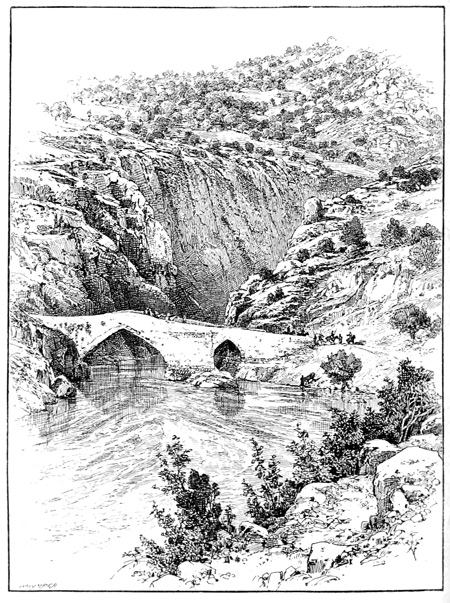
THE KARUN AT DUPULAN.
A long, very steep gravelly descent leads from these high lands down to the Karun, and to one of the routes—little used, however—from Isfahan to Shuster. It is reported as being closed by snow four months of the year. The scenery changed its aspect here, and for walls and parapets of splintered rock there are rounded gravelly hills and stretching uplands.
The three groups of most wretched mud hovels which form the village of Dupulan ("Two Bridge Place") are on an eminence on the left bank of the Karun, which emerges from its long imprisonment in a gorge in the mountains by a narrow passage between two lofty walls of rock so smooth and regular in their slope and so perfect a gateway as to suggest art rather than nature. This river, the volume of which is rapidly augmenting on its downward course, is here compressed into a width of about twenty yards.
At this point a stone bridge, built by Hussein Kuli Khan, of one large pointed arch with a smaller one for the flood, and a rough roadway corresponding to the arch in the steepness of its pitch, spans the stream, which passes onwards gently and smoothly, its waters a deep cool green. Below Dupulan the Karun, which in that direction has been explored by several travellers, turns to the south-west, and after a considerable bend enters the levels above Shuster by a north-westerly course. Near the bridge the Karun is joined by the Sabzu, a very vigorous torrent from the Ardal plain, which is crossed by a twig bridge, safer than it looks.
The camps were pitched in apricot orchards in the Sabzu ravine, near some elægnus trees, which are now bearing their sweet gray and yellow blossoms, which will be succeeded by auburn tresses of a woolly but very pleasant fruit. Dupulan has an altitude of only 4950 feet, and in its course from the Kuh-i-Rang to this point the Karun has descended about 4000 feet. Though there was a breeze, and both ends of my tent and the kanats were open, the mercury was at 86° inside, and at 5 a.m. at 72° outside (on May 21). There were no supplies, and even milk was unattainable.
The road we followed ascends the Dupulan Pass, which it crosses at a height of 6380 feet. The path is very bad, hardly to be called a path. The valley which it ascends is packed with large and small boulders, with round water-worn stones among them, and such track as there is makes sharp zigzags over and among these rocks. Screw was very unwilling to face the difficulties, which took two hours to surmount. The ascent was hampered by coming upon a tribe of Ilyats on the move, who at times blocked up the pass with their innumerable sheep and goats and their herds of cattle. Once entangled in this migration, it was only possible to move on a few feet at a time. It straggled along for more than a mile,—loaded cows and bullocks, innumerable sheep, goats, lambs, and kids; big dogs; asses loaded with black tents and short tent-poles on the loads; weakly sheep tied on donkeys' backs, and weakly lambs carried in shepherds' bosoms; handsome mares, each with her foal, running loose or ridden by women with babies seated on the tops of loaded saddle-bags made of gay rugs; tribesmen on foot with long guns slung behind their shoulders, and big two-edged knives in their girdles; sheep bleating, dogs barking, mares neighing, men shouting and occasionally firing off their guns, the whole ravine choked up with the ascending tribal movement.
Half-way up the ascent there is a most striking view of mountain ranges cleft by the great chasm of the Karun. The descent is into the eastern part of the Ardal valley, over arid treeless hillsides partially ploughed, to the village of Dehnau, not yet deserted for the summer. Fattiallah Khan expected us, and rooms were prepared for me in the women's house, which I excused myself from occupying by saying that I cannot sleep under a roof. I managed also to escape partaking of a huge garlicky dinner which was being cooked for me.
The Khan's house or fort, built like all else of mud, has a somewhat imposing gateway, over which are the men's apartments. The roof is decorated with a number of ibex horns. Within is a rude courtyard with an uneven surface, on which servants and negro slaves were skinning sheep, winnowing wheat, clarifying butter, carding wool, cooking, and making cheese. The women's apartments are round the courtyard, and include the usual feature of these houses, an atrium, or room without a front, and a darkish room within. The floor of the atrium was covered with brown felts, and there was a mattress for me to sit upon. The ruling spirit of the haram is the Khan's mother, a comely matron of enormous size, who occasionally slapped her son's four young and comely wives when they were too "forward." She wore a short jacket, balloon-like trousers of violet silk, and a black coronet, to which was attached a black chadar which completely enveloped her.
The wives wore figured white chadars, print trousers, and strings of coins. Children much afflicted with cutaneous maladies crawled on the floor. Heaps of servants, negro slaves, old hags, and young girls crowded behind and around, all talking at once and at the top of their voices, and at the open front the village people constantly assembled, to be driven away at intervals by a man with a stick. A bowl of cow's milk and some barley bread were given to me, and though a remarkably dirty negress kept the flies away by flapping the milk bowl with a dirty sleeve, I was very grateful for the meal, for I was really suffering from the heat and fatigue.
A visit to a haram is not productive of mutual elevation. The women seem exceedingly frivolous, and are almost exclusively interested in the adornment of their persons, the dress and ailments of their children, and in the frightful jealousies and intrigues inseparable from the system of polygamy, and which are fostered by the servants and discarded wives. The servile deference paid by the other women to the reigning favourite before her face, and the merciless persistency of the attempts made behind her back to oust her from her position, and the requests made on the one hand for charms or potions to win or bring back the love of a husband, and on the other for something which shall make the favourite hateful to him, are evidences of the misery of heart which underlies the outward frivolity.
The tone of Fattiallah Khan's haram was not higher than usual. The ladies took off my hat, untwisted my hair, felt my hands, and shrieked when they found that my gloves came off; laughed immoderately at my Bakhtiari shoes, which, it seems, are only worn by men; put their rings on my fingers, put my hat on their own heads, asked if I could give them better hair dyes than their own, and cosmetics to make their skins fair; paid the usual compliments, told me to regard everything as pishkash, asked for medicines and charms, and regretted that I would not sleep in their house, because, as they said, they "never went anywhere or saw anything."
They have no occupation, except occasionally a little embroidery. They amuse themselves, they said, by watching the servants at work, and by having girls to dance before them. They find the winter, though spent in a warm climate, very long and wearisome, and after dark employ female professional story-tellers to entertain them with love stories. At night the elder lady sent three times for a charm which should give her daughter the love of her husband. She is married to another Khan, and I recalled her as the forlorn-looking girl without any jewels who excited my sympathies in his house.
Marriages are early among these people. They are arranged by the parents of both bride and bridegroom. The betrothal feast is a great formality. The "settlements" having been made by the bridegroom's father and mother, they distribute sweetmeats among the members of the bride's family, and some respectable men who are present tie a handkerchief round the head of the bride, and kiss the hands of her parents as a sign of the betrothal. The engagement must be fulfilled by the bride's parents under pain of severe penalties, from which the bridegroom's parents are usually exempt. But, should he prove faithless, he is a marked man. It appears that "breach of promise of marriage" is very rare. The betrothal may take place at the tenderest age, but the marriage is usually delayed till the bride is twelve years old, or even older, and the bridegroom is from fifteen to eighteen.
The "settlements" made at the betrothal are paid at the time of marriage, and consist of a sum of money or cattle, mares, or sheep, according to the circumstances of the bridegroom's parents. It is essential among all classes that a number of costumes be presented to the bride. After the marriage is over her parents bestow a suit of clothes on her husband, but these are usually of an inferior, or, as my interpreter calls them, of a "trivial" description.
A Bakhtiari marriage is a very noisy performance. For three days or more, in fact as long as the festivities can be afforded, the relations and friends of both parties are assembled at the tents of the bride's parents, feasting and dancing (men and women on this occasion dancing together), performing feats of horsemanship, and shooting at a mark. The noise at this time is ceaseless. Drums, tom-toms, reeds, whistles, and a sort of bagpipe are all in requisition, and songs of love and war are chanted. At this time also is danced the national dance, the chapi, of which on no other occasion (except a burial) can a stranger procure a sight for love or money. It is said to resemble the arnaoutika of the modern Greeks; any number of men can join in it. The dancers form in a close row, holding each other by their kamarbands, and swinging along sidewise. They mark the time by alternately stamping the heel of the right and left foot. The dancers are led by a man who dances apart, waving a handkerchief rhythmically above his head, and either singing a war song or playing on a reed pipe. After the marriage feast the bride follows her husband to his father's tent, where she becomes subject to her mother-in-law.
The messenger, after looking round to see that there were no bystanders, very mysteriously produced from his girdle a black, flattish oval stone of very close texture, weighing about a pound, almost polished by long handling. He told me that it was believed that this stone, if kept in one family for fifty years and steadily worn by father and son, would then not only turn to gold, but have the power of transmuting any metal laid beside it for five years, and he wanted to know what the wisdom of the Feringhis knew about it.
I went up to my camp above the village and tried to rest there, but the buzz of a crowd outside and the ceaseless lifting of curtains and kanats made this quite impossible. When I opened the tent I found the crowd seated in a semicircle five rows deep, waiting for medicines, chiefly eye-lotion, quinine, and cough mixtures. These daily assemblages of "patients" are most fatiguing. The satisfaction is that some "lame dogs" are "helped over stiles," and that some prejudice against Christians is removed.
After this Fattiallah Khan, with a number of retainers, paid a formal visit to the Agha, who kindly sent for me, as I do not receive any but lady visitors in my tent. The Khan is a very good-looking and well-dressed man of twenty-eight, very amusing, and ready to be amused. He was very anxious to be doctored, but looked the opposite of a sick man. He and Isfandyar Khan were in arms against the Ilkhani two years ago, and a few men were shot. He looked as if he were very sorry not to have killed him.
The Bakhtiaris have an enormous conceit of themselves and their country. It comes out in all ways and on all occasions, and their war stories and songs abound in legends of singular prowess, one Bakhtiari killing twenty Persians, and the like. They represent the power of the Shah over them as merely nominal, a convenient fiction for the time being, although it is apparent that Persia, which for years has been aiming at the extinction of the authority of the principal chiefs, has had at least a partial success.
At such interviews a private conversation is impossible. The manners are those of a feudal régime. Heaps of retainers crowd round, and even join in the conversation. A servant brought the Khan a handsome kalian to smoke three times. He also took tea. A great quantity of opium for exportation is grown about Dehnau, and the Khan said that the cultivation of it is always increasing.
From Dehnau the path I took leads over gravelly treeless hills, through many treeless gulches, to the top of a great gorge, through which the Sabzu passes as an impetuous torrent. The descent to a very primitive bridge is long and difficult, a succession of rocky zigzags. Picturesqueness is not a usual attribute of mud villages, but the view from every point of Chiraz, the village on the lofty cliffs on the other side of the stream, is strikingly so. They are irregularly covered with houses, partly built on them and partly excavated out of them, and behind is a cool mass of greenery, apricot orchards, magnificent walnut and mulberry trees, great standard hawthorns loaded with masses of blossom, wheat coming into ear, and clumps and banks of canary-yellow roses measuring three inches across their petals. Groups of women, in whose attire Turkey red predominated, were on the house roofs. Wild flowers abounded, and the sides of the craggy path by which I descended were crowded with leguminous and umbelliferous plants, with the white and pink dianthus, and with the thorny tussocks of the gum tragacanth, largely used for kindling, now in full bloom.
As I dragged my unwilling horse down the steep descent, his bridle was taken out of my hands, and I was welcomed by the brother of Fattiallah Khan, who, with a number of village men escorted me over the twig bridge, and up to an exquisite halting-place under a large mulberry tree, where the next two hours were spent in receiving visitors. It is evident that these fine orchards must have been the pleasure-ground of some powerful ruler, and the immense yellow roses are such as grow in one or two places in Kashmir, where they are attributed to Jehangir.
The track from Chiraz for many miles follows up the right bank of the Sabzu at a great height, descends occasionally into deep gulches, crosses the spurs of mountains whose rifts give root-hold to contorted "pencil cedars," and winds among small ash trees and hawthorns, or among rich grass and young wheat, which is grown to a considerable extent on the irrigated slopes above the river. It is a great surprise to find so much land under cultivation, and so much labour spent on irrigation channels. Some of these canals are several miles in length, and the water always runs in them swiftly, and the right way, although the "savages" who make them have no levels or any tools but spades.
Mountains, much scored and cañoned by streams, very grand in form, and with much snow still upon them, rise to a great height above the ranges which form the Sabzu valley. From Chaharta, an uninteresting camping-ground by the river, I proceeded by an elevated and rather illegible track in a easterly direction to the meeting of two streams, forded the Sabzu, and camped for two days on the green slope of Sabz Kuh, at a height of 8100 feet, close to a vigorous spring whose waters form many streamlets, fringed by an abundance of pink primulas, purple and white orchises, white tulips, and small fragrant blue irises.
Lahdaraz is in the very heart of mountain ranges, and as the Ilyats have not yet come up so high, there were no crowds round my tent for medicine, but one sick woman was carried thither eleven miles on the back of her husband, who seemed tenderly solicitous about her.
On Monday I spent most of the day 1000 feet higher, in most magnificent scenery on an imposing scale of grandeur. The guide took us from the camp through herbage, snow, and alpine flowers, up a valley with fine mountains on either side, terminating on the brink of a gigantic precipice, a cloven ledge between the Kuh-i-Kaller and a stupendous cliff or headland, Sultan Ibrahim, over 12,000 feet, which descends in shelving masses to an abyss of tremendous depth, where water thunders in a narrow rift. The Sabz Kuh, or "green mountain" range, famous for the pasturage of its higher slopes, terminates in Sultan Ibrahim, and unites at its eastern end with the Kuh-i-Kaller, a range somewhat higher. On the east side of this huge chasm rises another range of peaks, with green shelves, dark rifts, and red precipices, behind which rise another, and yet another, whose blue, snow-patched summits blended with the pure cool blue of the sky. In the far distance, in a blue veil, lies the green-tinted plain of Khana Mirza, set as an emerald in this savage scenery, with two ranges beyond, and above them the great mountain mass of the Riji, whose snowy peaks were painted faintly on a faint blue heaven.
That misty valley, irrigated and cultivated, with 100 villages of the Janiki tribe upon it, is the only fair spot in the savage landscape. Elsewhere only a few wild flowers and a gnarled juniper here and there relieve the fierce, blazing verdurelessness of these stupendous precipices. Never, not even among the Himalayas, have I seen anything so superlatively grand, though I have always imagined that such scenes must exist somewhere on the earth. A pair of wild sheep on a ledge, a serpent or two, and an eagle soaring sunwards represented animate nature, otherwise the tremendous heights above, the awful depths below, the snowy mountains, and the valley with its smile, were given over to solitude and silence, except for the dull roar of the torrent hurrying down to vivify the Khana Mirza plain.
After leaving Lahdaraz the path followed the course of the Sabzu through grass and barley for a few miles. Then there is an abrupt and disagreeable change to yellow mud slopes and high mud mountains deeply fissured, the scanty herbage already eaten down by Ilyat flocks—a desolate land, without springs, streams, or even Ilyat tents. Then comes a precipice at an altitude of 7500 feet, through a cleft in which, the Tang-i-Wastagun, the road passes, and descends to the plain of Gandaman as something little better than a sheep track on a steep hillside above a stream. The heat was fierce. A pair of stout gardening gloves does not preserve the hands from blistering. Spectacles with wire gauze sides have to be abandoned as they threaten to roast the eyes. In this latitude, 32°, the heat of the sun at noon is tremendous. At the precipice top I crept into a hole at the base of a rock, for "the shadow of a great rock in a weary land," till the caravan staggered up. It was difficult to brave the sun's direct rays. He looked like a ball of magnesium light, white and scintillating, in the unclouded sky.
On crossing the Tang-i-Wastagun we left behind the Bakhtiari country proper for a time, and re-entered the Chahar Mahals, with their mixed village population of Persians and Armenians. The descent from the Tang-i-Wastagun is upon a ruined Armenian village with a large graveyard. The tombstones are of great size, ten feet long by three feet broad and three feet high, sarcophagus-shaped, and on each stone are an Armenian epitaph and a finely-engraved cross. The plain of Gandaman or Wastagun is a very large one, over 7000 feet in altitude, and is surrounded mainly by high mountains still snow-patched, but to the north by low rocky hills. Much of it is irrigated and under cultivation, and grows heavy crops of wheat and barley. The pasturage is fine and abundant, and the people breed cattle and horses. The uncultivated slopes are now covered with red tulips and a purple allium, and even the dry gravel added largely to the daily increasing botanical collection.
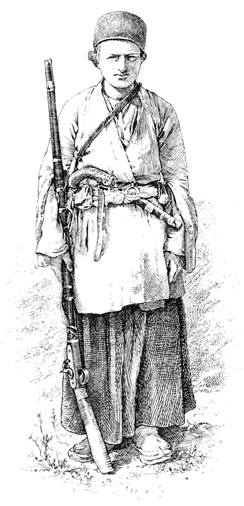
ALI JAN.
The camps were pitched on green turf near three springs, a quiet place, but there was little rest. We were hardly settled before there was a severe fight among the horses, my sour-tempered Screw being the aggressor. This was hardly quieted when there was a sharp "scrimmage" between the charvadars and the Agha's three young savages, in which one of them, Ali Jan, was badly beaten, and came to me to have a bleeding face and head dressed. After that the people began to come in from the villages for eye-washes and medicines. They have no bottles, nor have I, and the better-off bring great copper jugs and basins for an ounce or two of lotion! A very poor old woman much afflicted with ophthalmia said she had three sisters all blind, that she had nothing for lotion, nothing in the world but a copper cooking pot, and she cried piteously. I had nothing to give her, and eventually she returned with an egg-shell, with the top neatly chipped off. It is the custom to raise the hands to heaven and invoke blessings on the Hakīm's head, but I never received so many as from this poor creature.
The ride to the village of Gandaman, where we halted for two days, was an agreeable one. After being shut up among mountains and precipices, space and level ground to gallop over are an agreeable change, and in the early morning the heat was not excessive. The great plain was a truly pastoral scene. Wild-looking shepherds with long guns led great brown flocks to the hills; innumerable yokes of black oxen, ploughing with the usual iron-shod, pointed wooden share, turned over the rich black soil, making straight furrows, and crossing them diagonally; mares in herds fed with their foals; and shepherds busily separated the sheep from the goats.
Close to the filthy walled Armenian village of Kunak there is a conical hill with a large fort, in ruinous condition, upon it, and not far off are the remains of an Armenian village, enclosed by a square wall with a round tower at each corner. This must have been until recently a place of some local importance, as it is approached by a paved causeway, and had an aqueduct, now ruinous, carried over the river on three arches. Not only the plain but the hill-slopes up to a great height are cultivated, and though the latter have the precariousness of rain-lands, the crops already in ear promise well.
Crossing a spur which descends upon the north side of the plain, we reached Gandaman, a good-looking walled Moslem village of 196 houses, much planted, chiefly with willows, and rejoicing in eight springs, close together, the overflow of which makes quite a piece of water. It has an imamzada on an eminence and is fairly prosperous, for besides pastoral wealth it weaves and exports carpets, and dyes cotton and woollen yarn with madder and other vegetable dyes. The mountain view to the south-west is very fine.
I was in my tent early, but there was little rest, for crowds of people with bad eyes and woful maladies besieged it until the evening. At noon a gay procession crossed the green camping-ground, four mares caparisoned in red trappings, each carrying two women in bright dresses, but shrouded in pure white sheets bound round their heads with silver chains. The ketchuda of the Armenian village of Libasgun, two miles off, accompanied them, and said that they came to invite me to their village, for they are Christians. Then they all made the sign of the Cross, which is welcome in this land as a bond of brotherhood.
Cleanly, comely, large-eyed, bright-cheeked, and wholesome they looked, in their pure white chadars, gay red dresses, and embroidered under-vests. They had massive silver girdles, weighing several pounds, worn there only by married women, red coronets, heavy tiaras of silver, huge necklaces of coins, and large filigree silver drops attached down the edges of their too open vests. Their heavy hair was plaited, but not fastened up. Each wore a stiff diamond-shaped piece of white cotton over her mouth and the tip of her nose. They said it was their custom to wear it, and they would not remove it even to eat English biscuits! They managed to drink tea by veiling their faces with their chadars and passing the cup underneath, but they turned their faces quite away as they did it. They had come for the day, and had brought large hanks of wool to wind, but the headman had the tact to take them away after arranging for me to return the visit in the evening.
He seemed an intelligent man. Libasgun, with its 120 houses, is, according to his account, a prosperous village, paying its tax of 300 tumans (£100) a year to the Amin-ud-Daulat, and making a present only to the Ilkhani. It has 2000 sheep and goats, besides mares and cattle. It has an oil mill, and exports oil to Isfahan. The women weave carpets, and embroider beautifully on coarse cotton woven by themselves, and dyed indigo blue and madder red by their Gandaman neighbours. This man is proud of being a Christian. Among the Armenians Christianity is as much a national characteristic as pride of race and strict monogamy. He remarked that there are no sore eyes in Libasgun, and attributed it to the greater cleanliness of the people and to the cross signed in holy oil upon their brows in baptism!
I rode to this village in the late afternoon, and was received with much distinction in the balakhana of the ketchuda's house, where I was handed to the seat of honour, a bolster at the head of the handsomely-carpeted room. It soon filled with buxom women in red, with jackets displaying their figures, or want of figures, down to their waists. From the red velvet coronets on their heads hung two graduated rows of silver coins, and their muslin chadars were attached to their hair with large silver pins and chains. Magnificent necklaces of gold coins were also worn.
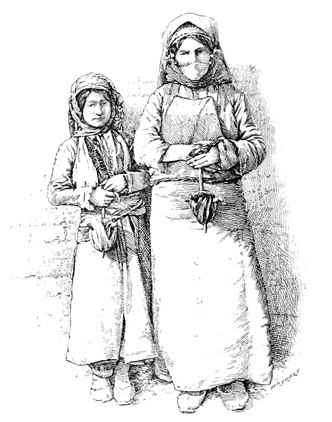
ARMENIAN WOMEN OF LIBASGUN.
Forty women sat on the floor in rows against the wall. Each had rosy cheeks, big black eyes, and a diamond-shaped white cloth over her mouth. The uniformity was shocking. They stared, not at me, but at nothing. They looked listless and soulless, only fit to be what they are—the servants of their husbands. When they had asked me my age, and why I do not dye my hair, the conversation flagged, for I could not get any information from them even on the simplest topics. Hotter and hotter grew the room, more stolid the vacancy of the eyes, more grotesque the rows of white diamonds over the mouths, when the happy thought occurred to me to ask to see the embroidered aprons, which every girl receives from her mother on her marriage. Two mountains of flesh obligingly rolled out of the room, and rolled in again bringing some beautiful specimens of needlework. This is really what is known as "Russian embroidery," cross stitch in artistic colours on coarse red or blue cotton. The stomachers are most beautifully worked. The aprons cover the whole of the front and the sides of the dress. The mothers begin to embroider them when their daughters are ten. The diamond-shaped cloth is put on by girls at eight or nine. The women would not remove it for a moment even to oblige a guest. The perpetual wearing of it is one of their religious customs, only prevailing, however, in some localities. They say that when our Lord was born His mother in token of reverence took a cloth and covered her mouth, hence their habit.
When the ketchuda arrived he found the heat of the room unbearable and proposed an adjournment to the lower roof, which was speedily swept, watered, and carpeted.
An elaborate banquet had been prepared in the hope that the Agha would pay them a visit, and they were much mortified at his non-appearance. The great copper basins containing the food were heaped together in the middle of the carpets, and the guests, fifty in number, sat down, the men on one side, and the women on the other, the wives of the ketchuda and his brothers serving. There were several samovars with tea, but only three cups. A long bolster was the place of honour, and I occupied it alone till the village priests arrived,—reverend men with long beards, high black head-dresses, and full black cassocks with flowing sleeves. All the guests rose, and remained standing till they had been ceremoniously conducted to seats. I found them very agreeable and cultured men, acquainted with the varying "streams of tendency" in the Church of England, and very anxious to claim our Church as a sister of their own. This banquet was rather a gay scene, and on a higher roof fully one hundred women and children dressed in bright red stood watching the proceedings below.
I proposed to see the church, and with the priests, most of the guests, and a considerable following of the onlookers, walked to it through filthy alleys. This ancient building, in a dirty and malodorous yard, differs externally from the mud houses which surround it only in having two bells on a beam. The interior consists of four domed vaults, and requires artificial light. A vault with a raised floor contains the altar and a badly-painted altar-piece representing the B. V.; a rail separates the men, who stand in front, from the women, who stand behind. A Liturgy and an illuminated medieval copy of the Gospels, of which they are very proud, are their only treasures. They have no needlework, and the altar cloth is only a piece of printed cotton. Nothing could well look poorer than this small, dark, vacant building, with a few tallow candles without candlesticks giving a smoky light.