JOURNEYS IN PERSIA AND KURDISTAN (continued 4)
Reading edition
We were to have marched to Kashgird, but on reaching the hamlet of Ahang Garang I found that Abbas Khan had taken quarters there, saying that Kashgird was in ruins.
Hadji, who had allowed himself to roll off several times, was moaning and weeping on the floor of my room, groaning out, with many cries of Ya Allah, "Let me stay here till I'm better; I don't want any wages; I shall be killed, oh, killed! Oh, my family! I shall never see Bushire any more!" Though there was much reason to think he was shamming, I did the little that he calls his "work," and left him to smoke his opium pipe and sleep by the fire in peace.
I was threatened with snow-blindness in one eye; in fact I saw nothing with it, and had to keep it covered up. One of the charvadars lay moaning outside my room, poor fellow, taking chlorodyne every half-hour, and another had got a bad foot from frost-bite. They have been terribly exposed, and the soft snow at a higher temperature has been worse for them than the dry powdery snow at a low temperature, as it soaks their socks, shoes, and leggings, and then freezes. Making Liebig's beef tea warms one, and they like it even from a Christian hand. The Afghan orderly bore up bravely, but was very weak. Indeed the prospect of getting these men to Tihran is darkening daily.
My room, though open to the snow at one end, was comfortable. The oven had been lighted twelve hours before, and it was delightful to hang one's feet into the warm hole. There were holes for light in the roof, and cold though it was, so long as daylight lasted these were never free from veiled faces looking down.
In order to become thoroughly warm it was necessary to walk long and briskly on the roof, and this brought all the villagers below it to stare the stare of vacuity rather than of curiosity. A snow scene is always beautiful at sunset, and this was exceptionally so, as the long indigo shadows on the plain threw into greater definiteness the gleaming, glittering hills, at one time dazzling in the sunshine, at another flushed in the sunset. The plain of Feraghan as seen from the roof was one smooth expanse of pure deep snow, broken only by brown splashes, where mud villages were emphasised by brown poplars, the unbroken, unsullied snow, two feet deep on the level and any number in the drifts, looking like a picture of the Arctic Ocean, magnificent in its solitude, one difficult track, a foot wide, the solitary link with the larger world which then seemed so very far away.
Things went better yesterday on the whole, though the mercury fell to zero in the night, and I was awakened several times by the cold of my open room, and when a number of people came at daylight for medicines my fingers were so benumbed that I could scarcely measure them. What a splendid field for a medical missionary loving his profession this plain with its 650 villages would be, where there are curable diseases by the hundred! Many of the suffering people have told me that they would give lodging and the best of their food to any English doctor who would travel among them.
The loads were well balanced yesterday, and Hadji only pulled his over once and only rolled off once, when Abbas Khan exclaimed, "He's not a man; why did Allah make such a creature?" We got off at nine, the roofs being crowded to see us start. Fuel is very scarce at Ahang Garang. For the cooking and "parlour" fire, the charge was forty-five krans, or about twenty-eight shillings! Probably this included a large modakel. For a room from two to four krans is expected.
Through M——'s kindness I now have a good horse to ride, and the difference in fatigue is incredible. We embarked again on the vast plain of snow. It was a grim day, and most ghastly and desolate this end of the plain looked, where the waters having done their fertilising work are lost in a salt lake, the absolutely white hills round the plain being emphasised by the blue neutral tint of the sky. For the first ten miles there was little more than a breeze, for the last ten a pitiless, ruthless, riotous north-easterly gale, blowing up the snow in hissing drifts, as it swept across the plain with a desolate screech.
The coverings with which we were swaddled were soon penetrated. The cold seemed to enter the bones, and to strike the head and face like a red-hot hammer, stunning as it struck, the tears wrung from the eyes were frozen, at times even the eyelids were frozen together. The frozen snow hit one hard. Hands and feet were by turns benumbed and in anguish, terrific blasts loaded with hard lumps of snow came down from the hills, snow was drifting from all the white ranges above us; on the more exposed part of the track the gusts burst with such violence as to force some of the mules off it to flounder in the deep snow; my Arab was struck so mercilessly on his sore swollen eyes that at times I could scarcely, with my own useless hands, induce him to face the swirls of frozen snow. Swifter and more resistless were the ice-laden squalls, more and more obliterated became the track, till after a fight of over three hours, and the ceaseless crossing of rolling hills and deep hollows, we reached the top of a wind-bared slope 7700 feet in altitude and saw this village, looking from that distance quite imposing, on a hill on the other side of a stream crossed by a brick bridge, with a ruined fort on a height above it. It promised shelter—that was all. Below the village there was an expanse of snow, sloping up to pure white hills outlined against an indigo depth of ominous-looking clouds.
While M—— went up a hill for some scientific work, I followed the orderly, who could scarcely sit on his horse from pain and weakness, into the most wretchedly ruinous, deserted-looking village I have yet seen, epitomising the disenchantment which a near view of an Eastern city brings, and up a steep alley to a ruinous yard heaped with snow-covered ruins, on one side of which were some ruinous rooms, their backs opening on a precipice above the river, and on the north-east wind. I tumbled off my horse, Abbas Khan, the least sick of the men, with benumbed hands breaking my fall. The severe cold had stiffened all my joints. We could scarcely speak; the bones of my face were in intense pain, and I felt as if the cold were congealing my heart.
With Abbas Khan's help I chose the rooms, the worst we have ever had. The one I took for myself has an open-work door facing the wind, and it is impossible to have a fire, for the draught blows sticks, ashes, and embers over the room. The others are worse. It is an awful night, blowing and snowing; all the men but two are hors de combat. The poor orderly, using an Afghan phrase, said, "The wind has played the demon with me." He has a fearful cough, and hæmorrhage from the lungs or throat. The cook is threatened with pleurisy. It may truly be called "Hospital Sunday." The day has been chiefly spent in making mustard poultices, which M—— is constantly crossing the yard in three feet of snow to put on, and protectors for the chests and backs, preparing beef tea, making up medicines, etc.
Surely things must have reached their worst. Out of seven men only one servant, and he an Indian lad with a fearful squint and eyes so badly inflamed that he can hardly see where he puts things down, is able to do anything. Two of the charvadars are lying ill in the stable. Mustard plasters, Dover's powders, salicylate of soda, emetics, poultices, clinical thermometers, chlorodyne, and beef tea have been in requisition all day. The cook, the Afghan orderly, and Hadji seem really ill. At eight this morning groans at my door took me out, and one of the muleteers was lying there in severe pain, with the hard fine snow beating on him. Later I heard fresh moaning on my threshold, and found Hadji fallen there with my breakfast. I got him in and he fell again, upsetting the tea, and while I attended to him the big dogs ate up the chapatties! He had a good deal of fever, and severe rheumatism, and on looking at his eyes I saw that he was nearly blind. He lost his blue glasses some days ago. I sent him to bed in the "kitchen" for the whole day, where he lay groaning in comfort by the fire with his opium pipe and his tea. He thinks he will not survive the night, and has just given me his dying directions!
Afterwards M—— came for the thermometer and chlorodyne, and remarked that my room was "unfit for a beast." The truth is I share it with several very big dogs. It did look grotesquely miserable last night—black, fireless, wet, dirty, with all my things lying on the dirty floor, having been tumbled about by these dogs in their search for my last box of Brand's meat lozenges, which they got out of a strong, tightly-tied-up bag, which they tore into strips. On going for my fur cloak to-day, these three dogs, who, I believe, would take on civilisation more quickly than their masters, were all found rolled up under it, and lying on my bed.
The mercury in the "parlour" with a large fire cannot be raised above 36°. In my room to-night the wet floor is frozen hard and the mercury is 20°. This is nothing after 12° and 16° below zero, but the furious east wind and a singular dampness in the air make it very severe. Yesterday, before the sky clouded over, there was a most remarkable ring or halo of prismatic colours round the sun, ominous of the storm which has followed.
This place standing high without shelter is fearfully exposed; there is no milk and no comfort of any kind for the sick men. We have decided to wrap them up and move them to Kûm, where there is a Persian doctor with a European education; but it is a great risk, though the lesser of two. I have just finished four protectors for the back and chest, three-quarters of a yard long by sixteen inches wide, buttoning on the shoulders, of a very soft felt namad nearly half an inch thick—a precaution much to be commended.
I think that Hadji, though in great pain, poor fellow, is partly shamming. He professed this evening to have violent fever, and the thermometer shows that he has none. Even the few things which I thought he had done for me, such as making chapatties, I find have been done by others. It is a pity for himself as well as for me that he should be so incorrigibly lazy.
Taj Khatan, Feb. 18.—Yesterday we had a severe march, and owing first to the depth of the snow, and then to the depth of the mud, we were seven hours in doing twenty-one miles. The wind was still intensely cold—bitter indeed. There are few remarks to be made about a country buried in snow. The early miles were across the fag end of the dazzling plain of Feraghan, which instead of being covered with villages is an uninhabited desert with a salt lake. Then the road winds among mountains of an altitude of 8000 and 9000 feet and more, its highest point being 8350 feet, where we began a descent which will land us at Tihran at a level under 4000 feet. Snowy mountains and snowy plains were behind—bare brown earth was to come all too soon.
Winding wearily round low hills, meeting caravans of camels to which we had to give way, and of asses floundering in the snow, we came in the evening to a broad slope with villages, poplars, walnuts, and irrigated lands, then to the large and picturesquely situated village of Givr on a steep bank above a rapid stream, and just at dusk to the important village of Jairud, also on high ground above the same river, and surrounded by gardens and an extraordinary number of fruit trees. The altitude is 6900 feet.[21] I had a balakhana, very cold, and was fairly benumbed for some time after the long cold march.
A great many people applied for medicine, and some of the maladies, specially when they affect children, make one sick at heart. Hadji is affecting to be stone deaf, so he no longer interprets for sick people, which creates an additional difficulty. We left this morning at ten, descended 2000 feet, and suddenly left the snow behind. Vast, gray, and grim the snow-covered mountains looked as they receded into indigo gloom, with snow clouds drifting round their ghastly heads and across the dazzling snow plains in which we had been floundering for thirty days. It is strange to see mother earth once more—rocky, or rather stony hills, mud hills, mud plains, mud slopes, a brown world, with a snow world above. Two pink hills rise above the brown plain, and some toothed peaks, but the rest of the view is simply hills and slopes of mud and gravel, bearing thorns, and the relics of last year's thistles and wormwood. The atmospheric colouring is, however, very fine.
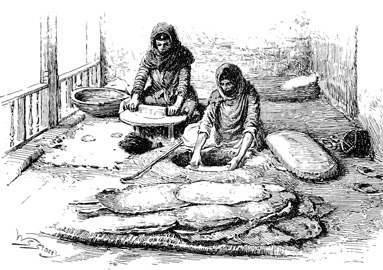
PERSIAN BREAD-MAKING.
This is a large village with beehive roofs in, and of, mud. A quagmire surrounds it and is in the centre of it, and the crumbling houses are thrown promiscuously down upon it. It is nearly the roughest place I have seen, and the worst accommodation, though Abbas Khan says it is the best house in the village. My room has an oven in the floor, neatly lined with clay, and as I write the women are making bread by a very simple process. The oven is well heated by the live embers of animal fuel. They work the flour and water dough, to which a piece of leaven from the last baking has been added, into a flat round cake, about eighteen inches in diameter and half an inch thick, place it quickly on a very dirty cushion, and clap it against the concave interior of the oven, withdrawing the cushion. In one minute it is baked and removed.
A sloping hole in the floor leads to the fowl-house. The skin of a newly-killed sheep hangs up. A pack saddle and gear take up one corner, my bed another, and the owner's miscellaneous property fills up the rest of the blackened, cracked mud hovel, thick with the sooty cobwebs and dust of generations. The door, which can only be shut by means of a wooden bolt outside, is six inches from the ground, so that fowls and cats run in and out with impunity. Behind my bed there is a doorless entrance to a dark den, full of goat's hair, bones, and other stores. In front there is a round hole for letting in light, which I persistently fill up with a blanket which is as persistently withdrawn. There is no privacy, for though the people are glad to let their rooms, they only partially vacate them, and are in and out all the time. Outside there is mud a foot deep, then a steep slope, and a disgusting green pool, and the drinking water is nauseous and brackish. The village people here and everywhere seem of a very harmless sort.
Kûm, Ash Wednesday, 1890.—It was really very difficult to get away from Taj Khatan. The charvadar came on here, leaving only two men to load twelve mules. M—— practically had to load them himself, and to reload them when the tackle broke and the loads turned. Hadji and the cook were quite incapable, the Afghan orderly, who seemed like a dying man, was left behind; in fact there were no servants and no interpreters, and the groom was so ill he could hardly sit on a horse.
The march of twenty-five miles took fully eight hours, but on the Arab horse, and with an occasional gallop, I got through quite comfortably, and have nothing to complain of. The road lies through a country of mud hills, brown usually, drab sometimes, streaked with deep madder red, and occasionally pale green clay—stones, thistles, and thorns their only crop. [I passed over much of this country in the spring, and though there were a few flowers, chiefly bulbs, and the thorns were clothed with a scanty leafage, and the thistles and artemisia were green-gray instead of buff, the general aspect of the region was the same.] There was not a village on the route, only two or three heaps of deserted ruins and two or three ruinous mud imamzadas, no cultivation, streams, or springs, the scanty pools brackish, here and there the glittering whiteness of saline efflorescence, not a tree or even bush, nothing living except a few goats, picking up, who knows how, a scanty living,—a blighted, blasted region, a land without a raison d'être.
Then came low mud ranges, somewhat glorified by atmosphere, higher hills on the left, ghastly with snow which was even then falling, glimpses far away to the northward of snowy mountains among heavy masses of sunlit clouds, an ascent, a gap in the mud hills, some low peaks of white, green, and red clay, a great plain partly green with springing wheat, and in the centre, in the glow of sunset, the golden dome and graceful minarets of the shrine of Fatima, the sister of Reza, groups of trees, and the mud houses, mud walls, and many domes and minarets of the sacred city of Kûm.
Descending, we trotted for some miles through irrigated wheat, passed a walled garden or two, rode along the bank of the Abi Khonsar or Abi Kûm, which we had followed down from Givr, admired the gleaming domes and tiled minarets of the religious buildings on its bank, and the nine-arched brick bridge which spans it, and reached a sort of hotel outside the gates, a superior caravanserai with good, though terribly draughty guest-rooms upstairs, furnished with beds, chairs, and tables, suited for the upper class of pilgrims who resort to this famous shrine.
To have arrived here in good health, and well able for the remaining journey of nearly a hundred miles, is nothing else than a triumph of race, of good feeding through successive generations, of fog-born physique, nurtured on damp east winds!
There is an air of civilisation about this place. The rooms have windows with glass panes and doors which shut, a fountain in front, beyond that a garden, and then the river, and the golden shrine of Fatima and its exquisite minarets. My door opens on a stone-flagged roof with a fine view of the city and hills—an excellent place for taking exercise. So strong is Mohammedan fanaticism here that much as I should like to see the city, it would be a very great risk to walk through it except in disguise.
M—— borrowed a taktrawan from the telegraph clerk and sent it back with two horses to Taj Khatan for the orderly, who was left there very ill yesterday morning, under Abbas Khan's charge, the Khan feeling so ill that he lay down inside it instead of riding. Hadji gave up work altogether, so I unpacked and pitched my bed, glad to be warmed by exercise. Near 8 p.m. Abbas Khan burst into the "parlour" saying that the taktrawan horses were stuck in the mud. He evidently desired to avoid the march back, but two mules have been sent to replace the horses, and two more are to go to-morrow. The orderly was so ill that I expect his corpse rather than himself.
This morning Hadji, looking fearful, told me that he should die to-day, and he and the cook are now in bed in opposite corners of a room below, with a good fire, feverish and moaning. It is really a singular disaster, and shows what the severity of the journey has been. The Persian doctor, with a European medical education, on whom our hopes were built, when asked to come and see these poor men, readily promised to do so; but the Princess, the Shah's daughter, whose physician he is, absolutely refuses permission, on the ground that we have come through a region in which there is supposed to be cholera!
I. L. B.
LETTER VII
Kûm, Feb. 21.
At five yesterday afternoon Abbas Khan rode in saying that the taktrawan, with the orderly much better, was only three miles off. This was good news; a mattress was put down for him next the fire and all preparations for his comfort were made. Snow showers had been falling much of the day, there was a pitiless east wind, and as darkness came on snow fell persistently. Two hours passed, but no taktrawan arrived. At 7.30 Abbas Khan was ordered to go in search of it with a good lantern; 8, 9, 10 o'clock came without any news. At 10.30, the man whose corpse I had feared to see came in much exhausted, having crawled for two miles through the mire and snow. The sowar, who pretended to start with the lantern, never went farther than the coffee-room at the gate, where he had spent an unconscientious but cheery evening!
In the pitch darkness the taktrawan and mules had fallen off the road into a gap, the taktrawan was smashed, and a good white mule, one of the "light division," was killed, her back being broken. This was not the only disaster. Hadji had lain down on the borrowed mattress and it had taken fire from the live ashes of his pipe and was burned, and he was a little scorched.
The telegraphist was to have started for Isfahan the next morning with his wife and child in the litter, in order to vacate the house for the new official and his family, and their baggage had actually started, but now they are detained till this taktrawan can be repaired. In the meantime another official has arrived with his goods and a large family, a most uncomfortable situation for both parties, but they bear it with the utmost cheerfulness and good nature.
Last night I made Hadji drink a mug of hot milk with two tablespoonfuls of brandy in it, and it worked wonders. This morning, instead of a nearly blind man groping his way about with difficulty, I beheld a man with nothing the matter but a small speck on one eye. It must have been snow-blindness. He looks quite "spry." It is not only the alcohol which has cured him, but that we are parting by mutual consent; and feeling sorry for the man, I have given him more than his wages, and his full demand for his journey back to Bushire, with additional warm clothing. M—— has also given him a handsome present.
I fear he has deceived me, and that the stone deafness, feebleness, idiocy, and the shaking, palsied gait of a man of ninety—all but the snow-blindness—have been assumed in order to get his return journey paid, when he found that the opportunities for making money were not what he expected. It is better to be deceived twenty times than to be hard on these poor fellows once, but he has been exasperating, and I feel somewhat aggrieved at having worked so hard to help a man who was "malingering." The last seen of him was an active, erect man walking at a good pace by the side of his mule, at least forty years thrown off. [He did not then leave Kûm, but being seized with pleurisy was treated with great kindness by Mr. Lyne the electrician, and afterwards by the Amin-es-Sultan (the Prime Minister), who was visiting Kûm, and who, thinking to oblige me, brought him up to Tihran in his train!] Those who had known him for years gave a very bad account of him, but said that if he liked he could be a good servant. It is the first time that I have been unfortunate in my travelling servant.
The English telegraph line, and a post-office, open once a week, are the tokens of civilisation in Kûm. A telegraphic invitation from the British Minister in Tihran, congratulatory telegrams on our safety from Tihran, Bushire, and India, and an opportunity for posting letters, make one feel once more in the world. The weather is grim, bitterly cold, with a strong north-east wind, raw and damp, but while snow is whitening the hills only rain and sleet fall here. The sun has not shone since we came, but the strong cold air is invigorating like our own climate.
Taking advantage of it being Friday, the Mohammedan day of rest, when most of the shops are closed and the bazars are deserted, we rode through a portion of them preceded by the wild figure of Abbas Khan, and took tea at the telegraph office, where they were most kind and pleasant regarding the accident which had put them to so much inconvenience.
Kûm is on the beaten track, and has a made road to Tihran. Almost every book of travels in Persia has something to say upon it, but except that it is the second city in Persia in point of sanctity, and that it thrives as much by the bodies of the dead which are brought in thousands for burial as by the tens of thousands of pilgrims who annually visit the shrine of Fatima, and that it is renowned for fanaticism, there is not much to say about it.
Situated in a great plain, the gleam of its golden dome and its slender minarets is seen from afar, and the deep green of its orchards, and the bright green of the irrigated and cultivated lands which surround it, are a splash of welcome fertility on the great brown waste. Singular toothy peaks of striated marl of brilliant colouring—red, blue, green, orange, and salt peaks very white—give a curious brilliancy to its environment, but this salt, which might be a source of wealth to the city, is not worked, only an ass-load or two at a time being brought in to supply the necessities of the market.
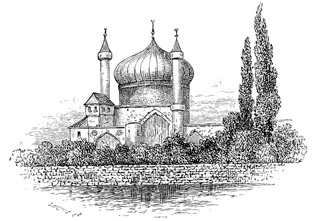
THE SHRINE OF FATIMA.
The shrine of Fatima, the sister of Reza the eighth Imam, who sleeps at Meshed, is better to Kûm than salt mines or aught else. Moslems, though they regard women with unspeakable contempt, agree to reverence Fatima as a very holy and almost worshipful person, and her dust renders Kûm a holy place, attracting tens of thousands of pilgrims every year, although, unlike pilgrimages to Meshed and Kerbela, Kûm confers no lifelong designation on those by whom it exists. Its estimated population is 10,000 souls, and at times this number is nearly doubled. Pilgrimage consists in a visit to the tomb of Fatima, paying a fee, and in some cases adding a votive offering. Vows of abstinence from some special sin are frequently made at the shrine and are carefully registered.
The dead, however, who are annually brought in thousands to be buried in the sacred soil which surrounds the shrine, are the great source of the wealth of Kûm. These corpses travel, as to Kerbela, on mules, four being lashed on one animal occasionally, some fresh, some decomposing, others only bags of exhumed bones. The graves occupy an enormous area, of which the shrine is the centre. The kings of the Kajar dynasty, members of royal families, and 450 saints are actually buried within the precincts of the shrine. The price of interments varies with the proximity to the dust of Fatima from six krans to one hundred tumans. The population may be said to be a population of undertakers. Death meets one everywhere. The Ab-i-Khonsar, which supplies the drinking water, percolates through "dead men's bones and all uncleanness." Vestments for the dead are found in the bazars. Biers full and empty traverse the streets in numbers. Stone-cutting for gravestones is a most lucrative business. The charvadars of Kûm prosper on caravans of the dead. There is a legion of gravediggers. Kûm is a gruesome city, a vast charnel-house, yet its golden dome and minarets brighten the place of death.
The dome of Fatima is covered with sheets of copper plated with gold an eighth of an inch in thickness, and the ornament at the top of the dome, which is of pure gold, is said to weigh 140 lbs. The slender minarets which front this imamzada are covered with a mosaic of highly-glazed tiles of exquisite tints, in which an azure blue, a canary yellow, and an iridescent green predominate, and over all there is a sheen of a golden hue. The shrine is inaccessible to Christians. I asked a Persian doctor if I might look in for one moment at the threshold of the outer court, and he replied in French, "Are you then weary of life?"[22]
My Indian servant, an educated man on whose faithful though meagre descriptions I can rely, visited the shrine and describes the dome as enriched with arabesques in mosaic and as hung with ex votos, consisting chiefly of strips of silk and cotton. The tomb itself, he says, is covered with a wooden ark, with certain sacred sentences cut upon it, and this is covered by a large brown shawl. Round this ark, which is under the dome, Kerman, Kashmir, and Indian shawls are laid down as carpets. This open space is surrounded with steel railings inlaid with gold after the fashion of the niello work of Japan, and the whole is enclosed with a solid silver fence, the rails of which are "as thick as two thumbs, and as high as a tall man's head." This imamzada itself is regarded as of great antiquity.
Two Persian kings, who reigned in the latter part of the seventeenth century, are buried near the beautiful minarets, which are supposed to be of the same date. There are many mosques and minarets in Kûm, besides a quantity of conical imamzadas, the cones of which have formerly been covered with glazed blue tiles of a turquoise tint, some of which still remain. It was taken by the Afghans in 1772, and though partially rebuilt is very ruinous. It has a mud wall, disintegrating from neglect, surrounded occasionally by a ditch, and at other times by foul and stagnant ponds. The ruinousness of Kûm can scarcely be exaggerated.
The bazars are large and very busy, and are considerably more picturesque than those of Kirmanshah. The town lives by pilgrims and corpses, and the wares displayed to attract the former are more attractive than usual. There are nearly 450 shops, of which forty-three sell Manchester goods almost exclusively. Coarse china, and pottery often of graceful shapes with a sky-blue glaze, and water-coolers are among the industries of this city, which also makes shoes, and tans leather with pomegranate bark.
The Ab-i-Khonsar is now full and rapid, but is a mere thread in summer. The nine-arched bridge, with its infamously paved roadway eighteen feet wide, is an interesting object from all points of view, for while its central arch has a span of forty-five feet, the others have only spans of twenty. The gateway beyond the bridge is tawdrily ornamented with blue and green glazed tiles. After seeing several of the cities of Persia, I am quite inclined to give Kûm the palm for interest and beauty of aspect, when seen from any distant point of view.
That it is a "holy" city, and that a pilgrimage to its shrine is supposed to atone for sin, are its great interests. Its population is composed in large proportion of mollahs and Seyyids, or descendants of Mohammed, and as a whole is devoted to the reigning Shiah creed. It has a theological college of much repute, established by Fath' Ali Shah, which now has 100 students. The women are said to be very devout, and crowd the mosques on Friday evenings, when their devotions are led by an imam. The men are fanatically religious, though the fanaticism is somewhat modified. No wine may be sold in Kûm, and no Jew or Armenian is allowed to keep a shop.
Kûm, being a trading city, manufactures a certain amount of public opinion in its business circles, which differs not very considerably from that which prevails at Kirmanshah. The traders accept it as a foregone conclusion that Russia will occupy Persia as far as Isfahan on the death of the present Shah, and regard such a destiny as "fate." If only their religion is not interfered with, it matters little, they say, whether they pay their taxes to the Shah or the Czar. To judge from their speech, Islam is everything to them, and their country very little, and the strong bond of the faith which rules life and thought from the Pillars of Hercules to the Chinese frontier far outweighs the paltry considerations of patriotism. But my impression is that all Orientals prefer the tyrannies and exactions, and the swiftness of injustice or justice of men of their own creed and race to good government on the part of unintelligible aliens, and that though Persians seem pretty comfortable in the prospect of a double occupation of Persia, its actual accomplishment might strike out a flash of patriotism.
Probably this ruinous, thinly-peopled country, with little water and less fuel, and only two roads which deserve the name, has possibilities of resurrection under greatly changed circumstances. Of the two occupations which are regarded as certain, I think that most men, at least in Central and Southern Persia, would prefer an English occupation, but every one says, "England talks and does not act," and that "Russia will pour 100,000 troops into Persia while England is talking in London."
I. L. B.
LETTER VIII
Caravanserai of Aliabad, Feb. 23.
Twelve hours and a half of hard riding have brought us here in two days. No doctor could be obtained in Kûm, and it was necessary to bring the sick men on as quickly as possible for medical treatment. It was bitterly cold on the last day, though the altitude is only 3400 feet, and it was a tiresome day, for I had not only to look over and repack, but to clean the cooking utensils and other things, which had not been touched apparently since we left Baghdad!
This is a tedious part of the journey, a "beaten track" with few features of interest, the great highway from Isfahan to Tihran, a road of dreary width; where it is a made road running usually perfectly straight, with a bank and a ditch on each side. The thaw is now complete, and travelling consists of an attempt to get on by the road till it becomes an abyss which threatens to prove bottomless, then there is a plunge and a struggle to the top of the bank, or over the bank to the trodden waste, but any move can be only temporary, the all-powerful mire regulates the march. The snow is nothing to the mud. Frequently carcasses of camels, mules, and asses, which have lain down to die under their loads, were passed, then caravans with most of the beasts entangled in the miry clay, unable to rise till they were unloaded by men up to their knees in the quagmire, and, worst of all, mules loaded with the dead, so loosely tied up in planks that in some cases when the mule flounders and falls, the miserable relics of humanity tumble out upon the swamp; and these scenes of falling, struggling, and even perishing animals are repeated continually along the level parts of this scarcely passable highroad.
Our loads, owing to bad tackle, were always coming off, the groom's mule fell badly, the packs came off another, and half an hour was spent in catching the animal, then I was thrown from my horse into soft mud.
Cultivation ceases a short distance from Kûm, giving place to a brown waste, with patches of saline efflorescence upon it, on which high hills covered partially with snow send down low spurs of brown mud. The water nearly everywhere is brackish, and only just drinkable. After crossing a rapid muddy river, nearly dry in summer, by a much decayed bridge of seven or eight low arches, we reached terra firma, and a long gradual ascent and a series of gallops brought us to the large caravanserai of Shashgird, an immense place with imposing pretensions which are fully realised within. In the outer court camels were lying in rows. A fine tiled archway leads to an immense quadrangle, with a fine stone abambar or covered receptacle for water in the middle. All round the quadrangle are arched recesses or mangers, each with a room at the back, to the number of eighty. At two of the corners there are enclosed courtyards with fountains, several superior rooms with beds (much to be avoided), chairs, mirrors, and tables fairly clean—somewhat dreary luxury, but fortunately at this season free from vermin. That caravanserai can accommodate 1000 men in rooms, and 1500 mules.
To-day's long march, which, however, has had more road suitable for galloping, has been over wild, weird, desolate, God-forsaken country, interesting from its desolation and its great wastes, forming part of the Kavir or Great Salt Desert of Persia, absolutely solitary, with scarcely a hamlet—miles of the great highway of Persia without a living creature, no house, no bush, nothing. Later, there were some vultures feasting on a dead camel, and a mule-load of two bodies down in the mud.
Some miles from Shashgird, far from the road, there is a large salt lake over which some stationary mists were brooding. Beyond this an ascent among snow clouds along some trenched land where a few vines and saplings have been planted leads to a caravanserai built for the accommodation of state officials on their journeys, where in falling snow we vindicated our origin in the triumphant West by taking lunch on a windy verandah outside rather than in the forlorn dampness of the inside, and brought a look of surprise even over the impassive face of the seraidar.
When we left the snow was falling in large wet flakes, and the snow clouds were drifting wildly among the peaks of a range which we skirted for a few miles and then crossed at a considerable height among wonderful volcanic formations, mounds of scoriæ, and outcrops of volcanic rock, hills of all shapes fantastically tumbled about, chiefly black, looking as if their fires had only just died out, streaked and splotched with brilliant ash—orange, carmine, and green—a remarkable volcanic scene, backed by higher hills looking ghastly in the snow.
After passing over an absolutely solitary region of camel-brown plains and slopes at a gallop, M—— a little in front always, and Abbas Khan, the wildest figure imaginable, always half a length behind, the thud of the thundering hoofs mingling with the screech of the cutting north wind which, coming over the snowy Elburz range, benumbed every joint, on the slope of a black volcanic hill we came upon the lofty towers and gaudy tiled front of this great caravanserai, imposing at a distance in the solitude and snow clouds, but shabby on a nearer view, and tending to disintegrate from the presence of saltpetre in the bricks and mortar.
There are successions of terraces and tanks of water with ducks and geese upon them, and buildings round the topmost terrace intended to be imposing. The seraidar is expecting the Amin-es-Sultan (the Prime Minister) and his train, who will occupy rather a fine though tawdry "suite of apartments"; but though they were at our service, I prefer the comparative cosiness of a small, dark, damp room, though with a very smoky chimney, as I find to my cost.
British Legation, Tihran, Feb. 26.—The night was very cold, and the reveille specially unwelcome in the morning. The people were more than usually vague about the length of the march, some giving the distance at twenty-five miles, and others making it as high as thirty-eight. As we did a good deal of galloping and yet took more than seven hours, I suppose it may be about twenty-eight. Fortunately we could desert the caravan, as the caravanserais are furnished and supply tea and bread. The baggage mules took ten hours for the march.
The day was dry and sunny, and the scenery, if such a tract of hideousness can be called scenery, was at its best. Its one charm lies in the solitude and freedom of a vast unpeopled waste.
The "made road" degenerates for the most part into a track "made" truly, but rather by the passage of thousands of animals during a long course of ages than by men's hands. This track winds among low ranges of sand and mud hills, through the "Pass of the Angel of Death," crosses salt and muddy streams, gravelly stretches, and quagmires of mud and tenacious clay, passing through a country on the whole inconceivably hideous, unfinished, frothy, and saturated with salt—the great brown desert which extends from Tihran to Quetta in Beloochistan, a distance of 2000 miles.
On a sunny slope we met the Prime Minister with a considerable train of horsemen. He stopped and spoke with extreme courtesy, through an interpreter, for, unlike most Persians of the higher class, he does not speak French. He said we had been for some time expected at Tihran, and that great fears were entertained for our safety, which we had heard at Kûm. He is a pleasant-looking man with a rather European expression, not more than thirty-two or thirty-three, and in spite of intrigues and detractors has managed to keep his hazardous position for some years. His mother was lately buried at Kûm, and he was going thither on pilgrimage. After the usual compliments he bowed his farewells, and the gay procession with its brilliant trappings and prancing horses flashed by. The social standing of a Persian is evidenced by the size of his retinue, and the first of the Shah's subjects must have been attended by fully forty well-mounted men, besides a number of servants who were riding with his baggage animals.
Shortly after passing him a turn among the hills brought the revelation through snow clouds of the magnificent snow-covered chain of the Elburz mountains, with the huge cone of Demavend, their monarch, 18,600 feet[23] in height, towering high above them, gleaming sunlit above the lower cloud-masses. Swampy water-courses, a fordable river crossed by a broad bridge of five arches, more low hills, more rolling desert, then a plain of mud irrigated for cultivation, difficult ground for the horses, the ruins of a deserted village important enough to have possessed two imamzadas, and then we reached the Husseinabad, which has very good guest-rooms, with mirrors on the walls.
This caravanserai is only one march from Tihran, and it seemed as if all difficulties were over. Abbas Khan and the sick orderly were sent on early, with a baggage mule loaded with evening dress and other necessities of civilisation; the caravan was to follow at leisure, and M—— and I started at ten, without attendants, expecting to reach Tihran early in the afternoon.
It is six days since that terrible ride of ten hours and a half, and my bones ache as I recall it. I never wish to mount a horse again. It had been a very cold night, and for some time after we started it was doubtful whether snow or rain would gain the day, but after an hour of wet snow it decided on rain, and there was a steady downpour all day. The Elburz range, which the day before had looked so magnificent when fifty miles off, was blotted out. This was a great disappointment.
An ascent of low, blackish volcanic hills is made by a broad road of gray gravel, which a torrent has at some time frequented. Thorns and thistles grow there, and skeletons of animals abound. Everything is grim and gray. From these hills we descended into the Kavir, a rolling expanse of friable soil, stoneless, strongly impregnated with salt, but only needing sufficient water to wash the salt out of it and to irrigate it to become as prolific as it is now barren.
It is now a sea of mud crossed by a broad road indicated by dykes, that never-to-be-forgotten mud growing deeper as the day wore on. Hour after hour we plunged through it, sometimes trying the road, and on finding it impassable scrambling through the ditches and over the dykes to the plain, which after offering firmer foothold for a time became such a "slough of despond" that we had to scramble back to the road, and so on, hour after hour, meeting nothing but one ghastly caravan of corpses, and wretched asses falling in the mud.
At mid-day, scrambling up a gravel hill with a little wormwood upon it, and turning my back to the heavy rain, I ate a lunch of dates and ginger, insufficient sustenance for such fatigue. On again!—the rain pouring, the mud deepening, my spine in severe pain. We turned off to a caravanserai, mostly a heap of ruins, the roofs having given way under the weight of the snow, and there I sought some relief from pain by lying down for the short thirty minutes which could be spared in the seraidar's damp room. It was then growing late in the afternoon, all landmarks had disappeared in a brooding mist, there were no habitations, and no human beings of whom to ask the way.
The pain returned severely as soon as I mounted, and increased till it became hardly bearable. Ceaseless mud, ceaseless heavy rain, a plain of mud, no refuge from mud and water, attempts to gallop were made with the risk of the horses falling into holes and even kanaats. M—— rode in front. Not a word was spoken. A gleaming dome, with minarets and wood, appeared below the Shimran hills. Unluckily, where two roads met one looked impassable and we took the other, which, though it eventually took us to Tihran, was a détour of some miles.
In the evening, when I was hoping that Tihran was at hand, we reached the town of Shah Abdul Azim, built among the ruins of an ancient city, either Rhages or Rhei. The gilded dome is the shrine of Abdul Azim, and is a great place of pilgrimage of the picnic order from Tihran. The one railroad of Persia runs from the capital to this town. As we floundered in darkness along wide roads planted with trees, there was the incongruity of a railway whistle, and with deep breathing and much glare an engine with some carriages passed near the road, taking away with its harsh Western noises that glorious freedom of the desert which outweighs all the hardship even of a winter journey.
It was several miles from thence to the gate of Tihran. It was nearly pitch dark when we got out of Abdul Azim and the rain still fell heavily. In that thick rainy darkness no houses were visible, even if they exist, there were no passengers on foot or on horseback, it was a "darkness which might be felt."
There was a causeway which gave foothold below the mud, but it was full of holes and broken culverts, deep in slime, and seemed to have water on each side not particular in keeping within bounds. It was necessary to get on, lest the city gates should be shut, and by lifting and spurring the jaded horses they were induced to trot and canter along that road of pitfalls. I have had many a severe ride in travelling, but never anything equal to that last two hours. The severe pain and want of food made me so faint that I was obliged to hold on to the saddle. I kept my tired horse up, but each flounder I thought would be his last. There was no guidance but an occasional flash from the hoofs of the horse in front, and the word "spur" ringing through the darkness.
After an hour of riding in this desperate fashion we got into water, and among such dangerous holes that from that point we were obliged to walk our horses, who though they were half dead still feebly responded to bit and spur. We reached the dimly-lighted city gate just as half of it was shut, and found Abbas Khan waiting there. The caravan with the other sick men never reached Tihran till late the next morning.
At the gate we learned that it was two miles farther to the British Legation, and that there was no way for me to get there but on horseback. One lives through a good deal, but I all but succumbed to the pain and faintness. Inside the gate there was an open sea of liquid mud, across which, for a time, certain lights shed their broken reflections. There was a railway shriek, and then the appearance of a station with shunting operations vaguely seen in a vague glare.
Then a tramway track buried under several inches of slush came down a slope, and crowded tramway cars with great single lamps came down the narrow road on horses too tired to be frightened, and almost too tired to get out of the way. Then came a street of mean houses and meaner shops lighted with kerosene lamps, a region like the slums of a new American city, with cafés and saloons, barbers' shops, and European enormities such as gazogenes and effervescing waters in several windows. Later, there were frequent foot passengers preceded by servants carrying huge waxed cambric lanterns of a Chinese shape, then a square with barracks and artillery, a causewayed road dimly lit, then darkness and heavier rain and worse mud, through which the strange spectacle of a carriage and pair incongruously flashed.
By that time even the courage and stamina of an Arab horse could hardly keep mine on his legs, and with a swimming head and dazed brain I could hardly guide him, as I had done from the gate chiefly by the wan gleam of Abbas Khan's pale horse; and expecting to fall off every minute, I responded more and more feebly and dubiously to the question frequently repeated out of the darkness, "Are you surviving?"
Just as endurance was on the point of giving way, we turned from the road through a large gateway into the extensive grounds which surround the British Legation, a large building forming three sides of a quadrangle, with a fine stone staircase leading up to the central door. Every window was lighted, light streamed from the open door, splashed carriages were dashing up and setting down people in evening dress, there were crowds of servants about, and it flashed on my dazed senses that it must be after eight, and that there was a dinner party!
Arriving from the mud of the Kavir and the slush of the streets, after riding ten hours in ceaseless rain on a worn-out horse; caked with mud from head to foot, dripping, exhausted, nearly blind from fatigue, fresh from mud hovels and the congenial barbarism of the desert, and with the rags and travel-stains of a winter journey of forty-six days upon me, light and festivity were overwhelming.
Alighting at a side door, scarcely able to stand, I sat down in a long corridor, and heard from an English steward that "dinner is waiting." His voice sounded very far off, and the once familiar announcement came like a memory out of the remote past. Presently a gentleman appeared in evening dress, wearing a star, which conveyed to my fast-failing senses that it was Sir H. Drummond Wolff. It was true that there was a large dinner party, and among the guests the Minister with thoughtful kindness had invited all to whom I had letters of introduction. But it was no longer possible to make any effort, and I was taken up to a room in which the comforts of English civilisation at first made no impression upon me, and removing only the mackintosh cloak, weighted with mud, which had served me so well, I lay down on the hearthrug before a great coal fire till four o'clock the next morning. And "so the tale ended," and the winter journey with its tremendous hardships and unbounded mercies was safely accomplished.[24]
I. L. B.
NOTES ON TIHRAN[25]
It is a matter of individual taste, but few cities in the East interest me in which national characteristics in architecture, costume, customs, and ways generally are either being obliterated or are undergoing a partial remodelling on Western lines. An Eastern city pure and simple, such as Canton, Niigata, or Baghdad, even with certain drawbacks, forms a harmonious whole gratifying to the eye and to a certain sense of fitness; while Cairo, Tokio, Lahore, and I will now add Tihran, produce the effect of a series of concussions.
Tihran—set down on a plain, a scorched desert, the sublimity of which is interfered with by kanaats or underground watercourses with their gravel mounds and ruinous shafts—has few elements of beauty or grandeur in its situation, even though "the triumphant barbarism of the desert" sweeps up to its gates, and the scored and channelled Shimran range, backed by the magnificent peak, or rather cone, of Demavend, runs to the north-east of the city within only ten miles of its walls.
The winter with its snow and slush disappeared abruptly two days after I reached Tihran, and as abruptly came the spring—a too transient enjoyment—and in a few days to brownness and barrenness succeeded a tender mist of green over the trees in the watered gardens, rapidly thickening into dark leafage in which the bulbul sang, and nature helped by art spread a carpet of violets and irises over the brown earth. But all of verdure and greenery that there is lies within the city walls. Outside is the unconquerable desert, rolling in endless shades of buff and brown up to the Elburz range, and elsewhere to the far horizon.
Situated in the most depressed part of an uninteresting waste in Lat. 35° 40′ N. and Long. 51° 25′ E., and at an altitude of 3800 feet, the climate is one of extremes, the summer extreme being the most severe. For some weeks the heat is nearly insupportable, and the Legations, and all of the four hundred Europeans who are not bound to the city by a fate which they execrate, betake themselves to "yailaks," or summer quarters on the slopes of the adjacent mountains.
Entering Tihran in the darkness, it was not till I saw it coming back from Gulahek, the "yailak" of the British Legation, when the mud was drying up and the willows were in their first young green, that I formed any definite idea of its aspect, which is undeniably mean, and presents no evidences of antiquity; indeed, it has no right to present any, for as a capital it only came into existence a century ago, with the first king of the present Kajar dynasty. The walls are said to be eleven miles in circuit, and give the impression of being much too large, so many are the vacant spaces within them. They consist chiefly of a broad ditch, and a high sloping rampart without guns. Twelve well-built domed gateways give access to the city. These are decorated with glazed tiles of bright colours and somewhat gaudy patterns and designs, representing genii, lions, and combats of mythical heroes.
Above the wall are seen tree-tops, some tile-covered minarets, the domes of two mosques, and the iron ribs of a roofless theatre in the Shah's garden, in which under a temporary awning the Tazieh or Passion Play (elsewhere referred to) is acted once a year in presence of the Shah and several thousand spectators.
Entering by a gateway over which is depicted a scene in the life of Rustem, the Achilles of Persia, or by the Sheikh Abdul Azim gate, where the custom-house is established and through which all caravans of goods must reach Tihran, the magnitude of the untidy vacant spaces, and the shabby mud hovels which fringe them, create an unfavourable impression. Then there are the inevitable ruinousness, the alleys with broken gutters in the centre, the pools of slime or the heaps of dust according to the weather, and the general shabbiness of blank walls of sun-dried bricks which give one the impression, I believe an unjust one, of decay and retrogression. I never went through those mean outskirts of Tihran which are within the city walls without being reminded of a man in shabby clothes preposterously too big for him.
The population is variously estimated at from 60,000 to 160,000 souls. It varies considerably with the presence or absence of the Court. The streets and bazars are usually well filled with people, and I did not see many beggars or evidences of extreme poverty, even in the Jewish quarter. On the whole it impressed me as a bustling place, but the bustle is not picturesque. It is framed in mean surroundings, and there is little variety in costume, and much sober if not sad colouring.
In "old" Tihran the alleys are crooked, dirty, and narrow, and the bazars chiefly frequented by the poor are very mean and untidy; but the better bazars, whether built as some are, round small domed open spaces, or in alleys roofed with low brick domes, are decidedly handsome, and are light, wide, clean, and in every way adapted for the purposes of buying and selling. European women, even though unattended, can walk through them quite freely without being mobbed or stared at.
The best bazars are piled with foreign merchandise, to the apparent exclusion of native goods, which, if they are of the better quality, must be searched for in out-of-the-way corners. Indeed, if people want fine carpets, curios, rich embroideries, inlaid arms, and Kerman stuffs, they must resort to the itinerant dealers, who gauge the tastes and purchasing powers of every European resident and visitor, and who may be seen at all hours gliding in a sort of surreptitious fashion round the Legation compounds, conveying their beautiful temptations on donkeys' backs.
It is chiefly in the fine lofty saddlery bazar and some small bazars that native manufactures are en évidence. All travelling is on horseback, and the Persian, though sober in the colours of his costly clothing, loves crimson and gold in leather and cloth, embroidered housings and headstalls, and gorgeous saddle-covers for his horse. The usual saddle is of plain wood, very high before and behind, and without stuffing. A thick soft namad or piece of felt covers the horse's back, and over this are placed two or more saddle-cloths covered with a very showy and often highly ornamental cover, with tasselled ends, embroidered in gold and silks and occasionally with real gems. The saddle itself is smoothly covered with a soft ornamental cover made to fit it, and the crupper, breastplate, and headstall are frequently of crimson leather embroidered in gold, or stitched ingeniously with turquoise beads.
The mule, whether the pacing saddle-mule worth from £60 to £80, much affected by rich Persians in Tihran, or the humbler beast of burden, is not forgotten by the traders in the great saddlery bazar. Rich charvadars take great pride in the "outfit" of their mules, and do not grudge twenty tumans upon it. Hence are to be seen elaborate headstalls, breastplates, and straps for bells, of showy embroidery, and leather stitched completely over with turquoise beads and cowries—the latter a favourite adornment—while cowried headstalls are also ornamented with rows of woollen tassels dyed with beautiful vegetable dyes. In this bazar too are found khurjins—the great leather or carpet saddle-bags without which it is inconvenient to travel—small leather portmanteaus for strapping behind the saddles of those who travel chapar, i.e. post,—cylindrical cases over two feet long which are attached in front of the saddle—decorated holsters, the multifarious gear required for the travelling pipe-bearers, the deep leather belts which are worn by chapar riders, the leathern water-bottles which are slung on the saddles, the courier bags, and a number of other articles of necessity or luxury which are regarded as essential by the Persian traveller.
In most of the bazars the shops are packed to the ceiling with foreign goods. It looks as if there were cottons and woollen cloth for the clothing of all Persia. I saw scarcely any rough woollen goods or shoddy. The Persian wears superfine, smooth, costly cloth, chiefly black and fawn, stiff in texture, and with a dull shine upon it. The best comes exclusively from Austria, a slightly inferior quality from Germany, and such cloth fabrics as are worn by Europeans from England and Russia.
The European cottons, which are slowly but surely displacing the heavy durable native goods, either undyed, or dyed at Isfahan with madder, saffron, and indigo, are of colours and patterns suited to native taste, white and canary yellow designs on a red ground predominating, and are both of Russian and English make, and the rivalry which extends from the Indian frontier, through Central Asia, is at fever-heat in the cotton bazars of Tihran. It does not appear that at present either side can claim the advantage.
In a search for writing paper, thread, tapes, and what are known as "small wares," I never saw anything that was not Russian. The cheap things, such as oil lamps, samovars, coarse coloured prints of the Russian Imperial family in tawdry frames, lacquered tin boxes, fitted work-boxes, glass teacups, china tea-pots, tawdry lacquered trays, glass brooches, bead necklaces, looking-glasses, and a number of other things which are coming into use at least in the south-west and the western portions of the Empire, are almost exclusively Russian, as is natural, for the low price at which they are sold would leave no margin of profit on such imports from a more distant country.
A stroll through the Tihran bazars shows the observer something of the extent and rapidity with which Europe is ruining the artistic taste of Asia. Masses of rubbish, atrocious in colouring and hideous in form, the principle of shoddy carried into all articles along with the quintessence of vulgarity which is pretence, goods of nominal utility which will not stand a week's wear, the refuse of European markets—in art Philistinism, in most else "Brummagem," without a quality of beauty or solidity to recommend them—are training the tastes and changing the habits of the people.
One squarish bazar, much resorted to for glass and hardware and what the Americans call "assorted notions," is crammed with Austrian glass, kerosene lamps of all sizes in hundreds, chandeliers, etc. The amount of glass exhibited there for sale is extraordinary, and not less remarkable is the glut of cheap hardware and worthless bijouterie. It is the Lowther Arcade put down in Tihran.
Kerosene and candles may be called a Russian monopoly, and Russia has completely driven French sugar from the markets. In the foreign town, as it may be called, there are two or three French shops, an American shop for "notions," and a German chemist.
The European quarter is in the northern part of Tihran, and is close to vacant and airy spaces. There are the Turkish Embassy, and the Legations of England, France, Germany, Russia, Italy, Belgium, Austria, and America, and a Dutch Consulate-General, each with its Persian gholams who perform escort duty. Their large and shady compounds, brightened by their national flags, and the stir and circumstance which surround them, are among the features of the city. The finest of all the Legation enclosures is that of England, which is beautifully wooded and watered. The reception-rooms and hall of the Minister's residence are very handsome, and a Byzantine clock tower gives the building a striking air of distinction. The grounds contain several detached houses, occupied by the secretaries and others.
A very distinct part of the foreign quarter is that occupied by the large and handsome buildings of the American Presbyterian Mission, which consist of a church occupied at stated hours by a congregation of the Reformed Armenian Church, and in which in the afternoons of Sundays Dr. Potter, the senior missionary, reads the English Liturgy and preaches an English sermon for the benefit of the English-speaking residents, very fine boarding-schools for Armenian girls and boys, and the houses of the missionaries—three clerical, one medical, and several ladies, one of whom is an M.D.
Outside this fine enclosure is a Medical Missionary Dispensary, and last year, in a good situation at a considerable distance, a very fine medical missionary hospital was completed. The boys' and girls' schools are of a very high class. To my thinking the pupils are too much Europeanised in dress and habits; but I understand that this is at the desire of the Armenian parents. The missionaries are not allowed to receive Moslem pupils; but besides Armenians they educate Jewish youths, some of whom have become Christians, and a few Guebres or Zoroastrians.
I do not think that the capital is a hopeful place for missionary work. The presence of Europeans of various creeds and nationalities complicates matters, and the fine, perhaps too fine, mission buildings in proximity to the houses of wealthy foreigners are at so great a distance from the Moslem and Jewish quarters, that persons who might desire to make inquiries concerning the Christian faith must be deterred both by the space to be traversed and the conspicuousness of visiting a mission compound in such a position. The members of the mission church last year were altogether Armenians. The education and training given in the schools are admirable.
Indications of the changes which we consider improvements abound in Tihran. There are many roads accessible to wheeled vehicles. There are hackney carriages. A tramway carrying thousands of passengers weekly has been laid down from the Maidan or central square to one of the southern gates. There are real streets paved with cobble stones, and bordered with definite sidewalks, young trees, and shops. There is a railroad about four miles long, from the city to the village of Sheikh Abdul Azim. There are lamp-posts and fittings, though the light is somewhat of a failure. There is an organised city police, in smart black uniforms with violet facings, under the command of Count Monteforte, an Italian. Soldiers in Europeanised uniforms abound, some of them, the "Persian Cossacks," in full Russian uniforms; and military bands instructed by a French bandmaster play European airs, not always easily recognisable, for the pleasure of the polyglot public.
All ordinary business can be transacted at the Imperial Bank, which, having acquired the branches and business of the New Oriental Bank, bids fair to reign supreme in the commercial world of Persia, the Shah, who has hitherto kept his hoards under his own eye, having set an example of confidence by becoming a depositor.
European tailors, dressmakers, and milliners render a resort to Europe unnecessary. There are at least two hotels where a European may exist. About five hundred European carriages, many of them Russian, with showy Russian horses harnessed à la Russe, dash about the streets with little regard to pedestrians, though an accident, if a European were the offender, might lead to a riot. The carriages of the many Legations are recognisable by their outriders, handsomely-dressed gholams.
But even the European quarter and its newish road, on which are many of the Legations, some of the foreign shops, and the fine compound and handsome buildings of the Imperial Bank, has a Persian admixture. Some of the stately houses of official and rich Persians are there, easily recognisable by their low closed gateways and general air of seclusion. Many of these possess exquisite gardens, with fountains and tanks, and all the arrangements for the out-of-doors life which Persians love. In the early spring afternoons the great sight of the road outside the British Legation is the crowd of equestrians, or rather of the horses they ride. However much the style of street, furniture, tastes, art, and costume have been influenced by Europe, fortunately for picturesque effect the Persian, even in the capital, retains the Persian saddle and equipments.
From later observation I am inclined to think very highly of the hardiness and stamina of the Persian horse, though at the time of my visit to Tihran I doubted both. Such showy, magnificent-looking animals, broken to a carriage which shows them to the best advantage, fine-legged, though not at the expense of strength, small-eared, small-mouthed, with flowing wavy manes, "necks clothed with thunder," dilated nostrils showing the carmine interior, and a look of scorn and high breeding, I never saw elsewhere. The tail, which in obedience to fashion we mutilate and abridge, is allowed in Persia its full development, and except in the case of the Shah's white horses, when it is dyed magenta, is perfectly beautiful, held far from the body like a flag. The arched neck, haughty bearing, and easy handling which Easterns love are given by very sharp bits; and a crowd of these beautiful animals pawing the ground, prancing, caracoling, walking with a gait as though the earth were too vulgar for their touch, or flashing past at a gallop, all groomed to perfection and superbly caparisoned, ridden by men who know how to ride, and who are in sympathy with their animals, is one of the fascinations of Tihran.
Creeping along by the side-walk is often seen a handsome pacing saddle-mule, or large white ass, nearly always led, carrying a Persian lady attended by servants—a shapeless black bundle, with what one supposes to be the outline of a hand clutching the enshrouding black silk sheet tightly over her latticed white mask: so completely enveloped that only a yellow shoe without a heel, and a glimpse of a violet trouser can be seen above the short stirrups.
Another piece of Orientalism unaffected by Western influence is the music performed daily at sunset in the upper stories of some of the highly-decorated tiled gateways which lead into and out of the principal squares. This is evoked from drums, fifes, cymbals, and huge horns, and as the latter overpower all the former, the effect is much like that of the braying of the colossal silver horns from the roofs of the Tibetan lamaserais. Many people suppose that this daily homage to the setting sun is a relic of the ancient fire or sun worship.
Two great squares, one of them with a tank in the middle with a big gun at each corner, artillery barracks on three sides, and a number of smooth-bore twenty-four-pounder guns on the fourth, are among the features of Tihran. In this great Maidan there are always soldiers in multifarious uniforms lounging, people waiting for the tram-cars, and Royal footmen, whose grotesque costumes border on the ridiculous. They are indeed a fitting accompaniment to the Royal horses with their magenta tails and spots, for they wear red coats with ballet-dancer skirts and green facings, green knee-breeches, white stockings, and tall stiff erections resembling a fool's cap on the head, topped by crests suggestive of nothing but a cock's comb.
A gateway much ornamented leads from the artillery square, or Maidan Topkhaneh, by a short road shaded with trees to the Citadel or Ark, which is an immense enclosure, rather mangy and unprepossessing in its exterior, which contains the palace of the Shah, the arsenal, certain public offices, the royal colleges, etc. Over the gateway floats rather grandly the Royal standard, bearing the Lion and the Sun in yellow on a green ground.
The Shah's palace is very magnificent, and the shady gardens, beautifully kept, with their fountains and tanks of pale blue tiles, through which clear water constantly moves, are worthy of a Royal residence. From the outside above the high wall the chief feature is a very lofty pavilion, brilliantly and elaborately painted, with walls inclining inwards, and culminating in two high towers. This striking structure contains the andarun or haram of the sovereign and his private apartments.
This hasty sketch exhausts those features of Tihran which naturally arrest the stranger's attention. There is no splendour about it externally, but there is splendour within it, and possibly few European residences can exceed in taste and magnificence the palaces of the Minister of Justice (the Muschir-u-Dowleh), the Naib-es-Sultan, the Zil-es-Sultan, and a few others, though I regret that much of the furniture has been imported from Europe, as it vexes the eye more or less with its incongruity of form and colouring. The current of European influence, which is affecting externals in Tihran, is not likely now to be stemmed. Eastern civilisation is doomed, and the transition period is not beautiful, whatever the outcome may be.
So much for what is within the walls. That which is outside deserves a passing notice as the environment of the capital. The sole grandeur of the situation lies in the near neighbourhood of the Shimran mountains—a huge wall, white or brown according to the season, with some irrigated planting near its base, which is spotted with villages and the yailaks not only of the numerous Legations but of rich Europeans and Persians. Otherwise the tameless barbarism of a desert, which man has slashed, tunnelled, delved, and heaped, lies outside the city walls, deformed by the long lines of kanaats—some choked, others still serviceable—by which the city is supplied with water from the mountains, their shafts illustrating the Scriptural expression "ruinous heaps." In the glare of the summer sun, with the mercury ranging from 95° to 110° in the shade, and with the heated atmosphere quivering over the burning earth, these wastes are abandoned to carcasses and the vultures which fatten on them, and travelling is done at night, when a breeze from the Shimran range sends the thermometer down from 10° to 15°.
Curving to the south-west of Tihran, the mountains end in a bare ridge, around the base of which, according to many archæologists, lie vestiges of the ancient city of Rhages, known in later days as Rhei. A tomb of brick with angular surfaces, sacred to the memory of an ancient and romantic attachment, remains of fortifications, and the Parsee cemetery on a ledge overlooking these remains, break the monotony of the waste in that direction.
This cemetery, or "Tower of Silence," a white splash on the brown hillside, is visible from afar. The truncated cones which in many places mark seats of the ancient Zoroastrian worship have been mentioned here and there, but it is only in Tihran and Yezd that the descendants of the ancient fire-worshippers are found in such numbers as to be able to give prominence to their ancient rites of sepulture. Probably throughout Persia their number does not exceed 8000. Their head resides in Tihran. They bear a good character for uprightness, and except in Yezd, where they weave rich stuffs, they are chiefly agriculturists. They worship firelight and the sun on the principles symbolised by both, they never use tobacco, and it is impolite to smoke in their presence because of the sacredness of fire.
Their belief has been, and is, that to bury the dead in the earth is to pollute it; and one among the reasons of the persecution of the early Christians by the Zoroastrians was their abhorrence of the desecration of the ground produced by the modes of Christian burial.
This "Tower of Silence" near Tihran is a large round edifice of whitewashed mud and stone. On the top of it, a few feet below the circular parapet, the dead are laid to be devoured by birds and consumed by exposure to the elements. The destiny of the spirit is supposed to be indicated by the eye which is first devoured by the fowls of the air, the right eye signifying bliss.
In a northern direction, to which the eye always turns to be refreshed by the purity of the icy cone of Demavend, or to watch the rosy light deepening into purple on the heights of Shimran, are palaces and country seats in numbers, with a mass of irrigated plantations extending for twenty miles, from Vanēk on the east to Kamaraniēh on the west. These are reached by passing through the Shimran gate, the most beautiful of the outer gates, tiled all over with yellow, black, blue, and green tiles in conventional designs, and with an immense coloured mosaic over the gateway representing Rustēm, Persia's great mythical hero, conquering some of his enemies.
On the slopes of the hills are palaces and hunting seats of the Shah, beginning with the imposing mass of the Kasr-i-Kajār, on a low height, surrounded by majestic groves, in which are enormous tanks. Palaces and hunting seats of ministers and wealthy men succeed each other rapidly, a perfect seclusion having been obtained for each by the rapid growth of poplars and planes, each dwelling carrying out in its very marked individuality a deference to Persian custom, and each if possible using running water as a means of decoration. Many of these palaces are princely, and realise some of the descriptions in the Arabian Nights, with the beauty of their decorated architecture, the deep shade of their large demesnes, the cool plash of falling water, the songs of nightingales, and the scent of roses—sensuous Paradises in which the Persian finds the summer all too short.
Beyond this enchanting region, and much higher up on the mountain slopes, are the hunting grounds of the Shah and his sons, well stocked with game and rigidly preserved; for the Shah is a keen sportsman, and is said to prefer a free life under canvas and the pleasures of the chase to the splendid conventionalities of the Court of Tihran.
The two roads and the many tracks which centre in the capital after scoring the desert for many miles around it, are a feature of the landscape not to be overlooked, the Meshed, Resht, Bushire, and Tabriz roads being the most important, except the route from Baghdad by Kirmanshah and Hamadan, which in summer can be travelled by caravans in twenty-eight days, and by which many bulky articles of value, such as pianos, carriages, and valuable furniture, find their way to Tihran.[26]
These are some of the features of the environments of Tihran. A traveller writing ten years hence may probably have to tell that the city has extended to its walls, that Western influence is nearly dominant in externals, and possibly that the concessionaires who for years have been hanging about the Palace in alternations of hope and despondency have made something of their concessions, and that goods reach the capital in another way than on the backs of animals.
LETTER IX
British Legation, Tihran, March 18.
Three weeks have passed quickly by since that terrible ride from Husseinabad. The snow is vanishing from the Shimran hills, the spring has come, and I am about to leave the unbounded kindness and hospitality of this house on a long and difficult journey. It is very pleasant to go away carrying no memories but those of kindness, received not only from Europeans and Americans, but from Persians, including the Amin-es-Sultan and the Muschir-u-Dowleh.
It is impossible to bear away other than pleasant impressions of Tihran society. Kindness received personally always sways one's impressions of the people among whom one is thrown, and even if I had any unfavourable criticisms to make I should not make them.
Society, or rather I should say the European population, is divided into classes and knots. There are the eleven American missionaries, whose duties and interests lie apart from those of the rest of the community, the diplomatic body, which has a monopoly of political interests, the large staff of the Indo-European telegraph, married and single, with Colonel Wells at its head, and the mercantile class, in which the manager and employés of the Imperial Bank may be included. Outside of these recognised classes there is a shifting body of passing travellers, civil and military, and would-be concessionaires and adventurers, besides a few Europeans in Persian employment.
From four to five hundred Europeans is a large foreign settlement, and it is a motley one, very various in its elements, "and in their idiosyncrasies, combinations, rivalries, and projects is to be found an inexhaustible fund of local gossip," writes Mr. Curzon in one of his recent brilliant letters to the Times, "as well as almost the sole source of non-political interest."
Outside of the diplomatic circle the relations of England and Russia with each other and with the Shah afford a topic of ceaseless interest. England is just now considered to be in the ascendant, so far as her diplomacy is concerned, but few people doubt that Russian policy will eventually triumph, and that North Persia at least will be "absorbed."
One or two specially pleasant things I must mention. Sir H. Drummond Wolff kindly wrote asking permission from the Shah for me to see his Museum, i.e. his treasure-house, and we, that is the Minister, the whole party from the Legation, and Dr. Odling of the telegraph staff and Mrs. Odling, went there yesterday. There was a great crowd outside the Palace gates, where we were received by many men in scarlet. The private gardens are immense, and beautifully laid out, in a more formal style than I have hitherto seen, with straight, hard gravel walks, and straight avenues of trees. The effect of the clear running water in the immense tanks lined with blue tiles is most agreeable and cool. Continuous rows of orange trees in tubs, and beds of narcissus, irises, and tulips, with a wealth of trellised roses just coming into leaf, are full of the promise of beauty. These great pleasure gardens are admirably kept, I doubt whether a fallen leaf would not be discovered and removed in five minutes.
The great irregular mass of the Palace buildings on the garden front is very fine, the mangy and forlorn aspect being confined to the side seen by the public. The walls are much decorated, chiefly with glazed and coloured tiles geometrically arranged, and the general effect is striking.
The "Museum," properly the audience chamber, and certainly one among the finest halls in the world, is approached by a broad staircase of cream-coloured alabaster. We were received by the Grand Vizier's two brothers, and were afterwards joined by himself and another high official.
The decorations of this magnificent hall are in blue and white stucco of the hard fine kind, hardly distinguishable from marble, known as gatch, and much glass is introduced in the ceiling. The proportions of the room are perfect. The floor is of fine tiles of exquisite colouring arranged as mosaic. A table is overlaid with beaten gold, and chairs in rows are treated in the same fashion. Glass cases round the room and on costly tables contain the fabulous treasures of the Shah and many of the Crown jewels. Possibly the accumulated splendours of pearls, diamonds, rubies, emeralds, sapphires, basins and vessels of solid gold, ancient armour flashing with precious stones, shields studded with diamonds and rubies, scabbards and sword hilts incrusted with costly gems, helmets red with rubies, golden trays and vessels thick with diamonds, crowns of jewels, chains, ornaments (masculine solely) of every description, jewelled coats of mail dating back to the reign of Shah Ismaël, exquisite enamels of great antiquity, all in a profusion not to be described, have no counterpart on earth. They are a dream of splendour not to be forgotten.
One large case contains the different orders bestowed on the Shah, all blazing with diamonds, a splendid display, owing to the European cutting of the stones, which brings out their full beauty. There are many glass cases from two to three feet high and twelve inches or more broad, nearly full of pearls, rubies, diamonds, sapphires, emeralds, flashing forth their many-coloured light—treasures not arranged, but piled like tea or rice. Among the extraordinarily lavish uses of gold and gems is a golden globe twenty inches in diameter, turning on a frame of solid gold. The stand and meridian are of solid gold set with rubies. The equator and elliptic are of large diamonds. The countries are chiefly outlined in rubies, but Persia is in diamonds. The ocean is represented by emeralds. As if all this were not enough, huge gold coins, each worth thirty-three sovereigns, are heaped round its base.
At the upper end of the hall is the Persian throne. Many pages would be needed for a mere catalogue of some of the innumerable treasures which give gorgeousness to this hall. Here indeed is "Oriental splendour," but only a part of the possessions of the Shah; for many gems, including the Dar-i-nur or Sea of Light, the second most famous diamond in the world, are kept elsewhere in double-locked iron chests, and hoards of bullion saved from the revenues are locked up in vaults below the Palace.
If such a blaze of splendour exists in this shrunken, shrivelled, "depopulated" empire, what must have been the magnificence of the courts of Darius and Xerxes, into which were brought the treasures of almost "all the kingdoms of the world and the glory of them"? Since seeing this treasure-house I think that many of the early descriptions of wealth, which I have regarded as Oriental hyperbole, were literal, and that there was a time in Persia, as in Judea, when "silver was not accounted of." And to come down from the far off-glories of Darius, Xerxes, and Khosroe and the Parthian kings, there have been within almost modern times Persian sovereigns celebrated among other things for their successful "looting" of foreign kingdoms—Shah Abbas the great, and Nadir Shah, who scarcely two hundred years ago returned from the sack of Delhi with gems valued at twenty millions of our money.
After we had seen most of what was to be seen the Vizier left us, and we went to the room in which stands the celebrated Peacock Throne, brought by Nadir Shah from Delhi, and which has been valued at £2,500,000. This throne is a large stage, with parapets and a high fan back, and is reached by several steps. It is entirely of gold enamel, and the back is incrusted with rubies and diamonds. Its priceless carpet has a broad border, the white arabesque pattern of which is formed of pearls closely stitched. You will think that I am lapsing into Oriental exaggeration!
While we were admiring the beautiful view of the gardens from the windows of this room, Hassan Ali Khan, better known as "the Nawab," suggested that we should retire, as the Shah is in the habit of visiting and enjoying his treasures at a later hour. However, at the foot of the stairs on the threshold of the vestibule stood the Shah, the "King of Kings," the "Asylum of the Universe," and that his presence there was not an accident was shown by the fact that the Grand Vizier was with him.
Sir Henry advanced, attended by "the Nawab," and presented me, lifting his hat to the king, who neither then nor when he left us made the slightest inclination of his head. Hassan Ali Khan, in answer to a question, mentioned some of my travels, and said that with His Majesty's permission I wished to visit the Bakhtiari country.[27] The king pushed up his big horn spectacles and focused his eyes, about which there is something very peculiar, upon me, with a stare which would have been disconcerting to a younger person, asked if I were going to travel alone in his dominions, and if fitting arrangements had been made; if I had been in Pekin, and had visited Borneo and the Celebes; said a few other things, and then without a bow turned round abruptly and walked down the garden with the Amin-es-Sultan.
This accidental and informal presentation was a very pleasant incident. The Shah is not what I expected from his various portraits. His manner (though he was said to be very affable on this occasion) has neither Eastern nor Western polish. He is a somewhat rough-looking man, well on in middle life, rather dark in complexion, and wearing a thick dark moustache, probably dyed, as is the custom. The long twisted moustache conceals the expression of his mouth, and the spectacles with thick horn rims that of his eyes. He was very simply dressed. The diamond aigrette and sword with jewelled hilt with which pictures and descriptions have familiarised us were absent, and this splendid monarch, the heir of splendour, and the possessor of fabulous treasures, wore the ordinary Persian high cap of Astrakan lambskin without any ornament, close-fitting dark trousers with a line of gold braid, a full-skirted coat of dull-coloured Kerman silk brocade, loose and open, under which were huddled one or more coats. A watch-chain composed of large diamonds completed his costume. He did not wear gloves, and I noticed that his hands, though carefully attended to, were those of a man used to muscular exercise, strong and wiry.
As the sovereign and his prime minister walked away, it was impossible not to speculate upon coming events: what will happen, for instance, when Nasr-ed-Din, possibly the ablest man in the country which he rules, and probably the best and most patriotic ruler among Oriental despots, goes "the way of all the earth"? and again, whether Ali Askar Khan, who has held his post for five years, and who at thirty-two is the foremost man in Persia after the king, will weather the storm of intrigue which rages round his head, and resist the undermining influence of Russia?
I have had two interesting conversations with him, and he was good enough to propose success to my journey at a dinner at the Legation; and though, as he does not speak French, the services of an interpreter were necessary, he impressed me very favourably as a man of thought, intelligence, and patriotism.
He made one remark which had a certain degree of pathos in it. After speaking of the severe strictures and harsh criticisms of certain recent writers, which he said were very painful to Persians, he added, "I hope if you write you will write kindly, and not crush the aspirations of my struggling country as some have done."
This Amin-es-Sultan, the faithful or trusted one of the sovereign, the Grand Vizier or Prime Minister, the second person in the empire, who unites in his person at this time the ministries of the Treasury, the Interior, the Court, and Customs, is of humble antecedents, being the son of a man who was originally an inferior attendant on the Shah in his hunting expeditions, and is the grandson of an Armenian captive. Certain persons of importance are bent upon his overthrow, and it can only be by the continued favour and confidence of the Shah that he can sustain himself against their intrigues, combined with those of Russia.
My visit to the Palace terminated with the sight of another throne-room opening upon the garden in which a few days hence, with surroundings of great magnificence, the Shah will receive the congratulations of the diplomatic corps, and afterwards give a general audience to the people.
This is an annual ceremony at the festival of No Ruz when the Persian New Year begins, at the time of the spring solstice, and is probably a relic of the Zoroastrian worship, though the modern Persians, as Mohammedans, allege that it is observed to celebrate the birthday of the Prophet's mother.[28]
Some hours after the close of a splendid ceremony in the audience chamber, chiefly religious, at which the Shah burns incense on a small brazier, he descends to the garden, and walking alone along an avenue of Royal Guards, with the crown of the Kajārs, blazing with jewels, carried in front of him, he seats himself on an alabaster throne, the foreign ministers having been received previously. This throne is a large platform, with a very high back and parapets of bold stone fretwork, supported on marble lions and other figures, and is ascended by three or four steps.
The populace, which to the number of many thousands are admitted into the garden, see him seated on his throne, their absolute master, the lord of life and death. A voice asks if they are content, and they say they are. A hymn of congratulation is sung, a chief of the Kajār tribe offers the congratulations of the people of Persia, the Hakim of the people hands the king a jewelled kalian, which he smokes, and showers of gold fall among the populace.
The British Minister is understood to be at this time the most powerful foreigner in Persia; and as we drove through the crowd which had assembled at the Palace gates, he was received with all Oriental marks of respect.
All my intercourse with Persians here has been pleasant, and if I mention one person particularly, it is owing to a certain interest which attaches to himself and his possible future, and because some hours spent at his splendid palace were among the pleasantest of the many pleasant and interesting ones which I shall hereafter recall.
Yahia Khan, Minister of Justice and Commerce, whose official title is Muschir-u-Dowleh, was formerly Minister of Foreign Affairs, but forfeited the confidence of the British Government in supposed connection with the escape of Ayoub Khan, and being suspected of Russian proclivities, which he denies, lost his position. He speaks French perfectly, is credited with very great abilities, and not only has courteous and charming manners, but thoroughly understands the customs of Europe.
As the possessor of one of the most magnificent palaces in Persia, married to the Shah's sister, his son, a youth of eighteen, married to a daughter of the Vali-'ahd, the heir-apparent, and as the brother of Mirza Hussein Khan—for long Grand Vizier and Sipah Salar, or Commander-in-Chief, whose gorgeous mosque, scarcely finished, the finest mosque built in late years by any but a royal personage, adjoins his house, Yahia Khan is in every way an important personage.
He is the fourth husband of the Shah's sister, who has had a tragic life and is a very accomplished woman. Her first husband, Mirza Taghi, when Prime Minister, attempted reforms which would have tended to diminish the hideous corruption which is the bane of Persian officialism, and consequently made many enemies, who induced the Shah, then a young man, to depose him. Worse than deposition was apprehended, and as it was not etiquette to murder a husband of a royal princess in her presence, his wife, who loved him, watched him night and day with ceaseless vigilance for some weeks. But the fatal day at last came, and a good and powerful man, whose loss is said to have been an irreparable one to Persia, was strangled by the Shah's messengers, it is said, in the bath.
Her son, who has married the Shah's grand-daughter, is courteous like his father, but is apparently without his force.
The Muschir-u-Dowleh invited me to breakfast, along with General Gordon and Hassan Ali Khan. The dejeûner was altogether in European style, except that in the centre of the table, among lilies and irises, a concealed fountain sent up jets of rose-water spray. Sèvres and Dresden porcelain, the finest damask, and antique and exquisitely beautiful silver adorned the table. The cooking was French. The wines and liqueurs, an innovation on Moslem tables now common, but of recent date, were both French and Persian. The service was perfection. The host conversed both thoughtfully and agreeably, and expressed himself remarkably well in French.