JOURNEYS IN PERSIA AND KURDISTAN (continued 5)
Reading edition
Afterwards we were invited to go over the palace and its grounds, which are remarkably beautiful, and then over the magnificent mosque. Shiah mosques are absolutely tabooed to Christians; but as this has not yet been used for worship, our entrance was not supposed to desecrate it. When quite finished it will be one of the most magnificent buildings dedicated to religious use in the world, and its four tile-covered minarets, its vast dome, and arches and façades in tiled arabesques and conventional patterns and exquisite colouring, show that the Persian artist when adequately encouraged has not lost his old feeling for beauty.
Besides the mosque there is a fine building, the low roof of which is supported by innumerable columns, all of plain brick, resembling a crypt, which will be used for winter worship. In addition, a lavish endowment has provided on the grounds a theological college and a hospital, with most, if not all, of the funds needed for their maintenance; and on every part of the vast pile of buildings the architect has lavished all the resources of his art.
No houses are to my thinking more beautiful and appropriate to the climate and mode of living than those of the upper classes of Persians, and the same suitability and good taste run down through the trading classes till one reaches the mud hovel, coarse and un-ideal, of the workman and peasant.
My memory does not serve me for the details of the Muschir-u-Dowleh's palace, which, though some of the rooms are furnished with European lounges, tables, and chairs in marqueterie and brocade, is throughout distinctively Persian; but the impression produced by the general coup d'œil, and by the size, height, and perfect proportion of the rooms, galleries, staircases, and halls, is quite vivid. The rooms have dados of primrose-coloured Yezd alabaster in slabs four feet high by three broad, clouded and veined most delicately by nature. The banqueting hall is of immense size, and the floor is covered with a dark fawn namad three-quarters of an inch thick, made, I understood, in one piece eighty feet long by fifty broad. The carpets are the most beautiful which can be turned out by Persian looms, and that is saying a great deal.
The roofs, friezes, and even the walls of this house, like those of others of its class, have a peculiarity of beauty essentially Persian. This is the form of gatch or fine stucco-work known as ainah karee. I saw it first at Baghdad, and now at Tihran wonder that such beautiful and costly decoration does not commend itself to some of our millionaires. Arches filled with honeycomb decoration, either pure white or tastefully coloured and gilded, are among the architectural adornments which the Alhambra borrowed from Persia. My impression is that this exquisite design was taken from snow on the hillsides, which is often fashioned by a strong wind into the honeycomb pattern.
But the glory of this form of decoration reaches its height when, after the gatch ceiling and cornice or deep frieze have been daringly moulded by the workman into distinct surfaces or facets, he lays on mirrors while the plaster is yet soft, which adhere, and even at their edges have scarcely the semblance of a joining. Sometimes, as in the new summer palace of the Shah's third son, the Naib-es-Sultaneh, the whole wall is decorated in this way; but I prefer the reception-rooms of Yahia Khan, in which it is only brought down a few feet. Immense skill and labour are required in this process of adornment, but it yields in splendour to none, flashing in bewildering light, and realising the fabled glories of the palaces of the Arabian Nights. One of the salons, about sixty feet by fifty, treated in this way is about the most beautiful room I ever saw.
The Persian architect also shows great art in his windows. He masses them together, and by this means gives something of grandeur even to an insignificant room. The beauty of the designs, whether in fretwork of wood or stone, is remarkable, and the effect is enhanced by the filling in of the interstices with coloured glass, usually amber and pale blue. So far as I have seen, the Persian house is never over-decorated, and however gorgeous the mirror-work, or involved the arrangement of arches, or daring the dreams in gatch ceilings and pillars, the fancy of the designer is always so far under control as to give the eye periods of rest.
Under the palace of the Muschir-u-Dowleh, as under many others, is a sort of glorified serdab, used in hot weather, partly under ground, open at each end, and finished throughout with marble, the roof being supported on a cluster of slender pillars with capitals picked out in gold, and the air being cooled by a fountain in a large marble basin. But this serdab is far eclipsed by a summer hall in the palace of the Shah's third son, which, as to walls and ceiling, is entirely composed of mirror-work, the floor of marble being arranged with marble settees round fountains whose cool plash even now is delicious. The large pleasure gardens which surround rich men's houses in the city are laid out somewhat in the old French style of formality, and are tended with scrupulous care.
I did not see the andarun of this or any house here, owing to the difficulty about an interpreter, but it is not likely that the ladies are less magnificently lodged than their lords. The andarun has its own court, no one is allowed to open a window looking upon it, it is as secluded as a convent. No man but the master of the house may enter, and when he retires thither no man may disturb him. To all inquirers it is a sufficient answer to say that he is in the andarun. To the Shah, however, belongs the privilege of looking upon the unveiled face of every woman in Persia. The domestic life of a Moslem is always shrouded in mystery, and even in the case of the Shah "the fierce light that beats upon a throne" fails to reveal to the outer world the number of wives and women in his andarun, which is variously stated at from sixty to one hundred and ninety.
It is not easy in any Eastern city to get exactly what one wants for a journey, especially as a European cannot buy in the bazars; and the servant difficulty has been a great hindrance, particularly as I have a strong objection to the regular interpreter-servant who has been accustomed to travel with Europeans.
I have now got a Persian cook with sleepy eyes, a portion of a nose, and a grotesquely "hang-dog" look. For an interpreter and personal attendant I have an educated young Brahmin, for some years in British post-office service in the Gulf, and lately a teacher in the American school here. He speaks educated English, and is said to speak good Persian. He has never done any "menial" work, but is willing to do anything in order to get to England. He has a frank, independent manner and "no nonsense about him." Taking him is an experiment.[29]
I. L. B.
LETTER X
Kûm, March 23.
This so far is a delightful journey. All the circumstances are favourable. A friend who was sending his servants, horses, and baggage to Isfahan has lent me a thoroughbred, and with a trustworthy young soldier as my escort I do not trouble myself about the caravan at all, and get over much of the ground at a gallop. The roads have nearly dried up, the country looks cheerful, travellers are numerous, living and dead, the sun is bright but the air is cool and bracing, and the insects are still hybernating, Mirza Yusuf is getting into my "ways," and is very pleasant. I did not think that I could have liked Persian travelling so well. A good horse and a good pace make an immense difference. It is not the custom for European ladies to travel unattended by European gentlemen in Persia, but no objection to my doing so was made in the highest quarters, either English or Persian, and so far there have been no difficulties or annoyances.
I left the British Legation at noon four days ago. The handsome Arab, with a sheepskin coat rolled on the front of the saddle, holsters, and Persian housings, looked like a life-guardsman's horse. I nearly came to grief as soon as I got out of the Legation gate; for he would not stand my English snaffle, and reared and threw himself about, and my spur touching him as he did so made him quite wild, and I endured much apprehension all through Tihran, expecting to find myself on the rough pavement; but I took off the offending spur, and rode him on the sharp bit he is used to, and when we were outside the gate he quietened down, and I had a long gallop.
How different it all looks! No more floundering through mud! The trees of Abdul Azim are green. Caravans are moving fast and cheerily. Even the dead on their last journey look almost cheerful under the sunny skies. We did not reach Husseinabad till long after dark. It was so unspeakably dark that my horse and I fell off the road into deep water, and we passed the caravanserai without knowing that we were near it.
The usual disorder of a first night was somewhat worse than usual. The loads were mixed up, and the servants and charvadars were quarrelling, and I did not get my dinner till ten; but things are all right now, and have been since the following morning, when I assumed the reins of government and saw the mules loaded myself, an efficient interpreter making my necessary self-assertion intelligible.
Though the spring has set in, most of the country between this and Tihran looks a complete desert. In February it was a muddy waste—it is now a dusty waste, on which sheep, goats, and camels pick up a gray herbage, which without search is not obvious to the human eye, and consists mostly of wormwood and other bitter and aromatic plants. Off the road a few tulips and dwarf irises coming up out of the dry ground show the change of season.
I came for some distance on one day by a road which caravans avoid because of robbers. It crosses a reddish desert with a few salt streams and much saline efflorescence, a blasted region without a dwelling or patch of cultivation. Yet a four-mile gallop across one part of it was most inspiriting. As the two Arabs, excited by the pace, covering great spaces of ground with each powerful stride, dashed over the level gravel I thought, "They'll have fleet steeds that follow"; but no steed or rider or bird or beast was visible through all that hungry land. We passed also close to a salt lake on the Kavir, seen in the distance on the former journey, near which are now pitched a quantity of Ilyat tents, all black. The wealth of these nomads is in camels, sheep, and goats. Though the camps, five in number, were small, they had over 200 camels among them.
Where four weeks ago there was deep mud there is now the glittering semblance of unsullied snow, and the likeness of frost crystals fills the holes. Miles of camels loaded with cotton march with stately stride in single file, the noble mountain camel, with heavy black fur on neck, shoulder, fore-arm, and haunch, and kindly gentle eyes, looking, as he is, the king of baggage animals, not degraded by servitude, though he may carry 800 lbs.
Some of the sights of the road were painful. For instance, just as I passed a caravan of the dead bound for Kûm a mule collided with another and fell, and the loosely-put-together boxes on its back gave way and corpses fell out in an advanced stage of decomposition. A camel just dead lay in a gully. On a ledge of rock above it seven gorged vultures (not the bald-headed) sat in a row. They had already feasted on him to repletion. I passed several dead camels, and one with a pleading pathetic face giving up the ghost on the road.
Yesterday I rode in here from the magnificent caravanserai of Shashgird, sixteen miles in three hours before lunch, and straight through the crowded bazars to the telegraph office unmolested, an Afghan camel-driver's coat, with the wool outside, having proved so good a disguise that the gholam who was sent to meet me returned to his master saying that he had not seen a lady, but that a foreign soldier and sahib had come into Kûm.
When my visit was over and I had received from Mr. Lyne the route to Isfahan, and such full information about rooms, water, and supplies as will enable me to give my own orders, and escape from the tyranny of the charvadars, having sent the horses to the caravanserai I disguised myself as a Persian woman of the middle class in the dress which Mrs. Lyne wears in the city, a thick white crêpe veil with open stitch in front of the eyes, a black sheet covering me from head to foot, the ends hanging from the neck by long loops, and held with the left hand just below the eyes, and so, though I failed to imitate the totter and shuffle of a Persian lady's walk, I passed unnoticed through the long and crowded streets of this fanatical city, attended only by a gholam, and at the door of my own room was prevented from entering by the servants till my voice revealed my identity.
Twice to-day I have passed safely through the city in the same disguise, and have even lingered in front of shops without being detected. Mr. and Mrs. Lyne have made the two days here very pleasant, by introducing me to Persians in whose houses I have seen various phases of Persian life. On reaching one house, where Mrs. Lyne arrived an hour later, I was a little surprised to be received by the host in uniform, speaking excellent French, but without a lady with him.
He had been very kind to Hadji, who, he says, is rich and has three wives. The poor fellow's lungs have been affected for two years, and the affection was for the time aggravated by the terrible journey. He talked a good deal about Persian social customs, especially polygamy.
He explained that he has only one wife, but that this is because he has been fortunate. He said that he regards polygamy as the most fruitful source of domestic unhappiness, but that so long as marriages are made for men by their mothers and sisters, a large sum being paid to the bride's father, a marriage is really buying "a pig in a poke," and constantly when the bride comes home she is ugly or bad-tempered or unpleasing and cannot manage the house. "This," he said, "makes men polygamists who would not otherwise be so.
"Then a man takes another wife, and perhaps this is repeated, and then he tries again, and so on, and the house becomes full of turmoil. There are always quarrels in a polygamous household," he said, "and the children dispute about the property after the father's death." Had he not been fortunate, and had not his wife been capable of managing the house, he said that he must have taken another wife, "for," he added, "no man can bear a badly-managed house."
I thought of the number of men in England who have to bear it without the Moslem resource.
A lady of "position" must never go out except on Fridays to the mosque, or with her husband's permission and scrupulously veiled and guarded, to visit her female friends. Girl-children begin to wear the chadar between two and three years old, and are as secluded as their mothers, nor must any man but father or brother see their faces. Some marry at twelve years old.
"La vie des femmes dans la Perse est très triste," he said. The absence of anything like education for girls, except in Tihran, and the want of any reading-book but the Koran for boys and girls, he regards as a calamity. He may be a pessimist by nature: he certainly has no hope for the future of Persia, and contemplates a Russian occupation as a certainty in the next twenty years.
After a long conversation I asked for the pleasure, not of seeing his wife, but the "mother of his children," and was rewarded by the sight of a gentle and lovely woman of twenty-one or twenty-two, graceful in every movement but her walk, exquisitely refined-looking, with a most becoming timidity of expression, mingled with gentle courtesy to a stranger. She was followed by three very pretty little girls. The husband and wife are of very good family, and the lady has an unmistakably well-bred look.
Though I knew what to expect in the costume of a woman of the upper classes, I was astonished, and should have been scandalised even had women only been present. The costume of ladies has undergone a great change in the last ninety years, and the extreme of the fashion is as lacking in delicacy as it is in comfort. However, much travelling compels one to realise that the modesty of the women of one country must not be judged of by the rules of another, and a lady costumed as I shall attempt to describe would avert her eyes in horror by no means feigned from an English lady in a Court or evening-dress of to-day.
The under garment, very much en évidence, is a short chemise of tinselled silk gauze, or gold-embroidered muslin so transparent as to leave nothing to the imagination. This lady wore a skirt of flowered silver brocade, enormously full, ten or twelve yards wide, made to stand nearly straight out by some frills or skirts of very stiffly starched cotton underneath, the whole, not even on a waistband round the waist, but drawn by strings, and suspended over the hips, the skirts coming down to within a few inches of the knee, leaving the white rounded limbs uncovered. The effect of this exaggerated bouffante skirt is most singular. White socks are worn. Over the transparent pirahān, or chemise, she wore a short velvet jacket beautifully embroidered in gold, with its fronts about ten inches apart, so as to show the flowered chemise. Her eyebrows were artificially curved and lengthened till they appeared to meet above her nose, her eyelashes were marked round with kohl, and a band of blue-black paint curving downwards above the nose crossed her forehead, but was all but concealed by a small white square of silk crêpe, on the head and brow and fastened under the chin by a brooch.
Had she been in another house she would have worn a large square of gold-embroidered silk, with the points in front and behind, and fastened under the chin. Under the crêpe square there was a small skull-cap of gold-embroidered velvet, matching her little zouave jacket, with an aigrette of gems at the side. Her arms were covered with bracelets, and a number of valuable necklaces set off the beauty of her dazzlingly white neck.
Persian ladies paint, or rather smear, but her young pure complexion needed no such aids. Her front hair, cut to the level of her mouth, hung down rather straight, and the remainder, which was long, was plaited into many small glossy plaits. Contrary to custom, it was undyed, and retained its jet-black colour. Most Persian ladies turn it blue-black with indigo, or auburn with henna, and with the latter the finger-nails and palms of the hands are always stained.
Her jewellery was all of solid gold; hollow gold and silver ornaments being only worn by the poor. She wore a chain with four scent caskets attached to it exhaling attar of roses and other choice perfumes.
She was a graceful and attractive creature in spite of her costume. She waited on her husband and on me, that is, she poured out the tea and moved about the room for hot water and bonbons with the feeble, tottering gait of a woman quite unaccustomed to exercise, and to whom the windy wastes outside the city walls and a breezy gallop are quite unknown. The little girls were dressed in the style of adults, and wore tinselled gauze chadārs or chargats.
After seeing a good deal of home life during some months in Persia, I have come to the conclusion that there is no child life. Swaddled till they can walk, and then dressed as little men and women, with the adult tyrannies of etiquette binding upon them, and in the case of girls condemned from infancy to the seclusion of the andarun, there is not a trace of the spontaneity and nonsense which we reckon as among the joys of childhood, or of such a complete and beautiful child life as children enjoy in Japan. There does not appear to be any child talk. The Persian child from infancy is altogether interested in the topics of adults; and as the conversation of both sexes is said by those who know them best to be without reticence or modesty, the purity which is one of the greatest charms of childhood is absolutely unknown. Parental love is very strong in Persia, and in later days the devotion of the mother to the boy is amply returned by the grown-up son, who regards her comfort as his charge, and her wishes as law, even into old age.
When tea was over the host retired with the remark that the ladies would prefer to amuse themselves alone, and then a Princess and another lady arrived attended by several servants. This Princess came in the black silk sheet with a suggestion of gold about its border which is the street disguise of women of the richer classes, and she wore huge bag-like violet trousers, into which her voluminous skirts were tucked.
She emerged from these wrappings a "harmony" in rose colour—a comely but over-painted young woman in rose and silver brocade skirts, a rose velvet jacket embroidered in silver, a transparent white muslin pirahān with silver stars upon it, and a chargat of white muslin embroidered in rose silk.
She and the hostess sat on a rug in front of a fire, and servants now and then handed them kalians. The three little girls and the guest's little girl were in the background. The doors were then fastened and a number of servants came in and entertained their mistresses. Two sang and accompanied themselves on a sort of tambourine. Tea was handed round at intervals. There was dancing, and finally two or three women acted some little scenes from a popular Persian play. By these amusements, I am told, the women of the upper classes get rid of time when they visit each other; and they spend much of their lives in afternoon visiting, taking care to be back before sunset. After a long time the gentle hostess, reading in my face that I was not enjoying the performances, on which indeed unaccustomed English eyes could not look, brought them to a close, and showed me some of her beautiful dresses and embroidered fabrics.
Putting on my disguise and attended by a servant I walked a third time unrecognised and unmolested through the crowded bazars, through the gate and across the bridge, when a boy looked quite into my shroud, which I was not perhaps clutching so tightly as in the crowd, and exclaiming several times Kafir, ran back into the city. I did not run, but got back to the "hotel" as fast as possible.
It is very noisy, and my room being on the ground floor, and having three doors, there is little peace either by day or night. Thirteen days from the No Ruz or New Year, which was March 21, are kept as a feast before the severe fast of the Ramazan, and this city of pilgrims is crowded, and all people put on new clothes, the boys being chiefly dressed in green.
To-morrow I begin my journey over new ground.
I. L. B.
LETTER XI
Kashan, March 26.
I have seen the last of Kûm and hotels and made roads for many months. So much the better! I had to ride the whole length of the bazars and the city, a mile and a half, but the camel-driver's coat served again as a disguise, and I heard no remarks except from two boys. Indeed I am delighted to find that the "foreign soldier" who rides in front of me attracts so much curiosity that I pass in his wake unnoticed.
The ruinous condition of Kûm is fearful. Once outside the houses and bazars which surround the shrine of Fatima, the town is mostly rubbish and litter, with forlorn, miserable houses created out of the rubbish, grouped near festering pools; broken causeways infamously paved, full of holes, heaps of potsherds, bones obtruding themselves, nothing to please and everything to disgust the eye and sadden the spirit, religious intolerance, a diminished population, and desolation.
The pottery bazar, abounding in blue glazed ware of graceful shapes, and a number of shrines of saints, are the only objects of interest. The domes of the latter were once covered with blue tiles, but these have nearly all peeled off, leaving the universal mud—a mud so self-asserting everywhere that Persia may be called the "Great Mud Land." The cherry and apricot trees are in full bloom, but as yet there is little greenery round Kûm, and the area of cultivation is very limited.
I am now on the road which, with the exception of that from Tihran to Resht, is best known to travellers,[30] but I cannot help sketching it briefly, though the interests are few considering the distance travelled, 280 miles from Tihran to Isfahan. I now see Persia for the first time; for traversing a country buried in snow is not seeing it. It would be premature to express the opinion that the less one sees of it the more one is likely to admire it.
I have been en route for a week under the best possible circumstances—the nights always cool, the days never too warm, the accommodation tolerable, the caravan in excellent working order, no annoyances, and no grievances. The soldier who attends me arranges everything for my comfort, and is always bright and kind. I have no ambition to "beat the record," but long gallops on a fine Arab horse turn marches of from twenty-two to thirty miles into delightful morning rides of from three and a half to four and a half hours, with long pleasant afternoons following them, and sound sleep at night. These are my halcyon days of Persian travelling; and yet I cannot write that Persia is beautiful.
It is early spring, and tulips and irises rise not out of a carpet of green but, to use the descriptive phrase of Isaiah, "as a root out of a dry ground," the wormwood is dressed in its gray-green, the buds of the wild dwarf-almond show their tender pink, the starry blossom of the narcissus gleams in moist places, the sky is exquisitely blue, and shining cloud-masses fleck the brown hillsides with violet shadows. Where there is irrigation carpets of young wheat cover the ground; but these, like the villages, occur only at long intervals, for the road passes mainly through a country destitute of water, or rather of arrangements for storing it.
As to natural trees there are none, and even the bushes are few and unlovely, chiefly camel thorn and a rigid and thorny tamarisk. Beyond Kûm there is no made road. A track worn by the caravans of ages exists,—sometimes parallel ruts for a width of half a mile, sometimes not two yards wide, and now and then lapsing into illegibility. There are large and small caravanserais of an inferior class along the route, and chapar khanas at intervals. Water is often bad and sometimes brackish. It is usually supplied from small brick abambars, or covered reservoirs. Milk is hard to obtain, often impossible; at some places fowls can be bought for eightpence each, and "flap jacks" everywhere.
Except the snowy cone of Demavend, with purple ranges curtaining his feet, no special object of admiration exists; the plains are reddish, yellowish, barren, gravelly, or splotched with salt; the ranges of hills, which are never far off (for Persia is a land of mountains), are either shapeless and gravelly, or rocky, rugged, and splintered, their hue reddish and purplish, their sides scored by the spring rush of wasted torrents, their aspect one of complete desolation, yet not without a certain beauty at this season—rose-flushed in the early morning, passing through shades of cobalt and indigo through the day, and dying away at sunset in translucent amethyst against a sky of ruddy gold.
But, take away the atmospheric colouring—which the advancing heat will abolish—and the plain English of the route is this, that in every direction, far as the eye can reach, the country is a salt waste or a gravelly waste, with a few limited oases of cultivation on the plains and in the folds of the hills, always treeless, except round a few of the villages, where there are small groves of poplars and willows. The villages are clusters of mud hovels, scarcely distinguishable from the wastes, and many of them are ruined and deserted, oppressive exactions or a failure of water being common reasons for a migration. These dismal ruins are shapeless heaps of mud, the square towers of the square walls alone retaining any semblance of form.
Long lines of choked kanaats, denoted by their crumbling shafts, attest the industrious irrigation of a former day. Tracks wind wearily among shrunken villages, or cross ridges of mud or gravel to take their unlovely way over arid stony plains. Unwatered tracts of land, once cultivated, as the kanaats show, but now deserts of sand and stones, send up gyrating clouds of gritty dust.
Such is Persia between its two capitals; and yet I repeat that in cool weather, and on a good horse, the journey is a very pleasant one. Most European men ride chapar, that is, post; but from what I see of the chapar horses, I would not do it for the sake of doubling the distance travelled in the day, and therefore cannot describe either its pleasures or tortures from experience.
On certain roads, as from Tihran to Shiraz, there are post stations (chapar khana) with horses and men at distances of from twenty to twenty-five miles, with a charge of one kran (eightpence) per farsakh (four miles) for each horse engaged, an order having been previously obtained from a government official. Besides your own horse you have to take one for the shasgird chapar, or post-boy, who has to take the horses back, and one for the servant. The two latter carry the very limited kit, which includes a long cotton bag, which, being filled with chopped straw at night, forms the traveller's bed. The custom is to ride through all the hours of daylight whenever horses are to be got, doing from sixty to ninety miles a day, always inspired by the hope of "cutting the record," even by half an hour, and winning undying fame.
The horses, which are kept going at a canter so long as they can be thrashed into one, are small and active, and do wonders; but from the strain put upon them, bad feeding, sore backs, and general dilapidation and exhaustion, are constantly tumbling down. Several times I have seen wretched animals brought into the yards, apparently "dead beat," and after getting some chopped straw and a little barley thrashed into a canter again for twenty-five miles more, because the traveller could not get a remount. They often fall down dead under their riders, urged by the heavy chapar whip to the last.
Riding chapar, journeying in a taktrawan or litter, or in a kajaweh, or riding caravan pace, by which only about thirty miles a day can be covered, are the only modes of travelling in Persia, though I think that with capable assistance a carriage might make the journey from Tihran as far as Kashan.
I lodge in the chapar khanas whenever I can. They consist of mud walls fourteen feet high, enclosing yards deep in manure, with stabling for the chapar horses on two sides, and recesses in their inner walls for mangers. The entrance is an arched gateway. There are usually two dark rooms at the sides, which the servants occupy and cook in, and over the gateway is the balakhana, an abortive tower, attained by a steep and crumbling stair, in which I encamp. The one room has usually two doors, half-fitting and non-shutting, and perhaps a window space or two, and the ashes of the last traveller's fire.
Such a breezy rest just suits me, and when my camp furniture has been arranged and I am enjoying my "afternoon tea," I feel "monarch of all I survey," even of the boundless desert, over which the cloud shadows chase each other till it purples in the light of the sinking sun. If there is the desert desolation there is also the desert freedom.
The first halt was delicious after the crowds and fanaticism of Kûm. A broad plain with irrigated patches and a ruinous village was passed; then came the desert, an expanse of camel-brown gravel thickly strewn with stones, with a range of low serrated brown hills, with curious stratification, on the east. A few caravans of camels, and the haram of the Governor of Yezd in closely-covered kajawehs, alone broke the monotony. Before I thought we were half-way we reached the abambars, the small brown caravanserai, and the chapar khana of Passanghām, having ridden in three hours a distance on which I have often expended eight.
Cool and breezy it was in my room, and cooler and breezier on the flat mud roof; and the lifting of some clouds in the far distance to the north, beyond the great sweep of the brown desert, revealed the mighty Elburz range, white with new-fallen snow. At Sinsin the next evening it was gloriously cold. There had been another heavy snowfall, and in the evening the Elburz range, over a hundred miles away, rose in unsullied whiteness like a glittering wall, and above it the colossal cone of Demavend, rose-flushed.
The routine of the day is simple and easy. I get the caravan off at eight, lie on the floor for an hour, gallop and walk for about half the march, rest for an hour in some place, where Mahboud, the soldier, always contrives to bring me a glass of tea, and then gallop and walk to the halting-place, where I rest for another hour till the caravan comes in. I now know exactly what to pay, and by giving small presents get on very easily.
There were many uncomfortable prophecies about the annoyances and rudenesses which a lady travelling alone would meet with, but so far not one has been fulfilled. How completely under such circumstances one has to trust one's fellow-creatures! There are no fastenings on the doors of these breezy rooms, and last night there was only the longitudinal half of a door, but I fell asleep, fearing nothing worse than a predatory cat.
The last two days' marches have been chiefly over stony wastes, or among low hills of red earth, gray gravel, and brown mud, with low serrated ranges beyond, and farther yet high hills covered with snow, after which the road leaves the hills and descends upon a pink plain, much of the centre of which is snow-white from saline efflorescence. The villages Kasseinabad, Nasrabad, and Aliabad are passed on the plain, with small fruit trees and barley surrounding them, and great mud caravanserais at intervals, only remarkable for the number of camels lying outside of them in rows facing each other. In the fresh keen air of evening the cone of Demavend was painted in white on the faint blue sky, reddening into beauty as the purple-madder shadows deepened over the yellow desert.
Tea made with saltish water, and salt sheep's milk, have been the only drawbacks of the six days' march.
Not far from Kashan we entered on a great alluvial plain formed of fine brown earth without a single stone—a prolific soil if it had water, as the fruit trees and abundant crops of young wheat round the villages show. So level, and on the whole so smooth, is this plain that it possesses the prodigy of a public conveyance, an omnibus with four horses abreast, which makes its laborious way with the aid of several attendants, who lift the wheels out of holes, prevent it from capsizing, and temporarily fill up the small irrigation ditches which it has to cross. Its progress is less "by leaps and bounds" than by jolts and rolls, and as my Arab horse bounded past I wondered that six men could be found to exchange the freedom of the saddle for such a jerky, stuffy box.
Five hundred yards from the gate of Kashan there is a telegraph station of the Indo-European line, where M. du Vignau and his wife expected me, and have received me with great kindness and hospitality. The electricians at these stations are allowed to receive guests in what is known as the "Inspectors' Room," and they exercise this liberty most kindly and generously. Many a weary traveller looks back upon the "Inspectors' Room" as upon an oasis in the desert of dirt; and though I cannot class myself just now with "weary travellers," I cordially appreciate the kindness which makes one "at home," and the opportunity of exchanging civilised ideas for a few hours.
I must not go beyond Kashan without giving a few words to the Persian section of the Indo-European telegraph line, one of the greatest marvels of telegraph construction, considering the nature of the country which the line traverses. Tihran is the centre of telegraphic control, and the residence of Colonel Wells, R.E., the Director, with a staff of twenty telegraphists, who work in relays day and night, and a Medical Officer. Julfa is another place of importance on the line, and at Shiraz there is another Medical Officer.
The prompt repair of the wires in cases of interruption is carefully arranged for. At suitable places, such as Kûm, Soh, Kashan, and other towns or villages from fifty to eighty miles apart, there are control or testing stations, each being in charge of a European telegraphist, who has under him two Persian horsemen, who have been well trained as linesmen. At stated hours the clerks place their instruments in circuit, and ascertain if all is right.
If this testing reveals any fault, it can be localised at once, and horsemen are despatched from the control stations on either side of it, with orders to ride rapidly along the line until they meet at the fault and repair it. As the telegraph crosses passes such as Kuhrūd, at an altitude of over 8000 feet, the duties of both inspectors and linesmen are most severe, full not only of hardship but of danger in terrible winter storms and great depths of snow, yet on their ceaseless watchfulness and fidelity the safety of our Indian Empire may some day depend.
The skill brought to bear upon the manipulation of this Government line from the Gulf, and throughout the whole system of which it is a part, is wonderful. Messages from any part of the United Kingdom now reach any part of India in less than an hour and a half, and in only about one word in two hundred does even the most trifling mistake occur in transmission, a result all the more surprising when it is remembered that the telegrams are almost entirely either in code or cypher, and that over 1000 are transmitted in the course of a day.
Among these are the long despatches continually passing between the Viceroy of India and the India Office on vitally important subjects, and press telegrams of every noteworthy event. The "exhaustive summary" of Indian news which appears weekly in the Times, accompanied by a commentary on events, is an altogether un-padded telegram, and is transmitted with punctuation complete, and even with inverted commas for quotations.[31]
The English staff, numbering from fifty to sixty men, is scattered along a line of 1900 miles. Some of them are married, and most occupy isolated positions, so far as other Europeans are concerned. It is the universal testimony of Englishmen and Persians that the relations between them have been for many years of the most friendly character, full of good-will and mutual friendly offices, and that the continual contact brought about by the nature of the duties of the electricians has been productive not of aversion and distrust, but of cordial appreciation on both sides.
I. L. B.
LETTER XI (Continued)
Kashan is one of the hottest places on the great Persian plateau, but has the rare luxury of a good water supply brought from a reservoir some distance off in the Kuhrūd mountains. It has a much-diminished population, said now to number 30,000 souls. Much of it is in ruins, and much more is ruinous. It has a thriving colony of Jews. It is noted for its silks and velvets; but the modern productions are regarded by judges as degenerate. It is still famous for its work in copper and for its great copper bazar.
Silk produced at Resht is brought here to be spun and dyed. Then it is sent to Sultanabad to be woven into carpets, and is brought back again to have the pile cut by the sharp instruments used for cutting velvet pile, and the finished carpets are sent to Tihran for sale. They are only made in small sizes, and are more suitable for portières than for laying on the floor. The colouring is exquisite, and the metallic sheen and lustre are unique. Silk carpets are costly luxuries. The price of even a fairly good one of very small size is £50, the silk alone costing £20.
Kashan is a great place for curio buyers, who enlist the Jews in their service. There are some valuable antiques in this house—embroideries, carpet squares in silk, glass whose greenish colour and grace of form remind me of Venetian glass, enamels on porcelain, tiles, metal inlaying and damascening, pierced brasswork, and many other articles of vertu, the art of making which is either lost or has greatly degenerated.
It is unaccountable, but it is certain that the secret of producing the higher types of beauty in various arts, especially the Keramic, died out more than one hundred and fifty years ago, and that there are no circumstances of that date to account for its decease, except that it is recorded that when the Afghan conqueror Mahmoud destroyed Isfahan he massacred the designers of reflêt tiles and other Keramic beauties, because they had created works which gave great umbrage to the Sunni sect to which he belonged.
These reflêts, for which collectors give fabulous sums, are intrinsically beautiful, both in the elegant conceptions of their designs and the fantastic richness of their colouring. There are designs in shades of brown on a lapis-lazuli ground, or in blue and green on a purple or umber ground, some of them star-shaped, with a pure white border composing the rest of the square, on which are inscribed phrases from the Koran. Looked at from above or frontwise, one exclaims, "What a beautiful tile!" but it is on turning it to the light that one's stereotyped phrases of admiration are exchanged for silence in presence of a singular iridescence which transfigures the tile, making it seem to gleam from within with golden purples and rosy gold.
The mosaic tiles are also beautiful, especially where the mosaic is on a lapis-lazuli or canary-yellow ground, neither of them reproducible at this day; and this also refers to other shades of blue, and to various reds and browns of exceeding richness, the art of making which has been lost for a century. But enough of art!
Possibly there may be a resurrection for Persian art; but in the meantime aniline dyes, tawdry European importations, and Western models without either grace or originality are doing their best to deprave it here, as elsewhere.
Roads from Tihran, Gulpaigan, Yezd, and Isfahan meet here, and it is something of what the Americans call "a distributing point," but it is a most uninviting place, in situation and general aspect, and its unsightly mud ruins, as in other Persian cities, are eloquent of nothing but paralysis and retrogression.
Murcheh Khurt, Palm Sunday, March 30.—Three very pleasant marches, equal to seventy-six miles, have brought me here, and now Isfahan is only two days off, and it will end my palmy days of Persian travelling.
The first day's march from Kashan was only seven farsakhs (the parasang of Xenophon), twenty-eight miles, but it is equivalent to thirty-five, owing to the roughness of the road and the long ascent. There was scarcely any ground for galloping, the way was lost once, and the march took over eight hours.
The track, for only in places did it attain to the dignity of a bridle-road, lay for hours over a stony desert, and then entered the mountains, where I halted for an hour at the once magnificent caravanserai of Gaberabad, in a romantic situation, but falling fast into ruins, and deserted for no reason, so far as I could make out, but that people used to be robbed and have their throats cut there.
Beyond it the scenery became very wild, and the rocks and mountains highly coloured and snow-patched, and after ascending along the side of a stream and up a causewayed sort of stair past the reservoir which supplies Kashan with water, we entered the rising valley of Kuhrūd, where the snow came nearly down to the road, and every slope was terraced and every level cultivated, and young wheat was springing and fruit orchards flourished, with green sward under the branches, and great poplars in picturesque groups towered above the lower woods.
We lost the way in the snow, and then took to the pebbly river as the safest track, and had an hour of fumbling in water and snow under apple and pear trees for the halting-place. The twilight of a frosty evening was coming on when we reached the village of Kuhrūd—500 houses in terraces on a mountain side, and clustering round a fort on a projecting spur.
It is surrounded and interpenetrated by groves of walnut, apricot, cherry, peach, plum, apple, pear, poplar, and vine, with roses climbing over everything and planted in rows like vines, and through it passes a fair, bright stream of living water, a stream "whose waters fail not," turning the mountain valley into an oasis. But at that altitude of something like 7000 feet, the buds are only just swelling, and the crimson catkins of the hazels were the only reminder of spring. It is the one place that I should care to revisit.
The snow was piled in great heaps in the village and against the wall of the very wretched, ruinous chapar khana in which I sought rest and shelter. Mahboud went up to the loft over the gateway, and came down looking dejected, mustering English enough to say, "No, no, mem Sahib!" I actually had to occupy one of the two gateway rooms, an inferior stable, without the smallest window hole, and no door except two unconnected boards with which one could cover a part of the doorway. Even when these were not put up a candle was necessary. It was freezing hard, but one could not have a fire because there was no smoke-hole. The walls were slimily and inkily black from the smoke of the fires of people who were less particular than I am. The dust and rubbish of the floor were swept into one corner. If one wanted a place to store boxes in, and looked into that room, one would exclaim dubiously, "Well, it might do for glass and china!"
Mahboud put a rug on the floor and brought a bowl of delicious milk, and with an inverted saddle for a pillow I rested quite comfortably, being too tired to be impatient, till Mirza Yusuf arrived with my luxuries, and the news that the caravan could not get in for another hour, for that several of the mules had fallen and the loads were slipping round constantly. Indeed it was ten before I had dinner. It is very fortunate to have an attendant always cheerful, never fussy, caring nothing for personal comfort, and always ready to interpret.
The ketchuda called with the usual proffer of service, "I am your sacrifice," etc., and induced me to buy some of the specialties of Kuhrūd, rose-water in bottles without corks, and a paste made of rose-water, pounded walnuts, and sugar. The rose-water is not very clear, but it has much of the overpowering, lingering odour of attar of roses.
Kuhrūd seems prosperous. Besides exporting large quantities of rose-water and walnut paste formed into blocks and done up in white skins, it sends wheat and fruit in abundance to Kashan.
Freedom, good sleep, and satisfactory travelling make up for all annoyances but vermin, and these are still hybernating. In that precarious privacy I slept soundly, and got the caravan off at eight the next morning—a glorious winter morning, the icy roads and the snow-covered valley glittering with frost crystals. We lost the way again among the pretty orchards, then got into a valley between high mud mountains, whose shapelessness is now judiciously concealed by snow from one to three feet deep, through which a track has been broken a foot wide. It is six miles from Kuhrūd to the summit of the Kuhrūd Pass, which is over 8000 feet, and it grew very cold and gray, and ragged masses of cloud swept angrily round the mountain-tops.
On the steepest part of the ascent it was extremely slippery, and the horses not being roughed slipped badly, and I was just fearing an accident to my borrowed horse and planning some method of dismounting when down he came on his nose and then on the side of his head, and fell several times again in his struggles to get up, his feet slipping from under him. When he did succeed in getting on his legs I was convinced that he had cut his knees, and slipped off him somehow to examine them; but my fears were groundless, and I had great difficulty in getting out of the drift into which I had descended, which was nearly up to my shoulders. His nose was bleeding a little, but that was all.
There was no way of remounting on a path a foot wide between walls of snow, and besides I was afraid of another accident, so I slipped the snaffle rein over his head and led him. It was horribly slippery, and having nails in my boots I fell several times just under his feet, but the sweet creature always stopped when I fell.
From the top there was a truly fearful view of "blackness, darkness, and tempest," inky mists, white mountain-tops showing momentarily through them to be lost again, and great sheets of very deep snow. Soon the gathering storm burst, a "blizzard" in which the snow was quite blinding, snow drifting and hissing as it went by, the wind tempestuous, mountains, valleys, path obliterated, even the soldier in front of me constantly lost to sight. An hour of this and I could walk no more, and somehow scrambled into the saddle.
At the foot of the descent the sky cleared, the sun shone, and we picked up the caravan, which had had rather a hard time. The succeeding route was through an absolutely uninhabited and uninhabitable country, clay and mud hills, purple, red, gray, pink, brown, an utter desolation, till we came in sight of the good-sized and at a distance imposing-looking village of Soh in a keen wind with frequent snow showers. Soh is a telegraph testing station.
The electrician was absent, but had kindly left directions that I was to be received, and I found a most comfortable guest-room quite ready. A little later an Englishman riding chapar to Isfahan threw a packet of English letters in at my door—a delightful surprise, which made havoc of the rest of the evening.
The desolation of this part of the route may be judged of from the fact that except the village of Kuhrūd there is not an inhabited house for forty-six miles. The country traversed reminds me much of the least interesting part of the route from Lesser Tibet into Kulu.
Yesterday morning there was ice, and the roads were very slippery on the gradual descent from the plain which opens out after passing Bideshk, the chapar station, an hour from Soh. The twenty-four miles' ride over this gravelly waste, quite uninhabited, was very pleasant, as it was possible to gallop much of the way, and besides the beauty of the atmospheric colouring the mirage occurring in most remarkable forms rendered monotony impossible.
There were no caravans on the road, but I met several dervishes, and there is one here to whom I have given what he demanded—a night's lodging. He carries a large carved almsholder; and the panther skin on his shoulders, the knotted club, and his lean, hungry, fanatical face give him a dangerous look. All I have seen on this march have worn long matted bushy hair, often covering their shoulders, an axe in the girdle, and peculiar turbans decorated with phrases from the Koran. They are the "mendicant friars" of Persia, and are under vows of poverty. Some are said to be learned; but they object to discussing religious matters with infidels, and almost nothing is known as to their beliefs. They hold universally the sanctity of idleness, and the duty of being supported by the community. The lower classes hold them in reverence, and the upper, though they are apt to loathe them, treat them with great respect, for fear of laying themselves open to the charge of laxity in religious matters.
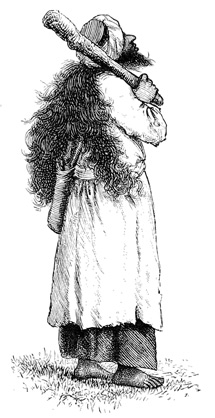
A DERVISH.
Many of them deal in charms, and are consulted as astrologers. Some are professed tellers of stories, to which I am told no European could degrade himself by listening, but which are most palatable to a village audience; and at this moment this unwelcome guest of mine has a crowd listening to a narrative partly told and partly acted.
They are credited with many vices, among the least of which are hazy ideas as to mine and thine, opium and bhang smoking to excess, and drunkenness.
They have recognised heads or chiefs, to whom they show great deference. One of their vows is that of obedience; and besides paying to the chief a part of the alms they receive, he gives them orders as to the houses they are to infest, and though the nuisance is not so common as formerly, a dervish at the door is still a sign of being great or rich, or both. Their cries, and their rude blasts on the buffalo horn, which is a usual part of their equipment, are most obnoxious. In the larger towns, such as Kûm and Kirmanshah, there are shops for the sale of their outfit—the tiger and panther skins, the axes, the knotted clubs, the almsbowls, etc.
Some are respectable, and enjoy much consideration, and I hope that many even of those whom a careful writer has called "disgusting vagabonds" are not humbugs; but the presumption is so much the other way that I am always glad when the ground admits of galloping past them, otherwise the dervish comes forward, with his knotted club much en évidence, with many compliments and good wishes, or else silently extends his almsholder, ejaculating Huk ("my right"). I usually have the means of appeasing, if not of satisfying him, but on the rare occasions when I have had no money the yells and maledictions have been awful.
The light and profane use of the Divine name is universal. The dervishes curse, but every one uses the name Allah wherever they can bring it in. The Ya Allah, as an expression of fatigue, or discontent, or interest, or nothing, is heard all day, and the boy who drives a cow, or a team, or a mule in a caravan, cries Ya Allah incessantly as an equivalent of "go along," and the gardener pushing his spade into the ground, the chopper with every blow of the axe, the labourer throwing up bricks, ejaculates the same. Mashallah, Inshallah, interlard all conversation. When men are building, the perpetual sing-song of phrases such as these is heard, "Brother, in God's name toss me a brick," the other replying, "Brother, in God's name here is a brick."
The vocabulary of abuse is also very large, and often involves serious reflections on the female relatives of the person abused. I hear such harmless phrases as "son of a burnt father," "son of a dog," "offspring of a pig," etc., on all occasions.
Murcheh Khurt is a large village with a good deal of cultivation about it, a mosque or more, a hammam, a chapar khana, and a caravanserai. Here again I found that the smart foreign soldier attracted all the notice, and that before the people ceased to wonder at him I had passed them. The chapar khana was full of men, so I have had to sink to the level of a recessed den with a manger in front in a ruinous caravanserai crowded with Persian travellers, muleteers, mules, horses, and asses, and the courtyard half-choked with ruins. I had not seen the inside of one of these dens before. Travellers have exhausted the vocabulary of abuse upon them; possibly they deserve it in the "vermin season"; but there is nothing worse than a square and perfectly dark room, with unplastered walls blackened by the smoke and cobwebs of ages, and a door which will not fasten.
The air is cool and the sky blue, and sitting at the open door is very pleasant. Mahboud and two of the servants caught cold at Kuhrūd and are ill, and my Arab has a chill too. He is a very stupid horse. His gentle eyes never change their expression, and his small ears rarely move. He has little sense or affection, but when he is patted his proud neck takes on a loftier arch. Gentle as he is to people he is a brute to other horses. He would like to fight every one of them, to stand on his hind-legs and grapple them round the shoulders with his fore-feet and bite their necks, roaring and squealing all the time. He and Mahboud's horse are inveterate enemies, and one of the few difficulties of the journey is the keeping them from a regular stand-up fight.
This village is an oasis in the desert. I have been through its gates, barely wide enough to admit an ass loaded with brushwood, with the seraidar and Mirza, walked through its narrow alleys, and inadvertently stumbled into a mosque where a great crowd of women were listening to a story of one of the twelve Imams told by a mollah, looked down upon it and over the adjacent country from a house roof, visited several houses, in which some of the inmates were ill and desired "Feringhi medicine," had a long conversation with the ketchuda, who came to see me to ask for eye lotion, and with the seraidar, and altogether have had quite a pleasant day.
Chapar Khana, Gez.—I am sitting in one of the three doorless doorways of my loft, grieving that the journey is just over, and that this is the last night of the exhilarating freedom of the desert. I rode twenty-four miles before one o'clock to-day, over a level uncultivated plain, bordered as usual by ranges of mountains. In fact, while I write of levels and plains it must be understood that Persia is chiefly a land of hills rising from a table-land from 3400 feet to 6000 feet in altitude, and that the traveller is rarely, if ever, more than fourteen or fifteen miles from mountains from 2000 to 6000 feet above the plain from which they rise, crowned by Demavend, whose imposing summit is 18,600 feet above the sea. The hills beyond Isfahan have assumed lofty proportions, and some of the snowy mountains of Luristan are to be seen in the far distance.
It is nearly an unmitigated waste between Murcheh Khurt and Gez, destitute even of tufts of wormwood; but the latter part of the march is through a stoneless alluvial desert of dry friable soil, soft springy galloping ground which water would turn into a paradise of fertility; and water there has once been, for not far from the road are the remains of some kanaats.
The questions naturally arise in a traveller's mind, first, what becomes of the enormous amount of snow which falls on the mountains; and next, how in a country so arid as the plateaus of Central Asia water for irrigation, and for the basins and fountains which abound in rich men's houses, is obtained.
Wells, unless the artesian borings shortly to be begun in the Tihran desert should be successful, are all but unknown, except for supplying drinking water, and there are scarcely any reservoirs, but ingenuity has devised a plan of subterranean water-channels, which besides their other advantages prevent loss by evaporation. Tihran has thirty-five of them, and the water which they distribute is naturally expensive, as the cost of making them is great.
It is on the slope of a hill that the spring is found which is the original source of supply; this is tapped at some depth, and its waters are led along a tunnel about four feet high by two feet wide lined with baked pottery where the ground is soft, and having a slight fall to the next spring or well, which may be from twenty-five to even sixty yards off.
As the labourers dig they draw up the earth and arrange it in a circle round the shaft, and as they come to water they draw up the mud and pour it on the top of the earth, where it dries and hardens, and below, the water is conducted as a running underground stream across great plains, its progress marked by mounds which have been compared to ant-hills and craters, but to my thinking are more like the shafts of disused mines.
Hundreds of these kanaats are seen, ruined and dry, and are the resort of porcupines and jackals. To construct a kanaat may call a village or series of villages into being. The letting it fall to ruin is one cause of deserted villages. Those which are not lined require annual repairs, which are now going on, but frequently the complete fall of the roof destroys the fall of the water, and the tunnel becomes irreparable.
The peasants are obliged to buy the water, for they cannot steal it, and the making of a kanaat is often a lucrative speculation. Pigeons live in them, and many of them are full of fish, which foreigners amuse themselves by poisoning by throwing a mixture of cocculus indicus with dough down the wells, when the poisoned but wholesome fish rise to the surface. They usually recover when they are left in the water. Dr. Wills describes them as having a muddy taste. The kanaats are a feature of Persia.
Ever since leaving Kûm all the dry and hard parts of the road have been covered with the industrious "road beetle," which works, like the ant, in concert, and carries on its activities at all seasons, removing from the road to its nest all the excreta of animals, except in regions where even animal fuel is so exceptionally scarce that boys with asses and ponies follow caravans for the same purpose. These beetles hover over the road on the wing, and on alighting proceed to roll the ball towards the nest, four or five of them standing on their hind-legs and working it forwards, or else rolling it with their heads close to the ground. Their instinct is wonderful, and they attract the attention of all travellers. They are about the size of a small walnut. Otherwise there is little of animated life to be seen on this route.
No day has had fewer noticeable objects. Two or three abambars, several caravanserais in absolute ruins, and a magnificent one in partial ruins are its record.
Gez consists of this post-house and a decaying caravanserai. From the roof as I write I watch the grooming of a whole row of chapar horses. As each pad is removed there is a horrid revelation of wounds, deep ulcers, sores often a foot long, and in some cases the white vertebræ of the spine are exposed. These are the wretched animals which often carry men from fourteen to seventeen stone who ride fifty miles in a day. It is hard enough even with extreme carefulness to keep the back of a horse all right on a continuous journey, but I never before saw animals ridden in such a state. They wince pitifully when their pads are put on again.
The desert is all around, purpling in the sunset, sweeping up to low broken ridges, and to some higher hills in the north-west covered with new-fallen snow. That the waste only requires water to make it prolific is apparent, for below these walls wheat is growing luxuriantly in some deep pits, irrigated from a dirty ditch out of which the drinking water comes. Nothing can be got, except by sending to a village a mile away.
Four of the men are ill, one with inflammation of the eyes, another with an abscess, and a third, a very strong man, with something like bilious fever, and a charvadar with malarial fever. The strong man's moans often become howls. He insists that he shall die to-night. These two afternoons have been much taken up with making poultices and medicines, and I shall be glad for the poor fellows to reach Isfahan and the care of a competent doctor.
Julfa, April 2.—I daresay this journey seems longer to you than it did to me. It was very pleasant, and its goal is pleasant, and a most kind welcome and the refinement of cultured English people go far to compensate for the loss of the desert freedom and the easy stride of the Arab horse.
I started the caravan at nine yesterday, with two men with bandaged eyes, and other two hardly able to sit on their mules; Mahboud, who is really more seriously ill than any of them, keeping up his pluck and capableness to the last. The man who threatened to die at Gez was very much better the next morning.
Soon after leaving Gez the country changes its aspect, the road becomes very bad, and passes through nine miles of rich cultivation—wheat, barley, opium, and vegetables growing abundantly; orchards are numerous, villages with trees and gardens succeed each other rapidly, water abounds, and before the gate of Isfahan is reached, domes and minarets rising among cypresses, planes, and poplars indicate the remains of the former capital of Persia.
Inside the shabby gateway the road to Julfa lies among rows of mean mud houses, heaps of ruins, and shabby provision bazars; and that mile or more of Isfahan was the one disagreeable part of the journey.
It was about the last day of the holidays, and the bazars, alleys, and open spaces were full of men in gay attire, and companies of shrouded women were moving along the quieter roads. It was too warm for the sheepskin coat which had served me so well at Kûm, and I had dressed with some regard to European sensibilities. The boys began to shout "A Feringhi woman! a Nazarene woman!" and then to call bad names; then men began to make up fiendish laughs,[32] and the howls and outcries gathered strength as I went on at the inevitable foot's pace, spitting being quite common, poor Mahboud constantly turning to me a perturbed wretched face, full of annoyance at the insults of his co-religionists, which it would have been dangerous to resent. It was a bad half-hour.
Before passing the residence of the Amir-i-Panj (the commander of 5000) near the Julfa gate the uproar died away, and once through the gate and in the Chahar Bagh (four gardens) there was peace. A bad road of cobble stones, with a double avenue of once magnificent planes, some once ornamental tanks, very high walls, pierced by storied gates, ornamented with wild designs on plaster in flaring colours, above which a blue dome is a conspicuous object, leads to a handsome bridge of thirty-three arches, with a broad level roadway, and corridors for foot passengers on either side, over the Zainderud, then came fields with springing wheat, a few houses, a narrow alley, and two or three miles from Isfahan the gate of its Armenian suburb, Julfa.
At once on crossing the bridge there was a change. Ruddy, cheery-looking unveiled women in red gowns, and pure white chadars completely enveloping their persons, moved freely about, and the men wore neither the becoming turban nor the ominous scowl of Islam. In the quaint narrow streets were churches with open vestibules, through which pictures of the thorn-crowned Christ and of sweet-faced Madonnas were visible; priests in black robes and women in white glided along the narrow roads. There was the fresher, purer air of Christianity, however debased and corrupted. In the low-browed churches divine honours are paid to a crowned and risen Christ, and the white-robed women have been baptized into His name. Never again will the Julfa alleys be so peaceful and lovable as yesterday, when they offered a haven from the howling bigots of Isfahan.
Dr. Bruce has not returned from Baghdad, but Mrs. and Miss Bruce welcomed me very kindly, and I am already forgetting my unpleasant reception. I. L. B.
LETTER XII
Julfa, April 17.
Mr. George Curzon wrote of Julfa: "The younger Julfa is a place wholly destitute of superficial attractions, consisting as it does of a labyrinth of narrow alleys closed by doors and plentifully perforated with open sewers. Life there is 'cabined, cribbed, confined' to an intolerable degree, and it is a relief to escape from its squalid precincts."
I dare not write thus if I would! It is now the early spring. The "sewers" are clear rapid streams, margined by grass and dandelions, and shaded by ash trees and pollard willows in their first flush of green. The "narrow alleys" are scrupulously clean, and there is neither mud nor dust. If I go up on the roof I see a cultivated oasis, gardens prolonged indefinitely concealing the desert which lies between them and the bold mountain ranges which surround this lofty and breezy plain. Every breeze is laden with the delicious odour of the bean blossom. A rapid river spanned by noble bridges hurries through the oasis it has helped to create, and on its other side the domes and minarets of Isfahan rise out of masses of fine trees, and bridges and mosques, minarets and mountains, are all seen through a most exquisite pink mist, for hundreds of standard peach trees are in full bloom, and look where one may everything is couleur de rose.
I quite admit that Julfa consists of a "labyrinth of alleys." I can never find my way about it. One alley with its shady central stream (or "sewer"), its roughly paved paths on either side, its mud walls pierced by low doors, is very much like another, and however lucky one may be in "happening on" the right road, it is always a weary time before one escapes from between mud walls into the gardens and wheatfields, to the blossoming beans, and the exquisite wild-flowers among the wheat.
As to the "cabined, cribbed, confined" life, I can give no testimony from personal knowledge. All life in European settlements in the East appears to me "cabined, cribbed, confined," and greatly devoid of external interests. Perhaps Julfa is deficient in the latter in an eminent degree, and in a very small foreign community people are interested chiefly in each other's affairs, sayings, and doings. Lawn tennis, picnics, and dinner parties are prevalent, the ordinary etiquette of European society prevails, and in all cases of need the residents are kind to each other both in life and death.
The European society is divided into three circles—the missionaries, the mercantile community, and the telegraph staff. The British agent, Mr. Aganoor, is an Armenian.[33] No Christians, Armenian or European, live in Isfahan, and it is practically défendu to European women. This transpontine restriction undoubtedly narrows the life and interests of Julfa. It is aggravating and tantalising to be for ever looking at a city of 60,000 or 70,000 people, the fallen capital of the Sufari dynasty, and never be able to enter it.
This Christian town of Julfa has a certain accessible historic interest. Shah Abbas, justly surnamed the Great, conceived the sagacious project of introducing among his Persian subjects at Isfahan—then, in the latter part of the sixteenth century, a magnificent capital—the Christian habits of trading, sagacity, and thrift, for then as now the Armenians had commercial dealings with China, India, and Europe, and had imported several arts into Persia.
This project he carried out in truly despotic fashion by moving almost the whole population of Julfa on the Araxes, on the modern Russo-Persian frontier, to the banks of the Zainderud, making over to it the best lands in the neighbourhood of Isfahan. Many years later the new Julfa was a place with twenty-four churches, great prosperity, and an estimated population of 40,000. Its agriculturists were prosperous market-gardeners for the huge city of Isfahan, and it had likewise a great trading community, and was renowned for the making of jewellery and watches.
It has now a dwindling population of about 3000, chiefly elderly men, women, and girls, the young men, after receiving a good education in the Church Mission and other schools, flying from its stagnation to India, Java, and even Europe. The twenty-four churches are reduced to twelve, and these with the vast cemetery in the desert at the base of Kuh Sufi are its chief objects of interest, apart from those which are human and living.
April 22.—The peach blossoms have long since fallen, but perhaps I still see Julfa couleur de rose, even after three weeks, so very great is the kindness under this roof, and so fully is my time occupied with various interests, and the preparations for a difficult journey.
This, as you know, is the Church Mission House. Dr. Bruce has been here for twenty years, and until lately, when the Archbishop of Canterbury's mission to the Assyrian Christians began its work at Urmi, near the Turkish frontier in the north-west, this was the only English mission in the Empire. It was contemplated as a mission to the Mohammedans, but in this respect has been an apparent failure. It is true that much prejudice has been disarmed, and, as I have heard from some leading Mohammedans, Dr. Bruce's zeal and good works have won their respect. A large part of the Bible has been translated into Persian and very widely circulated through the adjacent country by means of colporteurs of the British and Foreign Bible Society. His preaching of Christianity is listened to respectfully, and even with interest, wherever he itinerates, and Moslems daily call on him, and show much friendliness, but the results, as results are usually estimated, are nil—that is, no Mohammedans openly profess Christianity.
There is actual though not legal toleration, but Moslem children may not attend a mission school, and a Moslem who becomes a Christian loses his means of living, and probably his life is sacrificed to fanaticism.
In consequence of these difficulties, and certain encouragements in another direction, the ostensible work of the mission is among Armenians. Dr. Bruce has not been afraid of incurring the stigma of being a proselytiser, and has a large congregation of Armenians worshipping after the English form, ninety-four being communicants of the Church of England. On Easter Eve there was an evening Communion, and the great row of women kneeling at the rail in the pure white robes which cover them from head to foot, and then moving back to their places in the dim light, was very picturesque and beautiful.
Good works have been added one after another, till the mission is now a very large establishment. The C.M.S. has been liberal to this, its only Persian agency, and Dr. Bruce, having private means, has generously expended them largely on missionary work in Julfa.
The chief features of the compounds are the church, which is both simple and ecclesiastical in its exterior and interior, and the library adjoining it, where Dr. Bruce works at the translation of the Old Testament into Persian and the revision of the New, aided by a munshi, and where through much of the day he is receiving Moslems, some of whom come to inquire into Christianity, others for religious disputations, and a third and numerous class out of mere friendliness. The latter are generally invited into the Mission House, and are regaled with coffee and kalians, in orthodox Persian fashion. Among the latter visitors has been the Amir-i-Panj, who came to ask me to call on his wife, accompanied by a general of cavalry, whose name I cannot spell, and who speaks French remarkably well.
Among the other buildings are those of the Medical Mission, which include a roomy courtyard, where the animals which carry the patients are tethered, rooms for the doctor, a well-arranged dispensary and consulting-room, with waiting-rooms for both sexes, and rooms above in which serious surgical cases are received for treatment, and where at present there are eleven patients, although just now there is no European doctor, and they are being treated by the native assistants, most kindly helped by Dr. Scully of the telegraph staff. This hospital and dispensary are largely taken advantage of by Moslems, who highly appreciate this form of Christian benevolence.
The boys' school, with 205 pupils, has been a great benefit to Julfa. The head-master, Mr. Johannes, was educated in England and was formerly a master of the Nassik School in India. This school provides the education of one of our best middle-class schools, and the teaching is thorough. Smattering would be infinitely despised by teachers and pupils. In this thorough fashion Latin, French, the first four books of Euclid, and algebra are taught to the young men of the upper form. The boys have a large playground, with a great tank for bathing, and some of the equipments of a gymnasium, a vaulting pole, parallel bars, etc.
The girls' schools, containing 100 girls, have their own courtyard, and they need enlarging, though the process has been more than once repeated. Mrs. Aidin, an English teacher, is at their head, and exercises that strong influence which love and firmness give. The girls are a mass of red, a cool red, without yellow, and when they disperse they enliven the Julfa alleys with their carnation dresses and pure white chadars. The education is solid and suitable, and special attention is given to needlework.
Besides these there is an orphanage, begun for the benefit of those whose parents died in the famine, in which are twenty boys. Outside are many other works, a Bible House, from which colporteurs at intervals proceed on journeys, a Young Men's Christian Association, or something like it, etc. etc.
Now as to the Mission House itself, which has to accommodate Dr., Mrs., and Miss Bruce, Mr. Carless, a clerical missionary, and two English lady missionaries. So much has been written lately about the "style of living" of missionaries, their large houses, and somewhat unnecessary comfort in general, that I am everywhere specially interested in investigating the subject, having formed no definite opinion on the question whether living as natives or living as Europeans is the more likely mode of producing a salutary impression.
The Mission House here is a native building, its walls and ceilings simply decorated with pale brown arabesques on a white ground. There are a bedroom and parlour, with an ante-room between giving access to both from the courtyard, a storeroom, and a kitchen. Across the court are servants' quarters and a guest-room for natives. Above these, reached by an outside stair, are a good room, occupied by Mr. Carless as study and bedroom, and one small guest-room. Another stair leads to two rooms above some of the girls' school premises, having enclosed alcoves used as sleeping and dressing rooms. These are occupied by two ladies. One room serves as eating-room for the whole mission party, at present six in number, and as drawing-room and workroom. Books, a harmonium, Persian rugs on the floor, and just enough furniture for use constitute its "luxury."
There are two servants, both of course men, and all the ladies do some housework. At present the only horse is the dispensary horse, a beast of such rough and uneven paces that it is a penance to ride him. The food is abundant, well cooked, and very simple.
The life, all round, is a very busy one. Visitors are never refused at any hour. The long flat mud roofs from which one can see the gardens and the hills are used for exercise, otherwise some of the party would never have anything better than mud walls for their horizon, and life in courtyards is rather depressing for Europeans. I have told facts, and make no comments, and it must be remembered that both Dr. Bruce and Miss V——, a lady of rare devotion who has lately arrived,[34] are to a certain extent "honorary" missionaries, and have the means, if they had the desire, of surrounding themselves with comforts.
This is about the twenty-third mission circle with which I have become acquainted during the last eight months, and I see in nearly all the same difficulties, many of them of a nature which we can hardly realise at home.
Women coming to the East as missionaries are by far the greatest sufferers, especially if they are young, for Eastern custom, which in their position cannot be defied with advantage, limits free action and abridges all the comforts of independence. Thus a woman cannot take a walk or a ride or go to a house without a trusty man-servant in attendance on her, and this is often inconvenient, so she does not go out at all, contenting herself with a walk on the roof or in the courtyard.
The wave of enthusiasm on which a lady leaves her own country soon spends its force. The interest which has centred round her for weeks or even months is left behind. The enthusiastic addresses and farewell meetings, the journey "up the country" with its excitement and novelties, and the cordial welcome from the mission circle to which she is introduced, soon become things of the past. The circle, however kind, has its own interests and work, and having provided her with a munshi, necessarily goes on its own way more or less, and she is left to face the fearful difficulties of languages with which ours has no affinity, in a loneliness which is all the more severely felt because she is usually, for a time at least, one nominally of a family circle.
Unless she is a doctor or nurse she can do nothing till she has learned the language, and the difficulty of learning is increased by the loss of the flexible mind and retentive memory which are the heritage of extreme youth. The temptation is to "go at it" violently. Then come the aching head, the loss of sleep, the general lassitude and nervousness, and the self-questionings as to whether she was right in leaving her fruitful work in England.
Then, instead of realising the truth of the phrases used at home—"multitudes flocking as the doves to their windows"—"fields white unto the harvest," etc.—she finds that the work instead of seeking her has to be made by her most laboriously, and oftentimes the glowing hope of telling of the Redeemer's love and death to throngs of eager and receptive listeners is fulfilled in the drudgery of teaching sewing and the rudiments of English during the first year.
It is just this first year under which many women succumb. Then how many of the failings and weaknesses of the larger world must be epitomised in a mission group exposed, as Mr. Heyde of Kyelang feelingly said, "to the lowering influence of daily contact with a courteous and non-repulsive Heathenism and Mohammedanism"! Missionaries are not likely to possess, as they certainly are the last to claim, superior sanctity, and the new-comer, dreaming of a circle in all respects consecrated, finds herself among frictions, strong differences as to methods of working, not always gently expressed, and possible jealousies and criticisms, and an exaggeration of the importance of trifles, natural where large events are rare. A venerable American missionary in Turkey said, "Believe me, the greatest trial of missionaries is missionaries."
The small group is frequently destitute of social resources outside itself, it is cut off from friendly visits, services, lectures, music, new books, news, and the many recreative influences which all men regard as innocent. The life-work seems at times thrown away, the heat, the flies, and the mosquitos are depressing and exhausting, and in the case of young women, especially till they can use the language colloquially, there is little if any outside movement. Is it wonderful that supposed slights, tiffs, criticisms which would be utterly brushed away if a good walk in the open or a good gallop were possible, should be brooded over till they attain a magnitude which embitters and depresses life?
A man constantly finds the first year or two very trying till he has his tools—the language—at command, and even men at times rub each other the wrong way, but a man can take a good walk or a solitary gallop, or better still, a week of itinerating among the villages. People speak of the dangers and privations of missionary life. I think that these are singularly over-estimated. But the trials which I have alluded to, and which, with the hot climates and insufficient exercise, undermine the health of very many female missionaries, cannot be exaggerated, and demand our deep sympathy.
I do not think that the ordinary pious woman, the successful and patient worker in district visiting, Bible classes, mothers' meetings, etc., is necessarily suited to be a foreign missionary, but that a heart which is a well-spring of human love, and a natural "enthusiasm of humanity" are required, as well as love to the Master, the last permeating and sanctifying the others, and giving them a perennial freshness. Fancy G. G—— grumbling and discontented and magnifying unpropitious trifles, when her heart goes out to every Chinawoman she sees in a perfect passion of love![35]
With the medical missionary, whether man or woman, the case is different. The work seeks the worker even before he is ready for it, claims him, pursues him, absorbs him, and he is powerful to heal even where he is impotent to convert.
I have been to the hospital to see a woman from the Kuhrūd mountains, who was brought here to undergo an operation. She had spent all her living on native physicians without result, and her husband has actually sold his house to get money to give his wife a last chance of recovery. Fifteen years ago this man nearly took Dr. Bruce's life. Now, he says, "The fruits of Christianity are good."
Daily the "labyrinth of alleys" becomes denser with leafage, and the sun is hot enough to make the shade very pleasant, while occasional showers keep the greenery fresh. Indeed it is warm enough in my room to make the cool draught from the bādgīr very pleasant. These wind-towers are a feature of all Persian cities, breaking the monotony of the flat roofs.
Letters can be sent once a week from Isfahan, and there is another opportunity very safe and much taken advantage of, the "Telegraph chapar," a British official messenger, who rides up and down between Bushire and Tihran at stated intervals. The Persian post is a wretched institution, partaking of the general corruption of Persian officialism, and nowhere, unless registered, are letters less safe than in Tihran.[36] I shall send this, scrappy as it is, as I may not be here for another week's mail.
I. L. B.
LETTER XIII
Julfa, April 29.
Each day has been completely filled up since I wrote, and this is probably the last here. My dear old Cabul tent, a shuldari, also Indian, and a servants' tent made here on a plan of my own, are pitched in one of the compounds to exercise the servants in the art, and it really looks like going after many delays.
A few festivities have broken the pleasant monotony of life in this kindly and hospitable house—dinner parties, European and Armenian; a picnic on the Kuh Sufi, from which there is a very fine panoramic view of the vast plain and its surrounding mountains, and of the immense ruins of Isfahan and Julfa, with the shrunken remains of both; and a "church picnic."
From Kuh Sufi is seen how completely, and with a sharp line of definition, the arid desert bounds the green oasis of cultivated and irrigated gardens which surround the city, and which are famous for the size and lusciousness of their fruit. From a confusion of ruinous or ragged walls of mud, of ruined and modern houses standing complacently among heaps of rubbish, and from amidst a greenery which redeems the scene, the blue tiled dome of the Masjid-i-Shah, a few minarets, and the great dome of the Medresseh, denuded of half its tiles, rise conspicuously. Long lines of mud streets and caravanserais, gaunt in their ruin, stretch into the desert, and the city once boasting of 650,000 inhabitants and a splendid court survives with a population of less than 80,000 at the highest estimate.
The "church picnic" was held in a scene of decay, but 260 people, with all the women but three in red, enlivened it. It was in the grounds of the old palace of Haft Dast, in which Fatteh Ali Shah died, close to one of the three remarkable bridges of Isfahan, the Pul-i-Kajū. These bridges are magnificent. Their construction is most peculiar, and their roadways being flat they are almost unique in Persia.
The Pul-i-Kajū, though of brick, has stone piers of immense size, which are arched over so as to form a level causeway. On this massive structure the upper bridge is built, comprising a double series of rooms at each pier with doorways overlooking the river, and there are staircases and rooms also in the upper piers.
The Chahar Bagh bridge is also quaint and magnificent, with its thirty-three arches, some of them very large, its corridors for foot passengers, and chambers above each pier, each chamber having three openings to the river. These bridges have a many-storied look, from their innumerable windows at irregular altitudes, and form a grand approach to the city.
As at first, so now at last the most impressive thing to me about the Zainderud next to its bridges is the extent to which rinsing, one of the processes of dyeing, is carried on upon its shingle flats. Isfahan dyed fabrics are famous and beautiful, heavy cottons of village make and unbleached cottons of Manchester make being brought here to be dyed and printed.
There is quite a population of dyers, and now that the river is fairly low, many of them have camped for the season in little shelters of brushwood erected on the gravel banks. For fully half-a-mile these banks are covered with the rinsers of dyed and printed calicoes, and with mighty heaps of their cottons. Hundreds of pieces after the rinsing are laid closely together to dry, indigo and turquoise blue, brown and purple madder, Turkey red and saffron predominating, a vile aniline colour showing itself here and there. Some of the smaller dyers have their colour vats by the river, but most of the cotton is brought from Isfahan, ready dyed, on donkeys' backs, with the rinsers in attendance.
Along the channels among the shingle banks are rows of old millstones, and during much of the day a rinser stands in front of each up to his knees in water. His methods are rough, and the cotton must be good which stands his treatment. Taking in his hands a piece of soaked half-wrung cotton, from fifteen to twenty yards long, he folds it into five feet and bangs it on the millstone with all his might, roaring a tuneless song all the time, till he fails from fatigue. The noise is tremendous, and there will be more yet, for the river is not nearly at its lowest point. When the piece has had the water beaten out of it a boy spreads it out on the gravel, and keeps it wet by dashing water over it, and then the process of beating is repeated. The coloured spray rising from each millstone in the bright sunshine is very pretty. Each rinser has his watchdog to guard the cottons on the bank, and between the banging, splashing, and singing, the barking of the dogs and the shouts of the boys, it is a noisy and cheery scene.
I have heard that certain unscrupulous English makers were in the habit of sending "loaded" cottons here, but that the calico printers have been a match for them, for the calico printer weighs his cloth before he buys it, washes and dries it, and then weighs it again. A man must "get up very early" if he means to cheat a Persian.
The patterns and colours are beautiful. Quilts, "table-cloths" (for use on the floor), and chadars are often things of exquisite beauty. Indeed I have yielded to temptation, and to gratify my own tastes have bought some beautiful "table-cloths" for Bakhtiari women, printed chiefly in indigo and brown madder on a white ground.
The temptations are great. I really need many things both for my own outfit and for presents to the Bakhtiaris, and pedlars come every day and unpack their tempting bundles in the small verandah. No Europeans and no women of the upper classes can enjoy the delights of shopping in Persia, consequently the pedlar is a necessary institution.
Here they are of the humbler sort. They have learned that it is useless to display rich Turkestan and Feraghan carpets, gold and silver jewellery, inlaid arms, stuffs worked with gold thread, or any of the things which tempt the travelling Feringhi, so they bring all sorts of common fabrics, printed cambrics, worthless woollen stuffs, and the stout piece cottons and exquisitely-printed cotton squares of Isfahan.