Front matter
Reading edition
Cover art
JIM MORTIMER
BY
WARREN BELL
AUTHOR OF "J. O. JONES," "TALES OF GREYHOUSE," ETC.
WITH SIXTEEN FULL-PAGE ILLUSTRATIONS BY GORDON BROWNE
LONDON ADAM AND CHARLES BLACK 1908
CONTENTS
CHAPTER
Introducing Jim
Over the Telephone
Koko Reports Progress
A Handmaid to Mercury
Jim Rejoices
The Doctor Keeps His Word
Sir Savile's Offer
Number Nine
In the Pillory
At the Surgery
Mr Maybury's Resolve
Koko's Word
"Harris & Father"
A Piece of News
Koko is Thanked
Jim's Patients
In the Crescent
Master Harris is Shown Out
Hard Pressed
After the Play
A Matter of Wages
The Warning
The Ivory Fan
Jim Catches a Train
In the Silent House
The Vultures
The Home-Coming
A Delicate Mission
The Doctor Visits Mount Street
The Week Passes
In which it is shown that the Bearded Man had made Another Mistake
In which Two People set out upon a Journey
JIM MORTIMER.
CHAPTER I.
INTRODUCING JIM.
People, unless they be star-gazers, do not walk along, as a rule, with their faces turned towards the sky; hence it was that the slender telephone wire communicating between Dr Mortimer's private residence, "Pangora," and the doctor's private asylum, escaped the notice of all but a few who fared along the eight miles of high road dividing Threeways from Millingbourne, in the county of Eastfolkshire.
And yet this slender wire, which showed up against the blue sky much like a substantial cobweb, was fraught with interest. It was barely 300 yards in length, its installation had been a comparatively cheap and simple undertaking, and it had paid for itself scores of times over. Messages of life and death passed across it constantly; instructions in cases of emergency, tingling over the white line of road, saved the time that would otherwise have been occupied in walking the 300 yards--for doctors do not often run; reprimands were roared across it, bulletins despatched by its agency, dietary altered, medicine prescribed.
The sunshine was coquetting with the little wire, and the great oaks and elms were surveying the flirtation with affected indifference, one bright September morning, when Mr James Mortimer, the Doctor's grandson, who was known among his hospital intimates as the "Long 'Un," having breakfasted in trousers, shirt, and dressing-gown, rose from the table and ambled out into the surgery--for, in addition to an asylum, the doctor had a lucrative practice in that part of Eastfolkshire. The waiting-room adjoining the surgery was empty, save for one small, pale boy.
Although James was on holiday, he occasionally acted as deputy when his grandfather and the latter's assistant were not at hand. And James was quite competent to do so, for he was a fully qualified surgeon.
"Well, Johnny, been eating green pears?"
The urchin looked guilty.
"Y-yes, sir."
"Let's see your tongue--ah! hum!" and the Long 'Un affected a serious expression as he mixed a stiffish dose of black draught. The urchin pulled a very wry face as he tasted the dose, and stopped for breath half-way through it.
"Every drop!" commanded the Long 'Un.
The urchin obeyed him, and then, bursting into tears, was pleased to be violently sick.
"You'll feel better now--and here's a penny for you," quoth Jim Mortimer, in a truly paternal way for four-and-twenty.
But the urchin renewed his howling.
"I--I came up for me mother's medicine," he quavered; "I--she--she didn't know I'd been eatin' pears."
The Long 'Un threw back his head and burst into a roar of laughter.
"By George! what a shot! Why, Johnny, I thought you'd come to be doctored. Well, here's sixpence for you. Call again for the medicine--I don't know anything about it."
The urchin took the sixpence with a smile showing through his tears, and with a final sniff shuffled out of the waiting-room.
The Long 'Un still looking highly amused, approached the telephone and rang up the asylum.
"Ay, ay, sir!" came the response.
"That you, Hughes?"
"Yes, Mr James."
"How's the Zoo?"
"All quiet except the major. We've had to put him in the padded room."
"The major again!"
"Yes, sir; broke out at breakfast. It took three of us to get him down. He very near pulled Smith's windpipe out."
"He doesn't like Smith, does he?"
"'Ates him, sir."
"I think I'll come across and have a look at him," said Jim. "I have an idea I can handle the old chap."
"Glad to see you, Mr James," replied the head attendant; "you're going back to town to-day, aren't you, sir?"
"Yes--back to-day, worse luck."
Without bothering to alter his garb, Jim Mortimer, his gay dressing-gown sweeping the ground, strolled out into the garden and sauntered along the gravel path which led to the high road. As he went he pulled lazily at his pipe. Both of the gardeners touched their hats and smiled a welcome as he passed; the Long 'Un was a favourite all over the settlement.
Certainly he looked a quaint figure as he emerged into the high road--a quaint but not unpleasing one. Long he was--six feet, and four inches over that--but square-shouldered and supple. His carriage was easy, but not of a military description, and he stooped slightly, with the stoop of the rowing-man rather than that of one engaged in sedentary work or of one who has overgrown his strength. He looked, as he strolled across the road, like a long, lean hound, trained to the hour, hard as steel and tough as hickory. His face was well cut, with rather sleepy eyes and a certain gentleness about the corners of the mouth that had caused his school-fellows to regard him as somewhat of a "soft"--until he hit them. His hair was clipped short and well brushed, and his complexion was pink with health and the application of cold water.
As Jim was moving across the road in his indolently graceful way, a carriage and pair approached at a quick trot. At a word from one of its occupants the coachman pulled up close by the young surgeon.
"Can you tell me, please, if this is Dr Mortimer's?" inquired a stern-faced elderly lady, whose rich mantle and handsome equipage betokened her to be a person of means and possibly of position.
"Yes, all of this," replied Jim, with a comprehensive wave of his hand which took in each side of the road, "is Dr Mortimer's." A pretty girl was sitting by his questioner's side, and the fact was not lost upon Jim. "The Doctor is out," he added, "but I am a medical man. Can I be of service to you?"
The lady surveyed Jim's dressing-gown with evident disapproval, but Jim glanced unconcernedly at the telephone wire overhead. Meanwhile the pretty girl gazed straight before her at the blue smoke curling over the housetops in Threeways, having decided that this very tall man in such unorthodox attire was quite good-looking.
"I prefer to see Dr Mortimer himself. Do you think he will be in soon?"
"He may be in at any moment," said Jim; "that is the way to his house," he added to the coachman, "through those gates."
"I am obliged to you."
The lady sat back without troubling to bestow another glance on Jim, but she observed to her companion as they entered the drive that the extraordinary young fellow in the dressing-gown was probably one of the madmen.
Jim Mortimer, sauntering on, at length reached the asylum, a cheerful-looking red-brick-building, standing healthily high. He found Hughes in the patients' common room--a spacious and airy apartment provided with a piano, a bagatelle board, and other requisites for indoor pastimes.
As Jim was chatting with the head attendant, a grey-haired, round-shouldered man of some sixty summers came up to them.
"Take care, Mr James!" he exclaimed, "he's just behind you! Oh, if I had a gun now!"
Jim knew that Mr Richards--the speaker--had "alligators" on his bad days.
"No, he's gone under the table," replied Jim. "See him? Here, lend me a cue, and I'll kill him."
"That's right," said the poor fellow; "kill him, and I'll leave you all my money. He sat on the end of my bed last night--he won't let me alone. Kill him now he's not looking."
Jim seized the cue and slashed about under the table with it.
"There--I've done it. I've cut his head off."
"Oh, thank you, thank you!" cried Mr Richards, bursting into tears. "You shall have every penny of my money."
They left him crying quietly for joy. In a corner of the room a saturnine-looking gentleman was standing stock still with his eyes closed.
"Hullo!" said Jim, "I've not seen this one before. Who is he?"
"A new patient--a clergyman," replied Hughes; "he thinks he's dead. Comes to life for his meals, though."
Jim laughed--the careless laugh of thoughtless youth--but the next moment his face became grave. He felt very much for these afflicted souls, and they seemed to know it, for in their half-witted way they loved "Mr James."
After passing through several corridors, Jim and Hughes arrived at a room that was provided with a thick door in which was a grille of the old-fashioned kind. Within could be seen a red-faced, burly man, his clothing much disarranged, and his eyes wildly gleaming.
A stalwart attendant, with a bandage round his neck, was standing by, watching the occupant of the padded room through the little bars of the grille.
"I'll go in and have a chat with him," said Jim.
"You'd better not, sir," returned Hughes; "you'll take your life in your hands if you do."
"Nonsense!" cried Jim. "Open the door, Smith!"
The attendant Smith--he who had been so unfortunate as to earn the major's ill-will--shot back the bolt, and, as Jim stepped into the cell, made haste to secure the door behind him.
The patient fixed a glare of bovine ferocity on his caller as Jim advanced towards him.
"Morning, major! Men pretty fit this morning?"
The major had been about to hurl himself at the young fellow when Jim's words stirred an old memory in his inflamed brain.
"What's that to you--who are you?" he growled.
"The officer commanding the expedition," rapped out Jim.
The major's manner changed on the instant.
"The men are as well as can be expected, sir, considering the beastly bad water. Three more down with enteric to-day."
"Dear--dear!" exclaimed Jim, "that's bad. Well, major, we must hope for the best--hope for the best. And how are you yourself?"
"I think I've got a touch of the sun, sir," said the major, "but I daresay it'll pass off. I've been feeling queer up here for several days now," he added, touching his forehead.
"What you want, major," said Jim, "is a good sound sleep. You're looking overworked. Now just you lie down on your mattress yonder and have a nap. You've been doing very well lately, major, and I shall mention you in my despatches."
The poor madman's face glowed with delight.
"I'm very much obliged to you, sir," he said, with a world of gratitude in his voice.
"Well," said Jim, "I must be going on. Now, do as I say, and have some sleep."
"Thank you, sir, I think I will," said the major, turning towards the mattress with touching docility.
Unfortunately, however, he happened to look round at the grating, and in an instant his face and manner changed. Jim, following the lunatic's glance, saw that the attendant Smith was still peering through the bars.
"Get away from there--sharp!" he shouted, but even as he spoke the major hurled himself against the staunch oaken portal, and tore at it with his nails as he yelled imprecations at the object of his hate.
Jim stepped swiftly forward and laid his hand on the madman's shoulder. The major turned like an infuriated beast, his fingers twitching, and his whole body convulsed with fury.
"I told you to get some sleep, major," said Jim, imperiously, "and I expect my orders to be obeyed."
For a terrible moment the attendants held their breath. But Jim looked the major coolly in the face. Had he flinched the very slightest, the madman would have been at his throat.
Still steadily eyeing the man, Jim pointed to the mattress, and slowly, doubtfully, the major crept towards it and lay down. In two minutes he was slumbering like a child.
Jim made sure that the major was fast asleep before he softly approached the door. Hughes let him out and shot the bolt back into its socket with all possible speed.
"The Doctor himself couldn't have done it better, sir," said the head attendant, with heartfelt admiration. "Will you come and see the cricket now, sir?" he added.
The milder of the asylum's inmates were trying conclusions with bat and ball in an adjoining field. Jim, on arriving at the scene of play, displaced one of the attendants who was acting as wicket-keeper, and took up his position behind the sticks.
The ball came swiftly, and the batsman--a tall, broad-shouldered, ill-tempered-looking fellow--snicked it into Jim's ready hands.
"How's that?" roared the Long 'Un; but the attendant umpiring at the other end, being a diplomat, gave it as "Not out."
As Jim trundled the ball back to the bowler, the big batsman turned to him and testily observed, "Please don't ask a question of that sort again. I don't like it."
"My dear man," said Mortimer, assuming that he was addressing one of the most reasonable inmates of the place, "if I catch you at the wicket, you're out. That's only fair."
But the batsman merely glared at him sulkily.
The next ball was a still more palpable catch at the wicket, and was securely held.
"How's that?" inquired Jim, who didn't believe in showing the white feather. The words had hardly left his lips when the batsman swung round and aimed a terrific blow at his head--a blow that Jim, by great agility, just managed to avoid.
"I told you," said the batsman, with dignity, "that I did not like you saying that."
The ever-watchful Hughes hurried up.
"They're only satisfied by being clean bowled, Mr James," he explained, and then proceeded to administer a few words of rebuke to Jim's assailant, who looked duly reproved.
The Long 'Un was meditating trying an over--with the laudable object of getting the big batsman out in a way he would quite understand--when a page-boy came hurrying towards him with a message to the effect that the Doctor wished to speak to him at the telephone.
So Jim had perforce to postpone his over, and left the field little dreaming that certain words which would shortly come to him across the wire were destined to affect his after-career in a remarkable manner.
CHAPTER II.
OVER THE TELEPHONE.
Old Dr Mortimer was, in every sense of the word, a hard man. Of massive build and handsome countenance, upright and commanding in presence, with a clear brain, a will of iron, and a resonant, penetrating voice, his was at once a dominating and notable personality.
Dr Mortimer's sphere of action, it is true, was limited and local; but if, by the accident of circumstances, his lot had been cast in a military or political arena, he would assuredly have risen to a high place, and possibly cut his initials on the rock of fame.
Beginning on nothing, the Doctor had fought his way up to his present position by dint of sheer perseverance and strength of head. His indomitable will had cleared away all obstacles, and now he was seventy, hale and hearty, a man of wealth and a county magnate.
But Dame Fortune, while she gives with one hand, takes away with the other. The Doctor was now childless, and grandchildless, too, save for James. This man of iron had brought weaklings into the world; his wife had died before she was thirty, and as his riches increased, his brood had one by one faded into the grave. So now, when James--the only son of his eldest son--was in London, Dr Mortimer sat at his mahogany every night all alone--proud, rich, powerful, feared, obeyed on the instant--but alone.
His assistant, M'Pherson, a trustworthy, middle-aged Scotsman, of no especial brilliance, but conscientious to a hair, lived at the asylum and took most of his meals with the patients.
The Doctor had made his will years since, and James was absolutely heir to all he had, save for trifling legacies to his executors and such persons as Hughes, his cook, coachman, and gardeners. Every stick and stone was to be Jim's, and Jim knew it.
But the Doctor was not satisfied with his grandson. Throughout Jim's five years at Rugby the general tenor of his reports had been: "Has done well on the whole, but might have done much better." His hospital career had been of a very similar character. Jim, though of a lazy temperament, had, nevertheless, won warm encomiums from great surgeons for his skill with the knife. Sir Savile Smart, the renowned specialist in abdominal matters, had written to Dr Mortimer--who was an old friend of his--in high praise of Jim. But there, as ever, was the qualifying clause: "Your lad can do wonders when he likes, which isn't always." And then again Jim was given to bursts of rowdyism, accounts of which had trickled down to Threeways, where Jim was regarded as a lovable, harum-scarum youth, who would come into all the Doctor's money, "and so it would be all right." This meant that his wild ways didn't matter--he would never have to earn his living. Besides, he was only a youngster--he would sober down in time. He wouldn't go on fighting policemen all his life--"and so it would be all right."
At dinner on the preceding evening the Doctor, warmed by the generous grape, had been in an affable, not to say confiding mood, and it would have been well for Jim had this been their final conversation ere he departed for town, for the Doctor was in a high good-humour when they lit their bedroom candles, and even went so far as to pat his grandson on the back in a manner that was quite affectionate.
Jim guessed that this amiable frame of mind would decamp with the darkness, and his surmise proved correct, for when he got to the telephone and took the receiver off its peg, he knew by the sound of the Doctor's voice that his grandfather was in an irritable mood.
"Are you there, James?"
"Yes, sir."
"My carriage is waiting, and I must be off in a minute or two, but I want to have a word with you before you go."
"Shall I come across?" suggested Jim,
"No, that will waste time, and I haven't much to say."
It occurred to the Long 'Un that what little his grandfather wished to say would not be of an overwhelmingly genial character.
"I--ah--I received a bill this morning for a plate-glass window you smashed in the Strand about six weeks ago," began the Doctor; "I suppose you recollect it?"
"Seem to remember something of it," replied Jim.
"That's good of you. The bill is for twelve pounds."
"Those big shop windows run into money," hazarded Jim.
"Somewhat superfluous information," snapped the Doctor; "what I want to say is that I won't pay any more of these bills--do you clearly understand?"
"I do," said the Long 'Un.
"And, moreover, I won't have any more of your drunken frolics--it's high time you stopped all that nonsense. I should also advise you to drop the acquaintance of that disreputable reporter friend of yours--he seems to have a bad influence on you--Coke, is that his name?"
Jim chuckled.
"What--Koko? Most harmless man on earth! Gets me out of scrapes, not into them!"
A fresh grievance now occurred to the Doctor. "I am not at all satisfied with the way you are working," he said.
"We dig in pretty hard at Matt's," replied Jim, quite truthfully.
"Yes--but how about your degree? I expect more than a mere qualification from you."
"I'll read like a nigger this time, grandfather----"
"I'm glad to hear you say so," interrupted the Doctor, in a mollified tone.
"Time and weather permitting," concluded Jim, indiscreetly.
A short, ill-tempered cough sounded through the telephone. The Doctor was preparing his ultimatum; Jim's addendum gave him his cue.
"I suppose 'time and weather' mean such dissolute companions as Coker, or whatever his absurd name is. Well, now, attend to me, James. I'm not squeamish, but I expect you to pull up. I won't have any more playing the fool, either at the hospital or down here. For instance," he added, with growing ire, "what on earth d'you mean by masquerading about the high road in a dressing-gown?"
"I prefer ease to elegance," said Jim, cheekily.
"Well, sir," shouted the Doctor across the vibrating wire, "I don't intend that my grandson shall be taken for one of my patients!"
"Why--who took me for one of them?" demanded Jim in amazement.
"The Countess of Lingfield."
"The who?" exclaimed Jim.
"The Countess of Lingfield. She spoke to you from her carriage half an hour ago."
"By George!" Jim broke into a mellow laugh. "Was that a countess? I say, grandfather, who was the pretty girl with her?"
"Her daughter," replied the Doctor; "and it was she who observed that you were probably one of the 'harmless variety'!"
"Indeed!" said the Long 'Un, not quite so heartily.
"Yes, sir," proceeded the Doctor, his ire rising again, "and I was placed under the ignominious necessity of having to admit that you were my grandson."
"Awfully rough on you, grandpa."
The Doctor was evidently fuming at the other end of the telephone.
"So," was his next utterance, "I shall be obliged if you will behave more like a reasonable being in future. No more window-smashing, no more fighting with policemen, and no more drinking. I give you fair warning that if you cut any more capers, I'll stop supplies, and you'll have to get on as best you can by yourself. Good-bye!"
"Half a moment, sir! I should like to see you again before I go."
"I can't wait."
"Can't you spare a minute, sir?"
"No--I've wasted too much time already talking to you. Now remember! Any more nonsense, and you shan't handle another penny of mine. Good-bye!"
Jim let the receiver go with a bang, and a few moments later was flying across the road, his dressing-gown waving gracefully behind him. But he was too late. He arrived at "Pangora" just in time to see the carriage vanishing through the gates of the drive leading to a by-road on the opposite side of the house.
CHAPTER III.
KOKO REPORTS PROGRESS.
Mr Mortimer was seated at breakfast. His rooms were situated in a terrace leading out of a fashionable thoroughfare in Pimlico, but the terrace itself was not at all fashionable, consisting, as it did, chiefly of lodging-houses resorted to by medical students, clerks, actors, and ladies' maids and men-servants out of places. The keeper of the house was a burly, strident-voiced, strong-willed lady of forty, rough but not unkindly, who always gave Jim what she liked (as opposed to what he liked) for breakfast.
This morning--the morning after his arrival in town from Eastfolkshire--his first meal was composed of cold eggs-and-bacon and cold tea--not a deliriously appetising repast, 'tis true; but then, if a man is summoned to breakfast at nine and eventually crawls into his sitting-room at a quarter past ten, what can he expect? And Mrs Freeman was not the sort of lady to keep anything warm for lie-abed lodgers.
Having nibbled half a cold egg, Mortimer turned his attention to the loaf, and eventually breakfasted off bread and marmalade. The butter he eschewed, as it appeared to claim first cousinship with train-oil. As the tea was by this time black, and bitter to the taste, Jim sought to appease his thirst with a bottle of beer from the rickety sideboard. The cork of the bottle being in a state of crumbling decrepitude, Mortimer had to delay his drink while, with the help of a spoon and some expletives, he fished the broken fragments out of the beer.
"A picture," observed a quiet voice, while Jim was thus engaged, "calculated to melt the heart of any maid."
"Hullo--Koko!"
"While I object to that nickname," gravely responded the little man who had entered, as he removed his hat and displayed an almost entirely bald head, "I am compelled to reply to it. Well, how are you, young feller?"
Jim replied in a testy murmur that he felt all right, and proceeded to drag more fragments of cork out of the beer. Meanwhile, the man who had come in laid his hat, gloves, and stick on the far end of the table, and then arranged his tie in front of the mirror over the mantelpiece.
"Doocid dude you are, Koko!" said Jim, looking at his friend over the edge of the glass; "why," springing up, "you've grown!"
Now, as the caller was but an inch or two over five feet in height, there was every reason why he should have felt congratulated by this remark.
"No," he said, in a resigned voice, "I haven't grown--I've only got some of my fat off."
As Jim towered high above his friend--his height, if anything, accentuated by the clinging folds of his dressing-gown--the little man gazed admiringly up at the Long 'Un, and deep down in his heart perhaps, heaved a little sigh because of his own smallness. For, alas! Koko had finished growing. He was thirty, and already bald; he was years older than Jim--so was it likely he would grow now? And this was why, and quite naturally, George Somers, reporter on a sporting newspaper--this little, bald, quiet, unassuming man--had come, at first, to notice Jim Mortimer, and afterwards, when they got to know one another, to like him, and, finally, when they became close friends, to give him his whole heart in that sterling regard which men sometimes have for men, when each is sure that the other is worthy of such unflinching esteem.
Koko was neat and dapper in his dress, with nothing awry about him. He was excellently and attractively tidy, with the tidiness that little people have. So well proportioned was he, that his small stature never seemed ridiculous, even when viewed in close juxtaposition to the Long 'Un's great length. Koko was, in countenance, well favoured, with a small, neatly trimmed dark moustache, and rather large, mild eyes. Though generally impassive, his face would at times light up with a wonderful, sudden smile--a smile that it did you good to look upon, a smile that told you that Koko's nature was all gold.
And Koko, you must know, had for some years been inspired with the feeling that it was his particular mission in this world to look after the Long 'Un. Though he had many other duties, and one other hobby, he always found time to keep an almost maternal eye on Jim Mortimer.
"By the way, old boy," said Koko, after a time, "have you unpacked?"
"Only my pyjamas and dressing-gown," said Jim.
"Shall I lend you a hand?"
Mortimer gave a deep laugh.
"Anybody would think I was a blooming kid, Koko, by the way you talk," he said.
"So you are," said Koko, as he made his way to the adjoining bedroom, "in a great many things."
In a leisurely manner the Long 'Un followed after his friend, who was already bending over the unstrapped portmanteau. Mortimer was in a lazy mood, the beer he had consumed having filled him with a feeling of lethargy. Sitting on the end of his bed, he smoked and watched Koko as the latter endeavoured to find his way through the hurly-burly before him--as he took the socks out of the boots in which it was the Long 'Un's custom to pack them, rescued a tin of tooth-powder from the toe of a dancing pump--wherein it had been wedged to ensure safe travelling--fished a razor and shaving-brush out of the sponge-bag, and a sixpenny popular novel from the folds of a fancy waistcoat, put everything into its proper place in the chest of drawers or wardrobe, and at length paused, his task accomplished, in a somewhat flushed and heated condition.
"First-rate valet you'd make, Koko," said the Long 'Un, ungratefully.
Koko, without replying, pushed the empty portmanteau under the bed, and then washed his hands.
"I must be off now," he said simply.
"Oh, hang on a bit," returned Mortimer, as they went back to the sitting-room.
"Must go," said Koko, smoothing his silk hat with his coat sleeve--"work."
"Where?"
"Billiards in the afternoon, fight in the evening."
And with that he quietly departed.
Nobody would have dreamed that this quiet little man with the bald head had attended and described in nimble boxing terminology some of the fiercest combats that have ever been held at the National Milling Club; nobody would have dreamed that the Mr George Somers, whose hobby was the collecting of old, worm-eaten volumes, and whose initials, "G.S.," were so familiar to the readers of the Book Hunter, was a well-known figure in swimming-baths, gymnasiums, billiard saloons, football, and cricket grounds the country over, gun clubs, lacrosse clubs, tennis clubs, and weight-lifting clubs. Yet the little man who nosed round bookstalls in Holywell Street (that was), Wych Street (that was), and St Martin's Lane (that is), in search of rare first editions, was identical with the little man who accompanied Jim on many of his freebooting expeditions "up west," and with the little man who attended sporting functions of every kind all the year round, rain or shine, in the proud capacity of the Sporting Mail's "special representative."
When Koko, some hours later, on his return from the billiard match, again looked in on the Long 'Un, he found Mr Mortimer still in his dressing-gown lolling over a book. The table bore the débris of Jim's lunch.
As Koko entered the room, Mortimer threw away his book and yawned sluggishly. Koko walked gently up to him, and stood by the arm of his chair.
"I've got a bit of news for you, Jim."
"Go ahead with it."
"I've found out who that girl is."
"What?"
The Long 'Un was out of his chair in a second, all life and fire and eagerness; the transformation was complete.
Koko laughed inwardly; he never laughed out loud.
"Yes, I've found out about her. She's one of the girls at the Milverton Street post-office--she's the girl that takes in the telegrams."
"Are you sure?" exclaimed Jim.
"Certain," said Koko, selecting a cigarette from his little silver case.
Mortimer was struck dumb with delight. For, ever since Koko and he, whilst taking tea at an ABC shop near St Matthew's Hospital, had on three successive occasions observed an extremely handsome girl at a neighbouring table, the Long 'Un had been burning to know the young lady. That was before he went home for a month's vacation. It would appear that Koko, faithful as ever to his friend's interests, had not been idle during that month.
"Come on," exclaimed Jim, "let's go and send off some telegrams. She'll at least be obliged to look at us. That'll be something, won't it?"
"Yes, that'll be something," said Koko; "all right, go and get dressed."
The Long 'Un disappeared into the bedroom, and presently emerged in proper attire.
"You'd better wear your tail coat and top-hat, or I may cut you out," suggested Koko.
With a bellow of laughter, the Long 'Un hurried into his bedroom again, issuing therefrom a minute later clad in the kind of coat and the kind of hat affected by Koko.
"Now," said Koko, as they left Jim's sitting-room, "we start level."
CHAPTER IV.
A HANDMAID TO MERCURY.
Mortimer was in such haste to reach Milverton Street, that it was all Koko could do, with his short legs, to keep pace with him.
"I shall send one to myself to start with," explained Jim, "and then I shall go in at intervals and send wires to you, and the fellows at the hospital."
"Won't you find it rather expensive?"
"My boy, what is money for?" exclaimed the Long 'Un with enthusiasm. "Could I employ it better than in----"
"Yes, a good deal better," retorted Koko; "couldn't you go in and buy halfpenny stamps, and just glance over in her direction?"
"The stamp girl wouldn't like that," returned Mortimer with frank vanity; "but, I say, old man, isn't all this reckoning up of the cost rather sordid?"
"Well, perhaps it is," agreed Koko; "but apart from that, I don't quite see how you can effect anything. She doesn't look the sort of girl you can even discuss the weather with, unless you have been properly introduced to her."
"Never mind that for the present," said Jim. "Try and suggest a suitable telegram for me to send to myself."
"Do you wish to impress her with the fact that you have means?"
"Just as well," said Jim; "I shall have a tidy amount some day, you know."
"Then wire and tell me to put a pot of money for you on a horse."
"And then?"
"Make the next something about shares--'Buy me ten thousand Canadian Pacifics,' let us say."
"Well, and what's the third wire to be about? I can't put money on gees or buy shares every time."
"Make her jealous. Send a wire to 'Maggie Mortimer' at your Pimlico address, and put 'Best love, darling,' at the end of it," suggested Koko, demurely.
The Long 'Un stopped dead, and faced round on his small companion.
"Look here, Koko," he exclaimed, "I've taken your advice in several--er--affairs of this sort, and they've all turned out badly."
"In each case it was your own fault," said Koko.
"In each case you really managed the business, and it came to nothing. The fact is, you don't know anything about women. You may be all very well at a trotting match----"
"All right," said Koko, shortly, as he turned on his heel, "you can manage this by yourself."
"I apologise," cried Jim.
"In that case," said Koko, relenting, "I'll come. But I don't want you to round on me if it's a failure."
"I promise I won't," the Long 'Un declared, and so once more Koko stretched his short legs to the utmost in order to keep in step with Jim.
Miss Dora Maybury was quite one of the handsomest girls that ever obtained employment--by competitive examination--in the London Post-Office. It was, therefore, not at all surprising that the susceptible Jim Mortimer should have been so affected by her beauty. Dora's hair was chestnut brown; the dreamy depths of her dark eyes were fringed o'er with long lashes, from beneath whose graceful shadow she gazed upon the world with an expression that was at once distracting and unconsciously coquettish; her lips closed in exquisite lines upon teeth that were as white as you could wish them to be; and the whole form of her face--from forehead to chin--was such as the most censorious judge of a human countenance would not have desired to be other than what it was. Dora was tall, too, and of graceful figure--in brief, she was as comely a maid as you could well behold in a year's journeying.
It sometimes occurs that a girl brought up in luxury finds herself suddenly plunged into genteel poverty. Such was the case with Dora. Not so very long since she had lived in a great house, and ridden in carriages; then Fortune, in a sudden freak of fancy, had turned her back upon her, and, as if by a sweep of a fairy's wand, the mansion had changed to much humbler quarters in London, and the carriages into penny and halfpenny omnibuses.
It was natural that the unusually prepossessing girl behind the counter of the post-office in Milverton Street should attract a good deal of attention. Those who had occasion to send away telegrams pretty often--busy, preoccupied men though most of them were--soon came to notice this particular clerk's refined voice and manner. She had not been engaged in post-office work long enough to have acquired the slap-dash, curt style of the lady-clerk who has sat at the telegraphic seat of custom for several years; she was still sufficiently of an amateur, indeed, to display some human interest in many of the messages which were handed in to her. Not that a telegraph clerk is supposed to do this; but Dora could not forbear a smile when she was counting the many words of a wire from a love-sick swain to his lady-love, nor could she feel quite indifferent when a telegram bearing the direst ill-news--news of grave illness or even death--passed through her hands.
But we do not wish to have it supposed that we are holding up Dora Maybury as an angel of pity--or, indeed, as a perfect character in any sense. When business was slack, and Dora had time to think about herself, a pettish and discontented expression might often have been observed to flit across her pretty face. As a post-office clerk, Dora felt that she was not filling her proper niche in the world--and probably a good many other people thought so too.
There were five other girls behind the counter of the Milverton Street post-office, in addition to telegraphists in the room above, several male clerks, and a small gang of telegraph boys. Dora's great friend among the other girls was Rose Cook, a fat, good-natured, sentimental creature, who was at present desperately in love with a gentleman she had met at a dance--a Mr Somers, who wrote for the newspapers. Mr Somers was a friend of some friends of Miss Cook's, and that was how she had come to meet him, and to hear of his very tall friend, Mr Mortimer. But it should be added that Mr Somers had seen very little of Miss Cook, had no idea of the passion that consumed her, and was certainly wholly ignorant of the fact that she was employed in the Milverton Street post-office. He had only been in this particular post-office once in his life, and then he had had eyes for none save the young lady who took in the telegrams.
Now, earlier in this very day that witnessed the journey of the Long 'Un and Koko to Milverton Street, Miss Cook had been bemoaning the fact that "Mr Somers" had actually been in the post-office a few days previously, and had not so much as glanced at her.
"He was looking at you--they all do!" she had exclaimed, while discussing the matter at lunch with Dora.
Dora made no reply, but she was thinking over Miss Cook's complimentary complaint later that day, when a very tall man entered the post-office and proceeded to one of the compartments where telegram forms and pointless pencils attached to pieces of string were supplied for the convenience of the public.
Dora noticed that the tall man occasionally glanced towards the door, and presently began to beckon to somebody who was presumably standing in the doorway. After a time the person beckoned to entered the post-office, and, as he did so, Miss Cook, who was sitting next to Dora, gave vent to a little gasp.
"What's the matter, dear?" inquired Dora.
"That--that's--Mr Somers!" exclaimed Miss Cook.
"And who is the other?" asked Dora, who was not greatly impressed by Mr Somers's appearance.
"That must be his friend, Mr Mortimer."
Quite unconscious of the fact that their identity was no secret in the post-office, the Long 'Un and Koko proceeded to compile telegrams.
"What a lot of forms Mr Mortimer is tearing up!" whispered Dora to her friend.
"Evidently sending a telegram to a girl," replied Miss Cook, who was still looking agitated, and whose thoughts were naturally trending in a sentimental direction.
Dora smiled. The sight of Koko standing on tip-toe, and craning his head over the Long 'Un's arm, was certainly smile-inspiring. So Dora smiled.
Presently Mortimer withdrew his head and shoulders from the compartment, and turned towards the counter. It should be added that the various communications suggested by Koko had all been condemned as worthless by the Long 'Un, who, with some pains, had finally evolved the following bald and uninspiring message: "Annie arrives nine to-night. Please meet. Jim."
Koko turned towards the counter at the same time as Jim, and as he did so his face underwent a striking change. For there, gazing ardently upon him, sat Miss Rose Cook. In a flash Koko took in the situation, and saw that here was Jim's chance. He could introduce Jim straight away.
It was too late to stop Jim from sending the telegram, for he was already handing in the message and gazing with undisguised admiration at Miss Maybury. And as Miss Maybury bent her beautiful head over the form, and with a swiftly moving--far too swiftly moving--pencil, proceeded to count the words thereon, Jim's heart thumped wildly against his ribs, Jim's brain seemed to reel, and Jim fell head over ears--hopelessly, irretrievably---IN LOVE.
CHAPTER V.
JIM REJOICES.
Five minutes later Jim Mortimer was sailing down Milverton Street in a state of mild delirium. Instead of having to wait for months for an opportunity of becoming acquainted with the girl whose face had so captivated his fancy, the whole thing had been accomplished in a briefer time than it takes to write of it.
Koko it was who had effected this desirable consummation--Koko who had offered up himself on the altar of friendship. Koko saw as plain as daylight that Miss Cook was exceedingly pleased to see him, and knew that the introduction he contemplated would result in his having to meet with undesirable frequency a lady in whom he took no interest whatever. A few words of greeting were exchanged; then Miss Cook--who had an axe of her own to grind--introduced him to Miss Maybury, and then, as a matter of course, Koko made Mortimer known to the two girls.
Dora Maybury! So that was her name! What a sweet name! Dora! The Long 'Un dwelt lovingly on those two dear syllables.
He proceeded to murmur the name in an abstracted manner until they reached St Matthew's Hospital. Here Jim's hosts of friends greeted him in the heartiest fashion, and bottled beer flowed freely in the students' common-room. Koko knew many of Jim's friends, and always enjoyed himself when in the company of the light-hearted happy-go-lucky crew at "Matt's." Jim sat down and rattled off a comic song on a piano which, by reason of much hard usage, had long since lost its purity of tone. Jim played cleverly by ear; and, as he could sing songs by the score, he was consequently the star artiste of "Matt's."
"Chorus, boys!" he roared, and the boys, forming up in a line behind a red-haired youth from Wales--with a voice worthy of his nationality--pranced round the table as they let go the taking refrain at the top of their voices:--
Oh, follow the man from Cook's!
The wonderful man from Cook's!
And, whether your stay be short or long,
You'll see the sights, for he can't go wrong.
Oh, follow the man from Cook's!
The wonderful man from Cook's!
For it's twenty to one that there's plenty of fun,
If you follow the man from Cook's!
The last words of the chorus were ringing out into the quadrangle, when a porter entered the room and informed the pianist that a lady wished to see him.
"Lady!" exclaimed Jim.
"Yes, sir; wishes to see you very particular."
"Go on, Long 'Un!" yelled the students, "next verse."
But Jim's head was filled with romantic ideas. What if, for some strange, inexplicable reason, it should happen to be Dora! True, it was not very likely, but he had read in books of things like this happening.
"Half a second, you men," he said; "I've got to see somebody."
"Girl?" queried the red-haired youth from Wales.
But Jim (hoping it was) hurried out without replying to him. He found his fair visitor to be no other than Mrs Freeman, his landlady.
"Mr Mortimer, sir," she said, in some agitation, "this came for you just now, sir. I hope it's not bad news, sir."
For in the homely eyes of the landlady a telegram generally loomed large as a portent of ill. Jim opened the flimsy envelope, and read:
"Annie arrives nine to-night. Please meet. Jim."
Until this moment he had forgotten all about the wire he had sent himself. Now it had reached him in all its imbecile meaninglessness.
Mrs Freeman regarded his face anxiously.
"Not bad news, I 'ope, sir?"
Jim crushed the thing into his pocket somewhat impatiently.
"No; it's all right, thanks, Mrs Freeman. It's--it's nothing. Thanks for bringing it."
And so Mrs Freeman had to retrace her steps to Pimlico, feeling (it must be confessed) somewhat disappointed at the non-tragic contents of the message she had so carefully conveyed to the hospital.
Jim imbibed more beer and sang more songs, and finally, when the party broke up, dragged Koko off to dine at the Trocadero. All through the meal Jim was excessively merry, his bursts of laughter causing many of the diners to glance curiously in his direction. Koko, knowing by long experience that he could do nothing to stem Jim's methods of letting off steam, decided that his place to-night must be by Mortimer's side; so he hastily scribbled a note asking a colleague to report the fight at the National Milling Club for which he (Koko) had been booked, and despatched it to the Sporting Mail office by a special messenger. Koko felt easier in his mind when he had done this; he saw that Jim intended to make a night of it, and that his programme would be a variegated one.
Dinner over, the Long 'Un hailed a hansom, and, Koko having stowed himself away inside, took his place with a brief "Exhibition!" to the driver.
"Dora!" breathed Jim, as the cab sped across the Circus and headed for Piccadilly.
"I expect she likes nice, quiet men," said Koko.
"Not she," returned Jim with conviction.
"A nice, quiet, home-loving man--not a man who shouts, and swears, and behaves like an over-grown schoolboy," persisted Mr George Somers.
"You're very severe to-night, my bald-headed young friend," quoth the Long 'Un, with supreme good-humour.
"Never mind about my head," said Koko; "think what yours will be like in the morning."
"But it is to-night!" cried the Long 'Un, "it is to-night, and I mean to go the whole hog. Let the morning take care of itself. It is to-night; I have seen her; I know her; and now I am enjoying myself very much."
"You are also," added Koko, "on the verge of intoxication."
"Very near the verge," whooped the Long 'Un.
The cab was approaching Hyde Park Corner when Jim raised the little trap-door above his head.
"I've changed my mind, cabby; drive back to the Empire."
"Empire? Yessir!"
"You'll be chucked out of there to a certainty," said Koko, despairingly.
"Not me," said Jim.
But at the music-hall Mortimer was politely refused admittance by a man as tall as himself, and considerably broader.
"No, sir; you gave us trouble the last time you were here. I haven't forgotten you, sir."
"But that was Boat Race night," protested Jim.
"No matter, sir; can't let you in."
And the official squared his great shoulders and glanced at another official, almost as big as himself, who was standing a few yards away. Simultaneously Koko gave Jim's sleeve a tug.
"Come on," he said; "no good getting into a row."
Reluctantly Jim turned on his heel; he was in a mood for battle, and he had an idea that, big as the official was, he (Jim) could have rendered a pretty good account of himself had it come to a scrap.
The cab they had employed was lingering in the vicinity of the entrance. Jim hailed it and again gave the order "Exhibition." And in the course of thirty minutes or so, Koko and he found themselves passing through the turnstiles at that popular resort.
Very pleasant it was, too, sauntering through the bazaars and make-believe old streets, and round the band-stands, while eye and ear were charmed with colour and music respectively, and the promenading multitude laughed and chattered, forgetting the day's cares in a spell of enjoyable indolence.
But Jim was bent on celebrating the great event of the day--his introduction to Miss Maybury. He was desirous of applying more rebellious liquor to his young blood, and intimated the fact to a little Swiss waiter.
"Dora!" Jim gave the toast and drained his glass at a gulp. Up came Carlo again with a smile of appreciation. "As before," said Jim, and again toasted Dora.
Just then a pale, well-dressed young man, passing by in the company of two ladies, trod on Jim's outstretched foot. Jim gave vent to an exclamation, but the doer of the harm simply glanced over his shoulder without vouchsafing an apology.
"Why don't you look after your feet, sir!" cried Jim, angrily. To do him justice, he did not notice the presence of the ladies.
The perambulating crowd was thick just there, and the proprietor of the feet alluded to was brought to a standstill close to Jim by people coming in the opposite direction.
"It is never nice here," he observed to one of his companions in a tone evidently intended to reach Jim's ears, "on early closing nights."
For all Jim knew, the man who had trodden on his toes was making this remark to another man, but Koko had noticed the ladies, and now perceived that while one of them was regarding Jim with haughty disfavour, the other kept her face turned resolutely towards the bandstand.
"I'll show you what sort of a shop-boy I am!" exclaimed Jim, in a fury, and was jumping up when his leg got into difficulties with the little round table at which he was sitting, the result being that he fell over and broke the back of the chair he was occupying. In his struggle to retain his balance he swept the glasses off the table and smashed them, and, when the little Swiss waiter requested payment for the goods, rudely declined to give any compensation.
When the waiter beckoned to a policeman, men sitting at neighbouring tables rose to their feet, evidently expecting trouble. People in the vicinity stopped promenading, in order to look on. They talked about what followed for days afterwards.
The constable was not one of the gentlest of his species. He asked Jim for his name and address, and Jim produced his card; then the policeman told him he must leave the Exhibition, and, as Jim appeared reluctant to obey this order, gave him a push in the direction of the nearest exit.
Now, the policeman, regarding Jim's long, slim form, had not anticipated much trouble from this customer. How was he to know that Mr James Mortimer (that being the name on the card) had a marvellous way of hitting straight from the shoulder? Rough and unscientific he might be, but his blows came pat like a donkey's kicks, and hurt almost as much.
When the policeman had picked himself up and blown his whistle, the bystanders fairly tingled with excitement. They saw a little man urging the tall one to submit quietly, and they saw the tall man shake off the little man as one would brush away a fly. The tall man's hat had fallen off, and the little man was holding it. The tall man was a good-looking fellow, the bystanders remarked, and as he drew himself up, and glared defiance at the approaching enemy, he reminded certain spectators of some heroic subject in sculpture or painting. Of course, this was because they were inclined to be romantic. The bulk of those present saw in Jim merely a young man the worse for drink and spoiling for a fight.
A burly sergeant strode up.
"Now, then, none of this nonsense," he said roughly.
Crack! That peculiar straight left met him on the jaw, and the sergeant collapsed on to the gravel. Two more policemen rushed at Jim. Again the long arms shot out. One policeman fell, and the other staggered. Jim followed the latter up and delivered the coup de grâce. At that moment Jim felt a muscular hand gripping his neck. He lashed round furiously, then closed with his antagonist, and they fell among the chairs. Jim was on top, and wrenched himself free as a fifth policeman charged at him. A bit of a boxer was this man, young and active, and Jim and he hammered each other with the lustiness of schoolboys. Up and down among the chairs they went, and then Jim, seeing an opening, got home on the point, and turned swiftly to receive the sixth policeman, an enormous fellow who was unfortunately given to over-much beer. He hit Jim on the chest, and Jim gasped; then he hit at Jim again, and Jim, dodging the blow, retaliated with a sledge-hammer slap across the back of the big man's neck. The big man clutched at a table, and Jim hit him in the spine and upset man and table. Then three policemen, sore and furious, rushed at Jim together, and there was Jim's close-clipped poll towering above them, and there were Jim's long arms dealing out donkey kicks, and leaving marks every time. And then Jim retired in good order, face and fists to the foe, towards the buffet, and then, suddenly altering his tactics, he put his head down and butted the middle man of the trio in the stomach, and so made his way through them, and ran into the burly sergeant, who hit at Jim with his truncheon, but missed him, and got a crashing blow in the mouth by way of exchange. And that was Jim's last good donkey kick, for one of them got him by the leg, another hit him over the hip with his truncheon, and next moment Jim was rolling about the gravel with four of them clinging to him. And, of course, he at length surrendered, and was marched off between two of the policemen to the police-station, the faithful Koko following a few yards behind to bail him out.
CHAPTER VI.
THE DOCTOR KEEPS HIS WORD.
The whole fight did not last two minutes. It was short, sharp, and, to sport-loving members of the crowd, very sweet. Certain pugilistic souls among the visitors to the Exhibition went home that night and dreamt about it. Many of the women, it is true, shuddered, and clutched convulsively at the arms of their male companions as Jim's mighty hits went home and the policemen, by turn, bit the dust of the promenading ground, but quite a number watched the combat with bright, marvelling eyes, and lips parted half in admiration and half in horror.
For Jim looked very handsome and terrible in his fighting wrath. One old gentleman who had come from his club dinner in evening dress to listen to the band, returned to St James's Street chuckling with delight. Numbers of times he repeated to himself, "A bonny lad--a bonny lad!" and actually, instead of going home and to bed at a respectable hour, as an old gentleman of his years and gouty tendencies should have done, fought the battle over again at great length for the benefit of some other old club fogies, and finally had to be helped into a cab--at 2 A.M.--still chuckling with wicked joy.
It was, of course, a tremendous output of nervous energy--accentuated by the spirits he had imbibed--on Jim's part. It was a supreme effort, and died out suddenly. That smash over the hip--a policeman's favourite aiming-point--from the truncheon numbed him strangely, and when he fell, his capture was an easy matter. There was no more fight left in him when they led him off--he would have gone with entire docility, indeed, without a hand being laid on him.
Arrived at the police-station, he was conducted into the charge-room and placed in the narrow little dock facing the inspector's desk. The inspector, a quiet-looking man, glanced up in a casual fashion and then proceeded with the writing on which he was employed when they entered. This done, he inquired what the charge was, and, on being informed of its nature in the curt, unadorned phraseology of the man in blue, entered the particulars on a charge-sheet that lay before him, and finally allowed Koko to bail his friend out for £2.
Those who had witnessed the conflict would have been astonished by the inspector's imperturbable, cool tone, as he asked his brief questions. It was regarded as a matter-of-course case--youthful "medical "--too much to drink--dispute with waiter--resisted police. All very ordinary--very matter-of-course--nothing out of the way. The inspector even said "Good-night, sir," as Jim left the charge-room with Koko; previously the inspector had gazed at the ceiling as Jim presented a sovereign to his two custodians, who also bade him a "Good-night, sir," in a manner which showed that they bore him not the slightest ill-will on account of the hard usage they had received at his hands.
On the following day, Jim and Koko attended at the police-court and hung about in a fusty corridor for two hours before the name "Mortimer" was sharply called, and Jim, frock-coated, neatly gloved, and with a new hat in his hand, walked into the dock. Then the sergeant who had taken part in the fracas told his tale in the same unadorned manner of speech that his subordinate had used on the previous night.
"Anything to say?" inquired the magistrate, glancing at Jim.
"Nothing, your worship," replied Jim, who had been previously warned by Koko that "the less said the better" was a golden maxim to adopt on an occasion like the present.
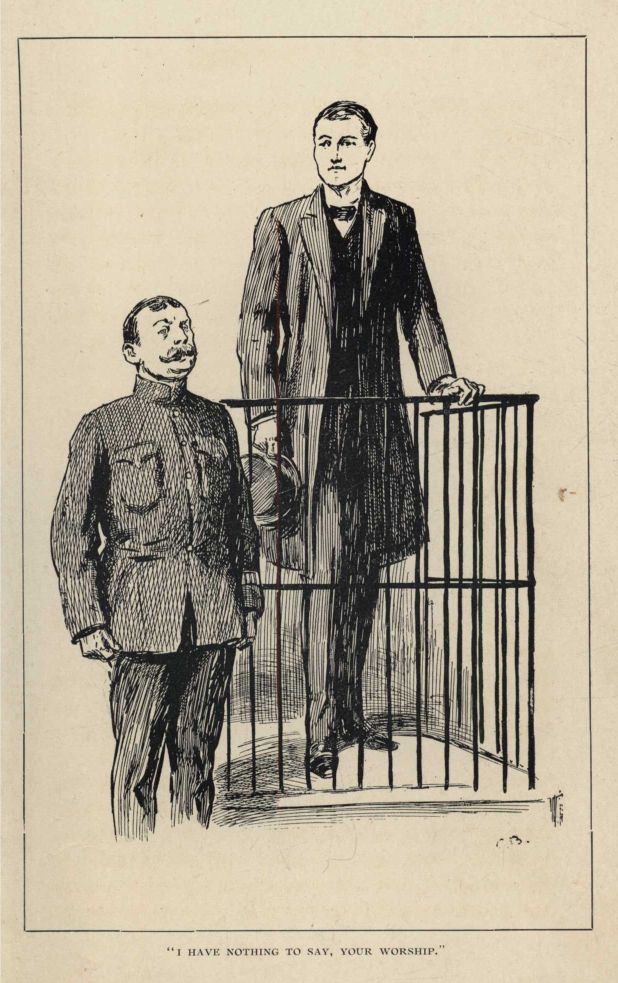
"I HAVE NOTHING TO SAY, YOUR WORSHIP."
The magistrate, who for two hours had been hearing the usual sordid charges--most of them associated with petty thefts and drunkenness--had been somewhat interested by the sergeant's account of what Jim had done. Now, as he looked at Jim's tall, lithe form, and fair, open countenance, and noted Jim's gentlemanly bearing, he decided to give the young fellow a seasonable word of advice.
"I am sorry to see you here, Mortimer," he said, "because a man of your position, by acting as you have done, not only sets a bad example, but runs the risk of imperilling the success of his future career. You have rendered yourself liable to a term of imprisonment, and you know well that if I were to inflict such a punishment on you the fact would act as a serious obstacle to you hereafter, as you would not be allowed to fill any responsible medical post were it known that you had been in prison. It appears from the evidence that you were the worse for drink at the time you resisted the police. I need hardly remind you of the view the public take of a medical man who gives way to such habits. It means, in the long run, utter ruin to him. As I said before, I should be acting within my rights by sending you to prison, but as I understand that after you had been taken into custody you gave the police no further trouble, I shall only inflict a fine upon you. You will pay forty shillings--and take care I don't see you here again."
Jim bowed. "I am greatly obliged to your worship," he said. Then, at a sign from a policeman stationed near by, he quitted the dock, and, having paid his fine, joined Koko in the corridor.
They lose no time in London police-courts. Hardly had Jim left the dock than the name of "Hodgkins" was uttered by the magistrate's clerk, repeated by the sergeant, bawled down the corridor by the constable at the door, and echoed by other policemen lounging in the outer precincts of the court.
"Hodgkins!"
"Hodgkins!"
"HODGKINS!"
As Jim joined Koko, a blear-eyed, decrepit old dame brushed past him at a rapid hobble. She had to answer a summons for assaulting a neighbour by striking her over the head with a fire-shovel. This, in fact, was "Hodgkins."
As Jim glanced at the old creature he realised that this quarrelsome, ill-favoured hag and he were companions in distress--united by a law-breaking bond! He, inflamed by whisky, had fought six policemen; she, supping cheap gin, had burst into a senile frenzy and set upon some other hag with her claw-like nails and the weapon that came first to hand. The same law applied to both of them--she, a rag-picker, and he, the heir to a bountiful fortune and many smiling acres in Eastfolkshire.
"Pah!" he exclaimed, as he hastened to reach cleaner air, "let's get out of this! Thank goodness that's over!"
"No harm done," said Koko, cheerily. "I know the two men in the reporters' box, and they both promised not to write a word about you."
"By George! that's jolly of them!" exclaimed the Long 'Un. "My grand-guv'nor won't get to hear of it after all, then."
"It would have made a tasty little par," said Koko, with a pressman's instinctive knowledge of what newspapers like.
"It would," said Jim. "I can imagine how it would have read."
"But they won't write a word. They're good sorts," said Koko.
And so the Long 'Un made his way back to Matt's, lighter, it is true, of purse, but very much lighter of heart as well, than when he set out to the police-court that morning.
News of Jim's display of pugilistic prowess had preceded him to the hospital--for one of the students had been an eye-witness of the battle--and he was saluted by the unruly crew there with acclamation. But Jim still had the taste of the police-court air in his mouth, and did not feel at all heroic. But for Koko's intervention his name would have been in a good many papers on the following day, and perhaps a briefer notice of "Hodgkins" and her misuse of domestic implements would have followed the account of the young doctor's "disorderly conduct."
That day he went home early, and tried to do some reading. He ended up, however, by going to a theatre with Koko. On the next evening he really did do some reading, and this studious fit lasted for quite a week.
"The Long 'Un," said the red-haired student at Matt's, "is turning over a new leaf. I will buy him a prize."
When Jim, on reaching the hospital next day, entered the students' common-room, he found a neat package, addressed to himself, occupying a prominent position on the mantelpiece. On opening the package he found that it consisted of a nice little one-and-sixpenny book, of the kind published by religious societies, entitled "Jim's Repentance: The Story of a Bad Boy Who Saw the Evils of His Ways."
The red-haired youth took the precaution of putting the table between himself and the Long 'Un ere he said: "Had to go through a catalogue before I found a suitable prize for you, Jim. Girl in the shop helped me."
Jim flung it at his head.
"Naughty, angry Jim!" said the red-haired student, reprovingly, as he dodged the book. "I shall take your prize away from you now."
Presently Jim found himself at the piano, and a little later out in the quad with the red-haired one and half-a-dozen others, "wondering what to do."
Eventually they solved the problem by going to a music-hall and joining vociferously in the choruses--it was one of those music-halls where the audience does join in the choruses--and the end of it was that Jim got home sometime between one and two in the morning, feeling uncommonly merry and not at all repentant.
But that was Jim's last night round the town with the Matt's lot. Even while he was chirruping choruses, an epistle was winging its way towards him by express train. He got that missive at breakfast time, and Koko, who called in just then, found him looking thoughtful.
"Read that," he said to Koko. And Koko read as follows:--
"Pangora," Threeways,
Sept. 20th.
MY DEAR JAMES,--You may possibly remember that in the course of the conversation I held with you over the telephone on the day of your departure for town, I expressed myself quite plainly with regard to your future conduct. My attention has to-day been drawn to a paragraph in the local Liberal journal--I am, as you know, a Conservative in politics--to the effect that a medical man named James Mortimer, who gave his address as St Matthew's Hospital, behaved in a disgraceful fashion at the Exhibition one night earlier in the month, and was eventually fined forty shillings and severely reprimanded by the magistrate. As I happen to know that you are the only Mortimer at St Matthew's, and as I am aware of your liking for drunken brawls, I can only conclude that you disregarded my injunctions at the first opportunity that presented itself. I am obliged, therefore, to keep my part of the compact by informing you that my doors are henceforth closed to you, and that you need never look to me for another penny.
I am, Your affectionate grandfather, JOHN MORTIMER.
CHAPTER VII.
SIR SAVILE'S OFFER.
"But," said Koko as he handed the letter back to Jim, "how on earth did your local rag get hold of it? I've seen both my friends since, and they assured me they didn't write a line about you."
"I give it up," said Jim; "the fact remains that the old man has got wind of it."
"But isn't this action on his part a bit sudden?" demanded Koko.
"He said he would," said Jim, munching a piece of watercress (Mrs Freeman's unvarying Tuesday breakfast was ham and watercress), "but I didn't think he meant it."
"Perhaps he doesn't mean it," said Koko, hopefully.
"I am very much afraid," returned Jim, "that he does, though. You see, he was already wild with me, as he had had to stump up for that big window I broke--you remember! Twelve quid--that was the bill. He told me about it over the telephone. I wish I'd been able to have a square talk with him, face to face; he wouldn't have been half so wild, I put all this down to that rotten telephone."
"Don't quite perceive how it's to blame," said Koko.
"Don't you! Why, if he tackled me face to face, I could have filled him up with all sorts of promises of reformation, and sent him off for his drive feeling sorry that I was going away. Instead of which he went off in a beastly huff. I should have reminded him--as touching the window--that some fellows charge their paters and grandpaters hundreds and even thousands. I should have explained that twelve pounds was a very light let-off. Hang the telephone!"
"The question is," said Koko, "do you think he means it?"
"Yes," replied the Long 'Un, with conviction.
"Then," continued the other, "what are you going to do?"
"I dunno! Turn sporting reporter very likely!"
"Well," said Koko, "with your knowledge of sporting matters you might be able to earn about twelve and sixpence a week just now--say by reporting football matches. That would hardly keep a man of your expensive tastes."
Jim laughed.
"Couldn't I do the fights at the National?" he suggested.
"No, my boy; you've had no experience--of reporting, I mean. But, seriously, Jim, can't you get a doctoring job?"
"I shall have a look round for something," said Jim.
Koko gazed at the ceiling.
"If it hadn't been for that girl," he mused sorrowfully, "this would never have happened. You were off your head about her----"
"Absolutely!" agreed Jim.
Koko sighed. "Women are always at the bottom of man's undoing. Avoid them in future, Jim."
"Not I," said Jim; "I'm not built that way."
"Well, you've lost any chance you had of getting this one," said Koko.
Jim's face fell.
"By George! I hadn't thought of that. I'm glad I didn't send that wire about Canadian Pacifics. We shall meet on more level terms now."
"Upon my word," said Koko, "I think you are the most optimistic man I have ever met. Here are you--disowned--kicked out--cut off without a shilling by your grandfather--and you are still thinking----"
"I still hope," breathed Jim, devoutly.
Mr Somers walked towards the door. However, he turned back to say one more thing.
"If, Jim, you should find it necessary to approach another kind of relative----"
"I fear I shall find it necessary," sighed the Long 'Un.
"I was going to say," continued Koko, "that if you want to pawn anything, I'll pawn it for you. I can nip in easier than you." And with that he went quietly on his way.
Having shaved and dressed, Jim set out, as a matter of course, for the hospital. As he walked along he reviewed the situation, and the awkwardness of his present plight became clearly apparent to him.
Yesterday he was the heir to a fortune and a flourishing practice. (The asylum he left out of his calculations, as he was aware that a private institution of this kind can now--according to the law of the land--only descend from father to son, and on the death of the latter must cease to exist.) To-day he was a young man of four-and-twenty, with a medical qualification, various surgical implements, a small collection of well-thumbed works relating to his craft, a sufficient wardrobe, and some thirty shillings in cash. Thus provided, the world was before him, and he was wondering what sort of a job he and the world would make of it, when, as he blundered absent-mindedly round the corner of the street in which St Matthew's Hospital was situated, he ran plump into the stalwart form of Sir Savile Smart, the eminent specialist of whom mention has already been made.
"What--Mortimer!"
"How do you do, Sir Savile?"
The great man's moustache hid a smile as he observed: "And how many more policemen's helmets have you added to your collection?"
Jim blushed.
"You'll get a fine wigging from your grandfather if he hears of your latest adventure," added Sir Savile.
"He has heard of it, sir," said Jim, and forthwith told the specialist of what had befallen him.
Sir Savile bit his moustache.
"No hope of a reprieve, I suppose?"
"No hope whatever, I fear," said Jim.
Sir Savile hailed a cab. "I'm due at Harley Street in fifteen minutes, but I can talk to you on the way."
He laid his hand kindly on the Long 'Un's arm as the cab approached them, and to Jim's credit be it said that he felt, at that moment, that he had more good friends than he deserved to have.
"Practically," said Sir Savile, as the cab sped westwards, "you want a billet?"
Jim ruefully acknowledged that he couldn't live on air.
"You want a billet? Good. I've got one for you."
He pulled a letter out of his pocket.
"My friend Taplow--'the ladies' doctor' they call him--has a surgery over the water. As you may know, it's not an uncommon thing for a man with a fat West-end practice to run a shilling and six-penny shop in the slums. Anything for money, Mortimer! Well, as I said, he's got a surgery over the water--in the Blackfriars district--and he wants a man to look after it. He'll pay about a hundred and twenty a year. Any good to you?"
"Better than living on air," said Jim.
"Experience, too," continued Sir Savile; "heaps. It's a rough, poverty-stricken quarter--very rough. You'll make acquaintance with the masses. The man lately in charge of the place was not quite up to the work--too old. And he was unfortunate in his end----"
"End!" said Jim. "Is he dead, then?"
"Dead as a door-nail."
"What did he die of?" queried Jim.
"Boots and knives. He was killed by Hooligans."
The Long 'Un opened his eyes wide.
"Perhaps," said Sir Savile, "you will now think that even living on air is better than risking one's chances of living on anything?"
"Not at all, sir," said Jim, stoutly; "I'm quite willing to take it on."
"I believe you are. Well, go and try it. Taplow's out of town, and has asked me to put somebody in temporarily. I will put you in. Any morbid objections to sleeping in your predecessor's bedroom?"
"None at all," said Jim.
"Right! You had better go to the place where he lodged, then. The surgery has no living rooms attached to it--it's just a surgery and waiting-room. When we get to Harley Street I'll give you full particulars. Quite sure you don't mind going?"
"Quite," replied Jim.
"I do like a man that knows his own mind," said the specialist in a tone of approval. "You needn't stay there for ever, you know--you're too good for that sort of work."
Jim blushed again.
"Still, it'll tide you over the present difficulty. That's the point. Ah, yes--and I must also give you the address of the place where you're to lodge. Better send them a wire. House is about ten minutes' walk from the surgery; people are gentlefolk, I believe--family--come down in the world. I remember Taplow speaking of them to me--knows something of them, and recommended his man there. One of the daughters is a post-office clerk--very pretty--that'll suit you, eh?"
"I intend to devote myself entirely to work in future, sir," said Jim.
"Ah, yes! Quite so--quite so!" said the specialist chuckling. "Let's see, yes--I recollect--the name is--er--Marcombe--Mayflower--Maybury--that's it."
Jim uttered an exclamation.
"Eh?--what?" inquired Sir Savile.
"N--nothing, sir, nothing!"
"Oh," returned the specialist, "I thought you were going to say something."
CHAPTER VIII.
NUMBER NINE.
Before the era of cheap train services, omnibuses, and trams--when the outer London suburbs of to-day were smiling meadowland, and people talked of Hampstead "village"--there were many residential quarters within a walk of the City on both the Middlesex and Surrey sides of the river. But with the growth of steam power arose great factories, and as fast as these central residential quarters were swept away by commerce, rows and rows of new streets swallowed up the fields that fringed Suburbia, and afforded accommodation to those whose homes in the heart of London were being razed to the ground.
But some of these quiet old squares and crescents have survived to this day, and you may still find them here and there, sadly shorn of the respectable family appearance they wore in their youth, and hemmed in by huge and ugly business barracks from whose grimy windows issue the whirr and hiss and thud of machinery, the monotonous clacking of type-writers, and the continuous patter of footsteps on iron-shod stairs.
These architectural survivors of a day when the world, humanly speaking, did not go round so fast--when the Times received news by "electric telegraph," and issued bulletins of various interest supplied by "Mr Reuter's" special service--nowadays look like faded old maids, for their exterior smartness is gone and their interior arrangement smack of a time when it never occurred to a builder to put a bathroom in a house, for the simple reason that he did not know how to convey hot water to it, save by means of a can. In some of them each floor is occupied by a separate family, while in others you may perceive the familiar dreary legend "Apartments to Let" on a card which hangs disconsolately in the fanlight over the door.
Such a crescent as we have described is Derby Crescent, which is situated but a stone's throw from the bustling thoroughfare that leads from Blackfriars Bridge to the "Elephant," and thence on and away to the Old Kent Road, itself suggestive of coach and chaise and the days of our grandfathers. Why Derby Crescent escaped demolition when Dame Commerce stretched out her long, lean, hungry hand and grabbed wide acres of comfortable homesteads for her building needs, nobody can tell you. But it remained, while its neighbouring squares and crescents vanished; and so, when William Maybury cotton spinner, of Manchester, was declared a bankrupt, he was glad to hide his head in one of the two houses which belonged to his wife in this self-same area. It was his second wife, for his first had died whilst still pretty and youthful. And it may be added that he had long since repented his second matrimonial venture, in spite of the houses and money the lady brought with her as a marriage portion.
To No. 9, therefore, he removed such goods and chattels as he was able to save from the wreck of his luxurious house in Manchester, and at No. 9 he had been residing for three years when Jim Mortimer rattled up in a cab a few hours after his talk with Sir Savile, and announced his arrival by plying a knocker that, like the house it belonged to, had seen very much better days.
After some delay the door was opened by a slatternly maid of tender years, for her hair still hung down her back in a plaited queue.
The girl surveyed Jim, and then said, "Are you the new boarder, please?" Then, before Jim could reply, she turned swiftly round and exclaimed, in a shrill voice, "Oh, shut hup, Master Frank!"
A boyish laugh rang out, and Jim, peering into the gloomy hall, perceived a lad aged about fourteen accoutred in Etons a good deal the worse for wear--apparently harmony reigned at No. 9 as far as appearances went--with a gleeful smirk on his face.
"Yes," said Jim, "I am Mr Mortimer."
"Will you come in, please?" the girl rejoined, and again swished round to remonstrate with her tormentor. "Give hover, Master Frank--I'll tell your ma, I will!"
"Sneak!" observed the amiable young gentleman addressed.
"Leave my 'air alone, then!"
Jim turned round and bade the cabman bring his portmanteau into the house, and as the cabman, with much heavy breathing, deposited the portmanteau in the hall, a large, middle-aged lady emerged from one of the sitting-rooms and treated the new boarder to a gracious smile.
"Dr Mortimer, I presume?"
Jim bowed.
"Sir Savile Smart was so kind as to wire--as well as you--and tell us that you were coming to take poor Dr Morgan's place. Very sad, was it not? Such a nice, quiet old gentleman! But it's only old gentlemen and women that these cowardly Hooligans venture to touch--indeed, we hardly dare go out after dark! It gave us a great shock when we heard of what had happened to Dr Morgan. The poor dear gentleman was really past work, and must have fallen an easy prey to the ruffians. My husband is not so young as he was, and I often feel nervous lest something should happen to him! He makes me very cross by refusing to carry a life-preserver. Every evening I expect to see his mangled corpse brought to the door. If we could afford to, we should move out of this dreadful neighbourhood, but there! people must live where they can live! When my husband met with his reverses, you see, Dr Mortimer, our thoughts naturally turned to Derby Crescent, where we could live rent free, as my dear mother left me her property in this--but your cabman is waiting, Dr Mortimer, and no doubt you wish to dismiss him!"
During her flight of eloquence the cabman had been regarding Mrs Maybury with a most grim and forbidding expression on his face. Jim, remembering that he had left his overcoat in the cab, walked back to the vehicle with him.
"What's the damage, cabby?" inquired the Long 'Un, when he had secured his coat.
"Leave it to you, sir."
Jim gave him sixpence over his fare. Over-paying cabmen had always been a weakness of his.
"Much obliged, sir!" The cabman touched his hat and pocketed the silver. "Wish you luck of your new quarters, sir."
"Thanks, cabby," said Jim.
"The way to treat 'er," continued the cabman, indicating the house--and presumably its mistress--with his thumb, "is to cut in when she's 'arfway through what she's got to say. Them kind o' wimmen don't mind bein' interrupted. Leastways, they mind a bit, but they ain't annoyed. They go on afterwards same as if you 'adn't interrupted of 'em. You sees what I mean?"
"I see what you mean," said Jim.
"My old woman goes on just like 'er"--with another thumb indication--"and so I know. I let 'er reel it off till I'm tired, and then I change the subjick, casual-like. It's quiet easy to make 'em change the subjick. There's wimmen 'oo, directly an idea enters their brains, utters it wiv their mouves. See? It goes inter one and outer the other as natural as rockin' a baby. But you can always interrupt 'em wivout doin' any 'arm, so you bear my tip in mind. Good-night to you, sir!" he added, mounting his box.
"Good-night to you, cabby," said Jim, who concluded, as he walked up the steps, that the cabman was something of a philosopher.
He found the little servant endeavouring to raise one end of his portmanteau, which, being chock full of clothes, boots, books, and instruments, was no light weight.
"Don't trouble," said Jim; "I'll carry it upstairs."
"I really cannot allow you to do that," said Mrs Maybury. "Frank," she added, turning to the boy, "help Mary with Dr Mortimer's portmanteau."
"Shan't!" said the boy, pouting.
"Obey me at once, Frank!"
"Shan't!" repeated the boy, disappearing into the room from which his stepmother had emerged.
By way of settling the matter, Jim shouldered the portmanteau. "Kindly go first," he said to Mary, "and show me where my room is."
As he was about to ascend the staircase, an immense black cat came stalking along the hall and rubbed itself, purring loudly, against his leg.
"What a wonder!" cried Mary. "Tom generally don't like strangers."
"Good old Tom!" said Jim. Then he commenced his ascent of the stairs, Mary preceding and "Tom" following him.
Thus guided--and accompanied--he at length reached his bedchamber--a by no means spacious apartment on the second floor.
"This was Dr Morgan's room, sir," said the servant; "it's to be yours now, sir."
"Thank you, Mary," said Jim.
Mary lingered. So did the cat.
"It's the room he slept in the night before he--he died, sir," she added, fearfully.
"Well," said Jim, with a smile, "I suppose he had to sleep somewhere!"
"Y--yes, sir--but don't you mind, sir?"
"Mind! No, of course not! You can run along now, if you like," he added, proceeding to unstrap his portmanteau.
As Jim, after unpacking the peculiar assortment of articles in his portmanteau, indulged in what barbers designate a "wash and brush up," his thoughts naturally turned to the people he was henceforth to live with. He wondered how many of them there were; whether there were any more boys like Master Frank; whether there were any more servants, and, if so, whether they were all as small as Mary; whether there were any more boarders, and, finally, whether this was really the home of the Dora Maybury he had met at the Milverton Street post-office. On this last point, however, he felt pretty certain. To begin with, Jim told himself, it was not probable that there were two pretty Dora Mayburys employed by the London Post Office; and, to end with, the boy Frank bore a most remarkable resemblance to the Dora Maybury Jim had been introduced to. In the dim light of the hall, indeed, the likeness was positively startling. Take that boy's Etons off and clothe him in a neat black dress, put a wig of woman's black hair on him, and then, with the angularities of his figure shrouded by the gloom of the hall, there would be presented to view a very good double of Dora Maybury.
Taking these two arguments--if such they may be called--into consideration, Jim felt pretty sure that this was Dora's home. Her home! Jim's brain reeled for a moment at the mere idea of it. His coming here seemed to have happened as things happen in dreams--he could hardly realise even yet that he was actually under the same roof as that which afforded shelter to Dora Maybury.
So quickly had this change in his circumstances been brought about, that he had not even considered what Miss Maybury's ideas on the subject of his advent might be. In truth, he hardly dared to consider the position from that point of view.
Jim had accepted his present post in his usual happy-go-lucky way, being at an age when men of his temperament do not act with much forethought. Had Sir Savile asked him to accompany an expedition in search of the North Pole, he would have agreed to go without a moment's hesitation; had the great surgeon offered him a billet as medical officer to a tour of exploration in Equatorial Africa, Jim would have "signed on" with all the readiness in the world; and with an equal amount of promptitude he would have sailed as surgeon on an emigrant steamer, would have taken over the medical duties in a small-pox ship, a workhouse, a blind school, or a convict prison. Had some great air-vessel been invented, Jim would have jumped at the opportunity to accompany her in her ethereal journey as medical adviser to the intrepid voyagers; or, if such a post had been on offer, he would have consented to doctor the exiles in a Siberian mine. He was, in fact, ready to go anywhere so long as he went in a medical capacity.
Whatever Jim's faults were--and they were many in number--he was at least devoted to his profession. His heart was in his work, and when he really put his shoulder to the wheel there was more than a touch of genius in the manoeuvres of his "hand." For Jim was a surgeon before anything.
Here he was, however, in charge of an obscure practice, where, owing to the proximity of hospitals, there would be few calls on his surgical skill. He would always be welcome, of course, in the operating theatre at "Matt's," although it was not likely that he would often have time to attend there.
Did Jim regret accepting this humble billet in a humble district? Not for a moment! Indeed, when he thought how Fate had afforded him a chance of seeing Dora every day, he very nearly broke into a hornpipe on his bedroom hearthrug. However, he restrained himself, and went down to the drawing-room, the big black cat following steadily in his wake.
Mrs Maybury, her large body clothed in a silk dress that was well in keeping with the fallen fortunes of the family, introduced Jim, firstly, to her husband--a slender man of medium height, between fifty and sixty, with an exceedingly well-cut face and neatly trimmed beard. He welcomed Jim to his house in a few well-chosen, courteous words, and Jim, as he noted the other's perfectly easy tone and manner, understood how Dora had come by the same distinguishing characteristics.
Jim was then introduced to the two other boarders--to Miss Bird, a maiden lady of obese person, harsh voice, and some sixty summers; and to Mr Cleave, a tall, spare man, with a severe face whose beauty was not enhanced by the pimples which flourished upon its surface. Mr Cleave appeared to be about thirty years of age.
"And now," said Mrs Maybury, as Jim took his seat on a small and uncompromisingly hard chair by her side, "I will tell you our ways and hours, Dr Mortimer. We breakfast at eight, as my husband and one of my daughters have to go to business early----" ("Aha!" thought Jim) "and Frank to school. Not that he does much good there," she continued, "as he is kept in almost every day for not learning his home lessons properly. He goes to the Metropolitan School for Boys--yes, a very good school, but the money seems to be wasted in Frank's case. Either he is teasing Mary or the cat, or getting into mischief of some sort--indeed," lowering her voice, "he has nearly driven Miss Bird out of the house already; not that that would be a very great loss, indeed, seeing that she----"
"By the way, Mrs Maybury," said Jim, recollecting the cabman's advice, "you will excuse my mentioning it, but have you a dau----"
At that moment, with a jingle, a rattle, and a stamping of hoofs, a cab pulled up in front of No. 9. Mrs Maybury hastened to the window and peered through the blind.
"It is Dora and Mr Jefferson--how kind of him to drive her home!"
Jim's tongue froze to his teeth. "Yes, I have two daughters--step-daughters, rather;" she continued, returning to Jim's side, "the elder, Harriet Rebecca--she hates her names so much that we call her 'H.R.'--helps me with the housekeeping, and Dora is in--in the--er--Civil Service. Mr Jefferson," she added, confidentially, "has been paying her attentions for some time."
At that moment the door opened, and Dora Maybury, radiant with excitement, hastened up to her stepmother. "Oh, mamma, Mr Jefferson has a box at Daly's to-night. Can I go with him? He says he doesn't mind Frank coming, too----"
"Certainly you may go, dear. Oh, and one moment, dear! Dr Mortimer--this is my step-daughter--Dora."
"I have had the pleasure," said Jim, as he bent his lofty head, "of meeting Miss Dora before, Mrs Maybury."
"Indeed!" cried Mrs Maybury. "How very small the world is! Yes--and--Mr Jefferson--Dr Mortimer."
Dora's companion had entered the room and approached the group. Directly their eyes met, Mr Jefferson and Jim recognised each other, the former being no less a person than the pale-faced gentleman who had uttered loud remarks at the Exhibition concerning early closing.
"I too have had the pleasure of meeting Dr Mortimer before," said Mr Jefferson, without troubling to return Jim's bow, "but I cannot say that I am pleased to see him again."
"Why, dear me!" said Jim with ready wit, "you must be the man who trod on my toes at the Exhibition the other night."
And at this unexpected rejoinder--much to Mr Jefferson's annoyance--Dora's pretty lips parted in an unmistakable smile.
CHAPTER IX.
IN THE PILLORY.
The somewhat strained situation brought about by Mr Jefferson's remark was suddenly relieved by a loud scream, and then a volume of shrill protest from Mary, who appeared, judging by the sound of her voice, to be in close proximity to the drawing-room door.
"Shut hup, Master Frank--give hover, I say. Your pa shall 'ear of this----"
Master Frank jeered rudely. "Bah, tell-! Don't care if he does!"
"Oh!" shrieked Mary, "it's bitin' me. Take it off, Master Frank!"
Mr Maybury walked to the door and, opening it, looked into the hall.
"What is the matter, Mary--why are you making so much noise?" he inquired.
"Master Frank put a beetle on my neck," whimpered Mary.
"Didn't," said Frank.
"Don't tell an untruth, Frank," his father warned him. "Did you or did you not put a beetle on Mary's neck?"
"It was a spider," admitted Frank, who, tease and scapegrace as he was, had not yet developed into that most difficult of persons to deal with--a liar.
"It was something crawly, and I thought it was a beetle," said Mary; "he keeps beetles," she added, in a tone conveying painfully correct knowledge on the point.
"Apologise at once to Mary," Mr Maybury commanded his son.
"Don't see why I should," muttered the rebellious youth.
"Very well, then--you will not go to the theatre to-night with Mr Jefferson and Dora."
The younger Miss Maybury, blushing somewhat (Jim noted the fact with a sinking heart), hastened to the scene of reprimand. "Oh, Frank--say you are sorry. You must come to-night."
Mr Jefferson, with his eye on the old-fashioned chandelier, fervently hoped that Frank would remain obstinately unrepentant.
"I'm--er--sorry," said Frank, stiffly.
"Dear Frank--I knew you would!" said Dora, flinging her arms round her brother's neck and bestowing a kiss of gratitude upon his brow.
"Here--chuck that!" cried Frank, shaking himself free. "What time must I be ready by?" he added.
"We shall start directly after dinner--I'm going up to dress now," cried Dora, and so the group separated, Frank and his sister proceeding upstairs, Mary descending to the kitchen--where Miss H. R. Maybury was preparing the evening meal--and Mr Maybury returning to the drawing-room.
"That boy," exclaimed Miss Bird, in a loud, nutmeg-grating tone, "ought to be sent to a reformatory."
Mrs Maybury turned on her lady boarder with asperity.
"You will oblige me, Miss Bird, by moderating your language when speaking of Frank."
"Idle, graceless young rascal!" added Miss Bird, who was not at all afraid of Mrs Maybury.
"Of course," said Mrs Maybury, with a contemptuous glance at her husband, "if the boy's father allows him to be spoken of in this way, I, who am only his stepmother----"
"Miss Bird is a little severe in her strictures, but I am afraid something must shortly be done to curb Frank's insubordination," said Mr Maybury with admirable tact.
"Try him with a whipping and dry bread and water for a week," snarled Miss Bird, who disliked children generally, and abominated Master Maybury.
"Pardon?" inquired Mr Cleave, who had sat through all the clamour deep in a bilious-looking periodical called The Total Abstainer. Mr Cleave, it should be added, was a little deaf. As, on looking up, he found Miss Bird scowling at him, he concluded that she had addressed him.
"--Bread and water for a week!" shouted Miss Bird, irritably. She hated having to repeat anything, and the case was made worse in Mr Cleave's case by the defect in his hearing.
"Water?" Mr Cleave nodded and smiled. "Certainly--plenty of water. Are you an abstainer, sir?" he concluded, turning to Jim, whose name he had not properly caught when they were introduced.
"Not I," replied Jim heartily.
Mr Cleave blinked severely.
"You sometimes fall into deadly sin by polluting your lips with alcoholic liquor?" he inquired.
"I occasionally have a drink," acknowledged Jim.
Gradually a very pained and shocked expression stole over Mr Cleave's cadaverous countenance. For Mr Cleave, as need hardly be explained, was a fanatic on the liquor question--the kind of ill-balanced enthusiast that does his cause more harm than good by his unbridled and immoderate denunciations of the evil he wishes to abolish. He gazed upon Jim with wonder and shame, and then, deeming him too hardened to be affected by remonstrance, turned for comfort to the pages of The Total Abstainer, and particularly to that part where notorious cases of drunkenness were set down under the kind, Christian-like heading of "OUR PILLORY."
While these remarks were being passed, Mr Jefferson, who had dressed for the theatre before he went to meet Dora, had been turning over the pages of a magazine and occasionally stealing a glance at Jim. For he was rather puzzled at finding the latter at No. 9. He was--it must be remembered--entirely ignorant concerning Jim's identity. He had seen Jim before, it was true, when visiting the Exhibition with Dora and her sister, and had looked diligently in the paper for several days afterwards to see what sort of punishment had been meted out to the turbulent youth, but had failed to glean any information there, thanks to the absolute silence Koko's press friends had maintained on the subject.