Front matter (continued 2)
Reading edition
So, gradually, the incident faded out of Mr Jefferson's mind, and he had forgotten all about it when he entered Mr Maybury's house on this particular evening, to find himself face to face with the disturber of the peace whose toes he had trodden on some ten days since--and whose pardon he had so unwisely omitted to beg.
Jefferson was the son of a wealthy City man. He enjoyed a liberal allowance, golfed, motored, and ploughed the smooth waters of the Thames in a steam-launch. He did everything, in fact, which cost money. Golf is not a cheap game as played in clubs round London; motoring is not a poor man's hobby; a steam-launch is a fairly expensive toy. Football and cricket are trifles light as air--from an expenditure point of view--compared with the pastimes Mr Jefferson followed. Mr Jefferson might have played football and cricket, for he was only twenty-six, but he preferred pursuits which betokened him to be the possessor of a well-filled purse. When he referred to his recreations he endeavoured to make it clear to his listeners that he had been out in his own motor-car, and that he had not been churning the pleasant reaches of Henley and Maidenhead at the invitation of any whisky baronet or tea and coffee knight. He had been, if you please, in his own launch. An unkind City acquaintance of his had once wondered--audibly--why Jefferson didn't have the receipted bill for his launch pasted on the exterior of the craft, just under her name. This was unkind, but they say very unkind things about and to each other in the City. The Stock Exchange--of which the Messrs Jefferson, father and son, were both members--is as merciless in its chaff as a public school. Which, as my public school readers will agree, is speaking very highly of the Stock Exchange.
For the rest, Mr Jefferson could make himself exceedingly agreeable when he liked, and as he was good-looking, attentive, gentlemanly, and always well dressed, it was not surprising that he had managed to make an impression on Dora's girlish and inexperienced mind. To tell the truth, Mr Jefferson had come to the conclusion that Dora would be his for the asking, and, therefore, was not going to hurry himself over the matter. She was a charming girl--the most charming girl he had ever met--and he admired her immensely. Possibly he would have been deeply in love with her by this time had she not always received him with a smile of genuine welcome and accepted his invitations to go here and there, and see this and that, with unconcealed delight. After the drudgery of the post-office counter, and the doubtful joys offered by her home circle, Mr Jefferson's society came as a very pleasant relief to Dora. Whenever they went out together he spent his money handsomely and gave her of the best--and Dora was accordingly grateful and quite prepared to whisper a tender affirmative when Harold Jefferson asked her to be his wife.
So stood the matter when Jefferson drove her home--she had begged off from her work early, at his request--this September evening. So stood the matter when Dora entered the drawing-room and was introduced to "Dr Mortimer."
When Harold Jefferson, following Dora at a leisurely pace, heard Jim say that he had met Miss Maybury before, he pricked up his ears. And when, on entering the drawing-room, he saw who the gentleman was that had met Dora before, a vague but distinct feeling of annoyance came over him. He had met Jim in the inimical manner already described, and, as he turned over the pages of the magazine, made up his mind to take an early opportunity to inform Mrs Maybury of the part this new boarder--Jefferson presumed Jim was a new boarder--had lately played before a large and interested audience.
Presently Dora and Frank came downstairs. The former looked prettier than ever in a white dress--with a pearl necklace, a gift Of Mr Jefferson's, round her fair neck, and some other tiny shining ornament in her hair. Frank looked unusually clean and dapper in his best suit, Dora having tied a neat bow for him and generally supervised his toilet.
Dora seated herself on the arm of her father's chair, and stroked the thin hair on his head in the caressing way both pretty and plain daughters are often pleased to exhibit. Once only Dora stole a shy and somewhat apprehensive glance at Jim. She had recognised Jim's voice directly he spoke to Mr Jefferson at the Exhibition, and had turned her face away, as she did not desire Jim, on the strength of his introduction to her earlier in the day, to address her whilst he was in such a quarrelsome mood.
And now--here he was--this Mr (or Dr) Mortimer--under her own father's roof; and here, too, was Mr Jefferson, who had already expressed his feelings with regard to this Mr (or Dr) Mortimer. Under the peculiar circumstances, Dora had no desire to enter into conversation with Jim, and so took shelter--as girls so often, and so wisely, do--under the paternal wing.
Frank, however, had no reason to avoid Mr Mortimer. He rather admired him for the easy way he had picked up his portmanteau and shouldered it upstairs. A real boy admires a strong man, and Frank was a real boy enough--suffering, at present, from being too much at home--for his summer holidays were only just over. So he seated himself by Jim.
"I say, Dr Mortimer," he said at length, "would you mind telling me how tall you are?"
Jim was genially glad of somebody to talk to.
"Six foot four," he replied.
"I say! Do you like being so tall?"
"Don't mind it," said Jim; "knock my head rather too often, perhaps."
Frank laughed. "There's a master at my school almost as tall as you," he proceeded, "but much broader."
"Indeed!" said Jim, who frequently had to listen to comparisons of this sort.
"Well," continued Frank, surveying Jim with a critical eye, "I don't know whether he's much broader. You are rather broad, aren't you? But he's much fatter. They say he weighs eighteen stone. What do you weigh?"
"Frank," said Mrs Maybury, "don't ask such personal questions, dear."
Dora smiled. She was listening in a not uninterested way to her brother's ingenuous remarks.
"Oh, I don't mind, Mrs Maybury," said Jim; "I go just over thirteen stone," he added, addressing Frank.
The boy looked thoughtful. Presently he said: "Can you fight well, Dr Mortimer?"
He asked the question in all innocence, for Dora had not breathed a word about Jim's performance at the Exhibition.
"I don't like fighting," replied Jim; "I am afraid of my nose bleeding."
Frank gazed at him with suspicion. Then, as Jim's face remained quite grave, Frank's grew scornful. Afraid of his nose bleeding! That was a nice thing for a man of six feet four to say!
To what extent Frank might have continued his interrogations we can only vaguely surmise, but at this point Miss Bird--who had been much irritated by Frank's inquisitive treble tones--dashed into the breach.
"And what, Mr Cleave," she asked, "are the cases in your 'Pillory' this week? Anything of an exceptional nature?"
Mr Cleave came to life with a convulsive start. He had been absorbed in a series of reports supplied by the Abstainer's special commissioner from the London police-courts.
"Pardon?" he asked. "Didn't catch----"
Miss Bird snapped her teeth, which came together much as a man-trap would close on an unfortunate poacher's leg.
"'Pillory!' What's the worst case?" she bawled.
"Oh! The cases in 'Our Pillory'?" bleated Mr Cleave.
"Yes! Read 'em out!" Miss Bird returned in a saw-like, rasping growl.
Mr Cleave turned over the pages of The Total Abstainer with evident relish.
"The worst," he said, in a high, thin voice, "is one that our commissioner only heard by unexpected good fortune. He does not often go westwards. He finds that Bow Street and Whitechapel bring more grist----"
"Read it out!" shouted Miss Bird.
"A piteous example of what over-indulgence in alcohol may bring a man to (read Mr Cleave) was afforded by a case which came before our notice one day last week in the Kensington Police Court. The degraded being, who faced the magistrate with an unabashed gaze, was a young doctor named Mortimer, who gave as his address a place of mercy and healing--the Hospital of St Matthew."
"By George!" exclaimed Jim, "that's how our local rag got hold of it! Copied it out of your paper."
"Pardon?" observed Mr Cleave.
"Go on!" roared Miss Bird.
"The facts were few but terrible (continued Mr Cleave). This member of a noble calling, inflamed and rendered reckless of all consequences by the Bend aforesaid, actually made a ferocious onslaught on a band of six policemen. In a fair pleasure garden he let loose his unruly passions, and only after a terrific struggle was he captured, handcuffed, and thrust into a cell----"
"They locked you up, then?" inquired Jefferson, glancing maliciously at Jim.
"Not they," said Jim; "I was let out on bail."
Miss Bird turned sharply round and glared into Jim's face.
"Are you the person referred to in that report?" she demanded.
"I am," said Jim.
A silence fell on the room. Even the dim-of-hearing Mr Cleave appreciated the situation, and understood that the lately arrived Dr Mortimer was identical with the prime villain of the "Pillory" that week.
"Pray continue, Mr Cleave," said Jefferson at length, with a curl of his lip; "I am sure Dr Mortimer does not mind."
Mr Cleave was bending over the paper again, when an interruption came from an unthought-of quarter. Mr Maybury rose to his feet.
"I do not think," he said, "that Mr Cleave had better proceed with his reading."
"Nonsense!" said Jefferson. "Go ahead, Mr Cleave."
"For the sake of the Cause, Mr Maybury," piped Cleave, "I wish to----"
"I am master of this house," said the ruined manufacturer, who, generally so mild and retiring, now spoke with unfaltering firmness, "and I say that no man shall be insulted to his face under my roof. You will oblige me, Mr Cleave, by not reading another word of that report. Frank, go and see if dinner is ready."
CHAPTER X.
AT THE SURGERY.
Jim set out for the surgery next morning feeling somewhat depressed. His sins were coming home to him. The attitude adopted towards him generally by No. 9 was a hostile one. After the sad disclosures on the previous evening, Miss Bird and Mr Cleave had, metaphorically, turned their backs on him; Mrs Maybury was coldly polite; Miss H. R. Maybury (a thin, angular young lady) barely recognised his presence; and, on the whole, Jim would have spent a most chilly evening had not Mr Maybury invited him to play chess.
"Seems to me," said Jim, as he left Derby Crescent, "I'm not in good odour there. Shall I leave or shall I live it down? I should like to leave, but--hullo!"
This exclamation was caused by the hitherto unnoticed presence of Tom, the great black cat, who had quietly followed Jim out of the Crescent into the main road, and seemed bent on accompanying the young doctor to his destination. Jim endeavoured to make the cat go back, but Tom persisted in accompanying him, and so at length the two reached Mount Street, where Dr Taplow's surgery was situated.
On the pavement by the surgery door a group of meanly clad people were already waiting for "the Doctor." The women--they were all women or children--gazed with interest on the Long 'Un. He was a man most people looked at twice, and to these poor souls he was of peculiar interest, for he was to minister to their ills. And who--in times of sickness--is of greater interest to one than the man who possesses the skill to make one well again?
"Waiting to see me?" said Jim, cheerily, "All right--you may come in in a moment."
Scouring the passage that lay on the other side of the door was a hag of forbidding appearance.
"I am Mr Mortimer," said Jim, in reply to her stare of inquiry. "I have come to take charge of the practice."
Passing by her, he opened a door on the right and entered the waiting-room--a bare apartment furnished with a few chairs and a table, on which latter lay a scanty collection of well-thumbed periodicals. Opening out of this was the surgery, which had not been entered, save by the hag aforesaid, since Dr Morgan had come by his untimely end.
On the desk lay the open ledger-with its quaint Latin entries--exactly as poor old Morgan had left it. On the shelves were the usual ranks of bottles containing acids, poisons, and other drugs; and here and there on the counter under the shelves stood various dose-glasses, phials, a stethoscope, and a pair of forceps, in whose grim clutch a rotten double tooth that had been wrenched from some unfortunate aching jaw still remained. The place was dirty and untidy, and altogether the sight that met Jim's eyes was most dispiriting. This was, indeed, a humble surgery in a humble district!
Still, Jim did not lose heart. He was fresh from one of the first hospitals in London--in spite of the sudden change in his fortunes he was full of enthusiasm, and eager to apply his knowledge.
The patients filed in, and Jim saw each in turn. They were all suffering from common ailments, and the Long 'Un--after his varied experience among the out-patients at Matt's, where he had sometimes doctored a hundred persons in one morning--made short work of them.
One little girl had a rash on her chest and back. Jim readily diagnosed the complaint as chicken-pox.
"Take her home and keep her in bed for a week, mum!" said he, to the girl's mother; "keep her warm, mind. If she gets a chill, it will drive the spots in, and the child may be very ill then. Keep her warm. Medicine? No, she doesn't want medicine. Just keep her warm--and away from the other children. All live in one room? Well, they'll all have it--if they've not had it before. Just as well. Sixpence, please!"
A young seamstress had no appetite and felt too weak to work. No, she wasn't married--she helped her mother. Take anything to drink? Only tea. How often? Oh, the pot was on the hob all day. They just helped themselves when they wanted it.
"The matter with you, mum," said Jim, "is tea! You're poisoning yourself. So comforting? Yes, but it's poison. No more tea, mum! Medicine? Yes. I'll make you up a nice tonic. And go out for a walk every evening--don't tire yourself, though!"
But it wasn't all sixpenny and shilling counter-trade. Later in the day--when it had been noised about that a new doctor had come to take charge of the practice--various messages--some verbal, some scribbled on notepaper--arrived. Would the doctor come to see Mrs Smith, who was suffering from heart complaint; and Mrs Jones, who had nothing at all the matter with her, but always thought she had? So Jim sallied forth and paid calls on the wives of fishmongers and ironmongers, and greengrocers, and publicans--nearly all his patients were women--ascended rickety staircases, dived into evil-smelling bedrooms, and went hither and thither and about and around on his useful errands of healing and comfort.
Over the way, just opposite, was a provision shop and eating-house, bearing the name of "Harris & Son."
From the portals of this establishment, about two o'clock in the afternoon, issued a weary little old man of Jewish appearance, who, after glancing up and down Mount Street, crossed over to the surgery.
He found Jim doing up some medicine.
"How d'ye do, doctor?" said he.
"How are you, sir?"
"Queer, doctor. Thought I'd come and ask your advice."
"Go ahead," said Jim, jabbing a stick of sealing-wax into the gas-jet.
"I've a funny feeling all over my 'ead--not in the 'ead, but all over it. I've been a good deal worried of late, doctor."
"Sort of feeling as if your hair was being brushed?" inquired Jim.
"That's it. Not so nice, though."
"I know it," said Jim; "I've had it myself when I've been stewing hard for an exam." (He hadn't really, but "having had it himself" was a medical formula that he deemed it well to abide by--it comforted patients.)
"Vell, I never! Vot is it, doctor?"
"Irritation of the subcutaneous nerves," said Jim, wisely.
"Ah!" said the weary little old man, "sounds bad!"
"Oh no--it'll soon go off. I'll make you up a tonic with a touch of bromide in it. That'll soothe you."
"Bromide! Vy, ain't that the vicked stuff society ladies take?"
"Some of them. But they take it neat--yours will be diluted."
Jim made up a bottle of "the mixture," and the old man laid down his shilling.
"I feel better already, sir," he said; "'ope you'll come over to our place and get a bit to eat when you vant it. I'm from over the road--Harris."
"Right!" said Jim, "I won't forget. Good-day, Mr Harris."
And in this way an adventure befell Jim, for, feeling hungry about an hour later, he went over to the emporium of Harris & Son. Blocking up the doorway he found a burly ruffian with close-cropped hair and a scarf round his neck.
"Now, my man!" said Jim, wishing to pass by.
The gentleman addressed turned on him with an oath.
"Oo are you 'my manning,' young lamp-post? You get out of my way--d'ye 'ear?"
Now Jim conjectured--and rightly--that the ruffian in question was of the Hooligan order, or belonged to a class of society near akin to that order. So, being aware that he had to hold his own in this district, and that it would never do to be intimidated, and bearing in mind that in situations of this kind it was a good plan to hit first and hit hard, he let drive between the fellow's eyes and knocked him clean off his feet.
This done, he stepped over him and proceeded to the counter to order some food.
As the rascal dropped, a pale slip of a girl, who was holding a baby, started up from the table at which she was sitting and rushed towards the prostrate figure.
The man Jim had felled struggled to his feet with a flood of imprecations pouring from his lips. The blow had dazed him, and for a few moments he glared about him in an uncertain way. Then, as his senses cleared, he perceived Jim, and gave a hoarse cry, fumbling the while at the heavily buckled belt which he wore round his waist.
"Oh, Jack--don't!" cried the girl, interposing her slender form between the man and the object of his meditated vengeance. As she did so, Jim noticed that one of her eyes was discoloured; it was not hard to guess who had caused the injury.
"Get over the counter!" cried Mr Harris; "you'll be safer 'ere."
"Not I," said Jim; "I can look after myself."
"'E's a terror," said the old man, in a hasty undertone; "e's a Hooligan--the worst of 'em--their boss."
"I don't care," said Jim; "I can tackle him."
At length the Hooligan managed to unclasp his belt, but even as he did so two policemen entered the shop.
"Now then--get out of this--quick!"
They knew him--evidently. They were two to his one. And there was Mortimer near at hand to help if required.
The Hooligan was not without some regard for his personal well-being. Directing a scowl of hate at Jim, he put on his belt again and left the shop, followed by the girl.
"Same old game?" said one of the constables to Mr Harris.
"I didn't see it all--but I believe this gentleman knocked 'im down," replied Mr Harris. "'E's the noo doctor over the road."
The policeman eyed Jim with interest.
"I'd advise you to be careful, sir," he said; "that's the most dangerous man in these parts. He's just done six months, and only came out three days ago. We've been keeping an eye on him."
"I'll look out--never fear," said Jim.
For some hours after that Jim was very busy, but even in the midst of his work he seemed to see the white, pleading face of the Hooligan's girl-wife. No doubt she loved the brute--no doubt she had been endeavouring to keep him in a good temper ever since he had come out of prison. And the man, smarting from his recent confinement, sulky, and conscious of his bull-like strength, had probably been thirsting for a quarrel all these three days.
Then Jim's sharp speech fell on his ear, and the Hooligan wasn't accustomed to being spoken to sharply by anybody save a policeman. He had wheeled round fiercely, and had hardly had time to take stock of the person addressing him before he was floored. He had never received such quick treatment before in his life.
"Still," thought Jim, "I wouldn't have hit him had I known his wife was there. At any rate, I'd have let him hit me first."
Jim got some tea at a shop in Blackfriars Road, and was fully employed making up medicine at the surgery until it was dusk, and the street lamps were shining yellow. Then he bethought him of Derby Crescent and dinner.
He was tidying up the surgery preparatory to taking his leave of the place for the day, when there came a short, peremptory knock on the street door, which he had previously closed. Jim heard a murmur of voices without. A woman, it seemed, was remonstrating with a man.
Jim went to the door and opened it. There, awaiting him, was the Hooligan; a little farther off stood the latter's slip of a wife.
"Well?" said Jim, curtly.
Even as he spoke the girl gave the alarm: "Look out, sir--he's got his belt off!" But the Hooligan was too quick, and the heavy buckle of the belt came crash on to Jim's head, just above the brow, ere the woman's warning was finished.
It was a frightful blow, and extracted a cry of pain from Jim. One cry, and then Jim sprang forward, dodged the belt swinging at his head again, and closed with the Hooligan. The two forms fell with a crash--Jim on top. In a second he was kneeling on the ruffian, his hands upon the other's throat.
"Oh, sir--oh, sir!--don't give him in charge! Oh, sir--he shan't do it again!--please don't give him in charge!"
It was a piteous appeal, and Jim, hearing, rose to his feet.
"All right--take him away!"
Jim's head was swimming, and the blood was trickling over his face.
He staggered back into the passage, feeling that his senses were leaving him. Supporting himself by the wall, he passed through the waiting-room, gained the surgery proper, and was clutching at the counter when a figure appeared in the doorway.
It was the Hooligan--with an uglier look than ever in his eyes.
Jim saw the brutal face and the uplifted belt. The man was going to hit him again. The belt rose--but of a sudden help arrived from an unexpected quarter, for at that moment a little, quick-moving man entered the surgery, and, noting the position of affairs, seized the Hooligan's wrists, and brought the ruffian to the floor with a neat trip.
"I got your card, and came along as soon as I could," said Koko. "By the way, who's your friend?"
"Oh, he was only getting even with me," said Jim. "I hit him earlier in the day."
The Hooligan's wife was endeavouring to make her husband leave the waiting-room, but he seemed anxious to renew the combat.
Her expostulations ceased abruptly, however--as did the man's maledictions--and a new voice fell upon the hearing of the two friends.
"Now, my good people, do you want anything here? If you will wait a few moments you shall be attended to."
Then Jim and Koko saw the doorway of the surgery proper filled by a portly form.
"You are Mr Mortimer, I believe?" said the new arrival. "I am Dr Taplow. I am greatly obliged to my friend Sir Savile for obtaining your services for me, and must thank you for acting as my locum tenens to-day. I am accompanied, however, by the gentleman I myself have appointed to take charge of the practice, and so I shall not require you after to-day."
Jim bowed. "Very good, sir," he replied.
"By the way--are you hurt?" inquired Dr Taplow.
"It's only a scratch," said Jim, reaching down his hat.
"Indeed! I was afraid it was something worse ... er--if you will let me know what I owe you, I will send you a cheque ... er ... come in, Dr Perkins, come in ... er--good evening, Mr Mortimer!"
CHAPTER XI.
MR MAYBURY'S RESOLVE.
Mr Maybury received a long and severe curtain lecture from his wife on the night of Jim's arrival at No. 9, the subject of it being Jim Mortimer and Jim Mortimer's delinquencies.
"After the disgraceful revelations of this evening," said the good dame, as, having blown out the candle, her lord composed himself for slumber, "we can't allow him to stay with us. It would give the house a bad name. People would tattle and gossip until we should be obliged to move. Imagine! Drunk and disorderly! fought the policemen! had to be bound with ropes and taken in an ambulance to a police-station----"
"I hardly think it was quite so bad as that," Mr Maybury interrupted in a mild, sleepy voice.
"The fact remains," continued Mrs Maybury, with energy, "that he was taken to a police-station, was fined, was reprimanded by the magistrate. A nice sort of man to have in one's house contaminating the children! Frank has taken a fancy to him already; the next thing will be Frank fighting policemen----"
"Don't talk such nonsense, my dear," said Mr Maybury. "Medical students," he added, "often get into trouble. Nobody cares much if they do; they are regarded as privileged madcaps. Dr Mortimer is a very young man--still a student at heart. I must say I like what I've seen of him very much, and am not surprised at Frank's taking a fancy to him."
"Do you want your son to be sent to a reformatory, as Miss Bird suggested?" inquired Mrs May bury.
"He won't be," her spouse assured her; "Frank has no vices; he's only mischievous."
"If he imitates Dr Mortimer," cried Mrs Maybury, "there's no knowing what the boy won't come to. No, William, you must tell Dr Mortimer that he must find fresh lodgings. He can't stay here. Miss Bird and Mr Cleave will both leave if he does. Mr Cleave told me to-night that he cannot breathe the same air as such a man."
"Cleave's an old woman," muttered Mr Maybury.
"Miss Bird----" began Mrs Maybury.
"I wish Miss Bird would go," put in Mr Maybury.
"And you can see Mr Jefferson doesn't like him," continued Mrs Maybury, "with half an eye. Mr Jefferson!--the man to whom you are indebted for your daily bread!"
"I'm employed by his father," objected Mr Maybury.
"It's all the same. Mr Jefferson got you your post. Suppose he told his father that you were harbouring a man who fights policemen and gets drunk----"
"His father would say that that was my business," rejoined Mr Maybury.
"Well, we can't risk keeping him here. It's too dangerous. I've no objection to the young man myself----"
"Then why d'you go on about him so much?" retorted Mr Maybury.
"For the sake of our home and its reputation," almost shrieked Mrs Maybury, "that's why. Here I work and slave and get no thanks--not a word of thanks--and then, when I express an opinion, you snap my head off. It's more than flesh and blood can stand!" she concluded, dissolving into tears.
"Suppose," said Mr Maybury, placidly, "we discuss the matter in the morning?"
"I won't say another word," cried Mrs Maybury, between her sobs; "I've said all I have to say. If you keep this man here, he'll take our good name away. There--now I've done!"
And so, with sobs at intervals, she at length fell asleep.
The once wealthy merchant held a very modest position in the business house of Jefferson & Son. He was, in fact, but one of their book-keepers. He--the erstwhile employer of fifty clerks and five hundred workpeople--now sat on a high stool at a high desk and laboured at the books for a small salary. When a man has come down in the world with a sudden run he is generally to be had at a low figure, and Jefferson & Son bore the fact in mind when they engaged Mr Maybury. The hours (ten to four) were short, it is true, but Mr Maybury would have worked later willingly could he have thereby added to his earnings.
The other clerks at Jefferson & Son's were mainly young fellows between whom and Mr Maybury no great bond of fellowship could very well exist. He was left largely to himself, therefore, went out to his frugal mid-day meal alone, returned alone, and said very little to those about him from the time the office opened till its closing hour.
Harold Jefferson did not trouble himself with business more than he could help. He preferred the West End to the City. However, he put in a certain number of appearances per week, and whilst at the office treated Mr Maybury with respect, mingled with a slight but distinct air of patronage.
Such conversations as they held related, of course, entirely to the firm's business, and so it was with no little surprise that, on the day following Jim's arrival at No. 9, Mr Maybury received an invitation from Harold Jefferson. "I want to speak to you about one or two matters," ran the pencilled note which the office-boy handed to Dora's father, "so shall be glad if you will lunch with me at 1.30. I will be waiting for you at the front entrance at that hour."
It was, of course, as much a command as an invitation. At the appointed time Mr Maybury met young Mr Jefferson, who at once hailed a cab and drove his guest to a restaurant in the West End. It would not do at all (thought young Mr Jefferson) to be seen lunching with one of his clerks at a restaurant in the City.
"Now, Mr Maybury," said the host, when lunch was over and they had lit their cigars, "I have two things to say to you. One of them concerns your daughter--Miss Dora."
Mr Maybury inclined his head. He had not imagined that this invitation was the outcome of purely hospitable motives.
"I have been paying her attentions for some time," said the well-to-do young stockbroker, "and I propose, with your sanction, to ask her to marry me."
"You have my full consent to do so," said the ruined merchant, graciously.
"From what you have observed, do you think that my proposal will be favourably received?" asked Jefferson, carelessly.
"I can offer no opinion," said Mr Maybury.
"I may at least take it that, if she accepts me, you are willing to regard me as a prospective son-in-law?"
"Perfectly willing," was the reply.
"Thank you. Now, as to this fellow Mortimer----"
"I beg your pardon. What has Mr Mortimer to do with the matter?"
"If," said Jefferson, "I become engaged to your daughter, Mr Maybury, I shall have a decided objection to your allowing such a man as Mortimer to remain under the same roof as my fiancée."
Mr Maybury took a thoughtful pull at his cigar. The well-to-do young stockbroker looked keenly at the ruined merchant. It was to the latter's advantage to defer to the former. Was he not, as his wife remarked, indebted to this man for his daily bread?
Mr Maybury laid down his cigar and sipped his champagne, and meantime such reflections as these coursed through his brain. He was a very poor man, 'tis true, but he had always prided himself on being a just one. Personally, he had perceived no great harm in "this fellow Mortimer." Why, therefore, should he turn him out of his house?
"Well?" inquired the young stockbroker, curtly.
"The most charitable course to pursue," said Mr Maybury, at length, "would be to see how he goes on. Should he prove himself unfit----"
"He has. He is a low, drunken brawler. I cannot bear the thought of Dora being brought into daily contact with him. You will at least admit that I have a right to lodge an objection against him--or will have, should your daughter accept me?"
"I should prefer to see how he goes on," said Mr Maybury.
"Very well, sir," rejoined Jefferson, rising from his seat with a look of great annoyance on his face, "have it your own way. Waiter, my bill. Please excuse me now, Mr Maybury, as I am not returning to the City."
Instead of going straight to the office, when he got back to the City, Mr Maybury turned into a quaint little churchyard--a smoke-begrimed patch of green, where one might rest awhile on a seat. Here he remained for ten minutes, and when he at length turned his steps officewards, he had made up his mind that, however disastrous such an attitude might prove to his prospects, he would in no way seek to influence Dora in Harold Jefferson's favour. Nor should Jim Mortimer leave his house, unless he himself desired to go.
"I have lost pretty nearly everything," thought the ex-merchant as he paced his way along the crowded pavement, "but till the day of my death I hope, please God, to retain my self-respect."
The thought inspired him, and he went back to his book-keeping with an unusual light in his eyes--with an additional firmness in his step. 'Twas true that Fate had robbed him of wealth and position, but Fate's worst buffets could not cause him to act in any way save that becoming a gentleman.
CHAPTER XII.
KOKO'S WORD.
"We'd better have a cab," said Koko, in his quiet way, as, after Jim's curt dismissal by Dr Taplow, they walked down the pavement together.
"Right you are," groaned Jim. He felt too ill, weak, and miserable to do anything except just agree with everything that was said to him. If the gentle reader has ever been sea-sick he will be in a position to appreciate Jim's condition.
"Keep a grip on that lamp-post while I fetch one," said Koko, hastening away through the gloom of the autumn evening.
When the cab arrived, Jim got in thankfully; and the two friends, holding Tom, who had followed Jim out of the surgery, between them, rattled off.
"I suppose you'll ask me to stay to dinner with you?" said Koko.
Jim uttered a hollow laugh.
"Stay if you like, but I won't guarantee you'll enjoy yourself."
"Any girls?" inquired Koko, flirtingly.
"Two," said Jim; "also a woman-man teetotal crank, and a female gorilla."
Koko particularly wished to stay to dinner with Jim, for he was formulating a plan for Jim's future. But he was not going to expound it until Jim was in a state to give it due consideration.
On reaching No. 9 they found Frank lurking in the passage. When Jim removed his hat, Frank, observing his wound, was filled with curiosity.
"I say, Dr Mortimer, how did you hurt your forehead?"
"Somebody hurt it for me," said Jim.
"Was it a fight?" inquired the youth excitedly.
"Kind of one," admitted Jim.
Full of the news he had gleaned, Frank burst into the drawing-room, where Mr and Mrs Maybury, Dora, and the other paying guests were awaiting the summons to dinner.
"I say, pater, Dr Mortimer's been having a fight. He's got an awful cut over the napper."
"Frank!" exclaimed Mrs Maybury, "how often must I tell you not to use such vulgar terms?"
Frank grinned.
"You go and have a look at it!" he added, with supreme gusto, "you never saw such a whopping cut in all your life."
Mrs Maybury turned a glance on her husband which plainly said: "And what do you think of him now?"
Miss Bird gave a snort of disgust, and Mr Cleave, heaving a deep sigh, buried himself anew in the advertisements of The Total Abstainer, he having by this time utterly exhausted all the literary portions of the paper.
Jim sent Mrs Maybury a message by Mary intimating that he had brought a friend, Mr Somers, home with him, and would be greatly obliged if she would permit the said Mr Somers to remain to dinner. Mrs Maybury graciously replying that she would be "most happy," Koko and Jim (the latter with his head neatly plastered) in due course appeared in the drawing-room.
Much to Mrs Maybury's surprise, Koko, after exchanging bows with the lady of the house, walked straight across to Dora and shook hands with her.
"You know Mr Somers, then, Dora?" inquired Mrs Maybury, somewhat sharply.
"Yes, mamma," replied Dora; "he is a friend of Miss Cook's."
"Indeed!" said Mrs Maybury, to whom it seemed that Miss Cook had been introducing Dora to very undesirable people--for Dora had informed her that it was by Miss Cook's agency she had become acquainted with Jim.
Dora had now been in the post-office six months, and had behaved so far in an exemplary manner. Even the girl's stepmother, prone to find fault as she was on the slightest pretext, had not discovered anything to grumble at in Dora's conduct. But now--now affairs were assuming a different complexion. Dora had made masculine friends unbeknown to her mother. One of them was a dissipated young doctor, and the other--well, who and what was this other man--this Mr Somers?
"And do you, too, belong to the medical profession, Mr Somers?" inquired the dame.
"No, I am a journalist," replied Koko.
Miss Bird glanced up sharply; Mr Cleave also looked across at the visitor. Miss Bird had not been introduced to Mr Somers, but she did not allow little obstacles of that kind to stand in her way when she required information.
"And what is your particular department?" she abruptly demanded.
"I work for the sporting press--I am what is known as a sporting journalist," replied Koko.
The inquisitive expression on Miss Bird's face turned into a stony glare of disapproval.
"You go to horse-races?"
Koko did not like being cross-examined about his private affairs in this unblushing manner. So he determined to let this rude old lady know all about himself so as to save further questions.
"Yes, I attend horse-races and swimming-matches, and billiard-matches and prize-fights----"
"Then you ought to be ashamed of yourself!" roared Miss Bird. As for Mr Cleave, he uttered a thin, high cough. He had heard that the average journalist did his work with a bottle of brandy at his elbow--what then must a journalist be like who reported prize-fights and horse-races! What indeed!
With a sigh he sought distraction in the long list of "Homes for Inebriates" which appeared regularly in The Total Abstainer. This weekly journal was Mr Cleave's invariable comforter when he felt distressed. Besides, it offered £100 insurance in the event of one of its regular subscribers being accidentally killed. Several of Mr Cleave's nearest relatives took in the paper, and Mr Cleave had often calculated what amount he would receive as insurance should all these relatives be killed in one railway accident.
"I believe," Miss Bird went on (as Koko made no rejoinder), "that drunkenness is a common vice among persons working for the press. Is that not so, Mr Cleave?"
"Pardon?" queried Cleave, putting his hand to his ear.
"Bless the man!" exclaimed Miss Bird, irritated beyond measure, "why doesn't he get an ear-trumpet! I was saying," she continued, in a boisterous key, "that most journalists were drunkards. Is that not so?"
Now, Mr Cleave recollected Mr Maybury's stern rebuke of the previous evening, so he deemed it as well to be cautious.
"Some journalists," he replied, nodding pleasantly at Miss Bird.
"Most!" insisted Miss Bird.
"I will not go so far as to say that----" quavered Mr Cleave.
"Then you are a coward!" snapped Miss Bird, in utter disgust. Mr Cleave had proved but a backboneless creature when she had relied on his support.
It is highly probable that Miss Bird would have proceeded to put further questions of a personal nature to Koko had not Mary popped her head into the room with "Dinner's quite ready, mum."
Miss Bird's face cleared. She could eat twice as much as anyone else in the house (not excepting Frank), and the announcement of dinner always put her in a good temper.
Whilst Koko and Jim had been upstairs, before entering the drawing-room, Jim had given his friend a brief sketch of the situation. For, it must be remembered, this was their first meeting since Koko had read old Dr Mortimer's drastic and final epistle. When Jim told Koko that this house was the home of Miss Dora Maybury, Koko had smacked his chum on the back and enjoined him to go in and win; but when Jim mentioned Jefferson, and the latter's attitude with regard to Dora, Koko whistled thoughtfully.
Two things he decided. Firstly, that Jim must stay on at No. 9 at all hazards; and, secondly, that the plan which had been in course of formation in his mind from the moment Dr Taplow had told Jim to go, must take an immediate and definite shape.
That plan Koko intended to broach to Jim after dinner. But Fate willed otherwise.
The meal progressed quietly, the presence of a stranger possibly having a restraining influence on the shrewish outbursts of Miss H. R. Maybury, the cheeky utterances of Master Frank, and the voluble rebukes of Mrs Maybury. Jim was seated between Miss Bird and Mr Cleave, the two girls, with Frank and Koko, facing him. Dora, as a matter of fact, sat immediately opposite Jim.
"Well, Dr Mortimer," presently observed Mr Maybury, "you have not come through your first day's work unscathed, I see."
For Mr Maybury felt sure that Jim would be able to give a satisfactory account of the proceedings.
Miss Bird grunted; Mr Cleave cast a glassy eye on the broccoli. Both waited for Jim's defence.
Jim laughed. "No," he said, "I met a Hooligan."
"Dear me! So soon!"
"I thought it advisable, in view of the possibility of my being some time in the district, to take a strong line from the beginning. So I led off by tackling what turned out to be the worst man of the lot."
"You have shown them that you are not a person to be trifled with?" suggested Mr Maybury, approvingly.
"That was my idea. But you may be interested to hear that another man has been put in permanent charge of the surgery----"
"Then you are no longer employed by Dr Taplow?" interrupted Mrs Maybury.
"That is so," said Jim.
"But he will still work in Mount Street," put in Koko, quickly, "as he is setting up a practice there on his own account."
They all glanced towards Koko, except Dora, who, looking at Jim, observed that he was palpably wonder-struck by Koko's remark. Jim, indeed, was as surprised as anyone at the table. What on earth was Koko driving at?
As everybody (except Dora) turned towards Koko, Mr Somers rose from the table.
"You must excuse such an unceremonious departure, Mrs Maybury," he said, "but I have just remembered that I have a most important appointment to keep. I thank you for your very kind hospitality. Jim, I should like to see you before I go."
As Koko bowed himself out, Jim, marvelling greatly, followed him. In the hall, Koko exclaimed:
"It's all right, Jim--I'll lend you the money."
"What--for me to set up against Taplow?"
"That's it. You must stay here, and you'll do well in Mount Street. You shall have the money in the morning, and then you can go along and rig up a place and start right off. What's the lowest figure you can begin on?"
"I don't know," said Jim. "Say fifty quid."
"You shall have it. I'll be round here with it at ten in the morning."
"But--old man--I don't like----"
"I've thought it out," said Koko, "and meant to tell you all about it after dinner, but you forced my hand by saying you'd left Taplow."
Then Koko put on his hat, opened the front door, and slipped out. Jim returned slowly to the dining-room.
"Is this true, Dr Mortimer?" asked Mrs Maybury, in a tone implying some doubt. "Are you really setting up in Mount Street on your own account?"
Jim had implicit confidence in Koko's word.
"It is quite true, Mrs Maybury," he replied, coolly, as he resumed his seat.
CHAPTER XIII.
"HARRIS & FATHER."
Mr Harris, senior partner in the firm of Harris & Son, provision dealers, Mount Street, S.E., was in a state of much tribulation. For Mr Harris, owing to an unfortunate propensity for backing horses which either came in last, or fell down and broke their legs, or behaved in some other unsatisfactory fashion, had, as the phrase is, outrun the constable, and on the day that witnessed his visit to Dr Taplow's surgery, had found himself threatened with bankruptcy and ruin.
That evening--there being no other course to pursue--he had made a clean breast of his affairs to his son Isaac, a weedy, lynx-eyed youth of a greasy and unwashed appearance.
"So dat is the case, my son," concluded Mr Harris, throwing out his hands in a gesture of despair; "and now--vot are ve to do--vot are ve to do?"
Mr Harris and his heir, it may be added, were East End Jews of a pronounced type, and their speech suggested a certain German strain in their ancestry.
"It is very sad, mine fader," replied young Harris; "it vos foolish of you to bet on dose 'orses----."
"It vos foolish of dose 'orses not to run faster!" cried Mr Harris, proceeding to cut his nails with the counter scissors.
"Don't take the edge off dose scissors, mine fader," said young Harris, snatching them away from his parent.
"And vy not? Dey are my scissors!" exclaimed Mr Harris, endeavouring to grab them back.
"Ven I haf bought dem dey vill not be yours," explained young Harris, amiably turning the point of the scissors towards his sire, so that, should the latter persist in his endeavour to regain them, he might receive some hurt from the effort.
The old dealer gazed wonderingly at his fond child. "You--you vill buy dose scissors? Ah! at the sale?"
"No--from you, mine fader. I haf saved up some money, and I haf backed 'orses, too. But I did notice, mine fader, dat the 'orses you did bet on did always lose, so I did always bet on dose vot you didn't, and so when you did lose I did often vin, and so, mine fader, I will buy the pizness from you--dat is to say," concluded the young man with hasty caution, "I vill pay your debts, mine fader, if you vill gif me the pizness."
"Isaac," said Mr Harris, with emotion, "do not be hard on your old fader. Think of the money I skwandered on your education, my son--think of the peautiful school I put you to ven you vos a boy----"
"It vas only fivepence a veek!" retorted young Isaac, ungratefully.
"And ven you vos fourteen, my son Isaac, ven you vos an eddicated young gentleman, I took you from dat school and I put you behind the counter, and I taught you the pizness--and you had two soots of clothes a year, and a veek's 'oliday at Margit--oh! I haf been a kind fader to you, my son Isaac! Vill you lend me the money to pay my debts vith, Isaac?"
"Not a farding!" exclaimed young Harris, roughly. "You've been 'ard on me, and now I'll be 'ard on you. You've made me vork and slave while you've gone off to put money on 'orses that always fell down! Yes, you've been 'ard on me, and now I'll be----"
Here young Harris paused in his harangue. An idea occurred to him. If he bought up his father's business and turned his father out of the house, he would have to engage a shopman. That would come expensive. No, he must keep his father on, and make him help with the work.
Old Harris was quick to take advantage of the discontinuance of Isaac's discourse.
"You von't be too 'ard on me, my son?" he whined, "think of the pantermimes I took you to ven you vos a little boy."
"Vell, I vill not be 'ard on you, mine fader," responded young Harris, apparently softened by this tender reminiscence. "No, I vill tell you vot I vill do. I vill take you into partnership. You shall be as I vos--you shall haf what you haf gave me. Is not that dootiful of me, mine fader?"
Old Harris groaned. True, his son had been his partner of recent years, but Isaac's share in the business had been so small that it could hardly have been called a share, save when viewed under a microscope. However, beggars can't be choosers, so there and then young Harris drew up a temporary agreement--to be presently made permanent in a due and proper manner by a solicitor--under which Isaac undertook to pay his father's debts (which amounted to a hundred pounds--a large sum for a small tradesman in a humble street), and Mr Harris, on his side, undertook to hand over the control of the shop to Isaac, he himself receiving board, lodging, and a share in the business, on condition he gave as much time to the business as his son had formerly devoted to it.
Thus were the tables completely turned on the unlucky provision dealer.
By way of showing that he was in earnest, and not being restrained by any false delicacy, Isaac, as soon as he had breakfasted on the following morning, went out in search of a painter. Having found a man, he brought him and his ladder and his paint-pot back with him, and set the man at once to alter the title over the shop window from "Harris & Son" to "Harris & Father."
So it came about that when Jim, having received the promised fifty pounds from Koko, walked round to see Mr Harris concerning a suitable tenement wherein he might set up as a surgeon, he found the painter just completing his task, and young Harris, with his hands in his pockets, perkily surveying the alteration.
"Hullo!" said Jim, "changes in the firm, I observe."
"Yes, doctor," said Isaac; "mine fader, he vos ruined by 'orse-racing, and so it is now my shop, and mine fader, he is my partner."
"Don't quite see how it can be your shop if he is your partner," said Jim.
"He vill tell you," said Isaac, indicating the interior of the shop with a dirty forefinger; "he is cleaning the counter. Soon he vill vipe the plates and knives and forks. He is going to vork now as I did used to."
And Isaac resumed his occupation of watching the painter with a most truculent and self-satisfied expression on his face.
Jim walked into the provision shop.
"Morning, Mr Harris."
Mr Harris shook his head despondently.
"I ain't Mr 'Arris no longer," he said. "'E's Mr 'Arris. 'E's the boss. Ah, doctor," continued the old man, wiping away a tear with his shirt-sleeve, "if I'd a-known this vas goin' to 'appen--if I'd a-known that velp vos goin' to buy me up by bettin' on the 'orses I said vos no good, I----"
Mr Harris paused for breath. Jim waited for some interesting old Hebraic curse. But none came.
"--I'd never 'ave let 'im see my evenin' paper. That's vare 'e got it. I marked the 'orses I vos goin' to flutter on, and 'e saw 'em and laid accordin'!"
"Rather smart!" laughed Jim. "The firm got square with the bookies that way."
"And when I think," almost shrieked old Harris, "that 'e betted vith money out of the till--that he used my money to play me that trick vith--when I think of that----"
Again Mr Harris paused for breath, again Jim expected a rich and fruity paternal curse, and again none such came.
"When I think of that," resumed Mr Harris, "it goes to my 'eart to remember I vouldn't buy a cash-registering machine that vos offered to me at 'arf-price by a pawnbroker friend of mine 'oo vos giving up!"
"And why didn't you?" asked Jim.
"Vy? Vy, becos that velp yonder--young Isaac--says: 'Fader, do not buy that machine. If you do, the customers vill steal the sausages vile ve turn our backs to get the change.' That is vy. And I gave 'im a shillin' for bein' so clever. And it's a thousand pound to a little bit of cat's meat, doctor," concluded Mr Harris with great bitterness, "that 'e laid that bob on a 'orse that came 'ome!"
"Well, Mr Harris," said Jim, "I'm sorry you have been so unfortunate. But I must get on with my business. I want to open a surgery in this street, and I want you to tell me if there's a likely house about here for the purpose."
Mr Harris fixed his gaze eagerly on Jim's face, and as he did so his eyes lightened up with a great idea. What he wanted was a little ready money. Get that ready money he must, or his scheme would fail!
"Yes, doctor," he said, "I know a 'ouse. That pawnbroker friend of mine, 'e shut up 'is shop when 'e retired from business, and asked me to get a tenant for it. You shall 'ave it cheap, my dear sir. You can 'ack it about a bit, and it'll suit you fine. Come and see it--come on!"
In nervous haste the old man put on his coat and hat. "Come on, doctor," he said.
But young Isaac confronted his father at the shop door. "Vare vos you goin', mine fader?" he inquired.
"I vos goin' vith the doctor. If I oblige 'im 'e will attend us for nozzing, my son. Is that not good? Come on, doctor."
With this Mr Harris hastened past his son, and, accompanied by Jim, at length arrived at a dingy-looking shop, whose shutters bore sundry placards giving the world to understand that the place was "TO LET."
"There, doctor, that vill make you a peautiful surgery. But you shall see it."
When Jim had inspected the place he decided to take it.
"What's the rent?" he asked old Harris.
"Sixty pounds a year, doctor, paid quarterly in advance."
"Do I pay you, Mr Harris?"
"Yes, you pay me," replied the dealer, hastily.
"All right. Then that's fifteen pounds. You shall have it as soon as I have taken possession. You get a commission on this deal, eh?"
"I get a commission? Vy, yes, I vould not let anything vithout one. I get ten per cent, doctor dear--to come off the first quarter's rent. That's six pounds. You vill pay me in advance, doctor, eh?"
"Oh, rather!" said Jim.
At this point Mr Harris looked cunningly at his young medical adviser. "The top part of the 'ouse, doctor dear--you vill sleep in it?"
"Not I," said Jim.
"Then you vill not vant it?"
"Well, I suppose not."
"You vill lend me the outside, then. Eh? You vill lend me the vall?"
"Lend you the wall--what for?"
"First say you vill lend it me!"
"Well, I'll lend it you. Now tell me what you'll do with it," said Jim.
Mr Harris rubbed his hands together. "I vill let it for advertisements. It vill be an 'oarding. I vill let it to one of those contractors--it vill be a fine 'oarding. It vill not 'urt you, and it vill bring me money."
"Where do I come in?" demanded Jim, laughing.
"Vy, it vill 'elp you, my dear doctor. People will look at the 'oarding, and then they vill see your plate, and then they vill come in for advice, and you'll make a fortune, doctor dear--all through me! Vy, you ought to pay me for the idea!"
"I hadn't thought of it in that light," said Jim, much amused.
The old dealer chuckled with glee. "Ah, my son Isaac!" he cried, "you shall sing yet vith the uzzer side of your mouth. I shall 'ave money. The evenin' paper shall come--Isaac vill mark the 'orses now--'e will back them, and I vill back vot 'e backs. Then ve vill see!"
"That will be a cute dodge--if it comes off!" said Jim.
"Come off--it must!" cried the old man, with the fatalism of the confirmed gambler, "it can't 'elp itself! Aha! And then ve vill see, Isaac my son, ve vill see!"
CHAPTER XIV.
A PIECE OF NEWS.
Jim went to work on the ex-pawnbroking establishment with marvellous energy. He had bank-notes in his pocket, and a compelling personality which duly influenced the workmen he engaged to make the necessary alterations. In a few days his surgery was ready, and the door of it adorned with a neat brass plate bearing his name.
Koko called and ran a critical eye over the place. "It'll do," he said; "now go ahead and cut out old Taplow."
"Well, it's all your idea," said Jim, "and carried out with your money, old man. By the way, many thanks for the loan. You bolted off in such a hurry the other day that I'd no time----"
"Had to go to a trotting match," explained Koko, briefly.
Jim was rather surprised himself at the way he had "got to work." In the morning he went off to his surgery full of zest and expectancy; his duties interested him keenly. True, very few people came to him to be doctored, but Jim had a stout heart, and thoroughly believed that he would be able to work up a good practice--in time. At present the folks round there went to the surgery they were used to--Dr Taplow's. They were yet to learn what Jim was made of. The man Taplow had "put in" was ten years older than Jim--bearded and serious, with a grave, telling manner, behind which lay (apparently) a wealth of knowledge. Jim's extreme youthfulness was against him. The ladies of the neighbourhood declared that they weren't going to be doctored by a boy like that, and Taplow's new man throve in consequence.
But Jim Mortimer did not lose heart. Before him was Dora's face--this was the beacon that guided him and gave him hope. Dora--with whom he merely exchanged a few words daily! And so he plodded on his rounds, with Dora's eyes, as lanterns, lighting the path that he trod.
The rough whom Jim had laid out in the fashion already described had not forgotten the incident. He had a sturdy band in the neighbourhood at his call, and one night, as Jim was issuing from a house in the Blackfriars Road, he found an ill-favoured ring of louts about him. Not a policeman was in sight, but a man was hosing down the pavement. Quick as thought, Jim made a dash for the hose, and, seizing it, turned it upon the Hooligans. The volume of water scattered them in all directions, and Jim, smiling, returned the hose to the road-cleaner with many thanks and a tip.
But the human scum of which this Hooligan band was composed was not easily daunted. It was equal to almost any atrocity--any meanness. It could kick a policeman's head in, and steal his cape; it could waylay old men, rob them, and leave them half dead in the gutter. This scum could plan out its forays with deliberation and cunning. It could watch a man pace his way homewards on Monday and Tuesday, and let him go scatheless, but it would have him on Wednesday in some dark corner.
A less courageous man than Jim would have thrown up the sponge and retired to a safer neighbourhood. But Jim held on. They broke his red lamp and smashed his windows, but he merely requisitioned the services of a glazier, and hammered half the life out of a ruffian whom he found, a few nights later, about to put the knob of his stick through the new lamp. And so the Hooligans came to learn that the new doctor in Mount Street--the bearded man, curiously enough, they let severely alone--was made of about the sternest stuff they had ever encountered, and they saw that they would have to bide their time and watch most diligently for an opportunity to be revenged on him. But their desire to get even with him never abated. They were just waiting, and they knew they would not have to wait very long.
Jim used to reach the surgery in the morning about ten. Between one and two, or two and three--according to his engagements--he had his lunch at the emporium of Harris & Father, or at some other eating-house situated near his work. Tea was served to him (when he was there to have it) by an old dame whom he had engaged to look after the house and do the cleaning. This lady occupied a couple of the upper back rooms, for Mr Harris, losing no time in carrying out his hoarding scheme, had let off the upper walls of the front to a bill-posting firm, the result being that that portion of the ex-pawnbroking establishment which faced the street was soon covered with flaming placards drawing attention to whatever melodrama was being played at the local theatre. As Mr Harris had anticipated, these posters attracted much attention, and Mount Street wayfarers stopped constantly to gape at the thrilling scenes depicted in crude and aggressive colours above Jim's surgery. Not being aware of Mr Harris's responsibility for this display, Mount Street naturally conjectured that Jim Mortimer had let off the walls on his own account; and so, while some of its inhabitants expressed admiration for Jim's cuteness, others declared that a doctor ought to be above getting money in that way, adding that Taplow didn't descend to such catchpenny tricks, which showed that he could afford to do without them.
The posters were a source of constant amusement to Jim himself, and he took a keen interest in the weekly changes of the pictorial decoration of his outside walls. The men who came every Monday to paste up new "bills" soon got to know the young doctor, and one of them gruffly invited Jim to pay a call on his father-in-law, who seemed unable to throw off an obstinate attack of bronchitis. Jim promptly looked up the old man; after examining him, he stripped him to the skin and rubbed him all over with brandy. "It'll be all right," said Jim, "you'll see." And it was, for the fierce spirit drew out the inflammation, and within three days the bill-poster's father-in-law was able to go downstairs. The story of the cure, needless to say, was related in every public-house in the district--and from that hour more patients began to trickle into Mortimer's surgery.
Jim went home for dinner, but returned to his surgery directly the meal was over. One night, however, he did not go to the surgery, but, instead, stayed at No. 9 and helped Frank with his home-lessons. They had the dining-room to themselves, and were soon deeply immersed in the Rivers of Europe. Presently Dora peeped in--a little shyly, it seemed to Jim--and Frank sang out: "I say, Dora, this is a lark; come and see!"
For Jim had drawn a rough outline map of Europe, and Frank was filling in the countries and rivers, Jim holding the map proper before him and coaching his pupil with characteristic energy.
"It waggles there," Jim said, as, Dora having seated herself by her brother, Frank started on the Danube, "and now it goes straight on. Steady, man--you're making it run over a mountain. Now, waggle it a bit more. That's prime."
Frank enjoyed the lesson hugely, and presently Dora drew a river--the Rhine--and won much partial praise from Mr Mortimer.
After that Jim took Frank through his French verbs, Dora flagrantly prompting her brother, and from this they proceeded to English History, Jim giving Frank a racy description of James the Second's flight, and the causes leading up to it, which somehow stuck in Frank's head to such effect that on the following day he was awarded eighty marks out of a possible hundred, and greatly astonished his form-master by displaying such unusual evidences of industrious preparation.
It was a happy evening--Jim never remembered spending a happier--and Mortimer went to his work next day with a light heart and a most tender recollection of Dora drawing the course of a river very incorrectly.
But such happy evenings as this had been do not often occur in anybody's life--it is their unexpectedness which gives them the charm which lingers in one's memory.
Jim helped Frank on several occasions after that, but Dora did not join them. She was out, Frank supposed, with Mr Jefferson. Such announcements filled Jim with forebodings which were to be realised only too speedily.
One evening, when Jim had been established in his new surgery about three weeks, Koko looked in.
"Hullo, Koko!"
"Hullo, Jim!"
Koko sat down and glanced about him.
"Business improving, Jim?"
"Things are looking better, thanks, old man."
"And as to No. 9?"
"Cold generally; variable breezes," was Jim's weather report.
"He doesn't know yet," thought Koko. Then he added: "I met Miss Cook to-day."
"Oh, how is she?" said Jim, carelessly, as he went on making up medicine.
"He ought to know," thought Koko, adding aloud: "She's all right. Gave me a bit of information--about Dora."
Jim stared round at his friend with a blank look on his face. "Eh?"
"She took a fortnight to make up her mind. She accepted him yesterday, and was wearing his ring to-day."
"Jefferson?"
Koko nodded a grave affirmative.
CHAPTER XV.
KOKO IS THANKED.
Dora often looked at her engagement ring. It was a beautiful ring, and had cost Mr Jefferson thirty pounds. Dora did not know this, but she knew it was a very expensive and valuable ring, and she was very proud of it. She often looked at it--she was for ever holding up her left hand and admiring this lovely, shining, diamond ring--this ring which glittered in dark places and flashed and twinkled even when her hand was quite still.
Dora felt that she was a very lucky girl to have a lover who could give her such a ring. Her stepmother had told her that she ought to consider herself very lucky, and so Dora supposed that she ought to. Yes, it was a beautiful ring, and Dora had blushed when Mr Jefferson had put it on her finger and kissed her. She felt that she was very fond of Mr Jefferson. Few girls, indeed, could boast such a lover as he--good-looking, perfectly dressed, the pink of politeness, and very much in love with her.
She was sure now that she was fond of him. He had proposed to her quite suddenly one night as they were driving home from the theatre. Dora had been considerably flurried by the suddenness of the proposal, and had asked for time to consider her answer. Mr Jefferson had seemed a little put out at her not accepting him at once, but with as good a grace as he could muster he had consented to give her the time she required in which to think him over, and went off for a fortnight's shooting in Scotland.
During this period Dora gave the matter careful consideration, and discussed it with her stepmother. She did not do this very willingly, but Mrs Maybury insisted on introducing the topic, she having been informed by Mr Jefferson of the fact that he had asked Dora to marry him. Mrs Maybury pointed out to Dora that she would, in all probability, never get such a good offer again--that it would be the wildest folly on her part to refuse Mr Jefferson. What was she--Dora? A post-office clerk! Did she wish to go on performing such drudgery? Of course not! This was one of a thousand reasons why she ought to accept Mr Jefferson!
As to the nine hundred and ninety-nine other reasons--well, one of them that must occur to Dora was the fact that her father was employed by the Jeffersons. It was in young Mr Jefferson's power to put Mr Maybury in a much better position at the office. Dora must bear that in mind.
But apart from all this, she had always understood that Dora was very fond of Mr Jefferson. Had she not accepted presents from him and accompanied him to the theatre, to the Exhibition, to all sorts of places? In short, Dora had encouraged him in every possible way, and Mrs Maybury was surprised--greatly surprised--to hear that Dora had even asked for time in which to consider her reply. In Mrs Maybury's opinion, Mr Jefferson had acted in a most considerate manner; he would have been justified in demanding an immediate "Yes" or "No." As it was, he had shown great forbearance.
Mrs Maybury had introduced the topic one evening when Miss Bird and Mr Cleave were present, as well as herself and Dora. She supposed that they both knew that Mr Jefferson had proposed to Dora. They would, therefore, be rather surprised to hear that Dora had asked for time in which to consider her answer.
"Ridiculous!" said Miss Bird. "She ought to write and accept him at once. What do you say, Mr Cleave?"
"Didn't quite catch----" replied Mr Cleave, putting his hand up to his ear.
"I say she ought to write and accept him at once!" howled Miss Bird.
Mr Cleave nodded rapidly. "Yes, an admirable offer. A most temperate young man. Yes--as you say--at once!"
"I am sure, Mr Cleave, I can get on quite well without your advice!" snapped Dora.
"My advice," said Mr Cleave, who only caught the last word of her sentence, "is to accept him. Yes, a good match. A most temperate young man."
"It's got nothing to do with temperance," roared Miss Bird.
Mr Cleave heard this remark--the people in the next house probably did as well--and looked at Miss Bird reproachfully.
"I hope you are not falling away from the Cause?" he said.
"It's got nothing to do with the Cause!" bellowed Miss Bird. "What I say is, a bad husband is better than no husband at all. Even a pretty girl doesn't get too many offers nowadays. Mr Jefferson will make a very good husband, and if Dora doesn't accept him she'll be a fool!"
"You hear what Miss Bird says!" observed Mrs Maybury, looking at Dora.
"Thank you," said Dora, in an icy voice, "I think I can manage my affairs without assistance from Miss Bird!"
With which declaration she flung off to bed.
Eventually, however, she accepted Mr Jefferson. The argument that weighed with her most was that by becoming engaged to Mr Jefferson she could not help but benefit her father. One of the first things Mr Jefferson would do (asseverated Mrs Maybury), after becoming engaged to Dora, would be to find some way of bettering Mr Maybury's position at the office.
It must be borne in mind, too, that Dora was by no means indifferent to Mr Jefferson. Had he suddenly ceased to pay her attentions she would have felt greatly hurt and annoyed, for she had become accustomed to his society, and always enjoyed herself very much whenever he took her out.
"Oh, Miss, what a lovely ring!" cried Mary, when she saw the trinket with which Jefferson had clinched the engagement; "oh! what gleamin' jools! What a rich gentleman he must be, Miss! Dr Mortimer couldn't give you a ring like that, Miss--he's too poor!"
Dora, who had been allowing the little servant to examine the ring (they were in her bedroom at the time, which was bedtime), drew her hand away sharply.
"Don't be so silly, Mary. You really are very stupid sometimes; you say such absurd things."
"I didn't mean anything, Miss," replied Mary, who had really spoken quite innocently; "it only came into my head, like."
"Then you have a very silly head!" exclaimed Dora.
Mary was going out of the room when Dora called her back.
"I'm so tired, Mary. Would you mind brushing my hair for me?"
"Of course I will, Miss," cried Mary (who had been pattering about since six in the morning); "I always love to do things for you, Miss!"
Dora sat down in front of the looking-glass, and Mary took her hair down and combed it and brushed it, "just like a grand lady's," as she said.
"I expect you'll have your own maid when you're married to Mr Jefferson, Miss," added Mary.
Dora made no reply. She was thinking--and the poor overworked little servant, with her woman's instinct, divined her thoughts.
"Don't you think, Miss," she said, presently, "that Dr Mortimer's thinner than when he first came?"
"Oh, I haven't noticed it," said Dora, carelessly.
"I have," returned Mary.
She brushed away vigorously without speaking for some little time, and then she said: "I wonder if he's in love, Miss!"
"Who?" demanded Dora, quite unnecessarily.
"Why, Miss, Dr Mortimer!"
"How should I know!" cried Dora. "Please be quick, Mary--I'm so tired."
"I sometimes think that he is," continued the sentimental little servant, "by the look in his eyes, Miss. I should think," added Mary thoughtfully "that he would be a very faithful lover, like the knights and barons you read of in books. Don't you think so too, Miss?"
"What idiotic things you say, Mary!" cried Dora, impatiently. "There, I think you've brushed my hair quite enough. Thank you very much."
"Quite welcome, Miss," said the little servant; "Good-night, Miss!"
"Good-night, Mary."
The diamond ring, twinkling and flashing, attracted a good deal of attention at the post-office. The other clerks went into raptures about it, and told Dora that she was a very lucky girl. Everybody--it seemed to Dora--said she was a lucky girl. Dora did not altogether appreciate being informed so frequently of her stupendous luck. After all, this ring was only the symbol of a bargain. Was she not giving herself in exchange for it? She did not put the matter to herself quite in these words, but this was the drift of her reflections on the subject. Why should she be considered so very, very lucky?
Miss Cook and she got away from the post-office early one afternoon.
"We will have a nice tea somewhere," said Dora; "I will treat you, dear."
"Shall we go to tea with Mr Somers?" suggested Miss Cook.
"Mr Somers! But he will be out."
"No, he won't. I saw him last night at the house of some friends of mine, and he told me he would be in to-day. I knew we should get off early to-day, and so I asked him," added Miss Cook, a little shamefacedly.
Dora sighed. She was fond of Miss Cook, and she was afraid that Mr Somers was never likely to take a fancy to her friend.
"Very well, dear; we will go and see Mr Somers."
They turned their steps, therefore, in the direction of the Adelphi, where, along a modest terrace, Koko did dwell.
Presently Dora said: "What friends did you go to see last night, Rose?"
"Oh, some old friends of ours--not at all grand. He is a bookseller."
"I suppose he has all the new novels. I wonder if he ever reads them!"
"He doesn't have any new novels, Dora. He is a second-hand bookseller. He deals in all sorts of old books."
"Oh!" said Dora. "Mr Somers is very fond of collecting old books, isn't he?"
"Yes, he has found some very good ones in the twopenny boxes--you know--the boxes which they mark 'THIS LOT 2d.'"
Dora laughed.
"Does Mr Somers go routing about for old books in those boxes?"
"Yes; he has made several 'finds,' as he calls them. My friend bought some from him a short time ago."
"What! has he been selling them again?"
"Yes; I wonder why! He called on my friend quite late one night, and sold him twelve very valuable books. He got fifty pounds for them. I wonder why he sold them--he is so fond of his old books! But here we are! Isn't it a queer, musty old place!"
Koko received the girls with a smile of genuine pleasure. He bustled about and got tea for them, and then Dora played to them both on a very old but still tuneful piano that Koko had picked up at a sale years since.
Then, while Miss Cook sat down and tried to pick out a march on the piano, Koko showed Dora his treasures, and spent quite a time telling her little anecdotes as to how this book and that book had come into his possession. While he talked, Dora was putting two and two together. She remembered how amazed Jim had looked when Koko said he was going to set up in Mount street, and she remembered how Koko had hurried away in the middle of dinner. She understood now why he had done so.
"Some have gone from here," said Dora, pointing to a gap in one of the shelves.
"Yes," said Koko, in an off-hand way, "I have a clear-out occasionally."
"Did you sell them?" she asked.
"Rather--I don't give my books away."
"And did you get a good price for them?"
"Fair," said Koko; "yes, a fair price."
Miss Cook ended up with a loud and inharmonious chord, and rose from the piano.
"Come, Dora--we must be going."
"Oh, don't go yet," urged Koko.
"We must--it is getting late, and Dora is expected at home. Good-bye, Mr Somers."
They shook hands, and Miss Cook sauntered out into the passage.
And now Dora had to say good-bye.
"Mr Somers--I know why you sold those books. You wanted to help Dr Mortimer."
Koko gazed at her for a few moments without speaking, and then said, quite simply: "Yes, I did. Jim's my best friend. I'd do anything to help him."
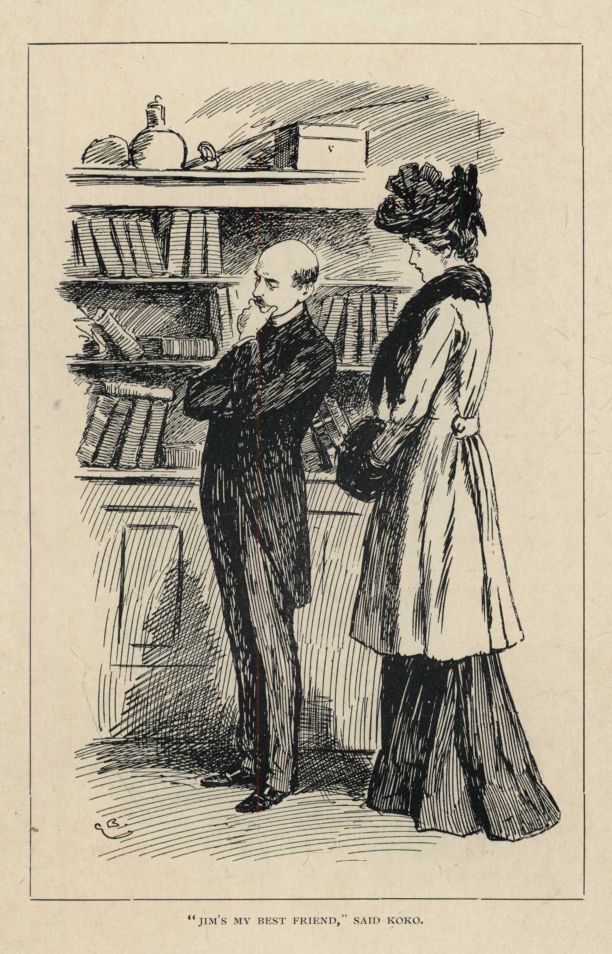
"HE'S MY BEST FRIEND," SAID KOKO.
As he spoke, his glance wandered to the half-emptied shelf. Much as he loved his old books, however, he did not regret his recent sacrifice.
"You are a very good man, Mr Somers--very kind and good. I only wish," she added, with demure hesitation, "that I were a little younger, for then it would be quite proper for me to--to kiss you."
"Are you coming, Dora?" Miss Cook was growing impatient.
Koko turned to Dora with a smile and took her hand.
"If I were a little younger, perhaps it would not be proper," he said gently, "but as I'm ever so much older than you, don't you think that----"
"Why, yes," said Dora, and, bending swiftly, she kissed him.
CHAPTER XVI.
JIM'S PATIENTS.
Thereafter, watching his friend closely, Koko observed a gradual change overcoming Jim. Often enough Jim's merry smile flashed up, 'tis true, but when it died away the normal expression it left on his face was not quite what it had been of yore. There was a wistfulness in Jim's eyes nowadays that Koko had never seen there before.
This change made clear to Koko the fact that Jim's medical student cubbishness had largely taken wing. Jim was no longer Fortune's spoilt boy. The outline of his face was less round, his features were more distinctive, his chin seemed set in a firmer mould, and the soft lines about the corners of his mouth, though still apparent, were not so soft as they had been but a few months since.
Koko was particularly struck by the alteration in Jim when, after a fortnight's absence in the country, he looked the Long 'Un up at his surgery one evening in the latter part of November.
Jim greeted his friend warmly, offered him a cigar, poked up the fire, and then, by way of avoiding more awkward topics, began to talk about his work.
He had much of interest to relate of his daily rounds, and Koko, listening in the kind of way that is so helpful to a talker--that is to say, with unassumed appreciation--realised that Jim had indeed tackled a hard nut in the Mount Street district. For Jim had to go into such slums as your apple-faced peasant in the wide, wind-blown shires would not live in rent free. In these foul places herded scum from across the seas that gloried in its filth, and regarded decent quarters with positive repugnance. Jim had to make his way through crooked alleys into crime-infested courts--into courts where no policeman would go unaccompanied by a fellow. Jim went alone, however, trusting to luck and his two good fists to get out again in the event of his meeting a hostile gang of Hooligans.
Jim told Koko of a squalid room he had that day been into which contained four separate families--each family occupying a corner.
Koko smiled. "I suppose they don't mind it?" he said.
"Mind it!" cried Jim. "Why, they like it, man! Being a lot in a room keeps them warm. They're company for each other. When number one family has a scrap with number two, three and four look on and applaud. Nice friendly arrangement--eh?"
"Don't some of these scraps turn out seriously?"
"Sometimes. The fellow who showed me up to-day is known to have killed a man in a scrap--but he got off by some queer hitch in the evidence. A very civil spoken chap--burglar by profession."
Koko opened his eyes. "A bit different from taking fees in Harley Street?" he said.
"Not so remunerative, but more exciting," returned Jim. "The other day," he added, "I was attending a woman, when her husband came up with a crowbar and told me to stand aside, as he wanted to 'finish' her."
"What did you do?"
"Asked him to wait till I'd done with her. He said he would if I'd have a drink, so we had some gin together, and then he lay down in a corner, saying he'd finish her after he'd had a nap. The lady told me not to worry, as he'd be as gentle as a lamb when he'd slept his drink off. She understood him, you see."
"She'd a fine nerve," commented Koko.
"Another time," continued Jim, "I was called to see an old chap who lived by himself in a garret. He'd got D.T.s very hot indeed, and was sitting up in bed with the counterpane covered with sovereigns and bank-notes. There must have been hundreds of pounds there. Miser, I suppose. When I arrived he was holding conversations with imaginary relatives who were evidently (in his opinion) after his cash. He was threatening one with a revolver, and calling him all sorts of purple names. It was the revolver business which made the other people in the house send for me. To oblige him, I threw his imaginary relatives out of the window, and told him they'd fallen on their heads in the court below. That pleased him, and he said he would like to reward me for my trouble. I thought he was going to press a tenner on me, but instead he asked me if I could change half-a-sovereign. I said I could, and he then gave me half-a-crown."
Koko chuckled joyously. "And after that?"
"Then a few dozen more imaginary relatives came in, and I threw them all out of the window. After a bit of a struggle with himself he gave me another shilling for doing this, and then I sent him to a hospital, money and all, and there he croaked, and now they can't find a single real relative to take over his property."
Jim discoursed for some time about his experiences, but at length Koko had to hasten away to fulfil an engagement, and so Jim locked up his surgery and bent his steps homewards.
Trudging down Blackfriars Road, he found a barrel-organ playing at the point where a by-street branched off in the direction of Derby Crescent. Jim loved a barrel-organ, and stopped to listen to this one. The organ-grinder had chosen a good pitch, in the glare of a great electric lamp-post. There was a small crowd of wayfarers watching a number of little girls dancing in front of the organ. Jim watched them too, and was delighted with the performance, for the little maids danced with thorough enjoyment and kept perfect time. One or two couples of grown-up girls were waltzing to the music--although the organ wasn't playing a waltz--but Jim was not interested in these.
Jim had visited many a music-hall in the company of Koko, the red-haired student at Matt's, and others, and had frequently watched the skilful gyrations of trained ballet-dancers, but it seemed to him that this queer little dance, with the heavens for a roof and a muddy wood-block road for a floor, was a much better dance than any he had seen in a music-hall. The organ played a merry tune--full of straightforward melody--and Jim was quite infected with it. He began to wonder when he had last danced--when he would dance again. And meanwhile he watched the little maids, and smiled at the earnest way in which they tripped in and out among each other, quite in the proper style and order; and he gave a shilling to the Italian woman who came round to collect.
As Jim listened to the music and watched the dainty steps of the little street dancers, he felt genuinely happy. The scene pleased him; it chased the wistfulness from his face, and he felt loth to continue his walk homewards. He was interested. These people around him were his people now; these people were his patients. Poor they were--starving, some of them--and he was their doctor. Had matters fallen out otherwise, it would have been his destiny to attend a very different class of patient. He would, in all probability, have assisted his grandfather--have ridden a horse, worn the best of clothes, and eaten and drunk "like a lord." He would have hunted and shot, and lived the life of a country gentleman, with just enough work to do to prevent himself from experiencing ennui. But instead of that he was fighting for an existence in Mount Street--among the poorest of the poor. No hunting, no shooting, no old port; it was grim fighting in Mount Street--hard work and a hard life--hardly earned money and money hard to get, even when he had earned it.
Still, he reflected, he lived. It was life--he lived strenuously. He was working in the heart of the greatest city in the world; he was living a man's life. Wasn't this, after all, better than lolling round a ready-made practice? Of course, that was good work, useful work--but this work in Mount Street was on a different plane. It was sheer fighting, and Jim, being a "scrapper" by nature, was filled with a feeling of fierce joy. He knew that he had played the fool, and that this was the penalty. But it was a penalty of a mixed kind, for it was a test which he relished. It was a test which would have knocked out a weak man, but Jim felt that he was getting a firmer foothold every day he trod the grimy pavement leading to his surgery.
Presently the little girls stopped--panting--and the organ-grinder dropped his handle. It was time he moved on.
So it was over, and Jim found himself feeling sorry. The other onlookers strolled away, and Jim was turning down the by-street, when he felt a touch on his arm, and looked round to find Dora Maybury by his side.
CHAPTER XVII.
IN THE CRESCENT.
This was the first time Jim had met Dora all by herself without the stronghold--No. 9, to wit. And there he had found few opportunities to say anything to her that was not formal and commonplace; indeed, their intercourse, with watching eyes and listening ears about them, had been (to Jim, at any rate) of a gallingly circumscribed character.
It is poor satisfaction, when the heart is hungry, to look into the eyes one loves, and remark that it is colder than it was yesterday; your lover is kept on conversation's shortest commons when, though burning to say a thousand tender things to the one girl he holds most precious, he has, perforce, to hazard a remark to the effect that there may be rain before morning.
Thus it was with Jim. He often saw Dora, but seldom spoke with her. There was that evening when she drew the course of the Rhine under his tutelage--but that was a memory by itself--a verdant oasis in the desert of verbal starvation!
It may be easily imagined, therefore, how fast beat Jim's heart when he found himself absolutely alone--and unwatched--with Dora Maybury.
"Have you too been listening to the organ?" he asked.
"Yes," said Dora, "I was there when you came up. I have been shopping. Frank came out with me, but disappeared."
Jim devoutly hoped that Frank would not reappear. Dora was carrying a heavy marketing-net--the shops keep open late in Blackfriars Road--and Jim promptly possessed himself of this.
"Frank ought to have been carrying it," explained Dora, as they walked down the by-street, "but," she added, "you know what brothers are!"
"I have heard accounts of them," said Jim, "but can't speak from experience, as I haven't any."
"Nor sisters?"
"Nor sisters either," said Jim; "nobody, in fact, but a grandfather."
"Dear me!" said Dora, "what a very lonely boy you must have been! I suppose your grandfather is very fond of you?"
"I think he has a sort of mild affection for me," said Jim, "but unfortunately I offended him when I--er--when I was put on The Total Abstainers black list."
Dora seemed interested.
"And what did he do?" she inquired.
"He behaved in a manner that was not even mildly affectionate."
"And you don't see him now?"
Jim admitted that that was so.
"But perhaps he will make it up at Christmas-time," suggested Dora. "He ought to."
Jim shook his head.
"My grandfather is not the sort of man to do anything because he ought to."
"Oh, I hope he will," said Dora; "it must be so wretched for you--having nobody."
"You are very kind," said Jim, his voice suddenly changing.
"But surely," said Dora, quickly, "anybody would be sorry for a man who had nobody in the world to care for him."
Jim made no rejoinder. So Dora, meaning only to make him feel that she sympathised with his position, said again that she hoped all would be right between him and his grandfather by the time Christmas came.
"But you have friends," she continued, comfortingly; "there is Mr Somers, and Sir Savile and I know my father likes you--oh yes, you have friends. You must not be disheartened. You must look upon us all as your friends, Dr Mortimer."
"I did not mean to extract all this sympathy from you, Miss Dora," said Jim. "I was only answering your questions."
"But I am glad you have told me," said Dora, "because I did not know all this about you before. And I am so sorry for people who have no home," she added, gently.
So spoke this maid, barely nineteen, in the innocent warmth of her nature. She could not have remembered that a man can bear taunts, abuse, sarcasm, and show a smiling front, but that the least word of sympathy will break down the same man's defences and leave his heart--hardened to all else--without a shield.
"You are too kind," said Jim again; "it would be better, perhaps, if you were not kind to me at all."
Then a silence fell upon them, and in silence they passed from the by-street into the crescent, whose glory was so faded. They walked by several of the shabby houses, still without speaking, but as they drew near to No. 9, the question Dora wanted to ask would not stay within her lips.
"Why?" she said, without looking at him.
"Because," replied Jim, steadily, "I love you. That is why it will be the kindest thing on your part never to be kind to me again."
As Jim spoke, Dora gazed up at him in a surprised, half-frightened manner. When she said "Why?" she knew very well that there was no need on her part to ask such a question. Her woman's instinct told her "why"; there was no need for Jim to do so. But, with a wilful disregard of conscience, which bade her not inquire too closely into Jim's reasons for that little speech, she had allowed her lips to shape the word that had extracted so blunt a confession from her companion.
Even had she not been engaged to Jefferson, Jim's avowal, considering the length of their acquaintance and the very small amount of conversation they had enjoyed together, would have been ill-timed and premature. As matters stood, Jim had no possible right to speak thus. But she had asked "Why?" and he had told her.
Jim himself, as soon as he had spoken, condemned himself for a fool, an ass, and an idiot. This would put an end to any little friendship that might have hitherto existed between them. What could he do to mend the sorry mistake his tongue had made?
He was the first to break the awkward silence. He laughed. Dora, on the other hand, bit her lip nervously.
"Please don't take me too seriously, Miss Dora," said Jim.
"So," said Dora, confronting him with dignity and flaming cheeks, "I am to regard what you said just now as a joke?"
"Well--if you like," replied Jim, rather awkwardly.
"Then I think you are very rude!" exclaimed Dora, "and I won't speak to you again."
She turned abruptly toward the steps leading up to the door of No. 9.
"Oh, I say, come now," expostulated Jim, "I think that is a little too severe. You asked 'Why?' and I told you 'Why!'"
Dora switched round to him and turned a very red little face, illuminated by eyes that flashed with anger, up to his.
"You had no right to say what you did just now, because you know I am engaged to Mr Jefferson----"
"Lucky man?" sighed Jim.
"Are you still regarding me as a person just to be joked with?" demanded Dora, with something like a sob in her voice.
"No," said Jim, earnestly, "as a girl to be loved for ever and ever!"
Jim's astonishing comprehensiveness struck Dora dumb for a moment. What could a girl do with a man like this!
Dora considered what she could say that would make a good rebuke. And meanwhile she looked (as Jim declared to himself) bewilderingly lovely.
"What you said, considering the circumstances," she continued at length, "was dishonourable and ungentlemanly."
"I plead guilty on both counts," said Jim.